EP1387342A2 - Méthode et dispositif pour améliorer l'échelle de gris d'un dispositif d'affichage - Google Patents
Méthode et dispositif pour améliorer l'échelle de gris d'un dispositif d'affichage Download PDFInfo
- Publication number
- EP1387342A2 EP1387342A2 EP03102071A EP03102071A EP1387342A2 EP 1387342 A2 EP1387342 A2 EP 1387342A2 EP 03102071 A EP03102071 A EP 03102071A EP 03102071 A EP03102071 A EP 03102071A EP 1387342 A2 EP1387342 A2 EP 1387342A2
- Authority
- EP
- European Patent Office
- Prior art keywords
- addressing
- impulse
- luminous elements
- sustain
- addressed
- Prior art date
- Legal status (The legal status is an assumption and is not a legal conclusion. Google has not performed a legal analysis and makes no representation as to the accuracy of the status listed.)
- Withdrawn
Links
- 238000000034 method Methods 0.000 title claims abstract description 18
- 230000004913 activation Effects 0.000 claims description 21
- 238000013139 quantization Methods 0.000 abstract description 13
- 230000006870 function Effects 0.000 description 16
- 210000004027 cell Anatomy 0.000 description 8
- 230000015654 memory Effects 0.000 description 8
- 238000006243 chemical reaction Methods 0.000 description 4
- 238000009125 cardiac resynchronization therapy Methods 0.000 description 3
- 230000006399 behavior Effects 0.000 description 2
- 238000010586 diagram Methods 0.000 description 2
- 230000000694 effects Effects 0.000 description 2
- 210000004180 plasmocyte Anatomy 0.000 description 2
- 230000037452 priming Effects 0.000 description 2
- 230000009471 action Effects 0.000 description 1
- 230000008901 benefit Effects 0.000 description 1
- 230000010354 integration Effects 0.000 description 1
- 239000011159 matrix material Substances 0.000 description 1
- 238000005259 measurement Methods 0.000 description 1
- 230000008569 process Effects 0.000 description 1
- 230000004044 response Effects 0.000 description 1
- 230000002123 temporal effect Effects 0.000 description 1
Images


Classifications
-
- G—PHYSICS
- G09—EDUCATION; CRYPTOGRAPHY; DISPLAY; ADVERTISING; SEALS
- G09G—ARRANGEMENTS OR CIRCUITS FOR CONTROL OF INDICATING DEVICES USING STATIC MEANS TO PRESENT VARIABLE INFORMATION
- G09G3/00—Control arrangements or circuits, of interest only in connection with visual indicators other than cathode-ray tubes
- G09G3/20—Control arrangements or circuits, of interest only in connection with visual indicators other than cathode-ray tubes for presentation of an assembly of a number of characters, e.g. a page, by composing the assembly by combination of individual elements arranged in a matrix no fixed position being assigned to or needed to be assigned to the individual characters or partial characters
- G09G3/2007—Display of intermediate tones
- G09G3/2018—Display of intermediate tones by time modulation using two or more time intervals
- G09G3/2022—Display of intermediate tones by time modulation using two or more time intervals using sub-frames
-
- G—PHYSICS
- G09—EDUCATION; CRYPTOGRAPHY; DISPLAY; ADVERTISING; SEALS
- G09G—ARRANGEMENTS OR CIRCUITS FOR CONTROL OF INDICATING DEVICES USING STATIC MEANS TO PRESENT VARIABLE INFORMATION
- G09G3/00—Control arrangements or circuits, of interest only in connection with visual indicators other than cathode-ray tubes
- G09G3/20—Control arrangements or circuits, of interest only in connection with visual indicators other than cathode-ray tubes for presentation of an assembly of a number of characters, e.g. a page, by composing the assembly by combination of individual elements arranged in a matrix no fixed position being assigned to or needed to be assigned to the individual characters or partial characters
- G09G3/22—Control arrangements or circuits, of interest only in connection with visual indicators other than cathode-ray tubes for presentation of an assembly of a number of characters, e.g. a page, by composing the assembly by combination of individual elements arranged in a matrix no fixed position being assigned to or needed to be assigned to the individual characters or partial characters using controlled light sources
- G09G3/28—Control arrangements or circuits, of interest only in connection with visual indicators other than cathode-ray tubes for presentation of an assembly of a number of characters, e.g. a page, by composing the assembly by combination of individual elements arranged in a matrix no fixed position being assigned to or needed to be assigned to the individual characters or partial characters using controlled light sources using luminous gas-discharge panels, e.g. plasma panels
- G09G3/288—Control arrangements or circuits, of interest only in connection with visual indicators other than cathode-ray tubes for presentation of an assembly of a number of characters, e.g. a page, by composing the assembly by combination of individual elements arranged in a matrix no fixed position being assigned to or needed to be assigned to the individual characters or partial characters using controlled light sources using luminous gas-discharge panels, e.g. plasma panels using AC panels
- G09G3/291—Control arrangements or circuits, of interest only in connection with visual indicators other than cathode-ray tubes for presentation of an assembly of a number of characters, e.g. a page, by composing the assembly by combination of individual elements arranged in a matrix no fixed position being assigned to or needed to be assigned to the individual characters or partial characters using controlled light sources using luminous gas-discharge panels, e.g. plasma panels using AC panels controlling the gas discharge to control a cell condition, e.g. by means of specific pulse shapes
- G09G3/294—Control arrangements or circuits, of interest only in connection with visual indicators other than cathode-ray tubes for presentation of an assembly of a number of characters, e.g. a page, by composing the assembly by combination of individual elements arranged in a matrix no fixed position being assigned to or needed to be assigned to the individual characters or partial characters using controlled light sources using luminous gas-discharge panels, e.g. plasma panels using AC panels controlling the gas discharge to control a cell condition, e.g. by means of specific pulse shapes for lighting or sustain discharge
-
- G—PHYSICS
- G09—EDUCATION; CRYPTOGRAPHY; DISPLAY; ADVERTISING; SEALS
- G09G—ARRANGEMENTS OR CIRCUITS FOR CONTROL OF INDICATING DEVICES USING STATIC MEANS TO PRESENT VARIABLE INFORMATION
- G09G2320/00—Control of display operating conditions
- G09G2320/02—Improving the quality of display appearance
- G09G2320/0271—Adjustment of the gradation levels within the range of the gradation scale, e.g. by redistribution or clipping
- G09G2320/0276—Adjustment of the gradation levels within the range of the gradation scale, e.g. by redistribution or clipping for the purpose of adaptation to the characteristics of a display device, i.e. gamma correction
-
- G—PHYSICS
- G09—EDUCATION; CRYPTOGRAPHY; DISPLAY; ADVERTISING; SEALS
- G09G—ARRANGEMENTS OR CIRCUITS FOR CONTROL OF INDICATING DEVICES USING STATIC MEANS TO PRESENT VARIABLE INFORMATION
- G09G2320/00—Control of display operating conditions
- G09G2320/02—Improving the quality of display appearance
- G09G2320/0285—Improving the quality of display appearance using tables for spatial correction of display data
-
- G—PHYSICS
- G09—EDUCATION; CRYPTOGRAPHY; DISPLAY; ADVERTISING; SEALS
- G09G—ARRANGEMENTS OR CIRCUITS FOR CONTROL OF INDICATING DEVICES USING STATIC MEANS TO PRESENT VARIABLE INFORMATION
- G09G2360/00—Aspects of the architecture of display systems
- G09G2360/16—Calculation or use of calculated indices related to luminance levels in display data
-
- G—PHYSICS
- G09—EDUCATION; CRYPTOGRAPHY; DISPLAY; ADVERTISING; SEALS
- G09G—ARRANGEMENTS OR CIRCUITS FOR CONTROL OF INDICATING DEVICES USING STATIC MEANS TO PRESENT VARIABLE INFORMATION
- G09G3/00—Control arrangements or circuits, of interest only in connection with visual indicators other than cathode-ray tubes
- G09G3/20—Control arrangements or circuits, of interest only in connection with visual indicators other than cathode-ray tubes for presentation of an assembly of a number of characters, e.g. a page, by composing the assembly by combination of individual elements arranged in a matrix no fixed position being assigned to or needed to be assigned to the individual characters or partial characters
- G09G3/22—Control arrangements or circuits, of interest only in connection with visual indicators other than cathode-ray tubes for presentation of an assembly of a number of characters, e.g. a page, by composing the assembly by combination of individual elements arranged in a matrix no fixed position being assigned to or needed to be assigned to the individual characters or partial characters using controlled light sources
- G09G3/28—Control arrangements or circuits, of interest only in connection with visual indicators other than cathode-ray tubes for presentation of an assembly of a number of characters, e.g. a page, by composing the assembly by combination of individual elements arranged in a matrix no fixed position being assigned to or needed to be assigned to the individual characters or partial characters using controlled light sources using luminous gas-discharge panels, e.g. plasma panels
- G09G3/288—Control arrangements or circuits, of interest only in connection with visual indicators other than cathode-ray tubes for presentation of an assembly of a number of characters, e.g. a page, by composing the assembly by combination of individual elements arranged in a matrix no fixed position being assigned to or needed to be assigned to the individual characters or partial characters using controlled light sources using luminous gas-discharge panels, e.g. plasma panels using AC panels
- G09G3/291—Control arrangements or circuits, of interest only in connection with visual indicators other than cathode-ray tubes for presentation of an assembly of a number of characters, e.g. a page, by composing the assembly by combination of individual elements arranged in a matrix no fixed position being assigned to or needed to be assigned to the individual characters or partial characters using controlled light sources using luminous gas-discharge panels, e.g. plasma panels using AC panels controlling the gas discharge to control a cell condition, e.g. by means of specific pulse shapes
- G09G3/292—Control arrangements or circuits, of interest only in connection with visual indicators other than cathode-ray tubes for presentation of an assembly of a number of characters, e.g. a page, by composing the assembly by combination of individual elements arranged in a matrix no fixed position being assigned to or needed to be assigned to the individual characters or partial characters using controlled light sources using luminous gas-discharge panels, e.g. plasma panels using AC panels controlling the gas discharge to control a cell condition, e.g. by means of specific pulse shapes for reset discharge, priming discharge or erase discharge occurring in a phase other than addressing
- G09G3/2925—Details of priming
Definitions
- the present invention relates to a method and an apparatus for grayscale enhancement of a display device. More specifically the invention is closely related to a kind of video processing for improving the picture quality of pictures which are displayed on devices like plasma display panels (PDP) and all kinds of displays based on the principle of duty cycle modulation (pulse width modulation) of light emission. Particularly, the present invention relates to an apparatus and a method for driving a display device having a plurality of luminous elements by addressing those luminous elements which have to be activated for one frame period by applying an addressing impulse having a predetermined writing voltage to each of them, and controlling the light output of each of the addressed luminous elements by applying a discrete, predetermined number of sustain impulses each having the same predetermined sustain voltage.
- a PDP utilizes a matrix array of discharge cells which can only be "ON” or “OFF”. Therefore, a PDP can be defined as a pure digital display. Also unlike a CRT or LCD in which grey levels are expressed by analog control of the light emission, a PDP controls the grey level by modulating the number of light pulses per frame (sustain pulses). The time-modulated signals will be integrated by the eye over a period corresponding to the eye time response. Since the amplitude video is portrayed by the number of light pulses, occurring at a given frequency, more amplitude means more light pulses and thus more "ON" time. This kind of modulation is also known as PWM, pulse width modulation.
- the input video value 4 should be converted according to the gamma function Y to which is actually not possible.
- the smallest video value which can be directly displayed on a PDP is defined by the light emitted by one sustain operation (actually around 0.7 cd/m 2 ).
- the tendency today is to improve the luminance efficacy of a plasma cell so that each sustain operation should be more luminous.
- Figure 1 illustrates such a function.
- the quadratic gamma function according to the above formular is drawn.
- the input quantizised with 8 bits is converted to an output signal also quantizised with 8 bits.
- the gradient at input level "0" is 0.
- the input level "255” is converted to the output level "255”.
- the output signal increases parabolically.
- the gamma function is zoomed for the low input levels up to the value "50".
- the zoomed part shows the real function and the digital function obtained by integer values.
- this problem is solved by rendition of the small luminance level below one sustain on the basis of a dithering operation which uses the temporal and spatial integration of the eye to render artificial levels. Nevertheless, the visibility of this dithering is linked to the minimal step which can be made on the screen (actually one sustain operation).
- the eye In the case of very luminous pictures, the eye is dazzled and not so sensitive to these levels, whereas in case of dark pictures the eye is very sensitive to low levels and will be able to see the noise created by such big steps.
- this object is solved by a method for driving a display device having a plurality of luminous elements including the steps of addressing those luminous elements which have to be activated for one complete frame period or a part of it, called activation cycle or sub-field, by applying an addressing impulse having a predetermined writing voltage to each of them, and controlling the light output of at least one of said addressed luminous elements on the basis of the energy of said addressing impulse.
- one of the addressed luminous elements in one frame period may be activated by the addressing impulse and at least one sustain impulse. Consequently, the discrete steps between other output levels than "0" and "1" may be reduced too.
- the activation energy of one addressing impulse should be smaller than that of one sustain impulse. A combination of such activation energies allows to reduce the quantization steps of the digital processing.
- the activation of luminous elements for one frame period is usually performed by a plurality of activation cycles (sub-fields) and preferably, an erasing operation is performed to the end of each activation cycle.
- the erasing operation ensures that any charges generated during addressing or sustaining operations are re-combined so that the respective luminous element is completely reset.
- a time period for addressing should be reserved.
- all luminous elements of the display which have to be activated for a frame period or a sub-period called "sub-field" of a frame are addressed by a writing/addressing impulse.
- a sustain operation may optionally be performed between the addressing and the erasing operation.
- the provision of a picture analysis of the input picture has the advantage to improve the decision of using the addressing impulses for controlling the light output of the luminous elements. Especially, if the statistical distribution of luminance shows major dark regions or the brightness of the present frame is lower than a predetermined threshold the inventive principle of using the addressing impulse for controlling the output of the luminous elements may be used.
- Such threshold for the peak or mean brightness of the present frame may be 10% of the maximal possible brightness.
- the present invention provides a technique that enables to dispose of an operation based on simple addressing without sustain, enabling to a display a sub-sustain light emission of e.g. 0.14 cd/m 2 .
- the main idea behind this invention is the use of sub-fields without any sustain operation.
- the principle of sub-fields it is expressively referred to the European patent application EP-A-1 136 974.
- the writing operation will be directly followed by an erase operation.
- the emitted light is defined by a standard emission of the addressing writing discharge (e.g. 0.14 cd/m 2 ).
- the PDP addressing writing operation can be considered as a discharge appearing in the selected cell, this discharge will let a remaining charge inside the cell for a certain time (capacity effect of the plasma cells).
- the sustain operation itself is an operation with alternating current so that at the end of the sustain cycles there is still the same charge in the cell.
- a global erase operation following the sustain operation suppresses the charges inside the cells.
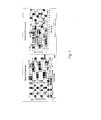
- the complete frame period shown in the figure is divided into 11 standard sub-fields and one single writing sub-field as a first sub-field.
- a priming operation is provided at the beginning of the frame period.
- the first sub-field i.e. the single-writing sub-field (W)
- This single writing sub-field is used for sub-sustain weighting.
- Each of the following standard sub-fields consists of an addressing block (white) followed by a sustain block (grey) and completed by the erasing block (black).
- the sustain cycle or block increases in accordance with the code digit.
- the previous gamma Table 1 can be upgraded to the following Table 2: Upgraded digitized gamma function Input (8-bit) Output (float) Output (8-bit) 0 0 0 1 0.003921569 0 2 0.015686275 0 3 0.035294118 0 4 0.062745098 0 5 0.098039216 0 6 0.141176471 0 7 0.192156863 W 8 0.250980392 W 9 0.317647059 W 10 0.392156863 W 11 0.474509804 W 12 0.564705882 1 13 0.662745098 1 14 0.768627451 1 15 0.882352941 1 16 1.003921569 1 17 1.133333333 1 18 1.270588235 1+W 19 1.415686275 1+W 20 1.568627451 2 21 1.729411765 2 22 1.898039216 2 23 2.074509804 2 ... ... ... 250 245.0980392 245 251 247.0627451 247 252 24
- Figure 3 illustrates at the bottom an example of a coding based on 11 standard sub-fields plus 4 single-writing sub-fields.
- the sub-field structure of this example is equal to that of Figure 2.
- the first four sub-fields (activation cycles) only include an addressing block (white) and an erasing block (black).
- Each of the following eleven standard sub-fields includes one sustain cycle (grey).
- the broadness of the sustain cycles is determined by their number within the frame period.
- At the top of Figure 3 there is shown a sub-field organisation with 15 standard sub-fields within the frame period.
- the sustain cycles of the 15 sub-fields at the top of Figure 3 are a little bit smaller than the sustain cycles of the 11 standards sub-fields of the inventive frame organisation at the bottom of Figure 3.
- the same maximum power of light is obtainable for the driven luminous element.
- smaller quantization steps are possible with the embodiment of the bottom of Figure 3.
- the gamma Table 1 can be updated for the first 30 levels to following Table 3: Alternatively upgraded digitized gamma function Input (8-bit) Output (float) Output (8-bit) 0 0 0 1 0,003921569 0 2 0,015686275 0 3 0,035294118 0 4 0,062745098 0 5 0,098039216 0 6 0,141176471 0 7 0,192156863 W 8 0,250980392 W 9 0,317647059 W 10 0,392156863 2W 11 0,474509804 2W 12 0,564705882 3W 13 0,662745098 3W 14 0,768627451 4W 15 0,882352941 4W 16 1,003921569 1 17 1,133333333 1 18 1,270588235 1+W 19 1,415686275 1+2W 20 1,568627451 1+3W 21 1,729411765 1+4W 22 1,898039216 2 23 2,074509804 2 24 2,258823529 2+
- the steps in dark areas are very small and no more noise (dithering or quantization) can be seen.
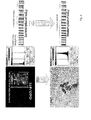
- FIG. 5 illustrates a possible circuit implementation of the inventive system.
- the input signals R, G, B for each colour are provided in a code length of 8 bits, i.e. bit 7 to bit 0.
- Such an input RGB picture (3x 8 bit) is sent to a video gamma block 10.
- the output signals of the video gamma block obtained by the gamma function has a resolution of 10 bits per colour.
- This pre-corrected RGB data is analysed in an average power measure block 12 which gives the computed average power value APL to a PWE control block 14.
- the average power value of a picture can be calculated by simply summing up the pixel values for all RGB data streams and dividing the result through the number of pixel values multiplied by 3.
- the control block 14 includes a look up table LUT 16, so that depending on the APL the corresponding parameters are chosen from this LUT:
- the sub-field coding parameters define the number of sub-fields, positioning of the sub-fields, the weights of the sub-fields and the types of the sub-fields as explained in WO 00/46782.
- the output signals of the video gamma unit 10 are also input to the sub-field coding unit 18, where the sub-field coding process is done.
- a sub-field code word is assigned to each normalized pixel value.
- more than one possibility to assign a sub-field coding word can be alternatively available.
- there may be a table for each mode so that the assignment is made with this table. Ambiguities can be avoided in this way.
- the PWE control block 14 also controls the writing WR of the RGB pixel data output from the sub-field coding unit 18 into a 2-frame memory 22. Furthermore, the PWE control block 14 controls the reading RD of RGB sub-fields data SF-R, SF-G and SF-B from the 2-frame memory 22 and the serial to parallel conversion circuit 24 via a control line SP.
- the read bits of the sub-field code words are collected in the serial/parallel conversion unit 24 for a whole line of the PDP 20. As there are e.g. 854 pixel in one line, this means 2562 sub-field coding bits need to be read for each line per sub-field period. These bits are input in the shift registers of the serial/parallel conversion unit 24.
- the resulting DATA are input to the PDP 20.
- an implementation can be made with two frame memories best. Data is written into one frame memory pixel wise, but read out from the other frame memory sub-field wise. In order to be able to read the complete first sub-field the whole frame must already be present in the memory. This calls for the need of two whole frame memories. While one frame memory is being used for writing, the other is used for reading, avoiding in this way reading the wrong data.
- the described implementation introduces a delay of 1 frame between power measurement and action. Power level is measured, and at the end of a given frame, the average power value becomes available to the controller.
Landscapes
- Engineering & Computer Science (AREA)
- Physics & Mathematics (AREA)
- Computer Hardware Design (AREA)
- General Physics & Mathematics (AREA)
- Theoretical Computer Science (AREA)
- Power Engineering (AREA)
- Plasma & Fusion (AREA)
- Control Of Indicators Other Than Cathode Ray Tubes (AREA)
Priority Applications (1)
| Application Number | Priority Date | Filing Date | Title |
|---|---|---|---|
| EP03102071A EP1387342A2 (fr) | 2002-07-30 | 2003-07-09 | Méthode et dispositif pour améliorer l'échelle de gris d'un dispositif d'affichage |
Applications Claiming Priority (3)
| Application Number | Priority Date | Filing Date | Title |
|---|---|---|---|
| EP02291925 | 2002-07-30 | ||
| EP02291925A EP1387341A1 (fr) | 2002-07-30 | 2002-07-30 | Méthode et dispositif pour l'amelioration de la representation des niveaux de gris d'un appareil d'affichage |
| EP03102071A EP1387342A2 (fr) | 2002-07-30 | 2003-07-09 | Méthode et dispositif pour améliorer l'échelle de gris d'un dispositif d'affichage |
Publications (1)
| Publication Number | Publication Date |
|---|---|
| EP1387342A2 true EP1387342A2 (fr) | 2004-02-04 |
Family
ID=30116927
Family Applications (1)
| Application Number | Title | Priority Date | Filing Date |
|---|---|---|---|
| EP03102071A Withdrawn EP1387342A2 (fr) | 2002-07-30 | 2003-07-09 | Méthode et dispositif pour améliorer l'échelle de gris d'un dispositif d'affichage |
Country Status (1)
| Country | Link |
|---|---|
| EP (1) | EP1387342A2 (fr) |
-
2003
- 2003-07-09 EP EP03102071A patent/EP1387342A2/fr not_active Withdrawn
Similar Documents
| Publication | Publication Date | Title |
|---|---|---|
| US6417824B1 (en) | Method of driving plasma display panel | |
| KR100660579B1 (ko) | 플라즈마 디스플레이 장치 | |
| JP3606429B2 (ja) | プラズマディスプレイパネルの駆動方法 | |
| US20040164933A1 (en) | Method for optimizing brightness in a display device and apparatus for implementing the method | |
| JPH06259034A (ja) | ディスプレイパネルの中間調画像表示方法 | |
| KR100924105B1 (ko) | 비디오 화상을 처리하기 위한 방법 및 장치 | |
| JP3961171B2 (ja) | ディスプレイ装置の多階調処理回路 | |
| KR101248872B1 (ko) | 영상표시장치 및 그의 고화질 제공방법 | |
| JP4951195B2 (ja) | プラズマディスプレイパネルに関するマルチスキャンディスプレイ | |
| US20050248583A1 (en) | Dither processing circuit of display apparatus | |
| EP1260956A2 (fr) | Panneau d'affichage à plasma et son procédé de commande | |
| US20030217872A1 (en) | Method for processing video pictures for display on a display device | |
| EP1387341A1 (fr) | Méthode et dispositif pour l'amelioration de la representation des niveaux de gris d'un appareil d'affichage | |
| JP3379446B2 (ja) | プラズマディスプレイパネル表示装置及びその駆動方法 | |
| JP4287004B2 (ja) | プラズマディスプレイパネルの階調表示処理装置及びその処理方法 | |
| EP1387342A2 (fr) | Méthode et dispositif pour améliorer l'échelle de gris d'un dispositif d'affichage | |
| US7109950B2 (en) | Display apparatus | |
| EP1936590B1 (fr) | Procédé et dispositif de traitement d'images vidéo | |
| EP1936589A1 (fr) | Procédé et dispositif de traitement d'images vidéo | |
| WO2005041162A1 (fr) | Procede et dispositif servant a traiter des images video a afficher sur un ecran | |
| EP1331625A1 (fr) | Panneau d'affichage à plasma et procédé de commande | |
| EP1732055B1 (fr) | Dispositif d'affichage | |
| US7796138B2 (en) | Method and device for processing video data by using specific border coding | |
| EP1359564B1 (fr) | Affichage à balayage multiple sur un panneau d'affichage à plasma | |
| EP1365382A1 (fr) | Méthode de commande d'un panneau d'affichage à plasma |
Legal Events
| Date | Code | Title | Description |
|---|---|---|---|
| PUAI | Public reference made under article 153(3) epc to a published international application that has entered the european phase |
Free format text: ORIGINAL CODE: 0009012 |
|
| AK | Designated contracting states |
Kind code of ref document: A2 Designated state(s): AT BE BG CH CY CZ DE DK EE ES FI FR GB GR HU IE IT LI LU MC NL PT RO SE SI SK TR |
|
| AX | Request for extension of the european patent |
Extension state: AL LT LV MK |
|
| 17P | Request for examination filed |
Effective date: 20040720 |
|
| RAP1 | Party data changed (applicant data changed or rights of an application transferred) |
Owner name: THOMSON LICENSING |
|
| STAA | Information on the status of an ep patent application or granted ep patent |
Free format text: STATUS: THE APPLICATION HAS BEEN WITHDRAWN |
|
| 18W | Application withdrawn |
Effective date: 20070410 |