EP1389637B1 - Molécules d'ARN interférant à bords francs - Google Patents
Molécules d'ARN interférant à bords francs Download PDFInfo
- Publication number
- EP1389637B1 EP1389637B1 EP02017601A EP02017601A EP1389637B1 EP 1389637 B1 EP1389637 B1 EP 1389637B1 EP 02017601 A EP02017601 A EP 02017601A EP 02017601 A EP02017601 A EP 02017601A EP 1389637 B1 EP1389637 B1 EP 1389637B1
- Authority
- EP
- European Patent Office
- Prior art keywords
- strand
- stretch
- rnai
- nucleotides
- ribonucleic acid
- Prior art date
- Legal status (The legal status is an assumption and is not a legal conclusion. Google has not performed a legal analysis and makes no representation as to the accuracy of the status listed.)
- Expired - Lifetime
Links
- 230000002452 interceptive effect Effects 0.000 title description 28
- 230000009368 gene silencing by RNA Effects 0.000 claims description 185
- 125000003729 nucleotide group Chemical group 0.000 claims description 185
- 239000002773 nucleotide Substances 0.000 claims description 152
- 230000004048 modification Effects 0.000 claims description 105
- 238000012986 modification Methods 0.000 claims description 105
- 210000004027 cell Anatomy 0.000 claims description 80
- 229920002477 rna polymer Polymers 0.000 claims description 75
- 150000007523 nucleic acids Chemical class 0.000 claims description 42
- 108090000623 proteins and genes Proteins 0.000 claims description 40
- 102000039446 nucleic acids Human genes 0.000 claims description 37
- 108020004707 nucleic acids Proteins 0.000 claims description 37
- 201000010099 disease Diseases 0.000 claims description 22
- 208000037265 diseases, disorders, signs and symptoms Diseases 0.000 claims description 22
- 239000003814 drug Substances 0.000 claims description 19
- 230000000295 complement effect Effects 0.000 claims description 12
- 238000012228 RNA interference-mediated gene silencing Methods 0.000 claims description 10
- 206010028980 Neoplasm Diseases 0.000 claims description 7
- 125000000217 alkyl group Chemical group 0.000 claims description 7
- 238000000034 method Methods 0.000 claims description 7
- 210000005260 human cell Anatomy 0.000 claims description 6
- 208000030159 metabolic disease Diseases 0.000 claims description 6
- 239000000203 mixture Substances 0.000 claims description 6
- 206010006187 Breast cancer Diseases 0.000 claims description 5
- 208000026310 Breast neoplasm Diseases 0.000 claims description 5
- 206010058467 Lung neoplasm malignant Diseases 0.000 claims description 5
- 208000008589 Obesity Diseases 0.000 claims description 5
- 206010061902 Pancreatic neoplasm Diseases 0.000 claims description 5
- 206010060862 Prostate cancer Diseases 0.000 claims description 5
- 208000000236 Prostatic Neoplasms Diseases 0.000 claims description 5
- 206010012601 diabetes mellitus Diseases 0.000 claims description 5
- 208000005017 glioblastoma Diseases 0.000 claims description 5
- 208000032839 leukemia Diseases 0.000 claims description 5
- 201000007270 liver cancer Diseases 0.000 claims description 5
- 208000014018 liver neoplasm Diseases 0.000 claims description 5
- 201000005202 lung cancer Diseases 0.000 claims description 5
- 208000020816 lung neoplasm Diseases 0.000 claims description 5
- 208000015486 malignant pancreatic neoplasm Diseases 0.000 claims description 5
- 235000020824 obesity Nutrition 0.000 claims description 5
- 201000002528 pancreatic cancer Diseases 0.000 claims description 5
- 208000008443 pancreatic carcinoma Diseases 0.000 claims description 5
- 239000008194 pharmaceutical composition Substances 0.000 claims description 5
- 208000024172 Cardiovascular disease Diseases 0.000 claims description 4
- 206010009944 Colon cancer Diseases 0.000 claims description 4
- 208000029742 colonic neoplasm Diseases 0.000 claims description 4
- 239000003937 drug carrier Substances 0.000 claims description 4
- 102000004190 Enzymes Human genes 0.000 claims description 3
- 108090000790 Enzymes Proteins 0.000 claims description 3
- -1 amino, fluoro, methoxy Chemical group 0.000 claims description 3
- 238000004519 manufacturing process Methods 0.000 claims description 3
- 229940123587 Cell cycle inhibitor Drugs 0.000 claims description 2
- 102000004127 Cytokines Human genes 0.000 claims description 2
- 108090000695 Cytokines Proteins 0.000 claims description 2
- 108700039887 Essential Genes Proteins 0.000 claims description 2
- 108091023040 Transcription factor Proteins 0.000 claims description 2
- 102000040945 Transcription factor Human genes 0.000 claims description 2
- 230000022131 cell cycle Effects 0.000 claims description 2
- 239000003102 growth factor Substances 0.000 claims description 2
- 230000004899 motility Effects 0.000 claims description 2
- 108091032973 (ribonucleotides)n+m Proteins 0.000 description 50
- 108020004459 Small interfering RNA Proteins 0.000 description 43
- 230000000694 effects Effects 0.000 description 43
- 108020004999 messenger RNA Proteins 0.000 description 41
- 238000003197 gene knockdown Methods 0.000 description 35
- 102000014160 PTEN Phosphohydrolase Human genes 0.000 description 34
- 108010011536 PTEN Phosphohydrolase Proteins 0.000 description 34
- 230000000692 anti-sense effect Effects 0.000 description 29
- 238000001890 transfection Methods 0.000 description 26
- 230000014509 gene expression Effects 0.000 description 24
- 239000004055 small Interfering RNA Substances 0.000 description 24
- 238000002474 experimental method Methods 0.000 description 23
- 125000002887 hydroxy group Chemical group [H]O* 0.000 description 23
- 210000002966 serum Anatomy 0.000 description 21
- 101150045355 akt1 gene Proteins 0.000 description 20
- 102000004169 proteins and genes Human genes 0.000 description 20
- 238000013461 design Methods 0.000 description 17
- 231100000673 dose–response relationship Toxicity 0.000 description 15
- 108091081021 Sense strand Proteins 0.000 description 14
- 101150107888 AKT2 gene Proteins 0.000 description 11
- 125000002924 primary amino group Chemical group [H]N([H])* 0.000 description 11
- 238000004458 analytical method Methods 0.000 description 9
- 230000005764 inhibitory process Effects 0.000 description 9
- 238000001262 western blot Methods 0.000 description 9
- 102000040650 (ribonucleotides)n+m Human genes 0.000 description 8
- 238000013459 approach Methods 0.000 description 8
- 229940079593 drug Drugs 0.000 description 8
- 150000002632 lipids Chemical class 0.000 description 8
- 239000002609 medium Substances 0.000 description 8
- 125000000548 ribosyl group Chemical group C1([C@H](O)[C@H](O)[C@H](O1)CO)* 0.000 description 8
- 239000000523 sample Substances 0.000 description 8
- 101710125691 Phosphatidylinositol 4,5-bisphosphate 3-kinase catalytic subunit beta isoform Proteins 0.000 description 7
- 238000006731 degradation reaction Methods 0.000 description 7
- 238000003119 immunoblot Methods 0.000 description 7
- 238000011534 incubation Methods 0.000 description 7
- YBJHBAHKTGYVGT-ZKWXMUAHSA-N (+)-Biotin Chemical group N1C(=O)N[C@@H]2[C@H](CCCCC(=O)O)SC[C@@H]21 YBJHBAHKTGYVGT-ZKWXMUAHSA-N 0.000 description 6
- 208000035657 Abasia Diseases 0.000 description 6
- 108091008611 Protein Kinase B Proteins 0.000 description 6
- FAPWRFPIFSIZLT-UHFFFAOYSA-M Sodium chloride Chemical compound [Na+].[Cl-] FAPWRFPIFSIZLT-UHFFFAOYSA-M 0.000 description 6
- 230000015556 catabolic process Effects 0.000 description 6
- 238000009396 hybridization Methods 0.000 description 6
- 239000013642 negative control Substances 0.000 description 6
- 125000002467 phosphate group Chemical group [H]OP(=O)(O[H])O[*] 0.000 description 6
- 229920000642 polymer Polymers 0.000 description 6
- 125000002652 ribonucleotide group Chemical group 0.000 description 6
- 108010042407 Endonucleases Proteins 0.000 description 5
- 102000004533 Endonucleases Human genes 0.000 description 5
- 108091028043 Nucleic acid sequence Proteins 0.000 description 5
- 108091028664 Ribonucleotide Proteins 0.000 description 5
- 125000003277 amino group Chemical group 0.000 description 5
- 125000002091 cationic group Chemical group 0.000 description 5
- 150000001875 compounds Chemical class 0.000 description 5
- 238000005516 engineering process Methods 0.000 description 5
- 230000001404 mediated effect Effects 0.000 description 5
- 238000003753 real-time PCR Methods 0.000 description 5
- 230000009467 reduction Effects 0.000 description 5
- 239000002336 ribonucleotide Substances 0.000 description 5
- RTZKZFJDLAIYFH-UHFFFAOYSA-N Diethyl ether Chemical compound CCOCC RTZKZFJDLAIYFH-UHFFFAOYSA-N 0.000 description 4
- RYYWUUFWQRZTIU-UHFFFAOYSA-N Thiophosphoric acid Chemical group OP(O)(S)=O RYYWUUFWQRZTIU-UHFFFAOYSA-N 0.000 description 4
- 230000008901 benefit Effects 0.000 description 4
- 125000004432 carbon atom Chemical group C* 0.000 description 4
- 230000002779 inactivation Effects 0.000 description 4
- 239000003446 ligand Substances 0.000 description 4
- 210000004962 mammalian cell Anatomy 0.000 description 4
- 230000010363 phase shift Effects 0.000 description 4
- 229920001184 polypeptide Polymers 0.000 description 4
- 102000004196 processed proteins & peptides Human genes 0.000 description 4
- 108090000765 processed proteins & peptides Proteins 0.000 description 4
- 238000012545 processing Methods 0.000 description 4
- 108020003175 receptors Proteins 0.000 description 4
- 102000005962 receptors Human genes 0.000 description 4
- 230000002829 reductive effect Effects 0.000 description 4
- 238000010200 validation analysis Methods 0.000 description 4
- 102100022900 Actin, cytoplasmic 1 Human genes 0.000 description 3
- 108010085238 Actins Proteins 0.000 description 3
- 108091003079 Bovine Serum Albumin Proteins 0.000 description 3
- 108020004414 DNA Proteins 0.000 description 3
- 102100023387 Endoribonuclease Dicer Human genes 0.000 description 3
- PEDCQBHIVMGVHV-UHFFFAOYSA-N Glycerine Chemical compound OCC(O)CO PEDCQBHIVMGVHV-UHFFFAOYSA-N 0.000 description 3
- 101000907904 Homo sapiens Endoribonuclease Dicer Proteins 0.000 description 3
- 241001529936 Murinae Species 0.000 description 3
- 239000006180 TBST buffer Substances 0.000 description 3
- 230000009286 beneficial effect Effects 0.000 description 3
- 229960002685 biotin Drugs 0.000 description 3
- 235000020958 biotin Nutrition 0.000 description 3
- 239000011616 biotin Substances 0.000 description 3
- 239000000872 buffer Substances 0.000 description 3
- 201000011510 cancer Diseases 0.000 description 3
- 230000008859 change Effects 0.000 description 3
- 238000011161 development Methods 0.000 description 3
- 239000000284 extract Substances 0.000 description 3
- 239000012894 fetal calf serum Substances 0.000 description 3
- 238000001502 gel electrophoresis Methods 0.000 description 3
- 238000001727 in vivo Methods 0.000 description 3
- 230000007246 mechanism Effects 0.000 description 3
- 230000009437 off-target effect Effects 0.000 description 3
- 230000002085 persistent effect Effects 0.000 description 3
- 229920002401 polyacrylamide Polymers 0.000 description 3
- 102000040430 polynucleotide Human genes 0.000 description 3
- 108091033319 polynucleotide Proteins 0.000 description 3
- 239000002157 polynucleotide Substances 0.000 description 3
- 230000008569 process Effects 0.000 description 3
- 239000012679 serum free medium Substances 0.000 description 3
- 239000011780 sodium chloride Substances 0.000 description 3
- 101100322915 Caenorhabditis elegans akt-1 gene Proteins 0.000 description 2
- 101100162366 Caenorhabditis elegans akt-2 gene Proteins 0.000 description 2
- 241000196324 Embryophyta Species 0.000 description 2
- 108060002716 Exonuclease Proteins 0.000 description 2
- TWRXJAOTZQYOKJ-UHFFFAOYSA-L Magnesium chloride Chemical compound [Mg+2].[Cl-].[Cl-] TWRXJAOTZQYOKJ-UHFFFAOYSA-L 0.000 description 2
- 241000124008 Mammalia Species 0.000 description 2
- 241000244206 Nematoda Species 0.000 description 2
- 108091034117 Oligonucleotide Proteins 0.000 description 2
- 241000283973 Oryctolagus cuniculus Species 0.000 description 2
- 229910019142 PO4 Inorganic materials 0.000 description 2
- 239000002202 Polyethylene glycol Substances 0.000 description 2
- PXIPVTKHYLBLMZ-UHFFFAOYSA-N Sodium azide Chemical compound [Na+].[N-]=[N+]=[N-] PXIPVTKHYLBLMZ-UHFFFAOYSA-N 0.000 description 2
- 241000251539 Vertebrata <Metazoa> Species 0.000 description 2
- JLCPHMBAVCMARE-UHFFFAOYSA-N [3-[[3-[[3-[[3-[[3-[[3-[[3-[[3-[[3-[[3-[[3-[[5-(2-amino-6-oxo-1H-purin-9-yl)-3-[[3-[[3-[[3-[[3-[[3-[[5-(2-amino-6-oxo-1H-purin-9-yl)-3-[[5-(2-amino-6-oxo-1H-purin-9-yl)-3-hydroxyoxolan-2-yl]methoxy-hydroxyphosphoryl]oxyoxolan-2-yl]methoxy-hydroxyphosphoryl]oxy-5-(5-methyl-2,4-dioxopyrimidin-1-yl)oxolan-2-yl]methoxy-hydroxyphosphoryl]oxy-5-(6-aminopurin-9-yl)oxolan-2-yl]methoxy-hydroxyphosphoryl]oxy-5-(6-aminopurin-9-yl)oxolan-2-yl]methoxy-hydroxyphosphoryl]oxy-5-(6-aminopurin-9-yl)oxolan-2-yl]methoxy-hydroxyphosphoryl]oxy-5-(6-aminopurin-9-yl)oxolan-2-yl]methoxy-hydroxyphosphoryl]oxyoxolan-2-yl]methoxy-hydroxyphosphoryl]oxy-5-(5-methyl-2,4-dioxopyrimidin-1-yl)oxolan-2-yl]methoxy-hydroxyphosphoryl]oxy-5-(4-amino-2-oxopyrimidin-1-yl)oxolan-2-yl]methoxy-hydroxyphosphoryl]oxy-5-(5-methyl-2,4-dioxopyrimidin-1-yl)oxolan-2-yl]methoxy-hydroxyphosphoryl]oxy-5-(5-methyl-2,4-dioxopyrimidin-1-yl)oxolan-2-yl]methoxy-hydroxyphosphoryl]oxy-5-(6-aminopurin-9-yl)oxolan-2-yl]methoxy-hydroxyphosphoryl]oxy-5-(6-aminopurin-9-yl)oxolan-2-yl]methoxy-hydroxyphosphoryl]oxy-5-(4-amino-2-oxopyrimidin-1-yl)oxolan-2-yl]methoxy-hydroxyphosphoryl]oxy-5-(4-amino-2-oxopyrimidin-1-yl)oxolan-2-yl]methoxy-hydroxyphosphoryl]oxy-5-(4-amino-2-oxopyrimidin-1-yl)oxolan-2-yl]methoxy-hydroxyphosphoryl]oxy-5-(6-aminopurin-9-yl)oxolan-2-yl]methoxy-hydroxyphosphoryl]oxy-5-(4-amino-2-oxopyrimidin-1-yl)oxolan-2-yl]methyl [5-(6-aminopurin-9-yl)-2-(hydroxymethyl)oxolan-3-yl] hydrogen phosphate Polymers Cc1cn(C2CC(OP(O)(=O)OCC3OC(CC3OP(O)(=O)OCC3OC(CC3O)n3cnc4c3nc(N)[nH]c4=O)n3cnc4c3nc(N)[nH]c4=O)C(COP(O)(=O)OC3CC(OC3COP(O)(=O)OC3CC(OC3COP(O)(=O)OC3CC(OC3COP(O)(=O)OC3CC(OC3COP(O)(=O)OC3CC(OC3COP(O)(=O)OC3CC(OC3COP(O)(=O)OC3CC(OC3COP(O)(=O)OC3CC(OC3COP(O)(=O)OC3CC(OC3COP(O)(=O)OC3CC(OC3COP(O)(=O)OC3CC(OC3COP(O)(=O)OC3CC(OC3COP(O)(=O)OC3CC(OC3COP(O)(=O)OC3CC(OC3COP(O)(=O)OC3CC(OC3COP(O)(=O)OC3CC(OC3COP(O)(=O)OC3CC(OC3CO)n3cnc4c(N)ncnc34)n3ccc(N)nc3=O)n3cnc4c(N)ncnc34)n3ccc(N)nc3=O)n3ccc(N)nc3=O)n3ccc(N)nc3=O)n3cnc4c(N)ncnc34)n3cnc4c(N)ncnc34)n3cc(C)c(=O)[nH]c3=O)n3cc(C)c(=O)[nH]c3=O)n3ccc(N)nc3=O)n3cc(C)c(=O)[nH]c3=O)n3cnc4c3nc(N)[nH]c4=O)n3cnc4c(N)ncnc34)n3cnc4c(N)ncnc34)n3cnc4c(N)ncnc34)n3cnc4c(N)ncnc34)O2)c(=O)[nH]c1=O JLCPHMBAVCMARE-UHFFFAOYSA-N 0.000 description 2
- 230000009471 action Effects 0.000 description 2
- 150000001413 amino acids Chemical class 0.000 description 2
- 238000000137 annealing Methods 0.000 description 2
- 238000003556 assay Methods 0.000 description 2
- 230000015572 biosynthetic process Effects 0.000 description 2
- 230000001413 cellular effect Effects 0.000 description 2
- 238000006243 chemical reaction Methods 0.000 description 2
- 230000001419 dependent effect Effects 0.000 description 2
- 102000013165 exonuclease Human genes 0.000 description 2
- 230000030279 gene silencing Effects 0.000 description 2
- 238000012226 gene silencing method Methods 0.000 description 2
- 229920001519 homopolymer Polymers 0.000 description 2
- 230000010468 interferon response Effects 0.000 description 2
- 238000011068 loading method Methods 0.000 description 2
- 239000006166 lysate Substances 0.000 description 2
- 230000036961 partial effect Effects 0.000 description 2
- YBYRMVIVWMBXKQ-UHFFFAOYSA-N phenylmethanesulfonyl fluoride Chemical compound FS(=O)(=O)CC1=CC=CC=C1 YBYRMVIVWMBXKQ-UHFFFAOYSA-N 0.000 description 2
- 239000010452 phosphate Substances 0.000 description 2
- 229920001223 polyethylene glycol Polymers 0.000 description 2
- 239000013641 positive control Substances 0.000 description 2
- 230000003389 potentiating effect Effects 0.000 description 2
- 238000012755 real-time RT-PCR analysis Methods 0.000 description 2
- 238000012552 review Methods 0.000 description 2
- 238000012216 screening Methods 0.000 description 2
- 238000002415 sodium dodecyl sulfate polyacrylamide gel electrophoresis Methods 0.000 description 2
- 238000013112 stability test Methods 0.000 description 2
- 239000000758 substrate Substances 0.000 description 2
- RYYWUUFWQRZTIU-UHFFFAOYSA-K thiophosphate Chemical compound [O-]P([O-])([O-])=S RYYWUUFWQRZTIU-UHFFFAOYSA-K 0.000 description 2
- 239000012096 transfection reagent Substances 0.000 description 2
- 238000013519 translation Methods 0.000 description 2
- 102000007445 2',5'-Oligoadenylate Synthetase Human genes 0.000 description 1
- 108010086241 2',5'-Oligoadenylate Synthetase Proteins 0.000 description 1
- QKNYBSVHEMOAJP-UHFFFAOYSA-N 2-amino-2-(hydroxymethyl)propane-1,3-diol;hydron;chloride Chemical compound Cl.OCC(N)(CO)CO QKNYBSVHEMOAJP-UHFFFAOYSA-N 0.000 description 1
- YQSPOXMPYQYCSI-UHFFFAOYSA-N 2-methoxy-1h-imidazole Chemical compound COC1=NC=CN1 YQSPOXMPYQYCSI-UHFFFAOYSA-N 0.000 description 1
- 108091093088 Amplicon Proteins 0.000 description 1
- 108010039627 Aprotinin Proteins 0.000 description 1
- 208000023275 Autoimmune disease Diseases 0.000 description 1
- 108091032955 Bacterial small RNA Proteins 0.000 description 1
- 241000283707 Capra Species 0.000 description 1
- 102000053642 Catalytic RNA Human genes 0.000 description 1
- 241000700199 Cavia porcellus Species 0.000 description 1
- 102000053602 DNA Human genes 0.000 description 1
- 241000255581 Drosophila <fruit fly, genus> Species 0.000 description 1
- 101100072149 Drosophila melanogaster eIF2alpha gene Proteins 0.000 description 1
- 241001269524 Dura Species 0.000 description 1
- 239000006145 Eagle's minimal essential medium Substances 0.000 description 1
- LFQSCWFLJHTTHZ-UHFFFAOYSA-N Ethanol Chemical compound CCO LFQSCWFLJHTTHZ-UHFFFAOYSA-N 0.000 description 1
- 241000282326 Felis catus Species 0.000 description 1
- DHMQDGOQFOQNFH-UHFFFAOYSA-N Glycine Natural products NCC(O)=O DHMQDGOQFOQNFH-UHFFFAOYSA-N 0.000 description 1
- 239000004471 Glycine Substances 0.000 description 1
- 108010001336 Horseradish Peroxidase Proteins 0.000 description 1
- 238000009015 Human TaqMan MicroRNA Assay kit Methods 0.000 description 1
- 102000014150 Interferons Human genes 0.000 description 1
- 108010050904 Interferons Proteins 0.000 description 1
- GDBQQVLCIARPGH-UHFFFAOYSA-N Leupeptin Natural products CC(C)CC(NC(C)=O)C(=O)NC(CC(C)C)C(=O)NC(C=O)CCCN=C(N)N GDBQQVLCIARPGH-UHFFFAOYSA-N 0.000 description 1
- 101710163270 Nuclease Proteins 0.000 description 1
- 229910004679 ONO2 Inorganic materials 0.000 description 1
- 241001494479 Pecora Species 0.000 description 1
- 102000003993 Phosphatidylinositol 3-kinases Human genes 0.000 description 1
- 108090000430 Phosphatidylinositol 3-kinases Proteins 0.000 description 1
- 229920001213 Polysorbate 20 Polymers 0.000 description 1
- 201000004681 Psoriasis Diseases 0.000 description 1
- 238000002123 RNA extraction Methods 0.000 description 1
- 238000010802 RNA extraction kit Methods 0.000 description 1
- 108010083644 Ribonucleases Proteins 0.000 description 1
- 102000006382 Ribonucleases Human genes 0.000 description 1
- 239000007983 Tris buffer Substances 0.000 description 1
- 108091008605 VEGF receptors Proteins 0.000 description 1
- 102000009484 Vascular Endothelial Growth Factor Receptors Human genes 0.000 description 1
- 102000005789 Vascular Endothelial Growth Factors Human genes 0.000 description 1
- 108010019530 Vascular Endothelial Growth Factors Proteins 0.000 description 1
- 239000002253 acid Substances 0.000 description 1
- 125000003158 alcohol group Chemical group 0.000 description 1
- 150000001298 alcohols Chemical class 0.000 description 1
- 125000002877 alkyl aryl group Chemical group 0.000 description 1
- 150000001414 amino alcohols Chemical class 0.000 description 1
- 125000005122 aminoalkylamino group Chemical group 0.000 description 1
- 238000010171 animal model Methods 0.000 description 1
- 239000000074 antisense oligonucleotide Substances 0.000 description 1
- 238000012230 antisense oligonucleotides Methods 0.000 description 1
- 229960004405 aprotinin Drugs 0.000 description 1
- 125000003710 aryl alkyl group Chemical group 0.000 description 1
- 238000005452 bending Methods 0.000 description 1
- PXXJHWLDUBFPOL-UHFFFAOYSA-N benzamidine Chemical compound NC(=N)C1=CC=CC=C1 PXXJHWLDUBFPOL-UHFFFAOYSA-N 0.000 description 1
- DHCLVCXQIBBOPH-UHFFFAOYSA-N beta-glycerol phosphate Natural products OCC(CO)OP(O)(O)=O DHCLVCXQIBBOPH-UHFFFAOYSA-N 0.000 description 1
- GHRQXJHBXKYCLZ-UHFFFAOYSA-L beta-glycerolphosphate Chemical compound [Na+].[Na+].CC(CO)OOP([O-])([O-])=O GHRQXJHBXKYCLZ-UHFFFAOYSA-L 0.000 description 1
- 238000010256 biochemical assay Methods 0.000 description 1
- 230000031018 biological processes and functions Effects 0.000 description 1
- 125000001246 bromo group Chemical group Br* 0.000 description 1
- 230000003197 catalytic effect Effects 0.000 description 1
- 239000008004 cell lysis buffer Substances 0.000 description 1
- 230000005754 cellular signaling Effects 0.000 description 1
- 238000005119 centrifugation Methods 0.000 description 1
- 150000005829 chemical entities Chemical class 0.000 description 1
- 238000007385 chemical modification Methods 0.000 description 1
- 125000001309 chloro group Chemical group Cl* 0.000 description 1
- 239000003184 complementary RNA Substances 0.000 description 1
- 230000009918 complex formation Effects 0.000 description 1
- 150000003983 crown ethers Chemical class 0.000 description 1
- 125000001651 cyanato group Chemical group [*]OC#N 0.000 description 1
- 230000006378 damage Effects 0.000 description 1
- 230000003247 decreasing effect Effects 0.000 description 1
- 230000005860 defense response to virus Effects 0.000 description 1
- 239000013578 denaturing buffer Substances 0.000 description 1
- 238000003745 diagnosis Methods 0.000 description 1
- 238000010586 diagram Methods 0.000 description 1
- 239000003085 diluting agent Substances 0.000 description 1
- 239000012895 dilution Substances 0.000 description 1
- 238000010790 dilution Methods 0.000 description 1
- LOKCTEFSRHRXRJ-UHFFFAOYSA-I dipotassium trisodium dihydrogen phosphate hydrogen phosphate dichloride Chemical compound P(=O)(O)(O)[O-].[K+].P(=O)(O)([O-])[O-].[Na+].[Na+].[Cl-].[K+].[Cl-].[Na+] LOKCTEFSRHRXRJ-UHFFFAOYSA-I 0.000 description 1
- 230000002222 downregulating effect Effects 0.000 description 1
- 238000009509 drug development Methods 0.000 description 1
- 108010037623 eIF-2 Kinase Proteins 0.000 description 1
- 102000010982 eIF-2 Kinase Human genes 0.000 description 1
- 125000001033 ether group Chemical group 0.000 description 1
- 125000001153 fluoro group Chemical group F* 0.000 description 1
- 238000010230 functional analysis Methods 0.000 description 1
- 150000002332 glycine derivatives Chemical class 0.000 description 1
- 125000003630 glycyl group Chemical group [H]N([H])C([H])([H])C(*)=O 0.000 description 1
- PCHJSUWPFVWCPO-UHFFFAOYSA-N gold Chemical compound [Au] PCHJSUWPFVWCPO-UHFFFAOYSA-N 0.000 description 1
- 239000001963 growth medium Substances 0.000 description 1
- 208000019622 heart disease Diseases 0.000 description 1
- 210000000777 hematopoietic system Anatomy 0.000 description 1
- CBOIHMRHGLHBPB-UHFFFAOYSA-N hydroxymethyl Chemical group O[CH2] CBOIHMRHGLHBPB-UHFFFAOYSA-N 0.000 description 1
- 208000026278 immune system disease Diseases 0.000 description 1
- 208000027866 inflammatory disease Diseases 0.000 description 1
- 230000002401 inhibitory effect Effects 0.000 description 1
- ZPNFWUPYTFPOJU-LPYSRVMUSA-N iniprol Chemical compound C([C@H]1C(=O)NCC(=O)NCC(=O)N[C@H]2CSSC[C@H]3C(=O)N[C@@H](CCCCN)C(=O)N[C@@H](C)C(=O)N[C@@H](CCCNC(N)=N)C(=O)N[C@H](C(N[C@H](C(=O)N[C@@H](CCCNC(N)=N)C(=O)N[C@@H](CC=4C=CC(O)=CC=4)C(=O)N[C@@H](CC=4C=CC=CC=4)C(=O)N[C@@H](CC=4C=CC(O)=CC=4)C(=O)N[C@@H](CC(N)=O)C(=O)N[C@@H](C)C(=O)N[C@@H](CCCCN)C(=O)N[C@@H](C)C(=O)NCC(=O)N[C@@H](CC(C)C)C(=O)N[C@@H](CSSC[C@H](NC(=O)[C@H](CC(O)=O)NC(=O)[C@H](CCC(O)=O)NC(=O)[C@H](C)NC(=O)[C@H](CO)NC(=O)[C@H](CCCCN)NC(=O)[C@H](CC=4C=CC=CC=4)NC(=O)[C@H](CC(N)=O)NC(=O)[C@H](CC(N)=O)NC(=O)[C@H](CCCNC(N)=N)NC(=O)[C@H](CCCCN)NC(=O)[C@H](C)NC(=O)[C@H](CCCNC(N)=N)NC2=O)C(=O)N[C@@H](CCSC)C(=O)N[C@@H](CCCNC(N)=N)C(=O)N[C@@H]([C@@H](C)O)C(=O)N[C@@H](CSSC[C@H](NC(=O)[C@H](CC=2C=CC=CC=2)NC(=O)[C@H](CC(O)=O)NC(=O)[C@H]2N(CCC2)C(=O)[C@@H](N)CCCNC(N)=N)C(=O)N[C@@H](CC(C)C)C(=O)N[C@@H](CCC(O)=O)C(=O)N2[C@@H](CCC2)C(=O)N2[C@@H](CCC2)C(=O)N[C@@H](CC=2C=CC(O)=CC=2)C(=O)N[C@@H]([C@@H](C)O)C(=O)NCC(=O)N2[C@@H](CCC2)C(=O)N3)C(=O)NCC(=O)NCC(=O)N[C@@H](C)C(O)=O)C(=O)N[C@@H](CCC(N)=O)C(=O)N[C@H](C(=O)N[C@@H](CC=2C=CC=CC=2)C(=O)N[C@H](C(=O)N1)C(C)C)[C@@H](C)O)[C@@H](C)CC)=O)[C@@H](C)CC)C1=CC=C(O)C=C1 ZPNFWUPYTFPOJU-LPYSRVMUSA-N 0.000 description 1
- 230000003993 interaction Effects 0.000 description 1
- 229940079322 interferon Drugs 0.000 description 1
- 230000002045 lasting effect Effects 0.000 description 1
- 150000002611 lead compounds Chemical class 0.000 description 1
- GDBQQVLCIARPGH-ULQDDVLXSA-N leupeptin Chemical compound CC(C)C[C@H](NC(C)=O)C(=O)N[C@@H](CC(C)C)C(=O)N[C@H](C=O)CCCN=C(N)N GDBQQVLCIARPGH-ULQDDVLXSA-N 0.000 description 1
- 108010052968 leupeptin Proteins 0.000 description 1
- 230000005923 long-lasting effect Effects 0.000 description 1
- 239000012139 lysis buffer Substances 0.000 description 1
- 229910001629 magnesium chloride Inorganic materials 0.000 description 1
- 238000002844 melting Methods 0.000 description 1
- 230000008018 melting Effects 0.000 description 1
- 125000000956 methoxy group Chemical group [H]C([H])([H])O* 0.000 description 1
- 238000006198 methoxylation reaction Methods 0.000 description 1
- 125000002496 methyl group Chemical group [H]C([H])([H])* 0.000 description 1
- 238000007069 methylation reaction Methods 0.000 description 1
- 125000001893 nitrooxy group Chemical group [O-][N+](=O)O* 0.000 description 1
- 238000005457 optimization Methods 0.000 description 1
- 210000000056 organ Anatomy 0.000 description 1
- 125000001181 organosilyl group Chemical group [SiH3]* 0.000 description 1
- 230000002018 overexpression Effects 0.000 description 1
- 230000001575 pathological effect Effects 0.000 description 1
- NBIIXXVUZAFLBC-UHFFFAOYSA-K phosphate Chemical compound [O-]P([O-])([O-])=O NBIIXXVUZAFLBC-UHFFFAOYSA-K 0.000 description 1
- 239000002953 phosphate buffered saline Substances 0.000 description 1
- 230000026731 phosphorylation Effects 0.000 description 1
- 238000006366 phosphorylation reaction Methods 0.000 description 1
- 239000000256 polyoxyethylene sorbitan monolaurate Substances 0.000 description 1
- 235000010486 polyoxyethylene sorbitan monolaurate Nutrition 0.000 description 1
- 230000032361 posttranscriptional gene silencing Effects 0.000 description 1
- 235000008476 powdered milk Nutrition 0.000 description 1
- 238000002360 preparation method Methods 0.000 description 1
- 238000000751 protein extraction Methods 0.000 description 1
- 230000004853 protein function Effects 0.000 description 1
- 239000003531 protein hydrolysate Substances 0.000 description 1
- 238000011536 re-plating Methods 0.000 description 1
- 230000002441 reversible effect Effects 0.000 description 1
- 230000001743 silencing effect Effects 0.000 description 1
- 150000003384 small molecules Chemical class 0.000 description 1
- CMZUMMUJMWNLFH-UHFFFAOYSA-N sodium metavanadate Chemical compound [Na+].[O-][V](=O)=O CMZUMMUJMWNLFH-UHFFFAOYSA-N 0.000 description 1
- 239000002904 solvent Substances 0.000 description 1
- 239000011550 stock solution Substances 0.000 description 1
- 230000002195 synergetic effect Effects 0.000 description 1
- 230000008685 targeting Effects 0.000 description 1
- 238000012360 testing method Methods 0.000 description 1
- 230000001225 therapeutic effect Effects 0.000 description 1
- 210000001519 tissue Anatomy 0.000 description 1
- 238000004448 titration Methods 0.000 description 1
- 238000010361 transduction Methods 0.000 description 1
- 230000026683 transduction Effects 0.000 description 1
- 125000000876 trifluoromethoxy group Chemical group FC(F)(F)O* 0.000 description 1
- LENZDBCJOHFCAS-UHFFFAOYSA-N tris Chemical compound OCC(N)(CO)CO LENZDBCJOHFCAS-UHFFFAOYSA-N 0.000 description 1
- 108700026220 vif Genes Proteins 0.000 description 1
- 229910000166 zirconium phosphate Inorganic materials 0.000 description 1
Images







Classifications
-
- C—CHEMISTRY; METALLURGY
- C12—BIOCHEMISTRY; BEER; SPIRITS; WINE; VINEGAR; MICROBIOLOGY; ENZYMOLOGY; MUTATION OR GENETIC ENGINEERING
- C12N—MICROORGANISMS OR ENZYMES; COMPOSITIONS THEREOF; PROPAGATING, PRESERVING, OR MAINTAINING MICROORGANISMS; MUTATION OR GENETIC ENGINEERING; CULTURE MEDIA
- C12N15/00—Mutation or genetic engineering; DNA or RNA concerning genetic engineering, vectors, e.g. plasmids, or their isolation, preparation or purification; Use of hosts therefor
- C12N15/09—Recombinant DNA-technology
- C12N15/11—DNA or RNA fragments; Modified forms thereof; Non-coding nucleic acids having a biological activity
- C12N15/113—Non-coding nucleic acids modulating the expression of genes, e.g. antisense oligonucleotides; Antisense DNA or RNA; Triplex- forming oligonucleotides; Catalytic nucleic acids, e.g. ribozymes; Nucleic acids used in co-suppression or gene silencing
- C12N15/1137—Non-coding nucleic acids modulating the expression of genes, e.g. antisense oligonucleotides; Antisense DNA or RNA; Triplex- forming oligonucleotides; Catalytic nucleic acids, e.g. ribozymes; Nucleic acids used in co-suppression or gene silencing against enzymes
-
- A—HUMAN NECESSITIES
- A61—MEDICAL OR VETERINARY SCIENCE; HYGIENE
- A61P—SPECIFIC THERAPEUTIC ACTIVITY OF CHEMICAL COMPOUNDS OR MEDICINAL PREPARATIONS
- A61P3/00—Drugs for disorders of the metabolism
- A61P3/04—Anorexiants; Antiobesity agents
-
- A—HUMAN NECESSITIES
- A61—MEDICAL OR VETERINARY SCIENCE; HYGIENE
- A61P—SPECIFIC THERAPEUTIC ACTIVITY OF CHEMICAL COMPOUNDS OR MEDICINAL PREPARATIONS
- A61P3/00—Drugs for disorders of the metabolism
- A61P3/08—Drugs for disorders of the metabolism for glucose homeostasis
- A61P3/10—Drugs for disorders of the metabolism for glucose homeostasis for hyperglycaemia, e.g. antidiabetics
-
- A—HUMAN NECESSITIES
- A61—MEDICAL OR VETERINARY SCIENCE; HYGIENE
- A61P—SPECIFIC THERAPEUTIC ACTIVITY OF CHEMICAL COMPOUNDS OR MEDICINAL PREPARATIONS
- A61P35/00—Antineoplastic agents
-
- C—CHEMISTRY; METALLURGY
- C12—BIOCHEMISTRY; BEER; SPIRITS; WINE; VINEGAR; MICROBIOLOGY; ENZYMOLOGY; MUTATION OR GENETIC ENGINEERING
- C12N—MICROORGANISMS OR ENZYMES; COMPOSITIONS THEREOF; PROPAGATING, PRESERVING, OR MAINTAINING MICROORGANISMS; MUTATION OR GENETIC ENGINEERING; CULTURE MEDIA
- C12N15/00—Mutation or genetic engineering; DNA or RNA concerning genetic engineering, vectors, e.g. plasmids, or their isolation, preparation or purification; Use of hosts therefor
- C12N15/09—Recombinant DNA-technology
- C12N15/11—DNA or RNA fragments; Modified forms thereof; Non-coding nucleic acids having a biological activity
- C12N15/111—General methods applicable to biologically active non-coding nucleic acids
-
- C—CHEMISTRY; METALLURGY
- C12—BIOCHEMISTRY; BEER; SPIRITS; WINE; VINEGAR; MICROBIOLOGY; ENZYMOLOGY; MUTATION OR GENETIC ENGINEERING
- C12Y—ENZYMES
- C12Y301/00—Hydrolases acting on ester bonds (3.1)
- C12Y301/03—Phosphoric monoester hydrolases (3.1.3)
- C12Y301/03048—Protein-tyrosine-phosphatase (3.1.3.48)
-
- A—HUMAN NECESSITIES
- A61—MEDICAL OR VETERINARY SCIENCE; HYGIENE
- A61K—PREPARATIONS FOR MEDICAL, DENTAL OR TOILETRY PURPOSES
- A61K38/00—Medicinal preparations containing peptides
-
- C—CHEMISTRY; METALLURGY
- C12—BIOCHEMISTRY; BEER; SPIRITS; WINE; VINEGAR; MICROBIOLOGY; ENZYMOLOGY; MUTATION OR GENETIC ENGINEERING
- C12N—MICROORGANISMS OR ENZYMES; COMPOSITIONS THEREOF; PROPAGATING, PRESERVING, OR MAINTAINING MICROORGANISMS; MUTATION OR GENETIC ENGINEERING; CULTURE MEDIA
- C12N2310/00—Structure or type of the nucleic acid
- C12N2310/10—Type of nucleic acid
- C12N2310/13—Decoys
-
- C—CHEMISTRY; METALLURGY
- C12—BIOCHEMISTRY; BEER; SPIRITS; WINE; VINEGAR; MICROBIOLOGY; ENZYMOLOGY; MUTATION OR GENETIC ENGINEERING
- C12N—MICROORGANISMS OR ENZYMES; COMPOSITIONS THEREOF; PROPAGATING, PRESERVING, OR MAINTAINING MICROORGANISMS; MUTATION OR GENETIC ENGINEERING; CULTURE MEDIA
- C12N2310/00—Structure or type of the nucleic acid
- C12N2310/10—Type of nucleic acid
- C12N2310/14—Type of nucleic acid interfering nucleic acids [NA]
-
- C—CHEMISTRY; METALLURGY
- C12—BIOCHEMISTRY; BEER; SPIRITS; WINE; VINEGAR; MICROBIOLOGY; ENZYMOLOGY; MUTATION OR GENETIC ENGINEERING
- C12N—MICROORGANISMS OR ENZYMES; COMPOSITIONS THEREOF; PROPAGATING, PRESERVING, OR MAINTAINING MICROORGANISMS; MUTATION OR GENETIC ENGINEERING; CULTURE MEDIA
- C12N2310/00—Structure or type of the nucleic acid
- C12N2310/30—Chemical structure
- C12N2310/31—Chemical structure of the backbone
- C12N2310/317—Chemical structure of the backbone with an inverted bond, e.g. a cap structure
-
- C—CHEMISTRY; METALLURGY
- C12—BIOCHEMISTRY; BEER; SPIRITS; WINE; VINEGAR; MICROBIOLOGY; ENZYMOLOGY; MUTATION OR GENETIC ENGINEERING
- C12N—MICROORGANISMS OR ENZYMES; COMPOSITIONS THEREOF; PROPAGATING, PRESERVING, OR MAINTAINING MICROORGANISMS; MUTATION OR GENETIC ENGINEERING; CULTURE MEDIA
- C12N2310/00—Structure or type of the nucleic acid
- C12N2310/30—Chemical structure
- C12N2310/31—Chemical structure of the backbone
- C12N2310/318—Chemical structure of the backbone where the PO2 is completely replaced, e.g. MMI or formacetal
- C12N2310/3183—Diol linkers, e.g. glycols or propanediols
-
- C—CHEMISTRY; METALLURGY
- C12—BIOCHEMISTRY; BEER; SPIRITS; WINE; VINEGAR; MICROBIOLOGY; ENZYMOLOGY; MUTATION OR GENETIC ENGINEERING
- C12N—MICROORGANISMS OR ENZYMES; COMPOSITIONS THEREOF; PROPAGATING, PRESERVING, OR MAINTAINING MICROORGANISMS; MUTATION OR GENETIC ENGINEERING; CULTURE MEDIA
- C12N2310/00—Structure or type of the nucleic acid
- C12N2310/30—Chemical structure
- C12N2310/32—Chemical structure of the sugar
- C12N2310/321—2'-O-R Modification
-
- C—CHEMISTRY; METALLURGY
- C12—BIOCHEMISTRY; BEER; SPIRITS; WINE; VINEGAR; MICROBIOLOGY; ENZYMOLOGY; MUTATION OR GENETIC ENGINEERING
- C12N—MICROORGANISMS OR ENZYMES; COMPOSITIONS THEREOF; PROPAGATING, PRESERVING, OR MAINTAINING MICROORGANISMS; MUTATION OR GENETIC ENGINEERING; CULTURE MEDIA
- C12N2310/00—Structure or type of the nucleic acid
- C12N2310/30—Chemical structure
- C12N2310/32—Chemical structure of the sugar
- C12N2310/322—2'-R Modification
-
- C—CHEMISTRY; METALLURGY
- C12—BIOCHEMISTRY; BEER; SPIRITS; WINE; VINEGAR; MICROBIOLOGY; ENZYMOLOGY; MUTATION OR GENETIC ENGINEERING
- C12N—MICROORGANISMS OR ENZYMES; COMPOSITIONS THEREOF; PROPAGATING, PRESERVING, OR MAINTAINING MICROORGANISMS; MUTATION OR GENETIC ENGINEERING; CULTURE MEDIA
- C12N2310/00—Structure or type of the nucleic acid
- C12N2310/30—Chemical structure
- C12N2310/33—Chemical structure of the base
- C12N2310/332—Abasic residue
-
- C—CHEMISTRY; METALLURGY
- C12—BIOCHEMISTRY; BEER; SPIRITS; WINE; VINEGAR; MICROBIOLOGY; ENZYMOLOGY; MUTATION OR GENETIC ENGINEERING
- C12N—MICROORGANISMS OR ENZYMES; COMPOSITIONS THEREOF; PROPAGATING, PRESERVING, OR MAINTAINING MICROORGANISMS; MUTATION OR GENETIC ENGINEERING; CULTURE MEDIA
- C12N2310/00—Structure or type of the nucleic acid
- C12N2310/50—Physical structure
- C12N2310/53—Physical structure partially self-complementary or closed
-
- C—CHEMISTRY; METALLURGY
- C12—BIOCHEMISTRY; BEER; SPIRITS; WINE; VINEGAR; MICROBIOLOGY; ENZYMOLOGY; MUTATION OR GENETIC ENGINEERING
- C12N—MICROORGANISMS OR ENZYMES; COMPOSITIONS THEREOF; PROPAGATING, PRESERVING, OR MAINTAINING MICROORGANISMS; MUTATION OR GENETIC ENGINEERING; CULTURE MEDIA
- C12N2320/00—Applications; Uses
- C12N2320/50—Methods for regulating/modulating their activity
-
- C—CHEMISTRY; METALLURGY
- C12—BIOCHEMISTRY; BEER; SPIRITS; WINE; VINEGAR; MICROBIOLOGY; ENZYMOLOGY; MUTATION OR GENETIC ENGINEERING
- C12N—MICROORGANISMS OR ENZYMES; COMPOSITIONS THEREOF; PROPAGATING, PRESERVING, OR MAINTAINING MICROORGANISMS; MUTATION OR GENETIC ENGINEERING; CULTURE MEDIA
- C12N2320/00—Applications; Uses
- C12N2320/50—Methods for regulating/modulating their activity
- C12N2320/51—Methods for regulating/modulating their activity modulating the chemical stability, e.g. nuclease-resistance
Definitions
- the present invention is related to a ribonucleic acid mediating RNA interference comprising a double-stranded structure whereby the double-stranded structure comprises a first strand and a second strand, whereby the first strand comprises a first stretch of contiguous nucleotides and whereby said first stretch is at least partially complementary to a target nucleic acid, and the second strand comprises a second stretch of contiguous nucleotides whereby said second stretch is at least partially identical to a target nucleic acid, the use of such ribonucleic acid, a cell and an organism, respectively, comprising such ribonucleic acid, a composition containing such ribonucleic acid and a pharmaceutical composition containing such ribonucleic acid.
- RNA-mediated interference is a post-transcriptional gene silencing mechanism initiated by double stranded RNA (dsRNA) homologous in sequence to the silenced gene ( Fire (1999), Trends Genet 15, 358-63 , Tuschl, et al. (1999), Genes Dev 13, 3191-7 , , Waterhouse, et al. (2001), Nature 411, 834-42 , Elbashir, et al. (2001), Nature 411, 494-8 , for review see Sharp (2001), Genes Dev 15, 485-90 , Barstead (2001), Curr Opin Chem Biol 5, 63-6 ).
- dsRNA double stranded RNA
- RNAi has been used extensively to determine gene function in a number of organisms, including plants ( Baulcombe (1999), Curr Opin Plant Biol 2, 109-13 ), nematodes ( Montgomery, et al. (1998), Proc Natl Acad Sci U S A 95, 15502-7 ), Drosophila ( Kennerdell, et al. (1998), Cell 95, 1017-26 , Kennerdell, et al. (2000), Nat Biotechnol 18, 896-8 ). In the nematode C. elegans about one third of the genome has already been subjected to functional analysis by RNAi (Kim (2001), Curr Biol 11, R85-7, Maeda, et al. (2001), Curr Biol 11, 171-6 ).
- RNAi in mammalian cells was not generally applicable, with the exception of early mouse development ( Wianny, et al. (2000), Nat Cell Biol 2, 70-5 ).
- the discovery that transfection of duplexes of 21-nt into mammalian cells interfered with gene expression and did not induce a sequence independent interferon-driven anti-viral response usually obtained with long dsRNA led to new potential application in differentiated mammalian cells ( Elbashir et al. (2001), Nature 411, 494-8 ).
- siRNAs small interfering RNAs resemble the processing products from long dsRNAs suggesting a potential bypassing mechanism in differentiated mammalian cells.
- the Dicer complex a member of the RNAse III family, necessary for the initial dsRNA processing has been identified ( Bernstein, et al. (2001), Nature 409, 363-6 , Billy, et al. (2001), Proc Natl Acad Sci U S A 98, 14428-33 ).
- One of the problems previously encountered when using unmodified ribooligonucleotides was the rapid degradation in cells or even in the serum-containing medium ( Wickstrom (1986), J Biochem Biophys Methods 13, 97-102 , Cazenave, et al. (1987), Nucleic Acids Res 15, 10507-21 ). It will depend on the particular gene function and assay systems used whether the respective knock down induced by transfected siRNA will be maintained long enough to achieve a phenotypic change.
- Elbashir et al. ( Elbashir SM et al., Genes & Development 15: 188-200, 2001 ) discloses that RNA interference is mediated by 21- and 22-nucleotide RNAs.
- the problem underlying the present invention was to provide synthetic interfering RNA molecules which are both stable and active in a biochemical environment such as a living cell.
- a ribonucleic acid mediating RNA interference comprising a double stranded structure whereby the double- stranded structure comprises a first strand and a second strand, whereby the first strand comprises a first stretch of contiguous nucleotides and whereby said first stretch is at least partially complementary to a target nucleic acid, and the second strand comprises a second stretch of contiguous nucleotides whereby said second stretch is at least partially identical to the target nucleic acid, whereby the double stranded structure is blunt ended on both sides of the double strand and the length of said first strand and said first stretch and the length of said second strand and said second stretch is 18 or 19 bases, for use in a method for the treatment of a disease.
- At least one nucleotide of the ribonucleic acid has a modification at the 2'-position and the modification is preferably selected from the group comprising amino, fluoro, methoxy and alkyl.
- the complementarity between said first strand and the target nucleic acid is perfect.
- the duplex formed between the first strand and the target nucleic acid comprises at least 15 nucleotides wherein there is one mismatch or two mismatches between said first strand and the target nucleic acid forming said double-stranded structure.
- the target gene is selected from the group comprising structural genes, housekeeping genes, transcription factors, motility factors, cell cycle factors, cell cycle inhibitors, enzymes, growth factors, cytokines and tumor suppressors.
- the disease is selected from the group comprising glioblastoma, prostate cancer, breast cancer, lung cancer, liver cancer, colon cancer, pancreatic cancer and leukaemia, diabetes, obesity, cardiovascular diseases, and metabolic diseases.
- the problem underlying the present invention is solved by the use of a ribonucleic acid according to any of the aspects of the present invention, for the manufacture of a medicament.
- the medicament is for the treatment of a disease or of a condition which is selected from the group comprising glioblastoma, prostate cancer, breast cancer, lung cancer, liver cancer, colon cancer, pancreatic cancer and leukaemia, diabetes, obesity, cardiovascular diseases, and metabolic diseases.
- the problem underlying the present invention is solved by a cell, preferably a knockdown cell, containing a ribonucleic acid according to the first aspect of the present invention whereby if the cell is a human cell, the human cell is an isolated human cell.
- the problem underlying the present invention is solved by an organism, preferably a knockdown organism, containing a ribonucleic acid according to the first aspect of the present invention wherein the organism is different from a human being.
- composition containing a ribonucleic acid according to the first aspect of the present invention.
- a pharmaceutical composition containing a ribonucleic acid according to the first aspect of the present invention, and a pharmaceutically acceptable carrier.
- Also disclosed is a method for inhibiting the expression of a target gene in a cell or derivative thereof comprising introduction of a ribonucleic acid according to any of the aspects of the present invention into the cell in an amount sufficient to inhibit expression of the target gene, wherein the target gene is the target gene of the a ribonucleic acid according to any of the aspects of the present invention.
- the present invention is based on the surprising finding that small interfering RNAs can be designed such as to be both highly specific and active as well as stable under the reaction conditions typically encountered in biological systems such as biochemical assays or cellular environments.
- the various interfering RNAs described in the prior art such as by Tuschl et al. ( international patent application WO 01/75164 ) provide for a length of 21 to 23 nucleotides and a modification at the 3' end of the double-stranded RNA.
- RNAi small interfering RNA
- RNAi consists of a ribonucleic acid comprising a double-stranded structure.
- Said double-stranded structure is formed by a first strand and a second strand.
- Said first strand comprises a stretch of contiguous nucleotides, also referred to as first stretch of contiguous nucleotides herein, and this first stretch is at least partially complementary to a target nucleic acid.
- Said second strand comprises also a stretch of contiguous nucleotides whereby said second stretch is at least partially identical to a target nucleic acid.
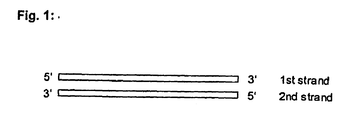
- the very basic structure of this ribonucleic acid is schematically shown in Fig. 1 .
- Said first strand and said second strand are preferably hybridised to each other and form the double-stranded structure.
- the hybridisation typically occurs by Watson Crick base pairing.
- the hybridisation or base pairing is not necessarily complete or perfect, which means that the first and the second stretch_are not 100 % base paired due to mismatches.
- the first stretch of contiguous nucleotides is essentially complementary to a target nucleic acid, more preferably to a part of the target nucleic acid.
- Complementary as used herein preferably means that the nucleotide sequence of the first strand is hybridising to a nucleic acid sequence or a part thereof of a target nucleic acid sequence.
- the target nucleic acid sequence is, in accordance with the mode of action of interfering ribonucleic acids, a single stranded RNA, more preferably an mRNA. Such hybridisation occurs most likely through Watson Crick base pairing, however, is not necessarily limited thereto.
- the extent to which said first strand and more particularly the first stretch of contiguous nucleotides of said first strand is complementary to a target nucleic acid sequence can be as high as 100% and be as little as 80%, preferably 80-100%, more preferably 85-100%, most preferably 90-100%. Optimum complementarity seems to be 95-100%. Complementarity in this sense means that the aforementioned range of nucleotides, such as, e. g., 80%-100%, depending on the particular range, of the nucleotides are perfect by Watson Crick base pairing.
- the complementarity between said first stretch of nucleotides and the target RNA has to be 18-19 nucleotides, stretches of as little as 17 nucleotides even with two sequence specific overhangs are not functional in mediating RNAi. Accordingly, given a duplex having a length of 19 nucleotides or base pairs a minimum complementarity of 17 nucleotides or nucleotide base pairs would be acceptable allowing for a mismatch of two nucleotides. It is disclosed that in case of a duplex consisting of 20 nucleotides or base pairs a complementarity of 17 nucleotides or nucleotide base pairs would be allowable and functionally active.
- the extent of complementarity required for a length of a duplex can also be based on the melting temperature of the complex formed by either the double stranded structure as described herein or by the complex of the first stretch of the first strand and the target nucleic acid.
- RNA mediated interference such as, for example, described in international patent applications WO 99/32619 , WO 00/44895 and WO 01/75164 .
- an interfering ribonucleic acid molecule may be designed according to the present invention is to have an optimum length of 18 or 19 nucleotides of the stretch which is complementary to the target nucleic acid. It is also within the present invention that said optimum length of 18 or 19 nucleotides is the length of the double stranded structure in the RNAi used. This length requirement is clearly different from the technical teaching of the prior art such as, for example, the international patent application WO 01/75164 . It is within the present invention that any further design, both according to the present invention and as described in the prior art, can be realised in connection with an interfering ribonucleic acid having said length characteristics, i.e. a length of 18 or 19 nucleotides.
- the interfering ribonucleic acid molecule may be designed is to have a free 5' hydroxyl group, also referred to herein as free 5' OH-group at the first strand.
- a free 5' OH-group means that the most terminal nucleotide forming the first strand is present and is thus not modified, particularly not by an end modification.
- the terminal 5'-hydroxy group of the second strand, respectively is also present in an unmodified manner.
- the 3'-end of the first strand and first stretch, respectively is unmodified such as to present a free OH-group which is also referred to herein as free 3'OH-group.
- such free OH-group is also present at the 3'-end of the second strand and second stretch, respectively.
- the 3'-end of the first strand and first stretch, respectively, and/or the 3'-end of the second strand and second stretch, respectively may have an end modification at the 3' end.
- free 5'OH-group and 3'OH-group also indicate that the respective most terminal nucleotide at the 5' end and the 3' end of the polynucleotide, respectively, presents a OH-group.
- OH-group may stem from either the sugar moiety of the nucleotide, more preferably from the 5'position in case of the 5'OH-group and from the 3'position in case of the 3'OH-group, or from a phosphate group attached to the sugar moiety of the respective terminal nucleotide.
- the phosphate group may in principle be attached to any OH-group of the sugar moiety of the nucleotide.
- the phosphate group is attached to the 5'OH-group of the sugar moiety in case of the free 5'OH-group and/or to the 3'OH-group of the sugar moiety in case of the free 3'OH-group.
- end modification means a chemical entity added to the most 5' or 3' nucleotide of the first and/or second strand.
- examples for such end modifications include, but are not limited to, inverted (deoxy) abasics, amino, fluoro, chloro, bromo, CN, CF, methoxy, imidazole, caboxylate, thioate, C 1 to C 10 lower alkyl, substituted lower alkyl, alkaryl or aralkyl, OCF 3 , OCN, O-, S-, or N-alkyl; O-, S-, or N-alkenyl; SOCH 3 ; SO 2 CH 3 ; ONO 2 ; NO 2 , N 3 ; heterozycloalkyl; heterozycloalkaryl; aminoalkylamino; polyalkylamino or substituted silyl, as, among others, described in European patents EP 0 5
- a further end modification is a biotin group.
- Such biotin group may preferably be attached to either the most 5' or the most 3' nucleotide of the first and/or second strand or to both ends.
- the biotin group is coupled to a polypeptide or a protein. It is also within the scope of the present invention that the polypeptide or protein is attached through any of the other aforementioned end modifications.
- the polypeptide or protein may confer further characteristics to the inventive nucleic acid molecules. Among others the polypeptide or protein may act as a ligand to another molecule. If said other molecule is a receptor the receptor's function and activity may be activated by the binding ligand. The receptor may show an internalization activity which allows an effective transfection of the ligand bound inventive nucleic acid molecules.
- An example for the ligand to be coupled to the inventive nucleic acid molecule is VEGF and the corresponding receptor is the VEGF receptor.
- RNAi of the present invention having different kinds of end modification(s) are presented in the following table 1.
- Table 1 Various embodiments of the interfering ribonucleic acid according to the present invention 1 st strand/1 st stretch 2 nd strand/ 2nd stretch 1.) 5'-end free OH free OH 3'-end free OH free OH 2.) 5'-end free OH free OH 3'-end end modification end modification 3.) 5'-end free OH free OH 3'-end free OH end modification 4.) 5'-end free OH free OH 3'-end end modification free OH 5.) 5'-end free OH end modification 3'-end free OH free OH 6.) 5'-end free OH end modification 3'-end end modification free OH 7.) 5'-end free OH end modification 3'-end free OH end modification 8.) 5'-end free OH end modification 3'-end end modification end modification
- the various end modifications as disclosed herein are preferably located at the ribose moiety of a nucleotide of the ribonucleic acid. More particularly, the end modification may be attached to or replace any of the OH-groups of the ribose moiety, including but not limited to the 2'OH, 3'OH and 5'OH position, provided that the nucleotide thus modified is a terminal nucleotide.
- Inverted abasics are nucleotides, either desoxyribonucleotides or ribonucleotides which do not have a nucleobase moiety. This kind of compound is, among others, described in Sternberger et al.(2002), Antisense. Nucl. Ac. Drug Dev. in press.
- any of the aforementioned end modifications may be used in connection with the various embodiments of RNAi depicted in table 1.
- any of the RNAi forms or embodiments disclosed herein with the sense strand being inactivated, preferably by having an end modification more preferably at the 5' end are particularly advantageous. This arises from the inactivation of the sense strand which corresponds to the second strand of the ribonucleic acids described herein, which might otherwise interfere with an unrelated single-stranded RNA in the cell.
- the expression and more particularly the translation pattern of the transcriptome of a cell is more specifically influenced. This effect is also referred to as off-target effect.
- the ribonucleic acid comprises a double-stranded structure whereby the double-stranded structure comprises a first strand and a second strand, whereby the first strand comprises a first stretch of contiguous nucleotides and whereby said first stretch is at least partially complementary to a target nucleic acid, and the second strand comprises a second stretch of contiguous nucleotides whereby said second stretch is at least partially identical to a target nucleic acid whereby the double-stranded structure is blunt-ended.
- the term double-stranded structure is also referred to as duplex. This design of RNAi is thus clearly different from, e. g., the one of Tuschl et al.
- overhang refers to a double-stranded structure whereby at least one end of one strand is longer than the corresponding end of the other strand forming the double-stranded structure, which is also referred to herein as the counter strand.
- first stretch is identical to the first strand and the second stretch is identical to the second strand.
- blunt-ended RNAi Taken the effectiveness of blunt-ended RNAi and the advantages of an end modification of either the first or the second strand or both, respectively, of the respective ribonucleic acid it is preferred to have a combination of both design principles. In other words, it is within the present invention to have blunt-ended RNAi carrying any end modification scheme as depicted in table 1.
- the ribonucleic acid has an overhang at the 5'-end of the ribonucleic acid. More particularly, such overhang may in principle be present at either or both the first strand and second strand of the ribonucleic acid.
- the length of said overhang may be as little as one nucleotide and as long as 2 to 8 nucleotides, preferably 2, 4, 6 or 8 nucleotides.
- the 5' overhang may be located on the first strand and/or the second strand of the ribonucleic.
- the nucleotide(s) forming the overhang may be (a) desoxyribonucleotide(s), (a) ribonucleotide(s) or a continuation thereof.
- the overhang preferably comprises at least one desoxyribonucleotide, whereby said one desoxyribonucleotide is preferably the most 5'-terminal one.
- the 3'-end of the respective counter-strand of the ribonucleic acid does not have an overhang, more preferably not a desoxyribonucleotide overhang.
- any of the ribonucleic acids may comprise an end modification scheme as outlined in connection with table 1 and/or and end modification as outlined herein.
- the ribonucleic acids of the present invention form a certain pattern of modified nucleotides on at least one of the strands and more particularly on one of the stretches of contiguous nucleotides of the ribonucleic acid(s) according to the present invention.
- the kind of modification of said nucleotides may be the same as discussed in connection with the other strategies for designing interfering RNA as disclosed herein and more particularly the kind of modification described herein for or as an end modification, such as, e.g., inverted abasics, methoxy, or amino and the like at the ribose moiety of at least one nucleotide forming the ribonucleotide acids according to the present application.
- the modification of said nucleotides may be any form of modification described herein, more particularly the kind of modification as described herein as end modification with the particularity that the so-called end modification is not necessarily located at terminal nucleotides. Rather the modification is occurring at a non-terminal nucleotide. Under such conditions the modification is preferably attached to the ribose moiety of the - to be - modified nucleotide and even more preferably to the 2'position of the ribose moiety.
- any ribonucleic acid designed according to this strategy may also have the features conferred to a ribonucleic acid according to the present invention by any of the other design strategies disclosed herein.
- the interfering ribonucleic acid having a pattern of modified nucleotides may have an end modification, an end modification scheme, or any combination of these elements or characteristics.
- the ribonucleic acid backbone as such may be further modified by forming different links between the nucleotides.
- Such different links are, among others, described in European patent EP 0 586 520 B1 and European patent EP 0 618 925 B1 .
- Of particular interest here are internal modification(s) of the ribonucleic acid backbone which have been shown to confer higher nuclease resistance of ribooligonucleotides.
- the modification of the modified nucleotide is a methoxylation of the 2'-OH-group of the ribose moiety of the nucleotide.
- both strands, and more particularly both the first stretch and the second stretch show this kind of modification of the nucleotides forming said strands and stretches, respectively.
- first strand and first stretch, respectively, or the second strand and second stretch, respectively show this particular pattern of modification of the nucleotides.
- group of modified nucleotide or flanking group of nucleotide may comprise or represent as little nucleotides as one nucleotide.
- nucleotide or group of nucleotides which are covalently linked to each other via standard phosphorodiester bonds or, at least partially, through phosphorothioate bonds, show such kind of modification.
- nucleotide or group of nucleotides is not forming the 5'-end or 3'-end of said stretch a nucleotide or group of nucleotides follows on both sides of the nucleotide which does not have the modification of the preceding nucleotide or group of nucleotides.
- this kind of nucleotide or group of nucleotides may have a different modification.
- This sequence of modified nucleotide and group of nucleotides, respectively, and unmodified or differently modified nucleotide or group of nucleotides may be repeated one or several times. Preferably, the sequence is repeated more than one time. For reason of clarity the pattern is discussed in more detail in the following, generally referring to a group of modified nucleotides or a group of unmodified nucleotides whereby each of said group may actually comprise as little as a single nucleotide.
- Unmodified nucleotide as used herein means either not having any of the afore-mentioned modifications at the nucleotide forming the respective nucleotide or group of nucleotides, or having a modification which is different from the one of the modified nucleotide and group of nucleotides, respectively.
- the modification of the unmodified nucleotide(s) wherein such unmodified nucleotide(s) is/are actually modified in a way different from the modification of the modified nucleotide(s), can be the same or even different for the various nucleotides forming said unmodified nucleotides.
- the pattern of modified and unmodified nucleotides may be such that the 5'-terminal nucleotide of the strand or of the stretch starts with a modified group of nucleotides or starts with an unmodified group of nucleotides.
- the 5'-terminal nuleotide is formed by an unmodified group of nucleotides.
- This kind of pattern may be realised either on the first stretch or the second stretch of the interfering RNA or on both. It has to be noted that a 5' phosphate on the target-complementary strand of the siRNA duplex is required for siRNA function, suggesting that cells check the authenticity of siRNAs through a free 5' OH (which can be phosphorylated) and allow only such bona fide siRNAs to direct target RNA destruction ( Nykanen, et al. (2001), Cell 107, 309-21 ).
- the first stretch shows a kind of pattern of modified and unmodified groups of nucleotides, whereas the second stretch does not show this kind of pattern.
- This may be useful insofar as the first stretch is actually the more important one for the target-specific degradation process underlying the interference phenomenon of RNA so that for specificity reasons the second stretch can be chemically modified so it is not functional in mediating RNA interference.
- both the first stretch and the second stretch have this kind of pattern.
- the pattern of modification and non-modification is the same for both the first stretch and the second stretch.
- the group of nucleotides forming the second stretch and corresponding to the modified group of nucleotides of the first stretch are also modified whereas the unmodified group of nucleotides of or forming the second stretch correspond to the unmodified group of nucleotides of or forming the first stretch.
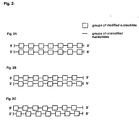
- Fig. 2A Another alternative is that there is a phase shift of the pattern of modification of the first stretch and first strand, respectively, relative to the pattern of modification of the second stretch and second strand, respectively.
- the shift is such that the modified group of nucleotides of the first strand corresponds to the unmodified group of nucleotides of the second strand and vice versa.
- Fig. 2B It is also within the present invention that the phase shift of the pattern of modification is not complete but overlapping as illustrated in Fig. 2C .
- the second nucleotide at the terminus of the strand and stretch, respectively is an unmodified nucleotide or the beginning of group of unmodified nucleotides.
- this unmodified nucleotide or unmodified group of nucleotides is located at the 5'-end of the first and second strand, respectively, and even more preferably of the first strand.
- the unmodified nucleotide or unmodified group of nucleotide is located at the 5'-end of the first strand and first stretch, respectively.
- the pattern consists of alternating single modified and unmodified nucleotides.
- the double-stranded structure of the inventive ribonucleic acid which is also referred to as duplex, is formed by the first strand and second strand, respectively, or the first and second stretch of contiguous nucleotides.
- the length of the first stretch and second stretch, respectively is 18 or 19 bases.
- a length of less than 30 nucleotides, preferably less than 21 nucleotides does not cause any biological system which is basically capable of showing RNA interference and also interferon response, to develop an interferon response.
- the ribonucleic acid comprises a double-stranded structure whereby the double-stranded structure comprises a first strand and a second strand, whereby the first strand comprises a first stretch of contiguous nucleotides and whereby said first stretch is at least partially complementary to a target nucleic acid, and the second strand comprises a second stretch of contiguous nucleotides whereby said second stretch is at least partially identical to a target nucleic acid whereby one terminus of the first strand and one terminus of the second strand are linked by a loop structure.
- the loop structure is comprised of a non-nucleic acid polymer.
- non-nucleic acid polymer may be polyethylene glycol or similar polymers
- the non-nucleic acid polymers may in principle be chosen from the group comprising polymers which do not comprise a polynucleotide and allow that the two strands to be linked may actually hybridize to each other.
- the molecule or moiety of the molecule linking the two stretches hybridizing with each other has to have a certain molecular structure or molecular flexibility to allow the bending of the molecule so as to allow that both stretches get in close contact and in a three-dimensional orientation which permits hybridization.
- Such molecule or moiety factually acts as a hinge.
- polyethylene glycol amino acid based molecules may be used.
- Such amino acid based molecules may be either homopolymers or hetereopolymers.
- a useful example is a homopolymer consisting of seven glycine residues which allows the generation of a hinge as required to bring the two stretches to hybridize in the close proximity as needed.
- This glycine based hinge is described, e. g., in Guan K. L. and Dixon J. E. (1991), Anal Biochem. 192, 262.
- the hinge may be formed by crown ethers known in the art.
- the loop is comprised of a nucleic acid.
- LNA as described in Elayadi and Corey (2001)Curr Opin Investig Drugs. 2(4):558-61 . Review; Orum and Wengel (2001) Curr Opin Mol Ther. 3(3):239-43 ; and PNA are regarded as nucleic acids and may also be used as loop forming polymers.
- the 5'-terminus of the first strand may be linked to the 3'-terminus of the second strand.
- the 3'-end of the first strand may be linked to the 5'-terminus of the second strand.
- the nucleotide sequence forming said loop structure is regarded as not being critical.
- the length of the nucleotide sequence forming such loop seems to be critical for sterical reasons. Accordingly, a minimum length of four nucleotides seems to be appropriate to form the required loop structure.
- the maximum number of nucleotides forming the hinge or the link between both stretches to be hybridized is not limited. However, the longer a polynucleotide is, the more likely secondary and tertiary structures are formed and thus the required orientation of the stretches affected.
- a maximum number of nucleotides forming the hinge is about 12 nucleotides. It is within the disclosure of this application that any of the designs described above may be combined with the present sixth strategy, i. e. by linking the two strands covalently in a manner that back folding (loop) can occur through a loop structure.
- the present inventors have surprisingly found that if the loop is placed 3' of the antisense strand, i. e. the first strand of the ribonucleic acid(s) according to the present invention, the activities of this kind of RNAi are higher compared to the placement of the loop 5' of the antisense strand. Accordingly, the particular arrangement of the loop relative to the antisense strand and sense strand, i. e. the first strand and the second strand, respectively, is crucial and is thus in contrast to the understanding as expressed in the prior art where the orientation is said to be of no relevance. However, this seems not true given the experimental results presented herein.
- RNAi RNAi-binding protein
- the vector comprises a promoter for the expression of RNAi.
- the respective promoter is pol III and more preferably the promoters are the U6, H1, 7SK promoter as described in Good et al. (1997) Gene Ther, 4, 45-54 .
- any gene producing such RNA may be modified in its expression by using the ribonucleic acid molecule according to the present invention. Because of this basic and generally applicable mechanism any application based thereon can be realised which imply the knockdown or knockout of a gene.
- a preferred application is the use of the inventive ribonucleic acid for target validation.
- target validation shall mean a process that involves taking steps to prove that a DNA, RNA, or protein molecule is directly involved in a biological process, preferably in a process ⁇ causally ⁇ involved in a disease or non-standard condition and is therefore a suitable target for development of a new therapeutic compound.
- Sequence homology studies have successfully classified genes into target families. The enormous task of deciphering which of these targets are key players in diseases and which should be used for subsequent drug development needs to be addressed in an efficient manner. Therefore, the knockdown of gene expression should be reduced by 50-100%, preferably by 90% to see significant effects on the phenotype. In other cases depending on the gene, a knockdown of as little as 20% might be sufficient to yield a phenotype.
- a phenotype will be defined by comparison of cells containing functional RNAi molecules with cells containing non functional RNAi molecules. This will ensure a significant readout even under conditions where the protein function is inhibited only partially. Generally there is no linear correlation between degree of mRNA reduction and the extent of the phenotype. It has to be acknowledged that for some proteins a reduction of about 20 % of the protein is sufficient to create a change in the phenotype whereas in case of other genes and mRNA, respectively, as little as 5 to 10 % remaining protein is sufficient to maintain the observed phenotype.
- a further use of the ribonucleic acid molecules according to the present invention is its use for the manufacture of a medicament or its use as a medicament.
- Such medicament could either be used for diseases or conditions such as any type of cancer where a gene and its product have been linked to the onset, cause or progression of this disease. Additionally, such medicament could be used to treat diseases where the presence or overexpression of a gene product is causing a pathological phenotype.
- the disease is characterised by a gain of function and may be remedied through application or administration of the corresponding, biologically active RNAi.
- Diseases or conditions which may be treated by the medicament comprising a ribonucleic acid as disclosed herein may be selected from the group comprising cancer, heart diseases, metabolic diseases, dermatological diseases, inflammatory diseases, immune system disorders and autoimmune disorders.
- the various forms of cancer include, but are not limited to, solid tumors and tumors of the hematopoietic system, such as glioblastoma, prostate cancer, breast cancer, lung cancer, liver cancer, pancreatic cancer and leukaemia.
- Metabolic diseases include, but are not limited to, obesity and diabetes.
- Dermatological diseases include, but are not limited to, psoriasis.
- the ribonucleic acid molecules according to the present invention may be used as diagnostics, preferably for those diseases as specified in connection with the above-mentioned diseases and conditions.
- diagnosis could be based on the observation that upon applying the ribonucleic acid molecules according to the present invention to a sample a change in the expression pattern of the sample occurs.
- sample comprises cells from a subject from whom it is assumed that it may exhibit said disease or condition to be treated.
- nucleic acids according to the present invention which is their use in the screening of pharmaceutically active compounds and lead optimization.
- the latter is done such as to compare the effect of candidate drugs such as small molecules and compare the effect created by said candidate drugs with the effect observed upon administering specific RNAi designed on the basis of the principles disclosed herein.
- candidate drugs having off-target effects may be eliminated from the screening process whereas those candidate drugs which create a similar or identical phenotype are deemed as highly relevant lead compound or may even be a pharmaceutically active compound themselves.
- the highly specific RNAi molecules act as gold standard against which candidate drugs are measured.
- the invention is related to a cell, preferably a knockdown cell, which contains a ribonucleic acid as disclosed herein.
- a cell preferably a knockdown cell, which contains a ribonucleic acid as disclosed herein.
- Such cell is preferably a cell which is either isolated or contained in a tissue or even organ which again preferably is not contained in an organism. However, the cell may also be contained in an organism.
- the cell is preferably a cell which is involved in the disease or condition which is to be treated by the inventive ribonucleic acids.
- This kind of knock-down cells may be used to generate an expression profile based on, e. g., mRNA or protein, in order to elucidate functional relationship and to determine downstream targets.
- the invention is related to an organism containing a ribonucleic acid as disclosed herein.
- a vertebrate organism Preferably such organism is a vertebrate organism and more preferably the vertebrate organism is a mammal.
- a mammal as used herein is, among others and not limited thereto, an ape, a dog, a cat, a goat, a sheep, a pig, a guinea pig, a rabbit, a mouse, and a rat.
- the present invention is related to a composition containing a ribonucleic acid according to the present invention.
- such composition comprises negative and positive controls either in combination with the effective ribonucleic acid or separated therefrom.
- Such composition may further comprise a solvent, preferably a buffer.
- the present invention is related to a pharmaceutical composition containing a ribonucleic acid according to the present invention and a pharmaceutically acceptable carrier.
- Pharmaceutically acceptable carriers are known to the one skilled in the art and comprise, among others, diluent, buffers and the like.
- the pharmaceutical composition may comprise further pharmaceutically active compounds.
- the disease or condition to be treated using the ribonucleic acid molecules according to the present invention are preferably those which are already now used in connection with the treatment of said diseases or conditions. Due to the different mode of action of the ribonucleic acid molecules according to the present invention and the medicaments used for the treatment of said diseases and conditions according to the prior art, synergistic effects will happen.
- Fig. 1 shows a schematic illustration defining the terminology as used herein.
- the upper of the two strand is the first strand and the antisense strand of the targeted nucleic acid such as mRNA.
- the second strand is the one which essentially corresponds in its sequence to the targeted nucleic acid and thus forms the sense strand.
- Both, the first strand and second strand form a double-stranded structure, typically through Watson Crick base pairing.
- Fig. 2 illustrates some embodiments of the ribonucleic acid molecules of the present invention with patterns of modified and unmodified groups of nucleotides which is also referred to herein as pattern of modification.
- the modified and unmodified groups of nucleotides on both the first stretch and the second stretch are located on corresponding parts of the stretches whereas in Fig. 2B the pattern realised on the first strand is also realised on the second strand, however, with a phase shift such that the modified group of nucleotides of the first stretch is base pairing with an unmodified group of nucleotides of the second stretch and vice versa.
- Fig. 2C a further possibility of arranging the modified and unmodified groups of nucleotides is realised. It is also within the present invention that the pattern of the first stretch is independent from the pattern of the second stretch and that both patterns partially overlap in terms of relative position to each other in the double-stranded structure defined by base pairing.
- Fig. 3 shows the result of a knockdown experiment using RNAi molecules with different end protection groups. More particularly Fig. 3A shows that the various forms of end protected RNAi molecules are functional on the knockdown of PTEN mRNA.
- Fig. 3B shows the sequence of the different RNAi molecules used in the experiment the result of which is depicted in Fig. 3A .
- Fig. 3C shows the result of an immunoblot analysis of PTEN protein after treatment with modified RNAi molecules in comparison to PTEN specific antisense constructs.
- Fig. 4 shows that the 3' overhang of RNAi molecules is not important for RNA interference. More particularly, Fig. 4A shows a dose response curve of different RNAi molecules and Fig. 4B shows the sequence of the RNAi molecules used in the experiment the result of which is shown in Fig. 4A .
- Fig. 5 shows that duplex length of the RNAi molecules has to be at least 18-19 nucleotide. More particularly, Fig. 5B shows the sequence of the PTEN specific RNAi molecules used in the experiment the result of which is depicted in Fig. 5A as dose response curve.
- Fig. 6 shows that four terminal mismatched nucleotides in RNAi molecules with a length of 19 nucleotides are still functional in mediating Akt1 knockdown. More particularly, Fig. 6B shows the sequence of the RNAi molecules used in the experiment the result of which is depicted in Fig. 6A .
- Fig. 7 shows the result of studies on the stability in serum conferred to RNAi molecules by 2'-O-methylation and that end modifications have no beneficial effects on RNAi stability. More particularly, Fig. 7A shows the result of a gel electrophoresis of the various RNAi molecules depicted in Fig. 7B being subject to incubation with fetal calf serum.
- Fig. 8 shows that an amino end modification results in loss of activity.
- Fig. 8B shows the particular RNAi molecules used in the experiments the result of which is shown in Fig. 8A.
- Fig. 8C shows the design principles which may be deduced from the results depicted in Fig. 8A .
- the term functional means functionally active in the particular assay system as described in the example and "not functional" means not functionally active in said system.
- Fig. 9 shows that 2'-O-Alkyl (methyl) modifications stabilize RNAi molecules but also result in reduction of their activity. More particularly, Fig. 9C shows the sequence of the RNAi molecules used in the experiment the result of which is depicted as a dose response curve in Fig. 9A. Fig. 9B shows the result of a gel electrophoresis of the various RNAi molecules depicted in Fig. 9C being subject to a two hour incubation in fetal calf serum.
- Fig. 10 shows the result of an experiment on the efficacy of RNAi molecules with blocks of 2'-O-methyl modifications with Fig. 10A graphically depicting the results of said experiments as a dose response curve and with Fig. 10C showing the sequences of the particular RNAi molecules used in said experiments.
- Fig. 10B shows the result of a gel electrophoresis of the various RNAi molecules depicted in Fig. 10C being subject to a two hour incubation in fetal calf serum.
- Fig. 11 shows that alternating 2'-O-methyl modification result in activity of the modified RNAi molecules compared to unmodified forms. More particularly, Fig. 11B shows the sequence of the RNAi molecules used in this experiment the result of which is depicted in Fig. 11A . Fig. 11C shows the stability of said RNAi molecules following incubation in serum for two hours, whereas Fig. 11D shows an immunoblot for PTEN protein upon application of different RNAi molecules to HeLa cells. As may be taken therefrom RNAi molecules with alternating modifications are stabilized against endonuclease degradation and active in mediating a PTEN protein knock down.
- Fig. 12 shows the result of a Western Blot analysis to determine the time course of PTEN protein knock down.
- Cells were continuously transfected with 2'-O-Methyl modified versus unmodified RNAi molecules using cationic lipids for 72 h. Protein lysates were prepared and analysed by immunoblot after 48 and 120 h. For the 96 h and 120 h timepoints the cells were splitted, replated and incubated in the absence of RNAi molecules for additional 24 and 48 h..
- Fig. 13 shows a Western Blot depicting the protein knock down of PTEN being persistent using alternating modified RNAi molecules versus unmodified RNAi molecules. Transfection were performed for only 5 h and new medium without transfection reagents was added. Lysates were analysed by immunoblot 72h and 96h post transfection with the indicated RNAi molecules..
- Fig. 14 shows the efficacy of various RNAi molecules with hairpin structures as dose response curve while Fig. 14B shows the structure of said RNAi molecules the result of which is depicted in Fig. 14A .
- Synthetic siRNAs with different loops are functional in reducing the p110 ⁇ , Akt1 and Akt 2 expression.
- (14A) Inhibition of p110 ⁇ mRNA expression in siRNA transfected HeLa cells. Samples were analyzed in parallel for the level of p110 ⁇ mRNA expression 24h after transfection of the indicated siRNAs. The transfected bimolecular siRNAs (21mer with 3' TT overhangs, molecule 1AB) or the monomolecular siRNAs with loop structures are schematically shown.
- RNA was prepared und subjected to real time RT-PCR (Taqman) analysis. p110 ⁇ mRNA levels are shown relative to the mRNA levels of p110 ⁇ , which serve as an internal reference. Each bar represents triplicate transfections ( ⁇ standard deviation). HeLa cells were transfected at 50% confluency (2500 cells per 96 well) with siRNAs at the indicated concentrations in growth medium.
- Fig. 15 shows the efficacy of various RNAi molecules with intermolecular and intramolecular loop structures as dose response curves.
- (15A) Inhibition of Akt1 mRNA expression in siRNA transfected HeLa cells. Samples were analysed in parallel for the level of Akt1 and Akt2 mRNA expression 24h after transfection of the indicated siRNAs. The different loops (A-loops; GAGA-loop and a polyethylenglycol (PEG)-linker) and their putative secondary structure are shown schematically.
- the siRNA molecule 9A is specific for Akt2 and serves as a negative control. Note that 10A and 10B do not contain self-complementary sequences and are transfected in combination.
- Akt1 mRNA levels is shown relative to the mRNA levels of p110 ⁇ , which served as internal control.
- the Akt1 specific molecule 7A serves here as a negative control.
- Fig. 15 C shows a Western Blot analysis on Akt protein depicting the functionality of synthetic siRNAs with different loops in specifically reducing the Akt1 and Akt 2 expression.
- Inhibition of Akt1 and Akt2 protein expression were analysed by immunoblot.
- the cells were harvested 48h after transfection of the indicated hairpin siRNAs (20nM).
- Cell extracts were separated by SDS-PAGE and analysed by immunoblotting using anti-p110 antibody, anti Akt 1/2. Similar results were obtained with an antibody specific for the phosphorylated form of Akt1.
- the positions of p110 ⁇ , another catalytic subunit of PI 3-kinase, which was used as a loading control, and of Akt1, Akt2 and phosphorylated Akt (P*-Akt) are indicated on the left.
- Fig. 16 shows an NH 2 modification, also referred to herein as amino modification, which may be present at either the 3'-OH terminal nucleotide or the 5' terminal nucleotide.
- the amino group is attached to the phosphate which in turn is attached to the OH group of the sugar moiety, through an alkyl group comprising an alkyl chain of 1 to 8, preferably 6 C atoms, whereby the second C atom close to the phosphate group has a CH 2 OH group attached thereo.
- the linker may be formed by an ether whereby the ether is comprised of two alcohols whereby one alcohol is an amino alcohol and the other is a dialcohol with one alcohol group involved in the formation of the ether group and the other one being an OH group located at either of the C atoms, preferably at the second C atom relative to the phosphate group.
- siRNAs were purchased from Biospring (Frankfurt, Germany). The ribo-oligonucleotides were resuspended in RNase free TE to a final concentration of 50 ⁇ M. In the case of bimolecular siRNA molecules equal aliquots (100 ⁇ M) were combined to a final concentration of 50 ⁇ M. For the formation of intramolecular duplexes the siRNAs were incubated at 50 °C for 2 min in annealing buffer (25mM NaCl; 5mM MgCl 2 ) and were cooled down to RT.
- annealing buffer 25mM NaCl; 5mM MgCl 2
- RNAi molecules were transfected by adding pre-formed 5x concentrated complex of annealed RNAi and lipid in serum-free medium to cells in complete medium. Prior to transfection 2500 HeLa cells were plated per well 15 - 18 hours before transfection for the 96 well format.
- the total transfection volume was 100 ⁇ l for cells plated in 96-wells and 10 ml for cells in 10 cm plates.
- the final lipid concentration was 0.8 to 1.2 ⁇ g/ml depending on cell density; the RNAi concentration is indicated in each experiment.
- RNA isolation was allowed to take place for 30min at 37°C. Complexes were added to cells to yield a final 1x concentration of both lipid and RNAi.
- cells were lysed using a standard cell lysis buffer for protein extraction ( Klippel, A., Escobedo, J. A., Hirano, M. and Williams, L. T. (1994). Mol Cell Biol 14, 2675-2685 ) or a denaturing buffer for RNA isolation according to the RNA isolation kit (Invitek, Berlin (Germany) 24 to 48 hours post transfection for RNA analysis and 48 to 72 hours post transfection for protein analysis by Western Blot.
- RNA of cells transfected in 96-wells was isolated and purified using the Invisorb RNA HTS 96 kit (In Vitek GmbH, Berlin). Inhibition of PTEN mRNA expression was detected by real time RT-PCR (Taqman) analysis using 300 nM PTEN 5' primer CACCGCCAAATTTAACTGCAGA, 300 nM PTEN 3' primer AAGGGTTTGATAAGTTCTAGCTGT and 100 nM of the PTEN Taqman probe Fam-TGCACAGTATCCTTTTGAAGACCATAACCCA-Tamra in combination with 40 nM ⁇ -actin 5' primer GTTTGAGACCTTCAACACCCCA, 40 nM ⁇ -actin 3' primer GACCAGAGGCATACAGGGACA and 100 nM of the ⁇ -actin Taqman probe Vic-CCATGTACGTAGCCATCCAGGCTGTG-Tamra.
- the Akt primers and probes are determined in Stemberger et al. (Stemberger, a.a.O.) and are used according to the manufacturer's instructions (Applied Biosystem; use of Amplicon Set). Also said primers and probes may be designed usin the software program Primer Express (Applied Biosystem). The reaction was carried out in 50 ⁇ l and assayed on the ABI PRISM 7700 Sequence detector (Applied Biosystems) according to the manufacturer's instructions under the following conditions: 48°C for 30 min, 95°C for 10 min, followed by 40 cycles of 15 sec at 95°C and 1 min at 60°C.
- RNA knockdown is shown by real time RT-PCR analysis of Hela cells transfected with 21 nt long siRNA duplex molecules unmodified and modified with either NH 2 or inverted Abasics groups at the 5'-end at a lipid carrier concentration of 1.0 ⁇ g/ml. Cell density was 2000 cells/well. Modifications on the 3'-end are either RNA overhangs, RNA overhangs with amino groups or DNA overhangs.
- Lysates were cleared by centrifugation at 14,000 x g for 5 minutes and aliquots of the cell extracts containing equal amounts of protein were analyzed for protein expression by Western-blotting: Samples were separated by SDS-PAGE and transferred to nitrocellulose-filters (Schleicher & Schuell). Filters were blocked in TBST buffer (10 mM Tris-HCl (pH 7.5), 150 mM NaCl, 0.05% (vol/vol) Tween 20, 0.5% (wt/vol) sodium azide) containing 5% (wt/vol) dried milk. The respective antibodies were added in TBST at appropriate dilutions.
- Bound antibody was detected using anti-mouse- or anti-rabbit-conjugated horse radish peroxidase (Transduction Laboratories) in TBST, washed, and developed using the SuperSignal West Dura (Pierce) or ECL (Amersham) chemoluminescence substrates (c.f. Stembergeret al. (2002). Antisense. Nucl. Ac. Drug Dev. in press. .
- the murine monoclonal anti-p110 antibody U3A and the murine monoclonal anti-p85 antibody N7B have been described (Klippel et al., 1994, aaO).
- Rabbit polyclonal anti-Akt and anti-phospho Akt (S473) antibodies were obtained from Cell Signaling Technology.
- the murine monoclonal anti-PTEN antibody was from Santa Cruz Biotechnology.
- the PTEN 53 specific antisense molecule, i. e. geneBloc, is described in Stemberg et al.
- RNAi molecules used in this and other examples disclosed herein are also referred to as small interfering RNA molecules siRNA. It is to be noted that in any of the figures contained herein the upper strand is the antisense or first strand, whereas the lower strand is the sense or second strand of the interfering RNA molecule.
- amino end modifications such as amino modification and inverted abasics modification of the terminal OH group of the nucleic acid are as potent as unmodified ends when the modification is located at the 3' end of the antisense strand (see also Fig. 8A; 8B ). Therefore chemical modification to stabilize or with other beneficial properties (delivery) will be tolerated without activity loss when located at the 3' OH; especially when the 3'OH is located on an overhanging nucleotide.
- RNAi RNA-NH 2
- siRNA-iB siRNA-iB
- the sequence of both molecules is depicted in Fig. 3B .
- 3A3B indicates that the interfering ribonucleic acid consists of strand 3A as the antisense strand and strand 3B as the sense strand.
- GB53 antisense oligonucleotide designated GB53 (Steinberger et al., supra) was generated which was directed against the PTEN mRNA as well. The particularities of this latter experiment were as follows.
- RNAi molecules depicted in Fig.3B are functional in yielding a PTEN protein knockdown.
- RNAi 18 is composed of strand 18A as antisense strand and strand 18B as sense strand.
- Blunt ended molecules are compared to molecules with 3'-overhangs (RNAi 18) and 5'-overhangs (RNAi 30 and RNAi 31) in their activity to knockdown PTEN mRNA in Hela cells.
- the activity of blunt ended molecules (RNAi 28) and molecules with 5'-overhangs is comparable to the activity of molecules with 3'-overhangs. This shows that 3'-overhangs are not essential for RNAi activity.
- Example 3 Duplex length requirements of interfering RNA molecules for RNAi activity in vivo
- the experimental approach was similar to the one outlined in connection with example 1 except that the interfering RNA molecules were directed against the mRNA of Akt1.
- the negative control to show the specificity of the RNAi molecules was again p110 mRNA.
- the experimental results are shown in Fig. 5A with the particularities of the interfering RNAi molecules used being represented in Fig. 5B .
- RNAi 51 the design of the interfering RNA molecule 51A/51B referred to as RNAi 51 corresponds to the one as described in international patent application WO 01/75164 .
- the RNAi molecule 55A/55B comprises a stretch of 17 nucleotides and has a clearly decreased activity in terms of degradation of Akt mRNA.
- RNAi mediated interference is thus a duplex length of 18 or 19 nucleotides, independent of the further design of the RNAi molecules such as blunt end or 5'-overhang or any other form as disclosed herein, but generally applicable to RNAi molecules.
- the particular design of the RNAi molecules may confer further advantages to said molecules, such as, e. g., increased efficiency and increased stability, respectively.
- Example 4 Target -antisense homology requirements for RNAi in vivo
- RNAi is specific for Akt1.
- a PTEN specific interfering RNA molecule was designed and used as negative control. The results are shown in Fig. 6A and Fig. 6B .
- the present invention is reducing this off-target problem of siRNA by two approaches. First by reducing the molecule length of the siRNA molecules to the minimal requirements (18-19 nt) and thereby reducing the chance of homology to off-targets. Second, by inactivation of the sense strand to prevent a unwanted RNA silencing caused by accidential complemetarity of the sense strand to a unrelated target RNA (see also Example 6).
- Example 5 Stability of modified RNAi molecules in serum
- Oligonucleotides were incubated in human serum for 15 min and two hours and loaded on 10% polyacrylamide gel with untreated controls. The results are shown in Fig. 7A .
- the various RNAi molecules used are shown and described in more detail in Fig. 7B .
- RNAi duplex of RNA molecules with all nucleotides modified with 2'-O-methyl groups RNAi molecules 79A79B and 28A28B
- end protection e.g. iB or Amino
- RNAi molecules in addition to the various modifications or designs of the inventive RNAi molecules as disclosed in this application a further or additional modification of the nucleotides may be the use of a phosphorothioate backbone of the RNAi molecules which may be either complete or partial in order to inhibit endonuclease function.
- a complete phosphorothioate backbone means that any of the nucleotides exhibits a phosphorothioate group whereas a partial phosphorothioate backbone means that not all of the nucleotides forming the RNAi molecule have a phosphorothioate modification.
- This modification is suitable to increase the lifetime of RNAi molecules irrespective of the further design of RNAi molecules.
- a partially or completely phosphorothioate modified RNAi is subject to the present invention which may be realized in connection with the different strategies for the design of interfering RNA molecules as disclosed herein or with any of the designs known in the art.
- Example 6 Inactivation of the sense strand by NH 2 end protection groups on the 5' and 3' ends
- the experimental set-up was similar to the one described in connection with example 1 with the target nucleic acid sequence being PTEN mRNA.
- the concentration of Hela cells was 2,000 cells per well.
- RNA of PTEN was analysed in Taqman assays after transfection of differently modified RNAi molecules.
- the different interfering RNA molecules used are depicted in Fig. 8B whereas the experimental results are shown in Fig. 8A .
- RNAi molecules are functional when the sense strand, i. e. the second stand, is modified on both ends with amino groups. Particularly effective are RNAi molecules 20A26B, 18A26B, and 28A26B. The lowest activity is shown by RNAi molecule 26A26B which corresponds to end modification on all 4 ends of the duplex (Tuschl is 18AB) .
- RNAi activity is also achieved when the antisense strand, i. e. the first strand, is modified only at the 3' end leaving a free OH group at the 5' end (RNAi constructs 22A26B; 20A26B). There is no activity when the antisense strand is modified with amino groups on both the 5' and the 3' end (26A26B). This leads to the conclusion that any end of the antisense strand and more particularly the 5' end of the antisense should be kept without modifications.
- the NH 2 end modification can be used to inactivate the sense strand on the 5' and 3' end and therefore reduce off-target effects mediated by an otherwise functional sense strand which results in a significantly increased specificity of the RNAi molecule which is advantageous for target validation as well as for any medical use of the RNAi molecule.
- RNAi are accordingly those not having an amino modification at the antisense strand or having an amino modification only at the 3' end of the antisense strand whereas an amino modification at both ends of the antisense strand is not functional, i. e. does not result in a knockdown of the target mRNA.
- Example 7 Impact of 2'-O-methyl modification of RNAi molecules for endonuclease protection.
- RNA knockdown is again shown using the real time RT-PCR analysis on Hela cells transfected with RNAi duplex molecules directed against the PTEN mRNA as represented in Fig. 9A .
- Experimental procedures were basically the same as specified in example 1.
- the nucleotides printed in bold are those having a 2'-O-methyl modification.
- RNAi molecules in Fig. 9A It is illustrated by the dose response curves shown for various RNAi molecules in Fig. 9A that internal 2'-O-alkyl groups are reducing RNAi activity.
- Preferably such 2'-O-alkyl groups are 2'-O-methyl or 2'-O-ethyl groups.
- molecules with unmodified nucleotides in combination with 2'-O-alkyl modification show significant activity.
- Fig. 9A there is no activity when the antisense strand is all modified with 2'-O-methyl groups and the sense strand is not modified (c. f., e. g., RNAi molecule 79A28B).
- RNAi molecules has to balance stability against activity which makes it important to be aware of the various design principles as disclosed in the present application.
- Example 8 Impact of blocks of internal 2'-O-methyl modifications on the stability of RNAi molecules in serum.
- RNAi molecules were incubated in serum for two hours and analysed on a 10% polyacrylamide gel
- Figs. 10A to 10C show the results of this study.
- Fig. 10A shows the dose response of the various RNAi molecules depicted in Fig. 10C
- Fig. 10B shows the result of a stability test using some of the RNAi molecules depicted in Fig. 10C .
- nucleotides written in bold in Fig. 10C are the ones carrying a modification which is in the present case of a 2'-0-methyl modification of the ribose moiety of the nucleotides.
- RNAi molecules There is a dose dependent inhibition by the unmodified RNAi molecules. It is also shown that the 2'-O-methyl modification of the core 9 nucleotides makes the RNAi stable in serum and allows activity of the duplex in the meaning of mediating the interference phenomenon leading to a degradation of the PTEN mRNA. Total modification of the sense strand makes the RNAi molecule stable in serum and allows certain activity.
- Alternating blocks of 5 nucleotides with 2'-O-methyl modification renders the RNAi molecule stable in serum and allows activity on PTEN RNA as shown by incubating the RNAi duplex in serum for two hours and loading the samples on a 10% polyacrylamide gel.
- the duplex comprising strands 80A and 80B is strongly degraded after incubation in serum for two hours.
- the duplex consisting of strands 82A and 82B confirms the result that the 5'-end of the first strand which comprises the antisense strand should not be modified at the 5'-terminal nucleoties (compare 82A82B with the reverse orientated 81A81B).
- Example 9 The impact of alternating internal 2'-O-alkyl modification on serum stability of RNAi molecules.
- RNAi molecules were transfected with the different RNAi molecules depicted in Fig. 11B and RNA knockdown was demonstrated using real time RT-PCR on PTEN RNA in a dose-dependent manner ( Fig. 11 A) .
- the stability of the various RNAi molecules after 15 min and two hours in serum at 37°C is depicted in Fig. 11C and a Western Blot for p110 and PTEN as the target-protein of the various RNAi molecules is depicted in Fig. 11D with the RNAi molecules tested being the same in both the experiments underlying Fig. 11 C and Fig. 11 D .
- nucleotides modified with 2'-O-methyl groups alternating with unmodified nucleotides render RNAi molecules stable in serum while still allowing them to be active in the sense of interfering with the target mRNA. It is shown that incubation of RNAi duplex molecules for 15 min and two hours in serum will degrade the unmodified duplex and the duplex where the 10 most 5'-positioned nucleotides are unmodified.
- RNAi molecules represented in Fig. 11B various patterns of modified and unmodified nucleotides are realised.
- the RNAi molecule 94A1/94B1 comprises a structure wherein a modified nucleotide is flanked by an unmodified nucleotide with the unmodified nucleotide being located at the 5' end of the first strand.
- the RNAi molecule comprised of strands 94A2 and 94B2 is another example where the modified nucleotides and the unmodified nucleotides of the first and the second strand are located at opposing sites.
- the RNAi molecule comprised of strands 94A1 and 94B2 have the same pattern of modified and unmodified nucleotides.
- the two RNAi molecules comprised of strands 94A1 and 94B1 and strands 94A2 and 94B2 differ from each other such that in the first case the first strand starts with an unmodified nucleotide and the corresponding first nucleotide of the second strand, i. e. the nucleotide at the 3' end of the second strand, starts with an unmodified nucleotide with the arrangement being opposite to this in the RNAi molecule comprised of 94A2 and 94B2.
- alternatingly modified RNAi molecules as depicted in Fig. 11B are functional in mediating a PTEN protein knock down as shown in Fig. 11D but only when the second 5' and second 3' terminal nucleotide is not modified (see 94A294B1 and 94A294B2).
- 94A294B1 and 94A294B2 Taken together these data show that the most stable and most active RNAi molecules do have alternating 2'Alkyl modified and unmodified nucleotide residues. It should be noted that these molecules do show a very similar mRNA reduction when compared to unmodified siRNA molecules which being stable in serum allows increased or easier handling.
- RNAi were transfected by adding pre-formed 5x concentrated complex of siRNAs and lipid in serum-free medium to cells in complete medium.
- the total transfection volume was 100 ⁇ l for cells plated in 96-wells and 10 ml for cells in 10 cm plates.
- the final lipid concentration was 0.8 to 1.2 ⁇ g/ml depending on cell density; the siRNA concentration is indicated in each experiment.
- RNAi molecules of the 94A2B 1 and 94A2B2 version yield a longer lasting PTEN protein knock down as unmodified molecules.
- the lack of protein knock down also seen in Fig. 11 with molecules of the 94A1B1 and 94A1B2 version is confirmed in this experiment.
- Unmodified molecules (80AB) are not as potent in supporting long lasting protein knock down when the cells are not continuously transfected.
- the experimental approach was similar to the one outlined in connection with example 10 with the exception that the transfection was terminated after 5 h by replacing the transfection medium with new medium.
- the protocol was slightly modified such that for each of the RNAi molecules a 40 nM concentration was realized using a stock solution of 1 ⁇ g RNAi / ml cationic lipid as described in connection with example 1. 5 hours after transfection the medium was withdrawn and fresh EMEM added. The cells were split after 72, with half of the cells being lysed and the other half newly plated and lysed 24 h later (96h post transfection).
- the result of a Western Blot analysis using 3 different RNAi molecules 80AB, 94A1/B2, 94A2/B 1 are depicted in Fig. 13 .
- RNAi molecules 94A1B2 As a positive control untreated cells were used.
- Fig. 13 shows the expression of PTEN after 72 h and 96 h, respectively. Taken the structural particularities of the various RNAi molecules it can be taken from Fig. 13 that protein knockdown is persistent with alternating molecules of the 94A2B 1 kind even over 96 h after splitting and replating cells compared to unmodified RNAi molecules (such as 80AB) and RNAi molecule 94A1B2.
- Example 12 Different loop structures are functional in mediating RNA interference
- RNAi molecules preferably synthetic RNAi molecules with self complementary structures can inhibit gene expression as efficiently as standard double stranded siRNA molecules
- HeLa cells were transfected with p110 ⁇ specific synthetic siRNAs.
- Transfections were carried out in 96 well or 10-cm plates (at 30% to 50% confluency) by using various cationic lipids such as Oligofectamine, Lipofectamine (Life Technologies), GeneBlocs were transfected by adding pre-formed 5x concentrated complex of GB and lipid in serum-free medium to cells in complete medium.
- the total transfection volume was 100 ⁇ l for cells plated in 96-wells and 10 ml for cells in 10 cm plates.
- the final lipid concentration was 0.8 to 1.2 ⁇ g/ml depending on cell density; the RNAi molecule concentration is indicated in each experiment.
- a dose dependent titration showed no significant difference in efficiency of mRNA knock-down achieved by the standard bimolecular double strand 21mer and the corresponding monomolecular molecules as analysed by realtime PCR (Taqman) ( Fig. 14A ).
- Two different loop structures a (A) 12 loop and a HIV derived pA-loop were tested in parallel with similar results.
- a comparision of the relative position of the antisense sequence and the loop structure revealed an improved knock-down efficiency with the antisense sequence being located 3' to the loop ( Fig. 14B ; compare construct 3A, 3B and 4A, 4B).
- Example 13 Studies on the efficacy of different intramolecular hairpin loops and intermolecular "bubbles"
- Akt1 mRNA as depicted in Fig. 15A and Fig. 15B as well as Akt1 protein levels as depicted in Fig. 15C was completely independent of the loop structure tested (compare molecules 5A, 6A, 7A, 8A) (the structure of the RNAi molecule tested is always depicted underneath the bar diagram). Even a molecule containing a rather unphysiological structure such as a polyethylenglycol linker (PEG) as a loop efficiently reduced Akt1 expression indicating that size and nucleotide sequence of the loop is not crucial ( Fig. 15A ; molecule 8A).
- PEG polyethylenglycol linker
- a synthetic siRNA molecule specific for Akt2 (9A) was used to control for specificity, and had no effect on Akt1 levels as shown in Fig. 15A .
- This molecule however, efficiently silenced Akt2 expression ( Fig. 15B ; Fig. 15C ).
- Self-complementary RNA molecules with loop structures have the possibility to anneal as doublestrands in monomolecular or bimolecular structures under physiological hybridization conditions ( Fig. 15B , loop or bubble structure).
- Fig. 15B loop or bubble structure
- constructs contained Akt1- and Akt2-specific sequences within the same molecule (Fig. 15B , constructs 10A, 10B) and were designed to be restricted to form a bimolecular duplex ("bubble").
- this molecule efficiently mediated both Akt1 and Akt2 mRNA knock-down as well as protein knock-down when transfected after annealing of both strands.
Landscapes
- Health & Medical Sciences (AREA)
- Life Sciences & Earth Sciences (AREA)
- Engineering & Computer Science (AREA)
- Chemical & Material Sciences (AREA)
- Organic Chemistry (AREA)
- Genetics & Genomics (AREA)
- Biomedical Technology (AREA)
- Bioinformatics & Cheminformatics (AREA)
- General Health & Medical Sciences (AREA)
- Zoology (AREA)
- Wood Science & Technology (AREA)
- General Engineering & Computer Science (AREA)
- Molecular Biology (AREA)
- Diabetes (AREA)
- Biotechnology (AREA)
- General Chemical & Material Sciences (AREA)
- Biochemistry (AREA)
- Public Health (AREA)
- Animal Behavior & Ethology (AREA)
- Pharmacology & Pharmacy (AREA)
- Nuclear Medicine, Radiotherapy & Molecular Imaging (AREA)
- Medicinal Chemistry (AREA)
- Veterinary Medicine (AREA)
- Chemical Kinetics & Catalysis (AREA)
- Plant Pathology (AREA)
- Obesity (AREA)
- Hematology (AREA)
- Physics & Mathematics (AREA)
- Biophysics (AREA)
- Microbiology (AREA)
- Virology (AREA)
- Endocrinology (AREA)
- Emergency Medicine (AREA)
- Child & Adolescent Psychology (AREA)
- Pharmaceuticals Containing Other Organic And Inorganic Compounds (AREA)
- Micro-Organisms Or Cultivation Processes Thereof (AREA)
- Medicines That Contain Protein Lipid Enzymes And Other Medicines (AREA)
Claims (12)
- Acide ribonucléique médiant l'ARN interférence, comprenant une structure double brin, la structure double brin comprenant un premier brin et un deuxième brin, le premier brin comprenant un premier segment de nucléotides contigus, et ledit premier segment étant au moins partiellement complémentaire d'un acide nucléique cible, et le deuxième brin comprenant un deuxième segment de nucléotides contigus, ledit deuxième segment étant au moins partiellement identique à l'acide nucléique cible, caractérisé en ce que la structure double brin possède une extrémité franche sur les deux côtés du double brin, et la longueur dudit premier brin et dudit premier segment, et la longueur dudit deuxième brin et dudit deuxième segment, étant de 18 ou 19 bases, pour utilisation dans un procédé de traitement d'une maladie.
- Acide ribonucléique selon la revendication 1, dans lequel au moins un nucléotide de l'acide ribonucléique possède une modification sur la position 2', la modification étant de préférence choisie dans le groupe comprenant les modifications amino, fluoro, méthoxy et alkyle.
- Acide ribonucléique selon l'une quelconque des revendications 1 et 2, dans lequel la complémentarité entre ledit premier brin et l'acide nucléique cible est parfaite.
- Acide ribonucléique selon l'une quelconque des revendications 1 et 2, dans lequel le duplex formé entre le premier brin et l'acide nucléique cible comprend au moins 15 nucléotides, un mésappariement ou deux mésappariements existant entre ledit premier brin et l'acide nucléique cible formant ladite structure double brin.
- Acide ribonucléique selon l'une quelconque des revendications 1 à 4, dans lequel le gène cible est choisi dans le groupe comprenant les gènes de structure, les gènes domestiques, les facteurs de transcription, les facteurs de motilité, les facteurs de cycles cellulaires, les inhibiteurs de cycles cellulaires, les enzymes, les facteurs de croissance, les cytokines et les suppresseurs tumoraux.
- Acide nucléique selon l'une quelconque des revendications 1 à 5, dans lequel la maladie est choisie dans le groupe comprenant le glioblastome, le cancer de la prostate, le cancer du sein, le cancer du poumon, le cancer du foie, le cancer du côlon, le cancer du pancréas et la leucémie, le diabète, l'obésité, les maladies cardiovasculaires et les maladies métaboliques.
- Utilisation d'un acide ribonucléique selon l'une quelconque des revendications 1 à 6, pour la fabrication d'un médicament.
- Utilisation selon la revendication 7, pour laquelle le médicament est destiné au traitement d'une maladie ou d'un état pathologique qui est choisi dans le groupe comprenant le glioblastome, le cancer de la prostate, le cancer du sein, le cancer des poumons, le cancer du foie, le cancer du côlon, le cancer du pancréas et la leucémie, le diabète, l'obésité, les maladies cardiovasculaires et les maladies métaboliques.
- Cellule, de préférence cellule knockdown, contenant un acide ribonucléique selon l'une quelconque des revendications 1 à 6, la cellule humaine étant une cellule humaine isolée si la cellule est une cellule humaine.
- Organisme, de préférence organisme knockdown, contenant un acide ribonucléique selon l'une quelconque des revendications 1 à 8, l'organisme étant différent d'un être humain.
- Composition contenant un acide ribonucléique selon l'une quelconque des revendications 1 à 6.
- Composition pharmaceutique contenant un acide ribonucléique selon l'une quelconque des revendications 1 à 6 et un support pharmaceutiquement acceptable.
Priority Applications (69)
| Application Number | Priority Date | Filing Date | Title |
|---|---|---|---|
| DK02017601.2T DK1389637T3 (da) | 2002-08-05 | 2002-08-05 | Interfererende RNA-molekyler med stumpe ender |
| EP02017601A EP1389637B1 (fr) | 2002-08-05 | 2002-08-05 | Molécules d'ARN interférant à bords francs |
| ES02017601T ES2389024T3 (es) | 2002-08-05 | 2002-08-05 | Moléculas de RNA interferentes de extremos romos |
| PCT/EP2003/008666 WO2004015107A2 (fr) | 2002-08-05 | 2003-08-05 | Nouvelles formes de molecules d'arn interferant |
| DK10012263.9T DK2258847T3 (en) | 2002-08-05 | 2003-08-05 | Additional new forms of interfering RNA molecules |
| HUE10012263A HUE032289T2 (en) | 2002-08-05 | 2003-08-05 | Other new forms of interfering RNA molecules |
| IL16654603A IL166546A0 (en) | 2002-08-05 | 2003-08-05 | Further novel forms of interfering ran molecules |
| BRPI0313202A BRPI0313202A8 (pt) | 2002-08-05 | 2003-08-05 | Formas adicionais para interferir com as moléculas de rna |
| HUE17160954A HUE039866T2 (hu) | 2002-08-05 | 2003-08-05 | Az interferáló RNS molekulák további új formái |
| EP17170478.6A EP3222725A1 (fr) | 2002-08-05 | 2003-08-05 | Nouvelles formes des molécules d'arn interférant |
| EP03784183.0A EP1527176B2 (fr) | 2002-08-05 | 2003-08-05 | Nouvelles formes de molecules d'arn interferant |
| PT03784183T PT1527176E (pt) | 2002-08-05 | 2003-08-05 | Novas formas de muléculas de arn de interferência |
| PT60271293T PT1857547T (pt) | 2002-08-05 | 2003-08-05 | Formas adicionais novas de moléculas de rna de interferência |
| DK06027129.3T DK1857547T3 (en) | 2002-08-05 | 2003-08-05 | Additional new forms of interfering RNA molecules |
| AU2003260370A AU2003260370B2 (en) | 2002-08-05 | 2003-08-05 | Further novel forms of interfering RNA molecules |
| EP10012263.9A EP2258847B2 (fr) | 2002-08-05 | 2003-08-05 | Autres nouvelles formes de molécules d'ARN interférant |
| CNB038188678A CN100543137C (zh) | 2002-08-05 | 2003-08-05 | 其它新形式的干扰rna分子 |
| TR2018/16291T TR201816291T4 (tr) | 2002-08-05 | 2003-08-05 | Müdahaleci rna moleküllerinin ilave yeni biçimleri. |
| ES10012263T ES2627779T5 (es) | 2002-08-05 | 2003-08-05 | Nuevas formas adicionales de moléculas de ARN de interferencia |
| SI200332565T SI1857547T1 (en) | 2002-08-05 | 2003-08-05 | FURTHER NEW MODELS OF THE INTERFERENCE RNA MOLECULAR |
| DK17160954.8T DK3222724T3 (en) | 2002-08-05 | 2003-08-05 | ADDITIONALLY UNKNOWN FORMS OF INTERFERRING RNA MOLECULES |
| EP17170484.4A EP3222726A1 (fr) | 2002-08-05 | 2003-08-05 | Nouvelles formes des molécules d'arn interférant |
| SI200332582T SI3222724T1 (sl) | 2002-08-05 | 2003-08-05 | Nadaljnje nove oblike molekul interferenčne RNA |
| AT03784183T ATE350473T2 (de) | 2002-08-05 | 2003-08-05 | Weitere neue formen von interferierende rns moleküle |
| CNA2008100970591A CN101301309A (zh) | 2002-08-05 | 2003-08-05 | 其它新形式的干扰rna分子 |
| TR2017/08347T TR201708347T4 (tr) | 2002-08-05 | 2003-08-05 | Müdahaleci rna moleküllerinin diğer yeni biçimleri. |
| SI200332526T SI2258847T1 (sl) | 2002-08-05 | 2003-08-05 | Nadaljnje nove oblike molekul interferenčne RNA |
| KR1020127005474A KR20120029002A (ko) | 2002-08-05 | 2003-08-05 | 신규한 형태의 간섭 rna 분자 |
| ES03784183.0T ES2280826T5 (es) | 2002-08-05 | 2003-08-05 | Nuevas formas adicionales de moléculas de ARN de interferencia |
| MXPA05001355A MXPA05001355A (es) | 2002-08-05 | 2003-08-05 | Formas nuevas adicionales de moleculas de arn de interferencia. |
| PT17160954T PT3222724T (pt) | 2002-08-05 | 2003-08-05 | Formas adicionais novas de moléculas de rna de interferência |
| CA2494930A CA2494930C (fr) | 2002-08-05 | 2003-08-05 | Formes modifiees de molecules d'arn interferent |
| HUE06027129A HUE038749T2 (hu) | 2002-08-05 | 2003-08-05 | Interferáló RNS molekulák további új formái |
| ES17160954.8T ES2695050T3 (es) | 2002-08-05 | 2003-08-05 | Nuevas formas adicionales de moléculas de ARN de interferencia |
| US10/633,630 US7452987B2 (en) | 2002-08-05 | 2003-08-05 | Interfering RNA molecules |
| DE60310944.6T DE60310944T3 (de) | 2002-08-05 | 2003-08-05 | Weitere neue formen von interferierende rns moleküle |
| KR1020057002008A KR101201664B1 (ko) | 2002-08-05 | 2003-08-05 | 신규한 형태의 간섭 rna 분자 |
| PT100122639T PT2258847T (pt) | 2002-08-05 | 2003-08-05 | Outras novas formas de moléculas de arn de interferência |
| SI200330726T SI1527176T1 (sl) | 2002-08-05 | 2003-08-05 | Nadaljnje nove oblike interferirajoäśih molekul rna |
| EP06027129.3A EP1857547B2 (fr) | 2002-08-05 | 2003-08-05 | Autres nouvelles formes d'ARN interférants |
| ES06027129T ES2665274T5 (es) | 2002-08-05 | 2003-08-05 | Nuevas formas adicionales de moléculas de ARN de interferencia |
| EP17160954.8A EP3222724B1 (fr) | 2002-08-05 | 2003-08-05 | Nouvelles formes des molécules d'arn interférant |
| JP2004526885A JP4705370B2 (ja) | 2002-08-05 | 2003-08-05 | より新規形態の干渉rna分子 |
| DK03784183.0T DK1527176T4 (en) | 2002-08-05 | 2003-08-05 | ADDITIONAL NEW FORMS OF INTERFERRING RNA MOLECULES |
| ZA2005/00459A ZA200500459B (en) | 2002-08-05 | 2005-01-18 | Further novel forms of interfering rna molecules |
| IL16654605A IL166546A (en) | 2002-08-05 | 2005-01-27 | Double-stranded ribonucleic acid, preparations containing it, is used in drug preparation and in vitro method to inhibit the expression of a target gene |
| CY20071100439T CY1106422T1 (el) | 2002-08-05 | 2007-03-29 | Επιπλεον νεες μορφες παρεμβαλλομενου rna |
| AU2008207337A AU2008207337A1 (en) | 2002-08-05 | 2008-08-15 | Further novel forms of interfering RNA molecules |
| US12/200,296 US7893245B2 (en) | 2002-08-05 | 2008-08-28 | Interfering RNA molecules |
| JP2010214237A JP5490655B2 (ja) | 2002-08-05 | 2010-09-24 | より新規形態の干渉rna分子 |
| US12/986,389 US8324370B2 (en) | 2002-08-05 | 2011-01-07 | Interfering RNA molecules |
| US13/692,178 US8933215B2 (en) | 2002-08-05 | 2012-12-03 | Interfering RNA molecules |
| JP2013106297A JP6069096B2 (ja) | 2002-08-05 | 2013-05-20 | より新規形態の干渉rna分子 |
| US14/578,636 US9222092B2 (en) | 2002-08-05 | 2014-12-22 | Interfering RNA molecules |
| US14/977,710 US9695423B2 (en) | 2002-08-05 | 2015-12-22 | Interfering RNA molecules |
| JP2016022713A JP2016144451A (ja) | 2002-08-05 | 2016-02-09 | より新規形態の干渉rna分子 |
| US15/589,968 US9790501B2 (en) | 2002-08-05 | 2017-05-08 | Interfering RNA molecules |
| US15/589,971 US9758784B1 (en) | 2002-08-05 | 2017-05-08 | Interfering RNA molecules |
| US15/594,349 US9783802B2 (en) | 2002-08-05 | 2017-05-12 | Interfering RNA molecules |
| JP2017095324A JP2017163995A (ja) | 2002-08-05 | 2017-05-12 | より新規形態の干渉rna分子 |
| US15/594,438 US9790505B2 (en) | 2002-08-05 | 2017-05-12 | Interfering RNA molecules |
| CY20171100599T CY1119021T1 (el) | 2002-08-05 | 2017-06-08 | Επιπλεον νεες μορφες μοριων παρεμβαλλομενου rna |
| US15/678,024 US10323246B2 (en) | 2002-08-05 | 2017-08-15 | Interfering RNA molecules |
| CY20181100393T CY1120128T1 (el) | 2002-08-05 | 2018-04-13 | Επιπλεον νεες μορφες μοριων παρεμβαλλομενου rna |
| US16/013,776 US10266829B2 (en) | 2002-08-05 | 2018-06-20 | Interfering RNA molecules |
| US16/122,827 US10329568B2 (en) | 2002-08-05 | 2018-09-05 | Interfering RNA molecules |
| CY181101252T CY1120919T1 (el) | 2002-08-05 | 2018-11-27 | Επιπλεον νεες μορφες μοριων παρεμβαλλομενου rna |
| US16/403,373 US10774332B2 (en) | 2002-08-05 | 2019-05-03 | Interfering RNA molecules |
| US16/988,226 US11578328B2 (en) | 2002-08-05 | 2020-08-07 | Interfering RNA molecules |
Applications Claiming Priority (1)
| Application Number | Priority Date | Filing Date | Title |
|---|---|---|---|
| EP02017601A EP1389637B1 (fr) | 2002-08-05 | 2002-08-05 | Molécules d'ARN interférant à bords francs |
Publications (2)
| Publication Number | Publication Date |
|---|---|
| EP1389637A1 EP1389637A1 (fr) | 2004-02-18 |
| EP1389637B1 true EP1389637B1 (fr) | 2012-05-30 |
Family
ID=30470242
Family Applications (1)
| Application Number | Title | Priority Date | Filing Date |
|---|---|---|---|
| EP02017601A Expired - Lifetime EP1389637B1 (fr) | 2002-08-05 | 2002-08-05 | Molécules d'ARN interférant à bords francs |
Country Status (4)
| Country | Link |
|---|---|
| EP (1) | EP1389637B1 (fr) |
| CN (1) | CN101301309A (fr) |
| DK (1) | DK1389637T3 (fr) |
| ES (1) | ES2389024T3 (fr) |
Cited By (4)
| Publication number | Priority date | Publication date | Assignee | Title |
|---|---|---|---|---|
| US8252755B2 (en) | 2006-09-22 | 2012-08-28 | Dharmacon, Inc. | Duplex oligonucleotide complexes and methods for gene silencing by RNA interference |
| US8524680B2 (en) | 2002-02-01 | 2013-09-03 | Applied Biosystems, Llc | High potency siRNAS for reducing the expression of target genes |
| US8815821B2 (en) | 2002-02-01 | 2014-08-26 | Life Technologies Corporation | Double-stranded oligonucleotides |
| EP3315125A1 (fr) | 2016-10-31 | 2018-05-02 | Silence Therapeutics (London) Ltd | Formulation de nanoparticules lipidiques |
Families Citing this family (35)
| Publication number | Priority date | Publication date | Assignee | Title |
|---|---|---|---|---|
| US9096636B2 (en) | 1996-06-06 | 2015-08-04 | Isis Pharmaceuticals, Inc. | Chimeric oligomeric compounds and their use in gene modulation |
| US7812149B2 (en) | 1996-06-06 | 2010-10-12 | Isis Pharmaceuticals, Inc. | 2′-Fluoro substituted oligomeric compounds and compositions for use in gene modulations |
| US5898031A (en) | 1996-06-06 | 1999-04-27 | Isis Pharmaceuticals, Inc. | Oligoribonucleotides for cleaving RNA |
| US7517864B2 (en) | 2001-05-18 | 2009-04-14 | Sirna Therapeutics, Inc. | RNA interference mediated inhibition of vascular endothelial growth factor and vascular endothelial growth factor receptor gene expression using short interfering nucleic acid (siNA) |
| US9994853B2 (en) | 2001-05-18 | 2018-06-12 | Sirna Therapeutics, Inc. | Chemically modified multifunctional short interfering nucleic acid molecules that mediate RNA interference |
| US7109165B2 (en) | 2001-05-18 | 2006-09-19 | Sirna Therapeutics, Inc. | Conjugates and compositions for cellular delivery |
| EP1478656B1 (fr) | 2002-02-01 | 2009-09-16 | Life Technologies Corporation | Compositions oligonucleotidiques presentant une efficacite amelioree |
| EP1432724A4 (fr) * | 2002-02-20 | 2006-02-01 | Sirna Therapeutics Inc | Inhibition a mediation par interference d'arn de genes de map kinase |
| US9657294B2 (en) | 2002-02-20 | 2017-05-23 | Sirna Therapeutics, Inc. | RNA interference mediated inhibition of gene expression using chemically modified short interfering nucleic acid (siNA) |
| US9181551B2 (en) | 2002-02-20 | 2015-11-10 | Sirna Therapeutics, Inc. | RNA interference mediated inhibition of gene expression using chemically modified short interfering nucleic acid (siNA) |
| US7892793B2 (en) | 2002-11-04 | 2011-02-22 | University Of Massachusetts | Allele-specific RNA interference |
| US8604183B2 (en) | 2002-11-05 | 2013-12-10 | Isis Pharmaceuticals, Inc. | Compositions comprising alternating 2′-modified nucleosides for use in gene modulation |
| US20070167384A1 (en) | 2003-04-02 | 2007-07-19 | Dharmacon, Inc. | Modified polynucleotides for use in rna interference |
| CA2528012C (fr) | 2003-06-02 | 2015-11-24 | University Of Massachusetts | Procedes et compositions de commande de l'efficacite permettant de rendre silencieux un arn |
| CA2527958C (fr) | 2003-06-02 | 2014-04-08 | University Of Massachusetts | Methodes et compositions en vue d'ameliorer l'efficacite et la specificicite de l'arni |
| US7750144B2 (en) | 2003-06-02 | 2010-07-06 | University Of Massachusetts | Methods and compositions for enhancing the efficacy and specificity of RNA silencing |
| CN1845993B (zh) | 2003-08-28 | 2010-06-23 | 诺瓦提斯公司 | 具有平端和3'修饰的干扰rna双链体 |
| US8680063B2 (en) | 2003-09-12 | 2014-03-25 | University Of Massachusetts | RNA interference for the treatment of gain-of-function disorders |
| WO2005027980A1 (fr) | 2003-09-12 | 2005-03-31 | University Of Massachusetts | Arn interference pour le traitement de troubles a gain de fonction |
| US20060134787A1 (en) | 2004-12-22 | 2006-06-22 | University Of Massachusetts | Methods and compositions for enhancing the efficacy and specificity of single and double blunt-ended siRNA |
| ATE452188T1 (de) | 2004-02-10 | 2010-01-15 | Sirna Therapeutics Inc | Rna-interferenz-vermittelte hemmung der genexpression unter verwendung multifunktioneller sina (short interfering nucleic acid) |
| US8569474B2 (en) | 2004-03-09 | 2013-10-29 | Isis Pharmaceuticals, Inc. | Double stranded constructs comprising one or more short strands hybridized to a longer strand |
| US10508277B2 (en) | 2004-05-24 | 2019-12-17 | Sirna Therapeutics, Inc. | Chemically modified multifunctional short interfering nucleic acid molecules that mediate RNA interference |
| US8394947B2 (en) | 2004-06-03 | 2013-03-12 | Isis Pharmaceuticals, Inc. | Positionally modified siRNA constructs |
| US7884086B2 (en) | 2004-09-08 | 2011-02-08 | Isis Pharmaceuticals, Inc. | Conjugates for use in hepatocyte free uptake assays |
| US20060166234A1 (en) | 2004-11-22 | 2006-07-27 | Barbara Robertson | Apparatus and system having dry control gene silencing compositions |
| US7923207B2 (en) | 2004-11-22 | 2011-04-12 | Dharmacon, Inc. | Apparatus and system having dry gene silencing pools |
| US7935811B2 (en) | 2004-11-22 | 2011-05-03 | Dharmacon, Inc. | Apparatus and system having dry gene silencing compositions |
| EP2239328A3 (fr) | 2005-08-18 | 2011-01-05 | Alnylam Pharmaceuticals Inc. | Procédés et compositions pour traiter une maladie neurologique |
| GB0608838D0 (en) | 2006-05-04 | 2006-06-14 | Novartis Ag | Organic compounds |
| EP1897941A1 (fr) * | 2006-09-11 | 2008-03-12 | Max-Delbrück-Centrum Für Molekulare Medizin | Moyens pour augmenter les niveaux intracellulaires de protoporphyrine IX, et son utilisation |
| US8188060B2 (en) | 2008-02-11 | 2012-05-29 | Dharmacon, Inc. | Duplex oligonucleotides with enhanced functionality in gene regulation |
| WO2010094491A1 (fr) | 2009-02-18 | 2010-08-26 | Silence Therapeutics Ag | Moyen d'inhibition de l'expression de ang2 |
| WO2012058210A1 (fr) | 2010-10-29 | 2012-05-03 | Merck Sharp & Dohme Corp. | INHIBITION FACILITÉE PAR L'INTERFÉRENCE D'ARN DE L'EXPRESSION D'UN GÈNE AU MOYEN D'ACIDES NUCLÉIQUES INTERFÉRENTS COURTS (siNA) |
| US20180193270A1 (en) | 2016-11-29 | 2018-07-12 | PureTech Health LLC | Exosomes for delivery of therapeutic agents |
Family Cites Families (4)
| Publication number | Priority date | Publication date | Assignee | Title |
|---|---|---|---|---|
| DE19956568A1 (de) * | 1999-01-30 | 2000-08-17 | Roland Kreutzer | Verfahren und Medikament zur Hemmung der Expression eines vorgegebenen Gens |
| DE10160151A1 (de) * | 2001-01-09 | 2003-06-26 | Ribopharma Ag | Verfahren zur Hemmung der Expression eines vorgegebenen Zielgens |
| KR20080023768A (ko) * | 2000-03-30 | 2008-03-14 | 화이트헤드 인스티튜트 포 바이오메디칼 리서치 | Rna 간섭의 rna 서열 특이적인 매개체 |
| CN100523215C (zh) | 2000-12-01 | 2009-08-05 | 马普科技促进协会 | 介导rna干涉的小rna分子 |
-
2002
- 2002-08-05 ES ES02017601T patent/ES2389024T3/es not_active Expired - Lifetime
- 2002-08-05 EP EP02017601A patent/EP1389637B1/fr not_active Expired - Lifetime
- 2002-08-05 DK DK02017601.2T patent/DK1389637T3/da active
-
2003
- 2003-08-05 CN CNA2008100970591A patent/CN101301309A/zh active Pending
Non-Patent Citations (3)
| Title |
|---|
| CZAUDERNA F ET AL: "Structural variations and stabilising modifications of synthetic siRNAs in mammalian cells", NUCLEIC ACIDS RESEARCH, vol. 31, no. 11, 1 June 2003 (2003-06-01), pages 2705 - 2716, XP002270732, ISSN: 0305-1048 * |
| MA JIN-BIAO ET AL: "Structural basis for overhang-specific small interfering RNA recognition by the PAZ domain", NATURE, vol. 429, no. 6989, 20 May 2004 (2004-05-20), pages 318 - 322, XP002470479, ISSN: 0028-0836 * |
| MARTINEZ J ET AL: "Single-stranded antisense siRNAs guide target RNA cleavage in RNAi", CELL, vol. 110, no. 5, 6 September 2002 (2002-09-06), pages 563 - 574, XP002257819, ISSN: 0092-8674 * |
Cited By (5)
| Publication number | Priority date | Publication date | Assignee | Title |
|---|---|---|---|---|
| US8524680B2 (en) | 2002-02-01 | 2013-09-03 | Applied Biosystems, Llc | High potency siRNAS for reducing the expression of target genes |
| US8815821B2 (en) | 2002-02-01 | 2014-08-26 | Life Technologies Corporation | Double-stranded oligonucleotides |
| US9592250B2 (en) | 2002-02-01 | 2017-03-14 | Life Technologies Corporation | Double-stranded oligonucleotides |
| US8252755B2 (en) | 2006-09-22 | 2012-08-28 | Dharmacon, Inc. | Duplex oligonucleotide complexes and methods for gene silencing by RNA interference |
| EP3315125A1 (fr) | 2016-10-31 | 2018-05-02 | Silence Therapeutics (London) Ltd | Formulation de nanoparticules lipidiques |
Also Published As
| Publication number | Publication date |
|---|---|
| EP1389637A1 (fr) | 2004-02-18 |
| CN101301309A (zh) | 2008-11-12 |
| DK1389637T3 (da) | 2012-09-03 |
| ES2389024T3 (es) | 2012-10-22 |
Similar Documents
| Publication | Publication Date | Title |
|---|---|---|
| US11578328B2 (en) | Interfering RNA molecules | |
| EP1389637A1 (fr) | Nouvelles formes de molécules d'ARN interférant | |
| AU2018200311B2 (en) | Further novel forms of interfering rna molecules | |
| AU2012216354B2 (en) | Further novel forms of interfering RNA molecules |
Legal Events
| Date | Code | Title | Description |
|---|---|---|---|
| PUAI | Public reference made under article 153(3) epc to a published international application that has entered the european phase |
Free format text: ORIGINAL CODE: 0009012 |
|
| AK | Designated contracting states |
Kind code of ref document: A1 Designated state(s): AT BE BG CH CY CZ DE DK EE ES FI FR GB GR IE IT LI LU MC NL PT SE SK TR |
|
| AX | Request for extension of the european patent |
Extension state: AL LT LV MK RO SI |
|
| 17P | Request for examination filed |
Effective date: 20040723 |
|
| AKX | Designation fees paid |
Designated state(s): AT BE BG CH CY CZ DE DK EE ES FI FR GB GR IE IT LI LU MC NL PT SE SK TR |
|
| 17Q | First examination report despatched |
Effective date: 20070709 |
|
| RAP1 | Party data changed (applicant data changed or rights of an application transferred) |
Owner name: SILENCE THERAPEUTICS AKTIENGESELLSCHAFT |
|
| RIC1 | Information provided on ipc code assigned before grant |
Ipc: C07H 21/02 20060101ALN20111103BHEP Ipc: C12Q 1/68 20060101ALN20111103BHEP Ipc: A61K 31/713 20060101ALI20111103BHEP Ipc: C12N 15/113 20100101AFI20111103BHEP |
|
| RTI1 | Title (correction) |
Free format text: BLUNT-ENDED INTERFERING RNA MOLECULES |
|
| REG | Reference to a national code |
Ref country code: DE Ref legal event code: R079 Ref document number: 60243017 Country of ref document: DE Free format text: PREVIOUS MAIN CLASS: C12N0015110000 Ipc: C12N0015113000 |
|
| GRAP | Despatch of communication of intention to grant a patent |
Free format text: ORIGINAL CODE: EPIDOSNIGR1 |
|
| RIC1 | Information provided on ipc code assigned before grant |
Ipc: C12Q 1/68 20060101ALN20111117BHEP Ipc: C12N 15/113 20100101AFI20111117BHEP Ipc: A61K 31/713 20060101ALI20111117BHEP Ipc: C07H 21/02 20060101ALN20111117BHEP |
|
| RIC1 | Information provided on ipc code assigned before grant |
Ipc: A61K 31/713 20060101ALI20111219BHEP Ipc: C07H 21/02 20060101ALN20111219BHEP Ipc: C12N 15/113 20100101AFI20111219BHEP Ipc: C12Q 1/68 20060101ALN20111219BHEP |
|
| GRAS | Grant fee paid |
Free format text: ORIGINAL CODE: EPIDOSNIGR3 |
|
| GRAA | (expected) grant |
Free format text: ORIGINAL CODE: 0009210 |
|
| AK | Designated contracting states |
Kind code of ref document: B1 Designated state(s): AT BE BG CH CY CZ DE DK EE ES FI FR GB GR IE IT LI LU MC NL PT SE SK TR |
|
| REG | Reference to a national code |
Ref country code: GB Ref legal event code: FG4D |
|
| REG | Reference to a national code |
Ref country code: CH Ref legal event code: EP |
|
| REG | Reference to a national code |
Ref country code: AT Ref legal event code: REF Ref document number: 560095 Country of ref document: AT Kind code of ref document: T Effective date: 20120615 |
|
| REG | Reference to a national code |
Ref country code: IE Ref legal event code: FG4D |
|
| REG | Reference to a national code |
Ref country code: DE Ref legal event code: R096 Ref document number: 60243017 Country of ref document: DE Effective date: 20120719 |
|
| REG | Reference to a national code |
Ref country code: SE Ref legal event code: TRGR |
|
| REG | Reference to a national code |
Ref country code: CH Ref legal event code: NV Representative=s name: ISLER & PEDRAZZINI AG |
|
| REG | Reference to a national code |
Ref country code: DK Ref legal event code: T3 |
|
| REG | Reference to a national code |
Ref country code: NL Ref legal event code: T3 |
|
| REG | Reference to a national code |
Ref country code: ES Ref legal event code: FG2A Ref document number: 2389024 Country of ref document: ES Kind code of ref document: T3 Effective date: 20121022 |
|
| PG25 | Lapsed in a contracting state [announced via postgrant information from national office to epo] |
Ref country code: CY Free format text: LAPSE BECAUSE OF FAILURE TO SUBMIT A TRANSLATION OF THE DESCRIPTION OR TO PAY THE FEE WITHIN THE PRESCRIBED TIME-LIMIT Effective date: 20120530 Ref country code: FI Free format text: LAPSE BECAUSE OF FAILURE TO SUBMIT A TRANSLATION OF THE DESCRIPTION OR TO PAY THE FEE WITHIN THE PRESCRIBED TIME-LIMIT Effective date: 20120530 |
|
| REG | Reference to a national code |
Ref country code: AT Ref legal event code: MK05 Ref document number: 560095 Country of ref document: AT Kind code of ref document: T Effective date: 20120530 |
|
| PG25 | Lapsed in a contracting state [announced via postgrant information from national office to epo] |
Ref country code: GR Free format text: LAPSE BECAUSE OF FAILURE TO SUBMIT A TRANSLATION OF THE DESCRIPTION OR TO PAY THE FEE WITHIN THE PRESCRIBED TIME-LIMIT Effective date: 20120831 |
|
| PG25 | Lapsed in a contracting state [announced via postgrant information from national office to epo] |
Ref country code: BE Free format text: LAPSE BECAUSE OF FAILURE TO SUBMIT A TRANSLATION OF THE DESCRIPTION OR TO PAY THE FEE WITHIN THE PRESCRIBED TIME-LIMIT Effective date: 20120530 |
|
| PG25 | Lapsed in a contracting state [announced via postgrant information from national office to epo] |
Ref country code: AT Free format text: LAPSE BECAUSE OF FAILURE TO SUBMIT A TRANSLATION OF THE DESCRIPTION OR TO PAY THE FEE WITHIN THE PRESCRIBED TIME-LIMIT Effective date: 20120530 Ref country code: EE Free format text: LAPSE BECAUSE OF FAILURE TO SUBMIT A TRANSLATION OF THE DESCRIPTION OR TO PAY THE FEE WITHIN THE PRESCRIBED TIME-LIMIT Effective date: 20120530 Ref country code: CZ Free format text: LAPSE BECAUSE OF FAILURE TO SUBMIT A TRANSLATION OF THE DESCRIPTION OR TO PAY THE FEE WITHIN THE PRESCRIBED TIME-LIMIT Effective date: 20120530 Ref country code: SK Free format text: LAPSE BECAUSE OF FAILURE TO SUBMIT A TRANSLATION OF THE DESCRIPTION OR TO PAY THE FEE WITHIN THE PRESCRIBED TIME-LIMIT Effective date: 20120530 |
|
| PG25 | Lapsed in a contracting state [announced via postgrant information from national office to epo] |
Ref country code: PT Free format text: LAPSE BECAUSE OF FAILURE TO SUBMIT A TRANSLATION OF THE DESCRIPTION OR TO PAY THE FEE WITHIN THE PRESCRIBED TIME-LIMIT Effective date: 20121001 |
|
| PG25 | Lapsed in a contracting state [announced via postgrant information from national office to epo] |
Ref country code: MC Free format text: LAPSE BECAUSE OF NON-PAYMENT OF DUE FEES Effective date: 20120831 |
|
| PLBE | No opposition filed within time limit |
Free format text: ORIGINAL CODE: 0009261 |
|
| STAA | Information on the status of an ep patent application or granted ep patent |
Free format text: STATUS: NO OPPOSITION FILED WITHIN TIME LIMIT |
|
| 26N | No opposition filed |
Effective date: 20130301 |
|
| REG | Reference to a national code |
Ref country code: DE Ref legal event code: R097 Ref document number: 60243017 Country of ref document: DE Effective date: 20130301 |
|
| PG25 | Lapsed in a contracting state [announced via postgrant information from national office to epo] |
Ref country code: BG Free format text: LAPSE BECAUSE OF FAILURE TO SUBMIT A TRANSLATION OF THE DESCRIPTION OR TO PAY THE FEE WITHIN THE PRESCRIBED TIME-LIMIT Effective date: 20120830 |
|
| REG | Reference to a national code |
Ref country code: CH Ref legal event code: PFA Owner name: SILENCE THERAPEUTICS GMBH, DE Free format text: FORMER OWNER: SILENCE THERAPEUTICS AKTIENGESELLSCHAFT, DE |
|
| REG | Reference to a national code |
Ref country code: DE Country of ref document: DE Effective date: 20140213 Ref legal event code: R082 Ref document number: 60243017 Representative=s name: BOHMANN, ARMIN, DIPL.-BIOL.UNIV. DR.RER.NAT., DE Ref country code: DE Ref legal event code: R082 Ref document number: 60243017 Country of ref document: DE Representative=s name: MEISSNER, BOLTE & PARTNER GBR, DE Effective date: 20140213 Ref country code: DE Ref legal event code: R082 Ref document number: 60243017 Country of ref document: DE Representative=s name: MEISSNER BOLTE PATENTANWAELTE RECHTSANWAELTE P, DE Effective date: 20140213 Ref country code: DE Ref legal event code: R081 Ref document number: 60243017 Country of ref document: DE Owner name: SILENCE THERAPEUTICS GMBH, DE Free format text: FORMER OWNER: SILENCE THERAPEUTICS AG, 13125 BERLIN, DE Effective date: 20140213 Ref country code: DE Ref legal event code: R081 Ref document number: 60243017 Country of ref document: DE Owner name: SILENCE THERAPEUTICS GMBH, DE Free format text: FORMER OWNER: ATUGEN AG, 13125 BERLIN, DE Effective date: 20120531 |
|
| REG | Reference to a national code |
Ref country code: FR Ref legal event code: CJ Effective date: 20140211 Ref country code: FR Ref legal event code: CD Owner name: SILENCE THERAPEUTICS GMBH, DE Effective date: 20140211 |
|
| PG25 | Lapsed in a contracting state [announced via postgrant information from national office to epo] |
Ref country code: LU Free format text: LAPSE BECAUSE OF NON-PAYMENT OF DUE FEES Effective date: 20120805 |
|
| PGFP | Annual fee paid to national office [announced via postgrant information from national office to epo] |
Ref country code: DK Payment date: 20140820 Year of fee payment: 13 |
|
| PGFP | Annual fee paid to national office [announced via postgrant information from national office to epo] |
Ref country code: SE Payment date: 20140820 Year of fee payment: 13 |
|
| REG | Reference to a national code |
Ref country code: DE Ref legal event code: R082 Ref document number: 60243017 Country of ref document: DE Representative=s name: MEISSNER, BOLTE & PARTNER GBR, DE Ref country code: DE Ref legal event code: R082 Ref document number: 60243017 Country of ref document: DE Representative=s name: MEISSNER BOLTE PATENTANWAELTE RECHTSANWAELTE P, DE Ref country code: DE Ref legal event code: R082 Ref document number: 60243017 Country of ref document: DE |
|
| REG | Reference to a national code |
Ref country code: ES Ref legal event code: PC2A Owner name: SILENCE THERAPEUTICS GMBH Effective date: 20150126 |
|
| REG | Reference to a national code |
Ref country code: NL Ref legal event code: PD Owner name: SILENCE THERAPEUTICS GMBH; DE Free format text: DETAILS ASSIGNMENT: VERANDERING VAN EIGENAAR(S), VERANDERING VAN DE JURIDISCHE ENTITEIT; FORMER OWNER NAME: SILENCE THERAPEUTICS AKTIENGESELLSCHAFT Effective date: 20151023 |
|
| REG | Reference to a national code |
Ref country code: DK Ref legal event code: EBP Effective date: 20150831 |
|
| REG | Reference to a national code |
Ref country code: SE Ref legal event code: EUG |
|
| PG25 | Lapsed in a contracting state [announced via postgrant information from national office to epo] |
Ref country code: SE Free format text: LAPSE BECAUSE OF NON-PAYMENT OF DUE FEES Effective date: 20150806 |
|
| REG | Reference to a national code |
Ref country code: FR Ref legal event code: PLFP Year of fee payment: 15 |
|
| PG25 | Lapsed in a contracting state [announced via postgrant information from national office to epo] |
Ref country code: DK Free format text: LAPSE BECAUSE OF NON-PAYMENT OF DUE FEES Effective date: 20150831 |
|
| REG | Reference to a national code |
Ref country code: FR Ref legal event code: PLFP Year of fee payment: 16 |
|
| REG | Reference to a national code |
Ref country code: FR Ref legal event code: PLFP Year of fee payment: 17 |
|
| PGFP | Annual fee paid to national office [announced via postgrant information from national office to epo] |
Ref country code: TR Payment date: 20210618 Year of fee payment: 20 Ref country code: NL Payment date: 20210721 Year of fee payment: 20 |
|
| PGFP | Annual fee paid to national office [announced via postgrant information from national office to epo] |
Ref country code: IT Payment date: 20210728 Year of fee payment: 20 Ref country code: IE Payment date: 20210728 Year of fee payment: 20 Ref country code: CH Payment date: 20210928 Year of fee payment: 20 Ref country code: FR Payment date: 20210727 Year of fee payment: 20 |
|
| PGFP | Annual fee paid to national office [announced via postgrant information from national office to epo] |
Ref country code: GB Payment date: 20210820 Year of fee payment: 20 Ref country code: ES Payment date: 20210901 Year of fee payment: 20 Ref country code: DE Payment date: 20210723 Year of fee payment: 20 |
|
| REG | Reference to a national code |
Ref country code: DE Ref legal event code: R071 Ref document number: 60243017 Country of ref document: DE |
|
| REG | Reference to a national code |
Ref country code: NL Ref legal event code: MK Effective date: 20220804 |
|
| REG | Reference to a national code |
Ref country code: CH Ref legal event code: PL |
|
| REG | Reference to a national code |
Ref country code: GB Ref legal event code: PE20 Expiry date: 20220804 |
|
| REG | Reference to a national code |
Ref country code: ES Ref legal event code: FD2A Effective date: 20220826 |
|
| REG | Reference to a national code |
Ref country code: IE Ref legal event code: MK9A |
|
| PG25 | Lapsed in a contracting state [announced via postgrant information from national office to epo] |
Ref country code: IE Free format text: LAPSE BECAUSE OF EXPIRATION OF PROTECTION Effective date: 20220805 Ref country code: GB Free format text: LAPSE BECAUSE OF EXPIRATION OF PROTECTION Effective date: 20220804 Ref country code: ES Free format text: LAPSE BECAUSE OF EXPIRATION OF PROTECTION Effective date: 20220806 |