EP1391949A2 - Positives Kathodenmaterial für nicht-wässrige Elektrolyt-Sekundärzelle - Google Patents
Positives Kathodenmaterial für nicht-wässrige Elektrolyt-Sekundärzelle Download PDFInfo
- Publication number
- EP1391949A2 EP1391949A2 EP03011081A EP03011081A EP1391949A2 EP 1391949 A2 EP1391949 A2 EP 1391949A2 EP 03011081 A EP03011081 A EP 03011081A EP 03011081 A EP03011081 A EP 03011081A EP 1391949 A2 EP1391949 A2 EP 1391949A2
- Authority
- EP
- European Patent Office
- Prior art keywords
- lithium
- positive electrode
- active material
- electrode active
- particles
- Prior art date
- Legal status (The legal status is an assumption and is not a legal conclusion. Google has not performed a legal analysis and makes no representation as to the accuracy of the status listed.)
- Granted
Links
Images





Classifications
-
- H—ELECTRICITY
- H01—ELECTRIC ELEMENTS
- H01M—PROCESSES OR MEANS, e.g. BATTERIES, FOR THE DIRECT CONVERSION OF CHEMICAL ENERGY INTO ELECTRICAL ENERGY
- H01M4/00—Electrodes
- H01M4/02—Electrodes composed of, or comprising, active material
- H01M4/36—Selection of substances as active materials, active masses, active liquids
- H01M4/48—Selection of substances as active materials, active masses, active liquids of inorganic oxides or hydroxides
-
- H—ELECTRICITY
- H01—ELECTRIC ELEMENTS
- H01M—PROCESSES OR MEANS, e.g. BATTERIES, FOR THE DIRECT CONVERSION OF CHEMICAL ENERGY INTO ELECTRICAL ENERGY
- H01M4/00—Electrodes
- H01M4/02—Electrodes composed of, or comprising, active material
- H01M4/36—Selection of substances as active materials, active masses, active liquids
- H01M4/48—Selection of substances as active materials, active masses, active liquids of inorganic oxides or hydroxides
- H01M4/485—Selection of substances as active materials, active masses, active liquids of inorganic oxides or hydroxides of mixed oxides or hydroxides for inserting or intercalating light metals, e.g. LiTi2O4 or LiTi2OxFy
-
- H—ELECTRICITY
- H01—ELECTRIC ELEMENTS
- H01M—PROCESSES OR MEANS, e.g. BATTERIES, FOR THE DIRECT CONVERSION OF CHEMICAL ENERGY INTO ELECTRICAL ENERGY
- H01M10/00—Secondary cells; Manufacture thereof
- H01M10/05—Accumulators with non-aqueous electrolyte
-
- H—ELECTRICITY
- H01—ELECTRIC ELEMENTS
- H01M—PROCESSES OR MEANS, e.g. BATTERIES, FOR THE DIRECT CONVERSION OF CHEMICAL ENERGY INTO ELECTRICAL ENERGY
- H01M4/00—Electrodes
- H01M4/02—Electrodes composed of, or comprising, active material
- H01M4/36—Selection of substances as active materials, active masses, active liquids
- H01M4/48—Selection of substances as active materials, active masses, active liquids of inorganic oxides or hydroxides
- H01M4/50—Selection of substances as active materials, active masses, active liquids of inorganic oxides or hydroxides of manganese
- H01M4/505—Selection of substances as active materials, active masses, active liquids of inorganic oxides or hydroxides of manganese of mixed oxides or hydroxides containing manganese for inserting or intercalating light metals, e.g. LiMn2O4 or LiMn2OxFy
-
- H—ELECTRICITY
- H01—ELECTRIC ELEMENTS
- H01M—PROCESSES OR MEANS, e.g. BATTERIES, FOR THE DIRECT CONVERSION OF CHEMICAL ENERGY INTO ELECTRICAL ENERGY
- H01M10/00—Secondary cells; Manufacture thereof
- H01M10/05—Accumulators with non-aqueous electrolyte
- H01M10/052—Li-accumulators
- H01M10/0525—Rocking-chair batteries, i.e. batteries with lithium insertion or intercalation in both electrodes; Lithium-ion batteries
-
- H—ELECTRICITY
- H01—ELECTRIC ELEMENTS
- H01M—PROCESSES OR MEANS, e.g. BATTERIES, FOR THE DIRECT CONVERSION OF CHEMICAL ENERGY INTO ELECTRICAL ENERGY
- H01M4/00—Electrodes
- H01M4/02—Electrodes composed of, or comprising, active material
- H01M2004/021—Physical characteristics, e.g. porosity, surface area
-
- Y—GENERAL TAGGING OF NEW TECHNOLOGICAL DEVELOPMENTS; GENERAL TAGGING OF CROSS-SECTIONAL TECHNOLOGIES SPANNING OVER SEVERAL SECTIONS OF THE IPC; TECHNICAL SUBJECTS COVERED BY FORMER USPC CROSS-REFERENCE ART COLLECTIONS [XRACs] AND DIGESTS
- Y02—TECHNOLOGIES OR APPLICATIONS FOR MITIGATION OR ADAPTATION AGAINST CLIMATE CHANGE
- Y02E—REDUCTION OF GREENHOUSE GAS [GHG] EMISSIONS, RELATED TO ENERGY GENERATION, TRANSMISSION OR DISTRIBUTION
- Y02E60/00—Enabling technologies; Technologies with a potential or indirect contribution to GHG emissions mitigation
- Y02E60/10—Energy storage using batteries
Definitions
- the inventors of the present invention have conceived that if the elution of manganese ions in a positive electrode active material with LiMn 2 O 4 can be successfully suppressed, improvement of discharge capacity, improvement of cycle characteristics and prevention of swelling of the battery can be achieved.
- the nonaqueous electrolyte secondary battery with the positive electrode active material of the present invention has excellent cycle characteristics, storage characteristics, and load characteristics, so that it can be used particularly advantageously for cellular phones, electrically powered tools and the like. Also, it has excellent output characteristics, so that it can be used particularly advantageously for electric vehicles.
- the inventors of the present invention have found that use of a lithium-manganese composite oxide in which a portion of manganese in lithium manganate has been substituted by aluminum and/or magnesium enables stabilization of the crystal structure, thereby further increasing the cycle characteristics and further suppressing the swelling of the battery without deteriorating the storage characteristics, load characteristics and output characteristics.
- the inventors of the present invention have completed the positive electrode active material as described above in (5) based on these findings.
- the positive electrode active material as described above in (1) elution of transition metal ions is suppressed by decreasing the unevenness in compositional ratio among particles. This can adjust the Li/Mn molar ratio to be within the range where the elution of manganese ions can be effectively suppressed without decreasing the charge-discharge capacity.
- the (400) crystallite diameter is 600 to 1,200 ⁇ , more excellent cycle characteristics can be realized without deteriorating the storage characteristics, load characteristics and output characteristics.
- the volume-based ratio of particles having a particle size of 50 ⁇ m or more is 10 vol% or less based on the total particles, a coated surface of a positive electrode having excellent smoothness can be obtained without deteriorating the cycle characteristics, storage characteristics, load characteristics, and output characteristics.
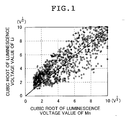
- Fig. 1 is a scattering drawing illustrating the distribution of (X,Y) in which X is a cubic root of the luminescence voltage value ascribable to a manganese atom and Y is a cubic root of the luminescence voltage ascribable to a lithium atom in a lithium-manganese composite oxide particle of the positive electrode active material of the present invention (Example 1).
- Fig. 3 is an explanatory view for illustrating how to concretely obtain an error of each point with respect to a primary regression line.
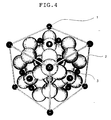
- Fig. 4 is a schematic diagram showing the crystal structure of a lithium-transition metal composite oxide of the spinel structure.
- Fig. 5 is a schematic sectional view showing a positive electrode.
- Fig. 6 is a schematic sectional view showing a cylinder type battery.
- Fig. 8 is a schematic perspective view showing a square type battery.
- Fig. 9 is a chart illustrating the state of existence of magnesium, obtained by line analysis by EPMA on the positive electrode active material obtained in Example 1.
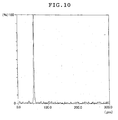
- the positive electrode active material of the present invention will be described in more detail by embodiments, examples and Figs. 1 to 10.
- the present invention should not be considered to be limited to the embodiments, the examples and Figs. 1 to 10.
- the positive electrode active material of the present invention includes at least a lithium-transition metal composite oxide of a spinel structure (spinel type crystal structure).
- spinel structure is one of representative crystal structure types found in compounds that are composite oxides and are of the AB204 type (where A and B represent metal atoms).
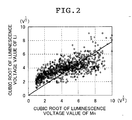
- each of the particles is given a two-dimensional coordinate having as coordinate components cubic roots of luminescence voltage values ascribable to a transition metal and lithium to represent the respective particles by points in a coordinate plane, and that a primary regression line passing an origin is obtained, a mean absolute deviation of an error of each of the points with respect to the primary regression line is 0.25 or less.
- channel 3 of the detector of the apparatus was used and the emission spectra at a light emission wavelength of 670.780 nm were measured in a high voltage power source magnification of 0.75.
- the analyzing apparatus is not particularly limited to the above-mentioned apparatus but an apparatus that performs elemental analysis of particles by light emission voltage of each element by use of microwave plasma may also be used.
- the obtained primary regression line is illustrated in Figs. 1 and 2.
- n the number of measured particles
- e' represents an average value of errors.
- the mean absolute deviation E of errors varies in the range of 0 ⁇ E ⁇ 1.
- the compositional ratio of the lithium-manganese composite oxide has unevenness among particles, which readily causes elution of manganese ions from particles with small Li/Mn molar ratio. As a result, the cycle characteristics and storage characteristics are decreased and in some cases the swelling of the battery also occurs.
- the above-mentioned effects are each realized by controlling the compositional ratio of each particle based on the mean absolute deviation of errors.
- D10, D50 and D90 are expressed by more preferable relational expressions depending on the purpose and usage. For example, in order to further increase the polar plate density, it is preferable that all of the following relational expressions be satisfied: 0.2 ⁇ (D10/D50) ⁇ 0.9 1.2 ⁇ (D90/D50) ⁇ 2 7 ⁇ m ⁇ D50 ⁇ 30 ⁇ m
- a nonaqueous electrolyte secondary battery with the positive electrode active material of the present invention in order for a nonaqueous electrolyte secondary battery with the positive electrode active material of the present invention to be used advantageously in a fixed manner such as for housing, household, etc., it is preferred that all of the following relational expressions be satisfied: 0.7 ⁇ (D10/D50) ⁇ 1 1 ⁇ (D90/D50) ⁇ 1.3 7 ⁇ m ⁇ D50 ⁇ 15 ⁇ m In this case, the cycle characteristics, storage characteristics, load characteristics and output characteristics are particularly excellent.
- a nonaqueous electrolyte secondary battery with the positive electrode active material of the present invention in order for a nonaqueous electrolyte secondary battery with the positive electrode active material of the present invention to be used advantageously for cellular phones, electrically powered tools, electric vehicles, etc., it is preferred that all of the following relational expressions be satisfied: 0.2 ⁇ (D10/D50) ⁇ 0.7 1.3 ⁇ (D90/D50) ⁇ 2 15 ⁇ m ⁇ D50 ⁇ 36 ⁇ m In this case, the cycle characteristics, storage characteristics, load characteristics and output characteristics are particularly excellent, and the polar plate density is still more excellent.
- the method for measuring the particle distribution of particles includes, for example, a sifting method, an image analysis method, a sedimentation method, a laser diffraction scattering method, and an electric detection method.
- the standard deviation of particle size is preferably 0.4 or less, and more preferably, 0.36 or less. Further, it is preferably 0.07 or more. If the standard deviation of particle size is in the above-mentioned range, the polar plate density can be increased without deteriorating the cycle characteristics, storage characteristics, load characteristics, and output characteristics.
- the transition metal is preferably manganese. If the transition metal is manganese, a nonaqueous electrolyte secondary battery with the positive electrode active material of the present invention has a particularly excellent cycle characteristics, storage characteristics and load characteristics, so that it can be used particularly advantageously in cellular phones, electrically powered tools and the like. Further, since the battery is also excellent in output characteristics, it can be used particularly advantageously for use electric vehicles too.
- lithium-transition metal composite oxide In the positive electrode active material of the present invention, preferred embodiments of the lithium-transition metal composite oxide include embodiments (i) to (viii) given below.
- e is preferably 0.0017 or more, and preferably 0.02 or less. If e is too small, the resistance to electron migration is in some cases decreased. If e is too large, the swelling of the battery due to adsorption of moisture may occur.
- the lithium-transition metal composite oxide preferably contains iron in a content of 25 ppm or less, more preferably 20 ppm or less, and still more preferably 18 ppm or less. Too high a content of iron may in some cases cause internal short circuit of the battery.
- the lithium-transition metal composite oxide when containing magnesium, preferably has an abundance ratio of magnesium on the surface of particles of 20% or more.
- the abundance ratio of magnesium on the surface of particles is more preferably 40% or more, and still more preferably 60% or more, and yet more preferably 80% or more.
- the abundance ratio of magnesium on the surface of the particles of the lithium-transition metal composite oxide is within the above-mentioned range, magnesium exists uniformly on the surface of the particles, so that excellent effect of suppressing the elution of the transition metal ions is obtained.
- the state in which magnesium exists on the surface of the particles is not particularly limited.
- the "abundance ratio of magnesium on the surface of the particles of lithium-transition metal composite oxide” can be obtained as follows.
- a group of particles of a lithium-transition metal composite oxide is observed for the state of existence of magnesium on the surface of the particles using an electron probe microanalyzer (EPMA) equipped with a wavelength dispersive X-ray photospectrometer (WDX). Then, a part at which the amount of magnesium per unit area is largest (i.e., the magnesium peak is highest) in the visual field of observation is selected and a line analysis is performed along a line segment (for example, a line segment of 300 ⁇ m long) passing through this part.
- EPMA electron probe microanalyzer
- WDX wavelength dispersive X-ray photospectrometer
- the lengths of parts having peak values of 4% or more assuming that the above-mentioned part at which the amount of magnesium per unit area is largest has a peak value of 100% are summed and the sum is divided by the length of the line segment.
- the quotient is defined as an "abundance ratio of magnesium on the surface of a particle of a lithium-transition metal composite oxide". Note that it is preferable that an average value of the "abundance ratio of magnesium on the surface of a particle of a lithium-transition metal composite oxide" obtained by repeating the line analysis a plurality of times (for example, 10 times) is used.
- crystallite refers to a maximum set that is considered to be a single crystal
- crystallite diameter refers to the size of a crystallite
- the degree of regularity of unit lattice arrangement can be expressed by the (400) crystallite diameter as described below.
- D represents the size of a crystallite ( ⁇ )
- K represents the Scherrer constant (that is 1.05 when ⁇ is calculated from the integral breadth)
- ⁇ represents the wavelength of an X-ray source (1.540562 ⁇ in the case of CuK ⁇ 1)
- ⁇ represents the width (radian) of a diffraction ray due to the size of the crystallite
- ⁇ represents a diffraction angle (degree).
- the positive electrode active material of the present invention has a specific surface area of 0.2 to 1.2 m 2 /g.
- the specific surface area is more preferably 0.25 m 2 /g or more and it is more preferably 0.9 m 2 /g or less. If the specific surface area is too small, the obtained battery has a decreased discharge capacity. If the specific surface area is too large, no battery having excellent cycle characteristics can be obtained.
- the specific surface area can be measured by a nitrogen gas adsorption method.
- the ratio of particles having a volume-based particle size of 50 ⁇ m or more be 10 vol% or less, more preferably 7 vol % or less, based on total particles.
- the positive electrode active material of the present invention can be produced by a method that is not particularly limited and includes, for example, the following (1) and (2).
- the compounds described hereinbelow are mixed such that each constituent element can exist in a predetermined compositional ratio to obtain a starting material mixture.
- the compounds used for preparing the starting material mixture are selected depending on the elements that constitute the objective composition.
- the lithium compound is not particularly limited and includes, for example, Li 2 CO 3 , LiOH, LiOH ⁇ H 2 O, Li 2 O, LiCl, LiNO 3 , Li 2 SO 4 , LiHCO 3 , Li (CH 3 COO) , lithium fluoride, lithium bromide, lithium iodide, and lithium peroxide.
- Li 2 CO 3 LiOH, LiOH ⁇ H 2 O, Li 2 O, LiCl, LiNO 3 , Li 2 SO 4 , LiHCO 3 , and Li(CH 3 COO).
- manganese compounds having specified particle size distribution more particularly those of which d10 is 5 to 25 ⁇ m, d50 is 7 to 40 ⁇ m, and d90 is 10 to 60 ⁇ m assuming that particle sizes of particles whose volume cumulative frequencies reach 10%, 50% and 90%, respectively, in the particle size distribution thereof are defined as "d10", "d50” and "d90", respectively.
- a mortar, a ball mill, a vibration mill, a jet mill, etc. can be used.
- various classifying apparatus can be used.
- the magnesium compound is not particularly limited and includes, for example, MgO, MgCO 3 , Mg(OH) 2 , MgCl 2 , MgSO 4 , Mg(NO 3 ) 2 , Mg(CH 3 COO) 2 , magnesium iodide, and magnesium perchlorate. Among these are preferred MgSO 4 and Mg(NO 3 ) 2 .
- the Aluminum compound is not particularly limited and includes, for example, Al 2 O 3 , Al(NO 3 ) 3 , Al 2 (SO 4 ) 3 , Al 2 (CO 3 ) 3 , and Al(CH 3 COO) 3 .
- the boron compound is not particularly limited and includes, for example, B 2 O 3 (melting point 460°C), H 3 BO 3 (decomposition temperature 173°C), lithium-boron composite oxide, orthoboric acid, boron oxide, and boron phosphate. Among these are preferred H 3 BO 3 and B 2 O 3 .
- the halogen compound is not particularly limited and includes, for example, NH 4 F, xNH 4 Cl, NH 4 Br, NH 4 I, LiF, LiCl, LiBr, LiI, MnF 2 , MnCl 2 , MnBr 2 , MnI 2 , hydrogen fluoride, fluorine oxide, hydrofluoric acid, hydrogen chloride, hydrochloric acid, chlorine oxide, chlorine oxyfluoride, bromine oxide, bromine fluorosulfate, hydrogen iodide, iodine oxide, and periodic acid.
- NH 4 F NH 4 Cl
- NH 4 Br NH 4 I
- LiF LiCl
- LiBr LiI
- MnF 2 MnCl 2
- MnBr 2 MnI 2
- the sulfur compound is not particularly limited and includes, for example, Li 2 SO 4 , MnSO 4 , (NH 4 ) 2 SO 4 , Al 2 (SO 4 ) 3 , MgSO 4 , sulfides, sulfur iodide, hydrogen sulfide, sulfuric acid and its salts, and nitrogen sulfide.
- Li 2 SO 4 , MnSO 4 , (NH 4 ) 2 SO 4 , Al 2 (SO 4 ) 3 , and MgSO 4 are preferred Li 2 SO 4 , MnSO 4 , (NH 4 ) 2 SO 4 , Al 2 (SO 4 ) 3 , and MgSO 4 .
- the sodium compound is not particularly limited and includes, for example, Na 2 CO 3 , NaOH, Na 2 O, NaCl, NaNO 3 , Na 2 SO 4 , NaHCO 3 , and CH 3 COONa.
- the calcium compound is not particularly limited and includes, for example, CaO, CaCO 3 , Ca(OH) 2 , CaCl 2 , CaSO 4 , Ca(NO 3 ) 2 , and Ca(CH 3 COO) 2 .
- the positive electrode active material which is the lithium-manganese composite oxide containing magnesium and boron.
- An aqueous solution containing predetermined compositional ratios of manganese ions and magnesium ions which is prepared from the above-mentioned manganese compounds and magnesium compounds, is dripped in purified water while being stirred.
- an aqueous solution of ammonium hydrogen carbonate is dripped to precipitate manganese and magnesium to obtain a salt of manganese and magnesium.
- alkali solutions such as an aqueous solution of sodium hydroxide, an aqueous solution of sodium hydrogen carbonate, an aqueous solution of potassium hydroxide, and an aqueous solution of lithium hydroxide may be used in place of the aqueous solution of ammonium hydrogen carbonate.
- the aqueous solution is filtered to collect the precipitate and the collected precipitate is washed with water and heat-treated. Thereafter, the precipitate is mixed with the above-mentioned lithium compounds and boron compounds to obtain the starting material mixture.
- the starting material mixture is calcined.
- the temperature, time and atmosphere of calcination are not particularly limited and may be determined appropriately depending on the purpose.
- the calcination temperature is preferably 650°C or higher, more preferably 700°C or higher. If the calcination temperature is too low, unreacted starting material remains in the resulting positive electrode active material so that in some cases it is impossible to make full use of the original characteristics of the positive electrode active material.
- the calcination temperature is preferably 1,100°C or lower, more preferably 950°C or lower. If the calcination temperature is too high, the particle size of the positive electrode active material may in some cases be too large so that the characteristics of the battery are decreased. Further, byproducts such as LigMnO 3 and LiMnO 2 tend to be easily produced, which may lead to a decrease in discharge capacity per unit weight, a decrease in cycle characteristics, and a decrease in operation voltage.
- the calcination time is preferably 1 to 24 hours, more preferably 6 to 12 hours. If the calcination time is too short, dispersion reaction between starting material particles does not proceed. If the calcination time is too long, the calcination after the dispersion reaction has been approximately completed comes to naught and in some cases coarse particles are formed due to sintering.
- the calcination atmosphere includes, for example, atmospheric gas, oxygen gas, mixed gases composed of one or more of these gases and an inert gas such as nitrogen gas or argon gas, an atmosphere of which the oxygen concentration (oxygen partial pressure) is controlled, and a weakly oxidizing atmosphere. Among these is preferred an atmosphere of which the oxygen concentration is controlled.
- calcination atmospheres preferred is an oxidizing atmosphere having an oxygen concentration of 10 vol% or more.
- an oxidizing atmosphere having an oxygen concentration of 10 vol% or more powder having a (400) crystallite diameter of 600 ⁇ or more can be obtained.
- an oxidizing atmosphere having an oxygen concentration of 18 vol% or more is preferable.
- an oxidizing atmosphere having an oxygen concentration of 18 vol% or more sufficient oxygen is supplied into the crystal structure so that powder having a (400) crystallite diameter of 600 to 1,200 ⁇ can be obtained.
- the product may be pulverized by use of a mortar, a ball mill, a vibration mill, a pin mill, a jet mill, or the like to make powder having an objective particle size.
- calcination followed by pulverization makes the powder to have the specific surface area in the above-mentioned suitable range.
- the positive electrode active material of the present invention can be obtained.
- the positive electrode active material of the present invention is used advantageously in nonaqueous electrolyte secondary batteries such as a lithium ion secondary battery and a lithium ion polymer secondary battery.
- the nonaqueous electrolyte secondary battery just needs to use the positive electrode active material of the present invention as at least a portion of the positive electrode active material used in a conventional nonaqueous secondary battery, and other construction is not particularly limited.
- the nonaqueous electrolyte secondary battery will be described in more detail by taking the lithium ion secondary battery as an example.
- lithium metal lithium alloys, or compounds that can occlude and release lithium ions
- the lithium alloys include, for example, LiAl alloys, LiSn alloys, and LiPb alloys.
- the compounds that can occlude and release lithium ions include, for example, carbon materials such as graphite and black lead, and oxides such as tin oxide and titanium oxide.
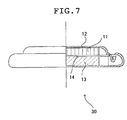
- Fig. 8 is a schematic perspective view showing a square type battery. As shown in Fig. 8, in a square type battery 40, positive electrodes 13 which are made by forming layers of a positive electrode active material on current collectors 12, and negative electrodes 11 which are made by forming layers of a negative electrode active material on current collectors 12 are alternately laminated on one another through separators 14.
- a positive electrode active material was obtained in the same manner as in Example 5 except that the mixing ratios of carbonate of manganese and magnesium, orthoboric acid and lithium carbonate were changed.
- the specific surface area of the obtained positive electrode active material was measured by a constant-pressure BET adsorption method using nitrogen gas.
- the particle size distribution of the obtained positive electrode active material was measured by a laser diffraction scattering method and the D10, D50, D90, standard deviation of particle size and ratio of particles having a volume-based particle size of 50 ⁇ m or more were obtained.
- the positive electrode active material of the present invention had a low elution amount of Mn and excellent storage characteristics as compared with the positive electrode active material of Comparative Example 1. Further, it can be seen that the positive electrode active material of the present invention had a polar plate density identical to that of the positive electrode active material of Comparative Example 1.
- the secondary battery for a test of which the negative electrode was lithium metal was fabricated as described below.
- the secondary battery for a test of which the negative electrode was lithium metal was discharged.
- the discharge capacity was defined as a 0.24C initial discharge capacity.
- the secondary battery for a test of which the negative electrode was lithium metal was discharged.
- the discharge capacity was defined as a load discharge capacity.
- an initial discharge capacity was measured under the conditions of a charging potential of 4.3 V, a discharging potential of 2.85 V, and a discharging load of 0.24 C, and then a load discharge capacity was measured under the conditions of a charging potential of 4.3 V, a discharging potential of 2.85 V, and a discharging load of 3.5 C.
- the value of the obtained load discharge capacity was divided by the value of the initial discharge capacity to obtain load efficiency at a discharging load of 3.5 C was obtained.
- the positive electrode active material of the present invention have both an excellent initial discharge capacity and an excellent load discharge capacity, and both an excellent initial efficiency and an excellent load efficiency, as well as excellent cycle characteristics.
- the secondary battery for a test of which the negative electrode was carbon was disassembled and the negative electrode and separator were taken out.
- the Mn attached to the negative electrode and separator was dissolved and concentrated, followed by measurement of the elution amount of Mn (i.e., the weight of Mn dissolved from the negative electrode and separator) by an ICP spectrophotometry. It can be said that the smaller the elution amount of Mn, the more excellent the cycle characteristics and storage characteristics.
- Charging and discharging were repeatedly performed under the conditions of a charging potential of 4.2 V, a discharging potential of 2.75 V, and a discharging load of 1.0C and a discharge capacity was measured after 43 cycles.
- the value of the discharge capacity obtained after 43 cycles was divided by the value of the discharge capacity obtained after 1 cycle to obtain a discharge capacity maintenance ratio after 43 cycles and the cycle characteristics were evaluated.
- a cylinder battery was fabricated as described below.
- a positive plate was obtained.
- a carbon material was used as a negative electrode active material, which was coated on a negative electrode current collector and dried in the same manner as in the case of the positive plate to obtain a negative plate.
- a porous polypropylene film was used as a separator.
- the positive plate, negative plate and separator were formed into thin sheets, which were wound and accommodated into a metal cylindrical battery case.
- the electrolytic solution was injected into the battery case to obtain a cylinder battery of lithium ion battery.
- Charging and discharging were Repeatedly performed at 60°C under the conditions of a charging potential of 4.2 V, a discharging potential of 2.75 V, and a discharging load of 2C and a discharge capacity was measured after 200 cycles.
- the value of the discharge capacity obtained after 200 cycles was divided by the value of the discharge capacity obtained after 1 cycle to obtain a high temperature discharge capacity maintenance ratio after 200 cycles and the high temperature cycle characteristics were evaluated.
- a load discharge capacity was measured under the conditions of a charging potential of 4.2 V, a discharging potential of 2.75 V, and a discharging load of 2.0 C.
- the value of the obtained load discharge capacity was divided by the value of the initial discharge capacity to obtain load efficiency at a discharging load of 2.0C.
- An initial discharge capacity and an electric power amount were measured under the conditions of a charging potential of 4.2 V, a discharging potential of 2.75 V, and a discharging load of 0.2 C.
- the value of the obtained electric power amount was divided by the value of the initial discharge capacity to obtain an average potential.
- the positive electrode active material of the present invention have both excellent cycle characteristics and excellent high temperature cycle characteristics, as well as the high average potential under load and excellent load capacity maintenance ratio.
Landscapes
- Chemical & Material Sciences (AREA)
- Chemical Kinetics & Catalysis (AREA)
- Electrochemistry (AREA)
- General Chemical & Material Sciences (AREA)
- Inorganic Chemistry (AREA)
- Engineering & Computer Science (AREA)
- Manufacturing & Machinery (AREA)
- Battery Electrode And Active Subsutance (AREA)
- Secondary Cells (AREA)
Applications Claiming Priority (4)
| Application Number | Priority Date | Filing Date | Title |
|---|---|---|---|
| JP2002145377 | 2002-05-20 | ||
| JP2002145377 | 2002-05-20 | ||
| JP2003122165A JP2004327309A (ja) | 2003-04-25 | 2003-04-25 | 非水電解液二次電池用正極活物質 |
| JP2003122165 | 2003-04-25 |
Publications (3)
| Publication Number | Publication Date |
|---|---|
| EP1391949A2 true EP1391949A2 (de) | 2004-02-25 |
| EP1391949A3 EP1391949A3 (de) | 2006-01-11 |
| EP1391949B1 EP1391949B1 (de) | 2011-03-16 |
Family
ID=29714282
Family Applications (1)
| Application Number | Title | Priority Date | Filing Date |
|---|---|---|---|
| EP03011081A Expired - Lifetime EP1391949B1 (de) | 2002-05-20 | 2003-05-20 | Pluspol-Aktivmaterial für nicht-wässrige Elektrolyt-Sekundärzelle |
Country Status (6)
| Country | Link |
|---|---|
| US (1) | US20040013941A1 (de) |
| EP (1) | EP1391949B1 (de) |
| KR (1) | KR100562366B1 (de) |
| CN (1) | CN1300869C (de) |
| AT (1) | ATE502408T1 (de) |
| DE (1) | DE60336367D1 (de) |
Cited By (3)
| Publication number | Priority date | Publication date | Assignee | Title |
|---|---|---|---|---|
| US7927741B2 (en) | 2007-01-26 | 2011-04-19 | Mitsui Mining & Smelting Co., Ltd. | Lithium transition metal oxide having layered structure |
| US20140349188A1 (en) * | 2005-08-01 | 2014-11-27 | Santoku Corporation | Positive electrode active material, positive electrode for nonaqueous electrolyte battery, and nonaqueous electrolyte battery |
| EP3152795B1 (de) | 2014-06-04 | 2019-10-02 | QuantumScape Corporation | Elektrodenmaterialien mit gemischten teilchengrössen |
Families Citing this family (36)
| Publication number | Priority date | Publication date | Assignee | Title |
|---|---|---|---|---|
| JP4245532B2 (ja) | 2004-08-30 | 2009-03-25 | 株式会社東芝 | 非水電解質二次電池 |
| EP1919012A1 (de) * | 2005-08-26 | 2008-05-07 | Matsushita Electric Industrial Co., Ltd. | Alkaline trockenbatterie |
| JP4625744B2 (ja) * | 2005-09-29 | 2011-02-02 | 株式会社東芝 | 非水電解質電池および電池パック |
| ATE556447T1 (de) | 2006-12-26 | 2012-05-15 | Santoku Corp | Positivelektroden-aktivmaterial für eine sekundärbatterie mit wasserfreiem elektrolyt, positivelektrode und sekundärbatterie |
| JP5392696B2 (ja) * | 2008-02-07 | 2014-01-22 | 独立行政法人産業技術総合研究所 | コアシェル型酸化コバルト微粒子又はそれを含有する分散液、それらの製造方法及び用途 |
| DE102008029804A1 (de) * | 2008-06-24 | 2010-07-08 | Süd-Chemie AG | Mischoxid enthaltend einen Lithium-Mangan-Spinell und Verfahren zu dessen Herstellung |
| WO2010032449A1 (ja) * | 2008-09-18 | 2010-03-25 | 戸田工業株式会社 | マンガン酸リチウム粒子粉末の製造方法及び非水電解質二次電池 |
| WO2010129417A1 (en) * | 2009-05-04 | 2010-11-11 | Meecotech, Inc. | Electrode active composite materials and methods of making thereof |
| DE102010032207B4 (de) | 2010-07-26 | 2014-02-13 | Süd-Chemie Ip Gmbh & Co. Kg | Verfahren zur Verminderung von magnetischen und/oder oxidischen Verunreinigungen in Lithium-Metall-Sauerstoff-Verbindungen |
| JP5532328B2 (ja) * | 2010-09-13 | 2014-06-25 | ソニー株式会社 | 負極活物質、二次電池、電動工具、電気自動車および電力貯蔵システム |
| KR101388919B1 (ko) * | 2011-05-27 | 2014-04-24 | 에스케이씨 주식회사 | 리튬이차전지용 리튬망간산화물 및 이의 제조방법 |
| JP5835612B2 (ja) * | 2011-12-06 | 2015-12-24 | トヨタ自動車株式会社 | 非水系二次電池 |
| KR20130090312A (ko) | 2012-02-03 | 2013-08-13 | 주식회사 엘지화학 | 리튬 이차전지용 리튬 복합 전이금속 산화물의 전구체 입자들 및 이를 포함하는 양극 활물질 |
| US9478808B2 (en) * | 2012-12-12 | 2016-10-25 | Samsung Sdi Co., Ltd. | Positive active material, positive electrode and rechargeable lithium battery including same |
| US9905850B2 (en) | 2013-07-26 | 2018-02-27 | Lg Chem, Ltd. | Polycrystalline lithium manganese oxide particles, preparation method thereof, and cathode active material including the same |
| US9905851B2 (en) | 2013-07-26 | 2018-02-27 | Lg Chem, Ltd. | Cathode active material and method of preparing the same |
| US10236499B2 (en) | 2013-07-26 | 2019-03-19 | Lg Chem, Ltd. | Polycrystalline lithium manganese oxide particles, preparation method thereof, and cathode active material including the same |
| KR102426251B1 (ko) * | 2015-04-28 | 2022-07-28 | 삼성에스디아이 주식회사 | 리튬이차전지용 산화코발트, 이로부터 형성된 리튬이차전지용 리튬코발트산화물, 그 제조방법 및 이를 포함한 양극을 구비한 리튬 이차 전지 |
| US10987735B2 (en) | 2015-12-16 | 2021-04-27 | 6K Inc. | Spheroidal titanium metallic powders with custom microstructures |
| HUE065423T2 (hu) | 2015-12-16 | 2024-05-28 | 6K Inc | Eljárás szferoidális dehidrogénezett titánötvözet részecskék elõállítására |
| WO2017150504A1 (ja) * | 2016-02-29 | 2017-09-08 | 三井金属鉱業株式会社 | スピネル型リチウムマンガン含有複合酸化物 |
| CN108713265B (zh) * | 2016-03-04 | 2022-01-04 | 松下知识产权经营株式会社 | 非水电解质二次电池 |
| AU2019290663B2 (en) | 2018-06-19 | 2023-05-04 | 6K Inc. | Process for producing spheroidized powder from feedstock materials |
| KR102671430B1 (ko) | 2019-02-22 | 2024-05-30 | 주식회사 엘지에너지솔루션 | 음극 활물질 및 이를 포함하는 리튬이차전지 |
| CA3134573A1 (en) | 2019-04-30 | 2020-11-05 | Sunil Bhalchandra BADWE | Mechanically alloyed powder feedstock |
| WO2021118762A1 (en) | 2019-11-18 | 2021-06-17 | 6K Inc. | Unique feedstocks for spherical powders and methods of manufacturing |
| US11590568B2 (en) | 2019-12-19 | 2023-02-28 | 6K Inc. | Process for producing spheroidized powder from feedstock materials |
| AU2021297476A1 (en) | 2020-06-25 | 2022-12-15 | 6K Inc. | Microcomposite alloy structure |
| AU2021349358A1 (en) | 2020-09-24 | 2023-02-09 | 6K Inc. | Systems, devices, and methods for starting plasma |
| EP4237174A1 (de) | 2020-10-30 | 2023-09-06 | 6K Inc. | Systeme und verfahren zur synthese von sphäroidisierten metallpulvern |
| EP4275239A4 (de) | 2021-01-11 | 2024-12-18 | 6K Inc. | Verfahren und systeme zur rückgewinnung von li-ionen-kathodenmaterialien mittels mikrowellenplasmaverarbeitung |
| AU2022246797A1 (en) | 2021-03-31 | 2023-10-05 | 6K Inc. | Systems and methods for additive manufacturing of metal nitride ceramics |
| WO2023229928A1 (en) | 2022-05-23 | 2023-11-30 | 6K Inc. | Microwave plasma apparatus and methods for processing materials using an interior liner |
| US12040162B2 (en) | 2022-06-09 | 2024-07-16 | 6K Inc. | Plasma apparatus and methods for processing feed material utilizing an upstream swirl module and composite gas flows |
| WO2024044498A1 (en) | 2022-08-25 | 2024-02-29 | 6K Inc. | Plasma apparatus and methods for processing feed material utilizing a powder ingress preventor (pip) |
| US12195338B2 (en) | 2022-12-15 | 2025-01-14 | 6K Inc. | Systems, methods, and device for pyrolysis of methane in a microwave plasma for hydrogen and structured carbon powder production |
Family Cites Families (10)
| Publication number | Priority date | Publication date | Assignee | Title |
|---|---|---|---|---|
| DE4435117C1 (de) * | 1994-09-30 | 1996-05-15 | Zsw | Ternäre Lithium-Mischoxide, Verfahren zu deren Herstellung sowie deren Verwendung |
| TW434187B (en) * | 1997-05-07 | 2001-05-16 | Fuji Chem Ind Co Ltd | A process for preparing a spinel type of lithium manganese complex oxide |
| DE19817357B4 (de) * | 1998-04-18 | 2008-10-30 | Robert Bosch Gmbh | Mikromechanisches Bauelement |
| CA2298095C (en) * | 1999-02-05 | 2005-03-01 | Ngk Insulators, Ltd. | Lithium secondary battery |
| JP2000231921A (ja) * | 1999-02-10 | 2000-08-22 | Toyota Central Res & Dev Lab Inc | リチウム二次電池用正極活物質の製造方法 |
| JP5199522B2 (ja) * | 1999-08-17 | 2013-05-15 | 日揮触媒化成株式会社 | スピネル型リチウム・マンガン複合酸化物、その製造方法および用途 |
| WO2001036334A1 (fr) * | 1999-11-15 | 2001-05-25 | Mitsubishi Chemical Corporation | Oxyde composite de lithium-manganese, materiau d'electrode positive pour accumulateur secondaire au lithium, electrode positive et accumulateur secondaire au lithium, et procede de preparation d'oxyde composite de lithium-manganese |
| JP4743804B2 (ja) * | 1999-11-24 | 2011-08-10 | 日立金属株式会社 | 非水系リチウム二次電池用正極活物質及びその製造方法 |
| JP2001155728A (ja) * | 1999-11-24 | 2001-06-08 | Hitachi Metals Ltd | 非水系リチウム二次電池用正極活物質及びその製造方法 |
| JP3816305B2 (ja) * | 2000-06-09 | 2006-08-30 | 日鉱メタルプレーティング株式会社 | 酸化コバルト粉の製造方法 |
-
2003
- 2003-05-19 KR KR1020030031611A patent/KR100562366B1/ko not_active Expired - Fee Related
- 2003-05-19 US US10/440,181 patent/US20040013941A1/en not_active Abandoned
- 2003-05-19 CN CNB031237258A patent/CN1300869C/zh not_active Expired - Fee Related
- 2003-05-20 DE DE60336367T patent/DE60336367D1/de not_active Expired - Lifetime
- 2003-05-20 AT AT03011081T patent/ATE502408T1/de not_active IP Right Cessation
- 2003-05-20 EP EP03011081A patent/EP1391949B1/de not_active Expired - Lifetime
Cited By (4)
| Publication number | Priority date | Publication date | Assignee | Title |
|---|---|---|---|---|
| US20140349188A1 (en) * | 2005-08-01 | 2014-11-27 | Santoku Corporation | Positive electrode active material, positive electrode for nonaqueous electrolyte battery, and nonaqueous electrolyte battery |
| US9337473B2 (en) | 2005-08-01 | 2016-05-10 | Santoku Corporation | Positive electrode active material, positive electrode for nonaqueous electrolyte battery, and nonaqueous electrolyte battery |
| US7927741B2 (en) | 2007-01-26 | 2011-04-19 | Mitsui Mining & Smelting Co., Ltd. | Lithium transition metal oxide having layered structure |
| EP3152795B1 (de) | 2014-06-04 | 2019-10-02 | QuantumScape Corporation | Elektrodenmaterialien mit gemischten teilchengrössen |
Also Published As
| Publication number | Publication date |
|---|---|
| EP1391949A3 (de) | 2006-01-11 |
| ATE502408T1 (de) | 2011-04-15 |
| CN1300869C (zh) | 2007-02-14 |
| KR100562366B1 (ko) | 2006-03-20 |
| CN1461066A (zh) | 2003-12-10 |
| KR20030090529A (ko) | 2003-11-28 |
| EP1391949B1 (de) | 2011-03-16 |
| HK1058107A1 (en) | 2004-04-30 |
| DE60336367D1 (de) | 2011-04-28 |
| US20040013941A1 (en) | 2004-01-22 |
Similar Documents
| Publication | Publication Date | Title |
|---|---|---|
| EP1391949B1 (de) | Pluspol-Aktivmaterial für nicht-wässrige Elektrolyt-Sekundärzelle | |
| US7294435B2 (en) | Positive electrode active material for nonaqueous electrolyte secondary battery, positive electrode mixture for nonaqueous electrolyte secondary battery, and nonaqueous electrolyte secondary battery | |
| JP5382025B2 (ja) | 非水電解質二次電池、非水電解質二次電池用正極活物質および非水電解質二次電池用正極合剤 | |
| JP2004193115A (ja) | 非水電解質二次電池用正極活物質および非水電解質二次電池 | |
| JP2006012433A (ja) | 非水電解質二次電池用正極活物質および非水電解質二次電池 | |
| JP2004253174A (ja) | 非水電解液二次電池用正極活物質 | |
| JP2005251716A (ja) | 非水電解質二次電池用正極活物質、非水電解質二次電池用正極合剤および非水電解質二次電池 | |
| JP2004227790A (ja) | 非水電解液二次電池用正極活物質 | |
| JP2006012426A (ja) | 非水電解質二次電池用正極活物質および非水電解質二次電池 | |
| JP2004235144A (ja) | 非水電解質二次電池用負極活物質および非水電解質二次電池 | |
| JP2002151070A (ja) | 非水電解質二次電池 | |
| JP4259393B2 (ja) | 非水電解質二次電池用正極活物質および非水電解質二次電池 | |
| JP2005222956A (ja) | 非水電解液二次電池 | |
| JP4876371B2 (ja) | 非水電解質二次電池用正極活物質、非水電解質二次電池用正極合剤および非水電解質二次電池 | |
| JP2005044722A (ja) | 非水電解液二次電池用正極活物質および非水電解液二次電池 | |
| JP3856015B2 (ja) | 非水電解液二次電池用正極副活物質、非水電解液二次電池用正極活物質および非水電解液二次電池 | |
| JP4626141B2 (ja) | 非水電解質二次電池用正極活物質および非水電解質二次電池 | |
| JP2004047448A (ja) | 非水電解液二次電池用正極活物質 | |
| JP2004327309A (ja) | 非水電解液二次電池用正極活物質 | |
| JP5044882B2 (ja) | 非水電解液二次電池用正極活物質および非水電解液二次電池 | |
| JP4940530B2 (ja) | 非水電解液二次電池用正極活物質 | |
| JP2005158612A (ja) | 非水電解質二次電池用正極副活物質、非水電解質二次電池用正極活物質、非水電解質二次電池および非水電解質二次電池の製造方法 | |
| JP3835419B2 (ja) | 非水電解液二次電池用正極活物質 | |
| JP2005190900A (ja) | 非水電解質二次電池用正極活物質および非水電解質二次電池 | |
| JP4765254B2 (ja) | 非水電解質二次電池、非水電解質二次電池用正極活物質および非水電解質二次電池用正極合剤 |
Legal Events
| Date | Code | Title | Description |
|---|---|---|---|
| PUAI | Public reference made under article 153(3) epc to a published international application that has entered the european phase |
Free format text: ORIGINAL CODE: 0009012 |
|
| 17P | Request for examination filed |
Effective date: 20030618 |
|
| AK | Designated contracting states |
Kind code of ref document: A2 Designated state(s): AT BE BG CH CY CZ DE DK EE ES FI FR GB GR HU IE IT LI LU MC NL PT RO SE SI SK TR |
|
| AX | Request for extension of the european patent |
Extension state: AL LT LV MK |
|
| PUAL | Search report despatched |
Free format text: ORIGINAL CODE: 0009013 |
|
| AK | Designated contracting states |
Kind code of ref document: A3 Designated state(s): AT BE BG CH CY CZ DE DK EE ES FI FR GB GR HU IE IT LI LU MC NL PT RO SE SI SK TR |
|
| AX | Request for extension of the european patent |
Extension state: AL LT LV MK |
|
| RIC1 | Information provided on ipc code assigned before grant |
Ipc: H01M 4/48 20060101AFI20031216BHEP Ipc: H01M 4/50 20060101ALI20051124BHEP Ipc: C01G 45/00 20060101ALI20051124BHEP |
|
| AKX | Designation fees paid |
Designated state(s): AT BE BG CH CY CZ DE DK EE ES FI FR GB GR HU IE IT LI LU MC NL PT RO SE SI SK TR |
|
| 17Q | First examination report despatched |
Effective date: 20061115 |
|
| GRAP | Despatch of communication of intention to grant a patent |
Free format text: ORIGINAL CODE: EPIDOSNIGR1 |
|
| RIN1 | Information on inventor provided before grant (corrected) |
Inventor name: NAKANO, YOKO Inventor name: KOBAYASHI, KENICHI |
|
| GRAS | Grant fee paid |
Free format text: ORIGINAL CODE: EPIDOSNIGR3 |
|
| RAP1 | Party data changed (applicant data changed or rights of an application transferred) |
Owner name: NICHIA CORPORATION |
|
| GRAA | (expected) grant |
Free format text: ORIGINAL CODE: 0009210 |
|
| AK | Designated contracting states |
Kind code of ref document: B1 Designated state(s): AT BE BG CH CY CZ DE DK EE ES FI FR GB GR HU IE IT LI LU MC NL PT RO SE SI SK TR |
|
| REG | Reference to a national code |
Ref country code: GB Ref legal event code: FG4D |
|
| REG | Reference to a national code |
Ref country code: CH Ref legal event code: EP |
|
| REG | Reference to a national code |
Ref country code: IE Ref legal event code: FG4D |
|
| REF | Corresponds to: |
Ref document number: 60336367 Country of ref document: DE Date of ref document: 20110428 Kind code of ref document: P |
|
| REG | Reference to a national code |
Ref country code: DE Ref legal event code: R096 Ref document number: 60336367 Country of ref document: DE Effective date: 20110428 |
|
| REG | Reference to a national code |
Ref country code: NL Ref legal event code: VDEP Effective date: 20110316 |
|
| PG25 | Lapsed in a contracting state [announced via postgrant information from national office to epo] |
Ref country code: GR Free format text: LAPSE BECAUSE OF FAILURE TO SUBMIT A TRANSLATION OF THE DESCRIPTION OR TO PAY THE FEE WITHIN THE PRESCRIBED TIME-LIMIT Effective date: 20110617 Ref country code: ES Free format text: LAPSE BECAUSE OF FAILURE TO SUBMIT A TRANSLATION OF THE DESCRIPTION OR TO PAY THE FEE WITHIN THE PRESCRIBED TIME-LIMIT Effective date: 20110627 Ref country code: SE Free format text: LAPSE BECAUSE OF FAILURE TO SUBMIT A TRANSLATION OF THE DESCRIPTION OR TO PAY THE FEE WITHIN THE PRESCRIBED TIME-LIMIT Effective date: 20110316 |
|
| PG25 | Lapsed in a contracting state [announced via postgrant information from national office to epo] |
Ref country code: AT Free format text: LAPSE BECAUSE OF FAILURE TO SUBMIT A TRANSLATION OF THE DESCRIPTION OR TO PAY THE FEE WITHIN THE PRESCRIBED TIME-LIMIT Effective date: 20110316 Ref country code: CY Free format text: LAPSE BECAUSE OF FAILURE TO SUBMIT A TRANSLATION OF THE DESCRIPTION OR TO PAY THE FEE WITHIN THE PRESCRIBED TIME-LIMIT Effective date: 20110316 Ref country code: SI Free format text: LAPSE BECAUSE OF FAILURE TO SUBMIT A TRANSLATION OF THE DESCRIPTION OR TO PAY THE FEE WITHIN THE PRESCRIBED TIME-LIMIT Effective date: 20110316 Ref country code: FI Free format text: LAPSE BECAUSE OF FAILURE TO SUBMIT A TRANSLATION OF THE DESCRIPTION OR TO PAY THE FEE WITHIN THE PRESCRIBED TIME-LIMIT Effective date: 20110316 Ref country code: BG Free format text: LAPSE BECAUSE OF FAILURE TO SUBMIT A TRANSLATION OF THE DESCRIPTION OR TO PAY THE FEE WITHIN THE PRESCRIBED TIME-LIMIT Effective date: 20110616 |
|
| PG25 | Lapsed in a contracting state [announced via postgrant information from national office to epo] |
Ref country code: BE Free format text: LAPSE BECAUSE OF FAILURE TO SUBMIT A TRANSLATION OF THE DESCRIPTION OR TO PAY THE FEE WITHIN THE PRESCRIBED TIME-LIMIT Effective date: 20110316 |
|
| PG25 | Lapsed in a contracting state [announced via postgrant information from national office to epo] |
Ref country code: EE Free format text: LAPSE BECAUSE OF FAILURE TO SUBMIT A TRANSLATION OF THE DESCRIPTION OR TO PAY THE FEE WITHIN THE PRESCRIBED TIME-LIMIT Effective date: 20110316 Ref country code: PT Free format text: LAPSE BECAUSE OF FAILURE TO SUBMIT A TRANSLATION OF THE DESCRIPTION OR TO PAY THE FEE WITHIN THE PRESCRIBED TIME-LIMIT Effective date: 20110718 |
|
| PG25 | Lapsed in a contracting state [announced via postgrant information from national office to epo] |
Ref country code: RO Free format text: LAPSE BECAUSE OF FAILURE TO SUBMIT A TRANSLATION OF THE DESCRIPTION OR TO PAY THE FEE WITHIN THE PRESCRIBED TIME-LIMIT Effective date: 20110316 Ref country code: SK Free format text: LAPSE BECAUSE OF FAILURE TO SUBMIT A TRANSLATION OF THE DESCRIPTION OR TO PAY THE FEE WITHIN THE PRESCRIBED TIME-LIMIT Effective date: 20110316 Ref country code: CZ Free format text: LAPSE BECAUSE OF FAILURE TO SUBMIT A TRANSLATION OF THE DESCRIPTION OR TO PAY THE FEE WITHIN THE PRESCRIBED TIME-LIMIT Effective date: 20110316 |
|
| PG25 | Lapsed in a contracting state [announced via postgrant information from national office to epo] |
Ref country code: MC Free format text: LAPSE BECAUSE OF NON-PAYMENT OF DUE FEES Effective date: 20110531 Ref country code: NL Free format text: LAPSE BECAUSE OF FAILURE TO SUBMIT A TRANSLATION OF THE DESCRIPTION OR TO PAY THE FEE WITHIN THE PRESCRIBED TIME-LIMIT Effective date: 20110316 |
|
| REG | Reference to a national code |
Ref country code: CH Ref legal event code: PL |
|
| PLBE | No opposition filed within time limit |
Free format text: ORIGINAL CODE: 0009261 |
|
| STAA | Information on the status of an ep patent application or granted ep patent |
Free format text: STATUS: NO OPPOSITION FILED WITHIN TIME LIMIT |
|
| PG25 | Lapsed in a contracting state [announced via postgrant information from national office to epo] |
Ref country code: CH Free format text: LAPSE BECAUSE OF NON-PAYMENT OF DUE FEES Effective date: 20110531 Ref country code: LI Free format text: LAPSE BECAUSE OF NON-PAYMENT OF DUE FEES Effective date: 20110531 |
|
| 26N | No opposition filed |
Effective date: 20111219 |
|
| PG25 | Lapsed in a contracting state [announced via postgrant information from national office to epo] |
Ref country code: DK Free format text: LAPSE BECAUSE OF FAILURE TO SUBMIT A TRANSLATION OF THE DESCRIPTION OR TO PAY THE FEE WITHIN THE PRESCRIBED TIME-LIMIT Effective date: 20110316 |
|
| REG | Reference to a national code |
Ref country code: IE Ref legal event code: MM4A |
|
| REG | Reference to a national code |
Ref country code: DE Ref legal event code: R097 Ref document number: 60336367 Country of ref document: DE Effective date: 20111219 |
|
| PG25 | Lapsed in a contracting state [announced via postgrant information from national office to epo] |
Ref country code: IE Free format text: LAPSE BECAUSE OF NON-PAYMENT OF DUE FEES Effective date: 20110520 |
|
| PG25 | Lapsed in a contracting state [announced via postgrant information from national office to epo] |
Ref country code: IT Free format text: LAPSE BECAUSE OF FAILURE TO SUBMIT A TRANSLATION OF THE DESCRIPTION OR TO PAY THE FEE WITHIN THE PRESCRIBED TIME-LIMIT Effective date: 20110316 |
|
| PG25 | Lapsed in a contracting state [announced via postgrant information from national office to epo] |
Ref country code: LU Free format text: LAPSE BECAUSE OF NON-PAYMENT OF DUE FEES Effective date: 20110520 |
|
| PG25 | Lapsed in a contracting state [announced via postgrant information from national office to epo] |
Ref country code: TR Free format text: LAPSE BECAUSE OF FAILURE TO SUBMIT A TRANSLATION OF THE DESCRIPTION OR TO PAY THE FEE WITHIN THE PRESCRIBED TIME-LIMIT Effective date: 20110316 |
|
| PG25 | Lapsed in a contracting state [announced via postgrant information from national office to epo] |
Ref country code: HU Free format text: LAPSE BECAUSE OF FAILURE TO SUBMIT A TRANSLATION OF THE DESCRIPTION OR TO PAY THE FEE WITHIN THE PRESCRIBED TIME-LIMIT Effective date: 20110316 |
|
| REG | Reference to a national code |
Ref country code: FR Ref legal event code: PLFP Year of fee payment: 13 |
|
| REG | Reference to a national code |
Ref country code: FR Ref legal event code: PLFP Year of fee payment: 14 |
|
| REG | Reference to a national code |
Ref country code: FR Ref legal event code: PLFP Year of fee payment: 15 |
|
| REG | Reference to a national code |
Ref country code: FR Ref legal event code: PLFP Year of fee payment: 16 |
|
| PGFP | Annual fee paid to national office [announced via postgrant information from national office to epo] |
Ref country code: FR Payment date: 20210412 Year of fee payment: 19 Ref country code: DE Payment date: 20210420 Year of fee payment: 19 |
|
| PGFP | Annual fee paid to national office [announced via postgrant information from national office to epo] |
Ref country code: GB Payment date: 20210429 Year of fee payment: 19 |
|
| REG | Reference to a national code |
Ref country code: DE Ref legal event code: R119 Ref document number: 60336367 Country of ref document: DE |
|
| GBPC | Gb: european patent ceased through non-payment of renewal fee |
Effective date: 20220520 |
|
| PG25 | Lapsed in a contracting state [announced via postgrant information from national office to epo] |
Ref country code: FR Free format text: LAPSE BECAUSE OF NON-PAYMENT OF DUE FEES Effective date: 20220531 |
|
| PG25 | Lapsed in a contracting state [announced via postgrant information from national office to epo] |
Ref country code: GB Free format text: LAPSE BECAUSE OF NON-PAYMENT OF DUE FEES Effective date: 20220520 Ref country code: DE Free format text: LAPSE BECAUSE OF NON-PAYMENT OF DUE FEES Effective date: 20221201 |