EP1392019A1 - Kommandozeilenschnittstellen Prozessor mit dynamischer Aktualisierung von Attributabhängigkeiten - Google Patents
Kommandozeilenschnittstellen Prozessor mit dynamischer Aktualisierung von Attributabhängigkeiten Download PDFInfo
- Publication number
- EP1392019A1 EP1392019A1 EP03300086A EP03300086A EP1392019A1 EP 1392019 A1 EP1392019 A1 EP 1392019A1 EP 03300086 A EP03300086 A EP 03300086A EP 03300086 A EP03300086 A EP 03300086A EP 1392019 A1 EP1392019 A1 EP 1392019A1
- Authority
- EP
- European Patent Office
- Prior art keywords
- cli
- notification
- specifications
- grammar
- vocabulary
- Prior art date
- Legal status (The legal status is an assumption and is not a legal conclusion. Google has not performed a legal analysis and makes no representation as to the accuracy of the status listed.)
- Granted
Links
- 238000000034 method Methods 0.000 claims abstract description 53
- 238000004891 communication Methods 0.000 claims abstract description 45
- 230000003993 interaction Effects 0.000 claims description 21
- 230000003044 adaptive effect Effects 0.000 claims description 12
- 238000010200 validation analysis Methods 0.000 claims description 9
- 230000000694 effects Effects 0.000 claims description 3
- 230000001902 propagating effect Effects 0.000 claims 1
- 238000009795 derivation Methods 0.000 abstract description 9
- 230000008901 benefit Effects 0.000 abstract description 8
- 238000013461 design Methods 0.000 abstract description 4
- 238000012549 training Methods 0.000 abstract description 3
- 238000007726 management method Methods 0.000 description 72
- 230000002688 persistence Effects 0.000 description 32
- 238000005516 engineering process Methods 0.000 description 29
- 230000006870 function Effects 0.000 description 20
- 230000018109 developmental process Effects 0.000 description 19
- 230000009471 action Effects 0.000 description 16
- 238000013507 mapping Methods 0.000 description 13
- 230000008859 change Effects 0.000 description 11
- 238000011161 development Methods 0.000 description 10
- 238000010586 diagram Methods 0.000 description 9
- 238000013515 script Methods 0.000 description 8
- 230000005540 biological transmission Effects 0.000 description 7
- 230000003287 optical effect Effects 0.000 description 4
- 230000008569 process Effects 0.000 description 4
- 238000012545 processing Methods 0.000 description 4
- 238000013459 approach Methods 0.000 description 3
- 238000012795 verification Methods 0.000 description 3
- 238000006243 chemical reaction Methods 0.000 description 2
- 238000002372 labelling Methods 0.000 description 2
- 238000012986 modification Methods 0.000 description 2
- 230000004048 modification Effects 0.000 description 2
- 230000006855 networking Effects 0.000 description 2
- 230000009467 reduction Effects 0.000 description 2
- RYGMFSIKBFXOCR-UHFFFAOYSA-N Copper Chemical compound [Cu] RYGMFSIKBFXOCR-UHFFFAOYSA-N 0.000 description 1
- 239000012190 activator Substances 0.000 description 1
- 239000000969 carrier Substances 0.000 description 1
- 230000002860 competitive effect Effects 0.000 description 1
- 238000007596 consolidation process Methods 0.000 description 1
- 229910052802 copper Inorganic materials 0.000 description 1
- 239000010949 copper Substances 0.000 description 1
- 230000008030 elimination Effects 0.000 description 1
- 238000003379 elimination reaction Methods 0.000 description 1
- 239000002360 explosive Substances 0.000 description 1
- 239000004744 fabric Substances 0.000 description 1
- 239000000835 fiber Substances 0.000 description 1
- 230000006872 improvement Effects 0.000 description 1
- 230000002452 interceptive effect Effects 0.000 description 1
- 238000012423 maintenance Methods 0.000 description 1
- 230000002085 persistent effect Effects 0.000 description 1
- 238000012913 prioritisation Methods 0.000 description 1
- 238000009877 rendering Methods 0.000 description 1
- 230000004044 response Effects 0.000 description 1
- 230000001360 synchronised effect Effects 0.000 description 1
- 238000012360 testing method Methods 0.000 description 1
Images


Classifications
-
- H—ELECTRICITY
- H04—ELECTRIC COMMUNICATION TECHNIQUE
- H04L—TRANSMISSION OF DIGITAL INFORMATION, e.g. TELEGRAPHIC COMMUNICATION
- H04L41/00—Arrangements for maintenance, administration or management of data switching networks, e.g. of packet switching networks
- H04L41/02—Standardisation; Integration
- H04L41/0226—Mapping or translating multiple network management protocols
-
- H—ELECTRICITY
- H04—ELECTRIC COMMUNICATION TECHNIQUE
- H04L—TRANSMISSION OF DIGITAL INFORMATION, e.g. TELEGRAPHIC COMMUNICATION
- H04L41/00—Arrangements for maintenance, administration or management of data switching networks, e.g. of packet switching networks
- H04L41/02—Standardisation; Integration
- H04L41/022—Multivendor or multi-standard integration
-
- H—ELECTRICITY
- H04—ELECTRIC COMMUNICATION TECHNIQUE
- H04L—TRANSMISSION OF DIGITAL INFORMATION, e.g. TELEGRAPHIC COMMUNICATION
- H04L41/00—Arrangements for maintenance, administration or management of data switching networks, e.g. of packet switching networks
- H04L41/08—Configuration management of networks or network elements
- H04L41/0866—Checking the configuration
- H04L41/0873—Checking configuration conflicts between network elements
-
- H—ELECTRICITY
- H04—ELECTRIC COMMUNICATION TECHNIQUE
- H04L—TRANSMISSION OF DIGITAL INFORMATION, e.g. TELEGRAPHIC COMMUNICATION
- H04L41/00—Arrangements for maintenance, administration or management of data switching networks, e.g. of packet switching networks
- H04L41/08—Configuration management of networks or network elements
- H04L41/0876—Aspects of the degree of configuration automation
- H04L41/0886—Fully automatic configuration
-
- H—ELECTRICITY
- H04—ELECTRIC COMMUNICATION TECHNIQUE
- H04L—TRANSMISSION OF DIGITAL INFORMATION, e.g. TELEGRAPHIC COMMUNICATION
- H04L41/00—Arrangements for maintenance, administration or management of data switching networks, e.g. of packet switching networks
- H04L41/50—Network service management, e.g. ensuring proper service fulfilment according to agreements
- H04L41/5041—Network service management, e.g. ensuring proper service fulfilment according to agreements characterised by the time relationship between creation and deployment of a service
- H04L41/5054—Automatic deployment of services triggered by the service manager, e.g. service implementation by automatic configuration of network components
-
- H—ELECTRICITY
- H04—ELECTRIC COMMUNICATION TECHNIQUE
- H04L—TRANSMISSION OF DIGITAL INFORMATION, e.g. TELEGRAPHIC COMMUNICATION
- H04L41/00—Arrangements for maintenance, administration or management of data switching networks, e.g. of packet switching networks
- H04L41/08—Configuration management of networks or network elements
- H04L41/0803—Configuration setting
- H04L41/0823—Configuration setting characterised by the purposes of a change of settings, e.g. optimising configuration for enhancing reliability
- H04L41/0826—Configuration setting characterised by the purposes of a change of settings, e.g. optimising configuration for enhancing reliability for reduction of network costs
-
- H—ELECTRICITY
- H04—ELECTRIC COMMUNICATION TECHNIQUE
- H04L—TRANSMISSION OF DIGITAL INFORMATION, e.g. TELEGRAPHIC COMMUNICATION
- H04L41/00—Arrangements for maintenance, administration or management of data switching networks, e.g. of packet switching networks
- H04L41/08—Configuration management of networks or network elements
- H04L41/0803—Configuration setting
- H04L41/0823—Configuration setting characterised by the purposes of a change of settings, e.g. optimising configuration for enhancing reliability
- H04L41/0836—Configuration setting characterised by the purposes of a change of settings, e.g. optimising configuration for enhancing reliability to enhance reliability, e.g. reduce downtime
Definitions
- the invention relates to communications network management, and in particular to command driven multi-vendor equipment management.
- communications networks are made up of a collection of managed communications network equipment. Communications services are provisioned over the managed communications network equipment.
- the network management and service provisioning task is complicated by many factors including: multiple communications network equipment vendors having multiple approaches in implementing the communications network equipment; a multitude of data transport technologies, with each vendor specializing in a sub-group of the multitude of data transport technologies; a multitude of network management and service provisioning protocols, with each vendor implementing only a sub-group of the multitude of network management and service provisioning protocols; a multitude of auxiliary network management and service provisioning equipment employing yet another multitude of network management and service provisioning technologies; etc.
- Carriers and service providers of communications services are faced with a large operational overhead in operating multi-vendor equipment, while at the same time necessarily employ multi-vendor equipment to leverage the investment risk associated with the installed communications infrastructure.
- Communications netwo rk equipment includes, but is not limited to: switching equipment, routers, bridges, access nodes providing a multiplexing function, remote access servers, distribution nodes providing a demultiplexing function, customer premise equipment, etc. with next generation communications equipment in development.
- Communications network include data transport networks as well as circuit-switched networks.
- a vendor may chose to implement an integral device 110 having a switching processor and a group of ports 112, while another vendor may chose a customizable implementation of a switching node 120 including: a switching fabric, an equipment rack divided into shelves, each shelf 122 having slot connectors for connection with interface cards, each interface card 124 having at least one port 112.
- a switching fabric including: a switching fabric, an equipment rack divided into shelves, each shelf 122 having slot connectors for connection with interface cards, each interface card 124 having at least one port 112.
- each implementation is adapted for a different environment: the former switching node 110 being more adapted to provide enterprise solutions as a private communications network node, perhaps being further adapted to enable access to public communications services; while the latter switching node 120 is better adapted for high data throughput in the core of public communications networks.
- the former (110) implements a small number of data transport protocols while for the latter (120), data transport protocols are implemented on interface cards 124 and/or ports 112 - providing for a flexible deployment thereof.
- All communications network equipment is subject to design choices which are bound to be different from vendor to vendor.
- Data transport technologies include: electrical transmission of data via copper pairs, coaxial cable, etc: optical transmission of data via optical cables; free space optical interconnects, etc.; wireless transmission of data via radio modems, microwave links, wireless Local Area Networking (LAN), etc.; with next generation data transport technologies under development.
- Data transport protocols used to convey data between data transport equipment includes: Internet Protocol (IP), Ethernet technologies, Token-Ring technologies, Fiber Distributed Data Interface (FDDI), Asynchronous Transmission Mode (ATM), Synchronous Optical NETwork (SONET) transmission protocol, Frame Relay (FR), X-25, Time Division Multiplexing (TDM) transmission protocol, Packet-Over-SONET (POS), Multi-Protocol Label Switching (MPLS), etc. with next generation data transport protocols under development.
- IP Internet Protocol
- Ethernet technologies Fiber Distributed Data Interface
- FDDI Fiber Distributed Data Interface
- ATM Asynchronous Transmission Mode
- SONET Synchronous Optical NETwork
- FR Frame Relay
- X-25 Time Division Multiplexing
- TDM Time Division Multiplexing
- POS Packet-Over-SONET
- MPLS Multi-Protocol Label Switching
- the physical communications network equipment alluded to above is part of a larger body of managed communications network entities enabling the provision of communications services.
- the communications network entities also include, but are not limited to: virtual routers, logical ports, logical interfaces, end-to-end (data) links, paths, virtual circuits, virtual paths, etc.
- Network management and service provisioning enabling technologies include, but are not limited to protocols: Simple Network Management Protocol (SNMP), Common Management Information Protocol (CMIP), Command Line Interface (CLI), etc.; as well includes devices: special function servers, centralized databases, distributed databases, relational databases, directories, network management systems, etc. with next generation devices and technologies under development.
- SNMP Simple Network Management Protocol
- CMIP Common Management Information Protocol
- CLI Command Line Interface
- Network management and service provisioning solutions include Network Management Systems (NMS) 140 enabled via special purpose software applications coded to configure and control the above mentioned communications network entities.
- NMS Network Management Systems
- Such software applications include functionality, not limited to: inventory reporting, configuration management, statistics gathering, performance reporting, fault management, network surveillance, service provisioning, billing & accounting, security enforcement, etc.
- Coding deploying, maintaining, and extending such software applications for network management and service provisioning has been and continues to be an enormous undertaking as well as an extremely complex procedure.
- Such software applications require a large number of man-hours to create, frequently are delivered with numerous problems, and are difficult to modify and/or support.
- the difficulty in creating and supporting large applications is primarily due to the inability of existing software development paradigms to provide a simplification of the software development process.
- the complexity of the software applications has been shown to increase as an increasing function of the number of different operations that are expected to be performed. Large programming efforts suffer in terms of reasonable performance, reliability, cost of development, and reasonable development cycles.
- Every communications network entity has configurable operational parameters associated therewith.
- Managed communications network entities are responsive to commands having associated attributes.
- the CLI commands are typically vendor specific.
- the Command Line Interface is a text based human-machine mode of interaction responsive to issued text-based CLI commands and typically complimented by textual information feedback.
- CLI interfaces are used by an analyst to manually enter CLI commands to configure and control a single data network element for management thereof and h provisioning of communications network services therethrough.
- the entry of CLI commands is considered to be a time consuming and error prone procedure and therefore undesirable.
- human interaction based response to communications network failures is inadequate given the ever increasing amount of throughput conveyed via the communications network equipment.
- the industry has been searching for methods to automate CLI command based configuration and control tasks.
- CISCO Systems Inc Known attempts of configuration and control of data network elements includes a script based technique proposed by CISCO Systems Inc.
- the methods used include the manual creation of batch-file scripts from CLI commands, where each script addresses a particular change in the configuration of a particular data network element.
- Such a CLI command script is downloaded to the particular data network element and it is issued for execution to carry out the desired changes.
- This attempt relies on an intended goal according to which all CISCO data network elements use a common CLI command syntax also referred to as CLI vocabulary and grammar.
- Such solutions tend to be limited to a particular vendor equipment, i.e. CISCO route rs.
- such scripts tend to be issued with the expectation that the desired change is carried out.
- Service Activator by Orchestream Holdings Plc. makes use of device driver software for CISCO data network element specific configuration.
- Each device driver includes specific application code for managing a specific data network element type.
- the device driver code is used to extract a current state of a particular data network element, compare the currently reported state against a virtual state held by the Service Activator software, generate a group of commands which are necessary in synchronizing the virtual and real states, and send the group of commands to be executed by the data network element. The process iterates until the reported state matches the virtual state. This attempt does not address errors generated in issuing commands, rather derives alarms from discrepancies between the current state and the virtual state. This attempt makes use of hard-coded device drivers which contain machine readable object code unintelligible to an analyst attempting to debug such a device driver.
- an analyst provides input via a network management and service provisioning software application 210 executing on the NMS 140.
- the software applications 210 are shielded from intricacies of enabling technologies by interfacing 218 with a Managed Object Layer (MOL) 208 to request implementation of desired generic actions 262.
- MOL Managed Object Layer
- the requests are event notified 500 to the CLI framework 220 which builds vendor-specific CLI commands to be sent to appropriate communications network elements (nodes).
- a mapping function 270 is used in shielding the software applications 210 from the intricacies of the CLI enabling technology.
- mapping function 270 In accordance with this solution, in building CLI commands specific to a particular vendor's CLI syntax, the mapping function 270 must have knowledge regarding which attributes are to be used in building CLI commands to provide them to the CLI framework 220. This knowledge is hard-coded in the MOL 208. Since the CLI attributes dependencies are subject to change, the MOL 208 must also be updated, re-compiled and re-deployed.
- one object of the present invention is to provide a network management and service provisioning Command Line Interface (CLI) framework that eliminates manual CLI command entry, provides support for independently-developed multi-vendor equipment, reduces communications network entity management costs, downtime and training time for analysts and that removes the need for software applications and manageable object type derivation hierarchy to be hard-coded with knowledge of attribute dependencies of CLI commands for each vendor equipment/type supported.
- CLI Command Line Interface
- the present invention provides a network management and service provisioning Command Line Interface CLI framework, comprising:
- the solution of the invention provides automated configuration management of managed communications network entities when SNMP is not a viable option.
- the automation eliminates manual CLI command entry and provides support for independently developed multi-vendor equipment by using multiple CLI command vocabularies and CLI command dictionaries associated therewith.
- the solution reduces data network entity management costs, downtime, and training time for analysts.
- the advantages are derived from a generic design of software applications 210 and Manageable Object Type MOL 208, reducing operational overheads by shielding thereof from updates to the CLI command grammar and/or vocabulary.
- the method presented herein removes the need for software applications 210 and MOL 208 to be hard-coded with knowledge of attribute dependencies of CLI commands for different vendor equipment.
- the deployment of generically coded MOL 208 and software applications 210 is easier to develop and maintain, and would therefore benefit from a less costly deployment.
- a CLI client entity participating in a network management and service provisioning solution uses a notification generator to issue at least one notification generated in accordance with de facto notification generation specifications to effect interaction with at least one managed data network entity.
- a learning module is operable to amend the de facto notification generation specifications based on received corrective feedback, if the de facto notification specifications led to at least one incorrectly formatted notification sent.
- the learning module enables a generic implementation of the CLI client entity in support of a network management and service provisioning solution adaptive to changes in the CLI vocabulary and grammar corresponding to the at least one managed data network entity specified via the corrective feedback.
- a network management and service provisioning solution is provided.
- a CLI client entity is operable to issue at least one notification generated in accordance with de facto notification generation specifications.
- a CLI framework is operable to receive the at least one notification and generate a CLI command sequence based on CLI vocabulary and grammar specifications associated with the at least one managed data network entity.
- a validation module assesses the correctness of each received notification, and provides a corrective feedback output for each received incorrectly formatted notification.
- a learning module amends the de facto notification generation specifications based on the corrective feedback.
- a communications module sends the CLI command sequence to the at least one managed data network entity in interacting therewith.
- the validation module and the learning module enable a generic coding of the CLI client entity in support of a generic network management and service provisioning solution adaptive to changes to the CLI vocabulary and grammar specifications.
- a method of interacting with at least one managed data network entity is provided.
- the correctness of each received notification is assessed.
- Corrective feedback is provided selectively for each incorrectly formatted received notification.
- a selection of CLI commands is determined from a plurality of CLI commands to form a CLI command sequence to interact with the at least one managed data network entity as specified in a corresponding plurality of CLI vocabulary and grammar specifications.
- the CLI command sequence is sent for execution to the at least one managed data network entity.
- Selectively providing corrective feedback provides support for a generic network management and service provisioning solution adaptive to changes in the CLI vocabulary and grammar.
- a method of requesting interaction with at least one managed data network entity is provided.
- De facto notification specifications are consulted.
- At least one notification generated in accordance with the de facto notification generation specifications is issued.
- the de facto notification generation specifications are selectively amended based on corrective feedback received, if the de facto notification specifications led to at least one incorrectly formatted issued notification.
- Selectively amending notification generation specifications provides support for a generic network management and service provisioning solution adaptive to changes in the CLI vocabulary and grammar corresponding to the at least one managed data network entity specified via the corrective feedback.
- a method of effecting network management and service provisioning is provided. At least one notification is generated to request interaction with at least one managed data network entity in accordance with de facto notification generation specifications. The correctness of each notification is assessed. Corrective feedback is provided for each received incorrectly formatted notification. The de facto notification generation specifications are selectively amended based on the corrective feedback.
- a CLI command sequence is generated based on CLI vocabulary and grammar specifications associated with the at least one managed data network entity. And, the command sequence sent to the at least one managed data network entity in interacting therewith. The correctness assessment of each notification and the amendment of notification generation specifications enable the provisioning of a generic network management and service provisioning solution adaptive to changes to the CLI vocabulary and grammar.
- FIG. 1 is a schematic diagram showing data network elements implementing connected data transport networks.
- Data network nodes 102, 110, 120 are physically interconnected in the data transport network 100 via physical links 108.
- Data transport networks 100 may be bridged via bridge data network nodes 104 to enable data exchange therebetween.
- Connected data transport networks 100 can be grouped defining a realm of influence for the purposes of network management and service provisioning.
- Physical links 108 provide Open Systems Interconnection (OSI) Layer-1 connectivity between data network nodes 102/104/110/120 physically conveying data for OSI Layer-2 data links between nodes 102/110/120 end-to-end.
- a Layer-2 data link may be provisioned over at least one physical data Ink 108 - the sequence of physical data links 108 used representing an OSI Layer-3 path 128.
- Network management and service provisioning is typically performed with the aid of at least one Network Management System (NMS) 140 connected to at least one node 102 associated with a data transport network 100.
- NMS Network Management System
- FIG. 3 is a schematic diagram showing interacting elements and process steps implementing a network management and service provisioning solution in accordance with a n exemplary embodiment of the invention.
- a Managed Object Server (MOS) 200 facilitates the implementation of a software development methodology for coding complex software applications 210 relating to network management and service provisioning.
- the MOS 200 implements a new architecture for providing network management and service provisioning solutions.
- the new architecture categorizes the above presented elements into:
- the network management and service provisioning solution may be command driven as specified by the software application 210, as well as event driven as a current state of the managed data transport network(s) in the realm of influence of the management and service provisioning solution changes.
- the MOS 200 shields the software applications 210 from intricacies of enabling technologies.
- the enabling technologies include support for a concept referred to as "persistence".
- each data network entity including data network equipment has an associated group of parameters. These parameters either have an effect on the operation of the data network entity or label the data network entity.
- the persistence concept encompasses the storage of, access to, reading, writing, modifying, synchronization/reconciliation, etc. of persistence parameters to control the operation of data network entities.
- the persistence parameters can be stored in a network management and service provisioning database, as well in registers associated with the managed physical data network equipment installed in the field.
- the persistence access to, reading of, writing of, modification of these parameters is provided via the enabling technologies including but not limited to the data network management and service provisioning protocols mentioned above.
- Persistence reconciliation and synchronization is performed, for example, between a persistence database and a persistence value held in a volatile register ensuring a correct record keeping thereof, fast access to the persisted information and backup thereof. Storage of persistence information is also used in reconfiguring data network equipment subsequent to network failures. Persistence reconciliation and synchronization may be envisioned to be performed between end communications network equipment associated for example with a physical link, a data link, a path, a service, etc.
- the persistence concept also encompasses special persistence types such as: constant persistence which can only be initialized but not modified or written to subsequently; as well as derived persistence which is not stored but rather calculated from other persistence values when needed.
- coding techniques used in support of the preferred software development methodology enable on-demand loading of enabling technology support.
- These coding techniques implement what are known in the art as software application persistence entity plug-ins such as, but not limited to: SNMP enabling technology plug-ins, CMIP enabling technology plug-ins, CLI enabling technology plug-ins, database plug-ins, etc.
- These plug-ins enable persistence.
- the persistence plug-ins capture data and methods necessary to interact with actual persistence entities (databases, registers, etc.)
- Each persistence plug-in includes a shared library (.so) file holding a coded description of the functionality it is capable to provide.
- the persistence plug-ins are coded in a general fashion without making special reference to the manageable data network entities or the software applications 210.
- the persistence plug-ins are not to be linked-in with the software application 210 object code.
- persistence plug-ins are provided as shared object code library (.so) files which register with the MOS 200 for on-demand loading thereof.
- the software applications 210 are also coded in a general fashion implementing the functionality provided while only making reference to manageable data network entities (via directives) in a high level abstract implementation of the functionality provided. Further details of the software development methodology regarding the software application 210 access to instances of manageable data network entities can be found in: co-pending commonly assigned patent application filed on December 19, 2001 with the United States Patent and Trademark Office by the Applicant entitled “NETWORK MANAGEMENT SYSTEM ARCHITECTURE" bearing serial number 10/021,080 which is incorporated herein by reference; and co-pending commonly assigned patent application filed on December 19, 2001 with the United States Patent and Trademark Office by the Applicant entitled “METHOD OF INVOKING POLYMORPHIC OPERATIONS IN A STATICALLY TYPED LANGUAGE” bearing serial number 10/021,629 which is incorporated herein by reference.
- manageable data network entities are available via the MOS 200 which instantiates, at run-time, and provides interaction 204 with, instances of managed object entities.
- the software applications 210 register 218 with the MOS 200 which augments the functionality thereof in brokering access 204 to instances of specific manageable entities and methods associated therewith.
- the managed object entity instances exist in a Managed Object Layer (MOL) 208 associated with the MOS 200.
- MOL Managed Object Layer
- the overall interaction 218/204 between the software applications 210 and the managed object type instances changes the data network state and/or provides an update of the data network state via the use of enabling technologies.
- the instantiation of the managed object types (300) is performed subsequent to the discovery of managed data network entities in the realm of influence of the network management and service provisioning solution.
- the discovery of physical managed entities is provided via software applications 210 such as the inventory reporting software application 214.
- the instantiation of managed entity objects may also be a result of the interaction of an analyst with the NMS 140 via the software applications 210.
- the MOL 208 makes use of a managed entity object derivation hierarchy 300 shown in FIG. 4 in instantiating managed entity objects.
- the manageable entity object instances define a managed object entity containment hierarchy 400 presented in FIG.5.
- the containment hierarchy 400 may exist only as a combination of associations between instances of managed object entities (but is not limited thereto).
- CLI enabling technology support is the focus of the present description.
- Command Line Interfaces although not standardized between different vendor equipment, not even for equipment manufactured by a particular vendor, are more prevalent than standardized SNMP support, standardized CMIP support, etc.
- a CLI framework 220 is provided.
- the CLI framework 220 provides command line interface configuration (i.e. persistence) support to managed entity object instances and therefore by extension to software applications 210.
- the CLI framework 220 consolidates persistence support for managed data network entities across multi-vendor equipment, as well across multiple vendor-specific equipment types.
- the CLI framework 220 may include, but is not limited to a combination of hardware, and software application code.
- a software application 210 requests at least one action 262 to be invoked on a managed entity object instance to change operational parameters, as well to change operational states of the corresponding field installed managed communications network entity.
- a variety of such actions 262 may be used, each of which may represent either a "basic action” or may be decomposed in a group of basic actions.
- a non-exhaustive list of basic actions 262 includes: create, update, read, delete actions, etc.
- basic actions 262 implementations transcend each one of the software applications 210 registered with the MOS 200 leading to a generic solution implementation.
- the provision of CLI configuration of managed data network entities is enabled through special purpose CLIattributes 264 and methods implemented by the manageable entity objects (300).
- the special purpose methods include CLI specific side-effect actions 266 such as but not limited to: CLIcreation, CLIdeletion, CLIread, CLIupdate actions, etc.
- a mapping function 270 is performed between basic actions 262 and CLIactions 266 to shield the software applications 210 from the intricacies of enabling technologies, in this case the CLI enabling technology.
- CLImapping specifications are consulted by the mapping function 270 as the implementation of basic actions 262 need CLI persistence support.
- Some basic actions 262 may only change CLIattributes 264. The change in CLIattributes 264 may in turn trigger CLIactions 266.
- the implementation of the solution makes use of a special purpose CLImapping attributes 265 which hold mapping specifications.
- mapping function 270 is also necessary as the basic actions 262 may be atomic with respect to the software applications 210 while at the same time the basic actions 262 represent high level actions to be implemented via atomic CLIactions 266.
- Managed entity object instances such as physical links 108, paths 128, etc. always have two ends associated therewith.
- the configuration of physical links 108, paths 128, etc. is effected solely by configuring the ends thereof. Further information regarding CLIid specification can be found in the above mentioned co-pending commonly assigned U.S. patent application 10/115,900.
- CLIattributes 264 may include: CLIreadUserlD, CLIreadPassword, CLIwriteUserID, CLIwritePassword, internetAddress, etc. where relevant.
- CLIactions 266 may use the CLIattributes 264 as parameters as specified via CLI mapping attributes 265.
- the interaction between the MOS 200 and the CLI framework 220 may be implemented via exchanged messages requesting CLIactions 266 to be taken in effecting changes to the operational parameters of managed data network entities.
- the CLI framework 220 registers with the MOS 200 to provide the persistence support. Changes to managed entity object instances are event-notified 500 to the CLI framework 220.
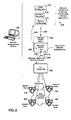
- the CLI framework 220 comprises: a CLI processor 520 (CLIP), a CLI dictionary 530, and CLI COMmunications module 540 (CLICOM).
- CLIP CLI processor 520
- CLI dictionary 530 CLI dictionary 530
- CLICOM CLI COMmunications module 540
- the CLI framework 220 is coded in a generic fashion and is adapted to load and parse 222 at run-time .grammar files 226.
- Each .grammar file 226 holds specifications of a CLI vocabulary and an associated grammar to be used in configuring and controlling at least one particular managed data network entity (providing persistence support).
- the grammar and vocabulary between other things, specify, without being limited to, the: CLI command names, associated parameters, valid parameter ranges, parameter typecasting rules, parameter conversions, parameter unit specifications, parameter unit conversions, as well as contexts in which the CLI commands may be issued.
- .grammar files 226 enables a generic coding of the CLI framework 220 - the loading 228 of updated .grammar files 226 enables the modification of the interaction with data network entities with preferably little and ultimately no changes to the CLI framework 220 code.
- the CLI vocabulary and grammar described in the .grammar files 226 is compiled into the CLI dictionary 530.
- the CLI dictionary 530 further codifies the CLI commands, the relations between CLI commands, and how the CLI commands relate to managed data network entities. Facilities such as a persistent storage may be provided for the storage and loading of the CLI dictionary 530 between CLI framework 220 restarts.
- the CLI processor 520 receives notifications 500 from the MOS 200 including requested CLIactions 266 to be performed. Having received a notification 500, the CLI processor 520 makes use of CLImapping attribute(s) 265 to query 504 CLI dictionary entries held in the CLIdictionary 530.
- the CLI framework 220 interacts 542 with the corresponding field installed managed data network entity(ies) via the CLICOM module 540 for each CLIaction 266 as well if a particular CLIattribute 264 change requires persistence support.
- a CLI command sequence is built to implement the specific CLIaction 266 (CLIcreate, CLlupdate, CLIread, CLIdelete etc.) based on the grammar specified in corresponding CLI dictionary entries to operate on the managed data network entity.
- the CLICOM module 540 sends 542 each CLI command sequence to the corresponding managed data network entity for execution. Further details regarding the CLICOM module 540 are presented in the above mentioned co-pending commonly assigned patent application 10/115,900.
- the managed data network entity 510 executes each CLI command in a received CLI command sequence.
- CLI Command Line Interface
- the solution shields only the software applications 210 from the complexity and diversity of the CLI enabling technology.
- the solution comes short of shielding the MOL 208 from the intricacies of the CLI enabling technology as attribute dependencies need to be known to the MOL 208 in implementing such solutions.
- the mapping function 270 has to have knowledge of vendor specific CLI command attributes, as values for these need to be provided to the CLI framework 220 to generate and issue CLI commands to managed data network entities.
- attribute dependencies are specified via the CLI mapping attributes 265 for each vendor specific equipment type. This represents a problem as the manageable object derivation hierarchy 300, by being coded with vendor specific attributes, needs to be updated, re-compiled and re-deployed with each vendor specific CLI vocabulary and/or grammar change as command attributes change. It is desirable to reduce these operational overheads incurred by updates to attribute dependencies.
- the CLI processor 520 is provided with a new functionality: attribute verification 810, to check for required attributes and inform 820 the MOL 208 of any required attributes missing from the notification(s) 500.
- the CLI processor 520 When the CLI processor 520 builds a CLI command, it checks 504 the command syntax (vocabulary and grammar) for the particular command and vendor, which is stored in the CLI dictionary 530, to determine if all of the required attributes have been supplied. If any attributes are missing, the CLI processor 520 informs 820 the MOL 208 of the absence thereof in connection with the particular CLIaction 266 requested and by extension in connection with the event notification 500 received.
- the command syntax vocal and grammar
- An example is the configuration of a port 112.
- shelf 122 and interface card 124 specifications may be needed. Attributes specifying shelf 122 and interface card 124 information may need to be provided.
- the MOL 208 is also provided with new attribute learning functionality 830, to learn of and keep track of attribute requirements provided by the CLI processor 520.
- the CLI processor 520 informs 820 the MOL 208 of missing attributes for a particular CLIaction 266 for a certain vendor's node
- the MOL 208 records which attributes are required for future use. While this function adds some complexity to the MOL 208, it removes the need to hard-code CLI attribute dependencies in the manageable object derivation hierarchy 300 reducing operational overheads associated with updating the associated CLI command syntax. If the CLI attribute dependencies change, the MOL 208 simply adapts to the changes based on the information 820 provided by the CLI processor 520 proving adynamic determination CLI attribute dependency updates.
- the manageable object types of the manageable object derivation hierarchy 300 are coded generically.
- the generic coding is further enabled via a labeling CLIattribute 263 associated with each instantiated managed object entity which holds a vendor/equipment type specification to provide support for vendor/equipment type specific attribute validation.
- the labeling CLIattribute 263 may be populated in instantiating the managed object hierarchy.
- the CLIid attribute may hold the vendor/equipment type specification.
- the vendor/equipment type specification maybe derived in deriving the CLIid attribute using methods described in the above mentioned co-pending commonly assigned patent application 10/115,900. Not only does the proposed solution shield the MOL 208 from the changes to vendor specific CLI syntax changes, but also from vendor specifics all together syntax complexities and variances of CLI commands between different vendor equipment.
- the MOL 208 uses a reactive method of issuing event notifications 500.
- the MOL 208 issues an event notification 500 with attributes based on generic, plausible, de facto, etc. notification generation specifications (CLImapping attributes 265) previously used by the mapping process 270.
- the event notification 500 includes the corresponding CLIid and vendor/equipment type specification.
- the attribute verification function 810 makes use of the CLIid and vendor/type specification to consult 504 the CLI dictionary 530 entries. If discrepancies are detected then the implementation of the issued notification 500 fails and the CLI processor 520 provides 820 the MOL 208 with corrective feedback including the correct necessary CLIattributes.
- the learning function 830 receives the corrective feedback and stores knowledge about any newly required CLIattributes 264 in corresponding CLImapping attributes 265.
- the mapping function 270 is therefore updated.
- the MOL 208 sends the event notification 500 with the required CLIattributes 264.
- the MOL 208 uses a proactive method of issuing event notifications 500.
- the MOL 208 first queries (500) the CLI processor 520 for required CLIattributes 264 in implementing a particular CLIaction 266 on a particular managed communications network entity having a CLIid and a vendor/equipment type specification.
- the CLI processor 520 consults 504 the CLI dictionary 530 and provides 820 the MOL 208 with corrective feedback specifying the necessary group of CLIattributes 264 for implementing the event notification/CLIaction 266.
- the learning function 830 stores knowledge about any newly required CLIattributes 264 in corresponding CLImapping attributes 265. The mapping process 270 is therefore updated.
- the MOL 208 subsequently sends a fully qualified event notification 500 to the CLI processor 520 requesting persistence support.
- the MOL 208 provides a consolidation of communications network management information for network management and service provisioning.
- network management and service provisioning software applications 210 interact directly with the CLI processor 520.
- the generic manageable object derivation hierarchy 300 and the learning function 830 are associated with each software application 210.
- the MOL 208 and software applications 210 represent CLI client entities served by the CLI framework 220 with CLI enabling technology support.
- multiple CLIactions 266 are preferably processed by the CLI framework 220 in parallel. Care is to be taken in coding such implementations to eliminate configuration conflicts. The elimination of configuration conflicts as well as the prioritization of configuration changes may be implemented via queuing of CLIactions 266 to be processed by the CLI framework 220.
- the parallel processing requires the use of multi-threading, multi-tasking coding techniques known to persons of skill in the art and are described elsewhere.
- the present invention automates the CLI command entry task in a network management and service provisioning environment comprised of diverse data network entities each of which has an associated CLI vocabulary.
- a CLI command dictionary 530 consolidates all data network entity specific CLI vocabularies and serves the CLI framework 220 with vendor/equipment type specific CLI commands for building CLI command sequences.
- the attribute verification function 810, exchanged discrepancy information 820 and the learning function 830 enable a generic deployment of network management and service provisioning solutions.
Landscapes
- Engineering & Computer Science (AREA)
- Computer Networks & Wireless Communication (AREA)
- Signal Processing (AREA)
- Automation & Control Theory (AREA)
- Computer And Data Communications (AREA)
- Data Exchanges In Wide-Area Networks (AREA)
Applications Claiming Priority (2)
| Application Number | Priority Date | Filing Date | Title |
|---|---|---|---|
| US10/222,874 US7177924B2 (en) | 2001-12-19 | 2002-08-19 | Command line interface processor with dynamic update of attribute dependencies |
| US222874 | 2002-08-19 |
Publications (2)
| Publication Number | Publication Date |
|---|---|
| EP1392019A1 true EP1392019A1 (de) | 2004-02-25 |
| EP1392019B1 EP1392019B1 (de) | 2006-01-04 |
Family
ID=31187949
Family Applications (1)
| Application Number | Title | Priority Date | Filing Date |
|---|---|---|---|
| EP20030300086 Expired - Lifetime EP1392019B1 (de) | 2002-08-19 | 2003-08-12 | Kommandozeilenschnittstellen Prozessor mit dynamischer Aktualisierung von Attributabhängigkeiten |
Country Status (2)
| Country | Link |
|---|---|
| EP (1) | EP1392019B1 (de) |
| DE (1) | DE60303106T2 (de) |
Cited By (3)
| Publication number | Priority date | Publication date | Assignee | Title |
|---|---|---|---|---|
| KR100724943B1 (ko) * | 2005-02-04 | 2007-06-04 | 삼성전자주식회사 | 통신장비 관리 장치 및 방법 |
| CN110324169A (zh) * | 2018-03-30 | 2019-10-11 | 北京京东尚科信息技术有限公司 | 一种接口管理的方法和装置 |
| CN113778572A (zh) * | 2021-09-28 | 2021-12-10 | 广州四三九九信息科技有限公司 | 一种多个cli程序自动衔接为任务流程的方法 |
Families Citing this family (1)
| Publication number | Priority date | Publication date | Assignee | Title |
|---|---|---|---|---|
| US9323621B2 (en) | 2014-03-06 | 2016-04-26 | International Business Machines Corporation | Dynamic monitoring of command line queries |
Citations (2)
| Publication number | Priority date | Publication date | Assignee | Title |
|---|---|---|---|---|
| US5533116A (en) * | 1992-03-10 | 1996-07-02 | Nokia Telecommunications Oy | Network management system |
| US5764955A (en) * | 1995-10-19 | 1998-06-09 | Oasys Group, Inc. | Gateway for using legacy telecommunications network element equipment with a common management information protocol |
-
2003
- 2003-08-12 DE DE2003603106 patent/DE60303106T2/de not_active Expired - Lifetime
- 2003-08-12 EP EP20030300086 patent/EP1392019B1/de not_active Expired - Lifetime
Patent Citations (2)
| Publication number | Priority date | Publication date | Assignee | Title |
|---|---|---|---|---|
| US5533116A (en) * | 1992-03-10 | 1996-07-02 | Nokia Telecommunications Oy | Network management system |
| US5764955A (en) * | 1995-10-19 | 1998-06-09 | Oasys Group, Inc. | Gateway for using legacy telecommunications network element equipment with a common management information protocol |
Non-Patent Citations (2)
| Title |
|---|
| HALSE G A ET AL: "XML to facilitate management of multi-vendor networks", SOUTH AFRICAN TELECOMMUNICATIONS NETWORK AND APPLICATION CONFERENCE, XX, XX, 2 September 2001 (2001-09-02), pages 1 - 6, XP002247410 * |
| PHIL SHAFER: "XML-based Network Management", JUNIPER NETWORKS, 17 August 2001 (2001-08-17), pages 1 - 18, XP002262472, Retrieved from the Internet <URL:www.juniper.net/solutions/literature/ white_papers/200017.pdf> [retrieved on 20031121] * |
Cited By (5)
| Publication number | Priority date | Publication date | Assignee | Title |
|---|---|---|---|---|
| KR100724943B1 (ko) * | 2005-02-04 | 2007-06-04 | 삼성전자주식회사 | 통신장비 관리 장치 및 방법 |
| CN110324169A (zh) * | 2018-03-30 | 2019-10-11 | 北京京东尚科信息技术有限公司 | 一种接口管理的方法和装置 |
| CN110324169B (zh) * | 2018-03-30 | 2023-06-27 | 北京京东尚科信息技术有限公司 | 一种接口管理的方法和装置 |
| CN113778572A (zh) * | 2021-09-28 | 2021-12-10 | 广州四三九九信息科技有限公司 | 一种多个cli程序自动衔接为任务流程的方法 |
| CN113778572B (zh) * | 2021-09-28 | 2023-09-15 | 广州四三九九信息科技有限公司 | 一种多个cli程序自动衔接为任务流程的方法 |
Also Published As
| Publication number | Publication date |
|---|---|
| EP1392019B1 (de) | 2006-01-04 |
| DE60303106D1 (de) | 2006-03-30 |
| DE60303106T2 (de) | 2006-08-24 |
Similar Documents
| Publication | Publication Date | Title |
|---|---|---|
| US7177924B2 (en) | Command line interface processor with dynamic update of attribute dependencies | |
| US20030115308A1 (en) | Network management system architecture | |
| US6047279A (en) | System and method for automatic network management support using artificial intelligence | |
| US20030112275A1 (en) | Dynamically configurable human-machine interface | |
| US7185075B1 (en) | Element management system with dynamic database updates based on parsed snooping | |
| US7054924B1 (en) | Method and apparatus for provisioning network devices using instructions in extensible markup language | |
| US6260062B1 (en) | Element management system for heterogeneous telecommunications network | |
| US6901440B1 (en) | System and method for universal service activation | |
| US6253243B1 (en) | Automated trap control for a distributed network management system | |
| US7366989B2 (en) | Element management system with data-driven interfacing driven by instantiation of meta-model | |
| US7249189B2 (en) | Network management programmable configuration management framework | |
| US20060190579A1 (en) | Assisted command script template creation | |
| US7363359B1 (en) | Element management system with automatic remote backup of network elements' local storage | |
| EP1793529A1 (de) | Verfahren und System zur Konfiguration von Netzwerkvorrichtungen durch eine Betriebssupportsystemschnittstelle | |
| US20040098422A1 (en) | Element management system with adaptive interfacing selected by last previous fully-qualified managed level | |
| EP2070258A2 (de) | Verfahren und system zur speicherung von konfigurationsinformationen für netzwerkknoten in einem netzwerkverwaltungssystem | |
| US20040136394A1 (en) | Bulk service configuration in communications networks | |
| EP1322066B1 (de) | Prozessor für die Befehlszeilenschnittstelle | |
| US20050149881A1 (en) | Dynamically configurable human-machine interface | |
| EP1392019B1 (de) | Kommandozeilenschnittstellen Prozessor mit dynamischer Aktualisierung von Attributabhängigkeiten | |
| Abeck | Network Management know it all | |
| US20030115309A1 (en) | Methods of invoking polymorphic operations in a statically typed language | |
| EP4523389A1 (de) | Netzwerkvorrichtung und verfahren zur verfolgung von vorrichtungskonfigurationen | |
| van der Linde | Evaluation and new specification of the extensible agent protocol | |
| Medved et al. | Network infrastructure discovery—Streamlining complex developments with parametric approach in MTOSI compliant fashion |
Legal Events
| Date | Code | Title | Description |
|---|---|---|---|
| PUAI | Public reference made under article 153(3) epc to a published international application that has entered the european phase |
Free format text: ORIGINAL CODE: 0009012 |
|
| AK | Designated contracting states |
Kind code of ref document: A1 Designated state(s): AT BE BG CH CY CZ DE DK EE ES FI FR GB GR HU IE IT LI LU MC NL PT RO SE SI SK TR |
|
| AX | Request for extension of the european patent |
Extension state: AL LT LV MK |
|
| 17P | Request for examination filed |
Effective date: 20040825 |
|
| 17Q | First examination report despatched |
Effective date: 20040923 |
|
| AKX | Designation fees paid |
Designated state(s): DE ES FR GB IT |
|
| GRAP | Despatch of communication of intention to grant a patent |
Free format text: ORIGINAL CODE: EPIDOSNIGR1 |
|
| RIN1 | Information on inventor provided before grant (corrected) |
Inventor name: WING-CHUNG CHAN, DAVID Inventor name: FLYNN, THOMAS VINCENT Inventor name: MURRAY, CHRISTOPHER WARREN |
|
| GRAS | Grant fee paid |
Free format text: ORIGINAL CODE: EPIDOSNIGR3 |
|
| GRAA | (expected) grant |
Free format text: ORIGINAL CODE: 0009210 |
|
| AK | Designated contracting states |
Kind code of ref document: B1 Designated state(s): DE ES FR GB IT |
|
| REG | Reference to a national code |
Ref country code: GB Ref legal event code: FG4D |
|
| REF | Corresponds to: |
Ref document number: 60303106 Country of ref document: DE Date of ref document: 20060330 Kind code of ref document: P |
|
| PG25 | Lapsed in a contracting state [announced via postgrant information from national office to epo] |
Ref country code: ES Free format text: LAPSE BECAUSE OF FAILURE TO SUBMIT A TRANSLATION OF THE DESCRIPTION OR TO PAY THE FEE WITHIN THE PRESCRIBED TIME-LIMIT Effective date: 20060415 |
|
| ET | Fr: translation filed | ||
| PLBE | No opposition filed within time limit |
Free format text: ORIGINAL CODE: 0009261 |
|
| STAA | Information on the status of an ep patent application or granted ep patent |
Free format text: STATUS: NO OPPOSITION FILED WITHIN TIME LIMIT |
|
| 26N | No opposition filed |
Effective date: 20061005 |
|
| REG | Reference to a national code |
Ref country code: FR Ref legal event code: CD Owner name: ALCATEL-LUCENT CANADA INC Effective date: 20130723 |
|
| REG | Reference to a national code |
Ref country code: FR Ref legal event code: GC Effective date: 20130820 |
|
| REG | Reference to a national code |
Ref country code: GB Ref legal event code: 732E Free format text: REGISTERED BETWEEN 20130912 AND 20130918 |
|
| REG | Reference to a national code |
Ref country code: FR Ref legal event code: RG Effective date: 20141015 |
|
| REG | Reference to a national code |
Ref country code: FR Ref legal event code: PLFP Year of fee payment: 13 |
|
| REG | Reference to a national code |
Ref country code: FR Ref legal event code: PLFP Year of fee payment: 14 |
|
| REG | Reference to a national code |
Ref country code: FR Ref legal event code: PLFP Year of fee payment: 15 |
|
| PGFP | Annual fee paid to national office [announced via postgrant information from national office to epo] |
Ref country code: GB Payment date: 20180222 Year of fee payment: 15 Ref country code: DE Payment date: 20180223 Year of fee payment: 15 |
|
| PGFP | Annual fee paid to national office [announced via postgrant information from national office to epo] |
Ref country code: IT Payment date: 20180227 Year of fee payment: 15 Ref country code: FR Payment date: 20180227 Year of fee payment: 15 |
|
| REG | Reference to a national code |
Ref country code: DE Ref legal event code: R119 Ref document number: 60303106 Country of ref document: DE |
|
| GBPC | Gb: european patent ceased through non-payment of renewal fee |
Effective date: 20180812 |
|
| PG25 | Lapsed in a contracting state [announced via postgrant information from national office to epo] |
Ref country code: IT Free format text: LAPSE BECAUSE OF NON-PAYMENT OF DUE FEES Effective date: 20180812 Ref country code: DE Free format text: LAPSE BECAUSE OF NON-PAYMENT OF DUE FEES Effective date: 20190301 |
|
| PG25 | Lapsed in a contracting state [announced via postgrant information from national office to epo] |
Ref country code: FR Free format text: LAPSE BECAUSE OF NON-PAYMENT OF DUE FEES Effective date: 20180831 |
|
| PG25 | Lapsed in a contracting state [announced via postgrant information from national office to epo] |
Ref country code: GB Free format text: LAPSE BECAUSE OF NON-PAYMENT OF DUE FEES Effective date: 20180812 |
|
| REG | Reference to a national code |
Ref country code: DE Ref legal event code: R082 Ref document number: 60303106 Country of ref document: DE Representative=s name: BARKHOFF REIMANN VOSSIUS, DE Ref country code: DE Ref legal event code: R081 Ref document number: 60303106 Country of ref document: DE Owner name: WSOU INVESTMENTS, LLC, LOS ANGELES, US Free format text: FORMER OWNER: ALCATEL CANADA INC., KANATA, ONTARIO, CA |