EP1392023A2 - Drahtlose Kommunikation mit kurzer Reichweite - Google Patents
Drahtlose Kommunikation mit kurzer Reichweite Download PDFInfo
- Publication number
- EP1392023A2 EP1392023A2 EP03254867A EP03254867A EP1392023A2 EP 1392023 A2 EP1392023 A2 EP 1392023A2 EP 03254867 A EP03254867 A EP 03254867A EP 03254867 A EP03254867 A EP 03254867A EP 1392023 A2 EP1392023 A2 EP 1392023A2
- Authority
- EP
- European Patent Office
- Prior art keywords
- channel
- initialisation
- transmission
- energy level
- service advertiser
- Prior art date
- Legal status (The legal status is an assumption and is not a legal conclusion. Google has not performed a legal analysis and makes no representation as to the accuracy of the status listed.)
- Granted
Links
Images





Classifications
-
- H—ELECTRICITY
- H04—ELECTRIC COMMUNICATION TECHNIQUE
- H04W—WIRELESS COMMUNICATION NETWORKS
- H04W16/00—Network planning, e.g. coverage or traffic planning tools; Network deployment, e.g. resource partitioning or cells structures
- H04W16/14—Spectrum sharing arrangements between different networks
-
- H—ELECTRICITY
- H04—ELECTRIC COMMUNICATION TECHNIQUE
- H04L—TRANSMISSION OF DIGITAL INFORMATION, e.g. TELEGRAPHIC COMMUNICATION
- H04L1/00—Arrangements for detecting or preventing errors in the information received
- H04L1/12—Arrangements for detecting or preventing errors in the information received by using return channel
- H04L1/16—Arrangements for detecting or preventing errors in the information received by using return channel in which the return channel carries supervisory signals, e.g. repetition request signals
-
- H—ELECTRICITY
- H04—ELECTRIC COMMUNICATION TECHNIQUE
- H04W—WIRELESS COMMUNICATION NETWORKS
- H04W24/00—Supervisory, monitoring or testing arrangements
-
- H—ELECTRICITY
- H04—ELECTRIC COMMUNICATION TECHNIQUE
- H04W—WIRELESS COMMUNICATION NETWORKS
- H04W48/00—Access restriction; Network selection; Access point selection
- H04W48/08—Access restriction or access information delivery, e.g. discovery data delivery
-
- H—ELECTRICITY
- H04—ELECTRIC COMMUNICATION TECHNIQUE
- H04W—WIRELESS COMMUNICATION NETWORKS
- H04W74/00—Wireless channel access
-
- H—ELECTRICITY
- H04—ELECTRIC COMMUNICATION TECHNIQUE
- H04W—WIRELESS COMMUNICATION NETWORKS
- H04W84/00—Network topologies
- H04W84/02—Hierarchically pre-organised networks, e.g. paging networks, cellular networks, WLAN [Wireless Local Area Network] or WLL [Wireless Local Loop]
- H04W84/10—Small scale networks; Flat hierarchical networks
-
- Y—GENERAL TAGGING OF NEW TECHNOLOGICAL DEVELOPMENTS; GENERAL TAGGING OF CROSS-SECTIONAL TECHNOLOGIES SPANNING OVER SEVERAL SECTIONS OF THE IPC; TECHNICAL SUBJECTS COVERED BY FORMER USPC CROSS-REFERENCE ART COLLECTIONS [XRACs] AND DIGESTS
- Y02—TECHNOLOGIES OR APPLICATIONS FOR MITIGATION OR ADAPTATION AGAINST CLIMATE CHANGE
- Y02D—CLIMATE CHANGE MITIGATION TECHNOLOGIES IN INFORMATION AND COMMUNICATION TECHNOLOGIES [ICT], I.E. INFORMATION AND COMMUNICATION TECHNOLOGIES AIMING AT THE REDUCTION OF THEIR OWN ENERGY USE
- Y02D30/00—Reducing energy consumption in communication networks
- Y02D30/70—Reducing energy consumption in communication networks in wireless communication networks
Definitions
- This invention relates to a method for implementing a short range wireless communication system, and to a method for a short range wireless device to communicate on a communication link.
- the invention relates also to a system implementing short range wireless communication, and to a short range wireless device for communicating on a communication link
- Wireless devices that transmit within a certain operating proximity may experience transmission collisions if the transmissions of each device are sent at substantively the same time and on the same channel. The resulting collisions are unintelligible by receiver devices and contribute to inefficient power consumption in the transmitting device.
- Implementation of carrier sensing multiple access with collision detection (CSMA/CD) or collision avoidance (CSMA/CA) involves two methods of addressing transmission timing issues. However, in the implementations of the carrier sensing associated with CSMA/CD and CSMA/CA, the success rate of detecting other devices within a predetermined transmission/reception range may be improved. Additionally, the device connection/setup times associated with the devices implementing these protocols is less than ideal.
- the present invention is directed to systems and methods for implementing a short range wireless communication system.
- An exemplary method for implementing a short range wireless communication system that comprises measuring an energy level on a channel at a time offset from a periodic interval and comparing a measured value of the energy level to a transmission threshold to determine whether to transmit on the channel.
- an exemplary method for implementing a short range wireless communication system comprises conducting carrier sensing on a channel, wherein the carrier sensing incorporates a random zero mean value offset. Also, if an energy level measured during carrier sensing is below a predetermined threshold, transmitting a message on the channel.
- an exemplary method for a short range wireless device to communicate on a communication link comprises after establishing a communication link on an initialisation channel, tuning from an initialisation channel to a unicast channel. Another aspect of the method includes re-establishing the communication link on the initialisation channel in the event of a data transmission error in the first packet on the unicast channel. Re-establishing the communication link comprises selecting a random number from an initial range of values, wherein the random number corresponds to a number of wait time periods a receiving device will wait before attempting to re-establish a connection. After a value is selected, the method includes waiting for a length of time equal to the number of wait time periods. The method handles the event in which the receiving device, after waiting the length of time, does not receive an expected transmission, and accordingly increases an upper bound of the initial range.
- a random mean zero value offset is appended to the start of carrier sensing at the beginning of a transmission frame to increase the likelihood that transmitters within a transmission range will recognize one another's overlapping transmissions and shift their transmission frames to avoid collisions.
- the transmitters thereby increase the transmission success rate and reduce the connection setup time.
- the embodiments are directed to a LowRate protocol and the methods and systems for providing low power consumption with optimized collision avoidance for a short range wireless communication system enabling communication between Service Advertiser devices and Initiator devices.
- LowRate refers to the low power consumption parameters associated with devices implementing the LowRate protocol as compared to a typical Bluetooth device.
- Figure 1 is an exemplary embodiment of the present invention wherein one or more of a multiplicity of LowRate Initiator devices 110 establishes a communication link with a LowRate Service Advertiser device 120.
- the Service Advertiser 120 may be, e.g., a banner advertisement located on a public thoroughfare broadcasting advertisements that inform the Initiator devices 110 within a given coverage area of the availability of additional data or advertised services.
- a first Service Advertiser 120a begins transmitting on a primary Initialisation channel. If another Service Advertiser 120b is already transmitting on the primary Initialisation channel as determined by the first Service Advertiser 120a through carrier sensing, the second Service Advertiser 120b will execute a predetermined number of transmission reattempts after a delay between attempts. If after the predetermined number of reattempts the primary Initialisation channel is still determined to be congested, transmission reattempts with carrier sensing may be executed on an alternate channel.
- the first Service Advertiser 120a will append a random mean zero value offset time to the start of the carrier sensing mode in a transmission frame.
- the offset allows for devices with similar transmission frames to shift their carrier sensing to increase the likelihood that a first Service Advertiser 120a will be conducting carrier sensing while a second Service Advertiser 120b is transmitting on an Initialisation channel.
- the limits of the random mean offset time value distribution are optimized according to system properties. While increasing the offset value from zero, the possibility of detecting other devices increases. However, increasing the offset value greater then Transmit/Receive switching period decreases system capacity.
- the Transmit/Receive switching time is the optimal maximum time value for the random mean offset ( Figures 7A, 7B, 8 and 9). If carrier sensing determines that a second Service Advertiser 120b is already transmitting on an Initialisation channel, the channel is designated as BUSY, and the first Service Advertiser 120a will execute a predetermined step or number of steps as described further in Figure 7A, 7B, 8 and 9 to reattempt carrier sensing or cycle through alternate Initialisation channels, searching for a channel to transmit on. Otherwise, if carrier sensing determines that no Service Advertiser 120 is transmitting on the Initialisation channel, the channel is designated IDLE, and transmission of service advertisements may commence.
- the above-mentioned LowRate Initiator devices 110 may be wireless devices, such as Personal Digital Assistants (PDA), cell phones, laptop computers or the like.
- An Initiator device 110 receives the transmitted service advertisements and determines whether or not to respond to them based on user input requesting additional services or data from the Service Advertiser 120.
- the Initiator device 110 is responsible for initiating a request for additional services or data on a given unicast channel with the Service Advertiser 120.
- Service Advertiser 120 As discussed in the Overview section, in Figure 1, two Service Advertisers 120 are shown, along with a multiplicity of Initiator devices 110. Each Service Advertiser 120 is capable of establishing an active short range wireless connection with one or more Initiator devices 110.
- the dotted circles 130 shown in Figure 1 represent Service Advertiser 120 transmissions, as it advertises its ability to provide further data or a service pertaining to a particular subject.
- the Service Advertiser 120 is capable of transmitting different types of message packets for reception by the Initiator devices 110.
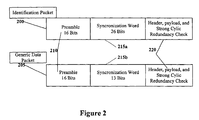
- FIG. 2 illustrates two exemplary message packets for use in one embodiment of the present invention.
- the two message packets in Figure 2 are an identification message (packet) 200 and a generic data message (packet) 205, as will be described in detail hereinafter.
- the identification message 200 comprises a 16-bit preamble 210, a 26-bit synchronization word 215a, and a section designated for header, payload and strong cyclic redundancy check data 220.
- the identification message also includes the address of the device that transmits the message.
- Service Advertisers 120 use the identification message 200 to advertise the availability of additional data and services to Initiator devices 110.
- An Initiator device 110 will respond by transmitting an identification response message specifying the unicast data transfer and service provider channel ("unicast channel") that it has designated for data transfer.
- the transmission of these messages during operation is detailed further in Figure 5.
- the Service Advertiser 120 shirts to the unicast channel specified in the identification response message by the Initiator device 110.
- Service Advertiser 120 provides the additional data or services on the unicast channel using the generic data message packet 205 shown in Figure 2
- the generic data message 205 includes the same 16-bit preamble 210 as the identification message 200, but utilizes a 13-bit synchronization word 215b, rather than a 26-bit synchronization word 215a.
- a header, payload and strong cyclic redundancy check 220 are also included in the generic data message.
- the 16-bit preamble and the difference in synchronization word lengths of the LowRate message packet formats illustrate design tradeoffs between network throughput and device complexity/power consumption.
- the standard Bluetooth 1.1 packet format uses a 4-bit preamble, which has been optimized for more efficient network performance in regard to transmission of special data such as voice or streaming video.
- a LowRate device uses a 16-bit preamble 210 that can be resolved using an analogue DC estimator, which consumes less power.
- the Initiator Device 110 uses the preamble 210 to perform frequency synchronization, symbol timing estimation, and Automatic Gain Control (AGC) training.
- AGC Automatic Gain Control
- the 13-bit synchronization word 215b of the generic data message and the 26-bit synchronization word 215a of the identification message are implemented using one or two consecutive 13-bit Barker codes, respectively.
- the second Barker code is the inverse of the first Barker code.
- the difference in the synchronization words reflects the different purposes for which each is used.
- the longer synchronization word 215a of the identification message 200 minimizes the probability of false synchronization, wherein random noise is incorrectly identified by the system as a synchronization word. Because the synchronization word 215b used in the generic data message 205 is used for device-to-device synchronization, the length of the synchronization word 215b may be shorter. Strong Cyclic Redundancy Check 220 also provides a method of stopping a false synchronization match as will be discussed in further detail below.
- the LowRate protocol message transmission occurs on a similar operating frequency band as current Bluetooth systems.
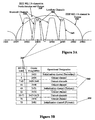
- the LowRate protocol operating frequency range of 2403 MHz through 2481 MHz is divided into twenty-seven channels, wherein each channel is 3 MHz wide.
- the implementation of the LowRate protocol at these operating frequencies allows for the LowRate protocol to be incorporated on a device that also has an existing Bluetooth System capability.
- FIG. 3B is a table illustrating an exemplary assignment of operating channels in one embodiment of the present invention.
- the LowRate protocol channels are divided into Initialisation channels and Unicast channels.
- An Initialisation channel is used to transmit identification messages 200 and to make the initial contact between Service Advertisers 120 and Initiator devices 110.
- a unicast channel is used to transmit generic data messages 205, which contain information such as the additional data or services requested by the Initiator device 110 or, alternatively, the Initiator device's 110 response to receipt of such additional data or services.
- a LowRate device - either Service Advertiser 120 or Initiator device 110 - may employ the frequency channels set forth in Figure 3B to transmit identification or generic data messages.
- the outermost channels used by the LowRate devices are located at 2403 MHz and 2481 MHz 340. These channels are near the minimum of the power spectrum used for IEEE 802.11b WLAN transmissions 320, 330. Consequently, the interference with LowRate transmissions due to IEEE 802.11b WLAN transmissions is minimized.
- a second advantage relates to the primary Initialisation channel. As will be discussed hereinafter, more than one channel may be designated as an Initialisation channel and one of the plurality may be a default or primary Initialisation channel. In the embodiment illustrated in Figure 3B, the 2481 MHz channel 345 is selected as the primary Initialisation channel used for transmitting service advertisements to avoid any co-channel interference between it and any of the Bluetooth channels.
- Initialisation channels three channels, one in the lower end, one in the upper end, and one in the middle of the operating spectrum are designated as Initialisation channels.
- secondary and tertiary Initialisation channels at 2403 MHz and 2451 MHz 360, respectively, are selected as alternate Initialisation channels for use in the event that carrier sensing determines that the primary Initialisation channel is BUSY.
- the secondary Initialisation channel is designated at the lower end of the operating spectrum (2403 MHz).
- the tertiary Initialisation channel is then selected at 2451 MHz in the middle of the operating spectrum to separate the Initialisation channels as much as possible and to avoid LowRate co-channel interference among LowRate devices and interference from other devices operating in the global unlicensed Industrial Scientific and Medical (ISM) band at 2400-2483.5 MHz.
- the other twenty-four operating channels are designated as Unicast channels and are used in transmitting the above-described generic data packets in fulfilment of an Initiator device's 110 request for additional data or services. A detailed description of the channel operation in accordance with the present invention will be discussed below in connection with Figure 5.
- Figure 4 is a table illustrating an exemplary relationship between the LowRate device transmission power and the transmission frame interval (i.e., the time between transmission frames) for service advertisement transmission frames in an embodiment of the present invention.
- the range of transmission frame intervals may extend from 50 milliseconds to 2 seconds.
- the transmission power is above -27 dBm or if the medium access control layer of the data link layer does not know the transmission power of the device, the range of the transmission frame intervals may extend from 200 milliseconds to 2 seconds.
- the transmission frame interval which is considered to be an application-specific design trade-off between power consumption and connection speed, may be, but is not limited to, any multiple of the minimum transmission period. Smaller latencies between device transmissions translate into shorter connection setup times. On the other hand, if service advertisements are sent more frequently, the level of power consumed for the additional transmissions also increases. Additionally, the medium access control layer of the data link control layer may add a predetermined hysteresis value to the transmission period, for example +/- 0.5ms, in order to expedite recovery time from overlapping service advertisements.
- Carrier sensing involves measuring the Received Signal Strength Indication (RSSI) on an Initialisation channel over a time interval (e.g., 30 ⁇ sec). The measured value of the RSSI is then compared with a predetermined threshold in order to determine whether the Initialisation channel is IDLE (i.e., the measured value is below the threshold and thus the Service Advertiser 120 may transmit); or the channel is BUSY (i.e., the measured value is above the threshold and thus the Service Advertiser 120 may not transmit).
- RSSI Received Signal Strength Indication
- the predetermined threshold may be a value less than or equal to an RSSI that would interfere with a Service Advertiser's transmissions (e.g., -60dBm).
- the designation BUSY indicates that if a Service Advertiser was to transmit, the transmissions would experience interference from other energy on the channel.
- the LowRate protocol's low level of power consumption is achieved through the use of periodic Service Advertiser 120 transmission frames optimized with a random mean zero value offset appended to the start of carrier sensing.
- Conducting carrier sensing with a random mean zero value offset assists in avoiding transmission collisions, thereby decreasing the level of power consumed during periodic transmissions.
- the random mean zero value offset allows for Service Advertisers 120 within close proximity of one another, (e.g., the distance within which one Service Advertiser's 120 transmissions could interfere with another Service Advertiser's 120 transmissions) to adjust transmission frames in order to increase the likelihood that carrier sensing will detect a transmission on an Initialisation channel and thus avoid collisions.
- Carrier sensing offsets will be discussed further below in connection with Figure 7A, 7B, 8 and 9.
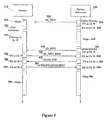
- FIG. 5 is an exemplary operation diagram of one embodiment of the present invention, wherein a Service Advertiser 120 attempts advertise services or information to an Initiator device 110 by sending out identification messages during periodic transmission frames.
- a transmission frame comprises a set of 5 or 6 different modes that a Service Advertiser 120 will cycle through as will be discussed in detail in connection with Figure 7A.
- Service Advertiser 120 conducts carrier sensing on the primary Initialisation channel and if the channel is IDLE, transitions from the carrier sensing mode to a transmit mode of the transmission frame. (515) During the transmit mode, the Service Advertiser 120 transmits an identification message ("ID_INFO”) on the primary Initialisation channel.
- ID_INFO identification message
- Service Advertiser 120 transitions from the transmit mode into a receive mode of the transmission frame.
- the Service Advertiser 120 listens to the initialisation channel for a response from an Initiator device 110. If a response is not received, the Service Advertiser 120 switches into a sleep mode of the transmission frame, thereby conserving power for the remainder of the transmission frame.
- the Service Advertiser 120 sends transmission frames repeatedly in accordance with an application-specific transmission period, such as one of the intervals set forth in Figure 4.
- the user of an Initiator device 110 may have the option of placing the Initiator Device 110 into a sleep mode.
- the Initiator device 110 ignores service advertisements from Service Advertisers 120. The user would then activate Initiator device 110 to receive service advertisements.
- the Initiator device 110 Upon activation, the Initiator device 110 enters a listening mode on the primary Initialisation channel wherein it listens to that channel for service advertisements.
- the Initiator device 110 may be in an "always-on" listening mode, wherein it always scans an Initialisation channel for service advertisements.
- Service Advertiser 120 waits until the start of a new transmission frame, at which time it emerges from the sleep mode to once again conduct carrier sensing on the primary Initialisation channel. (540)
- the Service Advertiser 120 repeats carrier sensing a predetemzined number of times after a delay (e.g. 1 ms), to expedite connection time with an Initiator device 110. Further, if the Service Advertiser 120 conducts carrier sensing a predetermined number of times and is unable to transmit its ID_INFO 545 message, it may attempt to carrier sense on an alternate Initialisation channel.
- Service Advertiser 120 upon determining that the primary Initialisation channel is IDLE, Service Advertiser 120 transmits an ID_INFO message to advertise the availability of certain data and services. (545) Having been activated by the user, the Initiator device 110 receives the ID_INFO message from the Service Advertiser 120. Upon receipt, the Initiator device 110 processes the message, and relays the advertised data or services to the user through a user interface such as a display. In the event that the user does not request additional information from the Service Advertiser 120, the Initiator device 110 will return to either a sleep mode or remain active to listen for other service advertisements.
- the Initiator device 110 transmits a response message ("ID_INFO_RESP") to the Service Advertiser 120 on the initialisation channel. (550, 555, 560)
- ID_INFO_RESP includes the value "X" of a unicast channel selected by the Initiator device 110 for data reception.
- the Service Advertiser 120 will then transmit the requested data to the Initiator device 110 over the specified unicast channel based on a polling scheme.
- the process of polling in general, involves a first device periodically retransmitting a message on a channel until it receives a response from a second device.
- the Service Advertiser 120 After tuning to the unicast channel X, the Service Advertiser 120 periodically transmits a DATA_PDU message to the Initiator device 110 until it receives a response or an application device specific time-out expires while waiting for a response. (570, 575)
- the DATA_PDU message contains the data related to the advertisements on the Initialisation channel.
- the Initiator device 110 receives the DATA_PDU message (580) and transmits an ACKNOWLEDGEMENT message (generic data message with Acknowledgement information) to Service Advertiser device 120 indicating that the data transfer has been completed and that therefore the wireless connection may be terminated. (585, 590)
- the Initiator device 110 may return to a sleep mode. (596) Alternately, the Initiator device 110 may resume listening on an Initialisation channel. Similarly, upon receipt of the ACKNOWLEDGEMENT message the Service Advertiser 120 also may return to a sleep mode. (585, 586) The Service Advertiser 120 remains in a sleep mode until it is once again time to conduct carrier sensing as dictated by the transmission frame interval, at which time the process of Figure 5 is repeated.
- FIG. 6A illustrates an exemplary operation topology for a StandAlone LowRate device 600.
- the StandAlone device 600 is capable of conducting short range wireless communications via LowRate connections 615 with other LowRate devices.
- a connection 615 may be between the StandAlone Low Rate Device 600 and a painting in a museum 610.
- a Service Advertiser 120 may advertise recorded descriptions of paintings to any Initiator Devices 110 within its coverage area.
- a connection 615 may be between device 600 and a billboard advertisement 620.
- LowRate applications may include a food package that transmits a URL address detailing nutritional information to an Initiator device 110, a lock that communicates with a digital key or a lamp that communicates with a LowRate enabled Personal Digital Assistant.
- StandAlone devices 600 may be everyday consumer devices for which low power consumption is an important design parameter.
- FIG. 6B illustrates an exemplary operation topology of a DualMode LowRate device 650.
- the DualMode device 650 includes both a LowRate protocol capability and another short-range wireless capability such as Bluetooth.
- the DualMode device 650 can establish a LowRate connection 675 with, e.g., a billboard advertisement, as discussed above in connection with Figure 5.
- the DualMode device 650 is also capable of establishing a Bluetooth connection 665 with a device 660 such as a Bluetooth enabled personal computer having an internet access capability.
- DualMode devices 650 are typically not as concerned with power consumption due to the existing Bluetooth system power requirements, which are significantly greater than the level of power consumption associated with a LowRate device.
- Figure 7A illustrates an exemplary use of a random mean zero value offset with carrier sensing when a first Service Advertiser 705 offsets its transmission frame later in time from an application-specific transmission interval 720 and its transmission is detected by a second Service Advertiser 701 in one embodiment of the present invention.
- a timeline 710 with an arrow indicating the direction of increasing time is shown in Figure 7A.
- Service Advertiser LowRate devices 701-705 are shown in Figure 7A as transmitting service advertisements over time.
- the Service Advertisers 701-705 are within a specified proximity of one another such that the carrier sensing of Service Advertiser 701 would recognize the transmissions of any of the other Service Advertisers 702-705, should the transmit modes overlap in time.
- an exemplary format of a transmission frame 730 includes five modes of operation: carrier sensing mode 715, first switching mode 731, transmission mode 732, second switching mode 733, and reception mode 734. If carrier sensing determines that the Initialisation Channel is IDLE, a Service Advertiser enters the first switching mode 731, as it prepares to enter the third mode of operation, the transmission mode 732. During the transmission mode 732, a Service Advertiser transmits the identification message ID_INFO 545 to advertise that additional information or specific services are available. The Service Advertiser enters a second switching mode 733 after the ID_INFO message is sent 545, as it switches between transmission and reception modes.
- carrier sensing determines that the Initialisation Channel is IDLE
- a Service Advertiser enters the first switching mode 731, as it prepares to enter the third mode of operation, the transmission mode 732.
- a Service Advertiser transmits the identification message ID_INFO 545 to advertise that additional information or specific services are available.
- the Service Advertiser enters a second switching mode 733 after
- the Service Advertiser listens for the message ID_INFO_RESP 560 on the Initialisation channel as transmitted by an Initiator device 110 to request services or additional data from the Service Advertiser.
- the Service Advertiser may enter a sixth mode -- namely, a sleep mode, if there is time remaining before the next transmission frame is scheduled.
- a first Service Advertiser should conduct carrier sensing at a different time than a second advertiser, preferably while the second Service Advertiser is transmitting.
- the carrier sensing will detect a level of energy associated with a transmission as being, e.g., above a predetermined threshold and execute a predetermined action or set of actions in accordance with one embodiment of the present invention.
- Such actions may involve either executing the next mode of the transmission frame, reattempting carrier sensing, tuning to an alternate Initialisation channel or any combination thereof.
- the Initialisation channel will be IDLE during both carrier sensing periods, and thus, neither of the Service Advertisers will recognize that the other is transmitting. Consequently, their transmissions will result in collisions, the loss of the transmitted data, and thus unnecessary power consumption.
- each Service Advertiser incorporates the random mean zero value offset into the timing of carrier sensing at the start of a transmission frame.
- the random mean zero value offset illustrates that a Service Advertiser can shift its transmission frame later in time, with respect to a predetermined application-specific transmission frame interval to achieve a random mean zero value offset that avoids collisions.
- a Service Advertiser 754 can shift its transmission frame earlier in time as shown by random mean zero value offset 790.
- the offset time is selected from a random distribution of values derived from a fraction of the length of time that it takes for a device to switch between the transmission and reception modes.
- the distribution of values may be derived from other device-specific timing characteristics or empirical data.
- carrier sensing acts to measure the RSSI, detecting various emissions at a given the frequency, regardless of the sources of the emissions.
- LowRate channels it is possible for LowRate channels to become congested or jammed by various other devices that transmit in the LowRate operating frequency spectrum such as microwave ovens, cordless telephones, or the transmissions of WLAN or Bluetooth devices.
- Service Advertisers 701 and 702 have periods of carrier sensing 715, 716 that start 720 and end 721 at the same time. Accordingly, both devices will measure the Received Signal Strength Indication (RSSI) on the primary Initialisation channel and determine that it is IDLE. After determining that the primary Initialisation channel is IDLE, both Service Advertisers 701, 702 will attempt to transmit on it, resulting in transmission collisions.
- RSSI Received Signal Strength Indication
- Service Advertisers 703 and 704 even though the periods of carrier sensing 717, 718 implement random mean zero value offsets from Service Advertiser 701, both periods of carrier sensing will indicate that the channel is IDLE, because no LowRate device is transmitting on an Initialisation channel during those periods of carrier sensing. Consequently, the resulting transmissions of Service Advertisers 703 and 704, like those of Service Advertiser 701 and 702, will also experience collisions.
- the period of carrier sensing 719 associated with Service Advertiser 705, which starts at time 722 incorporates a random mean zero value offset indicated by reference numeral 740.
- Carrier sensing 719 coincides with the start of the transmission period of Service Advertiser 701, and ends at time 723.
- Carrier sensing 719 will result in Service Advertiser 705 recognizing that Service Advertiser 701 is transmitting on the Initialisation channel and determining that the Initialisation channel is therefore BUSY. Consequently, Service Advertiser 705 will delay its transmission frame in time to avoid a collision.
- Figure 7B illustrates an exemplary use of random mean zero value offsets with carrier sensing when a first Service Advertiser 751 with an application-specific transmission frame interval detects a second Service Advertiser 754 which has offset its transmission frame interval earlier in time as indicated by reference numeral 790 in an embodiment of the present invention.
- the Service Advertisers 751-754 are within a specified proximity of one another, such that the carrier sensing of Service Advertiser 751 would recognize the transmissions of any of the other Service Advertisers (752, 753, 754) in the event that the transmissions overlap in time.
- Service Advertiser 754 incorporates a random mean zero value offset indicated by reference numeral 790 and conducts carrier sensing 765 at time 770 and thus, will be the first of the four devices 751-754 to transmit on the primary Initialisation channel. After measuring the RSSI on the primary Initialisation channel during carrier sensing, Service Advertiser 754 determines that the channel is IDLE. The transmission frame associated with Service Advertiser 754 is followed sequentially by transmission frames corresponding to Service Advertisers 753, 752, and 751, respectively. Service Advertiser 752 and Service Advertiser 753 conduct carrier sensing while Service Advertiser 754 is in switching mode 766 preparing to transmit. Consequently, both devices will incorrectly determine that the Initialisation channel is IDLE and attempt to transmit, leading to transmission collisions between Service Advertisers 754, 753, and ultimately with Service Advertiser 752.
- Service Advertiser 751 conducts carrier sensing 780 at time 771, which occurs just after Service Advertiser 754 has started to transmit at time 771. Accordingly, Service Advertiser 751 will detect that Service Advertiser 754 has begun transmitting, and determine that the primary Initialisation channel is BUSY. Service Advertiser 751 will then delay its transmission frame in time to avoid a collision.
- Figures 7A and 7B illustrate that transmission collisions may be avoided by implementing a random mean zero value offset that shifts the transmission frame of Service Advertisers either later or earlier in time to increase the likelihood that a Service Advertiser's carrier sensing will effectively recognize the transmissions of another Service Advertiser.
- Figure 8 illustrates an exemplary use of a random mean zero value offset with carrier sensing in which a second Service Advertiser 802 detects a first Service Advertiser 801 by implementing a random mean zero value offset 851, which offsets the second Service Advertiser's transmission frame later in time from an application-specific transmission frame interval.
- the second Service Advertiser 802 upon designating the primary Initialisation channel 841 as BUSY, in turn, cycles through alternate Initialisation channels attempting to find an IDLE channel.
- the random mean zero value offset 851 is shown in Figure 8 is the difference in time between the start of carrier sensing periods 825 and 826.
- a Service Advertiser may bypass a congested Initialisation channel, by switching to a secondary Initialisation channel (such as the one shown in Figure 3B) in the event that a predetermined number of attempted transmissions (e.g., three) on the primary Initialisation channel are unsuccessful.
- a secondary Initialisation channel such as the one shown in Figure 3B
- a timeline 840 indicates the direction of increasing time.
- Service Advertiser 801 conducts carrier sensing as specified by reference numeral 825 and prepares to transmit on primary Initialisation channel 841 at time 820.
- Service Advertiser 802 conducts carrier sensing 826 offset in time by a random mean zero value 851, after Service Advertiser 801 has begun to transmit. Consequently, Service Advertiser 802 will detect that Service Advertiser 801 is transmitting on the primary Initialisation channel 841 and after a predetermined delay will repeat carrier sensing a second and a third time (827, 828), each time, however, determining that the primary Initialisation channel 841 is BUSY.
- Service Advertiser 802 may then tune to the secondary Initialisation channel 842 in an attempt to establish a communication link with an Initiator device 110 that is actively listening for service advertisements on the secondary Initialisation channel.
- Service Advertiser 802 may find that Service Advertiser 803 is already transmitting on that channel. Service Advertiser 802 will then reattempt carrier sensing (831, 832) after a predetermined delay and again determines that the channel is BUSY. Service Advertiser 802 may tune to yet a tertiary Initialisation channel 843 and again reattempt a transmission. After conducting carrier sensing (834, 835, 836) initially offset by a value 853 during a time period when Service Advertiser 804 is transmitting, Service Advertiser 802 concludes that the tertiary Initialisation channel 843 is also BUSY.
- Service Advertiser 802 will then cycle back to the primary Initialisation channel 841 and reattempt carrier sensing on that channel. If the channel 841 is determined to be BUSY, Service Advertiser 802 will continue to cycle through the alternate Initialisation channels 842 and 843 until an Initialisation channel is determined by carrier sensing to be IDLE, at which time the Service Advertiser 802 may begin transmitting.
- the predetermined number of Initialisation channels may vary by application and that different cycling schemes may be implemented. Additionally, it is to be understood that the number of attempts of carrier sensing executed on an initialisation channel before reattempting transmission on an alternate initialisation channel may vary. Moreover, the random mean zero offset is generated from a distribution of values that may be application or device specific.
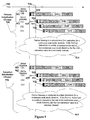
- Figure 9 illustrates an exemplary use of an offset with carrier sensing in which a first Service Advertiser's 901 transmissions are detected by a second Service Advertiser 902 which, in turn, enters a continuous scan mode.
- a timeline 940 indicates the direction of increasing time.
- Service Advertiser 901 conducts carrier sensing 925, establishes that the primary Initialisation channel 941 is IDLE and begins to transmit at time 920.
- Service Advertiser 902 repeatedly conducts carrier sensing (926, 927, and 928) initially offset by random mean zero value 929 after Service Advertiser 901 has begun to transmit. After three consecutive BUSY carrier sensing attempts (926, 927, and 928) on the primary Initialisation channel Service Advertiser 902 enters a continuous scan mode to increase the likelihood of transmission of its service advertisements.
- Service Advertiser 902 conducts carrier sensing repeatedly at a given frequency (e.g. every 1 ms), during a given continuous scan mode duration (e.g. 200 ms).
- the carrier sensing frequency in continuous scan mode is application-specific. Accordingly, Service Advertiser 902 may implement a carrier sensing frequency that is faster, slower, or the same as that which is illustrated in Figure 9. Alternatively, the carrier sensing frequency may either start at a low frequency and increase over time or start at a high frequency and decrease over time. If the RSSI measured during carrier sensing drops below the predetermined threshold value, the continuous carrier sensing is interrupted to transmit the message ID_INFO 520. However, if the RSSI does not drop below the threshold value by the completion of a predetermined continuous scan mode duration, the Service Advertiser 902 will tune to a secondary Initialisation Channel 942.
- Service Advertiser 902 will conduct carrier sensing (930, 931, and 932) initially offset by a value 935. Upon determining that Service Advertiser 903 is transmitting on the secondary Initialisation channel 942, Service Advertiser 902 will again enter the continuous scan mode 903 to conduct carrier sensing at the predetermined carrier sensing frequency. Accordingly, in the event that Service Advertiser 903 completes transmitting and the Initialisation channel becomes IDLE within the continuous scan mode duration, Service Advertiser 902 may then transmit its service advertisements. If the end of the continuous scan mode duration is reached without Service Advertiser 902 successfully transmitting a service advertisement, it may tune to yet an alternate channel or tune back to the primary Initialisation channel. Upon tuning to another Initialisation channel, Service Advertiser 902 will reattempt carrier sensing as discussed above until an opportunity to transmit service advertisements arises.
- error handling may be implemented.
- One example of error handling implemented in the LowRate protocol involves Strong Cyclic Redundancy Checks.
- the process of Cyclic Redundancy Checking involves examining data that has been transmitted on a communication link for errors that may have occurred during transmission.
- the sender applies a polynomial to a block of data designated for transmission and appends the resulting cyclic redundancy code to the data block.
- the receiver applies the same polynomial to the data after reception and compares the result with the appended result. If the two results are the same, the data has been successfully sent. Otherwise, the receiver may send a request to the sender for retransmission of the data block.
- Service Advertiser 120 may temporarily accelerate the transmission frame interval on the Initialisation channel in a predetermined manner over a predetermined length of time.
- the Service Advertiser 120 may increase the transmission frame interval as discussed above in connection with Figure 4 from once every 200 ms to once every 100 ms and maintain that transmission frame rate over a one second interval.
- the first Service Advertiser 120 may shift its advertising period to start a predetermined length of time earlier or later (e.g., 0.5 ms earlier) to avoid collisions.
- Error handling functionality is not limited to the Service Advertiser 120.
- the Initiator device 110 may have an active role in recovering from a nonresponse or incorrect response from the Service Advertiser 120 through the use of a Back-Off wait method, which is described in greater detail below in connection with Figure 10.
- a nonresponse involves the Service Advertiser 120 sending the ID_INFO message 545 and the Initiator device 110 initiating a communication link by transmitting the ID_INFO_RESP message 560 in an attempt at establishing the data transfer in the unicast channel. Accordingly, the Initiator device 110 tunes to the unicast data transfer channel specified in the ID_INFO_RESP message 560 and waits for the DATA_PDU message 575 from the Service Advertiser 120.
- a nonresponse indicates that the requested DATA_PDU message 575 is not received by the Initiator device 110.
- the Initiator device may identify an incorrect response, by determining that two or more Initiator devices 110 initiated a response to the same ID_INFO message 545.
- the Initiator device 110 identifies an incorrect response through processing the DATA_PDU message 575 and examining the message header for the destination address. If the Initiator device 110 identifies that the DATA_PDU message 575 contains a destination address not equal to its own destination address the response is designated incorrect. Accordingly, the Initiator device 110 will then conduct the Back-Off wait method described below in an attempt to re-establish a communication link with the Service Advertiser 120.
- FIG 10 is a flow chart illustrating an exemplary method by which collision handling may be performed by an Initiator device in accordance with one embodiment of the present invention.
- the Initiator Device 110 transmits an ID_INFO_RESP message, it tunes to the designated unicast channel and waits for the Service Advertiser 120 to transmit the DATA_PDU message.
- the Initiator Device executes certain events based on whether or not the DATA_PDU message is received on the unicast channel. In the event that the DATA_PDU message is received, the normal data transfer between Initiator device 110 and Service Advertiser 120 occurs in step 1005.
- a Back-Off wait comprises selecting a random number x from an initial range and waiting x time periods before reattempting to receive a response from the Service Advertiser 120, as shown in step 1000.
- the initial selection range of wait time periods may extend from 1 to 2 ⁇ (n+1) with n initialized to 1.
- the variable n represents the nth iteration through the Back-Off wait loop (i.e., steps 1000, 1002, 1015).
- the device 110 may wait x time periods before reattempting to receive a response from the Service Advertiser 120.
- the time periods may be derived from either the length of a full transmission frame from the Service Advertiser 120, the time associated with transmission/reception switching modes, other system specific times, or some arbitrary time values.
- the method for determining the selection range may take other forms in different embodiments. For instance, the Back-Off selection range may be increased linearly, exponentially, or it may be implemented from some other mathematical formula optimized for a specific application.
Landscapes
- Engineering & Computer Science (AREA)
- Computer Networks & Wireless Communication (AREA)
- Signal Processing (AREA)
- Mobile Radio Communication Systems (AREA)
- Road Signs Or Road Markings (AREA)
- Developing Agents For Electrophotography (AREA)
Applications Claiming Priority (2)
| Application Number | Priority Date | Filing Date | Title |
|---|---|---|---|
| US224768 | 1994-04-08 | ||
| US10/224,768 US20040038645A1 (en) | 2002-08-20 | 2002-08-20 | Carrier sensing multiple access with collision avoidance (CSMA/CA) scheme optimized for a priori known carrier usage for low duty cycle systems |
Publications (3)
| Publication Number | Publication Date |
|---|---|
| EP1392023A2 true EP1392023A2 (de) | 2004-02-25 |
| EP1392023A3 EP1392023A3 (de) | 2004-06-16 |
| EP1392023B1 EP1392023B1 (de) | 2006-05-10 |
Family
ID=31187977
Family Applications (1)
| Application Number | Title | Priority Date | Filing Date |
|---|---|---|---|
| EP03254867A Expired - Lifetime EP1392023B1 (de) | 2002-08-20 | 2003-08-05 | Drahtlose Kommunikation mit kurzer Reichweite |
Country Status (5)
| Country | Link |
|---|---|
| US (2) | US20040038645A1 (de) |
| EP (1) | EP1392023B1 (de) |
| AT (1) | ATE326100T1 (de) |
| DE (1) | DE60305108T2 (de) |
| ES (1) | ES2263921T3 (de) |
Cited By (14)
| Publication number | Priority date | Publication date | Assignee | Title |
|---|---|---|---|---|
| WO2006040626A1 (en) * | 2004-10-12 | 2006-04-20 | Nokia Corporation | Techniques for interference reduction in wireless communications networks |
| WO2006120556A2 (en) | 2005-05-10 | 2006-11-16 | Nokia Corporation | Content distribution & communication system for enhancing service distribution in short range radio environment |
| US7263345B2 (en) | 2004-03-17 | 2007-08-28 | Nokia Corporation | System and method for remote service information |
| US7313120B2 (en) | 2003-09-16 | 2007-12-25 | Nokia Corporation | Application control in peer-to-peer ad-hoc communication networks |
| US7412224B2 (en) | 2005-11-14 | 2008-08-12 | Nokia Corporation | Portable local server with context sensing |
| US7492777B2 (en) | 2002-10-31 | 2009-02-17 | Nokia Corporation | Device detection and service discovery system and method for a mobile ad hoc communications network |
| US7545941B2 (en) | 2003-09-16 | 2009-06-09 | Nokia Corporation | Method of initializing and using a security association for middleware based on physical proximity |
| EP2159967A1 (de) | 2008-08-29 | 2010-03-03 | ABB Research AG | Übertragung von IEC 61850 9-2 Netzwerknachrichten |
| US7697894B2 (en) | 2005-03-01 | 2010-04-13 | Nokia Corporation | Method and system for tactile confirmation of service bookmarks |
| WO2013184440A3 (en) * | 2012-06-08 | 2014-05-30 | Apple Inc. | Immediate connection following device discovery |
| US9204469B2 (en) | 2012-06-08 | 2015-12-01 | Apple Inc. | Duplicate connection detection for devices using random addresses |
| CN105637958A (zh) * | 2013-11-01 | 2016-06-01 | 上海贝尔股份有限公司 | 用于设备对设备通信的方法和装置 |
| US20200100089A1 (en) * | 2017-02-10 | 2020-03-26 | Sonova Ag | Communication device having a dual protocol wireless interface |
| US10841976B2 (en) * | 2017-07-26 | 2020-11-17 | Advanced Bionics Ag | Communication device with wireless interface using different protocols |
Families Citing this family (43)
| Publication number | Priority date | Publication date | Assignee | Title |
|---|---|---|---|---|
| US7596602B2 (en) * | 2002-12-10 | 2009-09-29 | Louis Ellman | System and method of facilitating the dissemination of information by means of active advertisements in portable information transceivers |
| US20040167988A1 (en) * | 2002-12-23 | 2004-08-26 | Johan Rune | Bridging between a Bluetooth scatternet and an Ethernet LAN |
| US8009600B2 (en) * | 2003-01-30 | 2011-08-30 | Avaya Inc. | Dealing with lost acknowledgements when power-saving |
| US7146130B2 (en) * | 2003-02-24 | 2006-12-05 | Qualcomm Incorporated | Wireless local access network system detection and selection |
| US20040165563A1 (en) * | 2003-02-24 | 2004-08-26 | Hsu Raymond T. | Wireless local access network system detection and selection |
| JP4425857B2 (ja) * | 2003-06-27 | 2010-03-03 | 三菱電機株式会社 | 送信機、受信機および無線通信装置 |
| JP2007520942A (ja) * | 2004-01-13 | 2007-07-26 | コーニンクレッカ フィリップス エレクトロニクス エヌ ヴィ | 短距離通信用の近接検出 |
| US7839844B2 (en) * | 2004-07-30 | 2010-11-23 | Sony Corporation | System and method for dynamically determining retransmit buffer time |
| US7643503B2 (en) * | 2004-07-30 | 2010-01-05 | Sony Corporation | System and method for dynamically determining retransmit buffer time |
| US8072945B2 (en) * | 2004-09-24 | 2011-12-06 | Aes Corporation | Link layered networks |
| JP4799054B2 (ja) * | 2005-06-03 | 2011-10-19 | 富士通株式会社 | 情報アクセス・システムおよびアクティブ型非接触情報記憶装置 |
| US7444133B1 (en) | 2005-11-01 | 2008-10-28 | At&T Mobility Ii Llc | Cell broadcast updates to application software |
| US7426203B1 (en) * | 2005-11-01 | 2008-09-16 | At&T Mobility Ii Llc | WAP push over cell broadcast |
| US20070099679A1 (en) * | 2005-11-01 | 2007-05-03 | Mikko Saarisalo | Wireless near field communication control using device state or orientation |
| US7444137B1 (en) * | 2005-11-01 | 2008-10-28 | At&T Mobility Ii Llc | Cell broadcast via encoded message to an embedded client |
| US20070147332A1 (en) * | 2005-12-28 | 2007-06-28 | Antti Lappetelainen | Multimode support for wireless communications |
| US7667646B2 (en) * | 2006-02-21 | 2010-02-23 | Nokia Corporation | System and methods for direction finding using a handheld device |
| US7809361B2 (en) | 2006-06-19 | 2010-10-05 | Nokia Corporation | Address privacy in short-range wireless communication |
| US8700105B2 (en) | 2006-06-22 | 2014-04-15 | Qualcomm Incorporated | Low duty cycle device protocol |
| US8018884B2 (en) * | 2006-06-21 | 2011-09-13 | Qualcomm Incorporated | Low duty cycle network controller |
| JP4750644B2 (ja) * | 2006-08-09 | 2011-08-17 | 株式会社エヌ・ティ・ティ・ドコモ | 無線システム、無線通信装置及び通信方法 |
| US7548203B2 (en) * | 2006-09-15 | 2009-06-16 | Nokia Corporation | Performance and power management in direction of arrival determination by utilizing sensor information |
| US7957696B2 (en) * | 2006-09-25 | 2011-06-07 | Silicon Laboratories Inc. | System and method for selecting channels for short range transmissions to broadcast receivers |
| US20080205309A1 (en) * | 2006-10-04 | 2008-08-28 | Nokia Corporation | Virtual adaptation layer for wireless communication |
| US8260324B2 (en) * | 2007-06-12 | 2012-09-04 | Nokia Corporation | Establishing wireless links via orientation |
| US20090109929A1 (en) * | 2007-10-29 | 2009-04-30 | Electronics And Telecommunications Research Institute | Media access method performed by reader in dense reader environment |
| US8369794B1 (en) * | 2008-06-18 | 2013-02-05 | Meru Networks | Adaptive carrier sensing and power control |
| US9185654B2 (en) | 2008-07-16 | 2015-11-10 | Qualcomm Incorporated | Network server having an information and scheduling controller to support one or more low duty cycle wireless devices |
| US8537850B2 (en) * | 2008-07-18 | 2013-09-17 | Samsung Electronics Co., Ltd. | Method and system for directional virtual sensing random access for wireless networks |
| DE102008042355A1 (de) * | 2008-09-25 | 2010-04-01 | Biotronik Crm Patent Ag | Elektrisches Therapiesystem und Therapiegerät |
| WO2010035100A1 (en) * | 2008-09-25 | 2010-04-01 | Nokia Corporation | Synchronization for device-to-device communication |
| US20100287052A1 (en) * | 2009-05-06 | 2010-11-11 | Minter David D | Short-range commercial messaging and advertising system and mobile device for use therein |
| JP5708102B2 (ja) * | 2011-03-18 | 2015-04-30 | 富士通株式会社 | 無線通信端末装置及び無線通信端末装置制御方法 |
| US20130010618A1 (en) * | 2011-07-07 | 2013-01-10 | Qualcomm Incorporated | Methods and apparatus for providing flexibility in peer discovery range and frequency of updates |
| EP3011793B1 (de) | 2013-07-17 | 2018-09-12 | MediaTek Singapore Pte Ltd. | Breitbandkanalzugangsverfahren in drahtlosen lokalen netzwerken |
| CN105706379B (zh) | 2013-11-11 | 2019-04-05 | Lg电子株式会社 | 用于蓝牙连接的方法和设备 |
| KR102429661B1 (ko) * | 2014-03-06 | 2022-08-05 | 삼성전자주식회사 | 검색자 디바이스 및 광고자 디바이스간의 서비스 세션을 성립하는 방법 및 시스템 |
| KR101883960B1 (ko) * | 2014-05-30 | 2018-07-31 | 엘지전자 주식회사 | 블루투스 연결 방법 및 장치 |
| US20170188358A1 (en) * | 2014-07-11 | 2017-06-29 | Telefonaktiebolaget Lm Ericsson (Publ) | Communication device and a method therein for transmitting data information at fixed time instants in a radio communications network |
| KR102247085B1 (ko) * | 2014-09-01 | 2021-04-30 | 삼성전자주식회사 | 비인가 주파수 대역을 사용하는 이동통신 시스템에서의 통신 기법 |
| US9788182B2 (en) | 2015-06-03 | 2017-10-10 | The United States Of America As Represented By The Secretary Of The Army | Method and system for packet collision avoidance in a wireless communication system |
| CN111726769B (zh) * | 2020-06-29 | 2021-07-06 | 南方电网数字电网研究院有限公司 | 用于微型智能传感器的通信系统、方法和装置 |
| WO2022217581A1 (zh) * | 2021-04-16 | 2022-10-20 | 华为技术有限公司 | 一种应用免授权频谱的通信方法及装置 |
Family Cites Families (9)
| Publication number | Priority date | Publication date | Assignee | Title |
|---|---|---|---|---|
| US5949776A (en) * | 1990-01-18 | 1999-09-07 | Norand Corporation | Hierarchical communication system using premises, peripheral and vehicular local area networking |
| US6374311B1 (en) * | 1991-10-01 | 2002-04-16 | Intermec Ip Corp. | Communication network having a plurality of bridging nodes which transmit a beacon to terminal nodes in power saving state that it has messages awaiting delivery |
| US5636223A (en) * | 1995-06-27 | 1997-06-03 | Motorola, Inc. | Methods of adaptive channel access attempts |
| SG42760A1 (en) * | 1995-07-25 | 1997-10-17 | Univ Singapore | A radio conferencing method and apparatus |
| DE19735527C2 (de) * | 1997-08-16 | 2003-02-06 | Philips Corp Intellectual Pty | Kommunikationssystem mit mehreren Funksystemen |
| EP1022876B1 (de) * | 1999-01-25 | 2006-04-19 | International Business Machines Corporation | Dienstankündigungen in drahtlosen lokalen Netzen |
| JP4116212B2 (ja) * | 1999-12-28 | 2008-07-09 | 株式会社東芝 | 通信装置およびその制御方法 |
| FI113319B (fi) * | 2000-09-29 | 2004-03-31 | Nokia Corp | Palveluita tarjoavan verkkoelementin valitseminen tietoliikenejärjestelmässä |
| FI20010484L (fi) * | 2001-03-09 | 2002-09-10 | Nokia Corp | Tiedonsiirtojärjestelmä, tiedonsiirtolaite ja menetelmä tiedonsiirron suorittamiseksi |
-
2002
- 2002-08-20 US US10/224,768 patent/US20040038645A1/en not_active Abandoned
-
2003
- 2003-08-05 AT AT03254867T patent/ATE326100T1/de not_active IP Right Cessation
- 2003-08-05 DE DE60305108T patent/DE60305108T2/de not_active Expired - Lifetime
- 2003-08-05 ES ES03254867T patent/ES2263921T3/es not_active Expired - Lifetime
- 2003-08-05 EP EP03254867A patent/EP1392023B1/de not_active Expired - Lifetime
-
2007
- 2007-01-16 US US11/623,603 patent/US20070116033A1/en not_active Abandoned
Cited By (26)
| Publication number | Priority date | Publication date | Assignee | Title |
|---|---|---|---|---|
| US7590097B2 (en) | 2002-10-31 | 2009-09-15 | Nokia Corporation | Device detection and service discovery system and method for a mobile ad hoc communications network |
| US7492777B2 (en) | 2002-10-31 | 2009-02-17 | Nokia Corporation | Device detection and service discovery system and method for a mobile ad hoc communications network |
| US7313120B2 (en) | 2003-09-16 | 2007-12-25 | Nokia Corporation | Application control in peer-to-peer ad-hoc communication networks |
| US7545941B2 (en) | 2003-09-16 | 2009-06-09 | Nokia Corporation | Method of initializing and using a security association for middleware based on physical proximity |
| US7263345B2 (en) | 2004-03-17 | 2007-08-28 | Nokia Corporation | System and method for remote service information |
| US7254399B2 (en) | 2004-10-12 | 2007-08-07 | Nokia Corporation | Techniques for interference reduction in wireless communications networks |
| US7640022B2 (en) | 2004-10-12 | 2009-12-29 | Nokia Corporation | Techniques for interference reduction in wireless communications networks |
| WO2006040626A1 (en) * | 2004-10-12 | 2006-04-20 | Nokia Corporation | Techniques for interference reduction in wireless communications networks |
| US7697894B2 (en) | 2005-03-01 | 2010-04-13 | Nokia Corporation | Method and system for tactile confirmation of service bookmarks |
| US7359674B2 (en) | 2005-05-10 | 2008-04-15 | Nokia Corporation | Content distribution & communication system for enhancing service distribution in short range radio environment |
| WO2006120556A3 (en) * | 2005-05-10 | 2007-02-08 | Nokia Corp | Content distribution & communication system for enhancing service distribution in short range radio environment |
| WO2006120556A2 (en) | 2005-05-10 | 2006-11-16 | Nokia Corporation | Content distribution & communication system for enhancing service distribution in short range radio environment |
| US7412224B2 (en) | 2005-11-14 | 2008-08-12 | Nokia Corporation | Portable local server with context sensing |
| EP2159967A1 (de) | 2008-08-29 | 2010-03-03 | ABB Research AG | Übertragung von IEC 61850 9-2 Netzwerknachrichten |
| WO2013184440A3 (en) * | 2012-06-08 | 2014-05-30 | Apple Inc. | Immediate connection following device discovery |
| US8892042B2 (en) | 2012-06-08 | 2014-11-18 | Apple Inc. | Immediate connection following device discovery |
| CN104412629A (zh) * | 2012-06-08 | 2015-03-11 | 苹果公司 | 发现设备后即刻连接 |
| US9154936B2 (en) | 2012-06-08 | 2015-10-06 | Apple Inc. | Immediate connection following device discovery |
| US9204469B2 (en) | 2012-06-08 | 2015-12-01 | Apple Inc. | Duplicate connection detection for devices using random addresses |
| US9491609B2 (en) | 2012-06-08 | 2016-11-08 | Apple Inc. | Immediate connection following device discovery |
| CN104412629B (zh) * | 2012-06-08 | 2018-03-30 | 苹果公司 | 发现设备后即刻连接的方法和电子设备 |
| CN108462956A (zh) * | 2012-06-08 | 2018-08-28 | 苹果公司 | 发现设备后即刻连接的方法和电子设备 |
| CN105637958A (zh) * | 2013-11-01 | 2016-06-01 | 上海贝尔股份有限公司 | 用于设备对设备通信的方法和装置 |
| US20200100089A1 (en) * | 2017-02-10 | 2020-03-26 | Sonova Ag | Communication device having a dual protocol wireless interface |
| US11019476B2 (en) * | 2017-02-10 | 2021-05-25 | Sonova Ag | Communication device having a dual protocol wireless interface |
| US10841976B2 (en) * | 2017-07-26 | 2020-11-17 | Advanced Bionics Ag | Communication device with wireless interface using different protocols |
Also Published As
| Publication number | Publication date |
|---|---|
| EP1392023B1 (de) | 2006-05-10 |
| US20070116033A1 (en) | 2007-05-24 |
| DE60305108D1 (de) | 2006-06-14 |
| ES2263921T3 (es) | 2006-12-16 |
| EP1392023A3 (de) | 2004-06-16 |
| US20040038645A1 (en) | 2004-02-26 |
| DE60305108T2 (de) | 2006-09-28 |
| ATE326100T1 (de) | 2006-06-15 |
Similar Documents
| Publication | Publication Date | Title |
|---|---|---|
| EP1392023B1 (de) | Drahtlose Kommunikation mit kurzer Reichweite | |
| JP6392228B2 (ja) | サービスを広告するように構成される発見メッセージを送信するためにモバイルデバイスをトリガするための方法 | |
| RU2635284C2 (ru) | Системы и способы передачи и приема сообщений обнаружения и персонального вызова | |
| JP6370878B2 (ja) | 近傍アウェアネットワーク中での衝突管理のためのシステムおよび方法 | |
| CN104094664B (zh) | 用于减少话务指示映射寻呼之后的冲突的系统和方法 | |
| US20080181130A1 (en) | Receiver-based link-layer protocol | |
| US20020193072A1 (en) | Communication system, a communication device and a method for performing communication | |
| CN114631393A (zh) | 用于使ieee 802.15.4实现与ieee 802.11更好的共存的具有冲突避免的混合载波侦听多址系统 | |
| EP1700436A1 (de) | Endgeräteeinrichtung zum ermöglichen der koexistenz einer vielzahl von verschiedenen kommunikationssystemen | |
| WO2011092370A1 (en) | Coordinating contention access between wireless networks | |
| JP6275741B2 (ja) | ワイヤレスメッセージ中の遅延指示のためのシステムおよび方法 | |
| US9198195B2 (en) | Method and apparatus for improving coexistence of synchronous and asynchronous nodes in a synchronous MAC system | |
| US7885213B2 (en) | System and method for asynchronous busy-tone multiple access with acknowledgment for ad hoc wireless networks | |
| JP2004048539A (ja) | 無線通信システム、無線基地局、通信方法およびプログラム | |
| JP2007060625A (ja) | 電子レンジモードノイズ環境下における通信モード | |
| WO2022244439A1 (en) | Hybrid carrier sense multiple access system with collision avoidance for ieee 802.15.4 to achieve better coexistence with ieee 802.11 | |
| US8879466B2 (en) | Sensor node for using asynchronous MAC | |
| KR101115998B1 (ko) | 전원상태에 따른 신호 전송 방법 |
Legal Events
| Date | Code | Title | Description |
|---|---|---|---|
| PUAI | Public reference made under article 153(3) epc to a published international application that has entered the european phase |
Free format text: ORIGINAL CODE: 0009012 |
|
| AK | Designated contracting states |
Kind code of ref document: A2 Designated state(s): AT BE BG CH CY CZ DE DK EE ES FI FR GB GR HU IE IT LI LU MC NL PT RO SE SI SK TR |
|
| AX | Request for extension of the european patent |
Extension state: AL LT LV MK |
|
| PUAL | Search report despatched |
Free format text: ORIGINAL CODE: 0009013 |
|
| AK | Designated contracting states |
Kind code of ref document: A3 Designated state(s): AT BE BG CH CY CZ DE DK EE ES FI FR GB GR HU IE IT LI LU MC NL PT RO SE SI SK TR |
|
| AX | Request for extension of the european patent |
Extension state: AL LT LV MK |
|
| 17P | Request for examination filed |
Effective date: 20040720 |
|
| 17Q | First examination report despatched |
Effective date: 20041215 |
|
| AKX | Designation fees paid |
Designated state(s): AT BE BG CH CY CZ DE DK EE ES FI FR GB GR HU IE IT LI LU MC NL PT RO SE SI SK TR |
|
| AXX | Extension fees paid |
Extension state: AL Payment date: 20040720 Extension state: MK Payment date: 20040720 Extension state: LV Payment date: 20040720 Extension state: LT Payment date: 20040720 |
|
| GRAP | Despatch of communication of intention to grant a patent |
Free format text: ORIGINAL CODE: EPIDOSNIGR1 |
|
| GRAS | Grant fee paid |
Free format text: ORIGINAL CODE: EPIDOSNIGR3 |
|
| GRAA | (expected) grant |
Free format text: ORIGINAL CODE: 0009210 |
|
| AK | Designated contracting states |
Kind code of ref document: B1 Designated state(s): AT BE BG CH CY CZ DE DK EE ES FI FR GB GR HU IE IT LI LU MC NL PT RO SE SI SK TR |
|
| AX | Request for extension of the european patent |
Extension state: AL LT LV MK |
|
| PG25 | Lapsed in a contracting state [announced via postgrant information from national office to epo] |
Ref country code: CH Free format text: LAPSE BECAUSE OF FAILURE TO SUBMIT A TRANSLATION OF THE DESCRIPTION OR TO PAY THE FEE WITHIN THE PRESCRIBED TIME-LIMIT Effective date: 20060510 Ref country code: BE Free format text: LAPSE BECAUSE OF FAILURE TO SUBMIT A TRANSLATION OF THE DESCRIPTION OR TO PAY THE FEE WITHIN THE PRESCRIBED TIME-LIMIT Effective date: 20060510 Ref country code: LI Free format text: LAPSE BECAUSE OF FAILURE TO SUBMIT A TRANSLATION OF THE DESCRIPTION OR TO PAY THE FEE WITHIN THE PRESCRIBED TIME-LIMIT Effective date: 20060510 Ref country code: RO Free format text: LAPSE BECAUSE OF FAILURE TO SUBMIT A TRANSLATION OF THE DESCRIPTION OR TO PAY THE FEE WITHIN THE PRESCRIBED TIME-LIMIT Effective date: 20060510 Ref country code: FI Free format text: LAPSE BECAUSE OF FAILURE TO SUBMIT A TRANSLATION OF THE DESCRIPTION OR TO PAY THE FEE WITHIN THE PRESCRIBED TIME-LIMIT Effective date: 20060510 Ref country code: CZ Free format text: LAPSE BECAUSE OF FAILURE TO SUBMIT A TRANSLATION OF THE DESCRIPTION OR TO PAY THE FEE WITHIN THE PRESCRIBED TIME-LIMIT Effective date: 20060510 Ref country code: AT Free format text: LAPSE BECAUSE OF FAILURE TO SUBMIT A TRANSLATION OF THE DESCRIPTION OR TO PAY THE FEE WITHIN THE PRESCRIBED TIME-LIMIT Effective date: 20060510 Ref country code: SI Free format text: LAPSE BECAUSE OF FAILURE TO SUBMIT A TRANSLATION OF THE DESCRIPTION OR TO PAY THE FEE WITHIN THE PRESCRIBED TIME-LIMIT Effective date: 20060510 Ref country code: SK Free format text: LAPSE BECAUSE OF FAILURE TO SUBMIT A TRANSLATION OF THE DESCRIPTION OR TO PAY THE FEE WITHIN THE PRESCRIBED TIME-LIMIT Effective date: 20060510 |
|
| REG | Reference to a national code |
Ref country code: GB Ref legal event code: FG4D |
|
| REG | Reference to a national code |
Ref country code: CH Ref legal event code: EP |
|
| REF | Corresponds to: |
Ref document number: 60305108 Country of ref document: DE Date of ref document: 20060614 Kind code of ref document: P |
|
| REG | Reference to a national code |
Ref country code: IE Ref legal event code: FG4D |
|
| PG25 | Lapsed in a contracting state [announced via postgrant information from national office to epo] |
Ref country code: IE Free format text: LAPSE BECAUSE OF NON-PAYMENT OF DUE FEES Effective date: 20060808 |
|
| PG25 | Lapsed in a contracting state [announced via postgrant information from national office to epo] |
Ref country code: DK Free format text: LAPSE BECAUSE OF FAILURE TO SUBMIT A TRANSLATION OF THE DESCRIPTION OR TO PAY THE FEE WITHIN THE PRESCRIBED TIME-LIMIT Effective date: 20060810 |
|
| REG | Reference to a national code |
Ref country code: SE Ref legal event code: TRGR |
|
| PG25 | Lapsed in a contracting state [announced via postgrant information from national office to epo] |
Ref country code: MC Free format text: LAPSE BECAUSE OF NON-PAYMENT OF DUE FEES Effective date: 20060831 |
|
| PG25 | Lapsed in a contracting state [announced via postgrant information from national office to epo] |
Ref country code: PT Free format text: LAPSE BECAUSE OF FAILURE TO SUBMIT A TRANSLATION OF THE DESCRIPTION OR TO PAY THE FEE WITHIN THE PRESCRIBED TIME-LIMIT Effective date: 20061010 |
|
| LTIE | Lt: invalidation of european patent or patent extension |
Effective date: 20060510 |
|
| REG | Reference to a national code |
Ref country code: CH Ref legal event code: PL |
|
| ET | Fr: translation filed | ||
| REG | Reference to a national code |
Ref country code: ES Ref legal event code: FG2A Ref document number: 2263921 Country of ref document: ES Kind code of ref document: T3 |
|
| PLBE | No opposition filed within time limit |
Free format text: ORIGINAL CODE: 0009261 |
|
| STAA | Information on the status of an ep patent application or granted ep patent |
Free format text: STATUS: NO OPPOSITION FILED WITHIN TIME LIMIT |
|
| 26N | No opposition filed |
Effective date: 20070213 |
|
| PG25 | Lapsed in a contracting state [announced via postgrant information from national office to epo] |
Ref country code: GR Free format text: LAPSE BECAUSE OF FAILURE TO SUBMIT A TRANSLATION OF THE DESCRIPTION OR TO PAY THE FEE WITHIN THE PRESCRIBED TIME-LIMIT Effective date: 20060811 |
|
| PG25 | Lapsed in a contracting state [announced via postgrant information from national office to epo] |
Ref country code: BG Free format text: LAPSE BECAUSE OF FAILURE TO SUBMIT A TRANSLATION OF THE DESCRIPTION OR TO PAY THE FEE WITHIN THE PRESCRIBED TIME-LIMIT Effective date: 20060810 Ref country code: EE Free format text: LAPSE BECAUSE OF FAILURE TO SUBMIT A TRANSLATION OF THE DESCRIPTION OR TO PAY THE FEE WITHIN THE PRESCRIBED TIME-LIMIT Effective date: 20060510 |
|
| PG25 | Lapsed in a contracting state [announced via postgrant information from national office to epo] |
Ref country code: TR Free format text: LAPSE BECAUSE OF FAILURE TO SUBMIT A TRANSLATION OF THE DESCRIPTION OR TO PAY THE FEE WITHIN THE PRESCRIBED TIME-LIMIT Effective date: 20060510 Ref country code: HU Free format text: LAPSE BECAUSE OF FAILURE TO SUBMIT A TRANSLATION OF THE DESCRIPTION OR TO PAY THE FEE WITHIN THE PRESCRIBED TIME-LIMIT Effective date: 20061111 Ref country code: LU Free format text: LAPSE BECAUSE OF NON-PAYMENT OF DUE FEES Effective date: 20060805 |
|
| PG25 | Lapsed in a contracting state [announced via postgrant information from national office to epo] |
Ref country code: CY Free format text: LAPSE BECAUSE OF FAILURE TO SUBMIT A TRANSLATION OF THE DESCRIPTION OR TO PAY THE FEE WITHIN THE PRESCRIBED TIME-LIMIT Effective date: 20060510 |
|
| PGFP | Annual fee paid to national office [announced via postgrant information from national office to epo] |
Ref country code: ES Payment date: 20090902 Year of fee payment: 7 Ref country code: FR Payment date: 20090814 Year of fee payment: 7 |
|
| PGFP | Annual fee paid to national office [announced via postgrant information from national office to epo] |
Ref country code: DE Payment date: 20090730 Year of fee payment: 7 Ref country code: GB Payment date: 20090805 Year of fee payment: 7 Ref country code: NL Payment date: 20090803 Year of fee payment: 7 Ref country code: SE Payment date: 20090806 Year of fee payment: 7 |
|
| PGFP | Annual fee paid to national office [announced via postgrant information from national office to epo] |
Ref country code: IT Payment date: 20090814 Year of fee payment: 7 |
|
| REG | Reference to a national code |
Ref country code: NL Ref legal event code: V1 Effective date: 20110301 |
|
| EUG | Se: european patent has lapsed | ||
| GBPC | Gb: european patent ceased through non-payment of renewal fee |
Effective date: 20100805 |
|
| REG | Reference to a national code |
Ref country code: FR Ref legal event code: ST Effective date: 20110502 |
|
| PG25 | Lapsed in a contracting state [announced via postgrant information from national office to epo] |
Ref country code: IT Free format text: LAPSE BECAUSE OF NON-PAYMENT OF DUE FEES Effective date: 20100805 Ref country code: NL Free format text: LAPSE BECAUSE OF NON-PAYMENT OF DUE FEES Effective date: 20110301 |
|
| REG | Reference to a national code |
Ref country code: DE Ref legal event code: R119 Ref document number: 60305108 Country of ref document: DE Effective date: 20110301 |
|
| PG25 | Lapsed in a contracting state [announced via postgrant information from national office to epo] |
Ref country code: FR Free format text: LAPSE BECAUSE OF NON-PAYMENT OF DUE FEES Effective date: 20100831 Ref country code: DE Free format text: LAPSE BECAUSE OF NON-PAYMENT OF DUE FEES Effective date: 20110301 |
|
| PG25 | Lapsed in a contracting state [announced via postgrant information from national office to epo] |
Ref country code: GB Free format text: LAPSE BECAUSE OF NON-PAYMENT OF DUE FEES Effective date: 20100805 |
|
| REG | Reference to a national code |
Ref country code: ES Ref legal event code: FD2A Effective date: 20111019 |
|
| PG25 | Lapsed in a contracting state [announced via postgrant information from national office to epo] |
Ref country code: ES Free format text: LAPSE BECAUSE OF NON-PAYMENT OF DUE FEES Effective date: 20100806 |
|
| PG25 | Lapsed in a contracting state [announced via postgrant information from national office to epo] |
Ref country code: SE Free format text: LAPSE BECAUSE OF NON-PAYMENT OF DUE FEES Effective date: 20100806 |