EP1394251A1 - Verfahren zur selektiven Zufallsmutagenese von Polynukleotiden - Google Patents
Verfahren zur selektiven Zufallsmutagenese von Polynukleotiden Download PDFInfo
- Publication number
- EP1394251A1 EP1394251A1 EP02018855A EP02018855A EP1394251A1 EP 1394251 A1 EP1394251 A1 EP 1394251A1 EP 02018855 A EP02018855 A EP 02018855A EP 02018855 A EP02018855 A EP 02018855A EP 1394251 A1 EP1394251 A1 EP 1394251A1
- Authority
- EP
- European Patent Office
- Prior art keywords
- polynucleotides
- sites
- polynucleotide
- nucleotides
- differing
- Prior art date
- Legal status (The legal status is an assumption and is not a legal conclusion. Google has not performed a legal analysis and makes no representation as to the accuracy of the status listed.)
- Withdrawn
Links
- 108091033319 polynucleotide Proteins 0.000 title claims abstract description 178
- 102000040430 polynucleotide Human genes 0.000 title claims abstract description 178
- 239000002157 polynucleotide Substances 0.000 title claims abstract description 178
- 238000000034 method Methods 0.000 title claims abstract description 118
- 239000002773 nucleotide Substances 0.000 claims description 90
- 125000003729 nucleotide group Chemical group 0.000 claims description 90
- 108090000623 proteins and genes Proteins 0.000 claims description 55
- 230000000694 effects Effects 0.000 claims description 25
- 230000035772 mutation Effects 0.000 claims description 25
- 108091034117 Oligonucleotide Proteins 0.000 claims description 19
- 238000011049 filling Methods 0.000 claims description 18
- 108091027305 Heteroduplex Proteins 0.000 claims description 15
- 238000010348 incorporation Methods 0.000 claims description 14
- 239000000203 mixture Substances 0.000 claims description 12
- 108060002716 Exonuclease Proteins 0.000 claims description 11
- 102000013165 exonuclease Human genes 0.000 claims description 11
- 238000012216 screening Methods 0.000 claims description 11
- JLCPHMBAVCMARE-UHFFFAOYSA-N [3-[[3-[[3-[[3-[[3-[[3-[[3-[[3-[[3-[[3-[[3-[[5-(2-amino-6-oxo-1H-purin-9-yl)-3-[[3-[[3-[[3-[[3-[[3-[[5-(2-amino-6-oxo-1H-purin-9-yl)-3-[[5-(2-amino-6-oxo-1H-purin-9-yl)-3-hydroxyoxolan-2-yl]methoxy-hydroxyphosphoryl]oxyoxolan-2-yl]methoxy-hydroxyphosphoryl]oxy-5-(5-methyl-2,4-dioxopyrimidin-1-yl)oxolan-2-yl]methoxy-hydroxyphosphoryl]oxy-5-(6-aminopurin-9-yl)oxolan-2-yl]methoxy-hydroxyphosphoryl]oxy-5-(6-aminopurin-9-yl)oxolan-2-yl]methoxy-hydroxyphosphoryl]oxy-5-(6-aminopurin-9-yl)oxolan-2-yl]methoxy-hydroxyphosphoryl]oxy-5-(6-aminopurin-9-yl)oxolan-2-yl]methoxy-hydroxyphosphoryl]oxyoxolan-2-yl]methoxy-hydroxyphosphoryl]oxy-5-(5-methyl-2,4-dioxopyrimidin-1-yl)oxolan-2-yl]methoxy-hydroxyphosphoryl]oxy-5-(4-amino-2-oxopyrimidin-1-yl)oxolan-2-yl]methoxy-hydroxyphosphoryl]oxy-5-(5-methyl-2,4-dioxopyrimidin-1-yl)oxolan-2-yl]methoxy-hydroxyphosphoryl]oxy-5-(5-methyl-2,4-dioxopyrimidin-1-yl)oxolan-2-yl]methoxy-hydroxyphosphoryl]oxy-5-(6-aminopurin-9-yl)oxolan-2-yl]methoxy-hydroxyphosphoryl]oxy-5-(6-aminopurin-9-yl)oxolan-2-yl]methoxy-hydroxyphosphoryl]oxy-5-(4-amino-2-oxopyrimidin-1-yl)oxolan-2-yl]methoxy-hydroxyphosphoryl]oxy-5-(4-amino-2-oxopyrimidin-1-yl)oxolan-2-yl]methoxy-hydroxyphosphoryl]oxy-5-(4-amino-2-oxopyrimidin-1-yl)oxolan-2-yl]methoxy-hydroxyphosphoryl]oxy-5-(6-aminopurin-9-yl)oxolan-2-yl]methoxy-hydroxyphosphoryl]oxy-5-(4-amino-2-oxopyrimidin-1-yl)oxolan-2-yl]methyl [5-(6-aminopurin-9-yl)-2-(hydroxymethyl)oxolan-3-yl] hydrogen phosphate Polymers Cc1cn(C2CC(OP(O)(=O)OCC3OC(CC3OP(O)(=O)OCC3OC(CC3O)n3cnc4c3nc(N)[nH]c4=O)n3cnc4c3nc(N)[nH]c4=O)C(COP(O)(=O)OC3CC(OC3COP(O)(=O)OC3CC(OC3COP(O)(=O)OC3CC(OC3COP(O)(=O)OC3CC(OC3COP(O)(=O)OC3CC(OC3COP(O)(=O)OC3CC(OC3COP(O)(=O)OC3CC(OC3COP(O)(=O)OC3CC(OC3COP(O)(=O)OC3CC(OC3COP(O)(=O)OC3CC(OC3COP(O)(=O)OC3CC(OC3COP(O)(=O)OC3CC(OC3COP(O)(=O)OC3CC(OC3COP(O)(=O)OC3CC(OC3COP(O)(=O)OC3CC(OC3COP(O)(=O)OC3CC(OC3COP(O)(=O)OC3CC(OC3CO)n3cnc4c(N)ncnc34)n3ccc(N)nc3=O)n3cnc4c(N)ncnc34)n3ccc(N)nc3=O)n3ccc(N)nc3=O)n3ccc(N)nc3=O)n3cnc4c(N)ncnc34)n3cnc4c(N)ncnc34)n3cc(C)c(=O)[nH]c3=O)n3cc(C)c(=O)[nH]c3=O)n3ccc(N)nc3=O)n3cc(C)c(=O)[nH]c3=O)n3cnc4c3nc(N)[nH]c4=O)n3cnc4c(N)ncnc34)n3cnc4c(N)ncnc34)n3cnc4c(N)ncnc34)n3cnc4c(N)ncnc34)O2)c(=O)[nH]c1=O JLCPHMBAVCMARE-UHFFFAOYSA-N 0.000 claims description 10
- 239000003795 chemical substances by application Substances 0.000 claims description 10
- 231100000219 mutagenic Toxicity 0.000 claims description 10
- 230000003505 mutagenic effect Effects 0.000 claims description 10
- 102000003960 Ligases Human genes 0.000 claims description 8
- 108090000364 Ligases Proteins 0.000 claims description 8
- UFJPAQSLHAGEBL-RRKCRQDMSA-N dITP Chemical compound O1[C@H](COP(O)(=O)OP(O)(=O)OP(O)(O)=O)[C@@H](O)C[C@@H]1N1C(N=CNC2=O)=C2N=C1 UFJPAQSLHAGEBL-RRKCRQDMSA-N 0.000 claims description 8
- SUYVUBYJARFZHO-RRKCRQDMSA-N dATP Chemical compound C1=NC=2C(N)=NC=NC=2N1[C@H]1C[C@H](O)[C@@H](COP(O)(=O)OP(O)(=O)OP(O)(O)=O)O1 SUYVUBYJARFZHO-RRKCRQDMSA-N 0.000 claims description 7
- SUYVUBYJARFZHO-UHFFFAOYSA-N dATP Natural products C1=NC=2C(N)=NC=NC=2N1C1CC(O)C(COP(O)(=O)OP(O)(=O)OP(O)(O)=O)O1 SUYVUBYJARFZHO-UHFFFAOYSA-N 0.000 claims description 7
- HAAZLUGHYHWQIW-KVQBGUIXSA-N dGTP Chemical compound C1=NC=2C(=O)NC(N)=NC=2N1[C@H]1C[C@H](O)[C@@H](COP(O)(=O)OP(O)(=O)OP(O)(O)=O)O1 HAAZLUGHYHWQIW-KVQBGUIXSA-N 0.000 claims description 7
- NHVNXKFIZYSCEB-XLPZGREQSA-N dTTP Chemical compound O=C1NC(=O)C(C)=CN1[C@@H]1O[C@H](COP(O)(=O)OP(O)(=O)OP(O)(O)=O)[C@@H](O)C1 NHVNXKFIZYSCEB-XLPZGREQSA-N 0.000 claims description 7
- 238000006073 displacement reaction Methods 0.000 claims description 6
- 230000005783 single-strand break Effects 0.000 claims description 6
- 238000003780 insertion Methods 0.000 claims description 3
- 230000037431 insertion Effects 0.000 claims description 3
- 150000004713 phosphodiesters Chemical group 0.000 claims description 3
- 238000006467 substitution reaction Methods 0.000 claims description 2
- 239000000178 monomer Substances 0.000 claims 3
- 238000012217 deletion Methods 0.000 claims 1
- 230000037430 deletion Effects 0.000 claims 1
- 230000002194 synthesizing effect Effects 0.000 claims 1
- 102000004190 Enzymes Human genes 0.000 description 26
- 108090000790 Enzymes Proteins 0.000 description 26
- 239000000047 product Substances 0.000 description 24
- 108020004414 DNA Proteins 0.000 description 23
- 238000002708 random mutagenesis Methods 0.000 description 23
- 241000588724 Escherichia coli Species 0.000 description 15
- 108090000765 processed proteins & peptides Proteins 0.000 description 15
- 238000002703 mutagenesis Methods 0.000 description 14
- 231100000350 mutagenesis Toxicity 0.000 description 14
- 102000004196 processed proteins & peptides Human genes 0.000 description 14
- 229920001184 polypeptide Polymers 0.000 description 13
- 108020004705 Codon Proteins 0.000 description 10
- 108010036364 Deoxyribonuclease IV (Phage T4-Induced) Proteins 0.000 description 10
- 102000039446 nucleic acids Human genes 0.000 description 10
- 108020004707 nucleic acids Proteins 0.000 description 10
- 150000007523 nucleic acids Chemical class 0.000 description 10
- RWQNBRDOKXIBIV-UHFFFAOYSA-N thymine Chemical compound CC1=CNC(=O)NC1=O RWQNBRDOKXIBIV-UHFFFAOYSA-N 0.000 description 10
- 102000010719 DNA-(Apurinic or Apyrimidinic Site) Lyase Human genes 0.000 description 9
- 108010063362 DNA-(Apurinic or Apyrimidinic Site) Lyase Proteins 0.000 description 9
- 238000006243 chemical reaction Methods 0.000 description 8
- 239000012634 fragment Substances 0.000 description 8
- 239000013615 primer Substances 0.000 description 8
- 108020001738 DNA Glycosylase Proteins 0.000 description 7
- 102000028381 DNA glycosylase Human genes 0.000 description 7
- 108010010677 Phosphodiesterase I Proteins 0.000 description 7
- 230000006872 improvement Effects 0.000 description 7
- 230000004048 modification Effects 0.000 description 7
- 238000012986 modification Methods 0.000 description 7
- 238000006116 polymerization reaction Methods 0.000 description 7
- 230000033616 DNA repair Effects 0.000 description 6
- 206010028980 Neoplasm Diseases 0.000 description 6
- ISAKRJDGNUQOIC-UHFFFAOYSA-N Uracil Natural products O=C1C=CNC(=O)N1 ISAKRJDGNUQOIC-UHFFFAOYSA-N 0.000 description 6
- 235000001014 amino acid Nutrition 0.000 description 6
- 230000003321 amplification Effects 0.000 description 6
- 201000011510 cancer Diseases 0.000 description 6
- 210000004027 cell Anatomy 0.000 description 6
- OPTASPLRGRRNAP-UHFFFAOYSA-N cytosine Chemical compound NC=1C=CNC(=O)N=1 OPTASPLRGRRNAP-UHFFFAOYSA-N 0.000 description 6
- UYTPUPDQBNUYGX-UHFFFAOYSA-N guanine Chemical compound O=C1NC(N)=NC2=C1N=CN2 UYTPUPDQBNUYGX-UHFFFAOYSA-N 0.000 description 6
- 238000003199 nucleic acid amplification method Methods 0.000 description 6
- 230000008569 process Effects 0.000 description 6
- 102000053602 DNA Human genes 0.000 description 5
- 108010014303 DNA-directed DNA polymerase Proteins 0.000 description 5
- 102000016928 DNA-directed DNA polymerase Human genes 0.000 description 5
- 150000001413 amino acids Chemical class 0.000 description 5
- 238000003776 cleavage reaction Methods 0.000 description 5
- 102000004169 proteins and genes Human genes 0.000 description 5
- 108010068698 spleen exonuclease Proteins 0.000 description 5
- 229940113082 thymine Drugs 0.000 description 5
- PHNGFPPXDJJADG-RRKCRQDMSA-N 2'-deoxyinosine-5'-monophosphate Chemical compound O1[C@H](COP(O)(O)=O)[C@@H](O)C[C@@H]1N1C(N=CNC2=O)=C2N=C1 PHNGFPPXDJJADG-RRKCRQDMSA-N 0.000 description 4
- KKZFLSZAWCYPOC-VPENINKCSA-N Deoxyribose 5-phosphate Chemical group O[C@H]1C[C@H](O)[C@@H](COP(O)(O)=O)O1 KKZFLSZAWCYPOC-VPENINKCSA-N 0.000 description 4
- 108010007577 Exodeoxyribonuclease I Proteins 0.000 description 4
- 101000940871 Homo sapiens Endonuclease Proteins 0.000 description 4
- 108010021757 Polynucleotide 5'-Hydroxyl-Kinase Proteins 0.000 description 4
- 102000008422 Polynucleotide 5'-hydroxyl-kinase Human genes 0.000 description 4
- IQFYYKKMVGJFEH-XLPZGREQSA-N Thymidine Chemical compound O=C1NC(=O)C(C)=CN1[C@@H]1O[C@H](CO)[C@@H](O)C1 IQFYYKKMVGJFEH-XLPZGREQSA-N 0.000 description 4
- 238000004458 analytical method Methods 0.000 description 4
- 238000000137 annealing Methods 0.000 description 4
- 230000002255 enzymatic effect Effects 0.000 description 4
- 108010052305 exodeoxyribonuclease III Proteins 0.000 description 4
- 230000001036 exonucleolytic effect Effects 0.000 description 4
- 238000005304 joining Methods 0.000 description 4
- 235000018102 proteins Nutrition 0.000 description 4
- 238000005215 recombination Methods 0.000 description 4
- 230000006798 recombination Effects 0.000 description 4
- 238000011160 research Methods 0.000 description 4
- 230000007017 scission Effects 0.000 description 4
- 239000000126 substance Substances 0.000 description 4
- 239000013598 vector Substances 0.000 description 4
- 108010047041 Complementarity Determining Regions Proteins 0.000 description 3
- 108010017826 DNA Polymerase I Proteins 0.000 description 3
- 102000004594 DNA Polymerase I Human genes 0.000 description 3
- 108010082610 Deoxyribonuclease (Pyrimidine Dimer) Proteins 0.000 description 3
- 102000004099 Deoxyribonuclease (Pyrimidine Dimer) Human genes 0.000 description 3
- 240000004808 Saccharomyces cerevisiae Species 0.000 description 3
- 235000014680 Saccharomyces cerevisiae Nutrition 0.000 description 3
- 125000003275 alpha amino acid group Chemical group 0.000 description 3
- 125000000539 amino acid group Chemical group 0.000 description 3
- 239000007795 chemical reaction product Substances 0.000 description 3
- 229940104302 cytosine Drugs 0.000 description 3
- RGWHQCVHVJXOKC-SHYZEUOFSA-J dCTP(4-) Chemical compound O=C1N=C(N)C=CN1[C@@H]1O[C@H](COP([O-])(=O)OP([O-])(=O)OP([O-])([O-])=O)[C@@H](O)C1 RGWHQCVHVJXOKC-SHYZEUOFSA-J 0.000 description 3
- 230000009615 deamination Effects 0.000 description 3
- 238000006481 deamination reaction Methods 0.000 description 3
- 238000005516 engineering process Methods 0.000 description 3
- 239000007858 starting material Substances 0.000 description 3
- 230000009466 transformation Effects 0.000 description 3
- VGONTNSXDCQUGY-RRKCRQDMSA-N 2'-deoxyinosine Chemical compound C1[C@H](O)[C@@H](CO)O[C@H]1N1C(N=CNC2=O)=C2N=C1 VGONTNSXDCQUGY-RRKCRQDMSA-N 0.000 description 2
- ASJSAQIRZKANQN-CRCLSJGQSA-N 2-deoxy-D-ribose Chemical group OC[C@@H](O)[C@@H](O)CC=O ASJSAQIRZKANQN-CRCLSJGQSA-N 0.000 description 2
- KDCGOANMDULRCW-UHFFFAOYSA-N 7H-purine Chemical compound N1=CNC2=NC=NC2=C1 KDCGOANMDULRCW-UHFFFAOYSA-N 0.000 description 2
- 229930024421 Adenine Natural products 0.000 description 2
- GFFGJBXGBJISGV-UHFFFAOYSA-N Adenine Chemical compound NC1=NC=NC2=C1N=CN2 GFFGJBXGBJISGV-UHFFFAOYSA-N 0.000 description 2
- DWRXFEITVBNRMK-UHFFFAOYSA-N Beta-D-1-Arabinofuranosylthymine Natural products O=C1NC(=O)C(C)=CN1C1C(O)C(O)C(CO)O1 DWRXFEITVBNRMK-UHFFFAOYSA-N 0.000 description 2
- 102100037373 DNA-(apurinic or apyrimidinic site) endonuclease Human genes 0.000 description 2
- 102100026121 Flap endonuclease 1 Human genes 0.000 description 2
- TWRXJAOTZQYOKJ-UHFFFAOYSA-L Magnesium chloride Chemical compound [Mg+2].[Cl-].[Cl-] TWRXJAOTZQYOKJ-UHFFFAOYSA-L 0.000 description 2
- 241001302042 Methanothermobacter thermautotrophicus Species 0.000 description 2
- 238000012408 PCR amplification Methods 0.000 description 2
- 108020004511 Recombinant DNA Proteins 0.000 description 2
- 108010006785 Taq Polymerase Proteins 0.000 description 2
- 230000009471 action Effects 0.000 description 2
- 229960000643 adenine Drugs 0.000 description 2
- IQFYYKKMVGJFEH-UHFFFAOYSA-N beta-L-thymidine Natural products O=C1NC(=O)C(C)=CN1C1OC(CO)C(O)C1 IQFYYKKMVGJFEH-UHFFFAOYSA-N 0.000 description 2
- 230000015572 biosynthetic process Effects 0.000 description 2
- 230000000903 blocking effect Effects 0.000 description 2
- 239000000872 buffer Substances 0.000 description 2
- 238000012219 cassette mutagenesis Methods 0.000 description 2
- 230000008859 change Effects 0.000 description 2
- 230000007423 decrease Effects 0.000 description 2
- VGONTNSXDCQUGY-UHFFFAOYSA-N desoxyinosine Natural products C1C(O)C(CO)OC1N1C(NC=NC2=O)=C2N=C1 VGONTNSXDCQUGY-UHFFFAOYSA-N 0.000 description 2
- 230000029087 digestion Effects 0.000 description 2
- 239000013604 expression vector Substances 0.000 description 2
- 238000000338 in vitro Methods 0.000 description 2
- 238000011534 incubation Methods 0.000 description 2
- 238000004519 manufacturing process Methods 0.000 description 2
- 230000000414 obstructive effect Effects 0.000 description 2
- 239000013612 plasmid Substances 0.000 description 2
- 239000012286 potassium permanganate Substances 0.000 description 2
- 108091008146 restriction endonucleases Proteins 0.000 description 2
- 238000002741 site-directed mutagenesis Methods 0.000 description 2
- 241000894007 species Species 0.000 description 2
- 238000003786 synthesis reaction Methods 0.000 description 2
- 229940104230 thymidine Drugs 0.000 description 2
- 229940035893 uracil Drugs 0.000 description 2
- OFWXLYPSGLVHNC-NSCUHMNNSA-N (e)-4-hydroxypent-2-enal Chemical compound CC(O)\C=C\C=O OFWXLYPSGLVHNC-NSCUHMNNSA-N 0.000 description 1
- 108091032973 (ribonucleotides)n+m Proteins 0.000 description 1
- OQCFWECOQNPQCG-UHFFFAOYSA-N 1,3,4,8-tetrahydropyrimido[4,5-c]oxazin-7-one Chemical compound C1CONC2=C1C=NC(=O)N2 OQCFWECOQNPQCG-UHFFFAOYSA-N 0.000 description 1
- LOJNBPNACKZWAI-UHFFFAOYSA-N 3-nitro-1h-pyrrole Chemical compound [O-][N+](=O)C=1C=CNC=1 LOJNBPNACKZWAI-UHFFFAOYSA-N 0.000 description 1
- LAVZKLJDKGRZJG-UHFFFAOYSA-N 4-nitro-1h-indole Chemical compound [O-][N+](=O)C1=CC=CC2=C1C=CN2 LAVZKLJDKGRZJG-UHFFFAOYSA-N 0.000 description 1
- 102100033409 40S ribosomal protein S3 Human genes 0.000 description 1
- LRSASMSXMSNRBT-UHFFFAOYSA-N 5-methylcytosine Chemical compound CC1=CNC(=O)N=C1N LRSASMSXMSNRBT-UHFFFAOYSA-N 0.000 description 1
- OZFPSOBLQZPIAV-UHFFFAOYSA-N 5-nitro-1h-indole Chemical compound [O-][N+](=O)C1=CC=C2NC=CC2=C1 OZFPSOBLQZPIAV-UHFFFAOYSA-N 0.000 description 1
- PSWCIARYGITEOY-UHFFFAOYSA-N 6-nitro-1h-indole Chemical compound [O-][N+](=O)C1=CC=C2C=CNC2=C1 PSWCIARYGITEOY-UHFFFAOYSA-N 0.000 description 1
- HCAJQHYUCKICQH-VPENINKCSA-N 8-Oxo-7,8-dihydro-2'-deoxyguanosine Chemical compound C1=2NC(N)=NC(=O)C=2NC(=O)N1[C@H]1C[C@H](O)[C@@H](CO)O1 HCAJQHYUCKICQH-VPENINKCSA-N 0.000 description 1
- 208000035657 Abasia Diseases 0.000 description 1
- 102100035886 Adenine DNA glycosylase Human genes 0.000 description 1
- 240000007087 Apium graveolens Species 0.000 description 1
- 235000015849 Apium graveolens Dulce Group Nutrition 0.000 description 1
- 235000010591 Appio Nutrition 0.000 description 1
- 101100452003 Caenorhabditis elegans ape-1 gene Proteins 0.000 description 1
- 108091035707 Consensus sequence Proteins 0.000 description 1
- 102000004127 Cytokines Human genes 0.000 description 1
- 108090000695 Cytokines Proteins 0.000 description 1
- 102000012410 DNA Ligases Human genes 0.000 description 1
- 108010061982 DNA Ligases Proteins 0.000 description 1
- 108010071146 DNA Polymerase III Proteins 0.000 description 1
- 102000007528 DNA Polymerase III Human genes 0.000 description 1
- 230000004544 DNA amplification Effects 0.000 description 1
- 239000003155 DNA primer Substances 0.000 description 1
- 238000001712 DNA sequencing Methods 0.000 description 1
- 231100001074 DNA strand break Toxicity 0.000 description 1
- 230000006820 DNA synthesis Effects 0.000 description 1
- 241000255581 Drosophila <fruit fly, genus> Species 0.000 description 1
- 101710190882 Endonuclease V Proteins 0.000 description 1
- 241000701832 Enterobacteria phage T3 Species 0.000 description 1
- 241000701838 Escherichia virus N4 Species 0.000 description 1
- 102100029075 Exonuclease 1 Human genes 0.000 description 1
- 101710088570 Flagellar hook-associated protein 1 Proteins 0.000 description 1
- 108090000652 Flap endonucleases Proteins 0.000 description 1
- 241000193385 Geobacillus stearothermophilus Species 0.000 description 1
- 101001000351 Homo sapiens Adenine DNA glycosylase Proteins 0.000 description 1
- 101000902539 Homo sapiens DNA polymerase beta Proteins 0.000 description 1
- 101000913035 Homo sapiens Flap endonuclease 1 Proteins 0.000 description 1
- AVXURJPOCDRRFD-UHFFFAOYSA-N Hydroxylamine Chemical compound ON AVXURJPOCDRRFD-UHFFFAOYSA-N 0.000 description 1
- 238000012218 Kunkel's method Methods 0.000 description 1
- QNAYBMKLOCPYGJ-REOHCLBHSA-N L-alanine Chemical compound C[C@H](N)C(O)=O QNAYBMKLOCPYGJ-REOHCLBHSA-N 0.000 description 1
- 241000877463 Lanio Species 0.000 description 1
- JLVVSXFLKOJNIY-UHFFFAOYSA-N Magnesium ion Chemical compound [Mg+2] JLVVSXFLKOJNIY-UHFFFAOYSA-N 0.000 description 1
- PWHULOQIROXLJO-UHFFFAOYSA-N Manganese Chemical compound [Mn] PWHULOQIROXLJO-UHFFFAOYSA-N 0.000 description 1
- 229910021380 Manganese Chloride Inorganic materials 0.000 description 1
- GLFNIEUTAYBVOC-UHFFFAOYSA-L Manganese chloride Chemical compound Cl[Mn]Cl GLFNIEUTAYBVOC-UHFFFAOYSA-L 0.000 description 1
- 101710163270 Nuclease Proteins 0.000 description 1
- 108090001050 Phosphoric Diester Hydrolases Proteins 0.000 description 1
- 102000004861 Phosphoric Diester Hydrolases Human genes 0.000 description 1
- 102000004160 Phosphoric Monoester Hydrolases Human genes 0.000 description 1
- 108090000608 Phosphoric Monoester Hydrolases Proteins 0.000 description 1
- 208000003251 Pruritus Diseases 0.000 description 1
- 241001135314 Pseudoalteromonas espejiana Species 0.000 description 1
- CZPWVGJYEJSRLH-UHFFFAOYSA-N Pyrimidine Chemical compound C1=CN=CN=C1 CZPWVGJYEJSRLH-UHFFFAOYSA-N 0.000 description 1
- 102000018120 Recombinases Human genes 0.000 description 1
- 108010091086 Recombinases Proteins 0.000 description 1
- 101100188837 Saccharomyces cerevisiae (strain ATCC 204508 / S288c) REX2 gene Proteins 0.000 description 1
- 108020004682 Single-Stranded DNA Proteins 0.000 description 1
- 108010080752 T5 D15 exonuclease Proteins 0.000 description 1
- 241000589500 Thermus aquaticus Species 0.000 description 1
- 102000005924 Triose-Phosphate Isomerase Human genes 0.000 description 1
- 108700015934 Triose-phosphate isomerases Proteins 0.000 description 1
- 102000006943 Uracil-DNA Glycosidase Human genes 0.000 description 1
- 108010072685 Uracil-DNA Glycosidase Proteins 0.000 description 1
- 238000010521 absorption reaction Methods 0.000 description 1
- 239000002253 acid Substances 0.000 description 1
- 150000007513 acids Chemical class 0.000 description 1
- 235000004279 alanine Nutrition 0.000 description 1
- 238000013459 approach Methods 0.000 description 1
- 230000001580 bacterial effect Effects 0.000 description 1
- 230000037429 base substitution Effects 0.000 description 1
- 230000008901 benefit Effects 0.000 description 1
- 238000007068 beta-elimination reaction Methods 0.000 description 1
- 230000001588 bifunctional effect Effects 0.000 description 1
- 239000011942 biocatalyst Substances 0.000 description 1
- 229960000074 biopharmaceutical Drugs 0.000 description 1
- 238000009835 boiling Methods 0.000 description 1
- 125000001369 canonical nucleoside group Chemical group 0.000 description 1
- 238000005251 capillar electrophoresis Methods 0.000 description 1
- 230000015556 catabolic process Effects 0.000 description 1
- 239000003054 catalyst Substances 0.000 description 1
- 230000001413 cellular effect Effects 0.000 description 1
- 238000001311 chemical methods and process Methods 0.000 description 1
- 239000003153 chemical reaction reagent Substances 0.000 description 1
- 238000010367 cloning Methods 0.000 description 1
- 230000000295 complement effect Effects 0.000 description 1
- 230000001276 controlling effect Effects 0.000 description 1
- 238000001816 cooling Methods 0.000 description 1
- 238000007334 copolymerization reaction Methods 0.000 description 1
- 230000008878 coupling Effects 0.000 description 1
- 238000010168 coupling process Methods 0.000 description 1
- 238000005859 coupling reaction Methods 0.000 description 1
- 238000005520 cutting process Methods 0.000 description 1
- 238000006731 degradation reaction Methods 0.000 description 1
- 238000004925 denaturation Methods 0.000 description 1
- 230000036425 denaturation Effects 0.000 description 1
- 230000001419 dependent effect Effects 0.000 description 1
- 201000010099 disease Diseases 0.000 description 1
- 208000037265 diseases, disorders, signs and symptoms Diseases 0.000 description 1
- 238000006911 enzymatic reaction Methods 0.000 description 1
- ZMMJGEGLRURXTF-UHFFFAOYSA-N ethidium bromide Chemical compound [Br-].C12=CC(N)=CC=C2C2=CC=C(N)C=C2[N+](CC)=C1C1=CC=CC=C1 ZMMJGEGLRURXTF-UHFFFAOYSA-N 0.000 description 1
- 229960005542 ethidium bromide Drugs 0.000 description 1
- 238000002474 experimental method Methods 0.000 description 1
- 239000000284 extract Substances 0.000 description 1
- 238000003804 extraction from natural source Methods 0.000 description 1
- 238000000855 fermentation Methods 0.000 description 1
- 230000004151 fermentation Effects 0.000 description 1
- 238000001917 fluorescence detection Methods 0.000 description 1
- 108010055863 gene b exonuclease Proteins 0.000 description 1
- 230000014509 gene expression Effects 0.000 description 1
- 238000010353 genetic engineering Methods 0.000 description 1
- 238000010438 heat treatment Methods 0.000 description 1
- 102000047799 human POLB Human genes 0.000 description 1
- 230000007062 hydrolysis Effects 0.000 description 1
- 238000006460 hydrolysis reaction Methods 0.000 description 1
- 238000001727 in vivo Methods 0.000 description 1
- 239000003262 industrial enzyme Substances 0.000 description 1
- 239000004615 ingredient Substances 0.000 description 1
- 239000003112 inhibitor Substances 0.000 description 1
- 230000010354 integration Effects 0.000 description 1
- 239000003446 ligand Substances 0.000 description 1
- 239000012160 loading buffer Substances 0.000 description 1
- 230000004807 localization Effects 0.000 description 1
- 229910001629 magnesium chloride Inorganic materials 0.000 description 1
- 229910001425 magnesium ion Inorganic materials 0.000 description 1
- 229910052748 manganese Inorganic materials 0.000 description 1
- 239000011572 manganese Substances 0.000 description 1
- 239000011565 manganese chloride Substances 0.000 description 1
- 230000007246 mechanism Effects 0.000 description 1
- 238000002844 melting Methods 0.000 description 1
- 230000008018 melting Effects 0.000 description 1
- 238000012269 metabolic engineering Methods 0.000 description 1
- 230000037353 metabolic pathway Effects 0.000 description 1
- 239000002207 metabolite Substances 0.000 description 1
- 239000002547 new drug Substances 0.000 description 1
- 230000002352 nonmutagenic effect Effects 0.000 description 1
- 239000002777 nucleoside Substances 0.000 description 1
- 125000003835 nucleoside group Chemical group 0.000 description 1
- 235000015097 nutrients Nutrition 0.000 description 1
- 229940046166 oligodeoxynucleotide Drugs 0.000 description 1
- 239000012285 osmium tetroxide Substances 0.000 description 1
- 229910000489 osmium tetroxide Inorganic materials 0.000 description 1
- 239000000813 peptide hormone Substances 0.000 description 1
- 125000002467 phosphate group Chemical group [H]OP(=O)(O[H])O[*] 0.000 description 1
- UEZVMMHDMIWARA-UHFFFAOYSA-M phosphonate Chemical compound [O-]P(=O)=O UEZVMMHDMIWARA-UHFFFAOYSA-M 0.000 description 1
- 150000008300 phosphoramidites Chemical class 0.000 description 1
- 229920002401 polyacrylamide Polymers 0.000 description 1
- 238000003752 polymerase chain reaction Methods 0.000 description 1
- 238000000746 purification Methods 0.000 description 1
- 150000003230 pyrimidines Chemical class 0.000 description 1
- 230000001105 regulatory effect Effects 0.000 description 1
- 108010033804 ribosomal protein S3 Proteins 0.000 description 1
- 229930000044 secondary metabolite Natural products 0.000 description 1
- 238000010186 staining Methods 0.000 description 1
- 238000010561 standard procedure Methods 0.000 description 1
- 239000000758 substrate Substances 0.000 description 1
- 239000013589 supplement Substances 0.000 description 1
- YMBCJWGVCUEGHA-UHFFFAOYSA-M tetraethylammonium chloride Chemical compound [Cl-].CC[N+](CC)(CC)CC YMBCJWGVCUEGHA-UHFFFAOYSA-M 0.000 description 1
- 238000012546 transfer Methods 0.000 description 1
- 239000013638 trimer Substances 0.000 description 1
- 238000009966 trimming Methods 0.000 description 1
- 238000011144 upstream manufacturing Methods 0.000 description 1
- XSQUKJJJFZCRTK-UHFFFAOYSA-N urea group Chemical group NC(=O)N XSQUKJJJFZCRTK-UHFFFAOYSA-N 0.000 description 1
- 108010075897 vsr endonuclease Proteins 0.000 description 1
- XLYOFNOQVPJJNP-UHFFFAOYSA-N water Substances O XLYOFNOQVPJJNP-UHFFFAOYSA-N 0.000 description 1
Images


Classifications
-
- C—CHEMISTRY; METALLURGY
- C12—BIOCHEMISTRY; BEER; SPIRITS; WINE; VINEGAR; MICROBIOLOGY; ENZYMOLOGY; MUTATION OR GENETIC ENGINEERING
- C12N—MICROORGANISMS OR ENZYMES; COMPOSITIONS THEREOF; PROPAGATING, PRESERVING, OR MAINTAINING MICROORGANISMS; MUTATION OR GENETIC ENGINEERING; CULTURE MEDIA
- C12N15/00—Mutation or genetic engineering; DNA or RNA concerning genetic engineering, vectors, e.g. plasmids, or their isolation, preparation or purification; Use of hosts therefor
- C12N15/09—Recombinant DNA-technology
- C12N15/10—Processes for the isolation, preparation or purification of DNA or RNA
- C12N15/102—Mutagenizing nucleic acids
Definitions
- the present invention provides a method for the randomization of polynucleotides at specific sites which comprises providing a double stranded polynucleotide sequence having at least one differing site and selectively randomizing the polynucleotide at or in the proximity to the differing sites.
- the basic concept of genetic engineering is the identification of a gene of interest in nature, followed by the transfer of this gene to a production organism and the production of the corresponding gene product - be it an enzyme, an antibody or a secondary metabolite - by fermentation.
- Heterologous gene expression has been an epoche-making step for a simple reason - gene products of enormous value became available in quantities that were far from reach by extraction from natural sources.
- nature certainly did not evolve molecules to serve as a biopharmaceutical, as an industrial enzyme or as a biocatalyst for chemical processes. Therefore, it became very early obvious that the quantitative improvement could be multiplied by a qualitative improvement.
- Qualitative improvement means modifying the properties or the composition of one or several gene products of interest, with the aim to improve their technical or medical applicability. If the gene products are proteins, e.g. enzymes or antibodies, this qualitative improvement has been termed protein engineering. Other applications have been termed analogously. For example, when dealing with metabolites, the process has been called metabolic engineering. The improvement of bacterial strains has been called strain engineering, etc. Today, there is an increasing demand for such engineering technologies, allowing to engineer gene products to become new functional ingredients in nutrients or consumer products, new catalysts for the chemical industry, or new drugs to target diseases that are not or not sufficiently treatable yet.
- Random Generation of new combinations of sequences: Insertion or joining to-gether of specific sequences (more generally known as recombinant DNA technology) Random recombination - homologous or heterologous - of sequence parts (DNA shuffling, RCR, Step, Itchy) Generation of new sequences by mutagenesis: Defined exchange of one or more nucleotides (known as site-specific mutagenesis, e.g. Kunkel method, etc.) Random mutagenesis (mutagenic PCR, cassette mutagenesis, method of the invention)
- Techniques for the deterministic generation of new combinations of sequence parts insert a specific sequence into another sequence at a specific site or, more generally, join two or more specific sequences in a specific order together. Insertion or joining is traditionally done by cutting sequences at specific sites with restriction enzymes and ligating the resulting pieces together by means of ligase enzymes.
- recently developed techniques use recombinase enzymes for the same purpose. These techniques are generally known as recombinant DNA technology. Random recombination techniques, on the other hand, combine sequence parts at more or less randomly chosen positions, i.e. generate in principle all possible combinations of sequences that are provided. This can either be done homologously, i.e. by joining analogous sequence parts from different source sequences, or heterologously, i.e. by joining non-analogous sequence parts from different source sequences.
- Techniques for the deterministic generation of new sequences change one or more nucleotides at specific sites of a polynucleotide for a different nucleotide. Although being specific with regard to the resulting polynucleotide sequence - and not only with regard to the site of the exchange - these methods are traditionally called site-specific mutagenesis methods.
- a well-known technique enabling the defined exchange of a specific nucleotide to be chosen in a polynucleotide is the protocol according to Kunkel (PNAS, 82(2):488, 1985).
- Techniques for the random generation of new sequences lead to pools of polynucleotides with sequences that are not determined. With regard to the position, this randomization of nucleotides can either be done again randomly over the whole gene sequence, e.g. by modified PCR protocols, or at defined positions or regions, e.g. by exchanging sequence parts with their randomized counterparts.
- deterministic techniques have the aim to generate one or a few desired sequences. These gene sequences are either known or expected to lead to improved gene products. Accordingly, deterministic techniques rely either on the knowledge or on the theoretical modeling of the relation between genotypes and phenotypes of gene sequences. Random techniques do not require knowledge of the relation between genotypes and phenotypes of gene sequences, but instead rely on methods for the efficient identification of gene sequences with a desired phenotype out of the pool of random sequences that are generated.
- Random mutagenesis techniques either introduce random mutations homogeneously over the entire target sequence, or enable the localization of the randomization to discrete positions or regions of the polynucleotide of interest.
- Lehtovaara and coworkers describe a method for introducing all types of base substitution mutations randomly into a nucleic acid.
- the method comprises the extension of a primer hybridized to the nucleic acid to be mutagenized in four separate reactions - one for each nucleotide - to generate a population of molecules, each copied from the template and terminating at all possible positions of the particular nucleotide; misincorporation of nucleotides at the variable 3' ends generated before; and completion of the molecules to forms that can be amplified and cloned.
- Cadwell and Joyce (PCR Methods Appl. 2 (1): 28, 1992; PCR Methods Appl. 3 (6): 136, 1994) describe a random mutagenesis technique referred to as mutagenic PCR.
- the modified polymerase chain reaction is performed under conditions that reduce the fidelity of nucleotide incorporation during DNA synthesis by using unequal concentrations of the four dNTPs and adding manganese instead of magnesium ions.
- Virnekas et al. (Nucleic Acids Res. 22 (25): 5600,1994) describe a random mutagenesis technique that uses trinucleotide phosphoramidites. These trinucleotide represent codons for all 20 amino acids, and are used as reagents for the chemical synthesis of mutagenized oligonucleotides.
- Wells et al. (Gene 34(2-3): 315, 1985) describe a method for the randomization of a sequence of interest at specific sites or regions.
- the method uses mutagenic oligodeoxynucleotide cassettes to generate random nucleotide substitutions.
- the introduction of a DNA cassette allows saturation of a target amino acid codon with multiple mutations. This procedure of complete randomization of the amino-acid sequence of interest and re-introduction into the gene as a cassette is also described by Loeb et al. (Genome 31(1):112, 1989) and Oliphant et al. (Gene 44(2-3):177, 1986)
- US Patent 5,723,323 (1985) discloses a method for saturation mutagenesis at specific sites in a sequence by use of synthetic polynucleotide coupling. The resulting, stochastically generated polynucleotide sequences are subsequently introduced into vectors containing the gene of interest.
- stochastic genes are produced by stochastic copolymerization of the four kinds of deoxyphosphonucleotides, A, C, G and T from the two ends of an initially linearized expression vector, followed by formation of cohesive ends in such a fashion as to form a stochastic first strand of DNA constituted by a molecule of expression vector possessing two stochastic sequences whose 3' ends are complementary, followed by the synthesis of the second strand of the stochastic DNA.
- Hermes et al. (Gene 84(1):143, 1989; Proc.Natl.Acad.Sci.USA 87(2): 696, 1990) describe a method to randomize larger parts of a gene by use of so-called "spiked" oligodeoxyribonucleotide primers. The method was developed for the random mutagenesis of the gene for triosephosphate isomerase. By providing oligonucleotides containing a certain percentage of the non-matching bases at every position, a library of mutants was produced with the mutations restricted to those sequence parts that are defined by the primer binding sites.
- a first set of methods is directed to randomization of polynucleotides that comprise entire genes, genomes or parts of genes, and, therefore, do not require the underlying sequence information. However, these methods do not teach any possibility of introducing mutations limited to sites that are relevant or essential for the function or phenotype of the gene product encoded by the polynucleotide or that have been arbitrarily selected by the experimentator.
- a second set of methods are directed to randomization of particular sites in a polynucleotide sequence. These methods range from randomization of single, specific positions to the randomization of entire regions.
- the technical problem underlying the present invention is to provide a method that enables the efficient randomization of sites without the requirement for sequence information on the target polynucleotides.
- a particular aspect of the technical problem underlying the present invention is to provide a method for the selective randomization of polynucleotides at relevant or essential sites without requiring the explicit knowledge of these sites.
- the present invention is directed to a method for the randomization of polynucleotides at relevant or essential sites. These sites are defined by positions at which two or more polynucleotides differ from each other.
- the randomization provides polynucleotide populations that encode a diversity of phenotypes, whereby the diversity is restricted to relevant or essential sites or to the proximity of relevant or essential sites.
- the method comprises the steps providing polynucleotides that differ at one or more sites from each other, whereby these differing sites define the sites that are to be randomized; generating heteroduplices from these polynucleotides; recognizing the resulting differing site(s); selectively randomizing the polynucleotides at or in proximity to these differing sites.
- the present invention is directed to a method for altering polynucleotide characteristics by combination of the randomization of polynucleotides according to steps (i) to (iv) as described above with the selection or screening of these polynucleotides or of the corresponding gene products.
- the invention is also directed to a method for altering polynucleotide characteristics by combination of the randomization of polynucleotides according to steps (i) to (iv) as described above with other random mutagenesis techniques such as mutagenic PCR or cassette mutagenesis and/or with in-vitro recombination techniques such as the method disclosed in WO 01/34835 and/or with the selection or screening of these polynucleotides or of the corresponding gene products.
- other random mutagenesis techniques such as mutagenic PCR or cassette mutagenesis and/or with in-vitro recombination techniques
- in-vitro recombination techniques such as the method disclosed in WO 01/34835 and/or with the selection or screening of these polynucleotides or of the corresponding gene products.
- the method is directed to saturation mutagenesis of polynucleotides at positions that are characterized by mutations in an original polynucleotide sequence, whereby these mutations are generated in a preceding process that comprises subjecting the original polynucleotide to a homogeneous random mutagenesis method and selecting or screening those polynucleotide variants that have desired characteristics.
- Homogeneous random mutagenesis techniques typically have a bias toward a subset of all possible mutations. Accordingly, a combination of homogeneous random mutagenesis techniques with selection or screening steps can result in the selection of mutations that are only partially optimal for the gene product.
- these pre-selected positions are randomized completely, i.e. any of the naturally occuring nucleotide is introduced at these positions, thereby enabling to select from the resulting focussed library with high efficiency variants with the optimal mutation.
- the method is directed to randomization of polynucleotides at regions that are characterized by mutations in these regions in an original polynucleotide sequence, whereby the mutations are generated in a preceding process that comprises subjecting the original polynucleotide to a homogeneous random mutagenesis method and selecting or screening those polynucleotide variants that have desired characteristics.
- a homogeneous random mutagenesis method comprises subjecting the original polynucleotide to a homogeneous random mutagenesis method and selecting or screening those polynucleotide variants that have desired characteristics.
- regions that can be identified as being relevant by identification of at least partially improving mutations in these regions via a pre-selection step are randomized specifically, thereby enabling to select from the resulting focussed library with high efficiency variants with the optimal mutation.
- regions can have a size of a codon, i.e. three nucleotides, or can be larger, up to 30 or more nucleotides.
- the method is directed to randomization of polynucleotides at sites that correspond to codons in a polypeptide that have been identified as being tolerant to the exchange for codons encoding a specific amino acid.
- codons that can be identified as being exchangeable can selectively be randomized.
- step (i) of the method of the invention For example, after every codon in a polynucleotide is exchanged for nucleotides coding for an alanine, all variants still encoding functional polypeptides are used as the starting polynucleotides in step (i) of the method of the invention as described above. This decreases the complexity to be screened significantly, thereby increasing the efficiency of engineering polypeptides by means of random mutagenesis drastically.
- the method is directed to randomization of polynucleotides at sites at which naturally occurring polynucleotides differ from each other.
- Analogous or related genes from the same or from different species are often highly homologous, having sometimes more than 90% homology at the nucleotide level.
- polynucleotide populations can efficiently be generated where the mutagenesis is restricted to those sites at which such homologous genes are different, without determination of the sequence of these naturally occurring, homologous genes.
- the method is directed to the efficient randomization of polynucleotides at several, pre-defined sites simultaneously. It has been a significant problem to generate populations of polynucleotides being randomized at several regions or positions that are distributed over a large sequence such as a gene encoding a polypeptide, an operon encoding a metabolic pathway, or an entire genome.
- regions that are known as being relevant can efficiently be randomized by providing in step (i) as described above two or more polynucleotides whose sequences differ at these particular sites from each other.
- two or more immunglobulin-encoding polynucleotides are provided that have the same sequence and differ only in the complementarity-determining regions (CDRs) of the heavy and the light chain, leading to a population of polynucleotides that are randomized specifically at the CDRs.
- CDRs complementarity-determining regions
- polynucleotide corresponds to any genetic material of any length and any sequence, comprising single-stranded and double-stranded DNA and RNA molecules, including regulatory elements, structural genes, groups of genes, plasmids, whole genomes, and fragments thereof.
- site in a polynucleotide refers to a certain position or region in the sequence of the polynucleotide.
- position in a polynucleotide refers to specific single bases in the sequence of the polynucleotide.
- region in a polynucleotide refers to stretches of several bases in the sequence of the polynucleotide.
- the term "differing site” is defined as at least one nucleotide which do not form a A/T or G/C Watson-Crick base pairing.
- polypeptide comprises proteins such as enzymes, antibodies and the like, medium-length polypeptides such as peptide inhibitors, cytokines and the like, as well as short peptides down to a amino acid sequence length below ten, such as peptidic receptor ligands, peptide hormones, and the like.
- gene product corresponds to any product, including, but not being limited to, polypeptides, that is encoded by a polynucleotide and that has a particular phenotype being selectable by any means of screening or selection technique.
- random mutagenesis or “randomization” as used in this description indicate the manipulation of polynucleotides by unpredicted, stochastical replacements of the original nucleotide at a position with any other nucleotide. Alternatively, the term can also indicate the manipulation of polypeptide sequences by unpredicted, stochastical replacements of the original amino acid residue at a position with any other amino acid residue. Randomization or random mutagenesis methods usually lead to populations of polynucleotides or polypeptides that are related but differ from each other in one or more positions. "Heteroduplices" refer to double-stranded polynucleotide molecules comprised of single strands that differ at one or more positions from each other.
- the resulting double stranded heteroduplex comprises base-paired and non base-paired regions.
- adenine (A) usually pairs with thymidine (T) and guanine (G) usually pairs with cytosine (C). All other combinations usually do not form base-pairs and are therefore termed "mismatches".
- “Nicks” are incisions in the backbone of a double-stranded polynucleotide in one of either strands. These single-stranded breaks can be generated by an agent that is able to introduce nicks into a double-stranded polynucleotide.
- Nucleobases or “bases” are abbreviated as given in Table 2. Abbreviation Nucleobase A Adenine C Cytosine G Guanine T Thymidine U Uracile N A, C, G, T, or U V Universal bases - AP site (position with the base being removed from the backbone) X Mutation (position at which two or more polynucleotides differ from each other)
- universal base refers to base analogs that are able to pair with more than one of the naturally occuring bases.
- universal nucleotide refers to nucleotide analogs that can be incorporated into polynucleotides and after incorporation are able to pair with more than one of the naturally occuring nucleotides.
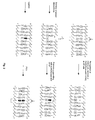
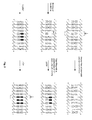
- the principle of the present invention is schematically and exemplarily shown in Fig. 1.
- the method is directed to the randomization of polynucleotides at relevant or essential sites. These sites are defined by positions at which two or more polynucleotides differ from each other.
- the randomization provides polynucleotide populations that encode a diversity of phenotypes, whereby the diversity is restricted to relevant or essential sites or to the proximity of these sites.
- the method comprises the provision of polynucleotides that differ at one or more sites from each other (101, mutations indicated with an "X"), the generation of heteroduplices from these polynucleotides (102), and the recognition and selective randomization of the resulting mismatches (103, randomized positions indicated with an "N"), either focussed to a single mismatching nucleotide (104), or to a codon of three nucleotides (105), or to a region or a larger stretch of surrounding nucleotides (106).
- the method comprises the following steps providing polynucleotides that differ at one or more sites from each other, whereby these one or more differing sites define the sites that are to be randomized; generating heteroduplices from the polynucleotides provided in step (a) leading to mismatches at the one or more sites; introducing single-strand nicks at one or more of the mismatches generated in step (b), by means of an agent that is able to specifically recognize mismatch sites; removing one or more nucleotides from the polynucleotide heteroduplex starting at the single-strand nicks generated in step (c); filling the one or more gaps produced in step (d) under conditions that lead to the incorporation of one or more mismatching nucleotides, thereby randomizing the polynucleotides specifically at relevant or essential sites.
- steps (c) and (d) are executed simultaneously, i.e. mismatching nucleotides are removed directly in one step.
- the nucleobase of the mismatching nucleotide is removed simultaneously with the introduction of the single-strand break, thereby leading to an apurinic /apyrimidinic (AP) site, which is afterwards modified to lead to an extendable 3'-OH end.
- this single nucleotide gap is extended further 5'- 3', 3'-5' or in both directions simultaneously.
- the filling of the gap according to step (e) leads to a nick at the end of the polymerized stretch of nucleotides, which is then covalently closed by means of a ligase enzyme, optionally in combination with a polynucleotide kinase.
- steps (d) and (e) are executed simultaneously, i.e. nucleotides next to the nick introduced in step (c) are removed simultaneously to the incorporation of one or more mismatching nucleotides.
- the remaining nick is preferably covalently closed by means of a ligase enzyme.
- the polymerization conditions are switched to non-mutagenic conditions, and the strand is synthesized without incorporation of mismatching nucleotides.
- Starting material for the method of the invention are two or more polynucleotides that differ at one or more sites from each other. These differences mark the sites where randomization is performed.
- These polynucleotides are preferably provided as linear PCR products, either in a single-stranded or in double-stranded form.
- other linear polynucleotides such as linearized plasmids or parts of a gene can be used analogously.
- these polynucleotides are preferably provided in a single-stranded form, one as the plus and one as the minus strand, thereby enabling the selective generation of heteroduplices.
- these polynucleotides are preferably provided in a double-stranded form in order to allow every possible heteroduplex pair be formed.
- the fraction of homoduplices decreases when increasing the number of double-stranded polynucleotides provided. For example, if two polynucleotides are provided at the same concentrations, the fraction of homoduplices is on average 50%, whereas, if twenty polynucleotides are provided at equal concentrations, the fraction of homoduplices is on average 5%.
- the polynucleotides provided in step (a) can originate from different sources. They can originate from the preceding randomization of an original polynucleotide combined with one or more selection or screening steps that select those polynucleotides that encode gene products with improved characteristics. Preferably, the preceding randomization is done homogeneously, leading to mutations over the entire polynucleotide. Furthermore, starting polynucleotides can originate from the scanning of an original polynucleotide for sites - comprising single positions or longer regions - that are tolerant for a nucleotide exchange in the polynucleotide and/or for an amino acid exchange in the encoded polypeptide.
- starting polynucleotides are analogous or related genes or parts thereof isolated from the same or different species, showing a minimum degree of homology.
- the positions at which polynucleotides differ can be introduced arbitrarily in order to provide marked polynucleotides to be selectively and efficiently randomized at these positions.
- the polynucleotide can have a length in the range between a few nucleotides and up to several kilobases.
- polynucleotides are between 10 and 100,000 nucleotides long, more preferably between 100 and 10,000 nucleotides, and most preferably between 500 and 5,000 nucleotides.
- step (b) heteroduplices are generated from the polynucleotides provided in step (a). If the starting materials are double-stranded polynucleotides, the polynucleotides are mixed, then subjected to conditions that lead to melting of the double-strands to produce single-stranded molecules, which is followed by reannealing of these single strandes (Current Protocols in Molecular Biology, 1987-1988, Wiley Interscience). If the starting materials are single-stranded polynucleotides, those are mixed and randomly annealed to form double-stranded polynucleotides. The resulting heteroduplex molecules comprise mismatches, which can selectively be targeted by chemical, biochemical and/or enzymatic means.
- nicks are introduced into the heteroduplices specifically at or directly next to the mismatch sites.
- a nick is either a sole single-strand break in the phosphodiester backbone at the 5' or 3' side of the mismatch site, or the removal of the entire mismatching nucleotide, or the removal of several nucleotides at or around the particular mismatch site.
- the introduction of nicks is usually random with respect to the particular strand in the heteroduplex to be nicked. In particular embodiments, however, one of the two strands can be selectively nicked, thereby increasing the possible frequency of randomized sites per polynucleotide in the resulting populations.
- Single-strand breaks at mismatch positions can be produced by several enzymatic and non-enzymatic ways.
- Vsr endonuclease from E. coli is particularly useful.
- the enzyme cleaves double-stranded DNA at T:G base-pair mismatches and produces a single-strand break 5' to the incorrectly paired T with a free 3'-OH and a 5'-phosphate residue at this nick.
- the enzyme shows a preference for T:G mismatches within a particular sequence context.
- the consensus sequence is N 1 T A / T GN 2 .
- N stands for A, T, G or C, the underlined T is opposed by a dG base (Gläsner, W. et al ., J.Mol.Biol.
- E. coli endonuclease IV Another useful enzyme is the E. coli endonuclease IV.
- This enzyme is a class II AP endonuclease with 3'-repair phosphodiesterase activity cleaves the phosphodiester backbone on the 5'side of the apurinic/apyrimidinic (AP) sites leaving a 5'-terminal 2-deoxyribose 5-phosphate residue (dRP, removable by dRPase activity) and a free 3'-OH residue.
- dRP 2-deoxyribose 5-phosphate residue
- the enzyme removes 3' blocking fragments, e.g.
- E. coli Endonuclease V (deoxyinosine 3'-endonuclease) is another useful enzyme.
- endonuclease V cleaves DNA duplexes containing AP sites, urea residues, hairpin or unpaired loops, flaps, and pseudo-Y structures. (Yao,M.
- the mode of action of the enzyme depends on the reaction conditions, i.e. pH, presence of MnCl 2 or MgCl 2 .
- a further enzyme performing incision on the 3'- side of the mismatch site in one of the two DNA strands in a heteroduplex is the CEL I-Iike nuclease isolated from celery (Oleykowski et al. Nucleic Acids Res. 26(20): 4597, 1998).
- a further, particularly useful enzyme in this context is MutY.
- the enyzme is a bifunctional glycosylase.
- MutY has an associated AP lyase activity (Lu,A.L. and Hsu,I.C., Genomics 14(2): 249,1992; Friedberg,E.C. et al ., DNA Repair and Mutagenesis, ASM Press, Washington: 157-158, 1995). MUG from E. coli is a further useful enzyme.
- TDG Thymine mismatch DNA glycosylase, from M. thermoautotrophicum
- TDG recognizes T/G (U/G, G/G, T/T, T/C) mismatches (deamination of 5'-methylcytosine to thymine) in dsDNA.
- TDG is a monofunctional glycosylase.
- the enzyme specifically removes thymine and uracil bases mispaired with guanine through hydrolysis of their N-glycosidic bond, thereby generating abasic sites in DNA.
- a further useful enzyme is Human endonuclease IV homolog APE/HAP1. The enzyme cleaves DNA at AP sites forming nicks in DNA (Yacoub,A. et al ., Cancer.Res. 57(24): 5457, 1997; Duguid, J.R. et al ., Cancer.Res., 55(24): 6097, 1995).
- APE1 shows only weak 3'-repair diesterase activity on deoxyribose fragments located at DNA strand breaks Demple,B and Harrison,L., Annu.Rev.Biochem. 63:915, 1994; Xu,Y.J et al ., J.Biol.Chem. 273(44): 28837,1998).
- a further useful enzyme is E. coli exonuclease III. This enzyme has a class III AP endonuclease activity besides the 3'- to 5'-exonuclease activity. It acts on 3'-OH, 3'-phosphate, and 3'-phosphoglycolate groups (Friedberg,E.C. et al ., DNA Repair and Mutagenesis, ASM Press, Washington: 157-158, 1995).
- single-strand breaks at mismatch positions can also be produced by chemical cleavage (CMC-chemical mismatch cleavage).
- CMC-chemical mismatch cleavage Osmiumtetroxide, potassium permanganate is known to recognise and modify a range of mismatched bases (T/C, T/G, T/T and C/T, C/A, C/C mismatches).
- Potassium permanganate/ tetraethylammonium chloride and hydroxylamine are next to others further alternatives (Roberts,E. et al ., Nucleic.Acids.Res. 25(16): 3377, 1997).
- the removal of single-strands according to step (d) can be limited to several nucleotides to generate single-strand regions in proximity to the mismatch positions within the double-stranded polynucleotides.
- the removal of the single-strands according to step (d) can be unrestricted, thereby extending the gap from the mismatch positions to the end of the polynucleotides. Exonucleases and polymerases can be advantageously used for this purpose.
- exonucleases are Lambda-exonuclease (5' ⁇ 3'exonuclease) (Little, Gene Amplification & Analysis 2 (1981), 135-145); T7 exonuclease (5' ⁇ 3'exonuclease), T5 D15 exonuclease (5' ⁇ 3' exonuclease)( Sayers et al., J. Biol. Chem. 265 (1990), 18311-18317), 5'-3' exonuclease from the bacteriophage N4 (Guinta et al. (J. Biol. Chem.
- DNA polymerase I 5' ⁇ 3'polymerase, 3' ⁇ 5' and 5' ⁇ 3' exonuclease
- Taq (Tth) polymerase 5' ⁇ 3'polymerase, 3' ⁇ 5' and 5' ⁇ 3'exonuclease
- Klenow fragment 5' ⁇ 3' polymerase, 3' ⁇ 5' exonuclease
- T4 DNA polymerase (5' ⁇ 3'polymerase, 3' ⁇ 5' exonuclease)(Young et al., Biochemistry 31(37): 8675,1992), Pwo, Pfu, Pfx, Tub, Vent, Tma, UITma polymerases (5 ' ⁇ 3'polymerase, 3' ⁇ 5' exonuclease).(Newton and Graham, in: PCR, Spektrum Akad. Verlag Heidelberg (1994), 1))
- the filling of the gaps according to step (e) is carried out by polymerization of nucleotides.
- the filling can be done with a standard polymerase under conditions that lead to an increased frequency of misincorporations (e.g. conditions of mutagenic PCR as described by Cadwell,R.C and Joyce,G.F., PCR Methods Appl. 2 (1): 28, 1992; PCR Methods Appl. 3 (6): 136, 1994). More preferably, the filling of the gaps can be carried out with a polymerase and universal nucleotides.
- Universal nucleotides are characterized as being able to form basepairs alternatively with two or more of the four standard nucleobases; Therefore, universal nucleosides are, but not limited to, dI (2'-deoxy-inosine), dP (P coding for 6H,8H-3,4-dihydropyrimido[4,5-c][1,2]oxazin-7-one, with "p” serving as pyrimidine (C or T) analogue, Lin and Brown, Nucleic Acids Research.
- dK K coding for N6-methoxy-2,6-diaminopurine, with "K” serving as a purine (G or A) analogue
- G or A analogue
- universal bases can be used 3-nitropyrrole (Nichols et al., Nature, 369:492, 1994; Bergstrom et al., J. Am. Chem. Soc, 117: 1201, 1995) or 4-, 5-, and 6- nitroindole (Loakes et al, Nucleic Acids Research. 22(20):4039-43, 1994).
- the filling of the gaps according to step (e) can be carried out with a polymerase and unequal mixtures of the four standard nucleotides (dATP, dCTP, dGTP, dTTP).
- filling of the gaps can be carried out with a polymerase in four separate reactions, whereby in each reaction of the four standard nucleotides (dATP, dCTP, dGTP, dTTP) is lacking.
- filling of the gaps can be carried out with a polymerase and a mixture of standard (dATP, dCTP, dGTP, dTTP) and universal nucleotides such as dITP.
- filling of the gaps can be carried out with a polymerase and a mixture of random nucleotide trimers, with specific oligonucleotides generated from the original pool of genes but carrying mutations, with completely random oligonucleotides, or with a combination of these.
- the filling of the gaps according to step (e) can be carried out with a ligase and specific and/or random oligonucleotides or mixtures thereof.
- the polymerase can also be chosen to have a high error rate (Suzuki,M. et al., J.Biol.Chem. 272(17): 11228, 1997).
- Polynucleotides generated in step(e) can be subjected to amplification procedures.
- In vitro PCR amplification is performed under conditions offering any of the standard nucleotides dNTPs.
- the amplification is carried out with unequal mixtures of the four standard nucleotides in order to compensate any bias for the nucleotide incorporated opposite to an universal nucleotide during the amplification.
- Polynucleotides obtained in step (e) can also be amplified in vivo.
- the degradation of the nicked strand according to step (d) is limited to one nucleotide to generate an unpaired nucleotide only at the specific mismatching positions.
- mismatching nucleobase is first removed by an agent that is able to specifically recognize mismatches and that has DNA glycosylyase and AP lyase activity.
- the resulting nicked abasic deoxyribose moiety is preferably removed by an agent having AP endonuclease activity such as Endonuclease IV from E.coli (Friedberg,E.C. et al ., DNA Repair and Mutagenesis, ASM Press, Washington: 157-158, 1995; Levin,J.D. et al ., J.Biol.Chem.
- This embodiment can be followed by the introduction of a single, universal nucleotide, such as dITP, by means of a polymerase, and ligation of the resulting nick by means of a ligase enzyme, optionally combined with a polynucleotide kinase.
- a single, universal nucleotide such as dITP
- a ligase enzyme optionally combined with a polynucleotide kinase.
- PCR amplification of this modified polynucleotide or amplification by inserting in a vector and transformation into a cell lead finally to a population of polynucleotide molecules comprising random mutations specifically at the mismatching position.
- the removal of nucleotides from the nicked strand according to step (d) is done simultaneously to the incorporation of new nucleotides according to step (e) by means of a polymerase having 5'-3' exonucleolytic activity or strand displacement activity to randomize positions at the 3' side of the mismatching positions.
- the mismatching nucleobase is first removed by an agent that is able to recognize mismatches and to excise the corresponding nucleobase resulting in an AP site.
- an enzyme with DNA glycosylase function such as TDG (Thymine mismatch DNA glycosylase from M. thermoautotrophicum , Neddermann,P. et al., J.Biol.Chem.
- MUG Match uracil DNA glycosylase from E.coli , Barrett,T.E et al ., Cell 92(1):117, 1998; Barrett,T.E et al ., EMBO.J. 18(23): 6599, 1999
- the phosphodiester bond 5' of the AP site is then hydrolyzed by means of a second agent leading to an extendable 3' OH end.
- an enzyme having AP endonuclease function such as E.coli Endonuclease IV (Friedberg,E.C.
- the resulting 3' OH end is then extended by means of a polymerase optionally having dRPase (deoxyribose phosphatase) function in order to remove the remaining abasic deoxyribose phosphate moiety, as e.g. Human DNA polymerase ⁇ (Matsumoto et al., Science 269(5224):699, 1995), Drosophila ribosomal protein S3 (Sandigursky et al. J.Biol.Chem. 272(28): 17480,1997).
- dRPase deoxyribose phosphatase
- Particularly useful polymerases with 5'-3'-exonucleolytic activity for the removal of nucleotides during the incorporation of new nucleotides are DNA polymerase I (Rigby et al., J. Mol. Biol. 113 (1977), 237-251) or Taq polymerase from Thermus aquaticus .
- Particularly useful polymerases with strand-displacement activity for the removal of nucleotides during the incorporation of new nucleotides are DNA polymerase ⁇ , large fragments of rBst DNA polymerase from B. stearothermophilus, Phi29 DNA polymerase (Giesler et al., Amersham Pharma Biotech).
- nucleotides are either universal bases (such as dITP, dPTP, dKTP) or standard nucleotides under conditions that lead to an increased misincoporation rate.
- the polynucleotides are either PCR-amplified or amplified by inserting into a vector and transformation into a cell lead finally to a population of polynucleotide molecules comprising random mutations specifically 3' downstream from the mismatching position.
- randomization can be done by a first polymerization step under conditions that lead to a high frequency of misincorporation and a second polymerization step under conditions that lead to a low frequency of misincorporation.
- the first polymerization step is carried out with a polymerase having 5'-3' exonucleolytic activity and using universal nucleotides.
- the second polymerization step is then carried out with a polymerase having 5'-3' exonucleolytic activity and using standard nucleotides.
- a polymerase with DRPase but without 5'-3'-exonucleolytic activity and strand-displacement activity can be used. Then only a single nucleotide is incorporated leading to the same result as the first embodiment.
- the removal of nucleotides from the nicked strand according to step (d) is done by means of an exonuclease thereby allowing to randomize a region extending from the mismatch site either to the 3' side, or to the 5' side, or to both, the 3' and the 5' side.
- the size of this region is preferably confined by controlling the exonucleolytic digestion.
- the mismatching nucleobase is first removed by an agent that is able to specifically recognize mismatches and that has DNA glycosylase and AP lyase activity.
- the resulting nicked abasic deoxyribose moiety can optionally be removed by an agent having AP endonuclease activity such as E.coli Endonuclease IV (Friedberg et al ., 1995 ), Human Endonuclease IV (Yacoub et al.,1997 ).
- the nick is then extended to a gap of a certain size by means of an enzyme having exonuclease activity.
- the gap is extended in 3' direction by means of an exonuclease that specifically has single-strand 3'-5'-exonucleolytic activity such as Exonuclease III from E.coli ( Friedberg et al ., 1995 ) or E.coli Exonuclease I (Brody et al. J. Biol. Chem. 261: 7136 ,1986).
- the gap is extended in 5' direction by means of an exonuclease that specifically has single-strand 5'-3'-exonucleolytic activity such as ⁇ -Exonuclease or T7-5'-exonuclease derived from the bacteriophage T7.
- the gap is extended in both directions by means of an exonuclease that has single-strand 3'-5'- and 5'-3'-exonucleolytic activity such as Bal 31 from Alteromonas espejiana (Gray et al., Nucleic Acid Res. 2 (1975) 1459-1492) or by means of a blend of enzymes having single-strand 3'-5'-exonucleolytic and 5'-3'-exonucleolytic activity.
- the resulting 3' OH end is then extended by means of a polymerase lacking 5'-3'-exonucleolytic and strand-displacement activity.
- Particularly useful polymerases for this purpose are T7 DNA polymerase, Klenow fragement, T4 DNA polymerase.
- Incorporated nucleotides are either universal bases such as dITP or standard nucleotides under conditions that lead to an increased misincoporation rate.
- randomised oligonucleotides of different length are being hybridised to the gaps of ssDNA generated as outlined above.
- these olignucleotides may contain varying degrees of universal bases.
- the polynucleotides are either PCR-amplified or amplified by inserting into a vector and transformation into a cell leading finally to a population of polynucleotide molecules comprising random mutations specifically 3' downstream or 5' upstream or to both direction from the former mismatching position.
- the following single-stranded polynucleotides were used to generate double-stranded polynucleotides with homologous and heterologous regions.
- the polynucleotides 1 and 2 as well as 3 and 4 were mixed in aequimolar amounts to yield a solution of 1 ⁇ g DNA in 20 ⁇ l water. Annealing was performed by heating the solution in a PCR cycler to 94 °C and subsequent cooling with a rate of 0.04 °C/s to 50 °C.
- the single-stranded polynucleotides 1 and 2 create a double-stranded polynucleotide with a mismatch at position 51 (Heteroduplex 1).
- the single-stranded polynucleotides 3 and 4 create a resulting double-stranded polynucleotide with a variety of mismatches such as T/G, A/A, G/T, C/A, A/C, A/A at the positions 51, 201, 221, 258, 347, 348 respectively which comprise 3 of the 8 possible mismatches (Heteroduplex 2).
- DNA-Glycosylases are used:
- the analysis of the cleavage reaction was carried out with fluorescent-labeled heteroduplices each strand being labeled at its 5'end. Fluorescence labeled single-stranded polynucleotides were generated with 5'-end labeled primer and a standard PCR protocol. The respective PCR products were denatured and re-annealed under standard PCR conditions (94 °C ⁇ 50 °C, 0.04 °C/s) and purified (QIAgen PCR purification kit). These fluorescence labeled heteroduplices were submitted to enzymatic reactions. The resulting DNA fragments were analysed using a capillary electrophoresis system with fluorescence detection (CEQ 2000 DNA Analysis-System, Beckmann).
- Mismatches in heteroduplices can be recognized and modified by the cleavage of a nucleoside residue at one of the two mismatch basepairs.
- a double-stranded polynucleotide with an apurinic site (AP site) site can be cleaved by E.
- coli endonuclease IV under the following conditions: The double-stranded polynucleotide substrate with an apurinic site was generated by annealing (94°C ⁇ 50°C, 0.04 °C/s) oligonucleotide 1 (5'GAATATGCACAGAGTG[Sp-d]TCCTTATGGC) and oligonucleotide 2 (5'GCCATAAGGAGCACTCTGTGCATATTC). A total of 1 ⁇ g annealing product was incubated in 20 ⁇ l of TDG Buffer (R&D Systems) with 4 u endonuclease IV (E.coli, MBI Fermentas) for different periods of time.
- TDG Buffer R&D Systems
- the reaction was stopped by adding 5 ⁇ l of 6 x loading buffer (MBI Fermentas) and boiling for 10 min at 95 °C.
- the reaction products were analysed using a 15% polyacrylamide gel and ethidiumbromide staining. There was an increase in intensity of the expected cleavage product with increasing time of the digestion.
- Heteroduplex DNA displaying mismatches may be nicked by bi-functional DNA-Glycosylases which subsequent to glycosylase activity further incise at the 3' site via ⁇ -elimination thereby producing an obstructive 3'end.
- These 3' blocking groups can be removed by E. coli endonuclease IV to generate suitable primers for extension reactions. Fragments generated by TDG action (Example 2) that had an obstructive 3'end were isolated from a denaturing PAGE gel employing standard procedures. In the following the blocked fragments were incubated with endonuclease IV using conditions as outlined in Example 3. The functionality of the trimmed oligonucleotide was demonstrated by primer extension under standard conditions. Reaction products were analysed as outlined in Example 2 and showed the extensibility of the endonuclease IV treated oligonucleotide.
- a polynucleotide was generated by digesting labelled polynucleotide 3 with Nae I.
- the reaction products were purified (QIAgen Minelute) and annealed (94°C ⁇ 50 °C, 0.04 °C/s) with unlabelled polynucleotide 3 prior to elongation by Taq-DNA-Polymerase.
- the polymerase reactions were carried out under standard and mutagenic (PCR supplemented with 100 - 400 ⁇ M Mn2 + ) PCR protocol conditions in the absence of dNTP but in the presence of 2mM dITP. Elongation products were detected by DNA-fragment analysis described in example 2 under standard and mutagenic conditions demonstrating the incorporation of dIMPs.
- oligonucleotide 3 Fluorescence labeled oligonucleotide 3 (5'Cy5-CGAGCGTTGC ATATGTGGAA GAAGATCATA TI) with a dIMP at the 3'-end was mixed with oligonucleotide 4 (5'[P]-GCACATGAAT ATGCACAGAG TGTTCCTTAT GGC) and unlabelled polynucleotide 3. After denaturation and annealing (94°C ⁇ 50°C, 0.04 °C/s), the oligonucleotides were ligated using 25 u T4-DNA-Ligase (MBI Fermentas) overnight at 16 °C under standard conditions. Ligation products of 65 nt single-stranded oligonucleotides were detected using the DNA-fragment analysis described in example 2.
- Example 7 Amplification of templates containing dIMP stretches
- a standard PCR was performed using primers (oligonucleotide 5: 5'CGTTGCATAT GTGGAAGAAG and oligonucleotide 6: 5'CAAGGCTCATGTTGATAACATC) and a template according to polynucleotide 3 but containing a sequence of 8 dIMPs starting at position 205 for the forward template strand and no dIMP for the reverse template strand.
- primers oligonucleotide 5: 5'CGTTGCATAT GTGGAAGAAG and oligonucleotide 6: 5'CAAGGCTCATGTTGATAACATC
Landscapes
- Genetics & Genomics (AREA)
- Engineering & Computer Science (AREA)
- Chemical & Material Sciences (AREA)
- Health & Medical Sciences (AREA)
- Life Sciences & Earth Sciences (AREA)
- Zoology (AREA)
- General Engineering & Computer Science (AREA)
- Organic Chemistry (AREA)
- Biotechnology (AREA)
- Wood Science & Technology (AREA)
- Biomedical Technology (AREA)
- Bioinformatics & Cheminformatics (AREA)
- Microbiology (AREA)
- Molecular Biology (AREA)
- Crystallography & Structural Chemistry (AREA)
- Plant Pathology (AREA)
- Physics & Mathematics (AREA)
- Biochemistry (AREA)
- General Health & Medical Sciences (AREA)
- Biophysics (AREA)
- Measuring Or Testing Involving Enzymes Or Micro-Organisms (AREA)
- Saccharide Compounds (AREA)
Priority Applications (10)
| Application Number | Priority Date | Filing Date | Title |
|---|---|---|---|
| EP02018855A EP1394251A1 (de) | 2002-08-23 | 2002-08-23 | Verfahren zur selektiven Zufallsmutagenese von Polynukleotiden |
| ES03747925T ES2237744T3 (es) | 2002-08-22 | 2003-08-22 | Procedimiento para la aleatorizacion combinatoria de polinucleotidos. |
| PCT/EP2003/009340 WO2004018674A1 (en) | 2002-08-22 | 2003-08-22 | Method for the selective combinatorial randomization of polynucleotides |
| AU2003267008A AU2003267008B2 (en) | 2002-08-22 | 2003-08-22 | Method for the selective combinatorial randomization of polynucleotides |
| AT03747925T ATE291084T1 (de) | 2002-08-22 | 2003-08-22 | Verfahren zur selektiven zufallsmutagenese von polynukleotiden |
| DK03747925T DK1419248T3 (da) | 2002-08-22 | 2003-08-22 | Fremgangsmåde til selektiv, kombinatorisk randomisering af polynucleotider |
| DE60300389T DE60300389T2 (de) | 2002-08-22 | 2003-08-22 | Verfahren zur selektiven zufallsmutagenese von polynukleotiden |
| JP2004530247A JP2005536213A (ja) | 2002-08-22 | 2003-08-22 | ポリヌクレオチドの選択的組合せランダム化の方法 |
| CA002495885A CA2495885A1 (en) | 2002-08-22 | 2003-08-22 | Method for the selective combinatorial randomization of polynucleotides |
| EP03747925A EP1419248B1 (de) | 2002-08-22 | 2003-08-22 | Verfahren zur selektiven zufallsmutagenese von polynukleotiden |
Applications Claiming Priority (1)
| Application Number | Priority Date | Filing Date | Title |
|---|---|---|---|
| EP02018855A EP1394251A1 (de) | 2002-08-23 | 2002-08-23 | Verfahren zur selektiven Zufallsmutagenese von Polynukleotiden |
Publications (1)
| Publication Number | Publication Date |
|---|---|
| EP1394251A1 true EP1394251A1 (de) | 2004-03-03 |
Family
ID=31197813
Family Applications (2)
| Application Number | Title | Priority Date | Filing Date |
|---|---|---|---|
| EP02018855A Withdrawn EP1394251A1 (de) | 2002-08-22 | 2002-08-23 | Verfahren zur selektiven Zufallsmutagenese von Polynukleotiden |
| EP03747925A Expired - Lifetime EP1419248B1 (de) | 2002-08-22 | 2003-08-22 | Verfahren zur selektiven zufallsmutagenese von polynukleotiden |
Family Applications After (1)
| Application Number | Title | Priority Date | Filing Date |
|---|---|---|---|
| EP03747925A Expired - Lifetime EP1419248B1 (de) | 2002-08-22 | 2003-08-22 | Verfahren zur selektiven zufallsmutagenese von polynukleotiden |
Country Status (9)
| Country | Link |
|---|---|
| EP (2) | EP1394251A1 (de) |
| JP (1) | JP2005536213A (de) |
| AT (1) | ATE291084T1 (de) |
| AU (1) | AU2003267008B2 (de) |
| CA (1) | CA2495885A1 (de) |
| DE (1) | DE60300389T2 (de) |
| DK (1) | DK1419248T3 (de) |
| ES (1) | ES2237744T3 (de) |
| WO (1) | WO2004018674A1 (de) |
Families Citing this family (13)
| Publication number | Priority date | Publication date | Assignee | Title |
|---|---|---|---|---|
| GB0422052D0 (en) | 2004-10-04 | 2004-11-03 | Dansico As | Enzymes |
| GB0423139D0 (en) | 2004-10-18 | 2004-11-17 | Danisco | Enzymes |
| CN103555733A (zh) | 2005-01-05 | 2014-02-05 | F-星生物技术研究与开发有限公司 | 分子中互补决定区以外的区域中工程改造了的具有结合特性的合成免疫球蛋白结构域 |
| EP1726643A1 (de) | 2005-05-27 | 2006-11-29 | Direvo Biotech AG | Methode zur Bereitstellung, Identifizierung und Selektion von Proteasen die eine veränderte Empfindlichkeit gegenüber Aktivität-verändernden Substanzen aufweisen |
| AT503889B1 (de) | 2006-07-05 | 2011-12-15 | Star Biotechnologische Forschungs Und Entwicklungsges M B H F | Multivalente immunglobuline |
| AT503861B1 (de) | 2006-07-05 | 2008-06-15 | F Star Biotech Forsch & Entw | Verfahren zur manipulation von t-zell-rezeptoren |
| AT503902B1 (de) | 2006-07-05 | 2008-06-15 | F Star Biotech Forsch & Entw | Verfahren zur manipulation von immunglobulinen |
| US8143046B2 (en) | 2007-02-07 | 2012-03-27 | Danisco Us Inc., Genencor Division | Variant Buttiauxella sp. phytases having altered properties |
| EP3241842B1 (de) | 2007-06-26 | 2024-01-31 | F-star Therapeutics Limited | Präsentieren von bindenden mitteln |
| DE102008008313A1 (de) * | 2008-02-07 | 2009-08-13 | Qiagen Gmbh | Amplifikation von bisulfitierten Nukleinsäuren |
| EP2113255A1 (de) | 2008-05-02 | 2009-11-04 | f-star Biotechnologische Forschungs- und Entwicklungsges.m.b.H. | Zytotoxisches Immunglobulin |
| JP5935382B2 (ja) * | 2011-05-24 | 2016-06-15 | 三菱レイヨン株式会社 | RrhJ1IIヌクレアーゼおよびその遺伝子 |
| EP3354746B1 (de) * | 2017-01-30 | 2019-05-29 | Gregor Mendel Institute of Molecular Plant Biology GmbH | Neuartige spike-in-oligonukleotide zur normalisierung von sequenzdaten |
Citations (1)
| Publication number | Priority date | Publication date | Assignee | Title |
|---|---|---|---|---|
| WO2002046396A1 (en) * | 2000-12-06 | 2002-06-13 | Novozymes A/S | Method for producing a polynucleotide library |
-
2002
- 2002-08-23 EP EP02018855A patent/EP1394251A1/de not_active Withdrawn
-
2003
- 2003-08-22 DE DE60300389T patent/DE60300389T2/de not_active Expired - Lifetime
- 2003-08-22 EP EP03747925A patent/EP1419248B1/de not_active Expired - Lifetime
- 2003-08-22 WO PCT/EP2003/009340 patent/WO2004018674A1/en not_active Ceased
- 2003-08-22 ES ES03747925T patent/ES2237744T3/es not_active Expired - Lifetime
- 2003-08-22 JP JP2004530247A patent/JP2005536213A/ja active Pending
- 2003-08-22 CA CA002495885A patent/CA2495885A1/en not_active Abandoned
- 2003-08-22 AT AT03747925T patent/ATE291084T1/de active
- 2003-08-22 AU AU2003267008A patent/AU2003267008B2/en not_active Ceased
- 2003-08-22 DK DK03747925T patent/DK1419248T3/da active
Patent Citations (1)
| Publication number | Priority date | Publication date | Assignee | Title |
|---|---|---|---|---|
| WO2002046396A1 (en) * | 2000-12-06 | 2002-06-13 | Novozymes A/S | Method for producing a polynucleotide library |
Non-Patent Citations (3)
| Title |
|---|
| KUCHNER AND F H ARNOLD A: "Directed evolution of enzyme catalysts", TRENDS IN BIOTECHNOLOGY, ELSEVIER, AMSTERDAM,, GB, vol. 15, no. 12, December 1997 (1997-12-01), pages 523 - 530, XP002133872, ISSN: 0167-7799 * |
| REETZ M T: "Directed evolution of selective enzymes and hybrid catalysts", TETRAHEDRON, ELSEVIER SCIENCE PUBLISHERS, AMSTERDAM, NL, vol. 58, no. 32, 5 August 2002 (2002-08-05), pages 6595 - 6602, XP004374099, ISSN: 0040-4020 * |
| WURST H ET AL: "MUTANT PROFILES OF SELECTABLE GENETIC ELEMENTS", PROCEEDINGS OF THE NATIONAL ACADEMY OF SCIENCES OF THE UNITED STATES, vol. 88, no. 22, 1991, 1991, pages 9909 - 9913, XP002226883, ISSN: 0027-8424 * |
Also Published As
| Publication number | Publication date |
|---|---|
| ATE291084T1 (de) | 2005-04-15 |
| DE60300389D1 (de) | 2005-04-21 |
| CA2495885A1 (en) | 2004-03-04 |
| DE60300389T2 (de) | 2006-03-16 |
| AU2003267008A1 (en) | 2004-03-11 |
| WO2004018674A1 (en) | 2004-03-04 |
| DK1419248T3 (da) | 2005-07-11 |
| AU2003267008B2 (en) | 2009-01-08 |
| ES2237744T3 (es) | 2005-08-01 |
| EP1419248B1 (de) | 2005-03-16 |
| EP1419248A1 (de) | 2004-05-19 |
| JP2005536213A (ja) | 2005-12-02 |
Similar Documents
| Publication | Publication Date | Title |
|---|---|---|
| AU761570B2 (en) | Methods for generating highly diverse libraries | |
| AU2022204663A1 (en) | DNA production method and DNA fragment joining kit | |
| CN102203273A (zh) | 生成基因特异性的文库的方法 | |
| CA2584984A1 (en) | Methods for assembly of high fidelity synthetic polynucleotides | |
| US20210222219A1 (en) | Enzymatic synthesis of nucleic acid sequences | |
| EP1419247B1 (de) | Verfahren zur herstellung von nukleinsäuren bestehend aus stochastisch kombinierten anteilen von ausgangsnukleinsäuren | |
| EP1419248B1 (de) | Verfahren zur selektiven zufallsmutagenese von polynukleotiden | |
| AU2002321251A1 (en) | Method for the production of nucleic acids consisting of stochastically combined parts of source nucleic acids | |
| WO2002006469A2 (en) | Methods of ligation mediated chimeragenesis utilizing populations of scaffold and donor nucleic acids | |
| US20220380823A1 (en) | System and method for nucleic acid library preparation via template switching mechanism | |
| CN114901820B (zh) | 构建基因突变文库的方法 | |
| WO2001029212A1 (en) | Methods for chimeragenesis of whole genomes or large polynucleotides | |
| CN107002290A (zh) | 样品制备方法 | |
| US20040132054A1 (en) | Method for the selective combinatorial randomization of polynucleotides | |
| WO2003040376A1 (en) | Method for site-directed mutagenesis of nucleic acid molecules using a single primer | |
| EP3655572A1 (de) | Schnelle bibliothekskonstruktion für hochdurchsatz-sequenzierung | |
| WO2025172578A1 (en) | A nucleic acid assembly method using type iib enzymes | |
| WO2025083338A1 (en) | An in vitro method for fragmenting polynucleotides for next generation sequencing |
Legal Events
| Date | Code | Title | Description |
|---|---|---|---|
| PUAI | Public reference made under article 153(3) epc to a published international application that has entered the european phase |
Free format text: ORIGINAL CODE: 0009012 |
|
| AK | Designated contracting states |
Kind code of ref document: A1 Designated state(s): AT BE BG CH CY CZ DE DK EE ES FI FR GB GR IE IT LI LU MC NL PT SE SK TR |
|
| AX | Request for extension of the european patent |
Extension state: AL LT LV MK RO SI |
|
| STAA | Information on the status of an ep patent application or granted ep patent |
Free format text: STATUS: THE APPLICATION HAS BEEN WITHDRAWN |
|
| 18W | Application withdrawn |
Effective date: 20040831 |