EP1395073A2 - Verfahren zur Anzeige eines Präsenzstatus auf einer Anzeigeeinheit eines Mobiltelefons - Google Patents
Verfahren zur Anzeige eines Präsenzstatus auf einer Anzeigeeinheit eines Mobiltelefons Download PDFInfo
- Publication number
- EP1395073A2 EP1395073A2 EP03090233A EP03090233A EP1395073A2 EP 1395073 A2 EP1395073 A2 EP 1395073A2 EP 03090233 A EP03090233 A EP 03090233A EP 03090233 A EP03090233 A EP 03090233A EP 1395073 A2 EP1395073 A2 EP 1395073A2
- Authority
- EP
- European Patent Office
- Prior art keywords
- data
- display unit
- mobile phone
- display
- phone
- Prior art date
- Legal status (The legal status is an assumption and is not a legal conclusion. Google has not performed a legal analysis and makes no representation as to the accuracy of the status listed.)
- Withdrawn
Links
- 238000000034 method Methods 0.000 title claims abstract description 25
- 238000004891 communication Methods 0.000 claims abstract description 25
- 230000001413 cellular effect Effects 0.000 description 5
- 238000012544 monitoring process Methods 0.000 description 4
- 101100078001 Saccharomyces cerevisiae (strain ATCC 204508 / S288c) MSC2 gene Proteins 0.000 description 3
- 238000013500 data storage Methods 0.000 description 3
- 238000013461 design Methods 0.000 description 2
- 239000013589 supplement Substances 0.000 description 2
- 238000012432 intermediate storage Methods 0.000 description 1
- 238000002955 isolation Methods 0.000 description 1
- 230000008520 organization Effects 0.000 description 1
- 230000002028 premature Effects 0.000 description 1
- 238000012545 processing Methods 0.000 description 1
- 230000003068 static effect Effects 0.000 description 1
- 238000003860 storage Methods 0.000 description 1
- 238000012546 transfer Methods 0.000 description 1
- 230000000007 visual effect Effects 0.000 description 1
Images

Classifications
-
- H—ELECTRICITY
- H04—ELECTRIC COMMUNICATION TECHNIQUE
- H04W—WIRELESS COMMUNICATION NETWORKS
- H04W4/00—Services specially adapted for wireless communication networks; Facilities therefor
- H04W4/20—Services signaling; Auxiliary data signalling, i.e. transmitting data via a non-traffic channel
-
- H—ELECTRICITY
- H04—ELECTRIC COMMUNICATION TECHNIQUE
- H04M—TELEPHONIC COMMUNICATION
- H04M1/00—Substation equipment, e.g. for use by subscribers
- H04M1/26—Devices for calling a subscriber
- H04M1/27—Devices whereby a plurality of signals may be stored simultaneously
- H04M1/274—Devices whereby a plurality of signals may be stored simultaneously with provision for storing more than one subscriber number at a time, e.g. using toothed disc
- H04M1/2745—Devices whereby a plurality of signals may be stored simultaneously with provision for storing more than one subscriber number at a time, e.g. using toothed disc using static electronic memories, e.g. chips
- H04M1/27467—Methods of retrieving data
- H04M1/27475—Methods of retrieving data using interactive graphical means or pictorial representations
-
- H—ELECTRICITY
- H04—ELECTRIC COMMUNICATION TECHNIQUE
- H04M—TELEPHONIC COMMUNICATION
- H04M1/00—Substation equipment, e.g. for use by subscribers
- H04M1/26—Devices for calling a subscriber
- H04M1/27—Devices whereby a plurality of signals may be stored simultaneously
- H04M1/274—Devices whereby a plurality of signals may be stored simultaneously with provision for storing more than one subscriber number at a time, e.g. using toothed disc
- H04M1/2745—Devices whereby a plurality of signals may be stored simultaneously with provision for storing more than one subscriber number at a time, e.g. using toothed disc using static electronic memories, e.g. chips
- H04M1/2753—Devices whereby a plurality of signals may be stored simultaneously with provision for storing more than one subscriber number at a time, e.g. using toothed disc using static electronic memories, e.g. chips providing data content
- H04M1/2757—Devices whereby a plurality of signals may be stored simultaneously with provision for storing more than one subscriber number at a time, e.g. using toothed disc using static electronic memories, e.g. chips providing data content by data transmission, e.g. downloading
-
- H—ELECTRICITY
- H04—ELECTRIC COMMUNICATION TECHNIQUE
- H04M—TELEPHONIC COMMUNICATION
- H04M1/00—Substation equipment, e.g. for use by subscribers
- H04M1/72—Mobile telephones; Cordless telephones, i.e. devices for establishing wireless links to base stations without route selection
- H04M1/724—User interfaces specially adapted for cordless or mobile telephones
- H04M1/72448—User interfaces specially adapted for cordless or mobile telephones with means for adapting the functionality of the device according to specific conditions
- H04M1/72454—User interfaces specially adapted for cordless or mobile telephones with means for adapting the functionality of the device according to specific conditions according to context-related or environment-related conditions
-
- H—ELECTRICITY
- H04—ELECTRIC COMMUNICATION TECHNIQUE
- H04M—TELEPHONIC COMMUNICATION
- H04M3/00—Automatic or semi-automatic exchanges
- H04M3/42—Systems providing special services or facilities to subscribers
- H04M3/42365—Presence services providing information on the willingness to communicate or the ability to communicate in terms of media capability or network connectivity
Definitions
- the invention relates to a method for displaying a presence status of a communication participant on a display unit of a cell phone.
- Presence Service Presence Service
- Presence server properties of selected communication participants can be monitored.
- Such features - which are referred to as presence status - include, for example, the current availability via telephone, short text messages (SMS) or email.
- SMS short text messages
- the respective user sends a watcher list to the presence computer.
- This monitoring list contains a list of the persons to be monitored that are of interest to the user or their communication terminals.
- the Presence calculator Presence data about the devices to be monitored or people to a communication terminal (e.g. mobile phone) of the user.
- the invention has for its object to provide a method with which the presence status on a display unit of the mobile phone can be output.
- this object is achieved by a method to display a presence status of a communication participant on a display unit of a mobile phone in which on the part of the mobile phone describing the presence status Presence data are received, the presence data presence display data are assigned, which can be output by the display unit and when querying from a phone book memory phone book data shared with the mobile phone with the telephone book data also the presence display data transmitted to the display unit of the mobile phone and there be displayed if necessary. It is particularly advantageous that the presence display data is then on the display unit of the cell phone are shown when a query the phone book data has taken place, so if the Information relating to communication participants is required become. It is therefore advantageously the presence display data not shown in isolation for itself, but in Connection with others, in the phone book of the mobile phone stored data about the same (to be monitored) communication subscriber.
- the method according to the invention can be designed that the presence display data together with the phone book data are output on the display unit.
- An embodiment of the method according to the invention provides that the presence data on the part of the mobile phone from one connected to the mobile phone via a cellular network Presence computer can be received.
- the method according to the invention can proceed such that after Receiving the presence data from an image data memory of the mobile phone Image data assigned to the presence data is read out this image data as presence display data to the display unit of the mobile phone are transmitted, whereupon the display unit the presence status in the form of an image is issued.
- the display of the presence status of the person to be monitored Object in image form enables a process user the presence information very quickly, so to speak "at a glance”. It is also possible also a larger number of presence information on the (in general small) display area of the display unit of the mobile phone to present in a clear manner.
- This type of display also enables a Language-independent and cross-country understandable information display.
- the method according to the invention can also proceed in such a way that after receiving the presence data from a text data memory of the Mobile data read out text data assigned to the presence data this text data as presence display data to the Display unit of the mobile phone are transmitted, whereupon the presence status on the display unit in the form of an alphanumeric String is output.
- This design the method according to the invention can advantageously can also be used with mobile phones whose Display units only for the output of alphanumeric characters are suitable. This can be the case with mobile phones, for example older design may be the case. Beyond that Additional information at the. using alphanumeric characters Output display unit which, for example, by the Output of the image according to the embodiment described above complete transmitted information.
- a SIM card connected to the mobile phone or a selected area of a RAM memory of the cell phone be used.
- a mobile telephone M with a display unit is shown schematically in FIG A is shown, which has an air interface is connected to a cellular network MFN.
- BTS Base Transceiver Station
- MSC1 Mobile Services Switching Center
- PR Presence Server
- the presence calculator PR can also be used in another mobile radio network (not shown in FIG. 1) if this additional cellular network with the 1 is connected to the mobile radio network MFN.
- a monitoring list LI is created by the mobile telephone M. and via the air interface, the base station BTS and the mobile switching centers MSC1 and MSC2 to the presence computer PR broadcast.
- the watchlist contains information about those communication participants (the are z. B. the communication devices of mobile subscribers, Landline subscribers and Internet subscribers), their presence status monitored and displayed using the mobile phone should.
- the Procedure for displaying the presence status of these devices or the user of these devices on the display unit of the mobile phone is described in detail with the help of Figure 2.
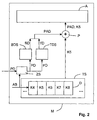
- FIG 2 are those running within the mobile phone M. Operations for displaying the presence status on the display unit A of the mobile phone shown.
- a first step from the mobile phone M which describes the presence status Presence data PD by means of a receiving device, not shown received and to a buffer store ZS forwarded.
- the buffer store ZS stores the presence data until further use. If from one existing phone book memory TS of the mobile phone M phone book data are queried by means of an interrogation signal AB, so this query signal AB also becomes a buffer ZS headed.
- Such phone book memory TS in mobile phones are sometimes referred to as address book storage; this occurs especially when in addition to them the name and telephone number of the communication participant also other information such as addresses or personal notes are saved.
- the presence data are assigned from the image data memory BDS Image data BD output.
- This image data BD contain for example image information from small format images (Icons), which the in a clear manner Able to display information content of the presence data are. If the presence data contain, for example, the information that a communication partner to be monitored (the is also known as presentity) on his cell phone is reachable (because he switched on his mobile phone and does not already have a cell phone call), so this information is represented by an image of a mobile phone become. Do the presence data contain the information that the communication participant of interest is currently can be reached via a landline phone, this can be done by the picture of a telephone handset will be presented.
- Icons small format images
- the presented communication participant is currently using a communication terminal (cell phone, laptop, palmtop, Computer with internet browser etc.) participating in an online game other game partners and so you can participate at this online game with the communicator in
- This presence data information can connect by a picture with a characteristic of the game in question Figure are shown - for example through a picture of a ship for a strategy game which the organization of a freight transport using cargo ships treated.
- the current accessibility via email through the visual representation of a Envelope, a current stay in London through a Image of Tower Bridge or current participation in one Conference (at which the participant to be monitored is not disturbed through a symbolic representation of a conference scene be depicted.
- the image data BD, the Describing such images is called presence display data transferred to a summation point P.
- This text data storage becomes the Text strings corresponding to presence data (e.g. alphanumeric Text strings) and read as text data TD output.
- This text data TD is also used as presence display data transmitted to the information point P. Contain for example the presence data PD the information that the Presentity participants are currently using their mobile phone in Kunststoff can be reached, one can go to this location information associated text string "Munich” (or a text string "Bavaria", which is not the city name of the current location, but only indicates the associated state) output as text data and as presence display data the summation point P are transmitted.
- This text data can for example to supplement the data from the image data storage BDS read out image data (in this case for supplement the picture with the mobile phone); later the picture "Mobile phone” together with the text string "Munich” at the Display unit A of the mobile phone are output.
- the text data TD can also by using the text data TD such detailed information is displayed on the display unit are difficult to display using an image is to be realized or can lead to misunderstandings.
- the query signal AB also becomes a telephone book memory TS of the mobile phone M transmitted.
- this phone book memory TS are stored phone book data D from those in this embodiment phone book records K4, K5, K6, K7 and K8 are shown.
- Telephone book data K4, K5, K6, K7 and K8 the telephone book data K5 queried; consequently, the phone book data K5 output from the phone book memory TS and to the Transfer summation point P.
- the summation point P symbolizes in the representation of the figure 2 a known control device for the display A of the cell phone.
- This control circuit P receives the current phone book data K5 and the presence display data PAD in the form of the image data BD and the text data TD.
- the presence display data PAD and the telephone book data K5 are (if necessary after processing by the control circuit P) transmitted to and on the display A of the mobile phone output.
- the presence display data PAD and the phone book data K5 together and simultaneously on one single view of display A, resulting in a compact information display leads. But it is the same possible that, for example, first on a first ad edition the display unit A shows the phone book data K5 (possibly together with a note that presence display data ) Are present.
- the presence display data PAD shown.
- the presence display data are currently being displayed on display A if there is an output of the phone book data K5.
- This type of display enables a mobile phone user when querying data a communication participant from the phone memory of the Mobile phones for example to recognize that the one to be monitored Communication participants are currently not using their mobile phone can be reached (because this is switched off, for example or the radio coverage is insufficient). simultaneously he receives the information that this participant can be reached via email via his laptop computer.
- Another advantage for the user of the mobile phone is in that it contains the phone book entries K5 and the presence information shown simultaneously on the display gets without having to do multiple operations needs. This is not the procedure described only particularly user-friendly, but also avoids one premature wear of the controls of the mobile phone (for example the buttons) by multiple entries per display request.
Landscapes
- Engineering & Computer Science (AREA)
- Signal Processing (AREA)
- Computer Networks & Wireless Communication (AREA)
- Environmental & Geological Engineering (AREA)
- Human Computer Interaction (AREA)
- Mobile Radio Communication Systems (AREA)
- Telephonic Communication Services (AREA)
Abstract
Description
Claims (7)
- Verfahren zur Anzeige eines Präsenzstatus eines Kommunikationsteilnehmers auf einer Anzeigeeinheit (A) eines Mobiltelefons (M), bei demseitens des Mobiltelefons (M) den Präsenzstatus beschreibende Präsenzdaten (PD) empfangen werden,den Präsenzdaten (PD) Präsenzanzeigedaten (PAD) zugeordnet werden, welche von der Anzeigeeinheit (A) ausgebbar sind, undbei einer Abfrage (AB) von in einem Telefonbuchspeicher (TS) des Mobiltelefons (M) gespeicherten Telefonbuchdaten (K5) mit den Telefonbuchdaten (K5) auch die Präsenzanzeigedaten (PAD) zu der Anzeigeeinheit (A) des Mobiltelefons (M) übertragen und dort angezeigt werden.
- Verfahren nach Anspruch 1,
dadurch gekennzeichnet, dassdie Präsenzanzeigedaten (PAD) gemeinsam mit den Telefonbuchdaten (K5) an der Anzeigeeinheit (A) ausgegeben werden. - Verfahren nach Anspruch 1 oder 2,
dadurch gekennzeichnet, dassseitens des Mobiltelefons (M) die Präsenzdaten (PD) von einem über ein Mobilfunknetz (MFN) mit dem Mobiltelefon (M) verbundenen Präsenzrechner (PR) empfangen werden. - Verfahren nach einem der vorhergehenden Ansprüche,
dadurch gekennzeichnet, dassnach Empfang der Präsenzdaten (PD) aus einem Bilddatenspeicher (BDS) des Mobiltelefons (M) den Präsenzdaten (PD) zugeordnete Bilddaten (BD) ausgelesen werden,diese Bilddaten (BD) als Präsenzanzeigedaten (PAD) zu der Anzeigeeinheit (A) des Mobiltelefons (M) übertragen werden,woraufhin an der Anzeigeeinheit (A) der Präsenzstatus in Form eines Bildes ausgegeben wird. - Verfahren nach einem der vorhergehenden Ansprüche,
dadurch gekennzeichnet, dassnach Empfang der Präsenzdaten (PD) aus einem Textdatenspeicher (TDS) des Mobiltelefons (M) den Präsenzdaten (PD) zugeordnete Textdaten (TD) ausgelesen werden,diese Textdaten (TD) als Präsenzanzeigedaten (PAD) zu der Anzeigeeinheit (A) des Mobiltelefons (M) übertragen werden,woraufhin an der Anzeigeeinheit (A) der Präsenzstatus in Form einer alphanumerischen Zeichenkette ausgegeben wird. - Verfahren nach einem der vorhergehenden Ansprüche,
dadurch gekennzeichnet, dassals Telefonbuchspeicher (TS) eine mit dem Mobiltelefon verbundene SIM-Karte verwendet wird. - Verfahren nach einem der vorhergehenden Ansprüche,
dadurch gekennzeichnet, dassals Telefonbuchspeicher (TS) ein vorgewählter Bereich eines RAM-Speichers des Mobiltelefons verwendet wird.
Applications Claiming Priority (2)
| Application Number | Priority Date | Filing Date | Title |
|---|---|---|---|
| DE10241096A DE10241096A1 (de) | 2002-09-02 | 2002-09-02 | Verfahren zur Anzeige eines Präsenzstatus auf einer Anzeigeeinheit eines Mobiltelefons |
| DE10241096 | 2002-09-02 |
Publications (2)
| Publication Number | Publication Date |
|---|---|
| EP1395073A2 true EP1395073A2 (de) | 2004-03-03 |
| EP1395073A3 EP1395073A3 (de) | 2005-10-05 |
Family
ID=31197614
Family Applications (1)
| Application Number | Title | Priority Date | Filing Date |
|---|---|---|---|
| EP03090233A Withdrawn EP1395073A3 (de) | 2002-09-02 | 2003-07-25 | Verfahren zur Anzeige eines Präsenzstatus auf einer Anzeigeeinheit eines Mobiltelefons |
Country Status (3)
| Country | Link |
|---|---|
| US (1) | US20040127253A1 (de) |
| EP (1) | EP1395073A3 (de) |
| DE (1) | DE10241096A1 (de) |
Cited By (1)
| Publication number | Priority date | Publication date | Assignee | Title |
|---|---|---|---|---|
| DE102004015261A1 (de) * | 2004-03-29 | 2005-11-03 | Siemens Ag | Verfahren zum automatischen Generieren von aktuellen Presen-ce-Informationen und Vorrichtung zur Durchführung des Verfahrens |
Families Citing this family (10)
| Publication number | Priority date | Publication date | Assignee | Title |
|---|---|---|---|---|
| US20070036137A1 (en) * | 2005-07-29 | 2007-02-15 | Horner Richard M | Indicating presence of a contact on a communication device |
| US7907051B2 (en) * | 2006-06-13 | 2011-03-15 | Microsoft Corporation | Techniques for setting and indicating presence for a device |
| US20090160694A1 (en) * | 2007-12-20 | 2009-06-25 | Cristiano Di Flora | Interaction with autonomous consumer electronics devices |
| US8554767B2 (en) * | 2008-12-23 | 2013-10-08 | Samsung Electronics Co., Ltd | Context-based interests in computing environments and systems |
| US8175902B2 (en) * | 2008-12-23 | 2012-05-08 | Samsung Electronics Co., Ltd. | Semantics-based interests in computing environments and systems |
| US20100198604A1 (en) * | 2009-01-30 | 2010-08-05 | Samsung Electronics Co., Ltd. | Generation of concept relations |
| US8660101B2 (en) * | 2009-12-30 | 2014-02-25 | Motorola Solutions, Inc. | Method and apparatus for updating presence state of a station in a wireless local area network (WLAN) |
| US8914000B2 (en) | 2010-10-01 | 2014-12-16 | Wallrust, Inc. | Method and system for providing presence information |
| EP2712148A1 (de) * | 2012-09-25 | 2014-03-26 | WallRust, Inc. | Verfahren und System zur Bereitstellung von Präsenzinformationen |
| US9497196B2 (en) * | 2014-04-01 | 2016-11-15 | Belkin International Inc. | IOT device environment detection, identification and caching |
Family Cites Families (7)
| Publication number | Priority date | Publication date | Assignee | Title |
|---|---|---|---|---|
| US6512930B2 (en) * | 1997-12-30 | 2003-01-28 | Telefonaktiebolaget Lm Ericsson (Publ) | On-line notification in a mobile communications system |
| DE19836064A1 (de) * | 1998-08-10 | 2000-02-17 | Bosch Gmbh Robert | Verfahren zur Anzeige von Daten über Zielteilnehmer |
| CN1267161A (zh) * | 1999-03-16 | 2000-09-20 | 电话通有限公司 | 在无线网络中使用用户状态和位置信息的方法和系统 |
| KR20010021111A (ko) * | 1999-07-23 | 2001-03-15 | 스테븐 디.피터스 | 무선 통신장치에 대한 메시징 및 상태 표시 |
| WO2003003694A2 (en) * | 2001-06-26 | 2003-01-09 | Versada Networks, Inc. | Detecting and transporting dynamic presence information over a wireless and wireline communications network |
| US6993327B2 (en) * | 2001-10-29 | 2006-01-31 | Motorola, Inc. | Multicast distribution of presence information for an instant messaging system |
| US20030119540A1 (en) * | 2001-12-21 | 2003-06-26 | Mathis James Earl | Contact list-based group call |
-
2002
- 2002-09-02 DE DE10241096A patent/DE10241096A1/de not_active Withdrawn
-
2003
- 2003-07-25 EP EP03090233A patent/EP1395073A3/de not_active Withdrawn
- 2003-08-29 US US10/651,291 patent/US20040127253A1/en not_active Abandoned
Cited By (2)
| Publication number | Priority date | Publication date | Assignee | Title |
|---|---|---|---|---|
| DE102004015261A1 (de) * | 2004-03-29 | 2005-11-03 | Siemens Ag | Verfahren zum automatischen Generieren von aktuellen Presen-ce-Informationen und Vorrichtung zur Durchführung des Verfahrens |
| DE102004015261B4 (de) * | 2004-03-29 | 2007-04-12 | Siemens Ag | Verfahren zum automatischen Generieren von aktuellen Presence-Informationen und Vorrichtung zur Durchführung des Verfahrens |
Also Published As
| Publication number | Publication date |
|---|---|
| DE10241096A1 (de) | 2004-03-25 |
| EP1395073A3 (de) | 2005-10-05 |
| US20040127253A1 (en) | 2004-07-01 |
Similar Documents
| Publication | Publication Date | Title |
|---|---|---|
| EP1246495B1 (de) | Notrufsystem innerhalb eines Telekommunikationsnetzes | |
| DE60116004T2 (de) | Datenaufzeichnungssystem zur Speicherung von Telefongesprächen von festen und mobilen Fernsprechstellen mit einer Datenaufzeichnungsfunktion auf einer Speicherkarte | |
| DE60035674T2 (de) | Kurznachrichten (SMS) Anwendung | |
| DE19856441C5 (de) | Verfahren zur Übertragung von Kurznachrichten | |
| DE102006014684A1 (de) | Systeme und Verfahren für Instant- Messaging | |
| EP1525762A1 (de) | Verfahren, teilnehmergerät sowie funkkommunikationssystem zum übertragen von nutzdatennachrichten | |
| DE10241096A1 (de) | Verfahren zur Anzeige eines Präsenzstatus auf einer Anzeigeeinheit eines Mobiltelefons | |
| DE60111224T2 (de) | Kommunikationsverfahren und gerät | |
| DE19726292A1 (de) | Verfahren zur geäuschlosen Überwachung von Telefongesprächen | |
| DE602005004721T2 (de) | Verfahren zur Verwaltung von verdoppelten Nachrichtenmeldungen in multimedialen Benachrichtigungsdiensten | |
| DE102009030219A1 (de) | Verfahren zur Übertragung einer elektronischen Kurznachricht an mehrere Empfänger | |
| EP1138163B1 (de) | Übertragungsrahmen und funkeinheit für die übertragung von kurznachrichten mit verschiedenen datenformaten | |
| EP1512270B1 (de) | Verfahren zum identifizieren eines telekommunikationsteilnehmers | |
| EP0927485B1 (de) | Einrichtung zur indirekten übermittlung von nachrichten in daten- und/oder kommunikationsnetzen | |
| DE602004010027T2 (de) | System zur Mehrfachaussendung, sowie entsprechendes Kommunikationsendgerät | |
| EP0879543A2 (de) | Verfahren zur herstellung einer sprachverbindung in einem mobilfunknetz und einrichtung zur durchführung dieses verfahrens | |
| DE60122534T2 (de) | Internationales fernsprechnetz das informationen, zustand und verwendbarkeit schaltet | |
| EP1537752B1 (de) | Mobilfunkendgerät mit Kommunikationspartnerauswahl | |
| DE60215137T2 (de) | Automatisiertes Senden von vorkonfigurierten Nachrichten | |
| DE10146878A1 (de) | Verfahren zum Abspeichern von Kurznachrichten | |
| DE60216282T2 (de) | Identifizierung mehrsprachiger teilnehmer an netzkommunikationen | |
| EP1421771B1 (de) | Verfahren zum herstellen einer telekommunikationsverbindung zwischen zwei personen | |
| EP1763211B1 (de) | Verfahren, bei dem während eines Anrufs, Client-Software zum Aufbau von Rich-Call Verbindungen als Download zur Verfügung gestellt wird. | |
| EP1395022A1 (de) | Verfahren zum Erstellen einer Überwachungsliste | |
| EP1333692A2 (de) | Kommunikationsgerät mit Instant Messenger Funktion |
Legal Events
| Date | Code | Title | Description |
|---|---|---|---|
| PUAI | Public reference made under article 153(3) epc to a published international application that has entered the european phase |
Free format text: ORIGINAL CODE: 0009012 |
|
| AK | Designated contracting states |
Kind code of ref document: A2 Designated state(s): AT BE BG CH CY CZ DE DK EE ES FI FR GB GR HU IE IT LI LU MC NL PT RO SE SI SK TR |
|
| AX | Request for extension of the european patent |
Extension state: AL LT LV MK |
|
| PUAL | Search report despatched |
Free format text: ORIGINAL CODE: 0009013 |
|
| AK | Designated contracting states |
Kind code of ref document: A3 Designated state(s): AT BE BG CH CY CZ DE DK EE ES FI FR GB GR HU IE IT LI LU MC NL PT RO SE SI SK TR |
|
| AX | Request for extension of the european patent |
Extension state: AL LT LV MK |
|
| AKX | Designation fees paid | ||
| STAA | Information on the status of an ep patent application or granted ep patent |
Free format text: STATUS: THE APPLICATION IS DEEMED TO BE WITHDRAWN |
|
| 18D | Application deemed to be withdrawn |
Effective date: 20060406 |
|
| REG | Reference to a national code |
Ref country code: DE Ref legal event code: 8566 |