EP1396790A2 - Mécanisme de traduction déporté d'une adresse virtuelle en provenance d'un noeud source dans un système multi-noeuds - Google Patents
Mécanisme de traduction déporté d'une adresse virtuelle en provenance d'un noeud source dans un système multi-noeuds Download PDFInfo
- Publication number
- EP1396790A2 EP1396790A2 EP03255536A EP03255536A EP1396790A2 EP 1396790 A2 EP1396790 A2 EP 1396790A2 EP 03255536 A EP03255536 A EP 03255536A EP 03255536 A EP03255536 A EP 03255536A EP 1396790 A2 EP1396790 A2 EP 1396790A2
- Authority
- EP
- European Patent Office
- Prior art keywords
- node
- virtual
- address
- memory
- physical
- Prior art date
- Legal status (The legal status is an assumption and is not a legal conclusion. Google has not performed a legal analysis and makes no representation as to the accuracy of the status listed.)
- Withdrawn
Links
Images




Classifications
-
- G—PHYSICS
- G06—COMPUTING OR CALCULATING; COUNTING
- G06F—ELECTRIC DIGITAL DATA PROCESSING
- G06F12/00—Accessing, addressing or allocating within memory systems or architectures
- G06F12/02—Addressing or allocation; Relocation
- G06F12/08—Addressing or allocation; Relocation in hierarchically structured memory systems, e.g. virtual memory systems
- G06F12/10—Address translation
- G06F12/1072—Decentralised address translation, e.g. in distributed shared memory systems
-
- G—PHYSICS
- G06—COMPUTING OR CALCULATING; COUNTING
- G06F—ELECTRIC DIGITAL DATA PROCESSING
- G06F12/00—Accessing, addressing or allocating within memory systems or architectures
- G06F12/02—Addressing or allocation; Relocation
- G06F12/0223—User address space allocation, e.g. contiguous or non contiguous base addressing
- G06F12/0284—Multiple user address space allocation, e.g. using different base addresses
-
- G—PHYSICS
- G06—COMPUTING OR CALCULATING; COUNTING
- G06F—ELECTRIC DIGITAL DATA PROCESSING
- G06F12/00—Accessing, addressing or allocating within memory systems or architectures
- G06F12/02—Addressing or allocation; Relocation
- G06F12/08—Addressing or allocation; Relocation in hierarchically structured memory systems, e.g. virtual memory systems
- G06F12/10—Address translation
- G06F12/1027—Address translation using associative or pseudo-associative address translation means, e.g. translation look-aside buffer [TLB]
Definitions
- the present invention relates generally to the field of computer memory systems, and more particularly to a remote translation mechanism for a multi-node system.
- Multiprocessor computer systems include a number of processing nodes connected together by an interconnection network.
- each processing node includes one or more processors, a local memory, and an interface circuit connecting the node to the interconnection network.
- the interconnection network is used for transmitting packets of information between processing nodes.
- Distributed, shared-memory multiprocessor systems include a number of processing nodes that share a distributed memory element. By increasing the number of processing nodes, or the number of processors within each node, such systems can often be scaled to handle increased demand. In such a system, each processor is able to access local memory, or memory of other (remote) processing nodes.
- a virtual address is used for all memory accesses within a distributed, shared-memory multiprocessor system, and is translated into a physical address in the requesting node's translation look-aside buffer (TLB).
- TLB translation look-aside buffer
- This amount of address translation information can be substantial, and can result in much duplication of translation information throughout the multiprocessor system (e.g., if the same page of memory is accessed by 64 different nodes, the TLB used by each node will need to contain an entry for that page). This type of system does not scale efficiently to very large numbers of processors.
- One embodiment of the invention provides a method for remotely translating a virtual memory address into a physical memory address in a multi-node system.
- the method includes providing the virtual memory address at a source node, determining that the virtual memory address is to be sent to a remote node, sending the virtual memory address to the remote node, and translating the virtual memory address on the remote node into a physical memory address using a remote-translation table (RTT).
- RTT contains translation information for an entire virtual memory address space associated with the remote node.
- Another embodiment of the invention provides a method for translating a virtual memory address in a multi-node system.
- the method includes providing a virtual memory address on a local node by using a virtual address of a load or a store instruction, identifying a virtual node associated with the virtual memory address, and determining if the virtual node corresponds to the local node. If the virtual node corresponds to the local node, then the method includes translating the virtual memory address into a local physical memory address on the local node. If, instead, the virtual node corresponds to a remote node, then the method includes sending the virtual memory address to the remote node, and translating the virtual memory address into a physical memory address on the remote node.
- a further embodiment of the invention provides a method for translating a virtual memory address in a multi-node system.
- the method includes providing a virtual memory address on a local node by using a virtual address of a load or a store instruction, identifying a virtual node associated with the virtual memory address, and determining if the virtual node corresponds to the local node. If the virtual node corresponds to the local node, then the method includes translating the virtual memory address into a local physical memory address on the local node. If, instead, the virtual node corresponds to a remote node, then the method includes sending the virtual memory address to the remote node, and translating the virtual memory address into a physical memory address on the remote node.
- One aspect of the systems and methods includes translating a virtual memory address into a physical memory address in a multi-node system that is initiated by providing the virtual memory address at a source node. A determination is made that a translation for the virtual memory address does not exist. A physical node to query is determined based on the virtual memory address. An emulated remote translation table (ERTT) segment is queried on the determined physical node to see if the ERTT segment may provide a translation. If the translation is received then the translation may be loaded into a TLB on the source node. Otherwise a memory reference error may be generated for the entity or application referencing the invalid virtual memory address.
- TLB emulated remote translation table
- ERTT segment may be located in generally accessible node memory, e.g. memory that is available for general purpose use by applications and the kernel.
- Various embodiments of the present invention provide a virtual-to-physical address translation mechanism for a shared-memory multiprocessor that scales efficiently to large numbers of processors.
- This mechanism supports a single virtual address format (e.g., using load or store instructions), and detects whether a reference for the instruction is to the local node or a remote node. If to a local node, or if remote translation is not enabled, the virtual to physical address translation is performed in the local translation look-aside buffer (TLB), producing a physical address that includes both the physical node number and the physical memory offset within that node.
- TLB local translation look-aside buffer
- a remote address translation mechanism is used, as follows.
- a physical node number is determined by adding the virtual node field of the virtual address to a physical base node.
- the virtual node number is also checked against a limit value, to ensure that the request is within allowable bounds.
- the remainder of the virtual address forms a virtual offset, which is sent with the memory request to the destination physical node.
- a "global address space identifier" (GASID) is also looked up for the local processor and sent with the request.
- the GASID and the upper portion of the virtual address are used to index into a remote translation table (RTT) at the destination node, to produce a physical page number at the remote node.
- RTT remote translation table
- the RTT is sized to cover the entire virtual address space at a single node.
- the use of the GASID allows multiple applications, with overlapping virtual address ranges, to share memory on the same node while all using the remote translation mechanism. Essentially, the GASID forms a unique extension to the virtual address offset for each application.
- the address translation mechanism of these embodiments scales to large system sizes, because each node keeps track of virtual to physical page mappings for its node only.
- the TLB is used for references to the local node by the local processor, and the RTT at a node is used for incoming references to the local node from remote nodes.
- a single virtual address format and access mechanism arc used for both local and remote memory references.
- the use of remote translation is thus functionally transparent.
- the RTT keeps a full map of the remote virtual address space, and each node is able to manage its virtual-to-physical address mapping independently.
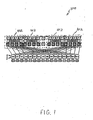
- FIG. 1 illustrates a specific hardware environment in which various embodiments of the present invention may be practiced. It is to be noted that FIG. 1 illustrates only one example of a hardware environment, and other environments (for other embodiments) may also be used.
- FIG. 1 illustrates a block diagram of a node that includes four multi-streaming processors (MSP's), according to one embodiment.
- node 100 includes each MSP 102 in a four MSP system.
- Node 100 is contained on a single printed circuit board.
- the sixteen M chips on node 100 contain memory controllers, network interfaces and cache coherence directories with their associated protocol engines.
- the memory system is sliced across the 16 M chips, round robin by 32-byte cache lines. Each M chip supports one slice. Bits 5 and 6 of the physical address determine the E chip within a processor, and bits 7 and 8 further specify one of four M chips connected to each E chip.
- Each M chip resides in one of sixteen independent address slices of the machine, and the interconnection network provides connectivity only between corresponding M chips on different nodes. All activity (cache, memory, network) relating to a line of memory stays within the corresponding slice. Each M chip controls a separate sector of a slice. Slices expand (get more memory in each) as nodes arc added so the number of sectors in each slice is equal to the number of nodes in a system.
- Total peak local memory bandwidth for one node is 204.8 GB/s, or 51.2 GB/s per MSP.
- each MSP 102 needs a maximum bandwidth of about 45 GB/s, there is bandwidth to support network traffic and I/O without greatly impacting computational performance.
- Each M chip contains two network ports, each 1.6 GB/s peak per direction.
- Node 100 also contains two I chip I/O controller ASIC's. These connect to the M chips and provide four I/O ports of 1.2 GB/s bandwidth, full duplex, off node 100. Each I chip contains two ports, 400 MB/s full duplex connections to 8 of the local M chips (one I chip connects to the even M chips and the other connects to the odd M chips), and a 1.6 GB/s full duplex connection to the other I chip. The total I/O bandwidth per module is thus 4.8 GB/s full duplex.
- the memory on node 100 is distributed across the set of 16 M chips.
- Each M chip directly controls the resources contained on two daughter boards so that there are thirty two daughter boards on node 100.
- the memory chips in the daughter boards are Direct Rambus DRAM. These chips have 16 internal banks and have 18 data pins that each run, with a 400 MHz clock, at an 800 Mbaud rate. Each chip then has a 1.6 GB/s read/write data rate. Being 18 bits wide, additional parts to support ECC are not needed.
- Daughter cards contain 16 chips organized into 4 memory channels of 4 chips each. Each memory channel is independent. Channels have a peak data bandwidth of 1.6 GB/s, so that the card supports a bandwidth of 6.4 GB/s. With 16 banks in a memory chip, a channel has 64 memory banks.
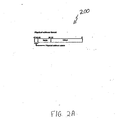
- FIG. 2A illustrates a format for a physical memory address, according to one embodiment.
- a 46-bit (64 TBytes) physical memory address is supported.
- the node size for this embodiment is a board containing four MSP's and 16 M chips.
- Physical memory address format 200 contains bits 47..0. Bits 35..0 represent an offset (into memory). Bits 45..36 represent the node. Bits 47..46 represent the physical address space.
- the physical memory format allows for up to 1024 nodes (4096 MSP's) and 64 GBytes of physical memory per node. Physical pages are allocated on a per-node basis. That is, any given physical page is distributed uniformly across the 16 sectors (the memory controlled by a given M chip) of a single node.
- This embodiment provides three parallel, physical address spaces, which are selected by two extra bits at the top of the physical address.
- FIG. 2B illustrates a more detailed map of the physical memory address format shown in FIG. 2A, in one embodiment.
- the mapping of a physical address to a destination location is dependent on the hardware implementation (as opposed to being specified in the user-level architecture). Address mapping must be done so that parallelism can be easily exploited by having the map such that multiple transactions can be requested and satisfied simultaneously with minimum hardware complexity.
- Bits 4..0 represent the byte in the line.
- Bits 6..5 represent the quadrant (E chip).
- Bits 8..5 collectively represent the slice/section (M chip).
- Bits 11..9 represent the memory channel.
- Bits 13..12 represent the memory chip for the memory channel, and bits 17..14 represent the bank for the memory chip.
- Bits 35..18 represent the memory chip address
- bits 45..36 represent the node number (in the system).
- Bits 47..46 represent the address space. Memory size options and configuration changes (including memory degrades) can modify this map. The map supports memory chips up to 1 Gbit density. There are three address spaces: coherent main memory, memory-mapped register space, and I/O device space. Coherent main memory may be cached.
- FIG. 3 illustrates a format for a virtual memory address, according to one embodiment.
- virtual memory address format 300 contains a 64-bit virtual address space.
- Bits 37..0 represent a virtual offset into virtual memory space, wherein potential page boundaries range from 64 KB to 4 GB.
- Bits 47..38 represent the VNode (i.e., virtual node). This is used by the hardware when performing remote address translation.
- Bits 61..48 must be set to zero in this implementation.
- Bits 63..62 specify the memory region, which determines the type of address translation used in kernel mode.
- the virtual address space can be considered a flat virtual address space for uniprocessor, or symmetric multiprocessing applications. As stated, this embodiment supports eight page sizes ranging from 64 KB to 4 GB. Thus, the page boundary can vary, from between bits 15 and 16, to between bits 31 and 32.
- virtual addresses used for instruction fetches and data references are first translated into physical addresses before memory is accessed.
- These embodiments support two forms of address translation: source translation, and remote translation.
- the first form of address translation is source translation, in which a virtual address is fully translated by a Translation Look-aside Buffer (TLB) on a local P chip to a physical address on an arbitrary node.
- the second form of address translation is remote translation, in which the physical node number is determined by a simple translation of the virtual address VNode field, and the remaining virtual address VOffset field is sent to the remote node to be translated into a physical address offset via a Remote-Translation Table (RTT).
- RTT Remote-Translation Table
- the type of address translation performed is based upon values in a configuration control register and the virtual address itself.
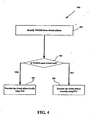
- FIG. 4 illustrates a flow diagram for analyzing a VNode field in the virtual memory address, according to one embodiment of the present invention.
- Flow diagram 400 includes blocks 402, 406, and 408, and also includes checkpoint 404.
- Flow diagram 400 illustrates one way in which a virtual memory address can be translated into a physical memory address (in either local or remote memory space).
- Block 402 includes identifying the virtual node from a virtual address.
- a local node can identify the virtual node by looking at the VNode field of the virtual address.
- Checkpoint 404 determines if the virtual node is the same as, or equal to, the local node.
- flow diagram 400 continues to block 406, wherein the virtual address is translated into a physical address locally using a Translation Look-Aside Buffer (TLB). The local node is then able to address local physical memory space. If the virtual node is not the same as the local node, then flow diagram 400 continues to block 408, wherein the virtual address is translated into a physical address remotely (on a remote node) using a Remote-Translation Table (RTT). In this fashion, the local node is effectively able to address remote memory space of the remote node.
- TLB Translation Look-Aside Buffer
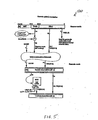
- FIG. 5 illustrates a detailed flow diagram 500 for implementing remote translation of a virtual memory address, according to one embodiment of the present invention.
- the hardware treats bits 47..38 of the Virtual Address (i.e., VA47-.38, for the VNode field) as a virtual node number.
- VA47-.38 for the VNode field
- the address is checked to make sure it does not exceed the user's partition defined by the NodeLimit field in the TLBcontrol register. If VA47..38 > NodeLimit, then an Address Error exception occurs.
- the physical node number for the address is computed by adding VA47..38 to the BaseNode value from the TLBcontrol register. (In this instance, the BaseNode is a reference mechanism by which the physical node number can be computed.) Overflow on this 10-bit addition is ignored; the OS must never create a partition (via the BaseNode and NodeLimit values) that exceeds the number of nodes in the machine.
- the virtual address Offset field (VA37..0) is sent to the resulting physical node as an Arcmote virtual address@ (RVA) to complete the translation.
- the RVA could also be referred to as a remote virtual memory address.
- the cache allocation is forced to non-allocate and the reference is not cached (Get/Put semantics).
- the value of the BaseNode is unique to each node. This creates a unique physical node mapping when adding the BaseNode to the VNode field. Therefore, in one implementation, various nodes can use common, contiguous VNodes (starting at 0, for example) to effectively reference different physical nodes (that are used for routing). Table 1 below illustrates an example of physical (destination) node mapping for three different source nodes A, B, and C.
- a look-up table is used to determine the physical node. In this embodiment, the BaseNode calculation is not required.
- RVA requests bypass the Ecache (in the E chips), since they can never be cached.
- the M chips contain a set of four, 2-bit Global Address Space ID (GASID) registers, one for each of the local MSP's.
- GASID Global Address Space ID
- the local M chip sends a packet out the network with an RVA, it includes the value of the two bit GASID for the originating MSP. This is used to qualify the remote translation of the RVA at the destination M chip.
- the 2-bit GASID, and the RVA are routed through the interconnection network.
- Bits 8..0 of the virtual address are not routed as such, because bits 8-.5 are used to select the memory/network slice, and bits 4..0 are used to generate the cache line word mask.
- the cache line mask is unneeded for the remote translation mechanism, and the slice information is also unneeded, since the remote transfer operations have an implied slice (from an M chip on one node to a corresponding M chip on the remote node).
- remote virtual addresses go through a translation to a pure physical address. This translation takes place before presenting the packet to the directory protocol engine. Remote translation takes place with a granularity of 16 MB.
- the two GASID bits, and bits 37..24 of the RVA are used to index into a 64K-entry Remote-Translation Table (RTT). Each entry ofthis table contains a valid bit, a write-enable bit, and a 12-bit value representing PA35..24 (the 16 MB physical page frame). These bits are appended to the lower bits of the RVA to form a physical memory address at the remote node.
- the valid bit is used for status of the translation. The valid bit indicates whether the RTT was able to translate the virtual memory address into a valid physical memory address space on the remote node.
- the write-enable bit indicates whether a write is permitted to a region referenced by the virtual memory address. A write to this region will only be allowed if the write-enable bit is set.
- the RVA is formed from one or more portions of the virtual address having the VNode field. In another embodiment, the RVA includes a virtual memory address, wherein the virtual memory address is translated into a physical memory address using the RTT.
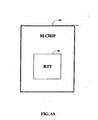
- FIG. 6A illustrates a block diagram of a remote-translation table (RTT) resident on an M chip, according to one embodiment of the present invention.
- M chip 600 on a given node in a multi-node system includes RTT 601.
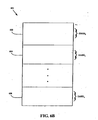
- FIG. 6B illustrates a more detailed diagram of the RTT shown in FIG. 6A, according to one embodiment on the invention.
- RTT 601 is indexed by a GASID and high-order bits of an RVA.
- the GASID comprises the highest-order bits of the index into RTT 601.
- RTT 601 is partitioned into various sections. Because the GASID comprises the highest-order bits, this embodiment shows RTT 601 being partitioned into sections corresponding to the different GASID's. In one implementation, these GASID's are associated with specific applications (or processors) operating on a MSP.
- RTT 601 includes section 602 for translation information corresponding to GASID 0 (at the top of RTT 601).
- Section 602 will not necessarily include translation information that is contiguous (i.e., in order). The information will be ordered as it is implemented by the application use for GASID 0 .
- RTT 601 contains translation information for the entire virtual memory address space for the node on which it resides, and therefore not all of the information in section 602 is used, or contiguous (if used).
- Section 604 includes translation information corresponding to GASID 1
- section 606 includes translation information corresponding to GASID A .
- the index into RTT 601 includes 2 high-order bits for the GASID, and 14 high-order bits from the RVA, thereby producing a 16-bit index into RTT 601.
- RTT 601 includes 64K entries (2 16 ), and each of sections 602, 604, and 606 includes 16K entries, wherein not all of the entries are necessarily applicable, or used, for the remote translation mechanism.
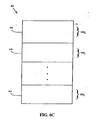
- FIG. 6C illustrates a more detailed view of a portion of the RTT shown in FIG. 6B, according to one embodiment of the invention.
- FIG. 6C illustrates a detailed view of section 602 (corresponding to GASID 0 ) in RTT 601.
- certain high-order bits of the RVA used to index into RTT 601 correspond to virtual processing elements (VPE) on a given node.
- Translation information is ordered within section 602 according to the VPE to which it is associated.
- Section 608 includes information corresponding to VPE 0 .
- Section 610 includes information corresponding to VPE 1
- section 612 includes information corresponding to VPE B .
- each of sections 608, 610, and 612 includes 4K entries (for this portion of RTT 601).
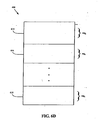
- FIG. 6D illustrates an even further detailed view of a portion of the RTT shown in FIG. 6C, according to one embodiment of the invention.
- FIG. 6D illustrates a detailed view of section 608 (corresponding to VPE 0 ) in RTT 601.
- certain bits of the RVA used to index into RTT 601 correspond to segments.
- Information is ordered within section 608 according to the segment to which it is associated.
- Section 614 includes information corresponding to seg 0 .
- Section 616 includes information corresponding to seg 1
- section 618 includes information corresponding to seg c .
- a way to think of the remote translation mechanism is as a hardware facility that supports automatically "stitching together" the local address spaces of cooperating tasks on a series of nodes.
- the hardware routes memory access requests to the logical nodes indicated in the VNode field of the user address.
- FIG. 7 provides a functional view of an exemplary embodiment of this routing model.
- each of the on-node address spaces are built and managed locally using source mode translation, thus allowing the use of standard memory mapping techniques and APIs for management of this space.
- Each of these on-node address spaces are then exported (or broadcast) across the job or application space by loading the local address mappings into the RTT and entering remote translation mode.
- failure to synchronize the transition to remote translation mode results in unexpected application termination because unsuccessful remote address translations are always fatal on some systems and often fatal on other systems.
- the operating system is responsible for maintaining coherency of the remote mapping space.
- the operating system will ensure that all valid local translations for the distributed memory job are loaded in the RTT. This requires that all memory for all local processing elements within the job or application is resident whenever the job is active.
- the operating system requires that whenever the memory space for a particular processing element is grown, it is grown on the processing element's local node. Doing so allows the operating system to use its normal methodology for handling memory growth within distributed memory jobs.
- the RTT can be updated, making the new space available to remote processing elements within the job or application.
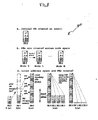
- FIG. 8 shows an exemplary embodiment 800 of how a distributed address space is constructed according to one embodiment of the present invention.
- Step 1 of the example 800 shows the layout of the initial processing element's address space.
- Step 2 the initial processing element copies itself and places children, one per node, across the node space of the job.
- Step 3 shows the continuation of the example 800 by illustrating the construction of the local address and processing element space on Node 0.
- the address space for the processing elements local to this node is built using standard memory APIs.
- Step 3d then creates the remaining processing elements.
- the example 800 keeps processing element 0's memory private during this step to allow each processing element to complete its initialization in a protected address space.
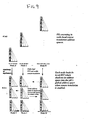
- FIG. 9 illustrates one embodiment of how this aggregation is performed.
- step 4a the independent node address spaces are shown. Note that each has been offset during its initialization based on its place within the global job space and according to the programming environment's distributed memory addressing model.
- the processing elements on each local node have synchronized with one another and are prepared to enter the global address space. This is performed through an API call by each processing element to the operating system that notifies the OS to enable remote translation.
- the OS ensures that all local memory for the job or application is resident and translations are loaded in the RTT.
- the processing element upon a successful synchronization, the processing element will be executing with remote translation enabled. This is illustrated at step 4b. Because each node/processing element could reach this point at different times, it is prudent in some embodiments for user code to synchronize across processing elements before utilizing remote memory. In some embodiments, failure to do so could have undesired results including job or application fatal errors or, in some other further embodiments, fatal kernel errors.
- the operating system will handle requests to change the address space configuration on a node-local basis. For example, in some embodiments, auto-grow-regions which are in the address space must be grown on the node to which they were mapped. In some such embodiments this allows the maintenance of normal mapping semantics by the operating system.
- any attempt to modify the address space of a distributed application outside scope of the local node will either fail or cause the job or application to terminate.
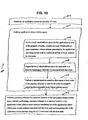
- FIG. 10 includes a method 1000 of accessing shared memory in a computer system having a plurality of nodes, including a first node, wherein each node includes a processor and local memory.
- this method 1000 includes distributing 1002 an application across the plurality of nodes and building 1004 an application virtual address space.
- building 1004 an application virtual address space includes building 1006 a local virtual address space for the application in each of the plurality ofnodes, wherein the local virtual address space translates a virtual address generated by the application executing on that node to a physical address in local memory for that node, and exporting 1008 the local virtual address space for each node to a Remote Translation Table (RTT) associated with that node.
- RTT Remote Translation Table
- This aspect of the present invention further includes performing 1012 a memory reference to a memory location in the application virtual address space, wherein performing 1012 a memory reference to a memory location in the application virtual address space includes translating bits of the application virtual address into a node address associated with the first node and translating bits of the application virtual address using the RTT associated with the first node.
- the local address space is read from a Translation Look-aside Buffer (TLB).
- TLB Translation Look-aside Buffer
- Yet further embodiments of the method 1000 include optionally performing 1010 a synchronization operation that causes at least some of the plurality of nodes to wait for all nodes to complete exporting their respective local virtual address spaces.
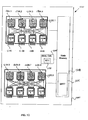
- FIG. 11 Another aspect of the present invention shown in FIG. 11 provides a system 1100 for remote address translation on a multinode system 1100 capable of distributing an application, job, or process across multiple nodes 1102.
- the system 1100 includes a plurality of nodes 1102, each node 1102 having one or more processors 1104, a memory 1106, and a memory controller 1108 operatively coupled 1110 to the memory 1108 and the one or more processors 1104.
- the memory controller 1108 includes a Remote Translation Table (RTT) 1112, wherein the RTT 1112 translates a virtual address received as part of a memory request received from another node 1102 into a memory request with physical addresses into the memory 1106 on the node 1102 associated with the RTT 1112.
- RTT Remote Translation Table
- the RTT 1112 is initialized upon the start of an process associated with an application or process by building a virtual to physical address translations for local virtual address space in the node 1102 corresponding to the application, and exporting the virtual to physical address translations for the local virtual address space from the node 1102 to the RTT 1112 associated with that node 1102.
- each of the plurality of nodes 1102 executes a synchronization operation that causes at least some of the plurality of nodes 1102 to wait for all of the plurality of nodes 1102 to complete exporting the virtual to physical address translations to their respective RTT's 1112.
- Yet another aspect of the present invention provides a device-readable medium having instructions thereon that cause a properly programmed device to perform a method of accessing shared memory in the device.
- the instructions when executed on a properly programmed information-processing device having a plurality of nodes, including a first node, each node having one or more processors, a memory, and a memory controller and coupled to the memory and the one or more processors, cause the information-processing device to distribute an application across the plurality of nodes and build an application virtual address space.
- building an application virtual address space includes building a local virtual address space for the application in each of the plurality of nodes, wherein the local virtual address space translates a virtual address generated by the application executing on that node to a physical address in local memory for that node, and exporting the local virtual address space for each node to a Remote Translation Table (RTT) associated with that node.
- the instructions when executed further include performing a memory reference to a memory location in the application virtual address space, wherein performing a memory reference to a memory location in the application virtual address space includes translating bits of the application virtual address into a node address associated with the first node and translating bits of the application virtual address using the RTT associated with the first node.
- building a local virtual address space further includes performing a synchronization operation that causes at least some of the plurality of nodes to wait for all nodes complete exporting their respective address space.
- the local address space is read from a Translation Look-aside Buffer (TLB).
- TLB Translation Look-aside Buffer
- Still another aspect of the present invention provides a multinode system for implementing remote address translation.
- Some embodiments of the multinode system include a plurality of nodes, including a first node.
- each of the plurality of nodes includes one or more processors, a memory, and a memory controller operatively coupled to the memory and the one or more processors.
- These embodiments include a means for distributing an application. across the plurality of nodes and a means for building an application virtual address space.
- the means for building an application virtual address space includes a means for building a local virtual address space for the application in each of the plurality of nodes, wherein the local virtual address space translates a virtual address generated by the application executing on that node to a physical address in local memory for that node and a means for exporting the local virtual address space for each node to a Remote Translation Table (RTT) associated with that node.
- RTT Remote Translation Table
- Some further embodiments include a means for performing a memory reference to a memory location in the application virtual address space, wherein performing a memory reference to a memory location in the application virtual address space includes a means for translating bits of the application virtual address into a node address associated with the first node, and a means for translating bits of the application virtual address using the RTT associated with the first node.
- building an application virtual address space further includes a means for performing a synchronization operation that causes at least some ofthe plurality of nodes to wait for all nodes to complete exporting their respective local virtual address spaces.
- FIG. 12 is a block diagram of parallel processing hardware and operating environment 1200 in which different embodiments of the invention can be practiced.
- environment 1200 comprises a node 1201 which includes two or more multiple processor units 1202. Although two multiple processor units 1202.1 and 1202.2 are shown in FIG. 12, it will be appreciated by those of skill in the art that other number of multiple processor units may be incorporated in environment 1200 and in configurations other than in a node 1201.
- node 1201 may include up to four multiple processor units 1202. Each of the multiple processor units 1202 on node 1201 has access to node memory 1208, which may be controlled by one or more memory controllers 1210.
- node 1201 is a single printed circuit board and node memory 1208 comprises daughter cards insertable on the circuit board.
- memory controller 1210 includes a remote translation table (RTT) 1212.
- RTT 1212 contains translation information for a virtual memory address space associated with one or more remote nodes.
- ERTT 1214 an emulated RTT (ERTT) 1214.
- FIG. 12 a logical representation of ERTT 1214 is shown as a single entity residing in node memory 1208.
- ERTT 1214 comprises at least two data structures, and may reside in node memories 1208 for more than one node 1201. It is desirable to locate ERTT 1214 in a generally accessible (e.g. accessible by both applications and the kernel) node memory 1208, because the kernel may manage the ERTT 1214 without resorting to specialized hardware memory mapping such as that involved with the RTT. Further details on the structure and operation of ERTT 1214 will be provided below.
- a multiple processor unit 1202 includes four processors 1204.1 - 1204.4 and four cache memory controllers 1206. Although each multiple processor unit is shown in FIG. 12 as having four processors, those of skill in the art will appreciate that other embodiments of the invention may have more or fewer processors 1204. In some embodiments, each processor 1204 incorporates scalar processing logic (S) and vector processing logic (V). In some embodiments, each cache memory control 1206 may access 512 KB of memory. Each of processor 1204 may access any one or more of the cache memory controllers 1206.
- the hardware environment is included within the Cray X1 computer system, which represents the convergence of the Cray T3E and the traditional Cray parallel vector processors.
- the X1 is a highly scalable, cache coherent, shared-memory multiprocessor that uses powerful vector processors as its building blocks, and implements a modernized vector instruction set.
- multiple processor unit 1202 is a Multi-streaming processor (MSP).
- MSP Multi-streaming processor
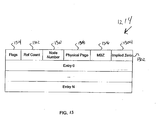
- FIG. 13 is a block diagram of an ERTT segment 1302 that is included as part of ERTT 1214 according to an embodiment of the invention.
- ERTT segment 1302 is a table of entries related to providing virtual to physical address translation.
- each entry is 64 bits wide and comprises an implied zero field 1304, must be zero field (MBZ) 1306, physical page 1308, node number 1310, reference count 1312 and flags 1314.
- Implied zero field 1304 comprises bits that are typically set to zero as they are not significant in the address translation.
- MBZ field 1306 comprises bits that are typically set to zero as they are also not significant in the address translation. It should be noted that these fields may or may not be physically present in the table.
- implied zero field 1304 may not physically exist, but software executing on the system may assume that these bits would be zero when performing address translation.
- Physical page 1308 comprises a page number of the physical page for an address.
- page boundaries may range from 64 KB to 4 GB.
- Node number 1310 comprises a node number identifying the physical node where the page resides.
- Reference count 1312 represents a count of the number of processes currently mapping the page. As an example consider two processes A and B. A references pages P1 and P2, while B references pages P1 and P3. The reference count for the ERTT segment entry for page P1 will be 2 because both A and B reference page P1. The reference count for the ERTT segment entries for pages P2 and P3 will be 1 because only one of A or B references the page. Now assume that process B terminates. The reference count for page P3 goes to zero, the reference count for page P1 is set to 1 to reflect the fact that process B no longer references those pages. In some embodiments, when a reference count for an ERTT segment entry goes to zero, the entry is removed and made available for later reuse. In addition, in some embodiments a corresponding entry in the RTT is also cleared and made available for reuse.
- Flags 1314 comprise a set of flags for the entry.
- the flags may include a lock flag indicating that the entry should be locked to prevent another process from altering the entry thereby providing for serial access to the ERTT segment entry.
- a valid flag indicates that the translation in the ERTT segment entry is a valid entry.
- a write flag indicates whether the page is writable or not.
- an ERTT segment may contain 16K entries, however no embodiment of the invention is limited to any particular number of entries.
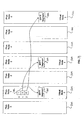
- FIG. 14 is a block diagram illustrating an exemplary configuration for using an emulated remote translation table according to an embodiment of the invention.
- a number of nodes 1201 are present in a system.
- An application is assigned to run on three of the nodes, physical nodes 1, 3 and 6. These physical nodes are mapped to virtual nodes 0, 1 and 2.
- Such a mapping is desirable, because some implementations of the RTT require that nodes assigned to an application using the RTT be contiguously numbered.
- Providing a virtual node that is physically contiguous while mapping to a set of physical nodes that need not be physically contiguous provides for more flexibility in allocating nodes to an application while maintaining compatibility with structures and software that require that nodes be contiguous.
- an ERTT header 1402 is maintained by one of the nodes of the application. In some embodiments, the ERTT header 1402 is maintained at a "well known" location in the group of nodes assigned to an application. However, in alternative embodiments, ERTT header 1402 may be replicated in all nodes assigned to an application. Further, in some embodiments, ERTT 1214 includes an ERTT header 1402 that is maintained by virtual node 0 assigned to the application. ERTT header 1402 maps virtual nodes to physical nodes. The index into ERTT header is a virtual node number, and the value at that location is the physical node number corresponding to the virtual node number. The BRIT segment 1302 may then be located using the physical node number. Thus in the example shown, ERTT header 1402 establishes a mapping between virtual nodes 0, 1 and 2 and physical nodes 1, 3 and 6 respectively.
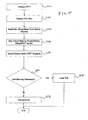
- FIG. 15 is a flowchart illustrating a method for maintaining an ERTT 1214 in a parallel processing environment according to an embodiment of the invention.
- the method to be performed by the operating environment constitutes computer programs made up of computer-executable instructions. Describing the methods by reference to a flowchart enables one skilled in the art to develop such programs including such instructions to carry out the methods on suitable computers (the processor or processors of the computer executing the instructions from computer-readable media).
- the method illustrated in FIG. 15 is inclusive of acts that may be taken by an operating environment executing an exemplary embodiment of the invention.
- an ERTT begins when an ERTT is initialized (block 1502).
- an ERTT is initialized in node memory 1208 when an application is assigned to run on one or more nodes-
- an ERTT is maintained through the use of memory mapping functions such as "madvise", “mmap”, “shmget” and the like.
- the ERTT may be initialized through the normal page fault mechanism of the kernel. As page faults occur, the kernel reads pages into memory and loads the appropriate ERTT segment entry with a translation. In some embodiments, memory must be referenced locally to cause the ERTT to be loaded before a remote node attempts to access local memory.
- TLB Translation Lookaside Buffer
- processes running on one of the nodes assigned to an application may attempt to access a virtual address that is not mapped by the TLB (Translation Lookaside Buffer) for the node. This cause a TLB miss which in turn causes memory management routines in the kernel to execute (block 1504).
- TLB miss routine one or more kernel memory management routines executed upon a TLB miss will be referred to collectively as the TLBmiss routine.
- the TLBmiss routine will then attempt to map the referenced page.
- the TLBmiss routine uses predetermined bits of the virtual address as a virtual node number (block 1506).
- the TLBmiss routine may the consult the ERTT header 1402 in order to determine the physical node having the physical address corresponding to the virtual address (block 1508).
- the standard operating system memory management routines may be used to make the translation to a physical page on the local node.
- the TLBmiss routine uses the offset portion of the virtual address as an index to query the determined physical node's ERTT segment 1302 to determine if the address is valid on the physical node (block 1510). If the physical node's ERTT segment 1302 has a translation for the virtual address, then the translation is placed in the referring (i.e. the local or source) node's TLB (block 1514) In some embodiments, the ERTT segment entry may be placed directly into the TLB because the ERTT entry format matches the TLB format with respect to all significant bites.
- an RTT provides a scalable address translation mechanism, and is designed to avoid translation faults in large systems (unlike a regular TLB design).
- the RTT supports full mapping of all the memory in a machine (unlike various networking cards) to allow full load/store access to all the memory in the system.
- Such a system allows each node to independently manage its own virtual-to-physical memory mapping.
- Such a system also removes the need to implement conventional TLB "shootdown.”
- Conventional TLB "shootdown" occurs when a node changes a local virtual-to-physical page mapping, and has to invalidate all of the TLB entries throughout the system that contain that mapping.
- the use of an RTT that supports full mapping removes the need to implement such an approach.
Landscapes
- Engineering & Computer Science (AREA)
- Theoretical Computer Science (AREA)
- Physics & Mathematics (AREA)
- General Engineering & Computer Science (AREA)
- General Physics & Mathematics (AREA)
- Memory System Of A Hierarchy Structure (AREA)
Applications Claiming Priority (6)
| Application Number | Priority Date | Filing Date | Title |
|---|---|---|---|
| US10/235,898 US6922766B2 (en) | 2002-09-04 | 2002-09-04 | Remote translation mechanism for a multi-node system |
| US235898 | 2002-09-04 | ||
| US643588 | 2003-08-18 | ||
| US10/643,588 US7529906B2 (en) | 2003-08-18 | 2003-08-18 | Sharing memory within an application using scalable hardware resources |
| US10/643,758 US7577816B2 (en) | 2003-08-18 | 2003-08-18 | Remote translation mechanism for a multinode system |
| US643758 | 2003-08-18 |
Publications (2)
| Publication Number | Publication Date |
|---|---|
| EP1396790A2 true EP1396790A2 (fr) | 2004-03-10 |
| EP1396790A3 EP1396790A3 (fr) | 2008-02-27 |
Family
ID=31721408
Family Applications (1)
| Application Number | Title | Priority Date | Filing Date |
|---|---|---|---|
| EP03255536A Withdrawn EP1396790A3 (fr) | 2002-09-04 | 2003-09-04 | Mécanisme de traduction déporté d'une adresse virtuelle en provenance d'un noeud source dans un système multi-noeuds |
Country Status (1)
| Country | Link |
|---|---|
| EP (1) | EP1396790A3 (fr) |
Cited By (5)
| Publication number | Priority date | Publication date | Assignee | Title |
|---|---|---|---|---|
| GB2418753A (en) * | 2004-09-28 | 2006-04-05 | Cray Canada Inc | Emulating shared memory in a distributed-memory computing system using memory windows |
| CN105190576A (zh) * | 2013-03-28 | 2015-12-23 | 惠普发展公司,有限责任合伙企业 | 共享的存储器系统 |
| WO2016175916A1 (fr) * | 2015-04-27 | 2016-11-03 | Intel Corporation | Technologies pour segments de mémoire accessibles à distance évolutifs |
| US10320697B2 (en) | 2013-01-27 | 2019-06-11 | Hewlett Packard Enterprise Development Lp | Socket state transfer |
| CN114372882A (zh) * | 2021-12-15 | 2022-04-19 | 杭州顶天网络有限公司 | 一种基于网络协议的分片扩容方法 |
Citations (2)
| Publication number | Priority date | Publication date | Assignee | Title |
|---|---|---|---|---|
| US4562539A (en) | 1982-04-28 | 1985-12-31 | International Computers Limited | Data processing system |
| US5864738A (en) * | 1996-03-13 | 1999-01-26 | Cray Research, Inc. | Massively parallel processing system using two data paths: one connecting router circuit to the interconnect network and the other connecting router circuit to I/O controller |
-
2003
- 2003-09-04 EP EP03255536A patent/EP1396790A3/fr not_active Withdrawn
Patent Citations (2)
| Publication number | Priority date | Publication date | Assignee | Title |
|---|---|---|---|---|
| US4562539A (en) | 1982-04-28 | 1985-12-31 | International Computers Limited | Data processing system |
| US5864738A (en) * | 1996-03-13 | 1999-01-26 | Cray Research, Inc. | Massively parallel processing system using two data paths: one connecting router circuit to the interconnect network and the other connecting router circuit to I/O controller |
Cited By (13)
| Publication number | Priority date | Publication date | Assignee | Title |
|---|---|---|---|---|
| GB2418753A (en) * | 2004-09-28 | 2006-04-05 | Cray Canada Inc | Emulating shared memory in a distributed-memory computing system using memory windows |
| GB2418753B (en) * | 2004-09-28 | 2008-10-15 | Cray Canada Inc | Low latency communication using memory address translation |
| US7685319B2 (en) | 2004-09-28 | 2010-03-23 | Cray Canada Corporation | Low latency communication via memory windows |
| US8260969B2 (en) | 2004-09-28 | 2012-09-04 | Intel Corporation | Low latency communication via memory windows |
| US8677025B2 (en) | 2004-09-28 | 2014-03-18 | Intel Corporation | Low latency communication via memory windows |
| US10320697B2 (en) | 2013-01-27 | 2019-06-11 | Hewlett Packard Enterprise Development Lp | Socket state transfer |
| US20160034392A1 (en) * | 2013-03-28 | 2016-02-04 | Hewlett-Packard Development Company, L.P. | Shared memory system |
| EP2979193A4 (fr) * | 2013-03-28 | 2016-11-16 | Hewlett Packard Entpr Dev Lp | Système de mémoire partagée |
| CN105190576A (zh) * | 2013-03-28 | 2015-12-23 | 惠普发展公司,有限责任合伙企业 | 共享的存储器系统 |
| WO2016175916A1 (fr) * | 2015-04-27 | 2016-11-03 | Intel Corporation | Technologies pour segments de mémoire accessibles à distance évolutifs |
| US10073809B2 (en) | 2015-04-27 | 2018-09-11 | Intel Corporation | Technologies for scalable remotely accessible memory segments |
| CN114372882A (zh) * | 2021-12-15 | 2022-04-19 | 杭州顶天网络有限公司 | 一种基于网络协议的分片扩容方法 |
| CN114372882B (zh) * | 2021-12-15 | 2024-12-10 | 杭州顶天网络有限公司 | 一种基于网络协议的分片扩容方法 |
Also Published As
| Publication number | Publication date |
|---|---|
| EP1396790A3 (fr) | 2008-02-27 |
Similar Documents
| Publication | Publication Date | Title |
|---|---|---|
| US7577816B2 (en) | Remote translation mechanism for a multinode system | |
| US6922766B2 (en) | Remote translation mechanism for a multi-node system | |
| US5897664A (en) | Multiprocessor system having mapping table in each node to map global physical addresses to local physical addresses of page copies | |
| JP3924206B2 (ja) | 不均一メモリ・アクセス(numa)データ処理システム | |
| US7363462B2 (en) | Performing virtual to global address translation in processing subsystem | |
| US7765381B2 (en) | Multi-node system in which home memory subsystem stores global to local address translation information for replicating nodes | |
| US8250254B2 (en) | Offloading input/output (I/O) virtualization operations to a processor | |
| US6163834A (en) | Two level address translation and memory registration system and method | |
| US6925547B2 (en) | Remote address translation in a multiprocessor system | |
| US8180996B2 (en) | Distributed computing system with universal address system and method | |
| US7680987B1 (en) | Sub-page-granular cache coherency using shared virtual memory mechanism | |
| EP0817059B1 (fr) | Tampon auxiliaire de traduction d'adresses pour aider l'accès à des données dans des espaces d'adresses à distance | |
| US6826653B2 (en) | Block data mover adapted to contain faults in a partitioned multiprocessor system | |
| US6633967B1 (en) | Coherent translation look-aside buffer | |
| US7529906B2 (en) | Sharing memory within an application using scalable hardware resources | |
| CA2414438C (fr) | Systeme et procede de gestion de semaphores et d'operations atomiques dans un multiprocesseur | |
| US8982140B2 (en) | Hierarchical memory addressing | |
| US7669011B2 (en) | Method and apparatus for detecting and tracking private pages in a shared memory multiprocessor | |
| JPH03220644A (ja) | コンピユータ装置 | |
| JPH10240707A (ja) | 主記憶共有型マルチプロセッサ | |
| US9208088B2 (en) | Shared virtual memory management apparatus for providing cache-coherence | |
| US7360056B2 (en) | Multi-node system in which global address generated by processing subsystem includes global to local translation information | |
| US7475220B1 (en) | Buffer overflow detection | |
| EP1396790A2 (fr) | Mécanisme de traduction déporté d'une adresse virtuelle en provenance d'un noeud source dans un système multi-noeuds | |
| KR100354274B1 (ko) | 주전산기의페이지디렉토리공유방법 |
Legal Events
| Date | Code | Title | Description |
|---|---|---|---|
| PUAI | Public reference made under article 153(3) epc to a published international application that has entered the european phase |
Free format text: ORIGINAL CODE: 0009012 |
|
| AK | Designated contracting states |
Kind code of ref document: A2 Designated state(s): AT BE BG CH CY CZ DE DK EE ES FI FR GB GR HU IE IT LI LU MC NL PT RO SE SI SK TR |
|
| AX | Request for extension of the european patent |
Extension state: AL LT LV MK |
|
| RAP1 | Party data changed (applicant data changed or rights of an application transferred) |
Owner name: CRAY INC. |
|
| PUAL | Search report despatched |
Free format text: ORIGINAL CODE: 0009013 |
|
| AK | Designated contracting states |
Kind code of ref document: A3 Designated state(s): AT BE BG CH CY CZ DE DK EE ES FI FR GB GR HU IE IT LI LU MC NL PT RO SE SI SK TR |
|
| AX | Request for extension of the european patent |
Extension state: AL LT LV MK |
|
| 17P | Request for examination filed |
Effective date: 20080416 |
|
| AKX | Designation fees paid |
Designated state(s): AT BE BG CH CY CZ DE DK EE ES FI FR GB GR HU IE IT LI LU MC NL PT RO SE SI SK TR |
|
| 17Q | First examination report despatched |
Effective date: 20090128 |
|
| STAA | Information on the status of an ep patent application or granted ep patent |
Free format text: STATUS: THE APPLICATION IS DEEMED TO BE WITHDRAWN |
|
| 18D | Application deemed to be withdrawn |
Effective date: 20160126 |