EP1397439B1 - Melanges de colorants azoiques reagissant avec les fibres et utilisation - Google Patents
Melanges de colorants azoiques reagissant avec les fibres et utilisation Download PDFInfo
- Publication number
- EP1397439B1 EP1397439B1 EP02754592A EP02754592A EP1397439B1 EP 1397439 B1 EP1397439 B1 EP 1397439B1 EP 02754592 A EP02754592 A EP 02754592A EP 02754592 A EP02754592 A EP 02754592A EP 1397439 B1 EP1397439 B1 EP 1397439B1
- Authority
- EP
- European Patent Office
- Prior art keywords
- alkyl
- sulfo
- group
- sulfatoethylsulfonyl
- phenyl
- Prior art date
- Legal status (The legal status is an assumption and is not a legal conclusion. Google has not performed a legal analysis and makes no representation as to the accuracy of the status listed.)
- Expired - Lifetime
Links
- 0 *CCS(c(cc1)ccc1NC(c(cc1)ccc1N=Nc(c(*)cc(c1c2N)cc(*)c2N=Nc(cc2)ccc2S(CC*)(=O)=O)c1O)=O)(=O)=O Chemical compound *CCS(c(cc1)ccc1NC(c(cc1)ccc1N=Nc(c(*)cc(c1c2N)cc(*)c2N=Nc(cc2)ccc2S(CC*)(=O)=O)c1O)=O)(=O)=O 0.000 description 5
Classifications
-
- C—CHEMISTRY; METALLURGY
- C09—DYES; PAINTS; POLISHES; NATURAL RESINS; ADHESIVES; COMPOSITIONS NOT OTHERWISE PROVIDED FOR; APPLICATIONS OF MATERIALS NOT OTHERWISE PROVIDED FOR
- C09B—ORGANIC DYES OR CLOSELY-RELATED COMPOUNDS FOR PRODUCING DYES, e.g. PIGMENTS; MORDANTS; LAKES
- C09B67/00—Influencing the physical, e.g. the dyeing or printing properties of dyestuffs without chemical reactions, e.g. by treating with solvents grinding or grinding assistants, coating of pigments or dyes; Process features in the making of dyestuff preparations; Dyestuff preparations of a special physical nature, e.g. tablets, films
- C09B67/0033—Blends of pigments; Mixtured crystals; Solid solutions
-
- C—CHEMISTRY; METALLURGY
- C09—DYES; PAINTS; POLISHES; NATURAL RESINS; ADHESIVES; COMPOSITIONS NOT OTHERWISE PROVIDED FOR; APPLICATIONS OF MATERIALS NOT OTHERWISE PROVIDED FOR
- C09B—ORGANIC DYES OR CLOSELY-RELATED COMPOUNDS FOR PRODUCING DYES, e.g. PIGMENTS; MORDANTS; LAKES
- C09B67/00—Influencing the physical, e.g. the dyeing or printing properties of dyestuffs without chemical reactions, e.g. by treating with solvents grinding or grinding assistants, coating of pigments or dyes; Process features in the making of dyestuff preparations; Dyestuff preparations of a special physical nature, e.g. tablets, films
- C09B67/0033—Blends of pigments; Mixtured crystals; Solid solutions
- C09B67/0046—Mixtures of two or more azo dyes
-
- D—TEXTILES; PAPER
- D06—TREATMENT OF TEXTILES OR THE LIKE; LAUNDERING; FLEXIBLE MATERIALS NOT OTHERWISE PROVIDED FOR
- D06P—DYEING OR PRINTING TEXTILES; DYEING LEATHER, FURS OR SOLID MACROMOLECULAR SUBSTANCES IN ANY FORM
- D06P1/00—General processes of dyeing or printing textiles, or general processes of dyeing leather, furs, or solid macromolecular substances in any form, classified according to the dyes, pigments, or auxiliary substances employed
- D06P1/38—General processes of dyeing or printing textiles, or general processes of dyeing leather, furs, or solid macromolecular substances in any form, classified according to the dyes, pigments, or auxiliary substances employed using reactive dyes
Definitions
- the invention is in the technical field of fiber-reactive azo dyes.
- Dye mixture of fiber-reactive azo dyes and their use for Dyeing hydroxy- and carboxamide-containing material in black Shades are for example from the documents US 5,445,654, US 5,611,821, KR 94-2560, Sho 58-160362 and EP-A-0 870 807. These However, have certain application-related deficiencies, such as a Too much dependency of the color yield of changing color parameters in Dyeing process, or an insufficient or uneven color composition Cotton (a good color build-up results from the ability of a dye, when using increased dye concentrations in the dyebath the corresponding to provide stronger coloration), or a too large salt dependence of the Colorations. Result of these defects can be poor reproducibility of the be available dyeings.
- EP, A, 1,046,679; EP, A, 982,374; EP, A, 1,048,695 and EP, A, 976,792 disclose reactive dye mixtures similar composition.
- the present invention has now found dye mixtures which Dyeing with high color strengths in the presence of only very small amounts, or even in the absence of electrolyte salts.
- (C 1 -C 4 ) -alkyl groups which are substituents R may be straight-chain or branched and are in particular methyl, ethyl, n-propyl, isopropyl, n-butyl, isobutyl, sec-butyl and tert-butyl , Preferred are methyl and ethyl.
- R may be straight-chain or branched and are in particular methyl, ethyl, n-propyl, isopropyl, n-butyl, isobutyl, sec-butyl and tert-butyl , Preferred are methyl and ethyl.
- (C 1 -C 4 ) -alkoxy groups are substituents R.
- Aryl groups standing for substituents R are in particular the phenyl group.
- a substituted aryl group for R 1 is especially one with one, two or three independent groups from the series (C 1 -C 4 ) alkyl, (C 1 -C 4 ) alkoxy, hydroxy, sulfo, carboxy, amido or Halogen substituted phenyl group.
- halogen standing for substituents R is fluorine, chlorine and bromine, fluorine and chlorine being preferred.
- Alkali eliminable substituents Z 1 which are in the ⁇ -position of the ethyl group of Z are, for example, halogen atoms, such as chlorine and bromine, ester groups of organic carboxylic and sulfonic acids, such as alkylcarboxylic acids, optionally substituted benzene carboxylic acids and optionally substituted benzenesulfonic acids, such as the alkanoyloxy groups of 2 to 5 carbon atoms, thereof in particular acetyloxy, benzoyloxy, sulfobenzoyloxy, phenylsulfonyloxy and toluenesulfonyloxy, further acidic ester groups of inorganic acids, such as phosphoric acid, sulfuric acid and thiosulfuric acid (phosphato, sulfato and thiosulfato groups), as well dialkylamino groups with alkyl groups of each 1 to 4 carbon atoms, such as dimethylamino and die
- Z is preferably vinyl, ⁇ -chloroethyl and especially preferably ⁇ -sulfatoethyl.
- sulfo groups are groups corresponding to the general formula -SO 3 M, thiosulfato groups corresponding to the general formula -S-SO 3 M, carboxy groups corresponding to the general formula -COOM, phosphato groups corresponding to the general formula -OPO 3 M 2 and sulfato groups corresponding groups of the general formula -OSO 3 M, in each case with M of the abovementioned meaning.
- the dyes of the general formula (I) and (II) can be used within the meaning of Z have different fiber-reactive groups -S02Z.
- the fiber-reactive groups -SO2Z may be vinylsulfonyl groups and on the other hand, groups -CH 2 CH 2 Z 1, preferably ⁇ -sulfatoethylsulfonyl groups, mean.
- Contain the dyes of the general formula (I) and (II) partially Vinylsulfonyl phenomenon, so the proportion of each dye with the Vinylsulfonylrios up to about 30 mol%, based on the respective Total amount of dye, before.
- For M standing alkali is especially lithium, sodium and potassium.
- Prefers M is hydrogen or sodium.
- k is preferably the number 2 or 3.
- R 1 to R 13 are preferably hydrogen, R 6 , R 7 , R 12 and R 13 are also preferably sulfo.
- the SO 2 Z group is preferably in the meta or para position to the nitrogen atom.
- the carbonamide group is preferably in para or meta position to the diazo group.
- the bond leading to the nitrogen atom is preferably bonded to the naphthalene nucleus in the ⁇ -position.
- the bond leading to the diazo group is preferably bonded to the naphthalene nucleus in the ⁇ -position.
- the SO 2 Z group is preferably in meta or para position to the diazo group.
- substituents for A are in particular 1,2-phenylene, 1,3-phenylene, 1,4-phenylene, 2-chloro-1,4-phenylene, 2-chloro-1,5-phenylene, 2-bromo-1,4-phenylene, 2-sulfo-1,4-phenylene, 2-sulfo-1,5-phenylene, 2-methoxy-1,5-phenylene, 2-ethoxy-1,5-phenylene, 2,5-dimethoxy-1,4-phenylene, 2-methoxy-5-methyl-1,4-phenylene, 2-methyl-1,4-phenylene, 2,6-naphthylene, 2,8-naphthylene, 1-sulfo-2,6-naphthylene, 6-sulfo-2,8-naphthylene or 1,2-ethylene and 1,3-propylene.
- A is 1,3-phenylene, 1,4-phenylene, 2-sulfo-1,4-phenylene, 2-methoxy-1,5-phenylene, 2,5-dimethoxy-1,4-phenylene, 2 -Methoxy-5-methyl-1,4-phenylene or 1,2-ethylene and 1,3-propylene, wherein in the case of the two last-mentioned alkylene groups, the radical R 1 is preferably phenyl and 2-sulfophenyl.
- D 1 or D 2 standing groups of the general formula (5) and (6) are, for example, 2- ( ⁇ -sulfatoethylsulfonyl) -phenyl, 3- ( ⁇ -sulfatoethylsulfonyl) -phenyl, 4- ( ⁇ -sulfatoethylsulfonyl) -phenyl, 2-carboxy-5- ( ⁇ -sulfatoethylsulfonyl) -phenyl, 2-chloro-4- ( ⁇ -sulfatoethylsulfonyl) -phenyl, 2-chloro-5- ( ⁇ -sulfatoethylsulfonyl) -phenyl, 2-bromo-4- ( ⁇ -sulfatoethylsulfonyl) -phenyl, 2-sulfo-4- ( ⁇ -sulfatoethylsulfonyl) -phenyl, 2-sulfo-5
- Y is preferably hydroxy or amino.
- D 3 is preferably 3- ( ⁇ -sulfatoethylsulfonyl) -phenyl, 4- ( ⁇ -sulfatoethylsulfonyl) -phenyl, 2-sulfo-4- ( ⁇ -sulfatoethylsulfonyl) -phenyl, 2-methoxy-5- ( ⁇ -sulfatoethylsulfonyl) - phenyl, 2,5-dimethoxy-4- ( ⁇ -sulfatoethylsulfonyl) -phenyl, 2-methoxy-5-methyl-4- ( ⁇ -sulfatoethylsulfonyl) -phenyl, 6- ( ⁇ -sulfatoethylsulfonyl) -1-sulfonaphth-2-one yl, 3- or 4-vinylsulfonyl-phenyl, 1-sulfo-4- (2,4-difluoropyr
- R 21 to R 23 are preferably hydrogen, and R 21 and R 22 are further preferably sulfo.
- R 2 ' to R 4' are preferably hydrogen or methyl
- R 2 ' is preferably also phenyl and R 3'
- R 4 ' are preferably 2-sulfoethyl, 2-, 3- or 4-sulfophenyl, 3- or 4-trimethylammonium phenyl sulfate, 3- or 4-trimethylammoniumphenyl chloride, or R 3 ' and R 4' form a cyclic ring system, preferably of the formula - (CH 2 ) 2 -O - (CH 2 ) 2 - corresponds.
- W is preferably 1,3-phenylene, 1,4-phenylene, 2-sulfo-1,4-phenylene, 2-methoxy-1,5-phenylene, 2,5-dimethoxy-1,4-phenylene, 2-methoxy-5-methyl-1,4-phenylene, 1,2-ethylene, 1,3-propylene.
- Q 1 , Q 2 are independently of one another preferably fluorine, chlorine, carboxypyridino, carbamoylpyridino or a group of the general formula (11) or (12) in which R 2 ' to R 4' , W and Z have the abovementioned preferred meanings.
- the radicals R 24 to R 26 are preferably methyl or ethyl.
- Anion B - is preferably sulfate or chloride.
- the quaternary ammonium group is preferably in the meta or para position for free bonding to the benzene nucleus.
- Examples of the group Z 21 are 2,4-dichloro-1,3,5-triazin-6-yl, 2-chloro-4-hydroxy-1,3,5-triazin-6-yl, 2-chloro-4 -methoxy-1,3,5-triazin-6-yl, 2-chloro-4-phenoxy-1,3,5-triazin-6-yl, 2-chloro-4- (4-sulfophenoxy) -1, 3,5-triazin-6-yl, 2-chloro-4-methylmercapto-1,3,5-triazin-6-yl, 4-amino-2-chloro-1,3,5-triazin-6-yl, 2-chloro-4-methylamino-1,3,5-triazin-6-yl, 2-chloro-4-morpholino-1,3,5-triazin-6-yl, 2-chloro-4-phenylamino-1, 3,5-triazin-6-yl, 2-chloro-4-methyl-phenylamino-1, 3,5-triazin-6-
- Z 21 is preferably 2,4-dichloro-1,3,5-triazin-6-yl, 2-chloro-4- (3-carboxypyridino) -1,3,5-triazin-6-yl, 2-chloro 4- (4-carboxypyridino) -1,3,5-triazin-6-yl, 2-chloro-4- (3-carbamoyl-pyridino) -1,3,5-triazin-6-yl, 2-chloro-4- (4-yl) 4-carbamoylpyridino) -1,3,5-triazin-6-yl, 2-chloro-4- (3- (2-sulfatoethylsulfonyl) -phenylamino) -1,3,5-triazin-6-yl, 2-chloro -4- (4- (2-sulfatoethylsulfonyl) -phenylamino) -1,3,5-triazin-6-yl, 2-chloro
- Z 21 particularly preferably represents 2,4-dichloro-1,3,5-triazin-6-yl, 2-chloro-4- (3- (2-sulfatoethylsulfonyl) phenylamino) -1,3,5-triazine 6-yl, 2-chloro-4- (4- (2-sulfatoethylsulfonyl) phenylamino) -1, 3, 5-triazin-6-yl, 2-chloro-4- (3- (vinylsulfonyl) -phenylamino) - 1,3,5-triazin-6-yl, 2-chloro-4- (4- (vinylsulfonyl) phenylamino) -1,3,5-triazin-6-yl, 2-chloro-4- (N-methyl) N- (2- (2-sulfatoethylsulfonyl) ethyl) amino) -1,3,5-triazin-6-yl, 2-ch
- the bond leading to the diazo group is preferably bonded to the naphthalene nucleus in the ⁇ position.
- the SO 2 Z group is preferably in the meta or para position to the diazo group.
- Preferred mixtures contain one or more dyes of the general formula (Ia) and one or more dyes of the general formula (IIa)
- M, A, R 1 , Z, D 3 and Y have the abovementioned meanings.
- A is particularly preferably phenylene and Z is vinyl or ⁇ -sulfatoethyl.
- Z is vinyl or ⁇ -sulfatoethyl.
- the dye mixtures according to the invention contain bisazo dyes of general formula (I) in an amount of 30 to 95% by weight, preferably 50 to 90 % By weight and monoazo dyes of the general formula (II) in an amount of 5 to 70% by weight, preferably 10 to 50% by weight.
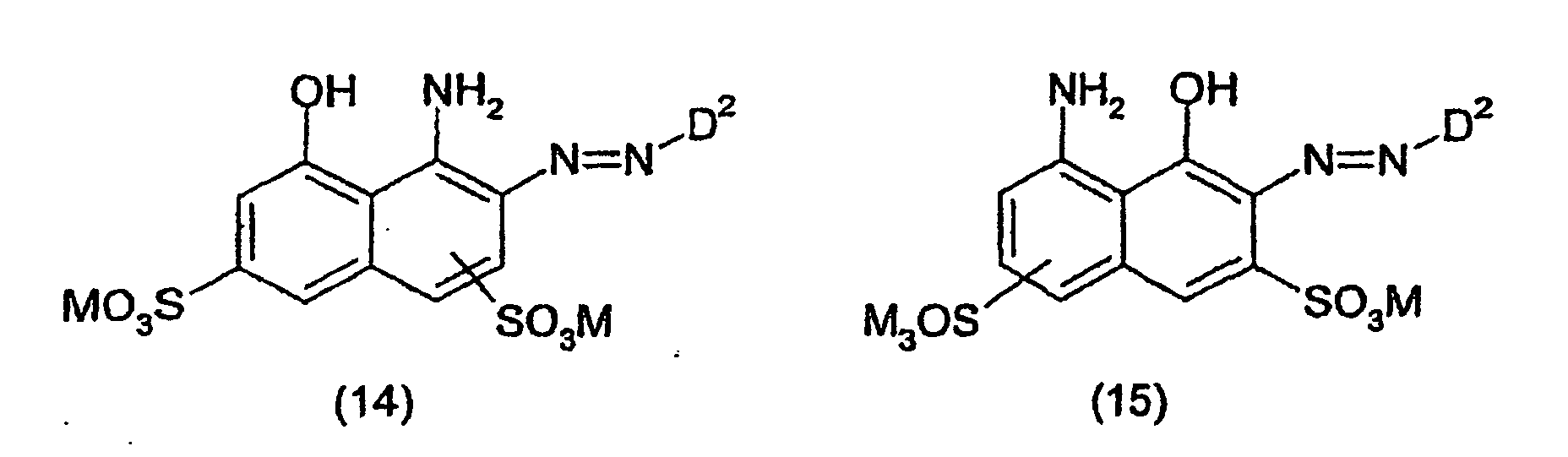
- the dye mixtures according to the invention may additionally contain one or more monoazo dyes of the general formulas (14) or (15) in an amount of up to 10% by weight, wherein M and D2 have the abovementioned meanings.
- D 2 is more preferably 4- (2-sulfatoethylsulfonyl) -phenyl or 4-vinylsulfonyl-phenyl.
- Dyes of the general formula (I) are known from EP-A-1 046 677, the dyes of the general formula (II) are known from DE-A-19 11 427 and from the literature or can be prepared by standard synthesis methods. Dyes of the general formulas (14) and (15) are likewise accessible via standard synthesis methods or are formed in part during the synthesis of dyes of the general formula (I). They are usually used as Nuancierkomponenten.
- the dye mixtures according to the invention can be used as a preparation in solid or in liquid (dissolved) form.
- solid form they contain so far necessary for water-soluble and especially fiber-reactive dyes conventional electrolyte salts, such as sodium chloride, potassium chloride and sodium sulfate, and may further contain the usual in commercial dyes aids, such as Buffer substances which have a pH in aqueous solution between 3 and 7 such as sodium acetate, sodium citrate, sodium borate, Sodium bicarbonate, sodium dihydrogen phosphate and Disodium hydrogen phosphate, dyeing aids, dedusting agents and low Quantities of siccatives; if in liquid, aqueous solution (including the Content of thickening agents, as are usual in printing pastes), They may also contain substances that increase the shelf life of these preparations such as mold-preventing agents.
- the dye mixtures according to the invention are in in general, as electrolyte salt-containing powder or granules (hereinafter generally referred to as preparation) with optionally one or more the above-mentioned aid.
- preparation electrolyte salt-containing powder or granules
- the dye mixture is to 20 to 90 wt .-%, based on the preparation contained.
- the Buffer substances are generally in a total amount of up to 10 wt .-%, related to the preparation before.
- the total dye content in these aqueous solutions is up to at about 50% by weight, such as between 5 and 50% by weight Electrolyte salt content in these aqueous solutions preferably below 10 wt .-%, based on the aqueous solution is; the aqueous solutions (Liquid preparations), the mentioned buffer substances usually in one Amount of up to 5 wt .-%, preferably up to 2 wt .-%, included.
- the dye mixtures according to the invention can be prepared in per se conventional procedure, such as by mechanical mixing of the individual dyes, either in the form of their dye powders or granules or their synthesis solutions or aqueous solutions of the individual dyes in general, which may contain conventional auxiliaries or by Diazotization familiar to the person skilled in the art and coupling of suitable mixtures of diazo and coupling components in the desired proportions.
- the dye mixture of the invention is in a manner known per se by salting out, for example, with common salt or potassium chloride or by Spray drying isolated.
- Dye mixtures in addition to ⁇ -chloroethylsulfonyl or ⁇ -thiosulfatoethylsulfonyl or ⁇ -sulfatoethylsulfonyl groups also vinylsulfonyl groups as reactive radicals not only starting from appropriately substituted vinylsulfonyl anilines or naphthylamines, but also by reaction a dye mixture wherein Z is ⁇ -chloroethyl, ⁇ -thiosulfatoethyl, or ⁇ -sulfatoethyl is, with an amount required for the desired proportion Alkali and conversion of said ⁇ -substituted Ethylsulfonyl phenomenon in Vinylsulfonyl be obtained. This transfer takes place in a Professional common fashion.
- the dye mixtures according to the invention have valuable application properties. They are used for dyeing or printing hydroxy- and / or carboxamido-containing materials, for example in the form of fabrics such as paper and leather or of films such as Polyamide, or in the mass, such as polyamide and polyurethane, but especially used by these materials in fibrous form.
- the present invention thus also relates to the use of dye mixtures according to the invention for dyeing or printing this Materials or methods for dyeing or printing such materials in and customary procedures, in which one is an inventive Dye mixture or their individual components (dyes) individually together used as a colorant.
- the materials come in the form of Fiber materials for use, in particular in the form of textile fibers, such as Fabrics or yarns, such as in the form of strands or bobbins.
- Hydroxy-containing materials are those natural or synthetic Origin, such as cellulose fiber materials or their Regenerated products and polyvinyl alcohols.
- Cellulose fiber materials are preferably cotton, but also other plant fibers, such as linen, hemp, jute and ramie fibers; regenerated cellulose fibers are, for example, rayon and Viscose rayon and chemically modified cellulosic fibers such as aminated Cellulose fibers or fibers, as described, for example, in WO 96/37641 and WO 96/37642 and in EP-A-0 538 785 and EP-A-0 692 559.
- Carbonamidity perfume pieces are for example synthetic and natural polyamides and polyurethanes, in particular in the form of fibers, for example, wool and other animal hair, silk, leather, polyamide-6,6, polyamide-6, Polyamide-11 and polyamide-4.
- the dye mixtures according to the invention can be based on the mentioned Substrates, in particular on the fiber materials mentioned, according to the water-soluble, in particular according to those known for fiber-reactive dyes Apply and fix application techniques. So you get up with them Cellulose fibers by exhaustion both short and long Liquor, for example in the ratio of goods to liquor from 1: 5 to 1: 100, preferably 1: 6 to 1: 30, using a variety of acid-binding agents and optionally neutral salts as necessary, such as sodium chloride or Sodium sulfate, dyeings with very good color yields.
- dye in aqueous bath at temperatures between 40 and 105 ° C, optionally at a Temperature up to 130 ° C under pressure, but preferably at 30 to 95 ° C, in particular 45 to 65 ° C, and optionally in the presence of customary Dyeing auxiliaries.
- the undressing of the If desired, dye-promoting neutral salts can also be added to the bath be added only after reaching the actual dyeing temperature.
- cellulose fibers are also excellent Color yields and a very good color structure, whereby by staying at Room temperature or elevated temperature, for example up to about 60 ° C, or in continuous dyeing proof, for example by means of a pad dry pad steam method, can be fixed by steaming or dry heat in the usual way.
- cellulose fibers which are single-phase, for example, by printing with a sodium bicarbonate or another acid-binding agent containing printing paste and subsequent steaming at 100 to 103 ° C, or two-phase, for example by printing with neutral or weakly acidic ink and then fix either by Passing through a hot electrolyte-containing alkaline bath or through Over-padding with an alkaline electrolyte-containing padding liquor and subsequent Lingering or steaming or treatment with dry heat of the alkaline überkotzten material, can be obtained, you get strong color prints with good contours and a clear white foundation. The failure of the prints is only slightly dependent on changing fixing conditions.
- thermofixing by means of dry heat according to the usual thermofixing hot air is used at 120 to 200 ° C.
- steam of 101 to 103 ° C can also be superheated steam and pressure steam from temperatures up to be used to 160 ° C.
- Dye mixtures on the cellulose fibers causing agent are, for example water-soluble basic salts of alkali metals and also alkaline earth metals of inorganic or organic acids or compounds that are alkali in the heat liberate, further alkali silicates.
- alkali metal hydroxides and alkali metal salts of weak to medium inorganic or to call organic acids wherein of the alkali metal compounds preferably the Sodium and potassium compounds are meant.
- Such acid-binding agents are for example, sodium hydroxide, potassium hydroxide, sodium carbonate, Sodium bicarbonate, potassium carbonate, sodium formate, sodium dihydrogen phosphate, Disodium hydrogen phosphate, sodium trichloroacetate, trisodium phosphate or Water glass or mixtures thereof, such as, for example, mixtures of sodium hydroxide solution and water glass.
- the dye mixtures according to the invention are characterized in Cellulose fiber materials when used in the dyeing and printing process by excellent color strength in the presence of no or very little alkali or alkaline earth compounds. So you need, for example, for a small Color depth no electrolyte salt, for an average color depth not more than 5g / l Electrolyte salt and for large color depths not more than 10 g / l of electrolyte salt.
- a low color depth denotes according to the invention the use of 2% by weight Dye based on the substrate to be dyed, an average color depth According to the invention, the use of 2 to 4% by weight of dye based on the coloring substrate and a large color depth according to the invention denotes the Use of 4 to 10% by weight of dye based on the substrate to be dyed.
- the dyeings obtainable with the dye mixtures according to the invention and Prints have clear nuances; in particular, the dyeings and prints Cellulose fiber materials good light fastness and especially good Wet fastnesses, such as washing, Walk, water, seawater, overdyeing and acid as well as alkaline perspiration, furthermore a good pleating fastness, Ironing fastness and rubbing fastness. Furthermore, the cellulose stains show up the usual aftertreatment by rinsing to remove unfixed Dye shares excellent wet fastness, especially as unfixed Due to their good solubility in cold water, it is easy to wash off dye contents.
- the dye mixtures according to the invention can also be used for the fiber reactive dyeing of wool find use.
- Also can be felt-free or low-felt wool (compare, for example, H. Rath, textbook of textile chemistry, Springer-Verlag, 3rd edition (1972), p. 295-299, in particular the equipment according to the so-called Hercosett method (page 298); J. Soc. Dyers and Colorists 1972, 93-99, and 1975, 33-44) with very good fastness properties.
- the procedure of Dyeing on wool takes place here in usual and well-known Därbeweise from acidic Milieu.
- the dyebath acetic acid and / or Ammonium sulfate or acetic acid and ammonium acetate or sodium acetate Add to obtain the desired pH.
- an addition of conventional leveling agents such as for example, based on a reaction product of cyanuric chloride with the triply molar amount of an aminobenzenesulfonic acid and / or a Aminonaphthalenesulfonic acid or based on a reaction product of for example stearylamine with ethylene oxide.
- the Dye mixture according to the invention preferably initially from acid dyebath with a pH of about 3.5 to 5.5 under control of the pH of the exhaustion process and the pH then, towards the end of the staining time, in the neutral and optionally a weak alkaline range up to a pH of 8.5 shifted to the full reactive especially for achieving high color depths Binding between the dyes of the dye mixtures of the invention and of the fiber. At the same time the non-reactive bound Dye fraction detached.
- the procedure described here also applies to the production of dyeings Fiber materials of other natural polyamides or of synthetic Polyamides and polyurethanes.
- the material to be dyed at a Temperature of about 40 ° C introduced into the bath, where it moved some time in it, the dyebath then to the desired weakly acidic, preferably weak acetic acid, pH adjusted and the actual coloration at a temperature between 60 and 98 ° C performed.
- the dyeings can also be used at Boiling temperature or in closed dyeing apparatus at temperatures up to 106 ° C are performed. Since the water solubility of the inventive Dye mixtures is very good, they can also be used with the usual advantage use continuous dyeing process.
- the color intensity of the invention Dye mixtures is very high.
- the dye mixtures of the invention provide on the materials mentioned, prefers fiber materials, navy blue to deep black dyeings with good Fastness properties.
- the following examples serve to illustrate the invention.
- the parts are Parts by weight, the percentages are by weight, unless otherwise stated noted. Parts by weight refer to parts by volume such as kilograms to liters.
- the in the examples formulaically described compounds are in the form of Written sodium salts, as they are generally in the form of their salts, preferably Lithium, sodium or potassium salts, prepared and isolated and in the form of their salts used for dyeing.
- starting compounds can be in the form of the free Acid or also in the form of their salts, preferably alkali metal salts, such as sodium or potassium salts to be used in the synthesis.
- the resulting inventive dye mixture provides under the for Reactive dyes usual dyeing conditions, for example on cotton, black dyeings and prints.
- the dye solution obtained can also be buffered by addition of a phosphate buffer at pH 5.5-6 and adjusted by further dilution or concentration as a liquid brand of certain strength.
- the resulting inventive dye mixture dyes cotton in navy blue to black tones.
- 2 parts of a dye obtained according to Example 1 - 3 are in 999 parts Dissolved water and 5 parts of sodium carbonate, 0.7 parts of sodium hydroxide (in the form a 32.5% aqueous solution) and optionally 1 part of a Wetting agent added.
- this dyebath is added 100 g of a Cotton fabric.
- the temperature of the dyebath is initially at 10 minutes 25 ° C, then increased in 30 minutes to final temperature (40-60 ° C) and this Temperature maintained for another 60-90 minutes. Thereafter, the dyed goods first 2 minutes with drinking water and then 5 minutes with e-water rinsed.
- the dyed product is neutralized at 40 ° C in 1000 parts of an aqueous Solution containing 1 part of 50% acetic acid for 10 minutes. With e-water is rinsed at 70 ° C and then 15 minutes with a detergent soaped, rinsed again and dried. This gives a strong color navy blue to gray color with very good fastness properties.
Landscapes
- Chemical & Material Sciences (AREA)
- Chemical Kinetics & Catalysis (AREA)
- Organic Chemistry (AREA)
- Engineering & Computer Science (AREA)
- Textile Engineering (AREA)
- Coloring (AREA)
- Artificial Filaments (AREA)
- Paper (AREA)
Claims (11)
- Mélanges de colorants réactifs, qui contiennent un ou plusieurs colorants de formule générale (I) indiquée et définie ci-aprèset un ou plusieurs colorants de formule générale (II) indiquée et définie ci-après
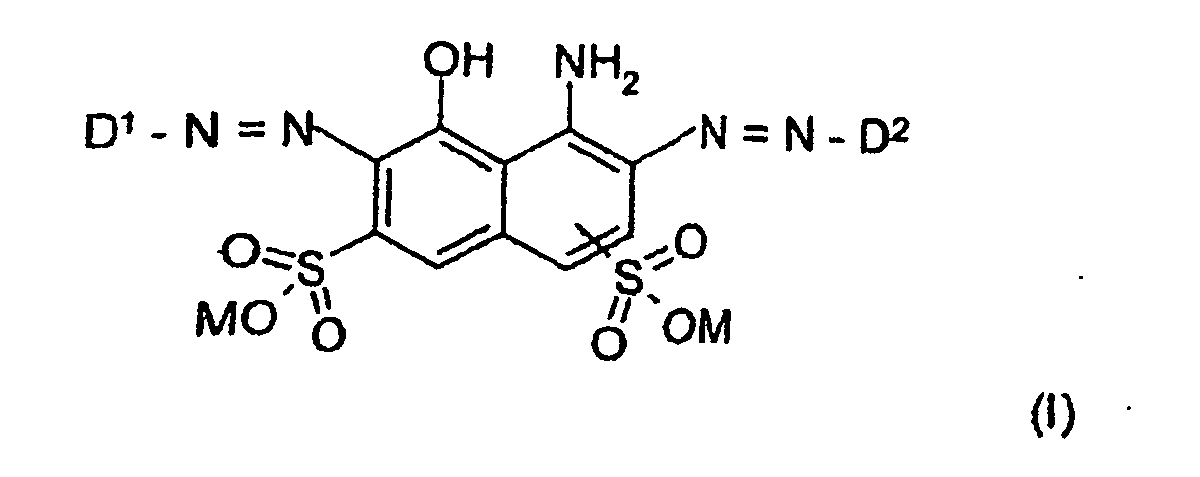 formules dans lesquelles :
D1 et D2 représentent un groupe de formule générale (1)dans laquelle
- R1
- est un atome d'hydrogène, un radical alkyle en C1-C4, aryle ou un radical aryle substitué ;
- R2
- et R3 représentent, indépendamment l'un de l'autre, un atome d'hydrogène ou d'halogène ou un groupe alkyle en C1-C4, alcoxy en C1-C4, hydroxy, sulfo, carboxy ou amido ; et
- A
- est un groupe phénylène de formule générale (2)
dans laquelle

- R4 et R5
- représentent, indépendamment l'un
de l'autre, un atome d'hydrogène ou d'halogène
ou un groupe alkyle en C1-C4, alcoxy en
C1-C4, hydroxy, sulfo, carboxy ou amido ;
ou
dans laquelle
- R6 et R7
- représentent, indépendamment l'un de l'autre, un atome d'hydrogène ou d'halogène ou un groupe alkyle en C1-C4, alcoxy en C1-C4, hydroxy, sulfo, carboxy ou amido ; ou
- R8 et R9
- représentent, indépendamment l'un de l'autre, un atome d'hydrogène ou d'halogène ou un groupe alkyle en C1-C4, alcoxy en C1-C4, hydroxy, cyano, amido ou aryle ; et
- X1
- représente un atome d'hydrogène ou un groupe de
formule -SO2-Z ; ou
un groupe phényle de formule générale (5)dans laquelle
- R10 et R11
- représentent, indépendamment l'un de l'autre, un atome d'hydrogène ou d'halogène ou un groupe alkyle en C1-C4, alcoxy en C1-C4, hydroxy, sulfo, carboxy ou amido ; et
- X2
- à l'une des significations de X1 ;
dans laquelle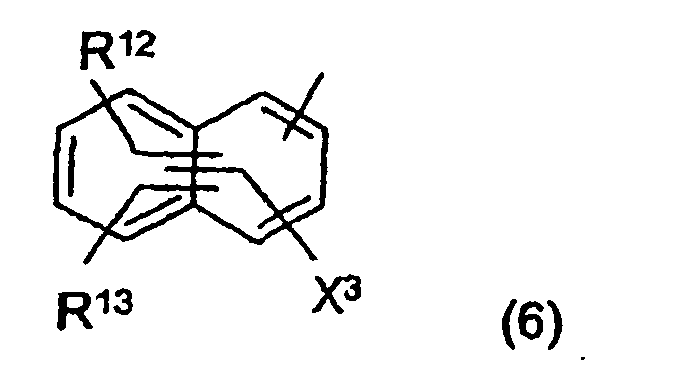
- R12 et R13
- représentent, indépendamment l'un de l'autre, un atome d'hydrogène ou d'halogène ou un groupe alkyle en C1-C4, alcoxy en C1-C4, hydroxy, sulfo, carboxy ou amido ; et
- X3
- a l'une des significations de X1 ;
- Z
- représente -CH=CH2, -CH2CH2Z1 ou le groupe
hydroxy,
où- Z1
- est un groupe hydroxy ou un groupe pouvant être éliminé sous l'action d'un alcali ; et
- M
- représente un atome d'hydrogène, un métal alcalin ou un équivalent d'un métal alcalino-terreux ;
- D3
- a l'une des significations de D1 ou D2 ou représente
un groupe de formule générale (7)
dans laquelle
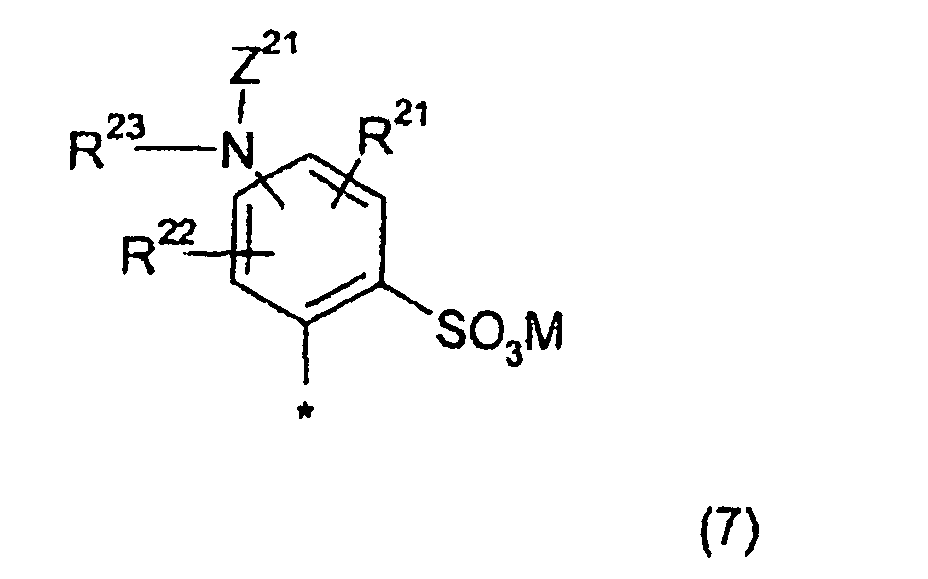
- R21 et R22
- ont indépendamment l' un de l' autre l'une des significations de R2 et R3 ;
- R23
- est un atome d'hydrogène, un groupe alkyle en C1-C4, un radical phényle non substitué ou substitué par alkyle en C1-C4, alcoxy en C1-C4, sulfo, halogène ou carboxy ; et
- Z21
- représente un radical hétérocyclique réactif avec les fibres, et
- n
- est 1 ou 2 ; et
- Y
- représente un groupe hydroxy ou amino qui est non substitué ou substitué par alkyle en C1-C4 ou aryle ;
dans le cas où A représente un groupe de formule générale (4), R1 représente un radical aryle ou aryle substitué ; et
le colorant réactif de formule générale (I) contenant au moins un groupe -SO2-Z. - Mélanges de colorants réactifs selon la revendication 1, caractérisés en ce que le radical hétérocyclique réactif Z21 est un groupe de formule générale (8) ou (9) ou (10),formules dans lesquelles

- V
- représente un atome de fluor ou de chlore ;
- U1, U2
- représentent, indépendamment l'un de l'autre, un atome de fluor, de chlore ou d'hydrogène ; et
- Q1, Q2
- représentent, indépendamment l'un de l'autre,
un atome de chlore ou de fluor ou un groupe
cyanamido, hydroxy, alcoxy en C1-C6, phénoxy,
sulfophénoxy, mercapto, alkyl(C1-C6)mercapto,
pyridino, carboxypyridino, carbamoylpyridino ou
un groupe de formule générale (11) ou (12)
où
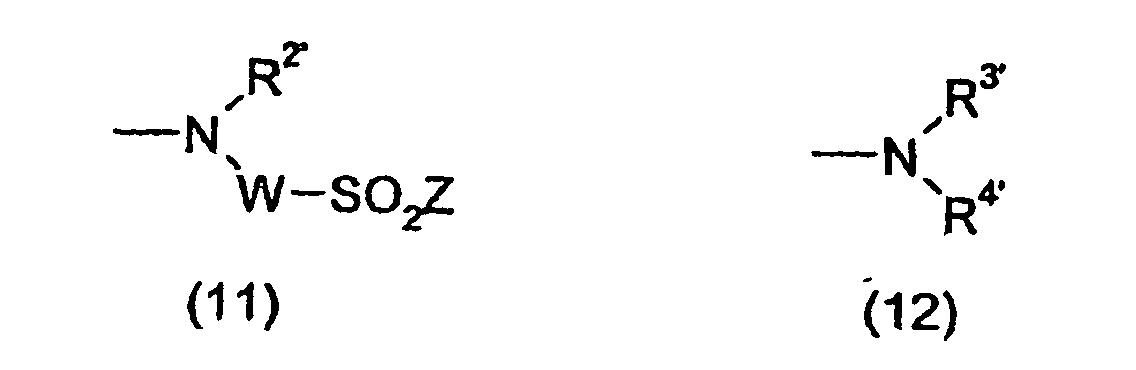
- R2'
- est un atome d'hydrogène ou un groupe alkyle en C1-C6, sulfoalkyle (C1-C6) ou phényle qui est non substitué ou substitué par alkyle en C1-C4, alcoxy en C1-C4, sulfo, halogène, carboxy, acétamido, uréido ;
- R3'
- et R4' ont indépendamment l' un de l' autre
l'une des significations de R2', ou forment
un système cyclique de formule -(CH2)j-,
dans laquelle j représente 4 ou 5, ou bien
de formule -(CH2)2-E-(CH2)2-, dans laquelle
E est un atome d'oxygène ou de soufre ou un
groupe sulfo, -NR5'-, où R5' = alkyle en
C1-C6, ou représentent un groupe de formule
générale (13)
dans laquelle

- R24, R25 et R26
- représentent un groupe alkyle en C1-C4 ou hydroxyalkyle en C1-C4 ; et
- B-
- est l'équivalent d'un anion, tel que l'anion hydrogénosulfate, sulfate, fluorure, chlorure, bromure, dihydrogénophosphate, hydrogénophosphate, phosphate, hydroxy ou acétate ;
- W
- est un radical phénylène qui est non substitué ou porte 1 ou 2 substituants, tels qu'alkyle en C1-C4, alcoxy en C1-C4, carboxy, sulfo, chlore, brome ou est un radical alkylène(C1-C4)-arylène ou alkylène en C2-C6, qui peut être interrompu par un atome d'oxygène ou de soufre ou par un groupe sulfo, amino, carbonyle, carbamoyle, ou est un groupement phénylène-CONH-phénylène, qui est non substitué ou substitué par alkyle en C1-C4, alcoxy en C1-C4, hydroxy, sulfo, carboxy, amido, uréido ou halogène, ou est un radical naphtalène qui est non substitué ou substitué par un ou deux groupes sulfo ;
- Z
- a la signification donnée plus haut et les substituants R1 à R5, R8 à R11 et R23 représentent un atome d'hydrogène, R6, R7, R12, R13, R21 et R22 représentent un atome d'hydrogène ou le groupe sulfo, et R24, R25 et R26 représentent le groupe méthyle.
- Mélanges de colorants réactifs selon la revendication 1 et/ou la revendication 2, caractérisés en ce que Z représente le groupe vinyle, β-chloréthyle ou β-sulfatoéthyle.
- Mélanges de colorants réactifs selon au moins l'une des revendications 1 à 3, caractérisés en ce que D3 dans la formule générale (II) représente le groupement 3-(β-sulfatoéthylsulfonyl)phényle, 4-(β-sulfatoéthylsulfonyl)phényle, 2-sulfo-4-(β-sulfatoéthylsulfonyl)phényle, 2-méthoxy-5-(β-sulfatoéthylsulfonyl)phényle, 2,5-diméthoxy-4-(β-sulfatoéthylsulfonyl)phényle, 2-méthoxy-5-méthyl-4-(β-sulfatoéthylsulfonyl)phényle, 6-(β-sulfatoéthylsulfonyl)-2-sulfonapht-2-yle, 3-vinylsulfonylphényle, 4-vinylsulfonylphényle, 4-(3-(2-sulfatoéthylsulfonyl)phénylcarbamoyl)-phényle, 4-(4-(2-sulfatoéthylsulfonyl)phénylcarbamoyl)phényle, 3-(3-(2-sulfatoéthylsulfonyl)-phénylcarbamoyl)phényle, 3-(4-(2-sulfatoéthylsulfonyl)phénylcarbamoyl)phényle, 1-sulfo-4-(2,4-difluoropyrimidin-6-yl)amino-2-phényle ou 1-sulfo-4-(4,6-difluoropyrimidin-2-yl)amino-2-phényle.
- Mélanges de colorants réactifs selon une ou plusieurs des revendications 1 à 4, caractérisés en ce qu'ils contiennent au moins un colorant de formule générale (Ia)et au moins un colorant de formule générale (IIa)
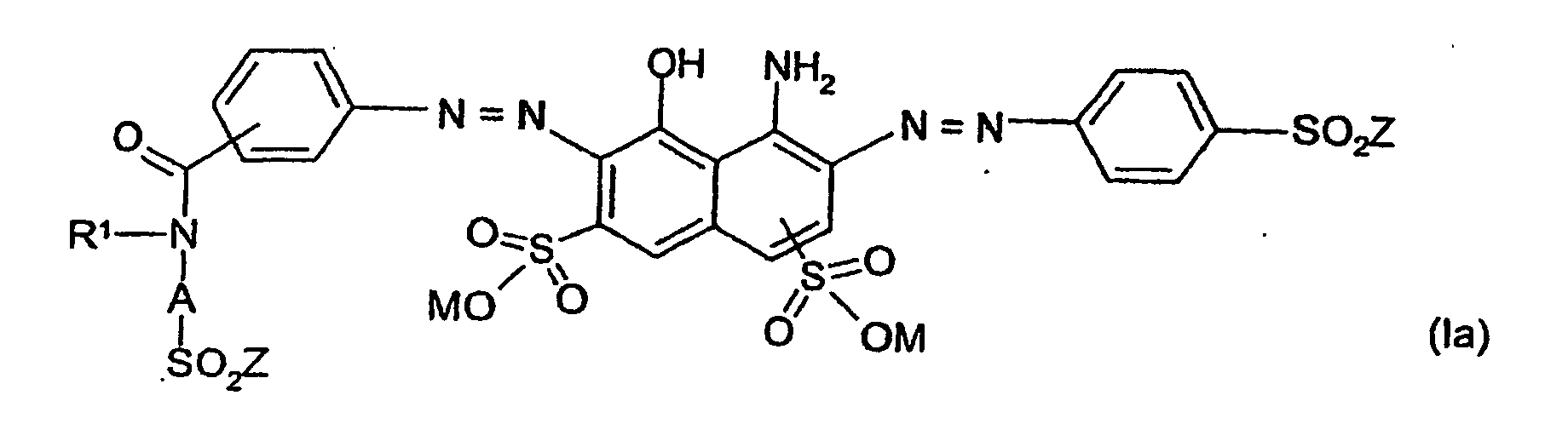 formules dans lesquelles M, A, R1, Z, D3 et Y sont définis comme indiqué dans la revendication 1.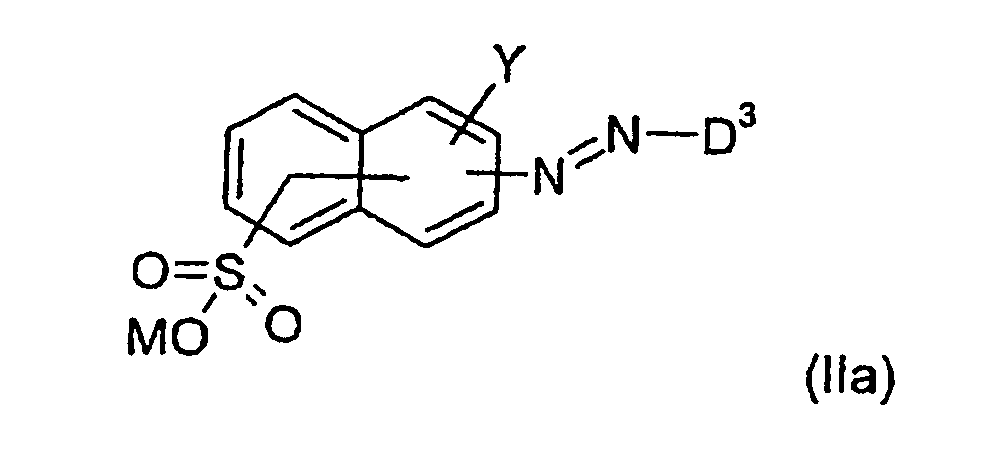
- Mélange de colorants réactifs selon la revendication 5, caractérisé en ce que, dans la formule (Ia), A représente le groupe phénylène, Z représente le groupe vinyle ou β-sulfatoéthyle, et dans la formule (IIa) Y représente le groupe hydroxy ou amino et D3 est défini comme indiqué dans la revendication 1.
- Mélanges de colorants réactifs selon une ou plusieurs des revendications 1 à 6, dans lesquels un ou plusieurs colorants de formule (I) sont contenus en une proportion de 30 à 95 % en poids et un ou plusieurs colorants de formule (II) sont contenus en une proportion de 5 à 70 % en poids.
- Mélanges de colorants réactifs selon la revendication 1, qui contiennent un ou plusieurs colorants monoazoïques de formule (14) et/ou un ou plusieurs colorants monoazoïques de formule (15) à raison de chacun 0,5 à 6 % en poids,D2 et M ayant les significations indiquées dans la revendication 1.
- Procédé pour la préparation de mélanges de colorants selon une ou plusieurs des revendications 1 à 8, caractérisé en ce que les colorants individuels de formules (I) et (II) et éventuellement (14) et (15) soit, sous forme solide, sont mélangés entre eux mécaniquement, soit sont mélangés sous forme des solutions aqueuses, en un rapport préétabli.
- Procédé pour la préparation de mélanges de colorants selon une ou plusieurs des revendications 1 à 8, dans le cas où D1 et D3 selon les formules générales (I) et (II) ont la même signification, carac térisé en ce qu'on soumet à une diazotation, à la manière usuelle, une amine de formule générale (16)dans laquelle M, Y et D2 sont tels que définis dans la revendication 1.

- Utilisation de mélanges de colorants réactifs selon une ou plusieurs des revendications 1 à 8, pour la teinture de matériau fibreux contenant des groupes hydroxy et/ou carbamoyle.
Applications Claiming Priority (3)
| Application Number | Priority Date | Filing Date | Title |
|---|---|---|---|
| DE10127061A DE10127061A1 (de) | 2001-06-02 | 2001-06-02 | Farbstoffmischungen von faserreaktiven Azofarbstoffen und ihre Verwendung |
| DE10127061 | 2001-06-02 | ||
| PCT/EP2002/005824 WO2002098986A2 (fr) | 2001-06-02 | 2002-05-28 | Melanges de colorants azoiques reagissant avec les fibres et utilisation |
Publications (2)
| Publication Number | Publication Date |
|---|---|
| EP1397439A2 EP1397439A2 (fr) | 2004-03-17 |
| EP1397439B1 true EP1397439B1 (fr) | 2005-11-16 |
Family
ID=7687117
Family Applications (1)
| Application Number | Title | Priority Date | Filing Date |
|---|---|---|---|
| EP02754592A Expired - Lifetime EP1397439B1 (fr) | 2001-06-02 | 2002-05-28 | Melanges de colorants azoiques reagissant avec les fibres et utilisation |
Country Status (13)
| Country | Link |
|---|---|
| US (1) | US6962611B2 (fr) |
| EP (1) | EP1397439B1 (fr) |
| JP (1) | JP4191593B2 (fr) |
| KR (1) | KR20040043123A (fr) |
| CN (1) | CN1513036A (fr) |
| AT (1) | ATE310052T1 (fr) |
| AU (1) | AU2002321041A1 (fr) |
| BR (1) | BR0209569A (fr) |
| CA (1) | CA2449125A1 (fr) |
| DE (2) | DE10127061A1 (fr) |
| MX (1) | MXPA03011053A (fr) |
| TW (1) | TW583277B (fr) |
| WO (1) | WO2002098986A2 (fr) |
Families Citing this family (6)
| Publication number | Priority date | Publication date | Assignee | Title |
|---|---|---|---|---|
| WO2003080741A1 (fr) * | 2002-03-22 | 2003-10-02 | Dystar Textilfarben Gmbh & Co. Deutschland Kg | Melanges de colorants azoiques reagissant avec les fibres, leur production et leur utilisation |
| MY136589A (en) * | 2003-02-05 | 2008-10-31 | Ciba Sc Holding Ag | Mixtures of reactive dyes and their use |
| CN100413927C (zh) * | 2005-09-05 | 2008-08-27 | 明德国际仓储贸易(上海)有限公司 | 双偶氮染料化合物及其应用 |
| CN101368008B (zh) * | 2007-08-15 | 2012-10-17 | 上海雅运纺织化工股份有限公司 | 藏青色活性染料组合物及其在纤维材料上的染色应用 |
| CN113788771B (zh) * | 2021-11-15 | 2022-04-12 | 高密丽美生物科技有限公司 | 一种巯基改性萘酚醚染料的制备方法 |
| CN116355438A (zh) * | 2021-12-27 | 2023-06-30 | 浙江瑞华化工有限公司 | 一种黑色活性染料组合物及其制备方法和用途 |
Family Cites Families (7)
| Publication number | Priority date | Publication date | Assignee | Title |
|---|---|---|---|---|
| US5611821A (en) * | 1995-09-16 | 1997-03-18 | Everlight Usa, Inc. | Black reactive dye composition |
| TW466263B (en) | 1998-07-28 | 2001-12-01 | Dystar Textilfarben Gmbh & Amp | Fiber-reactive black dye mixtures and use thereof for dyeing hydroxy-and/or carboxamido-containing fiber material |
| US6106580A (en) | 1998-08-27 | 2000-08-22 | Dystar Textilfarben Gmbh & Co. Deutschland Kg | Black dye mixtures of fiber-reactive azo dyes and use thereof for dyeing hydroxy--and/or carboxamido-containing fiber material |
| DE19918160A1 (de) * | 1999-04-22 | 2000-10-26 | Dystar Textilfarben Gmbh & Co | Reaktivfarbstoffmischungen für salzarmes Färben |
| DE19918159A1 (de) * | 1999-04-22 | 2000-10-26 | Dystar Textilfarben Gmbh & Co | Wasserlösliche Disazoverbindungen mit Arylcarbonamid-Diazokomponenten, Verfahren zu ihrer Herstellung und ihre Verwendung |
| US6036732A (en) | 1999-04-30 | 2000-03-14 | Dystar Textilfarben Gmbh & Co. Deuschland Kg | Black dye mixtures of fiber-reactive azo dyes, methods for their preparation and use thereof for dyeing hydroxy-and/or carboxamido-cont |
| US6159251A (en) * | 1999-10-05 | 2000-12-12 | Dystar Textilfarbon Gmbh & Co. Deutschland Kg | Dye mixtures of fiber-reactive azo dyes and use thereof for dyeing material containing hydroxy-and/or carboxamido groups |
-
2001
- 2001-06-02 DE DE10127061A patent/DE10127061A1/de not_active Withdrawn
-
2002
- 2002-05-28 AT AT02754592T patent/ATE310052T1/de not_active IP Right Cessation
- 2002-05-28 CA CA002449125A patent/CA2449125A1/fr not_active Abandoned
- 2002-05-28 AU AU2002321041A patent/AU2002321041A1/en not_active Abandoned
- 2002-05-28 CN CNA028109414A patent/CN1513036A/zh active Pending
- 2002-05-28 DE DE50204951T patent/DE50204951D1/de not_active Expired - Lifetime
- 2002-05-28 BR BR0209569-6A patent/BR0209569A/pt active Search and Examination
- 2002-05-28 US US10/478,124 patent/US6962611B2/en not_active Expired - Fee Related
- 2002-05-28 EP EP02754592A patent/EP1397439B1/fr not_active Expired - Lifetime
- 2002-05-28 KR KR10-2003-7015789A patent/KR20040043123A/ko not_active Abandoned
- 2002-05-28 WO PCT/EP2002/005824 patent/WO2002098986A2/fr not_active Ceased
- 2002-05-28 JP JP2003502098A patent/JP4191593B2/ja not_active Expired - Fee Related
- 2002-05-28 MX MXPA03011053A patent/MXPA03011053A/es active IP Right Grant
- 2002-05-30 TW TW091111583A patent/TW583277B/zh not_active IP Right Cessation
Also Published As
| Publication number | Publication date |
|---|---|
| US6962611B2 (en) | 2005-11-08 |
| CN1513036A (zh) | 2004-07-14 |
| TW583277B (en) | 2004-04-11 |
| JP2004527647A (ja) | 2004-09-09 |
| JP4191593B2 (ja) | 2008-12-03 |
| AU2002321041A1 (en) | 2002-12-16 |
| BR0209569A (pt) | 2004-03-30 |
| DE10127061A1 (de) | 2002-12-12 |
| WO2002098986A3 (fr) | 2003-03-13 |
| EP1397439A2 (fr) | 2004-03-17 |
| MXPA03011053A (es) | 2004-03-19 |
| CA2449125A1 (fr) | 2002-12-12 |
| WO2002098986A2 (fr) | 2002-12-12 |
| DE50204951D1 (de) | 2005-12-22 |
| KR20040043123A (ko) | 2004-05-22 |
| ATE310052T1 (de) | 2005-12-15 |
| US20040139567A1 (en) | 2004-07-22 |
Similar Documents
| Publication | Publication Date | Title |
|---|---|---|
| EP1490441B2 (fr) | Melanges de colorants azoiques reagissant aux fibres, realisation et utilisation associees | |
| DE10337636A1 (de) | Farbstoffmischungen von faserreaktiven Azofarbstoffen, ihre Herstellung und ihre Verwendung | |
| EP0979849B1 (fr) | Mélange de colorants azoiques réactifs aquasolubles, son procédé de fabrication et son utilisation | |
| EP0719841B1 (fr) | Mélange de colorants azoiques réactifs aquasolubles, son procédé de fabrication et son utilisation | |
| DE10337637A1 (de) | Farbstoffmischungen von faserreaktiven Azofarbstoffen, ihre Herstellung und ihre Verwendung | |
| EP1490442B1 (fr) | Melanges de colorants azoiques reagissant avec les fibres, leur production et leur utilisation | |
| DE69912227T2 (de) | Rotfärbende Farbstoffmischungen von faserreaktiven Azofarbstoffen und deren Verwendung | |
| DE60118506T2 (de) | Schwarze Farbstoffmischungen faserreaktiver Azofarbstoffe, Verfahren zu deren Herstellung sowie ihre Verwendung zum Faerben von Hydroxy- und/oder Karboxamidogruppen enthaltendem Fasermaterial | |
| EP1397438B1 (fr) | Melanges de colorants azoiques reagissant aux fibres et utilisation | |
| DE19851497A1 (de) | Farbstoffmischungen von faserreaktiven Azofarbstoffen und ihre Verwendung | |
| DE10127061A1 (de) | Farbstoffmischungen von faserreaktiven Azofarbstoffen und ihre Verwendung | |
| EP1046677B1 (fr) | Composés disazoiques solubles dans l'eau dérivés de diazos contenant un groupe arylcarbonamide, procédé pour leur préparation et leur utilisation | |
| DE10217477A1 (de) | Faserreaktive Azofarbstoffe, deren Herstellung und ihre Verwendung | |
| DE60002644T2 (de) | Farbstoffmischungen von faserreaktiven Azofarbstoffen und ihre Verwendung zum Färben von hydroxy- und/oder carbonamidgruppenhaltigem Material | |
| EP1274803B1 (fr) | Melange de colorants azoiques hydrosolubles reagissant avec la fibre, leur procede de production et leur utilisation | |
| EP0974622B1 (fr) | Mélange de colorants azoiques réactifs aquasolubles, son procédé de fabrication et son utilisation | |
| DE60004597T2 (de) | Farbstoffmischungen von faserreaktiven Azofarbstoffen und ihre Verwendung zum Färben von hydroxy- und/oder carbonamidgruppenhaltigem Material | |
| EP0992546B1 (fr) | Mélanges de colorants azoiques réactifs aquasolubles, leur procédé de fabrication et leur utilisation | |
| DE10225859A1 (de) | Wasserlösliche faserreaktive Disazofarbstoffe, Verfahren zu ihrer Herstellung und ihre Verwendung | |
| EP1316587B1 (fr) | Mélanges de colorants disazoiques réactifs et leur utilisation | |
| DE10217479A1 (de) | Farbstoffmischungen von faserreaktiven Azofarbstoffen, ihre Herstellung und ihre Verwendung | |
| EP1501898B1 (fr) | Colorants hydrosolubles reagissant avec les fibres, procede de production de ces colorants et leur utilisation | |
| DE10212770A1 (de) | Farbstoffmischungen von faserreaktiven Azofarbstoffen und ihre Verwendung | |
| DE10217478A1 (de) | Farbstoffmischungen von faserreaktiven Azofarbstoffen, ihre Herstellung und ihre Verwendung | |
| DE10212772A1 (de) | Farbstoffmischungen von faserreaktiven Azofarbstoffen, deren Herstellung und ihre Verwendung |
Legal Events
| Date | Code | Title | Description |
|---|---|---|---|
| PUAI | Public reference made under article 153(3) epc to a published international application that has entered the european phase |
Free format text: ORIGINAL CODE: 0009012 |
|
| 17P | Request for examination filed |
Effective date: 20040102 |
|
| AK | Designated contracting states |
Kind code of ref document: A2 Designated state(s): AT BE CH CY DE DK ES FI FR GB GR IE IT LI LU MC NL PT SE TR |
|
| AX | Request for extension of the european patent |
Extension state: AL LT LV MK RO SI |
|
| GRAP | Despatch of communication of intention to grant a patent |
Free format text: ORIGINAL CODE: EPIDOSNIGR1 |
|
| GRAS | Grant fee paid |
Free format text: ORIGINAL CODE: EPIDOSNIGR3 |
|
| GRAA | (expected) grant |
Free format text: ORIGINAL CODE: 0009210 |
|
| AK | Designated contracting states |
Kind code of ref document: B1 Designated state(s): AT BE CH CY DE DK ES FI FR GB GR IE IT LI LU MC NL PT SE TR |
|
| PG25 | Lapsed in a contracting state [announced via postgrant information from national office to epo] |
Ref country code: IT Free format text: LAPSE BECAUSE OF FAILURE TO SUBMIT A TRANSLATION OF THE DESCRIPTION OR TO PAY THE FEE WITHIN THE PRESCRIBED TIME-LIMIT;WARNING: LAPSES OF ITALIAN PATENTS WITH EFFECTIVE DATE BEFORE 2007 MAY HAVE OCCURRED AT ANY TIME BEFORE 2007. THE CORRECT EFFECTIVE DATE MAY BE DIFFERENT FROM THE ONE RECORDED. Effective date: 20051116 Ref country code: NL Free format text: LAPSE BECAUSE OF FAILURE TO SUBMIT A TRANSLATION OF THE DESCRIPTION OR TO PAY THE FEE WITHIN THE PRESCRIBED TIME-LIMIT Effective date: 20051116 Ref country code: IE Free format text: LAPSE BECAUSE OF FAILURE TO SUBMIT A TRANSLATION OF THE DESCRIPTION OR TO PAY THE FEE WITHIN THE PRESCRIBED TIME-LIMIT Effective date: 20051116 Ref country code: FI Free format text: LAPSE BECAUSE OF FAILURE TO SUBMIT A TRANSLATION OF THE DESCRIPTION OR TO PAY THE FEE WITHIN THE PRESCRIBED TIME-LIMIT Effective date: 20051116 Ref country code: GB Free format text: LAPSE BECAUSE OF FAILURE TO SUBMIT A TRANSLATION OF THE DESCRIPTION OR TO PAY THE FEE WITHIN THE PRESCRIBED TIME-LIMIT Effective date: 20051116 |
|
| REG | Reference to a national code |
Ref country code: GB Ref legal event code: FG4D Free format text: NOT ENGLISH |
|
| REG | Reference to a national code |
Ref country code: CH Ref legal event code: EP |
|
| REF | Corresponds to: |
Ref document number: 50204951 Country of ref document: DE Date of ref document: 20051222 Kind code of ref document: P |
|
| REG | Reference to a national code |
Ref country code: IE Ref legal event code: FG4D Free format text: LANGUAGE OF EP DOCUMENT: GERMAN |
|
| PG25 | Lapsed in a contracting state [announced via postgrant information from national office to epo] |
Ref country code: DK Free format text: LAPSE BECAUSE OF FAILURE TO SUBMIT A TRANSLATION OF THE DESCRIPTION OR TO PAY THE FEE WITHIN THE PRESCRIBED TIME-LIMIT Effective date: 20060216 Ref country code: SE Free format text: LAPSE BECAUSE OF FAILURE TO SUBMIT A TRANSLATION OF THE DESCRIPTION OR TO PAY THE FEE WITHIN THE PRESCRIBED TIME-LIMIT Effective date: 20060216 Ref country code: GR Free format text: LAPSE BECAUSE OF FAILURE TO SUBMIT A TRANSLATION OF THE DESCRIPTION OR TO PAY THE FEE WITHIN THE PRESCRIBED TIME-LIMIT Effective date: 20060216 |
|
| PG25 | Lapsed in a contracting state [announced via postgrant information from national office to epo] |
Ref country code: ES Free format text: LAPSE BECAUSE OF FAILURE TO SUBMIT A TRANSLATION OF THE DESCRIPTION OR TO PAY THE FEE WITHIN THE PRESCRIBED TIME-LIMIT Effective date: 20060227 |
|
| PG25 | Lapsed in a contracting state [announced via postgrant information from national office to epo] |
Ref country code: PT Free format text: LAPSE BECAUSE OF FAILURE TO SUBMIT A TRANSLATION OF THE DESCRIPTION OR TO PAY THE FEE WITHIN THE PRESCRIBED TIME-LIMIT Effective date: 20060417 |
|
| NLV1 | Nl: lapsed or annulled due to failure to fulfill the requirements of art. 29p and 29m of the patents act | ||
| PG25 | Lapsed in a contracting state [announced via postgrant information from national office to epo] |
Ref country code: BE Free format text: LAPSE BECAUSE OF NON-PAYMENT OF DUE FEES Effective date: 20060531 Ref country code: MC Free format text: LAPSE BECAUSE OF NON-PAYMENT OF DUE FEES Effective date: 20060531 |
|
| GBV | Gb: ep patent (uk) treated as always having been void in accordance with gb section 77(7)/1977 [no translation filed] |
Effective date: 20051116 |
|
| REG | Reference to a national code |
Ref country code: IE Ref legal event code: FD4D |
|
| PLBE | No opposition filed within time limit |
Free format text: ORIGINAL CODE: 0009261 |
|
| STAA | Information on the status of an ep patent application or granted ep patent |
Free format text: STATUS: NO OPPOSITION FILED WITHIN TIME LIMIT |
|
| 26N | No opposition filed |
Effective date: 20060817 |
|
| EN | Fr: translation not filed | ||
| BERE | Be: lapsed |
Owner name: DYSTAR TEXTILFARBEN G.M.B.H. & CO. DEUTSCHLAND KG Effective date: 20060531 |
|
| PG25 | Lapsed in a contracting state [announced via postgrant information from national office to epo] |
Ref country code: FR Free format text: LAPSE BECAUSE OF FAILURE TO SUBMIT A TRANSLATION OF THE DESCRIPTION OR TO PAY THE FEE WITHIN THE PRESCRIBED TIME-LIMIT Effective date: 20070105 |
|
| PG25 | Lapsed in a contracting state [announced via postgrant information from national office to epo] |
Ref country code: TR Free format text: LAPSE BECAUSE OF FAILURE TO SUBMIT A TRANSLATION OF THE DESCRIPTION OR TO PAY THE FEE WITHIN THE PRESCRIBED TIME-LIMIT Effective date: 20051116 Ref country code: LU Free format text: LAPSE BECAUSE OF NON-PAYMENT OF DUE FEES Effective date: 20060528 |
|
| PG25 | Lapsed in a contracting state [announced via postgrant information from national office to epo] |
Ref country code: FR Free format text: LAPSE BECAUSE OF FAILURE TO SUBMIT A TRANSLATION OF THE DESCRIPTION OR TO PAY THE FEE WITHIN THE PRESCRIBED TIME-LIMIT Effective date: 20051116 Ref country code: CY Free format text: LAPSE BECAUSE OF FAILURE TO SUBMIT A TRANSLATION OF THE DESCRIPTION OR TO PAY THE FEE WITHIN THE PRESCRIBED TIME-LIMIT Effective date: 20051116 |
|
| PGFP | Annual fee paid to national office [announced via postgrant information from national office to epo] |
Ref country code: AT Payment date: 20090514 Year of fee payment: 8 |
|
| PG25 | Lapsed in a contracting state [announced via postgrant information from national office to epo] |
Ref country code: AT Free format text: LAPSE BECAUSE OF NON-PAYMENT OF DUE FEES Effective date: 20100528 |
|
| PGFP | Annual fee paid to national office [announced via postgrant information from national office to epo] |
Ref country code: CH Payment date: 20110512 Year of fee payment: 10 |
|
| PGFP | Annual fee paid to national office [announced via postgrant information from national office to epo] |
Ref country code: DE Payment date: 20110708 Year of fee payment: 10 |
|
| REG | Reference to a national code |
Ref country code: CH Ref legal event code: PL |
|
| PG25 | Lapsed in a contracting state [announced via postgrant information from national office to epo] |
Ref country code: LI Free format text: LAPSE BECAUSE OF NON-PAYMENT OF DUE FEES Effective date: 20120531 Ref country code: CH Free format text: LAPSE BECAUSE OF NON-PAYMENT OF DUE FEES Effective date: 20120531 |
|
| REG | Reference to a national code |
Ref country code: DE Ref legal event code: R119 Ref document number: 50204951 Country of ref document: DE Effective date: 20121201 |
|
| PG25 | Lapsed in a contracting state [announced via postgrant information from national office to epo] |
Ref country code: DE Free format text: LAPSE BECAUSE OF NON-PAYMENT OF DUE FEES Effective date: 20121201 |