EP1398043A2 - Process for controlling microbial contamination of polymeric emulsions using carbon dioxide detection - Google Patents
Process for controlling microbial contamination of polymeric emulsions using carbon dioxide detection Download PDFInfo
- Publication number
- EP1398043A2 EP1398043A2 EP03020630A EP03020630A EP1398043A2 EP 1398043 A2 EP1398043 A2 EP 1398043A2 EP 03020630 A EP03020630 A EP 03020630A EP 03020630 A EP03020630 A EP 03020630A EP 1398043 A2 EP1398043 A2 EP 1398043A2
- Authority
- EP
- European Patent Office
- Prior art keywords
- carbon dioxide
- concentration
- headspace
- biocide
- dioxide concentration
- Prior art date
- Legal status (The legal status is an assumption and is not a legal conclusion. Google has not performed a legal analysis and makes no representation as to the accuracy of the status listed.)
- Withdrawn
Links
Classifications
-
- G—PHYSICS
- G01—MEASURING; TESTING
- G01N—INVESTIGATING OR ANALYSING MATERIALS BY DETERMINING THEIR CHEMICAL OR PHYSICAL PROPERTIES
- G01N33/00—Investigating or analysing materials by specific methods not covered by groups G01N1/00 - G01N31/00
- G01N33/44—Resins; Plastics; Rubber; Leather
-
- G—PHYSICS
- G01—MEASURING; TESTING
- G01N—INVESTIGATING OR ANALYSING MATERIALS BY DETERMINING THEIR CHEMICAL OR PHYSICAL PROPERTIES
- G01N33/00—Investigating or analysing materials by specific methods not covered by groups G01N1/00 - G01N31/00
- G01N33/0004—Gaseous mixtures, e.g. polluted air
- G01N33/0009—General constructional details of gas analysers, e.g. portable test equipment
- G01N33/0027—General constructional details of gas analysers, e.g. portable test equipment concerning the detector
- G01N33/0036—General constructional details of gas analysers, e.g. portable test equipment concerning the detector specially adapted to detect a particular component
- G01N33/004—CO or CO2
-
- A—HUMAN NECESSITIES
- A61—MEDICAL OR VETERINARY SCIENCE; HYGIENE
- A61L—METHODS OR APPARATUS FOR STERILISING MATERIALS OR OBJECTS IN GENERAL; DISINFECTION, STERILISATION OR DEODORISATION OF AIR; CHEMICAL ASPECTS OF BANDAGES, DRESSINGS, ABSORBENT PADS OR SURGICAL ARTICLES; MATERIALS FOR BANDAGES, DRESSINGS, ABSORBENT PADS OR SURGICAL ARTICLES
- A61L2/00—Disinfection or sterilisation of materials or objects, in general; Accessories therefor
- A61L2/16—Disinfection or sterilisation of materials or objects, in general; Accessories therefor using chemical substances
-
- A—HUMAN NECESSITIES
- A61—MEDICAL OR VETERINARY SCIENCE; HYGIENE
- A61L—METHODS OR APPARATUS FOR STERILISING MATERIALS OR OBJECTS IN GENERAL; DISINFECTION, STERILISATION OR DEODORISATION OF AIR; CHEMICAL ASPECTS OF BANDAGES, DRESSINGS, ABSORBENT PADS OR SURGICAL ARTICLES; MATERIALS FOR BANDAGES, DRESSINGS, ABSORBENT PADS OR SURGICAL ARTICLES
- A61L2/00—Disinfection or sterilisation of materials or objects, in general; Accessories therefor
- A61L2/26—Accessories
- A61L2/28—Devices for testing the effectiveness or completeness of sterilisation or disinfection, e.g. indicators which change colour
-
- Y—GENERAL TAGGING OF NEW TECHNOLOGICAL DEVELOPMENTS; GENERAL TAGGING OF CROSS-SECTIONAL TECHNOLOGIES SPANNING OVER SEVERAL SECTIONS OF THE IPC; TECHNICAL SUBJECTS COVERED BY FORMER USPC CROSS-REFERENCE ART COLLECTIONS [XRACs] AND DIGESTS
- Y10—TECHNICAL SUBJECTS COVERED BY FORMER USPC
- Y10T—TECHNICAL SUBJECTS COVERED BY FORMER US CLASSIFICATION
- Y10T436/00—Chemistry: analytical and immunological testing
- Y10T436/12—Condition responsive control
-
- Y—GENERAL TAGGING OF NEW TECHNOLOGICAL DEVELOPMENTS; GENERAL TAGGING OF CROSS-SECTIONAL TECHNOLOGIES SPANNING OVER SEVERAL SECTIONS OF THE IPC; TECHNICAL SUBJECTS COVERED BY FORMER USPC CROSS-REFERENCE ART COLLECTIONS [XRACs] AND DIGESTS
- Y10—TECHNICAL SUBJECTS COVERED BY FORMER USPC
- Y10T—TECHNICAL SUBJECTS COVERED BY FORMER US CLASSIFICATION
- Y10T436/00—Chemistry: analytical and immunological testing
- Y10T436/20—Oxygen containing
- Y10T436/204998—Inorganic carbon compounds
Definitions
- Aqueous based polymer emulsions are comprised of fine organic polymer particles suspended and stabilized in an aqueous environment with either surfactants or protective colloids or a combination of both. Because of the inherent supply of carbon nutrition for microorganisms in these polymer emulsions, they are susceptible to microbial attack and propagation. Such microbial attack and propagation can result in excessive biocontamination and spoilage. A standard industrial practice to combat such product biodeterioration is through the addition of various industrial biocides (antimicrobial agents). Biocides added at the point of manufacture keep the polymeric emulsions free of microbial contaminants for a limited time. But, during storage, microbial contamination can occur and contaminated products having a substantial presence of microbial growth, e.g. above 1 x 10 2 colony forming units per milliliter, may be unfit for use because of pH changes, viscosity changes, off color, odor and the like and must be scrapped.
- a typical method for determining the presence of microorganisms and quantification of the colony forming units per milliliter (cfu/ml) in polymeric emulsion products is streak plate testing.
- the emulsion polymer is coated onto various agar growth mediums and incubated for 2 to 7 days. The presence of microorganisms can then be determined from the growth on the plate. Absence of growth is an indication that the polymeric emulsion is free of contaminating microorganisms. Because of the time required for microbial detection, excessive biocontamination and biodeterioration can occur during the incubation period, thus wasting valuable time for intervention and product recovery.
- detection of contamination in polymer emulsions contained in drums or large storage tanks via streak plate testing is dependent upon the location in the container from which the emulsion sample is removed. For example, many microorganisms contaminating polymer emulsions prefer to grow at the surface or upper portions of the emulsion. If the emulsion is sampled from the top of the container, contamination would be detected via streak plate testing. However, if the emulsion is sampled from the bottom of the container, it is likely that streak plate testing would show no contamination. In this example, the presence of contamination would be missed and the emulsion would continue to be biodegraded resulting in lost product.
- WO 99/59431 teaches a method for detecting the presence of contaminating bacteria in a food sample stored in cans and other packages by modifying said packages to comprise a hydrophilic polymeric composition lining containing an indicator for the presence of absence of gases, including carbon dioxide.
- the indicator is triggered by a pH difference reflected by the level of carbon dioxide.
- WO 92/12413 teaches the use of a multi-layer body fluid culture sensor comprising a fluorophore embedded in a chemically inert matrix that is transparent at the wavelengths of interest.
- the fluorophore comprises a pH sensitive absorbance based dye that changes color when the pH is lowered by the reaction of microbial evolved carbon dioxide with water. This method and sensor are used to detect microorganisms in a blood culture bottle.
- WO 93/15402 teaches the monitoring of biological activity within a container or bag containing foodstuff or a human thrombocyte concentrate by means of an apparatus for indicating the partial pressure of carbon dioxide.
- a pH sensitive indicator material is employed to visually indicate elevated carbon dioxide levels.
- a need remains for direct analysis of a leading indicator of biological action in the early detection of microbial contaminants in polymeric emulsions.
- Such early warning of product contamination and the warning of an excessive concentration and growth rate of microorganisms permit immediate intervention to eliminate and prevent subsequent product biodeterioration before the product has lost all commercial value.
- a further need remains for detecting and responding to the presence of microbial contaminants in polymeric emulsions, on-line, in real time and without removing a sample for off-line analysis.
- a need remains for preventing the contamination of the polymeric emulsions without excessive addition of biocide to the polymeric emulsion.
- This invention relates to an improved process for the identification and control of excess biocontamination in aqueous based polymeric emulsions contained in vessels having a headspace, typically a vessel having a headspace vented to the atmosphere.
- the improvement for early detection which avoids excessive addition of biocide to the polymeric emulsion comprises: monitoring carbon dioxide concentration in the headspace of the vessel using a direct reading carbon dioxide probe (sensor) ; and, then adding biocide when a preselected concentration of carbon dioxide, above the atmospheric carbon dioxide concentration, is reached.
- biocide is added when the carbon dioxide concentration is 100 parts per million (ppm) above atmospheric carbon dioxide concentration (usually 400 ppm v/v).
- This invention is directed to an improved process for controlling microbial contamination of aqueous based polymeric emulsions in vessels, particularly vessels such as storage tanks, using carbon dioxide sensors that can operate in the humid gas phase matrix and in real time.
- Direct reading carbon dioxide sensors are used to measure the carbon dioxide concentration in the headspace of the vessel over a period of time. Based upon the carbon dioxide concentration in the headspace of the large storage tank, microbial contamination can be detected. Utilizing the carbon dioxide concentration level and the rate of change of the carbon dioxide concentration over time, the microbial concentration and microbial growth rate may be approximated. Biocide is added in an amount reflective of the approximated level of contamination and growth rate.
- Microbial contamination of polymer emulsions can lead to a range of effects, including color changes, odors, viscosity changes, pH changes, and visible surface growth. Excessive contamination, e.g. above 1 x 10 2 colony forming units per milliliter (cfu/ml) can lead to product spoilage.
- microorganisms capable of contaminating polymer emulsions include, but are not limited to, Aeromonas hydrophilia, Alcaligenes faecalis, Corynebacterium ammoniagenes, Enterobacter aerogenes, Escherichia coli, Klebsiella pneumoniae, Pseudomonas aeruginosa, Proteus vulgaris, Providencia rettgeri, Pseudomonas stutzeri, Shewanella putrefaciens, Serratia liquefaciens, Acinetobacter baumannii, Burkholderia cepacia, Chryseobacterium meningosepticum, Sphingobacterium spiritivorum, Ralstonia pickettii, Gluconoacetobacter liquefaciens, Geotrichum candidum, Aspergillus species, Sporothrix species, Trichoderma viride, Cladosporium species, Rhodoturula glut
- test mechanism unlike many techniques, is particularly sensitive to microbial growth in large storage tanks, e.g., 10,000 to 30,000 gallons.
- Atmospheric carbon dioxide levels are approximately 300-400 ppm.
- Low levels of microbial contamination of polymeric emulsions it is believed, initially is introduced and possibly saturates, the aqueous phase of the polymeric emulsion with carbon dioxide. Then, as the concentration of carbon dioxide in the aqueous phase increases, the carbon dioxide in the headspace begins to increase above atmospheric levels.
- Carbon dioxide concentrations exceeding background levels by a specified amount, e.g., 100 ppm has allowed for the establishment of criteria by which contamination can be identified and approximated. For example, bacterial contamination levels as low as 1 x 10 2 cfu/ml have been observed in experiments to result in a doubling of headspace carbon dioxide concentrations to approximately 600-800 ppm.
- the concentration, and the rate of change of carbon dioxide concentration are used to alert operators or automatic dispensers to intervene and provide treatment before spoilage occurs.
- the carbon dioxide sensors that can be used in this invention must withstand the temperature, humidity, pH and other process conditions likely to be found in emulsion polymer storage containers. Using these sensors, polymeric emulsions retained in storage tanks, rail cars, tank trucks, and other areas of possible contamination can be monitored for the presence of microorganisms through the detection of the carbon dioxide as a respiration product and for the rate of change, in real time.
- Preferred carbon dioxide sensors are carbon dioxide transmitters incorporating CARBOCAP® sensors.
- the CARBOCAP sensor is a single-beam dual-wavelength NDIR sensor. These sensors are well suited to withstand harsh and humid environments. These sensors are capable of measuring a wide range of carbon dioxide concentrations, up to 20%. They can provide data in minutes, and on an ongoing, real.
- the carbon dioxide concentration can be monitored at a location remote from the vessel and sensor, using a transmission mechanism, such as wireless technology, telephone lines, or the internet.
- biocides antimicrobial agents
- examples of commonly used industrial biocides are: hydrogen peroxide, 1,2-benzisothiazolin-3-one (BIT), and a blend of 5-chloro-2-methyl-4-isothiazolin-3-one (CIT) and 2-methyl-4-isothiazolin-3-one (MIT).
- Examples of other biocides commonly used for polymer emulsion preservation include 1,2-dibromo-2,4-dicyanobutane (DBDCB), 2,2-dibromo-3-nitrilo-propionamide (DBNPA), 2-bromo-2-nitro-1,3-propanediol (BNPD), aldehyde derivatives, formaldehyde releasing agents, hydantoins, and chlorinated aromatics.
- DBDCB 1,2-dibromo-2,4-dicyanobutane
- DBNPA 2,2-dibromo-3-nitrilo-propionamide
- BNPD 2-bromo-2-nitro-1,3-propanediol
- Examples of cationic biocides that are particularly effective in preserving polymer emulsions that have been stabilized with protective colloids, such as poly(vinyl alcohol), against biodeteriogenic microbes are: substituted pyridinium salts, substituted guanidine salts, tetrasubstituted ammonium salts, and polymeric cationic compounds, in which the substitution can be an alkyl, a cycloalkyl, and/or an aryl group of 2 to 18 carbons.
- the cationic compounds are also particularly effective in preserving polymer emulsions with low VOC's (i.e. less than 1000 ppm VOC).
- Polymeric emulsions susceptible to microbial attack and treatable per the procedures described herein include essentially all dispersions of synthetic polymers and copolymers in aqueous media.
- polymer emulsions for purposes of this invention, then, include emulsions of poly(vinyl acetate), poly(vinyl acetate) copolymers such as poly(vinyl acetate-co-ethylene) (VAE), poly(vinyl acetate-acrylics) such as poly(vinyl acetate-butyl acrylate) and poly(vinyl acetate-(2-ethyl)hexyl acrylate), polyacrylics, polymethacrylics, poly(styrene-acrylics), wherein acrylics can include C 3-10 alkenoic acids, such as acrylic acid, methacrylic acid, crotonic acid and isocrotonic acid and their esters, other polystyrene copolymers, poly(vinyl chloride-co-ethylene) copolymers, and the like.
- poly(vinyl acetate), poly(vinyl acetate) copolymers such as poly(vinyl acetate-
- Surfactants and protective colloids employed in the formation of the polymeric emulsions include anionic, cationic and nonionic surfactants such as ethoxylated alkyl phenols, dialkyl esters of sulfonic acids, block ethylene/propylene oxide copolymers and so forth.
- Protective colloids commonly used include hydroxyethyl cellulose and poly(vinyl alcohol).
- Polymeric emulsions may also be in a formulated state.
- aqueous polymeric emulsion can be combined with pigments as in paint formulations.
- polymeric emulsion then, it is meant to include the polymeric emulsion obtained by emulsion polymerization and its formulated state.
- Sterile AIRFLEX® 400 (1600 grams) poly(vinyl alcohol) stabilized vinyl acetate/ethylene polymeric emulsion was placed in a 2L plastic Nalgene container.
- the plastic cover was modified with two ports. The first port was used to mount and insert the carbon dioxide sensor and the second, much smaller diameter port was left open to the atmosphere to permit venting and a constant pressure within the container.
- a Vaisala GMT222 direct reading carbon dioxide transmitter connected to a data logger and computer was used as the measuring device. The cover was then screwed on tightly and the headspace carbon dioxide concentration measured over the course of 3 days. During this entire monitoring period the headspace carbon dioxide concentration remained steady at approximately 400 ppm.
- AIRFLEX 400 (1600 grams) poly(vinyl alcohol) stabilized (some biocide present) vinyl acetate/ethylene polymeric emulsion was inoculated with Gluconoacetobacter liquefaciens. The resulting concentration of Gluconoacetobacter liquefaciens in the Airflex 400 emulsion was measured via a dilution plate count on potato dextrose agar and found to be 5.4 x 10 4 cfu/ml. The contaminated emulsion was placed in a 2L plastic Nalgene container.
- the modified cover, equipped with the carbon dioxide sensor and vent hole, described in Example 1 was tightly screwed on.
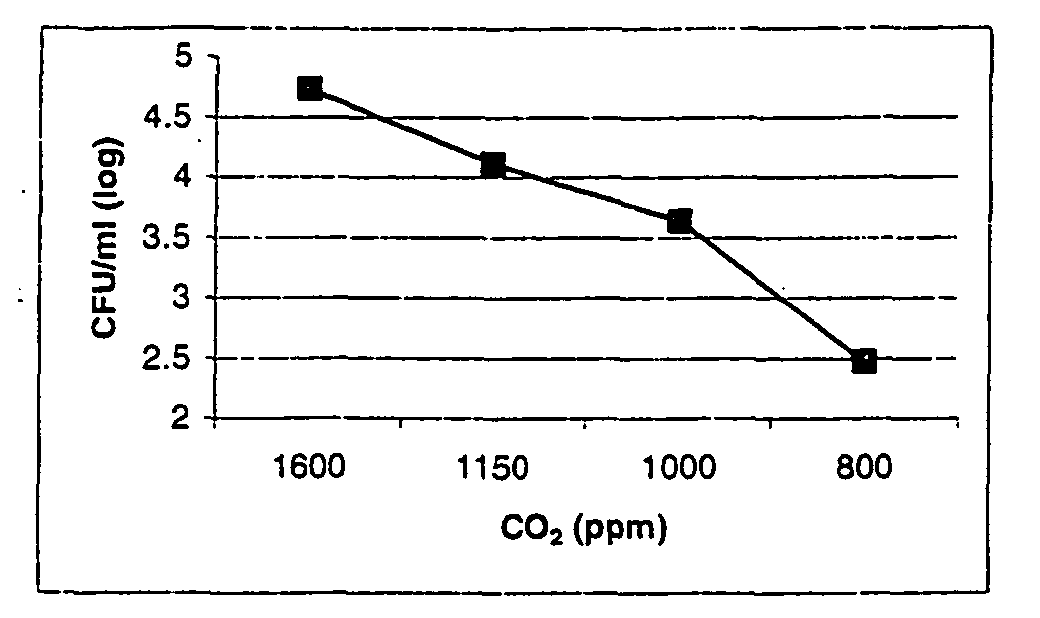
- the headspace carbon dioxide level began rising above background (-400 ppm) within a matter of minutes. After continually monitoring this sample for 2 days, the headspace carbon dioxide concentration leveled out at about 1600 ppm.
- DGH dodecylguanidine hydrochloride
- the sample was then monitored for headspace carbon dioxide concentration as described in Examples 1 and 2. After continually monitoring this sample for 2 days the headspace carbon dioxide concentration leveled out at about 1150 ppm.
- a sample of the AIRFLEX 400 poly(vinyl alcohol) stabilized vinyl acetate/ethylene polymeric emulsion was removed from the container and the concentration of Gluconoacetobacter liquefaciens was measured on potato dextrose agar using a dilution plate count method.
- the AIRFLEX 400 emulsion was found to have a Gluconoacetobacter liquefaciens contamination level of 1.30 x 10 4 cfu/ml.
- This Example shows that the reduction of carbon dioxide in the headspace indicated that the biocide addition was effective in reducing the microbial growth from that of Example 2.
- the results also show that as the rate of carbon dioxide reduction began to taper off (the rate of reduction slows) at the 1150 ppm, thus illustrating that microbial growth remained and that additional biocide was required. One need not wait until equilibrium occurs to determine that a substantial level of microbial growth remained. A slowing of the rate of carbon dioxide reduction at a level of carbon dioxide above about 300 ppm atmospheric levels, even 1000 ppm, is indicative of a need for additional biocide.
- Example 3 To the same contaminated sample described in Example 3 was added an additional 375 ppm DGH to further reduce the Gluconoacetobacter liquefaciens concentration. The sample was then monitored for headspace carbon dioxide concentration as described in Examples 1 and 2. After continually monitoring this sample for 3 days the headspace carbon dioxide concentration leveled out at about 1000 ppm.
- a sample of the AIRFLEX 400 poly(vinyl alcohol) stabilized vinyl acetate/ethylene polymeric emulsion was removed from the container and the concentration of Gluconoacetobacter liquefaciens was measured on potato dextrose agar using a dilution plate count method. The AIRFLEX 400 emulsion was found to have a Gluconoacetobacter liquefaciens contamination level of 4.40 x 10 3 cfu/ml.
- Example 3 the carbon dioxide concentration was instructive in alerting one that microbial growth remained, although in lower concentration than in Example 3, but still too high for a commercial product.
- Example 4 To the same contaminated sample described in Example 4 was added an additional 350 ppm DGH to further reduce the Gluconoacetobacter liquefaciens concentration. The sample was then monitored for headspace carbon dioxide concentration as described in Examples 1 and 2. After continually monitoring this sample for 3 days the headspace carbon dioxide concentration leveled out at about 800 ppm. A sample of the AIRFLEX 400 emulsion was removed from the container and the concentration of Gluconoacetobacter liquefaciens was measured on potato dextrose agar using a dilution plate count method.
- the AIRFLEX 400 poly(vinyl alcohol) stabilized vinyl acetate/ethylene polymeric emulsion was found to have a Gluconoacetobacter liquefaciens contamination level of 3.20 x 10 2 cfu/ml.
- Example CO 2 ppm Contamination, CFU/ml Biocide, ppm Time, hour 1 0 0 0 0 2 1600 5.4 X 10 4 0 24 2 inoculation 1600 5.4 X 10 4 400 Start 3 1150 1.3 X 10 4 400 24 4 1000 4.4 X 10 3 375 96 5 800 3.2 X 10 2 350 96
- Examples 1-5 show that the concentration of carbon dioxide in the headspace of a vented storage vessel can be used to detect microbial growth in the emulsion.
- the concentration of carbon dioxide in the headspace at conditions of near equilibrium can be an indication of microbial growth and suggest appropriate levels of biocide necessary to reduce the microbial growth.
- the declining rate of carbon dioxide concentration in the headspace affords an opportunity to predict whether further addition of biocide is necessary.
- a leveling of the carbon dioxide concentration above atmospheric is an indication that more biocide is required.
Landscapes
- Health & Medical Sciences (AREA)
- Life Sciences & Earth Sciences (AREA)
- Chemical & Material Sciences (AREA)
- General Health & Medical Sciences (AREA)
- Engineering & Computer Science (AREA)
- Epidemiology (AREA)
- Animal Behavior & Ethology (AREA)
- Public Health (AREA)
- Veterinary Medicine (AREA)
- Food Science & Technology (AREA)
- Medicinal Chemistry (AREA)
- Physics & Mathematics (AREA)
- Analytical Chemistry (AREA)
- Biochemistry (AREA)
- General Physics & Mathematics (AREA)
- Immunology (AREA)
- Pathology (AREA)
- Combustion & Propulsion (AREA)
- Chemical Kinetics & Catalysis (AREA)
- General Chemical & Material Sciences (AREA)
- Measuring Or Testing Involving Enzymes Or Micro-Organisms (AREA)
- Agricultural Chemicals And Associated Chemicals (AREA)
Abstract
Description
| Example | CO2, ppm | Contamination, CFU/ml | Biocide, ppm | Time, hour |
| 1 | 0 | 0 | 0 | 0 |
| 2 | 1600 | 5.4 X 10⁴ | 0 | 24 |
| 2 inoculation | 1600 | 5.4 X 10⁴ | 400 | Start |
| 3 | 1150 | 1.3 X 10⁴ | 400 | 24 |
| 4 | 1000 | 4.4 X 10³ | 375 | 96 |
| 5 | 800 | 3.2 X 10² | 350 | 96 |
Claims (6)
- In a process for the control of biocontamination in aqueous based polymeric emulsions contained in vessels having a headspace, the improvement for early detection and avoiding excessive addition of biocide to the aqueous based polymeric emulsion which comprises:direct monitoring of carbon dioxide concentration in the headspace of the vessel using a direct reading carbon dioxide sensor; and, then adding a biocide when a preselected concentration of carbon dioxide above the atmospheric carbon dioxide concentration is reached.
- The process of Claim 1 wherein the biocide is added when the carbon dioxide concentration in the headspace of the vessel is 100 parts per million (ppm) above atmospheric carbon dioxide concentration.
- The process of Claim 2 wherein biocide is added when the rate of carbon dioxide reduction slows down at 300 ppm above atmospheric carbon dioxide concentration.
- The process of Claim 1 wherein the headspace of the vessel is vented to the atmosphere.
- The process of claim 1 wherein the carbon dioxide concentration is monitored at a location remote from the vessel and sensor.
- The process of claim 1 wherein the carbon dioxide concentration is monitored at a location remote from the vessel and sensor, using wireless technology, telephone lines, or the internet.
Applications Claiming Priority (2)
| Application Number | Priority Date | Filing Date | Title |
|---|---|---|---|
| US10/243,152 US20040067592A1 (en) | 2002-09-13 | 2002-09-13 | Process for controlling microbial contamination of polymeric emulsions using carbon dioxide detection |
| US243152 | 2002-09-13 |
Publications (2)
| Publication Number | Publication Date |
|---|---|
| EP1398043A2 true EP1398043A2 (en) | 2004-03-17 |
| EP1398043A3 EP1398043A3 (en) | 2004-04-07 |
Family
ID=31887797
Family Applications (1)
| Application Number | Title | Priority Date | Filing Date |
|---|---|---|---|
| EP03020630A Withdrawn EP1398043A3 (en) | 2002-09-13 | 2003-09-10 | Process for controlling microbial contamination of polymeric emulsions using carbon dioxide detection |
Country Status (4)
| Country | Link |
|---|---|
| US (1) | US20040067592A1 (en) |
| EP (1) | EP1398043A3 (en) |
| KR (1) | KR20040024519A (en) |
| CN (1) | CN1495426A (en) |
Cited By (6)
| Publication number | Priority date | Publication date | Assignee | Title |
|---|---|---|---|---|
| WO2009072161A3 (en) * | 2007-12-07 | 2009-07-23 | Diesse Diagnostica Senese Spa | Device and method for microbiological analysis of biological samples |
| CN103487559A (en) * | 2013-10-15 | 2014-01-01 | 无锡艾科瑞思产品设计与研究有限公司 | CO2-concentration-detection-based device and method for detecting total microorganisms in food |
| WO2016134998A1 (en) * | 2015-02-27 | 2016-09-01 | Sabic Global Technologies B.V. | Methods for improving the base color of plastic by reducing biological growth in the latex system |
| GB2567635A (en) * | 2017-10-17 | 2019-04-24 | Cellfacts Analytics Ltd | A method and apparatus for monitoring microbial contaminants in an industrial process |
| WO2022048987A1 (en) * | 2020-09-02 | 2022-03-10 | Jointinventions Gmbh | Method for verifying a disinfection, test kit for this purpose, and disinfection method |
| US12140522B2 (en) | 2018-10-18 | 2024-11-12 | Alexander Boehler | Method and apparatus for monitoring microbial contaminants in an industrial process |
Families Citing this family (4)
| Publication number | Priority date | Publication date | Assignee | Title |
|---|---|---|---|---|
| CN100338458C (en) * | 2004-05-24 | 2007-09-19 | 湖南大学 | Method and apparatus for detecting microbe by piezoelectric quartz crystal sensor |
| CN102559838B (en) * | 2011-12-23 | 2014-02-26 | 浙江大学宁波理工学院 | Measuring method for inhibition of carbon dioxide to growth and metabolism of microorganisms during high density fermentation process |
| CN103344742B (en) * | 2013-07-16 | 2015-02-18 | 河南工业大学 | Method for predicting criticality of entomophthora in grains stored in granary |
| US11460410B2 (en) * | 2019-04-08 | 2022-10-04 | Puma SE | Bioindicator component applied to an article |
Family Cites Families (4)
| Publication number | Priority date | Publication date | Assignee | Title |
|---|---|---|---|---|
| US5094955A (en) * | 1988-03-15 | 1992-03-10 | Akzo N.V. | Device and method for detecting microorganisms |
| DK13492D0 (en) * | 1992-02-04 | 1992-02-04 | Bo Holte | METHOD AND APPARATUS FOR INDICATING THE EXISTENCE OF CO2 |
| MXPA01008719A (en) * | 2000-09-06 | 2002-04-10 | Air Products Polymers Lp | Polymer emulsion preservation using cationic compounds. |
| AU2002246971A1 (en) * | 2001-01-09 | 2002-08-06 | Ppg Industries Ohio, Inc. | Method and device for detecting and controlling the level of biological contaminants in a coating process |
-
2002
- 2002-09-13 US US10/243,152 patent/US20040067592A1/en not_active Abandoned
-
2003
- 2003-09-09 KR KR1020030063304A patent/KR20040024519A/en not_active Ceased
- 2003-09-10 EP EP03020630A patent/EP1398043A3/en not_active Withdrawn
- 2003-09-12 CN CNA031588387A patent/CN1495426A/en active Pending
Cited By (11)
| Publication number | Priority date | Publication date | Assignee | Title |
|---|---|---|---|---|
| WO2009072161A3 (en) * | 2007-12-07 | 2009-07-23 | Diesse Diagnostica Senese Spa | Device and method for microbiological analysis of biological samples |
| US9193985B2 (en) | 2007-12-07 | 2015-11-24 | Diesse Diagnostica Senese S.P.A. | Device and method for microbiological analysis of biological samples |
| CN103487559A (en) * | 2013-10-15 | 2014-01-01 | 无锡艾科瑞思产品设计与研究有限公司 | CO2-concentration-detection-based device and method for detecting total microorganisms in food |
| CN103487559B (en) * | 2013-10-15 | 2015-04-08 | 无锡艾科瑞思产品设计与研究有限公司 | CO2-concentration-detection-based device and method for detecting total microorganisms in food |
| WO2016134998A1 (en) * | 2015-02-27 | 2016-09-01 | Sabic Global Technologies B.V. | Methods for improving the base color of plastic by reducing biological growth in the latex system |
| CN107428859A (en) * | 2015-02-27 | 2017-12-01 | Sabic环球技术有限责任公司 | The method of plastics primary colours is improved by reducing the biological growth in latex system |
| US10421826B2 (en) | 2015-02-27 | 2019-09-24 | Sabic Global Technologies B.V. | Methods for improving the base color of plastic by reducing biological growth in the latex system |
| GB2567635A (en) * | 2017-10-17 | 2019-04-24 | Cellfacts Analytics Ltd | A method and apparatus for monitoring microbial contaminants in an industrial process |
| GB2567635B (en) * | 2017-10-17 | 2022-09-28 | Cellfacts Analytics Ltd | A method and apparatus for monitoring microbial contaminants in an industrial process |
| US12140522B2 (en) | 2018-10-18 | 2024-11-12 | Alexander Boehler | Method and apparatus for monitoring microbial contaminants in an industrial process |
| WO2022048987A1 (en) * | 2020-09-02 | 2022-03-10 | Jointinventions Gmbh | Method for verifying a disinfection, test kit for this purpose, and disinfection method |
Also Published As
| Publication number | Publication date |
|---|---|
| CN1495426A (en) | 2004-05-12 |
| US20040067592A1 (en) | 2004-04-08 |
| KR20040024519A (en) | 2004-03-20 |
| EP1398043A3 (en) | 2004-04-07 |
Similar Documents
| Publication | Publication Date | Title |
|---|---|---|
| US20040067592A1 (en) | Process for controlling microbial contamination of polymeric emulsions using carbon dioxide detection | |
| US6855514B2 (en) | Method for detecting presence of microorganisms, and quantities of microorganisms | |
| CA2330646C (en) | Method for determining deleterious bacterial growth in packaged food utilizing hydrophilic polymers | |
| RU2436082C2 (en) | Method and composition of indicator formulation for rapid detection of disinfectants with oxidative active substance on surfaces of objects and determining completeness of disinfecton | |
| US20100136607A1 (en) | Sensor device | |
| NO801728L (en) | STEAM STERILIZATION INDICATOR. | |
| CA2661285A1 (en) | Method and apparatus for the detection of living phytoplankton cells in water | |
| JP2017530936A (en) | System and method for releasing chlorine dioxide | |
| US5190728A (en) | Apparatus for monitoring fouling in commercial waters | |
| JPS5832879B2 (en) | How do you know what to do? | |
| Luque-Sastre et al. | A comparative study of the susceptibility of Listeria species to sanitizer treatments when grown under planktonic and biofilm conditions | |
| CA2799628A1 (en) | Detection and enumeration of legionella pneumophila | |
| AU2011373434B2 (en) | Method and device for detection and quantification of thermoduric microorganisms in a product | |
| EP0745138B1 (en) | Rapid read-out biological sterilisation indicator | |
| WO1998020337A1 (en) | Methods and devices for detecting spoilage in food products | |
| JP2002501363A (en) | Microbial monitoring method | |
| AU778034B2 (en) | Method for determining microbial contamination | |
| EP0244148A1 (en) | Method and device for enumerating microorganisms | |
| Crum et al. | Microbial penetration and utilization of organic aircraft fuel-tank coatings | |
| Vallejos et al. | Smart Polymers for Food and Water Quality Control and Safety | |
| JP2005287452A (en) | Microbial culture / detection method and microbe detection reagent. | |
| EP0723658A1 (en) | Assay method | |
| Vallejos Calzada et al. | Smart Polymers for Food and Water Quality Control and Safety | |
| KR20250085343A (en) | Gas indicator for quality control of food | |
| Gnanaraj et al. | Influence of oxygen transmission rate of packaging film on outgrowth of anaerobic bacterial spores |
Legal Events
| Date | Code | Title | Description |
|---|---|---|---|
| PUAI | Public reference made under article 153(3) epc to a published international application that has entered the european phase |
Free format text: ORIGINAL CODE: 0009012 |
|
| PUAL | Search report despatched |
Free format text: ORIGINAL CODE: 0009013 |
|
| AK | Designated contracting states |
Kind code of ref document: A2 Designated state(s): AT BE BG CH CY CZ DE DK EE ES FI FR GB GR HU IE IT LI LU MC NL PT RO SE SI SK TR |
|
| AX | Request for extension of the european patent |
Extension state: AL LT LV MK |
|
| AK | Designated contracting states |
Kind code of ref document: A3 Designated state(s): AT BE BG CH CY CZ DE DK EE ES FI FR GB GR HU IE IT LI LU MC NL PT RO SE SI SK TR |
|
| AX | Request for extension of the european patent |
Extension state: AL LT LV MK |
|
| RIC1 | Information provided on ipc code assigned before grant |
Ipc: 7G 01N 33/32 B Ipc: 7G 01N 33/00 B Ipc: 7C 12M 1/34 B Ipc: 7C 12M 1/12 B Ipc: 7C 09D 5/14 B Ipc: 7C 08J 3/03 B Ipc: 7A 61L 2/16 B Ipc: 7A 61L 2/28 A |
|
| 17P | Request for examination filed |
Effective date: 20040507 |
|
| AKX | Designation fees paid |
Designated state(s): AT BE BG CH CY CZ DE DK EE ES FI FR GB GR HU IE IT LI LU MC NL PT RO SE SI SK TR |
|
| STAA | Information on the status of an ep patent application or granted ep patent |
Free format text: STATUS: THE APPLICATION IS DEEMED TO BE WITHDRAWN |
|
| 18D | Application deemed to be withdrawn |
Effective date: 20070501 |