EP1398082B1 - Méthode de digestion des protéines en gel, et dispositif pour éviter le colmatage des cuves de réaction - Google Patents
Méthode de digestion des protéines en gel, et dispositif pour éviter le colmatage des cuves de réaction Download PDFInfo
- Publication number
- EP1398082B1 EP1398082B1 EP03253136A EP03253136A EP1398082B1 EP 1398082 B1 EP1398082 B1 EP 1398082B1 EP 03253136 A EP03253136 A EP 03253136A EP 03253136 A EP03253136 A EP 03253136A EP 1398082 B1 EP1398082 B1 EP 1398082B1
- Authority
- EP
- European Patent Office
- Prior art keywords
- well
- drain
- carrier
- sample
- passageway
- Prior art date
- Legal status (The legal status is an assumption and is not a legal conclusion. Google has not performed a legal analysis and makes no representation as to the accuracy of the status listed.)
- Expired - Lifetime
Links
- 238000000034 method Methods 0.000 title claims description 13
- 230000029087 digestion Effects 0.000 title description 7
- 239000012530 fluid Substances 0.000 claims description 22
- 238000002360 preparation method Methods 0.000 claims description 21
- 108090000623 proteins and genes Proteins 0.000 claims description 17
- 102000004169 proteins and genes Human genes 0.000 claims description 17
- 238000004458 analytical method Methods 0.000 claims description 13
- 102000004196 processed proteins & peptides Human genes 0.000 claims description 10
- 108090000765 processed proteins & peptides Proteins 0.000 claims description 10
- 108090000790 Enzymes Proteins 0.000 claims description 9
- 102000004190 Enzymes Human genes 0.000 claims description 9
- 238000004891 communication Methods 0.000 claims description 9
- 230000000274 adsorptive effect Effects 0.000 claims description 7
- 239000011159 matrix material Substances 0.000 claims description 7
- 239000000969 carrier Substances 0.000 claims description 5
- 239000012528 membrane Substances 0.000 claims description 5
- 239000002245 particle Substances 0.000 claims description 5
- 239000007787 solid Substances 0.000 claims description 4
- 239000002131 composite material Substances 0.000 description 7
- 238000001840 matrix-assisted laser desorption--ionisation time-of-flight mass spectrometry Methods 0.000 description 5
- 238000000132 electrospray ionisation Methods 0.000 description 4
- 239000000463 material Substances 0.000 description 4
- 238000005119 centrifugation Methods 0.000 description 3
- 238000011033 desalting Methods 0.000 description 3
- 150000002500 ions Chemical class 0.000 description 3
- 238000004949 mass spectrometry Methods 0.000 description 3
- -1 polyethylene Polymers 0.000 description 3
- 229920000642 polymer Polymers 0.000 description 3
- 239000004743 Polypropylene Substances 0.000 description 2
- 238000007792 addition Methods 0.000 description 2
- 239000011324 bead Substances 0.000 description 2
- 238000001819 mass spectrum Methods 0.000 description 2
- 229920001155 polypropylene Polymers 0.000 description 2
- 238000000746 purification Methods 0.000 description 2
- 238000011160 research Methods 0.000 description 2
- 150000003839 salts Chemical class 0.000 description 2
- 239000000126 substance Substances 0.000 description 2
- 239000000758 substrate Substances 0.000 description 2
- 102000035195 Peptidases Human genes 0.000 description 1
- 108091005804 Peptidases Proteins 0.000 description 1
- 239000004698 Polyethylene Substances 0.000 description 1
- 108010026552 Proteome Proteins 0.000 description 1
- 238000013459 approach Methods 0.000 description 1
- 238000003491 array Methods 0.000 description 1
- 238000003556 assay Methods 0.000 description 1
- 239000011230 binding agent Substances 0.000 description 1
- 230000015572 biosynthetic process Effects 0.000 description 1
- 239000000872 buffer Substances 0.000 description 1
- 238000005266 casting Methods 0.000 description 1
- 238000006243 chemical reaction Methods 0.000 description 1
- 239000012501 chromatography medium Substances 0.000 description 1
- 239000000356 contaminant Substances 0.000 description 1
- 238000011109 contamination Methods 0.000 description 1
- 238000012864 cross contamination Methods 0.000 description 1
- 238000003795 desorption Methods 0.000 description 1
- 238000001514 detection method Methods 0.000 description 1
- 238000009509 drug development Methods 0.000 description 1
- 238000007876 drug discovery Methods 0.000 description 1
- 238000001976 enzyme digestion Methods 0.000 description 1
- 125000000524 functional group Chemical group 0.000 description 1
- 238000003205 genotyping method Methods 0.000 description 1
- 239000011521 glass Substances 0.000 description 1
- 238000011534 incubation Methods 0.000 description 1
- 230000001788 irregular Effects 0.000 description 1
- 239000007788 liquid Substances 0.000 description 1
- 238000002414 normal-phase solid-phase extraction Methods 0.000 description 1
- 239000004033 plastic Substances 0.000 description 1
- 229920003023 plastic Polymers 0.000 description 1
- 229920000573 polyethylene Polymers 0.000 description 1
- 229920000098 polyolefin Polymers 0.000 description 1
- 238000012545 processing Methods 0.000 description 1
- 230000013777 protein digestion Effects 0.000 description 1
- 238000009877 rendering Methods 0.000 description 1
- 239000011347 resin Substances 0.000 description 1
- 229920005989 resin Polymers 0.000 description 1
- 238000005464 sample preparation method Methods 0.000 description 1
- 238000000926 separation method Methods 0.000 description 1
- 229910001220 stainless steel Inorganic materials 0.000 description 1
- 239000010935 stainless steel Substances 0.000 description 1
Images


Classifications
-
- B—PERFORMING OPERATIONS; TRANSPORTING
- B01—PHYSICAL OR CHEMICAL PROCESSES OR APPARATUS IN GENERAL
- B01L—CHEMICAL OR PHYSICAL LABORATORY APPARATUS FOR GENERAL USE
- B01L3/00—Containers or dishes for laboratory use, e.g. laboratory glassware; Droppers
- B01L3/50—Containers for the purpose of retaining a material to be analysed, e.g. test tubes
- B01L3/502—Containers for the purpose of retaining a material to be analysed, e.g. test tubes with fluid transport, e.g. in multi-compartment structures
- B01L3/5025—Containers for the purpose of retaining a material to be analysed, e.g. test tubes with fluid transport, e.g. in multi-compartment structures for parallel transport of multiple samples
- B01L3/50255—Multi-well filtration
-
- B—PERFORMING OPERATIONS; TRANSPORTING
- B01—PHYSICAL OR CHEMICAL PROCESSES OR APPARATUS IN GENERAL
- B01J—CHEMICAL OR PHYSICAL PROCESSES, e.g. CATALYSIS OR COLLOID CHEMISTRY; THEIR RELEVANT APPARATUS
- B01J20/00—Solid sorbent compositions or filter aid compositions; Sorbents for chromatography; Processes for preparing, regenerating or reactivating thereof
- B01J20/28—Solid sorbent compositions or filter aid compositions; Sorbents for chromatography; Processes for preparing, regenerating or reactivating thereof characterised by their form or physical properties
- B01J20/28014—Solid sorbent compositions or filter aid compositions; Sorbents for chromatography; Processes for preparing, regenerating or reactivating thereof characterised by their form or physical properties characterised by their form
- B01J20/28026—Particles within, immobilised, dispersed, entrapped in or on a matrix, e.g. a resin
-
- B—PERFORMING OPERATIONS; TRANSPORTING
- B01—PHYSICAL OR CHEMICAL PROCESSES OR APPARATUS IN GENERAL
- B01J—CHEMICAL OR PHYSICAL PROCESSES, e.g. CATALYSIS OR COLLOID CHEMISTRY; THEIR RELEVANT APPARATUS
- B01J20/00—Solid sorbent compositions or filter aid compositions; Sorbents for chromatography; Processes for preparing, regenerating or reactivating thereof
- B01J20/28—Solid sorbent compositions or filter aid compositions; Sorbents for chromatography; Processes for preparing, regenerating or reactivating thereof characterised by their form or physical properties
- B01J20/28014—Solid sorbent compositions or filter aid compositions; Sorbents for chromatography; Processes for preparing, regenerating or reactivating thereof characterised by their form or physical properties characterised by their form
- B01J20/28033—Membrane, sheet, cloth, pad, lamellar or mat
-
- G—PHYSICS
- G01—MEASURING; TESTING
- G01N—INVESTIGATING OR ANALYSING MATERIALS BY DETERMINING THEIR CHEMICAL OR PHYSICAL PROPERTIES
- G01N1/00—Sampling; Preparing specimens for investigation
- G01N1/28—Preparing specimens for investigation including physical details of (bio-)chemical methods covered elsewhere, e.g. G01N33/50, C12Q
- G01N1/40—Concentrating samples
-
- B—PERFORMING OPERATIONS; TRANSPORTING
- B01—PHYSICAL OR CHEMICAL PROCESSES OR APPARATUS IN GENERAL
- B01L—CHEMICAL OR PHYSICAL LABORATORY APPARATUS FOR GENERAL USE
- B01L2200/00—Solutions for specific problems relating to chemical or physical laboratory apparatus
- B01L2200/06—Fluid handling related problems
- B01L2200/0631—Purification arrangements, e.g. solid phase extraction [SPE]
-
- B—PERFORMING OPERATIONS; TRANSPORTING
- B01—PHYSICAL OR CHEMICAL PROCESSES OR APPARATUS IN GENERAL
- B01L—CHEMICAL OR PHYSICAL LABORATORY APPARATUS FOR GENERAL USE
- B01L2300/00—Additional constructional details
- B01L2300/06—Auxiliary integrated devices, integrated components
- B01L2300/0681—Filter
-
- B—PERFORMING OPERATIONS; TRANSPORTING
- B01—PHYSICAL OR CHEMICAL PROCESSES OR APPARATUS IN GENERAL
- B01L—CHEMICAL OR PHYSICAL LABORATORY APPARATUS FOR GENERAL USE
- B01L2300/00—Additional constructional details
- B01L2300/08—Geometry, shape and general structure
- B01L2300/0809—Geometry, shape and general structure rectangular shaped
- B01L2300/0829—Multi-well plates; Microtitration plates
-
- B—PERFORMING OPERATIONS; TRANSPORTING
- B01—PHYSICAL OR CHEMICAL PROCESSES OR APPARATUS IN GENERAL
- B01L—CHEMICAL OR PHYSICAL LABORATORY APPARATUS FOR GENERAL USE
- B01L2400/00—Moving or stopping fluids
- B01L2400/04—Moving fluids with specific forces or mechanical means
- B01L2400/0475—Moving fluids with specific forces or mechanical means specific mechanical means and fluid pressure
- B01L2400/0487—Moving fluids with specific forces or mechanical means specific mechanical means and fluid pressure fluid pressure, pneumatics
- B01L2400/049—Moving fluids with specific forces or mechanical means specific mechanical means and fluid pressure fluid pressure, pneumatics vacuum
-
- G—PHYSICS
- G01—MEASURING; TESTING
- G01N—INVESTIGATING OR ANALYSING MATERIALS BY DETERMINING THEIR CHEMICAL OR PHYSICAL PROPERTIES
- G01N1/00—Sampling; Preparing specimens for investigation
- G01N1/28—Preparing specimens for investigation including physical details of (bio-)chemical methods covered elsewhere, e.g. G01N33/50, C12Q
- G01N1/40—Concentrating samples
- G01N1/405—Concentrating samples by adsorption or absorption
-
- G—PHYSICS
- G01—MEASURING; TESTING
- G01N—INVESTIGATING OR ANALYSING MATERIALS BY DETERMINING THEIR CHEMICAL OR PHYSICAL PROPERTIES
- G01N27/00—Investigating or analysing materials by the use of electric, electrochemical, or magnetic means
- G01N27/26—Investigating or analysing materials by the use of electric, electrochemical, or magnetic means by investigating electrochemical variables; by using electrolysis or electrophoresis
- G01N27/416—Systems
- G01N27/447—Systems using electrophoresis
- G01N27/44704—Details; Accessories
- G01N27/44717—Arrangements for investigating the separated zones, e.g. localising zones
-
- Y—GENERAL TAGGING OF NEW TECHNOLOGICAL DEVELOPMENTS; GENERAL TAGGING OF CROSS-SECTIONAL TECHNOLOGIES SPANNING OVER SEVERAL SECTIONS OF THE IPC; TECHNICAL SUBJECTS COVERED BY FORMER USPC CROSS-REFERENCE ART COLLECTIONS [XRACs] AND DIGESTS
- Y10—TECHNICAL SUBJECTS COVERED BY FORMER USPC
- Y10T—TECHNICAL SUBJECTS COVERED BY FORMER US CLASSIFICATION
- Y10T436/00—Chemistry: analytical and immunological testing
- Y10T436/10—Composition for standardization, calibration, simulation, stabilization, preparation or preservation; processes of use in preparation for chemical testing
-
- Y—GENERAL TAGGING OF NEW TECHNOLOGICAL DEVELOPMENTS; GENERAL TAGGING OF CROSS-SECTIONAL TECHNOLOGIES SPANNING OVER SEVERAL SECTIONS OF THE IPC; TECHNICAL SUBJECTS COVERED BY FORMER USPC CROSS-REFERENCE ART COLLECTIONS [XRACs] AND DIGESTS
- Y10—TECHNICAL SUBJECTS COVERED BY FORMER USPC
- Y10T—TECHNICAL SUBJECTS COVERED BY FORMER US CLASSIFICATION
- Y10T436/00—Chemistry: analytical and immunological testing
- Y10T436/25—Chemistry: analytical and immunological testing including sample preparation
-
- Y—GENERAL TAGGING OF NEW TECHNOLOGICAL DEVELOPMENTS; GENERAL TAGGING OF CROSS-SECTIONAL TECHNOLOGIES SPANNING OVER SEVERAL SECTIONS OF THE IPC; TECHNICAL SUBJECTS COVERED BY FORMER USPC CROSS-REFERENCE ART COLLECTIONS [XRACs] AND DIGESTS
- Y10—TECHNICAL SUBJECTS COVERED BY FORMER USPC
- Y10T—TECHNICAL SUBJECTS COVERED BY FORMER US CLASSIFICATION
- Y10T436/00—Chemistry: analytical and immunological testing
- Y10T436/25—Chemistry: analytical and immunological testing including sample preparation
- Y10T436/25125—Digestion or removing interfering materials
-
- Y—GENERAL TAGGING OF NEW TECHNOLOGICAL DEVELOPMENTS; GENERAL TAGGING OF CROSS-SECTIONAL TECHNOLOGIES SPANNING OVER SEVERAL SECTIONS OF THE IPC; TECHNICAL SUBJECTS COVERED BY FORMER USPC CROSS-REFERENCE ART COLLECTIONS [XRACs] AND DIGESTS
- Y10—TECHNICAL SUBJECTS COVERED BY FORMER USPC
- Y10T—TECHNICAL SUBJECTS COVERED BY FORMER US CLASSIFICATION
- Y10T436/00—Chemistry: analytical and immunological testing
- Y10T436/25—Chemistry: analytical and immunological testing including sample preparation
- Y10T436/25375—Liberation or purification of sample or separation of material from a sample [e.g., filtering, centrifuging, etc.]
Definitions
- MALDI Matrix-assisted laser desorption/ionization
- TOF analysis begins when ions are formed and are accelerated to a constant kinetic energy as they enter a drift region. They arrive at a detector following flight times that are proportional to the square root of their masses. A mass spectrum is created because ions of different mass arrive at the detector at different times.
- Mass spectrometry can be a particularly powerful tool in the fields of drug discovery and development, genotyping, and proteome research.
- Current trends in research are to analyze larger and larger numbers of samples using automated handling equipment or robotics. Quantities of individual samples are from the nano-mole levels to femto-mole levels. As a result, instrumentation is becoming more sensitive and a need exists for sample handling formats to be miniaturized, high density and disposable.
- In-gel digestion of protein is a proteomics method that has many sample preparation steps prior to sample analysis (such as by MALDI TOF MS). Briefly, upon separation in the electropherisis gel, the proteins in a sample are stained for detection and portions of the gel containing the protein of interest are excised. The stain is then removed from these gel portions, and an enzyme solution is used to selectively digest the protein sample to form peptides that migrate out of the gel portion into solution. After purification of the peptides, analysis of the sample is carried out.
- Multiwell plates have been developed for simultaneous assay, typically consisting of 96, 384 or 1536 reaction vessels or wells per plate. It would be desirable to use multiwell plates also for sample handling and preparation, such as the removal of undesired salts and biochemical substances to improve the resolution and selectivity of the mass spectrum.
- EP 1 151 793 discloses a microtiter plate having lyophobic porous bottoms. Gel pieces containing proteins are placed in the wells of the plate and digested with enzyme. The enzyme is then removed from the gel pieces by centrifugation and applied to a MALDI sample carrier plate for analysis.
- the gel plugs are deformable and have a similar diameter to the cone-shaped drain outlet of the plate. When vacuum filtered, the gel plugs clog the outlet, causing the well either to not drain or overflow with multiple solution additions, thus contaminating adjacent wells.
- MALDI TOF matrix assisted laser desorption ionization time-of-flight
- ESI electro-spray ionization
- One embodiment of the invention provides an integrated proteomics sample preparation device and method for digestion of proteins and for desalting and concentrating samples prior to further analysis such as by MALDI TOF and/or electro-spray ionization (ESI) mass spectrometry.
- the device and method of the present invention allows for digestion, desalting and concentration of sample prior to MALDI TOF MS analysis.
- the device in accordance with an embodiment of the present invention includes a plurality of wells each in fluid communication with a respective outlet or drainage opening, optionally containing a three dimensional structure comprising a plurality of sorptive particles entrapped in a porous polymer matrix so as to form a device capable of carrying out solid phase extraction.
- the wells are configured so as to prevent a sample carrier, such as a gel piece inserted in the wells from clogging the outlet when subjected to a driving force such as vacuum.
- the device also reduces or eliminates cross-contamination between wells in the event a drain becomes clogged.
- the present invention is also directed towards a method of sample preparation using the device of the present invention.
- Suitable substrate materials for the sample preparation device of the present invention are not particularly limited, and include plastics (such as polyethylene and polypropylene), glass and stainless steel.
- the substrate materials should not interfere with the operation of the device or the chemicals to be used in the procedure.
- Polyolefins, and particularly polypropylene, are preferred materials.
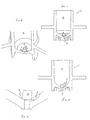
- a well 12 suitable for use in a single well or a multiwell sample preparation device that has a plurality of wells.
- a well 12 is defined by a vertically extending fluid impervious side wall and a sloping bottom portion.
- the middle and upper portions of the well 12 preferably have a uniform diameter and are substantially cylindrical in cross-section, although other configurations are contemplated and within the scope of the present invention.
- the lower portion of the well 12 tapers downwardly, in the direction of fluid flow, towards a bottom portion 13, which slopes inwardly towards a center, thereby having a frusto-conical configuration.
- Bottom portion 13 has a drain 15 that is preferably centrally located in the well 10.
- the fluid passageway(s) 18 modify the otherwise relatively smooth or even surface of bottom portion 13 and effectively provide a gap or space between a sample carrier 20, such as a gel piece ( Figure 2 ), that is contained in well 12 and supported by the bottom portion 13, and the drain 15.
- the sample carrier is a solid, such as a gel, coated bead or a membrane.
- the smallest dimension of each passageway 18 should be less than the smallest dimension of the carrier 20, so that the carrier 20 cannot be positioned in the passageway 18 to block fluid flow into the drain 15.
- the fluid passageway(s) 18 is always in fluid communication with the drain 15 and cannot be blocked or clogged by a carrier 20 when placed in the well 12, as exemplified by illustration in Figures 2, 3 and 4 .
- the carrier is a gel piece
- typically circular plug cutters found in automated picker robots cut the gel portion uniformly.
- the present invention is not limited to uniformly-shaped carriers, as the fluid passageway(s) 18 are configured to prevent fluid blockage even when carriers of irregular shape are present in the well 12.
- a single slit that is longer than the carrier is within the scope of the present invention.
- passageway 18 is sufficient to insure fluid flow around the sample carrier, preferably there is a plurality of such passageways. At least two passageways 18, most preferably three passageways 18, formed symmetrically about the drain 15 as best seen in Figures 5A and 7 , is the particularly preferred arrangement. The symmetrical arrangement of the passageways about the drain 15 ensure that regardless of the orientation of the carrier 20 in the well 12, fluid communication between the well 12 and the drain 15 will be maintained.
- the shape and topology of the passageway(s) 18 are not particularly limited, as long as they do not match that of the carrier 20.
- the passageway(s) 18 are lobes, but a square, stepped round, cone with a bump or cross bar also are suitable configurations. As best seen in Figure 7 , the lobes taper so that they are deeper as they approach the drain 15.
- the passageway(s) 18 are preferably formed by creating asymmetry in the surface of the bottom portion 13. This can be accomplished by providing grooves in the surface, or by providing raised portions or protrusions in or on the surface such as a cross bar 117 ( Figure 9 ) or ribs or bumps 118 ( Figure 10 ). Preferably the passageways 18 are grooves having a depth of about 0.2 mm, a width of about 0.25 mm and a length of about 1 mm.
- the protrusions are designed so that the largest opening in the drain is smaller than the smallest dimension of the sample carrier.
- the objective is to prevent the sample carrier 20 from being situated over the drain 15 in such as way as to block fluid flow to the drain 15.
- the drain 15 is a bore, preferably cylindrical and axially aligned with the central longitudinal axis of the well 12.
- the drain 15 is in fluid communication with the passageways 18.
- At least a portion of the drain 15 preferably includes an adsorptive composite structure 25 ( Figures 5 and 5A ).
- Suitable adsorptive composite structures are cast-in-place polymer bound, particle laden adsorptive membrane structures, such as those comprised of chromatographic beads which have been adhered together with a binder and disclosed in U.S. Patent No. 6,048,457 , the disclosure of which is hereby incorporated by reference.
- One such preferred structure is a three-dimensional structure comprising a plurality of sorptive particles entrapped in a porous polymer matrix and having an aspect ratio (average diameter to average thickness) of less than about 10, preferably less than about 5.
- the structure 25 is preferably coterminous with the bottom of the drain 15, and extends into the drain 15, preferably extending through the entire depth of the drain 15 and may extend into the passageway(s) 18 as shown in Figure 5 .
- the composite structure 25 can also completely fill the passageway(s) 18, it is preferred that a portion (preferably the upper half), such as 50%, of the passageway(s) 18 remains devoid of structure 25 to ensure the passageway(s) 18 is not blocked by the carrier 20.
- the composite structure can be formed to have one or more dimensions that are greater than the largest dimension of the carrier 20, and thus ensure fluid communication between the well and the drain without the formation of a passageway to maintain surface area for flow.
- the face shape of the composite structure can be a circle having a long leg 25A extending from the circle, or can be in the shape of an eye, thereby ensuring that some surface of the composite structure remains unobstructed and available for flow regardless of the orientation of the carrier 20.
- Devices in accordance with the present invention may incorporate a plurality of composite structures having resin materials with different functional groups to fractionate analytes that vary by charge, size, affinity and/or hydrophobicity; alternately, a plurality of devices containing different individual functional membranes may be used in combination to achieve a similar result.
- one or more membranes can be cast in a suitable housing and functionality can be added before or after casting.
- the drain can be devoid of any media, and the device used as a non-clogging processing device that delivers digested proteins to a collection well for analysis or concentration, for example.
- each carrier piece is placed in a respective well.
- a suitable amount of proteolytic enzyme solution is added to each well, such as by pipetting. Sufficient enzyme is added to effectively digest the protein(s).Preferably an excess of enzyme is added, and in sufficient amount to submerge the carrier in each well.
- vacuum is applied to each well, preferably to create a pressure differential of about 5-10 psi, to cause extracted peptides to flow into the drain 15 where they are adsorbed (when media is present) and can then be washed in the conventional manner and freed from buffers, salts and other contaminants. Concentrated peptides then can be eluted and delivered to a suitable target or presentation device for analysis such as by MALDI TOF MS.
- each well 12 surrounding at least a portion of each well 12 is a recess 30.
- the recess preferably is formed from the top surface 29 of each well 12, which generally corresponds to the top surface 32 of the tray 35, and extends downward (towards the drain 15) about 50% of the length of the well 12, where it terminates in bottom wall 34.
- the depth of the recess is not critical, as long as is sufficient to contain the overflow volume from at least one well.
Landscapes
- Chemical & Material Sciences (AREA)
- Analytical Chemistry (AREA)
- Health & Medical Sciences (AREA)
- Chemical Kinetics & Catalysis (AREA)
- General Health & Medical Sciences (AREA)
- Organic Chemistry (AREA)
- Biochemistry (AREA)
- Life Sciences & Earth Sciences (AREA)
- Physics & Mathematics (AREA)
- Dispersion Chemistry (AREA)
- General Physics & Mathematics (AREA)
- Immunology (AREA)
- Pathology (AREA)
- Hematology (AREA)
- Clinical Laboratory Science (AREA)
- Sampling And Sample Adjustment (AREA)
- Investigating Or Analysing Biological Materials (AREA)
Claims (12)
- Procédé de préparation d'échantillon pour un ou des échantillons contenant une protéine pour une analyse supplémentaire, comprenant les étapes consistant à :fournir un support solide contenant ledit échantillon ;fournir au moins un puits ayant une entrée, une surface inférieure et un drain dans ladite surface inférieure, ledit au moins un puits ayant au moins un passage formé dans ladite surface inférieure autour dudit train, et ayant la dimension la plus grande plus petite que la dimension la plus petite dudit support ;supporter ledit support au niveau de ladite surface inférieure, tout en conservant une communication de fluide entre ladite surface inférieure et ledit drain via ledit au moins un passage ;digérer ladite protéine dans ledit échantillon dans ledit support en ajoutant une solution enzymatique ;éluer des peptides depuis ledit support en ajoutant une solution audit puits ;caractérisé en ce que :ladite solution enzymatique est ajoutée en une quantité excessive, suffisante pour immerger le support dans ledit puits ;un vide est appliqué audit puits, en amenantlesdits peptides élués à s'écouler vers ledit drain à travers ledit au moins un passage.
- Procédé selon la revendication 1, caractérisé en ce quea) il y a trois passages agencés de manière symétrique autour dudit train, et/oub) lesdits peptides sont absorbés dans ledit drain par une structure absorbante positionner dans ledit drain, et facultativement ladite structure comporte une pluralité de particules sorbantes piégées dans une matrice poreuse, et/ouc) ledit support comporte un gel, et/oud) ledit support comporte une membrane.
- Procédé de préparation d'échantillon pour un ou des échantillons contenant une protéine pour une analyse supplémentaire, comprenant les étapes consistant à :fournir une pluralité de supports solides contenant ledit échantillon ;fournir un réseau de puits, chaque puits ayant une entrée, une surface inférieure et un drain dans ladite surface inférieure, chaque puits ayant au moins un passage formé dans ladite surface inférieure autour dudit train, etayant une dimension plus petite que la dimension la plus petite d'un de ladite pluralité de supports ;supporter un respectif de ladite pluralité de supports au niveau de ladite surface inférieure de chaque puits, tout en conservant une communication de fluide entre ladite surface inférieure et ledit drain via ledit au moins un passage ;digérer ladite protéine dans ledit échantillon dans chaque support en ajoutant une solution enzymatique ;éluer des peptides depuis chaque support en ajoutant une solution audit puits ;caractérisé en ce que :ladite solution enzymatique est ajoutée en une quantité excessive dans chaque puits, suffisante pour y immerger le support ;un vide est appliqué simultanément à chaque puits, en amenant lesdits peptides élués à s'écouler depuis chaque support vers ledit drain à travers ledit au moins un passage dans chaque puits.
- Procédé selon la revendication 1 à 3, caractérisé en ce que ledit support comporte un gel.
- Ensemble de préparation d'échantillon, comportant :un dispositif de préparation d'échantillon comportant au moins un puits adapté pour contenir un support d'échantillon, ledit au moins un puits ayant une entrée, une surface inférieure et un drain dans ladite surface inférieure, ledit au moins un puits ayant au moins un passage formé dans ladite surface inférieure autour dudit drain ;caractérisé par une source de vide en communication de fluide avec ledit puits.
- Ensemble selon la revendication 5, caractérisé en ce que ledit au moins un passage a une dimension inférieure à 1 mm.
- Ensemble selon la revendication 5 ou 6, caractérisé en ce que trois passages sont agencés de manière symétrique autour dudit drain.
- Ensemble selon la revendication 5, 6 ou 7, caractérisé en ce qu'une structure adsorbante est positionnée dans ledit drain, et facultativement ladite structure comporte une pluralité de particules sorbantes piégées dans une matrice poreuse.
- Ensemble selon la revendication 5, 6 ou 7, caractérisé par une pluralité desdits puits.
- Ensemble selon la revendication 9, caractérisé en ce que ladite pluralité de puits sont entourés par un évidement.
- Ensemble selon la revendication 5, 6, 7, 8, 9 ou 10, caractérisé en ce que ledit au moins un passage est formé par au moins un bossage dans la surface inférieure dudit puits.
- Ensemble de préparations d'échantillon, comportant :un dispositif de préparation d'échantillon comportant une pluralité de puits adaptés pour contenir un support d'échantillon, chaque puits ayant une entrée,une surface inférieure et un drain dans ladite surface inférieure, chaque puits ayant au moins deux passages formés dans ladite surface inférieure autour dudit drain ;caractérisé par une source de vide en communication de fluide avec chaque puits.
Applications Claiming Priority (2)
| Application Number | Priority Date | Filing Date | Title |
|---|---|---|---|
| US154550 | 1988-02-10 | ||
| US10/154,550 US8007745B2 (en) | 2002-05-24 | 2002-05-24 | Anti-clogging device and method for in-gel digestion applications |
Publications (2)
| Publication Number | Publication Date |
|---|---|
| EP1398082A1 EP1398082A1 (fr) | 2004-03-17 |
| EP1398082B1 true EP1398082B1 (fr) | 2012-07-11 |
Family
ID=29548899
Family Applications (1)
| Application Number | Title | Priority Date | Filing Date |
|---|---|---|---|
| EP03253136A Expired - Lifetime EP1398082B1 (fr) | 2002-05-24 | 2003-05-20 | Méthode de digestion des protéines en gel, et dispositif pour éviter le colmatage des cuves de réaction |
Country Status (4)
| Country | Link |
|---|---|
| US (3) | US8007745B2 (fr) |
| EP (1) | EP1398082B1 (fr) |
| JP (1) | JP3834561B2 (fr) |
| ES (1) | ES2389463T3 (fr) |
Families Citing this family (9)
| Publication number | Priority date | Publication date | Assignee | Title |
|---|---|---|---|---|
| CA2467131C (fr) * | 2003-05-13 | 2013-12-10 | Becton, Dickinson & Company | Appareil et methode de traitement d'echantillons biologiques et chimiques |
| WO2005111572A1 (fr) * | 2004-05-18 | 2005-11-24 | Eisai R & D Management Co., Ltd. | Dispositif de préparation d'échantillon et procédé de préparation d'échantillon |
| CN103827324B (zh) | 2011-07-27 | 2021-01-12 | Nexus Dx股份有限公司 | 用于检测分析物的装置和方法 |
| CN102980796A (zh) * | 2011-09-05 | 2013-03-20 | 岛津分析技术研发(上海)有限公司 | 质谱分析的样品制备方法 |
| US9388945B2 (en) * | 2013-02-01 | 2016-07-12 | Bio-Rad Laboratories, Inc. | System for emulsion aspiration |
| US9696284B2 (en) | 2015-06-10 | 2017-07-04 | Thermo Fisher Scientific Oy | Extraction column |
| WO2016198748A1 (fr) * | 2015-06-10 | 2016-12-15 | Thermo Fisher Scientific Oy | Colonne d'extraction |
| CN110389049A (zh) * | 2018-04-20 | 2019-10-29 | 艾博生物医药(杭州)有限公司 | 一种样本收集检测装置 |
| JP6878726B2 (ja) * | 2018-10-16 | 2021-06-02 | 防衛装備庁長官 | 試料前処理器具及び該器具を用いた試料前処理方法 |
Family Cites Families (14)
| Publication number | Priority date | Publication date | Assignee | Title |
|---|---|---|---|---|
| US4902481A (en) * | 1987-12-11 | 1990-02-20 | Millipore Corporation | Multi-well filtration test apparatus |
| US5108704A (en) * | 1988-09-16 | 1992-04-28 | W. R. Grace & Co.-Conn. | Microfiltration apparatus with radially spaced nozzles |
| US5171537A (en) * | 1991-05-06 | 1992-12-15 | Richard E. MacDonald | Activated immunodiagnostic pipette tips |
| CA2105962A1 (fr) * | 1992-09-18 | 1994-03-19 | Margaret Patricia Raybuck | Dispositif et procede de separation d'affinite |
| US5343909A (en) * | 1992-12-17 | 1994-09-06 | Jack Goodman | Liquid transfer device |
| AU1836097A (en) * | 1996-01-22 | 1997-08-11 | Regents Of The University Of California, The | Borrelia burgdorferi outer membrane proteins |
| US6048457A (en) | 1997-02-26 | 2000-04-11 | Millipore Corporation | Cast membrane structures for sample preparation |
| US6391241B1 (en) | 1997-06-06 | 2002-05-21 | Corning Incorporated | Method of manufacture for a multiwell plate and/or filter plate |
| US6159368A (en) * | 1998-10-29 | 2000-12-12 | The Perkin-Elmer Corporation | Multi-well microfiltration apparatus |
| US6309605B1 (en) * | 1999-05-05 | 2001-10-30 | Millipore Corporation | Well(s) containing filtration devices |
| EP1053784A3 (fr) | 1999-05-21 | 2001-05-23 | Bruker Daltonik GmbH | Traitement d' échantillons dans des solutions à petite surface de contact déterminée |
| DE10018788B4 (de) | 2000-04-15 | 2004-02-26 | Bruker Daltonik Gmbh | Prozessieren von Proteinen aus Gelen für massenspektrometrische Analysen |
| US6521411B2 (en) * | 2000-09-28 | 2003-02-18 | Transgenomic, Inc. | Method and system for the preparation of cDNA |
| US7374724B2 (en) * | 2001-05-29 | 2008-05-20 | Tecan Trading Ag | Device for processing samples, use of the device, and method for producing the device |
-
2002
- 2002-05-24 US US10/154,550 patent/US8007745B2/en not_active Expired - Fee Related
-
2003
- 2003-05-20 EP EP03253136A patent/EP1398082B1/fr not_active Expired - Lifetime
- 2003-05-20 ES ES03253136T patent/ES2389463T3/es not_active Expired - Lifetime
- 2003-05-21 JP JP2003143357A patent/JP3834561B2/ja not_active Expired - Fee Related
-
2005
- 2005-08-23 US US11/209,410 patent/US20060040395A1/en not_active Abandoned
-
2008
- 2008-10-22 US US12/288,658 patent/US8012434B2/en not_active Expired - Fee Related
Also Published As
| Publication number | Publication date |
|---|---|
| US20030219905A1 (en) | 2003-11-27 |
| US8012434B2 (en) | 2011-09-06 |
| JP3834561B2 (ja) | 2006-10-18 |
| JP2004004078A (ja) | 2004-01-08 |
| ES2389463T3 (es) | 2012-10-26 |
| US8007745B2 (en) | 2011-08-30 |
| US20090081083A1 (en) | 2009-03-26 |
| EP1398082A1 (fr) | 2004-03-17 |
| US20060040395A1 (en) | 2006-02-23 |
Similar Documents
| Publication | Publication Date | Title |
|---|---|---|
| US8012434B2 (en) | Anti-clogging device and method for in-gel digestion applications | |
| US7374724B2 (en) | Device for processing samples, use of the device, and method for producing the device | |
| US20050136546A1 (en) | Microtiter plate, system and method for processing samples | |
| US6939452B2 (en) | Parallel sample loading and injection device for multichannel microfluidic devices | |
| CN1846136B (zh) | 利用组合的样品处理和样品承载设备来分析样品的设备和方法 | |
| US6723236B2 (en) | Device for solid phase extraction and method for purifying samples prior to analysis | |
| WO2001053794A1 (fr) | Chargement d'echantillons en parallele et dispositif d'injection utilises pour des dispositifs a microfluides a plusieurs canaux | |
| US20030223912A1 (en) | Device, system, and method for aspirating liquids from SPE plates | |
| US20050029440A1 (en) | Machine and method for processing biomolecules | |
| JP4707029B2 (ja) | サンプル処理装置、ならびにその使用方法および作製方法 | |
| EP1398614B1 (fr) | Appareil et méthode pour la preparation d'echantillons et le spotting direct d'éluant sur cibles maldi-tof | |
| US20050070010A1 (en) | Dockable processing module | |
| EP1547691A1 (fr) | Plaque de microtitrage, système et méthode pour le traitement d'échantillons | |
| EP2174714B1 (fr) | Appareil avec une structure composite pour la préparation d'échantillons |
Legal Events
| Date | Code | Title | Description |
|---|---|---|---|
| PUAI | Public reference made under article 153(3) epc to a published international application that has entered the european phase |
Free format text: ORIGINAL CODE: 0009012 |
|
| 17P | Request for examination filed |
Effective date: 20030602 |
|
| AK | Designated contracting states |
Kind code of ref document: A1 Designated state(s): AT BE BG CH CY CZ DE DK EE ES FI FR GB GR HU IE IT LI LU MC NL PT RO SE SI SK TR |
|
| AX | Request for extension of the european patent |
Extension state: AL LT LV MK |
|
| AKX | Designation fees paid |
Designated state(s): DE ES FR GB IT |
|
| 17Q | First examination report despatched |
Effective date: 20080821 |
|
| GRAP | Despatch of communication of intention to grant a patent |
Free format text: ORIGINAL CODE: EPIDOSNIGR1 |
|
| GRAC | Information related to communication of intention to grant a patent modified |
Free format text: ORIGINAL CODE: EPIDOSCIGR1 |
|
| RAP1 | Party data changed (applicant data changed or rights of an application transferred) |
Owner name: EMD MILLIPORE CORPORATION |
|
| GRAS | Grant fee paid |
Free format text: ORIGINAL CODE: EPIDOSNIGR3 |
|
| GRAA | (expected) grant |
Free format text: ORIGINAL CODE: 0009210 |
|
| AK | Designated contracting states |
Kind code of ref document: B1 Designated state(s): DE ES FR GB IT |
|
| REG | Reference to a national code |
Ref country code: GB Ref legal event code: FG4D |
|
| REG | Reference to a national code |
Ref country code: DE Ref legal event code: R096 Ref document number: 60341497 Country of ref document: DE Effective date: 20120906 |
|
| REG | Reference to a national code |
Ref country code: ES Ref legal event code: FG2A Ref document number: 2389463 Country of ref document: ES Kind code of ref document: T3 Effective date: 20121026 |
|
| PLBE | No opposition filed within time limit |
Free format text: ORIGINAL CODE: 0009261 |
|
| STAA | Information on the status of an ep patent application or granted ep patent |
Free format text: STATUS: NO OPPOSITION FILED WITHIN TIME LIMIT |
|
| 26N | No opposition filed |
Effective date: 20130412 |
|
| REG | Reference to a national code |
Ref country code: DE Ref legal event code: R097 Ref document number: 60341497 Country of ref document: DE Effective date: 20130412 |
|
| REG | Reference to a national code |
Ref country code: FR Ref legal event code: PLFP Year of fee payment: 14 |
|
| REG | Reference to a national code |
Ref country code: FR Ref legal event code: PLFP Year of fee payment: 15 |
|
| REG | Reference to a national code |
Ref country code: FR Ref legal event code: PLFP Year of fee payment: 16 |
|
| PGFP | Annual fee paid to national office [announced via postgrant information from national office to epo] |
Ref country code: GB Payment date: 20180329 Year of fee payment: 16 |
|
| PGFP | Annual fee paid to national office [announced via postgrant information from national office to epo] |
Ref country code: DE Payment date: 20180508 Year of fee payment: 16 Ref country code: ES Payment date: 20180605 Year of fee payment: 16 |
|
| PGFP | Annual fee paid to national office [announced via postgrant information from national office to epo] |
Ref country code: FR Payment date: 20180411 Year of fee payment: 16 Ref country code: IT Payment date: 20180522 Year of fee payment: 16 |
|
| REG | Reference to a national code |
Ref country code: DE Ref legal event code: R119 Ref document number: 60341497 Country of ref document: DE |
|
| GBPC | Gb: european patent ceased through non-payment of renewal fee |
Effective date: 20190520 |
|
| PG25 | Lapsed in a contracting state [announced via postgrant information from national office to epo] |
Ref country code: DE Free format text: LAPSE BECAUSE OF NON-PAYMENT OF DUE FEES Effective date: 20191203 Ref country code: GB Free format text: LAPSE BECAUSE OF NON-PAYMENT OF DUE FEES Effective date: 20190520 Ref country code: IT Free format text: LAPSE BECAUSE OF NON-PAYMENT OF DUE FEES Effective date: 20190520 |
|
| PG25 | Lapsed in a contracting state [announced via postgrant information from national office to epo] |
Ref country code: FR Free format text: LAPSE BECAUSE OF NON-PAYMENT OF DUE FEES Effective date: 20190531 |
|
| REG | Reference to a national code |
Ref country code: ES Ref legal event code: FD2A Effective date: 20200928 |
|
| PG25 | Lapsed in a contracting state [announced via postgrant information from national office to epo] |
Ref country code: ES Free format text: LAPSE BECAUSE OF NON-PAYMENT OF DUE FEES Effective date: 20190521 |