EP1398403B1 - Procédé pour tisser un tissu à poils - Google Patents
Procédé pour tisser un tissu à poils Download PDFInfo
- Publication number
- EP1398403B1 EP1398403B1 EP03077766A EP03077766A EP1398403B1 EP 1398403 B1 EP1398403 B1 EP 1398403B1 EP 03077766 A EP03077766 A EP 03077766A EP 03077766 A EP03077766 A EP 03077766A EP 1398403 B1 EP1398403 B1 EP 1398403B1
- Authority
- EP
- European Patent Office
- Prior art keywords
- pile
- yarns
- weft
- weft yarns
- warp yarns
- Prior art date
- Legal status (The legal status is an assumption and is not a legal conclusion. Google has not performed a legal analysis and makes no representation as to the accuracy of the status listed.)
- Expired - Lifetime
Links
Images

Classifications
-
- D—TEXTILES; PAPER
- D03—WEAVING
- D03D—WOVEN FABRICS; METHODS OF WEAVING; LOOMS
- D03D39/00—Pile-fabric looms
- D03D39/16—Double-plush looms, i.e. for weaving two pile fabrics face-to-face
-
- D—TEXTILES; PAPER
- D03—WEAVING
- D03D—WOVEN FABRICS; METHODS OF WEAVING; LOOMS
- D03D27/00—Woven pile fabrics
- D03D27/02—Woven pile fabrics wherein the pile is formed by warp or weft
- D03D27/10—Fabrics woven face-to-face, e.g. double velvet
Definitions
- the present invention relates to a method for weaving pile fabrics on a face-to-face weaving machine, where, in successive insertion cycles, weft yarns are inserted between binding warp yarns and pile warp yarns, so that two backing fabrics are woven one above the other, in which groups of at least four weft yarns are inserted in respective openings between repeatedly crossing binding warp yarns, and so that pile warp yarns are interlaced over a weft yarn in the upper and lower backing fabric alternately in order to form pile burls.
- This invention likewise relates to a pile fabric comprising a backing fabric in which groups of weft yarns are inserted in respective openings between repeatedly crossing binding warp yarns and pile burls bent round a weft yarn.
- the present invention relates to a pile fabric such as, for instance, a carpet, having a high pile density as well as to a method for manufacturing such pile fabrics.
- the reed setting (the number of backing warp yarns per metre of width of the fabric) should be set at a high value, for instance, at 500 to 512 per metre on the one hand and a high weft density (the number of weft yarns per metre of length of the fabric) should be obtained, for instance, 8 to 10 per centimetre on the other hand, in order to obtain a sufficiently large number of pile rows per metre (high pile row density).
- a method and a fabric having the properties mentioned above are known from EP-A-0 922 799 ( Belgian patent n° 1 012 005 ).
- a weave is applied here, the binding warp yarns being crossed off each time in a group of four wefts, and the weft yarns of these groups each time being inserted in the backing fabric at three different levels. Because of this the weft yarns of each group will end up lying more or less above one another and a higher weft density and consequently also a higher pile row density will be obtained.
- this method it is possible to manufacture carpets having a high weft density of 13.5 or 27 weft yarns per metre for instance.
- the carpets obtained according to this method have the disadvantage that their quality could be better. Especially the flexibility, the quality of the back and the pile retention of these fabrics being capable of improvement.
- the purpose of the present invention is to provide a method for weaving pile fabrics having the properties mentioned in the first section of this description, supplying pile fabrics with a high pile density for a better quality than the pile fabrics woven according to the known weaving methods. Moreover, the present invention aims at increasing still more the pile density of the pile fabrics thus woven.
- This method may be carried out in such a manner that intermediate weft yarns may be provided between the successive pile burls, but may also, at will, be carried out without inserting intermediate weft yarns. Without intermediate weft yarns, the said pairs of weft yarns are the only weft yarns being provided per group. This allows for a very high weft density to be obtained, and therefore to weave fabrics having a very high pile density.
- a pair of weft yarns for the upper backing fabric and a pair of weft yarns for the lower backing fabric are inserted alternately during the successive insertion cycles.
- the pile forming pile warp yarns are made to form pile burls according to a two-shot weave.
- this method is preferably carried out such that in at least one backing fabric pile warp yarns forming no pile are woven in, which are situated between the two weft yarns of each pair of weft yarns, each time one weft yarn of which is situated on the back and the other on the pile face of the fabric. Because of which, these pile warp yarns forming no pile are covered both on the pile side and on the back and the inconvenient effect on the aspect of the pile fabric is avoided. By providing intermediate weft yarns between the successive pile burls, these pile warp yarns forming no pile are even better protected on one of the two faces. For instance, these intermediate weft yarns may extend on the back with respect to the weft yarns forming no pile and therefore increase the quality of the back of the fabric.
- both tension warp yarns and pile warp yarns forming no pile will be woven in, whereas the two weft yarns of each pair of weft yarns are provided on the back and on the pile face with respect to these tension warp yarns and of these pile warp yarns forming no pile respectively.
- This method may be carried out in a very productive manner on a three rapier weaving machine, by means of which three weft yarns are inserted simultaneously in each insertion cycle. Then the said third weft yarn preferably becomes a weft yarn situated between the successive pile burls, a number of advantages of which were mentioned already above.
- two weft yarns may be inserted during a number of insertion cycles, and three weft yarns may be inserted during a number of other insertion cycles, two weft yarns of which are inserted in the one backing fabric, whereas the third weft yarn is interlaced in the other backing fabric, so that each group of weft yarns comprises at least one third weft yarn.
- the weaving machine comprises weft insertion means being provided in order to insert three weft yarns per insertion cycle, whereas by carrying out this method during the insertion cycle in which two weft yarns are inserted, either one weft insertion means is disconnected or no weft yarn is presented to one weft insertion means.
- the method according to the present invention may also be carried out such, that in at least one backing fabric the pile warp yarns forming no pile are woven in and the said third weft yarns are provided on the back of these woven in pile warp yarns. These third weft yarns then provide the additional cover on the back of this woven in pile warp yarns forming no pile, resulting in a better quality of the back of the fabric.
- a number of tension warp yarns may be provided in at least one backing fabric and the said third weft yarns may be provided between the tension warp yarns on the one hand and the woven in pile warp yarns forming no pile on the other hand. Because of which the third weft yarns are inserted at a level, which is situated between the levels of the weft yarns situated above one another. Because the pile tufts then extend between two weft yarns running above one another at a first and a second level on the one hand, and a weft yarn at a third level between this first and second level on the other hand, a very good pile retention and pile tufts well kept in an upright position are obtained.
- pile warp yarns forming no pile are woven in in these backing fabrics preferably distributed among both backing fabrics.
- each group of weft yarns two pairs of weft yarns are provided, inserted above one another, and the pile warp yarns forming pile are interlaced according to a two-shot weave round the weft yarns of each pair situated on the back.
- the present invention further also relates to a pile fabric, comprising a backing fabric in which groups of weft yarns have been inserted in respective openings between repeatedly crossing binding warp yarns and pile burls bent round a weft yarn, - according to the present invention - each group of weft yarns of which comprises at least two pairs of weft yarns inserted above one another and the pile burls are bent round the weft yarns of each pair of the weft yarns situated on the back.
- the pile fabric according to the present invention preferably comprises pile warp yarns forming no pile, woven in in the backing fabric, whereas the two weft yarns of each pair of weft yarns are provided on the back and on the pile face of these pile warp yarns forming no pile respectively.
- both tension warp yarns may be provided and pile warp yarns forming no pile may be woven in, whereas the two weft yarns of each pair of weft yarns are running on the back and on the pile face of these tension warp yarns and pile warp yarns forming no pile respectively.
- each group of weft yarns comprises two pairs of weft yarns inserted above one another and one or two weft yarns inserted separately.
- the pile fabric is preferably carried out such that in each group of weft yarns the number of weft yarns inserted separately is smaller than the number of pairs of weft yarns inserted above one another.
- pile warp yarns forming no pile are woven in in the backing fabric and the said weft yarns inserted separately are provided on the back with respect to these woven in pile warp yarns. Because of which the weft yarns forming no pile are even better covered on the back of the fabric.
- a number of tension warp yarns are provided in the backing fabric and pile warp yarns forming no pile are woven in, and the said weft yarns inserted separately are provided between the tension warp yarns on the one hand and the pile warp yarns forming no pile on the other hand. Because of which the weft yarns inserted separately are inserted at a level situated between the levels of the weft yarns of the said pairs inserted above one another. Therefore these weft yarns inserted separately and the weft yarns running below one another, each at a respective level, may run closer next to one another and even may be running more or less below one another, because of which the weft density may be increased.
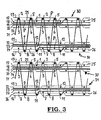
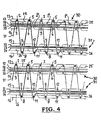
- the figures 2 , 3 and 4 each comprise an upper and a lower cross-section of the face-to-face carpet fabric which are only different from one another in that in the upper cross-section each time, by means of little circles (P) is indicated in which places a weft yarn is left out with respect to the method according to figure 1 .
- binding warp yarns (13-16), pile warp yarns (17-24) and tension warp yarns (25,26) are provided on a three rapier face-to-face weaving machine. This occurs with a high reed setting of, for instance, 512 per metre.
- the weaving machine is designed to insert each time three weft yarns (2,3,7), (4,9,8), (5,6,10), (1,12,11) simultaneously above one another during successive weft insertion cycles in sheds formed between these warp yarns (13-26).
- the warp yarns (13-26) are brought at the exact heights with respect to the insertion levels of the weft yarn (1-12) rapiers, by means of known shed forming means, so that the binding warp yarns (13-16) and the weft yarns (1-12) will form an upper (30) and a lower backing fabric (31), whereas pile warp yarns (21),(24),(18) forming pile are interlaced over a weft yarn (2),(5) of the upper backing fabric (30) and over a weft yarn (8),(11) of the lower backing fabric (31) alternately in order to form pile burls according to a predetermined drawing or pattern and whereas the tension warp yarns (25),(26) and pile warp yarns (17-24) forming no pile are woven in in both backing fabrics (30),(31).
- each backing fabric (30),(31) sets of two co-operating binding warp yarns (13,14),(15,16) are provided. These co-operating binding warp yarns (13,14),(15,16) are crossing one another repeatedly, so that successive openings are formed between their successive intersections and between the binding warp yarns (13,14),(15,16) running above one another. Through each opening, a group of weft yarns (1-6),(7-12) extend, because of which these weft yarns are interlaced by the binding warp yarns in the backing fabric (30),(31) concerned.
- Each group of weft yarns (1-6), (7-12) successively comprises, in order of insertion, one single weft yarn (1),(7), two weft yarns (2,3),(9,8) inserted simultaneously one above the other, one intermediate weft yarn (4),(10), and finally two other weft yarns (5),(6);(12),(11) inserted simultaneously above one another.
- the tension warp yarns (25),(26) are woven in in the backing fabrics (30),(31) and are running each time between the two weft yarns (2,3),(5,6);(9,8),(12,11) inserted simultaneously one above the other and on the back with respect to the intermediate weft yarns (1),(4);(7),(10).
- the pile warp yarns (17-24) forming no pile are woven in in the backing fabrics (30),(31), distributed among both backing fabrics and are running between the weft yarns (2,3),(5,6);(9,8),(12,11) inserted simultaneously one above the other and on the pile face with respect to the intermediate weft yarns (1),(4);(7),(10).
- These intermediate weft yarns are therefore running between the tension warp yarns (25),(26) and the woven in pile warp yarns (17-24) and because of this, are woven in at a level situated between the levels of the weft yarns (2,3),(5,6);(9,8),(12,11) inserted one above the other. Because of which the 6 weft yarns (1-6),(7-12) of each group will situate themselves per three weft yarns (2,3,4),(5,6,1);(7,8,9),(10,11,12) more or less above one another when they are compressed, because of which a high weft density is obtained.
- the pile warp yarns (18),(21),(24) forming pile are each time interlaced over a weft yarn (2),(5),(8),(11) which is situated on the back of the carpet concerned with respect to the interlaced pile warp yarns (17-24) and tension warp yarns (25),(26).
- Weaving through in such a manner, at the level of the pile warp yarns (18),(21),(24) forming pile at the level of each pile burl ensures that the pattern formed by the pile burls will be very clearly visible on the back of the carpets.
- the pile warp yarns forming no pile (17-24) are well covered on the back by both the weft yarn (2),(5),(8),(11) running on the back of each pair of weft yarns inserted simultaneously and the intermediate weft yarns (1),(4);(7),(10). This also will be an important contribution to the good quality of the back of the carpets.
- binding warp yarns (13,14),(15,16) are crossed off only after four successive insertion cycles, carpets having a great flexibility are obtained. It is obvious that also backing weaves are possible where the binding warp yarns (13,14),(15,16) are crossed off each time after more than four insertion cycles. Each pile tuft is situated between two weft yarns (2,3),(5,6),(9,8),(12,11) inserted above one another on the one hand and one weft yarn (1),(4);(7),(10) inserted at an intermediate level on the other hand, so that carpets having an excellent pile retention and pile tufts being well kept in an upright position are obtained.
- the method illustrated in figure 2 is different from the method described above with reference to figure 1 in that in a number of weft insertion cycles, only two weft yarns (11,12),(2,3) are inserted by disconnecting one of the three rapiers or by not supplying it with a weft yarn.
- each group of weft yarns (1-6),(7-12) now comprises two pairs of weft yarns (2,3),(5,6),(9,8),(11,12) inserted above one another and one intermediate weft yarn (4),(10) situated between the two pairs.
- each group of weft yarns (1-6),(7-12) likewise comprises two pairs of weft yarns (2,3),(5,6);(9,8),(11,12) inserted above one another and one intermediate weft yarn (1),(7).
- the methods according to figures 2 and 3 produce carpets having a higher pile density and pile tufts which are better compressed. Obviously it is possible with these methods to make the binding warp yarns (13,14),(14,15) also cross each time after more than four machine cycles.
- the pile density of the carpets may be further increased, with respect to the method according to figure 1 , by leaving out all intermediate weft yarns (1),(4),(7),(10) by weft cancelling or disconnecting a rapier. This is the method according to figure 4 . Moreover, because of this, the pile tufts are also very well compressed. With this method also, the binding warp yarns (13,14),(15,16) may be made to cross each time after more than four insertion cycles.
Landscapes
- Engineering & Computer Science (AREA)
- Textile Engineering (AREA)
- Woven Fabrics (AREA)
- Looms (AREA)
Claims (22)
- Procédé pour tisser un tissu à poils sur un métier à tisser pour tissu double pièce, dans lequel, dans des cycles d'insertion successifs, des fils de trame (1-12) sont insérés entre des fils de chaîne de liage (13-16) et des fils de chaîne de poils (17-24), de sorte que deux tissus de dossier (30), (31) soient tissés l'un au-dessus de l'autre, des groupes d'au moins quatre fils de trame (1-6) ; (7-12) étant insérés dans des ouvertures respectives entre des fils de chaîne de liage (13), (14) ; (15), (16) se croisant de manière répétée, et de sorte que des fils de chaîne de poils (18), (21), (24) soient entrelacés autour d'un fil de trame (2), (5), (8), (11) dans le tissu de dossier supérieur (30) et le tissu de dossier inférieur (31) en alternance afin de former des noeuds de poils, caractérisé en ce que pendant les cycles d'insertion successifs, à chaque fois au moins deux fils de trame (1, 11, 12), (2, 3, 7), (4, 8, 9), (5, 6, 10) sont insérés, de sorte que chaque groupe de fils de trame (1-6) ; (7-12) comprenne au moins deux paires de fils de trame (2, 3), (5, 6), (8, 9), (11, 12), insérées les unes au-dessus des autres, et en ce que les fils de chaîne de poils (18), (21), (24) sont entrelacés à chaque fois autour des fils de trame (2), (5), (8), (11) de ces paires, situées sur le dos.
- Procédé selon la revendication 1, caractérisé en ce qu'au cours des cycles d'insertion successifs, une paire de fils de trame (2, 3), (5, 6) est insérée pour le tissu de dossier supérieur (30) et une paire de fils de trame (8, 9), (11, 12) est insérée pour le tissu de dossier inférieur (31).
- Procédé selon la revendication 1 ou 2, caractérisé en ce que les fils de chaîne de poils (18), (21), (24) formant les poils sont prévus pour former des noeuds de poils suivant un tissage en deux temps.
- Procédé selon l'une quelconque des revendications précédentes, caractérisé en ce que dans chaque tissu de dossier (30), (31), des fils de chaîne de liage coopérants (13), (14) ; (15), (16) sont prévus, et se croisent l'un l'autre à chaque fois après au moins quatre cycles d'insertion successifs.
- Procédé selon l'une quelconque des revendications précédentes, caractérisé en ce que dans au moins un tissu de dossier (30), (31), des fils de chaîne de poils (17-24) ne formant pas de poils sont tissés, et en ce que les deux fils de trame de chaque paire de fils de trame (2, 3), (5, 6), (8, 9), (11, 12) sont prévus respectivement sur le dos et sur la face poils de ces fils de chaîne de poils (17-24) ne formant pas de poils.
- Procédé selon l'une quelconque des revendications précédentes, caractérisé en ce que dans au moins un tissu de dossier (30), (31), des fils de chaîne de tension (25), (26) sont prévus, et des fils de chaîne de poils (17-24) ne formant pas de poils sont incorporés, et en ce que les deux fils de trame de chaque paire de fils de trame (2, 3), (5, 6), (8, 9), (11, 12) sont prévus sur le dos et sur la face poils de ces fils de chaîne de poils (17-24) ne formant pas de poils.
- Procédé selon l'une quelconque des revendications précédentes, caractérisé en ce qu'au cours de cycles d'insertion successifs, à chaque fois trois fils de trame (1, 11, 12), (2, 3, 7), (4, 8, 9), (5, 6, 10), (1, 11, 12) sont insérés et en ce que deux d'entre eux (2, 3), (8, 9), (5, 6), (11, 12) sont insérés dans le tissu de dossier supérieur (30) et dans le tissu de dossier inférieur (31) alternativement, tandis qu'à chaque fois, le troisième fil de trame (7), (4), (10), (1) est inséré dans l'autre tissu de dossier.
- Procédé selon l'une quelconque des revendications précédentes 1 jusqu'à 6 incluse, caractérisé en ce que pendant un certain nombre de cycles d'insertion, deux fils de trame (2, 3), (11, 12) sont insérés, et en ce que pendant un certain nombre d'autres cycles d'insertion, trois fils de trame (4, 8, 9), (5, 6, 10) sont insérés, deux desdits fils de trame (8, 9) (5, 6) étant insérés dans l'un des tissus de dossier, tandis que le troisième fil de trame (4), (10) est inséré dans l'autre tissu de dossier, de sorte que chaque groupe de fils de trame (1-6), (7-12) comprenne aussi au moins un troisième fil de trame (1), (4), (7), (10).
- Procédé selon l'une quelconque des revendications précédentes, caractérisé en ce que le métier à tisser comprend des moyens d'insertion de trame, qui sont prévus pour insérer trois fils de trame (1, 11, 12), (2, 3, 7), (4, 8, 9), (5, 6, 10), (1, 11, 12) par cycle d'insertion, et en ce que pendant le cycle d'insertion dans lequel deux fils de trame (2, 3), (8, 9), (5, 6), (11, 12) sont insérés, soit un moyen d'insertion de trame est déconnecté, soit aucun fil de trame n'est présenté à l'un des moyens d'insertion de trame.
- Procédé selon l'une quelconque des revendications 7 à 9 incluse, caractérisé en ce que, dans au moins un tissu de dossier (30), (31), des fils de chaîne de poils (17-24) ne formant pas de poils sont incorporés, et en ce que lesdits troisièmes fils de trame (7), (4), (10), (1) sont prévus sur le dos de ces fils de chaîne de poils entrelacés.
- Procédé selon l'une quelconque des revendications 7 à 10 incluse, caractérisé en ce que, dans au moins un tissu de dossier (30), (31), un certain nombre de fils de chaîne de tension (25), (26) sont prévus, et en ce que lesdits troisièmes fils de chaîne de tension (7), (4), (10), (1) sont prévus entre les fils de chaîne de tension (25) (26) d'une part et les fils de chaîne de poils incorporés (17-24) ne formant pas de poils d'autre part.
- Procédé selon l'une quelconque des revendications précédentes, caractérisé en ce que des fils de chaîne de poils (17-24) ne formant pas de poils, répartis dans les deux tissus de dossier, sont incorporés dans ces tissus de dossier.
- Procédé selon l'une quelconque des revendications précédentes, caractérisé en ce que dans chaque groupe de fils de trame (1-6), (7-12), deux paires de fils de trame (2, 3), (5, 6), (8, 9), (11, 12), insérées l'une au-dessus de l'autre, sont prévues, et en ce que les fils de chaîne de poils (18), (21), (24) sont entrelacés suivant un tissage en deux temps autour des fils de trame (2), (5), (8), (11), situés sur le dos, de chaque paire.
- Tissu à poils comprenant un tissu de dossier (30), (31), dans lequel des groupes de fils de trame (1-6), (7-12) sont insérés dans des ouvertures respectives entre des fils de chaîne de liage (13), (14) ; (15), (16) se croisant de manière répétée, et des noeuds de poils entrelacées autour d'un fil de trame (2), (5) ; (8), (11), caractérisé en ce que chaque groupe de fils de trame (1-6), (7-12) comprend au moins deux paires de fils de trame (2, 3), (5, 6) ; (8, 9), (11, 12) insérées les unes au-dessus des autres et en ce que les noeuds de poils sont entrelacées autour des fils de trame (2), (5) ; (8), (11) de chaque paire des fils de trame (2, 3), (5, 6) ; (8, 9), (11, 12), situés sur le dos.
- Tissu à poils selon la revendication 14, caractérisé en ce que des fils de chaîne de poils (17-24) ne formant pas de poils sont incorporés dans le tissu de dossier (30), (31), et en ce que les deux fils de trame de chaque paire de fils de trame (2, 3), (5, 6) ; (8, 9), (11, 12) sont prévus sur le dos et sur la face poils de ces fils de chaîne de poils (17-24) ne formant pas de poils.
- Tissu à poils selon la revendication 14 ou 15, caractérisé en ce que des fils de chaîne de tension (25), (26) sont prévus et en ce que des fils de chaîne de poils (17-24) ne formant pas de poils sont incorporés dans le tissu de dossier (30), (31), et en ce que les deux fils de trame de chaque paire de fils de trame (2, 3), (5, 6) ; (8, 9), (11, 12) s'étendent sur le dos et sur la face poils de ces fils de chaîne de tension (25), (26) et des fils de chaîne de poils (17-24) ne formant pas de poils, respectivement.
- Tissu à poils selon l'une quelconque des revendications 14 à 16, caractérisé en ce que deux fils de trame (2, 3), (5, 6) ; (8, 9), (11, 12) insérés l'un au-dessus de l'autre et un fil de trame (1), (4) ; (7), (10) inséré séparément sont insérés en alternance dans le tissu de dossier (30), (31).
- Tissu à poils selon l'une quelconque des revendications 14 à 17, caractérisé en ce que chaque groupe de fils de trame (1-6), (7-12) comprend deux paires de fils de trame (2, 3), (5, 6) ; (8, 9), (11, 12) insérées l'une au-dessus de l'autre, et un fil de trame (1), (4) ; (7), (10) inséré séparément.
- Tissu à poils selon l'une quelconque des revendications 14 à 18, caractérisé en ce que chaque groupe de fils de trame comprend deux paires de fils de trame (1-6), (7-12) insérées l'une au-dessus de l'autre, et deux fils de trame (1), (4) ; (7), (10) insérés séparément.
- Tissu à poils selon l'une quelconque des revendications 14 à 19, caractérisé en ce que dans chaque groupe de fils de trame (1-6), (7-12), le nombre de fils de trame (1), (4), (7), (10) insérés séparément est inférieur au nombre de paires de fils de trame (1-6), (7-12) insérées les unes au-dessus des autres.
- Tissu à poils selon l'une quelconque des revendications 14 à 20, caractérisé en ce que des fils de chaîne de poils (17-24) ne formant pas de poils sont incorporés dans le tissu de dossier, et en ce que lesdits fils de trame (1), (4) ; (7), (10) insérés séparément sont prévus au dos de ces fils de chaîne de poils tissés (17-24).
- Tissu à poils selon l'une quelconque des revendications 14 à 21, caractérisé en ce qu'un certain nombre de fils de chaîne de tension (25), (26) sont prévus et des fils de chaîne de poils (17-24) ne formant pas de poils sont incorporés dans le tissu de dossier, et en ce que lesdits fils de trame (1), (4) ; (7), (10) insérés séparément sont prévus entre les fils de chaîne de tension (25), (26) d'une part et les fils de chaîne de poils (17-24) ne formant pas de poils d'autre part.
Applications Claiming Priority (2)
| Application Number | Priority Date | Filing Date | Title |
|---|---|---|---|
| BE200200530 | 2002-09-11 | ||
| BE2002/0530A BE1015103A3 (nl) | 2002-09-11 | 2002-09-11 | Werkwijze voor het weven van een poolweefsel. |
Publications (2)
| Publication Number | Publication Date |
|---|---|
| EP1398403A1 EP1398403A1 (fr) | 2004-03-17 |
| EP1398403B1 true EP1398403B1 (fr) | 2009-12-02 |
Family
ID=31722113
Family Applications (1)
| Application Number | Title | Priority Date | Filing Date |
|---|---|---|---|
| EP03077766A Expired - Lifetime EP1398403B1 (fr) | 2002-09-11 | 2003-09-04 | Procédé pour tisser un tissu à poils |
Country Status (4)
| Country | Link |
|---|---|
| US (1) | US6945280B2 (fr) |
| EP (1) | EP1398403B1 (fr) |
| BE (1) | BE1015103A3 (fr) |
| DE (1) | DE60330300D1 (fr) |
Families Citing this family (13)
| Publication number | Priority date | Publication date | Assignee | Title |
|---|---|---|---|---|
| BE1016276A3 (nl) * | 2003-03-20 | 2006-07-04 | Wiele Michel Van De Nv | Werkwijze en dubbelstukweefmachine voor het dubbelstukweven van een boven-en onderweefsel. |
| US7520303B2 (en) * | 2005-06-24 | 2009-04-21 | N.V. Michel Van De Wiele | Method for weaving a fabric, fabric woven by means of such a method and weaving machine for weaving such a fabric |
| US20070048491A1 (en) * | 2005-08-23 | 2007-03-01 | Couristan Inc. | Water resistant carpet and method of manufacture the same |
| BE1016883A3 (nl) * | 2005-12-06 | 2007-09-04 | Wiele Michel Van De Nv | Werkwijze voor het vervaardigen van poolweefsels met hoge dichtheid. |
| EP1900861B1 (fr) * | 2006-09-05 | 2015-07-08 | NV Michel van de Wiele | Procédé de tissage d'une étoffe et étoffe tissée selon ce procédé |
| BE1017429A3 (nl) * | 2006-12-22 | 2008-09-02 | Wiele Michel Van De Nv | Kunstgrasmatten. |
| BE1017428A3 (nl) * | 2006-12-22 | 2008-09-02 | Wiele Michel Van De Nv | Kunstgrasmat en werkwijze voor het vervaardigen van dergelijke mat. |
| EP2251467B1 (fr) * | 2009-05-13 | 2013-08-07 | SCHÖNHERR Textilmaschinenbau GmbH | Procédé de tisser simultanément deux étoffes, étoffe tissée selon ce procédé et machine à tisser utilisable avec ce procédé |
| BE1020430A3 (nl) * | 2011-12-23 | 2013-10-01 | Wiele Michel Van De Nv | Werkwijze voor het weven van een poolweefsel met poolvrije zones. |
| CN102677366A (zh) * | 2012-05-28 | 2012-09-19 | 常州环球地毯制造有限公司 | 仿手工编织地毯 |
| CN105155102B (zh) * | 2015-10-26 | 2017-03-29 | 辽宁采逸野蚕丝制品有限公司 | 一种双面割绒丝绒织物及其织造方法 |
| BE1023598B1 (nl) * | 2015-11-10 | 2017-05-11 | Nv Michel Van De Wiele | Werkwijze voor het dubbelstukweven van weefsels met figuurkettingdraden |
| US9534323B1 (en) * | 2016-01-09 | 2017-01-03 | Trident Limited | Terry fabric weave and resulting terry fabric |
Family Cites Families (11)
| Publication number | Priority date | Publication date | Assignee | Title |
|---|---|---|---|---|
| US2329739A (en) * | 1942-04-21 | 1943-09-21 | Joseph L Baker | Process of making pile fabrics |
| US3014502A (en) * | 1959-06-12 | 1961-12-26 | Morgan Valentine Co Inc L | Pile fabric and its method of manufacture |
| EP0805227B1 (fr) * | 1993-06-11 | 2002-03-20 | N.V. Michel Van de Wiele | Procédé pour la fabrication du velours face contre face |
| BE1012005A3 (nl) * | 1997-12-09 | 2000-04-04 | Wiele Michel Van De Nv | Werkwijze voor het weven van een poolweefsel met hoge pooldichtheid. |
| BE1011689A5 (nl) * | 1997-12-29 | 1999-12-07 | Wiele Michel Van De Nv | Werkwijze voor het weven van een poolweefsel met toepassing van bindingscorrecties. |
| BE1011943A3 (nl) * | 1998-05-28 | 2000-03-07 | Wiele Michel Van De Nv | Werkwijze en weefmachine voor het weven van een poolweefsel. |
| BE1012357A3 (nl) * | 1998-12-21 | 2000-10-03 | Wiele Michel Van De Nv | Werkwijze voor het dubbelstukweven van poolweefsels. |
| DE60015026T3 (de) * | 1999-07-19 | 2010-09-30 | Naamloze Vennootschap Michel Van De Wiele, Kortrijk | Verfahren zum Weben von Doppelstück-falsche Plüschgewebe mit geschnittener Flor und nach diesem Verfahren hergestelltes Gewebe |
| DE50011569D1 (de) * | 2000-08-16 | 2005-12-15 | Schoenherr Textilmaschinenbau | Verfahren zur Herstellung eines Doppelpolgewebes |
| BE1014128A3 (nl) * | 2001-04-20 | 2003-05-06 | Wiele Michel Van De Nv | Dubbelstukweefmachine met dubbelstukgaapvorming. |
| BE1014127A3 (nl) * | 2001-04-20 | 2003-05-06 | Wiele Michel Van De Nv | Inrichting voor het scheiden van kettinggarens op een dubbelstukweefmachine. |
-
2002
- 2002-09-11 BE BE2002/0530A patent/BE1015103A3/nl not_active IP Right Cessation
-
2003
- 2003-09-04 DE DE60330300T patent/DE60330300D1/de not_active Expired - Lifetime
- 2003-09-04 EP EP03077766A patent/EP1398403B1/fr not_active Expired - Lifetime
- 2003-09-11 US US10/659,696 patent/US6945280B2/en not_active Expired - Lifetime
Also Published As
| Publication number | Publication date |
|---|---|
| BE1015103A3 (nl) | 2004-10-05 |
| DE60330300D1 (de) | 2010-01-14 |
| EP1398403A1 (fr) | 2004-03-17 |
| US6945280B2 (en) | 2005-09-20 |
| US20040084101A1 (en) | 2004-05-06 |
Similar Documents
| Publication | Publication Date | Title |
|---|---|---|
| EP1900861B1 (fr) | Procédé de tissage d'une étoffe et étoffe tissée selon ce procédé | |
| EP1398403B1 (fr) | Procédé pour tisser un tissu à poils | |
| EP1666651B1 (fr) | Procédé de tissage des tissus et tissu à longs poils | |
| EP1152076B1 (fr) | Procédé pour la fabrication face contre face de tissus à poils et tissus tissés selon ce procédé | |
| CN105121723B (zh) | 具有阴阳花纹的地毯和用于编织具有阴阳花纹的地毯织物的方法 | |
| CN103814162A (zh) | 编织起绒织物的方法 | |
| EP1122347B1 (fr) | Procédé pour la fabrication d'un tissu à poils avec un grand nombre de fils de poils par système de fils de chaíne | |
| US6343626B1 (en) | Method for face-to-face weaving false boucle fabrics with cut pile, and fabrics woven according to this method | |
| US6186189B1 (en) | False and true bouclé fabrics, and a method for the production of such fabrics | |
| US7111648B2 (en) | Terry fabric and method for weaving same | |
| EP1013804B1 (fr) | Procédé pour tisser du velours double peluche | |
| US7431055B2 (en) | Method for weaving fabrics with areas having a corded structure with a large variety of colour effects | |
| US6095198A (en) | Method for weaving a pile fabric with high pile density | |
| CN109440267B (zh) | 一种高低毛隐纬缎档组织毛巾及其织造工艺 | |
| US6289941B1 (en) | Method for weaving a false boucle fabric | |
| EP0974689B1 (fr) | Procédé de fabrication de tissus avec structure nervurée des deux côtés et tissus fabriqués selon ce procédé | |
| US6367514B1 (en) | False bouclé fabrics with cut pile and/or pile loops, and method for the weaving thereof | |
| CN1594696B (zh) | 用于在双面绒头织物织机上生产双面绒头织物的方法 | |
| EP1001062A1 (fr) | Procédé de fabrication d'un tissu avec structure nervurée et tissu fabriqué selon ce procédé | |
| US2306405A (en) | Pile fabric and method of making same |
Legal Events
| Date | Code | Title | Description |
|---|---|---|---|
| PUAI | Public reference made under article 153(3) epc to a published international application that has entered the european phase |
Free format text: ORIGINAL CODE: 0009012 |
|
| AK | Designated contracting states |
Kind code of ref document: A1 Designated state(s): AT BE BG CH CY CZ DE DK EE ES FI FR GB GR HU IE IT LI LU MC NL PT RO SE SI SK TR |
|
| AX | Request for extension of the european patent |
Extension state: AL LT LV MK |
|
| 17P | Request for examination filed |
Effective date: 20040413 |
|
| AKX | Designation fees paid |
Designated state(s): DE FR IT TR |
|
| GRAP | Despatch of communication of intention to grant a patent |
Free format text: ORIGINAL CODE: EPIDOSNIGR1 |
|
| GRAS | Grant fee paid |
Free format text: ORIGINAL CODE: EPIDOSNIGR3 |
|
| GRAA | (expected) grant |
Free format text: ORIGINAL CODE: 0009210 |
|
| AK | Designated contracting states |
Kind code of ref document: B1 Designated state(s): DE FR IT TR |
|
| REF | Corresponds to: |
Ref document number: 60330300 Country of ref document: DE Date of ref document: 20100114 Kind code of ref document: P |
|
| PLBE | No opposition filed within time limit |
Free format text: ORIGINAL CODE: 0009261 |
|
| STAA | Information on the status of an ep patent application or granted ep patent |
Free format text: STATUS: NO OPPOSITION FILED WITHIN TIME LIMIT |
|
| 26N | No opposition filed |
Effective date: 20100903 |
|
| REG | Reference to a national code |
Ref country code: FR Ref legal event code: PLFP Year of fee payment: 13 |
|
| PGFP | Annual fee paid to national office [announced via postgrant information from national office to epo] |
Ref country code: FR Payment date: 20150922 Year of fee payment: 13 |
|
| PGFP | Annual fee paid to national office [announced via postgrant information from national office to epo] |
Ref country code: IT Payment date: 20150924 Year of fee payment: 13 |
|
| REG | Reference to a national code |
Ref country code: FR Ref legal event code: ST Effective date: 20170531 |
|
| PG25 | Lapsed in a contracting state [announced via postgrant information from national office to epo] |
Ref country code: FR Free format text: LAPSE BECAUSE OF NON-PAYMENT OF DUE FEES Effective date: 20160930 |
|
| PG25 | Lapsed in a contracting state [announced via postgrant information from national office to epo] |
Ref country code: IT Free format text: LAPSE BECAUSE OF NON-PAYMENT OF DUE FEES Effective date: 20160904 |
|
| PGFP | Annual fee paid to national office [announced via postgrant information from national office to epo] |
Ref country code: TR Payment date: 20210902 Year of fee payment: 19 Ref country code: DE Payment date: 20210920 Year of fee payment: 19 |
|
| REG | Reference to a national code |
Ref country code: DE Ref legal event code: R119 Ref document number: 60330300 Country of ref document: DE |
|
| PG25 | Lapsed in a contracting state [announced via postgrant information from national office to epo] |
Ref country code: DE Free format text: LAPSE BECAUSE OF NON-PAYMENT OF DUE FEES Effective date: 20230401 |
|
| PG25 | Lapsed in a contracting state [announced via postgrant information from national office to epo] |
Ref country code: TR Free format text: LAPSE BECAUSE OF NON-PAYMENT OF DUE FEES Effective date: 20220904 |