EP1398762A1 - Nichtlineares Modell zur Geräuschunterdrückung von verzerrten Signalen - Google Patents
Nichtlineares Modell zur Geräuschunterdrückung von verzerrten Signalen Download PDFInfo
- Publication number
- EP1398762A1 EP1398762A1 EP20030019302 EP03019302A EP1398762A1 EP 1398762 A1 EP1398762 A1 EP 1398762A1 EP 20030019302 EP20030019302 EP 20030019302 EP 03019302 A EP03019302 A EP 03019302A EP 1398762 A1 EP1398762 A1 EP 1398762A1
- Authority
- EP
- European Patent Office
- Prior art keywords
- feature vector
- noise
- estimate
- computer
- acoustic model
- Prior art date
- Legal status (The legal status is an assumption and is not a legal conclusion. Google has not performed a legal analysis and makes no representation as to the accuracy of the status listed.)
- Granted
Links
Images






Classifications
-
- G—PHYSICS
- G10—MUSICAL INSTRUMENTS; ACOUSTICS
- G10L—SPEECH ANALYSIS TECHNIQUES OR SPEECH SYNTHESIS; SPEECH RECOGNITION; SPEECH OR VOICE PROCESSING TECHNIQUES; SPEECH OR AUDIO CODING OR DECODING
- G10L21/00—Speech or voice signal processing techniques to produce another audible or non-audible signal, e.g. visual or tactile, in order to modify its quality or its intelligibility
- G10L21/02—Speech enhancement, e.g. noise reduction or echo cancellation
- G10L21/0208—Noise filtering
-
- G—PHYSICS
- G10—MUSICAL INSTRUMENTS; ACOUSTICS
- G10L—SPEECH ANALYSIS TECHNIQUES OR SPEECH SYNTHESIS; SPEECH RECOGNITION; SPEECH OR VOICE PROCESSING TECHNIQUES; SPEECH OR AUDIO CODING OR DECODING
- G10L15/00—Speech recognition
- G10L15/20—Speech recognition techniques specially adapted for robustness in adverse environments, e.g. in noise, of stress induced speech
-
- G—PHYSICS
- G10—MUSICAL INSTRUMENTS; ACOUSTICS
- G10L—SPEECH ANALYSIS TECHNIQUES OR SPEECH SYNTHESIS; SPEECH RECOGNITION; SPEECH OR VOICE PROCESSING TECHNIQUES; SPEECH OR AUDIO CODING OR DECODING
- G10L21/00—Speech or voice signal processing techniques to produce another audible or non-audible signal, e.g. visual or tactile, in order to modify its quality or its intelligibility
- G10L21/02—Speech enhancement, e.g. noise reduction or echo cancellation
- G10L21/0208—Noise filtering
- G10L21/0216—Noise filtering characterised by the method used for estimating noise
Definitions
- the present invention relates to noise reduction.
- the present invention relates to reducing noise in signals used in pattern recognition.
- a pattern recognition system such as a speech recognition system, takes an input signal and attempts to decode the signal to find a pattern represented by the signal. For example, in a speech recognition system, a speech signal is received by the recognition system and is decoded to identify a string of words represented by the speech signal.
- a new statistical model describes the corruption of spectral features caused by additive noise.
- the model explicitly represents the effect of unknown phase together with the unobserved clean signal and noise.
- Development of the model has realized three techniques for reducing noise in a noisy signal as a function of.the model.
- a frame of a noisy input signal is converted into an input feature vector.
- An estimate of a noise-reduced feature vector uses a model of the acoustic environment.
- the model is based on a non-linear function that describes a relationship between the input feature vector, a clean feature vector, a noise feature vector and a phase relationship indicative of mixing of the clean feature vector and the noise feature , vector.
- Inclusion of a mathematical representation of the phase relationship renders an accurate model.
- One unique characteristic of the phase relationship is that it is in the same domain as the clean feature vector and the noise feature vector.
- Another separate distinguishing characteristic is that the phase relationship includes a phase factor with a statistical distribution.
- FIG. 1 illustrates an example of a suitable computing system environment 100 on which the invention may be implemented.
- the computing system environment 100 is only one example of a suitable computing environment and is not intended to suggest any limitation as to the scope of use or functionality of the invention. Neither should the computing environment 100 be interpreted as having any dependency or requirement relating, to any one or combination of components illustrated in the exemplary operating environment 100.
- the invention is operational with numerous other general purpose or special purpose computing system environments or configurations.
- Examples of well-known computing systems, environments, and/or configurations that may be suitable for use with the invention include, but are not limited to, personal computers, server computers, hand-held or laptop devices, multiprocessor systems, microprocessor-based systems, set top boxes, programmable consumer electronics, network PCs, minicomputers, mainframe computers, telephony systems, distributed computing environments that include any of the above systems or devices, and the like.
- the invention may be described in the general context of computer-executable instructions, such as program modules, being executed by a computer.
- program modules include routines, programs; objects, components, data structures, etc. that perform particular tasks or implement particular abstract data types. Tasks performed by the programs and modules are described below and with the aid of figures.
- Those skilled in the art can implement the description and figures as computer-executable instructions, which can be embodied on any form of computer readable media discussed below.
- the invention may also be practiced in distributed computing environments where tasks are performed by remote processing devices that are linked through a communications network.
- program modules may be located in both local and remote computer storage media including memory storage devices.
- an exemplary system for implementing the invention includes a general-purpose computing device in the form of a computer 110.
- Components of computer 110 may include, but are not limited to, a processing unit 120, a system memory 130, and a system bus 121 that couples various system components including the system memory to the processing unit 120.
- the system bus 121 may be any of several types of bus structures including a memory bus or memory controller, a peripheral bus, and a local bus using any of a variety of bus architectures.
- such architectures include Industry Standard Architecture (ISA) bus, Micro Channel Architecture (MCA) bus, Enhanced ISA (EISA) bus, Video Electronics Standards Association (VESA) local bus, and Peripheral Component Interconnect (PCI) bus also known as Mezzanine bus.
- ISA Industry Standard Architecture
- MCA Micro Channel Architecture
- EISA Enhanced ISA
- VESA Video Electronics Standards Association
- PCI Peripheral Component Interconnect
- Computer 110 typically includes a variety of computer readable media.
- Computer readable media can be any available media that can be accessed by computer 110 and includes both volatile and nonvolatile media, removable and non-removable media.
- Computer readable media may comprise computer storage media and communication media.
- Computer storage media includes both volatile and nonvolatile, removable and non-removable media implemented in any method or technology for storage of information such as computer readable instructions, data structures, program modules or other data.
- Computer storage media includes, but is not limited to, RAM, ROM, EEPROM, flash memory or other memory technology, CD-ROM, digital versatile disks (DVD) or other optical disk storage, magnetic cassettes, magnetic tape, magnetic disk storage or other magnetic storage devices, or any other medium which can be used to store the desired information and which can be accessed by computer 110.
- Communication, media typically embodies computer readable instructions, data structures, program modules or other data in a modulated data signal such as a carrier wave or other transport mechanism and includes any information delivery media.
- modulated data signal means a signal that has one or more of its characteristics set or changed in such a manner as to encode information in the signal.
- communication media includes wired media such as a wired network or direct-wired connection, and wireless media such as acoustic, RF, infrared and other wireless media. Combinations of any of the above should also be included within the scope of computer readable media.
- the system memory 130 includes computer storage media in the form of volatile and/or nonvolatile memory such as read only memory (ROM) 131 and random access memory (RAM) 132.
- ROM read only memory
- RAM random access memory
- BIOS basic input/output system
- RAM 132 typically contains data and/or program modules that are immediately accessible to and/or presently being operated on by processing unit 120.
- FIG. 1 illustrates operating system 134, application programs 135, other program modules 136, and program data 137.
- the computer 110 may also include other removable/non-removable volatile/nonvolatile computer storage media.
- FIG. 1 illustrates a hard disk drive 141 that reads from or writes to non-removable, nonvolatile magnetic media, a magnetic disk drive 151 that reads from or writes to a removable, nonvolatile magnetic disk 152, and an optical disk drive 155 that reads from or writes to a removable, nonvolatile optical disk 156 such as a CD ROM or other optical media.
- removable/non-removable, volatile/nonvolatile computer storage media that can be used in the exemplary operating environment include, but are not limited to, magnetic tape cassettes, flash memory cards, digital versatile disks, digital video tape, solid state RAM, solid state ROM, and the like.
- the hard disk drive 141 is typically connected to the system bus 121 through a non-removable memory interface such as interface 140, and magnetic disk drive 151 and optical disk drive 155 are typically connected to the system bus 121 by a removable memory interface, such as interface 150.
- hard disk drive 141 is illustrated as storing operating system 144, application programs 145, other program modules 146, and program data 147. Note that these components can either be the same as or different from operating system 134, application programs 135, other program modules 136, and program data 137. Operating system 144, application programs 145, other program modules 146, and program data 147 are given different numbers here to illustrate that, at a minimum, they are different copies.
- a user may enter commands and information into the computer 110 through input devices such as a keyboard 162, a microphone 163, and a pointing device 161, such as a mouse, trackball or touch pad.
- Other input devices may include a joystick, game pad, satellite dish, scanner, or the like.
- a monitor 191 or other type of display device is also connected to the system bus 121 via an interface, such as a video interface 190.
- computers may also include other peripheral output devices such as speakers 197 and printer 196, which may be connected through an output peripheral interface 190.
- the computer 110 may operate in a networked environment using logical connections to one or more remote computers, such as a remote computer 180.
- the remote computer 180 may be a personal computer, a hand-held device, a server, a router, a network PC, a peer device or other common network node, and typically includes many or all of the elements - described above relative to the computer 110.
- the logical connections depicted in FIG. 1 include a local area network (LAN) 171 and a wide area network (WAN) 173, but may also include other networks.
- LAN local area network
- WAN wide area network
- Such networking environments are commonplace in offices, enterprise-wide computer networks, intranets and the Internet.
- the computer 110 When used in a LAN networking environment, the computer 110 is connected to the LAN 171 through a network interface or adapter 170. When used in a WAN networking environment, the computer 110 typically includes a modem 172 or other means for establishing communications over the WAN 173, such as the Internet.
- the modem 172 which may be internal or external, may be connected to the system bus 121 via the user input interface 160, or other appropriate mechanism.
- program modules depicted relative to the computer 110, or portions thereof may be stored in the remote memory storage device.
- FIG. 1 illustrates remote application programs 185 as residing on remote computer 180. It will be appreciated that the network connections shown are exemplary and other means of establishing a communications link between the computers may be used.
- FIG. 2 is a block diagram of a mobile device 200, which is an exemplary computing environment.
- Mobile device 200 includes a microprocessor 202, memory 204, input/output (I/O) components 206, and a communication interface 208 for communicating with remote computers or other mobile devices.
- I/O input/output
- the afore-mentioned components are coupled for communication with one another over a suitable bus 210.
- Memory 204 is implemented as non-volatile electronic memory such as random access memory (RAM) with a battery back-up module (not shown) such that information stored in memory 204 is not lost when the general power to mobile device 200 is shut down.
- RAM random access memory
- a portion of memory 204 is preferably allocated as addressable memory for program execution, while another portion of memory 204 is preferably used for storage, such as to simulate storage on a disk drive.
- Memory 204 includes an operating system 212, application programs 214 as well as an object store 216.
- operating system 212 is preferably executed by processor 202 from memory 204.
- Operating system 212 in one preferred embodiment, is a WINDOWS® CE brand operating system commercially available from Microsoft Corporation.
- Operating system 212 is preferably designed for mobile devices, and implements database features that can be utilized by applications 214 through a set of exposed application programming interfaces and methods.
- the objects in object store 216 are maintained by applications 214 and operating system 212, at least partially in response to calls to the exposed application programming interfaces and methods.
- Communication interface 208 represents numerous devices and technologies that allow mobile device 200 to send and receive information.
- the devices include wired and wireless modems, satellite receivers and broadcast tuners to name a few.
- Mobile device 200 can also be directly connected to a computer to exchange data therewith.
- communication interface 208 can be an infrared transceiver or a serial or parallel communication connection, all of which are capable of transmitting streaming information.
- Input/output components 206 include a variety of input devices such as a touch-sensitive screen, buttons, rollers, and a microphone as well as a variety of output devices including an audio generator, a vibrating device, and a display.
- input devices such as a touch-sensitive screen, buttons, rollers, and a microphone
- output devices including an audio generator, a vibrating device, and a display.
- the devices listed above are by way of example and need not all be present on mobile device 200.
- other input/output devices may be attached to or found with mobile device 200 within the scope of the present invention.
- this aspect of the present invention uses a new statistical model, which describes the corruption to the pattern recognition signals, and in particular to speech recognition spectral features, caused by additive noise.
- the model explicitly represents the effect of unknown phase together with the unobserved clean speech and noise as three hidden variables.
- the model is used to produce robust features for automatic speech recognition.
- the model is constructed in the log Mel-frequency feature domain. Advantages of this domain include low dimensionality, allowing for efficient training in inference.
- Logarithmic Mel-frequency spectral coefficients are also linearly related to Mel-Frequency Cepstrum Coefficients (MFCC), which correspond to the features used in a recognition system.
- MFCC Mel-Frequency Cepstrum Coefficients
- corruption from linear channels and additive noise are localized within individual Mel-frequency bins, which allows processing of each dimension of the feature independently.
- the model of the present invention is constructed in the logarithmic Mel-frequency spectral domain.
- Each spectral frame is processed by passing it through a magnitude-squared operation, a Mel-frequency filterbank, and a logarithm.
- the noisy log Mel-spectral features y i can be directly related to the unobserved spectra X[k] and N[k], which can be represented as: where, w i / k is the kth coefficient in the ith Mel-frequency filterbank.
- the variable ⁇ k is the phase difference between X[k] and N[k].
- the clean signal and noise are uncorrelated, the ⁇ k are uncorrelated and have a uniform distribution over the range [- ⁇ , ⁇ ].
- the first two include the clean log spectral energy and the noise log spectral energy that would have been produced in the absence of mixing.
- the third variable, ⁇ i accounts for the unknown phase between the two sources.
- ⁇ i will be a function of X[k] and N[k].
- ⁇ i collapses to a weighted sum of several independent random variables:
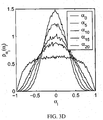
- Figure 3D shows the true distributions of ⁇ for a range of frequency bins. They were estimated from a set of joint noise, clean speech, and noisy speech data by solving for the unknown ⁇ .
- the higher frequency, higher bandwidth filters produce ⁇ distributions that are more nearly Gaussian.
- the low frequency bins in a Mel-frequency filterbank have a narrow bandwidth, and the bandwidth increases with frequency. This means that the effective number of terms in Eq. 5 also increases with frequency.
- a Gaussian assumption is quite bad for the lowest frequency bins, and becomes much better as the bandwidth of the filters increase. As the bandwidth increases, so does the number of effective terms in Eq. 5, and the central limit theorem begins to apply.
- a frequency-dependent Gaussian approximation P ⁇ i ( ⁇ i ) N ( ⁇ i ; 0, ⁇ 2 / ⁇ i ) works well.
- the parameter ⁇ 2 / ⁇ can be estimated from a small set of training data.
- a linear regression line is fit to the computed ⁇ 2 / ⁇ as a function of 1.
- Eq. 3 places a hard constraint on the four random variables, in effect yielding three degrees of freedom. This can be expressed by solving for y and writing the conditional probability distribution,
- x,n) is found by forming the distribution p(y, ⁇
- x,n) p( ⁇ ) is assumed, which is reasonable.
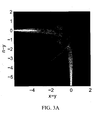
- conditional probability appears at first glance to have three independent variables. Instead, it is only a function of two: the relative value of speech and observation (x - y), and the relative value of noise and observation (n - y).
- Figure 3A contains a plot of this conditional probability distribution.
- Figure 3B shows an equivalent plot, directly estimated from data, thereby confirming Eq. 7A.
- Figure 3A contains a plot of the conditional probability distribution of the model represented by Eq. 7A. Note that due to the shift invariance of this model, there are only two independent terms in the plot.
- x ) p n ( y ).
- the graph also has a third region of interest, starting from the origin and moving in a positive x and n direction.
- both speech and noise are greater than the observation. This occurs most frequently when x and n have similar magnitudes, and are destructively interfering with each other.
- the relevant ⁇ exist in the region
- Eq. 7A can be used to derive a new formula for spectral subtraction.
- Eq. 1 and Eq. 9 The difference between Eq. 1 and Eq. 9 is confined to the region y ⁇ n, as illustrated in Figures 4A and 4B.
- Table II compares the relative accuracy of using Equations 1 and 9 for speech recognition, when the true noise spectra are available. Although the new method does not require a floor to prevent taking the logarithm of a negative number, it is included because it does yield a small improvement in error rate.
- the new method outperforms the old spectral subtraction rule. Although the old method is quite sensitive to the value chosen, the new method is not, producing less than 10% digit error rate for all tests.
- noisy-speech frames are processed independently of each other.
- a sequential tracker for estimating the log spectrum of non-stationary noise can be used to provide a noise estimate on a frame-by-frame basis.
- a suitable noise estimator is described in METHOD OF ITERATIVE NOISE ESTIMATION IN A RECURSIVE FRAMEWORK (Attorney Docket No. M61.12-0443), filed on even date herewith.
- Eq. 7A Another advantage of deriving the conditional observation probability, Eq. 7A, is that it can be embedded into a unified Bayesian model.
- the observed variable y is related to the hidden variables, including x and n through a unified probabilistic model.
- p ( y,x,n ) p ( y
- the Bayesian approach can additionally produce a variance of its estimate of E[x
- This variance can be easily leveraged within the decoder to improve word accuracy.
- a suitable decoding technique is described in METHOD OF PATTERN RECOGNITION USING NOISE REDUCTION UNCERTAINTY, filed May 20, 2002 and assigned serial no. 10/152,127.
- the static feature stream is replaced with an estimate of p(y
- the noise removal process outputs high variance for low SNR features, and low variance when the SNR is high.
- Equations 10, 11, 12, and 13 are conditioned on the mixture m, evaluated, and then combined in the standard way:
- one aspect of the present inventions is a compromise between these two methods.
- a Gaussian approximation is used to avoid summation over a two-dimensional grid, while at the same time preserving the true shape of p(y
- a Gaussian approximation is used along one dimension only, which allows preservation of the true shape of p(y
- the weighted Gaussian approximation is found in four steps illustrated in Figure 5 at 250.
- the coordinate space is first rotated in step 252.
- An expansion point is chosen in step 254.
- a second order Taylor series approximation is then made in step 256.
- the approximation is then expressed as the parameters of a weighted Gaussian distribution in step 258.
- the coordinate rotation is necessary because expanding along x or n directly can be problematic.
- a 45 degree rotation is used, which makes p(y
- v is held constant and a weighted Taylor series approximation along u is determined.
- the coefficients of the expansion are the derivatives of p (y
- u - u v ln(1 + cosh 2 v ) - ln 4 ⁇ 2 ⁇ 2
- Equations 10, 11, 12, and 13 are computed. Each equation requires at least one double integral over x and n, which is equivalent to a double integral over u and v. For example:
- the method makes use of Eq. 14 for x, as well as Eq. 15 and Eq. 16 for p(y,x,n).
- the Gaussian approximation enables a symbolic evaluation of the integral over u, but the integral over v remains.
- the integration in v is currently implemented as a numerical integration, a weighed sum along discrete values of v. In one embodiment, 500 equally spaced points in the range [-20, 20] are used. Most of the necessary values can be pre-computed and tabulated to speed up computation.
- the MMSE estimator ⁇ and for clean speech ⁇ is the conditional expectation: where p n ( y
- x ) p ( y
- the prior model for clean speech, p(x) in Eq. 18 is assumed to have the Gaussian mixture PDF: whose parameters are pre-trained from the log-domain clean speech data. This allows Eq.18 to be written as
- ⁇ 0 a single-point expansion point ⁇ 0 is used (i.e., x 0 does not depend on the mixture component m) to provide significantly improved computational efficiency, and ⁇ 0 is iteratively updated to increase its accuracy to the true value of clean speech x.
- the Taylor series expansion coefficients have the following closed forms:
- ⁇ ⁇ ⁇ 2 ⁇ .
- a zero-mean Gaussian distribution is used for the phase factor ⁇ in the new model described above, and which is used in this embodiment.
- the clean speech estimate of the current frame, x t +1 is calculated several times using an iterative method shown in the flow diagram of FIG. 6.
- the method of FIG. 6 begins at step 300 where the distribution parameters for the prior clean speech mixture model are pretrained from a set of clean training data.
- the mean, ⁇ m , covariance, ⁇ m , and mixture weight, c m for each mixture component m in a set of M mixture components is determined.
- the expansion point, x j / 0, used in the Taylor series approximation for the current iteration, j can be set equal to the mean vector of the Gaussian mixture model of the clean speech that best accounts for (in the maximum likelihood sense) the noisy speech observation vector y given the estimated noise vector n.
- the MMSE estimator for clean speech is calculated according to Eq. 25.
- the Taylor series expansion point for the next iteration, x j +1 / 0, is set equal to the noise estimate found for the current iteration, x j / t +1.
- x j +1 0 x j t +1
- the updating step shown in Eq. 26 improves the estimate provided by the Taylor series expansion and thus improves the calculation during the next iteration.
- the iteration counter j is incremented before being compared to a set number of iterations J at step 310. If the iteration counter is less than the set number of iterations, more iterations are to be performed and the process returns to step 304 to repeat steps 304, 306, 308 and 310 using the newly updated expansion point.
- J is set equal to three. Specifically, the iteration counter j is set to zero, the frame value t is incremented by one, and the expansion point x 0 for the first iteration of the next frame is set.
- a method and system for using the present invention in speech recognition is shown the block diagram of FIG. 7.
- the method begins where a noisy speech signal is converted into a sequence of feature vectors.
- a microphone 404 of FIG. 7 converts audio waves from a speaker 400 and one or more additive noise sources 402 into electrical signals.
- the electrical signals are then sampled by an analog-to-digital converter 406 to generate a sequence of digital values, which are grouped into frames of values by a frame constructor module 408.
- A-to-D converter 406 samples the analog signal at 16 kHz and 16 bits per sample, thereby creating 32 kilobytes of speech data per second and frame constructor module 408 creates a new frame every 10 milliseconds that includes 25 milliseconds worth of data.
- Each frame of data provided by frame constructor module 408 is converted into a feature vector by a feature extractor 410.
- Methods for identifying such feature vectors are well known in the art and include 13-dimensional Mel-Frequency Cepstrum Coefficients (MFCC) extraction.
- Noise estimation module 411 estimates the noise in the current frame and provides a feature vector representing the noise estimate, or a distribution thereof, together with the noisy speech signal to a noise reduction module 412.
- the noise reduction module 412 uses any one of the techniques described above, (new spectral subtraction of Eq. 9, the Bayesian approach with weighted Gaussian Approximation, or an MMSE estimator) with model parameters of the corresponding implementing equations, which are stored in noise reduction parameter storage 411, to produce a sequence of noise-reduced feature vectors from the sequence of noisy feature vectors, or distributions thereof.
- the output of noise reduction module 412 is a series of noise-reduced feature vectors. If the input signal is a training signal, this series of noise reduced feature vectors is provided to a trainer 424, which uses the noise-reduced feature vectors and a training text 426 to train an acoustic model 418. Techniques for training such models are known in the art and a description of them is not required for an understanding of the present invention.
- the noise-reduced feature vectors are provided to a decoder 414, which identifies a most likely sequence of words based on the stream of feature vectors, a lexicon 415, a language model 416, and the acoustic model 418.
- the particular method used for decoding is not important to the present invention and any of several known methods for decoding may be used.
- Confidence measure module 420 identifies which words are most likely to have been improperly identified by the speech recognizer, based in part on a secondary acoustic model(not shown). Confidence measure module 420 then provides the sequence of hypothesis words to an output module 422 along with identifiers indicating which words may have been improperly identified. Those skilled in the art will recognize that confidence measure module 420 is not necessary for the practice of the present invention.
- FIG. 7 depicts a speech recognition system
- the present invention may be used in other noise removal applications such as removing noise of recordings, or prior to transmission of data in order to transmit cleaner data.
- the pattern recognition system is also not limited to speech.
Landscapes
- Engineering & Computer Science (AREA)
- Acoustics & Sound (AREA)
- Computational Linguistics (AREA)
- Signal Processing (AREA)
- Health & Medical Sciences (AREA)
- Audiology, Speech & Language Pathology (AREA)
- Human Computer Interaction (AREA)
- Quality & Reliability (AREA)
- Multimedia (AREA)
- Physics & Mathematics (AREA)
- Complex Calculations (AREA)
- Measurement Of Mechanical Vibrations Or Ultrasonic Waves (AREA)
- Circuit For Audible Band Transducer (AREA)
- Noise Elimination (AREA)
- Radar Systems Or Details Thereof (AREA)
- Picture Signal Circuits (AREA)
Applications Claiming Priority (2)
| Application Number | Priority Date | Filing Date | Title |
|---|---|---|---|
| US237163 | 2002-09-06 | ||
| US10/237,163 US7047047B2 (en) | 2002-09-06 | 2002-09-06 | Non-linear observation model for removing noise from corrupted signals |
Publications (2)
| Publication Number | Publication Date |
|---|---|
| EP1398762A1 true EP1398762A1 (de) | 2004-03-17 |
| EP1398762B1 EP1398762B1 (de) | 2009-09-30 |
Family
ID=31887717
Family Applications (1)
| Application Number | Title | Priority Date | Filing Date |
|---|---|---|---|
| EP03019302A Expired - Lifetime EP1398762B1 (de) | 2002-09-06 | 2003-08-26 | Nichtlineares Modell zur Geräuschunterdrückung von verzerrten Signalen |
Country Status (5)
| Country | Link |
|---|---|
| US (1) | US7047047B2 (de) |
| EP (1) | EP1398762B1 (de) |
| JP (1) | JP4219774B2 (de) |
| AT (1) | ATE444551T1 (de) |
| DE (1) | DE60329446D1 (de) |
Cited By (4)
| Publication number | Priority date | Publication date | Assignee | Title |
|---|---|---|---|---|
| CN103250208A (zh) * | 2010-11-24 | 2013-08-14 | 日本电气株式会社 | 信号处理装置、信号处理方法和信号处理程序 |
| CN103310798A (zh) * | 2012-03-07 | 2013-09-18 | 国际商业机器公司 | 降噪方法和装置 |
| CN104205214A (zh) * | 2012-03-09 | 2014-12-10 | 国际商业机器公司 | 噪声降低方法、程序产品和装置 |
| CN109657273A (zh) * | 2018-11-16 | 2019-04-19 | 重庆大学 | 一种基于噪声增强的贝叶斯参数估计方法 |
Families Citing this family (37)
| Publication number | Priority date | Publication date | Assignee | Title |
|---|---|---|---|---|
| US7107210B2 (en) * | 2002-05-20 | 2006-09-12 | Microsoft Corporation | Method of noise reduction based on dynamic aspects of speech |
| US7103540B2 (en) * | 2002-05-20 | 2006-09-05 | Microsoft Corporation | Method of pattern recognition using noise reduction uncertainty |
| US7949522B2 (en) | 2003-02-21 | 2011-05-24 | Qnx Software Systems Co. | System for suppressing rain noise |
| US8073689B2 (en) * | 2003-02-21 | 2011-12-06 | Qnx Software Systems Co. | Repetitive transient noise removal |
| US7725315B2 (en) * | 2003-02-21 | 2010-05-25 | Qnx Software Systems (Wavemakers), Inc. | Minimization of transient noises in a voice signal |
| US7885420B2 (en) * | 2003-02-21 | 2011-02-08 | Qnx Software Systems Co. | Wind noise suppression system |
| US7895036B2 (en) * | 2003-02-21 | 2011-02-22 | Qnx Software Systems Co. | System for suppressing wind noise |
| US8326621B2 (en) | 2003-02-21 | 2012-12-04 | Qnx Software Systems Limited | Repetitive transient noise removal |
| JP2005249816A (ja) * | 2004-03-01 | 2005-09-15 | Internatl Business Mach Corp <Ibm> | 信号強調装置、方法及びプログラム、並びに音声認識装置、方法及びプログラム |
| EP1732063A4 (de) * | 2004-03-31 | 2007-07-04 | Pioneer Corp | Spracherkennungvorrichtung und spracherkennungverfahren |
| DE102004017486A1 (de) * | 2004-04-08 | 2005-10-27 | Siemens Ag | Verfahren zur Geräuschreduktion bei einem Sprach-Eingangssignal |
| US7502632B2 (en) * | 2004-06-25 | 2009-03-10 | Nokia Corporation | Text messaging device |
| US7498961B2 (en) * | 2004-09-14 | 2009-03-03 | Hewlett-Packard Development Company, L.P. | Context identification using a denoised signal |
| US8175877B2 (en) * | 2005-02-02 | 2012-05-08 | At&T Intellectual Property Ii, L.P. | Method and apparatus for predicting word accuracy in automatic speech recognition systems |
| US20060206320A1 (en) * | 2005-03-14 | 2006-09-14 | Li Qi P | Apparatus and method for noise reduction and speech enhancement with microphones and loudspeakers |
| US7672516B2 (en) * | 2005-03-21 | 2010-03-02 | Siemens Medical Solutions Usa, Inc. | Statistical priors for combinatorial optimization: efficient solutions via graph cuts |
| US7346504B2 (en) | 2005-06-20 | 2008-03-18 | Microsoft Corporation | Multi-sensory speech enhancement using a clean speech prior |
| US7680656B2 (en) * | 2005-06-28 | 2010-03-16 | Microsoft Corporation | Multi-sensory speech enhancement using a speech-state model |
| PL211141B1 (pl) * | 2005-08-03 | 2012-04-30 | Piotr Kleczkowski | Sposób miksowania sygnałów dźwiękowych |
| KR100745977B1 (ko) * | 2005-09-26 | 2007-08-06 | 삼성전자주식회사 | 음성 구간 검출 장치 및 방법 |
| JP4880036B2 (ja) * | 2006-05-01 | 2012-02-22 | 日本電信電話株式会社 | 音源と室内音響の確率モデルに基づく音声残響除去のための方法及び装置 |
| US7933420B2 (en) * | 2006-12-28 | 2011-04-26 | Caterpillar Inc. | Methods and systems for determining the effectiveness of active noise cancellation |
| US8068616B2 (en) * | 2006-12-28 | 2011-11-29 | Caterpillar Inc. | Methods and systems for controlling noise cancellation |
| US8340318B2 (en) * | 2006-12-28 | 2012-12-25 | Caterpillar Inc. | Methods and systems for measuring performance of a noise cancellation system |
| US7734247B2 (en) * | 2007-01-25 | 2010-06-08 | Sony Ericsson Mobile Communications Ab | Configurable serial memory interface |
| US8306817B2 (en) * | 2008-01-08 | 2012-11-06 | Microsoft Corporation | Speech recognition with non-linear noise reduction on Mel-frequency cepstra |
| US8214215B2 (en) * | 2008-09-24 | 2012-07-03 | Microsoft Corporation | Phase sensitive model adaptation for noisy speech recognition |
| GB2464093B (en) * | 2008-09-29 | 2011-03-09 | Toshiba Res Europ Ltd | A speech recognition method |
| US8185389B2 (en) * | 2008-12-16 | 2012-05-22 | Microsoft Corporation | Noise suppressor for robust speech recognition |
| US8639502B1 (en) | 2009-02-16 | 2014-01-28 | Arrowhead Center, Inc. | Speaker model-based speech enhancement system |
| US20100262423A1 (en) * | 2009-04-13 | 2010-10-14 | Microsoft Corporation | Feature compensation approach to robust speech recognition |
| US9009039B2 (en) * | 2009-06-12 | 2015-04-14 | Microsoft Technology Licensing, Llc | Noise adaptive training for speech recognition |
| WO2012107561A1 (en) * | 2011-02-10 | 2012-08-16 | Dolby International Ab | Spatial adaptation in multi-microphone sound capture |
| US9087513B2 (en) | 2012-03-09 | 2015-07-21 | International Business Machines Corporation | Noise reduction method, program product, and apparatus |
| US20150287406A1 (en) * | 2012-03-23 | 2015-10-08 | Google Inc. | Estimating Speech in the Presence of Noise |
| US20140114650A1 (en) * | 2012-10-22 | 2014-04-24 | Mitsubishi Electric Research Labs, Inc. | Method for Transforming Non-Stationary Signals Using a Dynamic Model |
| US9437212B1 (en) * | 2013-12-16 | 2016-09-06 | Marvell International Ltd. | Systems and methods for suppressing noise in an audio signal for subbands in a frequency domain based on a closed-form solution |
Family Cites Families (5)
| Publication number | Priority date | Publication date | Assignee | Title |
|---|---|---|---|---|
| IL84948A0 (en) | 1987-12-25 | 1988-06-30 | D S P Group Israel Ltd | Noise reduction system |
| US5148489A (en) * | 1990-02-28 | 1992-09-15 | Sri International | Method for spectral estimation to improve noise robustness for speech recognition |
| US5604839A (en) | 1994-07-29 | 1997-02-18 | Microsoft Corporation | Method and system for improving speech recognition through front-end normalization of feature vectors |
| US5924065A (en) * | 1997-06-16 | 1999-07-13 | Digital Equipment Corporation | Environmently compensated speech processing |
| CA2216224A1 (en) | 1997-09-19 | 1999-03-19 | Peter R. Stubley | Block algorithm for pattern recognition |
-
2002
- 2002-09-06 US US10/237,163 patent/US7047047B2/en not_active Expired - Fee Related
-
2003
- 2003-08-26 EP EP03019302A patent/EP1398762B1/de not_active Expired - Lifetime
- 2003-08-26 DE DE60329446T patent/DE60329446D1/de not_active Expired - Lifetime
- 2003-08-26 AT AT03019302T patent/ATE444551T1/de not_active IP Right Cessation
- 2003-09-08 JP JP2003316037A patent/JP4219774B2/ja not_active Expired - Fee Related
Non-Patent Citations (5)
| Title |
|---|
| J. DROPPO, A. ACERO AND L. DENG: "A nonlinear observation model for removing noise from corrupted speech log mel-spectral energies", PROCEEDINGS ICSLP 2002, 16 September 2002 (2002-09-16) - 20 September 2002 (2002-09-20), Denver, Colorado, pages 1569 - 1572, XP008025395 * |
| KRISTJANSSON T ET AL: "Towards non-stationary model-based noise adaptation for large vocabulary speech recognition", 2001 IEEE INTERNATIONAL CONFERENCE ON ACOUSTICS, SPEECH, AND SIGNAL PROCESSING. PROCEEDINGS (CAT. NO.01CH37221), 7 May 2001 (2001-05-07) - 11 May 2001 (2001-05-11), SALT LAKE CITY, UT, USA, Piscataway, NJ, USA, IEEE, USA, pages 337 - 340 vol.1, XP002264126, ISBN: 0-7803-7041-4 * |
| L. DENG, J. DROPPO AND A. ACERO: "Log-domain speech feature enhancement using sequential map noise estimation and a phase-sensitive model of the acoustic environment", PROCEEDINGS ICSLP 2002, 16 September 2002 (2002-09-16) - 20 September 2002 (2002-09-20), Denver, Colorado, pages 1813 - 1816, XP008025394 * |
| LI DENG ET AL: "A Bayesian approach to speech feature enhancement using the dynamic cepstral prior", 2002 IEEE INTERNATIONAL CONFERENCE ON ACOUSTICS, SPEECH, AND SIGNAL PROCESSING. PROCEEDINGS. (ICASSP)., vol. 1 OF 4, 13 May 2002 (2002-05-13) - 17 May 2002 (2002-05-17), ORLANDO, FL, NEW YORK, NY: IEEE, US, pages I,829 - 832, XP002254999, ISBN: 0-7803-7402-9 * |
| LI DENG ET AL: "Recursive noise estimation using iterative stochastic approximation for stereo-based robust speech recognition", 2001 IEEE WORKSHOP ON AUTOMATIC SPEECH RECOGNITION AND UNDERSTANDING. ASRU 2001. CONFERENCE PROCEEDINGS (CAT. NO.01EX544), 9 December 2001 (2001-12-09) - 13 December 2001 (2001-12-13), Madonna di Campiglio, Italy, pages 81 - 84, XP010603683 * |
Cited By (7)
| Publication number | Priority date | Publication date | Assignee | Title |
|---|---|---|---|---|
| CN103250208A (zh) * | 2010-11-24 | 2013-08-14 | 日本电气株式会社 | 信号处理装置、信号处理方法和信号处理程序 |
| CN103250208B (zh) * | 2010-11-24 | 2015-06-17 | 日本电气株式会社 | 信号处理装置和信号处理方法 |
| CN103310798A (zh) * | 2012-03-07 | 2013-09-18 | 国际商业机器公司 | 降噪方法和装置 |
| CN103310798B (zh) * | 2012-03-07 | 2015-08-26 | 国际商业机器公司 | 降噪方法和装置 |
| CN104205214A (zh) * | 2012-03-09 | 2014-12-10 | 国际商业机器公司 | 噪声降低方法、程序产品和装置 |
| CN104205214B (zh) * | 2012-03-09 | 2016-11-23 | 国际商业机器公司 | 噪声降低方法和装置 |
| CN109657273A (zh) * | 2018-11-16 | 2019-04-19 | 重庆大学 | 一种基于噪声增强的贝叶斯参数估计方法 |
Also Published As
| Publication number | Publication date |
|---|---|
| US20040052383A1 (en) | 2004-03-18 |
| EP1398762B1 (de) | 2009-09-30 |
| US7047047B2 (en) | 2006-05-16 |
| ATE444551T1 (de) | 2009-10-15 |
| JP2004102287A (ja) | 2004-04-02 |
| JP4219774B2 (ja) | 2009-02-04 |
| DE60329446D1 (de) | 2009-11-12 |
Similar Documents
| Publication | Publication Date | Title |
|---|---|---|
| EP1398762B1 (de) | Nichtlineares Modell zur Geräuschunterdrückung von verzerrten Signalen | |
| US7174292B2 (en) | Method of determining uncertainty associated with acoustic distortion-based noise reduction | |
| EP1396845B1 (de) | Verfahren zur iterativen Geräuschschätzung in einem rekursiven Zusammenhang | |
| US7617098B2 (en) | Method of noise reduction based on dynamic aspects of speech | |
| US7310599B2 (en) | Removing noise from feature vectors | |
| KR101201146B1 (ko) | 최적의 추정을 위한 중요한 양으로서 순간적인 신호 대 잡음비를 사용하는 잡음 감소 방법 | |
| US7769582B2 (en) | Method of pattern recognition using noise reduction uncertainty | |
| US20050182624A1 (en) | Method and apparatus for constructing a speech filter using estimates of clean speech and noise | |
| US6944590B2 (en) | Method of iterative noise estimation in a recursive framework | |
| EP1199712B1 (de) | Verfahren zur Geräuschunterdrückung | |
| Mammone et al. | Robust speech processing as an inverse problem |
Legal Events
| Date | Code | Title | Description |
|---|---|---|---|
| PUAI | Public reference made under article 153(3) epc to a published international application that has entered the european phase |
Free format text: ORIGINAL CODE: 0009012 |
|
| AK | Designated contracting states |
Kind code of ref document: A1 Designated state(s): AT BE BG CH CY CZ DE DK EE ES FI FR GB GR HU IE IT LI LU MC NL PT RO SE SI SK TR |
|
| AX | Request for extension of the european patent |
Extension state: AL LT LV MK |
|
| 17P | Request for examination filed |
Effective date: 20040906 |
|
| AKX | Designation fees paid |
Designated state(s): AT BE BG CH CY CZ DE DK EE ES FI FR GB GR HU IE IT LI LU MC NL PT RO SE SI SK TR |
|
| 17Q | First examination report despatched |
Effective date: 20061011 |
|
| 17Q | First examination report despatched |
Effective date: 20061011 |
|
| GRAP | Despatch of communication of intention to grant a patent |
Free format text: ORIGINAL CODE: EPIDOSNIGR1 |
|
| GRAS | Grant fee paid |
Free format text: ORIGINAL CODE: EPIDOSNIGR3 |
|
| GRAA | (expected) grant |
Free format text: ORIGINAL CODE: 0009210 |
|
| AK | Designated contracting states |
Kind code of ref document: B1 Designated state(s): AT BE BG CH CY CZ DE DK EE ES FI FR GB GR HU IE IT LI LU MC NL PT RO SE SI SK TR |
|
| REG | Reference to a national code |
Ref country code: CH Ref legal event code: EP Ref country code: GB Ref legal event code: FG4D |
|
| REG | Reference to a national code |
Ref country code: IE Ref legal event code: FG4D |
|
| REF | Corresponds to: |
Ref document number: 60329446 Country of ref document: DE Date of ref document: 20091112 Kind code of ref document: P |
|
| PG25 | Lapsed in a contracting state [announced via postgrant information from national office to epo] |
Ref country code: SE Free format text: LAPSE BECAUSE OF FAILURE TO SUBMIT A TRANSLATION OF THE DESCRIPTION OR TO PAY THE FEE WITHIN THE PRESCRIBED TIME-LIMIT Effective date: 20090930 Ref country code: FI Free format text: LAPSE BECAUSE OF FAILURE TO SUBMIT A TRANSLATION OF THE DESCRIPTION OR TO PAY THE FEE WITHIN THE PRESCRIBED TIME-LIMIT Effective date: 20090930 |
|
| PG25 | Lapsed in a contracting state [announced via postgrant information from national office to epo] |
Ref country code: SI Free format text: LAPSE BECAUSE OF FAILURE TO SUBMIT A TRANSLATION OF THE DESCRIPTION OR TO PAY THE FEE WITHIN THE PRESCRIBED TIME-LIMIT Effective date: 20090930 |
|
| NLV1 | Nl: lapsed or annulled due to failure to fulfill the requirements of art. 29p and 29m of the patents act | ||
| PG25 | Lapsed in a contracting state [announced via postgrant information from national office to epo] |
Ref country code: ES Free format text: LAPSE BECAUSE OF FAILURE TO SUBMIT A TRANSLATION OF THE DESCRIPTION OR TO PAY THE FEE WITHIN THE PRESCRIBED TIME-LIMIT Effective date: 20100110 Ref country code: EE Free format text: LAPSE BECAUSE OF FAILURE TO SUBMIT A TRANSLATION OF THE DESCRIPTION OR TO PAY THE FEE WITHIN THE PRESCRIBED TIME-LIMIT Effective date: 20090930 Ref country code: PT Free format text: LAPSE BECAUSE OF FAILURE TO SUBMIT A TRANSLATION OF THE DESCRIPTION OR TO PAY THE FEE WITHIN THE PRESCRIBED TIME-LIMIT Effective date: 20100201 Ref country code: CZ Free format text: LAPSE BECAUSE OF FAILURE TO SUBMIT A TRANSLATION OF THE DESCRIPTION OR TO PAY THE FEE WITHIN THE PRESCRIBED TIME-LIMIT Effective date: 20090930 Ref country code: RO Free format text: LAPSE BECAUSE OF FAILURE TO SUBMIT A TRANSLATION OF THE DESCRIPTION OR TO PAY THE FEE WITHIN THE PRESCRIBED TIME-LIMIT Effective date: 20090930 |
|
| PG25 | Lapsed in a contracting state [announced via postgrant information from national office to epo] |
Ref country code: CY Free format text: LAPSE BECAUSE OF FAILURE TO SUBMIT A TRANSLATION OF THE DESCRIPTION OR TO PAY THE FEE WITHIN THE PRESCRIBED TIME-LIMIT Effective date: 20090930 Ref country code: SK Free format text: LAPSE BECAUSE OF FAILURE TO SUBMIT A TRANSLATION OF THE DESCRIPTION OR TO PAY THE FEE WITHIN THE PRESCRIBED TIME-LIMIT Effective date: 20090930 |
|
| PG25 | Lapsed in a contracting state [announced via postgrant information from national office to epo] |
Ref country code: BE Free format text: LAPSE BECAUSE OF FAILURE TO SUBMIT A TRANSLATION OF THE DESCRIPTION OR TO PAY THE FEE WITHIN THE PRESCRIBED TIME-LIMIT Effective date: 20090930 Ref country code: AT Free format text: LAPSE BECAUSE OF FAILURE TO SUBMIT A TRANSLATION OF THE DESCRIPTION OR TO PAY THE FEE WITHIN THE PRESCRIBED TIME-LIMIT Effective date: 20090930 |
|
| PG25 | Lapsed in a contracting state [announced via postgrant information from national office to epo] |
Ref country code: NL Free format text: LAPSE BECAUSE OF FAILURE TO SUBMIT A TRANSLATION OF THE DESCRIPTION OR TO PAY THE FEE WITHIN THE PRESCRIBED TIME-LIMIT Effective date: 20090930 Ref country code: DK Free format text: LAPSE BECAUSE OF FAILURE TO SUBMIT A TRANSLATION OF THE DESCRIPTION OR TO PAY THE FEE WITHIN THE PRESCRIBED TIME-LIMIT Effective date: 20090930 |
|
| PLBE | No opposition filed within time limit |
Free format text: ORIGINAL CODE: 0009261 |
|
| STAA | Information on the status of an ep patent application or granted ep patent |
Free format text: STATUS: NO OPPOSITION FILED WITHIN TIME LIMIT |
|
| 26N | No opposition filed |
Effective date: 20100701 |
|
| PG25 | Lapsed in a contracting state [announced via postgrant information from national office to epo] |
Ref country code: GR Free format text: LAPSE BECAUSE OF FAILURE TO SUBMIT A TRANSLATION OF THE DESCRIPTION OR TO PAY THE FEE WITHIN THE PRESCRIBED TIME-LIMIT Effective date: 20091231 |
|
| PGFP | Annual fee paid to national office [announced via postgrant information from national office to epo] |
Ref country code: CH Payment date: 20100812 Year of fee payment: 8 Ref country code: IE Payment date: 20100812 Year of fee payment: 8 Ref country code: MC Payment date: 20100728 Year of fee payment: 8 |
|
| PGFP | Annual fee paid to national office [announced via postgrant information from national office to epo] |
Ref country code: LU Payment date: 20100915 Year of fee payment: 8 |
|
| PG25 | Lapsed in a contracting state [announced via postgrant information from national office to epo] |
Ref country code: IT Free format text: LAPSE BECAUSE OF FAILURE TO SUBMIT A TRANSLATION OF THE DESCRIPTION OR TO PAY THE FEE WITHIN THE PRESCRIBED TIME-LIMIT Effective date: 20090930 |
|
| PG25 | Lapsed in a contracting state [announced via postgrant information from national office to epo] |
Ref country code: MC Free format text: LAPSE BECAUSE OF NON-PAYMENT OF DUE FEES Effective date: 20110831 |
|
| REG | Reference to a national code |
Ref country code: CH Ref legal event code: PL |
|
| PG25 | Lapsed in a contracting state [announced via postgrant information from national office to epo] |
Ref country code: CH Free format text: LAPSE BECAUSE OF NON-PAYMENT OF DUE FEES Effective date: 20110831 Ref country code: LI Free format text: LAPSE BECAUSE OF NON-PAYMENT OF DUE FEES Effective date: 20110831 |
|
| REG | Reference to a national code |
Ref country code: IE Ref legal event code: MM4A |
|
| PG25 | Lapsed in a contracting state [announced via postgrant information from national office to epo] |
Ref country code: IE Free format text: LAPSE BECAUSE OF NON-PAYMENT OF DUE FEES Effective date: 20110826 |
|
| PG25 | Lapsed in a contracting state [announced via postgrant information from national office to epo] |
Ref country code: HU Free format text: LAPSE BECAUSE OF FAILURE TO SUBMIT A TRANSLATION OF THE DESCRIPTION OR TO PAY THE FEE WITHIN THE PRESCRIBED TIME-LIMIT Effective date: 20100401 Ref country code: BG Free format text: LAPSE BECAUSE OF FAILURE TO SUBMIT A TRANSLATION OF THE DESCRIPTION OR TO PAY THE FEE WITHIN THE PRESCRIBED TIME-LIMIT Effective date: 20090930 |
|
| PG25 | Lapsed in a contracting state [announced via postgrant information from national office to epo] |
Ref country code: TR Free format text: LAPSE BECAUSE OF FAILURE TO SUBMIT A TRANSLATION OF THE DESCRIPTION OR TO PAY THE FEE WITHIN THE PRESCRIBED TIME-LIMIT Effective date: 20090930 |
|
| PG25 | Lapsed in a contracting state [announced via postgrant information from national office to epo] |
Ref country code: LU Free format text: LAPSE BECAUSE OF NON-PAYMENT OF DUE FEES Effective date: 20110826 |
|
| REG | Reference to a national code |
Ref country code: DE Ref legal event code: R082 Ref document number: 60329446 Country of ref document: DE Representative=s name: GRUENECKER, KINKELDEY, STOCKMAIR & SCHWANHAEUS, DE |
|
| REG | Reference to a national code |
Ref country code: GB Ref legal event code: 732E Free format text: REGISTERED BETWEEN 20150115 AND 20150121 |
|
| REG | Reference to a national code |
Ref country code: DE Ref legal event code: R082 Ref document number: 60329446 Country of ref document: DE Representative=s name: GRUENECKER PATENT- UND RECHTSANWAELTE PARTG MB, DE Effective date: 20150126 Ref country code: DE Ref legal event code: R081 Ref document number: 60329446 Country of ref document: DE Owner name: MICROSOFT TECHNOLOGY LICENSING, LLC, REDMOND, US Free format text: FORMER OWNER: MICROSOFT CORP., REDMOND, WASH., US Effective date: 20150126 |
|
| REG | Reference to a national code |
Ref country code: FR Ref legal event code: TP Owner name: MICROSOFT TECHNOLOGY LICENSING, LLC, US Effective date: 20150724 |
|
| REG | Reference to a national code |
Ref country code: FR Ref legal event code: PLFP Year of fee payment: 14 |
|
| REG | Reference to a national code |
Ref country code: FR Ref legal event code: PLFP Year of fee payment: 15 |
|
| PGFP | Annual fee paid to national office [announced via postgrant information from national office to epo] |
Ref country code: GB Payment date: 20170823 Year of fee payment: 15 Ref country code: FR Payment date: 20170714 Year of fee payment: 15 |
|
| PGFP | Annual fee paid to national office [announced via postgrant information from national office to epo] |
Ref country code: DE Payment date: 20180814 Year of fee payment: 16 |
|
| GBPC | Gb: european patent ceased through non-payment of renewal fee |
Effective date: 20180826 |
|
| PG25 | Lapsed in a contracting state [announced via postgrant information from national office to epo] |
Ref country code: FR Free format text: LAPSE BECAUSE OF NON-PAYMENT OF DUE FEES Effective date: 20180831 |
|
| PG25 | Lapsed in a contracting state [announced via postgrant information from national office to epo] |
Ref country code: GB Free format text: LAPSE BECAUSE OF NON-PAYMENT OF DUE FEES Effective date: 20180826 |
|
| REG | Reference to a national code |
Ref country code: DE Ref legal event code: R119 Ref document number: 60329446 Country of ref document: DE |
|
| PG25 | Lapsed in a contracting state [announced via postgrant information from national office to epo] |
Ref country code: DE Free format text: LAPSE BECAUSE OF NON-PAYMENT OF DUE FEES Effective date: 20200303 |