EP1400372A1 - Briefordner mit drehbarer Ordnermechanik - Google Patents
Briefordner mit drehbarer Ordnermechanik Download PDFInfo
- Publication number
- EP1400372A1 EP1400372A1 EP03400051A EP03400051A EP1400372A1 EP 1400372 A1 EP1400372 A1 EP 1400372A1 EP 03400051 A EP03400051 A EP 03400051A EP 03400051 A EP03400051 A EP 03400051A EP 1400372 A1 EP1400372 A1 EP 1400372A1
- Authority
- EP
- European Patent Office
- Prior art keywords
- folder
- base plate
- letter
- cover
- binder
- Prior art date
- Legal status (The legal status is an assumption and is not a legal conclusion. Google has not performed a legal analysis and makes no representation as to the accuracy of the status listed.)
- Withdrawn
Links
- 230000007246 mechanism Effects 0.000 title claims abstract description 54
- 239000011230 binding agent Substances 0.000 title claims abstract description 22
- 239000000463 material Substances 0.000 claims description 4
- 230000008901 benefit Effects 0.000 description 8
- 230000005484 gravity Effects 0.000 description 3
- 238000004519 manufacturing process Methods 0.000 description 2
- 230000001419 dependent effect Effects 0.000 description 1
- 238000011161 development Methods 0.000 description 1
- 230000018109 developmental process Effects 0.000 description 1
- 238000010586 diagram Methods 0.000 description 1
- 238000006073 displacement reaction Methods 0.000 description 1
- 230000003203 everyday effect Effects 0.000 description 1
Images


Classifications
-
- B—PERFORMING OPERATIONS; TRANSPORTING
- B42—BOOKBINDING; ALBUMS; FILES; SPECIAL PRINTED MATTER
- B42F—SHEETS TEMPORARILY ATTACHED TOGETHER; FILING APPLIANCES; FILE CARDS; INDEXING
- B42F13/00—Filing appliances with means for engaging perforations or slots
- B42F13/16—Filing appliances with means for engaging perforations or slots with claws or rings
- B42F13/20—Filing appliances with means for engaging perforations or slots with claws or rings pivotable about an axis or axes parallel to binding edges
- B42F13/22—Filing appliances with means for engaging perforations or slots with claws or rings pivotable about an axis or axes parallel to binding edges in two sections engaging each other when closed
- B42F13/24—Filing appliances with means for engaging perforations or slots with claws or rings pivotable about an axis or axes parallel to binding edges in two sections engaging each other when closed wherein one section is in the form of fixed rods
Definitions
- the invention relates to a rotary mechanism for letter folders, with the aid of which the folder mechanism can be freely rotated horizontally to the (opened) folder cover by means of a vertical axis of rotation.
- Letter folders as such are well known and are used, for example, in offices or in training and study. Letter folders have a folder spine and a front and back cover hinged to the folder spine.
- the folder mechanism is usually located on a base plate, which is attached to the back cover near the back of the folder.
- the main purpose of letter folders is to store and manage documents and documents, such as paper, slip-in sleeves or, for example, photo insert sheets.
- the letter folders vary in the materials used, the (paper format) size, the perforation and the technical design of the folder mechanism, the main purpose of which is to store inserts.
- the base plate of letter folders with the folder mechanism attached to them is either riveted to the back cover and thus permanently fixed or, as a more recent invention (DE 4314445A1) provides, detachably fastened to the folder cover with the aid of locking eyes.
- the latter invention has the purpose that the removable unit base plate and folder mechanism when this bulky unit is removed from the folder cover and front cover and back cover folder binder separate storage of these components of a letter folder is possible.
- the economic benefit of this invention is limited to the increase in transport or storage space and thus the case of the empty folder.
- the base plate including folder mechanism As soon as the base plate including folder mechanism is fixed to the folder cover for use of the folder, the base plate including folder mechanism and folder cover are firmly connected to each other and at a fixed angle to each other.
- the base plate including folder mechanism and folder cover are firmly connected to each other and at a fixed angle to each other.
- the base plate including folder mechanism and folder cover are firmly connected to each other and at a fixed angle to each other.
- the object of the invention is to develop a letter folder which allows the folder mechanism including the inserts to be rotated horizontally independently of the folder cover by means of a vertical axis of rotation.
- An essential advantage of this invention is the reduced space required for the rotation of the folder mechanism including the inserts compared to the previously required rotation of the entire letter folder.
- the mere rotation of the folder mechanism saves approx. 14 cm radius compared to the rotation of the entire letter folder.
- Another advantage of the invention is that the binder cover consisting of the front part, file spine and back part can be left unchanged on the work surface, while the file mechanism including inserts can be rotated clockwise or counterclockwise in all angles.
- a touch or a frictional resistance on objects located on the work surface independently of the letter folder is only to be expected at such angles and in such places that the inlays in rotation protrude from the work surface on the binder cover.
- the inserts protruding over the edges of the folder cover are in a somewhat higher position than the work surface, so that even with outer edges of the inserts that bulge towards the work surface due to gravity, there are fewer contact points in any case with any objects on the work sheet are expected.
- a further advantage of the solution according to the invention is the lower expenditure of force in comparison to the turning and possibly lifting of the entire letter folder.
- the solution according to the invention of a letter folder with a rotatable folder mechanism for processing inserts, such as sheets, which cannot be processed in portrait format results in considerable handling advantages and thus comfort advantages compared to the known letter folders .
- the idea with the horizontally rotatable mechanism can, for example, also be applied to ring binders that are similar to letter folders.
- the ring binder inserts can be rotated horizontally by means of an axis of rotation between a base plate and the base plate carrying the ring binder mechanism.
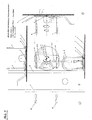
- a letter folder corresponding to the state of the art, in the example a DIN A4 letter folder, is modified as follows. Instead of attaching the folder mechanism located on a base plate (3) directly and rigidly to the usual position of the back cover (1) on the binder (1; 7; 10), a new, parallel to it is inserted between the base plate (3) and back cover (1). reasonably proportioned base plate (2) incorporated. This base plate (2) is permanently fixed with the back cover (1) of the binder cover precisely at the point at which the base plate (3) with the folder mechanism attached to it is located in known letter folders.
- the folder mechanism as such (with details such as clamping brackets, alignment pins, bearing webs, pivot bearings or levers) is only explained in more detail below for the sake of clarity if this is relevant for the solution according to the invention proposed here. In principle, all folder mechanisms are conceivable in connection with the invention.
- the solution according to the invention now provides that the base plate (2) is only connected on its upper side by an axis of rotation (4) or an axle pin (4) to the lower side of the base plate (3), on the upper side of which the folder mechanism remains unchanged located.
- the base plate (3) with the folder mechanism located on it can be moved or rotated clockwise or counterclockwise to the base plate (2) by means of the axis of rotation (4).
- axle pin (4) is constructed and attached in such a way that there is frictional resistance between the two plates (2; 3), but the base plate (3) can still be easily rotated about the axis.
- Such axle pins (4) and their attachment to the base plate (3) and base plate (2) correspond to the prior art.
- the surfaces of the top of the base plate (2) and the underside of the base plate (3) must be such that a counter-rotating movement of the plates is not too much impeded by friction or resistance.
- these surfaces are smooth and have a lens-shaped elevation (5) on the top of the base plate (2) and in the radius around the axis of rotation (4) in the starting or normal position, which is equivalent to that of a letter folder corresponding to the prior art a correspondingly shaped, only slightly smaller lenticular depression (6) on the underside of the rotatable base plate (3).
- the lenticular surface irregularities (5; 6) interlock and give the two plates (2; 3), which are only connected by the axis of rotation or the axis pin (4), a certain temporary fixation, which, however, can be solved with little effort.
- the base plate (3) together with folder mechanism and insert is rotated clockwise or counterclockwise at any angle with the folder cover open.
- further arrests due to lenticular surface irregularities (5; 6) or other technical solutions for arresting are conceivable, for example after the base plate (3) has been rotated 90 degrees clockwise.
- the height of the plates (2; 3) themselves is at least dimensioned such that they can be connected to each other with an axle pin (4).
- the Thickness of the plates (2; 3) does not increase due to increased material expenditure and weight be generous.
- the height of the base plate (2) and the base plate (3) together must not be the height of state of the art folder mechanics exceed Clamping bracket (8) can be used at the same height.
- safe stamping plates for use which are in height have it dimensioned accordingly.
- the height of the base plate (2) is also relevant for the rotation of the folder mechanism. If, as assumed in the example, the base plate (2) has a maximum wall thickness of 3mm, then it cannot be assumed that the folder inserts, when rotating the base plate (3) and folder mechanism, will bump against the folds (9) on which the front cover (10) and the back cover (1) are articulated on the back of the folder (7).
- the variant described in the exemplary embodiment uses a circular base plate (2) with a diameter sufficient for fastening the file mechanism.
- the base plate (3) is connected to the base plate (2) by means of an axis of rotation so that the circular base plate (2) does not just touch the fold (9) between the back cover (1) and file spine (7) of the file cover and thus there is no frictional resistance.
- the folder mechanism is therefore not at the level of the center point (4) of the base plate (2), but rather offset to the left.
- a base plate (2) which is somewhat higher than the fold (9) mentioned above would make it unnecessary to move the base plate (3) because no frictional resistance of the base plate (3) with the fold (9) is to be expected during rotation.
- materials such as plastic with smooth surfaces and rounded edges and corners are conceivable, for example, which ensure that the letter folder inserts during the inventive rotary movement of the base plate (3) experience as little friction and resistance as possible.
- this holding mechanism means that the front cover (10) and the back cover (1) of the binder cover are and remain parallel to each other and at a 90 degree angle to the folder back (7), which enables space-saving (standing) storage of letter folders.
- this device prevents the two clamping brackets (8) from being bent downward by the weight of the folder inserts when the letter folder is stored permanently and its functionality being disturbed.
Landscapes
- Sheet Holders (AREA)
Abstract
Description
Briefordner als solche sind hinlänglich bekannt und finden beispielsweise in Büros oder in Ausbildung und Studium Anwendung. Briefordner weisen einen Ordnerrücken sowie einen am Ordnerrücken angelenkten Vorder- und Rückdeckel auf. Die Ordnermechanik befindet sich meist auf einer Grundplatte, welche am Rückdeckel in der Nähe des Ordnerrückens angebracht ist. Der Hauptzweck von Briefordnern ist die Aufbewahrung und Verwaltung von Schriftstücken und Dokumenten, wie Papier, Einsteckhüllen oder beispielsweise auch Fotoeinlageblätter. Die Briefordner variieren in den verwendeten Materialien, der (Papierformat-)Größe, in der Lochung und in der technischen Ausgestaltung der Ordnermechanik, deren Hauptzweck in der Einlagen-Aufbewahrung besteht.
Die Grundplatte bei Briefordnern mit der darauf befestigten Ordnermechanik ist bei bekannten Lösungen entweder an den Rückdeckel angenietet und somit dauerhaft fixiert oder, wie es eine jüngere Erfindung (DE 4314445A1) vorsieht, mit Hilfe von Rastösen lösbar am Ordnereinband befestigt. Letztgenannte Erfindung hat den Zweck, dass durch die abnehmbare Einheit Grundplatte samt Ordnermechanismus bei Herausnahme eben dieser sperrigen Einheit aus dem aus Ordnerrücken und Vorderdeckel sowie Rückdeckel bestehenden Ordnereinband eine getrennte Lagerung dieser Komponenten eines Briefordners möglich ist. Der wirtschaftliche Nutzen dieser Erfindung ist auf Transport- bzw. Lagerraumzuwachs und somit den Fall des Leerordners beschränkt. Sobald die Grundplatte samt Ordnermechanik am Ordnereinband für den Gebrauch des Ordners fixiert ist, sind Grundplatte samt Ordnermechanik und Ordnereinband miteinander fest verbunden und zwar in einem festen Winkel zueinander. Mit anderen Worten treten bei üblicherweise rechteckigem Ordnereinband sowie ebenfalls rechteckigen sich im Ordnermechanismus befindlichen Einlagen, wie dies beispielsweise bei DIN A4 Papier der Fall ist, bei zweidimensionaler totaler Draufsicht nur parallele Kanten zwischen Ordnereinlage und Ordnereinband auf.
Solange die Briefordnereinlagen im Hochformat beschriftet sind, ist dies für eine angenehme Handhabung völlig ausreichend.
Eine andere Möglichkeit zur Bearbeitung quer beschrifteter Einlagen, die eine Entnahme einzelner Einlagen vermeidet, besteht beim Stand der Technik lediglich darin, den Ordnereinband samt Einlagen und damit den kompletten Ordner zu drehen. Dies führt häufig zu Unannehmlichkeiten und Schwierigkeiten, weil der für die Drehung des gesamten Briefordners notwendige Platz nicht vorhanden ist. Entsprechende Situationen in engen Hörsälen, in Seminarräumen, bei Präsentationen oder auf einem mit Arbeitsunterlagen übersähten Schreibtisch sind häufig gegeben. Oft muss auf der Arbeitsunterlage erst Platz geschaffen werden, um den Ordner für eine Queransicht zu drehen, oft muss er dazu von der Arbeitsunterlage angehoben werden, weil sonst andere Gegenstände durch die Drehung verschoben werden, umfallen oder etwa lose Blätter in Mitleidenschaft gezogen werden.
Die Idee mit der horizontal drehbaren Mechanik ist beispielsweise auch auf mit Briefordnern wesensverwandte Ringbücher übertragbar. Ganz analog lassen sich durch eine Drehachse zwischen einer Bodenplatte und der die Ringbuchmechanik tragende Grundplatte die Ringbuch-Einlagen horizontal drehen.
Die erfindungsgemäße Lösung sieht nun vor, dass die Bodenplatte (2) an ihrer oberen Seite lediglich durch eine Drehachse (4) bzw. einen Achsstift (4) mit der unteren Seite der Grundplatte (3) verbunden ist, an deren Oberseite sich unverändert die Ordnermechanik befindet. Durch die Drehachse (4) kann die Grundplatte (3) mit der sich darauf befindlichen Ordnermechanik im Uhrzeiger- oder Gegenuhrzeigersinn zur Bodenplatte (2) bewegt bzw. gedreht werden. Somit ist es auch möglich die sich im Briefordner befindlichen Ordnereinlagen unabhängig vom Ordnereinband zu drehen, theoretisch in allen denkbaren Winkeln im Uhrzeiger- und Gegenuhrzeigersinn.
Der Achsstift (4) ist so konstruiert und angebracht, dass zwischen beiden Platten (2; 3) zwar ein Reibungswiderstand vorhanden ist, die Grundplatte (3) sich aber trotzdem problemlos um die Achse drehen läßt. Solche Achsstifte (4) sowie ihre Befestigung an Grundplatte (3) und Bodenplatte (2) entsprechen dem Stand der Technik.
Weitere Arretierungen durch linsenförmige Oberflächenunebenheiten (5; 6) oder auch andere technische Lösungen zur Arretierung sind prinzipiell denkbar, beispielsweise nach Drehung der Grundplatte (3) um 90 Grad im Uhrzeigersinn.
Durch eine leichte Versetzung der Grundplatte (3) nach links, befindet sich die Ordnermechanik daher nicht auf Höhe des Mittelpunktes (4) der Bodenplatte (2), sondern entsprechend nach links versetzt. Durch eine verglichen mit dem angesprochenen Falz (9) etwas höheren Bodenplatte (2), könnte auf die Verschiebung der Grundplatte (3) verzichtet werden, weil bei der Drehung kein Reibwiderstand der Grundplatte (3) mit dem Falz (9) zu erwarten ist.
Für die bei geöffnetem Ordner den Ordnereinband berührenden Einlagenblätter, also das erste und letzte Einlageblatt, sind beispielsweise Materialien wie Plastik mit glatten Oberflächen und abgerundete Kanten und Ecken denkbar, die dafür sorgen, dass die Briefordner-Einlagen während der erfindungsgemäßen Drehbewegung der Grundplatte (3) möglichst wenig Reibung und Widerstand erfahren.
Bei geschlossenem Ordnereinband greifen die beiden geschlossenen Klemmbügel (8) des Ordnermechanismus an ihrem oberen Ende in zwei Schlitze (11), die am Vorderteil (10) des Ordnereinbandes eingearbeitet sind und die die Klemmbügel (8) durch einen einfachen Haltemechanismus festhalten. Zweck hierfür ist, dass durch diesen Haltemechanismus der Vorderdeckel (10) und der Rückdeckel (1) des Ordnereinbandes parallel zueinander und im 90 Grad Winkel zum Ordnerrücken (7) sind und bleiben, wodurch die platzsparende (Stehend-)Lagerung von Briefordnern möglich ist. Gleichsam wird durch diese Vorrichtung verhindert, dass bei Stehendlagerung des Briefordners die beiden Klemmbügel (8) durch das Gewicht der Ordnereinlagen nach unten gebogen werden und in ihrer Funktionalität gestört werden.
Im Fall der hier vorgeschlagenen erfindungsgemäßen Lösung wird bei Stehendlagerung des Briefordners durch das Greifen der beiden Klemmbügel (8) in die Schlitze (11) im Vorderdeckel (10) gewährleistet, dass sich bei entsprechend hohem Eigengewicht der Einlagen die Grundplatte (3) nicht aufgrund der Schwerkraft aus ihrer Arretierung in Normalposition löst und durch den Achsstift (4) eine unbeabsichtigte, selbstständige Drehbewegung ausgelöst wird. Somit wird das Problem einer unbeabsichtigten Drehbewegung an der Drehachse (4) durch ein dem Stand der Technik entsprechendes Detail von Briefordnern auf elegante und kostengünstige Art gelöst. Gemäss einer alternativen Ausgestaltung der Erfindung könnte zur Verhinderung von unbeabsichtigten Drehbewegungen ein zusätzlicher Haltemechanismus angebracht werden.
Claims (6)
- Drehmechanik für Briefordner oder auch Ringbücher zur Aufbewahrung und Verwaltung von Schriftstücken und Dokumenten, dadurch gekennzeichnet, dass der Ordnermechanismus und somit die durch Klemmbügel (8) festgehaltene Einlage mittels einer vertikalen Drehachse (4) horizontal zum Ordnereinband (1; 7; 10) im Uhrzeigersinn oder Gegenuhrzeigersinn um bis zu 360 Grad drehbar ist.
- Drehmechanik für Briefordner nach Anspruch 1, dadurch gekennzeichnet, dass der die Einlagen festhaltende Ordnermechanismus bezüglich einer horizontalen Bewegung starr an der Grundplatte (3) angebracht ist, die lediglich durch einen Achsstift (4) mit der Bodenplatte (2) verbunden ist, die ihrerseits bezüglich einer horizontalen Bewegung starr mit dem Rückdeckel (1) des Ordnereinbandes verbunden ist.
- Drehmechanik für Briefordner nach Anspruch 1 und 2, dadurch gekennzeichnet, dass Bodenplatte (2) und Grundplatte (3) in der dem Stand der Technik entsprechenden Normalposition von Briefordnern durch ineinandergreifende linsenförmige Oberflächenunebenheiten (5; 6) temporär miteinander fixiert sind, durch geringen Kraftaufwand aber in alle anderen entlang der Drehachse (4) denkbaren Positionen zueinander gebracht werden können.
- Drehmechanik für Briefordner nach Anspruch 1 bis 3, dadurch gekennzeichnet, dass ein Reibungswiderstand der sich drehenden Grundplatte (3) an dem zwischen Ordnerrücken (1) und Rückdeckel (1) angelenkten Falz (9) entweder durch die Lage und Position von Bodenplatte (2) und Grundplatte (3) vermieden wird oder durch die Höhe der Bodenplatte (2) vermieden wird.
- Drehmechanik für Briefordner nach Anspruch 1 bis 4, dadurch gekennzeichnet, dass die äußeren, den Ordnereinband berührenden Einlagen an allen Ecken und Kanten derart abgerundet und beschaffen sind sowie aus solchen Materialien hergestellt sind, dass der bei der horizontalen Drehbewegung der Grundplatte (3) denkbare Reibungswiderstand mit dem Ordnereinband und der Arbeitsunterlage, auf der sich der komplette Briefordner befindet, gering gehalten wird.
- Drehmechanik für Briefordner nach Anspruch 1 bis 5, dadurch gekennzeichnet, dass Grundplatte (3) und Bodenplatte (2) durch einen Haltemechanismus temporär fixiert werden, um die Drehbewegung bei der Stehendlagerung des Briefordners zu verhindern.
Applications Claiming Priority (2)
| Application Number | Priority Date | Filing Date | Title |
|---|---|---|---|
| DE20213605U DE20213605U1 (de) | 2002-08-29 | 2002-08-29 | Briefordner mit drehbarer Ordnermechanik |
| DE20213605U | 2002-08-29 |
Publications (1)
| Publication Number | Publication Date |
|---|---|
| EP1400372A1 true EP1400372A1 (de) | 2004-03-24 |
Family
ID=7974726
Family Applications (1)
| Application Number | Title | Priority Date | Filing Date |
|---|---|---|---|
| EP03400051A Withdrawn EP1400372A1 (de) | 2002-08-29 | 2003-08-26 | Briefordner mit drehbarer Ordnermechanik |
Country Status (2)
| Country | Link |
|---|---|
| EP (1) | EP1400372A1 (de) |
| DE (1) | DE20213605U1 (de) |
Citations (5)
| Publication number | Priority date | Publication date | Assignee | Title |
|---|---|---|---|---|
| DE1901426U (de) * | 1964-04-28 | 1964-10-01 | Anneliese Mayer | Aktenordner. |
| EP0482354A1 (de) * | 1990-10-22 | 1992-04-29 | KOLOMAN HANDLER GESELLSCHAFT m.b.H. | Aktenordner oder Schreibplatte |
| DE4314445A1 (de) * | 1993-05-03 | 1994-11-10 | Leitz Louis Kg | Briefordner |
| WO1995020494A1 (de) * | 1994-01-28 | 1995-08-03 | Kores Holding Zug Ag | Ordner zum aufbewahren von papierblättern |
| CH689082A5 (de) * | 1994-03-08 | 1998-09-15 | Donau-Plastik Stefan Stern Ges.M.B.H | Ordner mit heraustrennbarer heftmechanik |
Family Cites Families (1)
| Publication number | Priority date | Publication date | Assignee | Title |
|---|---|---|---|---|
| DE177568C (de) |
-
2002
- 2002-08-29 DE DE20213605U patent/DE20213605U1/de not_active Expired - Lifetime
-
2003
- 2003-08-26 EP EP03400051A patent/EP1400372A1/de not_active Withdrawn
Patent Citations (5)
| Publication number | Priority date | Publication date | Assignee | Title |
|---|---|---|---|---|
| DE1901426U (de) * | 1964-04-28 | 1964-10-01 | Anneliese Mayer | Aktenordner. |
| EP0482354A1 (de) * | 1990-10-22 | 1992-04-29 | KOLOMAN HANDLER GESELLSCHAFT m.b.H. | Aktenordner oder Schreibplatte |
| DE4314445A1 (de) * | 1993-05-03 | 1994-11-10 | Leitz Louis Kg | Briefordner |
| WO1995020494A1 (de) * | 1994-01-28 | 1995-08-03 | Kores Holding Zug Ag | Ordner zum aufbewahren von papierblättern |
| CH689082A5 (de) * | 1994-03-08 | 1998-09-15 | Donau-Plastik Stefan Stern Ges.M.B.H | Ordner mit heraustrennbarer heftmechanik |
Also Published As
| Publication number | Publication date |
|---|---|
| DE20213605U1 (de) | 2002-11-28 |
Similar Documents
| Publication | Publication Date | Title |
|---|---|---|
| DE2155505C3 (de) | Stützvorrichtung für Registraturmappen o.dgL | |
| DE3317988A1 (de) | Schutzeinrichtung fuer transparente | |
| DE202018101158U1 (de) | Verstellvorrichtung für eine Kopfstütze | |
| DE102007014361B4 (de) | Vorrichtung zum Aufstellen eines Buches oder dgl. | |
| DE20213605U1 (de) | Briefordner mit drehbarer Ordnermechanik | |
| DE519570C (de) | Lesevorrichtung | |
| DE649720C (de) | Vordruckordner mit schwenkbaren und in bestimmter Schraeglage einstellbaren Stuetzplatten | |
| DE9104704U1 (de) | Rechnungs- und Wechselgeldteller | |
| DE202009003877U1 (de) | Buchständer und Schneidbrett | |
| DE937345C (de) | Sammelmappe zum Aufbewahren von gefalztem Schriftgut | |
| DE549026C (de) | Buecherhalter | |
| DE402160C (de) | Zweiteiliges Schablonenkartenmagazin fuer Adressiermaschinen | |
| DE2620651C3 (de) | Tisch, insbesondere für Schüler | |
| DE212005000053U1 (de) | Einstellbare Materialhalteeinrichtung | |
| EP0687428A2 (de) | Notenblatthalter | |
| DE9532C (de) | Neuerungen an Bücherhaltern | |
| DE709615C (de) | Schablone zum Auftragen von Klebstoff auf einen Rand von einzelnen Schriftstuecken | |
| CH462778A (de) | Vorrichtung zum Lochen und Ablegen von Schriftstücken in einem Ordner | |
| DE202017102740U1 (de) | Tischflipchart | |
| DE9105273U1 (de) | Lampenständer für Rotlichtlampen | |
| DE9207440U1 (de) | Bildhalter | |
| DE20210412U1 (de) | Klemmrahmenprofil | |
| DE1245312B (de) | Ordner zum Einhaengen von Schriftgut | |
| DE1861027U (de) | Mappe, insbesondere zur unterstuetzung von mit dem verkauf und der ablieferung von waren betrauten personen. | |
| DE7340279U (de) | Ständer für die zeitweilige Ablage von Notizen |
Legal Events
| Date | Code | Title | Description |
|---|---|---|---|
| PUAI | Public reference made under article 153(3) epc to a published international application that has entered the european phase |
Free format text: ORIGINAL CODE: 0009012 |
|
| AK | Designated contracting states |
Kind code of ref document: A1 Designated state(s): AT BE BG CH CY CZ DE DK EE ES FI FR GB GR HU IE IT LI LU MC NL PT RO SE SI SK TR |
|
| AX | Request for extension of the european patent |
Extension state: AL LT LV MK |
|
| 17P | Request for examination filed |
Effective date: 20040924 |
|
| AKX | Designation fees paid |
Designated state(s): AT BE BG CH CY CZ DE DK EE ES FI FR GB GR HU IE IT LI LU MC NL PT RO SE SI SK TR |
|
| STAA | Information on the status of an ep patent application or granted ep patent |
Free format text: STATUS: THE APPLICATION IS DEEMED TO BE WITHDRAWN |
|
| 18D | Application deemed to be withdrawn |
Effective date: 20080301 |