EP1400560B1 - Pneus ayant un composant à base de caoutchouc fait à partir d'un élastomère styrène/butadiène ayant des fonctions silanoles et/ou siloxy pendantes - Google Patents
Pneus ayant un composant à base de caoutchouc fait à partir d'un élastomère styrène/butadiène ayant des fonctions silanoles et/ou siloxy pendantes Download PDFInfo
- Publication number
- EP1400560B1 EP1400560B1 EP03103360A EP03103360A EP1400560B1 EP 1400560 B1 EP1400560 B1 EP 1400560B1 EP 03103360 A EP03103360 A EP 03103360A EP 03103360 A EP03103360 A EP 03103360A EP 1400560 B1 EP1400560 B1 EP 1400560B1
- Authority
- EP
- European Patent Office
- Prior art keywords
- sbr
- elastomer
- tire
- styrene
- composite
- Prior art date
- Legal status (The legal status is an assumption and is not a legal conclusion. Google has not performed a legal analysis and makes no representation as to the accuracy of the status listed.)
- Expired - Lifetime
Links
- 229920001971 elastomer Polymers 0.000 title claims description 118
- 239000005060 rubber Substances 0.000 title claims description 66
- 239000002131 composite material Substances 0.000 title claims description 51
- 229920002857 polybutadiene Polymers 0.000 title claims description 22
- MTAZNLWOLGHBHU-UHFFFAOYSA-N butadiene-styrene rubber Chemical compound C=CC=C.C=CC1=CC=CC=C1 MTAZNLWOLGHBHU-UHFFFAOYSA-N 0.000 title claims description 21
- SCPYDCQAZCOKTP-UHFFFAOYSA-N silanol Chemical compound [SiH3]O SCPYDCQAZCOKTP-UHFFFAOYSA-N 0.000 title claims description 15
- 125000004469 siloxy group Chemical group [SiH3]O* 0.000 title claims description 8
- VYPSYNLAJGMNEJ-UHFFFAOYSA-N Silicium dioxide Chemical compound O=[Si]=O VYPSYNLAJGMNEJ-UHFFFAOYSA-N 0.000 claims description 88
- 239000000203 mixture Substances 0.000 claims description 61
- 239000000806 elastomer Substances 0.000 claims description 52
- -1 alkyl radical Chemical class 0.000 claims description 51
- 239000000377 silicon dioxide Substances 0.000 claims description 43
- 229920002472 Starch Polymers 0.000 claims description 38
- 239000004014 plasticizer Substances 0.000 claims description 38
- 239000008107 starch Substances 0.000 claims description 38
- 235000019698 starch Nutrition 0.000 claims description 38
- 239000007822 coupling agent Substances 0.000 claims description 34
- 239000005077 polysulfide Substances 0.000 claims description 21
- 229920001021 polysulfide Polymers 0.000 claims description 21
- 150000008117 polysulfides Polymers 0.000 claims description 21
- PPBRXRYQALVLMV-UHFFFAOYSA-N Styrene Chemical compound C=CC1=CC=CC=C1 PPBRXRYQALVLMV-UHFFFAOYSA-N 0.000 claims description 20
- 239000006229 carbon black Substances 0.000 claims description 19
- 229920003048 styrene butadiene rubber Polymers 0.000 claims description 19
- XUIMIQQOPSSXEZ-UHFFFAOYSA-N Silicon Chemical group [Si] XUIMIQQOPSSXEZ-UHFFFAOYSA-N 0.000 claims description 18
- 125000004432 carbon atom Chemical group C* 0.000 claims description 18
- 229910052710 silicon Inorganic materials 0.000 claims description 18
- 125000004434 sulfur atom Chemical group 0.000 claims description 18
- KAKZBPTYRLMSJV-UHFFFAOYSA-N Butadiene Chemical compound C=CC=C KAKZBPTYRLMSJV-UHFFFAOYSA-N 0.000 claims description 17
- 238000002156 mixing Methods 0.000 claims description 17
- 150000001993 dienes Chemical class 0.000 claims description 16
- NINIDFKCEFEMDL-UHFFFAOYSA-N Sulfur Chemical compound [S] NINIDFKCEFEMDL-UHFFFAOYSA-N 0.000 claims description 13
- 229910052717 sulfur Inorganic materials 0.000 claims description 13
- 239000011593 sulfur Substances 0.000 claims description 13
- 150000001343 alkyl silanes Chemical class 0.000 claims description 12
- 125000002887 hydroxy group Chemical group [H]O* 0.000 claims description 11
- 125000002496 methyl group Chemical group [H]C([H])([H])* 0.000 claims description 11
- 239000010703 silicon Substances 0.000 claims description 9
- 125000005372 silanol group Chemical group 0.000 claims description 8
- 125000001495 ethyl group Chemical group [H]C([H])([H])C([H])([H])* 0.000 claims description 7
- 239000005062 Polybutadiene Substances 0.000 claims description 6
- IJOOHPMOJXWVHK-UHFFFAOYSA-N chlorotrimethylsilane Chemical compound C[Si](C)(C)Cl IJOOHPMOJXWVHK-UHFFFAOYSA-N 0.000 claims description 6
- 150000003254 radicals Chemical class 0.000 claims description 6
- 230000002787 reinforcement Effects 0.000 claims description 6
- 238000010059 sulfur vulcanization Methods 0.000 claims description 6
- ZAMOUSCENKQFHK-UHFFFAOYSA-N Chlorine atom Chemical compound [Cl] ZAMOUSCENKQFHK-UHFFFAOYSA-N 0.000 claims description 5
- 229910052801 chlorine Inorganic materials 0.000 claims description 5
- 239000000460 chlorine Substances 0.000 claims description 5
- 125000001997 phenyl group Chemical group [H]C1=C([H])C([H])=C(*)C([H])=C1[H] 0.000 claims description 5
- UUEWCQRISZBELL-UHFFFAOYSA-N 3-trimethoxysilylpropane-1-thiol Chemical compound CO[Si](OC)(OC)CCCS UUEWCQRISZBELL-UHFFFAOYSA-N 0.000 claims description 4
- 125000000484 butyl group Chemical group [H]C([*])([H])C([H])([H])C([H])([H])C([H])([H])[H] 0.000 claims description 4
- QUPDWYMUPZLYJZ-UHFFFAOYSA-N ethyl Chemical compound C[CH2] QUPDWYMUPZLYJZ-UHFFFAOYSA-N 0.000 claims description 4
- 229910052739 hydrogen Inorganic materials 0.000 claims description 4
- 239000001257 hydrogen Substances 0.000 claims description 4
- 125000001436 propyl group Chemical group [H]C([*])([H])C([H])([H])C([H])([H])[H] 0.000 claims description 4
- DCQBZYNUSLHVJC-UHFFFAOYSA-N 3-triethoxysilylpropane-1-thiol Chemical compound CCO[Si](OCC)(OCC)CCCS DCQBZYNUSLHVJC-UHFFFAOYSA-N 0.000 claims description 3
- 125000003545 alkoxy group Chemical group 0.000 claims description 3
- LIKFHECYJZWXFJ-UHFFFAOYSA-N dimethyldichlorosilane Chemical compound C[Si](C)(Cl)Cl LIKFHECYJZWXFJ-UHFFFAOYSA-N 0.000 claims description 3
- 229910052736 halogen Inorganic materials 0.000 claims description 3
- 150000002367 halogens Chemical class 0.000 claims description 3
- 125000001449 isopropyl group Chemical group [H]C([H])([H])C([H])(*)C([H])([H])[H] 0.000 claims description 3
- 238000005987 sulfurization reaction Methods 0.000 claims description 3
- 125000000999 tert-butyl group Chemical group [H]C([H])([H])C(*)(C([H])([H])[H])C([H])([H])[H] 0.000 claims description 3
- 229920002554 vinyl polymer Polymers 0.000 claims description 3
- LOSLJXKHQKRRFN-UHFFFAOYSA-N 2-trimethoxysilylethanethiol Chemical compound CO[Si](OC)(OC)CCS LOSLJXKHQKRRFN-UHFFFAOYSA-N 0.000 claims description 2
- UZEBPNPRXOYGRA-UHFFFAOYSA-N 2-tripropoxysilylethanethiol Chemical compound CCCO[Si](CCS)(OCCC)OCCC UZEBPNPRXOYGRA-UHFFFAOYSA-N 0.000 claims description 2
- WKBOTKDWSSQWDR-UHFFFAOYSA-N Bromine atom Chemical compound [Br] WKBOTKDWSSQWDR-UHFFFAOYSA-N 0.000 claims description 2
- UFHFLCQGNIYNRP-UHFFFAOYSA-N Hydrogen Chemical compound [H][H] UFHFLCQGNIYNRP-UHFFFAOYSA-N 0.000 claims description 2
- BLRPTPMANUNPDV-UHFFFAOYSA-N Silane Chemical compound [SiH4] BLRPTPMANUNPDV-UHFFFAOYSA-N 0.000 claims description 2
- 125000000217 alkyl group Chemical group 0.000 claims description 2
- 125000004429 atom Chemical group 0.000 claims description 2
- GDTBXPJZTBHREO-UHFFFAOYSA-N bromine Substances BrBr GDTBXPJZTBHREO-UHFFFAOYSA-N 0.000 claims description 2
- 229910052794 bromium Inorganic materials 0.000 claims description 2
- JJQZDUKDJDQPMQ-UHFFFAOYSA-N dimethoxy(dimethyl)silane Chemical compound CO[Si](C)(C)OC JJQZDUKDJDQPMQ-UHFFFAOYSA-N 0.000 claims description 2
- JVUVKQDVTIIMOD-UHFFFAOYSA-N dimethoxy(dipropyl)silane Chemical compound CCC[Si](OC)(OC)CCC JVUVKQDVTIIMOD-UHFFFAOYSA-N 0.000 claims description 2
- YYLGKUPAFFKGRQ-UHFFFAOYSA-N dimethyldiethoxysilane Chemical compound CCO[Si](C)(C)OCC YYLGKUPAFFKGRQ-UHFFFAOYSA-N 0.000 claims description 2
- RSKGMYDENCAJEN-UHFFFAOYSA-N hexadecyl(trimethoxy)silane Chemical compound CCCCCCCCCCCCCCCC[Si](OC)(OC)OC RSKGMYDENCAJEN-UHFFFAOYSA-N 0.000 claims description 2
- 125000004435 hydrogen atom Chemical group [H]* 0.000 claims description 2
- 230000002452 interceptive effect Effects 0.000 claims description 2
- 125000000956 methoxy group Chemical group [H]C([H])([H])O* 0.000 claims description 2
- POPACFLNWGUDSR-UHFFFAOYSA-N methoxy(trimethyl)silane Chemical compound CO[Si](C)(C)C POPACFLNWGUDSR-UHFFFAOYSA-N 0.000 claims description 2
- 229910000077 silane Inorganic materials 0.000 claims description 2
- DWAWYEUJUWLESO-UHFFFAOYSA-N trichloromethylsilane Chemical compound [SiH3]C(Cl)(Cl)Cl DWAWYEUJUWLESO-UHFFFAOYSA-N 0.000 claims description 2
- NKLYMYLJOXIVFB-UHFFFAOYSA-N triethoxymethylsilane Chemical compound CCOC([SiH3])(OCC)OCC NKLYMYLJOXIVFB-UHFFFAOYSA-N 0.000 claims description 2
- XSIGLRIVXRKQRA-UHFFFAOYSA-N triethoxysilylmethanethiol Chemical compound CCO[Si](CS)(OCC)OCC XSIGLRIVXRKQRA-UHFFFAOYSA-N 0.000 claims description 2
- NMEPHPOFYLLFTK-UHFFFAOYSA-N trimethoxy(octyl)silane Chemical compound CCCCCCCC[Si](OC)(OC)OC NMEPHPOFYLLFTK-UHFFFAOYSA-N 0.000 claims description 2
- HQYALQRYBUJWDH-UHFFFAOYSA-N trimethoxy(propyl)silane Chemical compound CCC[Si](OC)(OC)OC HQYALQRYBUJWDH-UHFFFAOYSA-N 0.000 claims description 2
- TUQLLQQWSNWKCF-UHFFFAOYSA-N trimethoxymethylsilane Chemical compound COC([SiH3])(OC)OC TUQLLQQWSNWKCF-UHFFFAOYSA-N 0.000 claims description 2
- QJOOZNCPHALTKK-UHFFFAOYSA-N trimethoxysilylmethanethiol Chemical compound CO[Si](CS)(OC)OC QJOOZNCPHALTKK-UHFFFAOYSA-N 0.000 claims description 2
- 125000000391 vinyl group Chemical group [H]C([*])=C([H])[H] 0.000 claims description 2
- 125000001309 chloro group Chemical group Cl* 0.000 claims 1
- 239000000523 sample Substances 0.000 description 45
- RRHGJUQNOFWUDK-UHFFFAOYSA-N Isoprene Chemical compound CC(=C)C=C RRHGJUQNOFWUDK-UHFFFAOYSA-N 0.000 description 15
- XLOMVQKBTHCTTD-UHFFFAOYSA-N Zinc monoxide Chemical compound [Zn]=O XLOMVQKBTHCTTD-UHFFFAOYSA-N 0.000 description 14
- 229920001577 copolymer Polymers 0.000 description 13
- 229920003193 cis-1,4-polybutadiene polymer Polymers 0.000 description 10
- 239000013068 control sample Substances 0.000 description 8
- 238000005096 rolling process Methods 0.000 description 8
- 239000000463 material Substances 0.000 description 7
- 239000011787 zinc oxide Substances 0.000 description 7
- ATJFFYVFTNAWJD-UHFFFAOYSA-N Tin Chemical compound [Sn] ATJFFYVFTNAWJD-UHFFFAOYSA-N 0.000 description 5
- 239000003963 antioxidant agent Substances 0.000 description 5
- 238000006243 chemical reaction Methods 0.000 description 5
- LFQSCWFLJHTTHZ-UHFFFAOYSA-N Ethanol Chemical compound CCO LFQSCWFLJHTTHZ-UHFFFAOYSA-N 0.000 description 4
- 235000021355 Stearic acid Nutrition 0.000 description 4
- 239000000654 additive Substances 0.000 description 4
- 230000003078 antioxidant effect Effects 0.000 description 4
- 238000000034 method Methods 0.000 description 4
- QIQXTHQIDYTFRH-UHFFFAOYSA-N octadecanoic acid Chemical compound CCCCCCCCCCCCCCCCCC(O)=O QIQXTHQIDYTFRH-UHFFFAOYSA-N 0.000 description 4
- OQCDKBAXFALNLD-UHFFFAOYSA-N octadecanoic acid Natural products CCCCCCCC(C)CCCCCCCCC(O)=O OQCDKBAXFALNLD-UHFFFAOYSA-N 0.000 description 4
- 239000003921 oil Substances 0.000 description 4
- 229920000642 polymer Polymers 0.000 description 4
- 239000011347 resin Substances 0.000 description 4
- 229920005989 resin Polymers 0.000 description 4
- 239000008117 stearic acid Substances 0.000 description 4
- OVSKIKFHRZPJSS-UHFFFAOYSA-N 2,4-D Chemical compound OC(=O)COC1=CC=C(Cl)C=C1Cl OVSKIKFHRZPJSS-UHFFFAOYSA-N 0.000 description 3
- BWGNESOTFCXPMA-UHFFFAOYSA-N Dihydrogen disulfide Chemical compound SS BWGNESOTFCXPMA-UHFFFAOYSA-N 0.000 description 3
- XTXRWKRVRITETP-UHFFFAOYSA-N Vinyl acetate Chemical compound CC(=O)OC=C XTXRWKRVRITETP-UHFFFAOYSA-N 0.000 description 3
- 230000002902 bimodal effect Effects 0.000 description 3
- 235000014113 dietary fatty acids Nutrition 0.000 description 3
- 239000000194 fatty acid Substances 0.000 description 3
- 229930195729 fatty acid Natural products 0.000 description 3
- 150000004665 fatty acids Chemical class 0.000 description 3
- 239000003960 organic solvent Substances 0.000 description 3
- 150000001282 organosilanes Chemical class 0.000 description 3
- 238000006116 polymerization reaction Methods 0.000 description 3
- 239000000843 powder Substances 0.000 description 3
- 238000010057 rubber processing Methods 0.000 description 3
- 229920001897 terpolymer Polymers 0.000 description 3
- 229940117958 vinyl acetate Drugs 0.000 description 3
- 239000001993 wax Substances 0.000 description 3
- IMROMDMJAWUWLK-UHFFFAOYSA-N Ethenol Chemical compound OC=C IMROMDMJAWUWLK-UHFFFAOYSA-N 0.000 description 2
- 229920000219 Ethylene vinyl alcohol Polymers 0.000 description 2
- 239000002253 acid Substances 0.000 description 2
- RTACIUYXLGWTAE-UHFFFAOYSA-N buta-1,3-diene;2-methylbuta-1,3-diene;styrene Chemical compound C=CC=C.CC(=C)C=C.C=CC1=CC=CC=C1 RTACIUYXLGWTAE-UHFFFAOYSA-N 0.000 description 2
- 125000003178 carboxy group Chemical group [H]OC(*)=O 0.000 description 2
- 229920002301 cellulose acetate Polymers 0.000 description 2
- 239000003795 chemical substances by application Substances 0.000 description 2
- 239000004927 clay Substances 0.000 description 2
- 229920003244 diene elastomer Polymers 0.000 description 2
- 238000009826 distribution Methods 0.000 description 2
- 238000007720 emulsion polymerization reaction Methods 0.000 description 2
- 238000005886 esterification reaction Methods 0.000 description 2
- 239000000945 filler Substances 0.000 description 2
- 239000000446 fuel Substances 0.000 description 2
- FFUAGWLWBBFQJT-UHFFFAOYSA-N hexamethyldisilazane Chemical compound C[Si](C)(C)N[Si](C)(C)C FFUAGWLWBBFQJT-UHFFFAOYSA-N 0.000 description 2
- 239000004615 ingredient Substances 0.000 description 2
- 239000007788 liquid Substances 0.000 description 2
- 239000000178 monomer Substances 0.000 description 2
- 239000002245 particle Substances 0.000 description 2
- 230000000704 physical effect Effects 0.000 description 2
- 238000002360 preparation method Methods 0.000 description 2
- 238000002203 pretreatment Methods 0.000 description 2
- 239000012763 reinforcing filler Substances 0.000 description 2
- CBCKQZAAMUWICA-UHFFFAOYSA-N 1,4-phenylenediamine Chemical compound NC1=CC=C(N)C=C1 CBCKQZAAMUWICA-UHFFFAOYSA-N 0.000 description 1
- JTXMVXSTHSMVQF-UHFFFAOYSA-N 2-acetyloxyethyl acetate Chemical compound CC(=O)OCCOC(C)=O JTXMVXSTHSMVQF-UHFFFAOYSA-N 0.000 description 1
- NLHHRLWOUZZQLW-UHFFFAOYSA-N Acrylonitrile Chemical compound C=CC#N NLHHRLWOUZZQLW-UHFFFAOYSA-N 0.000 description 1
- 229920000945 Amylopectin Polymers 0.000 description 1
- 229920000856 Amylose Polymers 0.000 description 1
- VGGSQFUCUMXWEO-UHFFFAOYSA-N Ethene Chemical compound C=C VGGSQFUCUMXWEO-UHFFFAOYSA-N 0.000 description 1
- 239000005977 Ethylene Substances 0.000 description 1
- 238000005299 abrasion Methods 0.000 description 1
- 150000007513 acids Chemical class 0.000 description 1
- 239000012190 activator Substances 0.000 description 1
- 230000000996 additive effect Effects 0.000 description 1
- 125000001931 aliphatic group Chemical group 0.000 description 1
- XYLMUPLGERFSHI-UHFFFAOYSA-N alpha-Methylstyrene Chemical compound CC(=C)C1=CC=CC=C1 XYLMUPLGERFSHI-UHFFFAOYSA-N 0.000 description 1
- 125000003277 amino group Chemical group 0.000 description 1
- 239000003054 catalyst Substances 0.000 description 1
- 229920003211 cis-1,4-polyisoprene Polymers 0.000 description 1
- 238000006482 condensation reaction Methods 0.000 description 1
- 239000000470 constituent Substances 0.000 description 1
- GUJOJGAPFQRJSV-UHFFFAOYSA-N dialuminum;dioxosilane;oxygen(2-);hydrate Chemical compound O.[O-2].[O-2].[O-2].[Al+3].[Al+3].O=[Si]=O.O=[Si]=O.O=[Si]=O.O=[Si]=O GUJOJGAPFQRJSV-UHFFFAOYSA-N 0.000 description 1
- 150000005690 diesters Chemical class 0.000 description 1
- KPUWHANPEXNPJT-UHFFFAOYSA-N disiloxane Chemical class [SiH3]O[SiH3] KPUWHANPEXNPJT-UHFFFAOYSA-N 0.000 description 1
- 239000006185 dispersion Substances 0.000 description 1
- 230000000694 effects Effects 0.000 description 1
- 239000000839 emulsion Substances 0.000 description 1
- 125000003700 epoxy group Chemical group 0.000 description 1
- 230000032050 esterification Effects 0.000 description 1
- 229920001038 ethylene copolymer Polymers 0.000 description 1
- 238000010528 free radical solution polymerization reaction Methods 0.000 description 1
- 125000000524 functional group Chemical group 0.000 description 1
- 229920001519 homopolymer Polymers 0.000 description 1
- 230000003301 hydrolyzing effect Effects 0.000 description 1
- 238000011065 in-situ storage Methods 0.000 description 1
- 229920003049 isoprene rubber Polymers 0.000 description 1
- 239000011159 matrix material Substances 0.000 description 1
- 239000004200 microcrystalline wax Substances 0.000 description 1
- 235000019808 microcrystalline wax Nutrition 0.000 description 1
- 125000004123 n-propyl group Chemical group [H]C([H])([H])C([H])([H])C([H])([H])* 0.000 description 1
- 150000007524 organic acids Chemical class 0.000 description 1
- 235000005985 organic acids Nutrition 0.000 description 1
- 239000008188 pellet Substances 0.000 description 1
- 230000010399 physical interaction Effects 0.000 description 1
- 239000000049 pigment Substances 0.000 description 1
- 229920001200 poly(ethylene-vinyl acetate) Polymers 0.000 description 1
- 229920001195 polyisoprene Polymers 0.000 description 1
- 230000000379 polymerizing effect Effects 0.000 description 1
- 229920001296 polysiloxane Polymers 0.000 description 1
- 239000011118 polyvinyl acetate Substances 0.000 description 1
- 229920002689 polyvinyl acetate Polymers 0.000 description 1
- 230000001737 promoting effect Effects 0.000 description 1
- QQONPFPTGQHPMA-UHFFFAOYSA-N propylene Natural products CC=C QQONPFPTGQHPMA-UHFFFAOYSA-N 0.000 description 1
- 239000012779 reinforcing material Substances 0.000 description 1
- 238000010058 rubber compounding Methods 0.000 description 1
- 239000000126 substance Substances 0.000 description 1
- 229920003051 synthetic elastomer Polymers 0.000 description 1
- 229920003002 synthetic resin Polymers 0.000 description 1
- 239000000057 synthetic resin Substances 0.000 description 1
- 239000005061 synthetic rubber Substances 0.000 description 1
- 229910002029 synthetic silica gel Inorganic materials 0.000 description 1
- FBBATURSCRIBHN-UHFFFAOYSA-N triethoxy-[3-(3-triethoxysilylpropyldisulfanyl)propyl]silane Chemical compound CCO[Si](OCC)(OCC)CCCSSCCC[Si](OCC)(OCC)OCC FBBATURSCRIBHN-UHFFFAOYSA-N 0.000 description 1
- VTHOKNTVYKTUPI-UHFFFAOYSA-N triethoxy-[3-(3-triethoxysilylpropyltetrasulfanyl)propyl]silane Chemical compound CCO[Si](OCC)(OCC)CCCSSSSCCC[Si](OCC)(OCC)OCC VTHOKNTVYKTUPI-UHFFFAOYSA-N 0.000 description 1
- XLYOFNOQVPJJNP-UHFFFAOYSA-N water Substances O XLYOFNOQVPJJNP-UHFFFAOYSA-N 0.000 description 1
Classifications
-
- C—CHEMISTRY; METALLURGY
- C08—ORGANIC MACROMOLECULAR COMPOUNDS; THEIR PREPARATION OR CHEMICAL WORKING-UP; COMPOSITIONS BASED THEREON
- C08L—COMPOSITIONS OF MACROMOLECULAR COMPOUNDS
- C08L9/00—Compositions of homopolymers or copolymers of conjugated diene hydrocarbons
- C08L9/06—Copolymers with styrene
-
- B—PERFORMING OPERATIONS; TRANSPORTING
- B60—VEHICLES IN GENERAL
- B60C—VEHICLE TYRES; TYRE INFLATION; TYRE CHANGING; CONNECTING VALVES TO INFLATABLE ELASTIC BODIES IN GENERAL; DEVICES OR ARRANGEMENTS RELATED TO TYRES
- B60C1/00—Tyres characterised by the chemical composition or the physical arrangement or mixture of the composition
- B60C1/0016—Compositions of the tread
-
- C—CHEMISTRY; METALLURGY
- C08—ORGANIC MACROMOLECULAR COMPOUNDS; THEIR PREPARATION OR CHEMICAL WORKING-UP; COMPOSITIONS BASED THEREON
- C08L—COMPOSITIONS OF MACROMOLECULAR COMPOUNDS
- C08L21/00—Compositions of unspecified rubbers
-
- C—CHEMISTRY; METALLURGY
- C08—ORGANIC MACROMOLECULAR COMPOUNDS; THEIR PREPARATION OR CHEMICAL WORKING-UP; COMPOSITIONS BASED THEREON
- C08C—TREATMENT OR CHEMICAL MODIFICATION OF RUBBERS
- C08C19/00—Chemical modification of rubber
- C08C19/30—Addition of a reagent which reacts with a hetero atom or a group containing hetero atoms of the macromolecule
- C08C19/42—Addition of a reagent which reacts with a hetero atom or a group containing hetero atoms of the macromolecule reacting with metals or metal-containing groups
- C08C19/44—Addition of a reagent which reacts with a hetero atom or a group containing hetero atoms of the macromolecule reacting with metals or metal-containing groups of polymers containing metal atoms exclusively at one or both ends of the skeleton
-
- C—CHEMISTRY; METALLURGY
- C08—ORGANIC MACROMOLECULAR COMPOUNDS; THEIR PREPARATION OR CHEMICAL WORKING-UP; COMPOSITIONS BASED THEREON
- C08K—Use of inorganic or non-macromolecular organic substances as compounding ingredients
- C08K5/00—Use of organic ingredients
- C08K5/54—Silicon-containing compounds
- C08K5/548—Silicon-containing compounds containing sulfur
-
- C—CHEMISTRY; METALLURGY
- C08—ORGANIC MACROMOLECULAR COMPOUNDS; THEIR PREPARATION OR CHEMICAL WORKING-UP; COMPOSITIONS BASED THEREON
- C08K—Use of inorganic or non-macromolecular organic substances as compounding ingredients
- C08K9/00—Use of pretreated ingredients
- C08K9/02—Ingredients treated with inorganic substances
-
- C—CHEMISTRY; METALLURGY
- C08—ORGANIC MACROMOLECULAR COMPOUNDS; THEIR PREPARATION OR CHEMICAL WORKING-UP; COMPOSITIONS BASED THEREON
- C08K—Use of inorganic or non-macromolecular organic substances as compounding ingredients
- C08K9/00—Use of pretreated ingredients
- C08K9/04—Ingredients treated with organic substances
- C08K9/06—Ingredients treated with organic substances with silicon-containing compounds
-
- C—CHEMISTRY; METALLURGY
- C08—ORGANIC MACROMOLECULAR COMPOUNDS; THEIR PREPARATION OR CHEMICAL WORKING-UP; COMPOSITIONS BASED THEREON
- C08L—COMPOSITIONS OF MACROMOLECULAR COMPOUNDS
- C08L15/00—Compositions of rubber derivatives
Definitions
- the invention relates to a tire having at least one component (e.g. tread) of a rubber composition comprised of a styrene/butadiene elastomer composite comprised of a styrene/butadiene elastomer and a functionalized styrene/butadiene elastomer containing an internal silicon atom therein as a part of the elastomer, and at least one pendent silanol group and/or siloxy group from said silicon atom.
- Said elastomer composite is comprised of a significant polymodal (e.g.
- Said rubber composition contains synthetic, precipitated silica aggregates having hydroxyl groups on their surface which may be pre-treated (hydrophobated) to reduce hydroxyl groups contained on their surface prior to blending with said styrene/butadiene composite.
- Said rubber composition may contain a dispersion therein of a silica/plasticizer composite.
- Said rubber composition may be prepared by blending two bis(3-triethoxysilylpropyl) polysulfide coupling agents therewith, namely blending such polysulfide having an average of from 2 to 2.5 connecting sulfur atoms in its polysulfidic bridge in a non-productive mixing stage in the absence of addition of free sulfur and subsequently blending such polysulfide having an average of from 3.5 to 4 connecting sulfur atoms in its polysulfidic bridge in a productive mixing stage in combination with addition of free sulfur.
- Tires are historically prepared with treads of a rubber composition which is comprised of various elastomers and particularly cis 1,4-polybutadiene and styrene/butadiene copolymer elastomers, although minor amounts of other elastomers are often present.
- Tire tread rubber compositions conventionally contain particulate reinforcing fillers which are normally carbon black and/or aggregates of precipitated silica. Such reinforcement fillers are will known to those having skill in such art.
- functionalized elastomers are suggested for use with precipitated silicas.
- a rubber composition including a functionalized diene polymer and silica in which the functionalized diene polymer bears a chain end as a silanol functional group or a polysiloxane block which has a silanol end.
- a carbon black having silica fixed to its surface is suggested for use with a similar functionalized diene polymer.
- the term "phr" relates to parts by weight of a particular ingredient per 100 parts by weight of rubber contained in a rubber composition.
- a tire having at least one component of a rubber composition comprised of, based upon 100 parts by weight of elastomer (phr),
- said SBR elastomers (SBR-1) and (SBR-2) may have a weight average molecular weight to number average molecular weight ratio (Mw/Mn) of not more than 2 and preferably in a range of 1.01 to 1.15,
- said (SBR-2) functionalized styrene/butadiene elastomer may, for example, be at least one styrene/butadiene copolymer elastomer of the general Formula (I): wherein said [SBR-2A] and [SBR-2B] are two individual elastomer segments with a silicon atom therebetween and each having a bound styrene content in a range of from 25 to 35 percent, a vinyl 1,2-content in a range of 50 to 70 percent based on the butadiene component of the respective styrene/butadiene (SBR-2) copolymer, a Tg in a range of -15°C to -30°C; wherein the silicon (Si) atom is attached to a butadiene moiety of the respective (SBR-2A) and (SBR-2B); R 1 is selected from hydrogen, methyl, ethyl, propyl, butyl and phen
- said Formula (I) may be represented as a substantially linear silicon coupled elastomer as Formula (IA) or (IB): or wherein R 1 is selected from methyl, ethyl, propyl, butyl, and phenyl radicals, preferably an ethyl radical.
- R 2 radicals are, for example, radicals selected from isopropyl, t-butyl, phenyl and tolyl radicals.
- a significant aspect of this invention is, for a rubber tire tread, a rubber composition comprised of the combination of (SBR-1) and functionalized (SBR-2) having the said bimodal molecular weight distribution between said (SBR-1) and said (SBR-2), with said silicon atom contained in said functionalized (SBR-2) having a pendent hydroxyl or alkoxy group thereon, in combination with either of hereinafter referenced pre-treated (hydrophobated) silica aggregates, said starch/plasticizer composite and/or said combination of said bis-(3-ethoxysilylpropyl) polysulfide coupling agents.
- Such blend of styrene/butadiene copolymer rubber and silicon coupled, silanol and /or siloxane containing, styrene/butadiene elastomer is, for example, contemplated herein as T596 from the Japan Synthetic Rubber (JSR) Corporation.
- said coupling agent may be an organosulfur silane of the general formula (II): (II) (R 4 O) 3 ⁇ Si ⁇ R 5 ⁇ S x ⁇ R 5 ⁇ Si ⁇ (R 4 O) 3 wherein R 4 is an alkyl radical selected from at least one of methyl and ethyl radicals, preferably an ethyl radical, R 5 is an alkylene radical having from 1 to 18 carbon atoms, preferably from 2 through 4 carbon atoms, and x is a value in a range of 2 to 8, with an average of from 2 to 2.6 or from 3.5 to 4, preferably from 2 to 2.6;
- the precipitated silica may, prior to blending with said elastomer(s), be:
- a significant consideration for said pre-treatment of said silica is to reduce, or eliminate, evolution of alcohol during the mixing of the silica with said SBR composite such as may be caused, for example, by reaction of a coupling agent of Formula (II) with silanol groups of the aforesaid functionalized SBR and with hydroxy groups (e.g. silanol groups) contained on the surface of the silica.
- a coupling agent of Formula (II) with silanol groups of the aforesaid functionalized SBR and with hydroxy groups (e.g. silanol groups) contained on the surface of the silica.
- a tire which is comprised of a component of a rubber composition exclusive of any appreciable content of in situ formed alcohol which would inherently be expected to otherwise be formed by the reaction of a bis(3-triethoxysilyl) polysulfide coupling agent with, for example, hydroxyl groups contained on the precipitated silica and, where applicable, pendent hydroxyl groups contained in the SBR Composite.
- a significant consideration of use of the said SBR composite which contains the aforesaid functionalized SBR-2 in a tire tread rubber composition, particularly where said precipitated silica is pre-treated with said organosulfursilane of formula (II) and/or said with said alkylsilane of formula (III), is a reduction, or eliminating, of evolution of alcohol during the mixing of the precipitated silica with said coupling agent (formula II) with the diene-based elastomer and functionalized elastomer insofar as the coupling agent is concerned which may be a consideration where it is desired that an alcohol is not released when mixing the respective ingredients with the respective elastomers.
- alkylsilanes of formula (III) for use in the practice of this invention are, for example, trichloromethylsilane, dichlorodimethylsilane, chlorotrimethylsilane, trimethoxymethylsilane, dimethoxydimethylsilane, methoxytrimethylsilane, trimethoxypropylsilane, trimethoxyoctylsilane, trimethoxyhexadecylsilane, dimethoxydipropylsilane, triethoxymethylsilane and diethoxydimethylsilane.
- Particularly representative alkylsilanes are dichlorodimethylsilane, chlorotrimethylsilane and hexamethyldisilazane.
- organomercaptosilanes of formula (IV) for use in the practice of this invention are, for example organomercaptosilanes as, for example, mercaptomethyltrimethoxysilane, mercaptoethyltrimethoxysilane, mercaptopropyltrimethoxysilane, mercaptomethyltriethoxysilane, mercaptoethyltripropoxysilane and mercaptopropyltriethoxysilane.
- organomercaptosilanes of formula (IV) are mercaptopropyltriethoxysilane and mercaptopropyltrimethoxysilane.
- organosulfursilanes of formula (II) are, for example, bis (3-alkoxysilylalkyl) polysulfides having from 2 to 6, with an average of 2 to 2.6 or an average of from 3.5 to 4, connecting sulfur atoms in its polysulfidic bridge.
- such materials might be selected from at least one of a bis-(3-triethoxysilylpropyl) disulfide material with an average of from 2 to 2.6 connecting sulfur atoms in its polysulfidic bridge, and a bis(3-triethoxysilylpropyl) tetrasulfide material with an average of from 3.5 to 4 connecting sulfur atoms in its polysulfidic bridge.
- the precipitated silica may be treated with both an alkylsilane, as a hydrophobating agent, represented by formula (III) optionally with a coupling agent represented by formula (II) and alternatively with the organomercaptosilane of formula (IV) whether by itself or in combination with said alkylsilane and/or coupling agent.
- various other diene-based elastomers may be used for tire tread rubber composition.
- Such diene based elastomers may be, for example, homopolymers and copolymers of conjugated dienes such as for example isoprene and 1,3-butadiene and copolymers of such dienes with a vinyl aromatic compound such as styrene or alphamethyl styrene, preferably styrene.
- elastomers are, for example, cis 1,4-polyisoprene rubber (natural and synthetic), cis 1,4-polybutadiene rubber, styrene/butadiene copolymer rubber (prepared by aqueous emulsion of organic solvent polymerization and other than said elastomers contained in said SBR Composite), styrene/isoprene/butadiene terpolymer rubber, butadiene/acrylonitrile rubber, 3,4-polyisoprene rubber and isoprene/butadiene copolymer rubber.
- cis 1,4-polyisoprene rubber natural and synthetic
- cis 1,4-polybutadiene rubber cis 1,4-polybutadiene rubber
- styrene/butadiene copolymer rubber prepared by aqueous emulsion of organic solvent polymerization and other than said elastomers contained in said SBR Composite
- the rubber composition may contain a tin and/or silicon coupled, preferably tin coupled, diene-based elastomer prepared by organic solvent polymerization in the presence of a suitable tin-based catalyst complex of at least one of isoprene and 1,3-butadiene monomers or of styrene together with at least one of isoprene and 1,3-butadiene monomers.
- Said tin and/or silicon coupled elastomers may be selected from, for example, styrene/butadiene copolymers, isoprene/butadiene copolymers, styrene/isoprene copolymers and styrene/isoprene/butadiene terpolymers.
- styrene/butadiene copolymers polystyrene/butadiene copolymers
- isoprene/butadiene copolymers styrene/isoprene copolymers
- styrene/isoprene/butadiene terpolymers styrene/isoprene/butadiene terpolymers.
- the preparation of tin and silicon coupled elastomers via organic solvent polymerization is well known to those having skill in such art.
- the rubber composition may contain an additional functionalized diene-based elastomer.
- an additional functionalized elastomer may be provided as a diene-based elastomer as described above which contains one or more functional groups as hydroxyl groups, carboxyl groups, amine groups and epoxy groups, which are available to participate in reactions with, for example rubber reinforcing fillers such as, for example, carbon black (actually moieties such as for example minor amounts of carboxyl groups on the surface of carbon black), carbon black which contains domains of silica on its surface, amorphous silica, clay (particularly water swellable clay such as for example Montmorillonite clay), and starch-based reinforcement.
- Such additional functionalized diene-based elastomers, and their preparation, are well known to those having skill in such art.
- a starch/plasticizer for use in this invention is a composite of starch and plasticizer therefore.
- Such starch may be comprised of amylose units and amylopectin units in a ratio of, for example, 10/90 to 35/65, alternatively 20/80 to 30/70, and has a softening point according to ASTM No. D1228 in a range of 180°C to 220°C; and the starch/plasticizer composite itself having a softening point in a range of 110°C to 170°C according to ASTM No. D1228.
- the starch/plasticizer composite may be desired to be used, for example, as a free flowing, dry powder or in a free flowing, dry pelletized form.
- the synthetic plasticizer itself is compatible with the starch, and has a softening point lower than the softening point of the starch so that it causes the softening of the blend of the plasticizer and the starch to be lower than that of the starch alone.
- the plasticizer effect for the starch/plasticizer composite (meaning a softening point of the composite being lower than the softening point of the starch), can be obtained through use of a polymeric plasticizer such as, for example, poly(ethylenevinyl alcohol) with a softening point of less than 160°C.
- a polymeric plasticizer such as, for example, poly(ethylenevinyl alcohol) with a softening point of less than 160°C.
- plasticizers and their mixtures, are contemplated for use in this invention, provided that they have softening points of less than the softening point of the starch, and preferably less than 160°C, which might be, for example, one or more copolymers and hydrolyzed copolymers thereof selected from ethylene-vinyl acetate copolymers having a vinyl acetate molar content of from 5 to 90, alternatively 20 to 70, percent, ethylene-glycidal acrylate copolymers and ethylene-maleic anhydride copolymers. As hereinbefore stated hydrolysed forms of copolymers are also contemplated. For example, the corresponding ethylene-vinyl alcohol copolymers, and ethylene-acetate vinyl alcohol terpolymers may be contemplated so long as they have a softening point lower than that of the starch and preferably lower than 160°C.
- the blending of the starch and plasticizer involves what are considered or believed herein to be relatively strong chemical and/or physical interactions between the starch and the plasticizer.
- the starch/plasticizer composite has a desired starch to plasticizer weight ratio in a range of 0.5/1 to 4/1, alternatively 1/1 to 2/1, so long as the starch/plasticizer composition has the required softening point range, and preferably, is capable of being a free flowing, dry powder or extruded pellets, before it is mixed with the elastomer(s).
- the synthetic plasticizer(s) may be of a viscous nature at room temperature, or at 23°C and, thus, considered to be a liquid for the purposes of this description, although the plasticizer may actually be in a form of a viscous liquid at room temperature since it is to be appreciated that many plasticizers are polymeric in nature.
- synthetic plasticizers are, for example, poly(ethylenevinyl alcohol), cellulose acetate and diesters of dibasic organic acids, so long as they have a softening point sufficiently below the softening point of the starch with which they are being combined so that the starch/plasticizer composite has the required softening point range.
- the synthetic plasticizer is selected from at least one of poly(ethylenevinyl alcohol) and cellulose acetate.
- the aforesaid poly(ethylenevinyl alcohol) might be prepared by polymerizing vinyl acetate to form a poly(vinylacetate) which is then hydrolyzed (acid or base catalyzed) to form the poly(ethylenevinyl alcohol).
- acid or base catalyzed acid or base catalyzed
- vinylalcohol/ethylene (60/40 mole ratio) copolymers can be obtained in powder forms at different molecular weights and crystallinities such as, for example, a molecular weight of 11700 with an average particle size of 11.5 microns or a molecular weight (weight average) of 60,000 with an average particle diameter of less than 50 microns.
- plasticizers might be prepared, for example and so long as they have the appropriate Tg and starch compatibility requirements, by reacting one or more appropriate organic dibasic acids with aliphatic or aromatic diol(s) in a reaction which might sometimes be referred to as an esterification condensation reaction. Such esterification reactions are well known to those skilled in such art.
- the rubber composition of the tire component for this invention would be compounded by methods generally known in the rubber compounding art, such as mixing the various sulfur-vulcanizable constituent rubbers with various commonly used additive materials such as, for example, curing aids, such as sulfur, activators, retarders and accelerators, processing additives, such as oils, resins including tackifying resins, silicas, and plasticizers, fillers, pigments, fatty acid, zinc oxide, waxes, antioxidants and antiozonants, peptizing agents and reinforcing materials such as, for example, carbon black.
- curing aids such as sulfur, activators, retarders and accelerators
- processing additives such as oils, resins including tackifying resins, silicas, and plasticizers
- fillers pigments, fatty acid, zinc oxide, waxes, antioxidants and antiozonants
- peptizing agents and reinforcing materials such as, for example, carbon black.
- the additives mentioned above are selected and commonly used in conventional amounts.
- the tires can be built, shaped, molded and cured by various methods which will be readily apparent to those having skill in such art.
- Mixtures of diene rubber compositions were prepared comprised of recipes shown in Table 1 as Samples A, B, C and D, with Sample A being a Control Sample.
- Control Sample A utilized a blend of cis 1,4-polybutadiene rubber and emulsion polymerization prepared styrene/butadiene rubber (E-SBR) rubber together with precipitated silica as Zeosil 1165MPTM from Rhodia together with both an organosilane disulfide and an organosilane tetrasulfide coupling agent as a composites thereof with carbon black.
- E-SBR styrene/butadiene rubber
- Samples B, C and D utilized a blend of cis 1,4-polybutadiene rubber and an internal, pendent silanol functionalized styrene/butadiene rubber, with Sample C also containing the above E-SBR, wherein Samples B, C and D contained precipitated silica as Zeosil 165GRTM from Rhodia, with Sample D containing also an addition of carbon black as reinforcement, wherein Samples B and C also contained said composite of said organosilane disulfide coupling agent and carbon black.
- antidegradant(s) para-phenylene diamine type
- tackifying resin fatty acid, zinc oxide, rubber processing oil, and peptizer.
- Example I The prepared rubber Samples of Example I were cured at a temperature of 160°C for 14 minutes and various physical properties (rounded numbers are reported herein) reported in the following Table 2.
- Sample B which contains the internal, pendent silanol functionalized S-SBR, provides a five percent increase in the Rebound (100°C) property as compared to the Control Sample A, which contained relatively conventional elastomers, which is indicative of improved (reduced) rolling resistance for a tire for a tire having a tread of such composition, thus promoting better fuel economy for an associated vehicle.
- Sample B provides an improved Rebound (0°C) property, as compared to the Control Sample A, which is indicative of improved wet skid (wet skid resistance) property for a tire having a tread of such rubber composition.
- Rolling resistance (RR) rating of the tires, traction (stopping distance on wet and dry surfaces) and treadwear are normalized to a value of 100 for Control A tire.
- tire Sample B offers not only a superior compromise between rolling resistance/wet and dry skid and treadwear properties relative to tire Sample A but is also superior to Sample A in every individual aforementioned property.
- Mixtures of diene rubber compositions were prepared comprised of recipes shown in Table 4 as Samples E, F, G and H, with Sample E being a Control Sample.
- Control Sample E utilized a blend of cis 1,4-polybutadiene rubber and isoprene/butadiene copolymer rubber together with precipitated silica as Zeosil 1165MP from Rhodia together with both an organosilane disulfide and organosilane tetrasulfide coupling agents as a composites thereof with carbon black.
- Sample F utilized a blend of cis 1,4-polybutadiene rubber and a composite of styrene/butadiene elastomers (SBR), namely a composite of a solution polymerization prepared styrene/butadiene elastomer (SBR-1) and an internal silanol functionalized styrene/butadiene rubber (SBR-2).
- Sample G utilized cis 1,4-polybutadiene rubber, emulsion polymerization prepared styrene/butadiene copolymer rubber (E-SBR) and said (SBR) composite.
- Sample H utilized cis 1,4-polybutadiene rubber and said (SBR) composite. All of Samples F through G contained silica reinforcement together with an organosilane disulfide coupling agent and Samples E and H also contained an organosilane tetrasulfide coupling agent.
- Sample H also contained a starch/plasticizer composite, which replaced a portion of the silica, and addition of small amounts of rubber processing oil and carbon black.
- Example I The prepared rubber Samples of Example I were cured at a temperature of 160°C for 14 minutes and various physical properties (rounded numbers are reported herein) reported in the following Table 5.
- Control Properties Sample E Sample F Sample G Sample H Stress/strain 100% modulus (MPa) 2 2 1.8 2.4 300% modulus (MPa) 9.5 10.9 9.6 13 Hardness, Shore A 23°C 67.3 65.5 62.8 63.6 Rebound 0°C 16.1 11.8 13.1 12.3 23°C 34 32.8 35.3 37.1 100°C 62.1 62 63 69.1 DIN Abrasion, relative volume loss (cubic millimeters) 124.9 122.7 125.6 119.1 Tan Delta -10°C 0.539 0.758 0.668 0.725 +50°C 0.213 0.187 0.192 0.149
- Sample F which contains the internal, pendent silanol functionalized S-SBR, provides a decrease in the Rebound (0°C) property as compared to the Control Sample E, which is indicative of improved wet skid (skid resistance) property for a tire for a tire having a tread of such composition.
- Sample H which contains the starch/plasticizer composite provides an improved Rebound (100°C) property, as compared to the Control Sample A, which is indicative of improved (reduced) rolling resistance for a tire having a tread of such rubber composition and thus improved fuel economy for an associated vehicle.
- Rolling resistance (RR) rating of the tires, traction (stopping distance on wet and dry surfaces) and treadwear are normalized to a value of 100 for Control E tire.
- tire F (Sample F) which contains the SBR composite, provides a large gain in wet skid property relative to tire E (Sample E), albeit at the cost of lower treadwear property (increase in treadwear).
- Tire G shows that an overall compromise of properties can be improved (e.g. acceptable combination of rolling resistance, acceptable dry and wet skid resistance and treadwear values) through an inclusion of some additional E-SBR for the elastomer matrix in the rubber composition.
- Tire H which relative to Tire F, contains the starch/plasticizer composite shows an improved rolling resistance (less resistance to rolling) and treadwear (less tread wear) relative to Tire F at the expense of a reduction of wet skid (reduction in skidding resistance).
Landscapes
- Chemical & Material Sciences (AREA)
- Health & Medical Sciences (AREA)
- Chemical Kinetics & Catalysis (AREA)
- Medicinal Chemistry (AREA)
- Polymers & Plastics (AREA)
- Organic Chemistry (AREA)
- Engineering & Computer Science (AREA)
- Mechanical Engineering (AREA)
- Compositions Of Macromolecular Compounds (AREA)
Claims (10)
- Bandage pneumatique comportant au moins un composant d'une composition de caoutchouc caractérisé en ce qu'elle comprend, basés sur 100 parties en poids d'élastomère (phr),dans lequel ladite composition de caoutchouc comprend au moins un élément choisi parmi le groupe comprenant ledit composite d'amidon/plastifiant et ladite combinaison des agents de couplage à base de bis-(3-triéthoxysilyl-propyl) polysulfure.(A) à concurrence de 100 phr, des élastomères comprenant :(1) à concurrence de 30 à 80 phr, un composite d'élastomère de styrène/butadiène (composite SBR) comprenant un élastomère de styrène/butadiène (SBR-1) et un élastomère fonctionnalisé de styrène/butadiène (SBR-2) qui contient au moins un atome de silicium au sein dudit élastomère, avec des groupes silanol et/ou siloxy pendants par rapport audit élastomère et faisant partie de la chaíne élastomère pour ainsi subdiviser ledit élastomère en au moins deux segments (SBR-2A et SBR-2B), l'atome de silicium dudit groupe silanol et/ou dudit groupe siloxy pendant étant disposé entre lesdits segments, ledit composite SBR comprenant ainsi une configuration de poids moléculaire polymodal comprenant ledit SBR-1 possédant un poids moléculaire moyen en nombre (Mn) dans la plage de 200.000 à 300.000, à concurrence de 35 à 55 % en poids, et de manière correspondante ledit SBR-2 possédant un poids moléculaire moyen en nombre (Mn) dans la plage de 400.000 à 550.000, à concurrence de 65 à 35 % en poids, ledit composite SBR contenant au moins un élastomère supplémentaire de styrène/butadiène (SBR-3) pendant par rapport audit atome de silicium, à concurrence de 0 jusqu'à un maximum de 10 % en poids, possédant un poids moléculaire moyen en nombre (Mn) supérieur à 550.000, en variante entre 550.000 et 650.000 et possédant une teneur en styrène et des valeurs Tg dans la plage de celles desdits SBR-1 et SBR-2 ;(2) à concurrence de 20 à 70 phr, au moins un élastomère supplémentaire à base diénique ; et(B) à concurrence de 35 à 100 phr, un renforcement particulaire comprenant :(1) à concurrence de 35 à 85 phr, au moins un élément choisi parmi le groupe comprenant de la silice précipitée amorphe synthétique et du noir de carbone traité avec de la silice qui contient des domaines de silice sur sa surface, ainsi que leurs mélanges, ladite silice synthétique et lesdits domaines de silice contenant des groupes hydroxyle (par exemple des groupes silanol) sur leurs surfaces ; et(2) à concurrence de 0 à 15 phr, du noir de carbone ;(C) un agent de couplage possédant :(1) une fraction apte à réagir avec :(a) lesdits groupes hydroxyle contenus à la surface de ladite silice et dudit noir de carbone traité avec de la silice ; et(b) lesdits groupes silanol et/ou siloxy dudit composite SBR ; et(2) une autre fraction entrant en interaction avec la portion de polybutadiène dudit composite SBR et avec ledit élastomère supplémentaire à base diénique ; et(D) le cas échéant, un composite d'amidon/plastifiant, à concurrence de 2 à 10 phr, comprenant de l'amidon et un plastifiant pour ce dernier dont le rapport pondéral se situe dans la plage de 0,05/1 à 4/1, ledit composite d'amidon/plastifiant possédant un point de ramollissement dans la plage de 110 °C à 170 °C ; et(E) le cas échéant ledit agent de couplage sous la forme d'une combinaison d'un bis-(3-triéthoxysilylpropyl) polysulfure possédant en moyenne de 2 à 2,5 atomes de soufre de liaison dans son pont polysulfure et d'un bis-(3-triéthoxysilylpropyl) polysulfure possédant en moyenne de 3 à 4 atomes de soufre de liaison dans son pont polysulfure, ledit polysulfure possédant en moyenne de 2 à 2,5 atomes de soufre de liaison dans son pont polysulfure étant mélangé avec ladite composition de caoutchouc en l'absence de soufre et d'un accélérateur de vulcanisation au soufre, et ledit polysulfure possédant en moyenne de 3 à 4 atomes de soufre de liaison dans son pont polysulfure étant par la suite mélangé avec ladite composition de caoutchouc en présence de soufre et d'au moins un accélérateur de vulcanisation au soufre ; et
- Bandage pneumatique selon la revendication 1, dans lequel lesdits segments élastomères possèdent un rapport du poids moléculaire moyen en poids au poids moléculaire moyen en nombre (Mw/Mn) qui n'est pas supérieur à 2.
- Bandage pneumatique selon l'une quelconque des revendications précédentes, dans lequel ledit élastomère fonctionnalisé de styrène/butadiène (SBR-2) répond à la formule générale (I) :dans laquelle lesdits segments [SBR-2A] et [SBR-2B] possèdent chacun une teneur en styrène à l'état lié dans la plage de 25 à 35 %, une teneur en groupes vinyle à configuration 1,2 dans la plage de 50 à 70 %, basés sur le composant de butadiène du SBR, une valeur Tg dans la plage de -15 °C à -30 °C ; l'atome de silicium (Si) est fixé à la fraction butadiène des SBR respectifs ; R1 est choisi parmi le groupe comprenant un atome d'hydrogène, un groupe méthyle, un groupe éthyle, un groupe propyle, un groupe butyle et un groupe phényle, de préférence parmi le groupe comprenant un atome d'hydrogène (pour ainsi former un groupe silanol) et un groupe méthyle ou un groupe éthyle (et ainsi former un groupe alcoxy) ; et Z2 est choisi parmi le groupe comprenant un segment SBR supplémentaire possédant ladite teneur en styrène et ladite Tg, un radical alkyle contenant de 1 à 18 atomes de carbone, ou un radical aromatique contenant de 6 à 12 atomes de carbone, de préférence parmi le groupe comprenant lesdits radicaux alkyle et lesdits radicaux aromatiques pour ainsi obtenir un élastomère linéaire contenant un agent de couplage à base de silicium ; et n représente une valeur de 1 à 2 ; ou bien

dans lequel ledit SBR-2 répond à la formule (IA) :dans laquelle R2 représente un radical choisi parmi le groupe comprenant un radical isopropyle, un radical tert-butyle, un radical phényle et un radical tolyle, et n représente une valeur de 1 ou 2 ; ou bien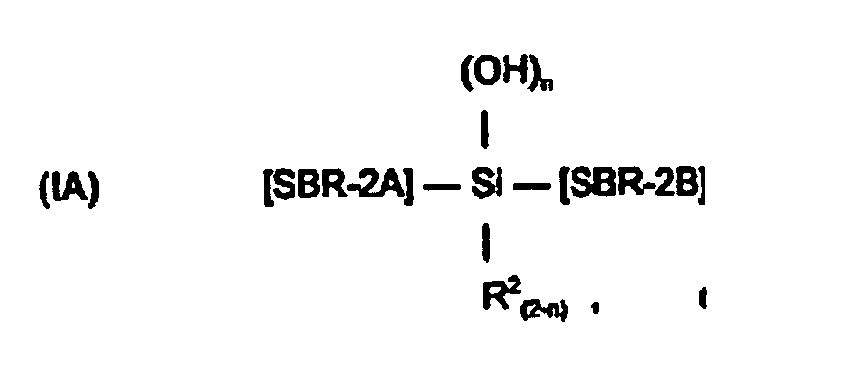
dans lequel ledit SBR-2 répond à la formule (IB) :dans laquelle R1 représente un radical choisi parmi le groupe comprenant un radical méthyle, un radical éthyle, un radical propyle, un radical butyle et un radical phényle, et R2 représente un radical choisi parmi le groupe comprenant un radical isopropyle, un radical tert-butyle, un radical phényle et un radical tolyle, et n représente une valeur de 1 à 2.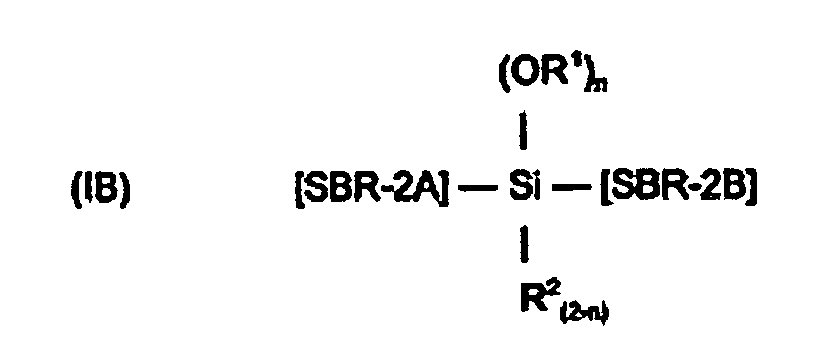
- Bandage pneumatique selon la revendication 3, dans lequel n est égal à 2.
- Bandage pneumatique selon l'une quelconque des revendications précédentes, dans lequel ledit agent de couplage est un silane organosulfuré répondant à la formule générale (II) :
- Bandage pneumatique selon l'une quelconque des revendications précédentes, dans lequel ladite silice précipitée, avant son mélange avec ledit ou lesdits élastomères, est soumise :ledit alkylsilane répond à la formule générale (III), à savoir :(A) à un prétraitement avec un alkylsilane répondant à la formule générale (III) avant son mélange avec ledit ou lesdits élastomères et ledit agent de couplage ;(B) à un prétraitement avec un agent de couplage répondant à la formule (II) ;(C) à un prétraitement avec un organomercaptosilane répondant à la formule (IV) ; ou(D) à un prétraitement avec une combinaison dudit alkylsilane répondant à la formule (III) avec(1) ledit agent de couplage répondant à la formule générale (II) et/ou(2) ledit organomercaptosilane répondant à la formule (IV),
ledit organomercaptosilane répond à la formule générale (IV), à savoir : - Bandage pneumatique selon la revendication 6, dans lequel, pour ladite formule (IV), X représente un atome de chlore et R7 est choisi parmi le groupe comprenant un radical méthyle et un radical éthyle, et n représente une valeur moyenne égale à 3.
- Bandage pneumatique selon la revendication 6, dans lequel lesdits alkylsilanes répondant à la formule (III) représentent au moins un membre choisi parmi le groupe constitué par le trichlorométhylsilane, le dichlorodiméthylsilane, le chlorotriméthylsilane, le triméthoxyméthylsilane, le diméthoxydiméthylsilane, le méthoxytriméthylsilane, le triméthoxypropylsilane, le triméthoxyoctylsilane, le triméthoxyhexadécylsilane, le diméthoxydipropylsilane, le triéthoxyméthylsilane et le diéthoxydiméthylsilane ; et
dans lequel lesdits organomercaptosilanes répondant à la formule (IV) représentent au moins un membre choisi parmi le groupe constitué par le mercaptométhyltriméthoxysilane, le mercaptoéthyltriméthoxysilane, le mercaptopropyltriméthoxysilane, le mercaptométhyltriéthoxysilane, le mercaptoéthyltripropoxysilane, le mercaptopropyltriéthoxysilane et le mercaptopropyltriméthoxysilane. - Bandage pneumatique selon l'une quelconque des revendications précédentes, dans lequel ladite composition de caoutchouc contient ledit composite d'amidon/plastifiant à concurrence de 1 à 10 phr.
- Bandage pneumatique selon la revendication 1, dans lequel ledit agent de couplage est une combinaison d'un bis-(3-triéthoxysilylpropyl) polysulfure possédant en moyenne de 2 à 2,5 atomes de soufre de liaison dans son pont polysulfure et d'un bis-(3-triéthoxysilylpropyl) polysulfure possédant en moyenne de 3 à 4 atomes de soufre de liaison dans son pont polysulfure, ledit polysulfure possédant en moyenne de 2 à 2,5 atomes de soufre de liaison dans son pont polysulfure étant mélangés avec ladite composition de caoutchouc en l'absence de soufre et d'un accélérateur de vulcanisation au soufre, et ledit polysulfure possédant en moyenne de 3 à 4 atomes de soufre de liaison dans son pont polysulfure étant par la suite mélangé avec ladite composition de caoutchouc en présence de soufre et d'au moins un accélérateur de vulcanisation au soufre.
Applications Claiming Priority (2)
| Application Number | Priority Date | Filing Date | Title |
|---|---|---|---|
| US41139602P | 2002-09-17 | 2002-09-17 | |
| US411396P | 2002-09-17 |
Publications (2)
| Publication Number | Publication Date |
|---|---|
| EP1400560A1 EP1400560A1 (fr) | 2004-03-24 |
| EP1400560B1 true EP1400560B1 (fr) | 2005-10-26 |
Family
ID=31946979
Family Applications (1)
| Application Number | Title | Priority Date | Filing Date |
|---|---|---|---|
| EP03103360A Expired - Lifetime EP1400560B1 (fr) | 2002-09-17 | 2003-09-11 | Pneus ayant un composant à base de caoutchouc fait à partir d'un élastomère styrène/butadiène ayant des fonctions silanoles et/ou siloxy pendantes |
Country Status (3)
| Country | Link |
|---|---|
| US (1) | US7071251B2 (fr) |
| EP (1) | EP1400560B1 (fr) |
| DE (1) | DE60302026T2 (fr) |
Cited By (1)
| Publication number | Priority date | Publication date | Assignee | Title |
|---|---|---|---|---|
| US20100184912A1 (en) * | 2007-04-18 | 2010-07-22 | Societe De Technologie Michelin | Monomodal coupled diene elastomer having a silanol functional group in the middle of the chain, its process of preparation and rubber composition comprising it |
Families Citing this family (23)
| Publication number | Priority date | Publication date | Assignee | Title |
|---|---|---|---|---|
| WO2005002391A2 (fr) * | 2003-06-24 | 2005-01-13 | Best Rite Manufacturing | Plateau encapsule, bouchons d'extremite, et procede de fabrication associe pour un tableau |
| US20050171267A1 (en) * | 2004-01-29 | 2005-08-04 | Zanzig David J. | Tire with component of rubber composition comprised of functionalized styrene/butadiene elastomer, silica and styrene/alpha methylstyrene resin |
| JP5501563B2 (ja) * | 2004-07-29 | 2014-05-21 | コンパニー ゼネラール デ エタブリッスマン ミシュラン | 亜鉛を含まない又は実質的に含まないゴム組成物 |
| FR2880354B1 (fr) * | 2004-12-31 | 2007-03-02 | Michelin Soc Tech | Composition elastomerique renforcee d'une charge de polyvinylaromatique fonctionnalise |
| JP4499658B2 (ja) | 2005-12-26 | 2010-07-07 | 住友ゴム工業株式会社 | ゴム組成物およびそれを用いた空気入りタイヤ |
| US7476708B2 (en) * | 2006-12-21 | 2009-01-13 | The Goodyear Tire & Rubber Company | Tire with a component made of a rubber composition comprised of a rubber having pendant hydroxyl groups and a nonsulfur containing silane |
| US8522847B2 (en) * | 2007-12-17 | 2013-09-03 | The Goodyear Tire & Rubber Company | Tire with tread rubber composition which contains dual silica moieties |
| IN2012DN02519A (fr) * | 2009-08-27 | 2015-08-28 | Columbian Chem | |
| US8459319B2 (en) * | 2009-08-31 | 2013-06-11 | The Goodyear Tire & Rubber Company | Tire with rubber tread containing combination of resin blend and functionalized elastomer |
| US9200147B2 (en) | 2010-06-29 | 2015-12-01 | Eastman Chemical Company | Processes for making cellulose ester compositions |
| US9273195B2 (en) | 2010-06-29 | 2016-03-01 | Eastman Chemical Company | Tires comprising cellulose ester/elastomer compositions |
| US8312905B2 (en) | 2010-09-24 | 2012-11-20 | The Goodyear Tire & Rubber Company | Pneumatic tire |
| US20120123018A1 (en) * | 2010-11-17 | 2012-05-17 | Carlo Kanz | Pneumatic tire |
| FR2968006B1 (fr) | 2010-11-26 | 2012-12-21 | Michelin Soc Tech | Bande de roulement de pneumatique |
| US20120157568A1 (en) * | 2010-12-21 | 2012-06-21 | Paul Harry Sandstrom | Silica reinforced rubber composition with combination of functionalized elastomer, liquid polymer and resin and tire with tread thereof |
| US9708474B2 (en) * | 2011-12-07 | 2017-07-18 | Eastman Chemical Company | Cellulose esters in pneumatic tires |
| US20130289183A1 (en) * | 2012-04-26 | 2013-10-31 | Michael Lester Kerns | Triglyceride containing solution polymerization prepared styrene/butadiene elastomer and tire with component |
| US10435545B2 (en) | 2012-04-26 | 2019-10-08 | The Goodyear Tire & Rubber Company | Triglyceride containing solution polymerization prepared styrene/butadiene elastomer and tire with component |
| US8772374B2 (en) * | 2012-10-22 | 2014-07-08 | The Goodyear Tire & Rubber Company | Preparation of silica reinforced rubber composition and tire with component thereof |
| US10077342B2 (en) | 2016-01-21 | 2018-09-18 | Eastman Chemical Company | Elastomeric compositions comprising cellulose ester additives |
| FR3061187B1 (fr) * | 2016-12-22 | 2019-02-01 | Compagnie Generale Des Etablissements Michelin | Composition de caoutchouc avec une bonne dispersion de quantites elevees de charge inorganique renforcante |
| EP3984765B1 (fr) * | 2019-12-05 | 2026-02-25 | Sumitomo Rubber Industries, Ltd. | Pneu |
| KR20230075406A (ko) * | 2020-09-28 | 2023-05-31 | 아란세오 도이치란드 게엠베하 | 부분 수소화 디엔 중합체 |
Family Cites Families (4)
| Publication number | Priority date | Publication date | Assignee | Title |
|---|---|---|---|---|
| JPH04354839A (ja) | 1991-05-31 | 1992-12-09 | Sumitomo Electric Ind Ltd | 時計用外装部品及びその製造方法 |
| FR2740778A1 (fr) | 1995-11-07 | 1997-05-09 | Michelin & Cie | Composition de caoutchouc a base de silice et de polymere dienique fonctionalise ayant une fonction silanol terminale |
| US5672639A (en) * | 1996-03-12 | 1997-09-30 | The Goodyear Tire & Rubber Company | Starch composite reinforced rubber composition and tire with at least one component thereof |
| FR2763074B1 (fr) | 1997-05-07 | 1999-06-25 | Michelin & Cie | Composition de caoutchouc a base de noir de carbone ayant de la silice fixee a sa surface et de polymere dyenique fonctionalise ou modifie par des fonctions silanols |
-
2003
- 2003-07-28 US US10/628,679 patent/US7071251B2/en not_active Expired - Fee Related
- 2003-09-11 DE DE60302026T patent/DE60302026T2/de not_active Expired - Fee Related
- 2003-09-11 EP EP03103360A patent/EP1400560B1/fr not_active Expired - Lifetime
Cited By (3)
| Publication number | Priority date | Publication date | Assignee | Title |
|---|---|---|---|---|
| US20100184912A1 (en) * | 2007-04-18 | 2010-07-22 | Societe De Technologie Michelin | Monomodal coupled diene elastomer having a silanol functional group in the middle of the chain, its process of preparation and rubber composition comprising it |
| CN101674946B (zh) * | 2007-04-18 | 2011-12-14 | 米其林技术公司 | 在链的中间具有硅烷醇官能团的单峰偶联二烯弹性体,其制备方法及包含该二烯弹性体的橡胶组合物 |
| US8344063B2 (en) * | 2007-04-18 | 2013-01-01 | Michelin Recherche Et Technique S.A. | Monomodal coupled diene elastomer having a silanol functional group in the middle of the chain, its process of preparation and rubber composition comprising it |
Also Published As
| Publication number | Publication date |
|---|---|
| US20040116587A1 (en) | 2004-06-17 |
| US7071251B2 (en) | 2006-07-04 |
| DE60302026T2 (de) | 2006-07-13 |
| EP1400560A1 (fr) | 2004-03-24 |
| DE60302026D1 (de) | 2005-12-01 |
Similar Documents
| Publication | Publication Date | Title |
|---|---|---|
| EP1400559B1 (fr) | Pneu ayant un composant à base de caoutchouc fait à partir d'un élastomère fonctionalisé par un groupe silanol ou un groupe siloxy, et de silice | |
| US7071251B2 (en) | Tire with component comprised of rubber composite of styrene/butadiene elastomer containing pendent silanol and/or siloxy groups | |
| EP1559586B1 (fr) | Pneumatique comportant un élément ayant une composition caoutchouteuse comprenant un élastomère styrène/butadiène fonctionalisé, de la silice et une résine styrène/alpha méthyle styrène | |
| EP1398347B1 (fr) | Composition de caoutchouc enrichie en cis 1,4-polybutadiène et contenant un élastomère styrène/butadiène fonctionalisé, de la silice et un agent de couplage | |
| EP1459907B1 (fr) | Pneu comportant une bande de roulement et un flanc, contenant un caoutchouc à faible émission d'hydrocarbures et ayant des limitations de composition | |
| US7906593B2 (en) | Rubber composition containing an alkoxysilane coupled in-chain functionalized elastomer and tire with component thereof | |
| EP1282659B1 (fr) | Transformabilite amelioree de caoutchouc renforce de silice contenant un compose amide | |
| US6608145B1 (en) | Silica-reinforced rubber compounded with an organosilane tetrasulfide silica coupling agent at high mixing temperature | |
| RU2748399C2 (ru) | Новые армирующие материалы, эластомерные композиции и шины для колес транспортных средств, их содержащие | |
| US10087306B2 (en) | Additive for silica reinforced rubber formulations | |
| US7262254B2 (en) | Tire with low volatile alcohol emission rubber tread with compositional limitations | |
| CN1141311A (zh) | 二氧化硅补强橡胶的制备和具有这种外胎面的轮胎 | |
| US20060058442A1 (en) | Tire with silica reinforced tread containing specialized high vinyl styrene/butadiene elastomer and alkoxyorganomercaptosilane | |
| EP1518895A1 (fr) | Composant pour pneumatique comprenant un mélange d'un caoutchouc polybutadiène et d'un composite à base d'un élastomère styrène/butadiène et de renforcements exfoliés d'argile | |
| JP4796702B2 (ja) | 重負荷用タイヤ、及びこのタイヤにおける不規則な摩耗を遅らせるためのゴム組成物 | |
| EP1514900B1 (fr) | Pneu pour materiel agricole ayant une bande de roulement à base d'une composition de caoutchouc contenant un matériau composite amidon/plastifiant | |
| JP3546586B2 (ja) | ゴム組成物、ゴム組成物の製造方法及びタイヤトレッド | |
| CN107011552B (zh) | 硫化橡胶组合物和使用有该硫化橡胶组合物的轮胎 | |
| EP3888939B1 (fr) | Composition de caoutchouc pour pneumatique | |
| JP4438336B2 (ja) | トレッド用ゴム組成物およびそれを用いたタイヤ | |
| JP3570064B2 (ja) | ゴム組成物 | |
| JP2001098112A (ja) | タイヤトレッド用ゴム組成物 |
Legal Events
| Date | Code | Title | Description |
|---|---|---|---|
| PUAI | Public reference made under article 153(3) epc to a published international application that has entered the european phase |
Free format text: ORIGINAL CODE: 0009012 |
|
| AK | Designated contracting states |
Kind code of ref document: A1 Designated state(s): AT BE BG CH CY CZ DE DK EE ES FI FR GB GR HU IE IT LI LU MC NL PT RO SE SI SK TR |
|
| AX | Request for extension of the european patent |
Extension state: AL LT LV MK |
|
| 17P | Request for examination filed |
Effective date: 20040924 |
|
| AKX | Designation fees paid |
Designated state(s): DE FR GB |
|
| GRAP | Despatch of communication of intention to grant a patent |
Free format text: ORIGINAL CODE: EPIDOSNIGR1 |
|
| GRAS | Grant fee paid |
Free format text: ORIGINAL CODE: EPIDOSNIGR3 |
|
| GRAA | (expected) grant |
Free format text: ORIGINAL CODE: 0009210 |
|
| AK | Designated contracting states |
Kind code of ref document: B1 Designated state(s): DE FR GB |
|
| REG | Reference to a national code |
Ref country code: GB Ref legal event code: FG4D |
|
| REF | Corresponds to: |
Ref document number: 60302026 Country of ref document: DE Date of ref document: 20051201 Kind code of ref document: P |
|
| ET | Fr: translation filed | ||
| PLBE | No opposition filed within time limit |
Free format text: ORIGINAL CODE: 0009261 |
|
| STAA | Information on the status of an ep patent application or granted ep patent |
Free format text: STATUS: NO OPPOSITION FILED WITHIN TIME LIMIT |
|
| 26N | No opposition filed |
Effective date: 20060727 |
|
| PGFP | Annual fee paid to national office [announced via postgrant information from national office to epo] |
Ref country code: GB Payment date: 20070809 Year of fee payment: 5 |
|
| PGFP | Annual fee paid to national office [announced via postgrant information from national office to epo] |
Ref country code: FR Payment date: 20080904 Year of fee payment: 6 |
|
| PGFP | Annual fee paid to national office [announced via postgrant information from national office to epo] |
Ref country code: DE Payment date: 20080930 Year of fee payment: 6 |
|
| GBPC | Gb: european patent ceased through non-payment of renewal fee |
Effective date: 20080911 |
|
| PG25 | Lapsed in a contracting state [announced via postgrant information from national office to epo] |
Ref country code: GB Free format text: LAPSE BECAUSE OF NON-PAYMENT OF DUE FEES Effective date: 20080911 |
|
| REG | Reference to a national code |
Ref country code: FR Ref legal event code: ST Effective date: 20100531 |
|
| PG25 | Lapsed in a contracting state [announced via postgrant information from national office to epo] |
Ref country code: FR Free format text: LAPSE BECAUSE OF NON-PAYMENT OF DUE FEES Effective date: 20090930 Ref country code: DE Free format text: LAPSE BECAUSE OF NON-PAYMENT OF DUE FEES Effective date: 20100401 |