EP1400788A1 - Sensor zur Flüssigkeitspegel- und Blasendetektion - Google Patents
Sensor zur Flüssigkeitspegel- und Blasendetektion Download PDFInfo
- Publication number
- EP1400788A1 EP1400788A1 EP03078110A EP03078110A EP1400788A1 EP 1400788 A1 EP1400788 A1 EP 1400788A1 EP 03078110 A EP03078110 A EP 03078110A EP 03078110 A EP03078110 A EP 03078110A EP 1400788 A1 EP1400788 A1 EP 1400788A1
- Authority
- EP
- European Patent Office
- Prior art keywords
- sensor
- signal
- bit count
- circuitry
- sampling
- Prior art date
- Legal status (The legal status is an assumption and is not a legal conclusion. Google has not performed a legal analysis and makes no representation as to the accuracy of the status listed.)
- Granted
Links
Images


Classifications
-
- F—MECHANICAL ENGINEERING; LIGHTING; HEATING; WEAPONS; BLASTING
- F16—ENGINEERING ELEMENTS AND UNITS; GENERAL MEASURES FOR PRODUCING AND MAINTAINING EFFECTIVE FUNCTIONING OF MACHINES OR INSTALLATIONS; THERMAL INSULATION IN GENERAL
- F16N—LUBRICATING
- F16N29/00—Special means in lubricating arrangements or systems providing for the indication or detection of undesired conditions; Use of devices responsive to conditions in lubricating arrangements or systems
- F16N29/04—Special means in lubricating arrangements or systems providing for the indication or detection of undesired conditions; Use of devices responsive to conditions in lubricating arrangements or systems enabling a warning to be given; enabling moving parts to be stopped
-
- F—MECHANICAL ENGINEERING; LIGHTING; HEATING; WEAPONS; BLASTING
- F04—POSITIVE - DISPLACEMENT MACHINES FOR LIQUIDS; PUMPS FOR LIQUIDS OR ELASTIC FLUIDS
- F04B—POSITIVE-DISPLACEMENT MACHINES FOR LIQUIDS; PUMPS
- F04B39/00—Component parts, details, or accessories, of pumps or pumping systems specially adapted for elastic fluids, not otherwise provided for in, or of interest apart from, groups F04B25/00 - F04B37/00
- F04B39/02—Lubrication
- F04B39/0207—Lubrication with lubrication control systems
-
- F—MECHANICAL ENGINEERING; LIGHTING; HEATING; WEAPONS; BLASTING
- F04—POSITIVE - DISPLACEMENT MACHINES FOR LIQUIDS; PUMPS FOR LIQUIDS OR ELASTIC FLUIDS
- F04B—POSITIVE-DISPLACEMENT MACHINES FOR LIQUIDS; PUMPS
- F04B39/00—Component parts, details, or accessories, of pumps or pumping systems specially adapted for elastic fluids, not otherwise provided for in, or of interest apart from, groups F04B25/00 - F04B37/00
- F04B39/02—Lubrication
- F04B39/0215—Lubrication characterised by the use of a special lubricant
-
- F—MECHANICAL ENGINEERING; LIGHTING; HEATING; WEAPONS; BLASTING
- F16—ENGINEERING ELEMENTS AND UNITS; GENERAL MEASURES FOR PRODUCING AND MAINTAINING EFFECTIVE FUNCTIONING OF MACHINES OR INSTALLATIONS; THERMAL INSULATION IN GENERAL
- F16N—LUBRICATING
- F16N29/00—Special means in lubricating arrangements or systems providing for the indication or detection of undesired conditions; Use of devices responsive to conditions in lubricating arrangements or systems
-
- G—PHYSICS
- G01—MEASURING; TESTING
- G01F—MEASURING VOLUME, VOLUME FLOW, MASS FLOW OR LIQUID LEVEL; METERING BY VOLUME
- G01F1/00—Measuring the volume flow or mass flow of fluid or fluent solid material wherein the fluid passes through a meter in a continuous flow
- G01F1/74—Devices for measuring flow of a fluid or flow of a fluent solid material in suspension in another fluid
-
- G—PHYSICS
- G01—MEASURING; TESTING
- G01F—MEASURING VOLUME, VOLUME FLOW, MASS FLOW OR LIQUID LEVEL; METERING BY VOLUME
- G01F23/00—Indicating or measuring liquid level or level of fluent solid material, e.g. indicating in terms of volume or indicating by means of an alarm
- G01F23/22—Indicating or measuring liquid level or level of fluent solid material, e.g. indicating in terms of volume or indicating by means of an alarm by measuring physical variables, other than linear dimensions, pressure or weight, dependent on the level to be measured, e.g. by difference of heat transfer of steam or water
- G01F23/28—Indicating or measuring liquid level or level of fluent solid material, e.g. indicating in terms of volume or indicating by means of an alarm by measuring physical variables, other than linear dimensions, pressure or weight, dependent on the level to be measured, e.g. by difference of heat transfer of steam or water by measuring the variations of parameters of electromagnetic or acoustic waves applied directly to the liquid or fluent solid material
- G01F23/284—Electromagnetic waves
- G01F23/292—Light, e.g. infrared or ultraviolet
- G01F23/2921—Light, e.g. infrared or ultraviolet for discrete levels
- G01F23/2922—Light, e.g. infrared or ultraviolet for discrete levels with light-conducting sensing elements, e.g. prisms
-
- G—PHYSICS
- G01—MEASURING; TESTING
- G01F—MEASURING VOLUME, VOLUME FLOW, MASS FLOW OR LIQUID LEVEL; METERING BY VOLUME
- G01F23/00—Indicating or measuring liquid level or level of fluent solid material, e.g. indicating in terms of volume or indicating by means of an alarm
- G01F23/22—Indicating or measuring liquid level or level of fluent solid material, e.g. indicating in terms of volume or indicating by means of an alarm by measuring physical variables, other than linear dimensions, pressure or weight, dependent on the level to be measured, e.g. by difference of heat transfer of steam or water
- G01F23/28—Indicating or measuring liquid level or level of fluent solid material, e.g. indicating in terms of volume or indicating by means of an alarm by measuring physical variables, other than linear dimensions, pressure or weight, dependent on the level to be measured, e.g. by difference of heat transfer of steam or water by measuring the variations of parameters of electromagnetic or acoustic waves applied directly to the liquid or fluent solid material
- G01F23/284—Electromagnetic waves
- G01F23/292—Light, e.g. infrared or ultraviolet
- G01F23/2921—Light, e.g. infrared or ultraviolet for discrete levels
- G01F23/2922—Light, e.g. infrared or ultraviolet for discrete levels with light-conducting sensing elements, e.g. prisms
- G01F23/2925—Light, e.g. infrared or ultraviolet for discrete levels with light-conducting sensing elements, e.g. prisms using electrical detecting means
-
- F—MECHANICAL ENGINEERING; LIGHTING; HEATING; WEAPONS; BLASTING
- F04—POSITIVE - DISPLACEMENT MACHINES FOR LIQUIDS; PUMPS FOR LIQUIDS OR ELASTIC FLUIDS
- F04B—POSITIVE-DISPLACEMENT MACHINES FOR LIQUIDS; PUMPS
- F04B2205/00—Fluid parameters
- F04B2205/08—Pressure difference over a throttle
-
- F—MECHANICAL ENGINEERING; LIGHTING; HEATING; WEAPONS; BLASTING
- F04—POSITIVE - DISPLACEMENT MACHINES FOR LIQUIDS; PUMPS FOR LIQUIDS OR ELASTIC FLUIDS
- F04B—POSITIVE-DISPLACEMENT MACHINES FOR LIQUIDS; PUMPS
- F04B2207/00—External parameters
- F04B2207/03—External temperature
-
- F—MECHANICAL ENGINEERING; LIGHTING; HEATING; WEAPONS; BLASTING
- F16—ENGINEERING ELEMENTS AND UNITS; GENERAL MEASURES FOR PRODUCING AND MAINTAINING EFFECTIVE FUNCTIONING OF MACHINES OR INSTALLATIONS; THERMAL INSULATION IN GENERAL
- F16N—LUBRICATING
- F16N2230/00—Signal processing
- F16N2230/18—Switches
- F16N2230/19—Photo sensor
-
- F—MECHANICAL ENGINEERING; LIGHTING; HEATING; WEAPONS; BLASTING
- F16—ENGINEERING ELEMENTS AND UNITS; GENERAL MEASURES FOR PRODUCING AND MAINTAINING EFFECTIVE FUNCTIONING OF MACHINES OR INSTALLATIONS; THERMAL INSULATION IN GENERAL
- F16N—LUBRICATING
- F16N2260/00—Fail safe
- F16N2260/02—Indicating
- F16N2260/04—Oil level
-
- F—MECHANICAL ENGINEERING; LIGHTING; HEATING; WEAPONS; BLASTING
- F25—REFRIGERATION OR COOLING; COMBINED HEATING AND REFRIGERATION SYSTEMS; HEAT PUMP SYSTEMS; MANUFACTURE OR STORAGE OF ICE; LIQUEFACTION SOLIDIFICATION OF GASES
- F25B—REFRIGERATION MACHINES, PLANTS OR SYSTEMS; COMBINED HEATING AND REFRIGERATION SYSTEMS; HEAT PUMP SYSTEMS
- F25B1/00—Compression machines, plants or systems with non-reversible cycle
- F25B1/04—Compression machines, plants or systems with non-reversible cycle with compressor of rotary type
- F25B1/047—Compression machines, plants or systems with non-reversible cycle with compressor of rotary type of screw type
-
- F—MECHANICAL ENGINEERING; LIGHTING; HEATING; WEAPONS; BLASTING
- F25—REFRIGERATION OR COOLING; COMBINED HEATING AND REFRIGERATION SYSTEMS; HEAT PUMP SYSTEMS; MANUFACTURE OR STORAGE OF ICE; LIQUEFACTION SOLIDIFICATION OF GASES
- F25B—REFRIGERATION MACHINES, PLANTS OR SYSTEMS; COMBINED HEATING AND REFRIGERATION SYSTEMS; HEAT PUMP SYSTEMS
- F25B2700/00—Sensing or detecting of parameters; Sensors therefor
- F25B2700/03—Oil level
-
- F—MECHANICAL ENGINEERING; LIGHTING; HEATING; WEAPONS; BLASTING
- F25—REFRIGERATION OR COOLING; COMBINED HEATING AND REFRIGERATION SYSTEMS; HEAT PUMP SYSTEMS; MANUFACTURE OR STORAGE OF ICE; LIQUEFACTION SOLIDIFICATION OF GASES
- F25B—REFRIGERATION MACHINES, PLANTS OR SYSTEMS; COMBINED HEATING AND REFRIGERATION SYSTEMS; HEAT PUMP SYSTEMS
- F25B2700/00—Sensing or detecting of parameters; Sensors therefor
- F25B2700/04—Refrigerant level
-
- F—MECHANICAL ENGINEERING; LIGHTING; HEATING; WEAPONS; BLASTING
- F25—REFRIGERATION OR COOLING; COMBINED HEATING AND REFRIGERATION SYSTEMS; HEAT PUMP SYSTEMS; MANUFACTURE OR STORAGE OF ICE; LIQUEFACTION SOLIDIFICATION OF GASES
- F25B—REFRIGERATION MACHINES, PLANTS OR SYSTEMS; COMBINED HEATING AND REFRIGERATION SYSTEMS; HEAT PUMP SYSTEMS
- F25B31/00—Compressor arrangements
- F25B31/002—Lubrication
- F25B31/004—Lubrication oil recirculating arrangements
Definitions
- the present invention is directed to a liquid level sensor for an air conditioning or refrigeration system.
- the system is an active and robust system which uses a binary sensor to provide an analog output.
- the present invention is discussed in terms of lubricating screw compressors for air conditioning systems, but is contemplated to apply to all systems whatever the application.
- screw compressors require oil flow to the compressor so as to lubricate bearings and prevent long term degradation's of the bearings. Additionally, oil flow is needed to seal the rotors in a screw compressor to avoid reduced performance and to cool the rotors to prevent frictional heating.
- Oil flow is needed by a compressor to lubricate the bearings and enhance their life. Additionally, in screw and scroll compressors, oil is used to seal the rotors, the absence of such a seal resulting in reduced compressor performance. Also, the lubrication of rotors can prevent frictional heating while cooling the rotors, and can prevent the radial growth and interference of rotors with adjacent compressor components. If the oil circulation system fails and compressor operation is allowed to continue, compressor failure and damage will ultimately result.
- a system is desired which proves that a flow of lubricant is high in oil quantity (i.e., less than 30% refrigerant by weight).
- the present invention provides a sensor system.
- the sensor system comprises a binary sensor issuing a signal representative of a first or second condition; sampling circuitry, operatively connected to the binary sensor, for monitoring the number of transitions between the first and second conditions during a sampling period; integration circuitry for accumulating the sampled number of transitions over time; and signal generation circuitry for issuing an analog signal representative of the accumulated transitions.
- the present invention further provides a method of using a sensor.
- the method comprises the steps of: sensing a condition; transmitting a binary signal having either a first state or a second state indicative of the sensed condition; determining either a first or a second mode of operation of a prime mover to be in effect; operating the prime mover, in the first mode of operation, responsive to the first or second state of the binary signal; and operating the prime mover, in the second mode of operation, responsive to the rate of transition of the binary signal between the first and second states.
- the present invention still further provides a controller and sensor.
- the controller and sensor comprise a liquid level sensor monitoring the presence or absence of a liquid and providing a binary signal indicative of the presence or absence of the liquid; and a controller operably connected to the sensor and receiving the binary signal.
- the controller includes components to sample the rate of transitions of the binary signal between a presence indicating signal and an absence indicating signal and to convert the sampled signal to an analog signal.
- the controller further includes components to integrate the analog signal and to issue control signals responsive to that integrated accumulation.
- the present invention yet further provides the circuitry for using a digital sensor as an analog sensor.
- the circuitry comprises a digital sensor issuing a binary signal having a first or a second state; sampling circuitry for receiving the binary signal, for sampling the state of the binary signal at a moment in time, and converting the sampled signal to a signal representative of a bit count; integrator circuitry to integrate the bit count over time; and circuitry to transmit an analog signal representative of the accumulated integral.
- the present invention additionally provides a method of using a digital sensor as an analog sensor.
- the method comprises the steps of: measuring a binary state with a digital sensor; constantly transmitting a binary signal indicative of either a first or a second binary state; sampling the transmitted signal at a first sampling rate to determine a bit count; integrating the product of the bit count over time; and issuing an analog signal reflected of the integrated bit count accumulation.
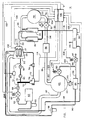
- FIG. 1 shows an air conditioning or refrigeration system 10.
- the system 10 includes three subsystems: a temperature conditioning system 12 (illustrated by wide double lines) which conditions the temperature of a fluid, a lubrication system 16 (illustrated by narrow double lines) which lubricates the mechanical components of the conditioning system 12, and a control system 18 (illustrated by single lines) which coordinates and controls the operation of the conditioning system 12 and the lubrication system 16.
- a temperature conditioning system 12 illustrated by wide double lines
- a lubrication system 16 illustrated by narrow double lines
- control system 18 illustrated by single lines
- the conditioning system 12 includes a compressor 20 which compresses a refrigerant and directs the compressed refrigerant and lubricant from a compressor rotor 21 and a compressor bearing 23 through a compressor discharge 22 to one or more oil separators 24.
- Exemplary compressors are shown in U.S. Patents 5,341,658 to Roach et al., 5,201,648 to Lakowske and 5,203,685 to Andersen et al. and exemplary oil separators are shown in U.S. Patents 5,502,984 to Boehde et al. and 5,029,448 to Carey, all of which are commonly assigned with the present invention and all of which are incorporated herein by reference.
- the lubricant and the refrigerant are separated into a primarily lubricant mixture and a primarily refrigerant mixture.
- the primarily refrigerant mixture (with some entrained lubricant) is directed by conduit 26 to a condenser 28 where the refrigerant is condensed from a hot vapor to a hot liquid.
- the hot liquid refrigerant passes through conduit 30 to an expansion valve 32.
- the expansion valve 32 meters the operation of the conditioning system by controlling the flow of the hot liquid refrigerant from the condenser 28.
- the hot liquid refrigerant leaving the expansion valve 32 enters conduit 34 where some of the liquid refrigerant flashes into a hot vapor leaving a cooler liquid refrigerant.
- the mixture of vapor and liquid refrigerant enters a liquid vapor separator 36 where the hot vapor is separated out and preferably directed to the compressor 20.
- the cooled liquid mixture leaves the liquid vapor separator 36 by means of conduit 38 and enters an evaporator 40 where the refrigerant cools the fluid, the refrigerant vaporizing in the process.
- Lubricant entrained in the primarily refrigerant mixture remains and pools in the bottom 44 of the evaporator 40.
- a conduit 42 directs the hot vaporous refrigerant from the evaporator 40 back to the compressor 20 to continue the temperature conditioning cycle.
- the lubrication system 16 includes the compressor 20 where a lubricant is injected or provided to the compressor rotor or rotors 21 and to the compressor bearing or bearings 23.
- the lubricant mixes with the refrigerant and the lubricant/refrigerant mixture exits through the compressor discharge 22 to the oil separator 24.
- the oil separator 24 separates the lubricant/refrigerant mixture into a primarily lubricant mixture and a primarily refrigerant mixture.
- the primarily lubricant is directed by conduit 50 to an oil sump 52.
- the oil sump 52 includes a vent 54 and an oil heater 56.
- the conduit 58 also includes a master oil line solenoid 66 for automatic control of flow of lubricant through the conduit 58 and includes a manual service valve 68.
- the conduit 58 ultimately directs the primarily lubricant mixture to a large capacity, vertical line 70 which acts as a trap during compressor shutdown.
- the vertical line 70 feeds a rotor feed line 72 providing lubricant to the compressor rotor or rotors 21 and feeds a bearing feed line 74 providing lubricant to the compressor bearing or bearings 23.
- the rotor feed line 72 includes an optical oil detector 76 such as the S-9400 series level switch sold by AC&R Components of Chatham, IL and also includes an oil charging service port 78 for adding or removing oil lubricant.
- the bearing feed line 74 includes a check valve 80 and a restrictor orifice 82.
- a differential pressure switch 84 is provided and arranged about the restrictor orifice so as to measure a differential pressure across that orifice 82.
- the lubrication system 16 also includes an oil return gas pump 86 for returning pooled lubricant from the bottom 44 of the evaporator 40.
- the oil return gas pump 86 returns the lubricant that accumulates from the refrigerant mixture as the refrigerant vaporizes in the evaporator 40.
- the accumulated lubricant passes through conduit 96 and a filter 98 and is returned to the compressor 20.
- a vent line 88 whose operation is controlled by a fill solenoid 90, and a condenser pressure conduit 92 whose operation is controlled by a drain solenoid valve 94.
- the control system 18 includes a controller 100 which may be implemented as a single controller or a plurality of controllers working in concert.
- the controller 100 is operably connected to the compressor 20 by an electrical line 102 so as to control the operation and capacity of the compressor 20.
- the controller 100 also controls the operation of the expansion valve by means of an electrical line 104 and controls the operation of the oil heater 56, the master oil line solenoid 66, and the solenoid valves 90 and 94 by means of an electrical lines 106.
- the controller 100 also includes an electrical line 108 connecting the controller 100 to a compressor discharge temperature sensor 110 located in the compressor discharge 22 so as to sense the discharge temperature of the lubricant/refrigerant mixture, and an electrical line 132 connecting the controller 100 to a saturated condenser temperature sensor 130 so as to sense the saturated condenser temperature.
- the controller 100 is also connected by an electrical line 112 to the differential pressure sensor 84 so as to receive a signal representative of a differential pressure from the sensor 84.
- the controller 100 is also connected to the optical oil detector 76 by an electrical line 114 so as to receive a signal from the optical oil detector 76 representative of the presence of oil, refrigerant or foam.
- the controller 100 also includes a variety of other sensors including sensors 120 associated with the evaporator and connected to the controller 100 by electrical lines 122 so as to sense the delta T across the evaporator 40 in any conventional manner.
- the large capacity vertical line 70 is arranged to trap oil very near the compressor 20 at shutdown. Compressor start will not be allowed by the control system 18 until oil is detected by the oil detector sensor 76 thus guaranteeing a minimum volume of oil available at compressor start.
- the oil flow differential pressure sensor 84 is also checked in the off cycle to guard against a failed switch or a wiring fault.
- the discharge temperature sensor 110 is constantly monitored and compared against the saturated condenser temperature as determined by the sensor 130. The comparison of the saturated condenser temperature with the discharge temperature determines a discharge superheat. A low superheat condition suggests that the oil separator 24 will begin to separate liquid refrigerant along with the lubricant and thus the primarily lubricant mixture will become too dilute.
- the controller 100 has a "time to trip" integral so that, if the superheat is deemed to be too low for too long, the system 10 will safely shutdown.
- the superheat value below which indefinite operation is not allowed and the total integral trip point are each determined from empirical tests on an actual system.
- the differential pressure sensor 84 senses pressure across the orifice 82 and the check valve 80 in the bearing feed line 74.
- the differential pressure sensor 84 is calibrated for a switch point relating to a desired minimum oil flow rate and the sensor 84 basically indicates the presence or absence of that minimum oil flow rate.
- the orifice 82 serves to provide pressure drop to indicate actual flow, while balancing oil flow to the bearing 23 as compared to the oil flow to the rotor 21. Since previous compressors 20 had orifices located within the compressor, the removal of the orifice 82 outside the compressor 20 improves oil quality by extending the dwell time that the oil is at a lower pressure to thereby release more refrigerant to vapor before the lubricant enters the compressor 20 to lubricate the bearings 23.
- the longer dwell time helps vaporize any liquid refrigerant still entrained in the lubricant to ensure that a liquid comprising highly concentrated lubricant is used to lubricate the compressor 20.
- the pressure sensor 84 is constantly monitored in normal operation and will shutdown the system 10 if flow is lost for more than a predetermined time period such as two seconds.
- the oil detector sensor 76 was previously used only as a binary level switch but is used in the present invention additionally as an analog sensor for foam quality. This is described as follows.
- the oil flow in the rotor feed line 72 has only a small amount of vapor and the flow is generally clear with only a small amount of bubbles or foaming present.
- foaming in the line 72 is normal and must be differentiated from the very dry foam condition which occurs as oil is lost from the primary lubrication system 16 and the level of oil in the oil sump 52 falls.
- the sensor 76 uses an infrared LED 150 and a matching infrared detector 152 in conjunction with a conical glass prism 154 having an interface 156 exposed to the rotor feed line 72. Owing to the properties associated with the index of refraction of light as light passes through a glass to vapor interface as opposed to a glass to liquid interface, the light from the LED 150 is either reflected back to the detector 152 when vapor is present within the rotor feed line 72 or is only marginally reflected when oil is present within the rotor feed line 72. The detector 152 then controls an open collector transistor for a discrete binary output.
- the off state implies dry as illustrated by a liquid level at line 160
- the on state implies wet as illustrated by a liquid level at line 162.
- This concept has previously been patented by others as evidenced by U.S. Patent 5,278,426 to Barbier, the disclosure of which is hereby incorporated by reference. In these previous uses, the sensor was used solely at start-up when the liquid level had already stabilized so the liquid level could be sensed relative to the interface 156 such as shown by the liquid level lines 160 and 162.
- the interior of the large capacity vertical line 70 and the rotor feed line 72 represents a dynamic mix of liquid lubricant and refrigerant as well as vaporous refrigerant resulting in a foamy mix indicated by the bubbles 164.
- the sensor 76 can no longer be used because there is no stable liquid level to sense.
- the present invention enables the conventional sensor to be used in a dynamic environment to sense the quality of the foam, enabling the verification that enough lubricant is present in the foam to ensure proper compressor operation.
- the sensor 76 is used for foam determination.
- the internal components of the sensor 76 are selected so that the detector 152 has a gain lying within a desired range.
- the desired gain and the desired range are empirically determined based on the environment to be sensed and will vary with any particular lubricant and refrigerant combination. Only detectors 152 which meet the desired gain and range criteria are used in the sensor 76.
- the intensity of the LED 150 is then calibrated to get the correct output for the desired criteria. This calibrated intensity will vary with the environment being sensed specifically including the lubricant and the refrigerant combinations being sensed.
- the calibrated sensor 76 When such a calibrated sensor 76 is used in the oil protection system of the present invention, the calibrated sensor 76 creates a very "noisy" signal due to the random nature of foamy flow, reacting very quickly to the small vapor bubbles 164 moving over the prism 154 and reflecting light back to the detector 152. As the vapor content of the foam 158 in the rotor feed line 72 increases, so does the DC level of the signal from the sensor 76.
- Figure 3 depicts a block diagram 200 for processing the signal from the sensor 76 in the controller 100.
- This signal is processed by the controller 100 using special filtering to create an analog value representative of the foam content.
- a time to trip function is implemented in the software in the controller 100 to define a foam content level beyond which a time integral is begun and the ultimate trip value for the integral at which compressor operation is terminated.
- the values for the protection level were empirically determined.
- the signal from the sensor 76 is provided on an electrical line 202 and passes through a first order filter and voltage divider 204 which roughly filters the signal and converts the 24 VDC signal to a 5 VDC signal.
- the filter and voltage divider 204 includes a pull-up resistor 206, a 200 k ohm resistor 208, a 30.1 k ohm resistor 210, a 0.1 microfarad capacitor 212, diodes 214 and 216, a 100 k ohm resistor 218 and a 15 microfarad capacitor 220.
- these values are dependent upon the application and will vary accordingly.
- the signal After leaving the filter and voltage divider 204, the signal is sampled at a rate of 200 milliseconds by a sampler 222 and then the signal is converted to a 10 bit digital signal by the analog to digital converter 224.
- the resultant digital signal enters a infinite impulse response filter 226 having a time constant of 6.4 seconds.
- the filtered signal from the filter 226 is provided to a 24 volt compensator 228 which compensates for variations in the sensor supply voltage to avoid errors resulting from variations in the 24 VDC supply voltage, these errors typically ranging between 19 and 26 VDC.
- the compensated signal is passed to an integrator control 240, an offset and time scaling block 242 and an integrator 244.
- time scaling is unnecessary since the integration rate is the same as the sampling rate of 200 milliseconds used by the sampler 22. Otherwise, the data of one rate must be adjusted, prorated or synchronized to equate to the data sampled at the other rate.
- the offset portion of the block 242 is used to establish a desired level of lubricant quality.
- a desired level of lubricant quality may be established, or the accumulated integral may be used as a conventional analog signal.
- the integrated control 240 specifies a must integrate level of 778 bit counts, this level being an empirically determined offset level differentiating dry foam from lubricant laden foam and corresponding to 3.8 VDC.
- the integrate level 778 is empirically selected to avoid transient levels which might occur at start-up as well as any other transient fluctuations in the line level. Integration is enabled above this level and the integrator 244 will continue to integrate the product of bit count times time while the bit count remains above 778. The integration of new bit counts will terminate between 573 and 778 bit counts but the already integrated amount will be held unless the bit count level in the compensated signal drops below 573, this bit count being the equivalent of 2.8 VDC.
- the summed integral will be provided as an analog signal to a comparitor 246 which trips whenever the integrated bit count exceeds 3,200 bit count seconds. This trip count is empirically determined and will vary for any particular system or application. Protective action will be called for when the trip count is exceeded.
- the foam causes a high number of transitions between the high and low states, and the high number of transitions caused by such foam is treated as "chatter" and measured to determine an analog signal representative of the state of the fluid in the conduit 72.
- a binary sensor 76 provides an analog output representative of the quality of the bubbles 164.
- the integration circuitry includes an integration control which selects a first level of accumulated transitions above which integration is enabled.
- the integration control implements a second level below which the accumulated transitions are cleared.
- the second level is less than the first level.
- the sampling circuitry further includes a filter, a voltage divider, a sampler having a predetermined rate, and an analog to digital converter, all sequentially connected in the order named.
- the embodiment provides a binary output to monitor a fluid having three states, the arrangement comprising:
- the prime mover has an inactive state and an active state, and wherein the controller is responsive to the binary signal in the inactive state and is responsive to the analog signal in the active state.
- the sensor is a liquid level sensor monitoring the presence or absence of a liquid and providing a binary signal indicative of the presence or absence of the liquid; and the controller is operably connected to the sensor and receiving the binary signal, the controller including components to sample the rate of transitions of the binary signal between a presence indicating signal and an absence indicating signal and components to convert the sampled signal to an analog signal.
- the controller further including components to integrate the analog signal and to issue control signals responsive to that integrated accumulation.
Landscapes
- Physics & Mathematics (AREA)
- Engineering & Computer Science (AREA)
- General Engineering & Computer Science (AREA)
- Electromagnetism (AREA)
- Mechanical Engineering (AREA)
- Fluid Mechanics (AREA)
- General Physics & Mathematics (AREA)
- Thermal Sciences (AREA)
- Applications Or Details Of Rotary Compressors (AREA)
- Measurement Of Levels Of Liquids Or Fluent Solid Materials (AREA)
- Compressor (AREA)
- Level Indicators Using A Float (AREA)
- Production Of Liquid Hydrocarbon Mixture For Refining Petroleum (AREA)
- Measuring Volume Flow (AREA)
Applications Claiming Priority (3)
| Application Number | Priority Date | Filing Date | Title |
|---|---|---|---|
| US08/924,228 US6131471A (en) | 1997-09-05 | 1997-09-05 | Liquid level sensor |
| US924228 | 1997-09-05 | ||
| EP98934583A EP1009979B1 (de) | 1997-09-05 | 1998-07-16 | Flüssigkeitsstandssensor |
Related Parent Applications (1)
| Application Number | Title | Priority Date | Filing Date |
|---|---|---|---|
| EP98934583A Division EP1009979B1 (de) | 1997-09-05 | 1998-07-16 | Flüssigkeitsstandssensor |
Publications (3)
| Publication Number | Publication Date |
|---|---|
| EP1400788A1 true EP1400788A1 (de) | 2004-03-24 |
| EP1400788A8 EP1400788A8 (de) | 2004-05-26 |
| EP1400788B1 EP1400788B1 (de) | 2006-02-01 |
Family
ID=25449924
Family Applications (2)
| Application Number | Title | Priority Date | Filing Date |
|---|---|---|---|
| EP98934583A Expired - Lifetime EP1009979B1 (de) | 1997-09-05 | 1998-07-16 | Flüssigkeitsstandssensor |
| EP03078110A Expired - Lifetime EP1400788B1 (de) | 1997-09-05 | 1998-07-16 | Sensor zur Flüssigkeitspegel- und Blasendetektion |
Family Applications Before (1)
| Application Number | Title | Priority Date | Filing Date |
|---|---|---|---|
| EP98934583A Expired - Lifetime EP1009979B1 (de) | 1997-09-05 | 1998-07-16 | Flüssigkeitsstandssensor |
Country Status (7)
| Country | Link |
|---|---|
| US (2) | US6131471A (de) |
| EP (2) | EP1009979B1 (de) |
| JP (1) | JP4056698B2 (de) |
| CN (2) | CN1154839C (de) |
| AU (1) | AU8407198A (de) |
| CA (1) | CA2300079C (de) |
| WO (1) | WO1999013299A2 (de) |
Cited By (2)
| Publication number | Priority date | Publication date | Assignee | Title |
|---|---|---|---|---|
| DE102006008661A1 (de) * | 2006-02-24 | 2007-11-29 | Audi Ag | Verfahren zur Messung des Gasgehalts einer Flüssigkeit |
| WO2009142831A1 (en) * | 2008-05-21 | 2009-11-26 | Justak John F | Predictive maintenance method and apparatus for hvacr systems |
Families Citing this family (21)
| Publication number | Priority date | Publication date | Assignee | Title |
|---|---|---|---|---|
| US6216474B1 (en) * | 1999-09-27 | 2001-04-17 | Carrier Corporation | Part load performance of variable speed screw compressor |
| JP2002213271A (ja) * | 2001-01-19 | 2002-07-31 | Mitsubishi Heavy Ind Ltd | ガスヒートポンプ式空気調和機 |
| DE10327329A1 (de) * | 2003-06-16 | 2005-01-05 | Willy Vogel Aktiengesellschaft | Verfahren zur Überwachung einer Öl- und Luftschmiereinrichtung mit Hilfe eines Schlierensensors |
| US7677051B2 (en) * | 2004-05-18 | 2010-03-16 | Carrier Corporation | Compressor lubrication |
| US7596958B2 (en) * | 2006-03-20 | 2009-10-06 | Hussmann Corporation | Refrigeration system with fiber optic sensing |
| US7874724B2 (en) * | 2007-04-11 | 2011-01-25 | Trane International Inc. | Method for sensing the liquid level in a compressor |
| DE102007043199A1 (de) * | 2007-09-11 | 2009-03-12 | Gühring Ohg | Prüfgerät für ein Minimalmengenschmiersystem und Verfahren zum Prüfen eines Minimalmengenschmiersystems |
| US8387406B2 (en) * | 2008-09-12 | 2013-03-05 | GM Global Technology Operations LLC | Refrigerant system oil accumulation removal |
| ITMI20092082A1 (it) | 2009-11-26 | 2011-05-27 | Dropsa Spa | "dispositivo per la lubrificazione ad olio o grassello" |
| IT1396624B1 (it) * | 2009-11-26 | 2012-12-14 | Dropsa Spa | Dispositivo di lubrificazione minimale |
| US20110120803A1 (en) * | 2009-11-26 | 2011-05-26 | Dropsa S.P.A. | Minimal lubrication device |
| DE102010015150A1 (de) * | 2010-04-16 | 2011-10-20 | Knorr-Bremse Systeme für Schienenfahrzeuge GmbH | Ölstandsanzeige für einen Schraubenverdichter |
| WO2012037021A2 (en) * | 2010-09-14 | 2012-03-22 | Johnson Controls Technology Company | Compressor having an oil management system |
| US9316522B2 (en) * | 2012-08-08 | 2016-04-19 | Eaton Corporation | Visual indicator with sensor |
| US9316524B2 (en) | 2012-08-08 | 2016-04-19 | Eaton Corporation | Visual indicator with sensor |
| FR2994480A1 (fr) * | 2012-08-08 | 2014-02-14 | Peugeot Citroen Automobiles Sa | Dispositif de detection de liquide dans un boitier, au moyen de photons injectes dans un prisme |
| CN106194738A (zh) * | 2015-05-08 | 2016-12-07 | 丹佛斯(天津)有限公司 | 监控装置和监控方法 |
| CN107850348B (zh) * | 2015-08-04 | 2021-02-02 | 开利公司 | 用于制冷剂润滑的轴承的液体感测 |
| US11085683B2 (en) * | 2018-06-22 | 2021-08-10 | Emerson Climate Technologies Retail Solutions, Inc. | Systems and methods for optical detection of refrigeration system abnormalities |
| US11717781B2 (en) * | 2019-04-10 | 2023-08-08 | Conmed Corporation | Filter cartridge assembly having fluid management structure |
| US12504207B2 (en) * | 2023-02-17 | 2025-12-23 | Aktiebolaget Skf | Cooling system and method for operating a cooling system |
Citations (3)
| Publication number | Priority date | Publication date | Assignee | Title |
|---|---|---|---|---|
| EP0460432A2 (de) * | 1990-05-29 | 1991-12-11 | AC & R COMPONENTS, INC. | System zur Kontrolle des Oelniveaus |
| US5072595A (en) * | 1990-09-19 | 1991-12-17 | Barbier William J | Apparatus for detecting small bubbles in a pressurized fluid stream |
| US5278426A (en) * | 1993-01-21 | 1994-01-11 | Barbier William J | Optical liquid level sensor for pressurized systems utilizing prismatic element |
Family Cites Families (17)
| Publication number | Priority date | Publication date | Assignee | Title |
|---|---|---|---|---|
| US2967450A (en) * | 1957-01-30 | 1961-01-10 | Standard Oil Co | Optical bubble flowmeter |
| US4105028A (en) * | 1976-10-12 | 1978-08-08 | Sadlier Patricia M | Positive control intravenous fluid administration |
| US4138879A (en) * | 1977-08-22 | 1979-02-13 | Tif Instruments, Inc. | Sightless bubble detector |
| SE409175B (sv) * | 1977-11-29 | 1979-08-06 | Aga Ab | Anordning vid en respirator for metning av till en patient tillford gasmengd |
| US4210809A (en) * | 1979-03-16 | 1980-07-01 | Technicon Instruments Corporation | Method and apparatus for the non-invasive determination of the characteristics of a segmented fluid stream |
| US4314484A (en) * | 1979-10-09 | 1982-02-09 | University Of Utah Research Foundation | Self-compensating optical drop count apparatus for measuring volumetric fluid flow |
| US4644755A (en) * | 1984-09-14 | 1987-02-24 | Esswood Corporation | Emergency refrigerant containment and alarm system apparatus and method |
| US5045069A (en) * | 1989-01-17 | 1991-09-03 | Robert Imparato | Portable infusion monitor |
| FR2645901B1 (fr) * | 1989-04-17 | 1991-07-12 | Schlumberger Prospection | Procede et dispositif pour la mesure des ecoulements multiphasiques notamment dans les puits d'hydrocarbures |
| US5029448A (en) * | 1990-01-23 | 1991-07-09 | American Standard Inc. | Oil separator for refrigeration systems |
| US5203685A (en) * | 1992-06-23 | 1993-04-20 | American Standard Inc. | Piston unloader arrangement for screw compressors |
| US5341658A (en) * | 1992-08-07 | 1994-08-30 | American Standard Inc. | Fail safe mechanical oil shutoff arrangement for screw compressor |
| US5201648A (en) * | 1992-09-01 | 1993-04-13 | American Standard Inc. | Screw compressor mechanical oil shutoff arrangement |
| US5347825A (en) | 1993-07-02 | 1994-09-20 | Krist Gene D | Hydronic interface system, method and apparatus |
| US5347821A (en) * | 1993-07-23 | 1994-09-20 | American Standard Inc. | Apparatus and method of oil charge loss protection for compressors |
| US5502984A (en) * | 1993-11-17 | 1996-04-02 | American Standard Inc. | Non-concentric oil separator |
| US5596351A (en) * | 1993-12-08 | 1997-01-21 | Calcomp Inc. | Ink level sensing on a pen carriage in a pen plotter |
-
1997
- 1997-09-05 US US08/924,228 patent/US6131471A/en not_active Expired - Lifetime
-
1998
- 1998-07-16 WO PCT/US1998/014693 patent/WO1999013299A2/en not_active Ceased
- 1998-07-16 AU AU84071/98A patent/AU8407198A/en not_active Abandoned
- 1998-07-16 EP EP98934583A patent/EP1009979B1/de not_active Expired - Lifetime
- 1998-07-16 CN CNB988088932A patent/CN1154839C/zh not_active Expired - Lifetime
- 1998-07-16 CA CA002300079A patent/CA2300079C/en not_active Expired - Fee Related
- 1998-07-16 CN CNB021482691A patent/CN1239890C/zh not_active Expired - Lifetime
- 1998-07-16 JP JP2000511038A patent/JP4056698B2/ja not_active Expired - Lifetime
- 1998-07-16 EP EP03078110A patent/EP1400788B1/de not_active Expired - Lifetime
-
2000
- 2000-01-10 US US09/480,348 patent/US6161395A/en not_active Expired - Lifetime
Patent Citations (3)
| Publication number | Priority date | Publication date | Assignee | Title |
|---|---|---|---|---|
| EP0460432A2 (de) * | 1990-05-29 | 1991-12-11 | AC & R COMPONENTS, INC. | System zur Kontrolle des Oelniveaus |
| US5072595A (en) * | 1990-09-19 | 1991-12-17 | Barbier William J | Apparatus for detecting small bubbles in a pressurized fluid stream |
| US5278426A (en) * | 1993-01-21 | 1994-01-11 | Barbier William J | Optical liquid level sensor for pressurized systems utilizing prismatic element |
Cited By (4)
| Publication number | Priority date | Publication date | Assignee | Title |
|---|---|---|---|---|
| DE102006008661A1 (de) * | 2006-02-24 | 2007-11-29 | Audi Ag | Verfahren zur Messung des Gasgehalts einer Flüssigkeit |
| DE102006008661B4 (de) * | 2006-02-24 | 2008-05-15 | Audi Ag | Verfahren zur Messung des Gasgehalts einer Flüssigkeit |
| WO2009142831A1 (en) * | 2008-05-21 | 2009-11-26 | Justak John F | Predictive maintenance method and apparatus for hvacr systems |
| US7905099B2 (en) | 2008-05-21 | 2011-03-15 | Justak John F | Predictive maintenance method and apparatus for HVACR systems |
Also Published As
| Publication number | Publication date |
|---|---|
| EP1009979B1 (de) | 2006-03-08 |
| US6161395A (en) | 2000-12-19 |
| WO1999013299A3 (en) | 1999-05-06 |
| CN1239890C (zh) | 2006-02-01 |
| CA2300079A1 (en) | 1999-03-18 |
| AU8407198A (en) | 1999-03-29 |
| WO1999013299A2 (en) | 1999-03-18 |
| US6131471A (en) | 2000-10-17 |
| EP1400788B1 (de) | 2006-02-01 |
| CN1425902A (zh) | 2003-06-25 |
| EP1009979A2 (de) | 2000-06-21 |
| JP2001516045A (ja) | 2001-09-25 |
| EP1400788A8 (de) | 2004-05-26 |
| CN1154839C (zh) | 2004-06-23 |
| CA2300079C (en) | 2003-01-21 |
| JP4056698B2 (ja) | 2008-03-05 |
| CN1269880A (zh) | 2000-10-11 |
Similar Documents
| Publication | Publication Date | Title |
|---|---|---|
| US5884494A (en) | Oil flow protection scheme | |
| US6161395A (en) | Liquid level sensor | |
| EP1075631B1 (de) | Elektronisch geregeltes entspannungsventil | |
| US6886354B2 (en) | Compressor protection from liquid hazards | |
| US5457965A (en) | Low refrigerant charge detection system | |
| US5634345A (en) | Oil monitoring system | |
| EP0597597A2 (de) | Klimaanlage | |
| US5724821A (en) | Compressor oil pressure control method | |
| US5778695A (en) | Liquid level sensor using refrigrant subcooling | |
| US6266964B1 (en) | Use of electronic expansion valve to maintain minimum oil flow | |
| CA2522760C (en) | Methods for detecting surge in centrifugal compressors | |
| CA2391101C (en) | Liquid level sensor | |
| JP2000266430A (ja) | 冷凍機の制御装置 | |
| JP4982163B2 (ja) | 冷凍装置 | |
| CA2452533C (en) | Electronic controlled expansion valve | |
| JP2008039200A (ja) | 冷凍装置 |
Legal Events
| Date | Code | Title | Description |
|---|---|---|---|
| PUAI | Public reference made under article 153(3) epc to a published international application that has entered the european phase |
Free format text: ORIGINAL CODE: 0009012 |
|
| AC | Divisional application: reference to earlier application |
Ref document number: 1009979 Country of ref document: EP Kind code of ref document: P |
|
| AK | Designated contracting states |
Kind code of ref document: A1 Designated state(s): FR GB |
|
| RIN1 | Information on inventor provided before grant (corrected) |
Inventor name: AMEEN, ALI S. Inventor name: OKOREN, RONALD W. Inventor name: SHEPECK, MATTHEW A. |
|
| 17P | Request for examination filed |
Effective date: 20040422 |
|
| 17Q | First examination report despatched |
Effective date: 20040709 |
|
| AKX | Designation fees paid |
Designated state(s): FR GB |
|
| GRAP | Despatch of communication of intention to grant a patent |
Free format text: ORIGINAL CODE: EPIDOSNIGR1 |
|
| GRAS | Grant fee paid |
Free format text: ORIGINAL CODE: EPIDOSNIGR3 |
|
| GRAA | (expected) grant |
Free format text: ORIGINAL CODE: 0009210 |
|
| AC | Divisional application: reference to earlier application |
Ref document number: 1009979 Country of ref document: EP Kind code of ref document: P |
|
| AK | Designated contracting states |
Kind code of ref document: B1 Designated state(s): FR GB |
|
| REG | Reference to a national code |
Ref country code: GB Ref legal event code: FG4D |
|
| ET | Fr: translation filed | ||
| PLBE | No opposition filed within time limit |
Free format text: ORIGINAL CODE: 0009261 |
|
| STAA | Information on the status of an ep patent application or granted ep patent |
Free format text: STATUS: NO OPPOSITION FILED WITHIN TIME LIMIT |
|
| 26N | No opposition filed |
Effective date: 20061103 |
|
| REG | Reference to a national code |
Ref country code: GB Ref legal event code: 732E |
|
| REG | Reference to a national code |
Ref country code: FR Ref legal event code: TP |
|
| REG | Reference to a national code |
Ref country code: FR Ref legal event code: PLFP Year of fee payment: 19 |
|
| REG | Reference to a national code |
Ref country code: FR Ref legal event code: PLFP Year of fee payment: 20 |
|
| PGFP | Annual fee paid to national office [announced via postgrant information from national office to epo] |
Ref country code: FR Payment date: 20170621 Year of fee payment: 20 Ref country code: GB Payment date: 20170620 Year of fee payment: 20 |
|
| REG | Reference to a national code |
Ref country code: GB Ref legal event code: PE20 Expiry date: 20180715 |
|
| PG25 | Lapsed in a contracting state [announced via postgrant information from national office to epo] |
Ref country code: GB Free format text: LAPSE BECAUSE OF EXPIRATION OF PROTECTION Effective date: 20180715 |