EP1400897A2 - Verfahren und Gerät zum Verbinden von Metadatenattributen mit Programmelementen - Google Patents
Verfahren und Gerät zum Verbinden von Metadatenattributen mit Programmelementen Download PDFInfo
- Publication number
- EP1400897A2 EP1400897A2 EP03255528A EP03255528A EP1400897A2 EP 1400897 A2 EP1400897 A2 EP 1400897A2 EP 03255528 A EP03255528 A EP 03255528A EP 03255528 A EP03255528 A EP 03255528A EP 1400897 A2 EP1400897 A2 EP 1400897A2
- Authority
- EP
- European Patent Office
- Prior art keywords
- program
- metadata attributes
- metadata
- attributes
- object code
- Prior art date
- Legal status (The legal status is an assumption and is not a legal conclusion. Google has not performed a legal analysis and makes no representation as to the accuracy of the status listed.)
- Withdrawn
Links
Images
Classifications
-
- G—PHYSICS
- G06—COMPUTING OR CALCULATING; COUNTING
- G06F—ELECTRIC DIGITAL DATA PROCESSING
- G06F8/00—Arrangements for software engineering
- G06F8/40—Transformation of program code
- G06F8/41—Compilation
- G06F8/42—Syntactic analysis
- G06F8/423—Preprocessors
Definitions
- the present invention relates to computer systems, and to the design of programming languages for use in computer systems, as well as associated development tools. More specifically, the present invention relates to a method and an apparatus for associating metadata attributes that generally do not affect program execution with program elements.
- Metadata It is often desirable for programmers to annotate program elements, such as fields, methods, and classes, as having particular attributes that indicate that they should be processed in special ways by development tools, deployment tools, or run-time libraries. We call such annotations "metadata.” Ideally, this metadata should be easily accessible at development time, deployment time, and run time.
- Metadata has many uses. Custom tools may use metadata to generate auxiliary source files to be used in conjunction with the source file containing the annotation. For example, a stub generator can generate remote procedure call stubs based on annotations indicating that certain methods are designed for remote use.
- the C++ programming language has a preprocessor directive called "#pragma" that affects the actions of the compiler as it compiles the program. Some uses of this directive associate metadata with the program. For example, this directive's COPYRIGHT function associates a copyright string with a program. The copyright string is then embedded in the object code where it can be read with the Unix strings utility.
- the C++ #pragma directive does not allow the programmer to associate arbitrary metadata, does not allow metadata to be associated with particular program elements, and does not allow metadata to be read at run time.
- JAVA's doclet API has been used to associate metadata with program elements by various tools such as ejbdoclet, webdoclet, ejbgen, and icontract. Although this usage does allow the programmer to associate arbitrary metadata with particular program elements, it does not allow metadata to be read at run time, nor does it provide a mechanism to manage the namespace of metadata attributes.
- one embodiment of the present invention provides a system for associating metadata attributes with program elements.
- the system receives source code containing syntactic elements that specify metadata attributes for program elements, wherein the metadata attributes do not affect program execution.
- the system parses the source code to obtain the metadata attributes.
- the system associates the metadata attributes with corresponding program elements and determines values associated with the metadata attributes.
- the system incorporates the metadata attributes, including identifiers for the associated values and the associated program elements, into object code for the program, thereby allowing the metadata attributes to be accessed from the object code.
- Such an approach enables programmers to associate arbitrary metadata with arbitrary program elements in a manner that allows the metadata to be accessed by development tools, deployment tools, and programmatically at runtime without the limitations of previously known mechanisms.
- a metadata attribute for a program element is expressed in the source code as a modifier for a declaration for the program element.
- a given metadata attribute can contain nested metadata attributes.
- a given metadata attribute is defined by a corresponding class for the given metadata attribute.
- the corresponding class for the given metadata attribute is located in a package named according to a unique package naming convention. This allows parties to define their own metadata attributes that are guaranteed not to interfere with attributes defined by other parties.
- the system additionally validates a given metadata attribute using validation criteria from an object file for a class associated with the given metadata attribute.
- determining values associated with the metadata attributes involves evaluating constant expressions.
- the object code for the program includes one or more class files for the program.
- a program element can include, a method, a class, and or a field.
- Another embodiment of the present invention provides a system for accessing metadata attributes associated with program elements.
- the system receives object code for a program, wherein the object code contains metadata attributes for program elements; these the metadata attributes do not affect program execution.
- the system stores the object code in a memory buffer without loading the object code for program execution.
- the system accesses the metadata attributes for the program elements from the object code through an application programming interface (API).
- API application programming interface
- the API includes: a method that returns a specified attribute of a specified element; a method that returns all attributes of a specified element; a method that returns all elements having a specified attribute; and a method that returns all elements having a specified attribute-value pair.
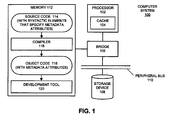
- FIG. 1 illustrates a computer system 100 in accordance with one embodiment of the present invention.
- computer system 100 includes processor 102, which is coupled to a memory 112 and to peripheral bus 110 through bridge 106.
- Bridge 106 can generally include any type of circuitry for coupling components of computer system 100 together.
- Processor 102 can include any type of processor, including, but not limited to, a microprocessor, a mainframe computer, a digital signal processor, a personal organizer, a device controller and a computational engine within an appliance.
- Processor 102 includes a cache 104 that stores code and data for execution by processor 102.
- Storage device 108 can include any type of non-volatile storage device that can be coupled to a computer system. This includes, but is not limited to, magnetic, optical, and magneto-optical storage devices, as well as storage devices based on flash memory and/or battery-backed up memory.
- Processor 102 communicates with memory 112 through bridge 106.
- Memory 112 can include any type of memory that can store code and data for execution by processor 102.
- memory 112 contains compiler 116.
- Compiler 116 converts source code 114 into object code 118. In doing so, compiler 116 incorporates metadata attributes that are specified by syntactic elements within source code 114 into object code 118. This process is described in more detail below with reference to FIG. 3.
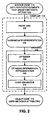
- FIG. 2 illustrates the structure of compiler 116 in accordance with one embodiment of the present invention.
- Compiler 116 takes as input source code 114 and outputs object code 118.
- source code 114 may include any computer program written in a high-level programming language, such as the JAVA programming language.
- Object code 118 includes executable instructions for a specific virtual machine or a specific processor architecture.
- Compiler 116 includes a number of components, including front end 202 and back end 206.
- Front end 202 takes in source code 114 and parses source code 114 to produce intermediate representation 204.
- Intermediate representation 204 feeds into back end 206, which produces object code 118.
- intermediate representation 204 feeds through optimizer 208, and the resulting optimized intermediate representation 209 feeds though code generator 210 which produces object code 118.
- compiler 116 incorporates metadata attributes into object code 118 as is described below with reference to FIG. 3.
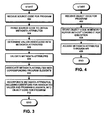
- FIG. 3 is a flow chart illustrating the process of incorporating metadata attributes for program elements in object code in accordance with one embodiment of the present invention.
- the system starts by receiving source code for a program, wherein the source code contains syntactic elements that specify metadata attributes for program elements (step 302). Note that the metadata attributes do not effect program execution.
- the program elements can include methods, classes or fields that can be associated with attributes.
- a method can be associated with attributes, such as: (1) a remote attribute that specifies whether the method is a remote method or a local method; (2) a precondition attribute and a postcondition attribute that collectively facilitate "design by contract;" (3) a deprecated attribute which indicates that a given method is supported, but should no longer be used; or (4) a query attribute that facilitates forming a database query for an accessor method.
- a class can be associated with attributes, such as: (1) an author attribute that identifies the author of the class; (2) a deprecated attribute , which indicates that the class is supported, but should no longer be used; and (3) a framework membership attribute that signifies that the class participates in a framework.
- attributes such as: (1) an author attribute that identifies the author of the class; (2) a deprecated attribute , which indicates that the class is supported, but should no longer be used; and (3) a framework membership attribute that signifies that the class participates in a framework.
- a field can have attributes, such as a persistence attribute , which indicates whether or not the field is persistent.
- a persistence attribute can be a boolean attribute, or alternatively a multi-valued attribute that specifies a type of persistence.
- a metadata attribute is expressed in the source code as a modifier associated with a declaration for a program element.
- each attribute is declared as a class.
- an interface for a class associated with a "deprecated” attribute can have the form:
- the deprecated attribute is associated with a program element as a modifier for a declaration for the program element.
- a class can be associated with both the deprecated attribute and the author "Mickey Mouse" in the following way: Note that in the above example, a modifier associated with an attribute can be easily identified by the "@" symbol. Also note that multiple attribute modifiers can be associated with a given declaration.
- Attributes can also be nested.
- a "remote" attribute for a class can the specified as follows: This nested remote attribute specifies that the communication style for the remote method is "Corba" and that the timeout period for the remote method is 10 seconds. Note that this information can be used by a programming tool to build a stub for the remote method.
- An interface for a class that defines the nested "remote” attribute can have the form:
- the system determines values associated with the metadata attributes, which may involve evaluating constant expressions (step 306).
- the system can validate the metadata attributes (step 308). In one embodiment of the present invention, this involves using validation criteria retrieved from an object file for a class that defines a given metadata attribute to validate the given metadata attribute.
- the system then associates metadata attributes with corresponding program elements (step 310).
- the system then incorporates the metadata attributes, including identifiers for associated values and associated program elements, into object code (class files) for the program (step 312).
- the metadata attributes are stored as "class file attributes" in a JAVA class.
- FIG. 4 is a flow chart of the process of accessing metadata attributes associated with program elements in accordance with one embodiment of the present invention. This process can take place either at run time (while the class is loaded), or at design time (while the class is not loaded).
- one embodiment of the present invention adds an accessor method to class Class for each primitive type attribute. For example, we can add the following accessor methods to class Class:
- one embodiment of the present invention provides an application programming interface (API) to obtain metadata associated without program elements without having the load the class.
- API application programming interface
- the process operates as follows. Upon receiving object code for a program (step 402), the process loads the object code into a memory buffer--without performing the time-consuming verification operations involved in loading the class into a virtual machine (step 404). Next, the process accesses metadata attributes for program elements through an API (step 406).
- API can be defined as a class.
- the class can include methods to: (1) return a specified attribute of a specified element; (2) return all attributes of a specified element; (3) return all elements having a specified attribute; (4) return all elements having a specified attribute-value pair; (5) return a specified sub-attribute of a complex attribute; and (6) to return all sub-attributes of a complex attribute.
- a computer-readable storage medium which may be any device or medium that can store code and/or data for use by a computer system.
- the transmission medium may include a communications network, such as the Internet.
Landscapes
- Engineering & Computer Science (AREA)
- General Engineering & Computer Science (AREA)
- Theoretical Computer Science (AREA)
- Software Systems (AREA)
- Physics & Mathematics (AREA)
- General Physics & Mathematics (AREA)
- Devices For Executing Special Programs (AREA)
- Stored Programmes (AREA)
Applications Claiming Priority (2)
| Application Number | Priority Date | Filing Date | Title |
|---|---|---|---|
| US10/237,886 US7013458B2 (en) | 2002-09-09 | 2002-09-09 | Method and apparatus for associating metadata attributes with program elements |
| US237886 | 2002-09-09 |
Publications (2)
| Publication Number | Publication Date |
|---|---|
| EP1400897A2 true EP1400897A2 (de) | 2004-03-24 |
| EP1400897A3 EP1400897A3 (de) | 2007-04-11 |
Family
ID=31946370
Family Applications (1)
| Application Number | Title | Priority Date | Filing Date |
|---|---|---|---|
| EP03255528A Withdrawn EP1400897A3 (de) | 2002-09-09 | 2003-09-04 | Verfahren und Gerät zum Verbinden von Metadatenattributen mit Programmelementen |
Country Status (2)
| Country | Link |
|---|---|
| US (1) | US7013458B2 (de) |
| EP (1) | EP1400897A3 (de) |
Cited By (4)
| Publication number | Priority date | Publication date | Assignee | Title |
|---|---|---|---|---|
| WO2008011011A3 (en) * | 2006-07-17 | 2008-07-03 | Mathworks Inc | System and method for providing and using meta-data in a dynamically typed array-based language |
| US7984416B2 (en) | 2006-03-24 | 2011-07-19 | The Mathworks, Inc. | System and method for providing class definitions in a dynamically typed array-based language |
| WO2014028784A1 (en) * | 2012-08-16 | 2014-02-20 | Microsoft Corporation | Imperative attribution for elements in managed runtimes |
| US8914776B2 (en) | 2012-05-17 | 2014-12-16 | Microsoft Corporation | Assisting development tools through inserted code statements |
Families Citing this family (36)
| Publication number | Priority date | Publication date | Assignee | Title |
|---|---|---|---|---|
| US6883135B1 (en) | 2000-01-28 | 2005-04-19 | Microsoft Corporation | Proxy server using a statistical model |
| US20030158668A1 (en) * | 2002-02-15 | 2003-08-21 | Anderson James J. | System and method of geospatially mapping topological regions and displaying their attributes |
| US7228301B2 (en) * | 2003-06-27 | 2007-06-05 | Microsoft Corporation | Method for normalizing document metadata to improve search results using an alias relationship directory service |
| US7810080B2 (en) * | 2003-09-15 | 2010-10-05 | Thomas Plum | Automated safe secure techniques for eliminating undefined behavior in computer software |
| US7818729B1 (en) * | 2003-09-15 | 2010-10-19 | Thomas Plum | Automated safe secure techniques for eliminating undefined behavior in computer software |
| US7856624B2 (en) * | 2003-09-15 | 2010-12-21 | Thomas Plum | Automated safe secure techniques for eliminating undefined behavior in computer software |
| US7584458B2 (en) * | 2003-10-02 | 2009-09-01 | Microsoft Corporation | Source code annotation language |
| US7584221B2 (en) | 2004-03-18 | 2009-09-01 | Microsoft Corporation | Field weighting in text searching |
| US7606793B2 (en) * | 2004-09-27 | 2009-10-20 | Microsoft Corporation | System and method for scoping searches using index keys |
| US7761448B2 (en) | 2004-09-30 | 2010-07-20 | Microsoft Corporation | System and method for ranking search results using click distance |
| US7827181B2 (en) * | 2004-09-30 | 2010-11-02 | Microsoft Corporation | Click distance determination |
| US7739277B2 (en) * | 2004-09-30 | 2010-06-15 | Microsoft Corporation | System and method for incorporating anchor text into ranking search results |
| US7562342B2 (en) * | 2004-12-02 | 2009-07-14 | International Business Machines Corporation | Method and apparatus for incrementally processing program annotations |
| US7716198B2 (en) * | 2004-12-21 | 2010-05-11 | Microsoft Corporation | Ranking search results using feature extraction |
| US7792833B2 (en) | 2005-03-03 | 2010-09-07 | Microsoft Corporation | Ranking search results using language types |
| US20060271917A1 (en) * | 2005-05-31 | 2006-11-30 | Microsoft Corporation | State-based source code annotation |
| US7703075B2 (en) * | 2005-06-22 | 2010-04-20 | Microsoft Corporation | Programmable annotation inference |
| US7599917B2 (en) * | 2005-08-15 | 2009-10-06 | Microsoft Corporation | Ranking search results using biased click distance |
| US7836439B2 (en) * | 2006-02-03 | 2010-11-16 | Research In Motion Limited | System and method for extending a component-based application platform with custom services |
| US8141035B2 (en) * | 2006-07-05 | 2012-03-20 | International Business Machines Corporation | Method for accessing internal states of objects in object oriented programming |
| US20080052671A1 (en) * | 2006-08-03 | 2008-02-28 | Frederic Plante | System, method and program product for providing content based designations for programming objects |
| US20080126761A1 (en) * | 2006-09-26 | 2008-05-29 | Fontenot Nathan D | Method and apparatus for scheduling optimization |
| US20080077849A1 (en) * | 2006-09-27 | 2008-03-27 | Adams Gregory D | Mechanism for associating annotations with model items |
| US9348912B2 (en) * | 2007-10-18 | 2016-05-24 | Microsoft Technology Licensing, Llc | Document length as a static relevance feature for ranking search results |
| US7840569B2 (en) * | 2007-10-18 | 2010-11-23 | Microsoft Corporation | Enterprise relevancy ranking using a neural network |
| US8484752B2 (en) * | 2007-11-14 | 2013-07-09 | Caterpillar Inc. | Verifying authenticity of electronic control unit code |
| US8321933B2 (en) * | 2007-11-14 | 2012-11-27 | Caterpillar Inc. | Securing electronic control unit code |
| US8812493B2 (en) * | 2008-04-11 | 2014-08-19 | Microsoft Corporation | Search results ranking using editing distance and document information |
| US20090320007A1 (en) * | 2008-06-24 | 2009-12-24 | Microsoft Corporation | Local metadata for external components |
| US9417931B2 (en) * | 2008-06-24 | 2016-08-16 | Microsoft Technology Licensing, Llc | Unified metadata for external components |
| US8943482B2 (en) * | 2009-05-15 | 2015-01-27 | International Business Machines Corporation | Incrementally constructing executable code for component-based applications |
| US8738635B2 (en) | 2010-06-01 | 2014-05-27 | Microsoft Corporation | Detection of junk in search result ranking |
| US8627308B2 (en) | 2010-06-30 | 2014-01-07 | International Business Machines Corporation | Integrated exchange of development tool console data |
| US9495462B2 (en) | 2012-01-27 | 2016-11-15 | Microsoft Technology Licensing, Llc | Re-ranking search results |
| US9104781B2 (en) | 2012-08-28 | 2015-08-11 | Microsoft Technology Licensing, Llc | Obtaining metadata set by imperative statement |
| CN113076086B (zh) * | 2021-04-12 | 2022-02-11 | 北京元年科技股份有限公司 | 元数据管理系统和使用其对模型对象进行建模的方法 |
Family Cites Families (5)
| Publication number | Priority date | Publication date | Assignee | Title |
|---|---|---|---|---|
| US5804803A (en) * | 1996-04-02 | 1998-09-08 | International Business Machines Corporation | Mechanism for retrieving information using data encoded on an object |
| US6654953B1 (en) * | 1998-10-09 | 2003-11-25 | Microsoft Corporation | Extending program languages with source-program attribute tags |
| US6574635B2 (en) * | 1999-03-03 | 2003-06-03 | Siebel Systems, Inc. | Application instantiation based upon attributes and values stored in a meta data repository, including tiering of application layers objects and components |
| US6636863B1 (en) * | 1999-09-13 | 2003-10-21 | E. Lane Friesen | System and method for generating persistence on the web |
| US6311194B1 (en) * | 2000-03-15 | 2001-10-30 | Taalee, Inc. | System and method for creating a semantic web and its applications in browsing, searching, profiling, personalization and advertising |
-
2002
- 2002-09-09 US US10/237,886 patent/US7013458B2/en not_active Expired - Lifetime
-
2003
- 2003-09-04 EP EP03255528A patent/EP1400897A3/de not_active Withdrawn
Cited By (6)
| Publication number | Priority date | Publication date | Assignee | Title |
|---|---|---|---|---|
| US7984416B2 (en) | 2006-03-24 | 2011-07-19 | The Mathworks, Inc. | System and method for providing class definitions in a dynamically typed array-based language |
| US8966456B2 (en) | 2006-03-24 | 2015-02-24 | The Mathworks, Inc. | System and method for providing and using meta-data in a dynamically typed array-based language |
| WO2008011011A3 (en) * | 2006-07-17 | 2008-07-03 | Mathworks Inc | System and method for providing and using meta-data in a dynamically typed array-based language |
| US9395963B1 (en) | 2006-07-17 | 2016-07-19 | The Mathworks, Inc. | System and method for accessing meta-data in a dynamically typed array-based language |
| US8914776B2 (en) | 2012-05-17 | 2014-12-16 | Microsoft Corporation | Assisting development tools through inserted code statements |
| WO2014028784A1 (en) * | 2012-08-16 | 2014-02-20 | Microsoft Corporation | Imperative attribution for elements in managed runtimes |
Also Published As
| Publication number | Publication date |
|---|---|
| US20040049766A1 (en) | 2004-03-11 |
| US7013458B2 (en) | 2006-03-14 |
| EP1400897A3 (de) | 2007-04-11 |
Similar Documents
| Publication | Publication Date | Title |
|---|---|---|
| US7013458B2 (en) | Method and apparatus for associating metadata attributes with program elements | |
| US7735071B2 (en) | Method and system for compiling multiple languages | |
| JP5851396B2 (ja) | 処理方法 | |
| US8347266B2 (en) | Declarative object identity | |
| US20040268301A1 (en) | Adding new compiler methods to an integrated development environment | |
| JP2002525744A (ja) | テキスト・オブジェクトのコンパイル方法およびシステム | |
| US20090328016A1 (en) | Generalized expression trees | |
| US7627594B2 (en) | Runtime support for nullable types | |
| US20060212847A1 (en) | Type checker for a typed intermediate representation of object-oriented languages | |
| US8250528B2 (en) | Static inheritance systems and methods | |
| US6948150B1 (en) | Component based design time architecture | |
| Spoto | A java framework for smart contracts | |
| US10713025B2 (en) | Metadata application constraints within a module system based on modular dependencies | |
| US11163545B2 (en) | Type inference optimization | |
| Boshernitsan | Harmonia: A flexible framework for constructing interactive language-based programming tools | |
| US20080022260A1 (en) | Method for accessing internal states of objects in object oriented programming | |
| US7512938B2 (en) | Typed intermediate representation for object-oriented languages | |
| US7171657B2 (en) | Method and apparatus for importing static members of a class | |
| US11347487B2 (en) | Confining reflective access based on module boundaries | |
| Courant et al. | Debootstrapping without archeology: Stacked implementations in Camlboot | |
| CN101253477A (zh) | 可空和后期绑定 | |
| US7526752B1 (en) | Introspection support for generic types | |
| US20250384119A1 (en) | Asynchronous Counting Gate | |
| Lee | Pro Objective-C | |
| Ségura-Devillechaise | Portable semantic alterations in Java |
Legal Events
| Date | Code | Title | Description |
|---|---|---|---|
| PUAI | Public reference made under article 153(3) epc to a published international application that has entered the european phase |
Free format text: ORIGINAL CODE: 0009012 |
|
| AK | Designated contracting states |
Kind code of ref document: A2 Designated state(s): AT BE BG CH CY CZ DE DK EE ES FI FR GB GR HU IE IT LI LU MC NL PT RO SE SI SK TR |
|
| AX | Request for extension of the european patent |
Extension state: AL LT LV MK |
|
| PUAL | Search report despatched |
Free format text: ORIGINAL CODE: 0009013 |
|
| AK | Designated contracting states |
Kind code of ref document: A3 Designated state(s): AT BE BG CH CY CZ DE DK EE ES FI FR GB GR HU IE IT LI LU MC NL PT RO SE SI SK TR |
|
| AX | Request for extension of the european patent |
Extension state: AL LT LV MK |
|
| 17P | Request for examination filed |
Effective date: 20070626 |
|
| AKX | Designation fees paid |
Designated state(s): DE GB |
|
| 17Q | First examination report despatched |
Effective date: 20071122 |
|
| STAA | Information on the status of an ep patent application or granted ep patent |
Free format text: STATUS: THE APPLICATION IS DEEMED TO BE WITHDRAWN |
|
| 18D | Application deemed to be withdrawn |
Effective date: 20081113 |