EP1400951A2 - Verfahren zur rechnergestützten Spracherkennung, Spracherkennungssystem und Steuereinrichtung zum Steuern eines technischen Systems und Telekommunikationsgerät - Google Patents
Verfahren zur rechnergestützten Spracherkennung, Spracherkennungssystem und Steuereinrichtung zum Steuern eines technischen Systems und Telekommunikationsgerät Download PDFInfo
- Publication number
- EP1400951A2 EP1400951A2 EP03014195A EP03014195A EP1400951A2 EP 1400951 A2 EP1400951 A2 EP 1400951A2 EP 03014195 A EP03014195 A EP 03014195A EP 03014195 A EP03014195 A EP 03014195A EP 1400951 A2 EP1400951 A2 EP 1400951A2
- Authority
- EP
- European Patent Office
- Prior art keywords
- speech recognition
- feature vector
- vector components
- information content
- feature
- Prior art date
- Legal status (The legal status is an assumption and is not a legal conclusion. Google has not performed a legal analysis and makes no representation as to the accuracy of the status listed.)
- Granted
Links
Images



Classifications
-
- G—PHYSICS
- G10—MUSICAL INSTRUMENTS; ACOUSTICS
- G10L—SPEECH ANALYSIS TECHNIQUES OR SPEECH SYNTHESIS; SPEECH RECOGNITION; SPEECH OR VOICE PROCESSING TECHNIQUES; SPEECH OR AUDIO CODING OR DECODING
- G10L15/00—Speech recognition
- G10L15/02—Feature extraction for speech recognition; Selection of recognition unit
Definitions
- the invention relates to a method for computer-aided Speech recognition, a speech recognition system and a Control device for controlling a technical system with a speech recognition system and a telecommunication device.
- Feature vectors As part of computer-aided speech recognition, one of a voice signal spoken to a user in the context of Preprocessing digitized and on so-called Feature vectors, also called feature vectors are mapped and for the to be carried out Voice recognition saved.
- the feature vectors have a fixed one predetermined number of feature vector components that are usually ordered in the feature vector according to their Meaning in the context of speech recognition, usually ordered by feature vector components with less increasing information content (decreasing statistical Variance).
- [1] is a method for calculating distances between a feature vector and several comparison vectors described. This procedure is for the components of the feature vector, their ability to discriminate determined. For those components of the feature vector, whose discrimination ability is worse than one is a predetermined threshold, a first partial distance to a group of components of the comparison vectors determined. For those components of the feature vector, whose ability to discriminate better than the given Is the second sub-distances to the corresponding components of the comparison vectors determined. From the first partial distance and the second partial distances the distances from the feature vector to the multiple Comparison vectors determined.
- the invention is based on the problem, one possibility for computer-aided speech recognition as well as a Specify speech recognition system where a reduced available computing power or a reduced available space is sufficient.
- a method for computer-aided speech recognition using feature vectors is one, preferred detection rate information determined at the beginning of the method saved with that for the feature vectors depending on the information content of the feature vector components what speech recognition rate is given each with the feature vectors with the respective considered feature vector components can be achieved.
- the first step is for a Speech recognition application determines or determines which Speech recognition rate for the respective Speech recognition application is needed.
- Using the stored speech recognition rate information is determined by the computer, which one At least information content of the feature vector components is required to get the specific speech recognition rate guarantee.
- the respective Speech recognition application creates a codebook under Taking into account the previously determined number of Feature vector components in the speech recognition system.
- the speech recognition is carried out under Use of feature vectors with the number of Feature vector components required to complete the provide determined information content.
- Speech recognition that is, the method of comparison of the feature vectors, in particular thus the comparison of the Feature vectors of a spoken speech signal with the Feature vectors of reference words contained in one electronic dictionary is stored is running using feature vectors with the number of Feature vector components that is required to the to ensure previously determined speech recognition rate.
- a speech recognition system has a speech recognition unit as well as one coupled with the speech recognition unit electronic dictionary in which the under the Word recognition words are stored.
- a recognition rate information memory in the speech recognition system provided in the detection rate information is stored with that for the feature vectors depending on the information content of the feature vector components what speech recognition rate is given each with the feature vectors with the respective considered feature vector components can be achieved.
- a detection rate information determination unit also provided to determine the Detection rate information is provided before the actual speech recognition based on preferably one Training record the detection rate information determined.
- an information content determination unit provided for determining the Information content for feature vector components of a Feature vectors in the speech recognition system.
- a feature vector component selection unit for selection of feature vector components that are part of the Speech recognition must be taken into account in the Speech recognition system provided.
- a control device for controlling a technical system has the speech recognition system described above, wherein in the electronic dictionary for controlling the provided control commands for the technical system, preferably speaker-independent, speech recognition are saved.
- the invention is particularly suitable for use in an embedded system.
- A is preferably used for the speech recognition itself Speech recognition process for speaker-independent Speech recognition, particularly preferably using Hidden Markov models performed.
- speech recognition in particular for speaker-independent speech recognition statistical Classifiers, for example using artificial ones neural networks.
- the feature vector components with relative high information content among the feature vector components of the respective feature vector can be selected and in Speech recognition framework can be used.
- This embodiment of the invention ensures that actually those feature vector components are not be taken into account, the lowest information content have within all feature vector components, with what ensures that the lost information as part of the speech recognition that arises due to the Disregarding a feature vector component, is minimized.
- a control device for controlling is suitable, for example a telecommunication device, for example one Telephone device, a fax machine, a PDA, one Notebooks, etc., or to control a device in which at least two of the device functionalities described above are integrated in a common device.
- a clearly defined and limited Vocabulary devices can be controlled by means of a Voice dialog can be controlled, which is relatively clear and thus inexpensive even with an embedded system is feasible.
- FIG. 1 shows a speech recognition system 100 according to an embodiment of the invention.
- the speech recognition system 100 operates depending on the operating mode in a first operating mode as Speech recognition device, in which Speech recognition mode a spoken utterance 101, spoken by a user (not shown) of the Speech recognition system 100 from which Speech recognition device is recognized.
- the speech recognition is done using a method for speaker-independent speech recognition.
- a second operating mode also referred to below as a training mode
- a training mode is using a spoken utterance 101, as explained in more detail below the speech recognition system 100 trains according to this Embodiment, this means that individual hidden Markov models for an utterance by means of the spoken Utterance 101 be trained.
- Each feature vector 109 has a predetermined number of Feature vector components.
- the feature vectors have 78 feature vector components each.
- the feature vectors 109 are fed to a computer 110.
- the microphone 102, the preamplification unit 104, in particular the Gain unit, and the analog / digital converter 106 and the feature extraction unit 108 as separate units or also as units integrated in the computer 110 can be realized.
- the feature vectors 109 are assigned to the computer 110 are fed via its input interface 111.
- the computer 110 also has a microprocessor 112, one Memory 113 and an output interface 114, which all coupled together by means of a computer bus 115 are.
- microprocessor 112 uses the microprocessor 112 to determine the detection rate information explained below as well as the methods of speech recognition carried out.
- a digital signal processor can also be used be provided, the one used in each case Has implemented speech recognition algorithms and a can have specialized microcontrollers thereon.
- the computer 110 is by means of the input interface 113 with a keyboard 116 and a computer mouse 117 electrical lines 118, 119 or a radio link, for example an infrared connection or a Bluetooth connection coupled.
- 121 is the computer 110 by means of Output interface 114 with a speaker 122 as well coupled to an actuator 123.
- Actuator 123 generally represents everyone in FIG possible actuator as part of the control of a technical Systems, for example realized in the form of a Hardware switch or in the form of a computer program for the case that, for example, a telecommunications device or another technical system, for example a Car radio, a stereo, a VCR, a TV, computer 110 itself, or any other technical system to be controlled.
- a technical Systems for example realized in the form of a Hardware switch or in the form of a computer program for the case that, for example, a telecommunications device or another technical system, for example a Car radio, a stereo, a VCR, a TV, computer 110 itself, or any other technical system to be controlled.
- the Feature extraction unit 108 a filter bank with a Majority of bandpasses, which the energy of the input speech signal 103 in individual frequency bands measure up. So-called Short-term spectra formed by the output signals of the Band passes rectified, smoothed and at short intervals are scanned, all according to the exemplary embodiment 10 msec, alternatively every 15 msec.
- the 13 coefficients of the Feature vectors 109 are called feature vector components of two successive time windows of the Size of 10 msec or 15 msec in the feature vector 109 saved. Furthermore, as feature vector components in the feature vector 109 is the temporal first derivative and the temporal second derivative of the cepstrum coefficients in the feature vector 109 as a super feature vector are summarized and the computer 110 fed.
- a speech recognition unit is implemented in the computer 110 in the form of a computer program and stored in a first memory subarea 201 (cf. FIG . 2 ) in the memory 113, which speech recognition unit is based on the principle of the Hidden Markov models. A speaker-independent speech recognition thus takes place by means of the computer program.
- One training record, stored in a second Memory subarea 202 of memory 113 has those Expressions of speech, in the form of for each Speech expressions formed feature vectors, which to the im Training of Hidden Markov explained below Models used for speech recognition be used.
- a Test data record saved that is, the utterances, which are used to test the trained Speech recognition unit, in other words for testing the trained Hidden Markov models in a fourth Memory subarea 204 are stored.
- a detection rate information is determined, which is stored in a fifth memory subarea 205 are.
- a sixth memory subarea 206 there is also an im Another more detailed table stored in the for one or more applications of the speech recognition system an indication of what recognition rate is stored is required for the respective application.
- the individual elements in different storage areas may be stored, but also in different, preferably to the respective Customized requirements of saved items To save.
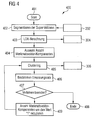
- Figures 3 and 4 show in a block diagram 300 (see FIG. 3 shows) or in a flow chart (see. Fig.4) the individual by the computer 110 implemented steps of the method for determining the data stored in the fifth memory portion 205 recognition rate information.
- step 401 After starting the method (step 401) in one Training step under the individual Hidden Markov models Use of the data in the second partial memory area 202 trained training data set trained.
- HMM training Training of the Hidden Markov models
- the HMM training is done using the DSP 123 as well using predefined training scripts, vividly of suitably equipped computer programs, carried out.
- each is formed Linguistic unit, that is, each phoneme, in three successive phoneme segments divided accordingly an initial phase (first phoneme segment), a central one Phase (second phoneme segment) and a final phase (third Phoneme segment) of a sound, i.e. a phoneme.
- every sound is included in a sound model three states, that is with a three state HMM modeled.
- the three phoneme segments are in a Bakis topology or generally a left-right topology strung together and on the concatenation of these the calculation is carried out in three segments Framework of speaker-independent speech recognition carried out.
- the Speech recognition mode a Viterbi algorithm for decoding of the feature vectors, which from the entered Speech signal 101 are formed, performed.
- the LDA matrix 304 (Step 403) by means of an LDA matrix calculation unit 303 determined.
- each segment class j containing a set D y -dimensional super feature vectors y , that is to say: where N j is the number of the class that are available super feature vectors y j j.
- the super feature vectors y k / j were determined using the segmentation of the speech signal database described above.
- each super feature vector y k / j contains the components of two time windows immediately following one another in the context of the short-term analysis (this justifies factor 2 above).
- any number of vector components adapted to the respective application can be contained in the super feature vector y k / j, for example up to 20 cepstrums coefficients and their associated temporal first derivatives and second derivatives.
- the average inter-scattering matrix S b is defined as: With as the average super feature vector across all classes.
- the first transformation matrix U is used to diagonalize the average intra-scatter matrix S w and is determined by transforming the positively definite and symmetrical average intra-scatter matrix S w into its eigenvector space.
- the average intra-scatter matrix S w is a diagonal matrix, the components of which are positive and greater than or equal to zero. The components whose values are greater than zero correspond to the average variance in the respective dimension defined by the corresponding vector component.
- the second transformation matrix W is used to normalize the average variances and is determined according to the following rule:
- the transformation U ⁇ W is also called whitening.
- V B T ⁇ S b ⁇ B .
- B T ⁇ S b ⁇ B also represents a positively definite and symmetrical matrix, is transformed into its eigenvector space.
- the values ⁇ 2 / d are the eigenvalues of the average inter-scattering matrix S b and represent a measure for the so-called pseudo-entropy of the feature vector components, which is also referred to below as the information content of the feature vector components. It should be noted that the trace of each matrix is invariant with respect to any orthogonal transformation, which results in the sum represents the total average variance of the average vector x j of the J classes.
- a Dimensional reduction made by the ⁇ 2 / d values in in their size descending order and the ⁇ 2 / d values are omitted, i.e. not taken into account remain that are less than a predetermined threshold.
- the predetermined threshold value can also be defined cumulatively his.
- the LDA matrix A can then be adapted by sorting the rows according to the eigenvalues ⁇ 2 / d and omitting the rows that belong to the sufficiently "small” variances and thus have only a low information content (low pseudo-entropy).
- Process step number aim method 1 Decorrelate the feature vector components
- Diagonalize the average intra-class covariance matrix S w 2 Normalize statistical variances within a class
- Maximize the class centers Diagonalize the transformed average inter-class covariance matrix B T ⁇ S b ⁇ B 4
- Reduce the dimensions of the feature vectors Select the rows of the matrix A with the 24 largest eigenvalues of A T ⁇ S b ⁇ A
- the last procedure to part procedure under the Training of the Hidden Markov models is the clustering of Feature vectors (step 405), which by means of a Cluster unit 305 is performed and which as a result has a respective code book 306, each specific to one Training data record with a predetermined number of Feature vector components.
- prototypes also referred to as prototype feature vectors are designated according to the in [1] Baum-Welch training described.
- step 406 for those in the test record which is in the third Part storage area 203 is stored, the detection rate for the respective feature vectors of the current dimension, that is, for the feature vectors with the current one Number of feature vector components determined.
- this is done in that for all utterances, that is for all episodes of Feature vectors in the test data set a speech recognition using the trained Hidden Markov models, differently expressed by means of a speech recognition unit 307, is carried out and the speech recognition results with the Target results of the test data record are compared.
- the determined recognition rate 308 results from the Ratio of the number of correct recognition results, different expressed by the number of matches between the Speech recognition result and the target result, which in the test data record is specified, and the total for Test data records shown by speech recognition.
- step 304 the Detected rate along with how many Feature vector components for determining the recognition rate 308 for the feature vectors of the test data set 203 have been used.
- the Number of feature vector components of the feature vectors 109 which is part of the determination of the recognition rate from the Test data set used to a given value preferably by the value "1", that is by one Feature vector component reduced (step 409).
- step 405 the steps of clustering (step 405) and thus the creation of the respective code book 306 and the Determining the speech recognition rate (step 406) again carried out, but now for feature vectors of Test data record, each with a feature vector component reduced feature vectors.
- the number of feature vector components can be in each iteration can be reduced by more than the value "1".
- the above-described methods lie on the one hand a pseudo entropy mapping and on the other hand a detection rate map.
- the recognition rate information is formed, by making the speech recognition rate dependent on the Pseudo-entropy is determined using the respective considered feature vector components. It is note that the detection rate information is now is independent of the number of considered Feature vector components.
- the detection rate information is in the fifth Part storage area 205 stored.
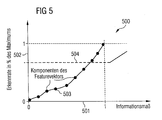
- the result of this method is thus the recognition rate information 500 shown in a functional diagram in FIG. 5 , which indicates the recognition rate 502 achieved in the form of data tuples 503 over a first axis on which the determined pseudo-entropy 501 is plotted.
- the detection rate information 500 thus represents the Relationship between the pseudoentropy and the mean of the speech recognition system achievable recognition rate.
- the Detection rate information 500 only once for each Speech recognition system, that is for each sentence that is trained must be performed by hidden Markov models.
- FIG. 6 shows in a flowchart 600 the individual method steps of the method for speech recognition according to the exemplary embodiment of the invention.
- Step 601 After starting the method (step 601) the Speech recognition application selected or determined in their Frame the speech recognition should be carried out (Step 602).
- Step 603 For the respective speech recognition application takes place under one also in the second memory subarea 202 stored, preferably speech recognition application-dependent Training data set a segmentation of the super feature vectors (Step 603) in the same, above described way.
- Step 604 making a speech recognition application dependent LDA matrix 605 is determined.
- Using speech recognition application-dependent LDA matrix 605 becomes a speech recognition application dependent Pseudo-entropy mapping determines a relationship represents between the achievable pseudo-entropy and the number of feature vector components taken into account in each case in the feature vectors.
- the respective speech recognition application dependent Pseudo-entropy mapping is shown in the sixth Storage subarea 206 stored.
- step 607 Using speech recognition application-dependent Pseudo-entropy mapping as previously determined is determined in a subsequent step (step 607), how many feature vector components and which ones Feature vector components, according to this embodiment each with the feature vector components smallest information content, in the context of speech recognition can be omitted, in other words can be disregarded.
- step 607 the number is now required Feature vector components for the selected application is determined in a subsequent step for the respective application and for the certain number of Feature vector components are clustered (Step 608).
- the result of clustering is a Speech recognition application dependent codebook 609, different expressed a lot of speech recognition application-dependent trained Hidden Markov models, which is also in the Memory is saved.
- the cluster process is the same the cluster method described above (step 405) for Determine detection rate information 500.
- the speaker-independent speech recognition then takes place using the saved Speech recognition application dependent codebook 609 (Step 610).
- the reduced feature vectors are taken into account, that is the feature vectors without those not considered Feature vector components.
- the comparison also takes place in a comparison room Dimension (k - n) instead.
- the detection rate information is also used determined only once; for every new speech recognition application it is only necessary to use the Detection rate information 500 to determine how many and preferably which feature vector components for the new one Speech recognition application are required, and the codebook for the determined number of required feature vector components to determine.
- Fig.5 shows the example that for the selected application a speech recognition rate of 95% is required, in Fig. 5 represented by a section line 504.
- two feature vector components can be omitted, with which the dimension of processed feature vectors can be reduced by the value 2 could.
- the invention can clearly be seen in that for a specially selected speech recognition application, for example from the area of Command and Control, different expressed for a control device, under certain Conditions a lower recognition rate of the speech recognizer can be accepted and this knowledge according to the invention is implemented in reducing the dimension of the processed feature vectors.
Landscapes
- Engineering & Computer Science (AREA)
- Computer Vision & Pattern Recognition (AREA)
- Computational Linguistics (AREA)
- Health & Medical Sciences (AREA)
- Audiology, Speech & Language Pathology (AREA)
- Human Computer Interaction (AREA)
- Physics & Mathematics (AREA)
- Acoustics & Sound (AREA)
- Multimedia (AREA)
- Machine Translation (AREA)
- Telephonic Communication Services (AREA)
Abstract
Description
- Figur 1
- ein Blockdiagramm eines Spracherkennungssystems gemäß einem Ausführungsbeispiel der Erfindung;
- Figur 2
- eine Skizze des Speichers des Rechners aus Figur 1 im Detail;
- Figur 3
- ein Blockdiagramm, in dem die einzelnen Verfahrensschritte zum Bestimmen einer Erkennungsraten-Information gemäß einem Ausführungsbeispiel der Erfindung dargestellt sind;
- Figur 4
- ein Ablaufdiagramm, in dem die einzelnen Verfahrensschritte zum Bestimmen einer Erkennungsraten-Information gemäß einem Ausführungsbeispiel der Erfindung dargestellt sind;
- Figur 5
- eine Skizze einer Erkennungsraten-Information gemäß einem Ausführungsbeispiel der Erfindung;
- Figur 6
- ein Ablaufdiagramm, in dem die einzelnen Verfahrensschritte des Verfahrens zur Spracherkennung gemäß einem Ausführungsbeispiel der Erfindung dargestellt sind.
- einer erste Phase (Schritt 402), in der die in der Trainings-Datenbank enthaltenen Sprachsignale 301 segmentiert werden mittels einer Segmentierungseinheit 302,
- einer zweiten Phase (Schritt 403), in der die LDA-Matrix (lineare Diskriminanzanalyse-Matrix) berechnet wird sowie
- einer dritten Phase (Schritt 405), in der das Codebuch, das heißt die HMM-Prototypen-Merkmalsvektoren für jeweils eine in einem Auswahlschritt (Schritt 404) ausgewählte Anzahl von Merkmalsvektor-Komponenten berechnet werden.
- x ein Merkmalsvektor,
- A eine LDA-Matrix,
- y ein Super-Merkmalsvektor,
- y ein globaler Verschiebungsvektor
- die Komponenten des Merkmalsvektors x im statistischen Durchschnitt voneinander im Wesentlichen unkorreliert sind,
- die statistischen Varianzen innerhalb einer Segmentklasse im statistischen Durchschnitt normalisiert sind,
- die Zentren der Segmentklassen im statistischen Durchschnitt einen maximalen Abstand voneinander aufweisen und
- die Dimension der Merkmalsvektoren x möglichst, vorzugsweise Spracherkennungsanwendungs-abhängig, reduziert wird.







- U eine erste Transformationsmatrix,
- W eine zweite Transformationsmatrix und
- V eine dritte Transformationsmatrix



| Nummer Verfahrensschritt | Ziel | Verfahren |
| 1 | Dekorrelieren der Merkmalsvektorkomponenten | Diagonalisieren der Durchschnitts-Intra-Klassen-Kovarianzmatrix S w |
| 2 | Normalisieren der statistischen Varianzen innerhalb einer Klasse | Bestimmen der inversen Quadratwurzel der transformierten Durchschnitts-Intra-Klassen-Kovarianzmatrix U T·S w·U |
| 3 | Maximieren der Klassenzentren | Diagonalisieren der transformierten Durchschnitts-Inter-Klassen-Kovarianzmatrix B T·S b·B |
| 4 | Reduzieren der Dimensionen der Merkmalsvektoren | Auswählen der Zeilen der Matrix A mit den 24 größten Eigenwerten von A T·S b·A |
- ein Sprachdialogsystem:
- für ein Sprachdialogsystem mit einer Spracherkennungsrate von 92 - 93 % zu gewährleisten;
- • ein Fahrzeug-Navigationssystem:
- für diese Spracherkennungsapplikation ist eine Spracherkennungsrate von ungefähr 95 % zu gewährleisten;
- • eine Steuerung eines technischen Systems, gemäß dem
Ausführungsbeispiel eines Videorekorders:
- für diese Spracherkennungsapplikation ist eine Spracherkennung von ungefähr 95 % zu gewährleisten;
- • eine Telefon-Anwendung:
- für diese Anwendung ist eine Spracherkennungsrate von 95 % zu gewährleisten;
- • ein Diktat, anders ausgedrückt das Erkennen von
Sprachinformation und Umsetzen des erkannten
Sprachsignals in ein Textverarbeitungssystem:
- für diese Applikation ist die mit dem Spracherkennungssystem maximal erreichbare Spracherkennungsrate erforderlich, das heißt in diesem Fall ist keine Reduktion von Merkmalsvektor-Komponenten sinnvoll.
Claims (9)
- Verfahren zur rechnergestützten Spracherkennung unter Verwendung von Merkmalsvektoren, wobei eine Erkennungsraten-Information gespeichert ist, mit der für die Merkmalsvektoren abhängig von dem Informationsgehalt der Merkmalsvektor-Komponenten angegeben wird, welche Spracherkennungsrate jeweils mit den Merkmalsvektoren mit den jeweils berücksichtigten Merkmalsvektor-Komponenten erzielbar ist,bei dem bestimmt wird, welche Spracherkennungsrate für eine Spracherkennungsanwendung benötigt wird,bei dem unter Verwendung der Erkennungsraten-Information ermittelt wird, welcher Informationsgehalt der Merkmalsvektor-Komponenten mindestens erforderlich ist, um die bestimmte Spracherkennungsrate zu gewährleisten,bei dem ermittelt wird, wie viele Merkmalsvektor-Komponenten in dem Spracherkennungssystem für die Spracherkennungsanwendung erforderlich sind, um den ermittelten Informationsgehalt bereitzustellen,bei dem die Spracherkennung ausgeführt wird unter Verwendung von Merkmalsvektoren mit der Anzahl von Merkmalsvektor-Komponenten, die erforderlich sind, um den ermittelten Informationsgehalt bereitzustellen.
- Verfahren gemäß Anspruch 1,
bei dem für die Spracherkennung ein sprecherunabhängiges Spracherkennungsverfahren verwendet wird. - Verfahren gemäß Anspruch 2,
bei dem die Spracherkennung unter Verwendung von Hidden Markov Modellen durchgeführt wird. - Verfahren gemäß einem der Ansprüche 1 bis 3,
bei dem die Merkmalsvektor-Komponenten mit höchstem Informationsgehalt ausgewählt werden und im Rahmen der Spracherkennung verwendet werden. - Spracherkennungssystem miteiner Spracherkennungseinheit,einem mit der Spracherkennungseinheit gekoppelten elektronischen Wörterbuch, in dem die im Rahmen der Spracherkennung berücksichtigten Wörter gespeichert sind,einem Erkennungsraten-Informations-Speicher, in dem Erkennungsraten-Information gespeichert ist, mit der für die Merkmalsvektoren abhängig von dem Informationsgehalt der Merkmalsvektor-Komponenten angegeben wird, welche Spracherkennungsrate jeweils mit den Merkmalsvektoren mit den jeweils berücksichtigten Merkmalsvektor-Komponenten erzielbar ist,einer Erkennungsraten-Informations-Ermittlungseinheit zum Ermitteln der Erkennungsraten-Information,einer Informationsgehalt-Ermittlungseinheit, zum Ermitteln des Informationsgehalts für Merkmalsvektor-Komponenten eines Merkmalsvektors in dem Spracherkennungssystem,einer Merkmalsvektor-Komponenten-Auswahleinheit zum Auswählen von Merkmalsvektor-Komponenten, die im Rahmen der Spracherkennung zu berücksichtigen sind.
- Spracherkennungssystem gemäß Anspruch 5,
bei dem die Spracherkennungseinheit eingerichtet ist zur sprecherunabhängigen Spracherkennung. - Spracherkennungssystem gemäß Ansprüche 5 oder 6, eingerichtet als ein Embedded System.
- Steuereinrichtung zum Steuern eines technischen Systems mit einem Spracherkennungssystem gemäß einem der Ansprüche 5 bis 7,
wobei in dem elektronischen Wörterbuch die zum Steuern des technischen Systems vorgesehenen Steuerbefehle gespeichert sind. - Telekommunikationsgerät mit einer Steuereinrichtung gemäß Anspruch 8.
Applications Claiming Priority (2)
| Application Number | Priority Date | Filing Date | Title |
|---|---|---|---|
| DE10244165 | 2002-09-23 | ||
| DE10244165 | 2002-09-23 |
Publications (3)
| Publication Number | Publication Date |
|---|---|
| EP1400951A2 true EP1400951A2 (de) | 2004-03-24 |
| EP1400951A3 EP1400951A3 (de) | 2004-08-18 |
| EP1400951B1 EP1400951B1 (de) | 2009-10-21 |
Family
ID=31896301
Family Applications (1)
| Application Number | Title | Priority Date | Filing Date |
|---|---|---|---|
| EP03014195A Expired - Lifetime EP1400951B1 (de) | 2002-09-23 | 2003-06-24 | Verfahren zur rechnergestützten Spracherkennung, Spracherkennungssystem und Steuereinrichtung zum Steuern eines technischen Systems und Telekommunikationsgerät |
Country Status (3)
| Country | Link |
|---|---|
| US (1) | US7231352B2 (de) |
| EP (1) | EP1400951B1 (de) |
| DE (1) | DE50312046D1 (de) |
Cited By (1)
| Publication number | Priority date | Publication date | Assignee | Title |
|---|---|---|---|---|
| CN102638605A (zh) * | 2011-02-14 | 2012-08-15 | 苏州巴米特信息科技有限公司 | 一种识别方言背景普通话的语音系统 |
Families Citing this family (4)
| Publication number | Priority date | Publication date | Assignee | Title |
|---|---|---|---|---|
| JP4304952B2 (ja) * | 2002-10-07 | 2009-07-29 | 三菱電機株式会社 | 車載制御装置、並びにその操作説明方法をコンピュータに実行させるプログラム |
| FI20045146A0 (fi) * | 2004-04-22 | 2004-04-22 | Nokia Corp | Audioaktiivisuuden ilmaisu |
| EP3123468A1 (de) * | 2014-03-28 | 2017-02-01 | Intel IP Corporation | Trainingsklassifizierer mit ausgewählten kohortenprobenuntergruppen |
| CN106128466B (zh) * | 2016-07-15 | 2019-07-05 | 腾讯科技(深圳)有限公司 | 身份向量处理方法和装置 |
Family Cites Families (2)
| Publication number | Priority date | Publication date | Assignee | Title |
|---|---|---|---|---|
| US6253173B1 (en) * | 1997-10-20 | 2001-06-26 | Nortel Networks Corporation | Split-vector quantization for speech signal involving out-of-sequence regrouping of sub-vectors |
| JP3814459B2 (ja) * | 2000-03-31 | 2006-08-30 | キヤノン株式会社 | 音声認識方法及び装置と記憶媒体 |
-
2003
- 2003-06-24 EP EP03014195A patent/EP1400951B1/de not_active Expired - Lifetime
- 2003-06-24 DE DE50312046T patent/DE50312046D1/de not_active Expired - Lifetime
- 2003-09-16 US US10/663,966 patent/US7231352B2/en not_active Expired - Fee Related
Non-Patent Citations (3)
| Title |
|---|
| DOLFING J G A ET AL: "Signal representations for hidden Markov model based online handwriting recognition" ACOUSTICS, SPEECH, AND SIGNAL PROCESSING, 1997. ICASSP-97., 1997 IEEE INTERNATIONAL CONFERENCE ON MUNICH, GERMANY 21-24 APRIL 1997, LOS ALAMITOS, CA, USA,IEEE COMPUT. SOC, US, 21. April 1997 (1997-04-21), Seiten 3385-3388, XP010225884 ISBN: 0-8186-7919-0 * |
| HAEB-UMBACH R ET AL: "Improvements in connected digit recognition using linear discriminant analysis and mixture densities" STATISTICAL SIGNAL AND ARRAY PROCESSING. MINNEAPOLIS, APR. 27 - 30, 1993, PROCEEDINGS OF THE INTERNATIONAL CONFERENCE ON ACOUSTICS, SPEECH, AND SIGNAL PROCESSING (ICASSP), NEW YORK, IEEE, US, Bd. 4, 27. April 1993 (1993-04-27), Seiten 239-242, XP010110438 ISBN: 0-7803-0946-4 * |
| HUBENER K ET AL: "Speech recognition for spontaneously spoken German dialogues" SPOKEN LANGUAGE, 1996. ICSLP 96. PROCEEDINGS., FOURTH INTERNATIONAL CONFERENCE ON PHILADELPHIA, PA, USA 3-6 OCT. 1996, NEW YORK, NY, USA,IEEE, US, 3. Oktober 1996 (1996-10-03), Seiten 212-215, XP010237682 ISBN: 0-7803-3555-4 * |
Cited By (1)
| Publication number | Priority date | Publication date | Assignee | Title |
|---|---|---|---|---|
| CN102638605A (zh) * | 2011-02-14 | 2012-08-15 | 苏州巴米特信息科技有限公司 | 一种识别方言背景普通话的语音系统 |
Also Published As
| Publication number | Publication date |
|---|---|
| EP1400951A3 (de) | 2004-08-18 |
| US20040102974A1 (en) | 2004-05-27 |
| DE50312046D1 (de) | 2009-12-03 |
| US7231352B2 (en) | 2007-06-12 |
| EP1400951B1 (de) | 2009-10-21 |
Similar Documents
| Publication | Publication Date | Title |
|---|---|---|
| DE69818231T2 (de) | Verfahren zum diskriminativen training von spracherkennungsmodellen | |
| DE69127961T2 (de) | Verfahren zur Spracherkennung | |
| DE69719236T2 (de) | Verfahren und System zur Spracherkennung mittels verborgener Markoff-Modelle mit kontinuierlichen Ausgangswahrscheinlichkeiten | |
| DE69807765T2 (de) | Kombination von Frequenzverzerrung und spektraler Formung in einem HMM - basierten Spracherkenner | |
| EP0797185B1 (de) | Verfahren und Vorrichtung zur Spracherkennung | |
| EP0821346B1 (de) | Verfahren zur Sprecherverifikation durch einen Rechner anhand mindestens eines von einem Sprecher eingesprochenen Sprachsignals | |
| DE112014006542B4 (de) | Einrichtung und Verfahren zum Verständnis von einer Benutzerintention | |
| DE60302407T2 (de) | Umgebungs- und sprecheradaptierte Spracherkennung | |
| EP1084490B1 (de) | Anordnung und verfahren zur erkennung eines vorgegebenen wortschatzes in gesprochener sprache durch einen rechner | |
| DE69819438T2 (de) | Verfahren zur Spracherkennung | |
| DE60313706T2 (de) | Spracherkennungs- und -antwortsystem, Spracherkennungs- und -antwortprogramm und zugehöriges Aufzeichnungsmedium | |
| DE20004416U1 (de) | Spracherkennungsvorrichtung unter Verwendung mehrerer Merkmalsströme | |
| EP1649450A1 (de) | Verfahren zur spracherkennung und kommunikationsger t | |
| EP1193688A2 (de) | Verfahren zur Ermittlung eines Eigenraums zur Darstellung einer Mehrzahl von Trainingssprechern | |
| DE602004000716T2 (de) | Rauschadaptierungssystem für ein Sprachmodell, Verfahren zur Rauschadaptierung und Programm zur Rauschadaptierung für Spracherkennung | |
| EP0987682B1 (de) | Verfahren zur Adaption von linguistischen Sprachmodellen | |
| DE69813597T2 (de) | Mustererkennung, die mehrere referenzmodelle verwendet | |
| EP1193689A2 (de) | Verfahren zur Ermittlung eines Eigenraums zur Darstellung einer Mehrzahl von Trainingssprechern | |
| WO2000005709A1 (de) | Verfahren und vorrichtung zur erkennung vorgegebener schlüsselwörter in gesprochener sprache | |
| EP1400951B1 (de) | Verfahren zur rechnergestützten Spracherkennung, Spracherkennungssystem und Steuereinrichtung zum Steuern eines technischen Systems und Telekommunikationsgerät | |
| DE102004017486A1 (de) | Verfahren zur Geräuschreduktion bei einem Sprach-Eingangssignal | |
| EP1039447B1 (de) | Bestimmung einer Regressionsklassen-Baumstruktur für einen Spracherkenner | |
| EP1136982A2 (de) | Erzeugung eines Sprachmodells und eines akustischen Modells für ein Spracherkennungssystem | |
| EP1704561A1 (de) | Verfahren und vorrichtung zur bearbeitung eines sprachsignals für die robuste spracherkennung | |
| DE10302101A1 (de) | Verfahren und Vorrichtung zum Trainieren eines Hidden Markov Modells, Computerprogramm-Element und Computerlesbares Speichermedium |
Legal Events
| Date | Code | Title | Description |
|---|---|---|---|
| PUAI | Public reference made under article 153(3) epc to a published international application that has entered the european phase |
Free format text: ORIGINAL CODE: 0009012 |
|
| AK | Designated contracting states |
Kind code of ref document: A2 Designated state(s): AT BE BG CH CY CZ DE DK EE ES FI FR GB GR HU IE IT LI LU MC NL PT RO SE SI SK TR |
|
| AX | Request for extension of the european patent |
Extension state: AL LT LV MK |
|
| PUAL | Search report despatched |
Free format text: ORIGINAL CODE: 0009013 |
|
| AK | Designated contracting states |
Kind code of ref document: A3 Designated state(s): AT BE BG CH CY CZ DE DK EE ES FI FR GB GR HU IE IT LI LU MC NL PT RO SE SI SK TR |
|
| AX | Request for extension of the european patent |
Extension state: AL LT LV MK |
|
| RIC1 | Information provided on ipc code assigned before grant |
Ipc: 7G 10L 15/00 B Ipc: 7G 10L 15/02 A |
|
| 17P | Request for examination filed |
Effective date: 20041025 |
|
| AKX | Designation fees paid |
Designated state(s): DE FR GB |
|
| RBV | Designated contracting states (corrected) |
Designated state(s): DE FR GB |
|
| GRAP | Despatch of communication of intention to grant a patent |
Free format text: ORIGINAL CODE: EPIDOSNIGR1 |
|
| GRAS | Grant fee paid |
Free format text: ORIGINAL CODE: EPIDOSNIGR3 |
|
| GRAA | (expected) grant |
Free format text: ORIGINAL CODE: 0009210 |
|
| RAP1 | Party data changed (applicant data changed or rights of an application transferred) |
Owner name: INFINEON TECHNOLOGIES AG |
|
| AK | Designated contracting states |
Kind code of ref document: B1 Designated state(s): DE FR GB |
|
| REG | Reference to a national code |
Ref country code: GB Ref legal event code: FG4D Free format text: NOT ENGLISH |
|
| REF | Corresponds to: |
Ref document number: 50312046 Country of ref document: DE Date of ref document: 20091203 Kind code of ref document: P |
|
| PLBE | No opposition filed within time limit |
Free format text: ORIGINAL CODE: 0009261 |
|
| STAA | Information on the status of an ep patent application or granted ep patent |
Free format text: STATUS: NO OPPOSITION FILED WITHIN TIME LIMIT |
|
| 26N | No opposition filed |
Effective date: 20100722 |
|
| REG | Reference to a national code |
Ref country code: FR Ref legal event code: TP Owner name: INTEL MOBILE COMMUNICATIONS GMBH, DE Effective date: 20120404 |
|
| REG | Reference to a national code |
Ref country code: GB Ref legal event code: 732E Free format text: REGISTERED BETWEEN 20120614 AND 20120620 |
|
| REG | Reference to a national code |
Ref country code: GB Ref legal event code: 732E Free format text: REGISTERED BETWEEN 20121213 AND 20121219 |
|
| REG | Reference to a national code |
Ref country code: DE Ref legal event code: R081 Ref document number: 50312046 Country of ref document: DE Owner name: INTEL MOBILE COMMUNICATIONS GMBH, DE Free format text: FORMER OWNER: INTEL MOBILE COMMUNICATIONS GMBH, 85579 NEUBIBERG, DE Effective date: 20130315 Ref country code: DE Ref legal event code: R081 Ref document number: 50312046 Country of ref document: DE Owner name: INTEL MOBILE COMMUNICATIONS GMBH, DE Free format text: FORMER OWNER: INTEL MOBILE COMMUNICATIONS TECHNOLOGY GMBH, 85579 NEUBIBERG, DE Effective date: 20130326 Ref country code: DE Ref legal event code: R081 Ref document number: 50312046 Country of ref document: DE Owner name: INTEL MOBILE COMMUNICATIONS GMBH, DE Free format text: FORMER OWNER: INFINEON TECHNOLOGIES AG, 85579 NEUBIBERG, DE Effective date: 20130314 Ref country code: DE Ref legal event code: R081 Ref document number: 50312046 Country of ref document: DE Owner name: INTEL MOBILE COMMUNICATIONS GMBH, DE Free format text: FORMER OWNER: INFINEON TECHNOLOGIES AG, 85579 NEUBIBERG, DE Effective date: 20130315 |
|
| PGFP | Annual fee paid to national office [announced via postgrant information from national office to epo] |
Ref country code: GB Payment date: 20130619 Year of fee payment: 11 Ref country code: DE Payment date: 20130619 Year of fee payment: 11 |
|
| PGFP | Annual fee paid to national office [announced via postgrant information from national office to epo] |
Ref country code: FR Payment date: 20130624 Year of fee payment: 11 |
|
| REG | Reference to a national code |
Ref country code: DE Ref legal event code: R119 Ref document number: 50312046 Country of ref document: DE |
|
| GBPC | Gb: european patent ceased through non-payment of renewal fee |
Effective date: 20140624 |
|
| REG | Reference to a national code |
Ref country code: FR Ref legal event code: ST Effective date: 20150227 |
|
| REG | Reference to a national code |
Ref country code: DE Ref legal event code: R119 Ref document number: 50312046 Country of ref document: DE Effective date: 20150101 |
|
| PG25 | Lapsed in a contracting state [announced via postgrant information from national office to epo] |
Ref country code: DE Free format text: LAPSE BECAUSE OF NON-PAYMENT OF DUE FEES Effective date: 20150101 |
|
| PG25 | Lapsed in a contracting state [announced via postgrant information from national office to epo] |
Ref country code: GB Free format text: LAPSE BECAUSE OF NON-PAYMENT OF DUE FEES Effective date: 20140624 Ref country code: FR Free format text: LAPSE BECAUSE OF NON-PAYMENT OF DUE FEES Effective date: 20140630 |