EP1401145A2 - Système de supervision, procédé et programme informatique utilisé dans ceux-ci - Google Patents
Système de supervision, procédé et programme informatique utilisé dans ceux-ci Download PDFInfo
- Publication number
- EP1401145A2 EP1401145A2 EP03254569A EP03254569A EP1401145A2 EP 1401145 A2 EP1401145 A2 EP 1401145A2 EP 03254569 A EP03254569 A EP 03254569A EP 03254569 A EP03254569 A EP 03254569A EP 1401145 A2 EP1401145 A2 EP 1401145A2
- Authority
- EP
- European Patent Office
- Prior art keywords
- server
- supervisory
- client device
- event
- request
- Prior art date
- Legal status (The legal status is an assumption and is not a legal conclusion. Google has not performed a legal analysis and makes no representation as to the accuracy of the status listed.)
- Withdrawn
Links
- 238000000034 method Methods 0.000 title claims description 14
- 238000012545 processing Methods 0.000 claims description 19
- 238000012546 transfer Methods 0.000 claims description 17
- 238000004891 communication Methods 0.000 claims description 8
- 235000010627 Phaseolus vulgaris Nutrition 0.000 description 15
- 244000046052 Phaseolus vulgaris Species 0.000 description 15
- 230000005540 biological transmission Effects 0.000 description 14
- 239000013307 optical fiber Substances 0.000 description 10
- 238000010586 diagram Methods 0.000 description 3
- 230000003287 optical effect Effects 0.000 description 3
- 208000033748 Device issues Diseases 0.000 description 2
- 101100028900 Caenorhabditis elegans pcs-1 gene Proteins 0.000 description 1
- 235000006719 Cassia obtusifolia Nutrition 0.000 description 1
- 235000014552 Cassia tora Nutrition 0.000 description 1
- 244000201986 Cassia tora Species 0.000 description 1
- 238000004364 calculation method Methods 0.000 description 1
- 230000003247 decreasing effect Effects 0.000 description 1
- 230000003467 diminishing effect Effects 0.000 description 1
- 239000000835 fiber Substances 0.000 description 1
- 238000012544 monitoring process Methods 0.000 description 1
- 238000012360 testing method Methods 0.000 description 1
- 230000002747 voluntary effect Effects 0.000 description 1
Images

Classifications
-
- H—ELECTRICITY
- H04—ELECTRIC COMMUNICATION TECHNIQUE
- H04L—TRANSMISSION OF DIGITAL INFORMATION, e.g. TELEGRAPHIC COMMUNICATION
- H04L67/00—Network arrangements or protocols for supporting network services or applications
- H04L67/01—Protocols
- H04L67/02—Protocols based on web technology, e.g. hypertext transfer protocol [HTTP]
Definitions
- This invention relates to a supervisory system, method, and a program.
- a supervisory system of the type described has each supervisory server and a plurality of client personal computers (PCs) both of which are connected through a network, for example, an internet.
- each client makes access to each supervisory server by the use of a WEB browser available for a home page on the internet while each supervisory server provides various supervised information or data to the client in the form of a HTML (Hyper Text Markup Language) file or the like.
- the supervisory information is representative of occurrence or not of a supervised event and that the supervised event may be, for example, a failure or a fault caused to occur in an object supervised system (simply called an object system).
- a supervisory system disclosed in the first reference has a server for transmitting supervisory information and a user (client) terminal for displaying the supervisory information, such as failure information, in a flickering manner to alert the user.
- the server implements, on a data base, a Java (Registered Trade Mark abbreviated to TM) program for providing the above-mentioned service.
- TM Registered Trade Mark abbreviated to TM
- Such a Java program is described as a Java Applet that is included in a HTML file and that is executable by the use of a WEB browser corresponding to the Java Applet.
- the server updates the data base and transfers, to the WEB browser, an event file specified by the HTML file including the Java program.
- the Java program is executed by the WEB browser of the client to display the supervisory information in the flickering manner and to alert the client or user.
- the second reference also discloses a similar supervisory system for remotely controlling a server control device from a client control device.
- the server control device transfers a file including a script for generating a transfer request of a Java Applet that enables automatic reception.
- the client control device transfers the transfer request of the Java Applet to the server control device.
- the server control device transmits the Java Applet to the client control device.
- the Java Applet sent to the client control device issues a transfer request of status information to the server control device
- an image of a camera coupled to the server control device is transferred to the client control device only when an event occurs such that a camera angle is changed.
- the above-mentioned supervisory system is very significant so as to formulate an expensive and reliable system because of using a general-purpose technique, such as WEB computing technique.
- Java RMI Remote Method Invocation
- the first and the second references never consider about occurrence of a burst-like failure.
- a burst-like or a burst-type failure may occur, for example, in a marine optical fiber system which includes terminal stations connected to each other through repeaters and an optical fiber.
- each terminal station includes various kinds of equipment of facilities used for light transmission. If a failure takes place in either the repeaters or the optical fiber, the failure is spread or continued like a burst into the various facilities of each terminal station.
- a supervisory server as mentioned in the first and the second references is used for supervising each terminal station.
- supervisory information or status information is transmitted one by one each time when a single event takes place. Taking this into account, it is readily understood that the first and the second references cannot cope with the burst-like failure. In addition, congestion of the supervisory information is inevitably caused to occur on a transmission path.
- a supervisory server is for transferring, to a client device, supervisory information that is given through a network from an object to be supervised and that includes a notice of a status change.
- the supervisory server comprises means operable in response to a request from the client device, for making the client device download a file that is available by a WEB browser and that incorporates a program, holding means for holding the supervisory information until a request of transmitting the supervisory information is issued from the program incorporated in the downloaded file, and transmitting means for transmitting the supervisory information to the client device after reception of the request of transmitting the supervisory information, either when a status change is caused to occur in the object or when the supervisory information is held in the holding means.
- the supervisory server further comprises means for carrying out reception processing of the supervisory information.
- the transmitting means transmits the supervisory information to the client device which generates the file available by the WEB browser with reference to information obtained by the reception processing.
- the supervisory information includes an alarm sent from the object to be supervised.
- the supervisory server is communicable with the client device in accordance with HTTP (Hyper Text Transfer Protocol).
- HTTP Hyper Text Transfer Protocol
- the supervisory server is connected to the client device through a repeater server that is located between the supervisory server and the client device and that is operable to repeat communication between the supervisory server and the client device.
- a supervisory system comprises a server and a client device.
- the server is operable in response to supervisory information that is sent from an object to be supervised and that includes a notice of a continuous status change and transfers the supervisory information to the client device through a network.
- the server comprises means operable in response to a request from the client device, for making the client device download a file that is available by a WEB browser and that incorporates a program, holding means for holding the supervisory information until a request of transmitting the supervisory information is issued from the program incorporated in the downloaded file, and transmitting means for transmitting the supervisory information to the client device after reception of the request of transmitting the supervisory information, either when a status change is caused to occur in the object or when the supervisory information is held in the holding means.
- a method is for use in a supervisory system to transfer, from a server to a client device through a network, occurrence of an event caused to occur in an object.
- the method is for giving an event notice indicative of the occurrence of the event from the server to the client device and comprises the steps of downloading, from the server to the client device, a file which is available by a WEB browser and which incorporates a program, holding the event notice in the server until an event request related to the event is issued from the program downloaded into the client device and is received by the server, and transmitting the event notice from the server to the client device after reception of the event request by the server either when any change is caused to occur in the object system or when the event is held in the server.
- a computer-readable program is for use in an event notifying method of a supervisory system.
- the supervisory system is for transferring, from a server to a client device through a network, an event caused to occur in an object to be supervised.
- the computer-readable program is for making a computer in the server execute the steps of making the client device download a predetermined program that is incorporated in a file, that is available by a WEB browser, and that issues an event request, holding the event caused to occur in the object until the event request is received from the predetermined program downloaded in the client device, and transmitting the held event after reception of the event request.
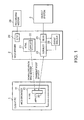
- a supervisory system is structured by a client personal computer (abbreviated to PC) 1 and a WEB server 2 and is coupled to an object system or an simple object 3 to be supervised by the supervisory system, although the following description will be directed to the object system alone.
- PC personal computer
- WEB server 2 the illustrated client PC 1 which may be called a client device implements a WEB browser 11 for displaying HTML (Hyper Text Markup Language) files.
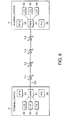
- the object system may be, for example, a terminal station of a marine optical network that will be described later with reference to Fig. 6 and that causes a burst-like event or failure to occur.
- the WEB server 2 implements a specific HTML file 21 that includes a specific program 22 and which may be simply often referred to specific HTML 21.
- the specific program 22 will be described as a Java Applet formed by a Java program hereinafter. At any rate, the Java Applet 22 can be executed on the WEB browser 11 corresponding to Java.
- the illustrated client PC 1 is downloaded by the use of the WEB browser 11 from the WEB server 2 with the specific HTML 21 together with the Java Applet 22.
- the WEB server 2 also implements a Servlet (namely, Java Servlet) 23 and Java Bean or Beans (simply called Bean) 24 and has an event holder 25 cooperating with the Servlet 23 and the Bean 24 for monitoring or supervising the object system 3.
- a recording medium 26 is attached to the WEB server 2 but may be included in the WEB server 2.
- the WEB server 2 is operated by an internal computer 26 in accordance with a program stored in the recording medium 26 and can freely make the client PC 1 download the HTML 21 along with the Applet 21.
- the downloaded HTML 21 is displayed by the WEB browser 11 on the client PC 1 and incorporates the Applet 21.
- the client PC 1 transmits a POST request by the use of the Applet 22 to the WEB server 2,
- the POST request may be a usual transmission request or a POST request defined in the Applet and is received by the Servlet 23 of the WEB server 2.
- the Servlet 23 may be defined as a Java program module executed on the side of the WEB server 2 in response to a request of each client.
- the illustrated Servlet 23 is operated to send a POST reply back to the client PC 1 in response to the POST request.
- each of the POST request and the POST reply has no identification code (ID).
- the Servlet 23 also serves to generate HTML information on the basis of information received from the Bean 24 and event information held by the event holder 25.
- the event information may be indicative of a burst-like or a burst-type event or failure that is spread over various devices and continued for a while.
- the illustrated Bean 24 is used to carry out reception processing of an event notice sent from the object system 3.
- the Bean 24 gives the Servlet 23 information received from the object system 3.
- the Bean 24 makes the event holder 25 hold the information received from the object system 3.
- the event holder 25 serves to hold a notice which is indicative of occurrence of the event sent from the object system 3 and which may be called an event notice.
- the event holder 25 may be placed independently of the Servlet 23 and the Bean 24, as shown in Fig. 1, and may be formed in either the Servlet 23 or the Bean 24.
- the object system 3 to be supervised or monitored by the illustrated supervisory system may have a single or a plurality of supervisory object unit (s) to be supervised and informs the WEB server 2 of event information, such as an alarm or alert.
- the object system 3 is assumed to issue a notice to the WEB server 2 in accordance with the TCP/IP (Transmission Control Protocol/ Internet Protocol) or the like.
- TCP/IP Transmission Control Protocol/ Internet Protocol
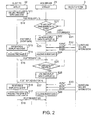
- the HTML 21 includes or incorporates the Applet 22 which is operable to transmit the POST request to the Servlet 23, with a unique ID (identification information) attached (S11 and S12 of Fig. 2).
- the POST request assignment of any parameter is disapproved. Therefore, a value of requesting transmission of an alarm, or a value of indicating the number of the event notice to be transmitted is assigned to the unique ID which serves as a parameter.
- the Servlet 23 judges at S21 of Fig. 2 whether or not the unique ID attached to the POST request indicates transmission or transfer of an alarm.
- the Servlet 23 holds the POST request, without sending a POST reply back to the Applet 22 until the event information is received from the object system 3 through the Bean 24.
- the Servlet 23 sends the POST reply to the Applet 22 (S22 and S23 in Fig. 2).
- the Applet 22 receives the POST reply and renders a reply content into HTML information and displays a received event by the use of the WEB browser 11 (S13 of Fig. 2). Subsequently, the Applet 22 transmits the POST request to the Servlet 23 again in the above-mentioned manner (S14 and S15 of Fig. 2). The Applet 22 is formed so that the POST request is repeatedly transmitted at a predetermined time interval.
- the Servlet 23 makes the event holder 25 hold the burst-like or type event received as a burst event from the Bean 24 until the POST request of the same ID is received by the Servlet 23 (S23 and S24 of Fig. 2).
- the same ID is assumed to be indicative of the ID for transmission of the alarm while the burst event is a notice of an alarm (namely, a status change).
- the Servlet 23 judges at S25 whether or not stored or held events are present and sends event information or data back to the Applet 22 (S26 and S27 of Fig. 2), if the stored events are present.
- event information may be continuously transmitted like a burst.
- the Servlet 23 When the Servlet 23 receives no event from the Bean 24, namely, when the event holder holds no event, no POST reply is returned back from the Servlet 23 to the Applet 22 until any event information is received from the object system 3. After any event information is transmitted from the object system 3, the Servlet 3 executes an operation in a manner similar to the above-mentioned operation (S16 to S18, S28, S33 of Fig. 2).
- the POST request issued from the Applet 22 to the Servlet 23 has the same ID as the ID indicative of the transmission of the alarm.
- the Servlet 23 can judge the ID of the received POST request and executes processing, such as processing of the POST reply, which is determined by a result of the judgment.
- the system according to this invention can inform the client PC 1 of an event in real time without transmitting or receiving any unnecessary packet.
- the HTTP is used between the client PC 1 and the WEB server 2 and is a protocol of a request-response type
- acquisition processing should be usually executed within a very short time interval.
- using the POST request and the POST reply in this invention dispenses with the acquisition processing.
- the system according to this embodiment does not use any other ports except the standard port (the port #80). This does not need to release any other ports in a firewall and makes it possible to apply to an internet environment with security kept.
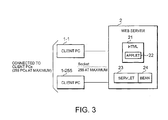
- a supervisory system is specified by connections between a WEB server2 and a plurality of client PCs numbered from 1 to 255.
- the WEB server 2 uses an OS (Operating System) of a UNIX series and limits the number of sockets that are connected to the WEB server 2 and that is equal to 255 at maximum. This means that the number of the clients PCs connected to the WEB server 2 is restricted to 255 at maximum.
- OS Operating System
- a supervisory system serves to remove the restriction of the number of the client PCs connected to the WEB server 2.
- the supervisory system illustrated in Fig. 4 has a repeater server 4-1 between the WEB server 2 and a first group of client PCs 1a-1 to 1 a-254 and has a repeater server 4-2 between the WEB server 2 and a second group of client PCs 1b-1 to 1b-254.
- Each of the repeater servers 4-1 and 4-2 is connected to the WEB server 2 through a single socket and can connect 254 client PCs (1a-1 to 1 a-254; 1b-1 to 1 b-254) in number to each socket of the WEB server 2. With this structure, a total of 508 client PCs can be connected to the WEB server 2.
- locating the repeater server or servers 4 between the client PCs and the WEB server2 serves to increase the number of the client PCs to 254 x n (n is representative of the number of the repeater servers).
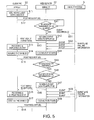
- FIG. 5 description will be made about a sequence chart of an operation executed in a supervisory system according to a fourth embodiment of this invention.
- the supervisory system according to this embodiment is similar in structure to that illustrated in Fig. 1. Accordingly, the following description will be made with reference to both of Figs. 1 and 5.
- the processing of the WEB server 2 illustrated in Fig. 5 is executed by the program stored in the recording medium 26.
- a user boots up the WEB browser 11 of the client PC1 and then downloads the HTML 21 from the WEB server 2 to get or acquire it.
- the HTML 21 includes the Applet 22 which transmits the POST request by the use of a unique ID (S11 and S12) to the Servlet 23. Since setting any parameter is not accepted in the POST request, a value, such as a value of requesting transmission of an alarm, a value of indicating the number of event notices to be transmitted, is assigned to the unique ID as the parameter.
- the Servlet 23 judges whether or not the unique ID of the POST request indicates transmission of the alarm (S41 of Fig. 5). The Servlet 23 does not send back any reply to the Applet 22 until event information is received through the Bean 24 from the object system 3. If the transmission of the alarm is indicated by the unique ID (S41; Yes) and event information is received from the object system 3 as a result of occurrence of any event (S31 of Fig. 5), the Servlet 23 returns a reply to the Applet 22 (S42 and S43 of Fig. 5).
- the Applet 22 renders reply contents into HTML information and displays a received event by the use of the WEB browser 12 (S13 of Fig. 5). Thereafter, the Applet 22 transmits the POST request again in the above-mentioned manner (S14 and S15 of Fig. 5). Thus, the Applet 22 is formed so that the POST request is transmitted at a predetermined interval.
- the Servlet 23 keeps, in the event holder 25, the event information of a burst type received from the Bean 24 (S32 and S44 of Fig. 5) until the POST request with the same ID (in this case, the ID of transmitting the alarm) is received.
- the number of the event information exceeds a predetermined number n (n is an integer greater than unity) after reception of the POST request (S45 and S46 of Fig. 5), the event information is returned as the POST reply back to the Applet 22 (S47 and S48 of Fig. 5) in a burst manner.
- the Servlet 23 does not receive any event from the Bean 24, namely, no event is kept in the event holder 25, no POST reply is returned back to the Applet 22 from the Servlet 3 until event information is received from the object system 3. Supplied with any event information from the object system 3, the Servlet 23 executes an operation similar to that mentioned above (S16 to S18, S28, S33 of Fig. 5).
- the POST request from the Applet 22 to the Servlet 23 is assumed to have the same ID as the ID of transmitting the alarm or the ID which includes the predetermined number n and which indicates transmission of the alarm. With this structure, it is possible to judge the ID of the received POST request and to execute processing in accordance with a result of judgment, such as processing about the POST reply.
- this embodiment makes it possible to notify the client PC 1 of an event in real time, without transmitting or receiving any unnecessary packets.
- the HTTP used between the client PC 1 and the WEB server 2 is a protocol of a request response type
- acquisition processing should be usually executed within a very short time so as to receive a notification from the WEB server 2.
- this embodiment dispenses with such acquisition processing by using the POST request and the POST reply.
- a marine optical network to which this invention is applicable has terminal stations 5 and 6 both of which are connected to each other through an optical fiber 100 and repeaters 7-1, 7-2, 7-3, 7-4 set or laid on bottom of an ocean.
- Each of the terminal stations 5 and 6 has WDM (Wavelength Division Multiplexers) 51; 61, LTE (Line Terminating Equipment) 52 to 54; 62 to 64, RFTE (Remote Fiber Test Equipment) 55; 65, and PFE (Power Feeding Equipment) 56; 66.
- WDM Widelength Division Multiplexers
- LTE Line Terminating Equipment
- RFTE Remote Fiber Test Equipment
- 65 Remote Fiber Test Equipment
- PFE Power Feeding Equipment
- the marine optical fiber network has the terminal stations 5 and 6 connected through the repeaters 7-1 to 7-4 and the optical fiber 100, let any failure be caused to occur in either one of the repeaters 7-1 to 7-4 and the optical fiber 100.
- burst-like failure information takes place from the terminal stations 5 and 6, the repeaters 7-1 to 7-4, the WDM 51, 61, the LTE 52 to 54; 62 to 64; the RFTE 55; 65, and the PFE 56; 66.
- the failure is spread from the optical fiber 100 or the repeater to any other various equipment or facilities like a burst and may therefore be called a burst-like event or failure.
- the burst-like failure information can be collectively transmitted to the client PC 1 in one piece by the use of the POST reply in this invention. Therefore, this invention can cope with occurrence of the burst-like failure information.
- this invention has not been restricted to the marine optical fiber network but can be applied to a land optical fiber network, any other transmission system, or any other object system.
- the server at any rate, when an object system issues an event that occurs in an object system and that includes a notice of a burst like status change, the server at first make the client device download the program available by the WEB browser in the client PC 1. Thereafter, the server keeps the event including the notice of a burst like status change until an event request is issued from the program of the client PC 1. After the event request is sent from the program of the client PC 1, the server transmits the event to the client PC 1 when a status change is caused to occur in the object system or when any event is kept in the server. With this structure, the server can notify the client of occurrence of an event including a burst like event in real time without declining security.
Landscapes
- Engineering & Computer Science (AREA)
- Computer Networks & Wireless Communication (AREA)
- Signal Processing (AREA)
- Computer And Data Communications (AREA)
- Information Transfer Between Computers (AREA)
Applications Claiming Priority (2)
| Application Number | Priority Date | Filing Date | Title |
|---|---|---|---|
| JP2002214627A JP2004054804A (ja) | 2002-07-24 | 2002-07-24 | 監視サーバ装置、監視システム及びそれらに用いるイベント通知方法並びにそのプログラム |
| JP2002214627 | 2002-07-24 |
Publications (2)
| Publication Number | Publication Date |
|---|---|
| EP1401145A2 true EP1401145A2 (fr) | 2004-03-24 |
| EP1401145A3 EP1401145A3 (fr) | 2005-09-14 |
Family
ID=31936869
Family Applications (1)
| Application Number | Title | Priority Date | Filing Date |
|---|---|---|---|
| EP03254569A Withdrawn EP1401145A3 (fr) | 2002-07-24 | 2003-07-22 | Système de supervision, procédé et programme informatique utilisé dans ceux-ci |
Country Status (3)
| Country | Link |
|---|---|
| US (1) | US20040153541A1 (fr) |
| EP (1) | EP1401145A3 (fr) |
| JP (1) | JP2004054804A (fr) |
Cited By (1)
| Publication number | Priority date | Publication date | Assignee | Title |
|---|---|---|---|---|
| CN101163063B (zh) * | 2006-10-13 | 2010-05-12 | 环达电脑(上海)有限公司 | 一种在浏览器上实时显示被控服务器报警信息的方法 |
Families Citing this family (5)
| Publication number | Priority date | Publication date | Assignee | Title |
|---|---|---|---|---|
| JP4649301B2 (ja) * | 2005-09-15 | 2011-03-09 | 株式会社東芝 | 通信方法及びサーバ装置 |
| WO2012063282A1 (fr) * | 2010-11-10 | 2012-05-18 | 株式会社日立製作所 | Procédé et système d'exploitation d'une application composite |
| CN106817294A (zh) * | 2015-11-30 | 2017-06-09 | 北京北信源软件股份有限公司 | 一种支持跨系统通信的企业级即时通信系统和方法 |
| WO2021137218A2 (fr) * | 2020-01-02 | 2021-07-08 | Lavi Gabriel | Procédés et systèmes pour prendre en charge la communication d'une pluralité de dispositifs de communication clients dans un réseau local sans fil |
| CN111447414B (zh) * | 2020-04-02 | 2021-12-14 | 广东金宇恒软件科技有限公司 | 一种方便调度便于监控的视频监控系统及方法 |
Citations (1)
| Publication number | Priority date | Publication date | Assignee | Title |
|---|---|---|---|---|
| JP2002099975A (ja) * | 2000-09-21 | 2002-04-05 | Yamatake Building Systems Co Ltd | 遠隔監視システム |
Family Cites Families (11)
| Publication number | Priority date | Publication date | Assignee | Title |
|---|---|---|---|---|
| US6052710A (en) * | 1996-06-28 | 2000-04-18 | Microsoft Corporation | System and method for making function calls over a distributed network |
| US5995756A (en) * | 1997-02-14 | 1999-11-30 | Inprise Corporation | System for internet-based delivery of computer applications |
| JP3322168B2 (ja) * | 1997-06-04 | 2002-09-09 | 日本電気株式会社 | 監視システム |
| JPH11110311A (ja) * | 1997-09-30 | 1999-04-23 | Canon Inc | 情報処理システム及び装置及び方法及び記憶媒体 |
| US6560639B1 (en) * | 1998-02-13 | 2003-05-06 | 3565 Acquisition Corporation | System for web content management based on server-side application |
| US6487590B1 (en) * | 1998-10-30 | 2002-11-26 | Lucent Technologies Inc. | Method for controlling a network element from a remote workstation |
| US6609081B1 (en) * | 2000-06-02 | 2003-08-19 | Astec International Limited | Automated expansion analyzer for telecommunications power systems |
| AU2001265725A1 (en) * | 2000-06-02 | 2001-12-11 | Astec International Limited | Browser-enabled remote user interface for telecommunications power systems |
| US7047281B1 (en) * | 2000-08-08 | 2006-05-16 | Fineground Networks | Method and system for accelerating the delivery of content in a networked environment |
| JP2002077251A (ja) * | 2000-08-28 | 2002-03-15 | Nec Corp | データ伝送システム、データ中継装置、およびデータ中継方法 |
| US6931429B2 (en) * | 2001-04-27 | 2005-08-16 | Left Gate Holdings, Inc. | Adaptable wireless proximity networking |
-
2002
- 2002-07-24 JP JP2002214627A patent/JP2004054804A/ja active Pending
-
2003
- 2003-07-22 EP EP03254569A patent/EP1401145A3/fr not_active Withdrawn
- 2003-07-23 US US10/624,492 patent/US20040153541A1/en not_active Abandoned
Patent Citations (1)
| Publication number | Priority date | Publication date | Assignee | Title |
|---|---|---|---|---|
| JP2002099975A (ja) * | 2000-09-21 | 2002-04-05 | Yamatake Building Systems Co Ltd | 遠隔監視システム |
Cited By (1)
| Publication number | Priority date | Publication date | Assignee | Title |
|---|---|---|---|---|
| CN101163063B (zh) * | 2006-10-13 | 2010-05-12 | 环达电脑(上海)有限公司 | 一种在浏览器上实时显示被控服务器报警信息的方法 |
Also Published As
| Publication number | Publication date |
|---|---|
| JP2004054804A (ja) | 2004-02-19 |
| US20040153541A1 (en) | 2004-08-05 |
| EP1401145A3 (fr) | 2005-09-14 |
Similar Documents
| Publication | Publication Date | Title |
|---|---|---|
| US7054922B2 (en) | Remote fieldbus messaging via Internet applet/servlet pairs | |
| EP1058429B1 (fr) | Systeme de communication et procede de communication | |
| US8762725B2 (en) | Secure machine-to-machine communication protocol | |
| EP3382563B1 (fr) | Dispositif de communication, système de communication, procédé de communication et programme de communication | |
| CN101345741A (zh) | 基于互联网的代理系统及代理连接方法 | |
| US20080071914A1 (en) | Session control system | |
| EP1401145A2 (fr) | Système de supervision, procédé et programme informatique utilisé dans ceux-ci | |
| CN105407149B (zh) | 消息推送方法及装置 | |
| JPH10334061A (ja) | 負荷分散システム | |
| EP3026860B1 (fr) | Procédé et système de gestion de transmission de synchronisation de configuration complète entre eml et nml | |
| US20060218223A1 (en) | Asynchronous communication method | |
| US20060141997A1 (en) | System and method for remote controlling equipment with the aid of api functions, and corresponding device, radiocommunication module, and set of functions | |
| CN109067509A (zh) | 分布式节点信令传输方法和系统、共享计算节点及信令网关 | |
| CN101167331B (zh) | 传输网络事件日志协议报文的方法、系统和装置 | |
| JP3465183B2 (ja) | ネットワーク監視方式 | |
| JP2581476B2 (ja) | 情報処理装置 | |
| CN101800667A (zh) | 告警消息发送方法、网络设备和告警系统 | |
| EP1638288B1 (fr) | Système d'échange des messages entre des appareils chez client (CPE) et des serveurs | |
| CN110278561A (zh) | 一种家长对孩子的智能移动设备的监控方法 | |
| CN1236246A (zh) | 数据传送方法 | |
| JP2003140991A (ja) | 遠隔監視システムおよびその通信方法 | |
| JP4629906B2 (ja) | 機械トラブル情報送信システム及び方法 | |
| JP4096749B2 (ja) | ゲートウェイ装置、適応通信システム及びそれらの動作プログラム | |
| US7058019B2 (en) | Method of transmitting data between compact control stations using ethernet | |
| JP2008103787A (ja) | 機器情報管理サーバ |
Legal Events
| Date | Code | Title | Description |
|---|---|---|---|
| PUAI | Public reference made under article 153(3) epc to a published international application that has entered the european phase |
Free format text: ORIGINAL CODE: 0009012 |
|
| AK | Designated contracting states |
Kind code of ref document: A2 Designated state(s): AT BE BG CH CY CZ DE DK EE ES FI FR GB GR HU IE IT LI LU MC NL PT RO SE SI SK TR |
|
| AX | Request for extension of the european patent |
Extension state: AL LT LV MK |
|
| PUAL | Search report despatched |
Free format text: ORIGINAL CODE: 0009013 |
|
| AK | Designated contracting states |
Kind code of ref document: A3 Designated state(s): AT BE BG CH CY CZ DE DK EE ES FI FR GB GR HU IE IT LI LU MC NL PT RO SE SI SK TR |
|
| AX | Request for extension of the european patent |
Extension state: AL LT LV MK |
|
| RIC1 | Information provided on ipc code assigned before grant |
Ipc: 7H 04L 12/26 B Ipc: 7H 04L 12/24 A |
|
| 17P | Request for examination filed |
Effective date: 20060324 |
|
| AKX | Designation fees paid |
Designated state(s): FR GB |
|
| REG | Reference to a national code |
Ref country code: DE Ref legal event code: 8566 |
|
| 17Q | First examination report despatched |
Effective date: 20061103 |
|
| STAA | Information on the status of an ep patent application or granted ep patent |
Free format text: STATUS: THE APPLICATION IS DEEMED TO BE WITHDRAWN |
|
| 18D | Application deemed to be withdrawn |
Effective date: 20070515 |