EP1401365B2 - Neue saugfähige struktur - Google Patents
Neue saugfähige struktur Download PDFInfo
- Publication number
- EP1401365B2 EP1401365B2 EP02733686A EP02733686A EP1401365B2 EP 1401365 B2 EP1401365 B2 EP 1401365B2 EP 02733686 A EP02733686 A EP 02733686A EP 02733686 A EP02733686 A EP 02733686A EP 1401365 B2 EP1401365 B2 EP 1401365B2
- Authority
- EP
- European Patent Office
- Prior art keywords
- absorbent
- core
- cores
- product
- sheet
- Prior art date
- Legal status (The legal status is an assumption and is not a legal conclusion. Google has not performed a legal analysis and makes no representation as to the accuracy of the status listed.)
- Expired - Lifetime
Links
- 239000002250 absorbent Substances 0.000 title claims abstract description 166
- 230000002745 absorbent Effects 0.000 title claims abstract description 165
- 238000004519 manufacturing process Methods 0.000 claims abstract description 11
- 238000000034 method Methods 0.000 claims abstract description 11
- 206010021639 Incontinence Diseases 0.000 claims abstract description 4
- 239000012530 fluid Substances 0.000 claims description 25
- 238000003892 spreading Methods 0.000 claims description 3
- 238000009736 wetting Methods 0.000 claims description 3
- 230000007480 spreading Effects 0.000 claims description 2
- 238000003860 storage Methods 0.000 abstract description 3
- 239000000463 material Substances 0.000 description 32
- 230000004888 barrier function Effects 0.000 description 9
- 238000010521 absorption reaction Methods 0.000 description 8
- 210000000056 organ Anatomy 0.000 description 7
- 230000008569 process Effects 0.000 description 7
- -1 polypropylene Polymers 0.000 description 6
- 239000007788 liquid Substances 0.000 description 5
- 239000004698 Polyethylene Substances 0.000 description 4
- 229920003043 Cellulose fiber Polymers 0.000 description 3
- 239000004743 Polypropylene Substances 0.000 description 3
- 210000005069 ears Anatomy 0.000 description 3
- 239000010408 film Substances 0.000 description 3
- 239000011521 glass Substances 0.000 description 3
- 239000003292 glue Substances 0.000 description 3
- 230000002209 hydrophobic effect Effects 0.000 description 3
- 239000002985 plastic film Substances 0.000 description 3
- 229920006255 plastic film Polymers 0.000 description 3
- 229920000573 polyethylene Polymers 0.000 description 3
- 239000004583 superabsorbent polymers (SAPs) Substances 0.000 description 3
- 229920002994 synthetic fiber Polymers 0.000 description 3
- 210000002700 urine Anatomy 0.000 description 3
- 239000002699 waste material Substances 0.000 description 3
- 210000003608 fece Anatomy 0.000 description 2
- 239000006261 foam material Substances 0.000 description 2
- 239000002245 particle Substances 0.000 description 2
- 239000003415 peat Substances 0.000 description 2
- 229920001155 polypropylene Polymers 0.000 description 2
- 229920000247 superabsorbent polymer Polymers 0.000 description 2
- 238000003466 welding Methods 0.000 description 2
- 229920000742 Cotton Polymers 0.000 description 1
- 229920005830 Polyurethane Foam Polymers 0.000 description 1
- 210000001015 abdomen Anatomy 0.000 description 1
- 239000011358 absorbing material Substances 0.000 description 1
- 239000011230 binding agent Substances 0.000 description 1
- 230000015572 biosynthetic process Effects 0.000 description 1
- 239000007767 bonding agent Substances 0.000 description 1
- 229920002678 cellulose Polymers 0.000 description 1
- 239000001913 cellulose Substances 0.000 description 1
- 230000008859 change Effects 0.000 description 1
- 230000001419 dependent effect Effects 0.000 description 1
- 238000009826 distribution Methods 0.000 description 1
- 230000000694 effects Effects 0.000 description 1
- 239000010808 liquid waste Substances 0.000 description 1
- 239000000203 mixture Substances 0.000 description 1
- 229920000728 polyester Polymers 0.000 description 1
- 229920000642 polymer Polymers 0.000 description 1
- 239000011496 polyurethane foam Substances 0.000 description 1
- 230000003019 stabilising effect Effects 0.000 description 1
- 239000010409 thin film Substances 0.000 description 1
Images
Classifications
-
- A—HUMAN NECESSITIES
- A61—MEDICAL OR VETERINARY SCIENCE; HYGIENE
- A61F—FILTERS IMPLANTABLE INTO BLOOD VESSELS; PROSTHESES; DEVICES PROVIDING PATENCY TO, OR PREVENTING COLLAPSING OF, TUBULAR STRUCTURES OF THE BODY, e.g. STENTS; ORTHOPAEDIC, NURSING OR CONTRACEPTIVE DEVICES; FOMENTATION; TREATMENT OR PROTECTION OF EYES OR EARS; BANDAGES, DRESSINGS OR ABSORBENT PADS; FIRST-AID KITS
- A61F13/00—Bandages or dressings; Absorbent pads
- A61F13/15—Absorbent pads, e.g. sanitary towels, swabs or tampons for external or internal application to the body; Supporting or fastening means therefor; Tampon applicators
- A61F13/53—Absorbent pads, e.g. sanitary towels, swabs or tampons for external or internal application to the body; Supporting or fastening means therefor; Tampon applicators characterised by the absorbing medium
- A61F13/531—Absorbent pads, e.g. sanitary towels, swabs or tampons for external or internal application to the body; Supporting or fastening means therefor; Tampon applicators characterised by the absorbing medium having a homogeneous composition through the thickness of the pad
- A61F13/532—Absorbent pads, e.g. sanitary towels, swabs or tampons for external or internal application to the body; Supporting or fastening means therefor; Tampon applicators characterised by the absorbing medium having a homogeneous composition through the thickness of the pad inhomogeneous in the plane of the pad
-
- A—HUMAN NECESSITIES
- A61—MEDICAL OR VETERINARY SCIENCE; HYGIENE
- A61F—FILTERS IMPLANTABLE INTO BLOOD VESSELS; PROSTHESES; DEVICES PROVIDING PATENCY TO, OR PREVENTING COLLAPSING OF, TUBULAR STRUCTURES OF THE BODY, e.g. STENTS; ORTHOPAEDIC, NURSING OR CONTRACEPTIVE DEVICES; FOMENTATION; TREATMENT OR PROTECTION OF EYES OR EARS; BANDAGES, DRESSINGS OR ABSORBENT PADS; FIRST-AID KITS
- A61F13/00—Bandages or dressings; Absorbent pads
- A61F13/15—Absorbent pads, e.g. sanitary towels, swabs or tampons for external or internal application to the body; Supporting or fastening means therefor; Tampon applicators
- A61F13/15577—Apparatus or processes for manufacturing
- A61F13/15666—Wrapping formed fibrous webs or pads, e.g. the pads being formed by uniting pad pieces cut from fibrous webs
-
- A—HUMAN NECESSITIES
- A61—MEDICAL OR VETERINARY SCIENCE; HYGIENE
- A61F—FILTERS IMPLANTABLE INTO BLOOD VESSELS; PROSTHESES; DEVICES PROVIDING PATENCY TO, OR PREVENTING COLLAPSING OF, TUBULAR STRUCTURES OF THE BODY, e.g. STENTS; ORTHOPAEDIC, NURSING OR CONTRACEPTIVE DEVICES; FOMENTATION; TREATMENT OR PROTECTION OF EYES OR EARS; BANDAGES, DRESSINGS OR ABSORBENT PADS; FIRST-AID KITS
- A61F13/00—Bandages or dressings; Absorbent pads
- A61F13/15—Absorbent pads, e.g. sanitary towels, swabs or tampons for external or internal application to the body; Supporting or fastening means therefor; Tampon applicators
- A61F13/15577—Apparatus or processes for manufacturing
- A61F13/15699—Forming webs by bringing together several webs, e.g. by laminating or folding several webs, with or without additional treatment of the webs
-
- A—HUMAN NECESSITIES
- A61—MEDICAL OR VETERINARY SCIENCE; HYGIENE
- A61F—FILTERS IMPLANTABLE INTO BLOOD VESSELS; PROSTHESES; DEVICES PROVIDING PATENCY TO, OR PREVENTING COLLAPSING OF, TUBULAR STRUCTURES OF THE BODY, e.g. STENTS; ORTHOPAEDIC, NURSING OR CONTRACEPTIVE DEVICES; FOMENTATION; TREATMENT OR PROTECTION OF EYES OR EARS; BANDAGES, DRESSINGS OR ABSORBENT PADS; FIRST-AID KITS
- A61F13/00—Bandages or dressings; Absorbent pads
- A61F13/15—Absorbent pads, e.g. sanitary towels, swabs or tampons for external or internal application to the body; Supporting or fastening means therefor; Tampon applicators
- A61F13/53—Absorbent pads, e.g. sanitary towels, swabs or tampons for external or internal application to the body; Supporting or fastening means therefor; Tampon applicators characterised by the absorbing medium
- A61F13/534—Absorbent pads, e.g. sanitary towels, swabs or tampons for external or internal application to the body; Supporting or fastening means therefor; Tampon applicators characterised by the absorbing medium having an inhomogeneous composition through the thickness of the pad
- A61F13/535—Absorbent pads, e.g. sanitary towels, swabs or tampons for external or internal application to the body; Supporting or fastening means therefor; Tampon applicators characterised by the absorbing medium having an inhomogeneous composition through the thickness of the pad inhomogeneous in the plane of the pad, e.g. core absorbent layers being of different sizes
Definitions
- the invention relates to an absorbent product, such as a diaper or an incontinence garment, having a longitudinal and a lateral direction, comprising a back sheet, being distal from the body of the wearer in use of the garment, and a top sheet, being proximal to the body of the wearer in use of the garment, said product having a front part, a rear part and a crotch part lying between the front and rear parts, the product further comprising an absorbent structure, between the top and back sheet, extending longitudinally from the front part to the rear part.
- an absorbent product such as a diaper or an incontinence garment, having a longitudinal and a lateral direction, comprising a back sheet, being distal from the body of the wearer in use of the garment, and a top sheet, being proximal to the body of the wearer in use of the garment, said product having a front part, a rear part and a crotch part lying between the front and rear parts, the product further comprising an absorbent structure,
- T-shaped absorbent core US-A-3,768,479
- the T-shaped absorbent core provided an absorbent product with an absorbent structure having good fluid-storing properties, as well as it gave a good and stable fit to the wearer.
- US-A-4,643,726 is an hour-glass shaped absorbent structure disclosed, which through its shape may absorb and store fluid to a greater extent than an absorbent core not being as large in size.
- WO99/17696 discloses an absorbent product comprising at least two separate absorbent layers lying on top of each other.
- US-A-5835402 discloses an absorbent product having two separate absorbent layers, whereby one of the layers is placed in the rear part and the crotch part and the other layer is placed in the front part.
- the shape provides a good stability in the front part of the absorbent product.
- the shape (or hour-glass shape) facilitates the absorbent structure to be correctly positioned in the longitudinal direction of the absorbent product, as it has a pre-disposed placement, due to the fitting of its shape between the legs of the wearer and the absorbent product.
- the absorbent material of the "ears" and the front edge part of the core not being in close proximity with the fluid waste source, i.e. urine, are used for storing fluid.
- the absorbent cores are produced in a mat forming process, which usually is divided in two types: continuous and discontinuous mat forming.
- each core is formed in a form having any desired shape.
- This process is advantageous due to its high flexibility with regard to the shape and surface of the core.
- it has been shown that it is difficult to achieve a good absorption capacity in the "ears", as the "ears” tend to become thinner than the rest of the absorbent core.
- This is a result of the mat forming process, and is especially significant at high production rates, or by manufacturing of thin layers.
- an absorbent product manufactured by this process has a sub-optimal fluid storing capacity.
- continuous mat forming may be used, whereby the absorption cores are cut into discrete pieces after the formation process, which pieces are placed in the absorbent product.
- continuous mat forming it is optimal to keep the longitudinal core edges straight and parallel, as one otherwise end up with the problems described above for the discontinuous mat forming.
- the products from continuous mat forming are normally absorbent products comprising cores with a rectangular surface shape. This leads to a worse fit, and frequently also to an insufficient absorption capacity in the front part of the absorbent product.
- the two cores are manufactured independently from each other, thereby avoiding the drawbacks of the prior art, such as the uneven distribution of the absorbent material, and are thereafter put together, to form the T-shaped absorbent structure. Accordingly, the different size, thickness, shape, and content of the two different absorbent cores can be greatly varied.
- the absorbent cores may be provided in three different ways: continuous mat-forming, discontinuous mat-forming, and as a prefabricated core, preferably being stored as a roll goods or as festooned blocks.
- T-shaped absorbent structure By a “T-shaped” absorbent structure is meant a structure, which, by its shape, essentially defines a “T”, whereby the cross-leg of the T is positioned in the front part or in the rear part of the diaper, and the longitudinal leg of the T extends from the front to the rear part of the diaper.
- absorbent core a single body of material having absorbent properties.
- essentially parallel longitudinal edges of the core is meant that the core edges are essentially parallel with each other.
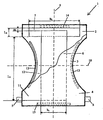
- Figure 1 discloses a diaper 1.
- the diaper comprises an absorbent structure 6, 7, being enclosed between a liquid-permeable top sheet 11 and a liquid-impermeable backing sheet 12, these sheets being fastened to each other in portions thereof reaching beyond the absorbent body.
- the diaper has a front part 2, a rear part 4 and an intermediate crotch part 3, whereby the longitudinal direction of the diaper extends from the rear to the front edge thereof.
- the top sheet and the backing sheet constitute a casing for the absorbent structure 6, 7, and the side portions of the front 2 and rear part 4 of the diaper 1 are laterally projecting from the front and rear parts in relation to the extension of the casing in the crotch part 3 of the diaper.
- the absorbent structure comprises two separate bodies: the first absorbent core 6 and the second absorbent core 7.
- the first absorbent core has the function of a regular absorbent core being in proximity with the waste fluid source, i. e. to absorb and spread fluid waste, i.e. urine.
- the second absorbent core mainly has the function of storage of liquid waste. The individual sizes of the first and second absorbent core may be greatly varied.
- the first absorbent core has the length l 1 of 200-600 mm and the width b 1 of 50-250 mm.
- the second absorbent core has the length l 2 of 50-150 mm and the width b 2 of 80-250 mm.
- the width b 2 is greater than the width b 1 .
- the thickness of the first and second absorbent core may also be greatly varied, whereby the first absorbent core has the thickness of 2-7 mm, and the second absorbent core has the thickness of 2-7 mm. Accordingly, during the mat-forming process, the number of layers used may vary between the different cores. They need have rectangular shapes. This makes it possible to provide an absorbent structure having the desired absorbing properties and shape.
- the absorbent cores 6, 7 is preferably formed of cellulose fibres but also other natural materials, such as cotton fibres or peat can be used. Alternatively, absorbent synthetic fibres or a mixture of natural and synthetic fibres may be used.
- the absorbent cores can also comprise a super-absorbent, i.e. a polymer having the capacity to abity to absorb liquid to an amount several times larger than its own weight.
- the absorbent cores can also contain form stabilising and/or liquid dispersing components and also bonding agents for holding together short fibres and particles to a continuous unit.
- the absorbent cores can contain more than one layer of absorbent material.
- the different cores may be formed of different material, thereby providing cores having different absorbent properties.
- an enhanced absorption capacity is desired in the front part of the diaper. For instance, this can be accomplished by producing a second absorbent core having a greater content of super-absorbent polymers than the first core.
- the liquid-permeable top sheet is preferably made of a material showing properties like dryness and softness at use of the absorbent product, as this sheet lies against the body of the wearer. It is desired, that the sheet has a soft and textile-like surface, which remains dry also at repeated wettings.
- the top sheet may for example be composed of nonwoven material with a soft and smooth surface, such as for example a spunbond made of polypropylene fibres.
- a hydrophobic nonwoven-material may be used, which has holes, so that openings are formed in the material, which openings are greater than the cavities between the fibres of the material.
- top sheet may for example be holed plastic films, such as for example a holed polyethylene film.
- the top sheet may be connected to the underlying backing sheet and to the absorption core by, for example, glue or through some kind of thermal bonding.
- the liquid-impermeable backing sheet consists of a flexible material, preferably a thin plastic film of PE (polyethylene), PP (polypropylene), a polyester, or some other kind of suitable material, such as a hydrophobic nonwoven-layer or a laminate of a thin film and a nonwoven material.
- PE polyethylene
- PP polypropylene
- polyester or some other kind of suitable material, such as a hydrophobic nonwoven-layer or a laminate of a thin film and a nonwoven material.
- breathable backing sheets which prevents fluid from coming out of the absorbent product, but that allows moisture to be ventilated.
- These breathable backing sheets may be composed of single material layers, or of laminates of, for example, blown or moulded polyethylene films, which have been laminated with, for example, a nonwoven layer of spunbond or of spunbond-meltblown-spunbond (SMS).
- SMS spunbond-meltblown-spunbond
- the absorption body is typically built up by one or more layers of cellulose fibres, for example cellulose fluff pulp. Other materials, which may be used, are for example absorbing nonwoven material, foam material, synthetic fibre materials or peat.
- the absorbent body may also comprise superabsorbent material, so called SAP (super absorbent polymers), that is material in the form of fibres, particles, granula, film or the like, which material has the ability to absorb fluid corresponding to several times the weight of the superabsorbent material.
- SAP superabsorbent polymers
- SAP super absorbent polymers
- the superabsorbent material binds the fluid and forms a fluid-containing gel.
- the absorbent body may comprise binders, form-stabilising components or the like.
- Additional layers improving the properties may also be used, such as various types of fluid-spreading material layers or inserts, so called waddings.
- the absorbent body may be chemically or physically treated in order to change the absorption properties. For instance, it is possible to provide an absorbent layer with compressed regions and/or being compressed in the entire layer(s) in order to control the fluid flow in the absorbent body. It is also possible to enclose the absorbent layer(s) in an envelope of for example tissue material.
- the absorbent body has in its longitudinal direction an outstretched form, and is T-shaped.
- the lateral part is at use adapted for being positioned towards the front part of the absorbent product, so that it at use is in the area around the belly of the user.
- Those parts on each side of the central part, which extend outside the absorbent body and between the rear and front side portion are preferably equipped with one or more elastic organs 13, at least in the part of the absorbent product which at use forms the crotch part.
- the elastic organs function as leg elastics, and have as their purpose to prevent fluid and faeces to leak out through the longitudinal edges, and thereby form outer fluid barriers.
- the elastic organs may be composed of one or several elastic threads, which in stretched state are applied between the backing sheet and the top sheet, or between the backing sheet and a separate sheet outside the top sheet in the lateral direction.
- the separate sheet may be composed of a strip, which extends along the absorbent body and the longitudinal edges.
- the elastics may be applied between the sheets in an un-stretched state, whereby instead both sheets are gathered or wrinkled at the application. It is also possible to apply the elastics on the outside of the backing sheet or on the inside of the top sheet.
- the absorbent product on the side that is facing the wearer may also be equipped with inner fluid barriers, which are attached in connection to the longitudinal edges inside the outer barriers.
- the inner barriers are made of an essentially liquid-impermeable material, such as for example a hydrophobic nonwoven or a plastic film, and are formed as a longitudinal path with a first edge being connected to the absorbent product and a second free edge, which is adapted for being in close contact with the user at use of the absorbent product.
- the second edge is equipped with one or more elastic elements, preferably an elastic thread, which in contracted state contracts the free edge, whereby an upstanding barrier is formed.
- the inner barrier may be designed as a strip of a single sheet, wherein the free edge is turned down in order to enclose the elastic element to prevent direct contact of the elastic thread to the user.
- the barrier may be formed of two combined layers, whereby the elastic thread is attached to the edge of the free end between the two layers.
- the inner layer of the barrier may be composed of an elongation of the top sheet and the outer layer of an essentially liquid-impermeable material, or the inner and outer layers of the barrier may be composed of one single material strip, which is folded around the elastic thread.
- the rear and/or front parts of the product may also be equipped with a so called waist elastics 14, 15, which is composed of elastic organs applied along the front and/or rear end edges in order to give the product a soft and flexible enclosure around the waist of the user.
- the elastic organs are attached between the backing sheet and the top sheet with glue or through welding, such as ultra-sonic welding.
- the elastic organs may be composed of one or more elastic threads, which in a stretched state are applied between the sheets, and thereby form the waist elastics.
- the elastics may be applied between the sheets in an unstretched state, whereby both sheets instead are gathered or wrinkled at application.
- elastic foam material composed of a thin strip of for example polyurethane foam, which like the elastic threads can be applied between the two sheets.
- elastic foam material composed of a thin strip of for example polyurethane foam, which like the elastic threads can be applied between the two sheets.
- the absorbent product may comprise a fastening system.
- This fastening system may be of any kind, which is suitable for the product, such as a hook and loop system, or a tape.
- the product may also be a pant diaper, thereby not having a fastening system for attaching opposing side portions to each other.
- the first absorbent core is placed with an overlap on the second absorbent core. It is fully possible, though, to put second absorbent core on the first absorbent core. Moreover, it also fully possible to use two "second" absorbent cores, whereby one is put under and the other is put over the first absorbent core, i.e. the first absorbent core is sandwiched between the other cores.
- the first absorbent core is positioned in a way making it overlapping the second absorbent core.
- the distance m in figure 1 is shorter than the distance l 2 of the second absorbent core, in this case.
- the distance m is within the interval ranging from 0 to 150 mm, thus being equal to or smaller than the distance 1 2 .
- the first absorbent core is equipped with a wicking layer, which wicking layer has the purpose to spread fluid towards the front part of the absorbent structure.
- liquid is spread to the second absorbent core, which is used for liquid storage.
- the wicking layer does not necessarily need to cover the whole first absorbent core, but should preferably cover at least the part of the first absorbent core being in the front part of the casing, more preferably the part being in the front and crotch parts of the casing, and most preferably the entire first absorbent core.
- the wicking layer is of a moisture permeable material, preferably tissue paper or a hydrophilic non-woven, and functions to disperse the fluid, i. e. urine, passing through the liquid permeable top sheet, preferably in a direction towards the front part of the diaper.
- the wicking layer comprises small capillaries directing the fluid towards smaller capillaries, due to capillary forces.
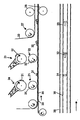
- FIG. 2 illustrates the manufacturing of an absorbent product according to the invention.
- an absorbent product is manufactured on a continuously moving belt 20.
- Two applicator devices 21, 22 can be seen. Over the applicator devices are mat-forming devices 23, 24 positioned.
- the second absorbent core 31 is formed by the mat-forming device in connection with the first applicator device 21, and a backing sheet 30 forming a continuously moving web is applied by the applicator device.
- the second core 31 is placed on the continuously moving web so that the edge of the second core that is to be closest to the front of the absorbent product points in the direction of movement of the continuously moving belt 20.
- the first absorbent core 32 is formed by the mat-forming device being connected to the second applicator device 22, and is placed on the second absorbent core 31 in order to form a T-shaped absorbent structure. Thereafter, a top sheet is applied on the T-shaped absorbent structure 33, the T-shaped absorbent structure thereby being packaged in a casing. Next, the casing is nipped between rollers, in order to create a good contact between the cores and also to compress the cores, which creates smaller capillaries, thereby creating better fluid spreading properties in the absorbent material. Thereafter, the casing is sealed, and cut to thereby constitute a finished absorbent product. This finished absorbent product is subsequently packaged in an outer package.
- the first and the second absorbent core may be manufactured by discontinuous mat-forming (as in figure 2), or by continuous mat-forming. Furthermore, the absorbent cores may be provided as prefabricated cores, preferably being stored on a roll. Any regular diaper manufacturing machine may be used for the mat-forming process.
- the area of the top and back sheets surrounding the cores may contain glue, thereby preventing the cores from sliding.
- the thickness of the absorbent cores in an overlapping relation may before wetting preferably be less than 5 mm, measured with an applied pressure of 0.1 N/cm 2 .
- the second absorbent core may be positioned in the rear part of the absorbent product.
- T-shaped absorbent structure of the invention may also be used for other absorbent products than diapers.
- absorbent products for example, incontinence garments or sanitary napkins may be mentioned.
Landscapes
- Health & Medical Sciences (AREA)
- Engineering & Computer Science (AREA)
- General Health & Medical Sciences (AREA)
- Public Health (AREA)
- Heart & Thoracic Surgery (AREA)
- Vascular Medicine (AREA)
- Life Sciences & Earth Sciences (AREA)
- Animal Behavior & Ethology (AREA)
- Epidemiology (AREA)
- Biomedical Technology (AREA)
- Veterinary Medicine (AREA)
- Manufacturing & Machinery (AREA)
- Absorbent Articles And Supports Therefor (AREA)
- Orthopedics, Nursing, And Contraception (AREA)
- Laminated Bodies (AREA)
- Compositions Of Macromolecular Compounds (AREA)
Claims (11)
- Absorbierendes Produkt (1, 34) wie beispielsweise eine Windel oder ein Inkontinenzschutz, mit einer Längs- (9) und einer Querrichtung (10), umfassend eine Rückseitenlage (12), die im Gebrauch des Produkts distal des Körpers des Trägers liegt und eine Oberseitenlage (11), die im Gebrauch des Produkts proximal des Körpers des Trägers liegt, wobei das Produkt einen Vorderteil (2), einen Hinterteil (4) und einen Schrittteil (3), der zwischen dem Vorder- und Hinterteil liegt, aufweist und das Produkt ein absorbierendes Gebilde zwischen der Oberseiten- und Rückseitenlage umfasst, das sich von dem Vorderteil längs zu dem Hinterteil erstreckt, dadurch gekennzeichnet, dass das absorbierende Gebilde wenigstens zwei separate Absorptionskerne (6, 7, 31, 32) umfasst, wobei sich wenigstens ein erster Absorptionskern (6, 32) von dem Vorderteil längs zu dem Hinterteil erstreckt und wenigstens ein zweiter Absorptionskern (7, 31) nur in dem Vorderteil oder dem Hinterteil angeordnet ist, wobei die Breite gesehen in der Querrichtung des zweiten Kerns (b2) größer ist als die Breite des ersten Kerns (b1), wobei der erste Kern (6, 32) parallele Längskanten aufweist, und so positioniert ist, dass er den zweiten Kern (7, 31) überlappt, und wobei die zwei Kerne (6, 7, 31, 32) ein T-förmiges absorbierendes Gebilde ausbilden, und wobei der erste und der zweite Absorptionskern beide rechteckig geformt sind.
- Absorbierendes Produkt nach Anspruch 1, wobei die Länge des ersten Absorptionskerns l1 im Intervall von 200 bis 600 mm liegt, die Breite b1 des ersten Kerns im Intervall von 50 bis 250 mm liegt, die Länge l2 des zweiten Kerns im Intervall von 50 bis 150 mm liegt und die Breite b2 des zweiten Kerns im Intervall von 80 bis 250 mm liegt.
- Absorbierendes Produkt nach einem der Ansprüche 1 bis 2, wobei wenigstens einer der Absorptionskerne wenigstens 25 % (w/w) SAP umfasst.
- Absorbierendes Produkt nach einem der Ansprüche 1 bis 3, wobei der Abstand m von der Vorderkante des ersten Absorptionskerns zu der Kante des zweiten Absorptionskerns die am nächsten zu der Vorderkante des absorbierendes Produkts liegt kleiner ist als die Länge des zweiten Absorptionskerns l2.
- Absorbierendes Produkt nach einem der vorstehenden Ansprüche, wobei der Abstand m im Intervall von 0 bis 150 mm liegt.
- Absorbierendes Produkt nach einem der vorstehenden Ansprüche, wobei der erste und zweite Absorptionskern vor dem Benetzen in einer überlappenden Beziehung eine Stärke aufweisen, die gemessen bei einem aufgebrachten Druck von 0,1 N/cm2 weniger als 5 mm beträgt.
- Absorbierendes Produkt nach Anspruch 4, wobei der zweite Kern auf dem ersten Kern liegt, wobei der zweite Kern der Oberseitenlage zugewandt ist.
- Absorbierendes Produkt nach einem der vorstehenden Ansprüche, wobei der erste Absorptionskern mit einer Dochteffektschicht ausgestattet ist, die Fluid in Richtung des Vorderteils des ersten Absorptionskerns verteilt.
- Absorbierendes Produkt nach einem der vorstehenden Ansprüche, wobei der zweite Kern eine Breite (b2) aufweist, die größer ist als seine Länge (l2).
- Verfahren zum Herstellen eines absorbierenden Produkts gemäß einem der Ansprüche 1 bis 9, umfassend die Schritte:(a) Bereitstellen einer Rückseitenlage oder einer Oberseitenlage, die eine sich kontinuierlich bewegende Bahn (20) bildet;(b) Bereitstellen eines Absorptionskerns (31);(c) Aufbringen des Absorptionskerns (31) des Schritts (b) auf die Lage durch ein erstes Auftragswerk (21);(d) Bereitstellen eines anderen Absorptionskerns (32);(e) Aufbringen des Absorptionskerns des Schritts (d) auf den Absorptionskern des Schritts (b) und/oder auf die Lage, die die sich kontinuierlich bewegende Bahn bildet durch ein zweites Auftragswerk (22), wobei sich wenigstens einer der Absorptionskerne von dem Vorderteil längs zu dem Hinterteil erstreckt und wenigstens einer der Kerne in dem Vorderteil oder dem Hinterteil angeordnet ist;(f) Aufbringen einer Oberseiten- oder Rückseitenlage auf dem absorbierenden Gebilde auf der sich kontinuierlich bewegenden Bahn, wobei das Produkt bei diesem Schritt eine Oberseiten- und eine Rückseitenlage zusätzlich zu den Absorptionskernen umfasst;(g) Einbringen des Produkts des Schritts (f) in einen Walzenspalt zwischen zwei Walzen (28);wobei die Kerne, die in dem Schritt (b) und (d) bereitgestellt wurden getrennt werden, wobei der Kern des Schritts (b) nur in dem Vorder- oder dem Hinterteil angeordnet ist, die Breite gesehen in der Querrichtung des Produkts (b2) des Kerns (31) des Schritts (b) größer ist als die Breite (b1) des Kerns (32) des Schritts (d), wobei der Kern (32) des Schritts (d) parallele Längskanten aufweist und wobei die zwei Kerne einen T-förmigen absorbierenden Gegenstand bilden.
- Verfahren nach Anspruch 10, wobei einer oder beide Absorptionskerne durch eine der folgenden Einrichtungen bereitgestellt werden: (i) diskontinuierliches Mattenformieren, (ii) kontinuierliches Mattenformieren und (iii) gelagert als vorgefertigter Kern.
Applications Claiming Priority (3)
| Application Number | Priority Date | Filing Date | Title |
|---|---|---|---|
| SE0101757 | 2001-05-18 | ||
| SE0101757A SE0101757L (sv) | 2001-05-18 | 2001-05-18 | Ny absorberande struktur |
| PCT/SE2002/000924 WO2002094164A1 (en) | 2001-05-18 | 2002-05-15 | New absorbent structure |
Publications (3)
| Publication Number | Publication Date |
|---|---|
| EP1401365A1 EP1401365A1 (de) | 2004-03-31 |
| EP1401365B1 EP1401365B1 (de) | 2005-10-05 |
| EP1401365B2 true EP1401365B2 (de) | 2008-10-22 |
Family
ID=20284159
Family Applications (1)
| Application Number | Title | Priority Date | Filing Date |
|---|---|---|---|
| EP02733686A Expired - Lifetime EP1401365B2 (de) | 2001-05-18 | 2002-05-15 | Neue saugfähige struktur |
Country Status (6)
| Country | Link |
|---|---|
| EP (1) | EP1401365B2 (de) |
| AT (1) | ATE305763T1 (de) |
| DE (1) | DE60206504T3 (de) |
| PL (1) | PL367247A1 (de) |
| SE (1) | SE0101757L (de) |
| WO (1) | WO2002094164A1 (de) |
Families Citing this family (1)
| Publication number | Priority date | Publication date | Assignee | Title |
|---|---|---|---|---|
| FR3120517B1 (fr) | 2021-03-11 | 2023-05-12 | Torres Edison Arley Zapata | Article d’hygiène anatomique, isolant et protecteur |
Citations (3)
| Publication number | Priority date | Publication date | Assignee | Title |
|---|---|---|---|---|
| US3306293A (en) † | 1963-07-31 | 1967-02-28 | Colgate Palmolive Co | Disposable diaper |
| US5906602A (en) † | 1997-03-27 | 1999-05-25 | The Procter & Gamble Company | Shaped absorbent cores comprising multiple pieces of absorbent material and method for making same |
| US6015935A (en) † | 1997-03-27 | 2000-01-18 | The Procter & Gamble Company | Absorbent articles comprising a material having a high vertical wicking capacity |
Family Cites Families (5)
| Publication number | Priority date | Publication date | Assignee | Title |
|---|---|---|---|---|
| US4643726A (en) * | 1983-07-18 | 1987-02-17 | E. R. Squibb & Sons, Inc. | Incontinence insert |
| US5134007A (en) * | 1988-05-24 | 1992-07-28 | The Procter & Gamble Company | Multiple layer absorbent cores for absorbent articles |
| CA2206289A1 (en) * | 1994-11-23 | 1996-05-30 | Kimberly-Clark Worldwide, Inc. | Absorbent article having a composite absorbent core |
| CO5261577A1 (es) * | 1997-10-08 | 2003-03-31 | Kimberly Clark Co | Articulo absorbente con estructura absorbente con region de capa heterogenea |
| US6699228B1 (en) * | 1998-06-11 | 2004-03-02 | Paragon Trade Brands, Inc. | Diaper for isolating bowel movement or stools from skin |
-
2001
- 2001-05-18 SE SE0101757A patent/SE0101757L/ not_active Application Discontinuation
-
2002
- 2002-05-15 EP EP02733686A patent/EP1401365B2/de not_active Expired - Lifetime
- 2002-05-15 WO PCT/SE2002/000924 patent/WO2002094164A1/en not_active Ceased
- 2002-05-15 DE DE60206504T patent/DE60206504T3/de not_active Expired - Lifetime
- 2002-05-15 AT AT02733686T patent/ATE305763T1/de not_active IP Right Cessation
- 2002-05-15 PL PL02367247A patent/PL367247A1/xx not_active Application Discontinuation
Patent Citations (3)
| Publication number | Priority date | Publication date | Assignee | Title |
|---|---|---|---|---|
| US3306293A (en) † | 1963-07-31 | 1967-02-28 | Colgate Palmolive Co | Disposable diaper |
| US5906602A (en) † | 1997-03-27 | 1999-05-25 | The Procter & Gamble Company | Shaped absorbent cores comprising multiple pieces of absorbent material and method for making same |
| US6015935A (en) † | 1997-03-27 | 2000-01-18 | The Procter & Gamble Company | Absorbent articles comprising a material having a high vertical wicking capacity |
Also Published As
| Publication number | Publication date |
|---|---|
| DE60206504T3 (de) | 2009-06-10 |
| WO2002094164A1 (en) | 2002-11-28 |
| SE0101757L (sv) | 2002-11-19 |
| PL367247A1 (en) | 2005-02-21 |
| SE0101757D0 (sv) | 2001-05-18 |
| EP1401365A1 (de) | 2004-03-31 |
| DE60206504D1 (de) | 2005-11-10 |
| EP1401365B1 (de) | 2005-10-05 |
| ATE305763T1 (de) | 2005-10-15 |
| DE60206504T2 (de) | 2006-07-13 |
Similar Documents
| Publication | Publication Date | Title |
|---|---|---|
| US7048725B2 (en) | Absorbent structure | |
| US10159610B2 (en) | Absorbent article with partially enclosed waist containment member and method of manufacturing thereof | |
| US9913763B2 (en) | Absorbent article with channels | |
| US9345626B2 (en) | Method for producing a web of a laminate material for retaining faeces and method for producing an absorbent article | |
| US20030236512A1 (en) | Absorbent core with folding zones for absorbency distribution | |
| US20110106036A1 (en) | Absorbent product | |
| MXPA04007868A (es) | Material mixto formado en seco con capas para corte y colocacion. | |
| SK87797A3 (en) | Absorbent articles having improved properties | |
| JP3794590B2 (ja) | キャビティを含む吸収体 | |
| WO2020251438A1 (en) | Absorbent article | |
| JP4757182B2 (ja) | 吸収性物品 | |
| US20040220539A1 (en) | Absorbent article with improved absorbency performance | |
| EP1401365B2 (de) | Neue saugfähige struktur | |
| KR102507716B1 (ko) | 탄성화된 흡수 용품 및 탄성화된 흡수 용품을 형성하는 방법 | |
| JP7784000B2 (ja) | 使い捨ての吸収性衛生物品のための吸収性コアを製造する方法、吸収性コア、および吸収性物品 | |
| CZ288285B6 (en) | Sheathing laminate for an absorbent product, process for manufacture of the sheathing laminate and absorbent product containing such sheathing laminate | |
| US12599510B2 (en) | Absorbent article with leak-proof containment flaps | |
| KR20230124005A (ko) | 허리 밴드를 갖는 흡수 용품 | |
| JP2022089467A (ja) | 吸収性物品及び吸収性物品の製造方法 | |
| JP2022007626A (ja) | 吸収性物品 | |
| US20080047659A1 (en) | Method for manufacturing single panel reattachable pant | |
| MXPA97009249A (en) | Article with absorbent pulp sheet su |
Legal Events
| Date | Code | Title | Description |
|---|---|---|---|
| PUAI | Public reference made under article 153(3) epc to a published international application that has entered the european phase |
Free format text: ORIGINAL CODE: 0009012 |
|
| 17P | Request for examination filed |
Effective date: 20031023 |
|
| AK | Designated contracting states |
Kind code of ref document: A1 Designated state(s): AT BE CH CY DE DK ES FI FR GB GR IE IT LI LU MC NL PT SE TR |
|
| AX | Request for extension of the european patent |
Extension state: AL LT LV MK RO SI |
|
| 17Q | First examination report despatched |
Effective date: 20041021 |
|
| GRAP | Despatch of communication of intention to grant a patent |
Free format text: ORIGINAL CODE: EPIDOSNIGR1 |
|
| GRAS | Grant fee paid |
Free format text: ORIGINAL CODE: EPIDOSNIGR3 |
|
| GRAA | (expected) grant |
Free format text: ORIGINAL CODE: 0009210 |
|
| AK | Designated contracting states |
Kind code of ref document: B1 Designated state(s): AT BE CH CY DE DK ES FI FR GB GR IE IT LI LU MC NL PT SE TR |
|
| PG25 | Lapsed in a contracting state [announced via postgrant information from national office to epo] |
Ref country code: AT Free format text: LAPSE BECAUSE OF FAILURE TO SUBMIT A TRANSLATION OF THE DESCRIPTION OR TO PAY THE FEE WITHIN THE PRESCRIBED TIME-LIMIT Effective date: 20051005 Ref country code: LI Free format text: LAPSE BECAUSE OF FAILURE TO SUBMIT A TRANSLATION OF THE DESCRIPTION OR TO PAY THE FEE WITHIN THE PRESCRIBED TIME-LIMIT Effective date: 20051005 Ref country code: CH Free format text: LAPSE BECAUSE OF FAILURE TO SUBMIT A TRANSLATION OF THE DESCRIPTION OR TO PAY THE FEE WITHIN THE PRESCRIBED TIME-LIMIT Effective date: 20051005 Ref country code: BE Free format text: LAPSE BECAUSE OF FAILURE TO SUBMIT A TRANSLATION OF THE DESCRIPTION OR TO PAY THE FEE WITHIN THE PRESCRIBED TIME-LIMIT Effective date: 20051005 Ref country code: FI Free format text: LAPSE BECAUSE OF FAILURE TO SUBMIT A TRANSLATION OF THE DESCRIPTION OR TO PAY THE FEE WITHIN THE PRESCRIBED TIME-LIMIT Effective date: 20051005 |
|
| REG | Reference to a national code |
Ref country code: GB Ref legal event code: FG4D |
|
| REG | Reference to a national code |
Ref country code: CH Ref legal event code: EP |
|
| REG | Reference to a national code |
Ref country code: IE Ref legal event code: FG4D |
|
| REF | Corresponds to: |
Ref document number: 60206504 Country of ref document: DE Date of ref document: 20051110 Kind code of ref document: P |
|
| PG25 | Lapsed in a contracting state [announced via postgrant information from national office to epo] |
Ref country code: GR Free format text: LAPSE BECAUSE OF FAILURE TO SUBMIT A TRANSLATION OF THE DESCRIPTION OR TO PAY THE FEE WITHIN THE PRESCRIBED TIME-LIMIT Effective date: 20060105 Ref country code: DK Free format text: LAPSE BECAUSE OF FAILURE TO SUBMIT A TRANSLATION OF THE DESCRIPTION OR TO PAY THE FEE WITHIN THE PRESCRIBED TIME-LIMIT Effective date: 20060105 |
|
| PG25 | Lapsed in a contracting state [announced via postgrant information from national office to epo] |
Ref country code: ES Free format text: LAPSE BECAUSE OF FAILURE TO SUBMIT A TRANSLATION OF THE DESCRIPTION OR TO PAY THE FEE WITHIN THE PRESCRIBED TIME-LIMIT Effective date: 20060116 |
|
| REG | Reference to a national code |
Ref country code: SE Ref legal event code: TRGR |
|
| PG25 | Lapsed in a contracting state [announced via postgrant information from national office to epo] |
Ref country code: PT Free format text: LAPSE BECAUSE OF FAILURE TO SUBMIT A TRANSLATION OF THE DESCRIPTION OR TO PAY THE FEE WITHIN THE PRESCRIBED TIME-LIMIT Effective date: 20060306 |
|
| REG | Reference to a national code |
Ref country code: CH Ref legal event code: PL |
|
| PG25 | Lapsed in a contracting state [announced via postgrant information from national office to epo] |
Ref country code: IE Free format text: LAPSE BECAUSE OF NON-PAYMENT OF DUE FEES Effective date: 20060515 |
|
| PG25 | Lapsed in a contracting state [announced via postgrant information from national office to epo] |
Ref country code: MC Free format text: LAPSE BECAUSE OF NON-PAYMENT OF DUE FEES Effective date: 20060531 |
|
| ET | Fr: translation filed | ||
| PLBI | Opposition filed |
Free format text: ORIGINAL CODE: 0009260 |
|
| PLAX | Notice of opposition and request to file observation + time limit sent |
Free format text: ORIGINAL CODE: EPIDOSNOBS2 |
|
| 26 | Opposition filed |
Opponent name: PAUL HARTMANN AG Effective date: 20060705 |
|
| NLR1 | Nl: opposition has been filed with the epo |
Opponent name: PAUL HARTMANN AG |
|
| PLBB | Reply of patent proprietor to notice(s) of opposition received |
Free format text: ORIGINAL CODE: EPIDOSNOBS3 |
|
| REG | Reference to a national code |
Ref country code: IE Ref legal event code: MM4A |
|
| PG25 | Lapsed in a contracting state [announced via postgrant information from national office to epo] |
Ref country code: LU Free format text: LAPSE BECAUSE OF NON-PAYMENT OF DUE FEES Effective date: 20060515 Ref country code: TR Free format text: LAPSE BECAUSE OF FAILURE TO SUBMIT A TRANSLATION OF THE DESCRIPTION OR TO PAY THE FEE WITHIN THE PRESCRIBED TIME-LIMIT Effective date: 20051005 |
|
| PUAH | Patent maintained in amended form |
Free format text: ORIGINAL CODE: 0009272 |
|
| STAA | Information on the status of an ep patent application or granted ep patent |
Free format text: STATUS: PATENT MAINTAINED AS AMENDED |
|
| 27A | Patent maintained in amended form |
Effective date: 20081022 |
|
| AK | Designated contracting states |
Kind code of ref document: B2 Designated state(s): AT BE CH CY DE DK ES FI FR GB GR IE IT LI LU MC NL PT SE TR |
|
| PG25 | Lapsed in a contracting state [announced via postgrant information from national office to epo] |
Ref country code: CY Free format text: LAPSE BECAUSE OF FAILURE TO SUBMIT A TRANSLATION OF THE DESCRIPTION OR TO PAY THE FEE WITHIN THE PRESCRIBED TIME-LIMIT Effective date: 20051005 |
|
| REG | Reference to a national code |
Ref country code: ES Ref legal event code: FD2A Effective date: 20060516 |
|
| NLR2 | Nl: decision of opposition |
Effective date: 20081022 |
|
| REG | Reference to a national code |
Ref country code: SE Ref legal event code: RPEO |
|
| NLR3 | Nl: receipt of modified translations in the netherlands language after an opposition procedure | ||
| PGFP | Annual fee paid to national office [announced via postgrant information from national office to epo] |
Ref country code: NL Payment date: 20090527 Year of fee payment: 8 |
|
| PGFP | Annual fee paid to national office [announced via postgrant information from national office to epo] |
Ref country code: FR Payment date: 20090529 Year of fee payment: 8 Ref country code: IT Payment date: 20090523 Year of fee payment: 8 Ref country code: SE Payment date: 20090525 Year of fee payment: 8 |
|
| REG | Reference to a national code |
Ref country code: NL Ref legal event code: V1 Effective date: 20101201 |
|
| EUG | Se: european patent has lapsed | ||
| PG25 | Lapsed in a contracting state [announced via postgrant information from national office to epo] |
Ref country code: NL Free format text: LAPSE BECAUSE OF NON-PAYMENT OF DUE FEES Effective date: 20101201 Ref country code: SE Free format text: LAPSE BECAUSE OF NON-PAYMENT OF DUE FEES Effective date: 20100516 Ref country code: IT Free format text: LAPSE BECAUSE OF NON-PAYMENT OF DUE FEES Effective date: 20100515 |
|
| REG | Reference to a national code |
Ref country code: FR Ref legal event code: ST Effective date: 20110729 |
|
| PG25 | Lapsed in a contracting state [announced via postgrant information from national office to epo] |
Ref country code: FR Free format text: LAPSE BECAUSE OF NON-PAYMENT OF DUE FEES Effective date: 20100531 |
|
| REG | Reference to a national code |
Ref country code: DE Ref legal event code: R082 Ref document number: 60206504 Country of ref document: DE Representative=s name: HOFFMANN - EITLE PATENT- UND RECHTSANWAELTE PA, DE Ref country code: DE Ref legal event code: R081 Ref document number: 60206504 Country of ref document: DE Owner name: ESSITY HYGIENE AND HEALTH AKTIEBOLAG, SE Free format text: FORMER OWNER: SCA HYGIENE PRODUCTS AB, GOETEBORG/GOTENBURG, SE |
|
| PGFP | Annual fee paid to national office [announced via postgrant information from national office to epo] |
Ref country code: DE Payment date: 20200506 Year of fee payment: 19 |
|
| PGFP | Annual fee paid to national office [announced via postgrant information from national office to epo] |
Ref country code: GB Payment date: 20200506 Year of fee payment: 19 |
|
| REG | Reference to a national code |
Ref country code: DE Ref legal event code: R119 Ref document number: 60206504 Country of ref document: DE |
|
| GBPC | Gb: european patent ceased through non-payment of renewal fee |
Effective date: 20210515 |
|
| PG25 | Lapsed in a contracting state [announced via postgrant information from national office to epo] |
Ref country code: GB Free format text: LAPSE BECAUSE OF NON-PAYMENT OF DUE FEES Effective date: 20210515 Ref country code: DE Free format text: LAPSE BECAUSE OF NON-PAYMENT OF DUE FEES Effective date: 20211201 |