EP1401851B1 - Groupes protecteurs separes en deux etapes pour la synthese de biopolymeres - Google Patents
Groupes protecteurs separes en deux etapes pour la synthese de biopolymeres Download PDFInfo
- Publication number
- EP1401851B1 EP1401851B1 EP02754822A EP02754822A EP1401851B1 EP 1401851 B1 EP1401851 B1 EP 1401851B1 EP 02754822 A EP02754822 A EP 02754822A EP 02754822 A EP02754822 A EP 02754822A EP 1401851 B1 EP1401851 B1 EP 1401851B1
- Authority
- EP
- European Patent Office
- Prior art keywords
- group
- synthesis
- process according
- nppoc
- trityl
- Prior art date
- Legal status (The legal status is an assumption and is not a legal conclusion. Google has not performed a legal analysis and makes no representation as to the accuracy of the status listed.)
- Expired - Lifetime
Links
- 125000006239 protecting group Chemical group 0.000 title claims abstract description 76
- 230000015572 biosynthetic process Effects 0.000 title claims abstract description 59
- 238000003786 synthesis reaction Methods 0.000 title claims abstract description 59
- 229920001222 biopolymer Polymers 0.000 title claims description 19
- 238000000034 method Methods 0.000 claims abstract description 35
- 239000000126 substance Substances 0.000 claims abstract description 14
- 150000007523 nucleic acids Chemical class 0.000 claims abstract description 9
- 108020004707 nucleic acids Proteins 0.000 claims abstract description 8
- 102000039446 nucleic acids Human genes 0.000 claims abstract description 8
- -1 nitroveratryloxycarbonyl Chemical group 0.000 claims description 37
- 125000002221 trityl group Chemical group [H]C1=C([H])C([H])=C([H])C([H])=C1C([*])(C1=C(C(=C(C(=C1[H])[H])[H])[H])[H])C1=C([H])C([H])=C([H])C([H])=C1[H] 0.000 claims description 33
- 230000008569 process Effects 0.000 claims description 22
- 150000001875 compounds Chemical class 0.000 claims description 16
- 239000002253 acid Substances 0.000 claims description 12
- 125000001424 substituent group Chemical group 0.000 claims description 12
- 150000008300 phosphoramidites Chemical class 0.000 claims description 8
- 125000006736 (C6-C20) aryl group Chemical group 0.000 claims description 5
- 229910052739 hydrogen Inorganic materials 0.000 claims description 5
- 239000001257 hydrogen Substances 0.000 claims description 5
- 125000004435 hydrogen atom Chemical class [H]* 0.000 claims description 5
- 125000002924 primary amino group Chemical group [H]N([H])* 0.000 claims description 5
- 125000004209 (C1-C8) alkyl group Chemical group 0.000 claims description 4
- 238000002360 preparation method Methods 0.000 claims description 4
- 239000007790 solid phase Substances 0.000 claims description 4
- 238000006467 substitution reaction Methods 0.000 claims description 4
- 125000004648 C2-C8 alkenyl group Chemical group 0.000 claims description 3
- 125000004649 C2-C8 alkynyl group Chemical group 0.000 claims description 3
- 238000010306 acid treatment Methods 0.000 claims description 3
- 230000009467 reduction Effects 0.000 claims description 3
- 125000006850 spacer group Chemical group 0.000 claims description 3
- 150000001720 carbohydrates Chemical class 0.000 claims description 2
- JNMAGPRBMGBRBJ-UHFFFAOYSA-N carbonic acid;1-(3,5-dimethoxyphenyl)-2-hydroxy-2-phenylethanone Chemical compound OC(O)=O.COC1=CC(OC)=CC(C(=O)C(O)C=2C=CC=CC=2)=C1 JNMAGPRBMGBRBJ-UHFFFAOYSA-N 0.000 claims description 2
- 238000006911 enzymatic reaction Methods 0.000 claims description 2
- 230000003647 oxidation Effects 0.000 claims description 2
- 238000007254 oxidation reaction Methods 0.000 claims description 2
- 102000004196 processed proteins & peptides Human genes 0.000 claims description 2
- 108090000765 processed proteins & peptides Proteins 0.000 claims description 2
- 230000001419 dependent effect Effects 0.000 claims 1
- 238000005286 illumination Methods 0.000 claims 1
- 230000015556 catabolic process Effects 0.000 abstract 1
- XEKOWRVHYACXOJ-UHFFFAOYSA-N Ethyl acetate Chemical compound CCOC(C)=O XEKOWRVHYACXOJ-UHFFFAOYSA-N 0.000 description 129
- YMWUJEATGCHHMB-UHFFFAOYSA-N Dichloromethane Chemical compound ClCCl YMWUJEATGCHHMB-UHFFFAOYSA-N 0.000 description 117
- VLKZOEOYAKHREP-UHFFFAOYSA-N n-Hexane Chemical compound CCCCCC VLKZOEOYAKHREP-UHFFFAOYSA-N 0.000 description 70
- JUJWROOIHBZHMG-UHFFFAOYSA-N Pyridine Chemical compound C1=CC=NC=C1 JUJWROOIHBZHMG-UHFFFAOYSA-N 0.000 description 68
- FAPWRFPIFSIZLT-UHFFFAOYSA-M Sodium chloride Chemical compound [Na+].[Cl-] FAPWRFPIFSIZLT-UHFFFAOYSA-M 0.000 description 43
- OKKJLVBELUTLKV-UHFFFAOYSA-N Methanol Chemical compound OC OKKJLVBELUTLKV-UHFFFAOYSA-N 0.000 description 39
- UMJSCPRVCHMLSP-UHFFFAOYSA-N pyridine Natural products COC1=CC=CN=C1 UMJSCPRVCHMLSP-UHFFFAOYSA-N 0.000 description 34
- UIIMBOGNXHQVGW-UHFFFAOYSA-M Sodium bicarbonate Chemical compound [Na+].OC([O-])=O UIIMBOGNXHQVGW-UHFFFAOYSA-M 0.000 description 30
- IQFYYKKMVGJFEH-XLPZGREQSA-N Thymidine Chemical class O=C1NC(=O)C(C)=CN1[C@@H]1O[C@H](CO)[C@@H](O)C1 IQFYYKKMVGJFEH-XLPZGREQSA-N 0.000 description 30
- 238000006243 chemical reaction Methods 0.000 description 24
- 239000000203 mixture Substances 0.000 description 23
- 239000012074 organic phase Substances 0.000 description 22
- NLXLAEXVIDQMFP-UHFFFAOYSA-N Ammonia chloride Chemical class [NH4+].[Cl-] NLXLAEXVIDQMFP-UHFFFAOYSA-N 0.000 description 21
- VYPSYNLAJGMNEJ-UHFFFAOYSA-N Silicium dioxide Chemical compound O=[Si]=O VYPSYNLAJGMNEJ-UHFFFAOYSA-N 0.000 description 21
- 238000004440 column chromatography Methods 0.000 description 21
- 239000000741 silica gel Substances 0.000 description 21
- 229910002027 silica gel Inorganic materials 0.000 description 21
- 239000011780 sodium chloride Substances 0.000 description 21
- 239000003480 eluent Substances 0.000 description 20
- 229940104230 thymidine Drugs 0.000 description 20
- OISVCGZHLKNMSJ-UHFFFAOYSA-N 2,6-dimethylpyridine Chemical compound CC1=CC=CC(C)=N1 OISVCGZHLKNMSJ-UHFFFAOYSA-N 0.000 description 18
- HEDRZPFGACZZDS-MICDWDOJSA-N Trichloro(2H)methane Chemical compound [2H]C(Cl)(Cl)Cl HEDRZPFGACZZDS-MICDWDOJSA-N 0.000 description 18
- DWRXFEITVBNRMK-UHFFFAOYSA-N Beta-D-1-Arabinofuranosylthymine Natural products O=C1NC(=O)C(C)=CN1C1C(O)C(O)C(CO)O1 DWRXFEITVBNRMK-UHFFFAOYSA-N 0.000 description 15
- IQFYYKKMVGJFEH-UHFFFAOYSA-N beta-L-thymidine Natural products O=C1NC(=O)C(C)=CN1C1OC(CO)C(O)C1 IQFYYKKMVGJFEH-UHFFFAOYSA-N 0.000 description 15
- 229910000030 sodium bicarbonate Inorganic materials 0.000 description 15
- 235000017557 sodium bicarbonate Nutrition 0.000 description 15
- 239000008259 solid foam Substances 0.000 description 15
- XKRFYHLGVUSROY-UHFFFAOYSA-N Argon Chemical compound [Ar] XKRFYHLGVUSROY-UHFFFAOYSA-N 0.000 description 14
- VHYFNPMBLIVWCW-UHFFFAOYSA-N 4-Dimethylaminopyridine Chemical compound CN(C)C1=CC=NC=C1 VHYFNPMBLIVWCW-UHFFFAOYSA-N 0.000 description 10
- LFQSCWFLJHTTHZ-UHFFFAOYSA-N Ethanol Chemical compound CCO LFQSCWFLJHTTHZ-UHFFFAOYSA-N 0.000 description 10
- QTBSBXVTEAMEQO-UHFFFAOYSA-N Acetic acid Chemical compound CC(O)=O QTBSBXVTEAMEQO-UHFFFAOYSA-N 0.000 description 9
- 238000001644 13C nuclear magnetic resonance spectroscopy Methods 0.000 description 8
- QARVLSVVCXYDNA-UHFFFAOYSA-N bromobenzene Chemical compound BrC1=CC=CC=C1 QARVLSVVCXYDNA-UHFFFAOYSA-N 0.000 description 8
- HTDQSWDEWGSAMN-UHFFFAOYSA-N 1-bromo-2-methoxybenzene Chemical compound COC1=CC=CC=C1Br HTDQSWDEWGSAMN-UHFFFAOYSA-N 0.000 description 7
- FYEHYMARPSSOBO-UHFFFAOYSA-N Aurin Chemical compound C1=CC(O)=CC=C1C(C=1C=CC(O)=CC=1)=C1C=CC(=O)C=C1 FYEHYMARPSSOBO-UHFFFAOYSA-N 0.000 description 7
- FYYHWMGAXLPEAU-UHFFFAOYSA-N Magnesium Chemical compound [Mg] FYYHWMGAXLPEAU-UHFFFAOYSA-N 0.000 description 7
- PMZURENOXWZQFD-UHFFFAOYSA-L Sodium Sulfate Chemical compound [Na+].[Na+].[O-]S([O-])(=O)=O PMZURENOXWZQFD-UHFFFAOYSA-L 0.000 description 7
- 235000019270 ammonium chloride Nutrition 0.000 description 7
- 229910052786 argon Inorganic materials 0.000 description 7
- 238000003776 cleavage reaction Methods 0.000 description 7
- 238000000605 extraction Methods 0.000 description 7
- 239000011777 magnesium Substances 0.000 description 7
- 229910052749 magnesium Inorganic materials 0.000 description 7
- OTCKOJUMXQWKQG-UHFFFAOYSA-L magnesium bromide Chemical compound [Mg+2].[Br-].[Br-] OTCKOJUMXQWKQG-UHFFFAOYSA-L 0.000 description 7
- 229910001623 magnesium bromide Inorganic materials 0.000 description 7
- 229920001467 poly(styrenesulfonates) Polymers 0.000 description 7
- 230000007017 scission Effects 0.000 description 7
- 229910052938 sodium sulfate Inorganic materials 0.000 description 7
- 235000011152 sodium sulphate Nutrition 0.000 description 7
- XLYOFNOQVPJJNP-UHFFFAOYSA-N water Substances O XLYOFNOQVPJJNP-UHFFFAOYSA-N 0.000 description 7
- XWKFPIODWVPXLX-UHFFFAOYSA-N 2-methyl-5-methylpyridine Natural products CC1=CC=C(C)N=C1 XWKFPIODWVPXLX-UHFFFAOYSA-N 0.000 description 6
- 238000000018 DNA microarray Methods 0.000 description 6
- DKGAVHZHDRPRBM-UHFFFAOYSA-N Tert-Butanol Chemical compound CC(C)(C)O DKGAVHZHDRPRBM-UHFFFAOYSA-N 0.000 description 6
- 238000009835 boiling Methods 0.000 description 6
- RAXXELZNTBOGNW-UHFFFAOYSA-N imidazole Natural products C1=CNC=N1 RAXXELZNTBOGNW-UHFFFAOYSA-N 0.000 description 6
- 230000003711 photoprotective effect Effects 0.000 description 6
- 229960000549 4-dimethylaminophenol Drugs 0.000 description 5
- 150000003833 nucleoside derivatives Chemical class 0.000 description 5
- 239000002773 nucleotide Substances 0.000 description 5
- 125000003729 nucleotide group Chemical group 0.000 description 5
- 230000035484 reaction time Effects 0.000 description 5
- 239000007787 solid Substances 0.000 description 5
- VEXZGXHMUGYJMC-UHFFFAOYSA-M Chloride anion Chemical compound [Cl-] VEXZGXHMUGYJMC-UHFFFAOYSA-M 0.000 description 4
- 125000000217 alkyl group Chemical group 0.000 description 4
- 239000011734 sodium Substances 0.000 description 4
- FPGGTKZVZWFYPV-UHFFFAOYSA-M tetrabutylammonium fluoride Chemical compound [F-].CCCC[N+](CCCC)(CCCC)CCCC FPGGTKZVZWFYPV-UHFFFAOYSA-M 0.000 description 4
- YNJBWRMUSHSURL-UHFFFAOYSA-N trichloroacetic acid Chemical compound OC(=O)C(Cl)(Cl)Cl YNJBWRMUSHSURL-UHFFFAOYSA-N 0.000 description 4
- 0 *C1=CC=*CC1 Chemical compound *C1=CC=*CC1 0.000 description 3
- BEGLUCQBKWTDMH-OUUZMBPXSA-N 1-[6-amino-9-[(2R,4S,5R)-4-hydroxy-5-(hydroxymethyl)oxolan-2-yl]-8H-purin-6-yl]-2,2-dimethylpropan-1-one Chemical compound C1N=C2C(C(=O)C(C)(C)C)(N)N=CN=C2N1[C@H]1C[C@H](O)[C@@H](CO)O1 BEGLUCQBKWTDMH-OUUZMBPXSA-N 0.000 description 3
- WUADAKQILOUEGX-UHFFFAOYSA-N 2-(2-nitrophenyl)propyl trityloxy carbonate Chemical compound [N+](=O)([O-])C1=C(C=CC=C1)C(COC(=O)OOC(C1=CC=CC=C1)(C1=CC=CC=C1)C1=CC=CC=C1)C WUADAKQILOUEGX-UHFFFAOYSA-N 0.000 description 3
- 238000005481 NMR spectroscopy Methods 0.000 description 3
- 238000010521 absorption reaction Methods 0.000 description 3
- 230000004913 activation Effects 0.000 description 3
- 125000003342 alkenyl group Chemical group 0.000 description 3
- 125000000304 alkynyl group Chemical group 0.000 description 3
- 125000003118 aryl group Chemical group 0.000 description 3
- 150000001768 cations Chemical class 0.000 description 3
- 125000004122 cyclic group Chemical group 0.000 description 3
- 238000010511 deprotection reaction Methods 0.000 description 3
- 238000002474 experimental method Methods 0.000 description 3
- 230000026030 halogenation Effects 0.000 description 3
- 238000005658 halogenation reaction Methods 0.000 description 3
- 125000002496 methyl group Chemical group [H]C([H])([H])* 0.000 description 3
- 239000002777 nucleoside Substances 0.000 description 3
- JUJWROOIHBZHMG-UHFFFAOYSA-O pyridinium Chemical compound C1=CC=[NH+]C=C1 JUJWROOIHBZHMG-UHFFFAOYSA-O 0.000 description 3
- BXIRKUVBZAINLY-XMBLLSNASA-N 1-[(2r,4s,5s)-4-hydroxy-5-(1-hydroxy-2,2,2-triphenylethyl)oxolan-2-yl]-5-methylpyrimidine-2,4-dione Chemical class O=C1NC(=O)C(C)=CN1[C@@H]1O[C@H](C(O)C(C=2C=CC=CC=2)(C=2C=CC=CC=2)C=2C=CC=CC=2)[C@@H](O)C1 BXIRKUVBZAINLY-XMBLLSNASA-N 0.000 description 2
- NPFYZDNDJHZQKY-UHFFFAOYSA-N 4-Hydroxybenzophenone Chemical compound C1=CC(O)=CC=C1C(=O)C1=CC=CC=C1 NPFYZDNDJHZQKY-UHFFFAOYSA-N 0.000 description 2
- XDTMQSROBMDMFD-UHFFFAOYSA-N Cyclohexane Chemical compound C1CCCCC1 XDTMQSROBMDMFD-UHFFFAOYSA-N 0.000 description 2
- 239000007818 Grignard reagent Substances 0.000 description 2
- JGFZNNIVVJXRND-UHFFFAOYSA-N N,N-Diisopropylethylamine (DIPEA) Chemical compound CCN(C(C)C)C(C)C JGFZNNIVVJXRND-UHFFFAOYSA-N 0.000 description 2
- 108091034117 Oligonucleotide Proteins 0.000 description 2
- 108091093037 Peptide nucleic acid Proteins 0.000 description 2
- JLCPHMBAVCMARE-UHFFFAOYSA-N [3-[[3-[[3-[[3-[[3-[[3-[[3-[[3-[[3-[[3-[[3-[[5-(2-amino-6-oxo-1H-purin-9-yl)-3-[[3-[[3-[[3-[[3-[[3-[[5-(2-amino-6-oxo-1H-purin-9-yl)-3-[[5-(2-amino-6-oxo-1H-purin-9-yl)-3-hydroxyoxolan-2-yl]methoxy-hydroxyphosphoryl]oxyoxolan-2-yl]methoxy-hydroxyphosphoryl]oxy-5-(5-methyl-2,4-dioxopyrimidin-1-yl)oxolan-2-yl]methoxy-hydroxyphosphoryl]oxy-5-(6-aminopurin-9-yl)oxolan-2-yl]methoxy-hydroxyphosphoryl]oxy-5-(6-aminopurin-9-yl)oxolan-2-yl]methoxy-hydroxyphosphoryl]oxy-5-(6-aminopurin-9-yl)oxolan-2-yl]methoxy-hydroxyphosphoryl]oxy-5-(6-aminopurin-9-yl)oxolan-2-yl]methoxy-hydroxyphosphoryl]oxyoxolan-2-yl]methoxy-hydroxyphosphoryl]oxy-5-(5-methyl-2,4-dioxopyrimidin-1-yl)oxolan-2-yl]methoxy-hydroxyphosphoryl]oxy-5-(4-amino-2-oxopyrimidin-1-yl)oxolan-2-yl]methoxy-hydroxyphosphoryl]oxy-5-(5-methyl-2,4-dioxopyrimidin-1-yl)oxolan-2-yl]methoxy-hydroxyphosphoryl]oxy-5-(5-methyl-2,4-dioxopyrimidin-1-yl)oxolan-2-yl]methoxy-hydroxyphosphoryl]oxy-5-(6-aminopurin-9-yl)oxolan-2-yl]methoxy-hydroxyphosphoryl]oxy-5-(6-aminopurin-9-yl)oxolan-2-yl]methoxy-hydroxyphosphoryl]oxy-5-(4-amino-2-oxopyrimidin-1-yl)oxolan-2-yl]methoxy-hydroxyphosphoryl]oxy-5-(4-amino-2-oxopyrimidin-1-yl)oxolan-2-yl]methoxy-hydroxyphosphoryl]oxy-5-(4-amino-2-oxopyrimidin-1-yl)oxolan-2-yl]methoxy-hydroxyphosphoryl]oxy-5-(6-aminopurin-9-yl)oxolan-2-yl]methoxy-hydroxyphosphoryl]oxy-5-(4-amino-2-oxopyrimidin-1-yl)oxolan-2-yl]methyl [5-(6-aminopurin-9-yl)-2-(hydroxymethyl)oxolan-3-yl] hydrogen phosphate Polymers Cc1cn(C2CC(OP(O)(=O)OCC3OC(CC3OP(O)(=O)OCC3OC(CC3O)n3cnc4c3nc(N)[nH]c4=O)n3cnc4c3nc(N)[nH]c4=O)C(COP(O)(=O)OC3CC(OC3COP(O)(=O)OC3CC(OC3COP(O)(=O)OC3CC(OC3COP(O)(=O)OC3CC(OC3COP(O)(=O)OC3CC(OC3COP(O)(=O)OC3CC(OC3COP(O)(=O)OC3CC(OC3COP(O)(=O)OC3CC(OC3COP(O)(=O)OC3CC(OC3COP(O)(=O)OC3CC(OC3COP(O)(=O)OC3CC(OC3COP(O)(=O)OC3CC(OC3COP(O)(=O)OC3CC(OC3COP(O)(=O)OC3CC(OC3COP(O)(=O)OC3CC(OC3COP(O)(=O)OC3CC(OC3COP(O)(=O)OC3CC(OC3CO)n3cnc4c(N)ncnc34)n3ccc(N)nc3=O)n3cnc4c(N)ncnc34)n3ccc(N)nc3=O)n3ccc(N)nc3=O)n3ccc(N)nc3=O)n3cnc4c(N)ncnc34)n3cnc4c(N)ncnc34)n3cc(C)c(=O)[nH]c3=O)n3cc(C)c(=O)[nH]c3=O)n3ccc(N)nc3=O)n3cc(C)c(=O)[nH]c3=O)n3cnc4c3nc(N)[nH]c4=O)n3cnc4c(N)ncnc34)n3cnc4c(N)ncnc34)n3cnc4c(N)ncnc34)n3cnc4c(N)ncnc34)O2)c(=O)[nH]c1=O JLCPHMBAVCMARE-UHFFFAOYSA-N 0.000 description 2
- RSWGJHLUYNHPMX-ONCXSQPRSA-N abietic acid Chemical compound C([C@@H]12)CC(C(C)C)=CC1=CC[C@@H]1[C@]2(C)CCC[C@@]1(C)C(O)=O RSWGJHLUYNHPMX-ONCXSQPRSA-N 0.000 description 2
- 125000003277 amino group Chemical group 0.000 description 2
- 229910052794 bromium Inorganic materials 0.000 description 2
- 239000000969 carrier Substances 0.000 description 2
- 229910052801 chlorine Inorganic materials 0.000 description 2
- MSZDOMFSWXWKTK-UHFFFAOYSA-N chloro-[(2-methylpropan-2-yl)oxy]-diphenylsilane Chemical compound C=1C=CC=CC=1[Si](Cl)(OC(C)(C)C)C1=CC=CC=C1 MSZDOMFSWXWKTK-UHFFFAOYSA-N 0.000 description 2
- USJRLGNYCQWLPF-UHFFFAOYSA-N chlorophosphane Chemical compound ClP USJRLGNYCQWLPF-UHFFFAOYSA-N 0.000 description 2
- 238000010276 construction Methods 0.000 description 2
- 230000008878 coupling Effects 0.000 description 2
- 238000010168 coupling process Methods 0.000 description 2
- 238000005859 coupling reaction Methods 0.000 description 2
- 239000013078 crystal Substances 0.000 description 2
- NUVBSKCKDOMJSU-UHFFFAOYSA-N ethylparaben Chemical compound CCOC(=O)C1=CC=C(O)C=C1 NUVBSKCKDOMJSU-UHFFFAOYSA-N 0.000 description 2
- 239000007789 gas Substances 0.000 description 2
- 150000004795 grignard reagents Chemical class 0.000 description 2
- 229910052736 halogen Inorganic materials 0.000 description 2
- 150000002367 halogens Chemical class 0.000 description 2
- 238000011065 in-situ storage Methods 0.000 description 2
- 229910052740 iodine Inorganic materials 0.000 description 2
- 230000007246 mechanism Effects 0.000 description 2
- 125000003835 nucleoside group Chemical group 0.000 description 2
- 238000005457 optimization Methods 0.000 description 2
- 230000001681 protective effect Effects 0.000 description 2
- 238000010992 reflux Methods 0.000 description 2
- 238000003756 stirring Methods 0.000 description 2
- FYSNRJHAOHDILO-UHFFFAOYSA-N thionyl chloride Chemical compound ClS(Cl)=O FYSNRJHAOHDILO-UHFFFAOYSA-N 0.000 description 2
- LZTRCELOJRDYMQ-UHFFFAOYSA-N triphenylmethanol Chemical class C=1C=CC=CC=1C(C=1C=CC=CC=1)(O)C1=CC=CC=C1 LZTRCELOJRDYMQ-UHFFFAOYSA-N 0.000 description 2
- 238000010626 work up procedure Methods 0.000 description 2
- CPYOXGBKVRNIPA-UHFFFAOYSA-N (2,2,2-triphenyl-1,1-disilyloxyethyl)peroxysilane Chemical compound [SiH3]OOC(C(C1=CC=CC=C1)(C1=CC=CC=C1)C1=CC=CC=C1)(O[SiH3])O[SiH3] CPYOXGBKVRNIPA-UHFFFAOYSA-N 0.000 description 1
- KVJGKLRSIMVYKR-ZDFSUQRYSA-N (2s,3s,5r)-5-(6-aminopurin-9-yl)-2-(1-hydroxy-2,2,2-triphenylethyl)oxolan-3-ol Chemical class OC([C@@H]1[C@@H](O)C[C@@H](O1)N1C=2N=CN=C(C=2N=C1)N)C(C=1C=CC=CC=1)(C=1C=CC=CC=1)C1=CC=CC=C1 KVJGKLRSIMVYKR-ZDFSUQRYSA-N 0.000 description 1
- IIOKZVWYCDDHOA-UHFFFAOYSA-N 2,2,2-triphenyl-1,1-disilyloxyethanol Chemical class OC(O[SiH3])(O[SiH3])C(c1ccccc1)(c1ccccc1)c1ccccc1 IIOKZVWYCDDHOA-UHFFFAOYSA-N 0.000 description 1
- DOXQTKSJMMPQEL-UHFFFAOYSA-N 2,2-bis(4-methoxyphenyl)-2-[4-[(2-methylpropan-2-yl)oxy-diphenylsilyl]oxyphenyl]ethanol Chemical compound C1=CC(OC)=CC=C1C(CO)(C=1C=CC(O[Si](OC(C)(C)C)(C=2C=CC=CC=2)C=2C=CC=CC=2)=CC=1)C1=CC=C(OC)C=C1 DOXQTKSJMMPQEL-UHFFFAOYSA-N 0.000 description 1
- JVSFQJZRHXAUGT-UHFFFAOYSA-N 2,2-dimethylpropanoyl chloride Chemical compound CC(C)(C)C(Cl)=O JVSFQJZRHXAUGT-UHFFFAOYSA-N 0.000 description 1
- ASJSAQIRZKANQN-CRCLSJGQSA-N 2-deoxy-D-ribose Chemical compound OC[C@@H](O)[C@@H](O)CC=O ASJSAQIRZKANQN-CRCLSJGQSA-N 0.000 description 1
- RXNYJUSEXLAVNQ-UHFFFAOYSA-N 4,4'-Dihydroxybenzophenone Chemical compound C1=CC(O)=CC=C1C(=O)C1=CC=C(O)C=C1 RXNYJUSEXLAVNQ-UHFFFAOYSA-N 0.000 description 1
- WDYVUKGVKRZQNM-UHFFFAOYSA-N 6-phosphonohexylphosphonic acid Chemical compound OP(O)(=O)CCCCCCP(O)(O)=O WDYVUKGVKRZQNM-UHFFFAOYSA-N 0.000 description 1
- CFNMUZCFSDMZPQ-GHXNOFRVSA-N 7-[(z)-3-methyl-4-(4-methyl-5-oxo-2h-furan-2-yl)but-2-enoxy]chromen-2-one Chemical compound C=1C=C2C=CC(=O)OC2=CC=1OC/C=C(/C)CC1OC(=O)C(C)=C1 CFNMUZCFSDMZPQ-GHXNOFRVSA-N 0.000 description 1
- MQUSDVJRJIYIHL-UHFFFAOYSA-N C(CCC)OC=1C(=C(C(=O)C2=CC=CC=C2)C=CC=1)O[SiH](C1=CC=CC=C1)C1=CC=CC=C1 Chemical compound C(CCC)OC=1C(=C(C(=O)C2=CC=CC=C2)C=CC=1)O[SiH](C1=CC=CC=C1)C1=CC=CC=C1 MQUSDVJRJIYIHL-UHFFFAOYSA-N 0.000 description 1
- HMFHBZSHGGEWLO-SOOFDHNKSA-N D-ribofuranose Chemical compound OC[C@H]1OC(O)[C@H](O)[C@@H]1O HMFHBZSHGGEWLO-SOOFDHNKSA-N 0.000 description 1
- AFVFQIVMOAPDHO-UHFFFAOYSA-N Methanesulfonic acid Chemical compound CS(O)(=O)=O AFVFQIVMOAPDHO-UHFFFAOYSA-N 0.000 description 1
- 229910019142 PO4 Inorganic materials 0.000 description 1
- PYMYPHUHKUWMLA-LMVFSUKVSA-N Ribose Natural products OC[C@@H](O)[C@@H](O)[C@@H](O)C=O PYMYPHUHKUWMLA-LMVFSUKVSA-N 0.000 description 1
- CIUQDSCDWFSTQR-UHFFFAOYSA-N [C]1=CC=CC=C1 Chemical compound [C]1=CC=CC=C1 CIUQDSCDWFSTQR-UHFFFAOYSA-N 0.000 description 1
- FXXACINHVKSMDR-UHFFFAOYSA-N acetyl bromide Chemical compound CC(Br)=O FXXACINHVKSMDR-UHFFFAOYSA-N 0.000 description 1
- WETWJCDKMRHUPV-UHFFFAOYSA-N acetyl chloride Chemical compound CC(Cl)=O WETWJCDKMRHUPV-UHFFFAOYSA-N 0.000 description 1
- 239000012346 acetyl chloride Substances 0.000 description 1
- HMFHBZSHGGEWLO-UHFFFAOYSA-N alpha-D-Furanose-Ribose Natural products OCC1OC(O)C(O)C1O HMFHBZSHGGEWLO-UHFFFAOYSA-N 0.000 description 1
- 150000001408 amides Chemical group 0.000 description 1
- 238000013459 approach Methods 0.000 description 1
- WMSAFTRKDRQXGT-UHFFFAOYSA-N bis(4-silyloxyphenyl)methanone Chemical compound C1=CC(O[SiH3])=CC=C1C(=O)C1=CC=C(O[SiH3])C=C1 WMSAFTRKDRQXGT-UHFFFAOYSA-N 0.000 description 1
- LTYMSROWYAPPGB-UHFFFAOYSA-N c(cc1)ccc1Sc1ccccc1 Chemical compound c(cc1)ccc1Sc1ccccc1 LTYMSROWYAPPGB-UHFFFAOYSA-N 0.000 description 1
- 150000004649 carbonic acid derivatives Chemical class 0.000 description 1
- 150000001732 carboxylic acid derivatives Chemical class 0.000 description 1
- 238000006555 catalytic reaction Methods 0.000 description 1
- OJZNZOXALZKPEA-UHFFFAOYSA-N chloro-methyl-diphenylsilane Chemical compound C=1C=CC=CC=1[Si](Cl)(C)C1=CC=CC=C1 OJZNZOXALZKPEA-UHFFFAOYSA-N 0.000 description 1
- 238000009833 condensation Methods 0.000 description 1
- 230000005494 condensation Effects 0.000 description 1
- 238000010411 cooking Methods 0.000 description 1
- 238000001816 cooling Methods 0.000 description 1
- 238000005661 deetherification reaction Methods 0.000 description 1
- 238000001514 detection method Methods 0.000 description 1
- 239000000539 dimer Substances 0.000 description 1
- 230000000694 effects Effects 0.000 description 1
- 238000005516 engineering process Methods 0.000 description 1
- 150000002148 esters Chemical class 0.000 description 1
- 238000006266 etherification reaction Methods 0.000 description 1
- 125000004494 ethyl ester group Chemical group 0.000 description 1
- 235000010228 ethyl p-hydroxybenzoate Nutrition 0.000 description 1
- 230000005284 excitation Effects 0.000 description 1
- 229910052731 fluorine Inorganic materials 0.000 description 1
- 238000007306 functionalization reaction Methods 0.000 description 1
- 150000004820 halides Chemical class 0.000 description 1
- 238000004128 high performance liquid chromatography Methods 0.000 description 1
- 230000006872 improvement Effects 0.000 description 1
- 239000011261 inert gas Substances 0.000 description 1
- 230000004060 metabolic process Effects 0.000 description 1
- 239000012038 nucleophile Substances 0.000 description 1
- 238000010534 nucleophilic substitution reaction Methods 0.000 description 1
- 238000002515 oligonucleotide synthesis Methods 0.000 description 1
- 238000005580 one pot reaction Methods 0.000 description 1
- 239000003960 organic solvent Substances 0.000 description 1
- 125000001997 phenyl group Chemical group [H]C1=C([H])C([H])=C(*)C([H])=C1[H] 0.000 description 1
- NBIIXXVUZAFLBC-UHFFFAOYSA-K phosphate Chemical compound [O-]P([O-])([O-])=O NBIIXXVUZAFLBC-UHFFFAOYSA-K 0.000 description 1
- 239000010452 phosphate Substances 0.000 description 1
- UEZVMMHDMIWARA-UHFFFAOYSA-M phosphonate Chemical compound [O-]P(=O)=O UEZVMMHDMIWARA-UHFFFAOYSA-M 0.000 description 1
- 239000003880 polar aprotic solvent Substances 0.000 description 1
- 238000004886 process control Methods 0.000 description 1
- 230000004224 protection Effects 0.000 description 1
- 238000003908 quality control method Methods 0.000 description 1
- 239000011541 reaction mixture Substances 0.000 description 1
- 238000009419 refurbishment Methods 0.000 description 1
- 238000011160 research Methods 0.000 description 1
- 230000035945 sensitivity Effects 0.000 description 1
- 238000000926 separation method Methods 0.000 description 1
- 125000003808 silyl group Chemical group [H][Si]([H])([H])[*] 0.000 description 1
- 238000004611 spectroscopical analysis Methods 0.000 description 1
- 238000010561 standard procedure Methods 0.000 description 1
- 125000004213 tert-butoxy group Chemical group [H]C([H])([H])C(O*)(C([H])([H])[H])C([H])([H])[H] 0.000 description 1
- 238000012360 testing method Methods 0.000 description 1
- JOXIMZWYDAKGHI-UHFFFAOYSA-N toluene-4-sulfonic acid Chemical compound CC1=CC=C(S(O)(=O)=O)C=C1 JOXIMZWYDAKGHI-UHFFFAOYSA-N 0.000 description 1
- 239000013638 trimer Substances 0.000 description 1
- JBWKIWSBJXDJDT-UHFFFAOYSA-N triphenylmethyl chloride Chemical class C=1C=CC=CC=1C(C=1C=CC=CC=1)(Cl)C1=CC=CC=C1 JBWKIWSBJXDJDT-UHFFFAOYSA-N 0.000 description 1
Images




Classifications
-
- C—CHEMISTRY; METALLURGY
- C07—ORGANIC CHEMISTRY
- C07H—SUGARS; DERIVATIVES THEREOF; NUCLEOSIDES; NUCLEOTIDES; NUCLEIC ACIDS
- C07H19/00—Compounds containing a hetero ring sharing one ring hetero atom with a saccharide radical; Nucleosides; Mononucleotides; Anhydro-derivatives thereof
- C07H19/02—Compounds containing a hetero ring sharing one ring hetero atom with a saccharide radical; Nucleosides; Mononucleotides; Anhydro-derivatives thereof sharing nitrogen
- C07H19/04—Heterocyclic radicals containing only nitrogen atoms as ring hetero atom
- C07H19/06—Pyrimidine radicals
-
- C—CHEMISTRY; METALLURGY
- C07—ORGANIC CHEMISTRY
- C07H—SUGARS; DERIVATIVES THEREOF; NUCLEOSIDES; NUCLEOTIDES; NUCLEIC ACIDS
- C07H19/00—Compounds containing a hetero ring sharing one ring hetero atom with a saccharide radical; Nucleosides; Mononucleotides; Anhydro-derivatives thereof
- C07H19/02—Compounds containing a hetero ring sharing one ring hetero atom with a saccharide radical; Nucleosides; Mononucleotides; Anhydro-derivatives thereof sharing nitrogen
- C07H19/04—Heterocyclic radicals containing only nitrogen atoms as ring hetero atom
- C07H19/06—Pyrimidine radicals
- C07H19/10—Pyrimidine radicals with the saccharide radical esterified by phosphoric or polyphosphoric acids
-
- C—CHEMISTRY; METALLURGY
- C07—ORGANIC CHEMISTRY
- C07H—SUGARS; DERIVATIVES THEREOF; NUCLEOSIDES; NUCLEOTIDES; NUCLEIC ACIDS
- C07H19/00—Compounds containing a hetero ring sharing one ring hetero atom with a saccharide radical; Nucleosides; Mononucleotides; Anhydro-derivatives thereof
- C07H19/02—Compounds containing a hetero ring sharing one ring hetero atom with a saccharide radical; Nucleosides; Mononucleotides; Anhydro-derivatives thereof sharing nitrogen
- C07H19/04—Heterocyclic radicals containing only nitrogen atoms as ring hetero atom
- C07H19/16—Purine radicals
-
- C—CHEMISTRY; METALLURGY
- C07—ORGANIC CHEMISTRY
- C07H—SUGARS; DERIVATIVES THEREOF; NUCLEOSIDES; NUCLEOTIDES; NUCLEIC ACIDS
- C07H19/00—Compounds containing a hetero ring sharing one ring hetero atom with a saccharide radical; Nucleosides; Mononucleotides; Anhydro-derivatives thereof
- C07H19/02—Compounds containing a hetero ring sharing one ring hetero atom with a saccharide radical; Nucleosides; Mononucleotides; Anhydro-derivatives thereof sharing nitrogen
- C07H19/04—Heterocyclic radicals containing only nitrogen atoms as ring hetero atom
- C07H19/16—Purine radicals
- C07H19/20—Purine radicals with the saccharide radical esterified by phosphoric or polyphosphoric acids
-
- C—CHEMISTRY; METALLURGY
- C07—ORGANIC CHEMISTRY
- C07H—SUGARS; DERIVATIVES THEREOF; NUCLEOSIDES; NUCLEOTIDES; NUCLEIC ACIDS
- C07H21/00—Compounds containing two or more mononucleotide units having separate phosphate or polyphosphate groups linked by saccharide radicals of nucleoside groups, e.g. nucleic acids
-
- C—CHEMISTRY; METALLURGY
- C07—ORGANIC CHEMISTRY
- C07H—SUGARS; DERIVATIVES THEREOF; NUCLEOSIDES; NUCLEOTIDES; NUCLEIC ACIDS
- C07H21/00—Compounds containing two or more mononucleotide units having separate phosphate or polyphosphate groups linked by saccharide radicals of nucleoside groups, e.g. nucleic acids
- C07H21/04—Compounds containing two or more mononucleotide units having separate phosphate or polyphosphate groups linked by saccharide radicals of nucleoside groups, e.g. nucleic acids with deoxyribosyl as saccharide radical
-
- Y—GENERAL TAGGING OF NEW TECHNOLOGICAL DEVELOPMENTS; GENERAL TAGGING OF CROSS-SECTIONAL TECHNOLOGIES SPANNING OVER SEVERAL SECTIONS OF THE IPC; TECHNICAL SUBJECTS COVERED BY FORMER USPC CROSS-REFERENCE ART COLLECTIONS [XRACs] AND DIGESTS
- Y02—TECHNOLOGIES OR APPLICATIONS FOR MITIGATION OR ADAPTATION AGAINST CLIMATE CHANGE
- Y02P—CLIMATE CHANGE MITIGATION TECHNOLOGIES IN THE PRODUCTION OR PROCESSING OF GOODS
- Y02P20/00—Technologies relating to chemical industry
- Y02P20/50—Improvements relating to the production of bulk chemicals
- Y02P20/55—Design of synthesis routes, e.g. reducing the use of auxiliary or protecting groups
Definitions
- the present invention relates to a process for the synthesis of biopolymers by the step-by-step construction of protected synthetic building blocks bearing two-stage protective groups.
- the two-stage protective groups are activated by a first exposure step and cleaved off a subsequent chemical treatment step.
- Biochips have become very important for research and diagnostics because they allow a fast and highly parallel treatment of complex biological questions. However, this requires chips of the highest quality, so there is great interest in new, more effective methods of synthesis.
- Photolabile nucleoside derivatives are used in the light-directed synthesis of nucleic acid chips.
- the chain structure of the nucleic acid fragments usually takes place by means of phosphoramidite synthons.
- the building blocks each carry a temporary photo protection group, which can be removed by exposure to light.
- the synthesis principle provides for a cyclic sequence of condensation and deprotection steps (by light).
- the efficiency with which such a light-controlled synthesis can take place is essentially determined by the photolabile protective groups used, in particular by the efficiency with which they can be removed in the irradiation step.
- the photo-protective groups used hitherto for light-controlled synthesis are usually involve the protection groups NVOC (SPA Fodor et al., Science 251 (1991), 767 et seq. ), MeNPOC ( AC Pease et al., Proc. Natl. Acad. Sci. 91 (1994), 5022 et seq ), DMBOC ( MC Pirrung, J. Chem. 60 (1995), 1116 et seq .) and NPPOC ( Hassan et al., Tetrahedron 53 (1997), 4247 et seq. ).
- NVOC SPA Fodor et al., Science 251 (1991), 767 et seq.
- MeNPOC AC Pease et al., Proc. Natl. Acad. Sci. 91 (1994), 5022 et seq
- DMBOC MC Pirrung, J. Chem. 60 (1995), 1116 et seq .
- NPPOC Hassan
- photolabile protecting groups in nucleoside or nucleotide chemistry are o-nitrobenzyl groups and their derivatives (cf., eg Pillai, Org. Photochem. 9 (1987), 225 ; Walker et al., J. Am. Soc. 110 (1988), 7170 ).
- Another photolabile protecting group was the 2- (o-nitrophenyl) ethyl group ( Pfleiderer et al., In: "Biophosphates on their Analogues - Synthesis, Structure, Metabolism and Activity", ELSEVIER Science Publishers BV Amsterdam (1987), 133 ff. ) as well as derivatives thereof ( WO97 / 44345 and WO96 / 18634 ) proposed.
- the photolabile protecting groups currently used for light-directed synthesis of nucleic acids are generally characterized by a comparatively low absorption coefficient at the wavelength of light irradiation.
- the photolabile nucleoside derivatives are usually irradiated with Hg high-pressure lamps at a wavelength of 365 nm.
- the low absorption coefficient of the photolabile protective group used at this wavelength has the consequence that only a very small proportion of the incident light can be used to excite the molecules ,
- the photolabile protecting groups used are usually colorless derivatives.
- Muller et al. (Helvetica Chim. Acta 84 (2001), 3735-3741 ) describe a photolabile protecting group consisting of a MeNPOC group to which a fluorescent coumarin derivative is coupled via an amino linker. This photolabile protecting group is used for the synthesis of oligonucleotides on DNA microarrays. The cleavage of the photolabile protecting group takes place in a single step by irradiation.
- a novel protecting group is provided in which the activation step is light-induced and the actual deprotection step takes place at the reaction center by chemical means, eg acid catalyzed ( Fig. 1 ).
- This novel protecting group or molecules bearing this protecting group can be used for the synthesis of biopolymers.
- An object of the invention is thus a process for the synthesis of biopolymers by stepwise construction of synthetic building blocks bearing protecting groups, using at least one building block carrying a two-stage protecting group which is activated by an exposure step and cleaved by a subsequent chemical treatment step.
- the chemical treatment step preferably comprises a treatment with base, a treatment with acid, an oxidation, a reduction or / and an enzymatic reaction.
- the chemical treatment step comprises an acid treatment.
- a derivatized trityl group is used as the two-stage protective group. Trityl groups are characterized by their excellent cleavability, in particular by treatment with acid.
- two-stage trityl protective groups are not acid-labile, but are converted into an acid-labile form only after activation and removal of one or more photolabile components.
- Particular preference is therefore given to using a synthesis unit having a two-stage protective group which has the general formula I: wherein R 1 and R 2 are each independently selected from hydrogen, OR 3 , O (CH 2 ) n COOR 3 and NHZ, R 3 is a C 1 -C 8 alkyl group, a C 2 -C 8 alkenyl group, a C 2 - C 8 alkynyl group or / and a C 6 -C 20 aryl group which may optionally have one or more substituents, X represents the synthetic building block, each Y is independently a photoactivatable protecting group, Z is an amino protecting group, n is an integer from 0 to 4 and wherein optionally R 1 or / and R 2 may be replaced by Y.
- the alkyl, alkenyl and alkynyl groups can be linear or cyclic, straight-chain or branched.
- Preferred meanings for R 1 and R 2 are hydrogen, O-methyl, OCOO-methyl or a protected amino group, for example an amino group converted into an amide function with a suitable carboxylic acid.
- the invention also covers compounds which carry a plurality of photoactivatable protective groups, in particular compounds of the formula I, wherein at least one of R 1 or R 2 is replaced by a photoactivatable protective group Y.
- the acid lability can be adapted to the desired requirements.
- the invention also encompasses compounds which carry one or more fluorescent groups, for example compounds in which Y represents a fluorescent photoprotective group and / or R 3 or Z represents fluorescent groups ( R. Ramage, FO Wahl, Tetrahedron Lett., 34 (1993), 7133 ) or molecules in which the fluorescence is replaced by substitution on the trityl skeleton ( JL Fourrey et al., Tetrahedron Lett., 28 (1987), 5157 ) was introduced.
- these fluorescent groups can be used to control the quality of biochips. This can be done, for example, in biochip carriers according to WO 00/13018 happen.
- the photoactivatable group Y of the two-step protective group can in principle be selected from any known photoprotective groups, such as nitroveratryloxycarbonyl (NVOC), ⁇ -methyl-6-nitropiperonyloxycarbonyl (MeNPOC), 3,5-dimethoxybenzoin carbonate (DMBOC), 2- (o-nitrophenyl) propyloxycarbonyl (NPPOC), o-nitrobenzyl and derivatives thereof, 2- (o-nitrophenyl) ethyl and derivatives thereof.
- NVOC nitroveratryloxycarbonyl
- MeNPOC ⁇ -methyl-6-nitropiperonyloxycarbonyl
- DMBOC 3,5-dimethoxybenzoin carbonate
- NPOC 2- (o-nitrophenyl) propyloxycarbonyl
- 2- (o-nitrophenyl) ethyl and derivatives thereof 2- (o-nitrophenyl) ethyl and derivatives thereof.
- photoactivatable groups Y may be the same or different.
- the photoactivatable component Y of the second-stage protecting group can be cleaved off by an exposure step.
- the lability of the remaining protecting group is increased, so that they are followed by a subsequent chemical treatment step can be cleaved, while a two-stage protecting group which still contains the photoactivatable component Y, under such conditions substantially resistant to cleavage.
- the process of the invention is used for the synthesis of biopolymers, wherein the biopolymer to be synthesized is constructed stepwise from a plurality of synthesis building blocks.
- the process is particularly preferably used for the synthesis of nucleic acids, for example DNA or RNA.
- the method is also suitable for the synthesis of other biopolymers, such as peptides, peptide nucleic acids (PNA) or saccharides.
- the synthetic building block may be a monomeric building block, for example a nucleoside derivative, but also an oligomeric building block, for example a dimer or trimer, ie for example a di- or trinucleoside derivative.
- the synthesis building block is particularly preferably a phosphoramidite building block.
- other nucleotide synthesis building blocks for.
- phosphate or phosphonate building blocks can be used.
- linker or spacer building blocks for example as phosphoramidites.
- Particularly preferred linkers or spacers as carriers of two-stage protective groups are in DE 100 41 539.3 described.
- the synthesis building blocks of the invention carrying a two-stage protective group generally have more lipophilic properties than the synthesis building blocks used to date in the prior art.
- This lipophilicity increases the solubility of the synthesis building blocks, in particular the phosphoramidite synthons in organic solvents.
- the thus possible more homogeneous reaction leads to a higher coupling efficiency compared to the pure photolabile phosphoramidite synthons.
- the possibility remains open for direct online process control. This leads to an improvement in quality control for biochips.
- the trityl group of the photoprotective groups according to the invention also enables the selective functionalization of the 5'-hydroxy function. This leads to an enormous cost reduction, since a separation of the 3'-5'-isomers is eliminated.
- phosphoramidite building blocks which carry the two-stage protective group on the 5'-O atom of the sugar, in particular the ribose or the deoxyribose, are therefore particularly preferred.
- the synthesis of the biopolymers can be carried out in a customary manner, for example on a solid phase. More preferably, multiple biopolymers carrying a different sequence of building blocks are generated on a single support in the form of an array in situ.
- R 1 and R 2 are each independently selected from hydrogen, OR 3 , O (CH 2 ) n COOR 3 and NHZ, R 3 contains a C 1 -C 8 alkyl group and / or a C 6 -C 20 aryl group, optionally May have substituents,
- X is a synthetic building block for the synthesis of biopolymers or a leaving group, each Y is independently a photoactivatable protecting group, Z is an amino protecting group, n is an integer from 0 to 4, and where R 1 or / and R 2 are optionally substituted by Y can be replaced.
- Substituents of alkyl, alkenyl, alkynyl or aryl groups are preferably selected from halogens, eg F, Cl, Br or I, OH, SH, -O-, -S-, -S (O) -, -S ( O) 2 -, NO 2 , CN and NHZ, where Z is an amino protecting group.
- the substituents can be monosubstituted or polysubstituted on the relevant radical.
- Aryl groups may also include heteroatom ring systems such as O, N or / and S.
- Alkyl, alkenyl and alkynyl groups may be in straight, branched or cyclic form and optionally substituted with a C 6 -C 20 aryl group, which in turn may contain substituents as indicated above.
- Substituents of aryl groups are selected, for example, from -OH, halogen, -C 1 -C 4 -alkyl, -OC 1 -C 4 -alkyl, wherein the alkyl groups may be substituted as indicated above.
- X is a leaving group
- it is a group which can be split off in a reaction of the compound (I) with another compound.
- X is a leaving group which can be split off by reaction with a nucleophile, if appropriate in the presence of an auxiliary base such as pyridine.
- Preferred examples of X are: Cl, Br, I, tosylate, mesylate, trifluorosulfonate, etc.
- the schematic representation of the protective group concept according to the invention is in illustration 1 shown.
- the synthesis module (A) carries a two-stage protecting group (BC).
- the photolabile portion (B) of the protecting group is split off.
- the chemically labile component (C) of the protecting group is cleaved, so that the synthesis unit (A) is present in an active form.
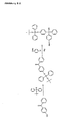
- Figure 2 shows an exemplary substance from a preferred class of two-stage protective groups according to the invention. It is based on the acid-labile trityl group, but contains a photolabile moiety (here the NPPOC group) in the p-position of a phenyl radical, which reduces or completely blocks the acid sensitivity of the trityl group.
- a photolabile moiety here the NPPOC group
- the protective group is converted into an acid-labile form and can then be cleaved in the presence of acid to release the unprotected synthesis block.
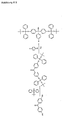
- Figure 3 shows two variants for the synthesis of a two-stage protective group according to the invention.
- Figure 4 shows two further variants for the preparation of erfindungsffleßer synthesis building blocks with two-stage protective groups.
- Figure 5 shows a third variant of the synthesis of two-stage protecting groups, wherein two of the phenyl groups on the trityl group are substituted with a photolabile group.
- Figure 6 shows concrete embodiments for carbonate derivatives of the two-stage protective group
- Figure 7 shows a method for synthesis of the S1-protecting group.
- ethyl 4-hydroxybenzoate and tert-butoxydiphenylchlorosilane in the presence of imidazole, the quantitative introduction of the silyl group succeeds.
- the silyl-derivatized ester is reacted with the Grignard reagent of bromobenzene to give 4- (tert-butoxydiphenylsilyloxy) triphenylcarbinol (S1).
- the use of bromoanisole leads to 4,4'-dimethoxy-4 "- (tert-butoxydiphenylsilyloxy) tritylcarbinol (S3, not shown).
- Figure 8A shows the synthesis of the S2 protecting group.
- the methoxy-silyloxy derivative starting from silyl-protected 4-hydroxybenzophenone, which is synthesized in analogy to the Hydroxybenzoeklareethylester in the presence of imidazole, by reaction with the Grignard reagent of bromo anisole to 4-tert-Butoxydiphenylsilyloxytriphenylcarbinol (S2) accessible.
- FIG. 9 shows the synthesis of the S6 protecting group.
- the tri-silyloxy-tritylcarbinol variant (S6) is prepared either by reacting 4'-silyloxy-bromobenzene with 4'-silylbenzoic acid ethyl ester or by reacting 4,4'-disilyloxybenzophenone and 4'-silyloxybromobenzene.
- the cleavage of the tert-butoxydiphenylsilyl group from the silyl-protected compounds can be achieved by one-hour reaction with TBAF; Termination of the reaction by addition of pyridine / methanol / water and pyridinium DOWEX done.
- the derivatives can usually be reacted directly with Nppoc-Cl.
- the replacement of the alcohol by a halide follows the mechanism of nucleophilic substitution of the 1st order. As a result, all processes proceed through a trigonal planar carbenium ion. Crucial for this mechanism is the stability of the cation, its structure and the possibility of delocalization of the ⁇ -electron. In addition, it is stabilized by electron-donating substituents and destabilized by electron-withdrawing substituents. In this case, the stability of the cation is directly associated with the acid resistance of the protecting group. The more stable the cation, the more acid labile are the corresponding protecting groups.
- Figure 10 shows the preparation of protected thymidine derivatives. For compounds with multiple Nppoc groups lower yields are obtained. Using refluxing acetyl bromide or SOBr 2 , it has been possible to prepare the halogenated derivatives in the presence of several Nppoc substituents on an analytical scale and to react them without further work-up with thymidine.
- Figure 11 shows another method for the synthesis of nucleotides bearing a two-step protective group.
- Figure 12 and Figure 13 show methods of preparing nucleotides bearing a two-step protective group starting from rosin acid.
- the tri-Nppoc-trityl thymidine is obtained in a one-pot reaction.
- the model compound used for this type of reaction was the tri-pivaloyl trityl derivative.
- the reaction proceeds in a polar aprotic solvent at 50 ° C within minutes via an intermediate, which then reacts with the corresponding nucleosides to the tandem-protected derivatives.
- the representation is on a preparative scale.
- the resulting magnesium bromide was allowed to cool to 70 ° C and 5.00 g (6.90 mmol, 1 eq) of 4,4'-di-tert.Butoxydiphenylsilyloxybenzophenone dissolved in 50 ml of THF was added dropwise and heated at 70 ° C for a further 2 h , The mixture was then allowed to cool and quenched with saturated ammonium chloride solution. For extraction, 250 ml of ethyl acetate were added and extracted twice with ammonium chloride solution (sat.) And once with sodium chloride solution (sat.). The organic phase was dried with sodium sulfate and evaporated.
- the resulting magnesium bromide was allowed to cool to 70 ° C and 5.00 g (6.90 mmol, 1 eq) of 4,4'-di-tert-butoxydiphenylsilyloxybenzophenone dissolved in 50 ml of THF was added dropwise and heated at 70 ° C for a further 2 h , The mixture was then allowed to cool and quenched with saturated ammonium chloride solution. For extraction, 250 ml of ethyl acetate were added and extracted twice with ammonium chloride solution (sat.) And once with sodium chloride solution (sat.). The organic phase was dried with sodium sulfate and evaporated.
- Butoxydiphenylsilyloxybenzophenone dissolved in 50 ml of THF was added dropwise and heated at 70 ° C for a further 2 h. The mixture was then allowed to cool and quenched with saturated ammonium chloride solution. For extraction, 250 ml of ethyl acetate were added and extracted twice with ammonium chloride solution (sat.) And once with sodium chloride solution (sat.). The organic phase was dried with sodium sulfate and evaporated. The residue was purified by column chromatography on silica gel 40-63 .mu.m with the eluent ethyl acetate / n-hexane + 1% TEA (1:10). The 4,4 ', 4 "-tri- (tert -butoxydiphenylsilyloxy) -triphenylcarbinol is obtained as a white powdery solid.
- the residue was purified by column chromatography according to the step-gradient method on silica gel 40-63 ⁇ m with the eluent ethyl acetate / n-hexane + 1% TEA (1: 3 and 1: 2).
- the 4-methoxy-4'-Nppoc-triphenylcarbinol is obtained as a white solid foam.
- the 5'-triphenylmethyl-thymidine derivatives are obtained as white solid foam in yields between 13-95% of theory. Th.
- the acid resistance of the unactivated protective groups was carried out with 80% acetic acid or 1% trichloroacetic acid (standard conditions for oligonucleotide synthesis). Table 2 shows the result of this study.
- a first optimization is achieved by using diphenylmethylchlorosilane instead of tert-butoxydiphenylchlorosilane.
- the two-step protecting groups are tested on a solid phase.
- the basic functionality test is performed on a DNA processor D from febit ag in a Geniom ® one instrument.
- 5'-O- (4,4 ', 4 "-TriNppoc-trityl) -thymidine-phosphoamidite is condensed onto a silanized DNA processor surface, followed by punctiform exposure, subsequent acid treatment (2 min max.) And coupling of a Finally, another detection takes place.
Landscapes
- Chemical & Material Sciences (AREA)
- Organic Chemistry (AREA)
- Biochemistry (AREA)
- Health & Medical Sciences (AREA)
- Molecular Biology (AREA)
- Life Sciences & Earth Sciences (AREA)
- Engineering & Computer Science (AREA)
- Biotechnology (AREA)
- General Health & Medical Sciences (AREA)
- Genetics & Genomics (AREA)
- Saccharide Compounds (AREA)
- Organic Low-Molecular-Weight Compounds And Preparation Thereof (AREA)
- Materials For Medical Uses (AREA)
- Polyesters Or Polycarbonates (AREA)
- Medicines Containing Antibodies Or Antigens For Use As Internal Diagnostic Agents (AREA)
Claims (20)
- Procédé pour la synthèse, par étapes, de biopolymères à partir de modules de synthèse qui portent des groupes protecteurs, caractérisé en ce que l'on utilise au moins un module de synthèse qui porte un groupe protecteur à deux étapes, le groupe protecteur à deux étapes étant activé par une étape d'exposition à la lumière puis éliminé par une étape de traitement chimique, le groupe protecteur à deux étapes utilisé étant un groupe trityle.
- Procédé selon la revendication 1, caractérisé en ce que l'étape de traitement chimique comporte un traitement avec une base, un traitement avec un acide, une oxydation, une réduction et/ou une réaction enzymatique.
- Procédé selon la revendication 2, caractérisé en ce que l'étape de traitement chimique comprend un traitement avec un acide.
- Procédé selon l'une quelconque des revendications 1 à 3, caractérisé en ce que le module de synthèse avec le groupe protecteur à deux étapes présente la formule générale 1 :

R3 contient un groupe alkyle en C1 à C8, un groupe alcényle en C2 à C8, un groupe alcynyle en C2 à C8 et/ou un groupe aryle en C6 à C20, qui peuvent comporter le cas échéant des substituants,
X représente le module de synthèse,
chaque Y est indépendamment un groupe de protection photoactivable,
Z est un groupe de protection amine,
n est un nombre entier de 0 à 4 et
dans laquelle R1 ou/et R2 peuvent être remplacés le cas échéant par Y. - Procédé selon la revendication 4, caractérisé en ce que l'on utilise un groupe protecteur à deux étapes qui porte au moins un groupe fluorescent.
- Procédé selon la revendication 5, caractérisé en ce que Y, R3 et/ou Z portent le groupe fluorescent.
- Procédé selon la revendication 5 ou 6, caractérisé en ce que le groupe fluorescent est introduit par substitution sur le squelette trityle.
- Procédé selon l'une quelconque des revendications 1 à 7, caractérisé en ce que le groupe photoactivable du groupe de protection à deux étapes est choisi parmi le nitrovératryloxycarbonyle (NVOC), le α-méthyl-6-nitropipéronyloxycarbonyle (MeNPOC), le 3,5-diméthoxybenzoïne-carbonate (DMBOC), le 2-(o-nitrophényl)propyloxycarbonyle (NPPOC), l'o-nitrobenzyle et des dérivés de celui-ci, et le 2-(o-nitrophényl)éthyle et des dérivés de celui-ci.
- Procédé selon l'une quelconque des revendications 1 à 8, caractérisé en ce que les biopolymères sont choisis parmi les acides nucléiques, les analogues d'acides nucléiques, les peptides et les saccharides.
- Procédé selon la revendication 9, caractérisé en ce que les biopolymères sont choisis parmi les acides nucléiques et les analogues d'acides nucléiques.
- Procédé selon la revendication 10, caractérisé en ce que des phosphoramidites sont utilisés comme modules de synthèse.
- Procédé selon la revendication 11, caractérisé en ce que l'on utilise des phosphoramidites qui portent le groupe protecteur à deux étapes sur l'atome d'oxygène de l'extrémité 5'.
- Procédé selon l'une quelconque des revendications 1 à 12, caractérisé en ce que la synthèse des biopolymères comporte l'utilisation de modules espaceurs ou modules de liaison.
- Procédé selon l'une quelconque des revendications 1 à 13, caractérisé en ce que la synthèse des biopolymères est effectuée sur une phase solide.
- Procédé selon la revendication 14, caractérisé en ce que l'on met en oeuvre, sur un seul support, une synthèse localement différentielle de plusieurs biopolymères ayant chacun une séquence différente de modules de synthèse.
- Composés de formule générale I

R3 contient un groupe alkyle en C1 à C8, un groupe alcényle en C2 à C8, un groupe alcynyle en C2 à C8 et/ou un groupe aryle en C6 à C20, qui peuvent comporter le cas échéant des substituants,
X représente un module de synthèse pour la synthèse de biopolymères ou un groupe partant,
chaque Y est indépendamment un groupe de protection photoactivable,
Z est un groupe de protection amine,
n est un nombre entier de 0 à 4 et
dans laquelle R1 ou/et R2 peuvent être remplacés le cas échéant par Y. - Composés selon la revendication 16, caractérisé en ce qu'ils portent au moins un groupe fluorescent.
- Composés selon la revendication 17, caractérisé en ce que Y, R3 ou/et Z portent un groupe fluorescent.
- Composés selon la revendication 17 ou 18, caractérisé en ce que un groupe fluorescent est introduit par substitution sur le squelette de base trityle.
- Utilisation de composés de la formule générale I comme modules de synthèse ou pour la préparation de modules de synthèse pour la synthèse de biopolymères.
Applications Claiming Priority (5)
| Application Number | Priority Date | Filing Date | Title |
|---|---|---|---|
| DE10132025 | 2001-07-03 | ||
| DE10132025A DE10132025A1 (de) | 2001-07-03 | 2001-07-03 | Zweistufige Schutzgruppen für die Synthese von Biopolymeren |
| US31430601P | 2001-08-24 | 2001-08-24 | |
| US314306P | 2001-08-24 | ||
| PCT/EP2002/007389 WO2003004510A1 (fr) | 2001-07-03 | 2002-07-03 | Groupes protecteurs separes en deux etapes pour la synthese de biopolymeres |
Publications (3)
| Publication Number | Publication Date |
|---|---|
| EP1401851A1 EP1401851A1 (fr) | 2004-03-31 |
| EP1401851B1 true EP1401851B1 (fr) | 2008-07-02 |
| EP1401851B8 EP1401851B8 (fr) | 2008-09-10 |
Family
ID=26009627
Family Applications (1)
| Application Number | Title | Priority Date | Filing Date |
|---|---|---|---|
| EP02754822A Expired - Lifetime EP1401851B8 (fr) | 2001-07-03 | 2002-07-03 | Groupes protecteurs separes en deux etapes pour la synthese de biopolymeres |
Country Status (5)
| Country | Link |
|---|---|
| US (1) | US7355036B2 (fr) |
| EP (1) | EP1401851B8 (fr) |
| AT (1) | ATE399790T1 (fr) |
| DE (1) | DE50212445D1 (fr) |
| WO (1) | WO2003004510A1 (fr) |
Families Citing this family (8)
| Publication number | Priority date | Publication date | Assignee | Title |
|---|---|---|---|---|
| AU2003290117A1 (en) | 2002-12-23 | 2004-07-22 | Febit Biotech Gmbh | Photoactivatable two-stage protective groups for the synthesis of biopolymers |
| DE102005027667A1 (de) * | 2005-06-15 | 2006-12-28 | Febit Biotech Gmbh | Verfahren zur Qualitätskontrolle funktionalisierter Oberflächen |
| US7893227B2 (en) * | 2006-12-05 | 2011-02-22 | Lasergen, Inc. | 3′-OH unblocked nucleotides and nucleosides base modified with non-cleavable, terminating groups and methods for their use in DNA sequencing |
| US7897737B2 (en) * | 2006-12-05 | 2011-03-01 | Lasergen, Inc. | 3′-OH unblocked, nucleotides and nucleosides, base modified with photocleavable, terminating groups and methods for their use in DNA sequencing |
| US8148503B2 (en) | 2008-06-11 | 2012-04-03 | Lasergen, Inc. | Nucleotides and nucleosides and methods for their use in DNA sequencing |
| CN104024269B (zh) | 2011-09-13 | 2017-05-24 | 激光基因公司 | 5‑甲氧基,3’‑oh未阻断,可快速光切割的终止核苷酸以及用于核酸测序的方法 |
| CN114835940B (zh) * | 2022-05-25 | 2023-04-07 | 常熟东南塑料有限公司 | 一种耐粉化酚醛树脂泡沫及其制备方法 |
| CN118207755B (zh) * | 2024-03-29 | 2024-08-13 | 江苏璞丽达数码科技有限公司 | 一种防龟裂单色装饰纸及其生产工艺 |
Family Cites Families (2)
| Publication number | Priority date | Publication date | Assignee | Title |
|---|---|---|---|---|
| DE4444996A1 (de) * | 1994-12-16 | 1996-06-20 | Wolfgang Prof Dr Dr Pfleiderer | Nucleosid-Derivate mit photolabilen Schutzgruppen |
| EP1207873B1 (fr) | 1999-07-28 | 2009-11-18 | The Trustees Of The University Of Pennsylvania | Procedes d'inhibition de l'activite des osteoclastes |
-
2002
- 2002-07-03 EP EP02754822A patent/EP1401851B8/fr not_active Expired - Lifetime
- 2002-07-03 DE DE50212445T patent/DE50212445D1/de not_active Expired - Lifetime
- 2002-07-03 WO PCT/EP2002/007389 patent/WO2003004510A1/fr not_active Ceased
- 2002-07-03 AT AT02754822T patent/ATE399790T1/de not_active IP Right Cessation
- 2002-07-03 US US10/482,744 patent/US7355036B2/en not_active Expired - Fee Related
Also Published As
| Publication number | Publication date |
|---|---|
| US20040197851A1 (en) | 2004-10-07 |
| EP1401851B8 (fr) | 2008-09-10 |
| EP1401851A1 (fr) | 2004-03-31 |
| DE50212445D1 (de) | 2008-08-14 |
| US7355036B2 (en) | 2008-04-08 |
| ATE399790T1 (de) | 2008-07-15 |
| WO2003004510A1 (fr) | 2003-01-16 |
Similar Documents
| Publication | Publication Date | Title |
|---|---|---|
| DE69125380T2 (de) | Durch reduktion orthogonal entfernbare hydroxylschutzgruppen und ihre verwendung in der chemischen synthese von oligonukleotiden | |
| EP0399330B1 (fr) | Procédé amide-ester phosphoreux modifié pour la préparation d'acides nucléiques modifiés | |
| DE69131164T2 (de) | Einführung selektiv spaltbarer stellen in oligonukleotidketten und reagenzien dafür | |
| DE69924930T2 (de) | Synthese von Oligonukleotiden | |
| DE3750080T2 (de) | Deoxyribonucleosid-phosphoramidite und deren verwendung zur hertellung von oligonukleotiden. | |
| EP0797580B1 (fr) | Derives de nucleosides comportant des groupes protecteurs photolabiles | |
| DE69609184T2 (de) | Verfahren zur synthese von oligonukleotiden | |
| DE69632456T2 (de) | Nukleinsäuresynthese unter verwendung von mittels licht abspaltbaren schutzgruppen | |
| DE69407419T2 (de) | 2' oder 3' -deoxy- und 2' -dideoxy-beta-l-pentafuranonukleoside, verfahren zur herstellung und anwendung in der therapie, insbesondere als antivirale wirkstoffe | |
| EP1585830A2 (fr) | Groupes protecteurs photoactivables subissant un traitement en deux etapes, destines a la synthese de biopolymeres | |
| EP0490281A1 (fr) | 3'- Amino ou thiolmodifié, fluorescence couplé nucléoside et oligonucléotide, leur procédé de preparation et leur utilisation | |
| EP0152459A1 (fr) | Procede de fabrication d'oligonucleotides. | |
| DE112004000265T5 (de) | Neuartige photolabile Schutzgruppen für verbesserte Verfahren zur Herstellung von Oligonukleotid-Arrays | |
| EP0901501B1 (fr) | Derives de nucleosides a groupes protecteurs photolabiles | |
| Damha et al. | Synthesis and spectroscopic analysis of branched RNA fragments: messenger RNA splicing intermediates | |
| DE69810934T2 (de) | Ribonukleosid-derivat und verfahren zu seiner herstellung | |
| EP0567841A2 (fr) | Composés marqués avec un fluorophore, leur préparation et utilisation | |
| EP1401851B8 (fr) | Groupes protecteurs separes en deux etapes pour la synthese de biopolymeres | |
| DE68906890T2 (de) | Nukleoside derivate, nützlich für die synthese von markierten oligonukleotiden, mit diesen derivaten hergestellte oligonukleotide und ihre synthese. | |
| DD294947A5 (de) | Verfahren zur herstellung von acylierten epipodophyllotoxinderivaten | |
| DD141836A5 (de) | Verfahren zur herstellung von polynucleotiden mit bestimmter sequenz | |
| DE69402177T2 (de) | Synthese von dimer-blöcken und ihre verwendung bei der zusammensetzung von oligonukleotiden | |
| DE3881691T2 (de) | Polydeoxyribonukleotide, pharmazeutische zusammensetzungen, verwendung und herstellung von polydeoxyribonukleotiden. | |
| DE69019052T2 (de) | Verfahren zur Herstellung von 2'Deoxy-5-trifluoromethyl-ss-uridin. | |
| DE602005001414T2 (de) | Photolabile Schutzgruppen |
Legal Events
| Date | Code | Title | Description |
|---|---|---|---|
| PUAI | Public reference made under article 153(3) epc to a published international application that has entered the european phase |
Free format text: ORIGINAL CODE: 0009012 |
|
| 17P | Request for examination filed |
Effective date: 20040112 |
|
| AK | Designated contracting states |
Kind code of ref document: A1 Designated state(s): AT BE BG CH CY CZ DE DK EE ES FI FR GB GR IE IT LI LU MC NL PT SE SK TR |
|
| AX | Request for extension of the european patent |
Extension state: AL LT LV MK RO SI |
|
| RAP1 | Party data changed (applicant data changed or rights of an application transferred) |
Owner name: FEBIT BIOTECH GMBH |
|
| GRAP | Despatch of communication of intention to grant a patent |
Free format text: ORIGINAL CODE: EPIDOSNIGR1 |
|
| GRAS | Grant fee paid |
Free format text: ORIGINAL CODE: EPIDOSNIGR3 |
|
| GRAA | (expected) grant |
Free format text: ORIGINAL CODE: 0009210 |
|
| AK | Designated contracting states |
Kind code of ref document: B1 Designated state(s): AT BE BG CH CY CZ DE DK EE ES FI FR GB GR IE IT LI LU MC NL PT SE SK TR |
|
| REG | Reference to a national code |
Ref country code: GB Ref legal event code: FG4D Free format text: NOT ENGLISH |
|
| RAP2 | Party data changed (patent owner data changed or rights of a patent transferred) |
Owner name: FEBIT HOLDING GMBH |
|
| REG | Reference to a national code |
Ref country code: CH Ref legal event code: EP |
|
| REF | Corresponds to: |
Ref document number: 50212445 Country of ref document: DE Date of ref document: 20080814 Kind code of ref document: P |
|
| REG | Reference to a national code |
Ref country code: IE Ref legal event code: FG4D Free format text: LANGUAGE OF EP DOCUMENT: GERMAN |
|
| NLT2 | Nl: modifications (of names), taken from the european patent patent bulletin |
Owner name: FEBIT HOLDING GMBH Effective date: 20080730 |
|
| PG25 | Lapsed in a contracting state [announced via postgrant information from national office to epo] |
Ref country code: NL Free format text: LAPSE BECAUSE OF FAILURE TO SUBMIT A TRANSLATION OF THE DESCRIPTION OR TO PAY THE FEE WITHIN THE PRESCRIBED TIME-LIMIT Effective date: 20080702 |
|
| NLV1 | Nl: lapsed or annulled due to failure to fulfill the requirements of art. 29p and 29m of the patents act | ||
| PG25 | Lapsed in a contracting state [announced via postgrant information from national office to epo] |
Ref country code: PT Free format text: LAPSE BECAUSE OF FAILURE TO SUBMIT A TRANSLATION OF THE DESCRIPTION OR TO PAY THE FEE WITHIN THE PRESCRIBED TIME-LIMIT Effective date: 20081202 Ref country code: ES Free format text: LAPSE BECAUSE OF FAILURE TO SUBMIT A TRANSLATION OF THE DESCRIPTION OR TO PAY THE FEE WITHIN THE PRESCRIBED TIME-LIMIT Effective date: 20081013 |
|
| REG | Reference to a national code |
Ref country code: IE Ref legal event code: FD4D |
|
| PG25 | Lapsed in a contracting state [announced via postgrant information from national office to epo] |
Ref country code: BG Free format text: LAPSE BECAUSE OF FAILURE TO SUBMIT A TRANSLATION OF THE DESCRIPTION OR TO PAY THE FEE WITHIN THE PRESCRIBED TIME-LIMIT Effective date: 20081002 Ref country code: FI Free format text: LAPSE BECAUSE OF FAILURE TO SUBMIT A TRANSLATION OF THE DESCRIPTION OR TO PAY THE FEE WITHIN THE PRESCRIBED TIME-LIMIT Effective date: 20080702 |
|
| REG | Reference to a national code |
Ref country code: CH Ref legal event code: PL |
|
| PG25 | Lapsed in a contracting state [announced via postgrant information from national office to epo] |
Ref country code: MC Free format text: LAPSE BECAUSE OF NON-PAYMENT OF DUE FEES Effective date: 20080731 |
|
| PG25 | Lapsed in a contracting state [announced via postgrant information from national office to epo] |
Ref country code: DK Free format text: LAPSE BECAUSE OF FAILURE TO SUBMIT A TRANSLATION OF THE DESCRIPTION OR TO PAY THE FEE WITHIN THE PRESCRIBED TIME-LIMIT Effective date: 20080702 Ref country code: EE Free format text: LAPSE BECAUSE OF FAILURE TO SUBMIT A TRANSLATION OF THE DESCRIPTION OR TO PAY THE FEE WITHIN THE PRESCRIBED TIME-LIMIT Effective date: 20080702 Ref country code: IE Free format text: LAPSE BECAUSE OF FAILURE TO SUBMIT A TRANSLATION OF THE DESCRIPTION OR TO PAY THE FEE WITHIN THE PRESCRIBED TIME-LIMIT Effective date: 20080702 |
|
| PLBE | No opposition filed within time limit |
Free format text: ORIGINAL CODE: 0009261 |
|
| STAA | Information on the status of an ep patent application or granted ep patent |
Free format text: STATUS: NO OPPOSITION FILED WITHIN TIME LIMIT |
|
| PG25 | Lapsed in a contracting state [announced via postgrant information from national office to epo] |
Ref country code: SK Free format text: LAPSE BECAUSE OF FAILURE TO SUBMIT A TRANSLATION OF THE DESCRIPTION OR TO PAY THE FEE WITHIN THE PRESCRIBED TIME-LIMIT Effective date: 20080702 Ref country code: CZ Free format text: LAPSE BECAUSE OF FAILURE TO SUBMIT A TRANSLATION OF THE DESCRIPTION OR TO PAY THE FEE WITHIN THE PRESCRIBED TIME-LIMIT Effective date: 20080702 |
|
| 26N | No opposition filed |
Effective date: 20090403 |
|
| GBPC | Gb: european patent ceased through non-payment of renewal fee |
Effective date: 20081002 |
|
| PG25 | Lapsed in a contracting state [announced via postgrant information from national office to epo] |
Ref country code: CH Free format text: LAPSE BECAUSE OF NON-PAYMENT OF DUE FEES Effective date: 20080731 Ref country code: LI Free format text: LAPSE BECAUSE OF NON-PAYMENT OF DUE FEES Effective date: 20080731 |
|
| REG | Reference to a national code |
Ref country code: FR Ref legal event code: ST Effective date: 20090529 |
|
| PG25 | Lapsed in a contracting state [announced via postgrant information from national office to epo] |
Ref country code: IT Free format text: LAPSE BECAUSE OF FAILURE TO SUBMIT A TRANSLATION OF THE DESCRIPTION OR TO PAY THE FEE WITHIN THE PRESCRIBED TIME-LIMIT Effective date: 20080702 |
|
| PG25 | Lapsed in a contracting state [announced via postgrant information from national office to epo] |
Ref country code: FR Free format text: LAPSE BECAUSE OF NON-PAYMENT OF DUE FEES Effective date: 20080731 Ref country code: AT Free format text: LAPSE BECAUSE OF NON-PAYMENT OF DUE FEES Effective date: 20080703 |
|
| PG25 | Lapsed in a contracting state [announced via postgrant information from national office to epo] |
Ref country code: GB Free format text: LAPSE BECAUSE OF NON-PAYMENT OF DUE FEES Effective date: 20081002 |
|
| PG25 | Lapsed in a contracting state [announced via postgrant information from national office to epo] |
Ref country code: SE Free format text: LAPSE BECAUSE OF FAILURE TO SUBMIT A TRANSLATION OF THE DESCRIPTION OR TO PAY THE FEE WITHIN THE PRESCRIBED TIME-LIMIT Effective date: 20081002 |
|
| PG25 | Lapsed in a contracting state [announced via postgrant information from national office to epo] |
Ref country code: LU Free format text: LAPSE BECAUSE OF NON-PAYMENT OF DUE FEES Effective date: 20080703 Ref country code: BE Free format text: LAPSE BECAUSE OF NON-PAYMENT OF DUE FEES Effective date: 20080731 Ref country code: CY Free format text: LAPSE BECAUSE OF FAILURE TO SUBMIT A TRANSLATION OF THE DESCRIPTION OR TO PAY THE FEE WITHIN THE PRESCRIBED TIME-LIMIT Effective date: 20080702 |
|
| PG25 | Lapsed in a contracting state [announced via postgrant information from national office to epo] |
Ref country code: TR Free format text: LAPSE BECAUSE OF FAILURE TO SUBMIT A TRANSLATION OF THE DESCRIPTION OR TO PAY THE FEE WITHIN THE PRESCRIBED TIME-LIMIT Effective date: 20080702 |
|
| PG25 | Lapsed in a contracting state [announced via postgrant information from national office to epo] |
Ref country code: GR Free format text: LAPSE BECAUSE OF FAILURE TO SUBMIT A TRANSLATION OF THE DESCRIPTION OR TO PAY THE FEE WITHIN THE PRESCRIBED TIME-LIMIT Effective date: 20081003 |
|
| PGFP | Annual fee paid to national office [announced via postgrant information from national office to epo] |
Ref country code: DE Payment date: 20100730 Year of fee payment: 9 |
|
| PG25 | Lapsed in a contracting state [announced via postgrant information from national office to epo] |
Ref country code: DE Free format text: LAPSE BECAUSE OF NON-PAYMENT OF DUE FEES Effective date: 20120201 |
|
| REG | Reference to a national code |
Ref country code: DE Ref legal event code: R119 Ref document number: 50212445 Country of ref document: DE Effective date: 20120201 |