EP1401982B1 - Adhesif monocomposant a faible emission - Google Patents
Adhesif monocomposant a faible emission Download PDFInfo
- Publication number
- EP1401982B1 EP1401982B1 EP02734005A EP02734005A EP1401982B1 EP 1401982 B1 EP1401982 B1 EP 1401982B1 EP 02734005 A EP02734005 A EP 02734005A EP 02734005 A EP02734005 A EP 02734005A EP 1401982 B1 EP1401982 B1 EP 1401982B1
- Authority
- EP
- European Patent Office
- Prior art keywords
- adhesive
- oil
- adhesive composition
- component
- hydrocarbon resin
- Prior art date
- Legal status (The legal status is an assumption and is not a legal conclusion. Google has not performed a legal analysis and makes no representation as to the accuracy of the status listed.)
- Expired - Lifetime
Links
Images

Classifications
-
- C—CHEMISTRY; METALLURGY
- C09—DYES; PAINTS; POLISHES; NATURAL RESINS; ADHESIVES; COMPOSITIONS NOT OTHERWISE PROVIDED FOR; APPLICATIONS OF MATERIALS NOT OTHERWISE PROVIDED FOR
- C09J—ADHESIVES; NON-MECHANICAL ASPECTS OF ADHESIVE PROCESSES IN GENERAL; ADHESIVE PROCESSES NOT PROVIDED FOR ELSEWHERE; USE OF MATERIALS AS ADHESIVES
- C09J123/00—Adhesives based on homopolymers or copolymers of unsaturated aliphatic hydrocarbons having only one carbon-to-carbon double bond; Adhesives based on derivatives of such polymers
- C09J123/02—Adhesives based on homopolymers or copolymers of unsaturated aliphatic hydrocarbons having only one carbon-to-carbon double bond; Adhesives based on derivatives of such polymers not modified by chemical after-treatment
- C09J123/04—Homopolymers or copolymers of ethene
- C09J123/08—Copolymers of ethene
- C09J123/0846—Copolymers of ethene with unsaturated hydrocarbons containing other atoms than carbon or hydrogen atoms
- C09J123/0853—Vinylacetate
-
- C—CHEMISTRY; METALLURGY
- C08—ORGANIC MACROMOLECULAR COMPOUNDS; THEIR PREPARATION OR CHEMICAL WORKING-UP; COMPOSITIONS BASED THEREON
- C08K—Use of inorganic or non-macromolecular organic substances as compounding ingredients
- C08K5/00—Use of organic ingredients
- C08K5/01—Hydrocarbons
-
- C—CHEMISTRY; METALLURGY
- C08—ORGANIC MACROMOLECULAR COMPOUNDS; THEIR PREPARATION OR CHEMICAL WORKING-UP; COMPOSITIONS BASED THEREON
- C08K—Use of inorganic or non-macromolecular organic substances as compounding ingredients
- C08K5/00—Use of organic ingredients
- C08K5/04—Oxygen-containing compounds
- C08K5/09—Carboxylic acids; Metal salts thereof; Anhydrides thereof
- C08K5/098—Metal salts of carboxylic acids
-
- C—CHEMISTRY; METALLURGY
- C08—ORGANIC MACROMOLECULAR COMPOUNDS; THEIR PREPARATION OR CHEMICAL WORKING-UP; COMPOSITIONS BASED THEREON
- C08K—Use of inorganic or non-macromolecular organic substances as compounding ingredients
- C08K5/00—Use of organic ingredients
- C08K5/16—Nitrogen-containing compounds
- C08K5/17—Amines; Quaternary ammonium compounds
-
- C—CHEMISTRY; METALLURGY
- C09—DYES; PAINTS; POLISHES; NATURAL RESINS; ADHESIVES; COMPOSITIONS NOT OTHERWISE PROVIDED FOR; APPLICATIONS OF MATERIALS NOT OTHERWISE PROVIDED FOR
- C09J—ADHESIVES; NON-MECHANICAL ASPECTS OF ADHESIVE PROCESSES IN GENERAL; ADHESIVE PROCESSES NOT PROVIDED FOR ELSEWHERE; USE OF MATERIALS AS ADHESIVES
- C09J11/00—Features of adhesives not provided for in group C09J9/00, e.g. additives
- C09J11/02—Non-macromolecular additives
- C09J11/06—Non-macromolecular additives organic
-
- C—CHEMISTRY; METALLURGY
- C09—DYES; PAINTS; POLISHES; NATURAL RESINS; ADHESIVES; COMPOSITIONS NOT OTHERWISE PROVIDED FOR; APPLICATIONS OF MATERIALS NOT OTHERWISE PROVIDED FOR
- C09J—ADHESIVES; NON-MECHANICAL ASPECTS OF ADHESIVE PROCESSES IN GENERAL; ADHESIVE PROCESSES NOT PROVIDED FOR ELSEWHERE; USE OF MATERIALS AS ADHESIVES
- C09J11/00—Features of adhesives not provided for in group C09J9/00, e.g. additives
- C09J11/08—Macromolecular additives
-
- C—CHEMISTRY; METALLURGY
- C09—DYES; PAINTS; POLISHES; NATURAL RESINS; ADHESIVES; COMPOSITIONS NOT OTHERWISE PROVIDED FOR; APPLICATIONS OF MATERIALS NOT OTHERWISE PROVIDED FOR
- C09J—ADHESIVES; NON-MECHANICAL ASPECTS OF ADHESIVE PROCESSES IN GENERAL; ADHESIVE PROCESSES NOT PROVIDED FOR ELSEWHERE; USE OF MATERIALS AS ADHESIVES
- C09J123/00—Adhesives based on homopolymers or copolymers of unsaturated aliphatic hydrocarbons having only one carbon-to-carbon double bond; Adhesives based on derivatives of such polymers
- C09J123/02—Adhesives based on homopolymers or copolymers of unsaturated aliphatic hydrocarbons having only one carbon-to-carbon double bond; Adhesives based on derivatives of such polymers not modified by chemical after-treatment
- C09J123/04—Homopolymers or copolymers of ethene
- C09J123/08—Copolymers of ethene
-
- C—CHEMISTRY; METALLURGY
- C09—DYES; PAINTS; POLISHES; NATURAL RESINS; ADHESIVES; COMPOSITIONS NOT OTHERWISE PROVIDED FOR; APPLICATIONS OF MATERIALS NOT OTHERWISE PROVIDED FOR
- C09J—ADHESIVES; NON-MECHANICAL ASPECTS OF ADHESIVE PROCESSES IN GENERAL; ADHESIVE PROCESSES NOT PROVIDED FOR ELSEWHERE; USE OF MATERIALS AS ADHESIVES
- C09J123/00—Adhesives based on homopolymers or copolymers of unsaturated aliphatic hydrocarbons having only one carbon-to-carbon double bond; Adhesives based on derivatives of such polymers
- C09J123/02—Adhesives based on homopolymers or copolymers of unsaturated aliphatic hydrocarbons having only one carbon-to-carbon double bond; Adhesives based on derivatives of such polymers not modified by chemical after-treatment
- C09J123/18—Homopolymers or copolymers of hydrocarbons having four or more carbon atoms
- C09J123/20—Homopolymers or copolymers of hydrocarbons having four or more carbon atoms having four to nine carbon atoms
-
- C—CHEMISTRY; METALLURGY
- C09—DYES; PAINTS; POLISHES; NATURAL RESINS; ADHESIVES; COMPOSITIONS NOT OTHERWISE PROVIDED FOR; APPLICATIONS OF MATERIALS NOT OTHERWISE PROVIDED FOR
- C09J—ADHESIVES; NON-MECHANICAL ASPECTS OF ADHESIVE PROCESSES IN GENERAL; ADHESIVE PROCESSES NOT PROVIDED FOR ELSEWHERE; USE OF MATERIALS AS ADHESIVES
- C09J125/00—Adhesives based on homopolymers or copolymers of compounds having one or more unsaturated aliphatic radicals, each having only one carbon-to-carbon double bond, and at least one being terminated by an aromatic carbocyclic ring; Adhesives based on derivatives of such polymers
- C09J125/02—Homopolymers or copolymers of hydrocarbons
- C09J125/04—Homopolymers or copolymers of styrene
- C09J125/06—Polystyrene
-
- C—CHEMISTRY; METALLURGY
- C09—DYES; PAINTS; POLISHES; NATURAL RESINS; ADHESIVES; COMPOSITIONS NOT OTHERWISE PROVIDED FOR; APPLICATIONS OF MATERIALS NOT OTHERWISE PROVIDED FOR
- C09J—ADHESIVES; NON-MECHANICAL ASPECTS OF ADHESIVE PROCESSES IN GENERAL; ADHESIVE PROCESSES NOT PROVIDED FOR ELSEWHERE; USE OF MATERIALS AS ADHESIVES
- C09J191/00—Adhesives based on oils, fats or waxes; Adhesives based on derivatives thereof
- C09J191/005—Drying oils
-
- C—CHEMISTRY; METALLURGY
- C08—ORGANIC MACROMOLECULAR COMPOUNDS; THEIR PREPARATION OR CHEMICAL WORKING-UP; COMPOSITIONS BASED THEREON
- C08L—COMPOSITIONS OF MACROMOLECULAR COMPOUNDS
- C08L23/00—Compositions of homopolymers or copolymers of unsaturated aliphatic hydrocarbons having only one carbon-to-carbon double bond; Compositions of derivatives of such polymers
-
- C—CHEMISTRY; METALLURGY
- C08—ORGANIC MACROMOLECULAR COMPOUNDS; THEIR PREPARATION OR CHEMICAL WORKING-UP; COMPOSITIONS BASED THEREON
- C08L—COMPOSITIONS OF MACROMOLECULAR COMPOUNDS
- C08L23/00—Compositions of homopolymers or copolymers of unsaturated aliphatic hydrocarbons having only one carbon-to-carbon double bond; Compositions of derivatives of such polymers
- C08L23/02—Compositions of homopolymers or copolymers of unsaturated aliphatic hydrocarbons having only one carbon-to-carbon double bond; Compositions of derivatives of such polymers not modified by chemical after-treatment
- C08L23/04—Homopolymers or copolymers of ethene
- C08L23/08—Copolymers of ethene
- C08L23/0846—Copolymers of ethene with unsaturated hydrocarbons containing atoms other than carbon or hydrogen
- C08L23/0853—Ethylene vinyl acetate copolymers
-
- C—CHEMISTRY; METALLURGY
- C08—ORGANIC MACROMOLECULAR COMPOUNDS; THEIR PREPARATION OR CHEMICAL WORKING-UP; COMPOSITIONS BASED THEREON
- C08L—COMPOSITIONS OF MACROMOLECULAR COMPOUNDS
- C08L23/00—Compositions of homopolymers or copolymers of unsaturated aliphatic hydrocarbons having only one carbon-to-carbon double bond; Compositions of derivatives of such polymers
- C08L23/02—Compositions of homopolymers or copolymers of unsaturated aliphatic hydrocarbons having only one carbon-to-carbon double bond; Compositions of derivatives of such polymers not modified by chemical after-treatment
- C08L23/04—Homopolymers or copolymers of ethene
- C08L23/08—Copolymers of ethene
- C08L23/0846—Copolymers of ethene with unsaturated hydrocarbons containing atoms other than carbon or hydrogen
- C08L23/0869—Copolymers of ethene with unsaturated hydrocarbons containing atoms other than carbon or hydrogen with unsaturated acids, e.g. [meth]acrylic acid; with unsaturated esters, e.g. [meth]acrylic acid esters
-
- C—CHEMISTRY; METALLURGY
- C08—ORGANIC MACROMOLECULAR COMPOUNDS; THEIR PREPARATION OR CHEMICAL WORKING-UP; COMPOSITIONS BASED THEREON
- C08L—COMPOSITIONS OF MACROMOLECULAR COMPOUNDS
- C08L25/00—Compositions of, homopolymers or copolymers of compounds having one or more unsaturated aliphatic radicals, each having only one carbon-to-carbon double bond, and at least one being terminated by an aromatic carbocyclic ring; Compositions of derivatives of such polymers
- C08L25/02—Homopolymers or copolymers of hydrocarbons
- C08L25/04—Homopolymers or copolymers of styrene
-
- C—CHEMISTRY; METALLURGY
- C08—ORGANIC MACROMOLECULAR COMPOUNDS; THEIR PREPARATION OR CHEMICAL WORKING-UP; COMPOSITIONS BASED THEREON
- C08L—COMPOSITIONS OF MACROMOLECULAR COMPOUNDS
- C08L25/00—Compositions of, homopolymers or copolymers of compounds having one or more unsaturated aliphatic radicals, each having only one carbon-to-carbon double bond, and at least one being terminated by an aromatic carbocyclic ring; Compositions of derivatives of such polymers
- C08L25/02—Homopolymers or copolymers of hydrocarbons
- C08L25/16—Homopolymers or copolymers of alkyl-substituted styrenes
-
- C—CHEMISTRY; METALLURGY
- C08—ORGANIC MACROMOLECULAR COMPOUNDS; THEIR PREPARATION OR CHEMICAL WORKING-UP; COMPOSITIONS BASED THEREON
- C08L—COMPOSITIONS OF MACROMOLECULAR COMPOUNDS
- C08L2666/00—Composition of polymers characterized by a further compound in the blend, being organic macromolecular compounds, natural resins, waxes or and bituminous materials, non-macromolecular organic substances, inorganic substances or characterized by their function in the composition
- C08L2666/02—Organic macromolecular compounds, natural resins, waxes or and bituminous materials
-
- C—CHEMISTRY; METALLURGY
- C08—ORGANIC MACROMOLECULAR COMPOUNDS; THEIR PREPARATION OR CHEMICAL WORKING-UP; COMPOSITIONS BASED THEREON
- C08L—COMPOSITIONS OF MACROMOLECULAR COMPOUNDS
- C08L2666/00—Composition of polymers characterized by a further compound in the blend, being organic macromolecular compounds, natural resins, waxes or and bituminous materials, non-macromolecular organic substances, inorganic substances or characterized by their function in the composition
- C08L2666/02—Organic macromolecular compounds, natural resins, waxes or and bituminous materials
- C08L2666/04—Macromolecular compounds according to groups C08L7/00 - C08L49/00, or C08L55/00 - C08L57/00; Derivatives thereof
-
- C—CHEMISTRY; METALLURGY
- C08—ORGANIC MACROMOLECULAR COMPOUNDS; THEIR PREPARATION OR CHEMICAL WORKING-UP; COMPOSITIONS BASED THEREON
- C08L—COMPOSITIONS OF MACROMOLECULAR COMPOUNDS
- C08L2666/00—Composition of polymers characterized by a further compound in the blend, being organic macromolecular compounds, natural resins, waxes or and bituminous materials, non-macromolecular organic substances, inorganic substances or characterized by their function in the composition
- C08L2666/28—Non-macromolecular organic substances
-
- C—CHEMISTRY; METALLURGY
- C08—ORGANIC MACROMOLECULAR COMPOUNDS; THEIR PREPARATION OR CHEMICAL WORKING-UP; COMPOSITIONS BASED THEREON
- C08L—COMPOSITIONS OF MACROMOLECULAR COMPOUNDS
- C08L2666/00—Composition of polymers characterized by a further compound in the blend, being organic macromolecular compounds, natural resins, waxes or and bituminous materials, non-macromolecular organic substances, inorganic substances or characterized by their function in the composition
- C08L2666/54—Inorganic substances
-
- C—CHEMISTRY; METALLURGY
- C08—ORGANIC MACROMOLECULAR COMPOUNDS; THEIR PREPARATION OR CHEMICAL WORKING-UP; COMPOSITIONS BASED THEREON
- C08L—COMPOSITIONS OF MACROMOLECULAR COMPOUNDS
- C08L33/00—Compositions of homopolymers or copolymers of compounds having one or more unsaturated aliphatic radicals, each having only one carbon-to-carbon double bond, and only one being terminated by only one carboxyl radical, or of salts, anhydrides, esters, amides, imides or nitriles thereof; Compositions of derivatives of such polymers
- C08L33/04—Homopolymers or copolymers of esters
-
- C—CHEMISTRY; METALLURGY
- C08—ORGANIC MACROMOLECULAR COMPOUNDS; THEIR PREPARATION OR CHEMICAL WORKING-UP; COMPOSITIONS BASED THEREON
- C08L—COMPOSITIONS OF MACROMOLECULAR COMPOUNDS
- C08L9/00—Compositions of homopolymers or copolymers of conjugated diene hydrocarbons
-
- C—CHEMISTRY; METALLURGY
- C08—ORGANIC MACROMOLECULAR COMPOUNDS; THEIR PREPARATION OR CHEMICAL WORKING-UP; COMPOSITIONS BASED THEREON
- C08L—COMPOSITIONS OF MACROMOLECULAR COMPOUNDS
- C08L91/00—Compositions of oils, fats or waxes; Compositions of derivatives thereof
-
- Y—GENERAL TAGGING OF NEW TECHNOLOGICAL DEVELOPMENTS; GENERAL TAGGING OF CROSS-SECTIONAL TECHNOLOGIES SPANNING OVER SEVERAL SECTIONS OF THE IPC; TECHNICAL SUBJECTS COVERED BY FORMER USPC CROSS-REFERENCE ART COLLECTIONS [XRACs] AND DIGESTS
- Y10—TECHNICAL SUBJECTS COVERED BY FORMER USPC
- Y10T—TECHNICAL SUBJECTS COVERED BY FORMER US CLASSIFICATION
- Y10T156/00—Adhesive bonding and miscellaneous chemical manufacture
- Y10T156/10—Methods of surface bonding and/or assembly therefor
Definitions
- the invention is directed to a low emissions one part adhesives.
- the invention relates generally to adhesives, such as flooring adhesives, and more particularly, to adhesives that have low emissions of undesirable materials, such as volatile organic compounds (VOCs).
- VOCs volatile organic compounds
- adhesives are assembled using adhesives.
- various flooring products made from wood, vinyl, tile, carpet and so forth are permanently adhered to a surface or substrate through the use of an adhesive.
- Commonly used adhesives include those sold under the trademarks Taylor Enviotec 2090 Vinyl Adhesive and Taylor Envirotec 2055 Premium Carpet Adhesive sold, by W.F. Taylor Co. of Fontana, California.
- Two component adhesives There are at least two general types of adhesives: two component adhesives and one component adhesives.
- Two components reactive adhesives are generally formed with a resin component and a hardener component and the resin and hardener are mixed immediately prior to application. This causes a chemical reaction to occur which typically initiates some type of cross-linking process.
- Two component adhesives are often considered undesirable because considerable mixing of the components must occur just prior to use. This can be inconvenient. Also, just the right amount of adhesive must be mixed prior to application. If too much is mixed, or the working "pot” time is exceeded, the adhesive will harden and the excess must be discarded.
- Reactive urethane type adhesives contain materials such as isocyanates, which are often considered undesirable.
- Single component adhesives can be more convenient to use than two component adhesives.
- Many single component adhesives are solvent-based adhesives in which an adhesive composition is mixed with a solvent and packaged in a drum, can or tube. After the adhesive is applied to a substrate, the solvent evaporates, which causes the adhesive to cure.
- solvents used in certain conventional solvent-based adhesives are believed by some to be undesirable.
- many solvent-based adhesives emit VOCs.
- VOCs Depending on the working environment, available ventilation, and the amount of adhesive to be used, some consider the VOC's and other emitted chemicals to be disadvantageous.
- Other single component adhesives contain excessive amounts of water, which can damage wood surfaces.
- There are other single component reactive adhesives such as moisture cure urethanes, but they typically exhibit emission problems because they give off solvents and other potentially dangerous materials such as isocyantes (MDI and TDD.
- thermosetting composition which is poor in or entirely free of volatile solvent, comprising polyester, polyoxazoleine, paraffin and eventually suitable reactive diluents such as fatty acids and other additives and fillers.
- Adhesives in accordance with the invention can be formulated as high solids, one-part, reactive, cross-linked adhesives. This can be achieved by utilizing amide-ester-acrylate reactions or reactions with any other carboxylated polymers.
- Adhesive compositions in accordance with the invention include oils, such as various drying oils and similarly acting polymers, co-polymers, and fatty acids. Metal naphthenates can be used to catalyze the drying speed when the adhesive composition is applied to a substrate.
- Adhesives in accordance with the invention also include various hydrocarbon resins, particularly crosslinkable hydrocarbons having a softening point in the range 70°C to 140°C. These can be dissolved or otherwise mixed in the drying oil component.
- hydrocarbon resins particularly crosslinkable hydrocarbons having a softening point in the range 70°C to 140°C.
- Adhesives in accordance with the invention also include fugitive alkali agents, such as ammonia, monomethanol amine (MEA) and triethanol amine (TEA).
- fugitive alkali agents such as ammonia, monomethanol amine (MEA) and triethanol amine (TEA).
- Cross linking agents such as materials with pendant oxazoline groups, such as latex polymer solutions and emulsions which include those groups are also included.
- High solids construction adhesives in accordance with the invention can be particularly useful in assembling various flooring products made from wood, vinyl, ceramic, rubber to various substrates common to flooring installations including: concrete, plywood, underlayment grade particle board, vinyl, ceramic tile, cement patches and underlayments, radiant heat flooring and terrazzo.
- Adhesives in accordance with the invention can benefit from polymer emulsions with carboxyl functionality, polymer emulsion cross-linkers containing pendant oxazoline group are also advantageously employed.
- Other useful ingredients include tackifying hydrocarbon resins dissolved in drying oils; napthenates of metals such as cobalt, calcium, zirconium, and manganese; fugitive bases for pH adjustment; and other stabilizing agents, such as fugitive anti-oxidants.
- the invention accordingly comprises the composition of matter, which will be exemplified in the compositions hereinafter described, and the scope of the invention will be indicated in the claims.
- the invention is directed to adhesive compositions comprising the combination produced by combining a drying oil, a hydrocarbon resin, a fugitive alkali agent, a fugitive anti-oxydant, a dryer and a crosslinking agent with oxazoline groups, to provide an adhesive that can be applied to a substrate and which with cure and on the substrate.
- Preferred ingredients, preferred percentages of components and mixing processes in accordance with preferred embodiments of the invention will be set forth below in Table 1.
- Drying Oils such as Linseed Oil, Tung Oil, Sunflower Oil, Cashew Shell Oil, Castor Oil, Coconut Oil, Cotton Seed Oil, Fish Oil, Oiticica Oil, Rapeseed Oil, Safflower Oil, Sesame Oil, Soybean Oil, Walnut Oil, Synthetic Drying Oils, Tall Oil, Fatty Acids, or any blend of the abave.
- Aliphatic C-5 Hydrocarbon Resin with a softening point of between about 75° and 115°C such as that produced from Acyclic Aliphatic monomers such as Cis 1, 3 Pentadiene, Trans 1, 3 Pentadiene, 2-Methyl 2 Butene, Dicyclopentadiene Copolymers, Vinyltoluene Copolymers 4 to 10 3 Alkylated Aromatic C-9 Resin with a softening point of between about 100° and 140°C, produced from C-8 to C-10 monomers such as Styrene, Vinyl Toluene, Styrene, Vinyl Toluene, Indene, Methyl Indene, Alpha Methyl Styrene.
- Acyclic Aliphatic monomers such as Cis 1, 3 Pentadiene, Trans 1, 3 Pentadiene, 2-Methyl 2 Butene, Dicyclopentadiene Copolymers, Vinyltoluene Copolymers 4 to 10 3 Alkylated Aromatic C
- Ingredient 2 and 3 are combined with Ingredient 1.
- Temperatures of between 115° and 149° C (240° and 300° F) may be required to form a substantially homogenous solution.
- This homogenous solution should be held at between about 121 ° and 127° C (250° and 260° F) before being combined with the ingredients below.
- Surfactants such as 6 to 10 mole ethoxylates of nonylphenols and other emulsifying agents such as saponified esters. 0.50 to 1.50 Add ingredients 4 and 5 to ingredient 6 while mixing until uniform.
- Anti-foaming agents such as non-silicon anti-foaming agents 0.05 to 0.10 6
- Polymer emulsions or hot melt polymers (advantageously high solids) with carboxyl functionality, such as Acrylic, Styrene Butadiene, EVA, VAE 30 to 60 Maintain the temperature of ingredient 6 to between 15° and 32° C (60° and 90° F).
- Then add the premixed ingredients 1, 2 and 3 above to ingredient 6 with high shear agitation until ingredients form a homogenous emulsion.
- Fugitive anti-oxidants such as oximes such as methyl ethyl ketoxime, Bactericide, Fungicides, and Freeze-Thaw Stabilizers 0.10 to 1.00 Add while agitating 8 Fugitive alkali agent, such as Ammonia, MEA, TEA 0.10 to 1.00 Use the alkali to adjust the above emulsion pH to between 8-10 before adding ingredients 9 and 10 9 Dispersing Agent, such as salts of poly acrylic acid 0.10 to 1.00 Add while agitating 10 Napthanates of metals such as cobalt, calcium, zirconium, and manganese 0.10 to 1.00 Add while agitating 11 Polymer emulsion with pendant oxazaoline groups 1.00 to 7.00 Add while agitating 12 Fillers such as Calcium Carbonate, Kaolin Clay, Mica, Talc, Silica, etc. 20 to 40 Add slowly with high shear agitation
- Adhesive compositions in accordance with the invention advantageously include liquids that can be used to dissolve and blend other ingredients, but which can be easily and readily oxidized and/or polymerized to transform into a hard, dry material after exposure to air.
- Examples of such material include relatively highly unsaturated oils and polymers, such as those identified above as drying oils.
- the drying oil component can be included as about 1 to 20wt%, preferably 4 to wt 10%, more preferably about 2wt% to 5wt%.
- the crosslinking starts as the composition starts to dry and the fugitive anti-oxidant starts to evaporate.
- Preferred open time should be up to about 30 and sometimes up to about 60 minutes and depend on the desired application.
- Adhesives in accordance with the invention also include hydrocarbon resins.
- the resins are selected to give the cured adhesive the desired amount of cured strength. Appropriate selection of resins also affects the uncured strength (initial shear strength) of the adhesive, often referred to as green strength.
- green strength For example, if the adhesive is used as a flooring adhesive, it is desirable that the uncured adhesive maintain the applied flooring in place with reasonable security so that tiles, for example, can be aligned properly and so that minor bumps and nudges do not require reseating and realignment of the flooring materials.
- Conventional moisture Cure Urethane adhesives can contains up to 1% 4,4' Diphenylmethane Diisocyanate(MDI), up to 1% Toluene Diisocyante, up to 10% Aliphatic Petroleum Distillates, up to 1% Ethyl Benzene, Up to 5% Xylene, Up to 7% Mineral Spirits and up to 1.5% 1,2,4-Trimethyl Benzene. All these VOCs are listed in the hazardous materials section of the MSDS for most commercial grade moisture cure urethane adhesives.
- MDI 4,4' Diphenylmethane Diisocyanate
- Toluene Diisocyante up to 10% Aliphatic Petroleum Distillates
- Ethyl Benzene Up to 5% Xylene
- Mineral Spirits Up to 7%
- 1,2,4-Trimethyl Benzene Up to 1.5% 1,2,4-Trimethyl Benzene
- softening point will refer to the temperature at which viscous flow of a material that does not have a definite melting point changes to plastic flow.
- Resins in accordance with preferred embodiments of the invention generally have softening points between 75°C and 140°C. It has also been determined that by mixing resins with different softening points, advantageous characteristics of each resin can be realized. For example, resins with a relatively low softening point, e.g., about 95-105°C will have up to 30-40% less green strength and cured strength than resins with a relatively high softening point in the range of e.g., 115-130°C. Softening point also affects processing and handling properties. If a softening point is too high, desired materials might be difficult to emulsify at temperatures needed for proper mixing.
- a resin formed with hydrocarbons having, on average, 6 or fewer carbon atoms and a softening point preferably between 75°C and 115°C is combined with a relatively harder resin formed from hydrocarbons having an average of 7 or more carbon atoms and a softening point preferably about between 100°C and 140°C.
- the relatively soft resin is an aliphatic hydrocarbon resin formed of hydrocarbons having an average of about 5 carbon atoms.
- Advantageous resins can be formed from acyclic aliphatic monomers, such as cis 1, 3 pentadiene, trans 1, 3 pentadiene, and 2-methyl 2 butene and cyclopentadienes.
- Adhesive compositions in accordance with the invention also advantageously include a relatively harder hydrocarbon resin, particularly one having a higher temperature softening point in the range of 100°C to 140°C.
- a relatively harder hydrocarbon resin particularly one having a higher temperature softening point in the range of 100°C to 140°C.
- alkylated aromatic resins particularly those formed from hydrocarbons having an average of 8 to 10 carbon atoms, such as those produced from C-8, C-9 and C-10 monomers, such as styrene, vinyl toluene, indene, methyl indene, alpha methyl styrene.
- Particularly suitable C-9 resins include petroleum aromatic hydrocarbon resins having softening points in the range 100°C to 135°C.
- These relatively harder resins are advantageously included as 10 to 20wt%, preferably 12wt% to 18wt%.
- C-9 and C-5 Resins are described below in Table 2.
- Adhesives in accordance with the invention can also be formulated with Versadil 100, Versadil 101 and Versadil 200.
- the low softening point resins are advantageously provided in the drying oil component in about a 2:1 to 1:2, preferably 1:1 weight ratio.
- the mixture of ingredients 1 and 2 of Table 1 can then be advantageously heated to a temperature above the softening point of the high temperature resin, preferably in the range of 115°C to 140°C with mixing, to form a generally homogeneous combination. Care should be taken to insure that the composition is not heated to a temperature too far over the softening points of the materials or it can be difficult to blend with the rest of the ingredients.
- the temperature can be reduced to a point when ease of mixing is maintained, generally approximately 115°C to 130°C.
- Surfactants such as 6 to 10 mole ethoxylates of nonylphenols can be included, advantageously in the range of less than 5% by weight, advantageously 0.5 to 1.5wt%.
- anti-foaming agents in particular, non-silicon anti-foaming agents. These are advantageously included as less than about 0.5 weight percent, preferably 0.05 to 0.10 weight percent.
- Adhesives in accordance with the invention also advantageously include polymer emulsion materials, particularly those having carboxyl functionality to provide enhanced adhesive properties, such as those having acrylic, styrene butadiene, ethylene vinyl acetate copolymer (EVA) and vinyl acetate ethylene copolymer can be included as about 20 to 80%, preferably about 30 to 60%, more preferably about 35 to 55% of the composition.
- the emulsion should be maintained at a temperature of about 15 to 30°C.
- Ingredients 4 and 5 can then be added and mixed until uniform.
- Ingredients 1, 2 and 3 are then added with high shear agitation until the ingredients form a substantially homogeneous blend.
- compositions in accordance with the invention also advantageously include fugitive anti-oxidants, such as oximes, such as methyl ethyl ketoxime, bactericides, fungicides and freeze/thaws stabilizers.
- fugitive anti-oxidants such as oximes, such as methyl ethyl ketoxime, bactericides, fungicides and freeze/thaws stabilizers.
- compositions in accordance with the invention also advantageously include fugitive alkali agents, such as ammonia, monomethanol amine (MEA) and triethanolamine (TEA).
- fugitive alkali agents such as ammonia, monomethanol amine (MEA) and triethanolamine (TEA).
- This alkali agent can be useful to adjust the pH of the emulsion to at least 7, preferably between about 8 and 10 before the oxazoline containing component is added.
- Adhesive compositions in accordance with the invention also include up to 2wt%, preferably 2.1 to 1wt% dispersing agents, such as salts of polyacrylic acids and dryers, in particular naphthenates of metals, such as cobalt, calcium, zirconium and manganese.
- the dryers should be included in an effective amount to catalyze the drying speed of the drying oil to a desired rate. The precise amount will depend on both the desired speed of cure and the particular composition of the adhesive. These should be added with agitation.
- Adhesive compositions in accordance with the invention also advantageously include oxazole containing materials, in particular, polymer emulsion materials that include pendant oxazoline groups. There should preferably be about a 1:1 mole ratio between carboxly groups in the composition and oxazoline groups. If too much of these materials are added, it will lower the possible solids content. If too little is added there will be lower cross link density and a weaker adhesive.
- Oxazolines are 5-membered heterocyclic compounds, having the general formula C 3 H 3 NO and are frequently used in organic synthesis. Emulsions containing particles of an oxazoline-modified polymer containing pendant oxazoline groups are discussed in U.S. Patent Nos. 4,474,923 , 4,508,869 and 4,325,856 , the contents of which are incorporated herein by reference.
- Preferred oxazolines have the following formula: wherein R 1 is an acyclic or organic radical having addition polymerizable unsaturation; each R 2 is independently hydrogen, halogen or an inertly substituted, organic radical and n is 1 or 2.
- the oxazoline containing emulsion preferably also includes at least one other addition polymerizable monomer which is copolymerizable with the oxazoline and discrete particles of a coreactive polymer which coreactive polymer had been prepared in an emulsion polymerization process from (1) an addition, polymerizable coreactive monomer containing pendant groups which are capable of reacting with an oxazoline group to form covalent bonds thereto and (2) at least one other monomer which is copolymerizable with said coreactive monomer.
- Adhesive compositions in accordance with the invention can also include effective amounts of fillers, such as calcium carbonate, kaolin clay, mica powder, and talc. Fillers should generally represent less than 50wt% of the composition, preferable in the range of 20-40wt% of the composition. If too much filler is included the cohesive strength of the product can be reduced. If too little filler is included, the solids content will be too low for many applications.
- fillers such as calcium carbonate, kaolin clay, mica powder, and talc. Fillers should generally represent less than 50wt% of the composition, preferable in the range of 20-40wt% of the composition. If too much filler is included the cohesive strength of the product can be reduced. If too little filler is included, the solids content will be too low for many applications.
- the polymer emulsion containing the oxazoline groups is believed to become available to act as a cross-linking agent to cure the carboxylated polymers. Accordingly, a one component self-curing adhesive which can be made substantially or entirely free of VOC's can be achieved.
- the process by which the adhesive in accordance with the invention is made can be split into two stages.
- the first stage can comprise the blending of the first seven ingredients and storing, with constant slow agitation, the resulting mixture as a premix to be used the final blend.
- the second stage comprises blending the last five ingredients with the premix.
- the premix Prior to blending the premix with the remaining ingredients, the premix may be cooled to a temperature preferable in the range of 24° to 43°C (75°F to 110°F).
- the cooling may occur using such devices as: a cooling jacket with cold water, a cooling jacket with a cooling tower, heat exchanger, a flash vacuum cooling system, or any other cooling device that can lower the temperature to within the desired range.
- Heat exchangers such as shell and tube heat exchangers, spiral heat exchangers, plate and frame heat exchangers, or compabloc welded plate heat exchangers may be used.
- the final temperature of the batch should be cooled to a temperature of preferably not more that 32°C (90°F).
- cured adhesives in accordance with the invention can be rendered electrically conductive.
- Conductive adhesive are advantageously used in constructing Electrostatic Dissipative Floors (ESD) by the inclusion of electro-conductive agents in the adhesive composition.
- electro-conductive agents include carbon black, synthetic conductive fibers, electrically conductive metal chips or fragments, or any other conductive materials such as conductive nano materials.
- Table 3 below provides formulation information for preparing electrically conductive adhesives in accordance with the invention.
- Table 3 also shows an alternative manufacturing process, which can also be used with the non-conductive adhesive. Other processing steps can be substituted such as those in Table 1.
- Ingredient 2 and 3 are dissolved in Ingredient 1 at temperatures of between 115° and 149° C (240° and 300° F) to form a homogenous solution.
- This homogenous solution should be held at between about 121° and 127° C (250° and 260° F) before being added to ingredients below.
- Surfactants such as 6 to 10 mole ethoxylates of nonylphenols.
- 0.50 to 1.50 ingredients 1 through 5 should be premixed and then heated and maintained at temperature between 115° and 127° C (240° and 260° F).
- 5 Anti-foaming agents such as Non-Silicon Anti-foaming agents 0.05 to 0.10 6 Polymer emulsion, advantageously with high solids content, e.g.
- Latex Polymer with Carboxyl Functionality such as Acrylic, Styrene Butadiene, EVA, VAE. 30 to 60 Pre-heat and maintain the temperature of ingredient 6 to between 15° and 32° C (60° and 90° F).
- 7 Fugitive anti-oxidants, Bactericide, Fungicides, and Freeze-Thaw Stabilizers 0.10 to 1.00
- Add while agitating Stage one is the blending of the first 7 ingredients and storing preferably (with constant slow agitation). The resulting mixture is used as a premix to be used in the final blend.
- the premix Prior to blending the premix above with the rest of the ingredients below, the premix should be coded. 8 Dispersing Agent, such as salts of poly acrylic acid. 0.10 to 1.00 Add while agitating 9 Electro-conductive agents such as; Carbon black, Synthetic Conductive Fibers, Electrically Conductive metal chips or fragments, or any other conductive materials such as Conductive Nano Materials 5.0 to 15.0 Add while agitating 10 Napthenates of metals such as cobalt, calcium, zirconium, and manganese 0.10 to 1.00 Add while agitating 11 Fugitive alkali agent, such as Ammonia, MEA, TEA 0.10 to 1.00 Use the alkali to adjust the above emulsion pH to between 8-10 before adding ingredients 9 and 10 12 Fillers such as Calcium carbonate, Kaolin Clay, Mica, Talc etc 20 to 40 Add slowly with high shear agitation 13 Latex polymer emulsion with pendant oxazoline groups 1.00 to 7.00 Add while agitating The final temperature of the batch should be
- the adhesive of Examples 1-3 As shown in Table 4, the adhesive of Examples 1-3, set forth below, exhibited excellent green strength and cure strength compared to conventional adhesives such as moisture cure urethane and exhibited acceptably low VOC emissions while curing.
- adhesive in accordance with the invention can be used to apply a wide variety of flooring. Acceptable coverage depends on the underlying floor substrate and the backing of the flooring to be applied. However, coverage in the range of about 0.49 to 7.37 m 2 /litre (20 to 300ft 2 /gallon) can be acceptable, preferably about 0.49 to 3.65 m 2 /litre (20-150 ft 2 /gallon) for wood; 2.45-7.37 m 2 /litre (100-300 ft 2 /gallon) for vinyl or ceramic and 1.23-5.26 m 2 /litre (50-150 ft 2 /gallon) for carpet.
- the adhesive can be applied using any suitable dispensing method such as trowelling, spray pumping, extrusion and so forth.
- Dispersing Agent such as salts of poly acrylic acid.
- Ingredient Amount wt % Process 1 Tung Oil 6.00 2 Aliphatic C-5 Hydrocarbon Resin with a softening point of 85° C 6.00 3 Alkylated Aromatic C-9 Resin with a softening point of 115° C 14.25
- Ingredient 2 and 3 are dissolved in ingredients 1 at temperatures of between 115° and 149° C (240° and 300° F) to form a homogenous solution. This homogenous solution should be held at between about 121 ° and 127° C (250° and 260° F) before being added to ingredients below.
- 4 9 mole ethoxylates of nonylphenols surfactant 1.00 Add ingredients 4 and 5 to ingredient 6 while mixing until uniform.
- Ingredient Amount wt % Process 1 Sunflower Oil 6.00 2 Aliphatic C-5 Hydrocarbon Resin with a softening point of 85° C 6.00 3 Alkylated Aromatic C-9 Resin with a softening point of 115° C 14.25
- Ingredient 2 and 3 are dissolved in ingredients 1 at temperatures of between 115° and 149° C (240° and 300° F) to form a homogenous solution. This homogenous solution should be held at between about 121° and 127° C (250° and 260° F) before being added to ingredients below.
- 4 9 mole ethoxylates of nonylphenols surfactant 1.00 Add ingredients 4 and 5 to ingredient 6 while mixing until uniform.
- Table 6 below provides Moisture Transmission Data (per ASTM 96-00) of adhesive in accordance with a preferred embodiment of the invention versus leading Moisture Cure Urethane Wood Adhesive which emit undesirable VOCs.
- Table 6 Adhesive ASTM 96-00 Moisture Transmission, G/m2(24 hr-mm Hg) A preferred embodiment of the invention 0.59.
- Commercial Moisture Cure Urethane Wood Adhesive 2 0.60.
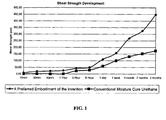
- FIG.1 shows that in certain respects, adhesives in accordance with the invention can have enhanced adhesive properties compared with conventional urethane adhesives.
- Adhesives in accordance with the invention can be formulated to have a shear strength of over 34.5 kPa (5 psi), even over 69 kPa (10 psi) at 15 minutes, and over 69 kPa (10 psi), even over 138 (20 psi) at 30 min.
- Final cure strengths (at 3 months) can exceed 1379 kPa (200 psi), and can even exceed 2068 kPa (300 psi) or 2758 kPa (400 psi).
- the adhesive used for FIG.1 exhibited a shear strength of 3103 kPa (450 psi).
- adhesives in accordance with the invention also exhibit desirable open times. Even at open times of up to 60 minutes the adhesive will still exhibit advantageous strength characteristics.
- FIG. 2 shows the progression of cross-link density with time for one embodiment of the invention.
- Adhesives in accordance with the invention can be formulated to exhibit an immediate initiation of cross-linking and a steady progression for the first hour.
- Different embodiments of the invention can be formulated to exhibit faster or slower progressions, varying by e.g. - about 10 or 20%, or otherwise depending on the desired applications.
- ingredients or compounds recited in the singular are intended to include compatible mixtures of such ingredients wherever the sense permits.
Landscapes
- Chemical & Material Sciences (AREA)
- Organic Chemistry (AREA)
- Health & Medical Sciences (AREA)
- Chemical Kinetics & Catalysis (AREA)
- Medicinal Chemistry (AREA)
- Polymers & Plastics (AREA)
- Oil, Petroleum & Natural Gas (AREA)
- Adhesives Or Adhesive Processes (AREA)
- Addition Polymer Or Copolymer, Post-Treatments, Or Chemical Modifications (AREA)
- Organic Low-Molecular-Weight Compounds And Preparation Thereof (AREA)
Claims (23)
- Composition d'adhésif, comprenant: la combinaison que l'on obtient en combinant un composant constitué d'une huile siccative ; un composant constitué d'une résine d'hydrocarbure ; un composant constitué d'un agent basique fugitif ; un composant constitué d'un anti-oxydant fugitif ; un composant siccatif ; et un composant constitué d'un agent de réticulation comportant des groupes oxazoline pendants, pour fournir un adhésif pouvant être appliqué sur un substrat et qui durcira sur le substrat.
- Composition d'adhésif selon la revendication 1, dans laquelle le composant résine comprend une résine d'hydrocarbure en C-5 et une résine d'hydrocarbure en C-9.
- Composition d'adhésif selon la revendication 1, dans laquelle le composant constitué d'une résine d'hydrocarbure comprend une résine d'hydrocarbure présentant un point de ramollissement de 70°C à 140°C.
- Composition d'adhésif selon la revendication 1, dans laquelle le composant constitué d'une huile siccative comprend au moins un élément choisi dans le groupe constitué par l'huile de lin, l'huile de tung et l'huile de tournesol.
- Composition d'adhésif selon la revendication 1, dans laquelle le composant constitué d'une huile siccative comprend au moins un élément choisi dans le groupe constitué par le baume de cajou, l'huile de ricin, l'huile de coprah, l'huile de graine de coton, l'huile de poisson, l'huile d'oïticica, l'huile de colza, l'huile de carthame, l'huile de sésame, l'huile de soja, l'huile de noix, le tallol et les acides gras.
- Composition d'adhésif selon la revendication 2, dans laquelle l'hydrocarbure en C-5 présente un point de ramollissement compris entre 75°C et 115°C.
- Composition d'adhésif selon la revendication 2, dans laquelle l'hydrocarbure en C-5 est choisi dans le groupe constitué par le cis-1,3-pentadiène, le trans-1,3-pentadiène et le 2-méthyl-2-butène.
- Composition d'adhésif selon la revendication 1, dans laquelle le composant constitué d'une résine d'hydrocarbure comprend une résine d'hydrocarbure présentant un point de ramollissement compris entre 100°C et 140°C.
- Composition d'adhésif selon la revendication 8, dans laquelle la résine d'hydrocarbure est formée d'hydrocarbures choisis dans le groupe constitué par le styrène, le vinyltoluène, l'indène, le méthylindène et l'alpha-méthylstyrène.
- Composition d'adhésif selon la revendication 1, dans laquelle l'agent basique fugitif comprend un élément du groupe constitué par l'ammoniac, la monoéthanolamine et la triéthanolamine.
- Composition d'adhésif selon la revendication 1, dans laquelle le composant constitué d'un anti-oxydant fugitif comprend une oxime.
- Composition d'adhésif selon la revendication 1, dans laquelle l'agent de réticulation comportant un groupe oxazoline pendant comprend des émulsions de polymère en latex.
- Composition d'adhésif selon la revendication 1, dans laquelle le composant siccatif comprend un naphténate métallique.
- Adhésif selon la revendication 1, comprenant un composant constitué d'une émulsion de polymère portant une fonction carboxyle.
- Adhésif selon la revendication 14, dans lequel le composant constitué d'une émulsion de polymère comprend des matériaux acrylique, styrène-butadiène, EVA et/or VAE portant une fonction carboxyle.
- Adhésif selon la revendication 13, dans lequel le métal est choisi dans le groupe constitué par le cobalt, le calcium, le zirconium et le manganèse.
- Adhésif selon la revendication 1, comprenant une quantité efficace de matériau conducteur de l'électricité permettant de rendre l'adhésif durci conducteur de l'électricité.
- Adhésif selon la revendication 1, dans lequel l'adhésif est formulé de manière à ne pas contenir de composés organiques volatils qui sont émis pendant le durcissement.
- Adhésif selon la revendication 1, dans lequel le composant constitué d'une huile siccative représente 1-20% en poids de la composition.
- Adhésif selon la revendication 1, dans lequel le composant constitué d'une résine d'hydrocarbure comprend des résines comportant au plus 6 atomes de carbone, dans un rapport pondéral par rapport au composant constitué d'une huile siccative de 2:1 à 1:2.
- Adhésif selon la revendication 1, dans lequel l'adhésif est formulé pour avoir une résistance au cisaillement de plus de 34,5 kPa (5 psi) après 15 minutes.
- Adhésif selon la revendication 1, dans lequel l'adhésif est formulé pour avoir une résistance au cisaillement de plus de 1380 kPa (200 psi) après 3 mois.
- Adhésif selon la revendication 1, dans lequel l'adhésif est formulé pour présenter un temps ouvert allant jusqu'à 60 minutes.
Applications Claiming Priority (3)
| Application Number | Priority Date | Filing Date | Title |
|---|---|---|---|
| US28495401P | 2001-04-19 | 2001-04-19 | |
| US284954P | 2001-04-19 | ||
| PCT/US2002/012280 WO2002086007A1 (fr) | 2001-04-19 | 2002-04-19 | Adhesif monobloc a faibles emissions |
Publications (3)
| Publication Number | Publication Date |
|---|---|
| EP1401982A1 EP1401982A1 (fr) | 2004-03-31 |
| EP1401982A4 EP1401982A4 (fr) | 2005-01-26 |
| EP1401982B1 true EP1401982B1 (fr) | 2010-02-24 |
Family
ID=23092159
Family Applications (1)
| Application Number | Title | Priority Date | Filing Date |
|---|---|---|---|
| EP02734005A Expired - Lifetime EP1401982B1 (fr) | 2001-04-19 | 2002-04-19 | Adhesif monocomposant a faible emission |
Country Status (7)
| Country | Link |
|---|---|
| US (2) | US6706789B2 (fr) |
| EP (1) | EP1401982B1 (fr) |
| AT (1) | ATE458793T1 (fr) |
| AU (1) | AU2002305199B2 (fr) |
| CA (1) | CA2444234C (fr) |
| DE (1) | DE60235467D1 (fr) |
| WO (1) | WO2002086007A1 (fr) |
Families Citing this family (22)
| Publication number | Priority date | Publication date | Assignee | Title |
|---|---|---|---|---|
| US20020108772A1 (en) * | 2000-12-12 | 2002-08-15 | Sumitomo Wiring Systems, Ltd. | Electrical wire having resin composition covering |
| US20050075428A1 (en) * | 2001-04-19 | 2005-04-07 | W.F. Taylor Co., Inc. | Low emissions one part adhesive |
| ATE458793T1 (de) * | 2001-04-19 | 2010-03-15 | W F Taylor Co Inc | Emissionsarmer einkomponentige klebstoff |
| US20070213418A1 (en) * | 2004-05-18 | 2007-09-13 | Vermilion Donn R | Asphalt-filled polymers |
| US20060069209A1 (en) * | 2004-09-29 | 2006-03-30 | Klosiewicz Daniel W | Heat stable functionalized polyolefin emulsions |
| US7282264B2 (en) * | 2004-10-08 | 2007-10-16 | W.F. Taylor Co., Inc. | Composition and method for controlling moisture |
| US7335707B2 (en) * | 2005-11-02 | 2008-02-26 | The Goodyear Tire & Rubber Company | Barrier layer composition |
| JP5300715B2 (ja) * | 2006-06-09 | 2013-09-25 | ビーエーエスエフ ソシエタス・ヨーロピア | 床敷き材用接着剤 |
| US7799895B2 (en) * | 2006-09-12 | 2010-09-21 | W.F. Taylor Co., Inc. | Low VOC bio-source adhesive |
| JP5596557B2 (ja) | 2008-01-18 | 2014-09-24 | ロディア オペレーションズ | ラテックスバインダー、凍結融解安定性を有する水性コーティング及び塗料並びにそれらの使用法 |
| US9388323B2 (en) * | 2008-01-18 | 2016-07-12 | Rhodia Operations | Latex binders, aqueous coatings and paints having freeze-thaw ability and methods for using same |
| FR2943070B1 (fr) | 2009-03-12 | 2012-12-21 | Total Raffinage Marketing | Fluide hydrocarbone hydrodeparaffine utilise dans la fabrication de fluides industriels, agricoles ou a usage domestique |
| FR2943064B1 (fr) | 2009-03-12 | 2013-12-06 | Total Raffinage Marketing | Diluant hydrocarbone a bas taux de cov pour materiaux de construction |
| EP2422026A4 (fr) | 2009-04-22 | 2015-09-02 | W F Taylor Co Inc | Film adhésif sans support |
| US8871888B2 (en) * | 2009-05-22 | 2014-10-28 | Ppg Industries Ohio, Inc | One-component epoxy coating compositions |
| BR112012014037A2 (pt) * | 2009-12-11 | 2020-08-25 | Rhodia Operations | métodos e sistemas para melhorar o tempo de abertura e tempo de secagem de aglutinantes de látex e revestimentos aquosos |
| WO2011082327A1 (fr) * | 2009-12-31 | 2011-07-07 | Bostik Inc. | Composition adhésive durcissable sous l'action de l'humidité et procédé pour l'installation de planchers en bois dur |
| US10308847B1 (en) | 2011-02-03 | 2019-06-04 | Carroll Benford Dickens | Pressure sensitive, waterproof adhesive compositions |
| JP2016084481A (ja) * | 2016-02-04 | 2016-05-19 | 積水化学工業株式会社 | フラット面用表面保護フィルムの巻回体、およびその製造方法 |
| US11098187B2 (en) | 2016-03-23 | 2021-08-24 | Bridgestone Americas Tire Operations, Llc | Resin-extended rubber and process for preparing |
| US10160887B1 (en) * | 2017-07-25 | 2018-12-25 | W.F. Taylor Llc | Cure signaling adhesive |
| US11519172B2 (en) * | 2018-10-04 | 2022-12-06 | Covestro Llc | Modified foam wall structures with high racking strength and methods for their manufacture |
Family Cites Families (6)
| Publication number | Priority date | Publication date | Assignee | Title |
|---|---|---|---|---|
| DE3402280C1 (de) * | 1984-01-24 | 1985-07-25 | Dynamit Nobel Ag, 5210 Troisdorf | Waermehaertbare Klebstoff- und Dichtungsmassen |
| US4626575A (en) * | 1985-04-22 | 1986-12-02 | Ashland Oil, Inc. | Pressure sensitive adhesives |
| EP0385747A3 (fr) * | 1989-03-01 | 1991-08-07 | Avery International Corporation | Compositions adhésives sensibles à la pression et étiquettes adhésives sensibles à la pression |
| DE4132077A1 (de) * | 1991-09-26 | 1993-04-08 | Herberts Gmbh | Wasserverduennbare lufttrocknende bindemittel, verfahren zu deren herstellung und deren verwendung in lufttrocknenden ueberzugsmittel |
| WO1996029373A1 (fr) * | 1995-03-22 | 1996-09-26 | Nippon Shokubai Co., Ltd. | Composition d'adhesif autocollant dispersable dans l'eau, son procede de production, et articles adhesifs autocollants fabriques a partir de cette composition |
| ATE458793T1 (de) * | 2001-04-19 | 2010-03-15 | W F Taylor Co Inc | Emissionsarmer einkomponentige klebstoff |
-
2002
- 2002-04-19 AT AT02734005T patent/ATE458793T1/de not_active IP Right Cessation
- 2002-04-19 WO PCT/US2002/012280 patent/WO2002086007A1/fr not_active Ceased
- 2002-04-19 DE DE60235467T patent/DE60235467D1/de not_active Expired - Lifetime
- 2002-04-19 US US10/126,146 patent/US6706789B2/en not_active Expired - Lifetime
- 2002-04-19 AU AU2002305199A patent/AU2002305199B2/en not_active Expired
- 2002-04-19 EP EP02734005A patent/EP1401982B1/fr not_active Expired - Lifetime
- 2002-04-19 CA CA2444234A patent/CA2444234C/fr not_active Expired - Lifetime
-
2003
- 2003-12-30 US US10/749,683 patent/US6881775B2/en not_active Expired - Lifetime
Also Published As
| Publication number | Publication date |
|---|---|
| US6706789B2 (en) | 2004-03-16 |
| DE60235467D1 (de) | 2010-04-08 |
| US6881775B2 (en) | 2005-04-19 |
| CA2444234C (fr) | 2011-08-02 |
| EP1401982A1 (fr) | 2004-03-31 |
| US20030073765A1 (en) | 2003-04-17 |
| EP1401982A4 (fr) | 2005-01-26 |
| ATE458793T1 (de) | 2010-03-15 |
| AU2002305199B2 (en) | 2007-11-01 |
| US20040162369A1 (en) | 2004-08-19 |
| WO2002086007A1 (fr) | 2002-10-31 |
| CA2444234A1 (fr) | 2002-10-31 |
Similar Documents
| Publication | Publication Date | Title |
|---|---|---|
| EP1401982B1 (fr) | Adhesif monocomposant a faible emission | |
| AU2002305199A1 (en) | Low emissions one part adhesive | |
| US5364894A (en) | Emulsification of asphalt and modified asphalt with primary emulsifier polymers comprised of acrylic acid type monomers | |
| CA2662623C (fr) | Adhesif de source biologique | |
| US5962564A (en) | Water based high solids adhesives and adhesive application system including pressurized canister | |
| US5565511A (en) | High-solids adhesives and method of producing same | |
| AU2005310016B2 (en) | Low emissions one part adhesive | |
| US5935312A (en) | Resin-based dispersion adhesive | |
| KR102491007B1 (ko) | 예비-팽윤된 비닐아세테이트-에틸렌계 재분산성 중합체 분말 조성물 및 이의 제조 방법, 이를 포함하는 아스팔트 조성물 | |
| US10160887B1 (en) | Cure signaling adhesive | |
| US3444117A (en) | Polymer blend | |
| KR102950654B1 (ko) | 수성 에어로졸 비닐아세테이트-에틸렌 접착제 조성물 | |
| JPS6185459A (ja) | 液状ゴム組成物 | |
| KR100822290B1 (ko) | 식물유 유래 지방산 에스테르 용매를 사용하여 제조되는 에폭시 에멀젼 접착제 조성물 | |
| AU637864B2 (en) | Hot melt adhesives having improved pot lives and processes for their preparation | |
| EP2586841B1 (fr) | Formulation adhésive à chaud pour le collage de matériaux plastiques | |
| US7169840B2 (en) | Floor covering adhesive | |
| JPH06145621A (ja) | 接着剤組成物 | |
| HK1073326B (en) | Method for producing aqueous floor covering adhesives, emulsion produced from said method and use thereof |
Legal Events
| Date | Code | Title | Description |
|---|---|---|---|
| PUAI | Public reference made under article 153(3) epc to a published international application that has entered the european phase |
Free format text: ORIGINAL CODE: 0009012 |
|
| 17P | Request for examination filed |
Effective date: 20031016 |
|
| AK | Designated contracting states |
Kind code of ref document: A1 Designated state(s): AT BE CH CY DE DK ES FI FR GB GR IE IT LI LU MC NL PT SE TR |
|
| AX | Request for extension of the european patent |
Extension state: AL LT LV MK RO SI |
|
| A4 | Supplementary search report drawn up and despatched |
Effective date: 20041210 |
|
| 17Q | First examination report despatched |
Effective date: 20070125 |
|
| GRAJ | Information related to disapproval of communication of intention to grant by the applicant or resumption of examination proceedings by the epo deleted |
Free format text: ORIGINAL CODE: EPIDOSDIGR1 |
|
| GRAP | Despatch of communication of intention to grant a patent |
Free format text: ORIGINAL CODE: EPIDOSNIGR1 |
|
| GRAS | Grant fee paid |
Free format text: ORIGINAL CODE: EPIDOSNIGR3 |
|
| GRAA | (expected) grant |
Free format text: ORIGINAL CODE: 0009210 |
|
| AK | Designated contracting states |
Kind code of ref document: B1 Designated state(s): AT BE CH CY DE DK ES FI FR GB GR IE IT LI LU MC NL PT SE TR |
|
| REG | Reference to a national code |
Ref country code: GB Ref legal event code: FG4D |
|
| REG | Reference to a national code |
Ref country code: CH Ref legal event code: EP |
|
| REG | Reference to a national code |
Ref country code: IE Ref legal event code: FG4D |
|
| REF | Corresponds to: |
Ref document number: 60235467 Country of ref document: DE Date of ref document: 20100408 Kind code of ref document: P |
|
| REG | Reference to a national code |
Ref country code: NL Ref legal event code: VDEP Effective date: 20100224 |
|
| PG25 | Lapsed in a contracting state [announced via postgrant information from national office to epo] |
Ref country code: PT Free format text: LAPSE BECAUSE OF FAILURE TO SUBMIT A TRANSLATION OF THE DESCRIPTION OR TO PAY THE FEE WITHIN THE PRESCRIBED TIME-LIMIT Effective date: 20100624 |
|
| PG25 | Lapsed in a contracting state [announced via postgrant information from national office to epo] |
Ref country code: FI Free format text: LAPSE BECAUSE OF FAILURE TO SUBMIT A TRANSLATION OF THE DESCRIPTION OR TO PAY THE FEE WITHIN THE PRESCRIBED TIME-LIMIT Effective date: 20100224 Ref country code: AT Free format text: LAPSE BECAUSE OF FAILURE TO SUBMIT A TRANSLATION OF THE DESCRIPTION OR TO PAY THE FEE WITHIN THE PRESCRIBED TIME-LIMIT Effective date: 20100224 |
|
| PG25 | Lapsed in a contracting state [announced via postgrant information from national office to epo] |
Ref country code: ES Free format text: LAPSE BECAUSE OF FAILURE TO SUBMIT A TRANSLATION OF THE DESCRIPTION OR TO PAY THE FEE WITHIN THE PRESCRIBED TIME-LIMIT Effective date: 20100604 Ref country code: BE Free format text: LAPSE BECAUSE OF FAILURE TO SUBMIT A TRANSLATION OF THE DESCRIPTION OR TO PAY THE FEE WITHIN THE PRESCRIBED TIME-LIMIT Effective date: 20100224 Ref country code: CY Free format text: LAPSE BECAUSE OF FAILURE TO SUBMIT A TRANSLATION OF THE DESCRIPTION OR TO PAY THE FEE WITHIN THE PRESCRIBED TIME-LIMIT Effective date: 20100224 Ref country code: SE Free format text: LAPSE BECAUSE OF FAILURE TO SUBMIT A TRANSLATION OF THE DESCRIPTION OR TO PAY THE FEE WITHIN THE PRESCRIBED TIME-LIMIT Effective date: 20100224 Ref country code: GR Free format text: LAPSE BECAUSE OF FAILURE TO SUBMIT A TRANSLATION OF THE DESCRIPTION OR TO PAY THE FEE WITHIN THE PRESCRIBED TIME-LIMIT Effective date: 20100525 Ref country code: NL Free format text: LAPSE BECAUSE OF FAILURE TO SUBMIT A TRANSLATION OF THE DESCRIPTION OR TO PAY THE FEE WITHIN THE PRESCRIBED TIME-LIMIT Effective date: 20100224 |
|
| PG25 | Lapsed in a contracting state [announced via postgrant information from national office to epo] |
Ref country code: MC Free format text: LAPSE BECAUSE OF NON-PAYMENT OF DUE FEES Effective date: 20100430 |
|
| REG | Reference to a national code |
Ref country code: CH Ref legal event code: PL |
|
| PLBE | No opposition filed within time limit |
Free format text: ORIGINAL CODE: 0009261 |
|
| STAA | Information on the status of an ep patent application or granted ep patent |
Free format text: STATUS: NO OPPOSITION FILED WITHIN TIME LIMIT |
|
| PG25 | Lapsed in a contracting state [announced via postgrant information from national office to epo] |
Ref country code: IE Free format text: LAPSE BECAUSE OF NON-PAYMENT OF DUE FEES Effective date: 20100419 Ref country code: DK Free format text: LAPSE BECAUSE OF FAILURE TO SUBMIT A TRANSLATION OF THE DESCRIPTION OR TO PAY THE FEE WITHIN THE PRESCRIBED TIME-LIMIT Effective date: 20100224 |
|
| 26N | No opposition filed |
Effective date: 20101125 |
|
| PG25 | Lapsed in a contracting state [announced via postgrant information from national office to epo] |
Ref country code: LI Free format text: LAPSE BECAUSE OF NON-PAYMENT OF DUE FEES Effective date: 20100430 Ref country code: CH Free format text: LAPSE BECAUSE OF NON-PAYMENT OF DUE FEES Effective date: 20100430 |
|
| PG25 | Lapsed in a contracting state [announced via postgrant information from national office to epo] |
Ref country code: IT Free format text: LAPSE BECAUSE OF FAILURE TO SUBMIT A TRANSLATION OF THE DESCRIPTION OR TO PAY THE FEE WITHIN THE PRESCRIBED TIME-LIMIT Effective date: 20100224 |
|
| PG25 | Lapsed in a contracting state [announced via postgrant information from national office to epo] |
Ref country code: LU Free format text: LAPSE BECAUSE OF NON-PAYMENT OF DUE FEES Effective date: 20100419 |
|
| PG25 | Lapsed in a contracting state [announced via postgrant information from national office to epo] |
Ref country code: TR Free format text: LAPSE BECAUSE OF FAILURE TO SUBMIT A TRANSLATION OF THE DESCRIPTION OR TO PAY THE FEE WITHIN THE PRESCRIBED TIME-LIMIT Effective date: 20100224 |
|
| REG | Reference to a national code |
Ref country code: FR Ref legal event code: PLFP Year of fee payment: 14 |
|
| REG | Reference to a national code |
Ref country code: DE Ref legal event code: R082 Ref document number: 60235467 Country of ref document: DE Representative=s name: FROHWITTER PATENT- UND RECHTSANWAELTE, DE Ref country code: DE Ref legal event code: R081 Ref document number: 60235467 Country of ref document: DE Owner name: W.F. TAYLOR LLC, DOVER, US Free format text: FORMER OWNER: W.F. TAYLOR CO., INC., FONTANA, CALIF., US |
|
| REG | Reference to a national code |
Ref country code: FR Ref legal event code: CA Effective date: 20160118 Ref country code: FR Ref legal event code: CJ Effective date: 20160118 Ref country code: FR Ref legal event code: CD Owner name: W.F. TAYLOR LLC, US Effective date: 20160118 |
|
| REG | Reference to a national code |
Ref country code: FR Ref legal event code: PLFP Year of fee payment: 15 |
|
| REG | Reference to a national code |
Ref country code: FR Ref legal event code: PLFP Year of fee payment: 16 |
|
| REG | Reference to a national code |
Ref country code: FR Ref legal event code: PLFP Year of fee payment: 17 |
|
| PGFP | Annual fee paid to national office [announced via postgrant information from national office to epo] |
Ref country code: DE Payment date: 20210629 Year of fee payment: 20 Ref country code: FR Payment date: 20210429 Year of fee payment: 20 |
|
| PGFP | Annual fee paid to national office [announced via postgrant information from national office to epo] |
Ref country code: GB Payment date: 20210429 Year of fee payment: 20 |
|
| REG | Reference to a national code |
Ref country code: DE Ref legal event code: R071 Ref document number: 60235467 Country of ref document: DE |
|
| REG | Reference to a national code |
Ref country code: GB Ref legal event code: PE20 Expiry date: 20220418 |
|
| PG25 | Lapsed in a contracting state [announced via postgrant information from national office to epo] |
Ref country code: GB Free format text: LAPSE BECAUSE OF EXPIRATION OF PROTECTION Effective date: 20220418 |