EP1403232A2 - Flammensperrender Festkörper - Google Patents
Flammensperrender Festkörper Download PDFInfo
- Publication number
- EP1403232A2 EP1403232A2 EP03019897A EP03019897A EP1403232A2 EP 1403232 A2 EP1403232 A2 EP 1403232A2 EP 03019897 A EP03019897 A EP 03019897A EP 03019897 A EP03019897 A EP 03019897A EP 1403232 A2 EP1403232 A2 EP 1403232A2
- Authority
- EP
- European Patent Office
- Prior art keywords
- flame
- solid body
- foam
- gas
- ceramic
- Prior art date
- Legal status (The legal status is an assumption and is not a legal conclusion. Google has not performed a legal analysis and makes no representation as to the accuracy of the status listed.)
- Granted
Links
Images

Classifications
-
- C—CHEMISTRY; METALLURGY
- C04—CEMENTS; CONCRETE; ARTIFICIAL STONE; CERAMICS; REFRACTORIES
- C04B—LIME, MAGNESIA; SLAG; CEMENTS; COMPOSITIONS THEREOF, e.g. MORTARS, CONCRETE OR LIKE BUILDING MATERIALS; ARTIFICIAL STONE; CERAMICS; REFRACTORIES; TREATMENT OF NATURAL STONE
- C04B38/00—Porous mortars, concrete, artificial stone or ceramic ware; Preparation thereof
- C04B38/0067—Porous mortars, concrete, artificial stone or ceramic ware; Preparation thereof characterised by the density of the end product
-
- A—HUMAN NECESSITIES
- A62—LIFE-SAVING; FIRE-FIGHTING
- A62C—FIRE-FIGHTING
- A62C4/00—Flame traps allowing passage of gas but not of flame or explosion wave
- A62C4/02—Flame traps allowing passage of gas but not of flame or explosion wave in gas-pipes
-
- F—MECHANICAL ENGINEERING; LIGHTING; HEATING; WEAPONS; BLASTING
- F16—ENGINEERING ELEMENTS AND UNITS; GENERAL MEASURES FOR PRODUCING AND MAINTAINING EFFECTIVE FUNCTIONING OF MACHINES OR INSTALLATIONS; THERMAL INSULATION IN GENERAL
- F16J—PISTONS; CYLINDERS; SEALINGS
- F16J13/00—Covers or similar closure members for pressure vessels in general
- F16J13/24—Covers or similar closure members for pressure vessels in general with safety devices, e.g. to prevent opening prior to pressure release
-
- C—CHEMISTRY; METALLURGY
- C04—CEMENTS; CONCRETE; ARTIFICIAL STONE; CERAMICS; REFRACTORIES
- C04B—LIME, MAGNESIA; SLAG; CEMENTS; COMPOSITIONS THEREOF, e.g. MORTARS, CONCRETE OR LIKE BUILDING MATERIALS; ARTIFICIAL STONE; CERAMICS; REFRACTORIES; TREATMENT OF NATURAL STONE
- C04B2111/00—Mortars, concrete or artificial stone or mixtures to prepare them, characterised by specific function, property or use
- C04B2111/00241—Physical properties of the materials not provided for elsewhere in C04B2111/00
- C04B2111/00267—Materials permeable to vapours or gases
-
- C—CHEMISTRY; METALLURGY
- C04—CEMENTS; CONCRETE; ARTIFICIAL STONE; CERAMICS; REFRACTORIES
- C04B—LIME, MAGNESIA; SLAG; CEMENTS; COMPOSITIONS THEREOF, e.g. MORTARS, CONCRETE OR LIKE BUILDING MATERIALS; ARTIFICIAL STONE; CERAMICS; REFRACTORIES; TREATMENT OF NATURAL STONE
- C04B2111/00—Mortars, concrete or artificial stone or mixtures to prepare them, characterised by specific function, property or use
- C04B2111/20—Resistance against chemical, physical or biological attack
- C04B2111/28—Fire resistance, i.e. materials resistant to accidental fires or high temperatures
Definitions
- the invention relates to a flame-retardant solid made of a gas-permeable, porous, non-combustible foam.
- Such a solid made of an aluminum foam is described by the utility model DE 202 08 576 U1.
- This solid body is described there with the aid of a pressure relief device with a rupture disc which closes an opening of a container or the like and which, when a predetermined pressure difference is exceeded, opens into a cavity of a basket arranged on the outside of the container, the gas-permeable walls of which have a flame-retardant effect due to heat dissipation.
- the walls through which the gas can flow are formed on the outside as a coarse-mesh grid and backed by an open-pore metal foam made of aluminum.
- the invention has for its object to develop the above-mentioned solid advantageously.
- the invention further relates to a flame, explosion or detonation barrier which can be introduced into a gas-flowed line or which can be assigned to a suction device for dusts or the like.
- Claim 1 initially and essentially proposes that the material of the flame-retardant solid be ceramic.
- the porosity which has been particularly distinguished for the use of such a ceramic foam as a flame-retardant solid, is between 10 and 50 ppi (average number of pores per "linear inch").
- foam ceramics are used as pouring filters or heat exchangers. When used as a pouring filter, a metal melt is passed through the extremely temperature-resistant material with a melting temperature of up to 1680 ° C.
- ceramic foams for decoration, for example in aquariums. Ceramic foams are also used as building materials. The use of ceramic foams is described in particular by Fraunhofer Magazine 9, 1999.
- the previously described solid body is used as a flame, explosion or detonation barrier.
- a barrier can be introduced into a gas-flowed, for example air-flowed line, in particular into a pipe.
- the ceramic foam then has an outline contour that corresponds to the inner contour of the pipe or pipe.
- the solid body introduced into the tube as a plug can also consist of several individual parts which are connected to one another in a suitable manner. It is essential that the gas (air) that flows through the line or the tube flows through the pores of the ceramic foam. Due to the high thermal capacity of the material, Flame fronts spreading in the tube cooled and thus extinguished when the surface of the ceramic foam passed through.
- suction devices for dusts.
- These suction devices usually have a filter through which the dust-laden gas or the dust-laden air is sucked through.
- the ceramic foam is brought into the suction line downstream of the filter in the manner described above, so that the ceramic foam is arranged in front of a suction device, for example a fan.
- the invention further relates to a pressure relief device with a rupture disk, as described in DE 202 08 576 U1.
- a pressure relief device with a rupture disk as described in DE 202 08 576 U1.
- the entire disclosure content of this document is included in this application.
- the open-pore foam with which the coarse-mesh grid is backed can not consist of metal, but of ceramic material.
- the flame fronts occurring in the event of an explosion should not, however, enter the solid body. At most, they should penetrate slightly deep into the solid, in order to then extinguish them through heat removal.
- the solid is used according to the invention in the cold state, in particular at room temperature.
- This gas can be a gas mixture consisting of a combustible gas and air. If this gas mixture is heated locally above its ignition temperature, a flame front is formed which spreads in the pipe in both directions.
- S the direction of propagation is denoted by S.
- a flame-retardant solid in the form of a ceramic foam.
- the ceramic foam can consist of zirconium oxide or silicon carbide. Its porosity is approximately 20-40 ppi (average number of pores per "linear inch"). As a result of this porosity, the gas or the gas mixture can flow through the ceramic foam 1 almost unhindered.
- the thickness D of the foam body is between 20 and 50 mm.
- Ceramic foam sheets with a thickness of 22 mm are preferably used. However, several plates can also be arranged one behind the other, so that the total thickness of the flame-retardant solid is 44 mm. Due to a melting temperature of up to 1680 ° C, the material can absorb a significant amount of heat without melting. It is therefore reusable.
- FIG. 2 is the part of a dust extraction device that has a filter 3.
- Such dust extraction devices can be used in joineries or other workshops or companies in which processes are carried out or processing methods can be used where dust is generated.
- the dust is sucked away from the place where it originates by means of a fan or another fan, which is connected to a pipeline.
- the air / dust mixture is passed into a filter, where the dust separates.
- dust explosions can occur inside the line.
- the ceramic foam has the shape of a plate with a thickness D of preferably 22 mm.
- a suction device 4 Downstream of the ceramic foam insert 1, whose outer contour corresponds to the inner contour of the line 2, there is a suction device 4, for example in the form of a fan wheel (fan).
- This fan wheel sucks air through the filter that is contaminated with dust.
- a spreading flame front cannot penetrate through the ceramic foam insert 1.
- a ceramic foam As flame, explosion or detonation protection, it is even possible to use the ceramic foam itself as a filter.
- the dust accumulates in front of the ceramic foam.
- the transport air can be sucked through the foam.
- a dust separator for example in the form of a cyclone, can also be used. Even then, the ceramic foam body placed in the air line can serve as a residual dust filter.
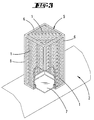
- the exemplary embodiment shown in FIG. 3 is a pressure loading device in the form of a cuboid-shaped container 5, the five sides of which are made of plates which are made of a ceramic material 1.
- the plates 1 are fixed by means of a frame 6.
- One wall of the container 5 is designed as a bursting plate 7.
- the container can be placed on a line 2 and close an opening there with the bursting plate 7. Explosive gases or dusts can flow in air in line 2. It comes to an explosion, the resulting pressure is derived by the bursting of the bursting plate 7. Flames that blow out of the opening then created are extinguished on the walls 1 of the container 5.
- Foam ceramic plates which are manufactured in dimensions of 100 x 100 x 22 mm, are suitable as raw materials for the production of the tube inserts (FIGS. 1 and 2) or the container walls (FIG. 3). In the case of small areas, the appropriate cross-sectional shapes can be sawn out of such panels. In the case of larger areas, several such plates are placed next to one another and fastened to one another in a suitable manner. This can be done, for example, by holding the plates in a frame. In a preferred embodiment of the invention, a plurality of plates are also placed one behind the other in order to increase the material thickness of the insert 1 or of the walls 1.
- the ceramic foam is operated at room temperature or at least at a temperature which is far below the ignition temperature of the gases which flow through the corresponding lines.
Landscapes
- Engineering & Computer Science (AREA)
- Chemical & Material Sciences (AREA)
- General Engineering & Computer Science (AREA)
- Ceramic Engineering (AREA)
- Health & Medical Sciences (AREA)
- Emergency Management (AREA)
- Structural Engineering (AREA)
- Mechanical Engineering (AREA)
- Materials Engineering (AREA)
- Public Health (AREA)
- Business, Economics & Management (AREA)
- Organic Chemistry (AREA)
- Filtering Materials (AREA)
- Filtering Of Dispersed Particles In Gases (AREA)
- Compositions Of Oxide Ceramics (AREA)
- Porous Artificial Stone Or Porous Ceramic Products (AREA)
- Ceramic Products (AREA)
- Woven Fabrics (AREA)
Abstract
Description
- Die Erfindung betrifft einen flammensperrenden Festkörper aus einem gasdurchlässigen, porösen, nicht brennbaren Schaum.
- Ein derartiger Festkörper aus einem Aluminiumschaum wird von der Gebrauchsmusterschrift DE 202 08 576 U1 beschrieben. Dieser Festkörper wird dort anhand einer Druckentlastungsvorrichtung mit einer eine Öffnung eines Behälters oder dergleichen verschließenden Berstscheibe beschrieben, die bei Überschreiten einer vorbestimmten Druckdifferenz in einen Hohlraum eines behälteraußenseitig angeordneten Korbes öffnet, dessen gasdurchlässigen Wände durch Wärmeabfuhr flammensperrend wirken. Die gasdurchströmbaren Wände sind dort außenseitig als grobmaschiges Gitter ausgebildet und von einem offenporigen Metallschaum aus Aluminium hinterlegt.
- Zufolge der Schmelztemperatur des Aluminiums können diese Festkörper meistens nur einmal verwendet werden. Außerdem sind die erforderlichen Wandstärken relativ hoch.
- Der Erfindung liegt die Aufgabe zugrunde, den eingangs genannten Festkörper gebrauchsvorteilhaft weiterzubilden.
- Die Erfindung betrifft ferner eine Flammen-, Explosions- oder Detonationssperre, die in eine gasdurchströmte Leitung einbringbar ist bzw. die einer Absaugvorrichtung für Stäube oder dergleichen zuzuordnen ist.
- Gelöst wird die Aufgabe durch die in den Ansprüchen angegebene Erfindung. Der Anspruch 1 schlägt zunächst und im Wesentlichen vor, dass das Material des flammensperrenden Festkörpers keramisch ist. In Betracht kommt als Material ein Siliciumcarbitschaum, ein Zirkonoxidschaum oder ein Schaum aus Mullit. Die Porösität, die sich für die Verwendung eines derartigen keramischen Schaumes als flammensperrender Festkörper besonders ausgezeichnet hat, liegt zwischen 10 und 50 ppi (durchschnittliche Anzahl an Poren pro "linear inch"). Im Stand der Technik ist es bekannt, derartige Schaumkeramiken als Gießfilter oder Wärmetauscher zu verwenden. Bei der Verwendung als Gießfilter wird durch das außerordentlich temperaturbelastbare Material mit einer Schmelztemperatur von bis zu 1680°C eine Metallschmelze geleitet. Im Stand der Technik ist es auch bekannt, keramische Schäume zur Dekoration bspw. in Aquarien zu verwenden. Ferner werden keramische Schäume als Baustoffe verwendet. Die Verwendung von Keramikschäumen beschreibt insbesondere das Fraunhofer-Magazin 9,1999.
- Es ist ferner bekannt, einen keramischen Schaum zur Unterstützung einer katalytischen Verbrennung bzw. einer Flammenbildung zu verwenden. Dabei sollen die Flammen innerhalb des Schaumes brennen. Dieser muss dazu eine entsprechend hohe Temperatur besitzen.
- Erfindungsgemäß wird der zuvor beschriebene Festkörper, dessen Materialstärke zwischen 20 und 50 mm betragen kann und bevorzugt zwischen 22 und 44 mm liegt, als Flammen-, Explosions- oder Detonationssperre verwendet. Eine solche Sperre kann in eine gasdurchströmte bspw. luftdurchströmte Leitung, insbesondere in ein Rohr eingebracht werden. Der Keramikschaum besitzt dann eine Umrisskontur, die der Innenkontur der Leitung oder des Rohres entspricht. Dabei kann der gleichsam als Stopfen in das Rohr eingebrachte Festkörper auch aus mehreren Einzelteilen bestehen, die in geeigneter Weise miteinander verbunden sind. Wesentlich ist, dass das Gas (Luft), welches durch die Leitung bzw. das Rohr strömt, die Poren des Keramikschaumes durchströmt. Zufolge der hohen Wärmekapazität des Materials werden in der Leitung bzw. in dem Rohr ausbreitende Flammfronten beim Durchtritt der Oberfläche des Keramikschaumes gekühlt und damit gelöscht. Eine weitere erfindungsgemäße Verwendung betrifft eine Absaugeinrichtung für Stäube. Diese Absaugeinrichtungen besitzen in der Regel einen Filter durch welchen das mit Staub belastete Gas, bzw. die mit Staub belastete Luft hindurchgesaugt wird. Der Keramikschaum wird in der zuvor beschriebenen Weise stromabwärts des Filters in die Saugleitung gebracht, so dass der Keramikschaum vor einer Saugeinrichtung, bspw. einem Ventilator, angeordnet ist.
- Die Erfindung betrifft ferner eine Druckentlastungsvorrichtung mit Berstscheibe, wie sie die DE 202 08 576 U1 beschreibt. Insofern wird der gesamte Offenbarungsgehalt dieser Schrift mit in diese Anmeldung mit einbezogen. Anders als dort kann der offenporige Schaum, mit dem das grobmaschige Gitter hinterfüttert ist, aber nicht aus Metall, sondern aus keramischem Material bestehen.
- Anders als beim eingangs geschilderten Stand der Technik sollen die bei einer Explosion auftretenden Flammfronten aber gerade nicht in den Festkörper eintreten. Sie sollen allenfalls geringfügig tief in den Festkörper eintreten, um dann durch Wärmeentzug zu verlöschen. Der Festkörper wird erfindungsgemäß im kalten Zustand, also insbesondere bei Raumtemperatur verwendet.
- Ausführungsbeispiele der Erfindung werden nachfolgend anhand beigefügter Zeichnungen erläutert. Es zeigen:
- Fig.1
- in grobschematischer Darstellung die Verwendung eines keramischen Schaumes als Flammen-, Explosions- oder Detonationssperre in einem gasdurchströmten Rohr,
- Fig. 2
- die Verwendung von einem keramischen Schaum als Flammensperre rückwärtig eines Filters in einer Staubabsaugeinrichtung und
- Fig. 3
- ebenfalls schematisch in einer perspektivischen, teilweise aufgebrochenen Darstellung die Verwendung von Keramikschaum bei einer Drukkentlastungsvorrichtung gemäß DE 202 08 576 U1.
- Die Fig. 1 zeigt ein Rohr 2, welches von einem Gas durchströmt ist. Bei diesem Gas kann es sich um Gasgemisch handeln, welches aus einem brennbaren Gas und Luft besteht. Wird diese Gasmischung über ihre Zündtemperatur lokal erwärmt, so kommt es zur Ausbildung einer Flammenfront, die sich in beiden Richtungen im Rohr ausbreitet. In der Fig. 1 ist die Ausbreitungsrichtung mit S bezeichnet. Innerhalb dieses Rohres 2 befindet sich ein flammensperrender Festkörper in Form eines Keramikschaums. Der Keramikschaum kann aus Zirkoniumoxid oder Siliciumcarbid bestehen. Seine Porösität beträgt etwa 20-40 ppi (durchschnittliche Anzahl an Poren pro "linear inch"). Zufolge dieser Porösität kann das Gas oder das Gasgemisch nahezu ungehindert den Keramikschaum 1 durchströmen. Die Dicke D des Schaumkörpers beträgt zwischen 20 und 50 mm. Vorzugsweise werden Platten aus Keramikschaum verwendet, die eine Dicke von 22 mm besitzen. Es können aber auch mehrere Platten hintereinander angeordnet werden, so dass die Gesamtdicke des flammensperrenden Festkörpers 44 mm beträgt. Zufolge einer Schmelztemperatur von bis zu 1680°C kann das Material eine erhebliche Wärmemenge aufnehmen, ohne zu schmelzen. Es ist demzufolge wiederverwendbar.
- Bei dem in Fig. 2 dargestellten Ausführungsbeispiel handelt es sich um den Teil einer Staubabsaugvorrichtung, die einen Filter 3 aufweist. Derartige Staubabsaugvorrichtungen können in Schreinereien oder anderen Werkstätten oder Betrieben verwendet werden, in denen Prozesse geführt werden oder Bearbeitungsverfahren angewendet werden, bei denen Staub entsteht. Mittels eines Ventilators oder eines anderweitigen Gebläses, welches an eine Rohrleitung angeschlossen ist, wird der Staub vom Ort seines Entstehens abgesaugt. Das Luft/ Staub-Gemisch wird in einen Filter geleitet, wo sich der Staub abscheidet. Innerhalb der Leitung kann es in ungünstigen Fällen zu Staubexplosionen führen. In Richtung des Gas/Staub-Stromes S abwärts befindet sich in der Leitung 2 ein flammensperrender Festkörper in Form eines Keramikschaumes, wie er zuvor zu Fig. 1 beschrieben worden ist. Auch hier besitzt der Keramikschaum die Form einer Platte mit einer Dicke D mit vorzugsweise 22 mm. Stromabwärts des Keramikschaum-Einsatzes 1, dessen Außenkontur der Innenkontur der Leitung 2 entspricht, befindet sich eine Saugeinrichtung 4 bspw. in Form eines Lüfterrades (Ventilators). Dieses Lüfterrad saugt durch den Filter Luft, die mit Staub belastet ist. Bei einer Staubexplosion kann eine sich ausbreitende Flammfront nicht durch den Keramikschaum-Einsatz 1 hindurchschlagen. Es ist bei der Verwendung eines Keramikschaumes als Flamm-, Explosions- oder Detonations-Schutz sogar möglich, den Keramikschaum selbst als Filter zu verwenden. Vor dem Keramikschaum lagert sich der Staub an. Die Transportluft kann durch den Schaum hindurchgesaugt werden. Anstelle eines Filters kann aber auch ein Staubabscheider bspw. in Form eines Zyklons verwendet werden. Auch dann kann der in die Luftleitung gebrachte Keramikschaumkörper als Rest-Staubfilter dienen.
- Bei dem in der Fig. 3 dargestellten Ausführungsbeispiel handelt es sich um eine Druckeintlastungsvorrichtung in Form eines quaderförmigen Behälters 5, dessen fünf Seiten aus Platten, die aus einem Keramikmaterial 1 bestehen, gefertigt sind. Mittels eines Rahmens 6 werden die Platten 1 fixiert. Eine Wand des Behälters 5 ist als Berstplatte 7 ausgebildet. Der Behälter kann auf eine Leitung 2 aufgesetzt werden und eine dortige Öffnung mit der Berstplatte 7 verschließen. In der Leitung 2 können explosive Gase oder Stäube in Luft strömen. Kommt es zu einer Explosion, wird der dabei entstehende Druck durch Bersten der Berstplatte 7 abgeleitet. Flammen, die aus der dann entstehenden Öffnung herausschlagen, werden an den Wänden 1 des Behälters 5 gelöscht.
- Als Rohmaterialien zur Fertigung der Rohreinsätze (Fig. 1 und 2) bzw. der Behälterwänder (Fig. 3) eignen sich Schaumkeramikplatten, die in Abmessungen von 100 x 100 x 22 mm gefertigt werden. Bei kleinen Flächen können aus derartigen Platten die geeigneten Querschnittsformen herausgesägt werden. Bei gröβeren Flächen werden mehrere derartiger Platten nebeneinander gelegt und in geeigneter Weise miteinander befestigt. Dies kann bspw. durch Aufnahme der Platten in einem Rahmen erfolgen. In einer bevorzugten Ausgestaltung der Erfindung werden eine Vielzahl von Platten auch hintereinander gelegt, um die Materialstärke des Einsatzes 1 bzw. der Wände 1 zu vergrößern.
- Anders als bei der Verwendung von keramischem Schaum zur katalytisch unterstützen Verbrennung wird der keramische Schaum bei Raumtemperatur oder zumindest bei einer Temperatur betrieben, die weit unterhalb der Zündtemperatur der Gase liegt, die durch die entsprechenden Leitungen strömen.
- Alle offenbarten Merkmale sind (für sich) erfindungswesentlich. In die Offenbarung der Anmeldung wird hiermit auch der Offenbarungsinhalt der zugehörigen/ beigefügten Prioritätsunterlagen (Abschrift der Voranmeldung) vollinhaltlich mit einbezogen, auch zu dem Zweck, Merkmale dieser Unterlagen in Ansprüche vorliegender Anmeldung mit aufzunehmen.
Claims (10)
- Flammensperrender Festkörper aus einem gasdurchlässigen, porösen und nicht brennbaren Schaum, dadurch gekennzeichnet, dass das Material des Schaumes keramisch ist.
- Flammensperrender Festkörper nach Anspruch 1 oder insbesondere danach, dadurch gekennzeichnet, dass der keramische Schaum aus Siliciumcarbid, Zirkonoxid oder Mullit besteht.
- Flammensperrender Festkörper nach einem oder mehreren der vorhergehenden Ansprüche oder insbesondere danach, dadurch gekennzeichnet, dass der keramische Schaum eine Porösität zwischen 10 und 50 ppi, bevorzugt zwischen 20 und 40 ppi. besitzt.
- Flammensperrender Festkörper nach einem oder mehreren der vorhergehenden Ansprüche oder insbesondere danach, dadurch gekennzeichnet, dass der keramische Schaum in Form von Platten verwendet wird.
- Flammensperrender Festkörper nach einem oder mehreren der vorhergehenden Ansprüche oder insbesondere danach, dadurch gekennzeichnet, dass die Materialstärke des keramischen Schaums zwischen 20 und 50 mm, bevorzugt zwischen 22 und 44 mm liegt und besonders bevorzugt 22 mm beträgt.
- Verwendung eines Festkörpers nach einem oder mehreren der vorhergehenden Ansprüche als Flammen-, Explosions- oder Detonationssperre in einer gasdurchströmten insbesondere luftdurchströmte Leitung (2), insbesondere in einem Rohr.
- Verwendung eines Festkörpers nach einem oder mehreren der vorhergehenden Ansprüche als Flammen-, Explosions- oder Detonationssperre in einer Absaugeinrichtung oder dergleichen für Stäube oder ähnliche Substanzen stromabwärts eines Filters (3) und vor einer Saugeinrichtung (4).
- Verwendung eines Festkörpers nach einem oder mehreren der vorhergehenden Ansprüche als Material für die Wände eines Behälters, in dessen Höhlung eine von einer Behälterwand ausgebildeten Berstscheibe (7) öffnen kann.
- Flammen-, Explosions- oder Detonationssperre für eine Gas- insbesondere luftdurchströmte Leitung (2) insbesondere ein Rohr in Form eines offenporigen, der Innenkontur der Leitung (2) angepassten Festkörper aus einem gasdurchlässigen, porösen und nicht brennbaren Schaum, dadurch gekennzeichnet, dass der Festkörper zusätzlich die Eigenschaften eines oder mehrerer der vorhergehenden Ansprüche besitzt.
- Druckentlastungsvorrichtung mit einer eine Öffnung eines Behälters oder dergleichen verschließenden Berstscheibe (7), die bei Überschreiten einer vorbestimmten Druckdifferenz in den Hohlraum des Behälters öffnet, dessen gasdurchlässige Wände von einem flammensperrenden Festkörper aus einem gasdurchlässigen, porösen und nicht brennbaren Schaum gebildet sind, dadurch gekennzeichnet, dass der Festkörper zusätzlich die Eigenschaften eines oder mehrerer der vorhergehenden Ansprüche besitzt.
Applications Claiming Priority (2)
| Application Number | Priority Date | Filing Date | Title |
|---|---|---|---|
| DE10245307 | 2002-09-27 | ||
| DE10245307A DE10245307A1 (de) | 2002-09-27 | 2002-09-27 | Flammensperrender Festkörper |
Publications (3)
| Publication Number | Publication Date |
|---|---|
| EP1403232A2 true EP1403232A2 (de) | 2004-03-31 |
| EP1403232A3 EP1403232A3 (de) | 2008-07-30 |
| EP1403232B1 EP1403232B1 (de) | 2012-02-15 |
Family
ID=31969688
Family Applications (1)
| Application Number | Title | Priority Date | Filing Date |
|---|---|---|---|
| EP03019897A Expired - Lifetime EP1403232B1 (de) | 2002-09-27 | 2003-09-02 | Flammensperrender Festkörper |
Country Status (3)
| Country | Link |
|---|---|
| EP (1) | EP1403232B1 (de) |
| AT (1) | ATE545620T1 (de) |
| DE (1) | DE10245307A1 (de) |
Cited By (4)
| Publication number | Priority date | Publication date | Assignee | Title |
|---|---|---|---|---|
| DE102007038995A1 (de) | 2007-08-02 | 2009-02-05 | Radius Einrichtungsbedarf Gmbh | Brenner für flüssigen Brennstoff |
| FR2931896A1 (fr) * | 2008-06-03 | 2009-12-04 | Peugeot Citroen Automobiles Sa | Agencement d'un systeme arrete flamme dans un moteur de vehicule automobile |
| WO2013139688A3 (de) * | 2012-03-22 | 2014-07-03 | Keller Lufttechnik Gmbh + Co. Kg | Explosionsschutz mit umhausung |
| US20200398090A1 (en) * | 2019-06-21 | 2020-12-24 | Kewaunee Scientific Corporation | Ceramic foam flame arrestor assembly for flammable storage cabinet |
Families Citing this family (1)
| Publication number | Priority date | Publication date | Assignee | Title |
|---|---|---|---|---|
| DE102017112150B4 (de) | 2017-06-01 | 2019-02-07 | R.Stahl Schaltgeräte GmbH | Explosionssicheres Gehäuse mit innerer Druckreduzierung |
Family Cites Families (6)
| Publication number | Priority date | Publication date | Assignee | Title |
|---|---|---|---|---|
| GB2168336B (en) * | 1984-12-12 | 1988-02-10 | Toshiba Ceramics Co | A ceramic foam |
| US4871694A (en) * | 1986-03-17 | 1989-10-03 | Legare David J | Cellular ceramic material and method of production thereof |
| JP3596910B2 (ja) * | 1993-06-14 | 2004-12-02 | 新原 ▲晧▼一 | セラミックス多孔体及びその製造方法 |
| NL1003755C2 (nl) * | 1996-08-07 | 1998-02-12 | Stichting Energie | Werkwijze voor het vervaardigen van een sinterplaat/substraat alsmede substraat toe te passen bij het verhitten van keramische produkten. |
| DE10134524A1 (de) * | 2001-07-16 | 2003-02-06 | Sueddeutsche Benda Verwaltungs | Schaumkeramik mit gerichteter offener Porenstruktur |
| DE20208576U1 (de) * | 2002-06-03 | 2002-08-22 | Brilex Gesellschaft für Explosionsschutz mbH, 59929 Brilon | Druckentlastungsvorrichtung mit Berstscheibe |
-
2002
- 2002-09-27 DE DE10245307A patent/DE10245307A1/de not_active Withdrawn
-
2003
- 2003-09-02 AT AT03019897T patent/ATE545620T1/de active
- 2003-09-02 EP EP03019897A patent/EP1403232B1/de not_active Expired - Lifetime
Cited By (4)
| Publication number | Priority date | Publication date | Assignee | Title |
|---|---|---|---|---|
| DE102007038995A1 (de) | 2007-08-02 | 2009-02-05 | Radius Einrichtungsbedarf Gmbh | Brenner für flüssigen Brennstoff |
| FR2931896A1 (fr) * | 2008-06-03 | 2009-12-04 | Peugeot Citroen Automobiles Sa | Agencement d'un systeme arrete flamme dans un moteur de vehicule automobile |
| WO2013139688A3 (de) * | 2012-03-22 | 2014-07-03 | Keller Lufttechnik Gmbh + Co. Kg | Explosionsschutz mit umhausung |
| US20200398090A1 (en) * | 2019-06-21 | 2020-12-24 | Kewaunee Scientific Corporation | Ceramic foam flame arrestor assembly for flammable storage cabinet |
Also Published As
| Publication number | Publication date |
|---|---|
| EP1403232A3 (de) | 2008-07-30 |
| ATE545620T1 (de) | 2012-03-15 |
| DE10245307A1 (de) | 2004-04-08 |
| EP1403232B1 (de) | 2012-02-15 |
Similar Documents
| Publication | Publication Date | Title |
|---|---|---|
| DE69819823T2 (de) | Feuerfestes, druckentlastendes Wandbauteil | |
| DE2820225A1 (de) | Bodenabfackelbrenner | |
| EP3199207B1 (de) | Druckentlastungsvorrichtung, modulare druckentlastungseinheit und brandschutzvorrichtung | |
| WO1999064723A1 (de) | Verfahren und vorrichtung zur rauchgas- und wärmeabsaugung sowie zur betriebslüftung für verkehrsbauten und räume | |
| EP1369628B1 (de) | Druckentlastungsvorrichtung mit Berstscheibe | |
| WO2019179646A1 (de) | Explosionssicheres gehäuse mit innerer druckreduzierung, verfahren | |
| CA2350639C (en) | Flame arrester | |
| EP1403232B1 (de) | Flammensperrender Festkörper | |
| EP2827957B1 (de) | Explosionsschutz mit umhausung | |
| EP1032790B1 (de) | Feuerfeste rohrwandverkleidung | |
| DE102014007414B4 (de) | Druckentlastungsvorrichtung | |
| DE102013013209A1 (de) | Brandschutzeinrichtung II | |
| DE3917439A1 (de) | Tunnelofen | |
| DE102021111730A1 (de) | Brandschutzvorrichtung, Warmluftofen und Betriebsverfahren | |
| DE102020102034A1 (de) | Verfahren zur Trockenfiltration eines Fremdkörper mitführenden Gasstroms, Verwendung eines anorganischen Materials auf Basis von Siliziumdioxid als Filtrationshilfsstoff, und Filtervorrichtung zur Reinigung von Fremdkörper mitführendem Rohgas | |
| DE1303596B (de) | Mehrschichtiger brennerblock fuer strahlungsbrenner | |
| DE19816059C2 (de) | Ofenwand eines Verbrennungsofens | |
| DE3928371A1 (de) | Rohrwand fuer heissreaktionsraeume | |
| EP2050484B1 (de) | Rauchschürze | |
| EP2998002A1 (de) | Inertgaslöschanlage | |
| AT502443B1 (de) | Rauchgasfilter | |
| DE3906593C2 (de) | Druckentlastungsvorrichtung in einer PFBC-Kraftwerksanlage | |
| DE4021080C2 (de) | Starterbrenner für einen Heizkessel, dessen Hauptbrennstoff nach dem Prinzip des umlaufenden fluidisierten Betts einspeisbar ist | |
| DE4236761A1 (de) | ||
| JP2544659B2 (ja) | パティキュレ―トトラップ装置 |
Legal Events
| Date | Code | Title | Description |
|---|---|---|---|
| PUAI | Public reference made under article 153(3) epc to a published international application that has entered the european phase |
Free format text: ORIGINAL CODE: 0009012 |
|
| AK | Designated contracting states |
Kind code of ref document: A2 Designated state(s): AT BE BG CH CY CZ DE DK EE ES FI FR GB GR HU IE IT LI LU MC NL PT RO SE SI SK TR |
|
| AX | Request for extension of the european patent |
Extension state: AL LT LV MK |
|
| PUAL | Search report despatched |
Free format text: ORIGINAL CODE: 0009013 |
|
| AK | Designated contracting states |
Kind code of ref document: A3 Designated state(s): AT BE BG CH CY CZ DE DK EE ES FI FR GB GR HU IE IT LI LU MC NL PT RO SE SI SK TR |
|
| AX | Request for extension of the european patent |
Extension state: AL LT LV MK |
|
| 17P | Request for examination filed |
Effective date: 20080906 |
|
| AKX | Designation fees paid |
Designated state(s): AT BE BG CH CY CZ DE DK EE ES FI FR GB GR HU IE IT LI LU MC NL PT RO SE SI SK TR |
|
| GRAP | Despatch of communication of intention to grant a patent |
Free format text: ORIGINAL CODE: EPIDOSNIGR1 |
|
| GRAS | Grant fee paid |
Free format text: ORIGINAL CODE: EPIDOSNIGR3 |
|
| GRAA | (expected) grant |
Free format text: ORIGINAL CODE: 0009210 |
|
| AK | Designated contracting states |
Kind code of ref document: B1 Designated state(s): AT BE BG CH CY CZ DE DK EE ES FI FR GB GR HU IE IT LI LU MC NL PT RO SE SI SK TR |
|
| REG | Reference to a national code |
Ref country code: GB Ref legal event code: FG4D Free format text: NOT ENGLISH Ref country code: CH Ref legal event code: EP |
|
| REG | Reference to a national code |
Ref country code: IE Ref legal event code: FG4D Free format text: LANGUAGE OF EP DOCUMENT: GERMAN |
|
| REG | Reference to a national code |
Ref country code: AT Ref legal event code: REF Ref document number: 545620 Country of ref document: AT Kind code of ref document: T Effective date: 20120315 |
|
| REG | Reference to a national code |
Ref country code: DE Ref legal event code: R096 Ref document number: 50314212 Country of ref document: DE Effective date: 20120412 |
|
| REG | Reference to a national code |
Ref country code: NL Ref legal event code: VDEP Effective date: 20120215 |
|
| PG25 | Lapsed in a contracting state [announced via postgrant information from national office to epo] |
Ref country code: NL Free format text: LAPSE BECAUSE OF FAILURE TO SUBMIT A TRANSLATION OF THE DESCRIPTION OR TO PAY THE FEE WITHIN THE PRESCRIBED TIME-LIMIT Effective date: 20120215 |
|
| PG25 | Lapsed in a contracting state [announced via postgrant information from national office to epo] |
Ref country code: FI Free format text: LAPSE BECAUSE OF FAILURE TO SUBMIT A TRANSLATION OF THE DESCRIPTION OR TO PAY THE FEE WITHIN THE PRESCRIBED TIME-LIMIT Effective date: 20120215 Ref country code: GR Free format text: LAPSE BECAUSE OF FAILURE TO SUBMIT A TRANSLATION OF THE DESCRIPTION OR TO PAY THE FEE WITHIN THE PRESCRIBED TIME-LIMIT Effective date: 20120516 Ref country code: PT Free format text: LAPSE BECAUSE OF FAILURE TO SUBMIT A TRANSLATION OF THE DESCRIPTION OR TO PAY THE FEE WITHIN THE PRESCRIBED TIME-LIMIT Effective date: 20120615 |
|
| REG | Reference to a national code |
Ref country code: IE Ref legal event code: FD4D |
|
| PG25 | Lapsed in a contracting state [announced via postgrant information from national office to epo] |
Ref country code: CY Free format text: LAPSE BECAUSE OF FAILURE TO SUBMIT A TRANSLATION OF THE DESCRIPTION OR TO PAY THE FEE WITHIN THE PRESCRIBED TIME-LIMIT Effective date: 20120215 |
|
| PG25 | Lapsed in a contracting state [announced via postgrant information from national office to epo] |
Ref country code: EE Free format text: LAPSE BECAUSE OF FAILURE TO SUBMIT A TRANSLATION OF THE DESCRIPTION OR TO PAY THE FEE WITHIN THE PRESCRIBED TIME-LIMIT Effective date: 20120215 Ref country code: RO Free format text: LAPSE BECAUSE OF FAILURE TO SUBMIT A TRANSLATION OF THE DESCRIPTION OR TO PAY THE FEE WITHIN THE PRESCRIBED TIME-LIMIT Effective date: 20120215 Ref country code: SI Free format text: LAPSE BECAUSE OF FAILURE TO SUBMIT A TRANSLATION OF THE DESCRIPTION OR TO PAY THE FEE WITHIN THE PRESCRIBED TIME-LIMIT Effective date: 20120215 Ref country code: CZ Free format text: LAPSE BECAUSE OF FAILURE TO SUBMIT A TRANSLATION OF THE DESCRIPTION OR TO PAY THE FEE WITHIN THE PRESCRIBED TIME-LIMIT Effective date: 20120215 Ref country code: SE Free format text: LAPSE BECAUSE OF FAILURE TO SUBMIT A TRANSLATION OF THE DESCRIPTION OR TO PAY THE FEE WITHIN THE PRESCRIBED TIME-LIMIT Effective date: 20120215 Ref country code: IE Free format text: LAPSE BECAUSE OF FAILURE TO SUBMIT A TRANSLATION OF THE DESCRIPTION OR TO PAY THE FEE WITHIN THE PRESCRIBED TIME-LIMIT Effective date: 20120215 Ref country code: DK Free format text: LAPSE BECAUSE OF FAILURE TO SUBMIT A TRANSLATION OF THE DESCRIPTION OR TO PAY THE FEE WITHIN THE PRESCRIBED TIME-LIMIT Effective date: 20120215 |
|
| PG25 | Lapsed in a contracting state [announced via postgrant information from national office to epo] |
Ref country code: IT Free format text: LAPSE BECAUSE OF FAILURE TO SUBMIT A TRANSLATION OF THE DESCRIPTION OR TO PAY THE FEE WITHIN THE PRESCRIBED TIME-LIMIT Effective date: 20120215 Ref country code: SK Free format text: LAPSE BECAUSE OF FAILURE TO SUBMIT A TRANSLATION OF THE DESCRIPTION OR TO PAY THE FEE WITHIN THE PRESCRIBED TIME-LIMIT Effective date: 20120215 |
|
| PLBE | No opposition filed within time limit |
Free format text: ORIGINAL CODE: 0009261 |
|
| STAA | Information on the status of an ep patent application or granted ep patent |
Free format text: STATUS: NO OPPOSITION FILED WITHIN TIME LIMIT |
|
| 26N | No opposition filed |
Effective date: 20121116 |
|
| REG | Reference to a national code |
Ref country code: DE Ref legal event code: R097 Ref document number: 50314212 Country of ref document: DE Effective date: 20121116 |
|
| BERE | Be: lapsed |
Owner name: BRILEX G.- FUR EXPLOSIONSSCHUTZ MBH Effective date: 20120930 |
|
| PG25 | Lapsed in a contracting state [announced via postgrant information from national office to epo] |
Ref country code: ES Free format text: LAPSE BECAUSE OF FAILURE TO SUBMIT A TRANSLATION OF THE DESCRIPTION OR TO PAY THE FEE WITHIN THE PRESCRIBED TIME-LIMIT Effective date: 20120526 Ref country code: MC Free format text: LAPSE BECAUSE OF NON-PAYMENT OF DUE FEES Effective date: 20120930 |
|
| REG | Reference to a national code |
Ref country code: CH Ref legal event code: PL |
|
| GBPC | Gb: european patent ceased through non-payment of renewal fee |
Effective date: 20120902 |
|
| REG | Reference to a national code |
Ref country code: FR Ref legal event code: ST Effective date: 20130531 |
|
| PG25 | Lapsed in a contracting state [announced via postgrant information from national office to epo] |
Ref country code: CH Free format text: LAPSE BECAUSE OF NON-PAYMENT OF DUE FEES Effective date: 20120930 Ref country code: LI Free format text: LAPSE BECAUSE OF NON-PAYMENT OF DUE FEES Effective date: 20120930 Ref country code: GB Free format text: LAPSE BECAUSE OF NON-PAYMENT OF DUE FEES Effective date: 20120902 Ref country code: BG Free format text: LAPSE BECAUSE OF FAILURE TO SUBMIT A TRANSLATION OF THE DESCRIPTION OR TO PAY THE FEE WITHIN THE PRESCRIBED TIME-LIMIT Effective date: 20120515 Ref country code: BE Free format text: LAPSE BECAUSE OF NON-PAYMENT OF DUE FEES Effective date: 20120930 |
|
| PG25 | Lapsed in a contracting state [announced via postgrant information from national office to epo] |
Ref country code: FR Free format text: LAPSE BECAUSE OF NON-PAYMENT OF DUE FEES Effective date: 20121001 |
|
| REG | Reference to a national code |
Ref country code: AT Ref legal event code: MM01 Ref document number: 545620 Country of ref document: AT Kind code of ref document: T Effective date: 20120902 |
|
| PG25 | Lapsed in a contracting state [announced via postgrant information from national office to epo] |
Ref country code: AT Free format text: LAPSE BECAUSE OF NON-PAYMENT OF DUE FEES Effective date: 20120902 |
|
| PG25 | Lapsed in a contracting state [announced via postgrant information from national office to epo] |
Ref country code: TR Free format text: LAPSE BECAUSE OF FAILURE TO SUBMIT A TRANSLATION OF THE DESCRIPTION OR TO PAY THE FEE WITHIN THE PRESCRIBED TIME-LIMIT Effective date: 20120215 |
|
| PG25 | Lapsed in a contracting state [announced via postgrant information from national office to epo] |
Ref country code: LU Free format text: LAPSE BECAUSE OF NON-PAYMENT OF DUE FEES Effective date: 20120902 |
|
| PG25 | Lapsed in a contracting state [announced via postgrant information from national office to epo] |
Ref country code: HU Free format text: LAPSE BECAUSE OF FAILURE TO SUBMIT A TRANSLATION OF THE DESCRIPTION OR TO PAY THE FEE WITHIN THE PRESCRIBED TIME-LIMIT Effective date: 20030902 |
|
| PGFP | Annual fee paid to national office [announced via postgrant information from national office to epo] |
Ref country code: DE Payment date: 20191001 Year of fee payment: 17 |
|
| REG | Reference to a national code |
Ref country code: DE Ref legal event code: R119 Ref document number: 50314212 Country of ref document: DE |
|
| PG25 | Lapsed in a contracting state [announced via postgrant information from national office to epo] |
Ref country code: DE Free format text: LAPSE BECAUSE OF NON-PAYMENT OF DUE FEES Effective date: 20210401 |