EP1403260B1 - Optisch aktive Epoxyverbindungen und Verfahren zu deren Herstellung - Google Patents
Optisch aktive Epoxyverbindungen und Verfahren zu deren Herstellung Download PDFInfo
- Publication number
- EP1403260B1 EP1403260B1 EP03021540A EP03021540A EP1403260B1 EP 1403260 B1 EP1403260 B1 EP 1403260B1 EP 03021540 A EP03021540 A EP 03021540A EP 03021540 A EP03021540 A EP 03021540A EP 1403260 B1 EP1403260 B1 EP 1403260B1
- Authority
- EP
- European Patent Office
- Prior art keywords
- group
- phenyl
- tert
- formula
- process according
- Prior art date
- Legal status (The legal status is an assumption and is not a legal conclusion. Google has not performed a legal analysis and makes no representation as to the accuracy of the status listed.)
- Expired - Lifetime
Links
Classifications
-
- C—CHEMISTRY; METALLURGY
- C07—ORGANIC CHEMISTRY
- C07D—HETEROCYCLIC COMPOUNDS
- C07D303/00—Compounds containing three-membered rings having one oxygen atom as the only ring hetero atom
- C07D303/02—Compounds containing oxirane rings
- C07D303/48—Compounds containing oxirane rings with hetero atoms or with carbon atoms having three bonds to hetero atoms with at the most one bond to halogen, directly attached to ring carbon atoms, e.g. ester or nitrile radicals
-
- C—CHEMISTRY; METALLURGY
- C07—ORGANIC CHEMISTRY
- C07C—ACYCLIC OR CARBOCYCLIC COMPOUNDS
- C07C45/00—Preparation of compounds having >C = O groups bound only to carbon or hydrogen atoms; Preparation of chelates of such compounds
- C07C45/61—Preparation of compounds having >C = O groups bound only to carbon or hydrogen atoms; Preparation of chelates of such compounds by reactions not involving the formation of >C = O groups
- C07C45/63—Preparation of compounds having >C = O groups bound only to carbon or hydrogen atoms; Preparation of chelates of such compounds by reactions not involving the formation of >C = O groups by introduction of halogen; by substitution of halogen atoms by other halogen atoms
-
- C—CHEMISTRY; METALLURGY
- C07—ORGANIC CHEMISTRY
- C07C—ACYCLIC OR CARBOCYCLIC COMPOUNDS
- C07C45/00—Preparation of compounds having >C = O groups bound only to carbon or hydrogen atoms; Preparation of chelates of such compounds
- C07C45/61—Preparation of compounds having >C = O groups bound only to carbon or hydrogen atoms; Preparation of chelates of such compounds by reactions not involving the formation of >C = O groups
- C07C45/65—Preparation of compounds having >C = O groups bound only to carbon or hydrogen atoms; Preparation of chelates of such compounds by reactions not involving the formation of >C = O groups by splitting-off hydrogen atoms or functional groups; by hydrogenolysis of functional groups
-
- C—CHEMISTRY; METALLURGY
- C07—ORGANIC CHEMISTRY
- C07C—ACYCLIC OR CARBOCYCLIC COMPOUNDS
- C07C45/00—Preparation of compounds having >C = O groups bound only to carbon or hydrogen atoms; Preparation of chelates of such compounds
- C07C45/61—Preparation of compounds having >C = O groups bound only to carbon or hydrogen atoms; Preparation of chelates of such compounds by reactions not involving the formation of >C = O groups
- C07C45/67—Preparation of compounds having >C = O groups bound only to carbon or hydrogen atoms; Preparation of chelates of such compounds by reactions not involving the formation of >C = O groups by isomerisation; by change of size of the carbon skeleton
- C07C45/68—Preparation of compounds having >C = O groups bound only to carbon or hydrogen atoms; Preparation of chelates of such compounds by reactions not involving the formation of >C = O groups by isomerisation; by change of size of the carbon skeleton by increase in the number of carbon atoms
- C07C45/72—Preparation of compounds having >C = O groups bound only to carbon or hydrogen atoms; Preparation of chelates of such compounds by reactions not involving the formation of >C = O groups by isomerisation; by change of size of the carbon skeleton by increase in the number of carbon atoms by reaction of compounds containing >C = O groups with the same or other compounds containing >C = O groups
-
- C—CHEMISTRY; METALLURGY
- C07—ORGANIC CHEMISTRY
- C07C—ACYCLIC OR CARBOCYCLIC COMPOUNDS
- C07C49/00—Ketones; Ketenes; Dimeric ketenes; Ketonic chelates
- C07C49/04—Saturated compounds containing keto groups bound to acyclic carbon atoms
- C07C49/16—Saturated compounds containing keto groups bound to acyclic carbon atoms containing halogen
-
- C—CHEMISTRY; METALLURGY
- C07—ORGANIC CHEMISTRY
- C07C—ACYCLIC OR CARBOCYCLIC COMPOUNDS
- C07C49/00—Ketones; Ketenes; Dimeric ketenes; Ketonic chelates
- C07C49/04—Saturated compounds containing keto groups bound to acyclic carbon atoms
- C07C49/16—Saturated compounds containing keto groups bound to acyclic carbon atoms containing halogen
- C07C49/163—Saturated compounds containing keto groups bound to acyclic carbon atoms containing halogen containing rings
-
- C—CHEMISTRY; METALLURGY
- C07—ORGANIC CHEMISTRY
- C07C—ACYCLIC OR CARBOCYCLIC COMPOUNDS
- C07C49/00—Ketones; Ketenes; Dimeric ketenes; Ketonic chelates
- C07C49/04—Saturated compounds containing keto groups bound to acyclic carbon atoms
- C07C49/16—Saturated compounds containing keto groups bound to acyclic carbon atoms containing halogen
- C07C49/167—Saturated compounds containing keto groups bound to acyclic carbon atoms containing halogen containing only fluorine as halogen
-
- C—CHEMISTRY; METALLURGY
- C07—ORGANIC CHEMISTRY
- C07C—ACYCLIC OR CARBOCYCLIC COMPOUNDS
- C07C49/00—Ketones; Ketenes; Dimeric ketenes; Ketonic chelates
- C07C49/76—Ketones containing a keto group bound to a six-membered aromatic ring
- C07C49/794—Ketones containing a keto group bound to a six-membered aromatic ring having unsaturation outside an aromatic ring
-
- C—CHEMISTRY; METALLURGY
- C07—ORGANIC CHEMISTRY
- C07C—ACYCLIC OR CARBOCYCLIC COMPOUNDS
- C07C49/00—Ketones; Ketenes; Dimeric ketenes; Ketonic chelates
- C07C49/76—Ketones containing a keto group bound to a six-membered aromatic ring
- C07C49/794—Ketones containing a keto group bound to a six-membered aromatic ring having unsaturation outside an aromatic ring
- C07C49/798—Ketones containing a keto group bound to a six-membered aromatic ring having unsaturation outside an aromatic ring containing rings other than six-membered aromatic rings
-
- C—CHEMISTRY; METALLURGY
- C07—ORGANIC CHEMISTRY
- C07C—ACYCLIC OR CARBOCYCLIC COMPOUNDS
- C07C49/00—Ketones; Ketenes; Dimeric ketenes; Ketonic chelates
- C07C49/76—Ketones containing a keto group bound to a six-membered aromatic ring
- C07C49/80—Ketones containing a keto group bound to a six-membered aromatic ring containing halogen
-
- C—CHEMISTRY; METALLURGY
- C07—ORGANIC CHEMISTRY
- C07C—ACYCLIC OR CARBOCYCLIC COMPOUNDS
- C07C49/00—Ketones; Ketenes; Dimeric ketenes; Ketonic chelates
- C07C49/76—Ketones containing a keto group bound to a six-membered aromatic ring
- C07C49/80—Ketones containing a keto group bound to a six-membered aromatic ring containing halogen
- C07C49/813—Ketones containing a keto group bound to a six-membered aromatic ring containing halogen polycyclic
-
- C—CHEMISTRY; METALLURGY
- C07—ORGANIC CHEMISTRY
- C07C—ACYCLIC OR CARBOCYCLIC COMPOUNDS
- C07C49/00—Ketones; Ketenes; Dimeric ketenes; Ketonic chelates
- C07C49/76—Ketones containing a keto group bound to a six-membered aromatic ring
- C07C49/82—Ketones containing a keto group bound to a six-membered aromatic ring containing hydroxy groups
-
- C—CHEMISTRY; METALLURGY
- C07—ORGANIC CHEMISTRY
- C07C—ACYCLIC OR CARBOCYCLIC COMPOUNDS
- C07C49/00—Ketones; Ketenes; Dimeric ketenes; Ketonic chelates
- C07C49/76—Ketones containing a keto group bound to a six-membered aromatic ring
- C07C49/82—Ketones containing a keto group bound to a six-membered aromatic ring containing hydroxy groups
- C07C49/83—Ketones containing a keto group bound to a six-membered aromatic ring containing hydroxy groups polycyclic
-
- C—CHEMISTRY; METALLURGY
- C07—ORGANIC CHEMISTRY
- C07D—HETEROCYCLIC COMPOUNDS
- C07D303/00—Compounds containing three-membered rings having one oxygen atom as the only ring hetero atom
- C07D303/02—Compounds containing oxirane rings
- C07D303/12—Compounds containing oxirane rings with hydrocarbon radicals, substituted by singly or doubly bound oxygen atoms
- C07D303/32—Compounds containing oxirane rings with hydrocarbon radicals, substituted by singly or doubly bound oxygen atoms by aldehydo- or ketonic radicals
-
- C—CHEMISTRY; METALLURGY
- C07—ORGANIC CHEMISTRY
- C07B—GENERAL METHODS OF ORGANIC CHEMISTRY; APPARATUS THEREFOR
- C07B2200/00—Indexing scheme relating to specific properties of organic compounds
- C07B2200/07—Optical isomers
Definitions
- the present invention relates to processes for the production of optically active epoxy compounds.
- optically active epoxy compounds and optically active (2S,3R)-2,3-epoxypropionic acid derivatives having a substituent at the 3-position, of the present invention are compounds useful as intermediates for the preparation of pharmaceuticals or agricultural chemicals.
- a 3-halogenopropane derivative having substituents at 1,3-positions and 2-propen-1-one having substituents at 1,3-positions are compounds useful as intermediates for the preparation of pharmaceuticals or agricultural chemicals.
- the present invention relates to a process for reproducing an optically active 2,3-epoxy-3-propionic acid having a substituents at 3-position and its ester.
- optically active 2,3-epoxypropionic acid having a substituent at 3-position and its ester, of the present invention are compounds useful as intermediates for the preparation of pharmaceuticals or agricultural chemicals, as mentioned above.
- an asymmetric epoxidation reaction of trans-allyl alcohol wherein titanium tetraisopropoxide and an optically active diethyl tartarate are employed, and tert-butyl hydroperoxide is further employed (e.g. K.B. Sharpless, et. al, J. Am. Chem. Soc. 109, 5765 (1987 )).
- the conventional asymmetric epoxidation reaction was not satisfactory as an industrial production process.
- a large amount of an oxidizing agent was present in the reaction system at the time of the reaction, whereby it was a process accompanying a danger of explosion, etc. in the production in a large amount, although there would be no problem in the production in a small amount, and as such, it could hardly be regarded as an industrial production process.
- 1-phenyl-3-hydroxy-3-cyclohexylpropan-1-one can be obtained by a reaction of cyclohexanecarboxyaldehyde with acetophenone (e.g. International Patent Publication No. 02/041984 ).
- EP-A-1 127 885 discloses the oxidation of optically active epoxyenone derivatives to optically active phenylglycidic ester derivatives.
- the present invention provides:
- a process for producing an optically active epoxyester derivative of the above formula (3) which comprises oxidizing the optically active epoxyenone derivative of the above formula (1) with an oxidizing agent, wherein R 1 is a methyl group, an ethyl group or a C 3-10 branched, linear or cyclic alkyl group, R 2 is a phenyl group, a substituted phenyl group or a tert-butyl group.
- the present invention further provides:
- optically active epoxy compounds of the present invention and the processes for their production will be described in detail.
- substituent R 1 is a methyl group, an ethyl group or a C 3-10 linear, branched or cyclic alkyl group, and may, for example, be a cyclohexyl group, an isopropyl group or a n-butyl group
- substituent R 2 is a phenyl group, a substituted phenyl group or a tert-butyl group, and may, for example, be a phenyl group, a 4-methoxyphenyl group or a tert-butyl group.
- the optically active epoxy enone derivative of the above formula (1), of the present invention may, for example, be (2S,3R)-2,3-epoxy-1-phenylbutan-1-one, (2S,3R)-2,3-epoxy-1-phenylpentan-1-one, (2S,3R)-2,3-epoxy-1-phenyl-4-methylpentan-1-one, (2S,3R)-2,3-epoxy-1-phenylhexan-1-one, (2S,3R)-2,3-epoxy-1-phenylheptan-1-one, (2S,3R)-2,3-epoxy-1-phenyloctan-1-one, (2S,3R)-2,3-epoxy-1-phenylnonan-1-one, (2S,3R)-2,3-epoxy-1-phenyldecan-1-one, (2S,3R)-2,3-epoxy-1-phenylundecan-1-one, (2S,3
- optically active epoxyenone derivative of the above formula (1) of the present invention can, for example, be produced by asymmetrically oxidizing the enone derivative of the formula (2):
- substituent R 1 is a methyl group, an ethyl group or a C 3-10 linear, branched or cyclic alkyl group, and may, for example, be a cyclohexyl group, an isopropyl group or a n-butyl group
- substituent R 2 is a phenyl group, a substituted phenyl group or a tert-butyl group, and may, for example, be a phenyl group, a 4-methoxyphenyl group or a tert-butyl group.
- the preparation method for the enone derivative of the above formula (2) of the present invention is not particularly limited, and it can be prepared, for example, by a cross aldol reaction of an aldehyde with acetophenone. Specifically, it may be prepared by reacting a silylenol ether or a lithium enolate of acetophenone or methyl tert-butyl ketone, with an aldehyde and then, dehydrating the formed aldol derivative by e.g. an acid, or in order to obtain one having a high purity, it may be prepared by the after-mentioned method via a ⁇ -haloketone having the 1,3-positions substituted.
- the lanthanoid triisopropoxide useful for the asymmetric oxidation reaction is not particularly limited so long as it is a rare earth metal alkoxide. However, it is preferably lanthanum triisopropoxide or ytterbium triisopropoxide, particularly preferably lanthanum triisopropoxide.
- the lanthanoid triisopropoxide to be used for the asymmetric oxidation reaction may be any one prepared by any production method and is not particularly limited.
- the lanthanoid triisopropoxide is used usually in an amount of from 0.1 mol% to 30 mol%, based on the enone derivative of the above formula (2) to be used for the reaction.
- the amount of (R)-1,1'-bi-2-naphthol to be used for the asymmetric oxidation reaction is usually from 1 to 2 mols, preferably from 1 to 1.5 mols per mol of the lanthanoid isopropoxide to be used for the reaction.
- the amount of the triphenylphosphine oxide to be used for the asymmetric oxidation reaction is usually from 1 to 5 mols, preferably from 1.1 to 3 mols per mol of the lanthanoid triisopropoxide to be used for the reaction.
- the amount of the cumene hydroperoxide and tert-butyl hydroperoxide to,be used for the asymmetric oxidation reaction is usually from 1 to 4 mols per mol of the lanthanoid isopropoxide at the time of forming the catalyst and further is usually from 1 to 2 mols per mol of the enone derivative of the formula (1) to be used for the reaction.
- a catalyst solution comprising the lanthanoid triisopropoxide, (R)-1,1-bi-2-naphthol, triphenylphosphine oxide and cumene hydroperoxide, may preliminarily be prepared, and the substrate and cumene hydroperoxide or tert-butyl hydroperoxide, may preliminarily be mixed and supplied to the catalyst solution, to carry out the reaction, or the substrate and cumene hydroperoxide or tert-butyl hydroperoxide may separately be supplied to the catalyst solution to carry out the reaction.
- zeolite such as molecular sieves 4A or molecular sieves 3A in a powder or molded form, may be employed in a proper amount, as the case requires.
- the solvent useful for the asymmetric oxidation reaction may specifically be an ether such as tetrahydrofuran (hereinafter referred to as THF), diethyl ether or diisopropyl ether, or an aromatic hydrocarbon such as benzene, toluene, ethylbenzene or xylene, preferably an ether, particularly preferably THF.
- THF tetrahydrofuran
- diethyl ether or diisopropyl ether diethyl ether or diisopropyl ether
- an aromatic hydrocarbon such as benzene, toluene, ethylbenzene or xylene
- the reaction temperature for the asymmetric oxidation reaction may be carried out at a temperature of from -30°C to 30°C.
- the reaction time for the asymmetric oxidation reaction of the present invention varies depending upon the substrate concentration, the amount of the catalyst, the catalyst concentration and the reaction temperature. However, usually, the reaction will be completed within from 0.5 to 24 hours after completion of the addition of the substrate.
- Post treatment of the asymmetric oxidation reaction of the present invention is not particularly limited. However, usually, a saturated ammonium chloride aqueous solution is added to decompose the catalyst, and then cumene peroxide present in excess, will be decomposed by e.g. an aqueous sodium sulfite solution, followed by purification by e.g. silica gel column chromatography, to obtain the desired optically active epoxyenone of the above formula (1).
- a saturated ammonium chloride aqueous solution is added to decompose the catalyst, and then cumene peroxide present in excess, will be decomposed by e.g. an aqueous sodium sulfite solution, followed by purification by e.g. silica gel column chromatography, to obtain the desired optically active epoxyenone of the above formula (1).
- substituent R 1 is a methyl group, an ethyl group or a C 3-10 linear, branched or cyclic alkyl group, and may, for example, be a cyclohexyl group, an isopropyl group or a n-butyl group
- substituent R 2 is a phenyl group, a substituted phenyl group or a tert-butyl group, and may, for example, be a phenyl group, a 4-methoxyphenyl group or a tert-butyl group.
- the optical active epoxy ester derivative of the above formula (3) of the present invention may, for example, be phenyl (2S,3R)-2,3-epoxybutyrate, phenyl (2S,3R)-2,3-epoxypentanoate, phenyl (2S,3R)-2,3-epoxy-4-methylpentanoate, phenyl (2S,3R)-2,3-epoxyhexanoate, phenyl (2S,3R)-2,3-epoxyheptanoate, phenyl (2S,3R)-2,3-epoxyoctanoate, phenyl (2S,3R)-2,3-epoxynonanoate, phenyl (2S,3R)-2,3-epoxydecanoate, phenyl (2S,3R)-2,3-epoxyundecanoate, phenyl (2S,3R)-2,3-epoxydodecanoate,
- the process for producing the optically active epoxy ester derivative of the above formula (3) of the present invention is not particularly limited. However, it may, for example, be obtained by a reaction to oxidize the optically active epoxyenone derivative of the above formula (1) by an oxidizing agent.
- the oxidizing agent useful in the production of the optically active epoxy ester derivative of the above formula (3) of the present invention is not particularly limited. Specifically, potassium persulfate, hydrogen peroxide, peracetic acid, performic acid, trifluoroperacetic acid, perbenzoic acid, m-chloroperbenzoic acid or cumene hydroperoxide may, for example, be mentioned. Preferred is m-chloroperbenzoic acid from the viewpoint of the safety and operation efficiency.
- the oxidizing agent to be used for the production of the optically active epoxy ester derivative of the above formula (3) of the present invention is used usually in an amount of from 1 to 10 mols per mol of the optically active epoxyenone derivative of the above formula (1) to be used for the reaction.
- the solvent to be used for the production of the optically active epoxy ester derivative of the above formula (3) of the present invention is not particularly limited so long as it is a solvent inert to the reaction.
- dichloromethane, 1,2-dichloroethane, chloroform, benzene, toluene or ethylbenzene may, for example, be used in an amount of from 5 to 100 parts by weight based on the epoxyenone of the above formula (1) to be used for the reaction.
- a pH-controlling agent such as sodium carbonate, sodium hydrogencarbonate, sodium phosphate, disodium hydrogen phosphate, sodium dihydrogen phosphate or phosphoric acid, may further be added.
- the reaction temperature and time in the production of the optically active epoxy ester derivative of the above formula (3) of the present invention may vary depending upon the type of the epoxyenone derivative of the above formula (1) to be used for the reaction, and they are not particularly limited. However, the reaction will usually be completed in from 1 to 48 hours within a temperature range of from 0 to 60°C. Further, in a case where the starting material remains, the oxidizing agent may further be added after the reaction for a predetermined time, or the decomposed products of the oxidizing agent may be removed and then the reaction may be carried out.
- Post treatment after the production of the optically active epoxy ester derivative of the above formula (3) of the present invention is not particularly limited.
- the product is washed with an aqueous alkali solution such as a saturated sodium hydrogencarbonate aqueous solution, followed by e.g. purification by silica gel column chromatography to obtain the desired product.
- an aqueous alkali solution such as a saturated sodium hydrogencarbonate aqueous solution
- the optically active epoxy ester derivative of the above formula (3) is hydrolyzed to obtain the (2S,3R)-2,3-epoxy-3-cyclohexylpropionic acid of the following formula (4).
- methanol a water/methanol mixed solvent or water/methanol/toluene mixed solvent
- a predetermined amount of an alkali metal hydroxide or an alkaline earth metal hydroxide is reacted thereto.
- substituent R 1 is a methyl group, an ethyl group or a C 3-10 linear, branched, or cyclic alkyl group, and may, for example, be a cyclohexyl group, an isopropyl group or a n-butyl group.
- the alkali metal hydroxide to be used for the production of the (2S,3R)-2,3-epoxypropionic acid having the 3-position substituted, of the above formula (4) of the present invention may specifically be e.g. lithium hydroxide, sodium hydroxide, potassium hydroxide, rubidium hydroxide, cesium hydroxide, magnesium hydroxide or strontium hydroxide. It is used usually in an amount of from 1 to 20 mols based on the optically active epoxy ester derivative of the above formula (3) to be used in the reaction.
- the amount of the solvent to be used for the production of the (2S,3R)-2,3-epoxypropionic acid having the 3-position substituted, of the above formula (4) of the present invention is usually from 1 to 40 times by weight based on the optically active epoxy ester derivative of the above formula (3) to be used for the reaction. Further, in a case where a mixed solvent is used, the proportions of the solvents in the mixed solvent are not particularly limited, and may be any proportions so long as the optically active epoxy ester derivative to be used for the reaction will be dissolved therein.
- reaction temperature and time for the reaction to prepare the (2S,3R)-2.,3-epoxypropionic acid having the 3-position substituted, of the above formula (4) of the present invention are not particularly limited. However, usually, the reaction will be completed in from 1 to 12 hours at a temperature of from -5°C to 30°C.
- Post treatment after the preparation of the (2S,3R)-2,3-epoxypropionic acid having the 3-position substituted, of the above formula (4) of the present invention is not particularly limited.
- oil-soluble impurities may be extracted and removed with e.g. an ether or a halogenated hydrocarbon solvent, and then an acid such as hydrochloric acid is added to adjust the pH to a level of at most 4, followed by extraction with an ether such as ethyl acetate or diethyl ether and further by drying and concentration to obtain the desired optically active (2S,3R)-2,3-epoxy-3-propionic acid.
- substituent R 1 is a methyl group, an ethyl group or a C 3-10 linear, branched, or cyclic alkyl group, and may, for example, be a cyclohexyl group, an isopropyl group or a n-butyl group
- substituent R 2 is a phenyl group, a substituted phenyl group or a tert-butyl group, and may, for example, be a phenyl group, a 4-methoxyphenyl group or a tert-butyl group
- substituent X is a fluorine atom, a chlorine atom, a bromine atom, or an iodine atom, and may, preferably, be a chlorine atom.
- the 3-halogenopropan-1-one having the 1,3-positions substituted, of the above formula (5) of the present invention may specifically be 3-fluoro-1-phenylbutan-1-one, 3-chloro-1-phenylbutan-1-one, 3-bromo-1-phenylbutan-1-one, 3-iodo-1-phenylbutan-1-one, 3-fluoro-1-phenylpentan-1-one, 3-chloro-1-phenylpentan-1-one, 3-bromo-1-phenylpentan-1-one, 3-iodo-1-phenylpentan-1-one, 3-fluoro-1-phenyl-4-methylpentan-1-one, 3-chloro-1-phenyl-4-methylpentan-1-one, 3-bromo-1-phenyl-4-methylpentan-1-one, 3-iodo-1-phenyl-4-methylpentan-1-one, 3-fluoro-1-phenylhexan-1-one, 3-ch
- the 3-halogenopropan-1-one having the 1,3-positions substituted, of the above formula (5) of the present invention may, for example, be obtained by reacting the 3-hydroxypropan-1-one having the 1,3-positions substituted, of the following formula (6) of the present invention, obtained by the above-mentioned process, with a hydrogen halide or a hydrogen halide acid in a solvent inert to the reaction.
- substituent R 1 is a methyl group, an ethyl group or a C 3-10 linear, branched, or cyclic alkyl group, and may, for example, be a cyclohexyl group, an isopropyl group or a n-butyl group
- substituent R 2 is a phenyl group, a substituted phenyl group or a tert-butyl group, and may, for example, be a phenyl group, a 4-methoxyphenyl group or a tert-butyl group.
- the 3-hydroxypropan-1-one having the 1,3-positions substituted, of the above formula (6) of the present invention, to be used for the production of a 3-halogenopropan-1-one having the 1,3-positions substituted, of the above formula (5) of the present invention can be prepared by a conventional method.
- THF tetrahydrofuran
- an aldehyde and a silylenol ether of acetophenone are reacted at a temperature of from -20°C to room temperature in a halogenated hydrocarbon solvent such as dichloromethane in the presence of titanium chloride (IV).
- THF tetrahydrofuran
- an aldehyde and a silylenol ether of acetophenone are reacted at a temperature of from -20°C to room temperature in a halogenated hydrocarbon solvent such as dichloromethane in the presence of titanium chloride (IV).
- the obtained 3-hydroxypropan-1-one having the 1,3-positions substituted may be purified and used for the process of the present invention, or without purification, may be used for the process of the present invention.
- the hydrogen halide or the hydrogen halide acid useful for the process of the present invention may specifically be hydrogen fluoride, hydrogen chloride, hydrogen bromide, hydrogen iodide, hydrofluoric acid, hydrochloric acid, hydrobromic acid or hydroiodic acid.
- the hydrogen halide or the hydrogen halide acid to be used for the production of the 3-halogenopropan-1-one having the 1,3-positions substituted, of the above formula (5) of the present invention means an anhydrous hydrogen halide, an aqueous solution containing from 5 to 36 wt% of a hydrogen halide acid, a mixture of a hydrogen halide and a hydrogen halide acid, or a solution having a hydrogen halide dissolved in an organic solvent.
- anhydrous hydrogen chloride an aqueous solution containing from 5 to 36 wt% of hydrochloric acid, a mixture of hydrogen chloride and hydrochloric acid, or a solution having hydrogen chloride dissolved in an organic solvent
- the hydrogen halide or the hydrogen halide acid is used usually in an amount of from 1 to 100 mols per mol of the 3-hydroxypropan-1-one having the 1,3-positions substituted, to be used for the reaction.
- any solvent may be used so long as it is inert to the reaction.
- an aromatic hydrocarbon such as benzene, toluene, ethylbenzene or xylene, an aliphatic hydrocarbon such as dichloromethane, chloroform or 1,2-dichloroethane, an ether such as diethyl ether, diisopropyl ether or THF, or a halogenated aromatic hydrocarbon such as chlorobenzene or o-chlorobenzene, may be used.
- dichloromethane, toluene or THF is preferred.
- the solvent is used in an amount of from 3 to 100 times by weight to the 3-hydroxypropan-1-one having the 1,3-positions substituted, to be used for the reaction.
- the reaction temperature and time for the production of the 3-halogenopropan-1-one having the 1,3-positions substituted, of the above formula (5) are usually within a temperature range of from -40°C to 30°C and within a range of from 1 to 12 hours.
- a process for producing the enone derivative of the above formula (2) a process may be employed wherein the 3-halogenopropan-1-one having the 1,3-positions substituted, of the above formula (5) as the crude product or after purification, is treated with a base in a solvent inert to the reaction.
- the base useful for the production of the enone derivative of the formula (2) is not particularly limited.
- an amine such as triethylamine, pyridine, 4-dimethylaminopyridine, 1,4-diazabicyclo[2.2.2]octane or 1,8-diazabicyclo[5.4.0]undeca-7-ene
- an alkali metal hydroxide such as lithium hydroxide, sodium hydroxide or potassium hydroxide
- an alkali metal carbonate such as lithium carbonate, sodium carbonate or potassium carbonate
- the solid may be used as it is, or may be used in the form of an aqueous solution.
- a phase-transfer catalyst such as a crown ether or an ammonium salt may be employed, as the case requires.
- the solvent useful for the production of the enone derivative of the above formula (2) is not particularly limited so long as it is inert to the reaction.
- it may, for example, be an aromatic hydrocarbon such as benzene, toluene, ethylbenzene or xylene, an aliphatic hydrocarbon such as dichloromethane, chloroform or 1,2-dichloroethane, an ether such as diethyl ether, diisopropyl ether or THF, or a halogenated hydrocarbon such as chlorobenzene or o-chlorobenzene.
- dichloromethane, toluene or THF It is used usually in an amount of from 3 to 100 times by weight to the 3-halogenopropan-1-one having the 1,3-positions substituted, of the above formula (5) to be used for the reaction.
- the reaction temperature and time for producing the enone derivative of the above formula (2) vary depending upon the type of the solvent and the type of the base, to be used for the reaction and are not particularly limited. However, usually, the reaction will be completed by a reaction within a temperature range of from 10 to 70°C for from 1 to 24 hours.
- the present invention is industrially extremely significant.
- the process of the present invention is a simple and safe process whereby an optically active 2,3-epoxypropionic acid having the 3-position substituted and its ester useful as intermediates for the preparation of pharmaceuticals or agricultural chemicals, can be obtained in one step, and yet, in the case of the optically active 2,3-epoxy-3-cyclohexylpropionic acid, it can be obtained in the form of highly pure crystals.
- an optically active 2,3-epoxypropionic acid having the 3-position substituted and its ester useful as intermediates for the preparation of pharmaceuticals or agricultural chemicals can be obtained in one step, and yet, in the case of the optically active 2,3-epoxy-3-cyclohexylpropionic acid, it can be obtained in the form of highly pure crystals.
- such a process is industrially extremely useful.
- optically active epoxy compounds of the present invention and processes of their production will be described in detail with reference to Examples. However, it should be understood that the present invention is by no means restricted to such specific Examples. The following instruments were used for the analyses of the compounds.
- the reaction solution was added to a saturated ammonium chloride aqueous solution (287 g) cooled to 0°C and extracted with ethyl acetate (890 ml ⁇ 2 times), followed by concentration to obtain a crude aldol derivative.
- a saturated ammonium chloride aqueous solution (287 g) cooled to 0°C and extracted with ethyl acetate (890 ml ⁇ 2 times), followed by concentration to obtain a crude aldol derivative.
- a saturated ammonium chloride aqueous solution (287 g) cooled to 0°C and extracted with ethyl acetate (890 ml ⁇ 2 times)
- concentration to obtain a crude aldol derivative.
- Into a 200 ml three-necked flask equipped with a dropping funnel and a stirrer the obtained aldol derivative and dichloromethane (2,000 ml) were charged and cooled to 0°C, whereupon concentrated
- reaction solution After confirming that the reaction solution turned to green, it was cooled to 0°C, and a THF (457 ml) solution of 1-phenyl-3-cyclohexyl-2-propen-1-one (203.3 g, 949 mmol) prepared in a separate container, was charged into a dropping funnel and dropwise added over a period of 1 hour. Then, the reaction was carried out for further 4 hours at the same temperature.
- reaction solution was cooled to room temperature, and after the precipitates were filtered off, m-chloroperbenzoic acid (70% purity, 87 g, 353 mmol) was further added to the reaction solution, and the reaction was carried out at 55°C for 12 hours.
- (2S,3R)-2,3-epoxy-1-phenyl-4-methylpentan-1-one was obtained in a yield of 92% with an optical purity of 96% in the same manner as in Example 1 except that 1-phenyl-3-cyclohexyl-2-propen-1-one was changed to 1-phenyl-4-methyl-2-penten-1-one.
- Phenyl (2S,3R)-2,3-epoxy-4-methylpentanoate was obtained in a yield of 68%, in the same manner as in Example 2 except that the (2S,3R)-2,3-epoxy-1-phenyl-4-methylpentan-1-one obtained in Example 4, was used.
- (2S,3R)-2,3-epoxy-1-phenylheptan-1-one was obtained in a yield of 89% with an optical purity of 92% in the same manner as in Example 1 except that 1-phenyl-3-cyclohexyl-2-propen-1-one was changed to 1-phenyl-2-hepten-1-one.
- Phenyl (2S,3R)-2,3-epoxyheptanoate was obtained in a yield of 65% in the same manner as in Example 2 except that the (2S,3R)-2,3-epoxy-1-phenylheptan-1-one obtained in Example 7, was used.
- acetophenone 116.7 g, 971 mmol was dropwise added to the same reaction solution at the same temperature, followed by stirring for 3 hours at the same temperature, whereupon cyclohexane carboxyaldehyde (99.0 g, 883 mmol) was added and the reaction was carried out for further 2 hours.
- reaction solution was added to a saturated ammonium chloride aqueous solution (287 g) cooled to 0°C, followed by extraction with ethyl acetate (890 ml ⁇ 2 times) and concentration, whereby crude 1-phenyl-3-hydroxy-3-cyclohexylpropan-1-one was obtained (194.8 g, 855 mmol).
- Example 10 The reaction and post treatment were carried out in the same manner as in Example 10 except that 1-phenyl-3-hydroxy-3-cyclohexylpropan-1-one obtained by the same production process as in Preparation Example 1, was used as the starting material, and 36% hydrochloric acid (180 g) was changed to 15% hydrochloric acid (250 ml), whereby the desired 1-phenyl-3-chloro-3-cyclohexylpropan-1-one (92.0 g, 366 mmol) was obtained in a yield of 91%.
- the reaction solution was cooled to room temperature, followed by washing with water (150 ml), washing with 1N hydrochloric acid (150 ml ⁇ 2 times), washing with a saturated sodium bicarbonate aqueous solution (240 ml ⁇ 2 times), drying and concentration, whereby crude 1-phenyl-3-cyclohexyl-2-propen-1-one was obtained. Further, purification was carried out by a short column packed with silica gel (50 g), whereby the desired 1-phenyl-3-cyclohexyl-2-propen-1-one (40.6 g, 189 mmol) was obtained (yield: 95%). Further, the result of the purity measurement by HPLC was 97%.
- Example 13 The reaction and post treatment were carried out in the same manner as in Example 13 except that 1-phenyl-3-chloro-3-cyclohexylpropan-1-one obtained by the same production process as in Example 11, was employed, triethylamine (30 g, 296 mmol) was changed to sodium carbonate (53.0 g, 500 mmol), and 18-crown-6-ether (2 g), and the reaction temperature was changed to 50°C.
Landscapes
- Chemical & Material Sciences (AREA)
- Organic Chemistry (AREA)
- Chemical Kinetics & Catalysis (AREA)
- Epoxy Compounds (AREA)
Claims (20)
- Verfahren zur Herstellung eines optisch aktiven Epoxidesterderivats der Formel (3),


- Verfahren nach Anspruch 1, worin in der Formel (1) R1 eine Cyclohexylgruppe, eine Isopropylgruppe oder eine n-Butylgruppe bedeutet.
- Verfahren nach Anspruch 1 oder 2, worin in der Formel (1) R2 eine Phenylgruppe, eine 4-Methoxyphenylgruppe oder eine tert.-Butylgruppe bedeutet.
- Verfahren nach Anspruch 1, worin das Epoxyenonderivat der Formel (1) erhalten wird durch asymmetrische Oxidation eines Enonderivats der folgenden Formel (2):

- Verfahren nach Anspruch 4, worin in der Formel (2) R1 eine Cyclohexylgruppe, eine Isopropylgruppe oder eine n-Butylgruppe bedeutet.
- Verfahren nach Anspruch 4 oder 5, worin in der Formel (2) R2 eine Phenylgruppe, eine 4-Methoxyphenylgruppe oder eine tert.-Butylgruppe bedeutet.
- Verfahren nach einem der Ansprüche 4 bis 6, worin das Enonderivat der Formel (2) asymmetrisch durch Cumolhydroperoxid oder tert.-Butylhydroperoxid in Gegenwart eines Katalysators, der ein Lanthanoidtriisopropoxid, (R)-1,1'-bi-2-naphthol und Triphenylphospinoxid umfasst, oxidiert wird.
- Verfahren nach Anspruch 7, worin das Lathanoidtriisopropoxid Lanthantriisopropoxid ist.
- Verfahren nach Anspruch 4, worin das α,β-ungesättigte Ketonderivat der Formel (2) durch Behandlung eines 3-Halogenpropan-1-on-Derivats mit Substituenten an den 1,3-Positionen der Formel (5),

- Verfahren nach Anspruch 9, wobei in der Formel (5) R1 eine Cyclohexylgruppe, eine Isopropylgruppe oder eine n-Butylgruppe bedeutet.
- Verfahren nach Anspruch 9 oder 10, worin in der Formel (5) R2 eine Phenylgruppe, eine 4-Methoxyphenylgruppe oder eine tert.-Butylgruppe bedeutet.
- Verfahren nach einem der Ansprüche 9 bis 11, worin in der Formel (5) X ein Chloratom bedeutet.
- Verfahren nach Anspruch 9, worin das 3-Halogenpropan-1-on-Derivat durch Umsetzen eines β-Hydroxyketonderivat der folgenden Formel (6):

- Verfahren nach Anspruch 13, worin in der Formel (6) R1 eine Cyclohexylgruppe, eine Isopropylgruppe oder eine n-Butylgruppe bedeutet.
- Verfahren nach Anspruch 13 oder 14, worin in der Formel (6) R2 eine Phenylgruppe, eine 4-Methoxyphenylgruppe oder eine tert.-Butylgruppe bedeutet.
- Verfahren nach Anspruch 13, worin 1-Phenyl-3-hydroxy-3-cyclohexylpropan-1-on mit Wasserstoffchlorid oder Chlorwasserstoffsäure umgesetzt wird, um Phenyl-3-chlor-3-cyclohexylpropan-1-on herzustellen.
- Verfahren nach Anspruch 13, worin 1-Phenyl-3-hydroxy-4-methylpentan-1-on mit Wasserstoffchlorid oder Chlorwasserstoffsäure umgesetzt wird, um Phenyl-3-chlor-4-methylpentan-1-on herzustellen.
- Verfahren nach Anspruch 13, worin 1-Phenyl-3-hydroxy-heptan-1-on mit Wasserstoffchlorid oder Chlorwasserstoffsäure umgesetzt wird, um Phenyl-3-chlorheptan-1-on herzustellen.
- Verfahren zur Herstellung eines optisch aktiven (2S,3R)-2,3-epoxypropionsäurederivats mit einem Substituenten an der 3-Position der folgenden Formel (4):


mit einem Oxidationsmittel und weiterhin die Hydrolysierung des auf diese Weise erhaltenen optisch aktiven Oxidesterderivats der Formel (3):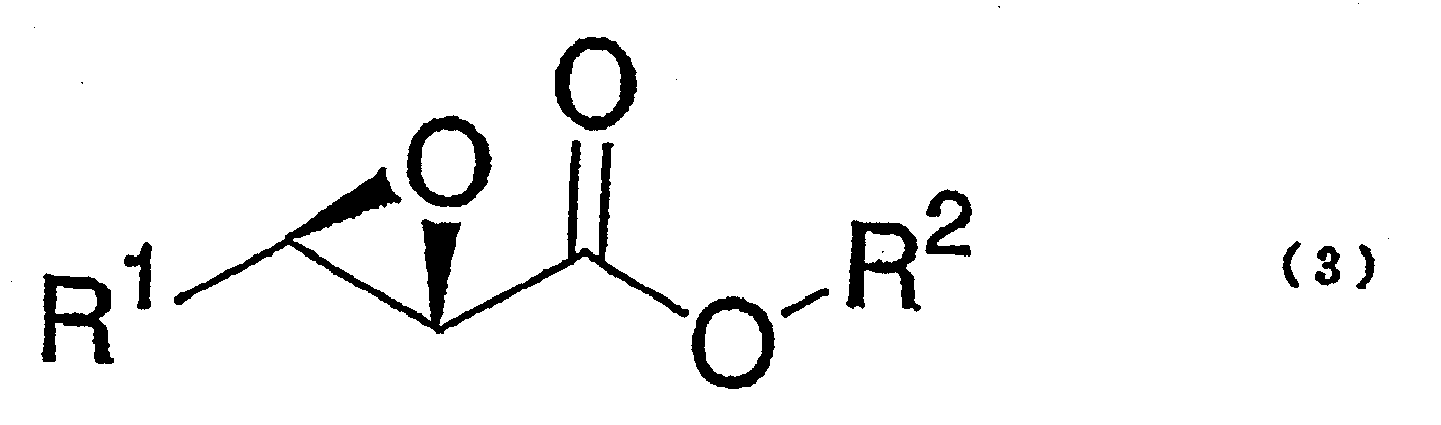
- Verfahren nach Anspruch 19, worin in der Formel (4) R1 eine Cyclohexylgruppe, eine Isopropylgruppe oder eine n-Butylgruppe bedeutet.
Applications Claiming Priority (6)
| Application Number | Priority Date | Filing Date | Title |
|---|---|---|---|
| JP2002279147 | 2002-09-25 | ||
| JP2002279148 | 2002-09-25 | ||
| JP2002279148 | 2002-09-25 | ||
| JP2002279147 | 2002-09-25 | ||
| JP2002311302 | 2002-10-25 | ||
| JP2002311302A JP2004141094A (ja) | 2002-10-25 | 2002-10-25 | 光学活性−2,3−エポキシ−3−シクロヘキシルプロピオン酸及びそのエステル類の製法 |
Publications (3)
| Publication Number | Publication Date |
|---|---|
| EP1403260A2 EP1403260A2 (de) | 2004-03-31 |
| EP1403260A3 EP1403260A3 (de) | 2004-04-14 |
| EP1403260B1 true EP1403260B1 (de) | 2007-08-08 |
Family
ID=31982150
Family Applications (1)
| Application Number | Title | Priority Date | Filing Date |
|---|---|---|---|
| EP03021540A Expired - Lifetime EP1403260B1 (de) | 2002-09-25 | 2003-09-24 | Optisch aktive Epoxyverbindungen und Verfahren zu deren Herstellung |
Country Status (3)
| Country | Link |
|---|---|
| US (1) | US7169944B2 (de) |
| EP (1) | EP1403260B1 (de) |
| DE (1) | DE60315391T2 (de) |
Families Citing this family (3)
| Publication number | Priority date | Publication date | Assignee | Title |
|---|---|---|---|---|
| CN1869002A (zh) * | 2005-05-27 | 2006-11-29 | 中国科学院上海药物研究所 | 一类非甾体雄激素受体调节剂、其制备方法和用途 |
| JP5964615B2 (ja) * | 2011-03-28 | 2016-08-03 | 住友化学株式会社 | ポジ型レジスト組成物 |
| CN103396383B (zh) * | 2013-07-30 | 2015-03-04 | 苏州大学 | 一种手性环氧化合物的制备方法 |
Family Cites Families (5)
| Publication number | Priority date | Publication date | Assignee | Title |
|---|---|---|---|---|
| DE3887048D1 (de) | 1987-09-19 | 1994-02-24 | Hoechst Ag | Flüssigkristalline, insbesondere ferroelektrische flüssigkristalline Mischungen. |
| FI95931C (fi) | 1988-09-02 | 1996-04-10 | Tanabe Seiyaku Co | Menetelmä (2R,3S)-3-(4-metoksifenyyli)glysidiinihapon alemman alkyyliesterin valmistamiseksi |
| JP3095539B2 (ja) | 1991-09-10 | 2000-10-03 | 大阪有機化学工業株式会社 | 光学活性α,β−エポキシカルボン酸およびそのエステルの製造法 |
| US6680275B2 (en) | 2000-02-23 | 2004-01-20 | Tosoh Corporation | Catalyst for asymmetric epoxidation of enones and process for producing optically active epoxide employing it |
| US6787657B2 (en) * | 2000-02-24 | 2004-09-07 | Tosoh Corporation | Optically active epoxypropionate derivative, intermediate thereof and processes for their production |
-
2003
- 2003-09-23 US US10/667,483 patent/US7169944B2/en not_active Expired - Lifetime
- 2003-09-24 DE DE60315391T patent/DE60315391T2/de not_active Expired - Lifetime
- 2003-09-24 EP EP03021540A patent/EP1403260B1/de not_active Expired - Lifetime
Also Published As
| Publication number | Publication date |
|---|---|
| DE60315391T2 (de) | 2008-04-17 |
| US7169944B2 (en) | 2007-01-30 |
| US20040063979A1 (en) | 2004-04-01 |
| EP1403260A2 (de) | 2004-03-31 |
| DE60315391D1 (de) | 2007-09-20 |
| EP1403260A3 (de) | 2004-04-14 |
Similar Documents
| Publication | Publication Date | Title |
|---|---|---|
| EP0022162B1 (de) | Verfahren zur Herstellung von disubstituierten 4-Hydroxycyclopentenonen; monosubstituierte Cyclopentendione und 4-Hydroxycyclopentenone | |
| Yamada et al. | Asymmetric Allylation of Carbonyl Compounds with Tartrate-Modified Chiral Allylic Tin Reagents. | |
| Ono et al. | Reaction of. alpha.-(phenylsulfinyl) acetonitrile with aldehydes and ketones to. gamma.-hydroxyalkenenitriles and syntheses of terpenoids | |
| US6127573A (en) | Oxidaton of primary alcohols to carboxylic acids with a TEMPO catalyst using NaClO2 and NaClO | |
| Georgiadis et al. | OXIDATIVE REARRANGEMENT OF FURYLCARBINOLS TO 6-HYDROXY-2H-PYRAN-3 (6H)-ONES, A USEFUL SYNTHON FOR THE PREPARATION OF A VARIETY OF HETEROCYCLIC COMPOUNDS, A REVIEW | |
| EA002438B1 (ru) | Способ получения производных 2-азадигидроксибицикло[2.2.1]гептана и l-виннокислой соли производного | |
| EP0095835B1 (de) | Herstellung von 4-7-Dialkoxybenzofuranen und dabei verwendete Zwischenprodukte | |
| Takano et al. | Chiral route to cis-caronaldehyde from D-mannitol | |
| DE60315391T2 (de) | Optisch aktive Epoxyverbindungen und Verfahren zu deren Herstellung | |
| US7173148B2 (en) | Process for producing 1-acetoxy-3-(substituted phenyl)propene compound | |
| Constantino et al. | An efficient synthesis of 3‐hydroxychromone using niobium pentachloride | |
| JP4534457B2 (ja) | 光学活性エポキシ化合物類、及びその製造方法 | |
| US5786518A (en) | Process for the manufacture of a gamma-halotiglic aldehyde | |
| JP2000143688A (ja) | ゼアキサンチンモノ−β−グルコシドの製造方法 | |
| EP1767532A1 (de) | Verfahren zur herstellung von fullerenderivaten | |
| US4705884A (en) | Fluorine-substituted phenyl benzoates and process for producing same | |
| US4107181A (en) | Useful prostaglandin intermediates | |
| US5011954A (en) | Epoxides and their preparation | |
| JP2009215198A (ja) | 光学活性β−フルオロメチルカルボニル誘導体の製造法 | |
| Enders et al. | Enantioselective synthesis of (S)‐(+)‐2‐tridecanol acetate, an aggregation pheromone component of Drosophila mulleri | |
| CN119798195B (zh) | 一种苯并呋喃衍生物的合成方法 | |
| EP0528694B1 (de) | Verfahren zur Herstellung von optisch aktiven 3-substituierten-2-Norbornanonen und deren Zwischenprodukte | |
| Tanaka et al. | Biomimetic Total Synthesis of (–)-Aplysistatin | |
| JPH08176053A (ja) | 3−置換−3−メチルブタナールの製造方法 | |
| KR100250838B1 (ko) | 3-(하이드록시메틸)테트라하이드로퓨란 유도체의 제조방법 |
Legal Events
| Date | Code | Title | Description |
|---|---|---|---|
| PUAI | Public reference made under article 153(3) epc to a published international application that has entered the european phase |
Free format text: ORIGINAL CODE: 0009012 |
|
| PUAL | Search report despatched |
Free format text: ORIGINAL CODE: 0009013 |
|
| AK | Designated contracting states |
Kind code of ref document: A2 Designated state(s): AT BE BG CH CY CZ DE DK EE ES FI FR GB GR HU IE IT LI LU MC NL PT RO SE SI SK TR |
|
| AX | Request for extension of the european patent |
Extension state: AL LT LV MK |
|
| AK | Designated contracting states |
Kind code of ref document: A3 Designated state(s): AT BE BG CH CY CZ DE DK EE ES FI FR GB GR HU IE IT LI LU MC NL PT RO SE SI SK TR |
|
| AX | Request for extension of the european patent |
Extension state: AL LT LV MK |
|
| 17P | Request for examination filed |
Effective date: 20040702 |
|
| 17Q | First examination report despatched |
Effective date: 20040820 |
|
| AKX | Designation fees paid |
Designated state(s): CH DE FR GB IT LI |
|
| GRAP | Despatch of communication of intention to grant a patent |
Free format text: ORIGINAL CODE: EPIDOSNIGR1 |
|
| GRAS | Grant fee paid |
Free format text: ORIGINAL CODE: EPIDOSNIGR3 |
|
| GRAA | (expected) grant |
Free format text: ORIGINAL CODE: 0009210 |
|
| AK | Designated contracting states |
Kind code of ref document: B1 Designated state(s): CH DE FR GB IT LI |
|
| REG | Reference to a national code |
Ref country code: GB Ref legal event code: FG4D |
|
| REG | Reference to a national code |
Ref country code: CH Ref legal event code: EP |
|
| REF | Corresponds to: |
Ref document number: 60315391 Country of ref document: DE Date of ref document: 20070920 Kind code of ref document: P |
|
| REG | Reference to a national code |
Ref country code: CH Ref legal event code: NV Representative=s name: NOVAGRAAF INTERNATIONAL SA |
|
| ET | Fr: translation filed | ||
| PLBE | No opposition filed within time limit |
Free format text: ORIGINAL CODE: 0009261 |
|
| STAA | Information on the status of an ep patent application or granted ep patent |
Free format text: STATUS: NO OPPOSITION FILED WITHIN TIME LIMIT |
|
| 26N | No opposition filed |
Effective date: 20080509 |
|
| PGFP | Annual fee paid to national office [announced via postgrant information from national office to epo] |
Ref country code: GB Payment date: 20090923 Year of fee payment: 7 |
|
| PGFP | Annual fee paid to national office [announced via postgrant information from national office to epo] |
Ref country code: CH Payment date: 20091006 Year of fee payment: 7 Ref country code: DE Payment date: 20090917 Year of fee payment: 7 |
|
| PGFP | Annual fee paid to national office [announced via postgrant information from national office to epo] |
Ref country code: FR Payment date: 20091012 Year of fee payment: 7 Ref country code: IT Payment date: 20090917 Year of fee payment: 7 |
|
| REG | Reference to a national code |
Ref country code: CH Ref legal event code: PL |
|
| GBPC | Gb: european patent ceased through non-payment of renewal fee |
Effective date: 20100924 |
|
| PG25 | Lapsed in a contracting state [announced via postgrant information from national office to epo] |
Ref country code: IT Free format text: LAPSE BECAUSE OF NON-PAYMENT OF DUE FEES Effective date: 20100924 |
|
| REG | Reference to a national code |
Ref country code: FR Ref legal event code: ST Effective date: 20110531 |
|
| REG | Reference to a national code |
Ref country code: DE Ref legal event code: R119 Ref document number: 60315391 Country of ref document: DE Effective date: 20110401 |
|
| PG25 | Lapsed in a contracting state [announced via postgrant information from national office to epo] |
Ref country code: LI Free format text: LAPSE BECAUSE OF NON-PAYMENT OF DUE FEES Effective date: 20100930 Ref country code: DE Free format text: LAPSE BECAUSE OF NON-PAYMENT OF DUE FEES Effective date: 20110401 Ref country code: CH Free format text: LAPSE BECAUSE OF NON-PAYMENT OF DUE FEES Effective date: 20100930 Ref country code: FR Free format text: LAPSE BECAUSE OF NON-PAYMENT OF DUE FEES Effective date: 20100930 |
|
| PG25 | Lapsed in a contracting state [announced via postgrant information from national office to epo] |
Ref country code: GB Free format text: LAPSE BECAUSE OF NON-PAYMENT OF DUE FEES Effective date: 20100924 |
|
| P01 | Opt-out of the competence of the unified patent court (upc) registered |
Effective date: 20230523 |