EP1403560A2 - Appareil et procedé de controle pour vehicules automobiles dans lequel une transmission à variation continue du type à courroie est equipé avec un dispositif de prevention du glissement de la courroie - Google Patents
Appareil et procedé de controle pour vehicules automobiles dans lequel une transmission à variation continue du type à courroie est equipé avec un dispositif de prevention du glissement de la courroie Download PDFInfo
- Publication number
- EP1403560A2 EP1403560A2 EP20030021867 EP03021867A EP1403560A2 EP 1403560 A2 EP1403560 A2 EP 1403560A2 EP 20030021867 EP20030021867 EP 20030021867 EP 03021867 A EP03021867 A EP 03021867A EP 1403560 A2 EP1403560 A2 EP 1403560A2
- Authority
- EP
- European Patent Office
- Prior art keywords
- hydraulic
- engine
- pulley
- belt
- section
- Prior art date
- Legal status (The legal status is an assumption and is not a legal conclusion. Google has not performed a legal analysis and makes no representation as to the accuracy of the status listed.)
- Granted
Links
- 230000005540 biological transmission Effects 0.000 title claims abstract description 29
- 238000000034 method Methods 0.000 title claims abstract description 14
- 230000003449 preventive effect Effects 0.000 title description 7
- 239000000446 fuel Substances 0.000 claims description 15
- 238000011084 recovery Methods 0.000 claims description 4
- 230000007246 mechanism Effects 0.000 description 6
- 238000001514 detection method Methods 0.000 description 3
- 238000010586 diagram Methods 0.000 description 3
- 239000000428 dust Substances 0.000 description 3
- 238000002347 injection Methods 0.000 description 3
- 239000007924 injection Substances 0.000 description 3
- 239000002699 waste material Substances 0.000 description 3
- 230000004913 activation Effects 0.000 description 1
- 238000004891 communication Methods 0.000 description 1
- 230000003247 decreasing effect Effects 0.000 description 1
- 230000008713 feedback mechanism Effects 0.000 description 1
- 238000012986 modification Methods 0.000 description 1
- 230000004048 modification Effects 0.000 description 1
Images



Classifications
-
- F—MECHANICAL ENGINEERING; LIGHTING; HEATING; WEAPONS; BLASTING
- F16—ENGINEERING ELEMENTS AND UNITS; GENERAL MEASURES FOR PRODUCING AND MAINTAINING EFFECTIVE FUNCTIONING OF MACHINES OR INSTALLATIONS; THERMAL INSULATION IN GENERAL
- F16H—GEARING
- F16H61/00—Control functions within control units of change-speed- or reversing-gearings for conveying rotary motion ; Control of exclusively fluid gearing, friction gearing, gearings with endless flexible members or other particular types of gearing
- F16H61/04—Smoothing ratio shift
-
- B—PERFORMING OPERATIONS; TRANSPORTING
- B60—VEHICLES IN GENERAL
- B60W—CONJOINT CONTROL OF VEHICLE SUB-UNITS OF DIFFERENT TYPE OR DIFFERENT FUNCTION; CONTROL SYSTEMS SPECIALLY ADAPTED FOR HYBRID VEHICLES; ROAD VEHICLE DRIVE CONTROL SYSTEMS FOR PURPOSES NOT RELATED TO THE CONTROL OF A PARTICULAR SUB-UNIT
- B60W10/00—Conjoint control of vehicle sub-units of different type or different function
- B60W10/04—Conjoint control of vehicle sub-units of different type or different function including control of propulsion units
- B60W10/06—Conjoint control of vehicle sub-units of different type or different function including control of propulsion units including control of combustion engines
-
- B—PERFORMING OPERATIONS; TRANSPORTING
- B60—VEHICLES IN GENERAL
- B60W—CONJOINT CONTROL OF VEHICLE SUB-UNITS OF DIFFERENT TYPE OR DIFFERENT FUNCTION; CONTROL SYSTEMS SPECIALLY ADAPTED FOR HYBRID VEHICLES; ROAD VEHICLE DRIVE CONTROL SYSTEMS FOR PURPOSES NOT RELATED TO THE CONTROL OF A PARTICULAR SUB-UNIT
- B60W10/00—Conjoint control of vehicle sub-units of different type or different function
- B60W10/10—Conjoint control of vehicle sub-units of different type or different function including control of change-speed gearings
- B60W10/101—Infinitely variable gearings
- B60W10/107—Infinitely variable gearings with endless flexible members
-
- B—PERFORMING OPERATIONS; TRANSPORTING
- B60—VEHICLES IN GENERAL
- B60W—CONJOINT CONTROL OF VEHICLE SUB-UNITS OF DIFFERENT TYPE OR DIFFERENT FUNCTION; CONTROL SYSTEMS SPECIALLY ADAPTED FOR HYBRID VEHICLES; ROAD VEHICLE DRIVE CONTROL SYSTEMS FOR PURPOSES NOT RELATED TO THE CONTROL OF A PARTICULAR SUB-UNIT
- B60W30/00—Purposes of road vehicle drive control systems not related to the control of a particular sub-unit, e.g. of systems using conjoint control of vehicle sub-units
- B60W30/18—Propelling the vehicle
- B60W30/188—Controlling power parameters of the driveline, e.g. determining the required power
-
- F—MECHANICAL ENGINEERING; LIGHTING; HEATING; WEAPONS; BLASTING
- F16—ENGINEERING ELEMENTS AND UNITS; GENERAL MEASURES FOR PRODUCING AND MAINTAINING EFFECTIVE FUNCTIONING OF MACHINES OR INSTALLATIONS; THERMAL INSULATION IN GENERAL
- F16H—GEARING
- F16H61/00—Control functions within control units of change-speed- or reversing-gearings for conveying rotary motion ; Control of exclusively fluid gearing, friction gearing, gearings with endless flexible members or other particular types of gearing
- F16H61/66—Control functions within control units of change-speed- or reversing-gearings for conveying rotary motion ; Control of exclusively fluid gearing, friction gearing, gearings with endless flexible members or other particular types of gearing specially adapted for continuously variable gearings
- F16H61/662—Control functions within control units of change-speed- or reversing-gearings for conveying rotary motion ; Control of exclusively fluid gearing, friction gearing, gearings with endless flexible members or other particular types of gearing specially adapted for continuously variable gearings with endless flexible members
- F16H61/66272—Control functions within control units of change-speed- or reversing-gearings for conveying rotary motion ; Control of exclusively fluid gearing, friction gearing, gearings with endless flexible members or other particular types of gearing specially adapted for continuously variable gearings with endless flexible members characterised by means for controlling the torque transmitting capability of the gearing
-
- F—MECHANICAL ENGINEERING; LIGHTING; HEATING; WEAPONS; BLASTING
- F16—ENGINEERING ELEMENTS AND UNITS; GENERAL MEASURES FOR PRODUCING AND MAINTAINING EFFECTIVE FUNCTIONING OF MACHINES OR INSTALLATIONS; THERMAL INSULATION IN GENERAL
- F16H—GEARING
- F16H2312/00—Driving activities
- F16H2312/14—Going to, or coming from standby operation, e.g. for engine start-stop operation at traffic lights
Definitions
- the present invention relates to shift hydraulic system of a belt-type continuously variable transmission. More particularly, the present invention relates to control apparatus and method for preventing an occurrence of a belt slip of the belt-type continuously variable transmission (so called, CVT).
- CVT continuously variable transmission
- a Japanese Patent Application First Publication No. Heisei 9-250370 published on September 22, 1997 exemplifies a previously proposed shift hydraulic system for a belt-type continuously variable transmission.
- a technique to prevent an excessive rise in the line pressure is disclosed. That is to say, if the electromagnetic hydraulic control valve has failed, the hydraulic valve becomes an open state such that the hydraulic of an oil pump is disabled to be drained and an excessive rise in the line pressure causes a clamp pressure to clamp a belt of the continuously variable transmission to be excessively high.
- the frictional load of the belt becomes large, a fuel consumption becomes wasteful, and a durability of the belt becomes worsened.
- the valve constituting the electromagnetic hydraulic control valve becomes sticky due to a clogging of the waste or dust so that the line pressure becomes lowered. If the line pressure is lowered, the clamp pressure for the belt is not sufficiently supplied. Thus, a slip of the belt occurs. The durability of the belt becomes reduced. Especially, when the vehicle is started, the large torque is inputted. On the contrary, there is a possibility that the belt slips when an engine speed is slow and the line pressure becomes lowered.
- an object of the present invention to provide control apparatus and method for the belt continuously variable transmission associated with an engine which are capable of preventing the occurrence of the belt slip and improving the durability of the belt even if the waste or dust is invaded into the hydraulic circuit to reduce the line pressure.
- a control apparatus for an automotive vehicle comprising: a continuously variable transmission associated with a vehicular engine and including a belt that transmits a revolution of a primary pulley to a secondary pulley that is enabled to make a gear shift by modifying a pulley ratio between the primary and secondary pulleys with a hydraulic; a belt slip determining section that determines if a slip between at least one of the primary and the secondary pulleys occurs; and an output section that outputs a signal to command an engine control unit to increase an engine speed by a predetermined engine speed when the belt slip determining section determines that the slip therebetween occurs.
- a control apparatus for an automotive vehicle comprising: an engine control unit; an oil pump driven by an engine; a continuously variable transmission associated with a vehicular engine and including a belt that transmits a revolution of a primary pulley to a secondary pulley that is enabled to make a gear shift by modifying a pulley ratio between the primary and secondary pulleys with a hydraulic, continuously variable transmission including a belt to transmit a revolution of a primary pulley to a secondary pulley driven by a revolution of the engine; an original hydraulic supplying section that supplies an original hydraulic of a control hydraulic to control the pulley ratio with the oil pump as a hydraulic source; a gear shift actuator that supplies an original hydraulic for the control hydraulic that controls a pulley ratio with the oil pump as a hydraulic source; a gear shift actuator that supplies the control hydraulic to each pulley; and a gear shift controlling section that outputs a control command to the gear shift actuator; and an original hydraulic determining section that determines whether the original
- a control method for an automotive vehicle comprising: a continuously variable transmission associated with a vehicular engine and including a belt that transmits a revolution of a primary pulley to a secondary pulley that is enabled to make a gear shift by modifying a pulley ratio between the primary and secondary pulleys with a hydraulic, and the method comprising: a belt slip determining section that determines if a belt slip between at least one of the primary and the secondary pulleys occurs; and outputting a signal to command an engine control unit to increase an engine speed by a predetermined engine speed at a time of determining that the slip therebetween occurs.
- Fig. 1 is a circuit block diagram of an essential unit of a vehicle equipped with a belt continuously variable transmission to which a control apparatus for the belt continuously variable transmission is applicable.
- Fig. 2 is a hydraulic circuit block diagram of the control apparatus shown in Fig. 1.
- Fig. 3 is an operational flowchart representing a belt slip detection control procedure in the first embodiment of the control apparatus for the belt continuously variable transmission.
- Fig. 4 is an operational flowchart representing a belt slip preventive control procedure in the first embodiment shown in Fig. 1.
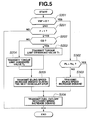
- Fig. 5 is an operational flowchart representing a belt slip detection and preventive control procedure in a second preferred embodiment of the control apparatus according to the present invention.
- Fig. 6 is an operational flowchart representing a belt slip preventive procedure in a third preferred embodiment of the control apparatus in a third preferred embodiment according to the present invention.
- Fig. 1 shows a control system of an engine and a belt(-type) continuously variable transmission 3 (hereinafter, described as CVT) to which a first preferred embodiment of a control apparatus according to the present invention is applicable.
- CVT continuously variable transmission 3
- Reference numeral 1 denotes a torque converter
- reference numeral 2 denotes a lock-up clutch
- reference numeral 3 denotes a CVT (Continuously Variable Transmission)
- reference numeral 4 denotes a primary pulley revolution speed sensor
- reference numeral 5 denotes a secondary pulley revolution speed sensor
- reference numeral 6 denotes a hydraulic control valve unit
- reference numeral 8 denotes an oil pump driven with an engine
- reference numeral 9 denotes a CVT control unit
- reference numeral 10 denotes an accelerator opening angle sensor
- reference numeral 11 denotes an oil temperature sensor
- reference numeral 18 denotes an engine
- reference numeral 19 denotes an engine control unit (hereinafter, also abbreviated as ECU)
- reference numeral 16 denotes an engine speed sensor
- a reference numeral 17 denotes a throttle valve opening angle sensor.
- Engine 18 is provided with a plurality of fuel injectors to inject fuel and with an electronically controlled throttle valve which is operated in response to a command of an electronically driven actuator.
- ECU 21 outputs a command to inject fuel to each fuel injector and a command to open an angle to electronically controlled throttle valve.
- ECU 21 basically receives signals from engine speed sensor 16 detecting the engine speed Ne, from accelerator opening angle sensor 10 to detect a manipulated variable of an accelerator pedal by a vehicle driver, and from throttle opening angle sensor 17 to detect a throttle opening angle TVO corresponding to an engine load and outputs commands such as to command engine 18 to control an engine output torque, to command engine 18 to control an idling speed of engine 18 during a vehicle stop, and to command engine 18 to control a fuel cut-off to improve a fuel economy by cutting off the fuel injection until an engine speed Ne is reduced to a predetermined engine speed during a vehicular deceleration.
- Torque converter 1 is linked to an engine output axle as a revolution transmission mechanism and lock-up clutch 2 is disposed to directly couple engine 18 to CVT 3.
- An output end of torque converter 1 is linked to a ring gear 21 of forward-and-rearward switching mechanism 20.
- Forward-and-rearward switching mechanism 20 is constituted by a planetary gear mechanism having a ring gear 21 linked to an engine output axle 12, a pinion carrier 22, and a sun gear 23 linked to an input axle 13 of the transmission.
- Pinion carrier 22 is provided with a backward drive brake 24 to fix pinion carrier 22 to a transmission casing and a forward drive clutch 25 to integrally link input axle 13 of the transmission and the pinion carrier 22.
- Primary pulley 30a of CVT 3 is disposed on an end of transmission input axle 13.
- CVT 3 is constituted by primary pulley 30a, secondary pulley 30b, and a belt 34 which transmits a revolution force of primary pulley 30a to a secondary pulley 30b.
- Primary pulley 30a includes a fixed truncated cone shaped plate 31, and a movable truncated cone shaped plate 32 which is movable in an axial direction of the input axle 13 of transmission by means of a hydraulic acted upon a primary pulley cylinder chamber 33, a letter V-shaped pulley groove being formed together with an oppositely arranged fixed truncated cone shaped plate 31.
- a secondary pulley 30b is disposed on a driven axle 38.
- Secondary pulley 30b includes a fixed truncated cone shaped plate 35 integrally revolved to driven axle 38 and a movable truncated cone shaped plate 36 which is formed with a letter V-shaped pulley groove together with the opposing fixed truncated cone plate 35 is movable in the axial direction of driven axle 38 by means of the hydraulic acted upon a secondary pulley cylinder chamber 37.
- a drive gear (not shown) is fixed onto driven axle 38 and drive gear drives a drive shaft from pinion disposed on an idler axle, a final gear, and differential mechanism to the road wheels (not shown).
- the revolving force inputted from engine output axle 12 to CVT 3 is transmitted to CVT 3 via torque converter 1 and forward-and-rearward switching mechanism 20.
- the revolving force of transmission input axle 13 is transmitted to a differential gear unit via primary pulley 30a, belt 34, secondary pulley 30b, a driven axle 38, drive gear, an idler gear, an idler axle, a pinion, and a final gear.
- a contact position radius of belt 34 is varied by displacing the contact position radius by moving movable truncated cone plate 36 in the axial direction and the movable truncated cone plate 32 of primary pulley 30a in the axial direction.
- a revolution ratio viz., a gear ratio between primary pulley 30a and secondary pulley 30b can be changed.
- Such a control as a V-shaped pulley groove width described above is carried out by means of the hydraulic control via CVT control unit 9 to be supplied to primary pulley cylinder chamber 33 or secondary pulley cylinder chamber 37.
- CVT control unit 9 receives primary revolution speed Npri from primary pulley revolution speed sensor 4, a secondary pulley revolution speed N SEC from secondary pulley revolution speed sensor 5, a primary pulley pressure Ppri from primary pressure sensor 14, and a secondary pulley Psec from secondary pressure sensor 15. In addition, CVT control unit 9 is communicated with ECU 21 to transmit and receive each sensor value information therebetween. Based on these input signals control signals are calculated. Control signals are outputted to hydraulic control valve units 6.
- Hydraulic control valve unit 6 drives respective electronic control valves and stepping motor 54 as will be described later on the basis of the control signals calculated in CVT control unit 9.
- the shift control is carried out by supplying a control pressure to primary pulley cylinder chamber 33 and secondary pulley cylinder chamber 37.
- Fig. 2 shows a circuit block diagram representing the hydraulic circuit of the belt (type) continuously variable transmission in the first embodiment according to the present invention.
- reference numeral 40 denotes a pressure regulator valve to adjust a delivery pressure of an oil pump 8 supplied from an oil passage 41 as a line pressure (viz., a pulley clamp pressure).
- An oil passage 42 is communicated with an oil passage 41.
- Oil passage 42 is connected to a shift control valve 50 which supplied a control hydraulic to primary pulley cylinder chamber 33 of CVT 3.
- a pulley pressure supply oil passage 48 which supplies a clamp pressure to clamp belt 34 is connected to secondary pulley cylinder.
- oil passage 43 connected to oil passage 42 supplies an original pressure of a pilot valve 55.
- Shift control valve 50 includes a suction port 50a connected to oil passage 42, a supply port 50b which supplies the hydraulic with primary pulley cylinder 33, a drain port 50c which drains the hydraulic, and a link 52 to which a stepping motor (S/M) 54 which is operated in response to a control signal from CVT control unit 9.
- Shift control valve 50 constitutes a mechanical feedback mechanism. An activation of stepping motor 52 moves spool 50d. When the hydraulic is supplied to primary pulley cylinder chamber 33, a variation in a gear (shift) ratio causes movable pulley (secondary pulley) to be moved. This movement drives spool 50d in a direction opposite to the drive of stepping motor 54 so that the supply of hydraulic is stopped.
- Hydraulic drained from pressure regulator valve 40 is supplied to a clutch regulator valve 60 via an oil passage 46.
- a clutch regulator valve 60 adjusts the hydraulic lower than that developed by pressure regulator valve 40 so that the hydraulic supplied as a clutch pressure of a forward clutch 25 is not higher than a pulley clamp pressure.
- This oil passage 46 is communicated with oil passage 42 and with an orifice 45.
- Clutch regulator valve 60 adjusts the hydraulic in oil passage 46 and oil passage 61.
- the hydraulic of oil passage 61 is supplied to a select switching valve 80 and select control valve 90.
- Pilot valve 55 sets a constant supply pressure to a lock-up solenoid 71 to a select switching solenoid 70.
- An output pressure of select switching solenoid 70 is supplied from oil passage 73 to select switching valve 80 to control an operation of a select switching valve 80.
- An output pressure of lock-up solenoid 71 is supplied from oil passage 72 to select switching valve 80.
- Select switching valve 80 is operated by select switching solenoid 70.
- An oil passage 72 which supplies a signal pressure from lock-up solenoid 71 is connected as an input port of select switching valve 80, an oil passage 61 at which clutch regulator valve 60 serves to adjust the hydraulic is connected to the select switching valve 80, and.an oil passage 93 at which select control valve 90 serves to adjust the hydraulic is connected to select switching valve 80.
- An oil passage 83 to supply the hydraulic to operate a spool 92 of a select control valve 90 is connected to select switching valve 80.
- a drain oil passage 84 to drain the hydraulic is connected to select switching valve 80.
- Select control valve 90 is operated by means of lock-up solenoid 71 supplied from hydraulic passage 83.
- a hydraulic passage 62 at which the hydraulic is adjusted by means of clutch regulator valve 60 is connected to an input port of select control valve 90.
- An oil passage 83 to supply a signal pressure of lock-up solenoid 71 is connected to select control valve 90. Then, a control over a communication state between the oil passage 62 and the oil passage 93 causes the hydraulic to be adjusted.
- Fig. 3 shows an operational flowchart representing a belt slip detection control procedure executed in the first embodiment of the control apparatus.
- CVT control unit 9 determines whether engine speed Ne is higher than a predetermined engine speed Ne1. If Ne > Ne1 (Yes) at step S101, the routine goes to a step S102. That is to say, in a case where the hydraulic is not secured irrespective of the drive of the engine, there is a possibility of failure in the hydraulic circuit.
- step S102 CVT control unit 9 determines whether a difference (P* sec - P 1 ) between a target secondary pulley cylinder hydraulic P*sec and a first set hydraulic P 1 (for example, 0.05 MPa) is larger than a (second) set hydraulic P 0 (for example, 1 MPa).
- step S103 CVT control unit 9 sets (P*sec - P 1 ) as a set value Pmin.
- step S104 CVT control unit 9 sets the set value to Pmin.
- step S102 through S104 CVT control unit 9 selects set value Pmin to determine if a difference between a target secondary pulley hydraulic P*sec and an actual secondary pulley hydraulic Psec is too large.
- CVT control unit 9 determines whether a difference between target secondary pulley hydraulic P*sec and actual secondary pulley hydraulic Psec is larger than set value Pmin, CVT control unit 9 can determine that the hydraulic is sufficiently secured.
- step S107 If G ⁇ G 0 (No) at step S107, the routine goes to step S111. That is to say, if the secondary pulley is not almost revolved against the revolution of the primary pulley, CVT control unit 9 can determine that the belt is being slipped. At step S108, a belt slip (occurrence) flag F is set to " 1 ". At step S111, a belt slip (occurrence) flag F is reset.
- Fig. 4 shows an operational flowchart representing a belt slip preventive control when the belt slip is detected.
- CVT control unit 9 determines if CVT falls in an overdrive mode (OD, namely, the shift ratio control is small). If OD (Yes) at step S202, the routine goes to a step S203. If Not, the routine goes to a step S204.
- CVT control unit 9 transmits a torque limitation demanded value T1 to ECU 31.
- CVT control unit 9 transmits a torque limitation demanded value T2 to ECU 31. It is noted that T1 > T2. That is to say, since, when the gear ratio is small, no deceleration is carried out (or a speed increase side), a torque applied to the secondary pulley is small and even if an upper limit of the input torque is made higher, the belt is not easy to be slipped. While securing a smooth running ability, the belt slip can be prevented. On the other hand, when the gear (shift) ratio is large, the deceleration occurs. The torque applied to the secondary pulley becomes large.
- CVT control unit 9 transmits to ECU 31 a fuel cut-off recovery speed increase demand signal which indicates a resumption of fuel injection when the engine speed is decreased by a predetermined speed. That is to say, if the engine idling speed is increased, there is a possibility that the fuel injection is resumed at an engine speed lower than the idling speed. Hence, an engine stability may occur.
- the idling speed is 550 rpm and the fuel cut-off recovery engine speed is 1200 rpm
- the idling speed is increased to 750 rpm.
- fuel cut-off recovery speed is also increased from 1200 rpm to 1350 rpm.
- VSP the velocity of the vehicle in which the control apparatus according to the present invention is mounted
- step S201 The contents of step S201 has been described.
- CVT control unit 9 determines whether a line pressure P L is larger than a predetermined line pressure P PL . If P L > P PL (Yes) at step S302, the routine is ended. If P L ⁇ P PL (No) at step S302, CVT control unit 9 transmits an idle speed increase demand ECU 31 to increase the present engine idle speed. That is to say, if line pressure PL during the vehicle stop is smaller than predetermined line pressure P PL , there is a possibility of the belt slip. Immediately, the idle speed is raised. It is possible to secure the line pressure. Then, the belt slip during the vehicular stop can be prevented.
- a third preferred embodiment of the control apparatus will be described.
- the basic structure of the third embodiment is generally the same or described in the first embodiment.
- the difference points will be described below.
- Fig. 6 shows an operational flowchart representing the belt slip preventive control when the belt slip is detected. Steps S201 through S206 are generally the same as those described in the first embodiment. The difference points will only be described below.
- CVT control unit 9 determines if the vehicle speed VSP, viz., the vehicle is stopped.
- the line pressure at the idling speed during the vehicular stop is equal to or smaller than the predetermined line pressure and the belt slip is determined to occur under a state in which the torque during the vehicular start is largely applied, the idling speed at the next vehicular stop is increased. Hence, it is not necessary to increase the idle speed with no belt slip. While preventing the belt slip, the fuel consumption can be improved.
Landscapes
- Engineering & Computer Science (AREA)
- Mechanical Engineering (AREA)
- Chemical & Material Sciences (AREA)
- Combustion & Propulsion (AREA)
- Transportation (AREA)
- General Engineering & Computer Science (AREA)
- Automation & Control Theory (AREA)
- Control Of Transmission Device (AREA)
- Combined Controls Of Internal Combustion Engines (AREA)
- Control Of Vehicle Engines Or Engines For Specific Uses (AREA)
Applications Claiming Priority (2)
| Application Number | Priority Date | Filing Date | Title |
|---|---|---|---|
| JP2002280749A JP3731746B2 (ja) | 2002-09-26 | 2002-09-26 | エンジン及びベルト式無段変速機の制御装置 |
| JP2002280749 | 2002-09-26 |
Publications (3)
| Publication Number | Publication Date |
|---|---|
| EP1403560A2 true EP1403560A2 (fr) | 2004-03-31 |
| EP1403560A3 EP1403560A3 (fr) | 2009-08-12 |
| EP1403560B1 EP1403560B1 (fr) | 2012-04-18 |
Family
ID=31973301
Family Applications (1)
| Application Number | Title | Priority Date | Filing Date |
|---|---|---|---|
| EP03021867A Expired - Lifetime EP1403560B1 (fr) | 2002-09-26 | 2003-09-26 | Appareil et procedé de controle pour vehicules automobiles dans lequel une transmission à variation continue du type à courroie est equipé avec un dispositif de prevention du glissement de la courroie |
Country Status (4)
| Country | Link |
|---|---|
| US (1) | US7192383B2 (fr) |
| EP (1) | EP1403560B1 (fr) |
| JP (1) | JP3731746B2 (fr) |
| KR (1) | KR100568049B1 (fr) |
Cited By (7)
| Publication number | Priority date | Publication date | Assignee | Title |
|---|---|---|---|---|
| EP1780448A3 (fr) * | 2005-10-31 | 2010-06-02 | JATCO Ltd | Dispositif de commande pour transmission à variation continue de véhicule |
| US7774120B2 (en) | 2005-10-31 | 2010-08-10 | Jatco Ltd | Control apparatus for continuously-variable transmission of vehicle |
| WO2012171518A1 (fr) * | 2011-06-14 | 2012-12-20 | Schaeffler Technologies AG & Co. KG | Véhicule à moteur et procédé pour faire fonctionner un véhicule à moteur |
| RU2491180C2 (ru) * | 2007-10-31 | 2013-08-27 | Дир Энд Компани | Рабочая машина с регулированием, ограничивающим крутящий момент бесступенчатой трансмиссии |
| EP3115649A4 (fr) * | 2014-03-03 | 2017-06-21 | Jatco Ltd | Dispositif de commande de transmission à variation continue de véhicule |
| EP3115652A4 (fr) * | 2014-03-03 | 2017-06-21 | Jatco Ltd | Dispositif de commande pour transmission variable en continu destinée à être utilisée dans des véhicules |
| CN107795651A (zh) * | 2016-09-06 | 2018-03-13 | 通用汽车环球科技运作有限责任公司 | 无级变速器以及控制高转矩事件的系统和方法 |
Families Citing this family (14)
| Publication number | Priority date | Publication date | Assignee | Title |
|---|---|---|---|---|
| JP2007232147A (ja) * | 2006-03-02 | 2007-09-13 | Yamaha Motor Co Ltd | 車両 |
| US7556120B2 (en) * | 2006-05-25 | 2009-07-07 | Gm Global Technology Operations, Inc. | Method and apparatus to control hydraulic pressure in an electro-mechanical transmission |
| JP4344378B2 (ja) * | 2006-11-28 | 2009-10-14 | ジヤトコ株式会社 | ベルト式無段変速機の油圧制御装置 |
| US8062169B2 (en) * | 2007-04-30 | 2011-11-22 | Caterpillar Inc. | System for controlling a hybrid energy system |
| JP2009191925A (ja) * | 2008-02-13 | 2009-08-27 | Toyota Motor Corp | ベルト挟圧力調節機構診断装置 |
| JP5527873B2 (ja) | 2009-03-18 | 2014-06-25 | 株式会社エフ・シー・シー | 動力伝達装置 |
| JP5398317B2 (ja) * | 2009-03-18 | 2014-01-29 | 株式会社エフ・シー・シー | 動力伝達装置 |
| JP5592335B2 (ja) * | 2011-11-04 | 2014-09-17 | 本田技研工業株式会社 | 可変容量ポンプの部分容量運転状態固着判定装置 |
| CN105556181B (zh) * | 2013-11-22 | 2017-07-21 | 加特可株式会社 | 无级变速器的控制装置 |
| GB2524023B (en) * | 2014-03-11 | 2017-10-18 | Ford Global Tech Llc | Belt slip monitor |
| CN115419693A (zh) | 2017-01-20 | 2022-12-02 | 北极星工业有限公司 | 车辆的车辆诊断方法 |
| JP6622831B2 (ja) * | 2018-03-07 | 2019-12-18 | 株式会社Subaru | 変速機の制御装置および変速機の制御方法 |
| JP6754415B2 (ja) | 2018-11-16 | 2020-09-09 | 本田技研工業株式会社 | 車両制御装置、車両及び車両制御方法 |
| CN115917187B (zh) * | 2020-11-02 | 2025-05-02 | 加特可株式会社 | 带轮压控制阀的阻尼压供给回路 |
Family Cites Families (18)
| Publication number | Priority date | Publication date | Assignee | Title |
|---|---|---|---|---|
| US4458318A (en) * | 1981-04-24 | 1984-07-03 | Borg-Warner Corporation | Control arrangement for a variable pulley transmission |
| JPH0341252A (ja) * | 1989-07-06 | 1991-02-21 | Mazda Motor Corp | 無段変速機を備えた車両の制御装置 |
| JP2950872B2 (ja) | 1989-12-09 | 1999-09-20 | 富士重工業株式会社 | 無段変速機の制御装置 |
| WO1992018791A1 (fr) * | 1991-04-19 | 1992-10-29 | Kumm Industries, Inc. | Transmission variable en continu et a regeneration de couple |
| JP2722856B2 (ja) * | 1991-05-30 | 1998-03-09 | 日産自動車株式会社 | 内燃機関のアイドル回転制御装置 |
| US5259272A (en) * | 1991-09-27 | 1993-11-09 | Mitsubishi Denki K.K. | Control device for continuously variable transmission for vehicles and method of controlling the same |
| JPH0611022A (ja) | 1992-06-23 | 1994-01-21 | Hitachi Ltd | Vベルト式無段階変速装置の制御方法及びその制御装置 |
| US5310384A (en) * | 1993-03-29 | 1994-05-10 | Borg-Warner Automotive, Inc. | Continuously variable transmission belt ratio measurement system |
| JPH08285021A (ja) * | 1995-04-10 | 1996-11-01 | Unisia Jecs Corp | 無段変速機の制御装置 |
| JP3116808B2 (ja) | 1996-03-18 | 2000-12-11 | 日産自動車株式会社 | 無段変速機のフェイルセーフ制御装置 |
| DE19712451A1 (de) * | 1997-03-25 | 1998-10-01 | Bosch Gmbh Robert | Vorrichtung und Verfahren zur Steuerung eines CVT bei einem Kraftfahrzeug |
| DE60010182T2 (de) * | 1999-07-21 | 2005-05-04 | Honda Giken Kogyo K.K. | Vorrichtung zur Steuerung einer Startkupplung in einem Fahrzeug mit Motorstoppfunktion im Leerlauf |
| JP2001047880A (ja) | 1999-08-05 | 2001-02-20 | Fuji Heavy Ind Ltd | ハイブリッド車の制御装置 |
| JP3750488B2 (ja) | 2000-05-23 | 2006-03-01 | トヨタ自動車株式会社 | 車両用無段変速機の制御装置 |
| JP3855599B2 (ja) | 2000-05-23 | 2006-12-13 | トヨタ自動車株式会社 | 車両用無段変速機の制御装置 |
| JP4378844B2 (ja) * | 2000-05-23 | 2009-12-09 | トヨタ自動車株式会社 | 車両駆動装置 |
| JP4445119B2 (ja) * | 2000-11-01 | 2010-04-07 | 三菱電機株式会社 | 車両用無段変速機のライン圧制御装置。 |
| JP2003214533A (ja) * | 2002-01-22 | 2003-07-30 | Nissan Motor Co Ltd | Vベルト式無段変速機のスリップ防止装置 |
-
2002
- 2002-09-26 JP JP2002280749A patent/JP3731746B2/ja not_active Expired - Lifetime
-
2003
- 2003-09-04 KR KR1020030061615A patent/KR100568049B1/ko not_active Expired - Fee Related
- 2003-09-25 US US10/669,711 patent/US7192383B2/en not_active Expired - Lifetime
- 2003-09-26 EP EP03021867A patent/EP1403560B1/fr not_active Expired - Lifetime
Non-Patent Citations (1)
| Title |
|---|
| None |
Cited By (11)
| Publication number | Priority date | Publication date | Assignee | Title |
|---|---|---|---|---|
| EP1780448A3 (fr) * | 2005-10-31 | 2010-06-02 | JATCO Ltd | Dispositif de commande pour transmission à variation continue de véhicule |
| US7774120B2 (en) | 2005-10-31 | 2010-08-10 | Jatco Ltd | Control apparatus for continuously-variable transmission of vehicle |
| US8133140B2 (en) | 2005-10-31 | 2012-03-13 | Jatco Ltd | Control apparatus for continuously-variable transmission of vehicle |
| RU2491180C2 (ru) * | 2007-10-31 | 2013-08-27 | Дир Энд Компани | Рабочая машина с регулированием, ограничивающим крутящий момент бесступенчатой трансмиссии |
| WO2012171518A1 (fr) * | 2011-06-14 | 2012-12-20 | Schaeffler Technologies AG & Co. KG | Véhicule à moteur et procédé pour faire fonctionner un véhicule à moteur |
| EP3115649A4 (fr) * | 2014-03-03 | 2017-06-21 | Jatco Ltd | Dispositif de commande de transmission à variation continue de véhicule |
| EP3115652A4 (fr) * | 2014-03-03 | 2017-06-21 | Jatco Ltd | Dispositif de commande pour transmission variable en continu destinée à être utilisée dans des véhicules |
| US10119611B2 (en) | 2014-03-03 | 2018-11-06 | Jatco Ltd | Vehicle stepless transmission control device |
| US10247304B2 (en) | 2014-03-03 | 2019-04-02 | Jatco Ltd | Control device for continuously variable transmission for use in vehicles |
| CN107795651A (zh) * | 2016-09-06 | 2018-03-13 | 通用汽车环球科技运作有限责任公司 | 无级变速器以及控制高转矩事件的系统和方法 |
| CN107795651B (zh) * | 2016-09-06 | 2020-07-17 | 通用汽车环球科技运作有限责任公司 | 无级变速器以及控制高转矩事件的系统和方法 |
Also Published As
| Publication number | Publication date |
|---|---|
| JP3731746B2 (ja) | 2006-01-05 |
| EP1403560A3 (fr) | 2009-08-12 |
| KR20040027317A (ko) | 2004-04-01 |
| JP2004116392A (ja) | 2004-04-15 |
| US20040063537A1 (en) | 2004-04-01 |
| KR100568049B1 (ko) | 2006-04-07 |
| EP1403560B1 (fr) | 2012-04-18 |
| US7192383B2 (en) | 2007-03-20 |
Similar Documents
| Publication | Publication Date | Title |
|---|---|---|
| US7192383B2 (en) | Control apparatus and method for automotive vehicle in which a belt-type continuously variable transmission is equipped with a belt slip preventive feature | |
| US7993225B2 (en) | Hydraulic pressure supply unit of continuously variable transmission | |
| EP2160530B1 (fr) | Appareil de commande d'embrayage de verrouillage | |
| US8825318B2 (en) | Control device and control method for automatic transmission | |
| US6719664B2 (en) | Control apparatus of lock-up clutch for vehicle and control method thereof | |
| US6923158B2 (en) | Engine torque control apparatus | |
| US20100145584A1 (en) | Lock-up clutch control device | |
| US7654935B2 (en) | Shift control system and shift control method for continuously variable transmission | |
| US7029410B2 (en) | System for preventing belt slip of belt-type continuously variable transmission | |
| EP1403561A2 (fr) | Dispostif et méthode de commande d'une transmission automatique | |
| US7179196B2 (en) | Input torque control system of belt-type continuously variable transmission for vehicle | |
| US7140991B2 (en) | Shift control system, and control apparatus and method for belt-type continuously variable transmission | |
| US8849524B2 (en) | Vehicular shift control apparatus | |
| EP1355089B1 (fr) | Système de commande hydraulique pour une transmission automatique | |
| US7651422B2 (en) | Shift control system in belt-type continuously variable transmission | |
| US7510501B2 (en) | Hydraulic control system of belt-type continuously variable transmission for vehicle | |
| EP2053281A2 (fr) | Appareil de contrôle de véhicule | |
| US7957872B2 (en) | Shift control apparatus of a continuously variable transmission and method of determining whether shift control apparatus is operating normally | |
| US6889653B2 (en) | Engine torque control apparatus | |
| US11077852B2 (en) | Shift control device and shift control method for vehicle | |
| JP2010210026A (ja) | 無段変速機の制御装置 | |
| JP2004124968A (ja) | ベルト式無段変速機の制御装置 |
Legal Events
| Date | Code | Title | Description |
|---|---|---|---|
| PUAI | Public reference made under article 153(3) epc to a published international application that has entered the european phase |
Free format text: ORIGINAL CODE: 0009012 |
|
| 17P | Request for examination filed |
Effective date: 20030926 |
|
| AK | Designated contracting states |
Kind code of ref document: A2 Designated state(s): AT BE BG CH CY CZ DE DK EE ES FI FR GB GR HU IE IT LI LU MC NL PT RO SE SI SK TR |
|
| AX | Request for extension of the european patent |
Extension state: AL LT LV MK |
|
| PUAL | Search report despatched |
Free format text: ORIGINAL CODE: 0009013 |
|
| AK | Designated contracting states |
Kind code of ref document: A3 Designated state(s): AT BE BG CH CY CZ DE DK EE ES FI FR GB GR HU IE IT LI LU MC NL PT RO SE SI SK TR |
|
| AX | Request for extension of the european patent |
Extension state: AL LT LV MK |
|
| 17Q | First examination report despatched |
Effective date: 20091023 |
|
| AKX | Designation fees paid |
Designated state(s): DE FR GB |
|
| GRAP | Despatch of communication of intention to grant a patent |
Free format text: ORIGINAL CODE: EPIDOSNIGR1 |
|
| RIN1 | Information on inventor provided before grant (corrected) |
Inventor name: SHIMADA, TETSUYA Inventor name: KODAMA, YOSHIHISAC/O JATCO LTD Inventor name: INOUE, TAKUICHIROC/O JATCO LTD Inventor name: GOTOU, KENICHI Inventor name: WAKAHARA, TATSUOC/O JATCO LTD Inventor name: YAMAMOTO, MASAHIROC/O JATCO LTD Inventor name: NOBU, HISAOC/O JATCO LTD Inventor name: SHIMANAKA, SHIGEKIC/O JATCO LTD Inventor name: TANAKA, HIROYASUC/O JATCO LTD Inventor name: IRIYAMA, MASAHIRO |
|
| GRAS | Grant fee paid |
Free format text: ORIGINAL CODE: EPIDOSNIGR3 |
|
| GRAA | (expected) grant |
Free format text: ORIGINAL CODE: 0009210 |
|
| AK | Designated contracting states |
Kind code of ref document: B1 Designated state(s): DE FR GB |
|
| REG | Reference to a national code |
Ref country code: GB Ref legal event code: FG4D |
|
| REG | Reference to a national code |
Ref country code: DE Ref legal event code: R096 Ref document number: 60340625 Country of ref document: DE Effective date: 20120614 |
|
| PLBE | No opposition filed within time limit |
Free format text: ORIGINAL CODE: 0009261 |
|
| STAA | Information on the status of an ep patent application or granted ep patent |
Free format text: STATUS: NO OPPOSITION FILED WITHIN TIME LIMIT |
|
| 26N | No opposition filed |
Effective date: 20130121 |
|
| REG | Reference to a national code |
Ref country code: DE Ref legal event code: R097 Ref document number: 60340625 Country of ref document: DE Effective date: 20130121 |
|
| GBPC | Gb: european patent ceased through non-payment of renewal fee |
Effective date: 20120926 |
|
| PG25 | Lapsed in a contracting state [announced via postgrant information from national office to epo] |
Ref country code: GB Free format text: LAPSE BECAUSE OF NON-PAYMENT OF DUE FEES Effective date: 20120926 |
|
| REG | Reference to a national code |
Ref country code: FR Ref legal event code: PLFP Year of fee payment: 14 |
|
| REG | Reference to a national code |
Ref country code: FR Ref legal event code: PLFP Year of fee payment: 15 |
|
| REG | Reference to a national code |
Ref country code: FR Ref legal event code: PLFP Year of fee payment: 16 |
|
| PGFP | Annual fee paid to national office [announced via postgrant information from national office to epo] |
Ref country code: DE Payment date: 20180911 Year of fee payment: 16 Ref country code: FR Payment date: 20180813 Year of fee payment: 16 |
|
| REG | Reference to a national code |
Ref country code: DE Ref legal event code: R119 Ref document number: 60340625 Country of ref document: DE |
|
| PG25 | Lapsed in a contracting state [announced via postgrant information from national office to epo] |
Ref country code: DE Free format text: LAPSE BECAUSE OF NON-PAYMENT OF DUE FEES Effective date: 20200401 |
|
| PG25 | Lapsed in a contracting state [announced via postgrant information from national office to epo] |
Ref country code: FR Free format text: LAPSE BECAUSE OF NON-PAYMENT OF DUE FEES Effective date: 20190930 |