EP1403577A2 - Mit einem Magnetventil versehenes Entspannungsventil - Google Patents
Mit einem Magnetventil versehenes Entspannungsventil Download PDFInfo
- Publication number
- EP1403577A2 EP1403577A2 EP20030019928 EP03019928A EP1403577A2 EP 1403577 A2 EP1403577 A2 EP 1403577A2 EP 20030019928 EP20030019928 EP 20030019928 EP 03019928 A EP03019928 A EP 03019928A EP 1403577 A2 EP1403577 A2 EP 1403577A2
- Authority
- EP
- European Patent Office
- Prior art keywords
- valve
- solenoid
- common
- valve element
- shaft
- Prior art date
- Legal status (The legal status is an assumption and is not a legal conclusion. Google has not performed a legal analysis and makes no representation as to the accuracy of the status listed.)
- Granted
Links
Images


Classifications
-
- F—MECHANICAL ENGINEERING; LIGHTING; HEATING; WEAPONS; BLASTING
- F25—REFRIGERATION OR COOLING; COMBINED HEATING AND REFRIGERATION SYSTEMS; HEAT PUMP SYSTEMS; MANUFACTURE OR STORAGE OF ICE; LIQUEFACTION SOLIDIFICATION OF GASES
- F25B—REFRIGERATION MACHINES, PLANTS OR SYSTEMS; COMBINED HEATING AND REFRIGERATION SYSTEMS; HEAT PUMP SYSTEMS
- F25B41/00—Fluid-circulation arrangements
- F25B41/30—Expansion means; Dispositions thereof
- F25B41/31—Expansion valves
- F25B41/325—Expansion valves having two or more valve members
-
- F—MECHANICAL ENGINEERING; LIGHTING; HEATING; WEAPONS; BLASTING
- F25—REFRIGERATION OR COOLING; COMBINED HEATING AND REFRIGERATION SYSTEMS; HEAT PUMP SYSTEMS; MANUFACTURE OR STORAGE OF ICE; LIQUEFACTION SOLIDIFICATION OF GASES
- F25B—REFRIGERATION MACHINES, PLANTS OR SYSTEMS; COMBINED HEATING AND REFRIGERATION SYSTEMS; HEAT PUMP SYSTEMS
- F25B41/00—Fluid-circulation arrangements
- F25B41/30—Expansion means; Dispositions thereof
- F25B41/31—Expansion valves
- F25B41/33—Expansion valves with the valve member being actuated by the fluid pressure, e.g. by the pressure of the refrigerant
- F25B41/335—Expansion valves with the valve member being actuated by the fluid pressure, e.g. by the pressure of the refrigerant via diaphragms
-
- F—MECHANICAL ENGINEERING; LIGHTING; HEATING; WEAPONS; BLASTING
- F25—REFRIGERATION OR COOLING; COMBINED HEATING AND REFRIGERATION SYSTEMS; HEAT PUMP SYSTEMS; MANUFACTURE OR STORAGE OF ICE; LIQUEFACTION SOLIDIFICATION OF GASES
- F25B—REFRIGERATION MACHINES, PLANTS OR SYSTEMS; COMBINED HEATING AND REFRIGERATION SYSTEMS; HEAT PUMP SYSTEMS
- F25B41/00—Fluid-circulation arrangements
- F25B41/30—Expansion means; Dispositions thereof
- F25B41/31—Expansion valves
- F25B41/34—Expansion valves with the valve member being actuated by electric means, e.g. by piezoelectric actuators
- F25B41/345—Expansion valves with the valve member being actuated by electric means, e.g. by piezoelectric actuators by solenoids
-
- F—MECHANICAL ENGINEERING; LIGHTING; HEATING; WEAPONS; BLASTING
- F25—REFRIGERATION OR COOLING; COMBINED HEATING AND REFRIGERATION SYSTEMS; HEAT PUMP SYSTEMS; MANUFACTURE OR STORAGE OF ICE; LIQUEFACTION SOLIDIFICATION OF GASES
- F25B—REFRIGERATION MACHINES, PLANTS OR SYSTEMS; COMBINED HEATING AND REFRIGERATION SYSTEMS; HEAT PUMP SYSTEMS
- F25B2341/00—Details of ejectors not being used as compression device; Details of flow restrictors or expansion valves
- F25B2341/06—Details of flow restrictors or expansion valves
- F25B2341/068—Expansion valves combined with a sensor
- F25B2341/0683—Expansion valves combined with a sensor the sensor is disposed in the suction line and influenced by the temperature or the pressure of the suction gas
-
- F—MECHANICAL ENGINEERING; LIGHTING; HEATING; WEAPONS; BLASTING
- F25—REFRIGERATION OR COOLING; COMBINED HEATING AND REFRIGERATION SYSTEMS; HEAT PUMP SYSTEMS; MANUFACTURE OR STORAGE OF ICE; LIQUEFACTION SOLIDIFICATION OF GASES
- F25B—REFRIGERATION MACHINES, PLANTS OR SYSTEMS; COMBINED HEATING AND REFRIGERATION SYSTEMS; HEAT PUMP SYSTEMS
- F25B2600/00—Control issues
- F25B2600/25—Control of valves
- F25B2600/2519—On-off valves
-
- F—MECHANICAL ENGINEERING; LIGHTING; HEATING; WEAPONS; BLASTING
- F25—REFRIGERATION OR COOLING; COMBINED HEATING AND REFRIGERATION SYSTEMS; HEAT PUMP SYSTEMS; MANUFACTURE OR STORAGE OF ICE; LIQUEFACTION SOLIDIFICATION OF GASES
- F25B—REFRIGERATION MACHINES, PLANTS OR SYSTEMS; COMBINED HEATING AND REFRIGERATION SYSTEMS; HEAT PUMP SYSTEMS
- F25B5/00—Compression machines, plants or systems, with several evaporator circuits, e.g. for varying refrigerating capacity
- F25B5/02—Compression machines, plants or systems, with several evaporator circuits, e.g. for varying refrigerating capacity arranged in parallel
-
- Y—GENERAL TAGGING OF NEW TECHNOLOGICAL DEVELOPMENTS; GENERAL TAGGING OF CROSS-SECTIONAL TECHNOLOGIES SPANNING OVER SEVERAL SECTIONS OF THE IPC; TECHNICAL SUBJECTS COVERED BY FORMER USPC CROSS-REFERENCE ART COLLECTIONS [XRACs] AND DIGESTS
- Y02—TECHNOLOGIES OR APPLICATIONS FOR MITIGATION OR ADAPTATION AGAINST CLIMATE CHANGE
- Y02B—CLIMATE CHANGE MITIGATION TECHNOLOGIES RELATED TO BUILDINGS, e.g. HOUSING, HOUSE APPLIANCES OR RELATED END-USER APPLICATIONS
- Y02B30/00—Energy efficient heating, ventilation or air conditioning [HVAC]
- Y02B30/70—Efficient control or regulation technologies, e.g. for control of refrigerant flow, motor or heating
Definitions
- This invention relates to a solenoid valve-equipped expansion valve according to the preamble part of claim 1.
- the expansion valve is intended for a rear-side circuit of an automotive air-conditioning system which is capable of air-conditioning a front side and a rear side of a vehicle compartment, independently of each other.
- the refrigeration cycle of such an automotive air-conditioning system includes in parallel circuits a front evaporator and an expansion valve and a rear evaporator and an expansion valve.
- a solenoid valve serving as a stop valve is provided in a rear-side circuit. When the rear-side refrigeration cycle is not being used, refrigerant is inhibited from flowing.
- valve element of the stop valve also is used as the valve element of the expansion valve, in order to achieve a compact valve structure.
- the common or dual-function valve element is pilot-operated, which needs a complicated construction of the valve.
- the solenoid valve-equipped expansion valve functions as an ordinary expansion valve.
- the stop valve completely may seal by means of a valve sheet.
- a check valve prevents refrigerant from a compressor, from flowing reversely towards the rear evaporator.
- the check valve is provided in a refrigerant passage returning from the rear evaporator to the compressor.
- the check valve completely isolates the rear evaporator from the refrigeration cycle and prevents a decrease of the amount of refrigerant used for refrigerating operations because refrigerant is hindered from collecting and staying in the rear evaporator.
- the automotive air-conditioning system shown in Fig. 1 is designed to air-condition a front side and a rear side of a vehicle compartment, independently of each other.
- a compressor 1, a condenser 2, an expansion valve 3, and a front evaporator 4 form a refrigeration cycle of a front-side air conditioning system, while a solenoid valve-equipped expansion valve 5 and a rear evaporator 6, which are connected in parallel with a circuit of the expansion valve 3 and the front evaporator 4, form part of a refrigeration cycle of a rear-side air conditioning system.
- high-temperature and high-pressure refrigerant compressed by the compressor 1 is supplied to the condenser 2, where the refrigerant is caused to exchange heat with air outside the compartment, and condensed to liquid refrigerant.
- This liquid refrigerant is sent to the expansion valve 3 and the solenoid valve-equipped expansion valve 5.
- the expansion valve 3 causes the liquid refrigerant to undergo adiabatic expansion to be changed into low-temperature and low-pressure refrigerant in a gas-and-liquid-mixed state, and supplies the refrigerant to the front evaporator 4.
- the front evaporator 4 causes the refrigerant supplied from the expansion valve 3 to exchange heat with air in the front side of the vehicle compartment or air introduced from outside into the compartment to thereby evaporate the refrigerant.
- the evaporated gaseous refrigerant is returned to the compressor 1.
- the expansion valve 3 detects the temperature of the refrigerant at an outlet of the front evaporator 4, and controls the flow rate of the refrigerant such that a predetermined degree of superheat is maintained.
- the liquid refrigerant condensed by the condenser 2 is caused to undergo adiabatic expansion to be changed into low-temperature and low-pressure refrigerant in a gas-and-liquid-mixed state, and supplied to the rear evaporator 6.
- the rear evaporator 6 causes the refrigerant supplied from the solenoid valve-equipped expansion valve 5 to exchange heat with air in the rear side of the compartment to thereby evaporate the refrigerant.
- the evaporated gaseous refrigerant passes through the solenoid valve-equipped expansion valve 5 and returns to the compressor 1.
- the solenoid valve-equipped expansion valve 5 controls the flow rate of the refrigerant by detecting the temperature and pressure of the refrigerant delivered from the rear evaporator 6.
- the solenoid valve-equipped expansion valve 5 blocks a refrigerant passage in the rear-side air conditioning system so as to inhibit refrigerant from flowing in the rear-side circuit.
- the solenoid valve-equipped expansion valve 5 according to a first embodiment is shown in Fig. 2 to simultaneously show a stop valve function (right half of Fig. 2) for blocking a refrigerant flow passage, and an ordinary expansion valve function (left-half of Fig. 2) where the valve lift is controlled.
- a body block 11 accommodates the stop valve and a valve portion of the expansion valve, a power element 12 for sensing the temperature and pressure of refrigerant returned from the rear evaporator 6, and a solenoid 13 for switching the solenoid valve-equipped expansion valve 5 between the function of the stop valve and that of the expansion valve.
- the body block 11 has side portions formed with a port 14 for receiving high-temperature and high-pressure refrigerant from the condenser 2, a port 15 for supplying low-temperature and low-pressure refrigerant adiabatically expanded by the solenoid valve-equipped expansion valve 5, to the rear evaporator 6, a port 16 for receiving refrigerant returned from the rear evaporator 6, and a port 17 for delivering the refrigerant received by the port 16 to the compressor 1.
- a fluid passage between the ports 14, 15 contains a valve seat 18 integrally formed with the body block 11.
- a shaft 19 extends longitudinally through a valve hole of the valve seat 18.
- An upper shaft end abuts a center disk 21 disposed on an underside surface of a diaphragm 20 of the power element 12.
- a lower shaft end is supported by a bearing portion 23 formed in a core casing 22 of the solenoid 13.
- a common valve element 24 is disposed in a manner opposed to the valve seat 18 such that the common valve element 24 can move to and away from the valve seat 18, using the shaft 19 as a guide, whereby a gap between the valve seat 18 and the common valve element 24 forms a variable orifice for throttling the flow of the high-pressure refrigerant.
- the high-pressure refrigerant is adiabatically expanded when it flows through the variable orifice.
- the common valve element 24 is held by a first core 25 of the solenoid 13, which is axially movable using the shaft 19 as a guide.
- the first core 25 operates as a movable core for actuating the common valve element 24.
- Below the first core 25 is disposed a second core 26 rigidly fitted on the shaft 19 for operating as a fixed core.
- the second core 26 is urged upward by a spring 27.
- the shaft 19 is urged by the spring 27 such that it is always in abutment with the power element.
- a spring 28 is disposed between the first core 25 and the second core 26.
- the spring 28 urges the first core 25 away from the second core 26, whereby the common valve element 24 held by the first core 25 is always seated on the valve seat 18 to maintain a fully-closed state.
- a solenoid coil 29 is disposed outside the core casing 22. When the solenoid coil 29 is energized, the first core 25 and the second core 26 are attracted to each other, whereby the common valve element 24 and the shaft 19 are electromagnetically coupled with each other to thereby transmit the displacement of the diaphragm 20 of the power element 12 to the common valve element 24.
- a V-shaped packing 30 is disposed in a space formed between the common valve element 24 and the first core 25.
- the solenoid 13 When the rear-side air conditioning system is not used, the solenoid 13 is in a deenergized state.
- the first core 25 is urged by the spring 28 away from the second core 2.
- the common valve element 24 is seated by the first core 25 on the valve seat 18. This is the stop valve function for blocking the refrigerant flow passage and for preventing refrigerant from flowing into the rear-side circuit.
- the solenoid 13 When the rear-side air conditioning system is used, the solenoid 13 is energized. The first core 25 and the second core 26 are attracted and attached to each other, so that the common valve element 24 is indirectly fixed to the shaft 19. Since the first core 25 is moved toward the second core 26, the common valve element 24 is moved away from the valve seat 18 to cause high-temperature and high-pressure refrigerant supplied from the condenser 2 to the port 14 to flow into the port 15 through the gap between the common valve element 24 and the valve seat 18. The high-temperature and high-pressure refrigerant is adiabatically expanded into low-temperature and low-pressure refrigerant, which is supplied from the port 15 to the rear evaporator 6.
- the rear evaporator 6 causes the refrigerant to exchange heat with air in the rear side of the compartment to thereby evaporate the refrigerant.
- the evaporated refrigerant is returned to the port 16 of the solenoid valve-equipped expansion valve 5 and is further returned to the compressor 1 from the port 17.
- the temperature and pressure of the refrigerant delivered from the rear evaporator 6 are sensed by the diaphragm 20 of the power element 12.
- the displacement of the diaphragm 20 dependent on the temperature and pressure of the refrigerant is transmitted to the common valve element 24 via the shaft 19 and the first and second cores 25, 26, to thereby control the flow rate of the refrigerant.
- the driving force-transmitting member for transmitting the driving force of the power element 12 to the valve portion, i.e. the shaft 19, may be divided to define two or more shafts, instead.
- the solenoid valve-equipped expansion valve 5a of Fig. 3 when used as an expansion valve (left half of Fig. 3), has a predetermined electric current supplied to the solenoid 13, for pulling the common valve element 24 away from the valve seat 18. During this operation, movements of the common valve element 24 are not adversely affected by the pressure of refrigerant supplied to the port 14.
- the driving force-transmitting member for transmitting the driving force of the power element 12 to a valve portion is formed by two shafts 31, 32, and a valve element guide 33.
- the shaft 31, the valve element guide 33, and the shaft 32 are arranged on the same axis in the mentioned order.
- the upper end of the shaft 31 abuts at the center disk 21 of the power element 12.
- the lower end of the shaft 31 is configured to axially movably guide the common valve element 24.
- the valve element guide 33 has essentially the same diameter as the valve hole and axially movably guides the common valve element 24.
- the shaft 32 is urged by the spring 27 toward the power element 12.
- the V-shaped packing 30 is disposed in a space formed between the common valve element 24 and a first core 25 such that the V-shaped packing 30 sealingly encloses the guide 33 and sealingly is confined in the space, whereby internal leakage of refrigerant is prevented when the valve 5a is closed.
- Such leakage, otherwise, would occur when high-pressure refrigerant introduced into the valve element guide 33 via a gap between the first core 25 and the shaft 32 flows toward a downstream side of the valve portion through a gap between the common valve element 24 and the valve element guide 33, and a gap between the common valve element 24 and a shaft 31.
- valve element guide 33 Since the valve element guide 33 has the same diameter as the hole, the effective pressure-receiving area of the seating portion where the common valve element 24 is seated on the valve seat 18, and the effective pressure-receiving area of the portion of the common valve element 24 which slides in gastight condition along the valve element guide 33 are equal.
- the pressure of high-pressure refrigerant introduced from the port 14 then does not generate any forces urging the common valve element 24 in opening and closing directions. Therefore, when the solenoid 13 is energized to attract the first core 25 and the second core 26 to each other, it is possible to pull the common valve element 24 away from the valve seat 18 only by the solenoid force. This means that only a small solenoid force is required for fixedly attaching the common valve element 24 to the driving force-transmitting member, and hence the solenoid 13 can be made compact in size.
- the shafts 31, 32 and the valve element guide 33 may be integrally formed as a unitary member.
- the shaft 32 in the solenoid 13 may have the same diameter as the valve element guide 33 to thereby integrally form the shaft 32 and the valve element guide 33 as a unitary member.
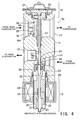
- the solenoid valve-equipped expansion valve 5b of Fig. 4 (third embodiment) is configured such that here the function of completely stopping a flow of refrigerant and the function of preventing a reverse flow of refrigerant from the compressor 1 into the rear evaporator 6 are added to the function of the stop valve of the solenoid valve-equipped expansion valve 5a of Fig. 3.
- the common valve element 24 in Fig 4 has a flexible annular valve sheet 34 at a seat portion which co-operates with the valve seat 18. When seated the valve sheet 34 completely seals the valve seat 18 when the solenoid valve-equipped expansion valve 5b is fully closed, whereby any flow of refrigerant is completely suppressed by the function of the stop valve for placing the solenoid valve-equipped expansion valve 5b in a fully closed state when the solenoid 13 is deenergized.
- a check valve 35 is disposed in a refrigerant passage between a port 16 for receiving refrigerant from the rear evaporator 6, and a port 17 for returning the refrigerant to the compressor 1.
- the check valve 35 is disposed on an outlet side of the refrigerant passage where the refrigerant enters a space communicating with a chamber under the diaphragm 20.
- the check valve 35 is integrally formed with at least one leg portion 35a guided by an inner wall of the refrigerant passage in directions of opening and closing of the check valve 35, and at the same time is urged by a spring 35b having a small spring force in the valve-closing direction.
- the check valve 35 carries a flexible annular valve sheet 36 at a seating portion where it is seated on a valve seat 35c.
- the check valve 35 completely isolates the rear evaporator 6 from the compressor 1. Therefore, when the rear-side circuit is made inoperative for a long time period, it is possible to prevent refrigerant on the compressor side from flowing reversely into the rear evaporator 6 and to stay therein. This prevents that the amount of refrigerant of the front-side circuit is decreased, and assures permanently normal refrigerating operation of the front-side circuit.
- valve sheet 34 may be provided on the valve seat 18, instead.
- solenoid valve-equipped expansion valves 5, 5a, 5b may be applied to refrigeration cycles using every kind of refrigerant. Furthermore, it is possible to apply the same expansion valve on the front-side circuit of an air conditioning system arranged in a reverse manner to the Fig. 1 arrangement. Further, it is possible to apply the expansion valve according to the invention in both of the systems.
Landscapes
- Engineering & Computer Science (AREA)
- Physics & Mathematics (AREA)
- Mechanical Engineering (AREA)
- Thermal Sciences (AREA)
- General Engineering & Computer Science (AREA)
- Fluid Mechanics (AREA)
- Magnetically Actuated Valves (AREA)
- Temperature-Responsive Valves (AREA)
Applications Claiming Priority (2)
| Application Number | Priority Date | Filing Date | Title |
|---|---|---|---|
| JP2002278572A JP4090317B2 (ja) | 2002-09-25 | 2002-09-25 | 電磁弁付膨張弁 |
| JP2002278572 | 2002-09-25 |
Publications (3)
| Publication Number | Publication Date |
|---|---|
| EP1403577A2 true EP1403577A2 (de) | 2004-03-31 |
| EP1403577A3 EP1403577A3 (de) | 2005-05-11 |
| EP1403577B1 EP1403577B1 (de) | 2008-01-09 |
Family
ID=31973267
Family Applications (1)
| Application Number | Title | Priority Date | Filing Date |
|---|---|---|---|
| EP03019928A Expired - Lifetime EP1403577B1 (de) | 2002-09-25 | 2003-09-02 | Mit einem Magnetventil versehenes Entspannungsventil |
Country Status (4)
| Country | Link |
|---|---|
| US (1) | US7036744B2 (de) |
| EP (1) | EP1403577B1 (de) |
| JP (1) | JP4090317B2 (de) |
| DE (1) | DE60318530T2 (de) |
Cited By (1)
| Publication number | Priority date | Publication date | Assignee | Title |
|---|---|---|---|---|
| EP2889553A1 (de) * | 2013-12-20 | 2015-07-01 | Hangzhou Sanhua Research Institute Co., Ltd. | Durchflussregelventil, Verwendung davon, Kühlsystem und Verfahren zur Steuerung davon |
Families Citing this family (18)
| Publication number | Priority date | Publication date | Assignee | Title |
|---|---|---|---|---|
| JP4693403B2 (ja) * | 2003-12-16 | 2011-06-01 | オットー・エゲルホフ・ゲーエムベーハー・ウント・コンパニ・カーゲー | 遮断弁、遮断弁を有するキット、及び膨張弁 |
| CN101142450B (zh) * | 2005-03-18 | 2011-06-22 | 开利商业冷藏公司 | 跨临界制冷系统 |
| US7886550B2 (en) * | 2005-05-06 | 2011-02-15 | Panasonic Corporation | Refrigerating machine |
| DE102005040536A1 (de) * | 2005-08-26 | 2007-03-29 | Honeywell Technologies Sarl | Verfahren und Vorrichtung zum Messen einer Kraft und einer Position |
| US7934696B1 (en) * | 2006-02-21 | 2011-05-03 | John Gruben | Ether injection control valve |
| DE102008039959A1 (de) * | 2007-11-19 | 2009-05-20 | Continental Teves Ag & Co. Ohg | Druckregelventil |
| JPWO2011016264A1 (ja) * | 2009-08-07 | 2013-01-10 | 三菱重工業株式会社 | 車両用空調システム |
| JP5619526B2 (ja) * | 2010-08-25 | 2014-11-05 | 株式会社不二工機 | 電磁弁一体型膨張弁 |
| JP5773610B2 (ja) * | 2010-10-18 | 2015-09-02 | 株式会社不二工機 | 複合弁 |
| CN102466054B (zh) * | 2010-11-18 | 2015-07-01 | 浙江三花股份有限公司 | 一种膨胀阀 |
| FR2979288B1 (fr) * | 2011-08-25 | 2013-08-23 | Valeo Systemes Thermiques | Dispositif de controle d'une circulation de fluide refrigerant et circuit incorporant un tel dispositif |
| CN102606793B (zh) * | 2012-03-26 | 2013-06-19 | 宁波奥柯汽车空调有限公司 | 一种电磁膨胀阀 |
| JP6149237B2 (ja) | 2013-04-24 | 2017-06-21 | 株式会社テージーケー | 車両用冷暖房装置および膨張弁 |
| DE102015114336B4 (de) * | 2015-08-28 | 2018-11-15 | Halla Visteon Climate Control Corporation | Kombinationsventil, insbesondere für den Einsatz in mobilen R744 Kältemittelkreisläufen |
| US10989455B1 (en) | 2017-12-13 | 2021-04-27 | Mainstream Engineering Corporation | Integrated hybrid thermostatic expansion valve and method for providing uniform cooling of heat generating devices |
| CN110878996B (zh) * | 2018-09-06 | 2021-09-28 | 天津华信机械有限公司 | 多功能膨胀阀和空调系统 |
| JP7340833B2 (ja) * | 2019-01-11 | 2023-09-08 | 株式会社テージーケー | 逆止弁および逆止弁を備える複合弁 |
| DE102023133823A1 (de) * | 2022-12-08 | 2024-06-13 | Hanon Systems | Wärmemanagement-fluidmodul für ein fahrzeug |
Citations (2)
| Publication number | Priority date | Publication date | Assignee | Title |
|---|---|---|---|---|
| JPH11182983A (ja) | 1997-12-22 | 1999-07-06 | Denso Corp | 電磁弁一体型膨張弁 |
| JPH11304298A (ja) | 1998-04-23 | 1999-11-05 | Tgk Co Ltd | 電磁弁付膨張弁 |
Family Cites Families (9)
| Publication number | Priority date | Publication date | Assignee | Title |
|---|---|---|---|---|
| JPS61105066A (ja) * | 1984-10-26 | 1986-05-23 | 日産自動車株式会社 | 膨張弁 |
| JPH0234877U (de) * | 1988-08-30 | 1990-03-06 | ||
| JPH10274453A (ja) * | 1997-01-31 | 1998-10-13 | Tgk Co Ltd | 膨張弁 |
| JPH10288424A (ja) * | 1997-04-11 | 1998-10-27 | Fuji Koki Corp | 温度式膨張弁 |
| US5979780A (en) * | 1997-10-03 | 1999-11-09 | Eaton Corporation | Thermostatic expansion valve with integral electrically operated inlet valve |
| US6375085B1 (en) * | 2000-05-11 | 2002-04-23 | Parker-Hannifin Corporation | Reducing noise in a thermal expansion valve |
| US6325296B1 (en) * | 2000-07-26 | 2001-12-04 | Eaton Corporation | Quieting a thermal expansion valve |
| JP2002327661A (ja) * | 2001-04-27 | 2002-11-15 | Denso Corp | 燃料噴射弁 |
| JP4506044B2 (ja) * | 2001-07-04 | 2010-07-21 | 株式会社豊田自動織機 | 制御弁及び可変容量型圧縮機 |
-
2002
- 2002-09-25 JP JP2002278572A patent/JP4090317B2/ja not_active Expired - Fee Related
-
2003
- 2003-09-02 EP EP03019928A patent/EP1403577B1/de not_active Expired - Lifetime
- 2003-09-02 DE DE60318530T patent/DE60318530T2/de not_active Expired - Fee Related
- 2003-09-10 US US10/658,551 patent/US7036744B2/en not_active Expired - Fee Related
Patent Citations (2)
| Publication number | Priority date | Publication date | Assignee | Title |
|---|---|---|---|---|
| JPH11182983A (ja) | 1997-12-22 | 1999-07-06 | Denso Corp | 電磁弁一体型膨張弁 |
| JPH11304298A (ja) | 1998-04-23 | 1999-11-05 | Tgk Co Ltd | 電磁弁付膨張弁 |
Cited By (1)
| Publication number | Priority date | Publication date | Assignee | Title |
|---|---|---|---|---|
| EP2889553A1 (de) * | 2013-12-20 | 2015-07-01 | Hangzhou Sanhua Research Institute Co., Ltd. | Durchflussregelventil, Verwendung davon, Kühlsystem und Verfahren zur Steuerung davon |
Also Published As
| Publication number | Publication date |
|---|---|
| JP2004116834A (ja) | 2004-04-15 |
| US20040055318A1 (en) | 2004-03-25 |
| DE60318530T2 (de) | 2008-05-21 |
| JP4090317B2 (ja) | 2008-05-28 |
| EP1403577B1 (de) | 2008-01-09 |
| EP1403577A3 (de) | 2005-05-11 |
| DE60318530D1 (de) | 2008-02-21 |
| US7036744B2 (en) | 2006-05-02 |
Similar Documents
| Publication | Publication Date | Title |
|---|---|---|
| EP1403577B1 (de) | Mit einem Magnetventil versehenes Entspannungsventil | |
| JP4153133B2 (ja) | 膨張弁 | |
| JP3794100B2 (ja) | 電磁弁一体型膨張弁 | |
| US5588590A (en) | Expansion valve combined with a solenoid valve | |
| US6997000B2 (en) | Refrigeration system and method of operation therefor | |
| US6315266B1 (en) | Pilot-operated flow regulating valve | |
| JPH11182983A (ja) | 電磁弁一体型膨張弁 | |
| EP1179714B1 (de) | Kältemittelkreislauf und Ventilvorrichtung dazu | |
| US6986498B2 (en) | Differential pressure valve | |
| JP3844321B2 (ja) | パイロット作動の三方向切換電磁弁 | |
| JP2004270975A (ja) | 流量制御弁 | |
| KR101020808B1 (ko) | 전자 밸브 일체형 팽창 밸브 | |
| US6367283B1 (en) | Three-stage electronically variable orifice tube | |
| JP4848548B2 (ja) | 電磁弁付き膨張弁 | |
| JP4086682B2 (ja) | 膨張装置 | |
| JP2003130500A (ja) | 電磁弁一体型膨張弁 | |
| JP5604626B2 (ja) | 膨張弁 | |
| EP1364818B1 (de) | Ausflussverhinderungsvorrichtung | |
| JP3786518B2 (ja) | 電磁弁付膨張弁 | |
| JP2001343081A (ja) | 定差圧弁 | |
| JP4260037B2 (ja) | 膨張装置 | |
| JP2004225989A (ja) | 電磁弁付膨張弁 | |
| JP6340742B2 (ja) | 電磁弁 | |
| JP2003002042A (ja) | 自動車用空調装置 | |
| JP2007155136A (ja) | 電磁制御弁 |
Legal Events
| Date | Code | Title | Description |
|---|---|---|---|
| PUAI | Public reference made under article 153(3) epc to a published international application that has entered the european phase |
Free format text: ORIGINAL CODE: 0009012 |
|
| AK | Designated contracting states |
Kind code of ref document: A2 Designated state(s): AT BE BG CH CY CZ DE DK EE ES FI FR GB GR HU IE IT LI LU MC NL PT RO SE SI SK TR |
|
| AX | Request for extension of the european patent |
Extension state: AL LT LV MK |
|
| PUAL | Search report despatched |
Free format text: ORIGINAL CODE: 0009013 |
|
| AK | Designated contracting states |
Kind code of ref document: A3 Designated state(s): AT BE BG CH CY CZ DE DK EE ES FI FR GB GR HU IE IT LI LU MC NL PT RO SE SI SK TR |
|
| AX | Request for extension of the european patent |
Extension state: AL LT LV MK |
|
| 17P | Request for examination filed |
Effective date: 20050420 |
|
| AKX | Designation fees paid |
Designated state(s): DE FR IT |
|
| 17Q | First examination report despatched |
Effective date: 20061215 |
|
| GRAP | Despatch of communication of intention to grant a patent |
Free format text: ORIGINAL CODE: EPIDOSNIGR1 |
|
| GRAS | Grant fee paid |
Free format text: ORIGINAL CODE: EPIDOSNIGR3 |
|
| GRAA | (expected) grant |
Free format text: ORIGINAL CODE: 0009210 |
|
| AK | Designated contracting states |
Kind code of ref document: B1 Designated state(s): DE FR IT |
|
| REF | Corresponds to: |
Ref document number: 60318530 Country of ref document: DE Date of ref document: 20080221 Kind code of ref document: P |
|
| ET | Fr: translation filed | ||
| PLBE | No opposition filed within time limit |
Free format text: ORIGINAL CODE: 0009261 |
|
| STAA | Information on the status of an ep patent application or granted ep patent |
Free format text: STATUS: NO OPPOSITION FILED WITHIN TIME LIMIT |
|
| 26N | No opposition filed |
Effective date: 20081010 |
|
| PGFP | Annual fee paid to national office [announced via postgrant information from national office to epo] |
Ref country code: DE Payment date: 20081030 Year of fee payment: 6 |
|
| PGFP | Annual fee paid to national office [announced via postgrant information from national office to epo] |
Ref country code: FR Payment date: 20080922 Year of fee payment: 6 |
|
| PG25 | Lapsed in a contracting state [announced via postgrant information from national office to epo] |
Ref country code: IT Free format text: LAPSE BECAUSE OF FAILURE TO SUBMIT A TRANSLATION OF THE DESCRIPTION OR TO PAY THE FEE WITHIN THE PRESCRIBED TIME-LIMIT Effective date: 20080109 |
|
| REG | Reference to a national code |
Ref country code: FR Ref legal event code: ST Effective date: 20100531 |
|
| PG25 | Lapsed in a contracting state [announced via postgrant information from national office to epo] |
Ref country code: FR Free format text: LAPSE BECAUSE OF NON-PAYMENT OF DUE FEES Effective date: 20090930 Ref country code: DE Free format text: LAPSE BECAUSE OF NON-PAYMENT OF DUE FEES Effective date: 20100401 |