EP1403793A1 - Procédé pour la consignation intégrée et automatique des documents dans l'enregistrement des transactions commerciales - Google Patents
Procédé pour la consignation intégrée et automatique des documents dans l'enregistrement des transactions commerciales Download PDFInfo
- Publication number
- EP1403793A1 EP1403793A1 EP02021648A EP02021648A EP1403793A1 EP 1403793 A1 EP1403793 A1 EP 1403793A1 EP 02021648 A EP02021648 A EP 02021648A EP 02021648 A EP02021648 A EP 02021648A EP 1403793 A1 EP1403793 A1 EP 1403793A1
- Authority
- EP
- European Patent Office
- Prior art keywords
- business
- data
- program module
- data record
- program
- Prior art date
- Legal status (The legal status is an assumption and is not a legal conclusion. Google has not performed a legal analysis and makes no representation as to the accuracy of the status listed.)
- Ceased
Links
Images



Classifications
-
- G—PHYSICS
- G06—COMPUTING OR CALCULATING; COUNTING
- G06Q—INFORMATION AND COMMUNICATION TECHNOLOGY [ICT] SPECIALLY ADAPTED FOR ADMINISTRATIVE, COMMERCIAL, FINANCIAL, MANAGERIAL OR SUPERVISORY PURPOSES; SYSTEMS OR METHODS SPECIALLY ADAPTED FOR ADMINISTRATIVE, COMMERCIAL, FINANCIAL, MANAGERIAL OR SUPERVISORY PURPOSES, NOT OTHERWISE PROVIDED FOR
- G06Q10/00—Administration; Management
- G06Q10/06—Resources, workflows, human or project management; Enterprise or organisation planning; Enterprise or organisation modelling
-
- G—PHYSICS
- G06—COMPUTING OR CALCULATING; COUNTING
- G06Q—INFORMATION AND COMMUNICATION TECHNOLOGY [ICT] SPECIALLY ADAPTED FOR ADMINISTRATIVE, COMMERCIAL, FINANCIAL, MANAGERIAL OR SUPERVISORY PURPOSES; SYSTEMS OR METHODS SPECIALLY ADAPTED FOR ADMINISTRATIVE, COMMERCIAL, FINANCIAL, MANAGERIAL OR SUPERVISORY PURPOSES, NOT OTHERWISE PROVIDED FOR
- G06Q10/00—Administration; Management
- G06Q10/10—Office automation; Time management
-
- G—PHYSICS
- G06—COMPUTING OR CALCULATING; COUNTING
- G06Q—INFORMATION AND COMMUNICATION TECHNOLOGY [ICT] SPECIALLY ADAPTED FOR ADMINISTRATIVE, COMMERCIAL, FINANCIAL, MANAGERIAL OR SUPERVISORY PURPOSES; SYSTEMS OR METHODS SPECIALLY ADAPTED FOR ADMINISTRATIVE, COMMERCIAL, FINANCIAL, MANAGERIAL OR SUPERVISORY PURPOSES, NOT OTHERWISE PROVIDED FOR
- G06Q20/00—Payment architectures, schemes or protocols
- G06Q20/08—Payment architectures
- G06Q20/20—Point-of-sale [POS] network systems
-
- G—PHYSICS
- G06—COMPUTING OR CALCULATING; COUNTING
- G06Q—INFORMATION AND COMMUNICATION TECHNOLOGY [ICT] SPECIALLY ADAPTED FOR ADMINISTRATIVE, COMMERCIAL, FINANCIAL, MANAGERIAL OR SUPERVISORY PURPOSES; SYSTEMS OR METHODS SPECIALLY ADAPTED FOR ADMINISTRATIVE, COMMERCIAL, FINANCIAL, MANAGERIAL OR SUPERVISORY PURPOSES, NOT OTHERWISE PROVIDED FOR
- G06Q40/00—Finance; Insurance; Tax strategies; Processing of corporate or income taxes
- G06Q40/12—Accounting
Definitions
- the invention relates to a method for the automatic storage of documents for business transactions, in which data on a business transaction are stored for access via a business application with the aid of a computer system and in which an identification code is assigned to a business transaction, with one or more different classes in the computer system of business transactions with different data structures are mapped.
- a business transaction means a business transaction in which the financial assets are either increased (income) or decreased (expenditure).
- Such business transactions can in turn be assigned to certain classes within which the data that is to be assigned to the individual business transactions have an approximately uniform structure. Typical classes are HR, materials management, production.
- each logging of a business transaction is carried out after a. certain business valuation methods documented by a document to which an identification code is assigned. Examples of the different business valuation can be: valuation of a business transaction according to the German Commercial Law or IAS, valuation of a business transaction between two group companies according to the legal or internal regulations, valuation of a business transaction in different currencies.
- This document principle means that auditing of the aggregated, i.e. Guaranteed data of the invoices summed up via certain characteristics via the documents for the process data.
- Another requirement for accounting is that monitoring and logging should not hinder the implementation of the logistical processes, i.e. booking processes that map the incoming and outgoing goods and services.
- An ERP software (E nterprise R esource Lanning P) fulfills the requirements of an accounting typically characterized in that the logistic processes, and accounting of a company to be in the same system, the ERP system performed. Accounting is closely linked to the logistical processes and logs directly and transactionally, which means that a document is only saved as such when the data that the document must contain is complete.
- the logistical processes are mapped in the ERP software and therefore usually linked to the terms of accounting (eg account). The terms are implemented in the software through fixed data structures.
- the various accounting invoices update their own records for logging.
- the object of the invention was that the methods mentioned at the outset be such improve that the disadvantages mentioned are at least partially eliminated.
- the invention also relates to a device for performing this method according to claim 10, or computer programs and computer program products according to claims 11 and 13, as well as an electronic data structure or an electronic document which can be obtained or was obtained by one of the methods according to the invention ,
- the invention further comprises computer programs on or embedded in a data carrier, with the aid of which the programs can be loaded into a computer and the method according to the invention can be carried out.
- the program can be in the form of a source code, an object code or a mixed code, fully or partially compiled.
- the data carrier can be any unit or device which is suitable for containing a program: ROM, for example CD-ROM or a semiconductor ROM or DVD ROM, a magnetic storage medium, for example floppy disk or hard disk, a transferable carrier, for example an electrical one or optical signal which can be transmitted via electrical or optical lines, or via electromagnetic waves such as radio or radio waves, or another suitable carrier.
- ROM read-only memory
- DVD ROM digital versatile disc read-only memory
- magnetic storage medium for example floppy disk or hard disk
- a transferable carrier for example an electrical one or optical signal which can be transmitted via electrical or optical lines, or via electromagnetic waves such as radio or radio waves, or another suitable carrier.
- the program is contained in a signal that is routed over a cable or other medium or medium, the cable or other medium or medium can represent the data carrier.
- the program can be embedded in an integrated circuit which is provided for executing the method according to the invention.
- the method according to the invention and the program code for carrying out the method are also referred to below as the "accounting engine” and the output data record also as the "document”.
- the method according to the invention can be used as a tool of an ERP software for accounting for the electronic filing of documents from private law organizations or from organizations under public law (collectively referred to as "company"). It is carried out using a computer system.
- a computer system in the sense of the invention can on the one hand only comprise a computer (PC, laptop; including conventional peripherals), and on the other hand can consist of a network of several computers. This also includes a network that is formed using the Internet.
- the accounting engine is preferably used in a computer network within a company. In such a computer system of a company, data relating to the individual business transactions can be stored using ERP software, for example.
- the accounting engine as program code, when executed in the computer system, has the effect that an input data record is generated from data on a single business transaction (output data), which in turn is transformed into an output data record (document) that is used by several accounting application programs (business applications ) that run on the computer system can be read and saved separately from the output data.
- output data can already be stored in the computer system or entered by a user via a user interface and immediately processed further, or imported via remote data transmission.
- the input data are changed or supplemented in whole or in part, using additional data stored in the computer system, depending on the requirements of different business applications.
- a business application can set the economic way in which a business transaction is evaluated.
- Another rating can be chosen through another business application. This can lead to the same business transaction being valuated in several different ways. For one business transaction, however, only one document is created for each valuation, which, however, can be read by several business applications. This one document contains more data than would be necessary if only one business application would have to access the document, but less data would be generated overall if a separate document was created for each of the different business applications, which do not always have to specify different ratings would. This corresponds to the characteristic "to be designed for access by at least two business registrations".
- the first step of the method according to the invention is carried out using a first program module, the second step using a second program module.
- the input data record with the specific structure is sent from the first program module to the second program module via an interface to hand over.
- the or each business application can be designed as a third or further program module and cooperate with the second program module in such a way that the transformation process in the second step of the method according to the invention can be set by the or each third program module via an interface.
- This configurability of the document can be implemented, for example, in that a user is shown on a screen a list with the selectable data or fields or also functions from which he or she can use one interaction (e.g.
- the second program module is particularly preferably designed such that it reads data selectable by the at least two business applications from the receipt for a data request from the or each third program module and the or each third and / or another program module via one Interface can be passed for further processing and / or for display. This selectable data can be selected by the third or another program module.
- the document obtained in the second step of the method according to the invention is preferably stored transactionally.
- the document for several business applications advantageously has a specific database structure with one or more tables. It is particularly advantageous if the document has different data areas for different accounting journals.
- Journals in this sense are tabular summaries of posting records, e.g. from the areas of receivables, liabilities, costs, income, incoming goods, outgoing goods, etc.
- the document can have a first data area for costs and income, a second for the material inventory, a third for claims and Liabilities, etc.
- the first area can contain information about: customer, product, cost center, etc., the second about product, storage type, storage location, etc., and the third about: customer, etc. This information is for explanatory purposes only and can be can be can be changed or supplemented as required.
- the document can also contain a further area ("header area") with data that are common to several journals, for example: the identification code (ID), the respective legal unit (company), a posting date, a processing date, a processor, etc.
- head area a further area with data that are common to several journals, for example: the identification code (ID), the respective legal unit (company), a posting date, a processing date, a processor, etc.
- ID identification code
- company legal unit
- a posting date e.g., a processing date
- processor e.g., etc.
- the various data areas can then be used to store the information from the business transaction that relates to the respective journal.
- the storage of the document in a physical memory can advantageously be implemented via a database structure with one or more tables.
- At least one function is applied to the data contained in the document.
- a function can be, for example, checking the document balance or a customer group contained in the document.
- Such functions are preferably stored selectably in a program module.
- At least one function is particularly preferably configurable via a further program module.
- the selectability of the functions can be implemented, for example, in that a user is shown on a screen a list with the selectable functions from which he can select one or more functions by means of an interaction (for example keyboard or mouse click or voice input).
- the configurability of the at least one function can be realized in that its parameters can be selected, for example analogously to what has already been described. If, for example, postings for several legal units are stored in a document, the function for checking the balance can be used, for example For example, it can be configured using the selection table so that it only checks the account balances of the selected unit.
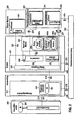
- the ERP software 111 comprises one or more program modules 110 for handling and processing data on business transactions, an accounting engine 106 designed as a program module and one or more business applications designed as a program module 109.
- the computer system 101 further comprises: input means 113, output means 112, a network connection 104 for connecting the computer 103 to further identical or different computers 114 in the form of a network, the network computers 114 being further inputs and / or Output units for entering and / or outputting data on business transactions or for configuring the accounting engine and for displaying input masks or for outputting results or for executing the accounting engine can serve a database 107 which contains data on the business transactions and business applications and which the ERP software 111 can access, as well as a storage unit 108 for storing the documents, wherein the storage unit 108 can also be part of the database 107.
- the program modules 106, 109, 110 can also access the database 107, the program modules 106 and 109 can also access the document storage 108.
- the method according to the invention can be carried out as follows.
- One of the modules 110 transfers data on a specific business transaction to the accounting engine 106 with an identification code (ID).
- ID an identification code
- the data may already be present in the database 107 or entered via the input or output means 113, 112, 114 and in the RAM 102 may be stored.
- the accounting engine 106 transforms the transferred data by adding data from the database 107 and / or by changing or converting the transferred data into a document that meets the requirements of a business document and that can be read by the different business applications 109.
- the document is then stored on the storage unit 108.
- the database 107 contains all information relevant to business management.
- the type of transformation and the type of data that are stored in the document can be specifically set via the modules 109.
- FIG. 2 Represent here the square rectangles program code, the rounded rectangles data structures.
- 2 has a first program module 210 and a second program module 220.
- the first program module 210 receives data on this business transaction via an interface 271 from a business transaction via a program module 250, which is specifically designed for a class of business transactions.
- data can be, for example: type, number, type of a product sold or , as an example from production, the removal of a number of goods or a raw material from a warehouse for a specific job in a specific production or the salary payment to an employee.
- This data can be loaded via storage media or entered virtually online using input devices (e.g. keyboard, screen).
- the data can also be transferred, for example, by transferring the addresses of the data concerned.
- An identification code 251 (ID) is also transferred.
- the first program module 210 contains one or more generation modules 211 that generate an input data record 212 from the data of the business transaction, which has a structure that is specific for all classes of business transactions that are mapped in the respective ERP software.
- the generation module 211 is also specifically designed for each class of business transactions 250.
- the assignment of the modules 250 to the modules 211 can be implemented, for example, using a table.
- the input data record 212 can have a header area in its structure, which contains general data such as the ID 251, account, cost center, user, time stamp, posting date, legal unit, etc. and data relating to the class of the business transaction.
- the rest of the structure contains the data relating to the specific business transaction. Some of the general data can also be read from a database via an interface 272 using a database application 260.
- the Configuration of the modules 211, their assignment to the modules 250 and the definition of the structure of the input data record 212 are expediently carried out when the accounting engine is installed in the EDP system of the respective company.
- the input data record 212 thus generated is transferred from the first program module 210 to the second program module 220 via an interface 213.
- This transformation takes place with the addition of data and / or with the conversion of data from the input data record. The addition takes place by means of the database application 260, which the receipt processor can access via an interface 273. Examples of such added data are a customer group or a price.
- a conversion of data can, for example, be carried out in such a way that a turnover is calculated and calculated from a transferred number of pieces and from the unit price that is available from the database application 260. This can then be saved in document 226 in a further step for access by different business applications.
- the document 226 has a header area 226a and different data areas 226b, 226c which are structured in terms of content and which are used for Read access is provided for single or multiple business applications.
- the header area contains the general data of the input data record 212 as well as the data from the database application 260 added by the document processor 221.
- the different data areas 226b, 226c contain the data for the individual accounting journals.
- area 262b stands for the Journal of Costs and Income. Which data of the individual areas 226 can be viewed from which business applications can be configured by the respective business application. This is explained in more detail below.
- a business application is designed in the form of a third program module 240.
- This third program module 240 contains a configuration module 242 which interacts with a configuration service 223 of the transformation module via an interface 274 in such a way that the configuration module 242 can be used to determine which data for access for a specific business application in the relevant data area (226a or 226b ) of the document 226 and can also be read by the respective third program module 240.
- the data required for the transformation can be stored in a database in tabular form.
- the names of the corresponding fields in the table can be selected via an interface 276 by means of the database application 260.
- the names of the selected fields are transferred to the configuration service 223 via an interface 274.
- the contents (data) of the fields selected in this way are then read by the transformation module 221 via the interface 273 from the database application 260, and inserted into the document via the document processor 222 or used for the transformation.
- the configuration module 242 can also be used to determine which business evaluation of the input data record is to be carried out and which of the results obtained in the Document should be saved, for example which currency should be used for a certain type of booking.
- one or more functions 231 can be applied to the document data record 226 by means of a server module 230.
- one or more functions 231 can be used to check whether the balance of debit and credit is zero, whether the specified tax rates are correct, whether all the mandatory fields are filled in, whether account information is correct, whether a customer group is correctly determined, or whether there are other errors or deficiencies In accordance with the principles of proper accounting.
- These functions 231 are stored in the service module 230 and can be selected via interfaces 277, 227 via the configuration module 242 for use on the relevant document and for the relevant business application.
- the document 226 with its structural data, the identification code 251 and the settings configured by the third program modules 240, 242 is stored by a persistency server module 225. It is stored in a physical memory in the form of a database structure with one or more tables.
- the document processor 222 can access the structural data via an interface 228 and use it to transform an input data record 212 into a document 226 of a specific class of business transactions.
- the interfaces 271, 213 are designed specifically for each class of business transactions.
- the or each third program module 240 contains a reading module 241 which interacts with a reading service module 224 via an interface 275, the reading service 224 making the data available to the reading module 241, which is selected with the aid of configuration module 242 were.
- the configuration module 242 can also be used to set which general data or fields are added to the document and can also be read using the database application 260 in the manner specified above.
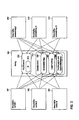
- FIG. 3 shows a schematic representation of the data structure of a document 304 together with instructions on what options exist for transforming data from business transactions 301, 302, 303 into specific data areas 306, 307, 308 of the document 304. It is also shown what possibilities there are for business applications 309, 310, 311 to access the data areas 306, 307, 308 of the document 304. However, the possibilities mentioned are by no means to be understood as a conclusive list, but merely represent exemplary embodiments of the invention.
- the electronic document 304 has a header area 305 and a data area 313.
- the header area 305 contains the ID 312 and other general data relating to a business transaction 301, 302, 303.
- the data area 313 has different areas 306, 307, 308 which contain data on different accounting journals: an area 306 for data on costs and income, an area 307 for warehousing and an area 308 for receivables and liabilities.
- the data area 313 has different areas 306, 307, 308 which contain data on different accounting journals: an area 306 for data on costs and income, an area 307 for warehousing and an area 308 for receivables and liabilities.
- journal areas such as areas 306, 307, 308 and others.
- FIGS. 4 and 5 There is a limitation in some way not intended by this. Contrary to FIGS. 1-3, data structures are not rounded in FIGS. 4, 5, and no program modules are shown.
- the following module is transferred to the first module 210 for this business transaction via the program module 250 (cf. FIG. 2): an ID (101), an order date (05.02.2002), a description of the business transaction (purchase of goods), article description (product Y), quantity (3) and purchase price (330).
- the program module 210 uses this data to generate two input data records 410, 420 which are specific for this class of business transactions: a first 410 for the GA I and a second 420 for the GA II. Both have the same structure: a header area 411, 421 and one data area each, the latter consisting of the journals inventory 412, 422 and liabilities 413, 423. All areas are implemented as single-line tables.
- the header area has - in the example - the fields with the name ID, posting date, business transaction in which the corresponding transferred data is entered, whereby the module 210 generates an ID from the transferred ID that uniquely identifies the two input data records, in the example by adding "I” or "II", according to the GA.
- a field UserID is added by module 210, in which an identifier of the person in charge is entered. This was taken from database application 260.
- the data area Inventory 412 shows the fields Group company, Article, Number, Value , whereby the field Group company is filled from the database, the rest from the transferred data. The content of the Value in field corresponds to the purchase price. It should be noted that debit postings appear as positive numbers, credit postings as negative.
- the liabilities area 413 shows the fields company, supplier and value , the first two fields containing values from database application 260.
- the input data record 420 for the GA II differs from the input data record 410 for the GA II not in the structural structure but only in the content of the value in fields , This is because the sales premium is not relevant for the valuation from a group perspective, and therefore the module 210 for generating the input data record for this GA II was configured in such a way that it reads the value for the production costs from a group-wide accessible database using the database application 260 and in the Value in fields the inventory line 422 and liabilities 423.
- the transformation module 221 generates a first document 430 from the first input data record 410 and a document 440 from the second input data record 420. Both documents have different data structures, which resulted from the structure of the input data records with the addition or omission of individual or several fields. There are header areas 431, 441, as well as the data areas inventory 432, 442 and liabilities 433, 443.
- the header areas 431, 441 have the same structure, but different contents in individual fields. They contain the Fields in the header area of the input data record as well as additional fields for the fiscal year and quarter. From the point of view of European company B, the business year is the same as the calendar year. Module 221 determines the year 2002 from the knowledge of the company and the booking date as the fiscal year and the first quarter as the quarter and saves these values in the corresponding fields.
- the stock areas 432 and 442 have different structures.
- the area 432 has the fields corresponding to 412 as well as fields for account, value in US $ and storage location.
- Account and storage location are determined by module 221 from database application 260, the value in US $ from the value in using a conversion factor from database application 260.
- a "value in US $" can be useful if the seller is located in the USA, as in the example.
- the stock area 442 has almost the same structure, but instead of the Storage location field there is a Value field in yen. This can be useful if the group is based in Japan and has to account in accordance with Japanese regulations, and if information regarding the storage location is not relevant from the group's perspective.
- Liabilities 433 and 443 also have different structures.
- area 433 also contains the fields account and value in US $, the content of which is determined analogously to that described above. The same applies to area 443, which, however, still contains a value field in yen.
- Another example of a business transaction is the sale of the said goods from B to a non-European third party (company XYZ), namely only the delivery of the goods.
- the billing document is not processed. From a business point of view, the inventory at company B is reduced and there are costs in the amount of the manufacturing price.
- the following module is transferred to the first module 210 for this business transaction via the program module 250 (cf. FIG. 2): an ID (213), an order date (April 10, 2002), a description of the business transaction, (goods issue), article description (product Y), number of pieces (3).
- two output data records 510, 520 are generated for the GA I and GA II, and from these two receipts 530, 540, the remaining, necessary data being determined via the database application 260.
- the head areas 511, 521, 531, .541 correspond to those of the aforementioned example. Only the content has been adapted. The same applies to the stock areas 512, 522, 532, 542. A liabilities area is not required for this class of business transactions.
- journal data areas there are costs and revenues 513, 523, 533, 543 in the journal data areas.
- these consist of the fields group company, customer (the third party company) and value in , Value fields in US $ and region have been added for document 530, and value in yen for document 540.
- the contents result from what has already been said and the data from the second example.
- the content of the account fields for the stock area in the examples are identical within a GA but differ from GA I to GA II. However, this does not have to be the case in general.
- the four documents are saved and can each be read by several business applications 240, for example by applications of inventory controlling, contribution margin accounting or general balance sheet accounting.
- applications of inventory controlling, contribution margin accounting or general balance sheet accounting it is possible to set which fields can be read by which business applications.
- an inventory control application can have access to all or individual fields of the header areas and the inventory areas. This configuration is conveniently done when the software is set up.
- the accounting engine represents a central component for the integrated logging of business transactions in the form of a piece of evidence using the document.
- One or more business applications can form specific, aggregated views of the piece of evidence.
- the documents can be stored redundancy-free for a certain business evaluation, which means that storage space can be saved to a considerable extent, depending on the number of documents and business applications, even though the need for storage space for the individual document increases.
- the coordination effort between the business applications of the user is reduced. Document structure and the procedure can be configured by the user.
- the accounting engine enables the separation of operational business transactions from the accounting applications. Such a separation enables an asynchronous coupling of accounting to logistical systems in terms of data technology.
- the accounting engine also enables business transactions that are not economically valued, e.g. a take-over of goods without quotation, with their process-specific terms. It can carry out the evaluation of incoming business transactions according to the regulations of the accounting. Documents from different evaluations can be kept logically separate. An independent document is preferably generated for each evaluation.
- Relationships used in subclaims indicate the further development of the subject matter of the main claim; they are not to be understood as a waiver of the achievement of independent, objective protection for the combination of features of the related subclaims.
Landscapes
- Business, Economics & Management (AREA)
- Engineering & Computer Science (AREA)
- Strategic Management (AREA)
- General Physics & Mathematics (AREA)
- Theoretical Computer Science (AREA)
- Entrepreneurship & Innovation (AREA)
- Accounting & Taxation (AREA)
- Human Resources & Organizations (AREA)
- Economics (AREA)
- General Business, Economics & Management (AREA)
- Physics & Mathematics (AREA)
- Marketing (AREA)
- Finance (AREA)
- Quality & Reliability (AREA)
- Tourism & Hospitality (AREA)
- Operations Research (AREA)
- Development Economics (AREA)
- Educational Administration (AREA)
- Game Theory and Decision Science (AREA)
- Technology Law (AREA)
- Data Mining & Analysis (AREA)
- Financial Or Insurance-Related Operations Such As Payment And Settlement (AREA)
Priority Applications (14)
| Application Number | Priority Date | Filing Date | Title |
|---|---|---|---|
| EP02021648A EP1403793A1 (fr) | 2002-09-27 | 2002-09-27 | Procédé pour la consignation intégrée et automatique des documents dans l'enregistrement des transactions commerciales |
| EP02021654A EP1403794A1 (fr) | 2002-09-27 | 2002-09-27 | Procédé et système de mémorisation automatique de données relatives à la gestion d'entreprise |
| EP03757800A EP1546963A1 (fr) | 2002-09-27 | 2003-09-08 | Procede et systeme de stockage automatique de donnees relatives a la gestion d'entreprise |
| US10/529,231 US7640195B2 (en) | 2002-09-27 | 2003-09-08 | Systems and method for automatic integrated document filing when logging business transactions |
| AU2003273837A AU2003273837B2 (en) | 2002-09-27 | 2003-09-08 | Method and system for the automatic storage of business management data |
| CA2500391A CA2500391C (fr) | 2002-09-27 | 2003-09-08 | Methode de classement de documents integre automatique au moment de l'enregistrement chronologique de transactions |
| JP2004540595A JP2006500689A (ja) | 2002-09-27 | 2003-09-08 | ビジネスイベント記録時の伝票の自動ファイリング方法 |
| AU2003271590A AU2003271590B2 (en) | 2002-09-27 | 2003-09-08 | Method for the automatic integrated filing of records during recording of business events |
| PCT/EP2003/009954 WO2004032005A2 (fr) | 2002-09-27 | 2003-09-08 | Procede de classement de pieces justificatives automatique, integre dans le protocole d'operations commerciales |
| EP03753395A EP1546961A2 (fr) | 2002-09-27 | 2003-09-08 | Procede de classement de pieces justificatives automatique, integre dans le protocole d'operations commerciales |
| JP2004540596A JP4722485B2 (ja) | 2002-09-27 | 2003-09-08 | ビジネスデータの自動記憶方法およびビジネスデータの自動記憶システム |
| PCT/EP2003/009955 WO2004032006A2 (fr) | 2002-09-27 | 2003-09-08 | Procede et systeme de stockage automatique de donnees relatives a la gestion d'entreprise |
| US10/529,142 US20060155550A1 (en) | 2002-09-27 | 2003-09-08 | Method and system for automatic storage of business management data |
| CA2500393A CA2500393C (fr) | 2002-09-27 | 2003-09-08 | Procede et systeme de stockage automatique de donnees relatives a la gestion d'entreprise |
Applications Claiming Priority (5)
| Application Number | Priority Date | Filing Date | Title |
|---|---|---|---|
| EP02021648A EP1403793A1 (fr) | 2002-09-27 | 2002-09-27 | Procédé pour la consignation intégrée et automatique des documents dans l'enregistrement des transactions commerciales |
| EP02021654A EP1403794A1 (fr) | 2002-09-27 | 2002-09-27 | Procédé et système de mémorisation automatique de données relatives à la gestion d'entreprise |
| DE10261121 | 2002-12-20 | ||
| DE10261123 | 2002-12-20 | ||
| PCT/EP2003/009954 WO2004032005A2 (fr) | 2002-09-27 | 2003-09-08 | Procede de classement de pieces justificatives automatique, integre dans le protocole d'operations commerciales |
Publications (1)
| Publication Number | Publication Date |
|---|---|
| EP1403793A1 true EP1403793A1 (fr) | 2004-03-31 |
Family
ID=31970329
Family Applications (2)
| Application Number | Title | Priority Date | Filing Date |
|---|---|---|---|
| EP02021648A Ceased EP1403793A1 (fr) | 2002-09-27 | 2002-09-27 | Procédé pour la consignation intégrée et automatique des documents dans l'enregistrement des transactions commerciales |
| EP03753395A Ceased EP1546961A2 (fr) | 2002-09-27 | 2003-09-08 | Procede de classement de pieces justificatives automatique, integre dans le protocole d'operations commerciales |
Family Applications After (1)
| Application Number | Title | Priority Date | Filing Date |
|---|---|---|---|
| EP03753395A Ceased EP1546961A2 (fr) | 2002-09-27 | 2003-09-08 | Procede de classement de pieces justificatives automatique, integre dans le protocole d'operations commerciales |
Country Status (6)
| Country | Link |
|---|---|
| US (1) | US7640195B2 (fr) |
| EP (2) | EP1403793A1 (fr) |
| JP (1) | JP2006500689A (fr) |
| AU (1) | AU2003271590B2 (fr) |
| CA (1) | CA2500391C (fr) |
| WO (1) | WO2004032005A2 (fr) |
Cited By (1)
| Publication number | Priority date | Publication date | Assignee | Title |
|---|---|---|---|---|
| CN115271344A (zh) * | 2022-06-22 | 2022-11-01 | 福建亿能达信息技术股份有限公司 | 一种医院业务流程的闭环管理方法、装置、设备和介质 |
Families Citing this family (61)
| Publication number | Priority date | Publication date | Assignee | Title |
|---|---|---|---|---|
| US8396811B1 (en) | 1999-02-26 | 2013-03-12 | Syncada Llc | Validation approach for auditing a vendor-based transaction |
| US20080172314A1 (en) | 1996-11-12 | 2008-07-17 | Hahn-Carlson Dean W | Financial institution-based transaction processing system and approach |
| US20070055582A1 (en) | 1996-11-12 | 2007-03-08 | Hahn-Carlson Dean W | Transaction processing with core and distributor processor implementations |
| US8392285B2 (en) | 1996-11-12 | 2013-03-05 | Syncada Llc | Multi-supplier transaction and payment programmed processing approach with at least one supplier |
| EP1403794A1 (fr) * | 2002-09-27 | 2004-03-31 | Sap Ag | Procédé et système de mémorisation automatique de données relatives à la gestion d'entreprise |
| WO2005059792A1 (fr) * | 2003-12-19 | 2005-06-30 | Three C Consulting Co., Ltd. | Systeme et programme de creation de documents |
| US7925551B2 (en) * | 2004-06-09 | 2011-04-12 | Syncada Llc | Automated transaction processing system and approach |
| US8762238B2 (en) | 2004-06-09 | 2014-06-24 | Syncada Llc | Recurring transaction processing system and approach |
| US7574386B2 (en) | 2004-06-09 | 2009-08-11 | U.S. Bank National Association | Transaction accounting auditing approach and system therefor |
| MXPA06014352A (es) | 2004-06-09 | 2007-07-25 | Bancorp Licensing Inc | Procesamiento de transaccion con nucleo de implementaciones de procesador de distribuidor. |
| WO2005124638A2 (fr) | 2004-06-09 | 2005-12-29 | U.S. Bancorp Licensing, Inc. | Systeme et approche de traitement et de gestion de commandes/ressoures |
| US8522194B2 (en) | 2005-12-30 | 2013-08-27 | Sap Ag | Software modeling |
| US8370794B2 (en) | 2005-12-30 | 2013-02-05 | Sap Ag | Software model process component |
| US8660904B2 (en) | 2005-12-30 | 2014-02-25 | Sap Ag | Architectural design for service request and order management application software |
| US8326703B2 (en) | 2005-12-30 | 2012-12-04 | Sap Ag | Architectural design for product catalog management application software |
| US8316344B2 (en) | 2005-12-30 | 2012-11-20 | Sap Ag | Software model deployment units |
| US8407664B2 (en) | 2005-12-30 | 2013-03-26 | Sap Ag | Software model business objects |
| US8402426B2 (en) | 2005-12-30 | 2013-03-19 | Sap Ag | Architectural design for make to stock application software |
| US8396731B2 (en) | 2005-12-30 | 2013-03-12 | Sap Ag | Architectural design for service procurement application software |
| US8676617B2 (en) | 2005-12-30 | 2014-03-18 | Sap Ag | Architectural design for self-service procurement application software |
| US8321831B2 (en) | 2005-12-30 | 2012-11-27 | Sap Ag | Architectural design for internal projects application software |
| US8448137B2 (en) | 2005-12-30 | 2013-05-21 | Sap Ag | Software model integration scenarios |
| US8380553B2 (en) | 2005-12-30 | 2013-02-19 | Sap Ag | Architectural design for plan-driven procurement application software |
| US8327319B2 (en) | 2005-12-30 | 2012-12-04 | Sap Ag | Software model process interaction |
| US8326702B2 (en) | 2006-03-30 | 2012-12-04 | Sap Ag | Providing supplier relationship management software application as enterprise services |
| US8438119B2 (en) | 2006-03-30 | 2013-05-07 | Sap Ag | Foundation layer for services based enterprise software architecture |
| US8396761B2 (en) | 2006-03-30 | 2013-03-12 | Sap Ag | Providing product catalog software application as enterprise services |
| US8396749B2 (en) | 2006-03-30 | 2013-03-12 | Sap Ag | Providing customer relationship management application as enterprise services |
| US8538864B2 (en) | 2006-03-30 | 2013-09-17 | Sap Ag | Providing payment software application as enterprise services |
| US8442850B2 (en) | 2006-03-30 | 2013-05-14 | Sap Ag | Providing accounting software application as enterprise services |
| US8321832B2 (en) | 2006-03-31 | 2012-11-27 | Sap Ag | Composite application modeling |
| US8312416B2 (en) | 2006-04-13 | 2012-11-13 | Sap Ag | Software model business process variant types |
| US8712884B2 (en) | 2006-10-06 | 2014-04-29 | Syncada Llc | Transaction finance processing system and approach |
| US8447657B2 (en) | 2007-12-31 | 2013-05-21 | Sap Ag | Architectural design for service procurement application software |
| US8671033B2 (en) | 2007-12-31 | 2014-03-11 | Sap Ag | Architectural design for personnel events application software |
| US8401936B2 (en) | 2007-12-31 | 2013-03-19 | Sap Ag | Architectural design for expense reimbursement application software |
| US8671034B2 (en) | 2007-12-31 | 2014-03-11 | Sap Ag | Providing human capital management software application as enterprise services |
| US8315900B2 (en) | 2007-12-31 | 2012-11-20 | Sap Ag | Architectural design for self-service procurement application software |
| US8671032B2 (en) * | 2007-12-31 | 2014-03-11 | Sap Ag | Providing payment software application as enterprise services |
| US8510143B2 (en) | 2007-12-31 | 2013-08-13 | Sap Ag | Architectural design for ad-hoc goods movement software |
| US8751337B2 (en) | 2008-01-25 | 2014-06-10 | Syncada Llc | Inventory-based payment processing system and approach |
| US8374896B2 (en) | 2008-09-18 | 2013-02-12 | Sap Ag | Architectural design for opportunity management application software |
| US8352338B2 (en) | 2008-09-18 | 2013-01-08 | Sap Ag | Architectural design for time recording application software |
| US8380549B2 (en) | 2008-09-18 | 2013-02-19 | Sap Ag | Architectural design for embedded support application software |
| US8326706B2 (en) | 2008-09-18 | 2012-12-04 | Sap Ag | Providing logistics execution application as enterprise services |
| US8315926B2 (en) | 2008-09-18 | 2012-11-20 | Sap Ag | Architectural design for tax declaration application software |
| US8595077B2 (en) | 2008-09-18 | 2013-11-26 | Sap Ag | Architectural design for service request and order management application software |
| US8818884B2 (en) | 2008-09-18 | 2014-08-26 | Sap Ag | Architectural design for customer returns handling application software |
| US8321250B2 (en) * | 2008-09-18 | 2012-11-27 | Sap Ag | Architectural design for sell from stock application software |
| US8386325B2 (en) | 2008-09-18 | 2013-02-26 | Sap Ag | Architectural design for plan-driven procurement application software |
| US8401928B2 (en) | 2008-09-18 | 2013-03-19 | Sap Ag | Providing supplier relationship management software application as enterprise services |
| US8321306B2 (en) | 2008-12-03 | 2012-11-27 | Sap Ag | Architectural design for selling project-based services application software |
| US8311904B2 (en) | 2008-12-03 | 2012-11-13 | Sap Ag | Architectural design for intra-company stock transfer application software |
| US8321308B2 (en) | 2008-12-03 | 2012-11-27 | Sap Ag | Architectural design for manual invoicing application software |
| US8738476B2 (en) | 2008-12-03 | 2014-05-27 | Sap Ag | Architectural design for selling standardized services application software |
| US8401908B2 (en) | 2008-12-03 | 2013-03-19 | Sap Ag | Architectural design for make-to-specification application software |
| US8671035B2 (en) | 2008-12-11 | 2014-03-11 | Sap Ag | Providing payroll software application as enterprise services |
| US20100332360A1 (en) * | 2009-06-30 | 2010-12-30 | Sap Ag | Reconciliation of accounting documents |
| US10146742B1 (en) * | 2012-03-19 | 2018-12-04 | Apttex Corporation | Social media integration and collaboration tools in a system for linking structured database management systems with document creation and word processing tools |
| US20130254132A1 (en) * | 2012-03-26 | 2013-09-26 | Ebay Inc. | Unified Service for Providing Shipping Services |
| CN110910538B (zh) * | 2019-11-28 | 2022-01-07 | 成都泊厮客智能设备有限公司 | 智能车锁、智能车库系统以及智能车库的停车控制方法 |
Family Cites Families (24)
| Publication number | Priority date | Publication date | Assignee | Title |
|---|---|---|---|---|
| US5557515A (en) * | 1989-08-11 | 1996-09-17 | Hartford Fire Insurance Company, Inc. | Computerized system and method for work management |
| JP3238198B2 (ja) | 1992-06-26 | 2001-12-10 | 株式会社日立製作所 | スイッチングシステムおよび情報蓄積装置 |
| US5267314A (en) * | 1992-11-17 | 1993-11-30 | Leon Stambler | Secure transaction system and method utilized therein |
| US6058413A (en) * | 1993-02-25 | 2000-05-02 | Action Technologies, Inc. | Method and apparatus for utilizing a standard transaction format to provide application platform and a medium independent representation and transfer of data for the management of business process and their workflows |
| JP2758826B2 (ja) | 1994-03-02 | 1998-05-28 | 株式会社リコー | 文書検索装置 |
| US20050075964A1 (en) * | 1995-08-15 | 2005-04-07 | Michael F. Quinn | Trade records information management system |
| US6026379A (en) * | 1996-06-17 | 2000-02-15 | Verifone, Inc. | System, method and article of manufacture for managing transactions in a high availability system |
| US5794234A (en) | 1996-08-14 | 1998-08-11 | The Ec Company | Method and system for providing electronic commerce between incompatible data processing systems |
| US5940809A (en) | 1996-08-19 | 1999-08-17 | Merrill Lynch & Co. | Securities brokerage-asset management system |
| US6070798A (en) * | 1997-02-21 | 2000-06-06 | Nethery; Kee | Purchaser generated transaction recording and negotiable instrument payment system |
| US6233565B1 (en) * | 1998-02-13 | 2001-05-15 | Saranac Software, Inc. | Methods and apparatus for internet based financial transactions with evidence of payment |
| US6138139A (en) * | 1998-10-29 | 2000-10-24 | Genesys Telecommunications Laboraties, Inc. | Method and apparatus for supporting diverse interaction paths within a multimedia communication center |
| EA003744B1 (ru) * | 1998-11-18 | 2003-08-28 | Сага Софтвеар, Инк. | Расширяемая распределенная интеграционная система приложения для предприятия |
| US6389429B1 (en) * | 1999-07-30 | 2002-05-14 | Aprimo, Inc. | System and method for generating a target database from one or more source databases |
| US7363264B1 (en) | 1999-10-29 | 2008-04-22 | Computer Sciences Corporation | Processing business transactions using dynamic database packageset switching |
| US7392210B1 (en) * | 2000-04-07 | 2008-06-24 | Jpmorgan Chase Bank, N.A. | Workflow management system and method |
| US6990466B1 (en) * | 2000-08-08 | 2006-01-24 | International Business Machines Corporation | Method and system for integrating core banking business processes |
| AU2001286786A1 (en) * | 2000-08-25 | 2002-03-13 | Stuart E. Massey | Transaction-based enterprise application integration (eai) and development system |
| US7107236B2 (en) * | 2001-01-02 | 2006-09-12 | ★Roaming Messenger, Inc. | Self-contained business transaction capsules |
| US8326754B2 (en) * | 2001-02-05 | 2012-12-04 | Oracle International Corporation | Method and system for processing transactions |
| US7203658B1 (en) * | 2001-03-19 | 2007-04-10 | Cisco Technology, Inc. | Methods and apparatus for processing order related messages |
| US20030233321A1 (en) * | 2001-11-30 | 2003-12-18 | Scolini Anthony J. | Integrated invoice solution |
| US6820078B2 (en) | 2002-05-09 | 2004-11-16 | Kevin Nip | Method and system for the automated collection and display of database information via a communications network |
| EP1403794A1 (fr) | 2002-09-27 | 2004-03-31 | Sap Ag | Procédé et système de mémorisation automatique de données relatives à la gestion d'entreprise |
-
2002
- 2002-09-27 EP EP02021648A patent/EP1403793A1/fr not_active Ceased
-
2003
- 2003-09-08 WO PCT/EP2003/009954 patent/WO2004032005A2/fr not_active Ceased
- 2003-09-08 EP EP03753395A patent/EP1546961A2/fr not_active Ceased
- 2003-09-08 AU AU2003271590A patent/AU2003271590B2/en not_active Expired
- 2003-09-08 JP JP2004540595A patent/JP2006500689A/ja active Pending
- 2003-09-08 CA CA2500391A patent/CA2500391C/fr not_active Expired - Lifetime
- 2003-09-08 US US10/529,231 patent/US7640195B2/en not_active Expired - Lifetime
Non-Patent Citations (1)
| Title |
|---|
| No Search * |
Cited By (1)
| Publication number | Priority date | Publication date | Assignee | Title |
|---|---|---|---|---|
| CN115271344A (zh) * | 2022-06-22 | 2022-11-01 | 福建亿能达信息技术股份有限公司 | 一种医院业务流程的闭环管理方法、装置、设备和介质 |
Also Published As
| Publication number | Publication date |
|---|---|
| US20060178956A1 (en) | 2006-08-10 |
| WO2004032005A2 (fr) | 2004-04-15 |
| EP1546961A2 (fr) | 2005-06-29 |
| WO2004032005A8 (fr) | 2004-06-24 |
| CA2500391C (fr) | 2014-02-18 |
| JP2006500689A (ja) | 2006-01-05 |
| AU2003271590B2 (en) | 2008-07-03 |
| AU2003271590A1 (en) | 2004-04-23 |
| CA2500391A1 (fr) | 2004-04-15 |
| US7640195B2 (en) | 2009-12-29 |
Similar Documents
| Publication | Publication Date | Title |
|---|---|---|
| EP1403793A1 (fr) | Procédé pour la consignation intégrée et automatique des documents dans l'enregistrement des transactions commerciales | |
| DE3650522T2 (de) | Computersystem für mehrere Arten voneinander unabhängiger Verwaltungsaufgaben und Verfahren für den Betrieb eines universellen Computerverwaltungssystems | |
| Landsman et al. | Are asset securitizations sales or loans? | |
| DE69531697T2 (de) | Voll ausgebautes handelssystem | |
| DE3855468T2 (de) | Rechnersystem für fortschrittliche finanzielle Anwendungen | |
| DE202005002890U1 (de) | Systeme zum Verwalten und Berichten von Finanzinformationen | |
| DE10297153T5 (de) | Elektronisches Handelssystem | |
| WO2001077914A2 (fr) | Procede d'acquisition et de traitement de donnees de transactions commerciales | |
| CH670716A5 (fr) | ||
| DE3532236A1 (de) | System zur verarbeitung und ueberwachung einer mehrzahl von versetzungsverwaltungs- und -abrechnungskriterien fuer eine mehrzahl von versetzten angestellten | |
| WO1999067749A1 (fr) | Releve de temps de travail pour differentes applications | |
| DE10154410A1 (de) | Informationsmanagementvorrichtung und Informationsmanagementsystem | |
| DE69328312T2 (de) | Verfahren und apparat für das formulieren und verhandeln von verträgen über risikoverwaltung | |
| EP1798672A1 (fr) | Système mis en oeuvre sur ordinateur destiné à la création, l'élaboration et la gestion de données structurées | |
| DE102016107072A1 (de) | Verfahren zur automatischen Finanzierung von Rechnungen | |
| EP1403794A1 (fr) | Procédé et système de mémorisation automatique de données relatives à la gestion d'entreprise | |
| DE69911208T2 (de) | System zur simulation eines geschäftsprozesses | |
| EP1628247A1 (fr) | Base de données à usage de comptabilité | |
| DE202018000271U1 (de) | Server-Vorrichtung zur Verarbeitung von Transaktionsdaten | |
| EP1669888A1 (fr) | Donnees a versions par estampilles | |
| DE10313693A1 (de) | Verfahren zur automatischen Wertberichtigung von bilanzrelevanten Objekten | |
| WO2007059978A1 (fr) | Systeme implemente sur ordinateur pour produire, traiter et gerer des ensembles de donnees structures | |
| EP1235165A1 (fr) | Procédé et produits-programmes informatiques pour la couverture des gains boursiers | |
| WO2006117043A1 (fr) | Procede de traitement de donnees destine au calcul optimal en temps de grands ensembles de donnees d'evenement | |
| DE10234004A1 (de) | Verfahren und System zur Abwicklung von Bestellvorgängen |
Legal Events
| Date | Code | Title | Description |
|---|---|---|---|
| PUAI | Public reference made under article 153(3) epc to a published international application that has entered the european phase |
Free format text: ORIGINAL CODE: 0009012 |
|
| AK | Designated contracting states |
Kind code of ref document: A1 Designated state(s): AT BE BG CH CY CZ DE DK EE ES FI FR GB GR IE IT LI LU MC NL PT SE SK TR |
|
| AX | Request for extension of the european patent |
Extension state: AL LT LV MK RO SI |
|
| 17P | Request for examination filed |
Effective date: 20040930 |
|
| AKX | Designation fees paid |
Designated state(s): AT BE BG CH CY CZ DE DK EE ES FI FR GB GR IE IT LI LU MC NL PT SE SK TR |
|
| 17Q | First examination report despatched |
Effective date: 20050531 |
|
| RAP1 | Party data changed (applicant data changed or rights of an application transferred) |
Owner name: SAP AG |
|
| APBN | Date of receipt of notice of appeal recorded |
Free format text: ORIGINAL CODE: EPIDOSNNOA2E |
|
| APBR | Date of receipt of statement of grounds of appeal recorded |
Free format text: ORIGINAL CODE: EPIDOSNNOA3E |
|
| APAF | Appeal reference modified |
Free format text: ORIGINAL CODE: EPIDOSCREFNE |
|
| APBT | Appeal procedure closed |
Free format text: ORIGINAL CODE: EPIDOSNNOA9E |
|
| STAA | Information on the status of an ep patent application or granted ep patent |
Free format text: STATUS: THE APPLICATION HAS BEEN REFUSED |
|
| 18R | Application refused |
Effective date: 20120424 |