EP1404098A2 - Procédé et système pour l'établissement d'un appel téléphonique VoIP dans un réseau securisé - Google Patents
Procédé et système pour l'établissement d'un appel téléphonique VoIP dans un réseau securisé Download PDFInfo
- Publication number
- EP1404098A2 EP1404098A2 EP03021794A EP03021794A EP1404098A2 EP 1404098 A2 EP1404098 A2 EP 1404098A2 EP 03021794 A EP03021794 A EP 03021794A EP 03021794 A EP03021794 A EP 03021794A EP 1404098 A2 EP1404098 A2 EP 1404098A2
- Authority
- EP
- European Patent Office
- Prior art keywords
- telephone terminal
- proxy
- connection
- telephone
- intranet
- Prior art date
- Legal status (The legal status is an assumption and is not a legal conclusion. Google has not performed a legal analysis and makes no representation as to the accuracy of the status listed.)
- Withdrawn
Links
Images
Classifications
-
- H—ELECTRICITY
- H04—ELECTRIC COMMUNICATION TECHNIQUE
- H04L—TRANSMISSION OF DIGITAL INFORMATION, e.g. TELEGRAPHIC COMMUNICATION
- H04L63/00—Network architectures or network communication protocols for network security
- H04L63/02—Network architectures or network communication protocols for network security for separating internal from external traffic, e.g. firewalls
-
- H—ELECTRICITY
- H04—ELECTRIC COMMUNICATION TECHNIQUE
- H04L—TRANSMISSION OF DIGITAL INFORMATION, e.g. TELEGRAPHIC COMMUNICATION
- H04L63/00—Network architectures or network communication protocols for network security
- H04L63/02—Network architectures or network communication protocols for network security for separating internal from external traffic, e.g. firewalls
- H04L63/0281—Proxies
-
- H—ELECTRICITY
- H04—ELECTRIC COMMUNICATION TECHNIQUE
- H04L—TRANSMISSION OF DIGITAL INFORMATION, e.g. TELEGRAPHIC COMMUNICATION
- H04L63/00—Network architectures or network communication protocols for network security
- H04L63/02—Network architectures or network communication protocols for network security for separating internal from external traffic, e.g. firewalls
- H04L63/029—Firewall traversal, e.g. tunnelling or, creating pinholes
-
- H—ELECTRICITY
- H04—ELECTRIC COMMUNICATION TECHNIQUE
- H04L—TRANSMISSION OF DIGITAL INFORMATION, e.g. TELEGRAPHIC COMMUNICATION
- H04L65/00—Network arrangements, protocols or services for supporting real-time applications in data packet communication
- H04L65/10—Architectures or entities
- H04L65/102—Gateways
- H04L65/1043—Gateway controllers, e.g. media gateway control protocol [MGCP] controllers
-
- H—ELECTRICITY
- H04—ELECTRIC COMMUNICATION TECHNIQUE
- H04L—TRANSMISSION OF DIGITAL INFORMATION, e.g. TELEGRAPHIC COMMUNICATION
- H04L65/00—Network arrangements, protocols or services for supporting real-time applications in data packet communication
- H04L65/1066—Session management
- H04L65/1069—Session establishment or de-establishment
-
- H—ELECTRICITY
- H04—ELECTRIC COMMUNICATION TECHNIQUE
- H04L—TRANSMISSION OF DIGITAL INFORMATION, e.g. TELEGRAPHIC COMMUNICATION
- H04L65/00—Network arrangements, protocols or services for supporting real-time applications in data packet communication
- H04L65/1066—Session management
- H04L65/1101—Session protocols
- H04L65/1106—Call signalling protocols; H.323 and related
-
- H—ELECTRICITY
- H04—ELECTRIC COMMUNICATION TECHNIQUE
- H04M—TELEPHONIC COMMUNICATION
- H04M7/00—Arrangements for interconnection between switching centres
- H04M7/006—Networks other than PSTN/ISDN providing telephone service, e.g. Voice over Internet Protocol (VoIP), including next generation networks with a packet-switched transport layer
- H04M7/0078—Security; Fraud detection; Fraud prevention
Definitions
- the invention relates to a method or a circuit arrangement for establishing a VoIP telephone connection (Voice over Internet Protocol), which is carried out between an external first telephone terminal of a first subscriber and a second telephone terminal of a second subscriber via the Internet, the second telephone terminal is preferably registered in a secure network such as an intranet, according to the categories of independent claims 1 and 10.
- VoIP over Internet Protocol Voice over Internet Protocol
- An alternative known solution is also to open the firewall for VoIP telephony.
- the firewall forwards all VoIP packets to the gatekeeper without evaluation.
- the gatekeeper processes the incoming packets (signaling, media) and switches the corresponding connections. This poses a not inconsiderable security risk, since all ports for the RTP packets (Real Time Protocol) are activated and there is no communication between the firewall and the gatekeeper.
- the method according to the invention for establishing a VoIP telephone connection or the circuit arrangement with the features of the independent claims 1 and 10 has the advantage that the telephone connection gradually in three partial connections from the external telephone terminal via the Internet to the extranet, from the extranet to the intranet and from the intranet to second telephone terminal or in reverse order. It is considered to be particularly advantageous that the VoIP connection can be set up particularly securely in or from existing IP networks.
- the existing security mechanisms for example according to the H.235 protocol, are retained.
- the additional use of a VoIP firewall, for example is not absolutely necessary. Nevertheless, a maximum of security is achieved at the security-relevant limits in the area of the VoIP connection.
- an appropriate firewall can also be installed.
- a very advantageous solution is the possibility to enter an identification of the company instead of the usual phone number.
- This can be, for example, a speed dial number or a letter code with alphanumeric characters.
- Such identifiers can be remembered more easily by a participant, for example, if the company name can be seen from it.
- An advantageous alternative solution is also the possibility of entering the corresponding email address instead of the phone number.
- the email address By automatically converting the email address into the corresponding telephone number, which is carried out, for example, by the gatekeeper, the desired subscriber can be dialed easily.
- a special telephone terminal is not required for this.
- the division of the call number into a public part, which usually represents the company group number and a private part, that is, the device number, can be done by an information server or by the gatekeeper.
- the corresponding address parts are stored in these devices, so that an assignment can be produced easily.
- connection setup can be simplified by starting with a RAS protocol (Registration Admission Status).
- RAS protocol Registration Admission Status
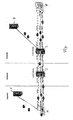
- the figure shows a schematic representation of an embodiment of the invention with a circuit arrangement from which the establishment of a VoIP connection between an external first telephone terminal and a second telephone terminal in a secured network, in particular in a company network, can be seen using security mechanisms existing in IP networks is.
- the second telephone terminal B is registered in an intranet of a private, secure company network, for example with a gatekeeper 4.
- the telephone terminal B not only has access to all telephone terminals within the intranet and also an available extranet from the company, but it can also be connected to public networks if a corresponding release is provided.
- the first telephone terminal A can also, however, be registered in another company network or it is connected to the usual public telephone network. Furthermore, the telephone terminal A has access to the Internet in any case, which takes place by means of an information server 1, so that a VoIP connection via the Internet is also possible with the telephone terminal A.
- the Internet was originally developed for secure, particularly secure, international data transfer and is therefore not ideal for a telephone connection, since the information is transmitted in packets on different lines.
- the distances between the subscribers are irrelevant, making VoIP connections particularly cost-effective and attractive, especially for long-distance calls.
- these advantages are faced with considerable technical difficulties.
- a first partial connection is established over the Internet between the telephone terminal A and an E-proxy 2 in the extranet of the company network.
- a proxy is usually understood to mean a device that is part of a security device (firewall) and among other things implements the incoming protocols for its own network (and vice versa).
- a partial connection is established between the E-proxy 2 and an I-proxy 3 of the intranet and in a third step between the I-proxy 3 and the telephone terminal B.
- the first subscriber (telephone terminal A) wants to call a company with an identifier 7505 via the Internet and here the second subscriber with the internal number 1234. He then enters the corresponding number sequence 7505 1234 as usual. Alternatively, it is also provided to enter a name code or an email address instead of the phone number, as will be explained later.
- the telephone terminal A After entering the phone number, the telephone terminal A sends a request for the first connection part to the information server 1 of its domain on the Internet, which analyzes the company ID 7505.
- the information server 1 can be designed as a name server or gatekeeper and, like the other devices 2, 3, 4, is known per se. (For reasons of clarity The processes within the information server 1 and the information exchange with other information servers in other domains should not be considered here.)
- the information server 1 sends a confirmation (Confirm) with the VoIP address of the E-proxy 2 to the telephone terminal A. Die Individual steps can be seen from the numbers 1 to 3 marked with circles.
- a fourth step (section 4) it is assumed as an example that the first participant has a home office and is therefore known.
- the first partial connection between the telephone terminal A and the e-proxy 2 can already be started with an RAS (Admission Request).
- RAS Admission Request
- the individual sequential steps and the ports 1719, 1720, which are necessary for the control, are shown by dashed lines. In general, step 4 does not apply, then step 5 would continue.
- the E-Proxy 2 starts the establishment of the H.245 control channel to the telephone terminal B after successfully setting up Q.931. Furthermore, using the negotiated port H.245, the multimedia channel (port 10000) becomes between the telephone terminal A and the E-Proxy 2 built.
- RTP means Real Time Protocol (suitable for voice transmission).
- the second partial connection between the E-proxy and the I-proxy is set up in parallel to the first partial connection, as described above (section 8).
- the protocol used can be H.323, SIP or an individual, proprietary protocol. If the H.323 protocol is used, the process can as previously described with the protocols RAS, Q.931, H.245. When using a proprietary protocol, individual features and functions can of course be implemented.
- the I-proxy 3 sends an ARQ signal (admission request) and others, in accordance with the numbers 9 and 10. with the number 1234 of the second telephone terminal B to gatekeeper 4 of its domain. Since the telephone terminal B is registered with the gatekeeper 4, the gatekeeper 4 answers with an AC F signal (Admission Confirm). This message contains the IP address of the telephone terminal B (intranet). The gatekeeper 4 also knows the identifiers, names and email addresses etc. of the registered telephone terminal B, so that it can easily convert the incoming identifier into the corresponding telephone number. The use of a NAT (Network Address Translater) in the internal network when establishing the connection can thus be used with great advantage.
- NAT Network Address Translater
- connection between the I-proxy 3 and the telephone terminal B is established in parallel to the establishment of the connection between the E-proxy 2 and I-proxy 3.
- H.323, SIP or a proprietary protocol can again advantageously be used as the protocol. If the H.323 protocol is used, the connection establishment starts with a setup message according to Q.931 from I-Proxy 3 to telephone terminal B.
- the telephone terminal B confirms the successful setup by sending the corresponding Q.931 message (alerting, connect) to the I-proxy 3 (number 13).
- the I-Proxy 3 starts to set up the H.245 control channel to the telephone terminal B.
Landscapes
- Engineering & Computer Science (AREA)
- Computer Networks & Wireless Communication (AREA)
- Signal Processing (AREA)
- Computer Security & Cryptography (AREA)
- Multimedia (AREA)
- Computer Hardware Design (AREA)
- Computing Systems (AREA)
- General Engineering & Computer Science (AREA)
- Business, Economics & Management (AREA)
- General Business, Economics & Management (AREA)
- Data Exchanges In Wide-Area Networks (AREA)
- Telephonic Communication Services (AREA)
Applications Claiming Priority (2)
| Application Number | Priority Date | Filing Date | Title |
|---|---|---|---|
| DE10245547A DE10245547B3 (de) | 2002-09-30 | 2002-09-30 | Verfahren zum Aufbau einer VoIP-Telefonverbindung in einem gesicherten Netzwerk sowie Schaltungsanordnung |
| DE10245547 | 2002-09-30 |
Publications (2)
| Publication Number | Publication Date |
|---|---|
| EP1404098A2 true EP1404098A2 (fr) | 2004-03-31 |
| EP1404098A3 EP1404098A3 (fr) | 2006-05-24 |
Family
ID=31969713
Family Applications (1)
| Application Number | Title | Priority Date | Filing Date |
|---|---|---|---|
| EP03021794A Withdrawn EP1404098A3 (fr) | 2002-09-30 | 2003-09-26 | Procédé et système pour l'établissement d'un appel téléphonique VoIP dans un réseau securisé |
Country Status (2)
| Country | Link |
|---|---|
| EP (1) | EP1404098A3 (fr) |
| DE (1) | DE10245547B3 (fr) |
Cited By (2)
| Publication number | Priority date | Publication date | Assignee | Title |
|---|---|---|---|---|
| DE102008019032A1 (de) * | 2008-04-15 | 2009-10-22 | T-Mobile International Ag | Universelle Adressierung eines Kommunikationspartners über verdeckte dynamische Zuordnung einer Rufnummer |
| CN112187759A (zh) * | 2020-09-21 | 2021-01-05 | 浙江网商银行股份有限公司 | 跨网数据传输方法及装置 |
Family Cites Families (5)
| Publication number | Priority date | Publication date | Assignee | Title |
|---|---|---|---|---|
| US6104716A (en) * | 1997-03-28 | 2000-08-15 | International Business Machines Corporation | Method and apparatus for lightweight secure communication tunneling over the internet |
| US6289462B1 (en) * | 1998-09-28 | 2001-09-11 | Argus Systems Group, Inc. | Trusted compartmentalized computer operating system |
| US20010046209A1 (en) * | 1998-12-31 | 2001-11-29 | David N. Glassman | Database workflow for multimedia networking and voip |
| US6757823B1 (en) * | 1999-07-27 | 2004-06-29 | Nortel Networks Limited | System and method for enabling secure connections for H.323 VoIP calls |
| GB2365256A (en) * | 2000-07-28 | 2002-02-13 | Ridgeway Systems & Software Lt | Audio-video telephony with port address translation |
-
2002
- 2002-09-30 DE DE10245547A patent/DE10245547B3/de not_active Expired - Fee Related
-
2003
- 2003-09-26 EP EP03021794A patent/EP1404098A3/fr not_active Withdrawn
Cited By (2)
| Publication number | Priority date | Publication date | Assignee | Title |
|---|---|---|---|---|
| DE102008019032A1 (de) * | 2008-04-15 | 2009-10-22 | T-Mobile International Ag | Universelle Adressierung eines Kommunikationspartners über verdeckte dynamische Zuordnung einer Rufnummer |
| CN112187759A (zh) * | 2020-09-21 | 2021-01-05 | 浙江网商银行股份有限公司 | 跨网数据传输方法及装置 |
Also Published As
| Publication number | Publication date |
|---|---|
| DE10245547B3 (de) | 2004-05-13 |
| EP1404098A3 (fr) | 2006-05-24 |
Similar Documents
| Publication | Publication Date | Title |
|---|---|---|
| EP1193919B1 (fr) | Procédé pour établir une connection entre un terminal d'un réseau de communication et une destination de connection externe au réseau, et dispositifs pour la réalisation du procédé | |
| EP1211878B1 (fr) | Méthode et appareil de renvoi d'appel par un représentant dans un système de communication | |
| EP1014660A2 (fr) | Méthode pour réaliser une fonction de lignes groupées dans un réseau de communication selon ITU-T H.323 | |
| EP1492300A1 (fr) | Procédé et arrangement pour l'accès à un premier terminal d'un premier réseau de transmissions depuis un noeud de communication d'un deuxième réseau de transmissions | |
| DE10353925A1 (de) | Verfahren zum Austausch von Daten zwischen zwei Hosts | |
| EP1649659B1 (fr) | Liaison entre abonnes dans des reseaux de communication hybrides | |
| EP1014665A2 (fr) | Méthode pour réaliser un transfert d'appel à partir de l'état actif dans un réseau de communication selon le standard ITU-T H.323 | |
| EP1665756A1 (fr) | Interfonctionnement de protocoles dans des reseaux multimedia hybrides | |
| WO2010034499A2 (fr) | Procédé et dispositif de conversion d'adresse bidirectionnelle dans des flux de données à commande sip entre des terminaux de traitement de données ipv4 et ipv6 | |
| WO2005079049A1 (fr) | Etablissement d'une liaison multimedia de transmission par paquets au moyen d'un systeme de reponse vocale interactif | |
| EP1430693B1 (fr) | Procede et dispositif de mise en oeuvre d'une application de pare-feu pour des donnees de communication | |
| DE10241202A1 (de) | Verfahren und Anordnungen zur Kommunikation zwischen einem leitungsvermittelten Kommunikationsnetz und mehreren VoIP-Netzwerkdomänen | |
| DE10245547B3 (de) | Verfahren zum Aufbau einer VoIP-Telefonverbindung in einem gesicherten Netzwerk sowie Schaltungsanordnung | |
| WO2007113031A1 (fr) | Procédé de transmission sécurisée de données utiles | |
| DE10001821A1 (de) | Verfahren zum Aufbau einer Verbindung zwischen zwei Datenübertragungsgeräten über ein Datenübertragungsnetz vom INTERNET-Typ | |
| DE10053951B4 (de) | Verfahren und Router zur Einrichtung einer Verbindung über ein IP-orientiertes Netz | |
| EP1513312B1 (fr) | Téléphonie Vidéo multimédia | |
| DE10345017A1 (de) | Verfahren und Vorrichtung zur Adressierbarkeit von Personen für Sprachkommunikation hinter beliebigen verbindungsorientierten Anschlussarten | |
| DE19833969A1 (de) | Verfahren zum Aufbau einer Kommunikationsverbindung | |
| EP1522183B1 (fr) | Procédé de conversion d'adresses dans de réseaux de commutation par paquets et element de commande pour réseaux de communication | |
| EP1438827A1 (fr) | Repartition fonctionnelle pour unites de commande de reseau | |
| DE102006030591A1 (de) | Verfahren zur Verwaltung von Kommunikationsverbindungen | |
| EP1383295B1 (fr) | Méthode de mappage d'adresses dans des réseaux de paquets et appareil de mappage pour réseaux de communication | |
| EP2208319A1 (fr) | Commande d'appel en mode commutation de circuits par le biais d'un canal utile ip dans le réseau d'accès | |
| DE10155939A1 (de) | Verfahren zur Übertragung von Signalisierungsdaten und Telekommunikationssystem |
Legal Events
| Date | Code | Title | Description |
|---|---|---|---|
| PUAI | Public reference made under article 153(3) epc to a published international application that has entered the european phase |
Free format text: ORIGINAL CODE: 0009012 |
|
| AK | Designated contracting states |
Kind code of ref document: A2 Designated state(s): AT BE BG CH CY CZ DE DK EE ES FI FR GB GR HU IE IT LI LU MC NL PT RO SE SI SK TR |
|
| AX | Request for extension of the european patent |
Extension state: AL LT LV MK |
|
| PUAL | Search report despatched |
Free format text: ORIGINAL CODE: 0009013 |
|
| AK | Designated contracting states |
Kind code of ref document: A3 Designated state(s): AT BE BG CH CY CZ DE DK EE ES FI FR GB GR HU IE IT LI LU MC NL PT RO SE SI SK TR |
|
| AX | Request for extension of the european patent |
Extension state: AL LT LV MK |
|
| RIC1 | Information provided on ipc code assigned before grant |
Ipc: H04L 29/06 20060101AFI20060405BHEP |
|
| 17P | Request for examination filed |
Effective date: 20061117 |
|
| AKX | Designation fees paid |
Designated state(s): AT BE BG CH CY CZ DE DK EE ES FI FR GB GR HU IE IT LI LU MC NL PT RO SE SI SK TR |
|
| 17Q | First examination report despatched |
Effective date: 20091215 |
|
| STAA | Information on the status of an ep patent application or granted ep patent |
Free format text: STATUS: THE APPLICATION IS DEEMED TO BE WITHDRAWN |
|
| 18D | Application deemed to be withdrawn |
Effective date: 20150401 |