EP1408129A1 - Alliage à base de zirconium et élément de reacteur nucléaire en cet alliage - Google Patents
Alliage à base de zirconium et élément de reacteur nucléaire en cet alliage Download PDFInfo
- Publication number
- EP1408129A1 EP1408129A1 EP02022307A EP02022307A EP1408129A1 EP 1408129 A1 EP1408129 A1 EP 1408129A1 EP 02022307 A EP02022307 A EP 02022307A EP 02022307 A EP02022307 A EP 02022307A EP 1408129 A1 EP1408129 A1 EP 1408129A1
- Authority
- EP
- European Patent Office
- Prior art keywords
- zirconium
- base alloy
- content
- hydrogen absorption
- alloy
- Prior art date
- Legal status (The legal status is an assumption and is not a legal conclusion. Google has not performed a legal analysis and makes no representation as to the accuracy of the status listed.)
- Ceased
Links
Images



Classifications
-
- G—PHYSICS
- G21—NUCLEAR PHYSICS; NUCLEAR ENGINEERING
- G21C—NUCLEAR REACTORS
- G21C3/00—Reactor fuel elements and their assemblies; Selection of substances for use as reactor fuel elements
- G21C3/02—Fuel elements
- G21C3/04—Constructional details
- G21C3/06—Casings; Jackets
- G21C3/07—Casings; Jackets characterised by their material, e.g. alloys
-
- C—CHEMISTRY; METALLURGY
- C22—METALLURGY; FERROUS OR NON-FERROUS ALLOYS; TREATMENT OF ALLOYS OR NON-FERROUS METALS
- C22C—ALLOYS
- C22C16/00—Alloys based on zirconium
-
- C—CHEMISTRY; METALLURGY
- C22—METALLURGY; FERROUS OR NON-FERROUS ALLOYS; TREATMENT OF ALLOYS OR NON-FERROUS METALS
- C22F—CHANGING THE PHYSICAL STRUCTURE OF NON-FERROUS METALS AND NON-FERROUS ALLOYS
- C22F1/00—Changing the physical structure of non-ferrous metals or alloys by heat treatment or by hot or cold working
- C22F1/16—Changing the physical structure of non-ferrous metals or alloys by heat treatment or by hot or cold working of other metals or alloys based thereon
- C22F1/18—High-melting or refractory metals or alloys based thereon
- C22F1/186—High-melting or refractory metals or alloys based thereon of zirconium or alloys based thereon
-
- G—PHYSICS
- G21—NUCLEAR PHYSICS; NUCLEAR ENGINEERING
- G21C—NUCLEAR REACTORS
- G21C1/00—Reactor types
- G21C1/04—Thermal reactors ; Epithermal reactors
- G21C1/06—Heterogeneous reactors, i.e. in which fuel and moderator are separated
- G21C1/08—Heterogeneous reactors, i.e. in which fuel and moderator are separated moderator being highly pressurised, e.g. boiling water reactor, integral super-heat reactor, pressurised water reactor
- G21C1/084—Boiling water reactors
-
- Y—GENERAL TAGGING OF NEW TECHNOLOGICAL DEVELOPMENTS; GENERAL TAGGING OF CROSS-SECTIONAL TECHNOLOGIES SPANNING OVER SEVERAL SECTIONS OF THE IPC; TECHNICAL SUBJECTS COVERED BY FORMER USPC CROSS-REFERENCE ART COLLECTIONS [XRACs] AND DIGESTS
- Y02—TECHNOLOGIES OR APPLICATIONS FOR MITIGATION OR ADAPTATION AGAINST CLIMATE CHANGE
- Y02E—REDUCTION OF GREENHOUSE GAS [GHG] EMISSIONS, RELATED TO ENERGY GENERATION, TRANSMISSION OR DISTRIBUTION
- Y02E30/00—Energy generation of nuclear origin
- Y02E30/30—Nuclear fission reactors
Definitions
- the present invention relates to zirconium-base alloys for nuclear reactors and to nuclear reactor components comprising the zirconium-base alloys.
- Zirconium alloys are now extensively used as fuel cladding materials and core structural materials in boiling-water reactors, pressurized-water reactors, and so forth.
- the most commonly employed so far are Zircaloy-2 containing 1.2-1.7 wt.% Sn, 0.07-0.20 wt.% Fe, 0.05-0.15 wt.% Cr, 0 . 03-0. 08 wt.% Ni, and the balance being Zr, and Zircaloy-4 containing 1.2-1.7 wt.% Sn, 0.18-0.24 wt.% Fe, 0. 07-0.13 wt.% Cr, and the balance being Zr.
- zirconium alloys In addition to these zirconium alloys, Zr - 2.5% Nb alloy, Zr - 1% Nb alloy, etc. are used for nuclear reactors as well.
- the above-described zirconium alloys have been developed in view of neutron economy, strength and corrosion resistance.
- nodular corrosion occurs, during operation, at localized regions on the surfaces of the above-described materials to give lenticular corrosion layers.
- the nodular corrosion process proceeds with the progress of irradiation, and the corrosion layers can come off when they got thick.
- structural materials undergo decrease in thickness.
- the falling of corrosion layers increases the radioactivity in a coolant, there is such a fear that the exposure dose during periodic inspection becomes higher.
- Known techniques for preventing occurrence of nodular corrosion include a heat treatment method in which an alloy is heated, for a short period of time, at a temperature in the temperature range in which the alloy exists in ⁇ + ⁇ or ⁇ phase and is then rapidly quenched (Japanese Patent Publications Nos. 45699/1986 and No. 58223/1988) , and a method in which the composition of an alloy is modified (Japanese Laid-Open Patent Publications No. 43450/1985 and No. 228442/1987).
- intermetallic compounds present in the alloy as precipitates mainly, two types of compounds Zr(Cr, Fe) 2 and Zr 2 (Ni, Fe) are present
- the precipitates are fine in the course of ⁇ + ⁇ or ⁇ quenching, occurrence of nodular corrosion is prevented to greatly improve the corrosion resistance of the alloy.
- Zircaloy-2 which is now mainly used for boiling-water reactors, has been modified, for example, by increasing its Fe content within the specified range.
- the modified Zircaloy-2 well functions under the current operating conditions when viewed from corrosion resistance and hydrogen absorption characteristics.
- the hydrogen absorption requirements due to such a change in circumstances that hydrogen is fed to the coolant water supply system of a nuclear reactor and due to a demand for decrease in the wall thickness of fuel structural materials, the hydrogen absorption requirements, in particular, are becoming severer in recent years. To lower hydrogen absorption is, therefore, an important matter for improvement in the reliability and performance of nuclear reactor fuels.
- the present invention relates to zirconium alloys for use in nuclear reactors.
- An object of the present invention is to provide zirconium-base alloys that show high corrosion resistance and low hydrogen absorption even when they are used,under the core conditions,in light-water-cooled nuclear power reactors for a prolonged period of time, and nuclear reactor components comprising the zirconium-base alloys.
- a zirconium-base alloy for nuclear reactors comprises 0.5 - 2 wt.% Sn, 0.07 - 0.6 wt.% Fe, 0.03 - 0.2 wt.% Ni, 0.05 - 0.2 wt.% Cr, and the balance being zirconium and unavoidable impurities, wherein the Fe content (X wt.%) of the zirconium-base alloy and the mean size (Y nm) of precipitates in the zirconium-base alloy are present in a region on the x (Fe content X) and y (mean precipitate size) rectangular coordinates, surrounded by the following five lines:
- a zirconium-base alloy for nuclear reactors comprises 0.5 - 2 wt.% Sn, 0.07 - 0.6 wt.% Fe, 0.03 - 0.2 wt.% Ni, 0.05 - 0.2 wt.% Cr, and the balance being zirconium and unavoidable impurities, wherein the Fe content (X wt.%) and the annealing parameter ( ⁇ Ai) of the zirconium-base alloy are present in a region on the x (Fe content X) and y (annealing parameter) rectangular coordinates, surrounded by the following five lines:
- the mean size (Y nm) of precipitates in a zirconium-base alloy can be determined, for example, by the following method: a zirconium-base alloy is made into a thin film, and precipitates contained in this thin film are observed by a transmission electron microscope; the images of the precipitates are recorded as image data; and these data are analyzed to determine the diameters of circles approximate to the precipitates and the mean diameter is then obtained by calculation.
- Another method useful for determining the mean precipitate size is as follows: a zirconium-base alloy is chemically etched, and precipitates on the etched alloy surface are observed by a scanning electron microscope. In general, approximately 200 precipitates are needed to obtain stable size distribution, so that it is desirable to observe 200 or more precipitates.
- the annealing parameter ( ⁇ Ai) is an index of the amount of heat a zirconium-base alloy gains during heat treatment, such as annealing, that is conducted after subjecting the alloy to ⁇ or ⁇ + ⁇ -quenching.
- the ⁇ -quenching herein means that a zirconium-base alloy is heated to a temperature in the temperature range in which the alloy exists in ⁇ phase and is then rapidly quenched
- the ⁇ + ⁇ -quenching means that a zirconium-base alloy is heated to a temperature in the temperature range in which the alloy exists in ⁇ + ⁇ phase and is then rapidly quenched.
- the region surrounded by the lines i) - v) on the rectangular coordinates defining the Fe content (X wt.%) of the zirconium-base alloy and the mean size (Y nm) of precipitates in the zirconium-base alloy is as shown in Fig. 1 or 2.
- a nuclear reactor component according to the present invention comprises the above-described zirconium alloy.
- the zirconium alloys of the present invention are excellent in both corrosion resistance and hydrogen absorption characteristics and are useful as materials for nuclear reactors. In particular, they are excellent as fuel cladding materials for use in nuclear fuel elements, and can increase the cladding life.
- FIG. 4 shows the relationship, at three different Fe contents, between mean precipitate size and the rate of dissolution of Fe and Ni, that is, Fe + Ni (at%/s).
- the region under each curve, below the threshold of occurrence of nodular corrosion is a nodular-corrosion-occurring region.
- Fig. 1 isadiagramusingrectangularcoordinates, plotting Fe content (wt.%) as the X-axis and mean precipitate diameter (nm) as the Y-axis.
- the region on the upper left side of the line of the threshold of nodular corrosion is a nodular-corrosion-occurring region. It can be known that the threshold precipitate size of occurrence of nodular corrosion gradually increases with Fe content.
- the relative hydrogen absorption rapidly lowers to approximately 0.6, but tends not to become below 0.6 any more because saturation occurs. Therefore, specifications are established so that the relative hydrogen absorption can be 0.6 or less of that of the conventional materials.
- the Fe content is set at not more than 0.6 wt.% because a zirconium-base alloy having an Fe content of more than 0. 6 wt.% has worsened processing characteristics and ductility.
- ⁇ Ai ⁇ ti ⁇ exp (-40,000/Ti) wherein ti is a retention time (h) at a heat treatment temperature Ti, and Ti is a heat treatment temperature (K).
- the zirconium-base alloys according to the present invention comprise Sn, Fe, Ni, Cr, Zr and unavoidable impurities.
- the Fe content is specified in consideration of correlation with mean precipitate size or annealing parameter ( ⁇ Ai), as described above.
- the contents of the essential components other than Fe are as follows: the Sn content is from 0.5 to 2 wt.%, the Ni content is from 0. 03 to 0.2 wt.%, the Cr content is from 0.05 to 0.2 wt.%, and the balance comprises Zr and unavoidable impurities.
- Sn is a constituent particularly useful for imparting improved strength and corrosion resistance to zirconium-base alloys.
- a zirconium-base alloy containing less than 0.5 wt.% of Sn cannot show sufficiently high strength, while a zirconium-base alloy containing more than 2 wt.% of Sn has worsened corrosion resistance. Therefore, from 0.5 to 2 wt.% is the Sn content specified in the present invention.
- a preferable Sn content range in the present invention is from 0.8 to 1.5 wt.%.
- Ni is a constituent particularly useful for imparting improved corrosion resistance to zirconium-base alloys.
- Ni is incorporated into a zirconium-base alloy in an amount of less than 0.03 wt.%, the effect of improving corrosion resistance cannot fully be obtained.
- a zirconium-base alloy containing more than 0 .2 wt.% of Ni has remarkably worsened hydrogen absorption property.
- the Ni content specified in the present invention is, therefore, from 0.03 to 0.2 wt.%.
- a preferable Ni content range in the present invention is from 0.05 to 0.10 wt.%.
- Cr is a constituent particularly useful for imparting improved corrosion resistance tozirconium-base alloys. This element governs the proportions of two types (Zr 2 (Fe, Ni) type and Zr(Fe, Cr) 2 type) of precipitates, mainly present in a zirconium-base alloy containing Fe, Ni and Cr, and indirectly affects the corrosion resistance and hydrogen absorption property of the zirconium-base alloy.
- Zr 2 (Fe, Ni) type and Zr(Fe, Cr) 2 type Zr(Fe, Cr) 2 type
- the Cr content specified in the present invention is, therefore, from 0.05 to 0.2 wt.%.
- a preferable Cr content range in the present invention is from 0.07 to 0.15 wt.%.
- a zirconium-base alloy according to the present invention can be produced in the following manner, for example.
- An ingot melt is subjected to hot forging (e.g., at 700 to 750°C) and solution treatment (e. g., at approximately 1000°C for several hours), and is then made into a billet for extrusion by conducting cutting, surface grinding and drilling.
- a double billet may also be made by the combination use of two alloys having different chemical compositions.
- the billet for extrusion is then subjected, for example, to hot extrusion at 600 to 700°C to obtain a tubeshell. In general, this tubeshell is alternately subjected to cold rolling and annealing three times to obtain a fuel cladding tube.
- ⁇ + ⁇ or ⁇ -quenching is conducted before the first, second or third cold rolling step, and, after the ⁇ + ⁇ or ⁇ -quenching is completed, cold rolling and annealing are alternately conducted.
- the ⁇ + ⁇ or ⁇ -quenching may be conducted in any of the following manners: the outer surface of the tubeshell is heated to a temperature (e.g., approximately 930°C) in the temperature range in which the alloy exists in ⁇ + ⁇ phase (a so-called tubeshell heat treatment); the ⁇ + ⁇ or ⁇ -quenching is conducted in a series of the steps of cold rolling and annealing, usually repeated approximately three times, for making the tubeshell into a fuel cladding tube; or the ⁇ + ⁇ or ⁇ -quenching is conducted inthecourseoftheproductionofthetubeshell.
- Thezirconium alloys according to the present invention are applicable to any of the above manners.
- the quantif ication of heat treatment by using annealing parameter ( ⁇ Ai) can also be applied to any of the above manners.
- the amount of heat a zirconium alloy gains after the lastly conducted ⁇ + ⁇ or ⁇ -quenching is quantified by the annealing parameter.
- zirconium-base alloys according to the present invention are excellent in both corrosion resistance and hydrogen absorption property and are useful, for example, for a variety of nuclear reactor components, in particular, for fuel cladding tubes in fuel assemblies, spacer bands, spacer cells and water rods.
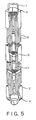
- Fig. 5 is a perspective view of a fuel assembly to be placed in a boiling-water reactor
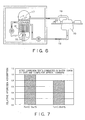
- Fig. 6 is a diagrammatical view of a boiling-water reactor.
- water 18 is changed to steam 17 by the thermal energy generated by a fuel element 16 in a core 15, and a turbine 19 is rotated by the steam to produce electric power.
- the steam once used is returned to water by a condenser 20; the water is re-circulated and is changed to steam again.
- the fuel element 16 shown in Fig. 6 is composed of a plurality of fuel assemblies, one fuel assembly being shown in Fig. 5.
- the fuel assembly 1 is composed of rod-shaped elements such as a predetermined number of fuel rods 6 and a water rod 7, which are arranged in a grid pattern in a channel box 2.
- the upper and lower ends of the rod-shaped elements are connected to an upper tie plate 3 and a lower tie plate 4 through an upper end plug and a lower end plug, respectively, and spacers 5 are arranged at predetermined intervals at a plurality of points between upper and lower end plugs.
- the channel box, water rod, fuel rods and spacers are in direct contact with water.
- These components are currently made from Zircaloy-2 or Zircaloy-4, and are required to show higher corrosion resistance and lower hydrogen absorption.
- Fig. 7 shows the results (after approximately 1100 hours) of corrosion tests carried out in water vapor at 400°C and 10.3 MPa, using an experimental alloy having a composition within the specif ications established in the present invention, and a comparative zirconium-base alloy.
- Example 1 Subjected to the corrosion tests were specifically a zirconium-base alloy containing 0.18 wt.% of Fe (Comparative Example 1) and a zirconium-base alloy of the present invention, containing 0.26 wt.% of Fe (Example 1).
- the mean size of precipitates in each alloy is approximately 80 nm, which is nearly equal to the mean size of precipitates in the conventional Zircaloy-2.
- Example 1 the alloy of Example 1 and that of Comparative Example 1 are as follows:
- Comparative Example 1 a zirconium-base alloy containing 1.35 wt.% Sn, 0.18 wt.% Fe, 0.07 wt.% Ni, 0.11 wt.% Cr, and the balance being Zr, and
- Example 1 a zirconium-base alloy containing 1.35 wt.% Sn, 0.26 wt.% Fe, 0.07 wt.% Ni, 0.11 wt.% Cr, and the balance being Zr.
- a ingot melt was subjected to hot forging (at 700 to 750°C) and solution treatment (at approximately 1000°C for several hours), and was then made into a billet for extrusion by conducting cutting, surface grinding and drilling.
- This billet for extrusion was subjected to hot extrusion at 600 to 700°C to obtain a tubeshell.
- the outer surface of this tubeshell was treated by the previously mentioned tubeshell heat treatment, that is, the outer surface of the tubeshell was heated to a temperature (e.g., approximately 930°C) at which the alloy exists in ⁇ + ⁇ phase, and was then alternately subjected to cold rolling and annealing three times to obtain a fuel cladding tube.
- the graph in Fig. 7 shows that the hydrogen absorption of the zirconium-base alloy of Example 1 is 0.8 when the Fe content increases, compared with the zirconium-base alloy of Comparative Example 1.
- This prediction well agrees with the test results shown in Fig. 7. It can thus be known that the improved zirconium-base alloy of the present invention is superior to the conventional alloy in hydrogen absorption property.
- the improved zirconium-base alloy of the present invention for the above-described components, it becomes possible to provide a fuel assembly that is superior to the conventional one particularly in hydrogen absorption property.
- Fig. 8 is a view showing the spacer shown in Fig. 5.
- a spacer has the function of bundling fuel rods individually placed in spacer cells to arrange them properly.
- it is presently required to decrease the wall thickness of spacer cells or spacer bands.
- the concentration of hydrogen in a material increases almost inversely proportional to the thickness of the material, and the ductility and strength properties of the material are greatly governed by the concentration of hydrogen in the material. It is, therefore, difficult to further decrease wall thickness with the conventional hydrogen absorption property left as they are. Decrease in hydrogen absorption is particularly required for spacers.
- this spacer can have a decreased wall thickness while retaining ductility and strength equal to those of the conventional spacer.
- the alloy of the present invention is used for a spacer as shown in Fig. 8, the hydrogen absorption of the spacer becomes 50% of that of the conventional spacer, so that it becomes possible to make the spacer wall thin to an extent unattainable by the use of the conventional materials.
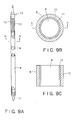
- Fig. 9 is a view showing the fuel rod 6 shown in Fig. 5 .
- the fuel rod is composed of a nuclear fuel material 9 that causes fissile reaction to generate heat, a fuel cladding tube 8, a plenum 12, an upper end plug 13 and a lower end plug 14.
- Fig. 9A is a perspective view of the fuel rod
- Fig. 9B is a cross-sectional view of the fuel rod
- Fig. 9C is a longitudinal sectional view of the fuel rod.
- reference numeral 8 designates a fuel cladding tube, in which a nuclear fuel material 9 is stacked.
- a conventional fuel cladding tube 8 is composed of a tube 10 made of Zircaloy-2 and a liner layer 11 made of pure zirconium, laid on the inner surface of the tube 10.
Landscapes
- Chemical & Material Sciences (AREA)
- Engineering & Computer Science (AREA)
- Metallurgy (AREA)
- Physics & Mathematics (AREA)
- Organic Chemistry (AREA)
- Materials Engineering (AREA)
- Mechanical Engineering (AREA)
- Crystallography & Structural Chemistry (AREA)
- Thermal Sciences (AREA)
- Plasma & Fusion (AREA)
- General Engineering & Computer Science (AREA)
- High Energy & Nuclear Physics (AREA)
- Monitoring And Testing Of Nuclear Reactors (AREA)
Priority Applications (3)
| Application Number | Priority Date | Filing Date | Title |
|---|---|---|---|
| JP2001108787A JP3983493B2 (ja) | 2001-04-06 | 2001-04-06 | ジルコニウム基合金の製造法 |
| US10/263,714 US6690759B1 (en) | 2001-04-06 | 2002-10-04 | Zirconium-base alloy and nuclear reactor component comprising the same |
| EP02022307A EP1408129A1 (fr) | 2001-04-06 | 2002-10-07 | Alliage à base de zirconium et élément de reacteur nucléaire en cet alliage |
Applications Claiming Priority (3)
| Application Number | Priority Date | Filing Date | Title |
|---|---|---|---|
| JP2001108787A JP3983493B2 (ja) | 2001-04-06 | 2001-04-06 | ジルコニウム基合金の製造法 |
| US10/263,714 US6690759B1 (en) | 2001-04-06 | 2002-10-04 | Zirconium-base alloy and nuclear reactor component comprising the same |
| EP02022307A EP1408129A1 (fr) | 2001-04-06 | 2002-10-07 | Alliage à base de zirconium et élément de reacteur nucléaire en cet alliage |
Publications (1)
| Publication Number | Publication Date |
|---|---|
| EP1408129A1 true EP1408129A1 (fr) | 2004-04-14 |
Family
ID=32397537
Family Applications (1)
| Application Number | Title | Priority Date | Filing Date |
|---|---|---|---|
| EP02022307A Ceased EP1408129A1 (fr) | 2001-04-06 | 2002-10-07 | Alliage à base de zirconium et élément de reacteur nucléaire en cet alliage |
Country Status (3)
| Country | Link |
|---|---|
| US (1) | US6690759B1 (fr) |
| EP (1) | EP1408129A1 (fr) |
| JP (1) | JP3983493B2 (fr) |
Cited By (3)
| Publication number | Priority date | Publication date | Assignee | Title |
|---|---|---|---|---|
| EP1634974A1 (fr) * | 2004-09-08 | 2006-03-15 | Global Nuclear Fuel-Americas, LLC | Procédé de fabrication de composants en alliage de zirconium pour réacteurs nucléaires |
| EP1634973A1 (fr) * | 2004-09-08 | 2006-03-15 | Global Nuclear Fuel-Americas, LLC | Méthode de fabrication d'un composant pour réacteur nucléaire en alliage de zirconium |
| RU2726936C1 (ru) * | 2019-02-21 | 2020-07-17 | Акционерное общество "Высокотехнологический научно-исследовательский институт неорганических материалов имени академика А.А. Бочвара" | Способ изготовления дистанционирующих решеток для тепловыделяющей сборки ядерного реактора |
Citations (5)
| Publication number | Priority date | Publication date | Assignee | Title |
|---|---|---|---|---|
| JPS6043450A (ja) * | 1983-08-16 | 1985-03-08 | Hitachi Ltd | ジルコニウム基合金基体 |
| EP0154559A2 (fr) * | 1984-03-08 | 1985-09-11 | Hitachi, Ltd. | Elément structural en alliage à base de zirconium et procédé pour sa fabrication |
| US4678521A (en) * | 1981-07-29 | 1987-07-07 | Hitachi, Ltd. | Process for producing zirconium-based alloy and the product thereof |
| US4810461A (en) * | 1985-12-09 | 1989-03-07 | Hitachi, Ltd. | Zirconium-based alloy with high corrosion resistance |
| US4863679A (en) * | 1984-03-09 | 1989-09-05 | Hitachi, Ltd. | Cladding tube for nuclear fuel and nuclear fuel element having this cladding tube |
Family Cites Families (10)
| Publication number | Priority date | Publication date | Assignee | Title |
|---|---|---|---|---|
| JPS5822364A (ja) | 1981-07-29 | 1983-02-09 | Hitachi Ltd | ジルコニウム基合金の製造法 |
| JPS5822365A (ja) | 1981-07-29 | 1983-02-09 | Hitachi Ltd | ジルコニウム基合金の製造方法 |
| US5264724A (en) * | 1989-02-13 | 1993-11-23 | The University Of Arkansas | Silicon nitride for application as the gate dielectric in MOS devices |
| JP2638351B2 (ja) * | 1991-09-20 | 1997-08-06 | 株式会社日立製作所 | 燃料集合体 |
| US5366690A (en) * | 1993-06-18 | 1994-11-22 | Combustion Engineering, Inc. | Zirconium alloy with tin, nitrogen, and niobium additions |
| DE69602123T3 (de) * | 1995-03-28 | 2007-03-29 | General Electric Co. | Legierung zur Verbesserung der Korrosionsbeständigkeit von Kernreaktorbauteile |
| JPH10265921A (ja) * | 1997-03-24 | 1998-10-06 | Kobe Steel Ltd | 高耐食性ジルコニウム基合金部材およびその製造方法 |
| JPH11194189A (ja) * | 1997-10-13 | 1999-07-21 | Mitsubishi Materials Corp | 耐食性およびクリープ特性にすぐれた原子炉燃料被覆管用Zr合金管の製造方法 |
| JP2001074872A (ja) * | 1999-08-31 | 2001-03-23 | Hitachi Ltd | 原子炉用ジルコニウム合金の製造方法 |
| KR100382997B1 (ko) * | 2001-01-19 | 2003-05-09 | 한국전력공사 | 고연소도 핵연료 용 니오븀 함유 지르코늄 합금 관재 및판재의 제조방법 |
-
2001
- 2001-04-06 JP JP2001108787A patent/JP3983493B2/ja not_active Expired - Fee Related
-
2002
- 2002-10-04 US US10/263,714 patent/US6690759B1/en not_active Expired - Fee Related
- 2002-10-07 EP EP02022307A patent/EP1408129A1/fr not_active Ceased
Patent Citations (5)
| Publication number | Priority date | Publication date | Assignee | Title |
|---|---|---|---|---|
| US4678521A (en) * | 1981-07-29 | 1987-07-07 | Hitachi, Ltd. | Process for producing zirconium-based alloy and the product thereof |
| JPS6043450A (ja) * | 1983-08-16 | 1985-03-08 | Hitachi Ltd | ジルコニウム基合金基体 |
| EP0154559A2 (fr) * | 1984-03-08 | 1985-09-11 | Hitachi, Ltd. | Elément structural en alliage à base de zirconium et procédé pour sa fabrication |
| US4863679A (en) * | 1984-03-09 | 1989-09-05 | Hitachi, Ltd. | Cladding tube for nuclear fuel and nuclear fuel element having this cladding tube |
| US4810461A (en) * | 1985-12-09 | 1989-03-07 | Hitachi, Ltd. | Zirconium-based alloy with high corrosion resistance |
Non-Patent Citations (1)
| Title |
|---|
| PATENT ABSTRACTS OF JAPAN vol. 009, no. 171 (C - 291) 16 July 1985 (1985-07-16) * |
Cited By (3)
| Publication number | Priority date | Publication date | Assignee | Title |
|---|---|---|---|---|
| EP1634974A1 (fr) * | 2004-09-08 | 2006-03-15 | Global Nuclear Fuel-Americas, LLC | Procédé de fabrication de composants en alliage de zirconium pour réacteurs nucléaires |
| EP1634973A1 (fr) * | 2004-09-08 | 2006-03-15 | Global Nuclear Fuel-Americas, LLC | Méthode de fabrication d'un composant pour réacteur nucléaire en alliage de zirconium |
| RU2726936C1 (ru) * | 2019-02-21 | 2020-07-17 | Акционерное общество "Высокотехнологический научно-исследовательский институт неорганических материалов имени академика А.А. Бочвара" | Способ изготовления дистанционирующих решеток для тепловыделяющей сборки ядерного реактора |
Also Published As
| Publication number | Publication date |
|---|---|
| US6690759B1 (en) | 2004-02-10 |
| JP3983493B2 (ja) | 2007-09-26 |
| JP2002302723A (ja) | 2002-10-18 |
Similar Documents
| Publication | Publication Date | Title |
|---|---|---|
| US5519748A (en) | Zircaloy tubing having high resistance to crack propagation | |
| EP0622470B1 (fr) | Procédé pour la fabrication d'un tubage en zircaloy à haute résistance à la propagation des criques | |
| JP2638351B2 (ja) | 燃料集合体 | |
| EP1111623B1 (fr) | Alliages de zirconium-niobium-étain pour des barreaux de combustible nucléaire et des éléments structurels qui permettent un haut degré de combustion | |
| EP0674322B1 (fr) | Assemblage combustible pour réacteur nucléaire et méthode de fabrication | |
| EP0155603B1 (fr) | Gaine pour combustible nucléaire et combustible nucléaire muni de cette gaine | |
| EP0712938B1 (fr) | Alliage de zirconium | |
| US5436947A (en) | Zirconium alloy fuel cladding | |
| US5618356A (en) | Method of fabricating zircaloy tubing having high resistance to crack propagation | |
| KR100284643B1 (ko) | 고 연소용 핵연료봉 및 구조재를 위한 지르코늄-주석-철 합금 | |
| JP3086207B2 (ja) | 核燃料棒を被覆する管の製造法、核燃料被覆管、ジルコニウム合金の製造法および構造部材の製造法 | |
| US6690759B1 (en) | Zirconium-base alloy and nuclear reactor component comprising the same | |
| US8043448B2 (en) | Non-heat treated zirconium alloy fuel cladding and a method of manufacturing the same | |
| EP0745258B1 (fr) | Element combustible nucleaire pour reacteur a eau pressurisee et son procede de production | |
| JP2814981B2 (ja) | 燃料集合体 | |
| JPH10260280A (ja) | 原子炉用ジルコニウム基合金及び燃料被覆管並びに燃料集合体 | |
| JP2004238737A (ja) | ジルコニウム基合金およびこの合金よりなる原子炉用構造部品 | |
| Rudling et al. | Impact of manufacturing changes on Zr alloy in-pile performance | |
| Farina et al. | Current status of Zirconium alloys for fission cladding | |
| JP2011174111A (ja) | ジルコニウム基合金およびその製造方法 |
Legal Events
| Date | Code | Title | Description |
|---|---|---|---|
| PUAI | Public reference made under article 153(3) epc to a published international application that has entered the european phase |
Free format text: ORIGINAL CODE: 0009012 |
|
| AK | Designated contracting states |
Kind code of ref document: A1 Designated state(s): AT BE BG CH CY CZ DE DK EE ES FI FR GB GR IE IT LI LU MC NL PT SE SK TR |
|
| AX | Request for extension of the european patent |
Extension state: AL LT LV MK RO SI |
|
| RAP1 | Party data changed (applicant data changed or rights of an application transferred) |
Owner name: GLOBAL NUCLEAR FUEL-JAPAN CO., LTD. |
|
| 17P | Request for examination filed |
Effective date: 20040429 |
|
| 17Q | First examination report despatched |
Effective date: 20040812 |
|
| AKX | Designation fees paid |
Designated state(s): DE SE |
|
| STAA | Information on the status of an ep patent application or granted ep patent |
Free format text: STATUS: THE APPLICATION HAS BEEN REFUSED |
|
| 18R | Application refused |
Effective date: 20051218 |