EP1408720A2 - Four à micro-ondes et sa méthode de commande agissant sur la reconnaissance de la fréquence de l'alimentation - Google Patents
Four à micro-ondes et sa méthode de commande agissant sur la reconnaissance de la fréquence de l'alimentation Download PDFInfo
- Publication number
- EP1408720A2 EP1408720A2 EP03251099A EP03251099A EP1408720A2 EP 1408720 A2 EP1408720 A2 EP 1408720A2 EP 03251099 A EP03251099 A EP 03251099A EP 03251099 A EP03251099 A EP 03251099A EP 1408720 A2 EP1408720 A2 EP 1408720A2
- Authority
- EP
- European Patent Office
- Prior art keywords
- power supply
- microwave oven
- period
- supply frequency
- blocking period
- Prior art date
- Legal status (The legal status is an assumption and is not a legal conclusion. Google has not performed a legal analysis and makes no representation as to the accuracy of the status listed.)
- Withdrawn
Links
Images



Classifications
-
- H—ELECTRICITY
- H05—ELECTRIC TECHNIQUES NOT OTHERWISE PROVIDED FOR
- H05B—ELECTRIC HEATING; ELECTRIC LIGHT SOURCES NOT OTHERWISE PROVIDED FOR; CIRCUIT ARRANGEMENTS FOR ELECTRIC LIGHT SOURCES, IN GENERAL
- H05B6/00—Heating by electric, magnetic or electromagnetic fields
- H05B6/64—Heating using microwaves
- H05B6/66—Circuits
- H05B6/68—Circuits for monitoring or control
Definitions
- the present invention relates generally to a microwave oven and method of controlling the same, and more particularly, to a microwave oven and a method of controlling the microwave oven to recognize a power supply frequency correctly at the time of power supply.
- a microwave oven is an apparatus for heating and cooking food using microwaves, which includes various drive devices, such as a high voltage transformer, a magnetron and the like, and is supplied with power from the outside to operate the drive devices.
- the microwave oven generates external interrupts corresponding to a power supply frequency and calculates cooking time using these interrupts. Since the power supply frequency is different depending on the installation environment of the microwave oven, for example, 50 Hz or 60 Hz, the microwave oven must correctly recognize the power supply frequency supplied.
- a power supply frequency is measured when a certain time elapses after the power has been supplied.
- the measurement of the power supply frequency is deferred during a first period for which a power supply signal of twenty cycles is input.
- the power supply frequency is measured during the next 20 cycles of the second period. Since the power supply signal includes delay signals E1 and E2, the power supply frequency can be recognized incorrectly due to the delay signals E1 and E2.
- the power supply frequency needs to be measured a plurality of times, for example, twenty times.
- FIG. 2 is a flowchart illustrating a conventional method of controlling the microwave oven.
- an inner timer is operated and a timer count B is increased at operations 70 and 72, respectively.
- a timer count B is increased at operations 70 and 72, respectively.
- the timer count B is cleared at operation 79 and proceeds to operation 70 to accumulate the first number of times A continuously. If the first number of times A exceeds twenty, that is, if the first period for which the power supply frequency is not measured elapses, it is determined whether the timer count B reaches a set value, for example, fifteen, that discriminates between a first power supply frequency of 50 Hz and a second power supply frequency of 60 Hz at operation 80. If the timer count B reaches fifteen, a second number of times C is accumulatively increased at operation 82. Thereafter, it is determined if the first number of times A equals forty at operation 84. If the timer count B is less than fifteen, the process proceeds to operation 84.
- the process proceeds to operation 79 where the timer count B is cleared, and then proceeds to operation 70.
- the first number of times A equals forty, that is, if the second period elapses, it is determined if the second number of times C is equal to or larger than ten at operation 86. If the second number of times C is equal to or larger than ten, the power supply frequency is set to a first frequency of 50 Hz at operation 88. In contrast, if the second number of times C is smaller than ten, the power supply frequency is set to a second frequency of 60 Hz at operation 90.
- the conventional microwave oven is problematic in that the conventional microwave oven is affected significantly by high frequency noise at the time power is supplied.
- an external interrupt includes high frequency noise as shown in Figure 3, five or six extraneous external interrupts are generated even though only one external interrupt is actually generated. For this reason, the first period for which the measurement of the power supply frequency is deferred is shortened, and the power supply frequency is measured in a state of unstable power. For example, in the case where the power supply frequency of 50 Hz, including high frequency noise, is measured, the timer count B is cleared before the timer count B reaches fifteen, and the second number of times C is less than ten, so the power supply frequency is determined to be 60 Hz. Accordingly, the power supply frequency may be recognized incorrectly.
- a method employing a low pass filter may be used in the microwave oven to eliminate high frequency noise.
- this conventional method is disadvantageous because the manufacturing cost of a microwave oven is increased by adding an expensive part thereto.
- An aim of the present invention is to provide a microwave oven and method of controlling the microwave oven, which recognizes a power supply frequency correctly at the time of power supply. Ideally it is desired to reduce or even eliminate the influence of noise.
- a microwave oven including a power supply unit; an interrupt generation unit generating interrupts corresponding to a power supply frequency of the power supply unit; and a control unit setting a blocking period to block generation of the interrupts and recognizing the power supply frequency on the basis of the interrupts generated by the interrupt generation unit when the blocking period elapses.
- a method of controlling a microwave oven including setting a blocking period to block generation of interrupts by the power supply frequency, increasing a timer count using a inner timer, determining whether the blocking period has elapsed by comparing the timer count with a set value, generating interrupts corresponding to the power supply frequency if the blocking period has elapsed, and determining the power supply frequency according to the generated interrupts.
- a method of controlling a microwave oven including setting a first period for which measurement of the power supply frequency is deferred and a second period for which the measurement of the power supply frequency is carried out and setting a blocking period in which generation of interrupts is blocked for each cycle period of a power supply signal with the power supply frequency in the first period or the second period.
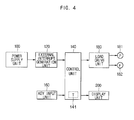
- FIG. 4 is a block diagram of a microwave oven according to an embodiment of the present invention, wherein the microwave oven includes a power supply unit 100, an external interrupt generation unit 120, and a control unit 140.
- the power supply unit 100 serves to lower an Alternating Current (AC) source voltage of 220 V to an AC source voltage of 17 V and to output the lower source voltage.
- the external interrupt generation unit 120 generates external interrupts corresponding to a power supply frequency of the AC source voltage lowered by the power supply unit 100.
- AC Alternating Current
- the control unit 140 calculates a cooking time using the power supply frequency by recognizing the power supply frequency on a basis of the external interrupts inputted from the external interrupt generation unit 120 and controls the overall operation of the microwave oven, including causing a cooking unit (not shown) to supply microwaves for use in cooking items disposed in the microwave oven.
- the control unit 140 is equipped with an inner timer 141.
- the control unit 140 is connected at its input terminal to a key input unit 160 that is equipped with function keys that set cooking conditions and that outputs a key signal in response to manipulation of a corresponding function key.
- the control unit 140 is connected at an output terminal to a load drive unit 180 that drives a power relay P 181 and a cooling fan F 182 in accordance with a set of cooking conditions, and a display unit 200 that displays the set of cooking conditions, cooking status and the like.
- the control unit 140 controls an operation status of the external interrupts to eliminate undesirable influences of high frequency noise at the time of initial power supply. That is, the control unit 140 disables the external interrupts before a timer count B reaches a predetermined set value, while the control unit 140 enables the external interrupts after the timer count B reaches the predetermined set value.
- the timer count B measured by the inner timer 141 for each cycle of a power supply signal is different according to the power supply frequency of the power supply signal. For example, if the power supply frequency is 50 Hz, the measured timer count B is fifteen. In contrast, if the power supply frequency is 60 Hz, the measured timer count B is fourteen. Accordingly, the power supply frequencies may be discriminated from each other by the timer count B. Thus, if the timer count B exceeds thirteen, the power supply frequency is either 50 Hz or 60 Hz.
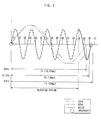
- Tp is a blocking period, i.e., a period for which the measurement of the power supply frequency is deferred.
- the external interrupts are disabled, that is, after an external interrupt has been generated, the blocking period T p is set to block the generation of the external interrupts until the accumulatively increased timer count B reaches thirteen. Thereafter, if the blocking period T p elapses, that is, if the timer count B exceeds thirteen, the external interrupts are enabled so that next external interrupts are generated. If the blocking period T p is set as described above, false external interrupts caused by high frequency noise may essentially be prevented from being generated.
- the blocking period T p By setting the blocking period T p , the first period for which the measurement of the power supply frequency is deferred is prevented from being shortened due to high frequency noise. Accordingly, the power supply frequency may be measured in a state of stable power, so the power supply frequency may be correctly recognized.
- the control unit 140 drives the inner timer 141 and inactivates external power supply interrupts (hereinafter, referred to as just "interrupts"; which are compared to internal interrupts by the inner timer). That is, the control unit 140 disables the interrupts at operation 300.
- interrupts external power supply interrupts
- the control unit 140 determines whether the interrupts are activated, that is, the interrupts are enabled, at operation 320. If the interrupts are disabled, the timer count B is increased cumulatively at operation 340. In this case, the timer count B is increased cumulatively if the internal interrupts are generated at certain intervals in the inner timer 141. Thereafter, it is determined if the timer count B has attained a predetermined set value B1 at operation 360. If the timer count B is equal to the predetermined set value B1, the predetermined set value B1 is used to set the blocking period T p . In one embodiment, the blocking period T p is set to thirteen.
- the process proceeds to operation 320.
- the accumulated timer count B is equal to the predetermined set value B1, that is, the blocking period T p has elapsed, the interrupts are enabled, and then the process proceeds to operation 320.
- the first number of times A the interrupts are generated is increased cumulatively at operation 400. Thereafter, it is determined if the first number of times A exceeds a predetermined set value A1 at operation 420. If the first number of times A is greater than the predetermined set value A1, the predetermined set value A1 is set to defer the measurement of the power supply frequency. In one embodiment, the predetermined set value A1 is set to twenty. If the first number of times A is less than or equal to the predetermined set value A1, the process proceeds to operation 430 where the timer count is cleared, and then proceeds to operation 300.
- the predetermined set value B2 is set to discriminate between a first power supply frequency of 50 Hz and a second power supply frequency of 60 Hz. In one embodiment, the predetermined set value B2 is set to fifteen. If the timer count B equals the predetermined set value B2, a second number of times C is cumulatively increased at operation 460. Thereafter, it is determined whether the first number of times A equals a predetermined set value A2 at operation 480. In one embodiment, the predetermined set value A2 is set to forty. In contrast, if the timer count B is less than the set value B2, the process proceeds to operation 480.
- the predetermined set value C1 is set to ten. If the second number of times C is equal to or larger than the predetermined set value C1, the power supply frequency is determined to be a first frequency of 50 Hz at operation 520. In contrast, if the second number of times C is smaller than the predetermined set value C1, the power supply frequency is determined to be a second frequency of 60 Hz at operation 540.
- the microwave oven and the method of controlling the microwave oven defer generation of the interrupts during the blocking period set until the timer count measured by the inner timer reaches the predetermined set value and allow the generation of the interrupts after the blocking period elapses. Accordingly, the microwave oven and the method of the controlling the microwave oven of the present invention provide the capability of correctly recognizing the power supply frequency without the influence of noise at the time power is supplied, thereby improving the reliability of the microwave oven.
- the present invention may be implemented by utilizing a computer-readable medium having instructions stored thereon for causing a computer/control unit to perform a method of controlling the microwave oven in accordance with the present invention.
Landscapes
- Physics & Mathematics (AREA)
- Electromagnetism (AREA)
- Electric Ovens (AREA)
- Control Of High-Frequency Heating Circuits (AREA)
Applications Claiming Priority (2)
| Application Number | Priority Date | Filing Date | Title |
|---|---|---|---|
| KR2002061665 | 2002-10-10 | ||
| KR10-2002-0061665A KR100453242B1 (ko) | 2002-10-10 | 2002-10-10 | 전자렌지 및 그 제어방법 |
Publications (2)
| Publication Number | Publication Date |
|---|---|
| EP1408720A2 true EP1408720A2 (fr) | 2004-04-14 |
| EP1408720A3 EP1408720A3 (fr) | 2013-02-20 |
Family
ID=32026134
Family Applications (1)
| Application Number | Title | Priority Date | Filing Date |
|---|---|---|---|
| EP03251099A Withdrawn EP1408720A3 (fr) | 2002-10-10 | 2003-02-24 | Four à micro-ondes et sa méthode de commande agissant sur la reconnaissance de la fréquence de l'alimentation |
Country Status (5)
| Country | Link |
|---|---|
| US (1) | US6855918B2 (fr) |
| EP (1) | EP1408720A3 (fr) |
| JP (1) | JP2004132682A (fr) |
| KR (1) | KR100453242B1 (fr) |
| CN (1) | CN1289868C (fr) |
Cited By (2)
| Publication number | Priority date | Publication date | Assignee | Title |
|---|---|---|---|---|
| WO2008149133A3 (fr) * | 2007-06-08 | 2009-01-22 | E2V Tech Uk Ltd | Alimentation électrique pour un appareil de chauffage radio fréquence |
| CN100512574C (zh) * | 2005-11-30 | 2009-07-08 | 美的集团有限公司 | 一种微波炉转盘控制装置的控制方法 |
Families Citing this family (3)
| Publication number | Priority date | Publication date | Assignee | Title |
|---|---|---|---|---|
| CN104812116B (zh) * | 2015-04-29 | 2016-08-24 | 韦道义 | 一种智能控制微波加热器 |
| CN105025605A (zh) * | 2015-06-29 | 2015-11-04 | 柳州蚊敌香业有限公司 | 一种智能控制电磁加热器 |
| US10845229B2 (en) | 2018-07-11 | 2020-11-24 | Edwards Vacuum Llc | Monitoring system and method |
Family Cites Families (10)
| Publication number | Priority date | Publication date | Assignee | Title |
|---|---|---|---|---|
| DE3303450A1 (de) * | 1982-02-04 | 1983-08-11 | Canon K.K., Tokyo | Steuereinrichtung fuer kopiergeraete oder dergleichen |
| SE468496B (sv) * | 1988-09-19 | 1993-01-25 | Sanyo Electric Co | Elektrisk apparat med en roterande platta |
| KR940007805B1 (ko) | 1992-02-22 | 1994-08-25 | 주식회사 금성사 | 50㎐/60㎐ 전원주파수 자동 인식 방법 |
| KR950014999B1 (ko) * | 1992-06-25 | 1995-12-21 | 대우전자주식회사 | 마이콤 제어회로 |
| KR960003256B1 (ko) * | 1993-09-27 | 1996-03-07 | 대우전자주식회사 | 전자레인지의 전원주파수 판독방법 |
| KR950013319A (ko) * | 1993-10-30 | 1995-05-17 | 배순훈 | 전자레인지의 전원주파수 판독방법 |
| US6138232A (en) * | 1996-12-27 | 2000-10-24 | Texas Instruments Incorporated | Microprocessor with rate of instruction operation dependent upon interrupt source for power consumption control |
| JP2002323222A (ja) * | 2001-04-23 | 2002-11-08 | Toshiba Corp | 電子レンジ |
| JP2002367768A (ja) * | 2001-06-04 | 2002-12-20 | Matsushita Electric Ind Co Ltd | マグネトロン駆動用電源 |
| KR100667210B1 (ko) * | 2001-12-08 | 2007-01-12 | 삼성전자주식회사 | 전자렌지 및 그 제어방법 |
-
2002
- 2002-10-10 KR KR10-2002-0061665A patent/KR100453242B1/ko not_active Expired - Fee Related
-
2003
- 2003-01-30 US US10/354,104 patent/US6855918B2/en not_active Expired - Fee Related
- 2003-02-24 EP EP03251099A patent/EP1408720A3/fr not_active Withdrawn
- 2003-02-24 CN CNB031060900A patent/CN1289868C/zh not_active Expired - Fee Related
- 2003-03-19 JP JP2003076546A patent/JP2004132682A/ja active Pending
Cited By (4)
| Publication number | Priority date | Publication date | Assignee | Title |
|---|---|---|---|---|
| CN100512574C (zh) * | 2005-11-30 | 2009-07-08 | 美的集团有限公司 | 一种微波炉转盘控制装置的控制方法 |
| WO2008149133A3 (fr) * | 2007-06-08 | 2009-01-22 | E2V Tech Uk Ltd | Alimentation électrique pour un appareil de chauffage radio fréquence |
| AU2008259580B2 (en) * | 2007-06-08 | 2013-03-21 | Teledyne Uk Limited | Power supply for radio frequency heating apparatus |
| US8536499B2 (en) | 2007-06-08 | 2013-09-17 | E2V Technologies (Uk) Limited | Power supply for radio frequency heating apparatus |
Also Published As
| Publication number | Publication date |
|---|---|
| KR20040032491A (ko) | 2004-04-17 |
| JP2004132682A (ja) | 2004-04-30 |
| KR100453242B1 (ko) | 2004-10-15 |
| US20040069777A1 (en) | 2004-04-15 |
| US6855918B2 (en) | 2005-02-15 |
| CN1289868C (zh) | 2006-12-13 |
| CN1488893A (zh) | 2004-04-14 |
| EP1408720A3 (fr) | 2013-02-20 |
Similar Documents
| Publication | Publication Date | Title |
|---|---|---|
| CN101953626B (zh) | 电饭煲 | |
| EP1408720A2 (fr) | Four à micro-ondes et sa méthode de commande agissant sur la reconnaissance de la fréquence de l'alimentation | |
| KR100591314B1 (ko) | 인버터 전자레인지 및 그 제어방법 | |
| CN100408924C (zh) | 控制微波炉的磁控管输出的装置及方法 | |
| CN115388432B (zh) | 微波炉功率调整方法、微波炉、相关设备和存储介质 | |
| US7002123B2 (en) | Microwave oven and method of controlling the same | |
| EP1289340B1 (fr) | Dispositif et méthode de commande en puissance de sortie d'une combinaison hote aspirante et four à micro-ondes | |
| JPH11329706A (ja) | 電子レンジのマグネトロン駆動制御装置および方法 | |
| KR100891658B1 (ko) | 전자레인지의 인버터 모듈 상태 감지방법 | |
| KR101864065B1 (ko) | 전자레인지 및 전자레인지 제어 방법 | |
| KR20000025539A (ko) | 전자레인지의 팝콘조리제어방법 | |
| KR100643885B1 (ko) | 전자레인지의 컨백션 팬 고장 진단 방법 | |
| KR100354070B1 (ko) | 전자렌지의 자동조리 제어방법 | |
| CN104184448B (zh) | 防止电容式触摸按键误检知的控制方法及用电器 | |
| KR100461645B1 (ko) | 전자레인지의 제어방법 | |
| KR100354061B1 (ko) | 전자렌지의조리부하자동판단방법 | |
| KR100191527B1 (ko) | 전자렌지의 엘리베이터 수명표시 방법 | |
| KR910008822B1 (ko) | 전자레인지의 온도감지방법 | |
| KR100231034B1 (ko) | 전자렌지의 운전제어장치 및 그 제어방법 | |
| CN121430060A (zh) | 烹饪设备及其检测方法、检测装置及存储介质 | |
| KR19980031219A (ko) | 전자렌지의 조리 제어 방법 및 그 장치 | |
| JPH1033365A (ja) | 複合加熱炊飯器 | |
| JPH0419991A (ja) | インバータ電源搭載電子レンジ | |
| KR20040065651A (ko) | 전자레인지의 시스템 고장 감지장치 및 그 감지방법 | |
| CN107257590A (zh) | 控制方法和烹饪电器 |
Legal Events
| Date | Code | Title | Description |
|---|---|---|---|
| PUAI | Public reference made under article 153(3) epc to a published international application that has entered the european phase |
Free format text: ORIGINAL CODE: 0009012 |
|
| 17P | Request for examination filed |
Effective date: 20030310 |
|
| AK | Designated contracting states |
Kind code of ref document: A2 Designated state(s): AT BE BG CH CY CZ DE DK EE ES FI FR GB GR HU IE IT LI LU MC NL PT SE SI SK TR |
|
| AX | Request for extension of the european patent |
Extension state: AL LT LV MK RO |
|
| RAP1 | Party data changed (applicant data changed or rights of an application transferred) |
Owner name: SAMSUNG ELECTRONICS CO., LTD. |
|
| RIC1 | Information provided on ipc code assigned before grant |
Ipc: H05B 6/68 20060101ALI20120817BHEP Ipc: H05B 6/66 20060101AFI20120817BHEP |
|
| PUAL | Search report despatched |
Free format text: ORIGINAL CODE: 0009013 |
|
| AK | Designated contracting states |
Kind code of ref document: A3 Designated state(s): AT BE BG CH CY CZ DE DK EE ES FI FR GB GR HU IE IT LI LU MC NL PT SE SI SK TR |
|
| AX | Request for extension of the european patent |
Extension state: AL LT LV MK RO |
|
| RIC1 | Information provided on ipc code assigned before grant |
Ipc: H05B 6/66 20060101AFI20130115BHEP Ipc: H05B 6/68 20060101ALI20130115BHEP |
|
| AKX | Designation fees paid |
Designated state(s): DE FR GB |
|
| STAA | Information on the status of an ep patent application or granted ep patent |
Free format text: STATUS: THE APPLICATION IS DEEMED TO BE WITHDRAWN |
|
| 18D | Application deemed to be withdrawn |
Effective date: 20160901 |