EP1409488B1 - Imidazotriazin-derivate als gaba-rezeptor-liganden - Google Patents
Imidazotriazin-derivate als gaba-rezeptor-liganden Download PDFInfo
- Publication number
- EP1409488B1 EP1409488B1 EP02747567A EP02747567A EP1409488B1 EP 1409488 B1 EP1409488 B1 EP 1409488B1 EP 02747567 A EP02747567 A EP 02747567A EP 02747567 A EP02747567 A EP 02747567A EP 1409488 B1 EP1409488 B1 EP 1409488B1
- Authority
- EP
- European Patent Office
- Prior art keywords
- carbonitrile
- compound
- imidazo
- fluoro
- mmol
- Prior art date
- Legal status (The legal status is an assumption and is not a legal conclusion. Google has not performed a legal analysis and makes no representation as to the accuracy of the status listed.)
- Expired - Lifetime
Links
Classifications
-
- C—CHEMISTRY; METALLURGY
- C07—ORGANIC CHEMISTRY
- C07D—HETEROCYCLIC COMPOUNDS
- C07D487/00—Heterocyclic compounds containing nitrogen atoms as the only ring hetero atoms in the condensed system, not provided for by groups C07D451/00 - C07D477/00
- C07D487/02—Heterocyclic compounds containing nitrogen atoms as the only ring hetero atoms in the condensed system, not provided for by groups C07D451/00 - C07D477/00 in which the condensed system contains two hetero rings
- C07D487/04—Ortho-condensed systems
-
- A—HUMAN NECESSITIES
- A61—MEDICAL OR VETERINARY SCIENCE; HYGIENE
- A61P—SPECIFIC THERAPEUTIC ACTIVITY OF CHEMICAL COMPOUNDS OR MEDICINAL PREPARATIONS
- A61P25/00—Drugs for disorders of the nervous system
-
- A—HUMAN NECESSITIES
- A61—MEDICAL OR VETERINARY SCIENCE; HYGIENE
- A61P—SPECIFIC THERAPEUTIC ACTIVITY OF CHEMICAL COMPOUNDS OR MEDICINAL PREPARATIONS
- A61P25/00—Drugs for disorders of the nervous system
- A61P25/06—Antimigraine agents
-
- A—HUMAN NECESSITIES
- A61—MEDICAL OR VETERINARY SCIENCE; HYGIENE
- A61P—SPECIFIC THERAPEUTIC ACTIVITY OF CHEMICAL COMPOUNDS OR MEDICINAL PREPARATIONS
- A61P25/00—Drugs for disorders of the nervous system
- A61P25/14—Drugs for disorders of the nervous system for treating abnormal movements, e.g. chorea, dyskinesia
-
- A—HUMAN NECESSITIES
- A61—MEDICAL OR VETERINARY SCIENCE; HYGIENE
- A61P—SPECIFIC THERAPEUTIC ACTIVITY OF CHEMICAL COMPOUNDS OR MEDICINAL PREPARATIONS
- A61P25/00—Drugs for disorders of the nervous system
- A61P25/18—Antipsychotics, i.e. neuroleptics; Drugs for mania or schizophrenia
-
- A—HUMAN NECESSITIES
- A61—MEDICAL OR VETERINARY SCIENCE; HYGIENE
- A61P—SPECIFIC THERAPEUTIC ACTIVITY OF CHEMICAL COMPOUNDS OR MEDICINAL PREPARATIONS
- A61P25/00—Drugs for disorders of the nervous system
- A61P25/22—Anxiolytics
-
- A—HUMAN NECESSITIES
- A61—MEDICAL OR VETERINARY SCIENCE; HYGIENE
- A61P—SPECIFIC THERAPEUTIC ACTIVITY OF CHEMICAL COMPOUNDS OR MEDICINAL PREPARATIONS
- A61P25/00—Drugs for disorders of the nervous system
- A61P25/24—Antidepressants
-
- A—HUMAN NECESSITIES
- A61—MEDICAL OR VETERINARY SCIENCE; HYGIENE
- A61P—SPECIFIC THERAPEUTIC ACTIVITY OF CHEMICAL COMPOUNDS OR MEDICINAL PREPARATIONS
- A61P25/00—Drugs for disorders of the nervous system
- A61P25/28—Drugs for disorders of the nervous system for treating neurodegenerative disorders of the central nervous system, e.g. nootropic agents, cognition enhancers, drugs for treating Alzheimer's disease or other forms of dementia
-
- A—HUMAN NECESSITIES
- A61—MEDICAL OR VETERINARY SCIENCE; HYGIENE
- A61P—SPECIFIC THERAPEUTIC ACTIVITY OF CHEMICAL COMPOUNDS OR MEDICINAL PREPARATIONS
- A61P43/00—Drugs for specific purposes, not provided for in groups A61P1/00-A61P41/00
-
- A—HUMAN NECESSITIES
- A61—MEDICAL OR VETERINARY SCIENCE; HYGIENE
- A61P—SPECIFIC THERAPEUTIC ACTIVITY OF CHEMICAL COMPOUNDS OR MEDICINAL PREPARATIONS
- A61P7/00—Drugs for disorders of the blood or the extracellular fluid
-
- A—HUMAN NECESSITIES
- A61—MEDICAL OR VETERINARY SCIENCE; HYGIENE
- A61P—SPECIFIC THERAPEUTIC ACTIVITY OF CHEMICAL COMPOUNDS OR MEDICINAL PREPARATIONS
- A61P9/00—Drugs for disorders of the cardiovascular system
-
- A—HUMAN NECESSITIES
- A61—MEDICAL OR VETERINARY SCIENCE; HYGIENE
- A61P—SPECIFIC THERAPEUTIC ACTIVITY OF CHEMICAL COMPOUNDS OR MEDICINAL PREPARATIONS
- A61P9/00—Drugs for disorders of the cardiovascular system
- A61P9/10—Drugs for disorders of the cardiovascular system for treating ischaemic or atherosclerotic diseases, e.g. antianginal drugs, coronary vasodilators, drugs for myocardial infarction, retinopathy, cerebrovascula insufficiency, renal arteriosclerosis
Definitions
- the present invention relates to a class of substituted imidazo-triazine derivatives and to their use in therapy. More particularly, this invention is concerned with imidazo[1,2- b ][1,2,4]triazine analogues which are substituted in the 7-position by a substituted phenyl ring. These compounds are ligands for GABA A receptors and are therefore useful in the therapy of deleterious mental states.
- GABA gamma-aminobutyric acid
- GABA A receptors which are members of the ligand-gated ion channel superfamily
- GABA B receptors which may be members of the G-protein linked receptor superfamily. Since the first cDNAs encoding individual GABA A receptor subunits were cloned the number of known members of the mammalian family has grown to include at least six ⁇ subunits, four ⁇ subunits, three ⁇ subunits, one ⁇ subunit, one ⁇ subunit and two ⁇ subunits.
- Receptor subtype assemblies which do exist include, amongst many others, ⁇ 1 ⁇ 2 ⁇ 2, ⁇ 2 ⁇ 1, ⁇ 2 ⁇ 2/3 ⁇ 2, ⁇ 3 ⁇ 2/3, ⁇ 4 ⁇ , ⁇ 5 ⁇ 3 ⁇ 2/3, ⁇ 6 ⁇ 2 and ⁇ 6 ⁇ .
- Subtype assemblies containing an ⁇ 1 subunit are present in most areas of the brain and are thought to account for over 40% of GABA A receptors in the rat.
- Subtype assemblies containing ⁇ 2 and ⁇ 3 subunits respectively are thought to account for about 25% and 17% of GABA A receptors in the rat.
- Subtype assemblies containing an ⁇ 5 subunit are expressed predominantly in the hippocampus and cortex and are thought to represent about 4% of GABA A receptors in the rat.
- a characteristic property of all known GABA A receptors is the presence of a number of modulatory sites, one of which is the benzodiazepine (BZ) binding site.
- the BZ binding site is the most explored of the GABA A receptor modulatory sites, and is the site through which anxiolytic drugs such as diazepam and temazepam exert their effect.
- the benzodiazepine binding site was historically subdivided into two subtypes, BZ1 and BZ2, on the basis of radioligand binding studies.
- the BZ1 subtype has been shown to be pharmacologically equivalent to a GABA A receptor comprising the ⁇ 1 subunit in combination with a ⁇ subunit and ⁇ 2. This is the most abundant GABA A receptor subtype, and is believed to represent almost half of all GABA A receptors in the brain.
- GABA A receptor agonists Compounds which are modulators of the benzodiazepine binding site of the GABA A receptor by acting as BZ agonists are referred to hereinafter as "GABA A receptor agonists".
- GABA A receptor agonists Compounds which are modulators of the benzodiazepine binding site of the GABA A receptor by acting as BZ agonists are referred to hereinafter as "GABA A receptor agonists".
- the ⁇ 1-selective GABA A receptor agonists alpidem and zolpidem are clinically prescribed as hypnotic agents, suggesting that at least some of the sedation associated with known anxiolytic drugs which act at the BZ1 binding site is mediated through GABA A receptors containing the ⁇ 1 subunit.
- GABA A receptor agonists which interact more favourably with the ⁇ 2 and/or ⁇ 3 subunit than with ⁇ 1 will be effective in the treatment of anxiety with a reduced propensity to cause sedation.
- agents which are antagonists or inverse agonists at ⁇ 1 might be employed to reverse sedation or hypnosis caused by ⁇ 1 agonists.
- the compounds of the present invention being selective ligands for GABA A receptors, are therefore of use in the treatment and/or prevention of a variety of disorders of the central nervous system.
- disorders include anxiety disorders, such as panic disorder with or without agoraphobia, agoraphobia without history of panic disorder, animal and other phobias including social phobias, obsessive-compulsive disorder, stress disorders including post-traumatic and acute stress disorder, and generalized or substance-induced anxiety disorder; neuroses; convulsions; migraine; depressive or bipolar disorders, for example single-episode or recurrent major depressive disorder, dysthymic disorder, bipolar I and bipolar II manic disorders, and cyclothymic disorder; psychotic disorders including schizophrenia; neurodegeneration arising from cerebral ischemia; attention deficit hyperactivity disorder; speech disorders, including stuttering; and disorders of circadian rhythm, e.g. in subjects suffering from the effects of jet lag or shift work.
- emesis including acute, delayed and anticipatory emesis, in particular emesis induced by chemotherapy or radiation, as well as motion sickness, and post-operative nausea and vomiting
- eating disorders including anorexia nervosa and bulimia nervosa
- premenstrual syndrome e.g. in paraplegic patients
- hearing disorders including tinnitus and age-related hearing impairment
- urinary incontinence urinary incontinence
- Selective ligands for GABA A receptors may also be effective as pre-medication prior to anaesthesia or minor procedures such as endoscopy, including gastric endoscopy.
- the compounds in accordance with the present invention may be useful as radioligands in assays for detecting compounds capable of binding to the human GABA A receptor.
- the present invention provides a class of imidazo-triazine derivatives which possess desirable binding properties at various GABA A receptor subtypes.
- the compounds in accordance with the present invention have good affinity as ligands for the ⁇ 2 and/or ⁇ 3 subunit of the human GABA A receptor.
- the compounds of this invention may interact more favourably with the ⁇ 2 and/or ⁇ 3 subunit than with the ⁇ 1 subunit.
- the compounds of the invention will exhibit functional selectivity in terms of a selective efficacy for the ⁇ 2 and/or ⁇ 3 subunit relative to the ⁇ 1 subunit.
- the compounds of the present invention are GABA A receptor subtype ligands having a binding affinity (K i ) for the ⁇ 2 and/or ⁇ 3 subunit, as measured in the assay described hereinbelow, of 200 nM or less, typically of 100 nM or less, and ideally of 20 nM or less.
- the compounds in accordance with this invention may possess at least a 2-fold, suitably at least a 5-fold, and advantageously at least a 10-fold, selective affinity for the ⁇ 2 and/or ⁇ 3 subunit relative to the ⁇ 1 subunit.
- compounds which are not selective in terms of their binding affinity for the ⁇ 2 and/or ⁇ 3 subunit relative to the ⁇ 1 subunit are also encompassed within the scope of the present invention; such compounds will desirably exhibit functional selectivity in terms of zero or weak (positive or negative) efficacy at the ⁇ 1 subunit and a full or partial agonist profile at the ⁇ 2 and/or ⁇ 3 subunit.
- X 1 represents hydrogen or fluoro
- R 11 represents hydrogen, C 1-6 alkyl, halo(C 1-6 )alkyl, dihalo(Ci- 6
- the salts of the compounds of formula I will be pharmaceutically acceptable salts.
- Other salts may, however, be useful in the preparation of the compounds according to the invention or of their pharmaceutically acceptable salts.
- Suitable pharmaceutically acceptable salts of the compounds of this invention include acid addition salts which may, for example, be formed by mixing a solution of the compound according to the invention with a solution of a pharmaceutically acceptable acid such as hydrochloric acid, sulphuric acid, methanesulphonic acid, fumaric acid, maleic acid, succinic acid, acetic acid, benzoic acid, oxalic acid, citric acid, tartaric acid, carbonic acid or phosphoric acid.
- a pharmaceutically acceptable acid such as hydrochloric acid, sulphuric acid, methanesulphonic acid, fumaric acid, maleic acid, succinic acid, acetic acid, benzoic acid, oxalic acid, citric acid, tartaric acid, carbonic acid or phosphoric acid.
- Suitable alkyl groups include straight-chained and branched alkyl groups containing from 1 to 6 carbon atoms. Typical examples include methyl and ethyl groups, and straight-chained or branched propyl, butyl and pentyl groups. Particular alkyl groups are methyl, ethyl, n -propyl, isopropyl, isobutyl, tert -butyl and 2,2-dimethylpropyl. Derived expressions such as "C 1-6 alkoxy" are to be construed accordingly.
- Suitable heteroaryl groups include pyridinyl, quinolinyl, isoquinolinyl, pyridazinyl, pyrimidinyl, pyrazinyl, furyl, benzofuryl, dibenzofuryl, thienyl, benzthienyl, pyrrolyl, indolyl, pyrazolyl, indazolyl, oxazolyl, isoxazolyl, thiazolyl, isothiazolyl, imidazolyl, benzimidazolyl, oxadiazolyl, thiadiazolyl, triazolyl and tetrazolyl groups.
- halogen as used herein includes fluorine, chlorine, bromine and iodine, especially fluoro or chloro.
- the compounds according to the invention may accordingly exist as enantiomers. Where the compounds according to the invention possess two or more asymmetric centres, they may additionally exist as diastereoisomers. It is to be understood that all such isomers and mixtures thereof in any proportion are encompassed within the scope of the present invention.
- X 1 represents hydrogen. In another embodiment, X 1 represents fluoro.
- R 4 represents hydrogen or methyl.
- R 5 represents hydrogen, methyl, ethyl, hydroxyethyl or dimethylaminoethyl. Particular values of R 5 include hydrogen, hydroxyethyl and dimethylaminoethyl.
- R 11 represents heteroaryl
- this group is suitably furyl
- R 11 include hydrogen, methyl, difluoroethyl (especially 1,1-difluoroethyl), fluoropropyl (especially 2-fluoroprop-2-yl), hydroxypropyl (especially 2-hydroxyprop-2-yl), tert-butyl and trifluoromethyl.
- R 11 represents methyl. In another embodiment, R 11 represents trifluoromethyl. In a further embodiment, R 11 represents 2-hydroxyprop-2-yl. In an additional embodiment, R 11 represents 2-fluoroprop-2-yl.
- the fluorine atom R 6 is favourably attached to the phenyl ring at the 4-, 5- or 6-position (relative to the cyano group at position 2), preferably at the 6-position.
- the binding affinity (K i ) of the compounds according to the present invention for the ⁇ 3 subunit of the human GABA A receptor is conveniently as measured in the assay described hereinbelow.
- the ⁇ 3 subunit binding affinity (K i ) of the compounds of the invention is ideally 50 nM or less, preferably 10 nM or less, and more preferably 5 nM or less.
- the compounds according to the present invention will ideally elicit at least a 40%, preferably at least a 50%, and more preferably at least a 60%, potentiation of the GABA EC 20 response in stably transfected recombinant cell lines expressing the ⁇ 3 subunit of the human GABA A receptor. Moreover, the compounds of the invention will ideally elicit at most a 30%, preferably at most a 20%, and more preferably at most a 10%, potentiation of the GABA EC 20 response in stably transfected recombinant cell lines expressing the ⁇ 1 subunit of the human GABA A receptor.
- the potentiation of the GABA EC 20 response in stably transfected cell lines expressing the ⁇ 3 and ⁇ 1 subunits of the human GABA A receptor can conveniently be measured by procedures analogous to the protocol described in Wafford et al., Mol. Pharmacol., 1996, 50, 670-678.
- the procedure will suitably be carried out utilising cultures of stably transfected eukaryotic cells, typically of stably transfected mouse Ltk-fibroblast cells.
- the compounds according to the present invention exhibit anxiolytic activity, as may be demonstrated by a positive response in the elevated plus maze and conditioned suppression of drinking tests (cf. Dawson et al. , Psychopharmacology, 1995, 121, 109-117). Moreover, the compounds of the invention are substantially non-sedating, as may be confirmed by an appropriate result obtained from the response sensitivity (chain-pulling) test (cf. Bayley et al., J. Psychopharmacol., 1996, 10, 206-213).
- the compounds according to the present invention may also exhibit anticonvulsant activity. This can be demonstrated by the ability to block pentylenetetrazole-induced seizures in rats and mice, following a protocol analogous to that described by Bristow et al. in J. Pharmacol. Exp. Ther., 1996, 279, 492-501.
- the compounds of the invention will ideally be brain-penetrant; in other words, these compounds will be capable of crossing the so-called "blood-brain barrier".
- the compounds of the invention will be capable of exerting their beneficial therapeutic action following administration by the oral route.
- compositions comprising one or more compounds of this invention in association with a pharmaceutically acceptable carrier.
- these compositions are in unit dosage forms such as tablets, pills, capsules, powders, granules, sterile parenteral solutions or suspensions, metered aerosol or liquid sprays, drops, ampoules, auto-injector devices or suppositories; for oral, parenteral, intranasal, sublingual or rectal administration, or for administration by inhalation or insufflation.
- a pharmaceutical carrier e.g.
- a solid preformulation composition containing a homogeneous mixture of a compound of the present invention, or a pharmaceutically acceptable salt thereof.
- preformulation compositions as homogeneous, it is meant that the active ingredient is dispersed evenly throughout the composition so that the composition may be readily subdivided into equally effective unit dosage forms such as tablets, pills and capsules.
- This solid preformulation composition is then subdivided into unit dosage forms of the type described above containing from 0.1 to about 500 mg of the active ingredient of the present invention.
- Typical unit dosage forms contain from 1 to 100 mg, for example 1, 2, 5, 10, 25, 50 or 100 mg, of the active ingredient.
- the tablets or pills of the novel composition can be coated or otherwise compounded to provide a dosage form affording the advantage of prolonged action.
- the tablet or pill can comprise an inner dosage and an outer dosage component, the latter being in the form of an envelope over the former.
- the two components can be separated by an enteric layer which serves to resist disintegration in the stomach and permits the inner component to pass intact into the duodenum or to be delayed in release.
- enteric layers or coatings such materials including a number of polymeric acids and mixtures of polymeric acids with such materials as shellac, cetyl alcohol and cellulose acetate.
- liquid forms in which the novel compositions of the present invention may be incorporated for administration orally or by injection include aqueous solutions, suitably flavoured syrups, aqueous or oil suspensions, and flavoured emulsions with edible oils such as cottonseed oil, sesame oil, coconut oil or peanut oil, as well as elixirs and similar pharmaceutical vehicles.
- Suitable dispersing or suspending agents for aqueous suspensions include synthetic and natural gums such as tragacanth, acacia, alginate, dextran, sodium carboxymethylcellulose, methylcellulose, polyvinyl-pyrrolidone or gelatin.
- a suitable dosage level is about 0.01 to 250 mg/kg per day, preferably about 0.05 to 100 mg/kg per day, and especially about 0.05 to 5 mg/kg per day.
- the compounds may be administered on a regimen of 1 to 4 times per day.
- the compounds in accordance with the present invention may be prepared by a process which comprises reacting a compound of formula II with a compound of formula III: wherein X 1 , R 11 and R 6 are as defined above, L 1 represents a suitable leaving group, and M 1 represents a boronic acid moiety -B(OH) 2 or a cyclic ester thereof formed with an organic diol, e.g. pinacol or neopentyl glycol, or M 1 represents -Sn(Alk) 3 in which Alk represents a C 1-6 alkyl group, typically n-butyl; in the presence of a transition metal catalyst.
- X 1 , R 11 and R 6 are as defined above
- L 1 represents a suitable leaving group
- M 1 represents a boronic acid moiety -B(OH) 2 or a cyclic ester thereof formed with an organic diol, e.g. pinacol or neopentyl glycol, or M 1 represents -Sn(A
- the leaving group L 1 is typically a halogen atom, e.g. bromo.
- the transition metal catalyst of use in the reaction between compounds II and III is suitably tetrakis(triphenylphosphine)-palladium(0).
- the reaction is conveniently carried out at an elevated temperature in a solvent such as N,N dimethylacetamide, 1,2-dimethoxyethane, tetrahydrofuran or 1,4-dioxane, advantageously in the presence of potassium phosphate, sodium carbonate or copper(I) iodide.
- the transition metal catalyst employed may be dichloro[1,1'-bis(diphenylphosphino)ferrocene]palladiuna(II), in which case the reaction may conveniently be carried out at an elevated temperature in a solvent such as N , N -dimethylformamide, typically in the presence of potassium phosphate.
- the compounds according to the present invention may be prepared by a process which comprises reacting a compound of formula IV with a compound of formula V: wherein X 1 , R 11 , R 6 , L 1 and M 1 are as defined above; in the presence of a transition metal catalyst; under conditions analogous to those described above for the reaction between compounds II and III.
- M 1 in the intermediates of formula III and IV above represents a boronic acid moiety -B(OH) 2 or a cyclic ester thereof formed with pinacol or neopentyl glycol
- the relevant compound III or IV may be prepared by reacting bis(pinacolato)diboron or bis(neopentyl glycolato)diborane respectively with a compound of formula VI or VII: wherein X 1 , R 11 and R 6 are as defined above, and L 2 represents hydroxy or a suitable leaving group; in the presence of a transition metal catalyst.
- L 2 represents a leaving group
- this is typically trifluoromethanesulfonyloxy (triflyloxy); or a halogen atom such as bromo.
- the transition metal catalyst of use in the reaction between bis(pinacolato)diboron or bis(neopentyl glycolato)diborane and compound VI or VII is suitably dichloro[1,1'-bis(diphenylphosphino)ferrocene]-palladium(II).
- the reaction is conveniently carried out at an elevated temperature in a solvent such as 1,4-dioxane, optionally in admixture with dimethylsulfoxide, typically in the presence of 1, 1'-bis(diphenylphosphino)ferrocene and/or potassium acetate.
- the relevant compound may be prepared by reacting the corresponding compound of formula VII wherein L 2 is hydroxy with N-phenyltriflylimide, typically in the presence of triethylamine; or with triflic anhydride, typically in the presence of pyridine. Analogous conditions may be utilised for converting an intermediate of formula VI above wherein L 2 represents hydroxy into the corresponding compound wherein L 2 represents triflyloxy.
- intermediates of formula VII above wherein L 2 is hydroxy may suitably be prepared from the appropriate methoxy-substituted precursor of formula VIII: wherein X 1 and R 11 are as defined above; by treatment with boron tribromide, typically in chloroform; or with hydrogen bromide, typically in acetic acid at reflux.
- the intermediates of formula VIII above may be prepared by reacting a compound of formula II as defined above with the appropriate compound of formula IX: wherein X 1 and M 1 are as defined above; in the presence of a transition metal catalyst; under conditions analogous to those described above for the reaction between compounds II and III.
- this compound may be prepared by bromination of the corresponding compound of formula X: wherein R 11 is as defined above; typically by treatment with bromine in acetic acid, in the presence of sodium acetate and optionally also potassium bromide.
- the intermediates of formula X may be prepared by reacting bromoacetaldehyde with the requisite compound of formula XI: wherein R 11 is as defined above.
- the reaction is conveniently carried out by heating the reactants in 1,2-dimethoxyethane, or a lower alkanol such as methanol and/or ethanol, at a temperature typically in the region of 60-80°C.
- the compounds according to the present invention may be prepared by a process which comprises reacting a compound of formula XI as defined above with a compound of formula XII: wherein X 1 and R 6 are as defined above, and L 3 represents a suitable leaving group; under conditions analogous to those described above for the reaction between bromoacetaldehyde and compound XI.
- the leaving group L 3 is suitably a halogen atom, e.g. bromo.
- the compounds according to the present invention wherein X 1 represents hydrogen and R 11 represents a heteroaryl moiety may be prepared by a process which comprises reacting a compound of formula XIII with a compound of formula XIV: R 1a - B(OH) 2 wherein R 6 is as defined above, R 1a represents a heteroaryl moiety, and L4 represents a suitable leaving group; in the presence of a transition metal catalyst.
- the leaving group L 4 is typically a halogen atom, e.g. chloro.
- the transition metal catalyst of use in the reaction between compounds XIII and XIV is suitably tris(dibenzylideneacetone)-dipalladium(0), in which case the reaction is conveniently effected at an elevated temperature in a solvent such as 1,4-dioxane, typically in the presence of tri-tert-butylphosphine and cesium carbonate.
- L 4 in the compounds of formula XIV above represents a halogen atom
- these compounds correspond to compounds of formula I as defined above wherein R 11 represents halogen, and they may therefore be prepared by any of the methods described above for the preparation of the compounds according to the invention.
- any compound of formula I initially obtained from any of the above processes may, where appropriate, subsequently be elaborated into a further compound of formula I by techniques known from the art.
- a compound of formula I wherein R 11 represents C 2-6 alkoxycarbonyl initially obtained may be reduced with lithium aluminium hydride to the corresponding compound of formula I wherein R 11 represents hydroxymethyl.
- the latter compound may then be oxidised to the corresponding compound of formula I wherein R 11 represents formyl by treatment with manganese dioxide.
- the compound of formula I wherein R 11 represents formyl may be reacted with a Grignard reagent of formula R a MgBr, wherein R a represents C 1-5 alkyl, to afford a compound of formula I wherein R 11 represents -CH(OH)R a , and this compound may in turn be oxidised using manganese dioxide to the corresponding compound of formula I wherein R 11 represents -COR a .
- the desired product can be separated therefrom at an appropriate stage by conventional methods such as preparative HPLC; or column chromatography utilising, for example, silica and/or alumina in conjunction with an appropriate solvent system.
- novel compounds may be prepared in racemic form, or individual enantiomers may be prepared either by enantiospecific synthesis or by resolution.
- the novel compounds may, for example, be resolved into their component enantiomers by standard techniques such as preparative HPLC, or the formation of diastereomeric pairs by salt formation with an optically active acid, such as (-)-di-p-toluoyl-d-tartaric acid and/or (+)-di- p -toluoyl-1-tartaric acid, followed by fractional crystallization and regeneration of the free base.
- the novel compounds may also be resolved by formation of diastereomeric esters or amides, followed by chromatographic separation and removal of the chiral auxiliary.
- any of the above synthetic sequences it may be necessary and/or desirable to protect sensitive or reactive groups on any of the molecules concerned. This may be achieved by means of conventional protecting groups, such as those described in Protective Groups in Organic Chemistry, ed. J.F.W. McOmie, Plenum Press, 1973; and T.W. Greene & P.G.M. Wuts, Protective Groups in Organic Synthesis, John Wiley & Sons, 1991.
- the protecting groups may be removed at a convenient subsequent stage using methods known from the art.
- the compounds in accordance with this invention potently inhibit the binding of [ 3 H]-flumazenil to the benzodiazepine binding site of human GABA A receptors containing the ⁇ 2 and/or ⁇ 3 subunit stably expressed in Ltk- cells.
- Supernatant is removed from cells.
- PBS approximately 20 ml
- the cells are scraped and placed in a 50 ml centrifuge tube. The procedure is repeated with a further 10 ml of PBS to ensure that most of the cells are removed.
- the cells are pelleted by centrifuging for 20 min at 3000 rpm in a benchtop centrifuge, and then frozen if desired. The pellets are resuspended in 10 ml of buffer per tray (25 cm x 25 cm) of cells.
- Each tube contains:
- Assays are incubated for 1 hour at 40°C, then filtered using either a Tomtec or Brandel cell harvester onto GF/B filters followed by 3 x 3 ml washes with ice cold assay buffer. Filters are dried and counted by liquid scintillation counting. Expected values for total binding are 3000-4000 dpm for total counts and less than 200 dpm for non-specific binding if using liquid scintillation counting, or 1500-2000 dpm for total counts and less than 200 dpm for non-specific binding if counting with meltilex solid scintillant. Binding parameters are determined by non-linear least squares regression analysis, from which the inhibition constant K i can be calculated for each test compound.
- the mixture was cooled to ambient temperature and partitioned between diethyl ether (200 ml) and 2 N hydrochloric acid (50 ml). The organics were discarded and the aqueous phase adjusted to pH 8 by the addition of 4 N sodium hydroxide solution and extracted with diethyl ether (2 x 500 ml). The organic layer was washed with brine (50 ml), dried (Na 2 SO 4 ), filtered and pre-adsorbed onto silica.
- Tetrakis(triphenylphosphine)palladium(0) (23.4 mg, 0.020 mmol) was then added and the mixture was stirred at 80°C for 16 h under nitrogen. The mixture was partitioned between ethyl acetate (25 ml) and water (10 ml) and the aqueous phase was extracted further with ethyl acetate (2 x 25 ml). The organic extracts were combined, dried (Na 2 SO 4 ) and evaporated in vacuo. The residue was purified by flash chromatography (silica gel, EtOAc) to yield 0.1047 g (73%) of the title compound as a yellow oil.
- the hydrochloride salt was prepared in diethyl ether: mp 113-126°C; 1 H NMR (400 MHz, DMSO-d 6 ) ⁇ 1.81 (6H, d, J 22.2 Hz), 7.68 (1H, dd, J 10.6, 8.6 Hz), 8.03 (1H, dd, J 7.8, 5.5 Hz), 8.36 (1H, m), 8.43 (1H, dd, J 7.4, 2.3 Hz), 8.63 (1H, dd, J 7.4, 1.2 Hz), 8.67 (1H, s), 8.91 (1H, d, J 4.3 Hz), 9.07 (1H, d, J 0.8 Hz), 9.16 (1H, s); MS (ES + ) m / z 352 [M+H] + .
- 5'-Amino-4,2'-difluorobiphenyl-2-carbonitrile (23 g, 100 mmol) was dissolved in hot 1,4-dioxane (20 ml) then treated with a chilled (5°C) solution of hydrobromic acid (200 ml of a 48% solution in water). The resulting suspension was cooled to 2°C (internal temperature) before adding a solution of sodium nitrite (6.9 g, 100 mmol) in water (14 ml) at such a rate that the internal temperature did not exceed 4°C.
- reaction mixture was filtered to remove inorganics and the filter cake was washed with diethyl ether.
- the filtrate was evaporated to dryness and the residue stirred with ice-cold 2 N sodium hydroxide solution (50 ml) for 45 min. This basic mixture was washed with diethyl ether and the organics discarded.
- the pH of the aqueous phase was adjusted to 5 with 36% hydrochloric acid then extracted with diethyl ether (50 ml).
- Tris(dibenzylideneacetone)dipalladium(0) and tri- tert -butylphosphine (0.2 M solution in 1,4-dioxane, 3.7 ml) were added and the mixture stirred at ambient temperature for 15 min then at 50°C for 18 h. After cooling to ambient temperature, the resulting dark suspension was poured onto 0.5 M sodium hydroxide solution (500 ml) and stirred vigorously for 2 h.
- the solution was stirred at 0°C for 15 min then heated at 50°C for 20 min.
- the mixture was cooled to ambient temperature, diluted with water (500 ml) and extracted with ethyl acetate (2 x 300 ml).
- the combined organics were washed with 10% aqueous ammonia solution (200 ml), water (200 ml) and brine (200 ml), dried over anhydrous magnesium sulfate, filtered and evaporated to give a black solid.
- the mixture was cooled to ambient temperature then partitioned between 2 N sodium hydroxide (75 ml) and diethyl ether (100 ml) and the organics were discarded.
- the aqueous extract was made acidic (pH 5) with 36% hydrochloric acid and then extracted with diethyl ether (2 x 75 ml).
- 3'-Amino-4-fluorobiphenyl-2-carbonitrile was bromo-deaminated following the procedure in Example 1 to give 3'-bromo-4-fluorobiphenyl-2-carbonitrile as a white solid: 1 H NMR (400 MHz, CDCl 3 ) ⁇ 7.35-7.40 (2H, m), 7.46-7.50 (3H, m), 7.59 (1H, dd, J 2, 1 Hz), 7.64 (1H, dd, J 2, 2 Hz).
- 5'-Amino-6,2'-difluorobiphenyl-2-carbonitrile was bromo-deaminated as described in Example 1 to furnish 5'-bromo-6,2'-difluorobiphenyl-2-carbonitrile as a pale brown solid: 1 H NMR (360 MHz, CDCl 3 ) ⁇ 7.13 (1H, dd, J 9, 9 Hz), 7.37-7.49 (2H, ddd, J 9, 9, 1 Hz), 7.57-7.62 (4H, m).
Landscapes
- Health & Medical Sciences (AREA)
- Chemical & Material Sciences (AREA)
- Organic Chemistry (AREA)
- Engineering & Computer Science (AREA)
- Bioinformatics & Cheminformatics (AREA)
- General Health & Medical Sciences (AREA)
- Animal Behavior & Ethology (AREA)
- Veterinary Medicine (AREA)
- Chemical Kinetics & Catalysis (AREA)
- General Chemical & Material Sciences (AREA)
- Medicinal Chemistry (AREA)
- Nuclear Medicine, Radiotherapy & Molecular Imaging (AREA)
- Public Health (AREA)
- Pharmacology & Pharmacy (AREA)
- Life Sciences & Earth Sciences (AREA)
- Neurology (AREA)
- Neurosurgery (AREA)
- Biomedical Technology (AREA)
- Psychiatry (AREA)
- Cardiology (AREA)
- Heart & Thoracic Surgery (AREA)
- Pain & Pain Management (AREA)
- Hematology (AREA)
- Urology & Nephrology (AREA)
- Diabetes (AREA)
- Vascular Medicine (AREA)
- Psychology (AREA)
- Hospice & Palliative Care (AREA)
- Pharmaceuticals Containing Other Organic And Inorganic Compounds (AREA)
- Nitrogen Condensed Heterocyclic Rings (AREA)
- Acyclic And Carbocyclic Compounds In Medicinal Compositions (AREA)
- Steroid Compounds (AREA)
- Heterocyclic Carbon Compounds Containing A Hetero Ring Having Nitrogen And Oxygen As The Only Ring Hetero Atoms (AREA)
Claims (10)
- Eine Verbindung der Formel I oder ein pharmazeutisch annehmbares Salz davon:wobei
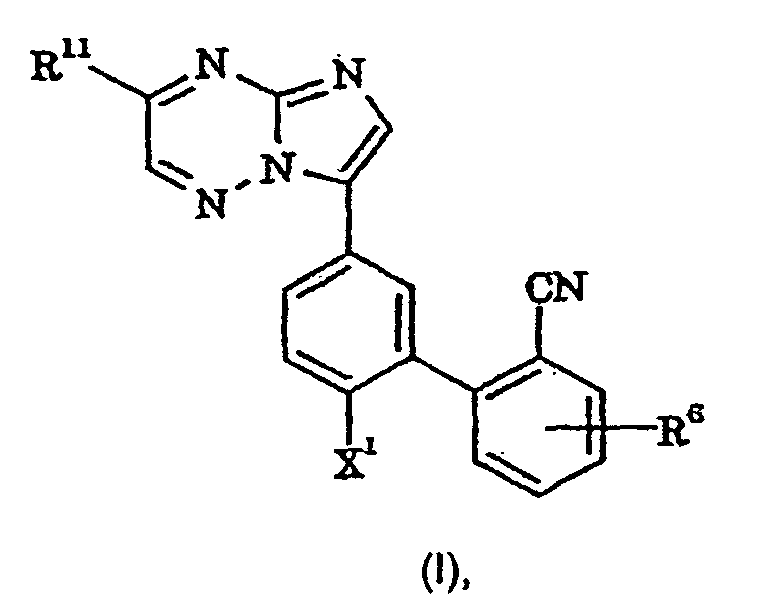
X1 Wasserstoff oder Fluor bedeutet,
R11 Wasserstoff, C1-6-Alkyl, Halogen(C1-6)alkyl, Dihalogen(C1-6)alkyl, Hydroxy-(C1-6)alkyl, Heteroaryl, Halogen, Trifluormethyl, C1-6-Alkoxy, Formyl, C2-6-Alkylcarbonyl, C2-6-Alkoxycarbonyl oder -CR4=NOR5 bedeutet,
R4 Wasserstoff oder C1-6-Alkyl bedeutet,
R5 Wasserstoff, C1-6-Alkyl, Hydroxy(C1-6)alkyl oder Di(C1-6)alkylamino(C1-6)alkyl bedeutet und
R6 Fluor bedeutet. - Eine wie in Anspruch 1 beanspruchte Verbindung, wobei das Fluoratom R6 an der 6-Position (relativ zur Cyanogruppe an Position 2) an den Phenylring gebunden ist.
- Eine wie in Anspruch 1 oder Anspruch 2 beanspruchte Verbindung, wobei X1 Fluor bedeutet.
- Eine wie in irgendeinem der vorhergehenden Ansprüche beanspruchte Verbindung, wobei R11 2-Hydroxyprop-2-yl bedeutet.
- Eine Verbindung, ausgewählt aus:und pharmazeutisch annehmbaren Salzen davon.4,2'-Difluor-5'-[3-(1-fluor-1-methylethyl)imidazo[1,2-b][1,2,4]triazin-7-yl]biphenyl-2-carbonitril,5,2'-Difluor-5'-(3-trifluormethylimidazo[1,2-b][1,2,4]triazin-7-yl)biphenyl-2-carbonitril,4,2'-Difluor-5'-[3-(1-hydroxy-1-methylethyl)imidazo[1,2-b][1,2,4]triazin-7-yl]biphenyl-2-carbonitril,4-Fluor-3'-[3-(1-hydroxy-1-methylethyl)imidazo[1,2-b][1,2,4]triazin-7-yl]biphenyl-2-carbonitril,6,2'-Difluor-5'-[3-(1-hydroxy-1-memylethyl)imidazo[1,2-b][1,2,4]triazin-7-yl]biphenyl-2-carbonitril,
- Eine pharmazeutische Zusammensetzung, die eine wie in Anspruch 1 definierte Verbindung der Formel I oder ein pharmazeutisch annehmbares Salz davon in Verbindung mit einem pharmazeutisch annehmbaren Träger enthält.
- Die Verwendung einer wie in Anspruch 1 definierten Verbindung der Formel I oder eines pharmazeutisch annehmbaren Salzes davon zur Herstellung eines Medikaments zur Behandlung und/oder Prävention von nachteiligen neurologischen Zuständen.
- 6,2'-Difluor-5'-[3-(1-hydroxy-1-methylethyl)imidazo[1,2-b][1,2,4]triazin-7-yl]biphenyl-2-carbonitril oder ein pharmazeutisch annehmbares Salz davon.
- Eine pharmazeutische Zusammensetzung, die 6,2'-Difluor-5'-[3-(1-hydroxy-1-methylethyl)imidazo[1,2-b][1,2,4)triazin-7-yl]biphenyl-2-carbonitril oder ein pharmazeutisch annehmbares Salz davon in Verbindung mit einem pharmazeutisch annehmbaren Träger enthält.
- Die Verwendung von 6,2'-Difluor-5'-[3-(1-hydroxy-1-methylethyl)imidazo[1,2-b][1,2,4]triazin-7-yl]biphenyl-2-carbonitril oder eines pharmazeutisch annehmbaren Salzes davon zur Herstellung eines Medikaments zur Behandlung und/oder Prävention von Angst.
Applications Claiming Priority (3)
| Application Number | Priority Date | Filing Date | Title |
|---|---|---|---|
| GB0117277 | 2001-07-16 | ||
| GBGB0117277.4A GB0117277D0 (en) | 2001-07-16 | 2001-07-16 | Therapeutic agents |
| PCT/GB2002/003114 WO2003008418A1 (en) | 2001-07-16 | 2002-07-08 | Imidazo-triazine derivatives as ligands for gaba receptors |
Publications (2)
| Publication Number | Publication Date |
|---|---|
| EP1409488A1 EP1409488A1 (de) | 2004-04-21 |
| EP1409488B1 true EP1409488B1 (de) | 2005-11-16 |
Family
ID=9918561
Family Applications (1)
| Application Number | Title | Priority Date | Filing Date |
|---|---|---|---|
| EP02747567A Expired - Lifetime EP1409488B1 (de) | 2001-07-16 | 2002-07-08 | Imidazotriazin-derivate als gaba-rezeptor-liganden |
Country Status (11)
| Country | Link |
|---|---|
| US (2) | US6617326B2 (de) |
| EP (1) | EP1409488B1 (de) |
| JP (1) | JP4373780B2 (de) |
| AT (1) | ATE310002T1 (de) |
| AU (1) | AU2002317957B2 (de) |
| CA (1) | CA2451445A1 (de) |
| DE (1) | DE60207416T2 (de) |
| ES (1) | ES2249598T3 (de) |
| GB (1) | GB0117277D0 (de) |
| PE (1) | PE20030432A1 (de) |
| WO (1) | WO2003008418A1 (de) |
Families Citing this family (29)
| Publication number | Priority date | Publication date | Assignee | Title |
|---|---|---|---|---|
| AU1253002A (en) * | 2000-11-10 | 2002-05-21 | Merck Sharp & Dohme | Imidazo-triazine derivatives as ligands for gaba receptors |
| GB0128499D0 (en) * | 2001-11-28 | 2002-01-23 | Merck Sharp & Dohme | Therapeutic agents |
| GB0210127D0 (en) * | 2002-05-02 | 2002-06-12 | Merck Sharp & Dohme | Therapeutic agents |
| GB0210124D0 (en) * | 2002-05-02 | 2002-06-12 | Merck Sharp & Dohme | Therapeutic agents |
| US20070032553A1 (en) * | 2003-09-10 | 2007-02-08 | Mckernan Ruth | Use of gabaa receptor agonists for the treatment of hearing, vestibular and attention disorders, intention tremor and restless leg syndrome |
| WO2005087735A1 (en) * | 2004-03-11 | 2005-09-22 | Theravance, Inc. | Biphenyl compounds useful as muscarinic receptor antagonists |
| EP2275096A3 (de) | 2005-08-26 | 2011-07-13 | Braincells, Inc. | Neurogenese durch modulation des Muscarinrezeptors |
| EP2258357A3 (de) | 2005-08-26 | 2011-04-06 | Braincells, Inc. | Neurogenese mit Acetylcholinesterasehemmer |
| WO2007047978A2 (en) | 2005-10-21 | 2007-04-26 | Braincells, Inc. | Modulation of neurogenesis by pde inhibition |
| EP2314289A1 (de) | 2005-10-31 | 2011-04-27 | Braincells, Inc. | Gaba-rezeptor-vermittelte modulation von neurogenese |
| CA2643199A1 (en) * | 2006-03-08 | 2007-09-13 | Braincells, Inc. | Modulation of neurogenesis by nootropic agents |
| US20100216734A1 (en) | 2006-03-08 | 2010-08-26 | Braincells, Inc. | Modulation of neurogenesis by nootropic agents |
| US7678808B2 (en) | 2006-05-09 | 2010-03-16 | Braincells, Inc. | 5 HT receptor mediated neurogenesis |
| US20100009983A1 (en) * | 2006-05-09 | 2010-01-14 | Braincells, Inc. | 5 ht receptor mediated neurogenesis |
| EP2021000A2 (de) | 2006-05-09 | 2009-02-11 | Braincells, Inc. | Neurogenese mittels angiotensin-modulation |
| WO2008030651A1 (en) | 2006-09-08 | 2008-03-13 | Braincells, Inc. | Combinations containing a 4-acylaminopyridine derivative |
| EP2066355A2 (de) * | 2006-09-19 | 2009-06-10 | Braincells, Inc. | Kombination aus einem durch einen peroxisom-proliferator aktivierten rezeptor-mittel und einem zweiten neurogenen mittel zur behandlung von erkrankungen des nervensystems sowie zur förderung von neuraler differenzierung und neurogenese |
| US20100216805A1 (en) | 2009-02-25 | 2010-08-26 | Braincells, Inc. | Modulation of neurogenesis using d-cycloserine combinations |
| US20150374705A1 (en) | 2012-02-14 | 2015-12-31 | Shanghai Institues for Biological Sciences | Substances for treatment or relief of pain |
| UA112028C2 (uk) | 2012-12-14 | 2016-07-11 | Пфайзер Лімітед | Похідні імідазопіридазину як модулятори гамка-рецептора |
| EP3154979B1 (de) | 2014-06-12 | 2018-03-07 | Pfizer Limited | Imidazopyridazinderivate als modulatoren der gabaa-rezeptoraktivität |
| US10079661B2 (en) | 2015-09-16 | 2018-09-18 | At&T Intellectual Property I, L.P. | Method and apparatus for use with a radio distributed antenna system having a clock reference |
| BR112018015386A2 (pt) | 2016-01-27 | 2019-03-19 | Universität Zürich | uso de moduladores de receptor gabaa para tratamento de prurido |
| CN112384513A (zh) | 2018-04-18 | 2021-02-19 | 纽罗塞克医疗公司 | Gabaa正变构调节剂化合物、其制备方法和用途 |
| WO2020191047A1 (en) * | 2019-03-18 | 2020-09-24 | Neurocycle Therapeutics, Inc. | Use of gabaa receptor modulators for treatment of pain |
| CN114981266A (zh) | 2019-10-22 | 2022-08-30 | 纽罗塞克医疗公司 | Gabaa正向变构调节剂化合物、其制备方法和用途 |
| CA3155618A1 (en) * | 2019-10-23 | 2021-04-29 | Jed Hubbs | Treatment of epileptic conditions with gabaa receptor modulators |
| CN116693555B (zh) | 2022-02-25 | 2025-07-04 | 上海赛默罗生物科技有限公司 | 咪唑并哒嗪类衍生物、其制备方法、药物组合物和用途 |
| CN117069725A (zh) | 2022-05-10 | 2023-11-17 | 上海赛默罗生物科技有限公司 | 咪唑并哒嗪取代苯环类衍生物、制备方法、药物组合物及用途 |
Family Cites Families (10)
| Publication number | Priority date | Publication date | Assignee | Title |
|---|---|---|---|---|
| US3422194A (en) * | 1967-08-15 | 1969-01-14 | Smithkline Corp | The treatment of depression with imidazo(1,2-b)-as-triazines and compositions thereof |
| GB9702524D0 (en) | 1997-02-07 | 1997-03-26 | Merck Sharp & Dohme | Therapeutic agents |
| BR0011823A (pt) * | 1999-06-22 | 2002-03-19 | Neurosearch As | Derivado de benzimidazol, composto, composição farmacêutica, uso de um derivado de benzimidazol, e, método para tratamento, prevenção ou alìvio de uma doença ou de um distúrbio ou de uma condição de um corpo animal vivo |
| GB9921150D0 (en) | 1999-09-07 | 1999-11-10 | Merck Sharp & Dohme | Therapeutic agents |
| GB9927687D0 (en) | 1999-11-23 | 2000-01-19 | Merck Sharp & Dohme | Therapeutic agents |
| WO2001090108A1 (en) | 2000-05-24 | 2001-11-29 | Merck Sharp & Dohme Limited | 3-phenyl-imidazo-pyrimidine derivatives as ligands for gaba receptors |
| GB0018473D0 (en) | 2000-07-27 | 2000-09-13 | Merck Sharp & Dohme | Therapeutic agents |
| AU1253002A (en) | 2000-11-10 | 2002-05-21 | Merck Sharp & Dohme | Imidazo-triazine derivatives as ligands for gaba receptors |
| GB0027561D0 (en) | 2000-11-10 | 2000-12-27 | Merck Sharp & Dohme | Therapeutic agents |
| TWI248936B (en) | 2001-03-21 | 2006-02-11 | Merck Sharp & Dohme | Imidazo-pyrimidine derivatives as ligands for GABA receptors |
-
2001
- 2001-07-16 GB GBGB0117277.4A patent/GB0117277D0/en not_active Ceased
-
2002
- 2002-07-08 EP EP02747567A patent/EP1409488B1/de not_active Expired - Lifetime
- 2002-07-08 CA CA002451445A patent/CA2451445A1/en not_active Abandoned
- 2002-07-08 WO PCT/GB2002/003114 patent/WO2003008418A1/en not_active Ceased
- 2002-07-08 DE DE60207416T patent/DE60207416T2/de not_active Expired - Fee Related
- 2002-07-08 AT AT02747567T patent/ATE310002T1/de not_active IP Right Cessation
- 2002-07-08 JP JP2003513977A patent/JP4373780B2/ja not_active Expired - Fee Related
- 2002-07-08 ES ES02747567T patent/ES2249598T3/es not_active Expired - Lifetime
- 2002-07-08 AU AU2002317957A patent/AU2002317957B2/en not_active Ceased
- 2002-07-10 PE PE2002000616A patent/PE20030432A1/es not_active Application Discontinuation
- 2002-07-15 US US10/195,274 patent/US6617326B2/en not_active Expired - Fee Related
-
2003
- 2003-06-17 US US10/463,025 patent/US6696444B2/en not_active Expired - Fee Related
Also Published As
| Publication number | Publication date |
|---|---|
| WO2003008418A1 (en) | 2003-01-30 |
| US20030055060A1 (en) | 2003-03-20 |
| ATE310002T1 (de) | 2005-12-15 |
| AU2002317957B2 (en) | 2007-10-25 |
| JP2004536862A (ja) | 2004-12-09 |
| EP1409488A1 (de) | 2004-04-21 |
| GB0117277D0 (en) | 2001-09-05 |
| US6617326B2 (en) | 2003-09-09 |
| DE60207416D1 (de) | 2005-12-22 |
| US6696444B2 (en) | 2004-02-24 |
| ES2249598T3 (es) | 2006-04-01 |
| JP4373780B2 (ja) | 2009-11-25 |
| PE20030432A1 (es) | 2003-05-17 |
| CA2451445A1 (en) | 2003-01-30 |
| DE60207416T2 (de) | 2006-08-03 |
| US20030216395A1 (en) | 2003-11-20 |
Similar Documents
| Publication | Publication Date | Title |
|---|---|---|
| US6617326B2 (en) | Imidazo-triazine derivatives as ligands for GABA receptors | |
| AU2002317957A1 (en) | Imidazo-triazine derivatives as ligands for GABA receptors | |
| US7005431B2 (en) | Imidazo-triazine derivatives as ligands for gaba receptors | |
| EP1235827B1 (de) | Imidazopyridinderivate als liganden für gaba-rezeptoren | |
| EP1343788B1 (de) | Imidazotriazin-derivate als liganden für gaba-rezeptoren | |
| EP1511747B1 (de) | Imidazopyridin derivate als liganden für gaba rezeptoren | |
| US6914065B2 (en) | Imidazo[1,2-C]pyrimidine derivatives as ligands for gaba receptors | |
| EP1214319B1 (de) | Imidazopyridinderivate als gaba rezeptor liganden | |
| US20040019057A1 (en) | Imidazo-pyrazine derivatives as ligands for gaba receptors | |
| US6642229B2 (en) | 3-Phenyl-imidazo-pyrimidine derivatives as ligands for GABA receptors | |
| EP1149102B1 (de) | Triazolopyridazinderivate als liganden für gaba-rezeptoren | |
| WO2003093273A1 (en) | Imidazo-triazine derivatives as ligands for gaba receptors | |
| EP1212324B1 (de) | Imidazotriazinderivate als gaba rezeptor-liganden | |
| US6303605B1 (en) | Triazolo-pyridazine derivatives as ligands for GABA receptors | |
| WO2004065388A1 (en) | Fluoroimidazopyrimidines as gaba-a alpha 2/3 ligands for depression/anxiety | |
| WO2004014891A1 (en) | Pyridazine derivatives as ligands for gaba receptors | |
| WO2004076452A1 (en) | 5,8-DIFLUOROIMIDAZO[1,2-a]PYRIDINES AS GABA-A α2/α3 LIGANDS FOR TREATING ANXIETY AND/OR DEPRESSION | |
| WO2003087099A1 (en) | Imidazo-pyridine derivatives as ligands for gaba receptors | |
| US6887885B2 (en) | Imidazo[4,5-c]pyridin-4-one analogues as GABAA receptor ligands |
Legal Events
| Date | Code | Title | Description |
|---|---|---|---|
| PUAI | Public reference made under article 153(3) epc to a published international application that has entered the european phase |
Free format text: ORIGINAL CODE: 0009012 |
|
| 17P | Request for examination filed |
Effective date: 20040216 |
|
| AK | Designated contracting states |
Kind code of ref document: A1 Designated state(s): AT BE BG CH CY CZ DE DK EE ES FI FR GB GR IE IT LI LU MC NL PT SE SK TR |
|
| AX | Request for extension of the european patent |
Extension state: AL LT LV MK RO SI |
|
| 17Q | First examination report despatched |
Effective date: 20041111 |
|
| GRAP | Despatch of communication of intention to grant a patent |
Free format text: ORIGINAL CODE: EPIDOSNIGR1 |
|
| GRAS | Grant fee paid |
Free format text: ORIGINAL CODE: EPIDOSNIGR3 |
|
| GRAA | (expected) grant |
Free format text: ORIGINAL CODE: 0009210 |
|
| AK | Designated contracting states |
Kind code of ref document: B1 Designated state(s): AT BE BG CH CY CZ DE DK EE ES FI FR GB GR IE IT LI LU MC NL PT SE SK TR |
|
| AX | Request for extension of the european patent |
Extension state: AL LT LV MK RO SI |
|
| PG25 | Lapsed in a contracting state [announced via postgrant information from national office to epo] |
Ref country code: NL Free format text: LAPSE BECAUSE OF FAILURE TO SUBMIT A TRANSLATION OF THE DESCRIPTION OR TO PAY THE FEE WITHIN THE PRESCRIBED TIME-LIMIT Effective date: 20051116 Ref country code: AT Free format text: LAPSE BECAUSE OF FAILURE TO SUBMIT A TRANSLATION OF THE DESCRIPTION OR TO PAY THE FEE WITHIN THE PRESCRIBED TIME-LIMIT Effective date: 20051116 Ref country code: BE Free format text: LAPSE BECAUSE OF FAILURE TO SUBMIT A TRANSLATION OF THE DESCRIPTION OR TO PAY THE FEE WITHIN THE PRESCRIBED TIME-LIMIT Effective date: 20051116 Ref country code: CZ Free format text: LAPSE BECAUSE OF FAILURE TO SUBMIT A TRANSLATION OF THE DESCRIPTION OR TO PAY THE FEE WITHIN THE PRESCRIBED TIME-LIMIT Effective date: 20051116 Ref country code: FI Free format text: LAPSE BECAUSE OF FAILURE TO SUBMIT A TRANSLATION OF THE DESCRIPTION OR TO PAY THE FEE WITHIN THE PRESCRIBED TIME-LIMIT Effective date: 20051116 Ref country code: SK Free format text: LAPSE BECAUSE OF FAILURE TO SUBMIT A TRANSLATION OF THE DESCRIPTION OR TO PAY THE FEE WITHIN THE PRESCRIBED TIME-LIMIT Effective date: 20051116 |
|
| REG | Reference to a national code |
Ref country code: GB Ref legal event code: FG4D |
|
| REG | Reference to a national code |
Ref country code: CH Ref legal event code: EP |
|
| REF | Corresponds to: |
Ref document number: 60207416 Country of ref document: DE Date of ref document: 20051222 Kind code of ref document: P |
|
| REG | Reference to a national code |
Ref country code: IE Ref legal event code: FG4D |
|
| REG | Reference to a national code |
Ref country code: CH Ref legal event code: NV Representative=s name: E. BLUM & CO. PATENTANWAELTE |
|
| PG25 | Lapsed in a contracting state [announced via postgrant information from national office to epo] |
Ref country code: GR Free format text: LAPSE BECAUSE OF FAILURE TO SUBMIT A TRANSLATION OF THE DESCRIPTION OR TO PAY THE FEE WITHIN THE PRESCRIBED TIME-LIMIT Effective date: 20060216 Ref country code: DK Free format text: LAPSE BECAUSE OF FAILURE TO SUBMIT A TRANSLATION OF THE DESCRIPTION OR TO PAY THE FEE WITHIN THE PRESCRIBED TIME-LIMIT Effective date: 20060216 Ref country code: BG Free format text: LAPSE BECAUSE OF FAILURE TO SUBMIT A TRANSLATION OF THE DESCRIPTION OR TO PAY THE FEE WITHIN THE PRESCRIBED TIME-LIMIT Effective date: 20060216 Ref country code: SE Free format text: LAPSE BECAUSE OF FAILURE TO SUBMIT A TRANSLATION OF THE DESCRIPTION OR TO PAY THE FEE WITHIN THE PRESCRIBED TIME-LIMIT Effective date: 20060216 |
|
| REG | Reference to a national code |
Ref country code: ES Ref legal event code: FG2A Ref document number: 2249598 Country of ref document: ES Kind code of ref document: T3 |
|
| PG25 | Lapsed in a contracting state [announced via postgrant information from national office to epo] |
Ref country code: PT Free format text: LAPSE BECAUSE OF FAILURE TO SUBMIT A TRANSLATION OF THE DESCRIPTION OR TO PAY THE FEE WITHIN THE PRESCRIBED TIME-LIMIT Effective date: 20060417 |
|
| LTIE | Lt: invalidation of european patent or patent extension |
Effective date: 20051116 |
|
| NLV1 | Nl: lapsed or annulled due to failure to fulfill the requirements of art. 29p and 29m of the patents act | ||
| PG25 | Lapsed in a contracting state [announced via postgrant information from national office to epo] |
Ref country code: IE Free format text: LAPSE BECAUSE OF NON-PAYMENT OF DUE FEES Effective date: 20060710 |
|
| ET | Fr: translation filed | ||
| PG25 | Lapsed in a contracting state [announced via postgrant information from national office to epo] |
Ref country code: MC Free format text: LAPSE BECAUSE OF NON-PAYMENT OF DUE FEES Effective date: 20060731 |
|
| PLBE | No opposition filed within time limit |
Free format text: ORIGINAL CODE: 0009261 |
|
| STAA | Information on the status of an ep patent application or granted ep patent |
Free format text: STATUS: NO OPPOSITION FILED WITHIN TIME LIMIT |
|
| 26N | No opposition filed |
Effective date: 20060817 |
|
| REG | Reference to a national code |
Ref country code: IE Ref legal event code: MM4A |
|
| REG | Reference to a national code |
Ref country code: CH Ref legal event code: PFA Owner name: MERCK SHARP & DOHME LTD. Free format text: MERCK SHARP & DOHME LTD.#HERTFORD ROAD#HODDESDON, HERTFORDSHIRE EN11 9BU (GB) -TRANSFER TO- MERCK SHARP & DOHME LTD.#HERTFORD ROAD#HODDESDON, HERTFORDSHIRE EN11 9BU (GB) |
|
| PG25 | Lapsed in a contracting state [announced via postgrant information from national office to epo] |
Ref country code: EE Free format text: LAPSE BECAUSE OF FAILURE TO SUBMIT A TRANSLATION OF THE DESCRIPTION OR TO PAY THE FEE WITHIN THE PRESCRIBED TIME-LIMIT Effective date: 20051116 |
|
| PG25 | Lapsed in a contracting state [announced via postgrant information from national office to epo] |
Ref country code: TR Free format text: LAPSE BECAUSE OF FAILURE TO SUBMIT A TRANSLATION OF THE DESCRIPTION OR TO PAY THE FEE WITHIN THE PRESCRIBED TIME-LIMIT Effective date: 20051116 Ref country code: LU Free format text: LAPSE BECAUSE OF NON-PAYMENT OF DUE FEES Effective date: 20060708 |
|
| PG25 | Lapsed in a contracting state [announced via postgrant information from national office to epo] |
Ref country code: CY Free format text: LAPSE BECAUSE OF FAILURE TO SUBMIT A TRANSLATION OF THE DESCRIPTION OR TO PAY THE FEE WITHIN THE PRESCRIBED TIME-LIMIT Effective date: 20051116 |
|
| PGFP | Annual fee paid to national office [announced via postgrant information from national office to epo] |
Ref country code: ES Payment date: 20090709 Year of fee payment: 8 Ref country code: FR Payment date: 20090708 Year of fee payment: 8 |
|
| PGFP | Annual fee paid to national office [announced via postgrant information from national office to epo] |
Ref country code: CH Payment date: 20090811 Year of fee payment: 8 Ref country code: DE Payment date: 20090730 Year of fee payment: 8 Ref country code: GB Payment date: 20090611 Year of fee payment: 8 |
|
| PGFP | Annual fee paid to national office [announced via postgrant information from national office to epo] |
Ref country code: IT Payment date: 20090725 Year of fee payment: 8 |
|
| REG | Reference to a national code |
Ref country code: CH Ref legal event code: PL |
|
| GBPC | Gb: european patent ceased through non-payment of renewal fee |
Effective date: 20100708 |
|
| REG | Reference to a national code |
Ref country code: FR Ref legal event code: ST Effective date: 20110331 |
|
| PG25 | Lapsed in a contracting state [announced via postgrant information from national office to epo] |
Ref country code: CH Free format text: LAPSE BECAUSE OF NON-PAYMENT OF DUE FEES Effective date: 20100731 Ref country code: DE Free format text: LAPSE BECAUSE OF NON-PAYMENT OF DUE FEES Effective date: 20110201 Ref country code: LI Free format text: LAPSE BECAUSE OF NON-PAYMENT OF DUE FEES Effective date: 20100731 |
|
| REG | Reference to a national code |
Ref country code: DE Ref legal event code: R119 Ref document number: 60207416 Country of ref document: DE Effective date: 20110201 |
|
| PG25 | Lapsed in a contracting state [announced via postgrant information from national office to epo] |
Ref country code: IT Free format text: LAPSE BECAUSE OF NON-PAYMENT OF DUE FEES Effective date: 20100708 Ref country code: FR Free format text: LAPSE BECAUSE OF NON-PAYMENT OF DUE FEES Effective date: 20100802 |
|
| PG25 | Lapsed in a contracting state [announced via postgrant information from national office to epo] |
Ref country code: GB Free format text: LAPSE BECAUSE OF NON-PAYMENT OF DUE FEES Effective date: 20100708 |
|
| REG | Reference to a national code |
Ref country code: ES Ref legal event code: FD2A Effective date: 20110818 |
|
| PG25 | Lapsed in a contracting state [announced via postgrant information from national office to epo] |
Ref country code: ES Free format text: LAPSE BECAUSE OF NON-PAYMENT OF DUE FEES Effective date: 20100709 |