EP1410093B1 - Appareil a balayage - Google Patents
Appareil a balayage Download PDFInfo
- Publication number
- EP1410093B1 EP1410093B1 EP02745666A EP02745666A EP1410093B1 EP 1410093 B1 EP1410093 B1 EP 1410093B1 EP 02745666 A EP02745666 A EP 02745666A EP 02745666 A EP02745666 A EP 02745666A EP 1410093 B1 EP1410093 B1 EP 1410093B1
- Authority
- EP
- European Patent Office
- Prior art keywords
- polariser
- wedge
- scanning apparatus
- reflected
- rotation
- Prior art date
- Legal status (The legal status is an assumption and is not a legal conclusion. Google has not performed a legal analysis and makes no representation as to the accuracy of the status listed.)
- Expired - Lifetime
Links
- 230000003287 optical effect Effects 0.000 claims abstract description 30
- 239000000463 material Substances 0.000 claims abstract description 8
- 230000005855 radiation Effects 0.000 claims description 7
- 238000000034 method Methods 0.000 claims description 5
- VYPSYNLAJGMNEJ-UHFFFAOYSA-N Silicium dioxide Chemical compound O=[Si]=O VYPSYNLAJGMNEJ-UHFFFAOYSA-N 0.000 description 14
- 239000000377 silicon dioxide Substances 0.000 description 7
- NINIDFKCEFEMDL-UHFFFAOYSA-N Sulfur Chemical compound [S] NINIDFKCEFEMDL-UHFFFAOYSA-N 0.000 description 4
- 239000005864 Sulphur Substances 0.000 description 4
- 230000003667 anti-reflective effect Effects 0.000 description 3
- 230000005540 biological transmission Effects 0.000 description 3
- 238000003384 imaging method Methods 0.000 description 2
- 239000004810 polytetrafluoroethylene Substances 0.000 description 2
- 229920001343 polytetrafluoroethylene Polymers 0.000 description 2
- 238000006073 displacement reaction Methods 0.000 description 1
- 238000002955 isolation Methods 0.000 description 1
- 230000010287 polarization Effects 0.000 description 1
Images




Classifications
-
- G—PHYSICS
- G02—OPTICS
- G02B—OPTICAL ELEMENTS, SYSTEMS OR APPARATUS
- G02B26/00—Optical devices or arrangements for the control of light using movable or deformable optical elements
- G02B26/08—Optical devices or arrangements for the control of light using movable or deformable optical elements for controlling the direction of light
- G02B26/10—Scanning systems
-
- G—PHYSICS
- G02—OPTICS
- G02B—OPTICAL ELEMENTS, SYSTEMS OR APPARATUS
- G02B26/00—Optical devices or arrangements for the control of light using movable or deformable optical elements
- G02B26/08—Optical devices or arrangements for the control of light using movable or deformable optical elements for controlling the direction of light
- G02B26/0875—Optical devices or arrangements for the control of light using movable or deformable optical elements for controlling the direction of light by means of one or more refracting elements
- G02B26/0883—Optical devices or arrangements for the control of light using movable or deformable optical elements for controlling the direction of light by means of one or more refracting elements the refracting element being a prism
- G02B26/0891—Optical devices or arrangements for the control of light using movable or deformable optical elements for controlling the direction of light by means of one or more refracting elements the refracting element being a prism forming an optical wedge
-
- G—PHYSICS
- G02—OPTICS
- G02B—OPTICAL ELEMENTS, SYSTEMS OR APPARATUS
- G02B27/00—Optical systems or apparatus not provided for by any of the groups G02B1/00 - G02B26/00, G02B30/00
- G02B27/28—Optical systems or apparatus not provided for by any of the groups G02B1/00 - G02B26/00, G02B30/00 for polarising
Definitions
- the present invention relates to a scanning apparatus which may be used in a real-time imaging system, and in particular in a real-time mm wave length, or microwave imaging system.
- the present invention aims to provide a system for producing linear scans which is of suitable size and weight to be used in mm wave length and microwave applications.
- the invention aims to provide a system which performs the function of the flapping mirrors, in effectively converting conical to linear scans.
- the invention uses at least one rotating polariser which, depending on the point in the optical path of the beam transmits and reflects the beam, so that the beam can pass through the polariser but then be reflected from another body back to the polariser to be reflected therefrom to cause cancellation of conical scans to produce a linear scan by a double reflection arrangement similar to that described previously.
- the invention may then provide a scanning apparatus comprising an optical system having first and second rotatable bodies arranged to rotate at the same speed, in opposite directions, having generally parallel axes of rotation and being inclined to those axes of rotation, the optical systems being arranged to define an optical path for a polarised beam so as to form a linear scan, wherein at least a first one of the bodies is a polariser and the optical system is such that the optical path passes through the polariser, is reflected at the second body, and is reflected by the polariser back to the second body.
- the axes are coincident.
- the second body is a mirror, or other reflective disc.
- the optical path is such that, after the optical path has been reflected by the polariser back to the second body, the second body reflects the beam back through the polariser.
- the second body is a polariser and the optical path is such that once the beam is reflected back to the second body it is transmitted through the second body.
- This is a transmission system, with the beam finally passing through the rotatable body, and emerging from the rotatable body in direction in which it was received.
- the polariser may be a circular polariser, or may be a linear polariser.
- the invention relies upon changes in the orientation of polarisation which affects whether or not the beam passes through, or is reflected by the polariser. Reflection is one possible way of altering the orientation of polarisation. However, it may be necessary to include in the optical system quarter wave plates or Faraday rotators to alter the orientation of polarisation. This is particularly the case when linear polarisers are used.
- the first body may be a linear polariser, and two rotatable quarter wave plates may be located on either side of the polariser.
- the quarter wave plates rotate about the same axis as the linear polariser, at the same speed and in the same direction as the linear polariser.
- a rotatable quarter wave plate is located on one side of the linear polariser, being rotatable about the same axis as the polariser, at the same speed and in the same direction, and a Faraday rotator is located on the other side of the polariser.
- the Faraday rotator may be fixed or rotatable.
- the quarter wave plate(s) and linear polariser are preferably connected to form a rotating unit.
- the apparatus may have a fixed quarter wave plate to convert linear polarised radiation into circular polarised radiation before it is received by the first body.
- angle of inclination of the first body is twice the angle of inclination of the second body.
- Linear scans may also be achieved by using a rotatable reflector and an optical wedge, wherein the wedge includes refractive materials.
- the wedge and the reflector are arranged so that their conical scan patterns are the same, but in opposite directions, to produce a linear scan pattern.
- the wedge and the reflector are arranged to counter-rotate about generally parallel axes, and the reflector is inclined to its axis of rotation, as are the faces of the wedge.
- the axes of rotation of the wedge and the reflector are coincident, and the median plane of the wedge is preferably generally perpendicular to the axis of rotation.
- the wedge may be wholly of refractive material, such as silica, but preferably has refractive plates supported on a refractive core.
- Refractive material such as sulphur, may be sandwiched between the plates and the core.
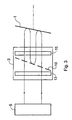
- a rotating mirror 1 is inclined at around 11° and a rotating unit 3, (shown in more detail in Fig. 2) which includes a linear polariser inclined at an angle of around 22°.
- a fixed quarter wave plate 5 is located in front of the rotating unit 3 to convert a linearly polarised beam to a circularly polarised beam.
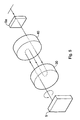
- Fig. 2 shows the rotating unit 3 in detail.
- This comprises an inclined linear polariser 10 positioned between two quarter wave plates 13 and 15.
- the quarter wave plates in this embodiment have fast axes of +45°, though other directions are possible.
- a linearly polarised beam is converted by the fixed quarter wave plate 5 to a right circularly polarised beam
- the incident beam is horizontally polarised and the fixed quarter wave plate 5, which has a fast axis at +45° produces right-handed circularly polarised beam.
- left circularly polarised beam may alternatively be used).
- the right circularly polarised beam passes through the first quarter wave plate 13 of rotating unit 3 which converts the beam to linear polarised.
- the beam then passes through the polariser 10 and through the second quarter wave plate 15 of the rotating unit, where it is converted to circular polarised light.
- the beam then reaches the rotating mirror 1, which rotates in the opposite direction from rotating unit 3 but at the same speed, and the beam is reflected from the counter-rotating mirror 1.
- the beam then passes back to the rotating unit 3 where it passes through the quarter wave plate 15. This time the light is reflected at the inclined polariser 10, because the plane of polarisation has been rotated through 90° when reflected at the rotating mirror 1 and transmitted by the quarter wave plate 15. The beam then passes to the counter rotating mirror 1 where it is reflected again, the handedness of the circularly polarised radiation undergoing a further change, and passes back through the rotating unit 3, this time passing through the linear polariser 10.
- the rotating unit 3 and the counter rotating mirror 1 produce conical scans, but in this tandem arrangement, with the rotations at the same speed and in opposite directions. Parts of the conical scans are effectively cancelled out to produce a linear scan. This cancellation is virtually complete if the inclination of the inclined polariser 10 is twice that of the counter-rotating mirror 1.
- Fig. 4 shows an alternative embodiment in which the rotating unit 20 consists of a quarter wave 23 plate and a linear polariser 21.
- the apparatus also has a Faraday rotator 25, which rotates the plane of polarization by 45°.
- the fixed quarter wave plate 5 converts a linearly polarised beam in to a circularly polarised beam.
- This circularly polarised beam is received by the rotating unit 20 and is converted into a linear beam by the quarter wave plate 23.
- the beam then passes through the linear polariser 21 and is then received by the Faraday rotator 25 which rotates the plane of the polarisation of the incident beam by 45°. This beam is then incident at the rotating mirror 1 where it is reflected.
- the beam passes back through the Faraday rotator 25 where it undergoes a further rotation of 45° in its plane of polarisation.
- the beam is now polarised at right angles to the transmission axis of the inclined polariser 21 of the rotation unit 3.
- the polariser 21 therefore reflects the incident beam in a conical scan pattern.
- This reflected beam now passes through the Faraday rotator 25 again and the plane of polarisation is rotated through 45°.
- the beam is then reflected at the mirror 1, and passes through the Faraday rotator, the plane of polarisation being rotated through 45° so that the beam is then able to pass through the inclined polariser 21 and then through the quarter wave plate 23 of the rotating unit 20.
- FIG. 5 It is also possible for two rotating units similar to that described in Fig. 1 to be used in series. This arrangement is shown in Fig. 5.
- the second unit 30 rotates about its axis with the same speed, but in the opposite direction from the first unit 40, and has a Faraday rotator between the quarter wave plate and the polariser. In this embodiment, it is not necessary to have a rotating mirror, because the polariser in the second rotating unit 40 can act as a mirror.
- the beam passes through the first rotating unit 30 as described for the first embodiment.
- the beam then passes to the second rotating unit 40 and is reflected from the inclined polariser of the second unit.
- the reflection at the inclined polariser of the second unit rotates the polarisation of the beam through 90°, so that when the beam passes back to the first polarising unit, it is reflected by the inclined polariser (and the polarisation is rotated through 90°). This time when the beam reaches the second rotating unit 40 it passes through the inclined polariser and via a second quarter wave plate 5a which is fixed.
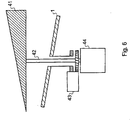
- the rotating unit is a rotating wedge 41 which rotates in the opposite direction from, and at the same speed as, the rotating mirror 1.
- the rotating wedge 1 is mounted on a drive shaft 42, and a gear box 43 and a motor 44 are used to control the speed and direction.
- the rotation is further balanced by balance weights 45a and 45b.
- Fig. 7 shows the wedge of this embodiment in more detail.
- the wedge 41 has a sulphur layer 46 sandwiched between two silica plates 47a and 47b, which are coated with anti-reflective PTFE layers 49a and 49b.
- the anti-reflective layer should have a refractive index which is the square root of the refractive index of the silica and have an optical thickness of ⁇ /4 where ⁇ is the wavelength of the radiation.
- PTFE is therefore an appropriate material for the anti-reflective layer, as it has a refractive index of 1.44 which approximates to the square root of the refractive index of silica (1.89).
- Its thickness should be 1.39 mm for radiation having a wavelength of 8mm (i.e. 35GHz).
- Alternative materials and thicknesses can be selected by the person skilled in the art. For example, it may be possible to achieve a suitably refractive wedge using a body of silica material, thus omitting the sulphur.
- a beam incident on the arrangement of Figs. 6 and 7 passes twice through the wedge 46 as it is reflected by the rotating mirror 1.
Landscapes
- Physics & Mathematics (AREA)
- General Physics & Mathematics (AREA)
- Optics & Photonics (AREA)
- Mechanical Optical Scanning Systems (AREA)
- Mechanical Treatment Of Semiconductor (AREA)
- Surgical Instruments (AREA)
- Valve Device For Special Equipments (AREA)
- Polarising Elements (AREA)
- Vehicle Body Suspensions (AREA)
- Ultra Sonic Daignosis Equipment (AREA)
- Apparatus For Radiation Diagnosis (AREA)
Claims (19)
- Un appareil à balayage linéaire comprenant un système optique présentant de premier (10, 30) et second (1, 40) corps rotatifs disposés pour tourner à la même vitesse, dans des directions opposées, ayant des axes de rotation généralement parallèles et étant inclinés par rapport à ces axes de rotation, le système optique étant disposé pour définir un trajet optique pour un faisceau polarisé de manière à former un balayage linéaire, dans lequel au moins un premier des corps est un polariseur et le système optique est disposé de telle manière que le trajet optique passe à travers le polariseur, soit réfléchi au niveau du second corps en retour vers le polariseur, et soit réfléchi par le polariseur en retour vers le second corps.
- Un appareil à balayage selon la revendication 1 dans lequel les axes de rotation des premier et second corps rotatifs sont coïncidants.
- Un appareil à balayage selon la revendication 1 ou la revendication 2 dans lequel le second corps rotatif est un élément réfléchissant et le trajet optique est disposé de telle manière qu'une fois que le faisceau polarisé est réfléchi en retour depuis le polariseur vers le second corps, le second corps réfléchit le faisceau en retour vers le polariseur et le faisceau passe à travers le polariseur.
- Un appareil à balayage selon la revendication 1 ou la revendication 2 dans lequel le second corps rotatif est un polariseur et le trajet optique est disposé de telle manière qu'une fois que le faisceau polarisé est réfléchi en retour vers le second corps, il et transmis à travers le second corps.
- Un appareil à balayage selon l'une quelconque des revendications ci-dessus dans lequel l'angle d'inclinaison du premier corps est le double de l'ange d'inclinaison du second corps.
- Un appareil à balayage selon l'une quelconque des revendications ci-dessus dans lequel le premier corps est un polariseur linéaire.
- Un appareil à balayage selon la revendication 6 dans lequel on prévoit de première et seconde plaques quart d'onde, une sur chaque côté du premier corps, et dans lequel l'appareil comprend des moyens pour faire tourner les première et seconde plaques quart d'onde autour du même axe que le premier corps, à la même vitesse et dans la même direction.
- Un appareil à balayage selon la revendication 7, dans lequel le second corps est un polariseur linéaire, dans lequel il existe de troisième et quatrième plaques quart d'onde, une sur chaque côté du second corps, les troisième et quatrième plaques quart d'onde étant disposées pour tourner autour du même axe que le second corps, à la même vitesse et dans la même direction que le second corps, et dans lequel un rotateur de Faraday est situé entre le second corps et la troisième plaque quart d'onde qui est située sur le premier côté de corps du second corps.
- Un appareil a balayage selon la revendication 6 dans lequel une plaque quart d'onde est située sur un côté du premier corps et est disposée pour tourner autour du même axe que le premier corps, à la même vitesse et dans la même direction que le premier corps, et dans lequel un rotateur de Faraday est situé sur l'autre côté du premier corps.
- Un appareil à balayage selon la revendication 7 ou la revendication 8 dans lequel la ou les plaques quart d'onde et le premier corps sont reliées pour former un ensemble tournant.
- Un appareil à balayage selon l'une quelconque des revendications ci-dessus dans lequel l'appareil comprend en outre une plaque quart d'onde fixe pour convertir un rayonnement polarisé linéaire en un rayonnement polarisé circulaire avant qu'il soit reçu par le premier corps.
- Un appareil à balayage linéaire présentant un réflecteur rotatif (11) et un coin optique rotatif (42) incorporant des matières réfringentes, dans lequel le coin (42) et le réflecteur (1) sont disposés pour tourner en sens contraire autour d'axe généralement parallèle, le réflecteur (1) et les deux faces du coin (42) étant inclinés par rapport à leurs axes de rotation respectifs, de telle manière qu'en service un faisceau passe à travers le coin (42), soit réfléchi par le réflecteur et passe en retour à travers le coin pour créer un balayage linéaire.
- Un appareil à balayage selon la revendication 11 dans lequel les axes de rotation du coin et du réflecteur sont coïncidants.
- Un appareil à balayage selon la revendication 11 ou la revendication 12 dans lequel le plan médian du coin est de manière générale perpendiculaire à l'axe de rotation du coin.
- Un appareil à balayage selon l'une quelconque des revendications 11-13 dans lequel le coin comprend des plaques réfringentes portées par un noyau réfringent.
- Un procédé de production d'un balayage linéaire, comprenant les étapes consistant à faire tourner de premier et second corps autour d'axes de rotation généralement parallèles, à la même vitesse, mais dans les direction mutuellement opposées, le premier corps étant un polariseur et à la fois le premier et le second corps étant inclinés par rapport à leurs axes de rotation respectifs, et à diriger un faisceau polarisé à travers le premier corps, de sorte qu'il soit réfléchi au niveau du second corps en retour vers le premier corps et qu'il soit réfléchi par le premier corps en retour vers le second corps.
- Un procédé selon la revendication 16 dans lequel le second corps est un élément réfléchissant et dans lequel, après que le faisceau polarisé soit réfléchi en retour depuis le premier corps vers le second corps, le second corps réfléchit le faisceau en retour vers le premier corps et le faisceau passe à travers le premier corps.
- Un procédé selon la revendication 16 dans lequel le second corps est un polariseur et dans lequel, après que le faisceau polarisé soit réfléchi en retour depuis le premier corps vers le second corps, il est transmis à travers le second corps.
- Un procédé de réalisation d'un balayage linéaire comprenant les étapes consistant à faire tourner un réflecteur et un coin optique dans des directions mutuellement opposées, mais autour d'axes de rotation généralement parallèles, le réflecteur et les deux faces du coin optique étant respectivement inclinés par rapport à l'axe de rotation du réflecteur et à l'axe respectif de rotation du coin, et à diriger un faisceau de manière qu'il passe à travers le coin optique, soit réfléchi par le réflecteur en retour vers le coin optique et passe à travers le coin optique pour créer un balayage linéaire.
Applications Claiming Priority (3)
| Application Number | Priority Date | Filing Date | Title |
|---|---|---|---|
| GB0117750 | 2001-07-20 | ||
| GBGB0117750.0A GB0117750D0 (en) | 2001-07-20 | 2001-07-20 | Scanning apparatus |
| PCT/GB2002/003349 WO2003009048A1 (fr) | 2001-07-20 | 2002-07-22 | Appareil a balayage |
Publications (2)
| Publication Number | Publication Date |
|---|---|
| EP1410093A1 EP1410093A1 (fr) | 2004-04-21 |
| EP1410093B1 true EP1410093B1 (fr) | 2004-12-15 |
Family
ID=9918899
Family Applications (1)
| Application Number | Title | Priority Date | Filing Date |
|---|---|---|---|
| EP02745666A Expired - Lifetime EP1410093B1 (fr) | 2001-07-20 | 2002-07-22 | Appareil a balayage |
Country Status (9)
| Country | Link |
|---|---|
| US (2) | US7038821B2 (fr) |
| EP (1) | EP1410093B1 (fr) |
| JP (1) | JP4170901B2 (fr) |
| AT (1) | ATE285082T1 (fr) |
| CA (2) | CA2689280C (fr) |
| DE (1) | DE60202297T2 (fr) |
| ES (1) | ES2233837T3 (fr) |
| GB (1) | GB0117750D0 (fr) |
| WO (1) | WO2003009048A1 (fr) |
Families Citing this family (11)
| Publication number | Priority date | Publication date | Assignee | Title |
|---|---|---|---|---|
| US7142340B2 (en) | 2003-10-31 | 2006-11-28 | Hewlett-Packard Development Company, L.P. | Optical scanner apparatuses and optical scanning methods |
| WO2005096064A2 (fr) * | 2004-03-30 | 2005-10-13 | Farran Technology Limited | Appareil d'exploration par balayage |
| US20070195271A1 (en) * | 2004-03-31 | 2007-08-23 | Koninklijke Philips Electronics, N.V. | Projection system with scanning device |
| US7719773B2 (en) * | 2007-11-12 | 2010-05-18 | Ricoh Company, Ltd. | Zoom lens unit and imaging apparatus |
| WO2009126546A1 (fr) * | 2008-04-07 | 2009-10-15 | University Of Florida Research Foundation, Inc. | Ensembles optiques monolithiques de haute précision et leurs procédés de fabrication et d'alignement |
| US20110040605A1 (en) * | 2009-08-17 | 2011-02-17 | Geoffrey Prentix Evertz | Electronic voting system |
| ES2387484B1 (es) | 2009-10-15 | 2013-08-02 | Alfa Imaging S.A. | Sistema de multiespectral de barrido. |
| US20200081129A1 (en) * | 2018-09-10 | 2020-03-12 | Veoneer Us, Inc. | Detection system for a vehicle |
| US12228653B2 (en) | 2022-10-07 | 2025-02-18 | Magna Electronics, Llc | Integrating a sensing system into headlight optics |
| US12092278B2 (en) | 2022-10-07 | 2024-09-17 | Magna Electronics, Llc | Generating a spotlight |
| US12202396B1 (en) | 2023-12-19 | 2025-01-21 | Magna Electronics, Llc | Line-scan-gated imaging for LiDAR headlight |
Family Cites Families (8)
| Publication number | Priority date | Publication date | Assignee | Title |
|---|---|---|---|---|
| DE1282675B (de) * | 1967-03-21 | 1968-11-14 | Eltro G M B H & Co Ges Fuer St | Vorrichtung zur sinusfoermigen Ablenkung eines Strahlenbuendels mittels Spiegel |
| US3881802A (en) * | 1974-04-18 | 1975-05-06 | Bendix Corp | Wedge-prism optical scanner |
| US4042933A (en) * | 1976-03-19 | 1977-08-16 | The United States Of America As Represented By The Secretary Of The Navy | Antenna line scan system for helicopter wire detection |
| US4168126A (en) * | 1977-07-05 | 1979-09-18 | Altman Associates, Inc. | Electro-optical measuring system using precision light translator |
| US4544228A (en) * | 1982-09-14 | 1985-10-01 | Spectra-Physics, Inc. | Scanning method using a rotating prism |
| US4871904A (en) * | 1987-12-28 | 1989-10-03 | Symbol Technologies, Inc. | Multidirectional optical scanner |
| EP0633541A1 (fr) * | 1993-07-06 | 1995-01-11 | Opticon Sensors Europe B.V. | Dispositif de lecture |
| GB9707654D0 (en) * | 1997-04-16 | 1997-06-04 | Secr Defence | Scanning apparatus |
-
2001
- 2001-07-20 GB GBGB0117750.0A patent/GB0117750D0/en not_active Ceased
-
2002
- 2002-07-22 WO PCT/GB2002/003349 patent/WO2003009048A1/fr not_active Ceased
- 2002-07-22 US US10/484,173 patent/US7038821B2/en not_active Expired - Fee Related
- 2002-07-22 ES ES02745666T patent/ES2233837T3/es not_active Expired - Lifetime
- 2002-07-22 JP JP2003514327A patent/JP4170901B2/ja not_active Expired - Fee Related
- 2002-07-22 EP EP02745666A patent/EP1410093B1/fr not_active Expired - Lifetime
- 2002-07-22 CA CA2689280A patent/CA2689280C/fr not_active Expired - Fee Related
- 2002-07-22 AT AT02745666T patent/ATE285082T1/de not_active IP Right Cessation
- 2002-07-22 DE DE60202297T patent/DE60202297T2/de not_active Expired - Lifetime
- 2002-07-22 CA CA2454194A patent/CA2454194C/fr not_active Expired - Fee Related
-
2006
- 2006-03-06 US US11/367,554 patent/US7106482B2/en not_active Expired - Fee Related
Also Published As
| Publication number | Publication date |
|---|---|
| ES2233837T3 (es) | 2005-06-16 |
| US7106482B2 (en) | 2006-09-12 |
| CA2454194A1 (fr) | 2003-01-30 |
| CA2454194C (fr) | 2010-12-07 |
| DE60202297D1 (en) | 2005-01-20 |
| EP1410093A1 (fr) | 2004-04-21 |
| GB0117750D0 (en) | 2001-09-12 |
| US20060146387A1 (en) | 2006-07-06 |
| US20040240019A1 (en) | 2004-12-02 |
| WO2003009048A1 (fr) | 2003-01-30 |
| JP4170901B2 (ja) | 2008-10-22 |
| US7038821B2 (en) | 2006-05-02 |
| ATE285082T1 (de) | 2005-01-15 |
| DE60202297T2 (de) | 2005-12-15 |
| JP2004536342A (ja) | 2004-12-02 |
| CA2689280A1 (fr) | 2003-01-30 |
| CA2689280C (fr) | 2011-07-12 |
Similar Documents
| Publication | Publication Date | Title |
|---|---|---|
| JP3367940B2 (ja) | フェーズド・アレイ・ビーム指向装置を備えたレーザ・レーダ・システム | |
| CA1313914C (fr) | Dispositif de collimation optique | |
| US5253033A (en) | Laser radar system with phased-array beam steerer | |
| CA1302138C (fr) | Rotateurs d'images optiques | |
| US5223956A (en) | Optical beam scanners for imaging applications | |
| CA2454194C (fr) | Appareil a balayage | |
| JPS596519B2 (ja) | レ−ザ−ジヤイロスコ−プ | |
| JPH027022A (ja) | 液晶セル窓 | |
| US5481384A (en) | Deflector system which produces dual, oppositely directed scanning beams simultaneously or successively | |
| US12510756B2 (en) | Optical apparatus and near-eye display device | |
| US4565426A (en) | Beam splitter | |
| CN114236855A (zh) | 光学系统和ar设备 | |
| EP0604031B1 (fr) | Système de balayage opto-mécanique | |
| US4850041A (en) | Laser radar with adjustable local oscillator | |
| US7349157B2 (en) | Optical splitting device and optical communication terminal comprising such a device | |
| US4504123A (en) | High efficiency polarizing beamsplitter | |
| US3703330A (en) | Optical rotary joint | |
| US7110623B1 (en) | Temporally coherent depolarizer and a polarization transformer | |
| US4477152A (en) | Reduction of signal modulation caused by polarization in visible optical scanning systems | |
| US12111557B1 (en) | Diffractive beam steering system with high efficiency | |
| JP2647488B2 (ja) | 偏波カプラ | |
| SU945641A1 (ru) | Многолучевой интерферометр дл спектральных и пол ризационных измерений | |
| RU2160914C2 (ru) | Устройство поворота плоскости поляризации лазерного излучения | |
| Kotov | Acousto-optic modulation of multicomponent Ar laser radiation | |
| CN118920259A (zh) | 一种多模式激光器 |
Legal Events
| Date | Code | Title | Description |
|---|---|---|---|
| PUAI | Public reference made under article 153(3) epc to a published international application that has entered the european phase |
Free format text: ORIGINAL CODE: 0009012 |
|
| 17P | Request for examination filed |
Effective date: 20040216 |
|
| AK | Designated contracting states |
Kind code of ref document: A1 Designated state(s): AT BE BG CH CY CZ DE DK EE ES FI FR GB GR IE IT LI LU MC NL PT SE SK TR |
|
| AX | Request for extension of the european patent |
Extension state: AL LT LV MK RO SI |
|
| GRAP | Despatch of communication of intention to grant a patent |
Free format text: ORIGINAL CODE: EPIDOSNIGR1 |
|
| GRAS | Grant fee paid |
Free format text: ORIGINAL CODE: EPIDOSNIGR3 |
|
| GRAA | (expected) grant |
Free format text: ORIGINAL CODE: 0009210 |
|
| AK | Designated contracting states |
Kind code of ref document: B1 Designated state(s): AT BE BG CH CY CZ DE DK EE ES FI FR GB GR IE IT LI LU MC NL PT SE SK TR |
|
| PG25 | Lapsed in a contracting state [announced via postgrant information from national office to epo] |
Ref country code: TR Free format text: LAPSE BECAUSE OF FAILURE TO SUBMIT A TRANSLATION OF THE DESCRIPTION OR TO PAY THE FEE WITHIN THE PRESCRIBED TIME-LIMIT Effective date: 20041215 Ref country code: CZ Free format text: LAPSE BECAUSE OF FAILURE TO SUBMIT A TRANSLATION OF THE DESCRIPTION OR TO PAY THE FEE WITHIN THE PRESCRIBED TIME-LIMIT Effective date: 20041215 Ref country code: BG Free format text: LAPSE BECAUSE OF FAILURE TO SUBMIT A TRANSLATION OF THE DESCRIPTION OR TO PAY THE FEE WITHIN THE PRESCRIBED TIME-LIMIT Effective date: 20041215 Ref country code: AT Free format text: LAPSE BECAUSE OF FAILURE TO SUBMIT A TRANSLATION OF THE DESCRIPTION OR TO PAY THE FEE WITHIN THE PRESCRIBED TIME-LIMIT Effective date: 20041215 Ref country code: EE Free format text: LAPSE BECAUSE OF FAILURE TO SUBMIT A TRANSLATION OF THE DESCRIPTION OR TO PAY THE FEE WITHIN THE PRESCRIBED TIME-LIMIT Effective date: 20041215 Ref country code: SK Free format text: LAPSE BECAUSE OF FAILURE TO SUBMIT A TRANSLATION OF THE DESCRIPTION OR TO PAY THE FEE WITHIN THE PRESCRIBED TIME-LIMIT Effective date: 20041215 Ref country code: FI Free format text: LAPSE BECAUSE OF FAILURE TO SUBMIT A TRANSLATION OF THE DESCRIPTION OR TO PAY THE FEE WITHIN THE PRESCRIBED TIME-LIMIT Effective date: 20041215 |
|
| REG | Reference to a national code |
Ref country code: GB Ref legal event code: FG4D Ref country code: CH Ref legal event code: EP |
|
| REG | Reference to a national code |
Ref country code: IE Ref legal event code: FG4D |
|
| REF | Corresponds to: |
Ref document number: 60202297 Country of ref document: DE Date of ref document: 20050120 Kind code of ref document: P |
|
| PG25 | Lapsed in a contracting state [announced via postgrant information from national office to epo] |
Ref country code: DK Free format text: LAPSE BECAUSE OF FAILURE TO SUBMIT A TRANSLATION OF THE DESCRIPTION OR TO PAY THE FEE WITHIN THE PRESCRIBED TIME-LIMIT Effective date: 20050315 Ref country code: GR Free format text: LAPSE BECAUSE OF FAILURE TO SUBMIT A TRANSLATION OF THE DESCRIPTION OR TO PAY THE FEE WITHIN THE PRESCRIBED TIME-LIMIT Effective date: 20050315 Ref country code: SE Free format text: LAPSE BECAUSE OF FAILURE TO SUBMIT A TRANSLATION OF THE DESCRIPTION OR TO PAY THE FEE WITHIN THE PRESCRIBED TIME-LIMIT Effective date: 20050315 |
|
| REG | Reference to a national code |
Ref country code: ES Ref legal event code: FG2A Ref document number: 2233837 Country of ref document: ES Kind code of ref document: T3 |
|
| PG25 | Lapsed in a contracting state [announced via postgrant information from national office to epo] |
Ref country code: CY Free format text: LAPSE BECAUSE OF FAILURE TO SUBMIT A TRANSLATION OF THE DESCRIPTION OR TO PAY THE FEE WITHIN THE PRESCRIBED TIME-LIMIT Effective date: 20050722 |
|
| PG25 | Lapsed in a contracting state [announced via postgrant information from national office to epo] |
Ref country code: MC Free format text: LAPSE BECAUSE OF NON-PAYMENT OF DUE FEES Effective date: 20050731 |
|
| PLBE | No opposition filed within time limit |
Free format text: ORIGINAL CODE: 0009261 |
|
| STAA | Information on the status of an ep patent application or granted ep patent |
Free format text: STATUS: NO OPPOSITION FILED WITHIN TIME LIMIT |
|
| ET | Fr: translation filed | ||
| 26N | No opposition filed |
Effective date: 20050916 |
|
| REG | Reference to a national code |
Ref country code: GB Ref legal event code: 732E |
|
| REG | Reference to a national code |
Ref country code: CH Ref legal event code: PUE Owner name: GESTIOEN AVANZADA DE TECNOLOG?AS ELETROENICAS, GA Free format text: THE UNIVERSITY OF READING#PALMER BUILDING, WHITEKNIGHTS#READING RG6 6AY (GB) -TRANSFER TO- GESTIOEN AVANZADA DE TECNOLOG?AS ELETROENICAS, GATE S.A.#C/ GENERAL PARDINAS, 91#28006 MADRID (ES) |
|
| NLS | Nl: assignments of ep-patents |
Owner name: GESTIOEN AVANZADA DE TECNOLOG?AS ELECTROENICAS, GA Effective date: 20061025 |
|
| REG | Reference to a national code |
Ref country code: ES Ref legal event code: PC2A |
|
| BECA | Be: change of holder's address |
Owner name: *GESTION AVANZADA DE TECHNOLOGIAS ELECTRONICAS GAT Effective date: 20061025 |
|
| PG25 | Lapsed in a contracting state [announced via postgrant information from national office to epo] |
Ref country code: PT Free format text: LAPSE BECAUSE OF NON-PAYMENT OF DUE FEES Effective date: 20050515 |
|
| REG | Reference to a national code |
Ref country code: FR Ref legal event code: PLFP Year of fee payment: 14 |
|
| PGFP | Annual fee paid to national office [announced via postgrant information from national office to epo] |
Ref country code: LU Payment date: 20150728 Year of fee payment: 14 |
|
| PGFP | Annual fee paid to national office [announced via postgrant information from national office to epo] |
Ref country code: NL Payment date: 20150727 Year of fee payment: 14 |
|
| PGFP | Annual fee paid to national office [announced via postgrant information from national office to epo] |
Ref country code: CH Payment date: 20150727 Year of fee payment: 14 Ref country code: ES Payment date: 20150715 Year of fee payment: 14 Ref country code: DE Payment date: 20150727 Year of fee payment: 14 Ref country code: IE Payment date: 20150727 Year of fee payment: 14 Ref country code: GB Payment date: 20150720 Year of fee payment: 14 |
|
| PGFP | Annual fee paid to national office [announced via postgrant information from national office to epo] |
Ref country code: FR Payment date: 20150727 Year of fee payment: 14 Ref country code: BE Payment date: 20150730 Year of fee payment: 14 |
|
| PGFP | Annual fee paid to national office [announced via postgrant information from national office to epo] |
Ref country code: IT Payment date: 20150729 Year of fee payment: 14 |
|
| PG25 | Lapsed in a contracting state [announced via postgrant information from national office to epo] |
Ref country code: BE Free format text: LAPSE BECAUSE OF NON-PAYMENT OF DUE FEES Effective date: 20160731 |
|
| REG | Reference to a national code |
Ref country code: DE Ref legal event code: R119 Ref document number: 60202297 Country of ref document: DE |
|
| REG | Reference to a national code |
Ref country code: CH Ref legal event code: PL |
|
| REG | Reference to a national code |
Ref country code: NL Ref legal event code: MM Effective date: 20160801 |
|
| GBPC | Gb: european patent ceased through non-payment of renewal fee |
Effective date: 20160722 |
|
| PG25 | Lapsed in a contracting state [announced via postgrant information from national office to epo] |
Ref country code: FR Free format text: LAPSE BECAUSE OF NON-PAYMENT OF DUE FEES Effective date: 20160801 Ref country code: LI Free format text: LAPSE BECAUSE OF NON-PAYMENT OF DUE FEES Effective date: 20160731 Ref country code: CH Free format text: LAPSE BECAUSE OF NON-PAYMENT OF DUE FEES Effective date: 20160731 Ref country code: NL Free format text: LAPSE BECAUSE OF NON-PAYMENT OF DUE FEES Effective date: 20160801 Ref country code: DE Free format text: LAPSE BECAUSE OF NON-PAYMENT OF DUE FEES Effective date: 20170201 |
|
| REG | Reference to a national code |
Ref country code: FR Ref legal event code: ST Effective date: 20170331 |
|
| REG | Reference to a national code |
Ref country code: IE Ref legal event code: MM4A |
|
| PG25 | Lapsed in a contracting state [announced via postgrant information from national office to epo] |
Ref country code: GB Free format text: LAPSE BECAUSE OF NON-PAYMENT OF DUE FEES Effective date: 20160722 |
|
| PG25 | Lapsed in a contracting state [announced via postgrant information from national office to epo] |
Ref country code: IE Free format text: LAPSE BECAUSE OF NON-PAYMENT OF DUE FEES Effective date: 20160722 |
|
| PG25 | Lapsed in a contracting state [announced via postgrant information from national office to epo] |
Ref country code: IT Free format text: LAPSE BECAUSE OF NON-PAYMENT OF DUE FEES Effective date: 20160722 Ref country code: LU Free format text: LAPSE BECAUSE OF NON-PAYMENT OF DUE FEES Effective date: 20160722 |
|
| PG25 | Lapsed in a contracting state [announced via postgrant information from national office to epo] |
Ref country code: ES Free format text: LAPSE BECAUSE OF NON-PAYMENT OF DUE FEES Effective date: 20160723 |
|
| REG | Reference to a national code |
Ref country code: ES Ref legal event code: FD2A Effective date: 20181128 |