EP1410536B1 - Systeme et procede edfa a assistance raman - Google Patents
Systeme et procede edfa a assistance raman Download PDFInfo
- Publication number
- EP1410536B1 EP1410536B1 EP01274382A EP01274382A EP1410536B1 EP 1410536 B1 EP1410536 B1 EP 1410536B1 EP 01274382 A EP01274382 A EP 01274382A EP 01274382 A EP01274382 A EP 01274382A EP 1410536 B1 EP1410536 B1 EP 1410536B1
- Authority
- EP
- European Patent Office
- Prior art keywords
- edfa
- raman
- amplifier
- gain portion
- gain
- Prior art date
- Legal status (The legal status is an assumption and is not a legal conclusion. Google has not performed a legal analysis and makes no representation as to the accuracy of the status listed.)
- Expired - Lifetime
Links
- 238000001069 Raman spectroscopy Methods 0.000 title claims abstract description 90
- 238000000034 method Methods 0.000 title claims abstract description 10
- 230000003287 optical effect Effects 0.000 claims abstract description 49
- 238000004891 communication Methods 0.000 claims abstract description 18
- 239000000835 fiber Substances 0.000 claims description 29
- 239000013307 optical fiber Substances 0.000 claims description 19
- 238000009825 accumulation Methods 0.000 abstract description 7
- 230000005540 biological transmission Effects 0.000 description 13
- 238000013461 design Methods 0.000 description 9
- 230000008901 benefit Effects 0.000 description 8
- 239000006185 dispersion Substances 0.000 description 6
- 230000006735 deficit Effects 0.000 description 2
- 238000010586 diagram Methods 0.000 description 2
- 238000009826 distribution Methods 0.000 description 2
- 238000012986 modification Methods 0.000 description 2
- 230000004048 modification Effects 0.000 description 2
- 238000012935 Averaging Methods 0.000 description 1
- 229910052691 Erbium Inorganic materials 0.000 description 1
- 238000010521 absorption reaction Methods 0.000 description 1
- 230000003321 amplification Effects 0.000 description 1
- 238000005452 bending Methods 0.000 description 1
- 230000015556 catabolic process Effects 0.000 description 1
- 238000006731 degradation reaction Methods 0.000 description 1
- 230000000593 degrading effect Effects 0.000 description 1
- 230000009977 dual effect Effects 0.000 description 1
- 230000000694 effects Effects 0.000 description 1
- 238000005516 engineering process Methods 0.000 description 1
- UYAHIZSMUZPPFV-UHFFFAOYSA-N erbium Chemical compound [Er] UYAHIZSMUZPPFV-UHFFFAOYSA-N 0.000 description 1
- 230000009022 nonlinear effect Effects 0.000 description 1
- 238000003199 nucleic acid amplification method Methods 0.000 description 1
- 230000010363 phase shift Effects 0.000 description 1
- 238000005086 pumping Methods 0.000 description 1
- 229910052761 rare earth metal Inorganic materials 0.000 description 1
- 150000002910 rare earth metals Chemical class 0.000 description 1
- 230000001932 seasonal effect Effects 0.000 description 1
Images


Classifications
-
- H—ELECTRICITY
- H04—ELECTRIC COMMUNICATION TECHNIQUE
- H04B—TRANSMISSION
- H04B10/00—Transmission systems employing electromagnetic waves other than radio-waves, e.g. infrared, visible or ultraviolet light, or employing corpuscular radiation, e.g. quantum communication
- H04B10/29—Repeaters
- H04B10/291—Repeaters in which processing or amplification is carried out without conversion of the main signal from optical form
- H04B10/2912—Repeaters in which processing or amplification is carried out without conversion of the main signal from optical form characterised by the medium used for amplification or processing
- H04B10/2916—Repeaters in which processing or amplification is carried out without conversion of the main signal from optical form characterised by the medium used for amplification or processing using Raman or Brillouin amplifiers
-
- H—ELECTRICITY
- H04—ELECTRIC COMMUNICATION TECHNIQUE
- H04B—TRANSMISSION
- H04B10/00—Transmission systems employing electromagnetic waves other than radio-waves, e.g. infrared, visible or ultraviolet light, or employing corpuscular radiation, e.g. quantum communication
- H04B10/29—Repeaters
- H04B10/291—Repeaters in which processing or amplification is carried out without conversion of the main signal from optical form
- H04B10/2912—Repeaters in which processing or amplification is carried out without conversion of the main signal from optical form characterised by the medium used for amplification or processing
Definitions
- the present invention relates to optical telecommunications systems. More particularly, the present invention relates to Raman assisted EDFA amplification in long haul and ultra-long haul optical telecommunications systems.
- optical amplifiers are employed to reduce or minimize power loss, especially in long haul systems, i.e., about 200 to 600 km, and ultra-long haul (ULH) systems, i.e., greater than about 2,000 km.
- Transmission systems may include a series of optical amplifiers periodically spaced along the fiber route between the transmitter and the receiver. These amplifiers provide the necessary optical signal power.
- optical fiber exhibits nonlinearities such as phase shifts of the optical signal.
- modulated optical signals include different wavelengths
- these different portions propagate along the transmission fiber at different velocities due to dispersion properties inherent in the fiber media. After propagation over a given distance, shorter wavelengths may overtake and become superimposed on longer wavelengths causing amplitude distortion. This is known as.chromatic dispersion.
- optical amplifiers must amplify sufficiently to raise the SNR to a level where a receiver can detect an optical signal but not be so high powered as to create intolerable nonlinearities.
- Lumped rare earth doped fiber optic amplifiers such as erbium doped fiber amplifiers (EDFAs) are used in ULH optical fiber telecommunications systems.
- EDFA gains are matched to the fiber span losses to produce low noise amplified optical signals along the entire transmission path.
- the spans between amplifiers are preset at approximately the same lengths-- between about 40 to 50 km-- so that the loss per span is substantially consistent throughout the system.
- ULH terrestrial systems are plagued with large span loss variations and daily and seasonal temperature fluctuations.
- terrestrial systems unlike custom built submarine systems, terrestrial systems often have to be designed using existing fiber in the ground, unmatched and with unknown fiber characteristics.
- This embedded fiber base is typically non-zero dispersion shifted fiber (NZ-DSF) with a dispersion of about 2-4ps/nm/km. Significant dispersion, therefore, may accumulate over long transmission distances.
- NZ-DSF non-zero dispersion shifted fiber
- terrestrial systems are typically designed with wide varying amplifier spacings of about 30 to 110 km.
- the associated span loss is very high and inconsistent.
- the longer spans generally cause increased noise accumulation.
- the nonlinearities limit the amount of power that can be launched into the next NZ-DCF span. This complicates the EDFA design and may potentially degrade performance. That is, in an attempt to minimize costs, terrestrial systems typically attempt to use a single, generic EDFA design throughout the entire system, notwithstanding the loss and nonlinearity variations from one span to the next.
- the present invention generally provides a system including distributed Raman assisted EDFA's to reduce the increased noise accumulation associated with long and inconsistent terrestrial spans but maintain the appropriate gain from each amplifier.
- a Raman assisted EDFA hybrid amplifier includes a Raman amplifier variable gain portion, an EDFA gain portion; and an optical attenuator coupled to an output of the EDFA gain portion.
- the amplifier includes at least one dispersion-compensating fiber disposed between the Raman amplifier variable gain portion and the EDFA gain portion.
- the dispersion-compensating fiber may be disposed within the Raman amplifier variable gain portion itself. If the EDFA gain portion is a multi-stage EDFA, the dispersion-compensating fiber may be disposed between stages of the multi-stage EDFA.
- the Raman portion is configured to provide variable gain, such that the EDFA gain portion has a substantially constant input power.
- the Raman amplifier variable gain ranges from about 1 to 16 dB. Most preferably the maximum Raman gain is about 14 dB.
- the optical attenuator reduces power from an output of the EDFA gain portion. Most preferably, the attenuator reduces power in 1 dB increments.
- a hybrid amplifier that includes a variable Raman gain source for optimizing the amplifier so that the overall effect of noise accumulation and multi-path interference (caused by multiple Rayleigh scattering) is minimized.
- lumped amplifiers such as EDFAs
- EDFAs are used with varying span lengths, ranging, for example, from about 30 to about 110 km between amplifiers.
- variable Raman gain amplifiers to provide optimum Raman gain depending upon the span in order to choose the maximum Raman gain and thus optimize noise performance and multi-path interference.
- the Raman amplifier is configured like a pre-amplifier for the EDFA gain portion.
- a method of amplifying an optical signal on an optical fiber communication link includes providing a first Raman assisted EDFA hybrid amplifier having a Raman amplifier variable gain portion, an EDFA gain portion, and an optical attenuator coupled to an output of the EDFA gain portion; transmitting the optical signal on the optical fiber communication link through the Raman assisted EDFA hybrid amplifier; amplifying the optical signal through the Raman amplifier variable gain portion; amplifying the optical signal through the EDFA gain portion; and attenuating the output power of the EDFA gain portion.
- the EDFA benefits from forward pumping and is capable of taking full advantage of the Raman assist. That is, in combination with variable Raman gain, all the spans are operated with optimum launch powers into longer lossier spans, with an improvement in noise performance and minimal nonlinear effects.
- the present invention allows for a single EDFA design to be used, in combination with Raman variable gain, in a system having spans ranging from 30km to 110km. This allows for the use of one type of amplifier as a generic building block for terrestrial ULH systems having varying spans.
- FIG. 1A is a block diagram of an exemplary optical communications system in accordance with one embodiment of the present invention.
- FIG. 1B is a block diagram of a multi-stage EDFA in accordance with an embodiment of the present invention.
- FIG. 2 is a graph showing the equivalent noise figure verses internal Raman gain for a particular 100km span
- FIG. 3 illustrates an exemplary method of choosing the launch power, EDFA output loss and Raman gain
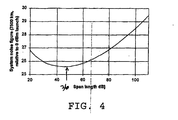
- FIG. 4 is a graph showing system a noise figure for a 7500 km system as a function of span length.
- Fig. 1A An exemplary embodiment of the present invention is shown in Fig. 1A and is designated generally by reference numeral 10.
- the hybrid amplifier includes transmission fiber 14, a Raman gain source 16, an EDFA gain source 18, and an optical attenuator 20.
- the Raman gain source 16 includes a Raman pump module 22, having one or more Raman wavelengths. Each can be independently adjustable through separate attenuators or through bias adjustments.
- the Raman gain source 16 is coupled to the transmission fiber 14 by way of coupler 24.
- the coupler may be any known type such as a WDM module or a 3dB device.
- the Raman gain is introduced into the transmission fiber 14 in a counterpropagating direction.
- the EDFA gain source 18 is provided by any known EDFA module such as a 980nm pumped EDFA or a 1480nm pumped EDFA.
- the EDFA gain source 18 may also consist of a dual stage EDFA or multi-stage EDFA as shown in FIG. 1B.
- the first EDFA 18' is coupled to the second EDFA 18".
- Disposed between the EDFAs in the multi-stage EDFA module 18 of FIG. 1B is dispersion-compensation fiber (DCF).
- DCF dispersion-compensation fiber
- DCF 26 Disposed between the Raman gain source 16 and the EDFA gain source 18 in FIG. 1A.
- This DCF 26 may alternatively be part of the Raman gain path as designated by the dashed lines and shown disposed coupled to the transmission fiber 14 before coupler 24.
- the DCF 26 is coupled into the transmission fiber 14 in this particular embodiment because this configuration assumes that the transmission fiber 14 is part of a terrestrial system that is already in the ground and would need to have the DCF coupled in.
- the DCF is of the conventional sort as well.
- the variable Raman gain source 16 acts as a pre-amplifier for the EDFA.
- SNR System signal-to-noise ratio
- interference noise caused by multiple Rayleigh scattering
- Raman gain can therefore only be increased until the point where the improvement in SNR is removed by the increase in interference noise. This optimum Raman gain depends on the span length and also might depend on the specific fiber type.
- FIG. 2 illustrates the equivalent noise figure (dB) versus internal Raman gain (dB) for an exemplary 100 km span.
- the equivalent (lumped) single amplifier noise figure is calculated so that an equivalent chain of optical amplifiers with the same span loss, the same equivalent noise figure, and the same path average intensity have the same output SNR as the hybrid (distributed Raman, EDFA) chain.
- Equivalent noise figures of 3-4 dB means that the hybrid chain is performing as well as a conventional EDFA chain (i.e., no net improvement).
- the minimum equivalent noise figure 30 in Figure 2 is approximately 0.7 dB which is achieved for a Raman gain of about 14 dB.
- a maximum Raman gain of about 14 dB in every span significantly improves the noise performance by about 3.4 dB compared to no Raman gain at all (for 100 km spans).
- the performance improvement of Raman gain reduces for shorter spans. The largest improvement is achieved for the very long spans.
- the channel launch power is basically chosen as a trade-off between noise accumulation (received SNR) and pulse distortions due to fiber non-linearities. With the same amount of end-to-end non-linear impairment, more power can be launched into a long span than into a short span.
- the launch power that optimizes (trades-off non-linearities and noise accumulation) system performance is a function of span length, but the optimum path average intensity is usually the same regardless of the span length.
- a ULH system design in accordance with the present invention chooses launch power based on the following span so that optimum power is launched into it.
- the adjustment is performed by adding loss to the output of the previous EDFA of the Raman assisted EDFA hybrid amplifier, for example, in 1 dB increments.
- the Raman gain is adjusted either manually or via feedback so that all EDFAs have the same input power.
- a major advantage over the known art is realized in that a single code of preferably single-stage medium gain EDFAs can be used with terrestrial systems regardless of the span loss distribution (within practical limits: e.g., 30-110 km).
- the EDFA gain and output power, the Raman gain upper and lower limits, and upper and lower loss limits can be chosen for a generation or class of systems without custom design for each amplifier in the transmission path.
- Another advantage of this design is that it significantly simplifies the gain equalization plan.
- FIG. 3 illustrates an exemplary method for choosing the launch power (for equal path average intensity), EDFA output loss, and Raman gain (for constant input power)
- this Figure shows that span losses from 5-25 dB can be handled by varying launch power 32 from 6.5-12 dBm (using 0-5.5 dB loss) and varying Raman gain 34 from 1-16 dB. All of this can be achieved in a practical system with available components.
- FIG. 4 illustrates the system noise figure versus span length (dB)
- this Figure shows the received SNR scales directly with the system noise figure.
- 45 km spans give the best performance using this design.
- the difference between effective noise figures of 45 km spans and 110 km spans is less than 4 dB, and the difference between 45 km spans and 85 km spans (typical average span length for terrestrial routes) is less than 2 dB. Therefore, it has been discovered that this design enables transmission over ULH terrestrial systems with widely distributed span lengths (averaging 85 km) with an SNR impairment of less than 2 dB compared to a system consisting of 45 km spans (similar to a submarine system).
- one advantage of the present invention is that the preferred system design makes a terrestrial link look and behave like a traditional long-haul or ULH undersea link.
- One code of (single stage) EDFAs is used with varying output loss to launch the optimum power into each span regardless of length.
- the Raman gain is adjusted so that each EDFA has substantially the same input power. This concept minimizes system degradation from wide span loss distributions and allows generic repeaters to be manufactured and used in all systems of the same generation (capacity).
Landscapes
- Physics & Mathematics (AREA)
- Electromagnetism (AREA)
- Engineering & Computer Science (AREA)
- Computer Networks & Wireless Communication (AREA)
- Signal Processing (AREA)
- Optical Communication System (AREA)
- Lasers (AREA)
- Optical Modulation, Optical Deflection, Nonlinear Optics, Optical Demodulation, Optical Logic Elements (AREA)
Abstract
Claims (29)
- Système de communications optiques (10) comprenant :un émetteur pour transmettre un signal optique ;un récepteur pour détecter ledit signal optique ; etune liaison de communication à fibre optique interposée entre ledit émetteur et ledit récepteur, ladite liaison de communication à fibre optique comprenant :au moins un amplificateur hybride EDFA et à effet Raman (12) ayant une partie à gain variable d'amplification à effet Raman (14) et une partie à gain EDFA (18), et caractérisé par un atténuateur optique (20) couplé à la sortie de la dite sortie à gain EDFA.
- Système selon la revendication 1, comprenant en outre au moins une fibre à dispersion-compensation (26) disposée entre ladite partie à gain variable d'amplification à effet Raman et ladite partie à gain EDFA.
- Système selon la revendication 1, comprenant en outre au moins une fibre à dispersion-compensation disposée dans ladite partie à gain variable d'amplification à effet Raman.
- Système selon la revendication 1, dans lequel ladite partie à gain EDFA comprend un amplificateur EDFA à plusieurs étages.
- Système selon la revendication 4, comprenant en outre au moins une fibre à dispersion-compensation disposée entre les étages dudit amplificateur EDFA à plusieurs étages.
- Système selon la revendication 1, dans lequel ladite liaison de communication à fibre optique comprend une pluralité de segments de fibre optique de longueurs variables connectés et arrangés entre ledit émetteur et ledit récepteur.
- Système selon la revendication 1, comprenant en outre un second amplificateur hybride EDFA et à effet Raman, dans lequel ledit au moins un amplificateur hybride EDFA et à effet Raman est configuré pour délivrer une puissance de lancement optimale pour ledit second amplificateur hybride EDFA et à effet Raman.
- Système selon la revendication 1, dans lequel ladite liaison de communication à fibre optique comprend une pluralité desdits amplificateurs hybrides EDFA et à effet Raman.
- Système selon la revendication 8, dans lequel ledit atténuateur optique de chaque dite pluralité d'amplificateurs hybrides EDFA et à effet Raman est ajusté pour réduire la puissance de sortie de ladite partie à gain EDFA.
- Système selon la revendication 9, dans lequel ladite puissance de sortie est ajustée par incréments de 1 dB jusqu'à ce qu'une puissance optimale soit atteinte pour être lancée dans l'amplificateur hybride EDFA et à effet Raman adjacent suivant.
- Système selon la revendication 8, dans lequel lesdites parties à gain variable d'amplification à effet Raman sont manuellement ajustées jusqu'à ce que lesdites parties à gain EDFA aient sensiblement la même puissance d'entrée à travers ladite liaison de communication à fibre optique.
- Système selon la revendication 8, dans lequel ledit atténuateur optique de chaque dite pluralité d'amplificateurs hybrides EDFA et à effet Raman est ajusté pour réduire la puissance de sortie de ladite partie à gain EDFA, et dans lequel lesdites parties à gain variable d'amplification à effet Raman sont ajustées manuellement jusqu'à ce que lesdites parties à gain EDFA aient sensiblement la même puissance d'entrée à travers ladite liaison de communication à fibre optique.
- Système selon la revendication 8, dans lequel lesdites parties à gain variable d'amplification à effet Raman sont ajustées au moyen d'une boucle d'asservissement jusqu'à ce que lesdites parties à gain EDFA aient sensiblement la même puissance d'entrée à travers ladite liaison de communication à fibre optique.
- Système selon la revendication 8, dans lequel ledit atténuateur optique de chaque dite pluralité d'amplificateurs hybrides EDFA et à effet Raman est ajusté pour réduire la puissance de sortie de ladite partie à gain EDFA, et dans lequel lesdites parties à gain variable d'amplification à effet Raman sont ajustées au moyen d'une boucle d'asservissement jusqu'à ce que lesdites parties à gain EDFA aient sensiblement la même puissance d'entrée à travers ladite liaison de communication à fibre optique.
- Système selon la revendication 6, dans lequel lesdites longueurs des segments de fibre optique s'étendent d'environ 30 km à environ 110 km.
- Amplificateur hybride EDFA et à effet Raman (12) comprenant :une partie à gain variable d'amplification à effet Raman (14),une partie à gain EDFA (18), et caractérisé par un atténuateur optique (20) couplé à la sortie de la dite sortie à gain EDFA.
- Amplificateur selon la revendication 16, comprenant en outre au moins une fibre à dispersion-compensation (26) disposée entre ladite partie à gain variable d'amplification à effet Raman et ladite partie à gain EDFA.
- Amplificateur selon la revendication 16, comprenant en outre au moins une fibre à dispersion-compensation disposée dans ladite partie à gain variable d'amplification à effet Raman.
- Amplificateur selon la revendication 16, dans lequel ladite partie à gain EDFA comprend un amplificateur EDFA à plusieurs étages.
- Amplificateur selon la revendication 19, comprenant en outre au moins une fibre à dispersion-compensation disposée entre les étages dudit amplificateur EDFA à plusieurs étages.
- Amplificateur selon la revendication 16, dans lequel ladite partie à gain EDFA est un amplificateur EDFA à un seul étage.
- Amplificateur selon la revendication 16, dans lequel ladite partie à effet Raman est configurée pour délivrer un gain variable, moyennant quoi ladite partie EDFA a une puissance d'entrée sensiblement constante.
- Amplificateur selon la revendication 16, dans lequel ledit gain variable s'étend d'environ 1 dB à environ 16 dB.
- Amplificateur selon la revendication 16, dans lequel ledit atténuateur optique réduit la puissance de sortie de la dite partie à gain EDFA.
- Amplificateur selon la revendication 24, dans lequel ledit atténuateur réduit la puissance de sortie par incréments de 1 dB.
- Procédé d'amplification d'un signal optique sur une liaison de communication à fibre optique, comprenant les étapes consistant à :proposer un premier amplificateur hybride EDFA et à effet Raman ayant une partie à gain variable d'amplification à effet Raman, une partie à gain EDFA, et un atténuateur optique couplé à une sortie de ladite partie à gain EDFA ;transmettre ledit signal optique sur ladite liaison de communication à fibre optique à travers ledit amplificateur hybride EDFA et à effet Raman ;amplifier ledit signal optique à travers ladite partie à gain variable d'amplification à effet Raman ;amplifier ledit signal optique à travers ladite partie à gain EDFA ; etatténuer la puissance de sortie de ladite partie à gain EDFA.
- Procédé selon la revendication 26, comprenant en outre l'étape consistant à ajuster ledit atténuateur optique pour ajouter une perte prédéterminée à la sortie de ladite partie à gain EDFA, moyennant quoi la puissance de lancement est optimisée.
- Procédé selon la revendication 26, comprenant en outre les étapes consistant à :proposer un second amplificateur hybride EDFA et à effet Raman ayant une partie à gain variable d'amplification à effet Raman, une partie à gain EDFA, et un atténuateur optique couplé à une sortie de ladite partie à gain EDFA ; etajuster le gain Raman de ladite première partie à gain variable d'amplification à effet Raman, moyennant quoi la puissance d'entrée de ladite seconde partie à gain EDFA est sensiblement la même que la puissance d'entrée de ladite première partie à gain EDFA.
- Procédé d'amplification d'un signal optique sur une liaison de communication à fibre optique, comprenant les étapes consistant à :proposer une pluralité d'amplificateurs hybrides EDFA et à effet Raman, ayant chacun une partie à gain variable d'amplification à effet Raman, une partie à gain EDFA, et un atténuateur optique couplé à une sortie de ladite partie à gain EDFA ;transmettre ledit signal optique sur ladite liaison de communication à fibre optique à travers lesdits amplificateurs hybrides EDFA et à effet Raman ;amplifier ledit signal optique à travers lesdites parties à gain variable d'amplification à effet Raman ;amplifier ledit signal optique à travers lesdites parties à gain EDFA ; etatténuer la puissance de sortie desdites parties à gain EDFA pour ajouter une perte prédéterminée à la sortie de chacune desdites parties à gain EDFA, moyennant quoi la puissance de lancement dans l'amplificateur hybride EDFA et à effet Raman suivant est optimisée et les puissances d'entrée dans lesdites parties à gain EDFA sont sensiblement les mêmes à travers tout le système.
Applications Claiming Priority (3)
| Application Number | Priority Date | Filing Date | Title |
|---|---|---|---|
| US24934600P | 2000-11-16 | 2000-11-16 | |
| US249346P | 2000-11-16 | ||
| PCT/US2001/043519 WO2003009498A2 (fr) | 2000-11-16 | 2001-11-16 | Systeme et procede edfa a assistance raman |
Publications (2)
| Publication Number | Publication Date |
|---|---|
| EP1410536A2 EP1410536A2 (fr) | 2004-04-21 |
| EP1410536B1 true EP1410536B1 (fr) | 2005-03-09 |
Family
ID=22943074
Family Applications (1)
| Application Number | Title | Priority Date | Filing Date |
|---|---|---|---|
| EP01274382A Expired - Lifetime EP1410536B1 (fr) | 2000-11-16 | 2001-11-16 | Systeme et procede edfa a assistance raman |
Country Status (6)
| Country | Link |
|---|---|
| EP (1) | EP1410536B1 (fr) |
| JP (1) | JP3993166B2 (fr) |
| AU (1) | AU2001297922A1 (fr) |
| CA (1) | CA2410257C (fr) |
| DE (1) | DE60109329T2 (fr) |
| WO (1) | WO2003009498A2 (fr) |
Cited By (1)
| Publication number | Priority date | Publication date | Assignee | Title |
|---|---|---|---|---|
| CN103098391A (zh) * | 2012-10-22 | 2013-05-08 | 华为技术有限公司 | 一种光纤衰耗补偿的方法和系统、网元 |
Families Citing this family (5)
| Publication number | Priority date | Publication date | Assignee | Title |
|---|---|---|---|---|
| JP4411405B2 (ja) * | 2003-11-12 | 2010-02-10 | 株式会社創業 | リアルタイム放送システムとリアルタイム放送信号伝送方法 |
| JP2006186013A (ja) * | 2004-12-27 | 2006-07-13 | Fujitsu Ltd | 光増幅装置および光増幅方法 |
| CN112655122B (zh) * | 2018-08-30 | 2025-04-25 | Ofs菲特尔有限责任公司 | 宽增益带宽c波段光纤放大器 |
| US11032004B1 (en) * | 2020-01-16 | 2021-06-08 | Fujitsu Limited | Optical system for compensating for signal loss |
| CN113746556A (zh) * | 2021-11-05 | 2021-12-03 | 北京邮电大学 | 一种基于级联拉曼放大辅助的宽波段增益谱优化方法及装置 |
Family Cites Families (2)
| Publication number | Priority date | Publication date | Assignee | Title |
|---|---|---|---|---|
| US5887093A (en) * | 1997-09-12 | 1999-03-23 | Lucent Technologies Incorporated | Optical fiber dispersion compensation |
| WO1999043107A1 (fr) * | 1998-02-20 | 1999-08-26 | Ciena Corporation | Amplificateur optique a facteur de bruit ameliore |
-
2001
- 2001-11-16 WO PCT/US2001/043519 patent/WO2003009498A2/fr not_active Ceased
- 2001-11-16 JP JP2003514721A patent/JP3993166B2/ja not_active Expired - Fee Related
- 2001-11-16 CA CA2410257A patent/CA2410257C/fr not_active Expired - Fee Related
- 2001-11-16 DE DE60109329T patent/DE60109329T2/de not_active Expired - Lifetime
- 2001-11-16 EP EP01274382A patent/EP1410536B1/fr not_active Expired - Lifetime
- 2001-11-16 AU AU2001297922A patent/AU2001297922A1/en not_active Abandoned
Cited By (3)
| Publication number | Priority date | Publication date | Assignee | Title |
|---|---|---|---|---|
| CN103098391A (zh) * | 2012-10-22 | 2013-05-08 | 华为技术有限公司 | 一种光纤衰耗补偿的方法和系统、网元 |
| WO2014063279A1 (fr) * | 2012-10-22 | 2014-05-01 | 华为技术有限公司 | Procédé d'affaiblissement/de compensation de fibre optique, système, et élément de réseau |
| CN103098391B (zh) * | 2012-10-22 | 2015-07-08 | 华为技术有限公司 | 一种光纤衰耗补偿的方法和系统、网元 |
Also Published As
| Publication number | Publication date |
|---|---|
| WO2003009498A3 (fr) | 2004-02-26 |
| CA2410257A1 (fr) | 2002-05-16 |
| DE60109329D1 (de) | 2005-04-14 |
| DE60109329T2 (de) | 2005-09-01 |
| EP1410536A2 (fr) | 2004-04-21 |
| JP3993166B2 (ja) | 2007-10-17 |
| AU2001297922A1 (en) | 2003-03-03 |
| WO2003009498A2 (fr) | 2003-01-30 |
| CA2410257C (fr) | 2011-02-15 |
| JP2005526372A (ja) | 2005-09-02 |
Similar Documents
| Publication | Publication Date | Title |
|---|---|---|
| EP1302006B1 (fr) | Systeme de pompage en cascade et procede servant a produire une amplification de raman distribuee dans des systemes de communication par fibres optiques | |
| US6081366A (en) | Optical fiber communication system with a distributed Raman amplifier and a remotely pumped er-doped fiber amplifier | |
| US6542290B1 (en) | Optical amplifier | |
| EP2064781B1 (fr) | Système et procédé d'égalisation de gain et système de communication optique intégrant un tel système | |
| US6038356A (en) | Lightwave transmission system employing raman and rare-earth doped fiber amplification | |
| JP4141291B2 (ja) | 光信号を増幅させるためのシステム、分散マップを有する伝送システム、及びエルビウムドープファイバ増幅器(edfa) | |
| US6529315B2 (en) | Optical amplifier providing dispersion compensation | |
| US5187610A (en) | Low noise, optical amplifier having post-amplification loss element | |
| JP3934517B2 (ja) | ラマン増幅分散補償モジュールとそれを用いた光通信システム | |
| EP1410536B1 (fr) | Systeme et procede edfa a assistance raman | |
| US7274880B2 (en) | Raman assisted EDFA system and method | |
| JPH0943647A (ja) | 利得等化器および光増幅器 | |
| US7139489B2 (en) | System and method of dispersion compensation in optical communication systems | |
| US7042632B2 (en) | Raman amplifier | |
| EP1410537B1 (fr) | Systeme et procede de compensation de dispersion dans des systemes de communication optiques | |
| KR100269170B1 (ko) | 광섬유 반사체를 이용한 광섬유증폭기 | |
| Du et al. | Unrepeatered transmission over 300km non-zero dispersion-shifted fiber with bi-directionally pumped Raman amplification | |
| Kjær et al. | Applications of dispersion compensating Raman amplifiers | |
| HK1121305A (en) | Optical transmission system and signal spectrum correction method |
Legal Events
| Date | Code | Title | Description |
|---|---|---|---|
| PUAI | Public reference made under article 153(3) epc to a published international application that has entered the european phase |
Free format text: ORIGINAL CODE: 0009012 |
|
| GRAP | Despatch of communication of intention to grant a patent |
Free format text: ORIGINAL CODE: EPIDOSNIGR1 |
|
| 17P | Request for examination filed |
Effective date: 20020716 |
|
| AK | Designated contracting states |
Kind code of ref document: A2 Designated state(s): AT BE CH CY DE DK ES FI FR GB GR IE IT LI LU MC NL PT SE TR |
|
| AX | Request for extension of the european patent |
Extension state: AL LT LV MK RO SI |
|
| GRAS | Grant fee paid |
Free format text: ORIGINAL CODE: EPIDOSNIGR3 |
|
| RBV | Designated contracting states (corrected) |
Designated state(s): AT BE CH CY DE DK ES FI FR GB GR IE IT LI LU MC NL PT SE TR |
|
| GRAA | (expected) grant |
Free format text: ORIGINAL CODE: 0009210 |
|
| RBV | Designated contracting states (corrected) |
Designated state(s): DE FR GB |
|
| AK | Designated contracting states |
Kind code of ref document: B1 Designated state(s): DE FR GB |
|
| REG | Reference to a national code |
Ref country code: GB Ref legal event code: FG4D |
|
| REF | Corresponds to: |
Ref document number: 60109329 Country of ref document: DE Date of ref document: 20050414 Kind code of ref document: P |
|
| ET | Fr: translation filed | ||
| PLBE | No opposition filed within time limit |
Free format text: ORIGINAL CODE: 0009261 |
|
| STAA | Information on the status of an ep patent application or granted ep patent |
Free format text: STATUS: NO OPPOSITION FILED WITHIN TIME LIMIT |
|
| 26N | No opposition filed |
Effective date: 20051212 |
|
| REG | Reference to a national code |
Ref country code: FR Ref legal event code: CD |
|
| REG | Reference to a national code |
Ref country code: DE Ref legal event code: R081 Ref document number: 60109329 Country of ref document: DE Owner name: TYCO ELECTRONICS SUBSEA COMMUNICATIONS LLC, MO, US Free format text: FORMER OWNER: TYCO TELECOMMUNICATIONS (US) INC., MORRISTOWN, N.J., US Effective date: 20110728 |
|
| PGFP | Annual fee paid to national office [announced via postgrant information from national office to epo] |
Ref country code: FR Payment date: 20121206 Year of fee payment: 12 Ref country code: DE Payment date: 20121128 Year of fee payment: 12 |
|
| PGFP | Annual fee paid to national office [announced via postgrant information from national office to epo] |
Ref country code: GB Payment date: 20121126 Year of fee payment: 12 |
|
| REG | Reference to a national code |
Ref country code: DE Ref legal event code: R119 Ref document number: 60109329 Country of ref document: DE |
|
| GBPC | Gb: european patent ceased through non-payment of renewal fee |
Effective date: 20131116 |
|
| REG | Reference to a national code |
Ref country code: FR Ref legal event code: ST Effective date: 20140731 |
|
| PG25 | Lapsed in a contracting state [announced via postgrant information from national office to epo] |
Ref country code: DE Free format text: LAPSE BECAUSE OF NON-PAYMENT OF DUE FEES Effective date: 20140603 |
|
| REG | Reference to a national code |
Ref country code: DE Ref legal event code: R079 Ref document number: 60109329 Country of ref document: DE Free format text: PREVIOUS MAIN CLASS: H04B0010170000 Ipc: H04B0010291000 |
|
| PG25 | Lapsed in a contracting state [announced via postgrant information from national office to epo] |
Ref country code: FR Free format text: LAPSE BECAUSE OF NON-PAYMENT OF DUE FEES Effective date: 20131202 Ref country code: GB Free format text: LAPSE BECAUSE OF NON-PAYMENT OF DUE FEES Effective date: 20131116 |
|
| REG | Reference to a national code |
Ref country code: DE Ref legal event code: R079 Ref document number: 60109329 Country of ref document: DE Free format text: PREVIOUS MAIN CLASS: H04B0010170000 Ipc: H04B0010291000 Effective date: 20141029 Ref country code: DE Ref legal event code: R119 Ref document number: 60109329 Country of ref document: DE Effective date: 20140603 |