EP1412112B1 - Solid-material bearing and a method for producing the same - Google Patents
Solid-material bearing and a method for producing the same Download PDFInfo
- Publication number
- EP1412112B1 EP1412112B1 EP02794542A EP02794542A EP1412112B1 EP 1412112 B1 EP1412112 B1 EP 1412112B1 EP 02794542 A EP02794542 A EP 02794542A EP 02794542 A EP02794542 A EP 02794542A EP 1412112 B1 EP1412112 B1 EP 1412112B1
- Authority
- EP
- European Patent Office
- Prior art keywords
- sintered
- process according
- ptfe
- bronze
- solid
- Prior art date
- Legal status (The legal status is an assumption and is not a legal conclusion. Google has not performed a legal analysis and makes no representation as to the accuracy of the status listed.)
- Expired - Lifetime
Links
Images
Classifications
-
- F—MECHANICAL ENGINEERING; LIGHTING; HEATING; WEAPONS; BLASTING
- F16—ENGINEERING ELEMENTS AND UNITS; GENERAL MEASURES FOR PRODUCING AND MAINTAINING EFFECTIVE FUNCTIONING OF MACHINES OR INSTALLATIONS; THERMAL INSULATION IN GENERAL
- F16C—SHAFTS; FLEXIBLE SHAFTS; ELEMENTS OR CRANKSHAFT MECHANISMS; ROTARY BODIES OTHER THAN GEARING ELEMENTS; BEARINGS
- F16C33/00—Parts of bearings; Special methods for making bearings or parts thereof
- F16C33/02—Parts of sliding-contact bearings
- F16C33/04—Brasses; Bushes; Linings
- F16C33/06—Sliding surface mainly made of metal
- F16C33/14—Special methods of manufacture; Running-in
-
- B—PERFORMING OPERATIONS; TRANSPORTING
- B22—CASTING; POWDER METALLURGY
- B22F—WORKING METALLIC POWDER; MANUFACTURE OF ARTICLES FROM METALLIC POWDER; MAKING METALLIC POWDER; APPARATUS OR DEVICES SPECIALLY ADAPTED FOR METALLIC POWDER
- B22F3/00—Manufacture of workpieces or articles from metallic powder characterised by the manner of compacting or sintering; Apparatus specially adapted therefor ; Presses and furnaces
- B22F3/02—Compacting only
-
- B—PERFORMING OPERATIONS; TRANSPORTING
- B22—CASTING; POWDER METALLURGY
- B22F—WORKING METALLIC POWDER; MANUFACTURE OF ARTICLES FROM METALLIC POWDER; MAKING METALLIC POWDER; APPARATUS OR DEVICES SPECIALLY ADAPTED FOR METALLIC POWDER
- B22F3/00—Manufacture of workpieces or articles from metallic powder characterised by the manner of compacting or sintering; Apparatus specially adapted therefor ; Presses and furnaces
- B22F3/24—After-treatment of workpieces or articles
- B22F3/26—Impregnating
-
- F—MECHANICAL ENGINEERING; LIGHTING; HEATING; WEAPONS; BLASTING
- F16—ENGINEERING ELEMENTS AND UNITS; GENERAL MEASURES FOR PRODUCING AND MAINTAINING EFFECTIVE FUNCTIONING OF MACHINES OR INSTALLATIONS; THERMAL INSULATION IN GENERAL
- F16C—SHAFTS; FLEXIBLE SHAFTS; ELEMENTS OR CRANKSHAFT MECHANISMS; ROTARY BODIES OTHER THAN GEARING ELEMENTS; BEARINGS
- F16C33/00—Parts of bearings; Special methods for making bearings or parts thereof
- F16C33/02—Parts of sliding-contact bearings
- F16C33/04—Brasses; Bushes; Linings
- F16C33/06—Sliding surface mainly made of metal
- F16C33/10—Construction relative to lubrication
- F16C33/1095—Construction relative to lubrication with solids as lubricant, e.g. dry coatings, powder
-
- F—MECHANICAL ENGINEERING; LIGHTING; HEATING; WEAPONS; BLASTING
- F16—ENGINEERING ELEMENTS AND UNITS; GENERAL MEASURES FOR PRODUCING AND MAINTAINING EFFECTIVE FUNCTIONING OF MACHINES OR INSTALLATIONS; THERMAL INSULATION IN GENERAL
- F16C—SHAFTS; FLEXIBLE SHAFTS; ELEMENTS OR CRANKSHAFT MECHANISMS; ROTARY BODIES OTHER THAN GEARING ELEMENTS; BEARINGS
- F16C33/00—Parts of bearings; Special methods for making bearings or parts thereof
- F16C33/02—Parts of sliding-contact bearings
- F16C33/04—Brasses; Bushes; Linings
- F16C33/06—Sliding surface mainly made of metal
- F16C33/12—Structural composition; Use of special materials or surface treatments, e.g. for rust-proofing
-
- B—PERFORMING OPERATIONS; TRANSPORTING
- B22—CASTING; POWDER METALLURGY
- B22F—WORKING METALLIC POWDER; MANUFACTURE OF ARTICLES FROM METALLIC POWDER; MAKING METALLIC POWDER; APPARATUS OR DEVICES SPECIALLY ADAPTED FOR METALLIC POWDER
- B22F3/00—Manufacture of workpieces or articles from metallic powder characterised by the manner of compacting or sintering; Apparatus specially adapted therefor ; Presses and furnaces
- B22F3/12—Both compacting and sintering
- B22F3/16—Both compacting and sintering in successive or repeated steps
- B22F3/164—Partial deformation or calibration
- B22F2003/166—Surface calibration, blasting, burnishing, sizing, coining
-
- B—PERFORMING OPERATIONS; TRANSPORTING
- B22—CASTING; POWDER METALLURGY
- B22F—WORKING METALLIC POWDER; MANUFACTURE OF ARTICLES FROM METALLIC POWDER; MAKING METALLIC POWDER; APPARATUS OR DEVICES SPECIALLY ADAPTED FOR METALLIC POWDER
- B22F2998/00—Supplementary information concerning processes or compositions relating to powder metallurgy
-
- B—PERFORMING OPERATIONS; TRANSPORTING
- B22—CASTING; POWDER METALLURGY
- B22F—WORKING METALLIC POWDER; MANUFACTURE OF ARTICLES FROM METALLIC POWDER; MAKING METALLIC POWDER; APPARATUS OR DEVICES SPECIALLY ADAPTED FOR METALLIC POWDER
- B22F2998/00—Supplementary information concerning processes or compositions relating to powder metallurgy
- B22F2998/10—Processes characterised by the sequence of their steps
-
- F—MECHANICAL ENGINEERING; LIGHTING; HEATING; WEAPONS; BLASTING
- F16—ENGINEERING ELEMENTS AND UNITS; GENERAL MEASURES FOR PRODUCING AND MAINTAINING EFFECTIVE FUNCTIONING OF MACHINES OR INSTALLATIONS; THERMAL INSULATION IN GENERAL
- F16C—SHAFTS; FLEXIBLE SHAFTS; ELEMENTS OR CRANKSHAFT MECHANISMS; ROTARY BODIES OTHER THAN GEARING ELEMENTS; BEARINGS
- F16C2204/00—Metallic materials; Alloys
- F16C2204/10—Alloys based on copper
- F16C2204/12—Alloys based on copper with tin as the next major constituent
-
- F—MECHANICAL ENGINEERING; LIGHTING; HEATING; WEAPONS; BLASTING
- F16—ENGINEERING ELEMENTS AND UNITS; GENERAL MEASURES FOR PRODUCING AND MAINTAINING EFFECTIVE FUNCTIONING OF MACHINES OR INSTALLATIONS; THERMAL INSULATION IN GENERAL
- F16C—SHAFTS; FLEXIBLE SHAFTS; ELEMENTS OR CRANKSHAFT MECHANISMS; ROTARY BODIES OTHER THAN GEARING ELEMENTS; BEARINGS
- F16C2220/00—Shaping
- F16C2220/20—Shaping by sintering pulverised material, e.g. powder metallurgy
Definitions
- the invention relates to a method for producing self-lubricating, maintenance-free bearings, especially bearing bushes and thrust washers the at least bronze powder is used, the bronze powder before the Sintering in a molding tool to a solid blank cold pressed, the solid material blank in an oven under a Inert gas atmosphere is sintered and the pores of the sintered bronze through Vakuuminfiltration be filled with a PTFE-containing suspension.
- the invention also relates to a self-lubricating bulk material store Sintered bronze according to claim 15.
- Powder blends are prepared that already Contain solid lubricants. This powder mixture is pressed and then sintered. For these methods, only such solid lubricants suitable, which do not decompose at the sintering temperatures of about 800 ° C.
- bearings with such lubricants because of the so inevitably associated pollution of the environment of the camp not for all applications suitable. Especially in the food industry such bearings can not be used.
- the bearings of type b. have the disadvantage that they contain oil and thus can not be used in many areas.
- the operating temperature of this Lagertys is severely limited, since at elevated temperatures drying of the Oil takes place.
- the bearings of type c. fail after relatively low wear thickness.
- the plain bearings of type d. have in principle low coefficients of friction and Wear rates on, but the thickness of the sliding layer to 1 to 2 mm limited.
- the production of such bearings is described for example in DE 197 53 639.5 A1.
- the method for producing such self-lubricating, maintenance-free multilayer plain bearing material sees before, that consists of different grain sizes bronze powder with a mean grain size of about 40 microns and a dendritic grain shape is applied to a metallic support body, and that the support body with the applied bronze powder in an oven at about 800 ° C below a protective gas atmosphere is sintered.
- the Supporting body with the bronze layer to produce a porosity between 40 and 70% hot rolled over the entire layer thickness the layer thickness only is about 0.5 to 10 mm.
- the pores with PTFE filled so that a proportion of PTFE based on the total material of up to 20% by weight.
- a plain bearing material is known, which is produced by sintering of Cu particles.
- the sintered layer has thicknesses below 1 mm and the porosities produced by the sintering process are 35 vol.%.
- Lubricants in the form of MoS 2 and graphite are introduced into the pores.
- the porosity generated by the sintering process is very much determined by the particle size distribution, so that often not the desired homogeneity can be achieved.
- GB 923,642 is a process for the production of self-lubricating Storage is known, in which after a compaction process in which a Full material blank is made from bronze powder, a sintering process is connected. There are no parameters for the compaction process taught. With regard to the sintering process is merely informed that the Blank expands during sintering. The aim of GB 923,642 is to apply for the sintering process subsequent impregnation process suitable additives to provide PTFE. Additives are proposed for this which do not have a lamellar structure.
- the object of the invention is to provide a method with which All-material bearings with wall thicknesses up to 20 mm can be manufactured have consistent sliding properties during operation.
- the solid material blank is produced with a wall thickness of 2 - 20 mm, wherein by means of cold pressing a porosity of 20 - 50 vol.% Is set in the solid material blank and homogeneously distributed throughout the blank material blank Pores are produced, the solid material blank is then sintered at a temperature in the range of 650 ° C to 850 ° C, in which the homogeneously distributed open pores are stabilized, and wherein in the vacuum infiltration a PTFE supension of 55 to 65 wt.% PTFE, 33.5 to 42.5 wt.% H 2 O and 0.5 to 3 wt.% Emulsifiers is used.
- the porosity are preferred value ranges, 25 to 47 vol.%, 20 to 40 vol.%, in particular> 20 to 40% by volume.
- the cold pressing of the bronze powder takes place in the direction of Rotational symmetry axis of the solid material blank to be produced.
- the cold pressing of the bronze powder therefore takes place in the direction of cold pressing Jack longitudinal axis. This will ensure that the pressure is even All areas of the produced blank material blank is distributed.
- the cold pressing is carried out at a pressure of 2 to 4 t / cm 2 , in particular 2.5 to 3.5 t / cm 2 .
- the pressure selected in this range from 2 to 4 t / cm 2 depends on the one hand on the selected grain size of the bronze powder and on the other hand on the desired porosity. If low porosity is desired, a correspondingly higher pressure is used. Greater pressures are required even when the bronze powder has a large grain size.
- bronze powder with 80 to 95 wt .-% copper and 5 to 20 Wt .-% tin used.
- the bronze powder may additionally contain up to 11% by weight of aluminum, iron, bismuth and / or lead.
- the sintering temperature is 650 ° C to 850 ° C, especially 600 ° C to 850 ° C. Since the sintering takes place before the introduction of the PTFE material, this is Process and at these high temperatures the PTFE material is not damaged.
- the sintering process is carried out for a period of 1 to 5 hours, preferably 1 to 3 hours.
- the sintering temperature and the Duration should be chosen so that the diffusion of the tin into the copper is completed as far as possible and a homogeneous mixed crystal has formed, on the other hand, but not too low porosity by changing the Pore volume arises. In addition, make sure that the open Pore system is maintained. Also the composition and type of Bronze powder (pre-alloyed, alloyed, element blends, combinations from this) play a role in the selection of the sintering temperatures and times.
- a bronze powder added with a pressing aid is used used.
- the pressing aid facilitates the pressing process and has the advantage that the the tools are subject to less wear and therefore also automatic presses can be used for manufacturing and for Another is that the friction is reduced at the Gesenkinnentouchn. This results in a more homogeneous pore and density distribution in the green body.
- the vacuum infiltration is carried out by conventional methods and is preferably carried out at a pressure of 5 to 10 mbar.
- the bearing After vacuum infiltration, the bearing is dried at about 40 ° to 100 ° C, so that the water used in the suspension and the emulsifiers are removed and only the PTFE remains in the pores.
- the porous bearing can be cold pressed again for calibration.
- the final density and strength is adjusted.
- pressures preferably 3 to 6 t / cm 2 are used.
- Running-in layer can, for example, from a lubricating varnish, filled with Solid lubricants, e.g. PTFE, graphite or lead.
- the self-lubricating solid material bearing made of sintered bronze is characterized characterized in that it has a wall thickness of 2 to 20 mm and a porosity from 20 to 50 vol.%, that 2 to 10 wt.% PTFE based on the Total material in the homogeneously distributed throughout the solid material open Pores of the sintered material are embedded, and that below a Inlet area of the PTFE content over the entire wall thickness max. 10% fluctuates.
- the small fluctuation of the PTFE content is due to the homogeneous pore distribution, wherein in one low surface area, which forms the inlet area, the porosity can be larger, so that in this area and then the PTFE content is correspondingly higher. This higher proportion of PTFE in this inlet area improves run-in properties.
- the wall thickness of the bulk material store is preferably> 3 mm to 20 mm, in particular> 3.5 to 20 mm, 4 to 20 mm and 5 to 20 mm.
- the sintered bronze has 80 to 95% copper and 5 to 20% tin.
- the sintered bronze may additionally contain up to 5% by weight of aluminum, iron, Have bismuth and / or lead.
- the open pores preferably have a size of 5 to 125 microns.
- the Pores of the sintered bronze are also preferably substantially open.
- the porosity the sintered bronze is preferably 20 to 50% by volume, in particular 25 to 47% by volume, 20 to 40% by volume and in particular> 20 to 40% by volume.
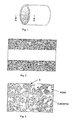
- FIG. 1 shows a bearing bush 1 made of solid material, which consists of a sintered bronze with vacuum infiltrated PTFE.
- FIG 2 is a section through the bearing bush 1 along the line A-A in Figure 1 shown.
- the sintered bronze matrix material 2 is in the open Pored 3 PTFE incorporated, as shown in Figure 3 in an enlarged view see is. It can clearly be seen that the pore structure is open and that the Pores are homogeneously distributed over the entire wall thickness. Based on these open pore structure that exists throughout the entire wall thickness It is possible to completely fill the pores with PTFE achieve, so that substantially constant sliding properties over the entire wall thickness can be obtained.
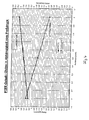
- FIG. 4 shows the PTFE content or the density as a function of the pressing pressure. It turns out that at a pressure of 2 to 3 t / cm 2 with increasing pressing pressure, the density increases and at the same time the porosity decreases, which accordingly leads to a lower proportion of PTFE in the solid material. Thus, the porosity and thereby the desired proportion of PTFE can be significantly adjusted by the pressing pressure, which in turn is important for the sliding properties.
- Eckart Bromix 90/10 means that this is a powder material from Eckart Bromix, which has 90% copper and 10% tin.
- NA K10 + 3% Sn is a prealloyed bronze powder from Norddeutsche Affinerie with a share of 90% copper and 10% tin, to which an additional 3% elemental tin is added.
- the porosity is substantially in the range of Porosity after cold pressing, which shows that the sintering process only for Stabilization of the pore structure serves and only a small effect on the Exerts porosity.
Landscapes
- Engineering & Computer Science (AREA)
- General Engineering & Computer Science (AREA)
- Mechanical Engineering (AREA)
- Manufacturing & Machinery (AREA)
- Sliding-Contact Bearings (AREA)
- Powder Metallurgy (AREA)
- Glass Compositions (AREA)
- Pressure Welding/Diffusion-Bonding (AREA)
Abstract
Description
Die Erfindung betrifft ein Verfahren zur Herstellung von selbstschmierenden, wartungsfreien Lagern, insbesondere von Lagerbuchsen und Anlaufscheiben, bei dem mindestens Bronzepulver eingesetzt wird, das Bronzepulver vor dem Sintern in einem formgebenden Werkzeug zu einem Vollmaterialrohling kalt gepresst wird, der Vollmaterialrohling in einem Ofen unter einer Schutzgasatmosphäre gesintert wird und die Poren der Sinterbronze durch Vakuuminfiltration mit einer PTFE aufweisenden Suspension gefüllt werden. Die Erfindung betrifft auch ein selbstschmierendes Vollmateriallager aus Sinterbronze nach dem Patentanspruch 15.The invention relates to a method for producing self-lubricating, maintenance-free bearings, especially bearing bushes and thrust washers the at least bronze powder is used, the bronze powder before the Sintering in a molding tool to a solid blank cold pressed, the solid material blank in an oven under a Inert gas atmosphere is sintered and the pores of the sintered bronze through Vakuuminfiltration be filled with a PTFE-containing suspension. The The invention also relates to a self-lubricating bulk material store Sintered bronze according to claim 15.
Derzeit existieren verschiedene Typen metallischer, selbstschmierender und
wartungsfreier Gleitlager. Dies sind unter anderem:
Für Gleitlager des Typs a. werden Pulvermischungen hergestellt, die bereits Festschmierstoffe enthalten. Diese Pulvermischung wird gepreßt und anschließend gesintert. Für diese Verfahren sind nur solche Festschmierstoffe geeignet, die sich bei den Sintertemperaturen von etwa 800° C nicht zersetzen.For plain bearings of type a. Powder blends are prepared that already Contain solid lubricants. This powder mixture is pressed and then sintered. For these methods, only such solid lubricants suitable, which do not decompose at the sintering temperatures of about 800 ° C.
Andererseits sind Lager mit derartigen Schmierstoffen wegen der damit unweigerlich verbundenen Verunreinigung der Umgebung des Lagers nicht für alle Anwendungszwecke geeignet. Insbesondere im Lebensmittelbereich sind derartige Lager nicht einsetzbar.On the other hand, bearings with such lubricants because of the so inevitably associated pollution of the environment of the camp not for all applications suitable. Especially in the food industry such bearings can not be used.
Die Gleitlager des Typs b. haben den Nachteil, daß sie Öl enthalten und somit in vielen Bereichen nicht einsetzbar sind. Die Einsatztemperatur dieses Lagertys ist stark begrenzt, da bei erhöhten Temperaturen ein Austrocknen des Öls stattfindet.The bearings of type b. have the disadvantage that they contain oil and thus can not be used in many areas. The operating temperature of this Lagertys is severely limited, since at elevated temperatures drying of the Oil takes place.
Die Gleitlager des Typs c. versagen nach relativ geringer Verschleißdicke.The bearings of type c. fail after relatively low wear thickness.
Die Gleitlager des Typs d. weisen prinzipiell geringe Reibwerte und Verschleißraten auf, allerdings ist die Dicke der Gleitschicht auf 1 bis 2 mm begrenzt. Die Herstellung solcher Gleitlager wird beispielsweise in der DE 197 53 639.5 A1 beschrieben. Das Verfahren zur Herstellung eines solchen selbstschmierenden, wartungsfreien mehrschichtigen Gleitlagerwerkstoffs sieht vor, daß ein aus unterschiedlichen Korngrößen bestehendes Bronzepulver mit einer mittleren Korngröße von etwa 40 µm und einer dendritischen Kornform auf einen metallischen Stützkörper aufgetragen wird, und daß der Stützkörper mit dem aufgetragenen Bronzepulver in einem Ofen bei etwa 800° C unter einer Schutzgasatmosphäre gesintert wird. Während des Sinterns wird der Stützkörper mit der Bronzeschicht zur Erzeugung einer Porosität zwischen 40 und 70% über die gesamte Schichtdicke heißgewalzt, wobei die Schichtdicke nur etwa 0,5 bis 10 mm beträgt. Mittels einer Vakuuminfiltration werden die Poren mit PTFE gefüllt, so daß sich ein Anteil an PTFE bezogen auf das Gesamtmaterial von bis zu 20 Gew.-% einstellt.The plain bearings of type d. have in principle low coefficients of friction and Wear rates on, but the thickness of the sliding layer to 1 to 2 mm limited. The production of such bearings is described for example in DE 197 53 639.5 A1. The method for producing such self-lubricating, maintenance-free multilayer plain bearing material sees before, that consists of different grain sizes bronze powder with a mean grain size of about 40 microns and a dendritic grain shape is applied to a metallic support body, and that the support body with the applied bronze powder in an oven at about 800 ° C below a protective gas atmosphere is sintered. During sintering, the Supporting body with the bronze layer to produce a porosity between 40 and 70% hot rolled over the entire layer thickness, the layer thickness only is about 0.5 to 10 mm. By means of a vacuum infiltration, the pores with PTFE filled, so that a proportion of PTFE based on the total material of up to 20% by weight.
Ferner ist ein Vakuuminfiltrationsverfahren aus der GB 707,065 bekannt, wobei allerdings keine Angaben über Herstellung und Dicken der Sinterschicht gemacht werden.Further, a vacuum infiltration method is known from GB 707,065, wherein However, no information is given about the production and thicknesses of the sintered layer become.
Aus der US 5,217,814 ist ein Gleitlagermaterial bekannt, das durch Sintern von Cu-Partikeln hergestellt wird. Die Sinterschicht besitzt Dicken unter 1 mm und die Porositäten, die durch den Sintervorgang erzeugt werden, liegen bei 35 Vol.%. Schmiermittel in Form von MoS2 und Graphit werden in die Poren eingebracht. Die durch den Sintervorgang erzeugte Porosität wird sehr stark durch die Partikelgrößenverteilung bestimmt, so daß oft nicht die gewünschte Homogenität erzielt werden kann.From US 5,217,814 a plain bearing material is known, which is produced by sintering of Cu particles. The sintered layer has thicknesses below 1 mm and the porosities produced by the sintering process are 35 vol.%. Lubricants in the form of MoS 2 and graphite are introduced into the pores. The porosity generated by the sintering process is very much determined by the particle size distribution, so that often not the desired homogeneity can be achieved.
Aus Dubbel "Taschenbuch für den Maschinenbau" 14. Auflage, Springer Verlag, S. 956, 957 ist es bekannt, bei der Herstellung von Sinterkörpern zur Verdichtung der Metallpulver einen Kaltpreßvorgang vorzuschalten. Mit steigendem Preßdruck nimmt das Verdichtungsverhältnis und somit auch die Dichte und Raumausfüllung zu. Es gibt allerdings keine Hinweise auf den Zusammenhang zwischen Kaltpreßverfahren und Einstellung der Porosität.From Dubbel "Paperback for Mechanical Engineering" 14th Edition, Springer Verlag, S. 956, 957 it is known in the production of sintered compacts for compaction the metal powder before a Kaltpreßvorgang. With rising Pressing pressure decreases the compression ratio and thus the density and Room filling too. However, there are no indications of the context between cold pressing and setting the porosity.
Aus der GB 923,642 ist ein Verfahren zur Herstellung von selbstschmierenden Lagern bekannt, bei dem nach einem Kompaktierungsprozess, bei dem ein Vollmaterialrohling aus Bronzepulver hergestellt wird, ein Sintervorgang angeschlossen wird. Zum Kompaktierungsvorgang werden keine Parameter vermittelt. Bezüglich des Sintervorgangs wird lediglich mitgeteilt, dass der Rohling sich beim Sintern ausdehnt. Ziel der GB 923,642 ist es, für den sich an den Sinterprozess anschließenden Imprägnierungsvorgang geeignete Zusätze zum PTFE zur Verfügung zu stellen. Es werden hierfür Zusätze vorgeschlagen, die keine lamellare Struktur besitzen. From GB 923,642 is a process for the production of self-lubricating Storage is known, in which after a compaction process in which a Full material blank is made from bronze powder, a sintering process is connected. There are no parameters for the compaction process taught. With regard to the sintering process is merely informed that the Blank expands during sintering. The aim of GB 923,642 is to apply for the sintering process subsequent impregnation process suitable additives to provide PTFE. Additives are proposed for this which do not have a lamellar structure.
Aufgabe der Erfindung ist es, ein Verfahren bereitzustellen, mit dem Vollmateriallager mit Wandstärken bis zu 20 mm gefertigt werden können, die gleichbleibende Gleiteigenschaften während des Betriebs aufweisen.The object of the invention is to provide a method with which All-material bearings with wall thicknesses up to 20 mm can be manufactured have consistent sliding properties during operation.
Diese Aufgabe wird mit einem Verfahren gemäß Anspruch 1 gelöst, bei dem der Vollmaterialrohling mit einer Wandstärke von 2 - 20 mm hergestellt wird, wobei mittels des Kaltpressens eine Porosität von 20 - 50 Vol.% im Vollmaterialrohling eingestellt wird und im gesamten Vollmaterialrohling homogen verteilte offene Poren erzeugt werden, der Vollmaterialrohling anschließend bei einer Temperatur im Bereich von 650°C bis 850°C gesintert wird, bei der die homogen verteilten offenen Poren stabilisiert werden, und bei dem bei der Vakuuminfiltration eine PTFE-Supspension aus 55 bis 65 Gew.% PTFE, 33,5 bis 42,5 Gew.% H2O und 0,5 bis 3 Gew.% Emulgatoren eingesetzt wird.This object is achieved by a method according to claim 1, in which the solid material blank is produced with a wall thickness of 2 - 20 mm, wherein by means of cold pressing a porosity of 20 - 50 vol.% Is set in the solid material blank and homogeneously distributed throughout the blank material blank Pores are produced, the solid material blank is then sintered at a temperature in the range of 650 ° C to 850 ° C, in which the homogeneously distributed open pores are stabilized, and wherein in the vacuum infiltration a PTFE supension of 55 to 65 wt.% PTFE, 33.5 to 42.5 wt.% H 2 O and 0.5 to 3 wt.% Emulsifiers is used.
Vorzugsweise wird der Vollmaterialrohling mit einer Wandstärke von > 3 mm bis 20 mm, insbesondere von > 3,5 bis 20 mm kalt gepreßt. Weitere bevorzugte Bereiche sind 4 bis 20 mm und 5 bis 20 mm. Ein Vorteil des Verfahrens besteht darin, daß Vollmaterialrohlinge über einen großen Wandstärkebereich mit der beanspruchten Porosität hergestellt werden können. Bezüglich der Einstellung der Porosität sind bevorzugte Wertebereiche, 25 bis 47 Vol.-%, 20 bis 40 Vol.-%, insbesondere > 20 bis 40 Vol.-%.Preferably, the solid material blank with a wall thickness of> 3 mm to 20 mm, in particular pressed from> 3.5 to 20 mm cold. Further preferred Areas are 4 to 20 mm and 5 to 20 mm. An advantage of the method exists in that solid material blanks over a large wall thickness range with the claimed porosity can be produced. Regarding the attitude the porosity are preferred value ranges, 25 to 47 vol.%, 20 to 40 vol.%, in particular> 20 to 40% by volume.
Durch das Kaltpressen wird dem Grünling eine ausreichende Festigkeit verliehen, so daß eine weitere Verarbeitung möglich wird.By cold pressing the green compact sufficient strength awarded, so that further processing is possible.
Es hat sich außerdem herausgestellt, daß ein Kaltpressen des Bronzepulvers zu
einer homogeneren Porenstruktur führt, als dies mit einem sofortigen
Sintervorgang erreicht werden kann. Beim Kaltpressen spielt die
Korngrößenverteilung der Bronzepartikel für die sich einstellende Porosität nur
eine untergeordnete Bedeutung. Außerdem ist der Anteil an offenen Poren
größer, so daß eine bessere Befüllung der Poren mit PTFE im Wege der
Vakuuminfiltration möglich ist. Der Sintervorgang wird zur Diffusion des Zinns in
das Kupfer und zur Stabilisierung der sich ausgebildeten Porenstruktur
eingesetzt. Insgesamt wird ein Vollmateriallager geschaffen, das aufgrund der
homogenen Porenverteilung über die Wanddicke des Lagers gleichbleibende
Gleiteigenschaften während der gesamten Lebensdauer des Lagers aufweist.
Der Einsatz von PTFE ermöglicht die Verwendung der Lager auch in der
Lebensmittelindustrie. It has also been found that cold pressing of the bronze powder leads to a more homogeneous pore structure than can be achieved with an immediate sintering process. During cold pressing, the particle size distribution of the bronze particles plays only a minor role for the resulting porosity. In addition, the proportion of open pores is greater, so that a better filling of the pores with PTFE by way of vacuum infiltration is possible. The sintering process is used to diffuse the tin into the copper and to stabilize the pore structure formed. Overall, a full-material warehouse is created, which has consistent sliding properties during the entire life of the bearing due to the homogeneous pore distribution over the wall thickness of the bearing.
The use of PTFE allows the use of bearings also in the food industry.
Vorzugsweise erfolgt das Kaltpressen des Bronzepulvers in Richtung der Rotationssymmetrieachse des herzustellenden Vollmaterialrohlings. Bei der Herstellung von Lagerbuchsen erfolgt daher das Kaltpressen in Richtung der Buchsenlängsachse. Dadurch wird sichergestellt, daß der Druck gleichmäßig auf alle Bereiche des herzustellenden Vollmaterialrohlings verteilt wird.Preferably, the cold pressing of the bronze powder takes place in the direction of Rotational symmetry axis of the solid material blank to be produced. In the Production of bushings therefore takes place in the direction of cold pressing Jack longitudinal axis. This will ensure that the pressure is even All areas of the produced blank material blank is distributed.
Vorzugsweise wird das Kaltpressen mit einem Druck von 2 bis 4 t/cm2, insbesondere 2,5 bis 3,5 t/cm2 durchgeführt. Welcher Druck in diesem Bereich von 2 bis 4 t/cm2 gewählt wird, hängt einerseits von der gewählten Komgröße des Bronzepulvers und andererseits von der gewünschten Porosität ab. Wenn eine geringe Porosität gewünscht wird, wird ein entsprechend größerer Druck eingesetzt. Größere Drücke sind auch dann erforderlich, wenn das Bronzepulver eine große Komgröße aufweist. Vorzugsweise wird eine Mischung aus vor- oder anlegiertem Bronzepulver und elementarem Zinn mit Komgrößen von 1 bis 100 µm, vorzugsweise von 10 bis 80 µm, insbesondere von 20 bis 40 µm, eingesetzt.Preferably, the cold pressing is carried out at a pressure of 2 to 4 t / cm 2 , in particular 2.5 to 3.5 t / cm 2 . The pressure selected in this range from 2 to 4 t / cm 2 depends on the one hand on the selected grain size of the bronze powder and on the other hand on the desired porosity. If low porosity is desired, a correspondingly higher pressure is used. Greater pressures are required even when the bronze powder has a large grain size. Preferably, a mixture of pre-alloyed or alloyed bronze powder and elemental tin with grain sizes of 1 to 100 .mu.m, preferably from 10 to 80 .mu.m, in particular from 20 to 40 microns, is used.
Vorzugsweise wird Bronzepulver mit 80 bis 95 Gew.-% Kupfer und 5 bis 20 Gew.-% Zinn verwendet.Preferably, bronze powder with 80 to 95 wt .-% copper and 5 to 20 Wt .-% tin used.
Das Bronzepulver kann zusätzlich bis zu 11 Gew.-% Aluminium, Eisen, Wismut und/oder Blei aufweisen.The bronze powder may additionally contain up to 11% by weight of aluminum, iron, bismuth and / or lead.
Die Sintertemperatur beträgt 650°C bis 850°C, insbesondere 600°C bis 850°C. Da das Sintern vor dem Einbringen des PTFE-Materials erfolgt, wird bei diesem Vorgang und bei diesen hohen Temperaturen das PTFE-Material nicht geschädigt.The sintering temperature is 650 ° C to 850 ° C, especially 600 ° C to 850 ° C. Since the sintering takes place before the introduction of the PTFE material, this is Process and at these high temperatures the PTFE material is not damaged.
Vorzugsweise wird der Sintervorgang während einer Zeitdauer von 1 bis 5 h, vorzugsweise 1 bis 3 Stunden durchgeführt. Die Sintertemperatur und die Zeitdauer sind so zu wählen, daß die Diffusion des Zinns in das Kupfer möglichst abgeschlossen ist und sich ein homogener Mischkristall gebildet hat, andererseits aber keine zu geringe Porosität durch Änderung des Porenvolumens entsteht. Außerdem ist darauf zu achten, daß das offene Porensystem erhalten bleibt. Auch die Zusammensetzung und die Art des Bronzepulvers (vorlegiert, anlegiert, Elementmischungen, Kombinationen daraus) spielen eine Rolle bei der Auswahl der Sintertemperaturen und -zeiten.Preferably, the sintering process is carried out for a period of 1 to 5 hours, preferably 1 to 3 hours. The sintering temperature and the Duration should be chosen so that the diffusion of the tin into the copper is completed as far as possible and a homogeneous mixed crystal has formed, on the other hand, but not too low porosity by changing the Pore volume arises. In addition, make sure that the open Pore system is maintained. Also the composition and type of Bronze powder (pre-alloyed, alloyed, element blends, combinations from this) play a role in the selection of the sintering temperatures and times.
Vorzugsweise wird ein mit einem Preßhilfsmittel versetztes Bronzepulver verwendet.Preferably, a bronze powder added with a pressing aid is used used.
Das Preßhilfsmittel erleichtert den Preßvorgang und hat den Vorteil, daß zum einen die Werkzeuge einem geringeren Verschleiß unterliegen und dadurch auch automatische Pressen zur Herstellung verwendet werden können und zum anderen darin, daß die Reibung an den Gesenkinnenwänden reduziert wird. Dadurch ergibt sich eine homogenere Poren- und Dichteverteilung im Grünling.The pressing aid facilitates the pressing process and has the advantage that the the tools are subject to less wear and therefore also automatic presses can be used for manufacturing and for Another is that the friction is reduced at the Gesenkinnenwänden. This results in a more homogeneous pore and density distribution in the green body.
Die Vakuuminfiltration wird nach herkömmlichen Verfahren durchgeführt und erfolgt vorzugsweise bei einem Druck von 5 bis 10 mbar.The vacuum infiltration is carried out by conventional methods and is preferably carried out at a pressure of 5 to 10 mbar.
Nach der Vakuuminfiltration wird das Lager bei etwa 40° bis 100°C getrocknet, so daß das bei der Suspension verwendete Wasser und die Emulgatoren entfernt werden und lediglich das PTFE in den Poren zurückbleibt.After vacuum infiltration, the bearing is dried at about 40 ° to 100 ° C, so that the water used in the suspension and the emulsifiers are removed and only the PTFE remains in the pores.
Nach der Vakuuminfiltration kann das poröse Lager zur Kalibrierung nochmals kalt gepreßt werden. Hierbei wird die endgültige Dichte und Festigkeit eingestellt. Beim Kalibrieren werden Drücke von vorzugsweise 3 bis 6 t/cm2 eingesetzt.After the vacuum infiltration, the porous bearing can be cold pressed again for calibration. Here, the final density and strength is adjusted. During calibration, pressures of preferably 3 to 6 t / cm 2 are used.
Nach der Kalibrierung wird noch eine Einlaufschicht aufgebracht. Diese Einlaufschicht kann beispielsweise aus einem Gleitlack, gefüllt mit Festschmierstoffen wie z.B. PTFE, Graphit oder Blei, bestehen.After calibration, a running-in layer is applied. These Running-in layer can, for example, from a lubricating varnish, filled with Solid lubricants, e.g. PTFE, graphite or lead.
Das selbstschmierende Vollmateriallager aus Sinterbronze ist dadurch gekennzeichnet, dass es eine Wandstärke von 2 bis 20 mm und eine Porosität von 20 bis 50 Vol.% aufweist, dass 2 bis 10 Gew.% PTFE bezogen auf das Gesamtmaterial in die im gesamten Vollmaterial homogen verteilten offenen Poren des Sintermaterials eingelagert sind, und dass unterhalb eines Einlaufbereiches der PTFE-Anteil über die gesamte Wanddicke max. 10 % schwankt.The self-lubricating solid material bearing made of sintered bronze is characterized characterized in that it has a wall thickness of 2 to 20 mm and a porosity from 20 to 50 vol.%, that 2 to 10 wt.% PTFE based on the Total material in the homogeneously distributed throughout the solid material open Pores of the sintered material are embedded, and that below a Inlet area of the PTFE content over the entire wall thickness max. 10% fluctuates.
Dies bedeutet, daß bei beispielsweise einem PTFE-Anteil von 10 Gew.-% dieser Anteil zwischen 9% und 11% schwankt. Die geringe Schwankung des PTFE-Anteils ist auf die homogene Porenverteilung zurückzuführen, wobei in einem geringen Oberflächenbereich, der den Einlaufbereich bildet, der Porenanteil größer sein kann, so daß in diesem Bereich auch dann der PTFE-Anteil entsprechend höher ist. Dieser höhere PTFE-Anteil in diesem Einlaufbereich verbessert die Einlaufeigenschaften.This means that, for example, a PTFE content of 10 wt .-% of this Share between 9% and 11% fluctuates. The small fluctuation of the PTFE content is due to the homogeneous pore distribution, wherein in one low surface area, which forms the inlet area, the porosity can be larger, so that in this area and then the PTFE content is correspondingly higher. This higher proportion of PTFE in this inlet area improves run-in properties.
Die Wandstärke des Vollmateriallagers ist vorzugsweise > 3 mm bis 20 mm, insbesondere > 3,5 bis 20 mm, 4 bis 20 mm und 5 bis 20 mm.The wall thickness of the bulk material store is preferably> 3 mm to 20 mm, in particular> 3.5 to 20 mm, 4 to 20 mm and 5 to 20 mm.
Vorzugsweise weist die Sinterbronze 80 bis 95% Kupfer und 5 bis 20% Zinn auf. Die Sinterbronze kann zusätzlich noch bis zu 5 Gew.-% Aluminium, Eisen, Wismut und/oder Blei aufweisen.Preferably, the sintered bronze has 80 to 95% copper and 5 to 20% tin. The sintered bronze may additionally contain up to 5% by weight of aluminum, iron, Have bismuth and / or lead.
Die offenen Poren weisen vorzugsweise eine Größe von 5 bis 125 µm auf. Die Poren der Sinterbronze sind ferner vorzugsweise weitgehend offen. Die Porosität der Sinterbronze beträgt vorzugsweise 20 bis 50 Vol.-%, insbesondere 25 bis 47 Vol.-%, 20 bis 40 Vol.-% und insbesondere > 20 bis 40 Vol.-%.The open pores preferably have a size of 5 to 125 microns. The Pores of the sintered bronze are also preferably substantially open. The porosity the sintered bronze is preferably 20 to 50% by volume, in particular 25 to 47% by volume, 20 to 40% by volume and in particular> 20 to 40% by volume.
Beispielhafte Ausführungsformen der Erfindung werden nachfolgend anhand der Zeichnungen näher erläutert.Exemplary embodiments of the invention are described below explained in more detail in the drawings.
Es zeigen:
- Figur 1
- eine erfindungsgemäße Lagerbuchse in perspektivischer Darstellung,
Figur 2- einen Schnitt längs der Linie A-A in Figur 1 und
Figur 3- eine vergrößerte Darstellung des Bereiches X in
der Figur 2 und Figur 4- eine grafische Darstellung des PTFE-Gehaltes bzw. der Dichte in Abhängigkeit vom Preßdruck.
- FIG. 1
- a bearing bush according to the invention in a perspective view,
- FIG. 2
- a section along the line AA in Figure 1 and
- FIG. 3
- an enlarged view of the area X in Figure 2 and
- FIG. 4
- a graphic representation of the PTFE content or the density as a function of the pressing pressure.
In der Figur 1 ist eine Lagerbuchse 1 aus Vollmaterial dargestellt, die aus einer Sinterbronze mit vakuuminfiltriertem PTFE besteht.FIG. 1 shows a bearing bush 1 made of solid material, which consists of a sintered bronze with vacuum infiltrated PTFE.
In der Figur 2 ist ein Schnitt durch die Lagerbuchse 1 längs der Linie A-A in
Figur 1 dargestellt. In das Sinter-Bronze-Matrixmaterial 2 ist in die offenen
Poren 3 PTFE eingelagert, wie dies in Figur 3 in vergrößerter Darstellung zu
sehen ist. Es ist deutlich zu sehen, daß die Porenstruktur offen ist und daß die
Poren homogen über die gesamte Wanddicke verteilt sind. Aufgrund dieser
offenen Porenstruktur, die über die gesamte Wanddicke durchgängig vorhanden
ist, ist es möglich, eine vollständige Auffüllung der Poren mit PTFE zu
erreichen, so daß im wesentlichen gleichbleibende Gleiteigenschaften über die
gesamte Wanddicke erhalten werden.In the figure 2 is a section through the bearing bush 1 along the line A-A in
Figure 1 shown. In the sintered
In der Figur 4 ist der PTFE-Gehalt bzw. die Dichte in Abhängigkeit vom Preßdruck dargestellt. Es zeigt sich, daß bei einem Preßdruck von 2 bis 3 t/cm2 mit zunehmendem Preßdruck die Dichte zunimmt und gleichzeitig die Porosität abnimmt, was dementsprechend zu einem geringeren PTFE-Anteil in dem Vollmaterial führt. Über den Preßdruck kann somit die Porosität und dadurch der gewünschte PTFE-Anteil maßgeblich eingestellt werden, was wiederum für die Gleiteigenschaften von Bedeutung ist.FIG. 4 shows the PTFE content or the density as a function of the pressing pressure. It turns out that at a pressure of 2 to 3 t / cm 2 with increasing pressing pressure, the density increases and at the same time the porosity decreases, which accordingly leads to a lower proportion of PTFE in the solid material. Thus, the porosity and thereby the desired proportion of PTFE can be significantly adjusted by the pressing pressure, which in turn is important for the sliding properties.
In der nachfolgenden Tabelle sind für verschiedene Preßdrücke und
Bronzematerialien die Parameter wie Gründichte, Porosität, PTFE-Gehalte,
usw. zusammengefaßt. Die Bezeichnung Eckart Bromix 90/10 bedeutet, daß es
sich hier um ein Pulvermaterial der Firma Eckart Bromix handelt, das 90%
Kupfer und 10% Zinn aufweist. Bei der Bezeichnung NA K10+3% Sn handelt
es sich um ein vorlegiertes Bronzepulver der Norddeutschen Affinerie mit
einem Anteil von 90 % Kupfer und 10 % Zinn, dem zusätzlich 3 %
elementares Zinn zugemischt werden.
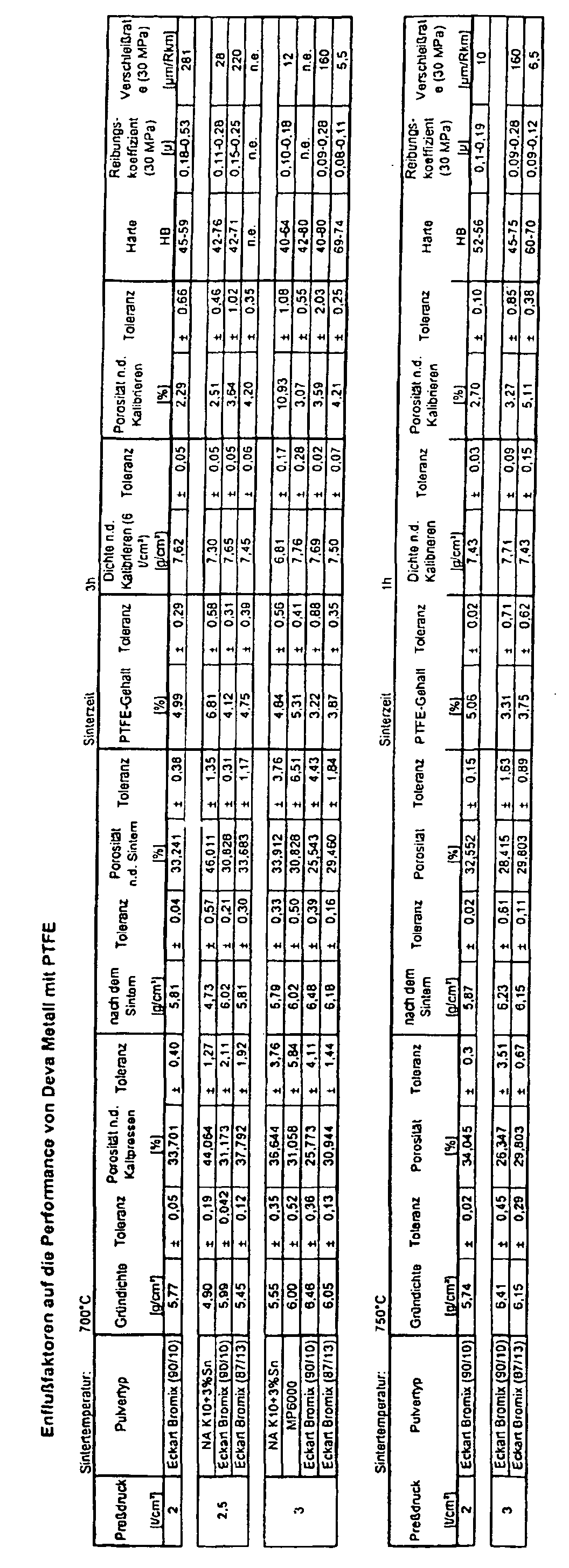
Wie die Beispiele zeigen, liegt die Porosität im wesentlichen im Bereich der Porosität nach dem Kaltpressen, was zeigt, daß der Sintervorgang lediglich zur Stabilisierung der Porenstruktur dient und nur einen geringen Einfluß auf die Porosität ausübt.As the examples show, the porosity is substantially in the range of Porosity after cold pressing, which shows that the sintering process only for Stabilization of the pore structure serves and only a small effect on the Exerts porosity.
Die Reibungskoeffizienten mit Werten im Bereich von µ = 0,08 bis µ = 0,10 sind denen der herkömmlichen graphithaltigen Legierungen deutlich überlegen. Deren Reibwerte liegen im Bereich von etwa µ = 0,15 bis µ = 0,25 im Trockenlauf. Die Verschleißwerte der PTFE-infiltrierten Lager sind unter gleichen Testbedingungen um den Faktor 5 bis etwa 20 geringer.The coefficients of friction with values in the range of μ = 0.08 to μ = 0.10 are clearly superior to those of conventional graphite-containing alloys. Their coefficients of friction are in the range of approximately μ = 0.15 to μ = 0.25 μm Dry running. The wear values of the PTFE-infiltrated bearings are below same test conditions by a factor of 5 to about 20 less.
Claims (18)
- Process for producing self-lubricating, maintenance-free bearings, in which at least bronze powder is used, the bronze powder, prior to sintering, is cold-pressed in a shaping die to form a solid-material blank, the solid-material blank is sintered in a furnace under a protective gas atmosphere, and the pores in the sintered bronze are filled with a suspension that includes PTFE by vacuum infiltration, characterized in that the solid-material blank is produced with a wall thickness of from 2 to 20 mm, with a porosity of from 20 to 50% by volume being established in the solid-material blank by means of the cold-pressing, and open pores which are distributed homogenously throughout the entire solid-material blank being produced,
in that the solid-material blank is then sintered at a temperature in the range from 650°C to 850°C, at which the homogenously distributed open pores are stabilized, and
in that a PTFE suspension comprising 55 to 65% by weight of PTFE, 33.5 to 42.5% by weight of H2O and 0.5 to 3% by weight of emulsifiers is used in the vacuum infiltration. - Process according to Claim 1, characterized in that the cold-pressing is carried out in the direction of the axis of rotational symmetry of the sold-material blank that is to be produced.
- Process according to Claim 1 or 2, characterized in that the cold-pressing is carried out at a pressure of from 196.133 to 392.266 MPa.
- Process according to one of Claims 1 to 3, characterized in that bronze powder and elemental tin with grain sizes of from 1 to 100 µm are used.
- Process according to Claim 4, characterized in that bronze powder and elemental tin with grain sizes of from 20 to 40 µm are used.
- Process according to one of Claims 1 to 5, characterized in that bronze powder containing 80 to 95% by weight of copper and 5 to 20% by weight of tin is used.
- Process according to one of Claims 1 to 6, characterized in that bronze powder containing up to 11% by weight of aluminium, iron bismuth and/or lead is used.
- Process according to one of Claims 1 to 7, characterized in that the sintering operation is carried out over a period of from 1 to 5 h, preferably 1 to 3 h.
- Process according to one of Claims 1 to 8, characterized in that a bronze powder mixed with pressing aid is used.
- Process according to one of Claims 1 to 9, characterized in that the vacuum infiltration is carried out at a pressure from 500 to 100 Pa.
- Process according to one of Claims 1 to 10, characterized in that after the vacuum infiltration the bearing is dried at approximately 40°C to 100°C.
- Process according to one of Claims 1 to 11, characterized in that after the vacuum infiltration the bearing is cold-pressed for calibration purposes.
- Process according to Claim 12, characterized in that the calibration is carried out at a pressure of from 294.199 to 588.399 MPa.
- Process according to one of Claims 1 to 13, characterized in that a run-in layer is applied after the calibration.
- Self-lubricating solid-material bearing made from sintered bronze, characterized in that it has a wall thickness of from 2 to 20 mm and a porosity of from 20 to 50% volume,
in that from 2 to 10% by weight of PTFE, based on the total material, is incorporated in the open pores of the sintered material, which are distributed homogenously throughout the entire solid material, and
in that below a run-in region the PTFE content fluctuates by at most 10% over the entire wall thickness. - Bearing according to Claim 15, characterized in that the wall thickness fluctuates by at most 4% ± 1% over the entire wall thickness.
- Bearing according to Claim 15 or 16, characterized in that the sintered bronze contains 8 to 95% of copper and 5 to 20% of tin.
- Bearing according to Claim 15 to 17, characterized in that the sintered bronze includes up to 11% by weight of aluminium, iron, bismuth and/or lead.
Applications Claiming Priority (3)
| Application Number | Priority Date | Filing Date | Title |
|---|---|---|---|
| DE10138058A DE10138058A1 (en) | 2001-08-03 | 2001-08-03 | Full material warehouse and process for its manufacture |
| DE10138058 | 2001-08-03 | ||
| PCT/EP2002/008621 WO2003013767A1 (en) | 2001-08-03 | 2002-08-02 | Solid-material bearing and a method for producing the same |
Publications (2)
| Publication Number | Publication Date |
|---|---|
| EP1412112A1 EP1412112A1 (en) | 2004-04-28 |
| EP1412112B1 true EP1412112B1 (en) | 2005-11-09 |
Family
ID=7694225
Family Applications (1)
| Application Number | Title | Priority Date | Filing Date |
|---|---|---|---|
| EP02794542A Expired - Lifetime EP1412112B1 (en) | 2001-08-03 | 2002-08-02 | Solid-material bearing and a method for producing the same |
Country Status (5)
| Country | Link |
|---|---|
| EP (1) | EP1412112B1 (en) |
| AT (1) | ATE309065T1 (en) |
| DE (2) | DE10138058A1 (en) |
| ES (1) | ES2253575T3 (en) |
| WO (1) | WO2003013767A1 (en) |
Cited By (2)
| Publication number | Priority date | Publication date | Assignee | Title |
|---|---|---|---|---|
| WO2011018343A1 (en) | 2009-08-12 | 2011-02-17 | Schaeffler Technologies Gmbh & Co. Kg | Method for producing a sliding coating on a plain bearing component and corresponding plain bearing component |
| EP3015200A4 (en) * | 2013-06-26 | 2017-06-14 | Zhejiang Changsheng Sliding Bearings Co., Ltd | Metal matrix self-lubricating composite and manufacturing method therefor |
Families Citing this family (9)
| Publication number | Priority date | Publication date | Assignee | Title |
|---|---|---|---|---|
| DE102004008631A1 (en) * | 2004-02-21 | 2005-09-08 | Ks Gleitlager Gmbh | Bearing material |
| DE102004011831B3 (en) * | 2004-03-11 | 2005-03-31 | Federal-Mogul Deva Gmbh | Sintered, solid-lubricated copper-based bearing material for dry sliding and rotating bearings, contains tin, bismuth and graphite |
| EP1892418A3 (en) * | 2006-08-12 | 2014-08-27 | INDUSTRA Industrieanlagen - Maschinen und Teile GmbH | Cog wheel machine |
| US20090202855A1 (en) * | 2008-01-09 | 2009-08-13 | Saxton David M | Porous sliding bearing and method of construction thereof |
| ES2375042B2 (en) * | 2009-10-27 | 2012-09-07 | Hierros Y Aplanaciones S.A. (Hiasa) | SOLAR PHOTOVOLTAIC FOLLOWER. |
| CN103492738B (en) * | 2011-04-26 | 2014-11-05 | 千住金属工业株式会社 | Sliding member |
| CN102506074A (en) * | 2011-10-19 | 2012-06-20 | 台州科锦轴承有限公司 | Oil-bearing copper-based powder metallurgy gasket for self-lubricating rod end joint bearing, preparation method and self-lubricating rod end joint bearing |
| CN103691955B (en) * | 2013-12-31 | 2015-10-28 | 舒思雄 | The balance weight that a kind of manufacture method of compressor balance weight and employing the method are produced |
| DE102019131184A1 (en) * | 2019-11-19 | 2021-05-20 | Schaeffler Technologies AG & Co. KG | Roller bearing arrangement |
Family Cites Families (7)
| Publication number | Priority date | Publication date | Assignee | Title |
|---|---|---|---|---|
| GB923642A (en) * | 1958-06-13 | 1963-04-18 | Bound Brook Bearings Ltd | Improvements in or relating to plain bearings, anti-friction elements or the like |
| JPS525002B2 (en) * | 1972-04-05 | 1977-02-09 | ||
| US4393563A (en) * | 1981-05-26 | 1983-07-19 | Smith David T | Cold forced sintered powder metal annular bearing ring blanks |
| DE4225398A1 (en) * | 1992-07-29 | 1994-02-03 | Thale Eisen Huettenwerk | Mfr. of powder-metallurgical self-lubricating bearings - comprising a calibration process applied after sintering |
| JP2615332B2 (en) * | 1993-01-19 | 1997-05-28 | 大同メタル工業株式会社 | Copper alloy plain bearing for low rigidity housing and method of manufacturing the same |
| JPH10166474A (en) * | 1996-12-14 | 1998-06-23 | Glacier Gmbh Deva Werke | Manufacture of slide bearing material |
| ES2189917T3 (en) * | 1996-12-14 | 2003-07-16 | Federal Mogul Deva Gmbh | BEARING MATERIAL AND PROCEDURE FOR MANUFACTURING. |
-
2001
- 2001-08-03 DE DE10138058A patent/DE10138058A1/en not_active Ceased
-
2002
- 2002-08-02 EP EP02794542A patent/EP1412112B1/en not_active Expired - Lifetime
- 2002-08-02 ES ES02794542T patent/ES2253575T3/en not_active Expired - Lifetime
- 2002-08-02 WO PCT/EP2002/008621 patent/WO2003013767A1/en not_active Ceased
- 2002-08-02 AT AT02794542T patent/ATE309065T1/en active
- 2002-08-02 DE DE50204885T patent/DE50204885D1/en not_active Expired - Lifetime
Cited By (3)
| Publication number | Priority date | Publication date | Assignee | Title |
|---|---|---|---|---|
| WO2011018343A1 (en) | 2009-08-12 | 2011-02-17 | Schaeffler Technologies Gmbh & Co. Kg | Method for producing a sliding coating on a plain bearing component and corresponding plain bearing component |
| DE102009037262A1 (en) | 2009-08-12 | 2011-02-17 | Schaeffler Technologies Gmbh & Co. Kg | Method for producing a sliding layer on a sliding bearing component and associated sliding bearing component |
| EP3015200A4 (en) * | 2013-06-26 | 2017-06-14 | Zhejiang Changsheng Sliding Bearings Co., Ltd | Metal matrix self-lubricating composite and manufacturing method therefor |
Also Published As
| Publication number | Publication date |
|---|---|
| ATE309065T1 (en) | 2005-11-15 |
| DE50204885D1 (en) | 2005-12-15 |
| EP1412112A1 (en) | 2004-04-28 |
| DE10138058A1 (en) | 2003-02-27 |
| WO2003013767A1 (en) | 2003-02-20 |
| ES2253575T3 (en) | 2006-06-01 |
Similar Documents
| Publication | Publication Date | Title |
|---|---|---|
| DE69619553T2 (en) | SELF-LUBRICATING SINED SLIDING MATERIAL AND METHOD FOR THE PRODUCTION THEREOF | |
| DE3843691C3 (en) | Mechanical seal with porous material and method of making the same | |
| DE4105657C2 (en) | Sliding material and method for its production | |
| DE60207510T2 (en) | POROUS METAL ARTICLES, METAL COMPOSITE MATERIAL USE THEREOF AND METHOD FOR THE PRODUCTION THEREOF | |
| DE3830447C2 (en) | Sintered material | |
| DE4106001C2 (en) | Sliding or sliding material and process for its manufacture | |
| DE4308371C2 (en) | Wear-resistant alloy of a sliding material | |
| EP0852298A1 (en) | Method for manufacturing a material for plain bearings | |
| DE2644272A1 (en) | METHOD AND APPARATUS FOR MANUFACTURING FIBER-REINFORCED PRODUCTS | |
| EP1412112B1 (en) | Solid-material bearing and a method for producing the same | |
| DE102007033902B3 (en) | Lead-free sintered sliding bearing material and sintered powder for producing the same | |
| DE10305808A1 (en) | sliding | |
| DE3728273A1 (en) | STORAGE MATERIAL WITH SEVERAL LAYERS AND METHOD FOR THE PRODUCTION THEREOF | |
| DE19506340C2 (en) | Sintered alloy and method for producing a sintered body therefrom | |
| DE69404305T2 (en) | VALVE SEAT INSERT | |
| DE69005402T2 (en) | Process for infiltrating a tubular element. | |
| DE102010004398B4 (en) | Slide | |
| DE68918900T2 (en) | Bearing alloy based on Al matrices. | |
| DE962561C (en) | Plain bearing made of at least porous metal on the surface, which contains a friction-reducing substance | |
| EP1716263B1 (en) | Slide bearing material | |
| AT517721B1 (en) | Method for producing a sliding bearing element | |
| DE3703964A1 (en) | Slide-bearing layered material or slide-bearing element and process for the production thereof | |
| DE3822919A1 (en) | COMPOSITE | |
| DE2316915A1 (en) | MACHINE COMPONENTS MADE OF COPPER ALLOYS AND THE PROCESS FOR THEIR PRODUCTION | |
| DD280149A1 (en) | SELF-LUBRICATING SINTERED SLIDING BEARINGS WITH ZONES OF DIFFERENT PERMEABILITAET |
Legal Events
| Date | Code | Title | Description |
|---|---|---|---|
| PUAI | Public reference made under article 153(3) epc to a published international application that has entered the european phase |
Free format text: ORIGINAL CODE: 0009012 |
|
| 17P | Request for examination filed |
Effective date: 20031220 |
|
| AK | Designated contracting states |
Kind code of ref document: A1 Designated state(s): AT BE BG CH CY CZ DE DK EE ES FI FR GB GR IE IT LI LU MC NL PT SE SK TR |
|
| AX | Request for extension of the european patent |
Extension state: AL LT LV MK RO SI |
|
| 17Q | First examination report despatched |
Effective date: 20040513 |
|
| GRAP | Despatch of communication of intention to grant a patent |
Free format text: ORIGINAL CODE: EPIDOSNIGR1 |
|
| GRAS | Grant fee paid |
Free format text: ORIGINAL CODE: EPIDOSNIGR3 |
|
| GRAA | (expected) grant |
Free format text: ORIGINAL CODE: 0009210 |
|
| AK | Designated contracting states |
Kind code of ref document: B1 Designated state(s): AT BE BG CH CY CZ DE DK EE ES FI FR GB GR IE IT LI LU MC NL PT SE SK TR |
|
| PG25 | Lapsed in a contracting state [announced via postgrant information from national office to epo] |
Ref country code: IE Free format text: LAPSE BECAUSE OF FAILURE TO SUBMIT A TRANSLATION OF THE DESCRIPTION OR TO PAY THE FEE WITHIN THE PRESCRIBED TIME-LIMIT Effective date: 20051109 Ref country code: CZ Free format text: LAPSE BECAUSE OF FAILURE TO SUBMIT A TRANSLATION OF THE DESCRIPTION OR TO PAY THE FEE WITHIN THE PRESCRIBED TIME-LIMIT Effective date: 20051109 Ref country code: SK Free format text: LAPSE BECAUSE OF FAILURE TO SUBMIT A TRANSLATION OF THE DESCRIPTION OR TO PAY THE FEE WITHIN THE PRESCRIBED TIME-LIMIT Effective date: 20051109 Ref country code: NL Free format text: LAPSE BECAUSE OF FAILURE TO SUBMIT A TRANSLATION OF THE DESCRIPTION OR TO PAY THE FEE WITHIN THE PRESCRIBED TIME-LIMIT Effective date: 20051109 Ref country code: FI Free format text: LAPSE BECAUSE OF FAILURE TO SUBMIT A TRANSLATION OF THE DESCRIPTION OR TO PAY THE FEE WITHIN THE PRESCRIBED TIME-LIMIT Effective date: 20051109 |
|
| REG | Reference to a national code |
Ref country code: GB Ref legal event code: FG4D Free format text: NOT ENGLISH |
|
| REG | Reference to a national code |
Ref country code: CH Ref legal event code: EP |
|
| REG | Reference to a national code |
Ref country code: IE Ref legal event code: FG4D Free format text: LANGUAGE OF EP DOCUMENT: GERMAN |
|
| REF | Corresponds to: |
Ref document number: 50204885 Country of ref document: DE Date of ref document: 20051215 Kind code of ref document: P |
|
| PG25 | Lapsed in a contracting state [announced via postgrant information from national office to epo] |
Ref country code: BG Free format text: LAPSE BECAUSE OF FAILURE TO SUBMIT A TRANSLATION OF THE DESCRIPTION OR TO PAY THE FEE WITHIN THE PRESCRIBED TIME-LIMIT Effective date: 20060209 Ref country code: SE Free format text: LAPSE BECAUSE OF FAILURE TO SUBMIT A TRANSLATION OF THE DESCRIPTION OR TO PAY THE FEE WITHIN THE PRESCRIBED TIME-LIMIT Effective date: 20060209 Ref country code: DK Free format text: LAPSE BECAUSE OF FAILURE TO SUBMIT A TRANSLATION OF THE DESCRIPTION OR TO PAY THE FEE WITHIN THE PRESCRIBED TIME-LIMIT Effective date: 20060209 Ref country code: GR Free format text: LAPSE BECAUSE OF FAILURE TO SUBMIT A TRANSLATION OF THE DESCRIPTION OR TO PAY THE FEE WITHIN THE PRESCRIBED TIME-LIMIT Effective date: 20060209 |
|
| GBT | Gb: translation of ep patent filed (gb section 77(6)(a)/1977) |
Effective date: 20060227 |
|
| PG25 | Lapsed in a contracting state [announced via postgrant information from national office to epo] |
Ref country code: PT Free format text: LAPSE BECAUSE OF FAILURE TO SUBMIT A TRANSLATION OF THE DESCRIPTION OR TO PAY THE FEE WITHIN THE PRESCRIBED TIME-LIMIT Effective date: 20060410 |
|
| NLV1 | Nl: lapsed or annulled due to failure to fulfill the requirements of art. 29p and 29m of the patents act | ||
| REG | Reference to a national code |
Ref country code: ES Ref legal event code: FG2A Ref document number: 2253575 Country of ref document: ES Kind code of ref document: T3 |
|
| REG | Reference to a national code |
Ref country code: IE Ref legal event code: FD4D |
|
| ET | Fr: translation filed | ||
| PG25 | Lapsed in a contracting state [announced via postgrant information from national office to epo] |
Ref country code: BE Free format text: LAPSE BECAUSE OF NON-PAYMENT OF DUE FEES Effective date: 20060831 Ref country code: CH Free format text: LAPSE BECAUSE OF NON-PAYMENT OF DUE FEES Effective date: 20060831 Ref country code: LI Free format text: LAPSE BECAUSE OF NON-PAYMENT OF DUE FEES Effective date: 20060831 Ref country code: MC Free format text: LAPSE BECAUSE OF NON-PAYMENT OF DUE FEES Effective date: 20060831 |
|
| PLBE | No opposition filed within time limit |
Free format text: ORIGINAL CODE: 0009261 |
|
| STAA | Information on the status of an ep patent application or granted ep patent |
Free format text: STATUS: NO OPPOSITION FILED WITHIN TIME LIMIT |
|
| 26N | No opposition filed |
Effective date: 20060810 |
|
| REG | Reference to a national code |
Ref country code: CH Ref legal event code: PL |
|
| BERE | Be: lapsed |
Owner name: FEDERAL-MOGUL DEVA G.M.B.H. Effective date: 20060831 |
|
| PG25 | Lapsed in a contracting state [announced via postgrant information from national office to epo] |
Ref country code: EE Free format text: LAPSE BECAUSE OF FAILURE TO SUBMIT A TRANSLATION OF THE DESCRIPTION OR TO PAY THE FEE WITHIN THE PRESCRIBED TIME-LIMIT Effective date: 20051109 |
|
| PG25 | Lapsed in a contracting state [announced via postgrant information from national office to epo] |
Ref country code: LU Free format text: LAPSE BECAUSE OF NON-PAYMENT OF DUE FEES Effective date: 20060802 Ref country code: TR Free format text: LAPSE BECAUSE OF FAILURE TO SUBMIT A TRANSLATION OF THE DESCRIPTION OR TO PAY THE FEE WITHIN THE PRESCRIBED TIME-LIMIT Effective date: 20051109 |
|
| PG25 | Lapsed in a contracting state [announced via postgrant information from national office to epo] |
Ref country code: CY Free format text: LAPSE BECAUSE OF FAILURE TO SUBMIT A TRANSLATION OF THE DESCRIPTION OR TO PAY THE FEE WITHIN THE PRESCRIBED TIME-LIMIT Effective date: 20051109 |
|
| PGFP | Annual fee paid to national office [announced via postgrant information from national office to epo] |
Ref country code: FR Payment date: 20110811 Year of fee payment: 10 Ref country code: AT Payment date: 20110721 Year of fee payment: 10 Ref country code: ES Payment date: 20110804 Year of fee payment: 10 Ref country code: GB Payment date: 20110722 Year of fee payment: 10 Ref country code: DE Payment date: 20110831 Year of fee payment: 10 |
|
| PGFP | Annual fee paid to national office [announced via postgrant information from national office to epo] |
Ref country code: IT Payment date: 20110812 Year of fee payment: 10 |
|
| REG | Reference to a national code |
Ref country code: DE Ref legal event code: R082 Ref document number: 50204885 Country of ref document: DE Representative=s name: MEHLER ACHLER PATENTANWAELTE, DE |
|
| REG | Reference to a national code |
Ref country code: AT Ref legal event code: MM01 Ref document number: 309065 Country of ref document: AT Kind code of ref document: T Effective date: 20120802 |
|
| GBPC | Gb: european patent ceased through non-payment of renewal fee |
Effective date: 20120802 |
|
| REG | Reference to a national code |
Ref country code: FR Ref legal event code: ST Effective date: 20130430 |
|
| PG25 | Lapsed in a contracting state [announced via postgrant information from national office to epo] |
Ref country code: IT Free format text: LAPSE BECAUSE OF NON-PAYMENT OF DUE FEES Effective date: 20120802 |
|
| PG25 | Lapsed in a contracting state [announced via postgrant information from national office to epo] |
Ref country code: AT Free format text: LAPSE BECAUSE OF NON-PAYMENT OF DUE FEES Effective date: 20120802 |
|
| PG25 | Lapsed in a contracting state [announced via postgrant information from national office to epo] |
Ref country code: GB Free format text: LAPSE BECAUSE OF NON-PAYMENT OF DUE FEES Effective date: 20120802 Ref country code: DE Free format text: LAPSE BECAUSE OF NON-PAYMENT OF DUE FEES Effective date: 20130301 |
|
| PG25 | Lapsed in a contracting state [announced via postgrant information from national office to epo] |
Ref country code: FR Free format text: LAPSE BECAUSE OF NON-PAYMENT OF DUE FEES Effective date: 20120831 |
|
| REG | Reference to a national code |
Ref country code: DE Ref legal event code: R119 Ref document number: 50204885 Country of ref document: DE Effective date: 20130301 |
|
| REG | Reference to a national code |
Ref country code: ES Ref legal event code: FD2A Effective date: 20131021 |
|
| PG25 | Lapsed in a contracting state [announced via postgrant information from national office to epo] |
Ref country code: ES Free format text: LAPSE BECAUSE OF NON-PAYMENT OF DUE FEES Effective date: 20120803 |