EP1412607B1 - Instrument de verrouillage de moteur de perforation vers le bas - Google Patents
Instrument de verrouillage de moteur de perforation vers le bas Download PDFInfo
- Publication number
- EP1412607B1 EP1412607B1 EP02749084A EP02749084A EP1412607B1 EP 1412607 B1 EP1412607 B1 EP 1412607B1 EP 02749084 A EP02749084 A EP 02749084A EP 02749084 A EP02749084 A EP 02749084A EP 1412607 B1 EP1412607 B1 EP 1412607B1
- Authority
- EP
- European Patent Office
- Prior art keywords
- locking member
- axial position
- relative
- downhole apparatus
- rotor
- Prior art date
- Legal status (The legal status is an assumption and is not a legal conclusion. Google has not performed a legal analysis and makes no representation as to the accuracy of the status listed.)
- Expired - Lifetime
Links
Images





Classifications
-
- E—FIXED CONSTRUCTIONS
- E21—EARTH OR ROCK DRILLING; MINING
- E21B—EARTH OR ROCK DRILLING; OBTAINING OIL, GAS, WATER, SOLUBLE OR MELTABLE MATERIALS OR A SLURRY OF MINERALS FROM WELLS
- E21B23/00—Apparatus for displacing, setting, locking, releasing or removing tools, packers or the like in boreholes or wells
- E21B23/04—Apparatus for displacing, setting, locking, releasing or removing tools, packers or the like in boreholes or wells operated by fluid means, e.g. actuated by explosion
-
- E—FIXED CONSTRUCTIONS
- E21—EARTH OR ROCK DRILLING; MINING
- E21B—EARTH OR ROCK DRILLING; OBTAINING OIL, GAS, WATER, SOLUBLE OR MELTABLE MATERIALS OR A SLURRY OF MINERALS FROM WELLS
- E21B23/00—Apparatus for displacing, setting, locking, releasing or removing tools, packers or the like in boreholes or wells
- E21B23/04—Apparatus for displacing, setting, locking, releasing or removing tools, packers or the like in boreholes or wells operated by fluid means, e.g. actuated by explosion
- E21B23/042—Apparatus for displacing, setting, locking, releasing or removing tools, packers or the like in boreholes or wells operated by fluid means, e.g. actuated by explosion using a single piston or multiple mechanically interconnected pistons
-
- E—FIXED CONSTRUCTIONS
- E21—EARTH OR ROCK DRILLING; MINING
- E21B—EARTH OR ROCK DRILLING; OBTAINING OIL, GAS, WATER, SOLUBLE OR MELTABLE MATERIALS OR A SLURRY OF MINERALS FROM WELLS
- E21B4/00—Drives for drilling, used in the borehole
- E21B4/02—Fluid rotary type drives
Definitions
- the present invention relates to downhole apparatus and particularly, but not exclusively, to downhole apparatus for use in releasing a stuck drill bit.
- a motor lock-up tool is described in US-A-4705117.
- a locking member is permanently rotationally fast with the rotor of the motor and is shiftable by application of fluid pressure over substantially the whole of the diameter thereof to a position in which it is disengaged from rotary connection with the body to allow rotation of the rotor.
- the apparatus of the present invention as defined in the precharacterizing portion of claim 1 is characterized in that the inter-engaging means which are capable of limiting rotation of the rotor relative to the locking member are disengaged when the locking member is in its initial position so as to allow rotation of the rotor.
- a differential area is defined on the locking member such an application of static fluid pressure to the differential area forces the locking member in a direction in which it is rotationally fast both the body and the rotor.
- Means are provided for selectively applying static fluid pressure to the differential area in order to actuate the tool.
- the body of downhole apparatus may be secured to the stator of a motor so that, in use, torque transmitted from the motor to a drill bit may be reacted to the surface via the apparatus body.
- the selective retaining means may be activated so as to allow movement of the locking member from the first axial postion into the second axial position wherein rotation of the locking member relative to both the rotor and the body is limited.
- the rotor is secured to the apparatus body in such as manner as to allow torque applied to the body at the surface to be transmitted to the rotor. In this way, rotational force over and above that generated by the motor itself can be applied to the drill bit in an attempt to release the bit from the well bore.
- the downhole apparatus 2 further comprises a body 8 within a bore 10 of which a locking member 12 is located so as to be movable between a first axial position (see Figure 1) and a second axial position (see Figure 3).
- a first axial position see Figure 1
- a second axial position see Figure 3
- the locking member 12 is disengaged from the rotor 4 so as to allow rotation of said rotor 4 relative to said locking member 12.
- the locking member 12 is engaged with the rotor 4 so as to limit rotation of said rotor 4 relative to said locking member 12.
- the apparatus 2 comprises means for limiting rotational movement of the locking member 12 relative to the body 8 when said locking member 12 is located in said second axial position.
- This limiting means comprises interlocking axially extending splines 14 defined on the body 8 and the locking member 12.
- Retaining means 16 is also provided for selectively retaining the locking member 12 in the first axial position.
- This retaining means comprises a shear pin secured to the body 8 and extending into an annular groove 17 defined in an outer surface of the locking member 12.
- Three O-ring seals 19,21,23 and a glyd ring 25 are located between the body 8 and the locking member 12.
- the body 8 of the apparatus 2 comprises two portions 8a, 8b which are retained together by means of a loose fitting threaded coupling 18.
- the coupling 18 allows the two body portions 8a, 8b to move axially apart from one another into the intermediate configuration shown in Figure 2.
- a shear ring 20 attaching the first body portion 8a to the locking member 12 fractures.
- the first body portion 8a is pulled uphole with sufficient force to fracture the shear. ring and thereby separate the two body portions 8a, 8b.
- the first body portion 8a defines an annular fluid chamber 22 with the locking member 12.
- Hydraulic lock in creating the chamber 22 is prevented by means of a one way vacuum release valve 24 located in the wall of the first body portion 8a
- hydraulic transfer ports 26 defined in the locking member 12 provide fluid communication between a bore 28 extending through the locking member 12 with the chamber 22.
- a locking ring 27 is retained between the locking member 12 and the second body portion 8b by means of a circlip 29. Ratchet teeth on the locking ring 27 engage ratchet teeth on the locking member 12. The arrangement is such as to permit movement of the locking member 12 towards the rotor 4 whilst opposing movement in the opposite direction.
- the locking member 12 and rotor 4 are provided with interlocking teeth members 30,32 respectively which, when engaged with one another, prevent relative rotation between the locking member 12 and the rotor 4. Relative rotation between the body 8 and the rotor 4 is thereby prevented.
- the two shoulders at either end of the outer casing 18,18a,18b are pre-loaded by the applied make-up torque through added threaded portions 18a,18b at each end which do not have one of the thread starts removed.
- the shear ring mounted at the top of the central (locking) shaft 12 on the first embodiment is replaced by shear pins 16 at the lower end of the shaft.
- the central shaft 12 has three diametrical seals 19,21,23 working on it.
- the first two 21,23 are at the top (left-hand) end while the third is at the lower (righthand) end.
- the uppermost seal, plus the one at the bottom, act on the same effective diameter.
- the third seal is sealing on a larger diameter.
- the purpose of the two smaller seals acting on the same diameter is to ensure that the shaft does not have a load acting on it (up or down) with internal pressure until the assembly has been activated by an axial pull.
- the shaft has a castellated adapter screwed onto it which has a profile facing downwards to mate with a special castellated adapter attached to the top end of a downhole motor rotor.
- the castellations 30,32 are designed to mesh when the tool has been activated and thereby torsionally lock the rotor with respect to the outer casings so that torque from surface (or at least from above the assembly) can be applied down through the rotor to the stuck bit.
- the central shaft 12 is held in the assembled position by both shear pins 16 and a serrated split collar 27 below the shear pins.
- the outer casings 18, 18a, 18b in the middle of each tool are designed with a unique design of threaded joint.
- the thread is a two-start thread which has been machined as a female box style thread from end to end on the outer casing.
- the inner section 18 approx. 3-4" from each end (i.e. between the illustrated undercuts) has one of the threads removed thereafter by machining.
- the pins 9a,9b of the casings 18a, 18b either side of the central casing 18, which are linked by the central casing 18, also have one of the thread starts removed.
- the upper and lower pins 9a,9b are held together by the outer casing 18m 18am 18b screw threads at either end of the outer casing.
- the connections are torqued up right hand conventionally and so, with left hand torque from the motor stator, the right hand threads will tighten when the motor is working and so will not unscrew.
- the threads removed from the pins 9a,9b and box between the outer casing undercuts allow axial travel between the top and bottom of the tool when an overpull is applied (which overpull is at least equal to the load required to shear the outer casing in the area of the undercuts).
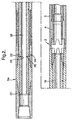
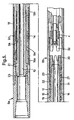
- the 4 3/4" version of the tool shown in Figures 4 and 5 is designed to shear at 80,000 lbs pull.
- the bending stiffness of the assembly is enhanced in the assembly of Figure 5 by the overlap of the two threaded pins 9a,9b by the spigot engagement in the wall section between the internal splines 14 and the external two start thread.
- the area around the splines and the double start threads are at the external lower pressure and hence the sealing of the inside of the tool is completed by the seal 31 on the outside of the sleeve 33 through which the shear pins are located.10 of the centre shaft and through the castellated adapter screwed onto the centre shaft.
- the castellations may or may not be designed to seal off the flow to the outside of the adapters when the two sets mesh together.
- a nozzle fitted in the top of the rotor so that a flow path is available down the centre of the rotor and then either simply down to the bit as in a conventional motor or out through a nozzle fitted in the universal housing of the motor.
- a nozzle fitted in the side of the motor would be beneficial in some circumstances as circulation would still be possible if the formation collapsed around the bit and blocked off the flow path around the outside of the bit.
- FIG. 6 to 9 A yet further embodiment of the present invention is shown in Figures 6 to 9 of the accompanying drawings.
- This further embodiment is again similar to the embodiment of Figures 1 to 3 and corresponding parts are identified with like reference numerals.
- the further embodiment principally differs from the first embodiment in that the single shear pin of the first embodiment is placed with a pair of shear pins 16 which pass through a sleeve 33 as in the second and third embodiments of Figures 4 and 5.
- the third embodiment shown in Figures 6 to 9 comprises a seal 31 provided on the outside of the sleeve 33.
- the further embodiment also retains the shear ring 20 and the hydraulic transfer ports 26.
- the further embodiment also differs from the first embodiment in that the threaded coupling is provided in three discrete portions.
- a central portion 18 (as shown in Figure 7) spans the first and second body portions 8a,8b.
- the second portion 18a of the coupling is screw threaded to the first body portion 8a whilst the third coupling portion 18b is screw threaded to the second body portion 8b.
- the coupling engages a two-start thread on the body 8 wherein one of the threads is removed
- the central portion 18 of the coupling has a two-start thread wherein one thread is removed.
- the remaining coupling portions 18a,18b have an unmodified two-start thread which allows said portions to be locked against respective shoulders of the first and second body portions 8a,8b.
- the ends of the second and third coupling portions 18a,18b distal to said respective shoulders are provided with castellations for engagement with castellations provided on the ends of the central coupling portion 18.
- a torque may be transmitted through the coupling and the arrangement assists in assembly of the tool.
- the tool is the same a described in relation to the first embodiment.
- Figures 8 and 9 show the locking member 12 of the further embodiment in intermediate and second axial positions respectively. It will be seen from each of these Figures that the castellations of the coupling allow the three coupling portions to move axially away from one another.
- the locking ring 27 is ideally made up to a torque sufficient to place the two body portions 8a,8b in abutment with one another and under compression.
- first embodiment see Figure 1
- second, third and fourth embodiments it is preferable for these portions to abut one another as in the second, third and fourth embodiments. In this way, the tool may be placed in compression so as to provide rigidity.
Landscapes
- Engineering & Computer Science (AREA)
- Geology (AREA)
- Life Sciences & Earth Sciences (AREA)
- Mining & Mineral Resources (AREA)
- Geochemistry & Mineralogy (AREA)
- Fluid Mechanics (AREA)
- Environmental & Geological Engineering (AREA)
- General Life Sciences & Earth Sciences (AREA)
- Physics & Mathematics (AREA)
- Mechanical Engineering (AREA)
- Details Of Spanners, Wrenches, And Screw Drivers And Accessories (AREA)
- Hydraulic Motors (AREA)
- Transplanting Machines (AREA)
- Earth Drilling (AREA)
- Finish Polishing, Edge Sharpening, And Grinding By Specific Grinding Devices (AREA)
- Clamps And Clips (AREA)
Claims (10)
- Appareil de fond de forage pour limiter la rotation d'un rotor (4) par rapport à un stator (6) associé audit rotor, l'appareil de fond de forage comprenant : un corps (8) dans un puits (10) dont un élément de verrouillage (12) est positionné de manière à pouvoir être déplacé entre une première position axiale par rapport au corps et une deuxième position axiale par rapport au corps ; un moyen (14) pour limiter le mouvement de rotation de l'élément de verrouillage (12) par rapport au corps (8) lorsque l'élément de verrouillage est positionné dans la deuxième position axiale ; et des moyens d'inter-engagement (30, 32) sur le rotor (4) et l'élément de verrouillage (12) pour limiter la rotation du rotor par rapport à l'élément de verrouillage lorsque l'élément de verrouillage est positionné dans la deuxième position axiale, caractérisé en ce que les moyens d'inter-engagement (30, 32) sont désengagés lorsque l'élément de verrouillage (12) est dans la première position axiale pour permettre la rotation du rotor (4) par rapport à l'élément de verrouillage (12) ; une zone différentielle est définie sur l'élément de verrouillage de telle manière que l'application d'une pression de fluide statique à ladite zone différentielle force l'élément de verrouillage dans le sens du mouvement de la première position axiale vers la deuxième position axiale ; et un moyen (18) est disposé pour appliquer sélectivement la pression de fluide statique à la zone différentielle.
- Appareil de fond de forage selon la revendication 1, caractérisé en ce que ledit moyen de sélection (18) pour appliquer la pression de fluide statique comprend un moyen pour permettre le mouvement intermédiaire dudit élément de verrouillage (12) de ladite première position axiale vers une position intermédiaire par rapport au corps dans laquelle la zone de l'élément de verrouillage exposée à ladite pression de fluide statique est différente de celle exposée à ladite pression de fluide statique lorsque ledit élément de verrouillage est positionné dans ladite première position axiale.
- Appareil de fond de forage selon la revendication 2, caractérisé en ce que ledit corps comprend deux portions (8a, 8b) mobiles l'une par rapport à l'autre de manière à permettre ledit mouvement intermédiaire dudit élément de verrouillage (12) par rapport à l'une desdites portions de corps.
- Appareil de fond de forage selon la revendication 3, caractérisé en ce que lesdites portions de corps sont mobiles axialement l'une par rapport à l'autre.
- Appareil de fond de forage selon la revendication 3 ou 4, caractérisé en ce que ledit élément de verrouillage (12) est sélectivement maintenu dans ladite première position axiale par rapport à ladite une portion de corps (8) par un moyen cassable (20).
- Appareil de fond de forage selon l'une quelconque des revendications 3 à 5, caractérisé en ce que ledit élément de verrouillage (12) est sélectivement maintenu dans ladite première position axiale et ladite position intermédiaire par rapport à l'autre desdites portions de corps (8b).
- Appareil de fond de forage selon l'une quelconque des revendications 3 à 6, caractérisé en ce que lesdites deux portions de corps (8a, 8b) sont connectées l'une à l'autre par un filetage de vis.
- Appareil de fond de forage selon la revendication 7, caractérisé en ce que la connexion par filetage de vis entre lesdites deux portions de corps (8a, 8b) est suffisamment lâche pour permettre ledit mouvement intermédiaire relatif entre ledit élément de verrouillage (12) et ladite une portion de corps (8a).
- Appareil de fond de forage selon la revendication 8, caractérisé en ce que ladite connexion par filetage de vis comprend un filetage à double pas avec l'un des deux filetages de celui-ci retiré.
- Appareil de fond de forage selon la revendication 9, caractérisé en ce que ladite connexion par filetage de vis comprend un collier à filetage (18) couvrant lesdites deux portions de corps (8a, 8b).
Applications Claiming Priority (5)
| Application Number | Priority Date | Filing Date | Title |
|---|---|---|---|
| GB0118521A GB0118521D0 (en) | 2001-07-30 | 2001-07-30 | Downhole release joint |
| GB0118521 | 2001-07-30 | ||
| GB0124349 | 2001-10-10 | ||
| GB0124349A GB0124349D0 (en) | 2001-07-30 | 2001-10-10 | Downhole motor lock-up tool |
| PCT/GB2002/003483 WO2003012242A1 (fr) | 2001-07-30 | 2002-07-30 | Instrument de verrouillage de moteur de perforation vers le bas |
Publications (2)
| Publication Number | Publication Date |
|---|---|
| EP1412607A1 EP1412607A1 (fr) | 2004-04-28 |
| EP1412607B1 true EP1412607B1 (fr) | 2005-12-28 |
Family
ID=26246377
Family Applications (1)
| Application Number | Title | Priority Date | Filing Date |
|---|---|---|---|
| EP02749084A Expired - Lifetime EP1412607B1 (fr) | 2001-07-30 | 2002-07-30 | Instrument de verrouillage de moteur de perforation vers le bas |
Country Status (6)
| Country | Link |
|---|---|
| US (1) | US7036580B2 (fr) |
| EP (1) | EP1412607B1 (fr) |
| CA (1) | CA2421227C (fr) |
| GB (1) | GB2378197B (fr) |
| NO (1) | NO323545B1 (fr) |
| WO (1) | WO2003012242A1 (fr) |
Families Citing this family (23)
| Publication number | Priority date | Publication date | Assignee | Title |
|---|---|---|---|---|
| GB0101014D0 (en) * | 2001-01-15 | 2001-02-28 | Neyrfor Weir Ltd | Improved downhole tool |
| GB2394740B (en) | 2002-11-01 | 2006-03-01 | Smith International | Lockable motor assembly and method |
| US7703550B2 (en) * | 2004-02-06 | 2010-04-27 | Smith International, Inc. | Down hole motor with locking mechanism |
| GB0507639D0 (en) * | 2005-04-15 | 2005-05-25 | Caledus Ltd | Downhole swivel sub |
| AU2011202827B2 (en) * | 2005-04-15 | 2014-03-27 | Tercel Ip Limited | Method of running downhole apparatus into a wellbore with a swivel sub |
| WO2009137537A2 (fr) * | 2008-05-05 | 2009-11-12 | Weatherford/Lamb, Inc. | Outils actionnés par signal, pour des opérations de broyage, de forage et/ou de repêchage |
| GB0721353D0 (en) * | 2007-10-31 | 2007-12-12 | Expro North Sea Ltd | Connecting assembly |
| US8540035B2 (en) | 2008-05-05 | 2013-09-24 | Weatherford/Lamb, Inc. | Extendable cutting tools for use in a wellbore |
| US9127517B2 (en) * | 2009-12-23 | 2015-09-08 | Expert E & P Consultants, L.L.C. | Drill pipe connector and method |
| US9376865B2 (en) | 2012-05-25 | 2016-06-28 | Halliburton Energy Services, Inc. | Rotational locking mechanisms for drilling motors and powertrains |
| CN102979477B (zh) * | 2012-11-28 | 2015-05-06 | 中国石油天然气股份有限公司 | 井下电控压缩式封隔器 |
| CN104919175A (zh) * | 2012-12-19 | 2015-09-16 | 普拉德研究及开发股份有限公司 | 基于螺杆的控制系统 |
| CN104884728B (zh) * | 2012-12-29 | 2017-12-22 | 哈利伯顿能源服务公司 | 具有液压致动离合器的井下钻井组件及其使用方法 |
| EP2923025B1 (fr) | 2013-02-20 | 2017-09-27 | Halliburton Energy Services, Inc. | Mécanisme de verrouillage de rotation en fond |
| US10161196B2 (en) | 2014-02-14 | 2018-12-25 | Halliburton Energy Services, Inc. | Individually variably configurable drag members in an anti-rotation device |
| EP3074589B1 (fr) | 2014-02-14 | 2020-03-04 | Halliburton Energy Services, Inc. | Éléments de traînée réglables configurables uniformément de manière variable dans un dispositif anti-rotation |
| WO2015122918A1 (fr) | 2014-02-14 | 2015-08-20 | Halliburton Energy Services Inc. | Dispositif de déflexion de corps de sonde |
| WO2016043752A1 (fr) | 2014-09-18 | 2016-03-24 | Halliburton Energy Services, Inc. | Mécanisme de verrouillage amovible pour verrouiller un logement à un arbre de forage d'un système de forage rotatif |
| GB2532235A (en) * | 2014-11-12 | 2016-05-18 | Nov Downhole Eurasia Ltd | Downhole motor |
| AU2014412066B2 (en) | 2014-11-19 | 2018-10-18 | Halliburton Energy Services, Inc. | Drilling direction correction of a steerable subterranean drill in view of a detected formation tendency |
| WO2017074259A1 (fr) * | 2015-10-26 | 2017-05-04 | Turbodynamics Pte Ltd | Système et procédé de mise en prise et de désaccouplement d'un trépan ou d'un autre dispositif par rapport à un système d'entraînement de fond de trou |
| US9995089B1 (en) * | 2017-03-08 | 2018-06-12 | William Thomas Carpenter | Method and apparatus for efficient bi-rotational drilling |
| US20190063649A1 (en) * | 2017-08-23 | 2019-02-28 | William von Eberstein | Connector assembly and method |
Family Cites Families (10)
| Publication number | Priority date | Publication date | Assignee | Title |
|---|---|---|---|---|
| US4299296A (en) * | 1979-07-06 | 1981-11-10 | Smith International, Inc. | In-hole motor drill with bit clutch |
| US4705117A (en) * | 1985-11-22 | 1987-11-10 | Amoco Corporation | Method and apparatus for reducing drill bit wear |
| US4678044A (en) * | 1986-03-31 | 1987-07-07 | Halliburton Company | Tubing pressure operated initiator for perforating in a well borehole |
| GB8612019D0 (en) * | 1986-05-16 | 1986-06-25 | Shell Int Research | Vibrating pipe string in borehole |
| CA1309120C (fr) * | 1986-12-24 | 1992-10-20 | Cameron Iron Works, Inc. | Raccord tubulaire |
| US5472057A (en) * | 1994-04-11 | 1995-12-05 | Atlantic Richfield Company | Drilling with casing and retrievable bit-motor assembly |
| US6196336B1 (en) * | 1995-10-09 | 2001-03-06 | Baker Hughes Incorporated | Method and apparatus for drilling boreholes in earth formations (drilling liner systems) |
| EG21606A (en) * | 1997-02-25 | 2001-12-31 | Shell Int Research | Drill string tool |
| GB2339442B (en) * | 1998-07-09 | 2002-06-05 | Smith International | Downhole tension swivel sub |
| GB9917267D0 (en) * | 1999-07-22 | 1999-09-22 | Smith International | Locking motor shaft |
-
2002
- 2002-07-30 CA CA2421227A patent/CA2421227C/fr not_active Expired - Fee Related
- 2002-07-30 US US10/416,889 patent/US7036580B2/en not_active Expired - Lifetime
- 2002-07-30 EP EP02749084A patent/EP1412607B1/fr not_active Expired - Lifetime
- 2002-07-30 GB GB0217596A patent/GB2378197B/en not_active Expired - Lifetime
- 2002-07-30 WO PCT/GB2002/003483 patent/WO2003012242A1/fr not_active Ceased
-
2003
- 2003-03-26 NO NO20031385A patent/NO323545B1/no not_active IP Right Cessation
Also Published As
| Publication number | Publication date |
|---|---|
| US7036580B2 (en) | 2006-05-02 |
| WO2003012242A1 (fr) | 2003-02-13 |
| NO323545B1 (no) | 2007-06-11 |
| GB2378197B (en) | 2005-07-20 |
| GB0217596D0 (en) | 2002-09-11 |
| CA2421227A1 (fr) | 2003-02-13 |
| US20040011520A1 (en) | 2004-01-22 |
| NO20031385D0 (no) | 2003-03-26 |
| EP1412607A1 (fr) | 2004-04-28 |
| NO20031385L (no) | 2003-05-22 |
| GB2378197A (en) | 2003-02-05 |
| CA2421227C (fr) | 2010-04-13 |
Similar Documents
| Publication | Publication Date | Title |
|---|---|---|
| EP1412607B1 (fr) | Instrument de verrouillage de moteur de perforation vers le bas | |
| EP1190158B1 (fr) | Outil de pose hydraulique | |
| CA2837085C (fr) | Dispositif d'accouplement tubulaire | |
| US9267338B1 (en) | In-well disconnect tool | |
| US4452472A (en) | Tubular safety joint for drill strings | |
| US5086844A (en) | Hydraulic release oil tool | |
| US7819186B2 (en) | Downhole tool | |
| US9534638B2 (en) | Retention means for a seal boot used in a universal joint in a downhole motor driveshaft assembly | |
| EP0824630B1 (fr) | Mecanisme d'ancrage d'un instrument de puits | |
| CA1216230A (fr) | Outil sous-marin amplificateur de couple mecanique | |
| GB2341622A (en) | Downhole clutch assembly | |
| WO2009152042A2 (fr) | Système de prise mécanique et de raccordement amovible | |
| US20140299379A1 (en) | Down-Hole Swivel Sub | |
| EP3574181A1 (fr) | Raccord double femelle de sécurité à actionnement hydraulique | |
| GB2346401A (en) | Torque limiting tool | |
| NO348302B1 (en) | Annulus pressure release running tool | |
| US20070034371A1 (en) | Downhole actuation tool | |
| US7252150B2 (en) | Downhole tool | |
| NO20231381A1 (en) | An orientation adjustment assembly for a directional drill and a method for orientation or re-orientation of a directional drill | |
| WO2020212247A1 (fr) | Palier de butée | |
| WO2016083582A1 (fr) | Raccord double femelle orientable de fond de trou et procédé permettant de faire passer un train de tiges dans un puits de forage | |
| WO2025224475A1 (fr) | Déconnexion de train de tiges |
Legal Events
| Date | Code | Title | Description |
|---|---|---|---|
| PUAI | Public reference made under article 153(3) epc to a published international application that has entered the european phase |
Free format text: ORIGINAL CODE: 0009012 |
|
| 17P | Request for examination filed |
Effective date: 20030305 |
|
| AK | Designated contracting states |
Kind code of ref document: A1 Designated state(s): AT BE BG CH CY CZ DE DK EE ES FI FR GB GR IE IT LI LU MC NL PT SE SK TR |
|
| 17Q | First examination report despatched |
Effective date: 20041202 |
|
| REG | Reference to a national code |
Ref country code: DE Ref legal event code: 8566 |
|
| GRAP | Despatch of communication of intention to grant a patent |
Free format text: ORIGINAL CODE: EPIDOSNIGR1 |
|
| RBV | Designated contracting states (corrected) |
Designated state(s): FR NL |
|
| GRAS | Grant fee paid |
Free format text: ORIGINAL CODE: EPIDOSNIGR3 |
|
| GRAA | (expected) grant |
Free format text: ORIGINAL CODE: 0009210 |
|
| AK | Designated contracting states |
Kind code of ref document: B1 Designated state(s): FR NL |
|
| ET | Fr: translation filed | ||
| PLBE | No opposition filed within time limit |
Free format text: ORIGINAL CODE: 0009261 |
|
| STAA | Information on the status of an ep patent application or granted ep patent |
Free format text: STATUS: NO OPPOSITION FILED WITHIN TIME LIMIT |
|
| 26N | No opposition filed |
Effective date: 20060929 |
|
| PGFP | Annual fee paid to national office [announced via postgrant information from national office to epo] |
Ref country code: NL Payment date: 20140710 Year of fee payment: 13 |
|
| PGFP | Annual fee paid to national office [announced via postgrant information from national office to epo] |
Ref country code: FR Payment date: 20140708 Year of fee payment: 13 |
|
| REG | Reference to a national code |
Ref country code: NL Ref legal event code: MM Effective date: 20150801 |
|
| REG | Reference to a national code |
Ref country code: FR Ref legal event code: ST Effective date: 20160331 |
|
| PG25 | Lapsed in a contracting state [announced via postgrant information from national office to epo] |
Ref country code: NL Free format text: LAPSE BECAUSE OF NON-PAYMENT OF DUE FEES Effective date: 20150801 Ref country code: FR Free format text: LAPSE BECAUSE OF NON-PAYMENT OF DUE FEES Effective date: 20150731 |