EP1413143B1 - Verarbeitung von einem komprimierten mediensignal - Google Patents
Verarbeitung von einem komprimierten mediensignal Download PDFInfo
- Publication number
- EP1413143B1 EP1413143B1 EP02743521A EP02743521A EP1413143B1 EP 1413143 B1 EP1413143 B1 EP 1413143B1 EP 02743521 A EP02743521 A EP 02743521A EP 02743521 A EP02743521 A EP 02743521A EP 1413143 B1 EP1413143 B1 EP 1413143B1
- Authority
- EP
- European Patent Office
- Prior art keywords
- signal
- variable
- samples
- encoding
- code words
- Prior art date
- Legal status (The legal status is an assumption and is not a legal conclusion. Google has not performed a legal analysis and makes no representation as to the accuracy of the status listed.)
- Expired - Lifetime
Links
Images
Classifications
-
- H—ELECTRICITY
- H04—ELECTRIC COMMUNICATION TECHNIQUE
- H04N—PICTORIAL COMMUNICATION, e.g. TELEVISION
- H04N19/00—Methods or arrangements for coding, decoding, compressing or decompressing digital video signals
- H04N19/46—Embedding additional information in the video signal during the compression process
- H04N19/467—Embedding additional information in the video signal during the compression process characterised by the embedded information being invisible, e.g. watermarking
-
- G—PHYSICS
- G06—COMPUTING OR CALCULATING; COUNTING
- G06T—IMAGE DATA PROCESSING OR GENERATION, IN GENERAL
- G06T1/00—General purpose image data processing
- G06T1/0021—Image watermarking
- G06T1/0028—Adaptive watermarking, e.g. Human Visual System [HVS]-based watermarking
- G06T1/0035—Output size adaptive watermarking
-
- H—ELECTRICITY
- H04—ELECTRIC COMMUNICATION TECHNIQUE
- H04N—PICTORIAL COMMUNICATION, e.g. TELEVISION
- H04N1/00—Scanning, transmission or reproduction of documents or the like, e.g. facsimile transmission; Details thereof
- H04N1/32—Circuits or arrangements for control or supervision between transmitter and receiver or between image input and image output device, e.g. between a still-image camera and its memory or between a still-image camera and a printer device
- H04N1/32101—Display, printing, storage or transmission of additional information, e.g. ID code, date and time or title
- H04N1/32144—Display, printing, storage or transmission of additional information, e.g. ID code, date and time or title embedded in the image data, i.e. enclosed or integrated in the image, e.g. watermark, super-imposed logo or stamp
- H04N1/32149—Methods relating to embedding, encoding, decoding, detection or retrieval operations
- H04N1/32154—Transform domain methods
-
- H—ELECTRICITY
- H04—ELECTRIC COMMUNICATION TECHNIQUE
- H04N—PICTORIAL COMMUNICATION, e.g. TELEVISION
- H04N1/00—Scanning, transmission or reproduction of documents or the like, e.g. facsimile transmission; Details thereof
- H04N1/32—Circuits or arrangements for control or supervision between transmitter and receiver or between image input and image output device, e.g. between a still-image camera and its memory or between a still-image camera and a printer device
- H04N1/32101—Display, printing, storage or transmission of additional information, e.g. ID code, date and time or title
- H04N1/32144—Display, printing, storage or transmission of additional information, e.g. ID code, date and time or title embedded in the image data, i.e. enclosed or integrated in the image, e.g. watermark, super-imposed logo or stamp
- H04N1/32149—Methods relating to embedding, encoding, decoding, detection or retrieval operations
- H04N1/32267—Methods relating to embedding, encoding, decoding, detection or retrieval operations combined with processing of the image
- H04N1/32277—Compression
-
- G—PHYSICS
- G06—COMPUTING OR CALCULATING; COUNTING
- G06T—IMAGE DATA PROCESSING OR GENERATION, IN GENERAL
- G06T2201/00—General purpose image data processing
- G06T2201/005—Image watermarking
- G06T2201/0052—Embedding of the watermark in the frequency domain
-
- G—PHYSICS
- G06—COMPUTING OR CALCULATING; COUNTING
- G06T—IMAGE DATA PROCESSING OR GENERATION, IN GENERAL
- G06T2201/00—General purpose image data processing
- G06T2201/005—Image watermarking
- G06T2201/0053—Embedding of the watermark in the coding stream, possibly without decoding; Embedding of the watermark in the compressed domain
Definitions
- the invention relates to a method and arrangement for processing a compressed media signal in which samples of said media signal are represented by variable-length code words according to a first coding rule, the method comprising the steps of:
- the invention relates particularly to the process of embedding a watermark in an MPEG-encoded video signal, in which the signal samples are DCT coefficients.
- a watermark in a compressed media signal is disclosed in F. Hartung and B. Girod: "Digital Watermarking of MPEG-2 Coded Video in the Bitstream Domain", published in ICASSP, Vol. 4, 1997, pp. 2621-2624.
- the media signal is a video signal the signal samples of which are DCT coefficients obtained by subjecting the image pixels to a Discrete Cosine Transform.
- the watermark is a DCT transformed pseudo-noise sequence.
- the watermark is embedded by adding the DCT transformed noise sequence to the corresponding DCT coefficients The zero coefficients of the MPEG-coded signal are hot affected.
- a problem of the prior art watermark embedding scheme is that modification of DCT coefficients in an already compressed bit stream changes the bit rate because the DCT coefficients are represented by variable-length code words. An increased bit rate is usually not acceptable.
- the prior art embedder therefore checks whether transmission of the watermarked coefficient increases the bit rate, and transmits the original coefficient in that case. But also reduction of the bit rate is not desired.
- a change of the bit rate may result in overflow or underflow of buffers in the decoder, and change the position of timing information in the bit stream.
- the method in accordance with the invention is characterized in that of the result of the testing is affirmative, the method includes the step of re-encoding a signal sample into a longer code word according to a second coding rule. Said re-encoding into longer code words compensates for the reduction of bit rate caused by the watermarking process.
- the signal sample being re-encoded is preferably but not necessarily the modified signal sample.
- the MPEG video compression standard is an example thereof
- the MPEG standard provides variable-length code words for frequently occurring combinations (pairs) of runs of zero DCT coefficients and a preceding or succeeding non-zero DCT coefficient.
- MPEG defines an "Escape coding"method which provides a relatively long fixed-length code word.
- a preferred embodiment of the invention exploits the insight that MPEG's Escape coding rule may be applied to any run/level pair.
- the invention is particularly advantageous if the watermarking process modifies the second value (i.e. a non-zero DCT coefficient) of run/level pair into the first value (i.e. a zero DCT coefficient).
- a watermarking process is proposed in Applicant's non-published earlier European patent application 01200277.0 (Attorney's docket PHNL0 10062). It causes a run/level pair to be modified into a run of zeroes, which is subsequently merged with the run of a succeeding or preceding run/level pair. This reduces the bit rate considerably and jusfiftes re-encoding of the new run/level pair in accordance with the second coding rule so as to compensate for the reduction of bit rate
- the invention also relates to an arrangement for processing a compressed media signal in accordance with claim 9.
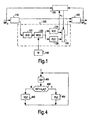
- Fig. 1 shows a schematic diagram of an arrangement carrying out a preferred embodiment of the method according to the invention.
- the arrangement comprises a parsing unit 110, a VLC processing unit 120, an output stage 130, a watermark buffer 140, and a bit rate control processor 150.
- the operation of the arrangement will be described with reference to Figs. 2A-2C and 3A-3C.
- the arrangement receives an MPEG video stream MP in which represents a sequence of video images.
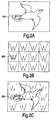
- One such video image is shown in Fig. 2A by way of illustrative example.
- the video images are divided into blocks of 8 ⁇ 8 pixels, one of which is denoted 210 in Fig. 2A.
- the pixel blocks are represented by respective blocks of 8 ⁇ 8 DCT coefficients.
- the upper left transform coefficient of such a DCT block represents the average luminance of the corresponding pixel block and is commonly referred to as the DC coefficient
- the other coefficients represent spatial frequencies and are referred to as AC coefficients.
- the upper left AC coefficients represent coarse details of the image, the lower right coefficients represent fine details.
- the AC coefficients are quantized. This quantization process causes many AC coefficients of a DCT block to assume the value zero.
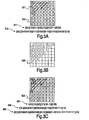
- Fig. 3A shows a typical example of a DCT block 310 representing image block 210 in Fig. 2A.
- the coefficients of the DCT block have been sequentially scanned in accordance with a zigzag pattern ( 301 in Fig. 3A) and variable-length encoded.
- the variable-length encoding scheme is a combination of Huffman coding and nm-length coding. More particularly, each run of zero AC coefficients and a subsequent non-zero AC coefficient constitutes a run/level pair which is encoded into a single variable length code word.
- Reference numeral 311 in Fig. 3A shows the series of run/level pairs representing DCT block 310.
- An End-Of-Block code (BOB) denotes the absence of further non-zero coefficients in the DCT block.
- Reference numeral 312 in Fig. 3A shows the corresponding variable-length code words in accordance with the MPEG2 video compression standard.
- DCT luminance blocks and two DCT chrominance blocks constitute a macroblock
- a number of macroblocks constitutes a slice
- a number of slices constitutes a picture (field or frame)
- a series of pictures constitutes a video sequence.
- Some pictures are autonomously encoded (1-pictures)
- other pictures are predictively encoded with motion compensation (P and P-pictures).
- the DCT coefficients represent differences between pixels of the current picture and pixels of a reference picture rather than the pixels themselves.
- the MPEG2 video stream MP in is applied to the parsing unit 110 (Fig. 1).
- This parsing unit partially interprets the MPEG bit stream and splits the stream into variable-length code words representing luminance DCT coefficients (hereinafter: VLCs) and other MPEG codes.
- the unit also gathers information such as: the coordinates of the blocks, the coding type (field or fiame), the scan type (zigzag or alternate).
- the VLCs and associated information are applied to the VLC processing unit 120.
- the other MPEG codes are directly applied to the output stage 130.
- the watermark to be embedded is a pseudo-random noise sequence in the pixel domain.
- a 128 ⁇ 128 basic watermark pattern is "tiled" over the extent of the image. This tiling operation is illustrated in Fig. 2B.
- the 128 ⁇ 128 basic pseudo-random watermark pattern is herein shown as a symbol W for better visualization.
- the spatial noise values of the basic watermark are transformed to the same representation as the video content in the MPEG stream.
- the 128 ⁇ 128 basic watermark pattern is likewise divided into 8x8 blocks, one of which is denoted 220 in Fig. 2B.
- the blocks are discrete cosine-transformed and quantized. Note that the transform and quantizing operation need to be done only once.
- the DCT coefficients thus calculated are stored in the 128 ⁇ 128 watermark buffer 140 of the arrangement.
- the watermark buffer 140 is connected to the VLC processing unit 120, in which the actual embedding of the watermark takes place.
- the VLC processing unit decodes ( 121 ) selected variable-length code words representing the video image into run/level pairs, and converts the run/level pairs into a two-dimensional array of 8 ⁇ 8 DCT coefficients.
- the watermark is embedded, in a modification stage 123, by adding to each video block the spatially corresponding watermark block.
- the watermark block 220 (Fig. 2B) is thus added to the spatially corresponding image block 210 (Fig. 2A). This operation is carried out in the DCT domain.
- only DCT coefficients that are turned into zero coefficients by this operation are selected for the purpose of watermark embedding.
- the coefficient having the value 2 in Fig. 3A will be modified only if the corresponding watermark coefficient has the value -2.
- c in is a coefficient of a video DCT block
- w is a coefficient of the spatially corresponding watermark DCT block
- c out is a coefficient of the watermarked video DCT block.
- only the signs of the DCT coefficients of the watermark pattern are stored in the watermark buffer 140, so that the buffer stores +1 and -1 values only.
- Fig. 3B shows a typical example of a watermark block 320 in the DCT domain, corresponding to noise block 220 in Fig. 2B.
- Fig. 3C shows a watermarked video DCT block 330, obtained by the above-described "addition" of watermark DCT block 320 to video DCT block 310. It will be appreciated that the number of zero coefficients in the DCT block is increased by this operation. In this specific example, two non-zero coefficients are turned into zero coefficients. They are shaded in Fig. 3C. The new zero coefficients merge into runs of other run/level pairs.
- Reference numeral 331 in Fig. 3C shows the run/level pairs of the watermarked DCT block 330. The former run/level pairs (1/-1) and (0/2) have been merged into a new run/level pair (2/2), and former nm/level pairs (2/1) and (7/-1) have been merged into a new nm/level pair (10/-1).
- the new run/level pairs are re-encoded.
- said re-encoding is performed by a variable-length encoder 124 and a fixed-length encoder 125.
- the encoders 124 and 125 comply with the relevant compression standard. In this example, they comply with MPEG's DCT coefficients Table, which defines short variable-length code words for frequently occurring run/level pairs and long fixed-length (24-bits) "Escape codes" for other run/level pairs.
- Reference numeral 332 in Fig. 3C shows the output of variable-length encoder 124 in response to receipt of nin/level pairs 331.
- the watermark embedding process appears to have saved 4 bits, compared with the corresponding input 312 (see Fig. 3A). Similar bit cost reductions may have occurred in previous blocks.
- the invention exploits the insight that MPEG's fixed-length "Escape coding" rule may also be applied to run/level pairs having an entry in the variable-length coding table.
- the fixed-length encoder 125 produces the fixed-length code word for each (or at least each new) run/level pair.
- a selector 126 selects the variable-length code word produced by encoder 124 or the longer fixed-length code word produced by encoder 125. The selection is controlled by the bit rate control processor 150.
- Fig. 4 shows a flow chart of operations performed by the bit rate control processor 150.
- the processor keeps track of the cumulative difference DIF between the number of bits in input stream MP in and the number of bits in output stream MP out .
- the processor also receives the lengths n v of the code words produced by VLC encoder 124, and knows the lengths n f (here 24) of the code words produced by FLC encoder 125.
- the processor controls selector 126 to select the variable-length code word in a step 403. If the cumulative difference exceeds n f -n v , the longer fixed-length code word is selected in a step 404.
- Reference numeral 333 in Fig. 3C shows a possible result of this selection process.
- the latter selection brings the cumulative difference in danger of exceeding 15.
- the processor 150 selects the 24-bit fixed-length code.
- Fig. 2C shows the watermarked image.
- the pixel block denoted 230 in this Figure corresponds to the watermarked video DCT block 330 in Fig. 3C.
- the amount of watermark embedding varies from block to block and from tile to tile.
- a method and arrangement are disclosed for processing a compressed media signal, for example, embedding a watermark in an MPEG2 video signal.
- the watermark a spatial noise pattern (140)
- the discarded coefficients are subsequently merged in the runs of other run/level pairs.
- some of the new run/level pairs are not variable-length encoded (124) but represented by longer code words according to a further coding rule (125) providing such longer code words, for example, MPEG's "Escape coding".
Landscapes
- Engineering & Computer Science (AREA)
- Multimedia (AREA)
- Signal Processing (AREA)
- General Physics & Mathematics (AREA)
- Theoretical Computer Science (AREA)
- Physics & Mathematics (AREA)
- Compression Or Coding Systems Of Tv Signals (AREA)
- Editing Of Facsimile Originals (AREA)
- Compression, Expansion, Code Conversion, And Decoders (AREA)
- Image Processing (AREA)
- Television Systems (AREA)
- Signal Processing For Digital Recording And Reproducing (AREA)
- Reduction Or Emphasis Of Bandwidth Of Signals (AREA)
Claims (9)
- Verfahren zum Verarbeiten eines komprimierten Mediensignals, wobei Abtastwerte des genannten Mediensignals durch Codewörter variabler Länge entsprechend einer ersten Codierungsregel dargestellt werden, wobei dieses Verfahren die nachfolgenden Verfahrensschritte umfasst:- das Decodieren (121) selektierter Codewörter variabler Länge zu betreffenden selektierten Signalabtastwerten;- das Modifizieren (123) der genannten selektierten Signalabtastwerte entsprechend einem bestimmten Signalverarbeitungsalgorithmus; und- das Codieren (124) der modifizierten Signalabtastwerte zu modifizierten Codewörtern variabler Länge entsprechend der genannten ersten Codierungsregel;- das Testen (402) ob der genannte Schritt der Codierung die Bitrate des komprimierten Mediensignals verringert;dadurch gekennzeichnet, dass wenn das Ergebnis des Testes positiv ist, das Verfahren den Schritt aufweist von Neucodierung (125) eines Signalabtastwertes zu einem längeren Codewort nach einer zweiten Codierungsregel.
- Verfahren nach Anspruch 1, wobei der genannte Signalverarbeitungsalgorithmus ein Wasserzeichen (140) in das komprimierte Mediensignal einbettet.
- Verfahren nach Anspruch 1, wobei der genannte Schritt der Neucodierung eines Signalabtastwertes auf den modifizierten Signalabtastwert angewandt wird.
- Verfahren nach Anspruch 1, wobei die selektierten Codewörter variabler Länge je einen Lauf von Signalabtastwerten mit einem ersten Wert und eines angrenzenden Signalabtastwertes mit einem anderen zweiten Wert darstellen, wobei der Schritt der Modifikation auf den genannten benachbarten Signalabtastwert angewandt wird.
- Verfahren nach Anspruch 4, wobei der genannte Schritt der Modifikation auf den genannten angrenzenden Signalabtastwert nur dann angewandt wird, wenn der modifizierte benachbarte Signalabtastwert der ersten Wert durch die genannte Modifikation annimmt.
- Verfahren nach Anspruch 5, wobei der Schritt der Neucodierung die Schritte der Mischung des modifizierten benachbarten Signalabtastwertes mit einem nachfolgenden oder vorhergehenden Lauf von Signalabtastwerten umfasst, und zwar zum Erhalten eines neuen Laufs von Signalabtastwerten, und das Codieren des neuen Laufes von Signalabtastwerten und eines weiteren angrenzenden Signalabtastwertes mit dem zweiten zu einem neuen Codewort variabler Länge nach der ersten Codierungsregel.
- Verfahren nach Anspruch 4, wobei der erste Wert Null ist und die Signalabtastwerte, die zur Modifikation qualifiziert sind, Signalabtastwerte mit dem kleinsten Nicht-Nullwert sind.
- Verfahren nach Anspruch 1, wobei das Mediensignal in Teile aufgeteilt wird und die Anzahl modifizierter angrenzender Signalabtastwerte auf ein vorbestimmtes Maximum je Teil begrenzt ist.
- Anordnung zum Verarbeiten eines komprimierten Mediensignals, wobei Abtastwerte des genannten Mediensignals durch Codewörter variabler Länge nach einer ersten Codierungsregel dargestellt werden, wobei die Anordnung die nachfolgenden Elemente aufweist:- einen Decoder (121) zum Decodieren selektierter Codewörter variabler Länge zu betreffenden selektierten Signalabtastwerten;- Mittel (123) zum Modifizieren der genannten selektierten Signalabtastwerte entsprechend einem bestimmten Signalverarbeitungsalgorithmus; und- einen Codierer (124) zum Codieren der modifizierten Signalabtastwerte zu modifizierten Codewörtern variabler Länge entsprechend der genannten ersten Codierungsregel;- Verarbeitungsmittel (150) zum Testen ob die genannte Codierung (124) die Bitrate des komprimierten Mediensignals verringert;dadurch gekennzeichnet, dass wenn die genannte Codierung (124) tatsächlich die Bitrate verringert die Verarbeitungsmittel (150) dazu vorgesehen sind, den genannten Codierer steuern zur Neucodierung (125) eines Signalabtastwertes zu einem längeren Codewort nach einer zweiten Codierungsregel.
Priority Applications (1)
| Application Number | Priority Date | Filing Date | Title |
|---|---|---|---|
| EP02743521A EP1413143B1 (de) | 2001-07-19 | 2002-07-02 | Verarbeitung von einem komprimierten mediensignal |
Applications Claiming Priority (4)
| Application Number | Priority Date | Filing Date | Title |
|---|---|---|---|
| EP01202767 | 2001-07-19 | ||
| EP01202767 | 2001-07-19 | ||
| PCT/IB2002/002737 WO2003009602A1 (en) | 2001-07-19 | 2002-07-02 | Processing a compressed media signal |
| EP02743521A EP1413143B1 (de) | 2001-07-19 | 2002-07-02 | Verarbeitung von einem komprimierten mediensignal |
Publications (2)
| Publication Number | Publication Date |
|---|---|
| EP1413143A1 EP1413143A1 (de) | 2004-04-28 |
| EP1413143B1 true EP1413143B1 (de) | 2006-05-03 |
Family
ID=8180665
Family Applications (1)
| Application Number | Title | Priority Date | Filing Date |
|---|---|---|---|
| EP02743521A Expired - Lifetime EP1413143B1 (de) | 2001-07-19 | 2002-07-02 | Verarbeitung von einem komprimierten mediensignal |
Country Status (8)
| Country | Link |
|---|---|
| US (1) | US20030016756A1 (de) |
| EP (1) | EP1413143B1 (de) |
| JP (1) | JP2004536531A (de) |
| KR (1) | KR20040018483A (de) |
| CN (1) | CN1241395C (de) |
| AT (1) | ATE325507T1 (de) |
| DE (1) | DE60211171T2 (de) |
| WO (1) | WO2003009602A1 (de) |
Families Citing this family (20)
| Publication number | Priority date | Publication date | Assignee | Title |
|---|---|---|---|---|
| US20040003394A1 (en) * | 2002-07-01 | 2004-01-01 | Arun Ramaswamy | System for automatically matching video with ratings information |
| US7177441B2 (en) * | 2002-12-09 | 2007-02-13 | International Business Machines Corporation | System and method for secret communication |
| US20060078212A1 (en) * | 2003-01-23 | 2006-04-13 | Koninklijke Philips Electronics N.V. | Embedding a watermark in a coded signal |
| US7460684B2 (en) | 2003-06-13 | 2008-12-02 | Nielsen Media Research, Inc. | Method and apparatus for embedding watermarks |
| US7454076B2 (en) * | 2004-06-15 | 2008-11-18 | Cisco Technology, Inc. | Hybrid variable length coding method for low bit rate video coding |
| CA2572622A1 (en) | 2004-07-02 | 2006-02-09 | Nielsen Media Research, Inc. | Methods and apparatus for mixing compressed digital bit streams |
| US7430238B2 (en) * | 2004-12-10 | 2008-09-30 | Micronas Usa, Inc. | Shared pipeline architecture for motion vector prediction and residual decoding |
| CN100387062C (zh) * | 2005-07-01 | 2008-05-07 | 中山大学 | 一种带补偿的保护mpeg-2视频数据的方法 |
| KR100647192B1 (ko) | 2005-09-01 | 2006-11-23 | 삼성전자주식회사 | 데이터의 복원 시간을 단축하는 데이터 압축 장치 및 그방법 |
| KR100736104B1 (ko) | 2006-04-06 | 2007-07-06 | 삼성전자주식회사 | 독립적 파싱을 지원하는 비디오 코딩 방법 및 장치 |
| EP2095560B1 (de) | 2006-10-11 | 2015-09-09 | The Nielsen Company (US), LLC | Verfahren und vorrichtung zur einbettung von codes in komprimierte audiodatenströme |
| WO2008118146A1 (en) | 2007-03-23 | 2008-10-02 | Thomson Licensing | Modifying a coded bitstream |
| WO2008154041A1 (en) * | 2007-06-14 | 2008-12-18 | Thomson Licensing | Modifying a coded bitstream |
| US8565472B2 (en) * | 2007-10-30 | 2013-10-22 | General Instrument Corporation | Method, device and system for dynamically embedding watermark information into multimedia content |
| US20090110059A1 (en) * | 2007-10-31 | 2009-04-30 | General Instrument Corporation | Method and system for transmitting end-user access information for multimedia content |
| US7965838B2 (en) * | 2007-11-30 | 2011-06-21 | Faraday Technology Corp. | Watermark generating circuit and related method thereof |
| EP2797334A1 (de) | 2013-04-26 | 2014-10-29 | Nagravision S.A. | Verfahren und Vorrichtung zur Einbettung von Wasserzeichen in nicht komprimierten Videodaten |
| EP2797335A1 (de) | 2013-04-26 | 2014-10-29 | Nagravision S.A. | Verfahren zum Wasserzeichnen eines komprimierten verschlüsselten Inhalts durch mindestens einen Inhaltsschlüssel |
| US10652127B2 (en) | 2014-10-03 | 2020-05-12 | The Nielsen Company (Us), Llc | Fusing online media monitoring data with secondary online data feeds to generate ratings data for online media exposure |
| JP6492895B2 (ja) * | 2015-04-01 | 2019-04-03 | 富士ゼロックス株式会社 | 印刷データ処理装置及びプログラム |
Family Cites Families (10)
| Publication number | Priority date | Publication date | Assignee | Title |
|---|---|---|---|---|
| EP1139671B1 (de) * | 1994-03-25 | 2009-12-16 | Nec Corporation | Bildwiedergabevorrichtung |
| US6055270A (en) * | 1994-04-20 | 2000-04-25 | Thomson Cosumer Electronics, Inc. | Multiplexer system using constant bit rate encoders |
| US6229924B1 (en) * | 1996-05-16 | 2001-05-08 | Digimarc Corporation | Method and apparatus for watermarking video images |
| US5809139A (en) * | 1996-09-13 | 1998-09-15 | Vivo Software, Inc. | Watermarking method and apparatus for compressed digital video |
| US5956429A (en) * | 1997-07-31 | 1999-09-21 | Sony Corporation | Image data compression and decompression using both a fixed length code field and a variable length code field to allow partial reconstruction |
| US6208745B1 (en) * | 1997-12-30 | 2001-03-27 | Sarnoff Corporation | Method and apparatus for imbedding a watermark into a bitstream representation of a digital image sequence |
| US6332194B1 (en) * | 1998-06-05 | 2001-12-18 | Signafy, Inc. | Method for data preparation and watermark insertion |
| US6694040B2 (en) * | 1998-07-28 | 2004-02-17 | Canon Kabushiki Kaisha | Data processing apparatus and method, and memory medium |
| WO2001006455A1 (en) * | 1999-07-15 | 2001-01-25 | Koninklijke Philips Electronics N.V. | Embedding auxiliary data in an information signal |
| JP2001346170A (ja) * | 2000-05-31 | 2001-12-14 | Nec Corp | データ挿入強度調整方法及びデータ挿入回路 |
-
2002
- 2002-07-02 AT AT02743521T patent/ATE325507T1/de not_active IP Right Cessation
- 2002-07-02 DE DE60211171T patent/DE60211171T2/de not_active Expired - Fee Related
- 2002-07-02 EP EP02743521A patent/EP1413143B1/de not_active Expired - Lifetime
- 2002-07-02 CN CNB028029445A patent/CN1241395C/zh not_active Expired - Fee Related
- 2002-07-02 KR KR10-2004-7000848A patent/KR20040018483A/ko not_active Ceased
- 2002-07-02 WO PCT/IB2002/002737 patent/WO2003009602A1/en not_active Ceased
- 2002-07-02 JP JP2003514812A patent/JP2004536531A/ja active Pending
- 2002-07-16 US US10/196,120 patent/US20030016756A1/en not_active Abandoned
Also Published As
| Publication number | Publication date |
|---|---|
| KR20040018483A (ko) | 2004-03-03 |
| WO2003009602A1 (en) | 2003-01-30 |
| DE60211171D1 (de) | 2006-06-08 |
| JP2004536531A (ja) | 2004-12-02 |
| DE60211171T2 (de) | 2007-05-03 |
| CN1241395C (zh) | 2006-02-08 |
| US20030016756A1 (en) | 2003-01-23 |
| ATE325507T1 (de) | 2006-06-15 |
| EP1413143A1 (de) | 2004-04-28 |
| CN1473438A (zh) | 2004-02-04 |
Similar Documents
| Publication | Publication Date | Title |
|---|---|---|
| CN100459708C (zh) | 将水印嵌入信息信号中的方法和设备 | |
| US20030016756A1 (en) | Processing a compressed media signal | |
| US6037984A (en) | Method and apparatus for embedding a watermark into a digital image or image sequence | |
| US7215707B2 (en) | Optimal scanning method for transform coefficients in coding/decoding of image and video | |
| KR101091751B1 (ko) | 복호 장치 및 복호 방법 | |
| WO2005017699A2 (en) | Method and apparatus for selection of scanning mode in dual pass encoding | |
| CN100474928C (zh) | 可变比特率信号的水印 | |
| EP1125440A1 (de) | Skalierbare kodierung | |
| US20050089189A1 (en) | Embedding a watermark in an image signal | |
| JP4642509B2 (ja) | 圧縮画像データへの秘匿情報の埋め込み装置および秘匿データ埋め込み符号化装置 | |
| JP2008502256A (ja) | 移動されたオブジェクトにより引き起こされた電子透かし不規則性の補償 | |
| KR100195717B1 (ko) | 가변 길이 복호기 | |
| EP1356683A1 (de) | Wasserzeichen für ein komprimiertes informations-signal | |
| KR100487363B1 (ko) | 엠펙비디오디코더의전처리장치및이를활용한간이형비디오디코더 | |
| KR100195716B1 (ko) | 가변 길이 복호기 | |
| JP5174878B2 (ja) | 秘匿情報の抽出装置および書き替え装置 | |
| KR100521026B1 (ko) | 단말기에 있어서 시각 특수 효과를 이용한 개인 정보 보호방법 | |
| KR100195722B1 (ko) | 가변 길이 복호기 | |
| JP2007221387A (ja) | データ挿入装置および方法ならびに画像圧縮符号化装置および方法 | |
| JP2007221388A (ja) | データ挿入装置および方法ならびに画像圧縮符号化装置および方法 |
Legal Events
| Date | Code | Title | Description |
|---|---|---|---|
| PUAI | Public reference made under article 153(3) epc to a published international application that has entered the european phase |
Free format text: ORIGINAL CODE: 0009012 |
|
| 17P | Request for examination filed |
Effective date: 20040219 |
|
| AK | Designated contracting states |
Kind code of ref document: A1 Designated state(s): AT BE CH CY DE DK EE ES FI FR GB GR IE IT LI LU MC NL PT SE SK TR |
|
| 17Q | First examination report despatched |
Effective date: 20050210 |
|
| GRAP | Despatch of communication of intention to grant a patent |
Free format text: ORIGINAL CODE: EPIDOSNIGR1 |
|
| GRAS | Grant fee paid |
Free format text: ORIGINAL CODE: EPIDOSNIGR3 |
|
| GRAA | (expected) grant |
Free format text: ORIGINAL CODE: 0009210 |
|
| AK | Designated contracting states |
Kind code of ref document: B1 Designated state(s): AT BE CH CY DE DK EE ES FI FR GB GR IE IT LI LU MC NL PT SE SK TR |
|
| PG25 | Lapsed in a contracting state [announced via postgrant information from national office to epo] |
Ref country code: IT Free format text: LAPSE BECAUSE OF FAILURE TO SUBMIT A TRANSLATION OF THE DESCRIPTION OR TO PAY THE FEE WITHIN THE PRE;WARNING: LAPSES OF ITALIAN PATENTS WITH EFFECTIVE DATE BEFORE 2007 MAY HAVE OCCURRED AT ANY TIME BEFORE 2007. THE CORRECT EFFECTIVE DATE MAY BE DIFFERENT FROM THE ONE RECORDED.SCRIBED TIME-LIMIT Effective date: 20060503 Ref country code: SK Free format text: LAPSE BECAUSE OF FAILURE TO SUBMIT A TRANSLATION OF THE DESCRIPTION OR TO PAY THE FEE WITHIN THE PRESCRIBED TIME-LIMIT Effective date: 20060503 Ref country code: AT Free format text: LAPSE BECAUSE OF FAILURE TO SUBMIT A TRANSLATION OF THE DESCRIPTION OR TO PAY THE FEE WITHIN THE PRESCRIBED TIME-LIMIT Effective date: 20060503 Ref country code: NL Free format text: LAPSE BECAUSE OF FAILURE TO SUBMIT A TRANSLATION OF THE DESCRIPTION OR TO PAY THE FEE WITHIN THE PRESCRIBED TIME-LIMIT Effective date: 20060503 Ref country code: BE Free format text: LAPSE BECAUSE OF FAILURE TO SUBMIT A TRANSLATION OF THE DESCRIPTION OR TO PAY THE FEE WITHIN THE PRESCRIBED TIME-LIMIT Effective date: 20060503 Ref country code: FI Free format text: LAPSE BECAUSE OF FAILURE TO SUBMIT A TRANSLATION OF THE DESCRIPTION OR TO PAY THE FEE WITHIN THE PRESCRIBED TIME-LIMIT Effective date: 20060503 Ref country code: CH Free format text: LAPSE BECAUSE OF FAILURE TO SUBMIT A TRANSLATION OF THE DESCRIPTION OR TO PAY THE FEE WITHIN THE PRESCRIBED TIME-LIMIT Effective date: 20060503 Ref country code: LI Free format text: LAPSE BECAUSE OF FAILURE TO SUBMIT A TRANSLATION OF THE DESCRIPTION OR TO PAY THE FEE WITHIN THE PRESCRIBED TIME-LIMIT Effective date: 20060503 |
|
| REG | Reference to a national code |
Ref country code: GB Ref legal event code: FG4D |
|
| REG | Reference to a national code |
Ref country code: CH Ref legal event code: EP |
|
| REF | Corresponds to: |
Ref document number: 60211171 Country of ref document: DE Date of ref document: 20060608 Kind code of ref document: P |
|
| REG | Reference to a national code |
Ref country code: IE Ref legal event code: FG4D |
|
| PG25 | Lapsed in a contracting state [announced via postgrant information from national office to epo] |
Ref country code: IE Free format text: LAPSE BECAUSE OF NON-PAYMENT OF DUE FEES Effective date: 20060703 |
|
| PG25 | Lapsed in a contracting state [announced via postgrant information from national office to epo] |
Ref country code: MC Free format text: LAPSE BECAUSE OF NON-PAYMENT OF DUE FEES Effective date: 20060731 |
|
| PG25 | Lapsed in a contracting state [announced via postgrant information from national office to epo] |
Ref country code: SE Free format text: LAPSE BECAUSE OF FAILURE TO SUBMIT A TRANSLATION OF THE DESCRIPTION OR TO PAY THE FEE WITHIN THE PRESCRIBED TIME-LIMIT Effective date: 20060803 Ref country code: DK Free format text: LAPSE BECAUSE OF FAILURE TO SUBMIT A TRANSLATION OF THE DESCRIPTION OR TO PAY THE FEE WITHIN THE PRESCRIBED TIME-LIMIT Effective date: 20060803 |
|
| PG25 | Lapsed in a contracting state [announced via postgrant information from national office to epo] |
Ref country code: ES Free format text: LAPSE BECAUSE OF FAILURE TO SUBMIT A TRANSLATION OF THE DESCRIPTION OR TO PAY THE FEE WITHIN THE PRESCRIBED TIME-LIMIT Effective date: 20060814 |
|
| PG25 | Lapsed in a contracting state [announced via postgrant information from national office to epo] |
Ref country code: PT Free format text: LAPSE BECAUSE OF FAILURE TO SUBMIT A TRANSLATION OF THE DESCRIPTION OR TO PAY THE FEE WITHIN THE PRESCRIBED TIME-LIMIT Effective date: 20061003 |
|
| NLV1 | Nl: lapsed or annulled due to failure to fulfill the requirements of art. 29p and 29m of the patents act | ||
| REG | Reference to a national code |
Ref country code: CH Ref legal event code: PL |
|
| ET | Fr: translation filed | ||
| PLBE | No opposition filed within time limit |
Free format text: ORIGINAL CODE: 0009261 |
|
| STAA | Information on the status of an ep patent application or granted ep patent |
Free format text: STATUS: NO OPPOSITION FILED WITHIN TIME LIMIT |
|
| 26N | No opposition filed |
Effective date: 20070206 |
|
| PG25 | Lapsed in a contracting state [announced via postgrant information from national office to epo] |
Ref country code: GR Free format text: LAPSE BECAUSE OF FAILURE TO SUBMIT A TRANSLATION OF THE DESCRIPTION OR TO PAY THE FEE WITHIN THE PRESCRIBED TIME-LIMIT Effective date: 20060804 |
|
| PG25 | Lapsed in a contracting state [announced via postgrant information from national office to epo] |
Ref country code: EE Free format text: LAPSE BECAUSE OF FAILURE TO SUBMIT A TRANSLATION OF THE DESCRIPTION OR TO PAY THE FEE WITHIN THE PRESCRIBED TIME-LIMIT Effective date: 20060503 |
|
| PG25 | Lapsed in a contracting state [announced via postgrant information from national office to epo] |
Ref country code: LU Free format text: LAPSE BECAUSE OF NON-PAYMENT OF DUE FEES Effective date: 20060702 Ref country code: TR Free format text: LAPSE BECAUSE OF FAILURE TO SUBMIT A TRANSLATION OF THE DESCRIPTION OR TO PAY THE FEE WITHIN THE PRESCRIBED TIME-LIMIT Effective date: 20060503 |
|
| PGFP | Annual fee paid to national office [announced via postgrant information from national office to epo] |
Ref country code: DE Payment date: 20080904 Year of fee payment: 7 |
|
| PG25 | Lapsed in a contracting state [announced via postgrant information from national office to epo] |
Ref country code: CY Free format text: LAPSE BECAUSE OF FAILURE TO SUBMIT A TRANSLATION OF THE DESCRIPTION OR TO PAY THE FEE WITHIN THE PRESCRIBED TIME-LIMIT Effective date: 20060503 |
|
| PGFP | Annual fee paid to national office [announced via postgrant information from national office to epo] |
Ref country code: FR Payment date: 20080729 Year of fee payment: 7 |
|
| PGFP | Annual fee paid to national office [announced via postgrant information from national office to epo] |
Ref country code: GB Payment date: 20080828 Year of fee payment: 7 |
|
| GBPC | Gb: european patent ceased through non-payment of renewal fee |
Effective date: 20090702 |
|
| REG | Reference to a national code |
Ref country code: FR Ref legal event code: ST Effective date: 20100331 |
|
| PG25 | Lapsed in a contracting state [announced via postgrant information from national office to epo] |
Ref country code: FR Free format text: LAPSE BECAUSE OF NON-PAYMENT OF DUE FEES Effective date: 20090731 |
|
| PG25 | Lapsed in a contracting state [announced via postgrant information from national office to epo] |
Ref country code: GB Free format text: LAPSE BECAUSE OF NON-PAYMENT OF DUE FEES Effective date: 20090702 |
|
| PG25 | Lapsed in a contracting state [announced via postgrant information from national office to epo] |
Ref country code: DE Free format text: LAPSE BECAUSE OF NON-PAYMENT OF DUE FEES Effective date: 20100202 |