EP1413705A2 - Fermeture de sécurité - Google Patents
Fermeture de sécurité Download PDFInfo
- Publication number
- EP1413705A2 EP1413705A2 EP03256424A EP03256424A EP1413705A2 EP 1413705 A2 EP1413705 A2 EP 1413705A2 EP 03256424 A EP03256424 A EP 03256424A EP 03256424 A EP03256424 A EP 03256424A EP 1413705 A2 EP1413705 A2 EP 1413705A2
- Authority
- EP
- European Patent Office
- Prior art keywords
- panel
- security
- opening
- window
- connecting element
- Prior art date
- Legal status (The legal status is an assumption and is not a legal conclusion. Google has not performed a legal analysis and makes no representation as to the accuracy of the status listed.)
- Withdrawn
Links
Images


Classifications
-
- E—FIXED CONSTRUCTIONS
- E06—DOORS, WINDOWS, SHUTTERS, OR ROLLER BLINDS IN GENERAL; LADDERS
- E06B—FIXED OR MOVABLE CLOSURES FOR OPENINGS IN BUILDINGS, VEHICLES, FENCES OR LIKE ENCLOSURES IN GENERAL, e.g. DOORS, WINDOWS, BLINDS, GATES
- E06B9/00—Screening or protective devices for wall or similar openings, with or without operating or securing mechanisms; Closures of similar construction
- E06B9/02—Shutters, movable grilles, or other safety closing devices, e.g. against burglary
Definitions
- This invention relates to a security closure, more particularly to a security closure for closing a door, window or like opening in unoccupied premises such as a building or portable like structure.
- GB-A-2160248 discloses a security closure comprising a panel having peripherally extending sidewalls with inwardly turned rim portions which captively retain the end portions of at least two elongate support members so as to permit lateral sliding movement of the support members in a direction parallel to the opposed sides, whilst restraining them against movement perpendicular to the plane of the panel.
- At least two spaced apart elongate connectors eg. screws, are used to connect the support members to anchor means, eg. elongate bars, which have a length not substantially less than the length or width of the panel.
- GB-A-2045321 proposes a flat security panel for a window opening, there being provided around the edges of the panel clips to which are connected wires which are used to pull the panel rearwardly against the window frame and secure it there.
- GB-A-2208171 discloses another system involving security panels, but in which the panel has a peripheral flange with a rim.
- a connector e.g. a wire or a strip of metal, is connected to the peripheral flange, again for use in pulling the panel tightly against the outside of the window frame.
- EP-A-0496616 Another example of a security closure for a window or door opening in a building is shown in EP-A-0496616.
- the disclosed system involves the use of a panel having a plurality of apertures formed in the peripheral region thereof, through each of which is passed the shank of a bolt or pin whose blank head abuts the outer surface of the panel and whose inwardly extending shank is then secured in place and has attached to it a connecting member such as a flexible wire or tape, whose other end is anchored after passing through an aperture in the window or door frame or surround or an anchor bar bearing against the inside face thereof.
- tensioning and anchoring of the connecting member again draws the panel securely against the outside of the window or door frame opening.
- panel-based security closures Whilst at least some of the above known examples of panel-based security closures provide a reasonable level of security in certain circumstances, they are all somewhat expensive and time-consuming to manufacture and install. Moreover, and more importantly, the level of security they are able to provide against unauthorised or forced entry from the outside is often limited, because they all rely in some manner on essential fixtures being exposed to the outside surface of the panel, thereby leaving them vulnerable to tampering with or forced removal.
- the invention provides a security closure for closing a door or window opening in a building, comprising a panel of sheet material having an outer face and an inner face for facing the opening to be closed, the panel carrying one or more mounting means and having attached thereto a respective one or more connecting elements for anchoring to the surround or frame of the opening, whereby tensioning of the anchored one or more connecting elements will pull the panel against the opening, wherein the mounting means via which the one or more connecting elements are attached to the panel comprise one or more respective mounting studs mounted on and protruding inwardly from only the inner face of the panel.
- the means by which the one or more connecting elements are attached to the panel comprise one or more respective mounting studs which do not pass through apertures formed in the body of the panel from its outer face to its inner face, but instead are mounted merely on its inner face, leaving no part of the mounting studs protruding from or accessible from the outer face of the panel.
- the panel of such a barrier can be contained within the reveal of a door or window, rather than on the surface of a surrounding wall. This reduces the need to provide a heavily reinforced barrier structure, as is the case with most known barriers.
- the nature of a barrier embodying the invention is such that a barrier can be constructed on-site, shaped and sized to a particular door or window.
- the outer face of the panel has a flush external finish and the one or more mounting studs, to which are attached the respective one or more connecting elements for securing the panel against the opening, are accessible only from the inner face of the panel, i.e. from inside the opening when the closure is in place.
- the mounting studs are inaccessible from the panel's outer face, unlike the closures of the prior art.
- a security panel for forming a security closure of the first aspect of the invention, comprising a panel of sheet material having an outer face and an inner face, there being mounted on and protruding inwardly from only the inner face of the panel the one or more mounting studs for attachment thereto of a respective one or more connecting elements for anchorage to the surround or frame of the opening to be closed.
- a method of closing for security purposes a door or window opening in a building comprising providing a security panel according to the second aspect of the invention, attaching to a respective mounting stud one end of a respective connecting element, anchoring the opposite end of the respective connecting element to the surround or frame of the opening (which latter step may be either before or after the previously recited step), tensioning the one or more respective connecting elements so as to pull the panel against the opening, and locking the said connecting element in its tensioned position, whereby the opening is securely closed by the panel.
- the panel is preferably of sheet metal, e.g. steel. It may be in the form a continuous solid sheet or alternatively it may be formed with one or more arrays of perforations (e.g. polygonal or circular) extending through its structure from its outer face to its inner face. Such array(s) of perforations may usefully serve to allow light into the building or other space into whose window, door or other opening the closure is mounted, provided they do not detract to any significant extent from the structural integrity and strength of the panel itself.
- perforations e.g. polygonal or circular
- the mounting studs on the inner face of the panel may take any of a variety of forms.
- the connecting elements may likewise take a variety of forms.
- the one or more mounting studs may each preferably be selected from: (i) a straight-sided cylindrical bolt or pin having a transverse aperture, (ii) a bolt or pin having a cylindrical externally threaded shank, or (iii) a cylindrical collar or nut having an internally threaded bore.
- the connecting elements for attachment to the mounting studs may preferably be selected from, respectively: (i) a flexible wire, cable, tape or strap (e.g. a galvanized steel multi-strand wire, cable, tape or strap) for insertion into and optionally clamping by the transverse aperture in the mounting stud, (ii) a rigid or semi-rigid bar, pin or hook for insertion into the transverse aperture as in (i) above, (iii) a connecting rod or bar having an internally threaded end collar or nut for screw connection onto the externally threaded shank of the bolt or pin, or (iv) a rod or bar having at least an end portion which is externally threaded for screw connection into the internally threaded bore of the collar or nut of the mounting stud.
- a flexible wire, cable, tape or strap e.g. a galvanized steel multi-strand wire, cable, tape or strap
- a rigid or semi-rigid bar, pin or hook for insertion into the transverse aperture as in (i
- the one or more mounting studs are mounted on just the inner face of the panel; extending inwardly from it without substantially extending into the main structure of the panel towards its outer face.
- the one more mounting studs are mounted on the panel at the appropriate desired locations by means of welding, e.g. capacitor discharge welding or bonding.
- welding e.g. capacitor discharge welding or bonding.
- the mounting studs are thus preferably of a material which is compatible with the material of the panel itself to allow their attachment thereto by the preferred welding technique.
- the number and positioning of the mounting studs will be selected appropriately to provide optimum strength and security to the space to be secured, depending for example on its size, shape and position in the building in question.
- the connecting elements are to pass through holes made directly in the surround or frame of the window or door or other opening to be sealed, the positioning of those holes and the corresponding mounting studs on the panel will be matched accordingly.
- each connecting element is anchored to the interior of the window, door or other opening using any of a variety of anchoring means which also preferably serve as tensioning means to enable the connecting element to be tightened up to draw the panel against the exterior of the window or door frame.
- a wire, cable, tape or strap as the or each connecting element, it preferably passes through an aperture drilled through the window or door frame or surround, and its anchoring means preferably comprises a ratchet or other tensioning device.
- anchoring means preferably comprises a ratchet or other tensioning device. Examples of suitable ratchet-operated mechanisms for the tightening of such wires or straps are widely known.
- a simple locking nut with or without an associated locking washer, may be used to the same effect.
- the connecting element(s) being anchored directly against the window or door frame
- the respective anchor bars therefore preferably have one or more respective appropriately positioned apertures therein through which pass the respective connecting elements.
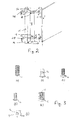
- FIG. 1 here there is shown a wall 13 of a building having a window opening 14 therein, which is closed and sealed by a security panel 1 within the window reveal, in accordance with the invention.
- the panel 1 is dimensioned such as to substantially completely fill the window opening 14.
- the panel 1 has rear and front faces 2,3 (respectively), with the front face 3, in accordance with the main object of the invention, having no exposed parts of the components by which the closure is mounted and secured in the window opening 14.
- the panel 1 itself may either be a continuous, unperforated solid panel of sheet steel, as shown in Figure 1(b), or alternatively, as shown in Figure 1(a), it may have formed therein an array of through-holes or apertures 4 extending between its front and rear faces, which, whilst not compromising the structural rigidity and strength of the panel, allow light and air ventilation into the building via the window opening 14 which is nevertheless closed and sealed by the panel.
- Figure 2 shows one example of the connecting elements and associated anchoring/tensioning means which can be used in the system of Figure 1.
- Using known capacitor discharge welding technology there are welded to the inside face 2 of the panel 1 a series of mounting studs 9, so that these studs are mounted on, and only extend inwardly from, the inner face 2 of the panel 1, leaving the outer face 3 of the panel flat within the window reveal and without any exposed parts of the closure means which could be liable for tampering with or vandalism.
- Each mounting stud 9 is formed with a transverse aperture 9a, through which is threaded a respective connecting element in the form of an elongate, flexible galvanized steel wire or tape 5.
- the wires or tapes 5 pass through respective apertures 18 pre-drilled in the frame or surround 13 of the window, avoiding the glass and thus allowing the holes 18 to be plugged upon removal of the closure device, thereby leaving the window structure "as good as new".
- a rigid or semi-rigid hooks or pins may be provided to pass through the apertures 18 as an alternative to the wires or tapes 5.
- ratchet tensioning devices 28 associated with each wire or tape 5.
- a pair of lateral anchor beams e.g. of a U-shaped cross-section metal formation, one to each side of the window opening 14, through respective apertures 27a in which pass the respective wires or tapes 5.
- the upper and lower end portions of the anchor beams 15 abut the wall portions 16 immediately above and below the window opening itself when the closure is finally mounted in position.
- Figures 3 (a) - (f) show a variety of different exemplary forms of mounting studs for use in embodiments of the invention.
- Figure 3(a) shows a mounting stud in the form of an externally threaded bolt or pin 10, for use particularly with a connecting element having an internally threaded end sleeve or collar portion.
- Figures 3(c) and (d) are variants of this, illustrating different head formations via which the studs are welded to the inner face 2 of the panel 1.
- Figure 3(b) shows a different type of stud, for use particularly with a connecting element in the form of a flexible wire or tape, which has a transverse hole 9a formed in the shank thereof, through which can be threaded and secured an end of the wire or tape element.
- the wire or tape 5 may be provided with a crimped or enlarged end portion for preventing its release from the aperture 9a when secured therein.
- Figure 3(f) shows an alternative but corresponding stud to that of Figure 3(b).
- Figure 3(e) shows yet another form of stud, this one 11 comprising an internally threaded central bore 26 for cooperative attachment to the threaded end of a rod or bar forming the connecting element of the closure system.
- Figure 4 shows a modified arrangement very similar to that shown in Figure 2, in which a window frame 23 has a hole 18 bored through it on either side thereof, but in which arrangement there is only a single wire, tape or strap 24 attached to a given mounting stud 9 on either side of the panel 1.
- the top and bottom ends of an anchor bar 27 on each side of the window or door opening 17 abut the upper and lower wall sections 23 adjacent the window or door opening 17, the anchor bar being formed with an aperture 27a for accommodating the wire, tape or strap 24 which passes therethrough before engaged by tensioning device 28 and intermediate washer 20.
- the end 25 of the wire, tape or strap 24 may additionally be formed with a crimped end portion or sleeve to assist its retention in the aperture 9a of the mounting stud 9.
- FIG. 5 shows a further variation on the basic idea, this time using a different combination of mounting stud and connecting device, although the functional principle remains the same.
- each mounting stud is in the form of an internally threaded sleeve 11 (Figure 3(e)) with each connecting element being in the form of an elongate externally threaded rod 22.
- the rod 22 again passes through a hole 18 drilled in the frame or surround 23 of the window or door opening 13, and as in the previous examples, on each side of the opening there is provided an anchor bar 27 for securing the closure in position in the opening.
- the mounting studs 11 are again mounted as and when required at the correct desired locations on the panel 1 by capacitor discharge welding, and the respective threaded connecting rods 22 are then attached thereto.
- an optional locking washer 21 e.g. of plastics material or metal
- an optional locking washer 21 could be used to assure a tight connection between the two.
- the connecting rods 22 are anchored in place and tensioned by means of a simple nut 19, with associated locking washer 20 (e.g. of plastics material). Tightening of these assembled components thus draws the panel 1 into engagement with the window or door opening 17, as already described.
- closure exemplified by the above described illustrative examples is very simple to manufacture and use and can be made relatively inexpensively.
- the closure system of the invention has great flexibility and can secure windows of any width, in practice up to about 1m or more for example, in a wall of any thickness.
- the components can be made to be all re-usable many times over and can be replaced individually in any given set-up.
Landscapes
- Engineering & Computer Science (AREA)
- Structural Engineering (AREA)
- Architecture (AREA)
- Civil Engineering (AREA)
- Load-Bearing And Curtain Walls (AREA)
- Building Environments (AREA)
Applications Claiming Priority (2)
| Application Number | Priority Date | Filing Date | Title |
|---|---|---|---|
| GB0223467 | 2002-10-10 | ||
| GB0223467A GB2393993A (en) | 2002-10-10 | 2002-10-10 | Security closure for unoccupied premises |
Publications (2)
| Publication Number | Publication Date |
|---|---|
| EP1413705A2 true EP1413705A2 (fr) | 2004-04-28 |
| EP1413705A3 EP1413705A3 (fr) | 2004-09-15 |
Family
ID=9945593
Family Applications (1)
| Application Number | Title | Priority Date | Filing Date |
|---|---|---|---|
| EP03256424A Withdrawn EP1413705A3 (fr) | 2002-10-10 | 2003-10-10 | Fermeture de sécurité |
Country Status (2)
| Country | Link |
|---|---|
| EP (1) | EP1413705A3 (fr) |
| GB (1) | GB2393993A (fr) |
Cited By (1)
| Publication number | Priority date | Publication date | Assignee | Title |
|---|---|---|---|---|
| GB2403253A (en) * | 2003-06-25 | 2004-12-29 | Graham Neil Armstrong | Protective screen for doors or windows |
Family Cites Families (11)
| Publication number | Priority date | Publication date | Assignee | Title |
|---|---|---|---|---|
| US2066005A (en) * | 1936-01-10 | 1936-12-29 | Johns Manville | Building wall |
| GB2160248B (en) * | 1984-06-14 | 1987-04-23 | Jolpine Ltd | Security closure |
| GB2208171B (en) * | 1987-07-17 | 1991-08-14 | Watt Ronald W | Security closure |
| US4963063A (en) * | 1987-12-27 | 1990-10-16 | Bulent Gulistan | Captive panel fastener |
| GB2233695A (en) * | 1989-05-12 | 1991-01-16 | Westling Ltd | Security door with adjustable frame |
| GB2266914B (en) * | 1992-05-15 | 1994-09-21 | Lawrence John Godley | Temporary barrier apparatus |
| DE9408180U1 (de) * | 1994-05-18 | 1994-07-21 | Schlittenbauer, Robert, 85088 Vohburg | Vorrichtung zum Abdichten von Öffnungen, wie Kellerfenstern o.dgl. |
| US5832671A (en) * | 1995-02-22 | 1998-11-10 | Vacant Property Security Limited | Security closure |
| GB2339822B (en) * | 1996-03-11 | 2000-09-20 | Vacant Property Security Ltd | Security closure |
| FR2761106B1 (fr) * | 1997-03-19 | 1999-06-04 | Protim | Volet anti-effraction pour l'occultation temporaire d'ouvertures de portes, fenetres et analogues dans des batiments |
| GB2341431B (en) * | 1999-08-06 | 2003-09-24 | Gerrard Alan Reid | A method of fixing a security screen or closure to windows or door frames |
-
2002
- 2002-10-10 GB GB0223467A patent/GB2393993A/en not_active Withdrawn
-
2003
- 2003-10-10 EP EP03256424A patent/EP1413705A3/fr not_active Withdrawn
Cited By (1)
| Publication number | Priority date | Publication date | Assignee | Title |
|---|---|---|---|---|
| GB2403253A (en) * | 2003-06-25 | 2004-12-29 | Graham Neil Armstrong | Protective screen for doors or windows |
Also Published As
| Publication number | Publication date |
|---|---|
| EP1413705A3 (fr) | 2004-09-15 |
| GB0223467D0 (en) | 2002-11-13 |
| GB2393993A (en) | 2004-04-14 |
Similar Documents
| Publication | Publication Date | Title |
|---|---|---|
| US8572928B2 (en) | System for erecting structures and support profile | |
| US4817334A (en) | Window bar security system | |
| US6125910A (en) | Intruder resistant screen | |
| US20030131954A1 (en) | Screen assembly | |
| US8959867B2 (en) | Systems and methods for constructing a building structure | |
| CA2163141A1 (fr) | Systeme de volet et methode | |
| EP0496616B1 (fr) | Fermeture de sécurité | |
| US5466022A (en) | Safety cable lock for knob-operated door | |
| US7726081B1 (en) | Hurricane net wind abatement system | |
| US5246194A (en) | Safety mechanism for securing panels to supporting posts | |
| EP1413705A2 (fr) | Fermeture de sécurité | |
| GB2253234A (en) | Door or window frame assembly | |
| US20110067347A1 (en) | Strap for securing a storm panel to a track | |
| US5313748A (en) | Security device for skylights and other vents, shafts or wells | |
| EP0503952A1 (fr) | Clôture et panneau | |
| US20070066325A1 (en) | Readily attachable ceiling antenna housing | |
| EP1056922A1 (fr) | Ensemble grillage | |
| JP3336264B2 (ja) | 壁材設置用金具及びそれを用いた既設建築物の外壁材施工法 | |
| JPH046461Y2 (fr) | ||
| JP4769029B2 (ja) | 屋根パネル連結金物および屋根パネルの連結方法 | |
| JP4756927B2 (ja) | 屋根パネル連結金物および屋根パネルの連結方法 | |
| AU2007201625A1 (en) | A security device | |
| JP2887387B2 (ja) | シャッターの補強構造 | |
| JP2576733Y2 (ja) | 開口パネルの補強構造 | |
| JP2003097160A (ja) | 面格子取付金具 |
Legal Events
| Date | Code | Title | Description |
|---|---|---|---|
| PUAI | Public reference made under article 153(3) epc to a published international application that has entered the european phase |
Free format text: ORIGINAL CODE: 0009012 |
|
| AK | Designated contracting states |
Kind code of ref document: A2 Designated state(s): AT BE BG CH CY CZ DE DK EE ES FI FR GB GR HU IE IT LI LU MC NL PT RO SE SI SK TR |
|
| AX | Request for extension of the european patent |
Extension state: AL LT LV MK |
|
| PUAL | Search report despatched |
Free format text: ORIGINAL CODE: 0009013 |
|
| AK | Designated contracting states |
Kind code of ref document: A3 Designated state(s): AT BE BG CH CY CZ DE DK EE ES FI FR GB GR HU IE IT LI LU MC NL PT RO SE SI SK TR |
|
| AX | Request for extension of the european patent |
Extension state: AL LT LV MK |
|
| 17P | Request for examination filed |
Effective date: 20050315 |
|
| AKX | Designation fees paid |
Designated state(s): AT BE BG CH CY CZ DE DK EE ES FI FR GB GR HU IE IT LI LU MC NL PT RO SE SI SK TR |
|
| STAA | Information on the status of an ep patent application or granted ep patent |
Free format text: STATUS: THE APPLICATION HAS BEEN WITHDRAWN |
|
| 18W | Application withdrawn |
Effective date: 20051103 |