EP1414176A2 - Dispositif et procédé de communication résistant aux erreurs en rafale, programme d'ordinateur pour la mise en oeuvre dudit procédé, et milieu d'enregistrement avec le programme - Google Patents
Dispositif et procédé de communication résistant aux erreurs en rafale, programme d'ordinateur pour la mise en oeuvre dudit procédé, et milieu d'enregistrement avec le programme Download PDFInfo
- Publication number
- EP1414176A2 EP1414176A2 EP03024204A EP03024204A EP1414176A2 EP 1414176 A2 EP1414176 A2 EP 1414176A2 EP 03024204 A EP03024204 A EP 03024204A EP 03024204 A EP03024204 A EP 03024204A EP 1414176 A2 EP1414176 A2 EP 1414176A2
- Authority
- EP
- European Patent Office
- Prior art keywords
- frame
- frames
- error
- divided
- section
- Prior art date
- Legal status (The legal status is an assumption and is not a legal conclusion. Google has not performed a legal analysis and makes no representation as to the accuracy of the status listed.)
- Granted
Links
Images






Classifications
-
- H—ELECTRICITY
- H04—ELECTRIC COMMUNICATION TECHNIQUE
- H04L—TRANSMISSION OF DIGITAL INFORMATION, e.g. TELEGRAPHIC COMMUNICATION
- H04L1/00—Arrangements for detecting or preventing errors in the information received
- H04L1/12—Arrangements for detecting or preventing errors in the information received by using return channel
- H04L1/16—Arrangements for detecting or preventing errors in the information received by using return channel in which the return channel carries supervisory signals, e.g. repetition request signals
-
- H—ELECTRICITY
- H04—ELECTRIC COMMUNICATION TECHNIQUE
- H04L—TRANSMISSION OF DIGITAL INFORMATION, e.g. TELEGRAPHIC COMMUNICATION
- H04L1/00—Arrangements for detecting or preventing errors in the information received
- H04L1/0078—Avoidance of errors by organising the transmitted data in a format specifically designed to deal with errors, e.g. location
- H04L1/0083—Formatting with frames or packets; Protocol or part of protocol for error control
-
- H—ELECTRICITY
- H04—ELECTRIC COMMUNICATION TECHNIQUE
- H04L—TRANSMISSION OF DIGITAL INFORMATION, e.g. TELEGRAPHIC COMMUNICATION
- H04L1/00—Arrangements for detecting or preventing errors in the information received
- H04L1/08—Arrangements for detecting or preventing errors in the information received by repeating transmission, e.g. Verdan system
Definitions
- the present invention relates to a communication device and a communication method immune to burst errors. More particularly, the present invention relates to a communication device (a transmitter, a receiver, and a transmitting/receiving device) which is immune to burst errors caused by fading or noise, a communication method performed by the communication device, a program for executing the communication method, and a computer-readable storage medium for storing the program.
- a communication device a transmitter, a receiver, and a transmitting/receiving device
- a communication method performed by the communication device
- a program for executing the communication method a computer-readable storage medium for storing the program.
- Golay codes which are block correcting codes
- Part (a) of FIG. 14 is an illustration showing an exemplary method for transmitting four blocks, for which error correction of the Golay (24, 12) code is performed, after interleaving processing.
- first to fourth blocks respectively contain 24 bits (12 bit data and 12 bit redundancy codes).
- a transmitting device sequentially transmits a first bit (1b) of the respective first to fourth blocks, and sequentially transmits a second bit (2b) of the respective first to fourth blocks.
- the transmitting device sequentially transmits a third (3b) to 24th bit (24b) of the respective first to fourth blocks.
- a receiving device cyclically distributes the received bits among the four blocks in the same manner as the transmitting device, and reconstructs the first to fourth blocks, respectively. Then, the receiving device performs an error correcting process for the respective reconstructed blocks.
- bits of the respective blocks are interleaved and transmitted, thereby handling a burst error occurring in intensive and sequential manners. For example, even in the above described case where a burst error of four bits occurs in intensive and sequential manners, only one bit error occurs on a block-by-block basis in the conventional transmission method, whereby error correction can be performed for all the blocks (part (b) of FIG. 14).
- a correcting capability of the conventional method quickly reaches its limit .
- at least four bit errors occur in any one block.
- a transmitter 102 having a power synchronous signal generator 106 for generating a power synchronous signal 105 from commercial power passing through a lamp line 104, a timing signal generating section 110 for generating a timing signal, which is obtained by dividing the power synchronous signal 105 into a plurality of signals, and a control section 111 for transmitting, based on the timing signal, the same information frame (packet) to the lamp line 104 a plurality of different times in order to prevent noise synchronized with the commercial power passing through the lamp line 104 from falling on the same location of the packet.
- a power synchronous signal generator 106 for generating a power synchronous signal 105 from commercial power passing through a lamp line 104
- a timing signal generating section 110 for generating a timing signal, which is obtained by dividing the power synchronous signal 105 into a plurality of signals
- a control section 111 for transmitting, based on the timing signal, the same information frame (packet) to the lamp line 104 a plurality of
- the device disclosed in the above gazette includes a receiver 103 having a storing section 112 for storing a plurality of information frames (packet) received via the lamp line 104, a determining section 113 for determining that an information frame (packet) is a correct signal from among the plurality of information frames, which are the same information frame transmitted the plurality of times, if the information frame includes the least bit error, and a control section 111 for controlling the storing section 112 and the determining section 113.
- the above device has to include the power synchronous signal generator 106 and the timing signal generating section 110 in order to detect a zero cross of power.
- the above two components make it difficult to reduce the size and cost of the device.
- the above method of determining a cycle of a burst error by detecting a zero cross of the power is applied only to the power line carrier communications.
- a transmission time to some extent, of each transmission, and cause a terminal to pause for some time after transmission.
- the Japanese Radio Law requires one transmission time and a pause time to be 200 ms, at the maximum, and 40ms, respectively.
- a half-cycle of 50Hz takes 10 ms.
- a pause time 40ms which is quadruple of the half cycle is required for each frame (packet) transmission.
- an object of the present invention is to provide a communication device and a communication method which are capable of correcting a burst error exceeding a correcting capability of an error correcting code by only transmitting one packet, without the need for a special component for detecting a cycle of the burst error.
- the present invention has the following features to attain the object mentioned above.
- the present invention is directed to a transmitter for transmitting data to a receiver, a receiver for receiving the data from the transmitter, and a communication device including the transmitter and the receiver.
- the transmitter of the present invention includes a frame generating section, a frame dividing section, and a transmission control section.
- the receiver includes a reception control section, a frame reconstructing section, and a frame processing section.
- the communication device includes all the above components.
- the frame generating section generates at least one predetermined frame by performing at least an error detecting code generating process for data to be transmitted.
- the frame dividing section divides the at least one frame generated by the frame generating section into a plurality of divided frames, based on a cycle of a burst error whose cyclical occurrence in a course of transmission is predictable.
- the transmission control section generates a packet in which each of the plurality of divided frames obtained by the frame dividing section is copied at least once in one cycle of the burst error for transmission, and transmits the packet to the receiver.
- the frame generating section performs at least the error detecting code generating process for the data to be transmitted, and generates one frame of L length.
- the frame dividing section divides the frame of L length generated by the frame generating section, by a length T/n which is obtained by dividing the predicted burst error cycle T by n (n is an integer equal to or greater than two), into n ⁇ L/T divided frames.
- the transmission control section generates a packet in which each of the n ⁇ L/T divided frames obtained by the frame dividing section is sequentially transmitted n times in one cycle of the burst error.
- the frame generating section divides the data to be transmitted into m (m is a natural number) pieces of data, and generates m frames of L length by performing at least the error detecting code generating process for each of the m pieces of data to which division information indicating division order is further added.
- the frame dividing section divides each of the m frames of L length generated by the frame generating section by a length T/n, which is obtained by dividing the predicted burst error cycle T by n, into n ⁇ L/T divided frames.
- the transmission control section generates a packet in which each of the m ⁇ n ⁇ L/T divided frames obtained by the frame dividing section is discontinuously transmitted n/m times in one cycle of the burst error.
- a frame storing section storing the m frames, which are generated by the frame generating section and divided by the frame dividing section, by copying each of them frames n/m times in order from a first frame to an mth frame, and storing a matrix of divided frames with n rows and n ⁇ L/T columns may be further included.
- the transmission control section can sequentially obtain the divided frame from the matrix of divided frames, which is stored in the frame storing section, by performing column-wise interlacing from a first row and first column to a n row and nxL/T column, and generate a packet including the divided frames in an order in which the divided frames are obtained.
- the transmission control section may generate a packet in which the divided frames contained in the specific frame are sequentially transmitted n times in one cycle of the burst error.
- a reception control section receives a packet in which a same divided frame is copied at least once for transmission, in one cycle of a burst error whose cyclical occurrence in a course of transmission is predictable, and sequentially distributes a plurality of divided frames contained in the packet, from a first divided frame, in a cyclical manner into a plurality of groups corresponding to the number of copies of the same divided frame.
- a frame reconstructing section reconstructs a plurality of frames by assembling the distributed divided frames with respect to each of the plurality of groups of the reception control section.
- a frame processing section performs at least an error detecting process for each of the plurality of frames reconstructed by the frame reconstructing section, and processes data stored in a frame having no error as reception data.
- the reception control section receives a packet in which a same divided frame is sequentially transmitted n times in one cycle of the burst error, and cyclically distributes a plurality of divided frames contained in the packet, from a first divided frame, into first to nth groups.
- the frame reconstructing section reconstructs n frames by assembling the distributed divided frames with respect to each of the first to nth groups.
- the frame processing section performs at least the error detecting process for each of n frames reconstructed by the frame reconstructing section, and processes data stored in a frame having no error as reception data.
- the reception control section receives a packet in which m types of divided frames are discontinuously transmitted n/m times in one cycle of the burst error, and sequentially distributes a plurality of divided frames contained in the packet, from a first divided frame, into first to nth groups in a cyclical manner.
- the frame reconstructing section reconstructs n frames by assembling the distributed divided frames with respect to each of the first to nth groups.
- the frame processing section performs at least the error detecting process for each of the n frames reconstructed by the frame reconstructing section, and processes data stored in a frame having no error as reception data.
- a data processing section for determining whether or not the reception data processed by the data processing section includes all data transmitted by the transmitter, and requiring the transmitter to retransmit a frame having lost data, if any, maybe further included.
- the frame generating section of the transmitter may generate at least one predetermined frame by performing the error detecting code generating process and an error correcting code generating process for data to be transmitted
- the frame processing section of the receiver may perform the error detecting process and an error correcting process for each of a plurality of frames reconstructed by the frame reconstructing section, and process data stored in a frame having no error as reception data.
- the respective processes performed by the frame generating section, the frame dividing section, and the transmission control section of the above transmitter, and the reception control section, the frame reconstructing section, and the frame generating section of the above receiver can be considered as a transmission method providing a series of processes. That is, the above respective processes can be considered as a transmission method performing following processes.
- At least one predetermined frame is generated by performing at least an error detecting code generating process for data to be transmitted, the at least one generated frame is divided into a plurality of frames, based on a cycle of a burst error whose cyclical occurrence in a course of transmission is predictable, a packet in which each of the plurality of divided frames obtained by division is copied at least once in one cycle of the burst error for transmission is generated, and the packet is transmitted to a receiving side.
- the packet transmitted from the transmitting side is received, a plurality of divided frames contained in the packet are cyclically distributed from a first divided frame into a plurality of groups corresponding to a number of copies of each of the plurality of divided frames, a plurality of frames are reconstructed by assembling the distributed divided frames with respect to each of the plurality of groups, at least an error detecting process is performed for each of the plurality of reconstructed frames, and data stored in a frame having no error is processed as reception data.
- the above communication method is provided as a program for causing a communication device (or a computer such as a microcomputer and a personal computer) to perform a series of processes.
- the program may be stored in a computer-readable storage medium.
- n copies of the divided frame are transmitted in one burst error cycle on the transmission side, whereby the receivingside can reliably receive, in each cycle, the divided frame unaffected by the burst error.
- a transmitting device immune to burst errors which is capable of correcting a burst error exceeding a correcting capability of an error correcting code by only transmitting one packet, without the need for a special component for detecting a cycle of the burst error, for example, a power synchronous signal generator or a timing signal generating section.
- the same divided frame of the first half of transmission data and the same divided frame of the last half of the transmission data are alternately repeated once for transmission in one burst cycle, whereby the receiving side can reliably receive, in each cycle, the divided frame unaffected by the burst error by one or two transmissions.
- the receiving side can reliably receive, in each cycle, the divided frame unaffected by the burst error by one or two transmissions.
- a transmission medzum usedin communications of the present invention is not limited, and either radio or cable communications can be applied to the present invention.
- a burst error which occurs due to fading caused by high-speed moving, etc., and whose burst cycle is determined in proportion to moving speeds, will be described as a burst error in radio communications whose frequency is higher than a high-frequency band.
- a burst error which occurs due to noise, which is caused by an electric device, in synchronization with a frequency of commercial power will be described as a burst error in other cable communications.
- FIG. 1 is a block diagram showing the structure of a communication device according to a first embodiment of the present embodiment.
- a communication device 1 according to the first embodiment includes a transmitter 2 and a receiver 3.
- the transmitter 2 includes a control section 21, a frame generating section 22, a frame dividing section 23, a transmission control section 24, and a transmitting section 25.
- the receiver 3 includes a control section 31, a frame processing section 32, a frame reconstructing section 33, a reception control section 34, and a receiving section 35.
- the control section 21 and the control section 31 may be united.
- the transmitting section 25 and the receiving section 35 may be united as a transmitting/receiving section.
- the control section 21 performs data transmission and a setting process of various parameters.
- the frame generating section 22 generates a frame, for which a predetermined error detecting coding process and a predetermined error correcting coding process are performed, with respect to data to be transmitted.
- the frame dividing section 23 divides the frame generated by the frame generating section 22 by a predetermined number so as to obtain a plurality of frames.
- the transmission control section 24 generates a packet in which each of the plurality of divided frames divided by the frame dividing section 23 is repeated a predetermined times.
- the transmitting section 25 sends the packet generated by the transmission control section 24 to a transmission medium 4.
- the transmitting section 25 includes a modulator for modulating the packet and transmitting the modulated packet, and an I/F circuit (an antenna, a coupling transformer, an amplifier, and a high frequency circuit, etc.) for radio or cable communications.
- the control section 31 performs data reception and a setting process of various parameters.
- the receiving section 35 receives a packet transmitted from the transmitter via the transmission medium 4.
- the receiving section 35 includes a demodulator for demodulating the received packet, and an I/F circuit for radio or cable communications.
- the reception control section 34 divides the packet received by the receiving section 35 into a predetermined number of frame groups.
- the frame reconstructing section 33 reconstructs the frame by assembling the divided frames divided by the reception control section 34 in a predetermined order.
- the frame processing section 32 performs a predetermined error correcting process and a predetermined error detecting process for the frame reconstructed by the frame reconstructing section 33.
- a method of the modulator and the demodulator included in the transmitting section 25 and the receiving section 35, respectively, is not specifically limited, and OFDM method, CDMA method, SS method, FSK method, PSK method, ASK method, and other various methods may be used. Also, each of the above components may be structured as a software algorithm of a computer or a microcomputer, hardware, or a combination thereof.
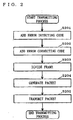
- FIG. 2 is a flowchart showing a transmitting process performed by the transmitter 2.
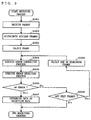
- FIG. 3 is a flowchart showing a receiving process performed by the receiver 3.
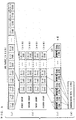
- FIG. 4 is an illustration for describing the structures of the frame and the packet processed by the transmitter 2.
- FIG. 5 is an illustration for describing the structures of the frame and the packet processed by the receiver 3.
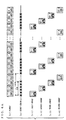
- FIGS. 6A and 6B are illustrations for describing effects of a communication method according to the first embodiment when a burst error occurs.
- control section 21 transfers the transmission date of 13 bytes to the frame generating section 22.
- the control section 21 may notify the frame generating section 22 of an address indicating a field in which the transmission data is stored.
- the frame generating section 22 calculates an error detecting code with respect to the transmission data received from the control section 21, and adds the calculated error detecting code to the transmission data (step S201).
- a CRC of two bytes is added to the transmission data, and an error detecting frame of 15 bytes is generated (part (b) of FIG. 4).
- a transmission source ID and a transmission destination ID are generally added to data, but those IDs are not directly related to the present invention and therefore are not further described herein.
- a code indicating a data length is added to data, but the description thereof is omitted herein.
- the frame generating section 22 further calculates an error correcting code with respect to the error detecting frame, and adds the calculated error detecting code to the error detecting frame (step S202).
- an error correcting code In this example, a case in which the Golay (24, 12) code, which has been described in the BACKGROUND OF THE INVENTION section, is used as an error correcting code.
- the Golay (24, 12) code In a case where the Golay (24, 12) code is used, an error correcting code of 12 bits is sequentially calculated and added for every 12 bits from a head of the error detecting frame of 15 bytes (120 bits) for which error correction is to be performed.
- the error correcting frame generated by adding the error correcting code includes ten error correcting blocks, and a frame length L thereof is 30 bytes.
- a cycle of a burst error occuring over the transmission medium 4 is predicted.
- An exemplary case in which the communication device of the present invention is applied to power line carrier communications and the burst error occurs due to noise synchronized with 50 Hz commercial power will be described herein.
- the burst error occurs for every data of 12 bytes.
- the frame dividing section 23 divides the error correcting frame generated by the frame generating section 22 into a plurality of frames so that each divided frame has a predetermined size s determined based on the predicted cycle of the burst error (step S203). Then, the transmission control section 24 generates a packet in which each of the plurality of divided frames divided by the frame dividing section 23 is copied a predetermined times n, which is determined based on the predicted cycle of the burst error (step S204).
- the predetermined size s and the predetermined number n are, for example, determined as follows.
- the parameters T, n, and L it is assumed that values predetermined based on the predicted burst error cycle are set in the control section 21, and the control section 21 gives these parameters to any components, if necessary. Note that, in a case where a cycle of the burst error fluctuates in the radio communications, etc., the parameters T, n, and L may be dynamically changed by detecting a fading cycle, ormaybeadjustedbyperforming feedback control for the error detecting results obtained by the receiver.
- the transmission control section 24 transmits the packet generated as described above via the transmitting section 25 (step S205).
- the receiving section 35 receives and demodulates the packet (part (a) of FIG. 5) maintaining bit synchronization and frame synchronization (step S301).
- the reception control section 34 distributes the divided frames contained in the packet demodulated by the receiving section 35 in accordance with the predetermined number n, based on which each divided frame is copied in the transmitter (step S302).
- the divided frames are distributed by 3 bytes into four groups (part (b) of FIG. 5).
- the frame processing section 32 performs an error correcting process and an error detecting process for any one of the four error correcting frames reconstructed by the frame reconstructing section 33, and extracts the transmission data (part (d) of FIG. 5) (steps S303 to S305). Then, the frame processing section 32 determines whether or not the extracted transmission data includes any errors (step S306). If the extracted data has no error, the frame processing section 32 transfers the transmission data to the control section 31 as reception data (step S307). Note that, in a case where processing is performed by software of the microcomputer, an address indicating a field in which the data is stored may be notified.
- the frame processing section 32 similarly performs the error correcting process and the error detecting process with respect to any of the remaining error correcting frames, and extracts the transmission data (steps S309, S304 to S305). In a case where transmission data having no error cannot be extracted after the four error correcting frames are processed, the frame processing section 32 ends the reception process as unsuccessful data reception (No at step S308).
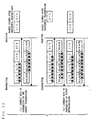
- FIGS. 6A and 6B are used for describing that the communication method of the first embodiment substantially improves a burst error correcting capability.
- FIGS. 6A and 6B show a case where a burst error (shown in FIGS. 6A (b) and 6B (b)) whose cycle T and length are 12 bytes and 9 bytes, respectively, occurs when a packet (shown in FIGS. 6A (a) and 6B (a)) in which a divided frame of three bytes is copied four times is transmitted.
- a phase of the packet has no correlation to a phase of the burst error.
- phase relations between the packet and the burst error there are 96 patterns of phase relations between the packet and the burst error, and therefore descriptions of these phase relations are omitted other than those shown in FIGS. 6A and 6B.
- the same one divided frame is quadruplicated in one burst cycle, whereby many errors occur in any three divided frames of the four quadruplicated divided frames.
- no error occurs in one frame of the four quadruplicated divided frames.
- the frame in which no error occurred is arranged so that its position is always the same in each burst cycle, whereby it is possible to substantially improve an error correcting capability.
- a frame reconstructed from divided frames belonging to a fourth group as shown in part (c4) of FIG. 6A has no error, thereby performing accurate error correction.
- this frame is reception data.
- a frame reconstructed from divided frames belonging to a second group as shown in part (c2) of FIG. 6A has no error, thereby performing accurate error correction.
- this frame is reception data.
- the communication device and the communication method according to the first embodiment of the present invention it is possible to correct a burst error exceeding a correcting capability of an error correcting code by only transmitting one packet, without the need for a special component for detecting a cycle of the burst error. Also, it is possible to perform processing for a frame stored in a memory, etc., by software, in accordance with transmission speeds or response speeds .
- transmission of the same one divided frame is repeated the predetermined times n, in order to correct a burst error exceeding a correcting capability of an error correcting code.
- transmission efficiency is always decreased by l/n compared to a normal transmission, regardless of the presence or absence of a burst error .
- a communication device and a communication method by which a burst error can be corrected utilizing a burst error correcting capability as described in the first embodiment, and transmission efficiency exceeding the level of the first embodiment can be realized when there is no burst error, will be described.
- FIG. 7 is a block diagram showing the structure of a communication device according to the second embodiment of the present invention.
- a communication device 5 according to the second embodiment includes a transmitter 6 and a receiver 7.
- the communication device 5 in which the transmitter 6 and the receiver 7 are united will be described, but the communication device 5 may separately include the transmitter 6 and the receiver 7.
- the transmitter 6 includes a control section 61, a frame generating section 62, a frame storing section 63, a frame dividing section 64, a transmission control section 65, and a transmitting section 66.
- the receiver 7 includes a control section 71, a data processing section 72, a frame processing section 73, a frame reconstructing section 74, a reception control section 75, and a receiving section 76.
- the control section 61 and the control section 71 maybe united.
- the transmitting section 66 and the receiving section 76 may be united as a transmitting/receiving section.
- the control section 61 performs data transmission and a setting process of various parameters.
- the frame generating section 62 divides data to be transmitted into a predetermined number of data, and generates a frame by performing a predetermined error detecting coding process and a predetermined error correcting process for each divided data.
- the frame storing section 63 stores a plurality of frames generated by the frame generating section 62 in a predetermined order.
- the frame dividing section 64 divides each of the plurality of frames stored in the frame storing section 63, based on a predetermined unit of division.
- the transmission control section 65 generates a packet in which the plurality of divided frames divided by the frame dividing section 64 are arranged in accordance with a predetermined interleaving process.
- the transmitting section 66 sends, to the transmission medium 4, the packet generated by the transmission control section 65.
- the transmitting section 66 has the same structure as the above transmitting section 25.
- the control section 71 performs data reception and a setting process of various parameters.
- the receiving section 76 receives a packet transmitted from the transmitter via the transmission medium 4.
- the receiving section 76 has the same structure as the above receiving section 35.
- the reception control section 75 divides the packet received by the receiving section 76, based on the predetermined unit of division.
- the frame reconstructing section 74 reconstructs the frame by assembling the divided frames divided by the reception control section 75 in accordance with the predetermined interleaving process.
- the frame processing section 73 performs the predetermined error correcting processand the predetermined error detecting process for the frame reconstructed by the frame reconstructing section 74.
- FIG. 8 is a flowchart showing a transmitting process performed by the transmitter 6.
- FIG. 9 is a flowchart showing a receiving process performed by the receiver 7.
- FIG. 10 is an illustration for describing the structures of the frame and the packet processed by the transmitter 6.
- FIG. 11 is an illustration for describing the structures of the frame and the packet processed by the receiver 7.
- FIGS. 12A to 12C are illustrations for describing effects of the communication method according to the second embodiment when a burst error occurs.
- FIG. 13 is a sequence diagram corresponding to communications shown in FIGS. 12A to 12C.
- the control section 61 transfers the transmission data of 24 bytes to the frame generating section 62.
- the control section 61 may notify the frame generating section 62 of an address indicating a field in which the transmission data is stored.
- the frame generating section 62 divides the transmission data received from the control section 61 by a predetermined dividing number m (step S801) , calculates an error detecting code for each divided transmission data, and adds the calculated error detecting code to each divided transmission data (step S802).
- the frame generating section 62 adds division information, which indicates howmuch data is generated by dividing the originaltransmission data,and where each divided transmission data is in the plurality of divided original transmission data, to each divided transmission data (step S803).
- division information which indicates howmuch data is generated by dividing the originaltransmission data,and where each divided transmission data is in the plurality of divided original transmission data, to each divided transmission data (step S803).
- the predetermined dividing number m is 2 .
- the transmission data of 24 bytes is divided into two pieces of transmission data of 12 bytes, and a CRC of two bytes and division information of one byte are added to the respective two pieces of transmission data, thereby generating two error detecting frames of 15 bytes (part (b) of FIG. 10).
- the frame generating section 62 calculates an error correcting code with respect to each error detecting frame, and adds the calculated error correcting code to each error detecting frame (step S804).
- the Golay (24, 14) code which has been mentioned in the "BACKGROUND OF THE INVENTION" section, is used as an error correcting code is described.
- the Golay (24,12) code has been described in the above first embodiment.
- each of the two error correcting frames generated by adding the error correcting code includes ten error correcting blocks, and a frame length thereof is 30 bytes.
- the frame storing section 63 arranges the plurality of error correcting frames, which are generated by the frame generating section 62, in order of division of the original transmission data, and stores n/m copies of each of the plurality of error correcting frames (Step S805).
- a cycle T of a burst error which occurs over the transmission medium 4 (in the course of transmission)
- a divided frame of three bytes (predetermined size s) is transmitted four (predetermined number n) times during the above cycle of 12 bytes will be described.
- the frame storing section 63 stores the two error correcting frames generated by the frame generating section 62 as follows: an error correcting frame of the first half of the transmission data is stored in a first field, an error correcting frame of the last half of the transmission data in a second field, an error correcting frame of the first half of the transmission data in a third field, and an error correcting frame of the first half of the transmission data in a fourth field, respectively (part (d) of FIG. 10).
- a copy of the error correcting frame a copy may be actually performed in memory space, or a virtual copy may be performed by defining an address transformation in order to minimize a memory consumption.
- the frame dividing section 64 divides each error correcting frame stored in the frame storing section 63 into a plurality of divided frames of the predetermined size s, which is determined based on the predicted cycle of the burst error (step S806).
- the transmission control section 65 generates a packet in which the plurality of divided frames divided by the frame dividing section 64 are arranged in accordance with the predetermined interleaving method and stored (step S807).
- the parameters T, n, and m it is assumed that values predetermined based on the predicted burst error cycle are set in the control section 61, and the control section 61 gives these parameters to any components, if necessary. Note that, in a case where a cycle of the burst error fluctuates in the radio communications, etc., the parameters T, n, and m may be dynamically changedbydetectingafadingcycle, or may be adjusted by performing feedback control for the error detecting results obtained by the receiver.
- the transmission control section 65 transmits the above packet via the transmitting section 66 (step S808).
- the transmitting section 66 after adding a preamble necessary for bit synchronization and a synchronous code necessary for frame synchronization to the packet to be transmitted by the transmission control section 65, modulates the packet by the modulator, and sends the modulated packet to the transmission medium 4 via the I/F circuit.
- the receiving section 76 receives and demodulates the packet (part (a) of FIG. 11) maintaining bit synchronization and frame synchronization (step S901).
- the reception control section 75 distributes the divided frames contained in the packet demodulated by the receiving section 76 in accordance with the interleaving process used in the receiver (step S902).
- the divided frames are distributed by three bytes into four groups (part (b) of FIG. 11).
- the frame processing section 73 extracts one piece of transmission data (part (c) of FIG. 11) by performing an error correcting process and an error detecting process for any one of the four error correcting frames reconstructed by the frame reconstructing section 74 (steps S903 to S905).
- the frame processing section 73 determines whether or not the extracted transmission data includes any errors (step S906). If the determination is made by the frame processing section 73 that the extracted transmission data has no error, the data processing section 72 temporarily stores the transmission data and analyzes the division information (step S907). Then, the data processing section 72 determines whether or not all the divided transmission data composing the original transmission data is received (step S908 ) .
- the data processing section 72 determines that the data is successfully received, and transfers the plurality of transmission data to the control section 71 as reception data (step S909). Note that, in a case where processing is performed by software of a microcomputer, the data processing section 72 may notify the control section 71 of an address indicating a field in which the transmission data is stored. Furthermore, if all the divided transmission data composing the original transmission data is received, the data processing section 72 returns an ALL-ACK frame indicating that all transmission data has been received to the transmitter 6 which is a transmission source (step S909) .
- the ACK frame including a command "ACK" as data contents is transmitted by a method immune to a burst error, as is the case with the first embodiment.
- the transmission data is extracted with respect to any remaining error correcting frame by performing the error correcting process and the error detecting process in a similar manner (step S912, and S904 to S905). If all the divided transmission data composing the original transmission data is not received after all the four error correcting frames are processed, the data processing section 72 determines that data reception is unsuccessful, and returns a partial ACK indicating a portion of the transmission data, which has been received, to the transmitter 6 which is a transmission source (steps S910 and S911).
- the transmitter 6 which is a transmission source, receives the partial ACK, rewrites the entire field stored in the frame storing section 63 to an error correcting frame which does not include the transmission data indicated by the partial ACK, divides the rewritten error correcting frame into a plurality of divided frames by the frame dividing section 64, and newly generates a packet in which the divided frames are arranged in accordance with the predetermined interleaving process and stored by the transmission control section 65. Then, the transmitter 6 retransmits the generated packet to the receiver 7 (steps S805 to S808 shown in FIG. 8).
- the receiver 7 processes the retransmitted data in a similar manner as described above (step S901 to S912).
- FIGS. 12A to 12C and FIG. 13 are used for describing that a burst error correcting capability is substantially improved by the communication method according to the second embodiment.
- FIG. 12A shows a case where a burst error (part (b) of FIG. 12A) whose cycle T and length are 12 bytes and 6 bytes, respectively, occurs when a packet (part (a) of FIG. 12A) in which one divided frame (three bytes) of the first half of the transmission data and one divided frame (three bytes) of the last half of the transmission data are alternately repeated.
- a phase of the packet has no correlation to a phase of the burst error.
- the same divided frame of the first half of the transmission data and the same divided frame of the last half of the transmission data are alternately repeated once in one burst cycle.
- many errors occur in any consecutive divided frames of the first and last half of the transmission data, but no error occurs in the remaining divided frames of the first and last half of the transmission data.
- the remaining divided frames having no error are arranged so as to be always the same locations in each burst error cycle, whereby it is possible to substantially improve an error correcting capability.
- FIGS. 12B and 12C show a case where a burst error (part (b) of FIG. 12B and part (b) of 12C) whose cycle T and length are 12 bytes and 9 bytes, respectively, occurs when a packet (part (a) of FIG. 12B and part (a) of FIG. 12C) in which one divided frame (three bytes) of the first half of the transmission data and one divided frame (three bytes) of the last half of the transmission data are alternately repeated is transmitted.
- a phase of the packet has no correlation to a phase of the burst error.
- the same divided frame of the first half of the transmission data and the same divided frame of the last half of the transmission data are alternately repeated once in one burst cycle, andmany errors occur in any three consecutive divided frames of the first and last half of the transmission data.
- only the last half of the transmission data is stored in the storage area of the receiver 7, and the first half of the transmission data is retransmitted.
- FIG. 12C as is the case with the FIG. 12B, there occurs many burst errors in any three consecutive three divided frames, but retransmission is performed for only the divided frames of the first half of the transmission data.
- the communication device and the communication method according to the second embodiment of the present invention it is possible to improve transmission efficiency in a case where a length of a burst error is shorter than the first embodiment, and keep a burst error tolerance equivalent to the first embodiment by a retransmission process in a case where a length of a burst error is longer than the first embodiment, without the need for a special component for detecting a cycle of the burst error.
- a data length of the transmission data to which the present invention can be applied is not limited to those described in the first and second embodiments.
- the same effect as described in the above embodiments can be obtained in a case where the present invention is applied to the data communications in which a different length of transmission data is transmitted.
- an error detecting code and an error correcting code are not limited to those described in the first and second embodiments.
- an error correcting code may be selected from among a BCH code, a Reed-Solomon code, and a Viterbi code, etc. , in view of the throughput and a correcting capability.
- the present invention can be flexibly applied to a communication system in which the burst error cycle T, the transmission speeds, the number n, and the dividing number m are different from those described in the above embodiments.
- the error correcting process and the error detecting process are performed for each error correcting frame, and the transmission data is transferred to the control sections 31 and 71 as the reception data if there is no error in the transmission data.
- the error detecting process may be performed without performing the error correcting process for transferring the transmission data to the control sections 31 and 71 as the reception data if there is no error in the transmission data.
- only the error correcting process may be performed for transferring the transmission data to which the error correcting process is performed to the control sections 31 and 71 as the reception data.
- the error correcting coding performed in the transmitters 2 and 6 is not necessarilyperformed, and it is possible to obtain the useful effects of the present invention in a case where only the error detecting coding is performed.
- a code indicating a data length which is added to the transmission data, is omitted.
- a code indicating a data length of effective data is added as the code indicating a data length, thereby enabling a following telegraphic message receiving method.
- a case where effective data of 11 bytes is transmitted by a frame of a fixed length (in the above embodiments, 30 bytes) will be taken as an example.
- a code of one byte indicating a length of effective data is added to the effective data of 11 bytes, and a dummy telegraphic message of 12 bytes is added for fixed length frame transmission.
- the resultant data of 24 bytes is split into a first half of data and a last half of data, and transmitted in accordance with the transmission method as described in the above embodiment.
- the receiver receives the transmission telegraphic message including the code indicating the effective data length, and performs the error correcting process and the error detecting process for the error correcting frame of the first half of data. Then, the receiver determines that the effective data is included only in the first half of data based on the code indicating the effective data length added to the processed first half of data, and does not perform the error correcting process and the error detecting process for the error correcting frame of the last half of data, which contains the division information and the dummy telegraphic message. If the above telegraphic message receiving method is used, a retransmission process for the frame having no effective data is not required, thereby improving transmission efficiency.
Landscapes
- Engineering & Computer Science (AREA)
- Computer Networks & Wireless Communication (AREA)
- Signal Processing (AREA)
- Detection And Prevention Of Errors In Transmission (AREA)
- Data Exchanges In Wide-Area Networks (AREA)
Applications Claiming Priority (2)
| Application Number | Priority Date | Filing Date | Title |
|---|---|---|---|
| JP2002309339 | 2002-10-24 | ||
| JP2002309339 | 2002-10-24 |
Publications (3)
| Publication Number | Publication Date |
|---|---|
| EP1414176A2 true EP1414176A2 (fr) | 2004-04-28 |
| EP1414176A3 EP1414176A3 (fr) | 2008-04-02 |
| EP1414176B1 EP1414176B1 (fr) | 2010-03-31 |
Family
ID=32064355
Family Applications (1)
| Application Number | Title | Priority Date | Filing Date |
|---|---|---|---|
| EP03024204A Expired - Lifetime EP1414176B1 (fr) | 2002-10-24 | 2003-10-21 | Dispositif et procédé de communication résistant aux erreurs en rafale, programme d'ordinateur pour la mise en oeuvre dudit procédé, et milieu d'enregistrement lisible par ordinateur stockant le programme |
Country Status (6)
| Country | Link |
|---|---|
| US (1) | US7096405B2 (fr) |
| EP (1) | EP1414176B1 (fr) |
| KR (1) | KR100969775B1 (fr) |
| CN (1) | CN100477548C (fr) |
| DE (1) | DE60331884D1 (fr) |
| TW (1) | TW200421747A (fr) |
Cited By (3)
| Publication number | Priority date | Publication date | Assignee | Title |
|---|---|---|---|---|
| GB2408660A (en) * | 2003-11-25 | 2005-06-01 | Samsung Electronics Co Ltd | Constructing a wireless LAN frame by splitting MAC frame, attaching CRC, preamble and header to each segment and combining into WLAN frame |
| US8913649B2 (en) | 2004-10-15 | 2014-12-16 | Tq Delta, Llc | Impulse noise protection during initialization |
| EP3719661A1 (fr) * | 2019-04-05 | 2020-10-07 | Renesas Electronics Corporation | Dispositif de communication |
Families Citing this family (19)
| Publication number | Priority date | Publication date | Assignee | Title |
|---|---|---|---|---|
| US7609697B2 (en) * | 2004-03-30 | 2009-10-27 | Sony Corporation | Optimizing IEEE 802.11 for TCP/IP data transfer |
| JP2005318291A (ja) * | 2004-04-28 | 2005-11-10 | Yamaha Corp | データ伝送方法、サーバ装置、データ受信装置、および、データ伝送システム。 |
| KR20050119595A (ko) * | 2004-06-16 | 2005-12-21 | 삼성전자주식회사 | 이동통신 시스템에서 연접 지그재그 부호를 이용한 채널부호화/복호화 장치 및 방법 |
| GB0506539D0 (en) * | 2005-03-31 | 2005-05-04 | Koninkl Philips Electronics Nv | Method and apparatus for transmitting data, and a communication system |
| US7533323B2 (en) * | 2005-07-28 | 2009-05-12 | Prostor Systems, Inc. | Adaptive archival format |
| US20070165757A1 (en) * | 2006-01-18 | 2007-07-19 | Arie Heiman | Method and system for an improved cellular interference cancelling diversity receiver |
| US8929870B2 (en) | 2006-02-27 | 2015-01-06 | Qualcomm Incorporated | Methods, apparatus, and system for venue-cast |
| CN101051880B (zh) * | 2006-04-07 | 2010-11-03 | 华为技术有限公司 | 一种数据帧发送、接收及转发方法及其装置 |
| CN100421397C (zh) * | 2006-04-12 | 2008-09-24 | 重庆邮电学院 | 一种光突发交换网络性能及故障监测方法 |
| WO2007129699A1 (fr) * | 2006-05-09 | 2007-11-15 | Nec Corporation | système de communication, nœud, terminal, procédé de communication et programme |
| JP5233165B2 (ja) * | 2007-05-24 | 2013-07-10 | 富士ゼロックス株式会社 | データ伝送装置 |
| CN101552008B (zh) * | 2008-04-01 | 2011-11-16 | 华为技术有限公司 | 语音编码方法及装置、语音解码方法及装置 |
| KR101779614B1 (ko) * | 2011-06-08 | 2017-09-18 | 엘에스산전 주식회사 | 인버터 통신 시스템 |
| CN102420919A (zh) * | 2011-11-09 | 2012-04-18 | 成都航天通信设备有限责任公司 | 一种通信系统、通信方法及在无线传输时信号的控制方法 |
| CN104716991A (zh) * | 2015-03-26 | 2015-06-17 | 北京博望华科科技有限公司 | 一种数据分包续传的电力载波通信系统及方法 |
| WO2017090674A1 (fr) * | 2015-11-26 | 2017-06-01 | 京セラ株式会社 | Dispositif de transmission et dispositif de reception |
| JP7401815B2 (ja) * | 2020-03-24 | 2023-12-20 | 日本電信電話株式会社 | 制御システム及び制御方法 |
| KR102779749B1 (ko) * | 2021-03-26 | 2025-03-12 | 한국전력공사 | 프레임 연집 오류 정정을 위한 부호기/복호기 및 부호화/복호화 방법 |
| IL282469B2 (en) * | 2021-04-20 | 2024-10-01 | Maris Tech Ltd | Streaming media communication with forward error correction |
Family Cites Families (9)
| Publication number | Priority date | Publication date | Assignee | Title |
|---|---|---|---|---|
| JPS58105636A (ja) * | 1981-12-18 | 1983-06-23 | Fujitsu Denso Ltd | 電力線搬送方式 |
| JPH09149080A (ja) * | 1995-11-27 | 1997-06-06 | Matsushita Electric Ind Co Ltd | データ伝送装置 |
| DE69731074T2 (de) * | 1997-04-30 | 2005-10-06 | Hewlett-Packard Development Co., L.P., Houston | Anordnung und Verfahren zur Übertragung von Daten über eine Vielzahl von Kanälen |
| KR19990042498A (ko) * | 1997-11-27 | 1999-06-15 | 전주범 | 인터넷 텔레비전에서의 사이트접속 제어방법 |
| JPH11266190A (ja) | 1998-03-17 | 1999-09-28 | Sekisui Chem Co Ltd | 電灯線通信用送信装置、電灯線通信用受信装置、電灯線通信装置及び電灯線通信方法 |
| JP2000078197A (ja) * | 1998-09-03 | 2000-03-14 | Toshiba Corp | 通信ノード及びパケット転送方法 |
| US6498936B1 (en) * | 1999-01-22 | 2002-12-24 | Ericsson Inc. | Methods and systems for coding of broadcast messages |
| US6804218B2 (en) * | 2000-12-04 | 2004-10-12 | Qualcomm Incorporated | Method and apparatus for improved detection of rate errors in variable rate receivers |
| US20040028076A1 (en) * | 2001-06-30 | 2004-02-12 | Strolle Christopher H | Robust data extension for 8vsb signaling |
-
2003
- 2003-10-21 DE DE60331884T patent/DE60331884D1/de not_active Expired - Lifetime
- 2003-10-21 EP EP03024204A patent/EP1414176B1/fr not_active Expired - Lifetime
- 2003-10-23 KR KR1020030074257A patent/KR100969775B1/ko not_active Expired - Fee Related
- 2003-10-23 TW TW092129406A patent/TW200421747A/zh unknown
- 2003-10-23 US US10/690,561 patent/US7096405B2/en not_active Expired - Lifetime
- 2003-10-24 CN CNB2003101029206A patent/CN100477548C/zh not_active Expired - Fee Related
Cited By (7)
| Publication number | Priority date | Publication date | Assignee | Title |
|---|---|---|---|---|
| GB2408660A (en) * | 2003-11-25 | 2005-06-01 | Samsung Electronics Co Ltd | Constructing a wireless LAN frame by splitting MAC frame, attaching CRC, preamble and header to each segment and combining into WLAN frame |
| GB2408660B (en) * | 2003-11-25 | 2007-03-07 | Samsung Electronics Co Ltd | Method of dividing a payload intra-frame |
| US7489708B2 (en) | 2003-11-25 | 2009-02-10 | Samsung Electronics Co., Ltd. | Method of dividing a payload intra-frame |
| US8913649B2 (en) | 2004-10-15 | 2014-12-16 | Tq Delta, Llc | Impulse noise protection during initialization |
| US9621198B2 (en) | 2004-10-15 | 2017-04-11 | Tq Delta, Llc | DMT symbol repetition in the presence of impulse noise |
| US11394485B2 (en) | 2004-10-15 | 2022-07-19 | Tq Delta, Llc | DMT symbol repetition in the presence of impulse noise |
| EP3719661A1 (fr) * | 2019-04-05 | 2020-10-07 | Renesas Electronics Corporation | Dispositif de communication |
Also Published As
| Publication number | Publication date |
|---|---|
| EP1414176B1 (fr) | 2010-03-31 |
| HK1062246A1 (en) | 2004-10-21 |
| KR20040036621A (ko) | 2004-04-30 |
| TW200421747A (en) | 2004-10-16 |
| KR100969775B1 (ko) | 2010-07-13 |
| CN1497864A (zh) | 2004-05-19 |
| EP1414176A3 (fr) | 2008-04-02 |
| US7096405B2 (en) | 2006-08-22 |
| DE60331884D1 (de) | 2010-05-12 |
| US20040128609A1 (en) | 2004-07-01 |
| CN100477548C (zh) | 2009-04-08 |
Similar Documents
| Publication | Publication Date | Title |
|---|---|---|
| EP1414176B1 (fr) | Dispositif et procédé de communication résistant aux erreurs en rafale, programme d'ordinateur pour la mise en oeuvre dudit procédé, et milieu d'enregistrement lisible par ordinateur stockant le programme | |
| US6718503B1 (en) | Reduced latency interleaver utilizing shortened first codeword | |
| KR102245241B1 (ko) | 텔레그램 분할 송신 방법에 기초한 상이한 센서 노드들 및 가변 데이터 길이들에 대한 최적화된 홉핑 패턴들 | |
| RU2234806C2 (ru) | Устройство предотвращения ошибок для мультимедийной системы | |
| US6157612A (en) | Fast fading packet diversity transmission method and system | |
| JP4391703B2 (ja) | 直交送信ダイバーシチおよびマルチキャリアcdma通信システム用のインタリーブ方法および装置 | |
| US11075652B2 (en) | Polar code transmission method and apparatus | |
| JPH11502989A (ja) | 受信無効部分の効果を除去するためパケット寸法を最適化する方法 | |
| AU719988B2 (en) | A method for enhancing data transmission | |
| JP3627765B2 (ja) | スクランブルにより情報秘匿を行なう通信システムにおける送信装置 | |
| US6678854B1 (en) | Methods and systems for providing a second data signal on a frame of bits including a first data signal and an error-correcting code | |
| US5333197A (en) | System to prevent a scrambler from generating undesired symbols | |
| JPH05183447A (ja) | 改善された誤まり検出符号化システム | |
| US20220255664A1 (en) | Methods and systems for transmitting data payloads | |
| JP4328176B2 (ja) | バースト誤りに強い通信装置及び通信方法、その通信方法を実行するためのプログラム、そのプログラムを記録したコンピュータ読み取り可能な記録媒体 | |
| HK1062246B (en) | Communication device and communication method immune to burst error, program for executing the method, and computer-readable storage medium storing the program | |
| JPS62190932A (ja) | インタリ−ブ方式 | |
| JPH0720094B2 (ja) | スペクトラム拡散通信方式 | |
| US8467372B2 (en) | Wireless communication system with reordering of data symbols and related methods | |
| JP2604640B2 (ja) | データ伝送方法及びデータ伝送装置 | |
| KR20030065674A (ko) | 물리채널 전송 포맷 스크램블링 방법 및 물리채널 전송포맷 정보 전송 장치 | |
| KR100878801B1 (ko) | 물리채널 전송 포맷 스크램블링 방법 | |
| JP2006157269A (ja) | 送信装置および受信装置 | |
| JPH0761059B2 (ja) | ルート識別方式 | |
| JPH05122109A (ja) | ルート識別方式 |
Legal Events
| Date | Code | Title | Description |
|---|---|---|---|
| PUAI | Public reference made under article 153(3) epc to a published international application that has entered the european phase |
Free format text: ORIGINAL CODE: 0009012 |
|
| AK | Designated contracting states |
Kind code of ref document: A2 Designated state(s): AT BE BG CH CY CZ DE DK EE ES FI FR GB GR HU IE IT LI LU MC NL PT RO SE SI SK TR |
|
| AX | Request for extension of the european patent |
Extension state: AL LT LV MK |
|
| REG | Reference to a national code |
Ref country code: HK Ref legal event code: DE Ref document number: 1062246 Country of ref document: HK |
|
| PUAL | Search report despatched |
Free format text: ORIGINAL CODE: 0009013 |
|
| AK | Designated contracting states |
Kind code of ref document: A3 Designated state(s): AT BE BG CH CY CZ DE DK EE ES FI FR GB GR HU IE IT LI LU MC NL PT RO SE SI SK TR |
|
| AX | Request for extension of the european patent |
Extension state: AL LT LV MK |
|
| 17P | Request for examination filed |
Effective date: 20080709 |
|
| RAP1 | Party data changed (applicant data changed or rights of an application transferred) |
Owner name: PANASONIC CORPORATION |
|
| 17Q | First examination report despatched |
Effective date: 20081028 |
|
| AKX | Designation fees paid |
Designated state(s): DE FR GB |
|
| GRAP | Despatch of communication of intention to grant a patent |
Free format text: ORIGINAL CODE: EPIDOSNIGR1 |
|
| GRAS | Grant fee paid |
Free format text: ORIGINAL CODE: EPIDOSNIGR3 |
|
| GRAA | (expected) grant |
Free format text: ORIGINAL CODE: 0009210 |
|
| AK | Designated contracting states |
Kind code of ref document: B1 Designated state(s): DE FR GB |
|
| REG | Reference to a national code |
Ref country code: GB Ref legal event code: FG4D |
|
| REF | Corresponds to: |
Ref document number: 60331884 Country of ref document: DE Date of ref document: 20100512 Kind code of ref document: P |
|
| REG | Reference to a national code |
Ref country code: HK Ref legal event code: GR Ref document number: 1062246 Country of ref document: HK |
|
| PLBE | No opposition filed within time limit |
Free format text: ORIGINAL CODE: 0009261 |
|
| STAA | Information on the status of an ep patent application or granted ep patent |
Free format text: STATUS: NO OPPOSITION FILED WITHIN TIME LIMIT |
|
| PGFP | Annual fee paid to national office [announced via postgrant information from national office to epo] |
Ref country code: DE Payment date: 20100924 Year of fee payment: 8 |
|
| 26N | No opposition filed |
Effective date: 20110104 |
|
| PGFP | Annual fee paid to national office [announced via postgrant information from national office to epo] |
Ref country code: GB Payment date: 20101021 Year of fee payment: 8 |
|
| PGFP | Annual fee paid to national office [announced via postgrant information from national office to epo] |
Ref country code: FR Payment date: 20111103 Year of fee payment: 9 |
|
| GBPC | Gb: european patent ceased through non-payment of renewal fee |
Effective date: 20121021 |
|
| REG | Reference to a national code |
Ref country code: FR Ref legal event code: ST Effective date: 20130628 |
|
| PG25 | Lapsed in a contracting state [announced via postgrant information from national office to epo] |
Ref country code: DE Free format text: LAPSE BECAUSE OF NON-PAYMENT OF DUE FEES Effective date: 20130501 Ref country code: GB Free format text: LAPSE BECAUSE OF NON-PAYMENT OF DUE FEES Effective date: 20121021 |
|
| REG | Reference to a national code |
Ref country code: DE Ref legal event code: R119 Ref document number: 60331884 Country of ref document: DE Effective date: 20130501 |
|
| PG25 | Lapsed in a contracting state [announced via postgrant information from national office to epo] |
Ref country code: FR Free format text: LAPSE BECAUSE OF NON-PAYMENT OF DUE FEES Effective date: 20121031 |