EP1415523B1 - Sämaschine - Google Patents
Sämaschine Download PDFInfo
- Publication number
- EP1415523B1 EP1415523B1 EP20030017336 EP03017336A EP1415523B1 EP 1415523 B1 EP1415523 B1 EP 1415523B1 EP 20030017336 EP20030017336 EP 20030017336 EP 03017336 A EP03017336 A EP 03017336A EP 1415523 B1 EP1415523 B1 EP 1415523B1
- Authority
- EP
- European Patent Office
- Prior art keywords
- seed
- sowing
- sowing unit
- unit
- units
- Prior art date
- Legal status (The legal status is an assumption and is not a legal conclusion. Google has not performed a legal analysis and makes no representation as to the accuracy of the status listed.)
- Expired - Lifetime
Links
- 238000009331 sowing Methods 0.000 title claims abstract description 82
- 238000000151 deposition Methods 0.000 claims description 9
- 108010016634 Seed Storage Proteins Proteins 0.000 description 3
- 238000000034 method Methods 0.000 description 2
- 238000010899 nucleation Methods 0.000 description 2
- 241001136792 Alle Species 0.000 description 1
- 241000219310 Beta vulgaris subsp. vulgaris Species 0.000 description 1
- 241000196324 Embryophyta Species 0.000 description 1
- 235000021536 Sugar beet Nutrition 0.000 description 1
- 240000008042 Zea mays Species 0.000 description 1
- 235000005824 Zea mays ssp. parviglumis Nutrition 0.000 description 1
- 235000002017 Zea mays subsp mays Nutrition 0.000 description 1
- 235000005822 corn Nutrition 0.000 description 1
- 230000003111 delayed effect Effects 0.000 description 1
- 238000001514 detection method Methods 0.000 description 1
- 238000006073 displacement reaction Methods 0.000 description 1
- 230000001788 irregular Effects 0.000 description 1
Images


Classifications
-
- A—HUMAN NECESSITIES
- A01—AGRICULTURE; FORESTRY; ANIMAL HUSBANDRY; HUNTING; TRAPPING; FISHING
- A01B—SOIL WORKING IN AGRICULTURE OR FORESTRY; PARTS, DETAILS, OR ACCESSORIES OF AGRICULTURAL MACHINES OR IMPLEMENTS, IN GENERAL
- A01B79/00—Methods for working soil
- A01B79/005—Precision agriculture
-
- A—HUMAN NECESSITIES
- A01—AGRICULTURE; FORESTRY; ANIMAL HUSBANDRY; HUNTING; TRAPPING; FISHING
- A01C—PLANTING; SOWING; FERTILISING
- A01C21/00—Methods of fertilising, sowing or planting
- A01C21/005—Following a specific plan, e.g. pattern
-
- A—HUMAN NECESSITIES
- A01—AGRICULTURE; FORESTRY; ANIMAL HUSBANDRY; HUNTING; TRAPPING; FISHING
- A01C—PLANTING; SOWING; FERTILISING
- A01C7/00—Sowing
- A01C7/08—Broadcast seeders; Seeders depositing seeds in rows
- A01C7/10—Devices for adjusting the seed-box ; Regulation of machines for depositing quantities at intervals
- A01C7/102—Regulating or controlling the seed rate
Definitions
- the invention relates to a seed drill, in particular for a single-grain seed, as used for example for sowing corn, sugar beets and other fine seeds.
- the seed drill claimed in EP 0 592 995 B1 is characterized by a displacement sensor which detects the travel path of the seeder (or an associated tractor).
- a central control device has one or more, stepless adjustable proportional controller on. These controllers are used to process path pulses emitted by the position sensor. These path pulses are used in pulses for driving DC motors, which are assigned to each Einzelkornsä réelle. In this case, each Einzelkornsä réelle on a rotary encoder and a separate control loop to ensure a given sheabstand (spacing of the individual seed grains) reproducible.
- the known solution principle summarized is to use the guideway as a reference variable. Depending on a particular path length that has been traveled, a seed is deposited by the seeder.
- US-A-6070539 relates to a device for application of agricultural products.
- US 2001/000806 A1 describes a GPS system for seed drills.
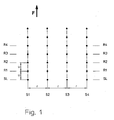
- FIG. 1 schematically shows a predefined "sawing image".
- F denotes the transport direction of the machine.
- the image is based on four sowing machines S1, S2, S3 and S4, which are fastened next to one another on a common frame, as the cited prior art describes in detail.
- each planter drops seeds at a distance "a” from a "start line” labeled SL.
- the individual seeds of the sowing units S1, S2, S3 and S4 are each on an imaginary line / along a row (R1, R2, R3, R4), wherein the distance from row to row is constant a (corresponding to the grain spacing to which the sowing units S1, S2, S3, S4 are set).
- the invention has for its object to offer a seeder of the generic type, in which these disadvantages are avoided.
- the sowing machine should be used to maintain a defined sowing pattern as precisely as possible.
- the drill should work so that even irregular shecular can be precisely created. This applies, for example, to applications in which the plants grown from the seed are subsequently used to display "images" which, for example, can be recognized from the air (from an aircraft) and used as advertising media.
- the invention is based on the following consideration: Technology relates to seed drills, where the guideway is used as a reference variable.
- This reference variable is "1-dimensional”.
- the outlined disadvantages of the prior art can be avoided, provided that a "2-dimensional control" takes place, not only in the direction of the travel path, but also "perpendicular to it", that is to say concretely: between adjacent sowing units.
- this "sowing error" does not continue continuously in the direction of travel of the sowing machine, but is immediately recognized by the adjacent sowing unit (for example S1) and a subsequent control of the sowing unit S2 concerned takes place.
- this basic regulation and control technology also makes it possible to image completely arbitrary, even unsymmetrical seed images by, for example, individually controlling and controlling (controlling) each individual sowing unit via its position.
- control also includes a corresponding "control”.
- seeding unit includes any technical embodiment of a means by which seed is applied, in particular Einzelkornsä sexualen.
- sowing units which are arranged side by side along a corresponding frame (fastened), are mutually "linked” control technology.
- the control of a sowing unit of the control (position) of the adjacent sowing unit depends.
- the advantages of the invention can be exploited in a special way, when the controls (positions) of several sowing units with each other or with respect to a "master-sowing unit” (master sowing unit) are controlled.
- the advantages can be optimally exploited if all sowing units are networked with one another in terms of control engineering.
- control can therefore be designed so that it controls at least one sowing unit so that this sowing unit, taking into account the position of Seed storage of several adjacent sowing sets the next seed.
- control / control designed so that it sets several sowing units so that each of these sowing sets taking into account the position of the seed deposit of at least one adjacent sowing unit sets the next seed.
- the seed placement of at least one sowing unit can be done by an external system for determining the position of the last stored seed.
- a corresponding system can be set up both on the seeder itself and on an associated tractor.
- the regulation of the sowing unit can depend on the Position of the seed deposit of an adjacent sowing unit using an angle sensor done. With this sensor, an angle can be detected and converted into an electrical signal quantity.
- angle sensor include: angle encoders, angle encoders, magnetic angle sensors, rotary potentiometers, etc.
- the sowing units can each be equipped with a sensor for detecting the discharge point of a seed. In sowing units with seeding discs, this may be a sensor for detecting the angular position of the seed disc, for example the mentioned angle encoder.
- the seeder of Figure 3 includes, for example, again 4 sowing units S1 to S4, which are fixed at a distance "r" on a common frame.
- the direction of travel of the machine is indicated by arrow F.
- the sowing units S 1 and S3 are intended to deposit a seed grain at a distance "a", starting from the start line SL. Accordingly, two adjacent seed grains form an imaginary line such as R1.
- the sowing units S2 and S4 deposit the first seed after "3 / 2a", then parallel each at a distance a, to obtain a sowing pattern in which the grains deposited by S2, S4 are exactly halfway apart from S1, S3 deposited grains lie.
- Two adjacent seed grains of S1, S3 and S2, S4 each form an imaginary line such as R1, R1 '.
- angle decoders which are located on each sowing unit S1, S2, S3, S4.
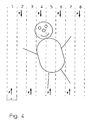
- Figure 4 shows schematically a drill, which can be created with a drill of the type described. "A” indicates the working width of the seeder with a large number of sowing units.
- “F” indicates the (meandering) direction of travel of the seeder, with seeds being discharged from the sowing units for the first time during the journey designated by "2" to form the "arm area” of the figure to be created.
- the seeds are stored accordingly so that they are in the desired assignment for later detection of a head and body part.
Landscapes
- Life Sciences & Earth Sciences (AREA)
- Soil Sciences (AREA)
- Environmental Sciences (AREA)
- Engineering & Computer Science (AREA)
- Mechanical Engineering (AREA)
- Sowing (AREA)
- Steroid Compounds (AREA)
- Mechanical Treatment Of Semiconductor (AREA)
- Valve-Gear Or Valve Arrangements (AREA)
- Pharmaceuticals Containing Other Organic And Inorganic Compounds (AREA)
Description
- Die Erfindung betrifft eine Sämaschine, insbesondere für eine Einzelkornsaat, wie sie beispielsweise zur Aussaat von Mais, Zuckerrüben und anderen Feinsamen verwendet wird.
- Der grundsätzliche Aufbau einer solchen Sämaschine wird in der EP 0 592 995 B1 beschrieben. Diese Veröffentlichung bildet nicht nur selber einen Stand der Technik, sondern gibt auch einen Überblick über den bis zum Prioritätstag dieser Veröffentlichung bekannt gewordenen Stand der Technik.
- Die in der EP 0 592 995 B1 beanspruchte Sämaschine zeichnet sich durch einen Wegsensor aus, der den Fahrweg der Sämaschine (beziehungsweise einer zugehörigen Zugmaschine) erfaßt. Eine zentrale Steuereinrichtung weist einen oder mehrere, stufenlos verstellbare Proportionalregler auf. Diese Regler dienen der Verarbeitung von Wegimpulsen, die der Wegsensor abgibt. Diese Wegimpulse werden in Impulse zur Ansteuerung von Gleichstrommotoren verwendet, die jedem Einzelkornsägerät zugeordnet sind. Dabei weist jedes Einzelkornsägerät einen Drehimpulsgeber und einen eigenen Regelkreis auf, um einen vorgegebenen Säabstand (Abstand der einzelnen Saatgutkörner) reproduzierbar sicherzustellen.
- Das bekannte Lösungsprinzip besteht zusammengefaßt darin, den Fahrweg als Führungsgröße zu benutzen. In Abhängigkeit von einer bestimmten Weglänge, die zurückgelegt wurde, wird ein Säkorn von dem Sägerät abgelegt.
- Die US-A-6070539 betrifft ein Gerät zur Ausbringung landwirtschaftlicher Produkte. Die US 2001/000806 A1 beschreibt ein GPS-System für Sämaschinen.
- Mit dieser Maschine lassen sich auch unterschiedliche Säabstände von Reihe zu Reihe (also von Sägerät zu Sägerät) einstellen.
- In Figur 1 ist schematisch ein vorgegebenes "Säbild" dargestellt. F bezeichnet die Transportrichtung der Maschine. Das Bild geht von vier Sägeräten S1, S2, S3 und S4 aus, die nebeneinander an einem gemeinsamen Rahmen befestigt sind, wie der zitierte Stand der Technik im einzelnen beschreibt. Es wird weiter davon ausgegangen, daß jedes Sägerät, ausgehend von einer mit SL bezeichneten "Startlinie", Saatkörner mit einem Abstand "a" ablegt. Bei ordnungsgemäßer Funktionsweise der Sämaschine ergibt sich das in Figur 1 dargestellte Säbild. Die einzelnen Saatkörner der Säaggregate S1, S2, S3 und S4 liegen jeweils auf einer gedachten Linie/entlang einer Reihe (R1, R2, R3, R4), wobei der Abstand von Reihe zu Reihe konstant a beträgt (entsprechend dem Kornabstand, auf den die Säaggregate S1, S2, S3, S4 eingestellt sind).
- Kommt es nun - aus welchen Gründen auch immer - im Bereich des Einzelkornsäaggregates S2 zu einer Verzögerung an der Startlinie SL, so entsteht das in Figur 2 dargestellte "unsymmetrische" Säbild. Unter der Voraussetzung, daß alle Säaggregate anschließend "normal" weiter arbeiten, also nach einer Wegstrecke a jeweils präzise ein weiteres Saatkorn ablegen bleibt die unkontrollierte (willkürliche) Ablage der Saatgutkörner zwischen den einzelnen Säaggregaten erhalten. Das vorgegebene Säbild ist nicht mehr realisierbar.
- Der Erfindung liegt die Aufgabe zugrunde, eine Sämaschine der gattungsgemäßen Art anzubieten, bei der diese Nachteile vermieden werden. Mit der Sämaschine soll ein vorgegebenes Säbild so präzise wie möglich eingehalten werden. Vorzugsweise soll die Sämaschine so arbeiten, daß auch unregelmäßige Säbilder präzise erstellt werden können. Dies gilt beispielsweise für Anwendungen, bei denen mit dem aus dem Saatgut erwachsenden Pflanzen anschließend "Bilder" dargestellt werden, die zum Beispiel aus der Luft (aus einem Flugzeug) erkannt und als Werbeträger genutzt werden können.
- Der Erfindung liegt folgende Überlegung zugrunde: Der Stand der Technik betrifft Sämaschinen, bei denen der Fahrweg als Führungsgröße benutzt wird. Diese Führungsgröße ist "1-dimensional". Die skizzierten Nachteile des Standes der Technik können vermieden werden, sofern eine "2-dimensionale Regelung" erfolgt, und zwar nicht nur in Richtung des Fahrweges, sondern auch "senkrecht dazu", das heißt konkret: zwischen benachbarten Säaggregaten.
- Geht man von dem eingangs skizzierten Beispiel (Figuren 1, 2) aus, so wird der grundsätzliche Unterschied zwischen dem erfindungsgemäßen Konzept und der bekannten Lösung deutlich:
- Kommt es im Bereich des Säaggregates S2 zu der skizzierten Verzögerung so setzt sich dieser "Säfehler" nicht in Fahrrichtung der Sämaschine kontinuierlich fort, sondern er wird umgehend von dem benachbarten Säaggregat (beispielsweise S1) erkannt und es erfolgt eine Nachsteuerung des betroffenen Säaggregates S2. Im Ergebnis führt dies dazu (je nach Regelung), daß entweder das nächste Saatkorn des Säaggregates S2 vorzeitig, nämlich parallel zum entsprechenden Saatkorn des Säaggregates S1 abgelegt wird oder das nächste Saatkorn vom Säaggregat S2 verzögert, nämlich mit dem übernächsten regulären Saatkorn des Säaggregates S1 abgegeben wird.
- Dies ist aber nur eine Möglichkeit der 2-dirhensionalen Steuerung/Regelung der Sämaschine. So kann zum Beispiel bei einer Führung der Sämaschine entlang einer Kurve mit Hilfe eines Winkelsensors der "weitere Weg" außenliegender Säaggregate bei der Kurvenbewegung mathematisch berechnet und entsprechend ausgeglichen werden, so daß auch innerhalb einer Kurvenführung Saatkörner benachbarter Säaggregate "entlang einer Linie" abgelegt werden, wie nachstehend noch beschrieben wird.
- Schließlich ermöglicht es diese grundsätzliche Regelungs- und Steuerungstechnik auch, völlig beliebige, auch unsymmetrische Säbilder abzubilden, indem beispielsweise jedes einzelne Säaggregat individuell über seine Position angesteuert und geregelt (gesteuert) wird.
- Danach betrifft die Erfindung in ihrer allgemeinsten Ausführungsform eine Sämaschine mit folgenden Merkmalen:
- mehrere Säaggregate sind im Abstand nebeneinander an einem Rahmen befestigt,
- jedes Säaggregat weist einen eigenen Antrieb zur Ablage von Saatgut auf,
- die Sämaschine umfaßt eine Regelung, die so ausgelegt ist, daß sie bei einem vorgegebenen Säbild entweder
- mindestens ein Säaggregat so regelt, daß dieses Säaggregat unter Berücksichtigung der Position der Saatgutablage mindestens eines benachbarten Säaggregats das Saatgut ablegt, wobei die Position jedes einzelnen Saatgutes und damit die Position des nächsten abzulegenden Saatguts genau bestimmbar ist, oder
- alle Säaggregate zentral unter Verwendung eines externen Systems zur Positionsbestimmung der Saatgutablage jedes einzelnen Säaggregats, unter Berücksichtigung der Position der Saatgutablage jeweils mindestens eines benachbarten Säaggregates geregelt werden, wobei die Position jedes abgelegten Saatguts und damit die Position des nächsten abzulegenden Saatguts genau bestimmbar ist.
- Der Begriff "Regelung" umfaßt erfindungsgemäß auch eine entsprechende "Steuerung".
- Der Begriff "Säaggregat" umfaßt jede technische Ausführungsform eines Mittels, mit dem Saatgut ausgebracht wird, insbesondere Einzelkornsäeinrichtungen.
- Entscheidend ist, daß die einzelnen Säaggregate, die nebeneinander entlang eines entsprechenden Rahmens angeordnet (befestigt) sind, untereinander steuerungstechnisch "verlinkt" sind. Im einfachsten Fall ist die Steuerung eines Säaggregates von der Steuerung (Position) des benachbarten Säaggregates abhängig. Die Vorteile der Erfindung können in besonderer Weise ausgenutzt werden, wenn die Steuerungen (Positionen) mehrerer Säaggregate untereinander oder in Bezug auf ein "Haupt-Säaggregat" (Master-Säaggregat) gesteuert werden. Die Vorteile lassen sich optimal ausnutzen, wenn alle Säaggregate untereinander regelungstechnisch vernetzt sind.
- Gemäß einer Ausführungsform kann die Regelung deshalb so ausgelegt werden, daß sie mindestens ein Säaggregat so regelt, daß dieses Säaggregat unter Berücksichtigung der Position der Saatgutablage mehrerer benachbarter Säaggregate das nächste Saatgut ablegt.
- Eine andere Möglichkeit sieht vor, die Regelung/Steuerung so auszulegen, daß sie mehrere Säaggregate so einstellt, daß jedes dieser Säaggregate unter Berücksichtigung der Position der Saatgutablage jeweils mindestens eines benachbarten Säaggregates das jeweils nächste Saatgut ablegt.
- Die Position der Saatgutablage mindestens eines Säaggregates kann durch ein externes System zur Positionsbestimmung des zuletzt abgelegten Saatgutes erfolgen.
- Hierzu können beispielsweise Festzuordnungssysteme wie GPS global positioning system), DGPS (Differential global positioning system) oder ein Laserpositioniersystem dienen. Einzelheiten ergeben sich aus www.starlinkdgps.com mit der Maßgabe, dass die Bestimmungsgenauigkeit heute im cm- bis mm-Bereich liegt.
- Mit diesen Systemen, die als solche Stand der Technik sind, ist es möglich, die Position eines abgelegten Saatkorns genau zu bestimmen und damit auch die Position des nächsten abzulegenden Saatkorns.
- Ein entsprechendes System kann sowohl an der Sämaschine selbst, als auch an einer zugehörigen Zugmaschine eingerichtet werden.
- Die Regelung des Säaggregates kann in Abhängigkeit von der Position der Saatgutablage eines benachbarten Säaggregates unter Verwendung eines Winkelsensors erfolgen. Mit diesem Sensor lässt sich ein Winkel erfassen und in eine elektrische Signalgröße wandeln. Dazu gehören: Winkelschrittgeber, Winkelencoder, magnetische Winkelaufnehmer, Drehpotentiometer etc.
- Die Säaggregate können (jeweils) mit einem Sensor zur Erkennung des Abwurfpunktes eines Saatkorns ausgerüstet sein. Bei Säaggregaten mit Säscheiben kann dies ein Sensor zur Erkennung der Winkelstellung der Säscheibe, zum Beispiel der erwähnte Winkelencoder sein.
- Es ist ohne weiteres zu erkennen, daß auch andere technische Verfahren zur Positionsbestimmung des Säaggregates, des zuletzt abgelegten Saatgutes beziehungsweise der Einrichtungen untereinander angewendet werden können, um die erfindungsgemäße Lehre zu verwirklichen.
- Diese wird nachstehend anhand verschiedener Ausführungsbeispiele näher erläutert. Dabei zeigen - jeweils in stark schematisierter Darstellung - :
- Figur 3: ein Säbild unter Berücksichtigung einer Kurvenführung,
- Figur 4: ein individuelles Säbild.
- Die Sämaschine nach Figur 3 umfaßt beispielhaft wieder 4 Säaggregate S1 bis S4, die im Abstand "r" an einem gemeinsamen Rahmen befestigt sind.
- Die Fahrtrichtung der Maschine zeigt Pfeil F. Die Säaggregate S 1 und S3 sollen, ausgehend von der Startlinie SL, jeweils im Abstand "a" ein Saatkorn ablegen. Entsprechend bilden zwei nebeneinander liegende Saatkörner eine gedachte Linie wie R1.
- Die Säaggregate S2 und S4 legen das erste Saatkorn nach "3/2a" ab, danach parallel jeweils im Abstand a, um ein Säbild zu erreichen, bei dem die von S2, S4 abgelegten Körner jeweils genau auf der halben Entfernung der von S1, S3 abgelegten Körner liegen. Zwei nebeneinander liegende Saatkörner von S1,S3 bzw. S2, S4 bilden jeweils eine gedachte Linie wie R1, R1'.
- Bei der dargestellten Kurvenführung ergibt sich mit der Forderung, daß die parallel gesteuerten Säaggregate S1 und S3 ihre Körner jeweils genau zwischen den Körner der Säaggregate S2 und S4 ablegen, daß die von S3 abgelegten Körner im Kurvenbereich einen größeren Abstand (a+d2) aufweisen müssen als die von S1 abgelegten Körner.
- Entsprechende Verhältnisse ergeben sich für die Säeinrichtungen S2, S4, wie durch die Kurvenabstände "a+d1" beziehungsweise "a+d3" angedeutet, wobei d3>d2>d1 ist.
- Erfindungsgemäß werden diese unterschiedlichen Abstände über Winkeldekoder geregelt, die sich an jedem Säaggregat S1, S2, S3, S4 befinden.
- Auf diese Weise läßt sich der Abstand der "versetzten Reihen" unabhängig von der Fahrtrichtung konstant halten, wie durch die Linien R1, R1' beziehungsweise R3, R3' angezeigt ist.
- Figur 4 zeigt schematisch ein Säbild, welches mit einer Sämaschine der beschriebenen Art erstellbar ist. Dabei ist mit "A" die Arbeitsbreite der Sämaschine mit einer Vielzahl von Säaggregaten angegeben.
- "F" gibt die (mäanderförmige) Fahrtrichtung der Sämaschine an, wobei erstmals während der mit "2" bezeichneten Fahrt Saatkörner von den Säaggregaten abgegeben werden, um den "Armbereich" der zu erstellenden Figur zu bilden. In der Spur 4 werden entsprechend die Saatkörner so abgelegt, dass sie in der gewünschten Zuordnung zur späteren Erkennung eines Kopf- und Körperteils liegen.
Claims (7)
- Sämaschine zur Einzelkornsaat mit folgenden Merkmalen:mehrere Säaggregate (51, 52, 53, 54) sind im Abstand (r) nebeneinander an einem Rahmen befestigt,jedes Säaggregat (51, 52, 53, 54) weist einen eigenen Antrieb zur Ablage von Saatgut auf,die Sämaschine umfaßt eine Regelung, die so ausgelegt ist, daß sie bei einem vorgegebenen Säbild entwedermindestens ein Säaggregat (51 bis 54) so regelt, daß dieses Säaggregat (51 bis 54) unter Berücksichtigung der Position der Saatgutablage mindestens eines benachbarten Säaggregats das Saatgut ablegt, wobei die Position jedes einzelnen Saatgutes und damit die Position des nächsten abzulegenden Saatgutes genau bestimmbar ist, oderalle Säaggregate (51, 52, 53, 54) zentral unter Verwendung eines externen Systems zur Positionsbestimmung der Saatgutablage jedes einzelnen Säaggregates unter Berücksichtigung der Position der Saatgutablagejeweils mindestens eines benachbarten Säaggregates geregelt werden, wobei die Position jedes abgelegten Saatguts und damit die Position des nächsten abzulegenden Saatguts genau bestimmbar ist.
- Sämaschine nach Anspruch 1, bei der die Regelung so ausgelegt ist, dass sie mindestens ein Säaggregat so regelt, dass dieses Säaggregat unter Berücksichtigung der Position der Saatgutablage mehrerer benachbarter Säaggregate das nächste Saatgut ablegt.
- Sämaschine nach Anspruch 1, bei der die Regelung so ausgelegt ist, dass sie mehrere Säaggregate so regelt, dass jedes dieser Säaggregate unter Berücksichtigung der Position der Saatgutablage jeweils mindestens eines benachbarten Säaggregates das jeweils nächste Saatgut ablegt.
- Sämaschine nach Anspruch 1, bei der die Position der Saatgutablage mindestens eines Säaggregats durch ein externes System zur Positionsbestimmung des zuletzt abgelegten Saatguts erfolgt.
- Sämaschine nach Anspruch 1 oder 4, bei der das externe System ein Festzuordnungssystem wie GPS oder ein Laserpositioniersystem ist.
- Sämaschine nach Anspruch 1, bei der die Regelung des Säaggregats in Abhängigkeit von der Position der Saatgutablage eines benachbarten Säaggregats unter Verwendung eines Winkelsensors erfolgt.
- Sämaschine nach Anspruch 1, bei der die Regelung unter Berücksichtigung jeder einzelnen Saatgutablage erfolgt.
Applications Claiming Priority (2)
| Application Number | Priority Date | Filing Date | Title |
|---|---|---|---|
| DE2002151114 DE10251114B4 (de) | 2002-11-02 | 2002-11-02 | Sämaschine |
| DE10251114 | 2002-11-02 |
Publications (2)
| Publication Number | Publication Date |
|---|---|
| EP1415523A1 EP1415523A1 (de) | 2004-05-06 |
| EP1415523B1 true EP1415523B1 (de) | 2006-10-18 |
Family
ID=32087327
Family Applications (1)
| Application Number | Title | Priority Date | Filing Date |
|---|---|---|---|
| EP20030017336 Expired - Lifetime EP1415523B1 (de) | 2002-11-02 | 2003-07-31 | Sämaschine |
Country Status (4)
| Country | Link |
|---|---|
| EP (1) | EP1415523B1 (de) |
| AT (1) | ATE342651T1 (de) |
| DE (2) | DE10251114B4 (de) |
| DK (1) | DK1415523T3 (de) |
Cited By (3)
| Publication number | Priority date | Publication date | Assignee | Title |
|---|---|---|---|---|
| EP2926640A1 (de) | 2014-04-04 | 2015-10-07 | Müller-Elektronik GmbH & Co. KG | Haltemodul zum Halten eines Antriebs für ein Einzelkornsägerät |
| US9179595B2 (en) | 2012-03-09 | 2015-11-10 | Deere & Company | Assembly and method for the precision drilling of seed grains |
| EP3338524A1 (de) | 2016-12-22 | 2018-06-27 | Amazonen-Werke H. Dreyer GmbH & Co. KG | Landwirtschaftliche einzelkornsämaschine und verfahren |
Families Citing this family (21)
| Publication number | Priority date | Publication date | Assignee | Title |
|---|---|---|---|---|
| DE102005010686B9 (de) * | 2004-03-16 | 2013-07-04 | Johannes Benninger | Verfahren zum Pflanzen von Sämlingen und/oder zur Direkt- oder Einzelkornsaat sowie zur Saat- und/oder Pflanzenpflege |
| DE102005011004B4 (de) * | 2005-03-02 | 2008-11-06 | Wtk-Elektronik Gmbh | Einzelkornsämaschine |
| GB0623591D0 (en) * | 2006-11-27 | 2007-01-03 | Syngenta Participations Ag | Crop images |
| US7726251B1 (en) | 2009-03-11 | 2010-06-01 | Deere & Company | Agricultural seeding apparatus and method for seed placement synchronization between multiple rows |
| WO2012034754A1 (de) * | 2010-09-13 | 2012-03-22 | Lacos Computerservice Gmbh | Verfahren zum ausbringen von landwirtschaftlichen stoffen in kurven |
| SE536033C2 (sv) | 2011-02-23 | 2013-04-09 | Vaederstad Verken Ab | Jordbruksmaskin och förfarande vid en sådan |
| US9320192B2 (en) | 2013-11-12 | 2016-04-26 | Dickey-John Corporation | Synchronization of a twin row planting system |
| US10104836B2 (en) | 2014-06-11 | 2018-10-23 | John Paul Jamison | Systems and methods for forming graphical and/or textual elements on land for remote viewing |
| GB2527818A (en) * | 2014-07-03 | 2016-01-06 | Adcrop Ltd | Planting apparatus and methods |
| DE102015217496A1 (de) | 2015-09-14 | 2017-03-16 | Deere & Company | Verfahren zum Ausbringen von Saatgutpartikeln oder Pflanzen auf ein Feld und eine entsprechende Maschine |
| CN107197644B (zh) * | 2016-03-16 | 2022-01-18 | 北京光和麦田科技有限公司 | 分选装置、播种机、分选控制系统及方法 |
| DE102016207510A1 (de) | 2016-05-02 | 2017-11-02 | Deere & Company | Pneumatische Drillmaschine |
| EP3530095B1 (de) * | 2018-02-21 | 2020-09-16 | Amazonen-Werke H. Dreyer GmbH & Co. KG | Sämaschine |
| US11083127B2 (en) * | 2018-05-09 | 2021-08-10 | Deere & Company | Seeding machine to provide transverse tramlines |
| US11134608B2 (en) | 2018-05-15 | 2021-10-05 | Deere & Company | Method and machine for plant cultivation on a field |
| SE1950658A1 (sv) * | 2019-06-04 | 2020-12-05 | Vaederstad Holding Ab | Lantbruksredskap och förfarande för bestämning av rörelsetillstånd hos ett lantbruksredskap |
| DE102019128003A1 (de) * | 2019-10-17 | 2021-04-22 | Amazonen-Werke H. Dreyer Gmbh & Co. Kg | Landwirtschaftliche Ausbringmaschine |
| DE102019218191A1 (de) * | 2019-11-25 | 2021-05-27 | Robert Bosch Gmbh | Verfahren zum Ausbringen von Saatgut und/oder Setzlingen und landwirtschaftliche Maschine |
| DE102020117911A1 (de) | 2020-07-07 | 2022-01-13 | Deere & Company | Verfahren zum Pflanzenanbau in einem regelmäßigen Muster mit standortangepasster Variation der Pflanzendichte |
| CN113170632B (zh) * | 2021-03-08 | 2022-08-23 | 中国农业大学 | 基于图像处理与变种播种技术的自走式田间图案播种机 |
| US12156492B2 (en) * | 2021-03-10 | 2024-12-03 | Deere & Company | Planting control for grouped seed placement |
Family Cites Families (8)
| Publication number | Priority date | Publication date | Assignee | Title |
|---|---|---|---|---|
| DE4223585A1 (de) * | 1992-07-17 | 1994-01-20 | Amazonen Werke Dreyer H | Vorrichtung zum Ausbringen von landwirtschaftlichem Material |
| DE4234600C2 (de) * | 1992-10-14 | 1994-12-08 | Kleine Franz Maschf | Sämaschine für Einzelkornsaat |
| US6070539A (en) * | 1997-03-21 | 2000-06-06 | Case Corporation | Variable rate agricultural product application implement with multiple inputs and feedback |
| US5956255A (en) * | 1997-09-23 | 1999-09-21 | Case Corporation | Seed planter performance monitor |
| DE19921995A1 (de) * | 1999-05-12 | 2000-11-16 | Amazonen Werke Dreyer H | Vorrichtung zum Anschlußfahren |
| US6505124B2 (en) * | 1999-11-01 | 2003-01-07 | Gary W. Clem, Inc. | GPS system to provide planter tripping for crop research plots |
| DE19958761A1 (de) * | 1999-12-08 | 2001-06-28 | Egon Fueglein | Positionierungs- und Bearbeitungssystem |
| DE10130182A1 (de) * | 2000-08-15 | 2002-02-28 | Amazonen Werke Dreyer H | Einzelkornsämaschine |
-
2002
- 2002-11-02 DE DE2002151114 patent/DE10251114B4/de not_active Expired - Fee Related
-
2003
- 2003-07-31 EP EP20030017336 patent/EP1415523B1/de not_active Expired - Lifetime
- 2003-07-31 DE DE50305408T patent/DE50305408D1/de not_active Expired - Lifetime
- 2003-07-31 AT AT03017336T patent/ATE342651T1/de active
- 2003-07-31 DK DK03017336T patent/DK1415523T3/da active
Cited By (5)
| Publication number | Priority date | Publication date | Assignee | Title |
|---|---|---|---|---|
| US9179595B2 (en) | 2012-03-09 | 2015-11-10 | Deere & Company | Assembly and method for the precision drilling of seed grains |
| EP2926640A1 (de) | 2014-04-04 | 2015-10-07 | Müller-Elektronik GmbH & Co. KG | Haltemodul zum Halten eines Antriebs für ein Einzelkornsägerät |
| EP3338524A1 (de) | 2016-12-22 | 2018-06-27 | Amazonen-Werke H. Dreyer GmbH & Co. KG | Landwirtschaftliche einzelkornsämaschine und verfahren |
| DE102016125453A1 (de) | 2016-12-22 | 2018-07-12 | Amazonen-Werke H. Dreyer Gmbh & Co. Kg | Landwirtschaftliche Einzelkornsämaschine und Verfahren |
| EP3788855A1 (de) | 2016-12-22 | 2021-03-10 | Amazonen-Werke H. Dreyer GmbH & Co. KG | Landwirtschaftliche einzelkornsämaschine und verfahren |
Also Published As
| Publication number | Publication date |
|---|---|
| DE10251114B4 (de) | 2006-04-13 |
| ATE342651T1 (de) | 2006-11-15 |
| DE10251114A1 (de) | 2004-05-19 |
| EP1415523A1 (de) | 2004-05-06 |
| DK1415523T3 (da) | 2007-02-19 |
| DE50305408D1 (de) | 2006-11-30 |
Similar Documents
| Publication | Publication Date | Title |
|---|---|---|
| EP1415523B1 (de) | Sämaschine | |
| EP2636292B1 (de) | Anordnung und Verfahren zur Präzisionsaussaat von Saatkörnern | |
| EP3141096B1 (de) | Verfahren zum ausbringen von saatgutpartikeln oder pflanzen auf ein feld und eine entsprechende maschine | |
| EP3300571B1 (de) | Verfahren zur berechnung optimierter füllmengen für eine maschine zur ausbringung von landwirtschaftlichem material und zur erstellung eines optimierten wegplanes | |
| EP3530095B1 (de) | Sämaschine | |
| EP3338524B1 (de) | Landwirtschaftliche einzelkornsämaschine und verfahren | |
| DE102018111584A1 (de) | Pneumatische Einzelkornsämaschine | |
| DE102005010686B4 (de) | Verfahren zum Pflanzen von Sämlingen und/oder zur Direkt- oder Einzelkornsaat sowie zur Saat- und/oder Pflanzenpflege | |
| EP4062733B1 (de) | Verfahren zum ermitteln der lage eines portionsschwerpunkts einer granulatportion | |
| EP0843958B2 (de) | Verfahren zum Steuern und/oder Regeln von landwirtschaftlichen Bearbeitungs- und/oder Verteilmaschinen | |
| EP1856964A1 (de) | Sämaschine | |
| EP3766319B1 (de) | Landwirtschaftliches arbeitsgerät zum bearbeiten eines bodens | |
| EP1637026A1 (de) | Elektronische Überwachungseinrichtung | |
| EP4070635A1 (de) | Verfahren zum säen mittels einer sämaschine | |
| EP0570792B1 (de) | Verfahren zum Anlegen von Markierungsstreifen mit einer Sämaschine | |
| EP3409094B1 (de) | Verfahren zum planen und/oder ausführen eines düngungsvorgangs | |
| DE102019103233A1 (de) | Sämaschine | |
| DE202021105889U1 (de) | Sämaschine | |
| AT500250B1 (de) | Verfahren und sämaschine zum ausbringen von saatgut auf ein feld | |
| DE102015203883B4 (de) | Vorrichtung zur Bestimmung des Abstandes von Saatgutkörnern | |
| AT500239B1 (de) | Verfahren und sämaschine zum einbringen von fahrgassenmarkierungen in ein feld | |
| EP3508046B1 (de) | Verfahren zum betreiben einer verteilmaschine | |
| EP0282813A1 (de) | Einzelkornsämaschine | |
| DE102004045724A1 (de) | Sensoreinheit für eine landwirtschaftliche Maschine | |
| DE102016107981A1 (de) | Saatgut-Beabstandungssystem für eine Saatgut-Pflanzmaschine |
Legal Events
| Date | Code | Title | Description |
|---|---|---|---|
| PUAI | Public reference made under article 153(3) epc to a published international application that has entered the european phase |
Free format text: ORIGINAL CODE: 0009012 |
|
| AK | Designated contracting states |
Kind code of ref document: A1 Designated state(s): AT BE BG CH CY CZ DE DK EE ES FI FR GB GR HU IE IT LI LU MC NL PT RO SE SI SK TR |
|
| AX | Request for extension of the european patent |
Extension state: AL LT LV MK |
|
| 17P | Request for examination filed |
Effective date: 20040420 |
|
| 17Q | First examination report despatched |
Effective date: 20040701 |
|
| AKX | Designation fees paid |
Designated state(s): AT BE BG CH CY CZ DE DK EE ES FI FR GB GR HU IE IT LI LU MC NL PT RO SE SI SK TR |
|
| GRAP | Despatch of communication of intention to grant a patent |
Free format text: ORIGINAL CODE: EPIDOSNIGR1 |
|
| GRAS | Grant fee paid |
Free format text: ORIGINAL CODE: EPIDOSNIGR3 |
|
| GRAA | (expected) grant |
Free format text: ORIGINAL CODE: 0009210 |
|
| AK | Designated contracting states |
Kind code of ref document: B1 Designated state(s): AT BE BG CH CY CZ DE DK EE ES FI FR GB GR HU IE IT LI LU MC NL PT RO SE SI SK TR |
|
| PG25 | Lapsed in a contracting state [announced via postgrant information from national office to epo] |
Ref country code: SK Free format text: LAPSE BECAUSE OF FAILURE TO SUBMIT A TRANSLATION OF THE DESCRIPTION OR TO PAY THE FEE WITHIN THE PRESCRIBED TIME-LIMIT Effective date: 20061018 Ref country code: SI Free format text: LAPSE BECAUSE OF FAILURE TO SUBMIT A TRANSLATION OF THE DESCRIPTION OR TO PAY THE FEE WITHIN THE PRESCRIBED TIME-LIMIT Effective date: 20061018 Ref country code: RO Free format text: LAPSE BECAUSE OF FAILURE TO SUBMIT A TRANSLATION OF THE DESCRIPTION OR TO PAY THE FEE WITHIN THE PRESCRIBED TIME-LIMIT Effective date: 20061018 Ref country code: IT Free format text: LAPSE BECAUSE OF FAILURE TO SUBMIT A TRANSLATION OF THE DESCRIPTION OR TO PAY THE FEE WITHIN THE PRESCRIBED TIME-LIMIT;WARNING: LAPSES OF ITALIAN PATENTS WITH EFFECTIVE DATE BEFORE 2007 MAY HAVE OCCURRED AT ANY TIME BEFORE 2007. THE CORRECT EFFECTIVE DATE MAY BE DIFFERENT FROM THE ONE RECORDED. Effective date: 20061018 Ref country code: IE Free format text: LAPSE BECAUSE OF FAILURE TO SUBMIT A TRANSLATION OF THE DESCRIPTION OR TO PAY THE FEE WITHIN THE PRESCRIBED TIME-LIMIT Effective date: 20061018 Ref country code: FI Free format text: LAPSE BECAUSE OF FAILURE TO SUBMIT A TRANSLATION OF THE DESCRIPTION OR TO PAY THE FEE WITHIN THE PRESCRIBED TIME-LIMIT Effective date: 20061018 Ref country code: CZ Free format text: LAPSE BECAUSE OF FAILURE TO SUBMIT A TRANSLATION OF THE DESCRIPTION OR TO PAY THE FEE WITHIN THE PRESCRIBED TIME-LIMIT Effective date: 20061018 |
|
| REG | Reference to a national code |
Ref country code: GB Ref legal event code: FG4D Free format text: NOT ENGLISH |
|
| REG | Reference to a national code |
Ref country code: IE Ref legal event code: FG4D Free format text: LANGUAGE OF EP DOCUMENT: GERMAN Ref country code: CH Ref legal event code: EP |
|
| REF | Corresponds to: |
Ref document number: 50305408 Country of ref document: DE Date of ref document: 20061130 Kind code of ref document: P |
|
| REG | Reference to a national code |
Ref country code: SE Ref legal event code: TRGR |
|
| PG25 | Lapsed in a contracting state [announced via postgrant information from national office to epo] |
Ref country code: BG Free format text: LAPSE BECAUSE OF FAILURE TO SUBMIT A TRANSLATION OF THE DESCRIPTION OR TO PAY THE FEE WITHIN THE PRESCRIBED TIME-LIMIT Effective date: 20070118 |
|
| PG25 | Lapsed in a contracting state [announced via postgrant information from national office to epo] |
Ref country code: ES Free format text: LAPSE BECAUSE OF FAILURE TO SUBMIT A TRANSLATION OF THE DESCRIPTION OR TO PAY THE FEE WITHIN THE PRESCRIBED TIME-LIMIT Effective date: 20070129 |
|
| GBT | Gb: translation of ep patent filed (gb section 77(6)(a)/1977) |
Effective date: 20070104 |
|
| PG25 | Lapsed in a contracting state [announced via postgrant information from national office to epo] |
Ref country code: PT Free format text: LAPSE BECAUSE OF FAILURE TO SUBMIT A TRANSLATION OF THE DESCRIPTION OR TO PAY THE FEE WITHIN THE PRESCRIBED TIME-LIMIT Effective date: 20070319 |
|
| REG | Reference to a national code |
Ref country code: IE Ref legal event code: FD4D |
|
| ET | Fr: translation filed | ||
| PLBE | No opposition filed within time limit |
Free format text: ORIGINAL CODE: 0009261 |
|
| STAA | Information on the status of an ep patent application or granted ep patent |
Free format text: STATUS: NO OPPOSITION FILED WITHIN TIME LIMIT |
|
| 26N | No opposition filed |
Effective date: 20070719 |
|
| REG | Reference to a national code |
Ref country code: CH Ref legal event code: PL |
|
| PG25 | Lapsed in a contracting state [announced via postgrant information from national office to epo] |
Ref country code: MC Free format text: LAPSE BECAUSE OF NON-PAYMENT OF DUE FEES Effective date: 20070731 Ref country code: LI Free format text: LAPSE BECAUSE OF NON-PAYMENT OF DUE FEES Effective date: 20070731 Ref country code: GR Free format text: LAPSE BECAUSE OF FAILURE TO SUBMIT A TRANSLATION OF THE DESCRIPTION OR TO PAY THE FEE WITHIN THE PRESCRIBED TIME-LIMIT Effective date: 20070119 Ref country code: CH Free format text: LAPSE BECAUSE OF NON-PAYMENT OF DUE FEES Effective date: 20070731 |
|
| PG25 | Lapsed in a contracting state [announced via postgrant information from national office to epo] |
Ref country code: EE Free format text: LAPSE BECAUSE OF FAILURE TO SUBMIT A TRANSLATION OF THE DESCRIPTION OR TO PAY THE FEE WITHIN THE PRESCRIBED TIME-LIMIT Effective date: 20061018 |
|
| PG25 | Lapsed in a contracting state [announced via postgrant information from national office to epo] |
Ref country code: LU Free format text: LAPSE BECAUSE OF NON-PAYMENT OF DUE FEES Effective date: 20070731 Ref country code: CY Free format text: LAPSE BECAUSE OF FAILURE TO SUBMIT A TRANSLATION OF THE DESCRIPTION OR TO PAY THE FEE WITHIN THE PRESCRIBED TIME-LIMIT Effective date: 20061018 |
|
| PG25 | Lapsed in a contracting state [announced via postgrant information from national office to epo] |
Ref country code: TR Free format text: LAPSE BECAUSE OF FAILURE TO SUBMIT A TRANSLATION OF THE DESCRIPTION OR TO PAY THE FEE WITHIN THE PRESCRIBED TIME-LIMIT Effective date: 20061018 Ref country code: HU Free format text: LAPSE BECAUSE OF FAILURE TO SUBMIT A TRANSLATION OF THE DESCRIPTION OR TO PAY THE FEE WITHIN THE PRESCRIBED TIME-LIMIT Effective date: 20070419 |
|
| REG | Reference to a national code |
Ref country code: FR Ref legal event code: PLFP Year of fee payment: 14 |
|
| REG | Reference to a national code |
Ref country code: FR Ref legal event code: PLFP Year of fee payment: 15 |
|
| REG | Reference to a national code |
Ref country code: FR Ref legal event code: PLFP Year of fee payment: 16 |
|
| PGFP | Annual fee paid to national office [announced via postgrant information from national office to epo] |
Ref country code: NL Payment date: 20210721 Year of fee payment: 19 |
|
| PGFP | Annual fee paid to national office [announced via postgrant information from national office to epo] |
Ref country code: AT Payment date: 20210722 Year of fee payment: 19 |
|
| REG | Reference to a national code |
Ref country code: AT Ref legal event code: PC Ref document number: 342651 Country of ref document: AT Kind code of ref document: T Owner name: KVERNELAND GROUP SOEST GMBH, DE Effective date: 20220411 |
|
| REG | Reference to a national code |
Ref country code: NL Ref legal event code: PD Owner name: KVERNELAND GROUP SOEST GMBH; DE Free format text: DETAILS ASSIGNMENT: CHANGE OF OWNER(S), ASSIGNMENT; FORMER OWNER NAME: KVERNELAND AS Effective date: 20220525 |
|
| REG | Reference to a national code |
Ref country code: GB Ref legal event code: 732E Free format text: REGISTERED BETWEEN 20220707 AND 20220713 |
|
| REG | Reference to a national code |
Ref country code: GB Ref legal event code: 732E Free format text: REGISTERED BETWEEN 20220728 AND 20220803 |
|
| REG | Reference to a national code |
Ref country code: DE Ref legal event code: R081 Ref document number: 50305408 Country of ref document: DE Owner name: KVERNELAND GROUP SOEST GMBH, DE Free format text: FORMER OWNER: KVERNELAND ASA, KVERNALAND, NO |
|
| PGFP | Annual fee paid to national office [announced via postgrant information from national office to epo] |
Ref country code: SE Payment date: 20220720 Year of fee payment: 20 Ref country code: GB Payment date: 20220722 Year of fee payment: 20 Ref country code: DK Payment date: 20220725 Year of fee payment: 20 Ref country code: DE Payment date: 20220620 Year of fee payment: 20 |
|
| PGFP | Annual fee paid to national office [announced via postgrant information from national office to epo] |
Ref country code: FR Payment date: 20220720 Year of fee payment: 20 Ref country code: BE Payment date: 20220720 Year of fee payment: 20 |
|
| REG | Reference to a national code |
Ref country code: BE Ref legal event code: PD Owner name: KVERNELAND AS; NO Free format text: DETAILS ASSIGNMENT: CHANGE OF OWNER(S), CHANGE OF LEGAL ENTITY; FORMER OWNER NAME: KVERNELAND AS Effective date: 20220630 |
|
| REG | Reference to a national code |
Ref country code: NL Ref legal event code: MM Effective date: 20220801 |
|
| REG | Reference to a national code |
Ref country code: AT Ref legal event code: MM01 Ref document number: 342651 Country of ref document: AT Kind code of ref document: T Effective date: 20220731 |
|
| PG25 | Lapsed in a contracting state [announced via postgrant information from national office to epo] |
Ref country code: AT Free format text: LAPSE BECAUSE OF NON-PAYMENT OF DUE FEES Effective date: 20220731 |
|
| PG25 | Lapsed in a contracting state [announced via postgrant information from national office to epo] |
Ref country code: NL Free format text: LAPSE BECAUSE OF NON-PAYMENT OF DUE FEES Effective date: 20220801 |
|
| REG | Reference to a national code |
Ref country code: DE Ref legal event code: R071 Ref document number: 50305408 Country of ref document: DE |
|
| REG | Reference to a national code |
Ref country code: DK Ref legal event code: EUP Expiry date: 20230731 |
|
| REG | Reference to a national code |
Ref country code: BE Ref legal event code: MK Effective date: 20230731 |
|
| REG | Reference to a national code |
Ref country code: GB Ref legal event code: PE20 Expiry date: 20230730 |
|
| REG | Reference to a national code |
Ref country code: SE Ref legal event code: EUG |
|
| PG25 | Lapsed in a contracting state [announced via postgrant information from national office to epo] |
Ref country code: GB Free format text: LAPSE BECAUSE OF EXPIRATION OF PROTECTION Effective date: 20230730 |