EP1415568B1 - Dispositif de conditionnement et d'application comportant un corps contenant des particules - Google Patents
Dispositif de conditionnement et d'application comportant un corps contenant des particules Download PDFInfo
- Publication number
- EP1415568B1 EP1415568B1 EP03292481A EP03292481A EP1415568B1 EP 1415568 B1 EP1415568 B1 EP 1415568B1 EP 03292481 A EP03292481 A EP 03292481A EP 03292481 A EP03292481 A EP 03292481A EP 1415568 B1 EP1415568 B1 EP 1415568B1
- Authority
- EP
- European Patent Office
- Prior art keywords
- product
- particles
- binder
- receptacle
- properties
- Prior art date
- Legal status (The legal status is an assumption and is not a legal conclusion. Google has not performed a legal analysis and makes no representation as to the accuracy of the status listed.)
- Expired - Lifetime
Links
Images


Classifications
-
- A—HUMAN NECESSITIES
- A45—HAND OR TRAVELLING ARTICLES
- A45D—HAIRDRESSING OR SHAVING EQUIPMENT; EQUIPMENT FOR COSMETICS OR COSMETIC TREATMENTS, e.g. FOR MANICURING OR PEDICURING
- A45D33/00—Containers or accessories specially adapted for handling powdery toiletry or cosmetic substances
- A45D33/02—Containers or accessories specially adapted for handling powdery toiletry or cosmetic substances with dispensing means, e.g. sprinkling means
-
- A—HUMAN NECESSITIES
- A45—HAND OR TRAVELLING ARTICLES
- A45D—HAIRDRESSING OR SHAVING EQUIPMENT; EQUIPMENT FOR COSMETICS OR COSMETIC TREATMENTS, e.g. FOR MANICURING OR PEDICURING
- A45D34/00—Containers or accessories specially adapted for handling liquid toiletry or cosmetic substances, e.g. perfumes
- A45D34/04—Appliances specially adapted for applying liquid, e.g. using roller or ball
-
- A—HUMAN NECESSITIES
- A45—HAND OR TRAVELLING ARTICLES
- A45D—HAIRDRESSING OR SHAVING EQUIPMENT; EQUIPMENT FOR COSMETICS OR COSMETIC TREATMENTS, e.g. FOR MANICURING OR PEDICURING
- A45D34/00—Containers or accessories specially adapted for handling liquid toiletry or cosmetic substances, e.g. perfumes
- A45D34/04—Appliances specially adapted for applying liquid, e.g. using roller or ball
- A45D34/041—Appliances specially adapted for applying liquid, e.g. using roller or ball using a roller, a disc or a ball
-
- A—HUMAN NECESSITIES
- A45—HAND OR TRAVELLING ARTICLES
- A45D—HAIRDRESSING OR SHAVING EQUIPMENT; EQUIPMENT FOR COSMETICS OR COSMETIC TREATMENTS, e.g. FOR MANICURING OR PEDICURING
- A45D34/00—Containers or accessories specially adapted for handling liquid toiletry or cosmetic substances, e.g. perfumes
- A45D34/04—Appliances specially adapted for applying liquid, e.g. using roller or ball
- A45D34/042—Appliances specially adapted for applying liquid, e.g. using roller or ball using a brush or the like
-
- A—HUMAN NECESSITIES
- A45—HAND OR TRAVELLING ARTICLES
- A45D—HAIRDRESSING OR SHAVING EQUIPMENT; EQUIPMENT FOR COSMETICS OR COSMETIC TREATMENTS, e.g. FOR MANICURING OR PEDICURING
- A45D34/00—Containers or accessories specially adapted for handling liquid toiletry or cosmetic substances, e.g. perfumes
- A45D34/04—Appliances specially adapted for applying liquid, e.g. using roller or ball
- A45D34/042—Appliances specially adapted for applying liquid, e.g. using roller or ball using a brush or the like
- A45D34/045—Appliances specially adapted for applying liquid, e.g. using roller or ball using a brush or the like connected to the cap of the container
-
- A—HUMAN NECESSITIES
- A45—HAND OR TRAVELLING ARTICLES
- A45D—HAIRDRESSING OR SHAVING EQUIPMENT; EQUIPMENT FOR COSMETICS OR COSMETIC TREATMENTS, e.g. FOR MANICURING OR PEDICURING
- A45D40/00—Casings or accessories specially adapted for storing or handling solid or pasty toiletry or cosmetic substances, e.g. shaving soaps or lipsticks
- A45D40/24—Casings for two or more cosmetics
-
- A—HUMAN NECESSITIES
- A45—HAND OR TRAVELLING ARTICLES
- A45D—HAIRDRESSING OR SHAVING EQUIPMENT; EQUIPMENT FOR COSMETICS OR COSMETIC TREATMENTS, e.g. FOR MANICURING OR PEDICURING
- A45D2200/00—Details not otherwise provided for in A45D
- A45D2200/05—Details of containers
- A45D2200/053—Transparent containers
-
- A—HUMAN NECESSITIES
- A45—HAND OR TRAVELLING ARTICLES
- A45D—HAIRDRESSING OR SHAVING EQUIPMENT; EQUIPMENT FOR COSMETICS OR COSMETIC TREATMENTS, e.g. FOR MANICURING OR PEDICURING
- A45D2200/00—Details not otherwise provided for in A45D
- A45D2200/05—Details of containers
- A45D2200/058—Means for mixing different substances prior to application
-
- A—HUMAN NECESSITIES
- A45—HAND OR TRAVELLING ARTICLES
- A45D—HAIRDRESSING OR SHAVING EQUIPMENT; EQUIPMENT FOR COSMETICS OR COSMETIC TREATMENTS, e.g. FOR MANICURING OR PEDICURING
- A45D2200/00—Details not otherwise provided for in A45D
- A45D2200/20—Additional enhancing means
- A45D2200/202—Ionisation
-
- A—HUMAN NECESSITIES
- A45—HAND OR TRAVELLING ARTICLES
- A45D—HAIRDRESSING OR SHAVING EQUIPMENT; EQUIPMENT FOR COSMETICS OR COSMETIC TREATMENTS, e.g. FOR MANICURING OR PEDICURING
- A45D33/00—Containers or accessories specially adapted for handling powdery toiletry or cosmetic substances
Definitions
- the present invention relates to devices for packaging and / or application of a cosmetic product, especially care.
- Cosmetic product means a product as defined in Council Directive 93/35 / EEC of 14 June 1993.
- the invention aims to meet all or part of the aforementioned needs.
- the object of the invention is, according to one of its aspects among others, a device for packaging and / or applying a product, comprising a container containing the product and at least one body intended to be at least partially in contact with the product at least during use of the device, this body comprising particles in a binder, at least a portion of the particles being at least partially directly in contact with the product, the body having at least one cavity visible at the naked eye.
- the product may be a solid, optionally a powder, a liquid or a gel.
- the binder may comprise an organic or inorganic material.
- the particles may be chosen for example in order to cause the diffusion in the product of substances having an effect on its conservation and to reduce the preservative content of the product at the time of its packaging.
- the cavity or cavities of the body allow to increase the exchange surface with the product, which can increase the amount of the substance or substances released by the body particles in the product.
- the particles may be composed at least in part of a mineral or vegetable matter.
- the particles may in particular be a mineral powder.
- Particles may contain, for example, at least one of the following elements: metals and their alloys, cobalt, barium, chromium, aluminum, silver, copper, titanium, bronze, manganese, metal oxides, bauxite, iron oxides, ferrite, copper oxides, silver oxides, salts, in particular carbonates, especially calcium carbonate, barium sulphate, non-ferrous compounds, alum stone, sulfur, carbon, trace elements, sea salt, gem salts, alumina, kaolin, clay, steatite, sandstone, lime, algae and plankton and their extracts, bactericidal agents, vitamins, proteins, acids, hormones, collagens, alums, silk, hemp, waxes, oils.
- metals and their alloys cobalt, barium, chromium, aluminum, silver, copper, titanium, bronze, manganese, metal oxides, bauxite, iron oxides, ferrite, copper oxides, silver oxides, salts, in particular
- the body may further comprise, where appropriate, a moisture absorber, in particular a polyacrylate, a colloidal silica gel, an alginate or a cotton. This may allow for example the product contained in the container to diffuse deeper within the body or facilitate the contact of the particles with the product.
- a moisture absorber in particular a polyacrylate, a colloidal silica gel, an alginate or a cotton. This may allow for example the product contained in the container to diffuse deeper within the body or facilitate the contact of the particles with the product.
- the binder may comprise a thermoplastic or thermosetting polymer.
- the binder can be polymerizable hot or cold, and possibly contain a polymerization catalyst.
- the binder may in particular comprise at least one polymer chosen from the following list: PP, PS, PE, PA, in particular PA 6, PET, POM, methacrylate, urea-formaldehyde, melamine, cyanoacrylate, polyacrylate.
- the binder may be a liquid, especially an oil or water.
- the body can be a ceramic.
- the size of the particles may be between 0.1 and 200 micrometers, or even between 0.1 and 150 micrometers, in particular between 1 and 100 micrometers or between 1 and 50 micrometers, for example between 1 and 20 micrometers, and for example still be about 10 micrometers.
- the body may contain, for example, from 5 to 90% by weight of said particles, especially from 10 to 75%, better still from 20 to 70%, for example more than 40%, or even more than 50 or 60%.
- the body may for example comprise between 1 and 80% of alumina powder, or even between 15 and 70% of alumina powder with a moisture absorber.
- the body may for example contain between 5 and 80% by weight of a mixture of alumina powder and silver or between 10 and 75% of a mixture of alumina powder and copper.
- the particles may be coated particles or not.
- the coating material is chosen so as to allow diffusion through it of the substance or substances to be released into the product.
- the particles may be able to release ions in contact with the product.
- the particles are, for example, particles of silver or of a silver salt
- the released ions may be biologically active Ag + ions.
- the particles may contain, for example, at least one element having purifying properties, antiseptics, promoting blood circulation, regenerating, including healing, anti-pain, anti-wrinkle, antioxidant, bactericidal, desiccant, this list not being limiting.
- the body cavity (s) can be made in a variety of ways.
- a cavity may be for example in the form of a through hole or blind, especially in the form of a crater, a space formed between ribs or fins or delimited by a dihedron or by any non-fully convex surface.
- the body may for example have a substantially spherical, cylindrical, annular or polyhedral shape.
- the body may comprise for example at least one rib or at least one through hole.
- the outer surface may be partly smooth.
- the body may be free in the container, to serve for example to homogenize the product when the container is shaken.
- the body may also, for example, be above the level of the product when the device is placed on a horizontal flat surface.
- the body can in particular define a surface used for the application of the product.
- the body may be arranged to releasably attach to the container.
- the body may be connected to a rod itself connected to a closure member of the container.
- the dimensions of the body can be chosen according to the dimensions of the container, the nature of the product, and the functions that are given to the body.
- a larger dimension of the body may be for example between 5 mm and 50 mm, in particular between 7 mm and 40 mm.
- the device may comprise more than one body, for example two bodies, which may or may not be identical and may or may not contain particles of the same nature.
- the body when it comprises a polymeric binder, can be produced by molding, in particular by injection molding; the body, especially when it is ceramic, can be achieved with a cooking step.
- the presence of the cavity or cavities makes it possible to reduce the quantity of material, thus the cost of the body.
- the body may be made by molding material with at least one cavity visible to the naked eye.
- a device 10 for packaging and dispensing a cosmetic or care product P comprising a container 2 containing the product P and a dispensing member 3 such as a pump, for example, for dispensing the product P.
- the device 1 comprises in the illustrated example a dip tube 4 connected to the pump 3, itself actuated by a push button 5 provided with a non-visible dispensing orifice.
- the wall of the container 2 may be transparent.
- a body 10 is immersed in the product P, being free therein, and can be used if necessary to homogenize the product P by shaking the container 2.
- the body 10 contains dispersed particles 11, homogeneously for example, in a binder 17, a part of the particles 11 which is located on the surface of the body 10 being at least partially directly in contact with the product P.
- the particles 11 may be, within the body 10, all of the same nature or not.
- the body 10 may in particular comprise a mixture of particles 11 in different materials, and the body may further contain unrepresented particles totally inert with respect to the product P.
- the particles 11 are chosen so as to exert an action on the product P, for example to release a substance therein.
- the particles 11 may, for example, release ions having a biocidal effect allowing a better preservation of the product P.
- the body may be made with 30% by weight of polyamide 6, 69.5% of alumina powder and 0.5% of silver and / or copper salts. It can then have antibacterial virtues through the diffusion of silver or copper ions in the product and reduce the amount of preservatives used.
- the body 10 can also be made, for example, with 60% clay powder, 10% ferrite powder and 30% polypropylene, the percentages being expressed by weight. This body 10 may be magnetized to further present magnetic properties.
- the body 10 may be magnetized by the presence of a magnet inside the body 10.
- the body 10 may be overmoulded around the magnet.
- the magnet can be much larger in size than the particles.
- each body can be magnetized with different magnetic forces in order to attract each other.
- the agitation forces applied are sufficient to separate the aggregations of these bodies. New magnetic fields can even be created.
- the container 2 can be filled with bodies such as 10, so as to maximize the exchange surfaces with the product P, the product P fills the spaces between the bodies and the interior of the cavities of these body.
- the body 10, shown in isolation figure 2 is generally spherical and has cavities 12 visible to the naked eye, to increase the exchange surface with the product.
- cavities 12 may be formed for example by annular grooves extending between discoid-shaped fins 13 joined by a central core 14.
- the device may not have a single body 10 but have several.
- a device 20 comprising two bodies 10.
- This device 20 comprises a container 21 whose neck 22 is provided with a flow reducer 23 having an inner sealing lip 24 and an outer threaded skirt 25 for attaching a closure cap 26.
- the bodies 10 may also comprise different polymeric materials and / or different particles.
- a device 30 comprising a container 31 and a flow reducer 32 fastened for example on the container 31, this reducer 32 defining a housing 33 containing the body 10.
- the body 10 may be above the level of the product P when the device 30 rests head up on a horizontal flat surface.
- the body 10 may be free to rotate or not in the housing 33.
- the body 10 can be rotated about an axis perpendicular to a plane defined by a wall of said at least one cavity.
- the container 31 may be closed by a closure cap 35 having a central sealing skirt 36 cooperating with the opening of the housing 33.
- the container 31 When the container 31 is turned over to dispense product P, it flows through the passages formed in the body 10 and between the body 10 and the housing wall 33, passages where it can be loaded with one or more substances released by the particles present on the surface of the body 10.
- the body 10 is maintained, in the example of the figure 5 , by cooperation of shapes in a spherical portion of the housing 33, but it is not beyond the scope of the present invention when the body 10 is held in the housing by an insert.
- FIG. 6 a device 40 comprising a container 41 on which is fixed an intermediate piece 42 defining a housing 43 which can contain the body 10. The latter is held in the housing 43 by a closure cap 46 attached to the container 41.
- the capsule 46 may be made with a film hinge 47, the latter connecting a base portion 45 fixed to the container, for example by snapping, and a pivoting cover 48.
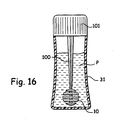
- the body 10 is connected to a rod 100, the rod being mounted in a closure member 101, for example of the type of the closure cap 46.
- a closure member 101 for example of the type of the closure cap 46.
- the body 10 is at least partially immersed in the product P.
- the immersion level of the body 10 in the product P is, among other things, dependent on the length of the rod 100 relative to the depth of the container 31, and relatively to the level of product in this container 31.
- the rod 100 may be obtained by molding with the body 10. It may be of cylindrical section or not, include a longitudinal groove, and optionally be of frustoconical shape, the body then being disposed at one end of this frustoconical shape.
- a device 50 comprising a body 10 of spherical shape for the application of the product P, the body 10 being rotatable in a housing 52 of suitable shape, in the manner of a "roll-on".
- the body 10 comprises in the example in question cavities 12 formed by craters that do not interfere with the rotation of the body 10 in its housing 52 while allowing to increase the contact area between the body 10 and the product P.
- Figures 8 and 9 a spherical shell body 10 having cavities 12 defined by grooves extending parallel to meridians.
- FIG. 10 a body 10 of spherical envelope surface also, having cavities 12 each occupying about a quarter of hemisphere, separated by partitions 72 quarter-disc shape.
- the body 10 may comprise a through bore 76, extending for example according to a diameter as shown in axial half-section at the figure 11 .
- the body 10 may also be in the form of a hollow body having an internal cavity 12 communicating with the outside through an opening 81, for example single, as shown in section at the figure 2 .
- the body has an envelope having a shape other than spherical.
- a body 10 of generally annular shape comprising a central hole 85 and annular grooves 86 defining between them fins 87.
- the body 10 may still be of a generally polyhedral shape, as has been shown in FIGS. Figures 14 and 15 .
- the body 10 of the figure 14 has a substantially parallelepipedic shape, with cavities including holes 91 and spaces between ribs 92.
- the body 10 shown in section on the figure 15 has a through bore 96, of rectangular section, and fins 97 defining between them cavities 98.
- the body 10 may be made by molding material, incorporating the particles into the matrix material before shaping the body.
- the cavities will preferably be arranged so as to allow simple demolding of the body during its manufacture, for example to be able to use a mold in two parts only.
- the body may optionally undergo a treatment to erode its surface to allow particles to come into direct contact with the product P.
- the bodies may, for example, be introduced into a drum with an abrasive agent such as sand and rotate the drum for a sufficient time.
- the body may be further made of a ceramic, which may be shaped prior to firing.
- the binder can still be a cement or a liquid, especially an oil or water.
- the product P may have various natures and properties.
- the product P can in particular be a liquid, for example a lotion or a cream, a powder or a gel.
- the product may in particular be an aqueous solution, an alcoholic solution, an oil or an emulsion.
- the product may also result from bringing into contact with a liquid of a body capable of disintegrating in contact with this liquid.
- the body may be made with cavities other than by plastic injection molding, in particular by rotational molding or machining.
Landscapes
- Cosmetics (AREA)
- Agricultural Chemicals And Associated Chemicals (AREA)
- Manufacturing Of Micro-Capsules (AREA)
- Road Signs Or Road Markings (AREA)
- Sampling And Sample Adjustment (AREA)
- Seal Device For Vehicle (AREA)
Description
- La présente invention concerne les dispositifs de conditionnement et/ou d'application d'un produit cosmétique, notamment de soin.
- Par « produit cosmétique », on désigne un produit tel que défini dans la Directive 93/35/CEE du Conseil du 14 juin 1993.
- Il est connu d'incorporer aux produits cosmétiques, conditionnés dans des récipients, des conservateurs.
- Il existe un besoin pour réduire la teneur en conservateurs dans le produit au moment de son conditionnement.
- Il existe également un besoin pour conférer au produit, après son conditionnement, des propriétés qu'il n'a pas au moment de son conditionnement.
- L'invention vise à répondre à tout ou partie des besoins précités.
- L'invention a pour objet, selon l'un de ses aspects parmi d'autres, un dispositif de conditionnement et/ou d'application d'un produit, comportant un récipient contenant le produit et au moins un corps destiné à être au moins partiellement au contact du produit au moins lors d'une utilisation du dispositif, ce corps comportant des particules dans un liant, une partie au moins des particules étant au moins partiellement directement en contact avec le produit, le corps comportant au moins une cavité visible à l'oeil nu.
- Le produit peut être un solide, éventuellement pulvérulent, un liquide ou un gel.
- Le liant peut comporter une matière organique ou minérale.
- Selon la nature des particules, on peut faire diffuser dans le produit des substances et/ou provoquer dans le produit des réactions visant à lui conférer des propriétés particulières.
- En particulier, les particules peuvent être choisies par exemple de manière à provoquer la diffusion dans le produit de substances ayant un effet sur sa conservation et permettant de réduire la teneur en conservateurs du produit au moment de son conditionnement.
- La ou les cavités du corps permettent d'augmenter la surface d'échange avec le produit, ce qui peut permettre d'accroître la quantité de la ou des substances libérées par les particules du corps dans le produit.
- Les particules peuvent être composées au moins en partie d'une matière minérale ou végétale. Les particules peuvent notamment être une poudre minérale.
- Des particules peuvent contenir par exemple l'un au moins des éléments de la liste suivante : métaux et leurs alliages, cobalt, baryum, chrome, aluminium, argent, cuivre, titane, bronze, manganèse, oxydes métalliques, bauxite, oxydes de fer, notamment ferrite, oxydes de cuivre, oxydes d'argent, sels, en particulier carbonates, notamment carbonate de calcium, sulfate de baryum, composés non ferreux, pierre d'alun, soufre, carbone, oligo-éléments, sel marin, sels gemmes, alumine, kaolin, argile, stéatite, grès, chaux, algues et planctons et leurs extraits, agents bactéricides, vitamines, protéines, acides, hormones, collagènes, aluns, soie, chanvre, cires, huiles.
- Le corps peut en outre comporter, le cas échéant, un absorbeur d'humidité, notamment un polyacrylate, un gel de silice colloïdale, un alginate ou un coton. Cela peut permettre par exemple au produit contenu dans le récipient de diffuser plus profondément au sein du corps ou de faciliter la mise en contact des particules avec le produit.
- Le liant peut comporter un polymère thermoplastique ou thermodurcissable.
- Le liant peut être polymérisable à chaud ou à froid, et contenir éventuellement un catalyseur de polymérisation.
- Le liant peut notamment comporter au moins un polymère choisi dans la liste suivante : PP, PS, PE, PA, notamment PA 6, PET, POM, méthacrylate, urée-formaldéhyde, mélamine, cyanoacrylate, polyacrylate.
- Le liant peut être un liquide, notamment une huile ou de l'eau.
- Le corps peut être une céramique.
- La taille des particules peut être comprise entre 0,1 et 200 micromètres, voire entre 0,1 et 150 micromètres, notamment entre 1 et 100 micromètres ou entre 1 et 50 micromètres, par exemple entre 1 et 20 micromètres, et par exemple encore être de 10 micromètres environ.
- Le corps peut contenir par exemple de 5 à 90 % en masse desdites particules, notamment de 10 à 75 %, mieux de 20 à 70 %, par exemple plus de 40 %, voire plus de 50 ou de 60 %.
- Le corps peut par exemple comporter entre 1 et 80 % de poudre d'alumine, voire entre 15 et 70 % de poudre d'alumine avec un absorbeur d'humidité.
- Le corps peut encore par exemple contenir entre 5 et 80 % en masse d'un mélange de poudre d'alumine et d'argent ou entre 10 et 75 % d'un mélange de poudre d'alumine et de cuivre.
- Les particules peuvent être des particules enrobées ou non. Dans le cas où les particules sont enrobées, la matière d'enrobage est choisie de manière à permettre la diffusion à travers elle de la ou des substances devant être libérées dans le produit.
- Les particules peuvent être aptes à libérer des ions au contact du produit. Dans le cas où les particules sont par exemple des particules d'argent ou d'un sel d'argent, les ions libérés peuvent être des ions Ag+ aux vertus biocides.
- Plus généralement, les particules peuvent contenir, par exemple, au moins un élément présentant des propriétés purifiantes, antiseptiques, favorisant la circulation sanguine, régénérantes, notamment cicatrisantes, anti-douleurs, anti-rides, anti-oxydantes, bactéricides, desséchantes, cette liste n'étant pas limitative.
- La ou les cavités du corps peuvent être réalisées de diverses manières.
- Une cavité peut se présenter par exemple sous la forme d'un trou traversant ou borgne, notamment sous la forme d'un cratère, d'un espace formé entre des nervures ou ailettes ou délimité par un dièdre ou par toute surface non entièrement convexe.
- Le corps peut présenter par exemple une forme sensiblement sphérique, cylindrique, annulaire ou polyédrique. Le corps peut comporter par exemple au moins une nervure ou au moins un perçage traversant.
- La surface extérieure peut être en partie lisse.
- Le corps peut être libre dans le récipient, pour servir par exemple à homogénéiser le produit lorsque le récipient est secoué.
- Le corps peut aussi, par exemple, se trouver au-dessus du niveau du produit lorsque le dispositif est posé sur une surface plane horizontale.
- Le corps peut notamment définir une surface servant à l'application du produit.
- Le corps peut être agencé pour se fixer de manière amovible sur le récipient.
- Le corps peut être relié à une tige elle-même reliée à un organe de fermeture du récipient.
- Les dimensions du corps peuvent être choisies en fonction des dimensions du récipient, de la nature du produit, et des fonctions que l'on donne au corps. Une plus grande dimension du corps peut être comprise par exemple entre 5 mm et 50 mm, notamment entre 7 mm et 40 mm.
- Le dispositif peut comporter plus d'un corps, par exemple deux corps, lesquels peuvent être identiques ou non et contenir ou non des particules de mêmes natures.
- Le corps, lorsqu'il comporte un liant polymérique, peut être réalisé par moulage, notamment par moulage par injection ; le corps, notamment lorsqu'il est en céramique, peut être réalisé avec une étape de cuisson. La présence de la ou des cavités permet de réduire la quantité de matière, donc le coût du corps.
- L'invention a encore pour objet, indépendamment de ce qui précède, un procédé de fabrication d'un corps destiné à être mis au contact d'un produit cosmétique ou de soin, caractérisé par le fait qu'il comporte les étapes suivantes :
- a) fournir au moins un corps contenant des particules dans un liant, notamment un polymère,
- b) abraser le corps de façon à mettre à jour à la surface extérieure du corps des particules.
- Le corps peut être réalisé par moulage de matière avec au moins une cavité visible à l'oeil nu.
- Le procédé peut comporter en outre l'étape suivante :
- introduire le corps dans un récipient d'un dispositif de conditionnement et d'application d'un produit cosmétique ou de soin.
- L'invention pourra être mieux comprise à la lecture de la description détaillée qui va suivre, d'exemples non limitatifs de mise en oeuvre de celle-ci, et à l'examen du dessin annexé, sur lequel :
- la
figure 1 représente de manière schématique, en coupe axiale, un exemple de dispositif conforme à l'invention, - la
figure 2 représente de manière schématique, en perspective, le corps de lafigure 1 , - la
figure 3 est une vue à échelle agrandie, en coupe, de la surface du corps, - les
figures 4 à 7 et lafigure 16 représentent de manière schématique et partielle, en coupe axiale, d'autres exemples de dispositifs conformes à l'invention, - la
figure 8 représente de manière schématique, en perspective, un autre exemple de réalisation d'un corps, - la
figure 9 est une coupe transversale, selon IX-IX, du corps de lafigure 8 , et - les
figures 10 à 15 représentent de manière schématique d'autres exemples encore de corps. - On a représenté sur la
figure 1 un dispositif 10 de conditionnement et de distribution d'un produit P cosmétique ou de soin, comportant un récipient 2 contenant le produit P et un organe de distribution 3 tel qu'une pompe par exemple, permettant de distribuer le produit P. Le dispositif 1 comporte dans l'exemple illustré un tube plongeur 4 relié à la pompe 3, elle-même actionnée par un bouton-poussoir 5 pourvu d'un orifice de distribution non apparent. La paroi du récipient 2 peut être transparente. - Un corps 10 est plongé dans le produit P, étant libre dans celui-ci, et pouvant être utilisé le cas échéant pour homogénéiser le produit P en secouant le récipient 2.
- Comme on l'a illustré très schématiquement sur la
figure 3 , le corps 10 contient des particules 11 dispersées, de manière homogène par exemple, dans un liant 17, une partie des particules 11 qui est située à la surface du corps 10 étant au moins partiellement directement en contact avec le produit P. - Les particules 11 peuvent être, au sein du corps 10, toutes de même nature ou non. Le corps 10 peut notamment comporter un mélange de particules 11 en différents matériaux, et le corps peut contenir en outre des particules non représentées totalement inertes vis-à-vis du produit P.
- Les particules 11 sont choisies de manière à exercer une action sur le produit P, par exemple libérer une substance dans celui-ci. Les particules 11 peuvent par exemple libérer des ions ayant un effet biocide permettant une meilleure conservation du produit P.
- A titre d'exemple, le corps peut être réalisé avec 30 % en masse de polyamide 6, 69,5 % de poudre d'alumine et 0,5 % de sels d'argent et/ou de cuivre. Il peut alors avoir des vertus antibactériennes grâce à la diffusion des ions argent ou cuivre dans le produit et permettre de diminuer la quantité de conservateurs utilisés. Le corps 10 peut encore être réalisé, par exemple, avec 60 % de poudre d'argile, 10 % de poudre de ferrite et 30 % de polypropylène, les pourcentages étant exprimés en masse. Ce corps 10 pourra être magnétisé afin de présenter en outre des propriétés magnétiques.
- Selon une variante de réalisation du corps 10, le corps 10 peut être magnétisé par la présence d'un aimant à l'intérieur de ce corps 10. Par exemple, le corps 10 peut être surmoulé autour de l'aimant. L'aimant peut être de dimensions nettement supérieures aux particules.
- Lorsque deux corps tels que 10 sont disposés dans le récipient 2, comme cela est par exemple représenté
Figure 4 , chaque corps peut être magnétisé avec des forces magnétiques différentes de manière à s'attirer les unes les autres. En secouant le récipient 2, les forces d'agitation appliquées sont suffisantes pour séparer les agrégations de ces corps. De nouveaux champs magnétiques peuvent même être créés. - Selon un autre mode de réalisation, le récipient 2 peut être rempli de corps tels que 10, de manière à maximiser les surfaces d'échange avec le produit P, le produit P remplit les espaces entre les corps et l'intérieur des cavités de ces corps.
- Le corps 10, représenté isolément à la
figure 2 , est de forme générale sphérique et comporte des cavités 12 visibles à l'oeil nu, permettant d'accroître la surface d'échange avec le produit. - Ces cavités 12 peuvent être formées par exemple par des gorges annulaires s'étendant entre des ailettes 13 de forme discoïde réunies par un noyau central 14.
- Le dispositif peut ne pas comporter un seul corps 10 mais en comporter plusieurs.
- A titre d'exemple, on a représenté à la
figure 4 un dispositif 20 comportant deux corps 10. Ce dispositif 20 comporte un récipient 21 dont le col 22 est pourvu d'un réducteur d'écoulement 23 comportant une lèvre d'étanchéité intérieure 24 et une jupe filetée extérieure 25 permettant la fixation d'un capuchon de fermeture 26. - On a illustré sur la
figure 4 la possibilité d'utiliser des corps 10 ayant des dimensions différentes, voire des formes différentes. - Les corps 10 peuvent aussi comporter des matières polymériques différentes et/ou des particules différentes.
- On ne sort pas du cadre de la présente invention lorsque le corps 10 n'est pas plongé en permanence dans le produit P, mais entre en contact avec ce dernier au moment de l'application ou de la distribution du produit.
- A titre d'exemple, on a représenté à la
figure 5 un dispositif 30 comportant un récipient 31 et un réducteur d'écoulement 32 fixé par encliquetage par exemple sur le récipient 31, ce réducteur 32 définissant un logement 33 contenant le corps 10. - On voit sur la
figure 5 que le corps 10 peut se situer au-dessus du niveau du produit P lorsque le dispositif 30 repose tête en haut sur une surface plane horizontale. - Le corps 10 peut être libre en rotation ou non dans le logement 33.
- Le corps 10 peut être en rotation autour d'un axe perpendiculaire à un plan défini par une paroi de ladite au moins une cavité.
- Le récipient 31 peut être fermé par un capuchon de fermeture 35 comportant une jupe d'étanchéité centrale 36 coopérant avec l'ouverture du logement 33.
- Lorsque le récipient 31 est retourné pour distribuer du produit P, ce dernier s'écoule à travers les passages formés dans le corps 10 et entre le corps 10 et la paroi du logement 33, passages où il peut se charger avec une ou plusieurs substances libérées par les particules présentes à la surface du corps 10.
- Le corps 10 est maintenu, dans l'exemple de la
figure 5 , par coopération de formes dans une portion sphérique du logement 33, mais on ne sort pas du cadre de la présente invention lorsque le corps 10 est maintenu dans le logement par une pièce rapportée. - On a représenté à la
figure 6 un dispositif 40 comportant un récipient 41 sur lequel est fixé une pièce intermédiaire 42 définissant un logement 43 pouvant contenir le corps 10. Ce dernier est maintenu dans le logement 43 par une capsule de fermeture 46 fixée sur le récipient 41. - La capsule 46 peut être réalisée avec une charnière film 47, cette dernière reliant une partie de base 45 fixée sur le récipient, par exemple par encliquetage, et un couvercle pivotant 48.
- En variante, comme représenté à la
figure 16 , le corps 10 est relié à une tige 100, la tige étant montée dans un organe de fermeture 101, par exemple du type de la capsule de fermeture 46. Lorsque l'organe de fermeture 101 est au moins partiellement monté sur le récipient 31, le corps 10 est au moins partiellement plongé dans le produit P. Le niveau d'immersion du corps 10 dans le produit P est entre autre dépendant de la longueur de la tige 100 relativement à la profondeur du récipient 31, et relativement au niveau de produit dans ce récipient 31. - La tige 100 peut être obtenue de moulage avec le corps 10. Elle peut être de section cylindrique ou non, comporter une rainure longitudinale, et éventuellement être de forme tronconique, le corps étant alors disposé à une extrémité de cette forme tronconique.
- On ne sort pas du cadre de la présente invention lorsqu'au moins une partie de la surface du corps 10 sert à l'application du produit.
- A titre d'exemple, on a représenté à la
figure 7 un dispositif 50 comportant un corps 10 de forme sphérique servant à l'application du produit P, ce corps 10 pouvant tourner dans un logement 52 de forme adaptée, à la manière d'un « roll-on ». - Le corps 10 comporte dans l'exemple considéré des cavités 12 formées par des cratères qui ne gênent pas la rotation du corps 10 dans son logement 52 tout en permettant d'augmenter la surface de contact entre le corps 10 et le produit P.
- On ne sort pas du cadre de la présente invention lorsque le corps a des formes autres que celles illustrées sur les
figures 1 à 7 , les cavités pouvant être réalisées de nombreuses autres manières encore. - A titre d'exemple, on a représenté aux
figures 8 et 9 un corps 10 d'enveloppe sphérique comportant des cavités 12 définies par des rainures s'étendant parallèlement à des méridiennes. - On a représenté à la
figure 10 un corps 10 de surface enveloppe sphérique également, comportant des cavités 12 occupant chacune environ un quart d'hémisphère, séparées par des cloisons 72 en forme de quart de disque. - Le corps 10 peut comporter un perçage traversant 76, s'étendant par exemple selon un diamètre comme on l'a représenté en demi-coupe axiale à la
figure 11 . - Le corps 10 peut encore se présenter sous la forme d'un corps creux comportant une cavité intérieure 12 communiquant avec l'extérieur par une ouverture 81, par exemple unique, comme on l'a représenté en coupe à la
figure 2 . - On ne sort pas du cadre de la présente invention lorsque le corps présente une enveloppe ayant une forme autre que sphérique.
- A titre d'exemple, on a représenté à la
figure 13 un corps 10 de forme générale annulaire comportant un trou central 85 et des gorges annulaires 86 définissant entre elles des ailettes 87. - Le corps 10 peut encore être de forme générale polyédrique, comme on l'a représenté aux
figures 14 et 15 . - Le corps 10 de la
figure 14 présente une forme sensiblement parallélépipédique, avec des cavités comprenant des trous 91 et des espaces situés entre des nervures 92. - Le corps 10 représenté en section sur la
figure 15 comporte un perçage traversant 96, de section rectangulaire, et des ailettes 97 définissant entre elles des cavités 98. - Le corps 10 peut être fabriqué par moulage de matière, en incorporant les particules à la matière de la matrice avant la mise en forme du corps. Dans ce cas, quelle que soit la forme du corps 10, les cavités seront de préférence disposées de manière à permettre un démoulage simple du corps lors de sa fabrication, afin par exemple de pouvoir utiliser un moule en deux parties seulement.
- Après le moulage, le corps peut éventuellement subir un traitement visant à éroder sa surface afin de permettre à des particules d'entrer en contact direct avec le produit P. On peut introduire par exemple les corps dans un tambour avec un agent abrasif tel que du sable et mettre en rotation le tambour pendant une durée suffisante.
- Dans toutes les formes de réalisation qui précèdent, le corps peut encore être réalisé dans une céramique, laquelle peut être mise en forme avant la cuisson. Le liant peut encore être un ciment ou un liquide, notamment une huile ou de l'eau.
- On comprend que certains des exemples de réalisation qui viennent d'être décrits permettent d'exploiter les propriétés antiseptiques, purifiantes, désincrustantes ou circulatoires, cette liste n'étant pas limitative, de composés naturels ou d'origine naturelle, tels que par exemple des métaux ou des oxydes, par diffusion d'ions ou autres substances libérées par ces composés dans un produit cosmétique ou de soin. La quantité de la ou des substances qui diffusent dans le produit peut être plus ou moins importante, en fonction notamment de la solubilité des particules dans le produit P. Les particules peuvent libérer des substances dans le produit à l'état de traces.
- Il est possible, grâce à l'invention, en choisissant de manière appropriée la nature des particules, de conférer à un produit des propriétés données, sans avoir à introduire dans la formulation initiale du produit une substance particulière conférant au produit les propriétés recherchées.
- Le produit P peut présenter des natures et propriétés diverses. Le produit P peut notamment être un liquide, par exemple une lotion ou une crème, une poudre, un gel. Le produit peut en particulier être une solution aqueuse, alcoolique, une huile ou une émulsion. Le produit peut encore résulter de la mise au contact d'un liquide d'un corps apte à se déliter au contact de ce liquide.
- L'invention n'est bien entendu pas limitée aux exemples de réalisation qui viennent d'être décrits et les revendications englobent des formes de réalisation non illustrées, notamment des formes de réalisation combinant tout ou partie des caractéristiques des différents modes de réalisation illustrés.
- Dans toute la description y compris les revendications, l'expression « comportant un » doit être considérée comme étant synonyme de « comportant au moins un », sauf si le contraire est spécifié.
- Le corps peut être réalisé avec des cavités autrement que par moulage par injection de matière plastique, notamment par rotomoulage ou usinage.
Claims (30)
- Dispositif de conditionnement et/ou d'application d'un produit (P) cosmétique, comportant un récipient contenant le produit (P) et au moins un corps (10) destiné à être au moins partiellement au contact du produit au moins lors d'une utilisation du dispositif, caractérisé en ce que le corps comporte des particules (11) dans un liant (17), ledit corps étant obtenu de moulage de matière et/ou réalisé dans une céramique, tel qu'une partie au moins des particules (11) est au moins partiellement directement en contact avec le produit, le corps comportant au moins une cavité (12 ; 85 ; 86 ; 91 ; 96 ; 98) visible à l'oeil nu.
- Dispositif selon la revendication 1, caractérisé par le fait que le liant comporte une matière organique.
- Dispositif selon l'une des deux revendications précédentes, caractérisé par le fait que le corps comporte une matière minérale.
- Dispositif selon la revendication 2, caractérisé par le fait que le liant (17) comporte un polymère thermoplastique.
- Dispositif selon la revendication 2, caractérisé par le fait que le liant comporte un polymère thermodurcissable.
- Dispositif selon la revendication 1, caractérisé par le fait que le liant comporte au moins un polymère choisi dans la liste suivante : PP. PS, PE, PA, notamment PA 6, PET, POM, méthacrylate, urée-formaldéhyde, mélamine, cyanoacrylate, polyacrylate.
- Dispositif selon la revendication 1, caractérisé par le fait que le liant est un liquide, notamment une huile.
- Dispositif selon la revendication 1, caractérisé par le fait que le corps est une céramique.
- Dispositif selon l'une quelconque des revendications précédentes, caractérisé par le fait que la taille des particules (11) est comprise entre 0,1 et 200 micromètres, notamment entre 0,1 et 150 micromètres.
- Dispositif selon l'une quelconque des revendications précédentes, caractérisé par le fait que le corps contient de 5 à 90 % en masse desdites particules, notamment de 10 à 75 %, mieux de 20 à 70 %.
- Dispositif selon l'une quelconque des revendications précédentes, caractérisé par le fait que les particules (11) sont composées au moins en partie d'une matière minérale ou végétale.
- Dispositif selon l'une quelconque des revendications précédentes, caractérisé par le fait que les particules contiennent l'un au moins des éléments de la liste suivante : métaux et leurs alliages, cobalt, baryum, chrome, aluminium, argent, cuivre, titane, bronze, manganèse, oxydes métalliques, bauxite, oxydes de fer, notamment ferrite, oxydes de cuivre, oxydes d'argent, sels, en particulier carbonates, notamment carbonate de calcium, sulfate de baryum, composés non ferreux, pierre d'alun, soufre, carbone, oligo-éléments, sel marin, sels gemmes, alumine, kaolin, argile, grès, chaux, stéatite, algues et planctons et leurs extraits, agents bactéricides, vitamines, protéines, acides, hormones, collagènes, aluns, soie, chanvre, cires, huiles.
- Dispositif selon l'une quelconque des revendications précédentes, caractérisé par le fait que le corps contient en outre un absorbeur d'humidité, notamment un polyacrylate, un gel de silice colloïdale, un alginate ou un coton.
- Dispositif selon l'une quelconque des revendications précédentes, caractérisé par le fait que les particules sont aptes à libérer des ions au contact du produit.
- Dispositif selon l'une quelconque des revendications précédentes, caractérisé par le fait que les particules contiennent au moins un élément présentant des propriétés purifiantes, antiseptiques, favorisant la circulation sanguine, régénérantes, notamment cicatrisantes, anti-douleurs, anti-rides, anti-oxydantes, bactéricides, desséchantes.
- Dispositif selon l'une quelconque des revendications précédentes, caractérisé par le fait que le produit est un solide éventuellement pulvérulent, un liquide ou un gel.
- Dispositif selon l'une quelconque des revendications précédentes, caractérisé par le fait que le corps présente une forme sensiblement sphérique, cylindrique, annulaire ou polyédrique.
- Dispositif selon l'une quelconque des revendications précédentes, caractérisé par le fait que le corps (10) comporte au moins une nervure (13).
- Dispositif selon l'une quelconque des revendications précédentes, caractérisé par le fait que le corps (10) comporte au moins un perçage traversant (76 ; 85 ; 91 ; 96).
- Dispositif selon l'une quelconque des revendications précédentes, caractérisé par le fait que le corps (10) est libre dans le récipient.
- Dispositif selon l'une quelconque des revendications 1 à 19, caractérisé par le fait qu'il est agencé de manière à ce que le corps définisse une surface servant à l'application du produit.
- Dispositif selon l'une quelconque des revendications 1 à 19, caractérisé par le fait que le corps est agencé pour se fixer de manière amovible sur le récipient.
- Dispositif selon l'une quelconque des revendications 1 à 19, caractérisé par le fait qu'il comporte un logement (33 ; 43) agencé pour maintenir le corps (10) au-dessus du niveau du produit (P) dans le récipient lorsque le dispositif est posé sur une surface plane horizontale.
- Dispositif selon l'une quelconque des revendications 1 à 19, caractérisé par le fait que le corps (10) est relié à une tige (100) reliée à un organe de fermeture (101) du récipient.
- Dispositif selon l'une quelconque des revendications précédentes, caractérisé par le fait qu'une plus grande dimension du corps est comprise entre 5 mm et 50 mm, notamment entre 7 mm et 40 mm.
- Dispositif selon l'une quelconque des revendications précédentes, caractérisé par le fait qu'il comporte au moins deux corps.
- Dispositif selon l'une quelconque des revendications précédentes, caractérisé par le fait que le produit (P) est dépourvu de conservateurs.
- Procédé de fabrication d'un corps destiné à être mis au contact d'un produit (P) cosmétique ou de soin, caractérisé par le fait qu'il comporte les étapes suivantes :a) fournir au moins un corps (10) contenant des particules (11) dans un liant, notamment un polymère, le corps étant réalisé par moulage de matière,b) abraser le corps (10) de façon à mettre à jour à la surface extérieure du corps (10) des particules (11).
- Procédé selon la revendication précédente, caractérisé par le fait que le corps (10) comporte au moins une cavité (12) visible à l'oeil nu.
- Procédé selon l'une des deux revendications précédentes, caractérisé par le fait qu'il comporte en outre l'étape suivante :- introduire le corps dans un récipient d'un dispositif (1) de conditionnement et d'application d'un produit (P) cosmétique ou de soin.
Applications Claiming Priority (2)
| Application Number | Priority Date | Filing Date | Title |
|---|---|---|---|
| FR0213515 | 2002-10-29 | ||
| FR0213515A FR2846205B1 (fr) | 2002-10-29 | 2002-10-29 | Dispositif de conditionnement et d'application comportant un corps contenant des particules |
Publications (2)
| Publication Number | Publication Date |
|---|---|
| EP1415568A1 EP1415568A1 (fr) | 2004-05-06 |
| EP1415568B1 true EP1415568B1 (fr) | 2008-03-26 |
Family
ID=32088368
Family Applications (1)
| Application Number | Title | Priority Date | Filing Date |
|---|---|---|---|
| EP03292481A Expired - Lifetime EP1415568B1 (fr) | 2002-10-29 | 2003-10-08 | Dispositif de conditionnement et d'application comportant un corps contenant des particules |
Country Status (8)
| Country | Link |
|---|---|
| US (2) | US7234885B2 (fr) |
| EP (1) | EP1415568B1 (fr) |
| JP (1) | JP2004149535A (fr) |
| KR (1) | KR100524241B1 (fr) |
| AT (1) | ATE390059T1 (fr) |
| DE (1) | DE60319936T2 (fr) |
| ES (1) | ES2302903T3 (fr) |
| FR (1) | FR2846205B1 (fr) |
Cited By (3)
| Publication number | Priority date | Publication date | Assignee | Title |
|---|---|---|---|---|
| USD726028S1 (en) | 2013-10-08 | 2015-04-07 | International Cosmetic Suppliers Ltd. | Cosmetics case |
| USD734895S1 (en) | 2013-12-05 | 2015-07-21 | International Cosmetic Suppliers Ltd. | Cosmetics container |
| USD735415S1 (en) | 2013-12-05 | 2015-07-28 | International Cosmetic Suppliers Ltd. | Cosmetics container |
Families Citing this family (15)
| Publication number | Priority date | Publication date | Assignee | Title |
|---|---|---|---|---|
| US20070282241A1 (en) * | 2006-05-31 | 2007-12-06 | Squires Meryl J | Applicator system |
| FR2906115B1 (fr) * | 2006-09-26 | 2011-04-01 | Alcan Packaging Beauty Serv | Embout applicateur typiquement spherique pour application de produits cosmetiques |
| KR100751510B1 (ko) | 2006-12-15 | 2007-08-23 | 임정원 | 화장품 케이스 |
| FR2925264B1 (fr) * | 2007-12-19 | 2011-03-18 | Oreal | Dispositif de conditionnement. |
| FR2947432B1 (fr) * | 2009-07-02 | 2014-11-21 | Lvmh Rech | Dispositif pour l'application d'un produit cosmetique comportant des particules magnetiques et ensemble comprenant le dispositif. |
| FR2958133B1 (fr) * | 2010-04-01 | 2013-11-29 | Oreal | Melangeur de produit cosmetique, necessaire de preparation d'une composition cosmetique et procede de preparation associe. |
| FR2971920B1 (fr) | 2011-02-25 | 2013-11-08 | Oreal | Dispositif de conditionnement et d'application d'un produit. |
| WO2013075116A2 (fr) | 2011-11-17 | 2013-05-23 | Heliae Development, Llc | Compositions riches en oméga 7 et procédés d'isolement d'acides gras oméga 7 |
| US9232844B2 (en) | 2013-10-08 | 2016-01-12 | International Cosmetic Suppliers Ltd | Cosmetics container |
| JP6632369B2 (ja) * | 2014-12-24 | 2020-01-22 | 花王株式会社 | 泡吐出器 |
| FR3038302B1 (fr) * | 2015-06-30 | 2019-09-13 | Karine Courtin | Recipient comportant un insert bactericide |
| KR102189157B1 (ko) * | 2019-06-04 | 2020-12-09 | (주)바이오스플래시 | 흡수성이 뛰어난 에센스용기 |
| WO2021199214A1 (fr) * | 2020-03-30 | 2021-10-07 | 株式会社エイエムジー | Élément stérilisation |
| JP6826749B1 (ja) * | 2020-08-14 | 2021-02-10 | 株式会社エイエムジー | 滅菌部材 |
| US20240268539A1 (en) * | 2021-07-13 | 2024-08-15 | Panasonic Intellectual Property Management Co., Ltd. | Cosmetic material and hairdressing appliance |
Family Cites Families (22)
| Publication number | Priority date | Publication date | Assignee | Title |
|---|---|---|---|---|
| BE548211A (fr) * | 1955-06-01 | |||
| US3758543A (en) * | 1967-04-25 | 1973-09-11 | Allied Chem | Novel sulfates and method for their preparation |
| US4287253A (en) * | 1975-04-08 | 1981-09-01 | Photocircuits Division Of Kollmorgen Corp. | Catalytic filler for electroless metallization of hole walls |
| US4145291A (en) * | 1976-09-27 | 1979-03-20 | Foremost-Mckesson, Inc. | Disinfecting means within a water dispenser |
| US4607594A (en) * | 1985-01-11 | 1986-08-26 | Raetec Industries, Inc. | Animal litter |
| US4611046A (en) * | 1985-03-15 | 1986-09-09 | Ford Motor Company | Hydroxyl terminated azomethines and high glass transition temperature polyether products produced therefrom |
| US4836884A (en) * | 1986-02-17 | 1989-06-06 | Telectronics N.V. | Implantable materials |
| US4697703A (en) * | 1986-07-02 | 1987-10-06 | Malcolm Will | Joint prosthesis package |
| IL82169A (en) * | 1987-04-10 | 1991-06-10 | Univ Ramot | Lithium cell |
| WO1990009152A1 (fr) * | 1989-02-15 | 1990-08-23 | Microtek Medical, Inc. | Materiau et prothese biocompatibles |
| JP2801790B2 (ja) | 1991-03-22 | 1998-09-21 | ウシオ電機株式会社 | 放電ランプ用電極 |
| DE4127513A1 (de) * | 1991-08-20 | 1993-02-25 | Bayer Ag | Bindemittelgemische und ihre verwendung |
| US5527577A (en) * | 1993-06-22 | 1996-06-18 | Aptar Group, Inc. | Flexible eduction tube for hand dispenser |
| US5544682A (en) * | 1994-07-19 | 1996-08-13 | Mcdaniel; Freddie B. | Resolvation system for an active-ingredient-containing liquid solution |
| FR2791570B1 (fr) * | 1999-03-31 | 2003-04-04 | Oreal | Patch a effet de champ magnetique |
| FR2800041B1 (fr) * | 1999-10-22 | 2001-12-07 | Oreal | Ensemble de conditionnement et d'application d'un produit liquide |
| FR2804846B1 (fr) * | 2000-02-16 | 2002-08-09 | Oreal | Dispositif de conditionnement et d'application comportant une structure poreuse incorporant un agent biocide |
| FR2805720B1 (fr) * | 2000-03-03 | 2002-08-16 | Oreal | Dispositif comprenant un applicateur et/ou un organe d'essorage magnetique |
| TW520469B (en) | 2000-04-10 | 2003-02-11 | Asml Netherlands Bv | Lithographic apparatus, device manufacturing method, and device manufactured thereby |
| JP2002370940A (ja) | 2001-06-14 | 2002-12-24 | Nippon Epoch Kk | 毛髪の理美容施術用薬液の改質方法 |
| FR2832598B1 (fr) * | 2001-11-26 | 2006-01-27 | Oreal | Article de conditionnement et/ou d'application d'un produit |
| US6818603B2 (en) * | 2002-08-14 | 2004-11-16 | Johnson & Johnson Consumer Companies, Inc. | Cleansing bar containing discrete elements |
-
2002
- 2002-10-29 FR FR0213515A patent/FR2846205B1/fr not_active Expired - Fee Related
-
2003
- 2003-10-08 EP EP03292481A patent/EP1415568B1/fr not_active Expired - Lifetime
- 2003-10-08 ES ES03292481T patent/ES2302903T3/es not_active Expired - Lifetime
- 2003-10-08 DE DE60319936T patent/DE60319936T2/de not_active Expired - Lifetime
- 2003-10-08 AT AT03292481T patent/ATE390059T1/de not_active IP Right Cessation
- 2003-10-28 KR KR10-2003-0075380A patent/KR100524241B1/ko not_active Expired - Fee Related
- 2003-10-29 JP JP2003368445A patent/JP2004149535A/ja not_active Withdrawn
- 2003-10-29 US US10/694,905 patent/US7234885B2/en not_active Expired - Fee Related
-
2007
- 2007-06-25 US US11/819,106 patent/US7524126B2/en not_active Expired - Fee Related
Cited By (3)
| Publication number | Priority date | Publication date | Assignee | Title |
|---|---|---|---|---|
| USD726028S1 (en) | 2013-10-08 | 2015-04-07 | International Cosmetic Suppliers Ltd. | Cosmetics case |
| USD734895S1 (en) | 2013-12-05 | 2015-07-21 | International Cosmetic Suppliers Ltd. | Cosmetics container |
| USD735415S1 (en) | 2013-12-05 | 2015-07-28 | International Cosmetic Suppliers Ltd. | Cosmetics container |
Also Published As
| Publication number | Publication date |
|---|---|
| KR20040038730A (ko) | 2004-05-08 |
| US7234885B2 (en) | 2007-06-26 |
| DE60319936T2 (de) | 2009-03-05 |
| KR100524241B1 (ko) | 2005-10-26 |
| US7524126B2 (en) | 2009-04-28 |
| US20080003046A1 (en) | 2008-01-03 |
| FR2846205B1 (fr) | 2005-03-11 |
| ES2302903T3 (es) | 2008-08-01 |
| DE60319936D1 (de) | 2008-05-08 |
| EP1415568A1 (fr) | 2004-05-06 |
| JP2004149535A (ja) | 2004-05-27 |
| ATE390059T1 (de) | 2008-04-15 |
| FR2846205A1 (fr) | 2004-04-30 |
| US20040136771A1 (en) | 2004-07-15 |
Similar Documents
| Publication | Publication Date | Title |
|---|---|---|
| EP1415568B1 (fr) | Dispositif de conditionnement et d'application comportant un corps contenant des particules | |
| EP1196062B1 (fr) | Dispositif de conditionnement et/ou d'application contenant des fibres comportant au moins un corps aimante ou aimantable | |
| CA2389556C (fr) | Dispositif de conditionnement comprenant des fibres et procede de fabrication des fibres | |
| CA2412812C (fr) | Dispositif de conditionnement et/ou d'application d'un produit | |
| CA2213636C (fr) | Applicateur de produit en poudre et procede de fabrication de l'applicateur | |
| CA2380828C (fr) | Dispositif, notamment a usage cosmetique, comportant un recipient contenant un produit a appliquer et un element permettant de generer un champ magnetique | |
| CA2213644C (fr) | Applicateur de produit liquide ou semi-liquide et ensemble d'application utilisant un tel applicateur | |
| EP1600079B1 (fr) | Dispositif de conditionnement et d'application d'un produit | |
| FR3064459A1 (fr) | Applicateur cosmetique | |
| EP1358818A1 (fr) | Dispositif d'application d'un produit, notamment cosmetique, recouvert d'un floquage de differents types de fibres | |
| FR2804846A1 (fr) | Dispositif de conditionnement et d'application comportant une structure poreuse incorporant un agent biocide | |
| FR2889921A1 (fr) | Ensemble de conditionnement et d'application comportant un dispositif magnetique. | |
| FR2925264A1 (fr) | Dispositif de conditionnement. | |
| FR3095114A1 (fr) | Applicateur de cosmétique avec composant de transfert thermique | |
| WO2015101728A1 (fr) | Dispositif de conditionnement et d'application d'une composition liquide | |
| FR2648686A1 (fr) | Ensemble de maquillage mettant en oeuvre un produit fluide de maquillage susceptible de durcir par evaporation d'un solvant | |
| EP1591035A1 (fr) | Dispositif de conditionnement et d'application comportant un support et un organe de distribution | |
| WO2016174332A1 (fr) | Applicateur flocke | |
| FR2825247A1 (fr) | Dispositif de conditionnement et/ou d'application contenant des fibres comportant au moins un corps aimante ou aimantable | |
| CA2226649C (fr) | Ensemble d'application pour produit de type rouge a levres | |
| FR2971920A1 (fr) | Dispositif de conditionnement et d'application d'un produit. | |
| EP1595472A2 (fr) | Dispositif de conditionnement et d'application comportant un organe de refaçonnage de la surface d'application | |
| EP1452109B1 (fr) | Dispositif d'application d'un produit, notamment cosmétique | |
| FR3031284A1 (fr) | Applicateur cosmetique a espace interieur contenant la composition | |
| JP6923751B2 (ja) | 製品、とりわけ液体化粧品を梱包及び塗布するためのデバイス |
Legal Events
| Date | Code | Title | Description |
|---|---|---|---|
| PUAI | Public reference made under article 153(3) epc to a published international application that has entered the european phase |
Free format text: ORIGINAL CODE: 0009012 |
|
| AK | Designated contracting states |
Kind code of ref document: A1 Designated state(s): AT BE BG CH CY CZ DE DK EE ES FI FR GB GR HU IE IT LI LU MC NL PT RO SE SI SK TR |
|
| AX | Request for extension of the european patent |
Extension state: AL LT LV MK |
|
| 17P | Request for examination filed |
Effective date: 20041108 |
|
| AKX | Designation fees paid |
Designated state(s): AT BE BG CH CY CZ DE DK EE ES FI FR GB GR HU IE IT LI LU MC NL PT RO SE SI SK TR |
|
| 17Q | First examination report despatched |
Effective date: 20061031 |
|
| GRAJ | Information related to disapproval of communication of intention to grant by the applicant or resumption of examination proceedings by the epo deleted |
Free format text: ORIGINAL CODE: EPIDOSDIGR1 |
|
| GRAP | Despatch of communication of intention to grant a patent |
Free format text: ORIGINAL CODE: EPIDOSNIGR1 |
|
| GRAP | Despatch of communication of intention to grant a patent |
Free format text: ORIGINAL CODE: EPIDOSNIGR1 |
|
| GRAS | Grant fee paid |
Free format text: ORIGINAL CODE: EPIDOSNIGR3 |
|
| GRAA | (expected) grant |
Free format text: ORIGINAL CODE: 0009210 |
|
| AK | Designated contracting states |
Kind code of ref document: B1 Designated state(s): AT BE BG CH CY CZ DE DK EE ES FI FR GB GR HU IE IT LI LU MC NL PT RO SE SI SK TR |
|
| REG | Reference to a national code |
Ref country code: GB Ref legal event code: FG4D Free format text: NOT ENGLISH |
|
| REG | Reference to a national code |
Ref country code: IE Ref legal event code: FG4D Free format text: LANGUAGE OF EP DOCUMENT: FRENCH Ref country code: CH Ref legal event code: EP |
|
| REF | Corresponds to: |
Ref document number: 60319936 Country of ref document: DE Date of ref document: 20080508 Kind code of ref document: P |
|
| PG25 | Lapsed in a contracting state [announced via postgrant information from national office to epo] |
Ref country code: FI Free format text: LAPSE BECAUSE OF FAILURE TO SUBMIT A TRANSLATION OF THE DESCRIPTION OR TO PAY THE FEE WITHIN THE PRESCRIBED TIME-LIMIT Effective date: 20080326 |
|
| REG | Reference to a national code |
Ref country code: ES Ref legal event code: FG2A Ref document number: 2302903 Country of ref document: ES Kind code of ref document: T3 |
|
| PG25 | Lapsed in a contracting state [announced via postgrant information from national office to epo] |
Ref country code: AT Free format text: LAPSE BECAUSE OF FAILURE TO SUBMIT A TRANSLATION OF THE DESCRIPTION OR TO PAY THE FEE WITHIN THE PRESCRIBED TIME-LIMIT Effective date: 20080326 |
|
| NLV1 | Nl: lapsed or annulled due to failure to fulfill the requirements of art. 29p and 29m of the patents act | ||
| PG25 | Lapsed in a contracting state [announced via postgrant information from national office to epo] |
Ref country code: SI Free format text: LAPSE BECAUSE OF FAILURE TO SUBMIT A TRANSLATION OF THE DESCRIPTION OR TO PAY THE FEE WITHIN THE PRESCRIBED TIME-LIMIT Effective date: 20080326 |
|
| REG | Reference to a national code |
Ref country code: IE Ref legal event code: FD4D |
|
| PG25 | Lapsed in a contracting state [announced via postgrant information from national office to epo] |
Ref country code: SK Free format text: LAPSE BECAUSE OF FAILURE TO SUBMIT A TRANSLATION OF THE DESCRIPTION OR TO PAY THE FEE WITHIN THE PRESCRIBED TIME-LIMIT Effective date: 20080326 Ref country code: CZ Free format text: LAPSE BECAUSE OF FAILURE TO SUBMIT A TRANSLATION OF THE DESCRIPTION OR TO PAY THE FEE WITHIN THE PRESCRIBED TIME-LIMIT Effective date: 20080326 Ref country code: PT Free format text: LAPSE BECAUSE OF FAILURE TO SUBMIT A TRANSLATION OF THE DESCRIPTION OR TO PAY THE FEE WITHIN THE PRESCRIBED TIME-LIMIT Effective date: 20080901 Ref country code: SE Free format text: LAPSE BECAUSE OF FAILURE TO SUBMIT A TRANSLATION OF THE DESCRIPTION OR TO PAY THE FEE WITHIN THE PRESCRIBED TIME-LIMIT Effective date: 20080626 |
|
| PG25 | Lapsed in a contracting state [announced via postgrant information from national office to epo] |
Ref country code: RO Free format text: LAPSE BECAUSE OF FAILURE TO SUBMIT A TRANSLATION OF THE DESCRIPTION OR TO PAY THE FEE WITHIN THE PRESCRIBED TIME-LIMIT Effective date: 20080326 Ref country code: NL Free format text: LAPSE BECAUSE OF FAILURE TO SUBMIT A TRANSLATION OF THE DESCRIPTION OR TO PAY THE FEE WITHIN THE PRESCRIBED TIME-LIMIT Effective date: 20080326 |
|
| PG25 | Lapsed in a contracting state [announced via postgrant information from national office to epo] |
Ref country code: DK Free format text: LAPSE BECAUSE OF FAILURE TO SUBMIT A TRANSLATION OF THE DESCRIPTION OR TO PAY THE FEE WITHIN THE PRESCRIBED TIME-LIMIT Effective date: 20080326 Ref country code: IE Free format text: LAPSE BECAUSE OF FAILURE TO SUBMIT A TRANSLATION OF THE DESCRIPTION OR TO PAY THE FEE WITHIN THE PRESCRIBED TIME-LIMIT Effective date: 20080326 |
|
| PLBE | No opposition filed within time limit |
Free format text: ORIGINAL CODE: 0009261 |
|
| STAA | Information on the status of an ep patent application or granted ep patent |
Free format text: STATUS: NO OPPOSITION FILED WITHIN TIME LIMIT |
|
| 26N | No opposition filed |
Effective date: 20081230 |
|
| BERE | Be: lapsed |
Owner name: L'OREAL Effective date: 20081031 |
|
| PG25 | Lapsed in a contracting state [announced via postgrant information from national office to epo] |
Ref country code: BG Free format text: LAPSE BECAUSE OF FAILURE TO SUBMIT A TRANSLATION OF THE DESCRIPTION OR TO PAY THE FEE WITHIN THE PRESCRIBED TIME-LIMIT Effective date: 20080626 Ref country code: EE Free format text: LAPSE BECAUSE OF FAILURE TO SUBMIT A TRANSLATION OF THE DESCRIPTION OR TO PAY THE FEE WITHIN THE PRESCRIBED TIME-LIMIT Effective date: 20080326 |
|
| PG25 | Lapsed in a contracting state [announced via postgrant information from national office to epo] |
Ref country code: MC Free format text: LAPSE BECAUSE OF NON-PAYMENT OF DUE FEES Effective date: 20081031 |
|
| REG | Reference to a national code |
Ref country code: CH Ref legal event code: PL |
|
| PG25 | Lapsed in a contracting state [announced via postgrant information from national office to epo] |
Ref country code: CY Free format text: LAPSE BECAUSE OF FAILURE TO SUBMIT A TRANSLATION OF THE DESCRIPTION OR TO PAY THE FEE WITHIN THE PRESCRIBED TIME-LIMIT Effective date: 20080326 Ref country code: BE Free format text: LAPSE BECAUSE OF NON-PAYMENT OF DUE FEES Effective date: 20081031 |
|
| PG25 | Lapsed in a contracting state [announced via postgrant information from national office to epo] |
Ref country code: CH Free format text: LAPSE BECAUSE OF NON-PAYMENT OF DUE FEES Effective date: 20081031 Ref country code: LI Free format text: LAPSE BECAUSE OF NON-PAYMENT OF DUE FEES Effective date: 20081031 |
|
| PG25 | Lapsed in a contracting state [announced via postgrant information from national office to epo] |
Ref country code: LU Free format text: LAPSE BECAUSE OF NON-PAYMENT OF DUE FEES Effective date: 20081008 Ref country code: HU Free format text: LAPSE BECAUSE OF FAILURE TO SUBMIT A TRANSLATION OF THE DESCRIPTION OR TO PAY THE FEE WITHIN THE PRESCRIBED TIME-LIMIT Effective date: 20080927 |
|
| PG25 | Lapsed in a contracting state [announced via postgrant information from national office to epo] |
Ref country code: TR Free format text: LAPSE BECAUSE OF FAILURE TO SUBMIT A TRANSLATION OF THE DESCRIPTION OR TO PAY THE FEE WITHIN THE PRESCRIBED TIME-LIMIT Effective date: 20080326 |
|
| PG25 | Lapsed in a contracting state [announced via postgrant information from national office to epo] |
Ref country code: GR Free format text: LAPSE BECAUSE OF FAILURE TO SUBMIT A TRANSLATION OF THE DESCRIPTION OR TO PAY THE FEE WITHIN THE PRESCRIBED TIME-LIMIT Effective date: 20080627 |
|
| PGFP | Annual fee paid to national office [announced via postgrant information from national office to epo] |
Ref country code: ES Payment date: 20140911 Year of fee payment: 12 |
|
| PGFP | Annual fee paid to national office [announced via postgrant information from national office to epo] |
Ref country code: DE Payment date: 20140930 Year of fee payment: 12 Ref country code: GB Payment date: 20141008 Year of fee payment: 12 Ref country code: FR Payment date: 20141008 Year of fee payment: 12 |
|
| PGFP | Annual fee paid to national office [announced via postgrant information from national office to epo] |
Ref country code: IT Payment date: 20141022 Year of fee payment: 12 |
|
| REG | Reference to a national code |
Ref country code: DE Ref legal event code: R119 Ref document number: 60319936 Country of ref document: DE |
|
| GBPC | Gb: european patent ceased through non-payment of renewal fee |
Effective date: 20151008 |
|
| PG25 | Lapsed in a contracting state [announced via postgrant information from national office to epo] |
Ref country code: IT Free format text: LAPSE BECAUSE OF NON-PAYMENT OF DUE FEES Effective date: 20151008 Ref country code: GB Free format text: LAPSE BECAUSE OF NON-PAYMENT OF DUE FEES Effective date: 20151008 Ref country code: DE Free format text: LAPSE BECAUSE OF NON-PAYMENT OF DUE FEES Effective date: 20160503 |
|
| REG | Reference to a national code |
Ref country code: FR Ref legal event code: ST Effective date: 20160630 |
|
| PG25 | Lapsed in a contracting state [announced via postgrant information from national office to epo] |
Ref country code: FR Free format text: LAPSE BECAUSE OF NON-PAYMENT OF DUE FEES Effective date: 20151102 |
|
| REG | Reference to a national code |
Ref country code: ES Ref legal event code: FD2A Effective date: 20161128 |
|
| PG25 | Lapsed in a contracting state [announced via postgrant information from national office to epo] |
Ref country code: ES Free format text: LAPSE BECAUSE OF NON-PAYMENT OF DUE FEES Effective date: 20151009 |