EP1416703A2 - Kommunikationsgeräte , Verfahren und Rechnerprogramme zur Informationsverarbeitung - Google Patents
Kommunikationsgeräte , Verfahren und Rechnerprogramme zur Informationsverarbeitung Download PDFInfo
- Publication number
- EP1416703A2 EP1416703A2 EP20030256828 EP03256828A EP1416703A2 EP 1416703 A2 EP1416703 A2 EP 1416703A2 EP 20030256828 EP20030256828 EP 20030256828 EP 03256828 A EP03256828 A EP 03256828A EP 1416703 A2 EP1416703 A2 EP 1416703A2
- Authority
- EP
- European Patent Office
- Prior art keywords
- information
- identification information
- party
- pieces
- communication
- Prior art date
- Legal status (The legal status is an assumption and is not a legal conclusion. Google has not performed a legal analysis and makes no representation as to the accuracy of the status listed.)
- Granted
Links
Images







Classifications
-
- H—ELECTRICITY
- H04—ELECTRIC COMMUNICATION TECHNIQUE
- H04L—TRANSMISSION OF DIGITAL INFORMATION, e.g. TELEGRAPHIC COMMUNICATION
- H04L61/00—Network arrangements, protocols or services for addressing or naming
- H04L61/45—Network directories; Name-to-address mapping
- H04L61/4535—Network directories; Name-to-address mapping using an address exchange platform which sets up a session between two nodes, e.g. rendezvous servers, session initiation protocols [SIP] registrars or H.323 gatekeepers
-
- H—ELECTRICITY
- H04—ELECTRIC COMMUNICATION TECHNIQUE
- H04M—TELEPHONIC COMMUNICATION
- H04M1/00—Substation equipment, e.g. for use by subscribers
- H04M1/26—Devices for calling a subscriber
- H04M1/27—Devices whereby a plurality of signals may be stored simultaneously
- H04M1/274—Devices whereby a plurality of signals may be stored simultaneously with provision for storing more than one subscriber number at a time, e.g. using toothed disc
- H04M1/2745—Devices whereby a plurality of signals may be stored simultaneously with provision for storing more than one subscriber number at a time, e.g. using toothed disc using static electronic memories, e.g. chips
- H04M1/27467—Methods of retrieving data
- H04M1/27475—Methods of retrieving data using interactive graphical means or pictorial representations
-
- H—ELECTRICITY
- H04—ELECTRIC COMMUNICATION TECHNIQUE
- H04M—TELEPHONIC COMMUNICATION
- H04M1/00—Substation equipment, e.g. for use by subscribers
- H04M1/72—Mobile telephones; Cordless telephones, i.e. devices for establishing wireless links to base stations without route selection
- H04M1/724—User interfaces specially adapted for cordless or mobile telephones
- H04M1/72403—User interfaces specially adapted for cordless or mobile telephones with means for local support of applications that increase the functionality
- H04M1/72409—User interfaces specially adapted for cordless or mobile telephones with means for local support of applications that increase the functionality by interfacing with external accessories
- H04M1/72412—User interfaces specially adapted for cordless or mobile telephones with means for local support of applications that increase the functionality by interfacing with external accessories using two-way short-range wireless interfaces
-
- H—ELECTRICITY
- H04—ELECTRIC COMMUNICATION TECHNIQUE
- H04L—TRANSMISSION OF DIGITAL INFORMATION, e.g. TELEGRAPHIC COMMUNICATION
- H04L67/00—Network arrangements or protocols for supporting network services or applications
- H04L67/50—Network services
- H04L67/51—Discovery or management thereof, e.g. service location protocol [SLP] or web services
-
- H—ELECTRICITY
- H04—ELECTRIC COMMUNICATION TECHNIQUE
- H04M—TELEPHONIC COMMUNICATION
- H04M1/00—Substation equipment, e.g. for use by subscribers
- H04M1/26—Devices for calling a subscriber
- H04M1/27—Devices whereby a plurality of signals may be stored simultaneously
- H04M1/274—Devices whereby a plurality of signals may be stored simultaneously with provision for storing more than one subscriber number at a time, e.g. using toothed disc
- H04M1/2745—Devices whereby a plurality of signals may be stored simultaneously with provision for storing more than one subscriber number at a time, e.g. using toothed disc using static electronic memories, e.g. chips
- H04M1/27453—Directories allowing storage of additional subscriber data, e.g. metadata
-
- H—ELECTRICITY
- H04—ELECTRIC COMMUNICATION TECHNIQUE
- H04M—TELEPHONIC COMMUNICATION
- H04M2250/00—Details of telephonic subscriber devices
- H04M2250/02—Details of telephonic subscriber devices including a Bluetooth® interface
-
- H—ELECTRICITY
- H04—ELECTRIC COMMUNICATION TECHNIQUE
- H04W—WIRELESS COMMUNICATION NETWORKS
- H04W8/00—Network data management
- H04W8/22—Processing or transfer of terminal data, e.g. status or physical capabilities
-
- H—ELECTRICITY
- H04—ELECTRIC COMMUNICATION TECHNIQUE
- H04W—WIRELESS COMMUNICATION NETWORKS
- H04W8/00—Network data management
- H04W8/26—Network addressing or numbering for mobility support
-
- H—ELECTRICITY
- H04—ELECTRIC COMMUNICATION TECHNIQUE
- H04W—WIRELESS COMMUNICATION NETWORKS
- H04W88/00—Devices specially adapted for wireless communication networks, e.g. terminals, base stations or access point devices
- H04W88/02—Terminal devices
Definitions
- the present invention relates to communication devices suitable for short distance radio communication, which are mounted on apparatus and mobile terminals such as mobile phones, PHSs (Personal Handyphone Systems), PDAs (Personal Digital Assistants) and mobile PCs (Mobile Personal Computers), and methods and computer programs for information processing of the communication devices.
- apparatus and mobile terminals such as mobile phones, PHSs (Personal Handyphone Systems), PDAs (Personal Digital Assistants) and mobile PCs (Mobile Personal Computers), and methods and computer programs for information processing of the communication devices.
- communication devices which relate a plurality of pieces of identification information used in connection with devices of the other party and manages them, and uses that identification information in connection information, and methods and computer programs for information processing thereof.
- a mobile terminal and so on such as a mobile pone and PDA having a communication function, which are able to perform communication of information transmission, information exchange and so on in a short distance by radio, are being spread.
- a short distance communication function like this is utilized in communication of information transmission, information exchange and so on among various kinds of apparatuses, such as a remote control device, and is not limited to a mobile terminal of a mobile phone and so on.
- Bluetooth As a radio communication standard for a short distance, Bluetooth is in existence. This Bluetooth has standardized data exchange and a communication function in order to realize a data communication function by radio instead of a cable and the infrared rays as a transmission medium.
- ISM band Industry Science and Medical Band
- FH-SS Frequency Hopping-Spread Spectrum
- a mobile terminal having Bluetooth can perform asynchronous data communication, synchronous voice communication of some channels and simultaneous communication of voice and data, and can also perform simultaneous communication between a parent apparatus and a plurality of child apparatuses in addition to transmission/reception by radio between two apparatuses of one to one. Further, the construction of a network is possible. Like this, the mobile terminal with Bluetooth has an excellent communication function.
- This patent document discloses technology that displays identification information obtained by way of radio communication on a display part so that a user of a mobile terminal can identify a terminal, with which the user desires to communicate, from a plurality of terminals existing within a radio range.
- identification of a terminal or an apparatus with which a user desires to communicate and selection thereof are indispensable for information transmission and information exchange.
- a terminal within a radio range, with which a user wants to communicate can be identified from identification information received by communication.
- a human confirmation such as a relation between that terminal and an owner or a manager, is rendered necessary when a plurality of terminals come responding on the occasion of information transmission and/or information exchange, or when it is impossible to specify the other party of communication from the contents of identification information. In a case like this, this is troublesome.
- a communication device has an identification information reception part (a radio transmission/reception part 12, a baseband part 14 and a control part 16), a storage part (a data base part 18) and an information processing part (the control part 16).
- the identification information reception part receives a plurality of pieces of identification information concerning a device of the other party which is connected to the communication device, and, in the storage part, the pieces of identification information which are received are stored.
- the information processing part stores the received pieces of identification information in the storage part, retrieves the identification information from the storage part by receiving input of specifying information out of the pieces of identification information, and relates a result of that retrieval to the specifying information and outputs them, or makes that output possible.
- the communication device in order to specify the device of the other party, can use a plurality of pieces of identification information, for example, proper information representative of a communication device, human information such as an individual or a juridical person possessing that device, and so on. These pieces of identification information can be obtained by transmission and reception with the device of the other party by radio. However, the acquisition of the identification information is not limited to this. As a different manner except a device of the other party, the identification information may also be acquired by receiving a plurality of pieces of identification information, concerning a device of the other party, which is input from an input operation part. Thereupon, the storage part which stores these pieces of identification information is provided, and the information processing part stores the pieces of identification information, which are received, in the storage part.
- the pieces of identification information are stored so that the rest of the pieces of identification information except the specifying information is related to the specifying information out of the pieces of identification information.
- "relating the specifying information out of the pieces of identification information to the rest of the pieces of identification information" is to link the specifying information to the identification information, for example, by means of a relation between the human information representative of an owner or a manager of a device of the other party and the proper information representative of that device of the other party.
- the information processing part in case that the storage part is retrieved based on the input of the specifying information, if the pieces of identification information related to the specifying information are output, or if it is possible to output the pieces of identification information related to the specifying information, the identification information which can specify a device of the other party according to the specifying information can be recognized. Because of this, it is possible to identify and specify the device of the other party with ease. Further, when communicating with the device of the other party, it is possible to retrieve the identification information by receiving the input of specifying information and perform a connection with the device of the other party by using a result of that retrieval.
- the rest of the pieces of the identification information is related by the specifying information out of the pieces of identification information received from the device of the other party, and these are registered. And the pieces of identification information retrieved based on the input of the specifying information are output, or these are managed so as to be capable of outputting. Because of this, the device of the other party can be identified according to the specifying information, and can be easily and quickly specified by the identification information. By this, identifying and specifying the device of the other party becomes easy.
- the pieces of identification information are retrieved by receiving the input of the specifying information, and the connection with the device of the other party can be performed by using that retrieved result. Because of this, a convenience of the connection with the device of the other party may be improved.
- the identification information can include human information and one or more pieces of proper information representative of a device of the other party, and can be constituted so that the specifying information to which the identification information is related is the human information.
- the human information is not limited to a direct name like a person's name and a company's name.
- the human information includes the abbreviation of a name, an animal's name, a nickname, and so on. According to a construction like this, a device of the other party can be identified in relation to the human information of a person's name and so on, and the device of the other party used for communication can be specified with ease.
- Another communication device embodying the present invention can provide an information presenting part that relates a result of retrieval of the information processing part to the specifying information and presents them. That is, if a plurality of pieces of identification information related to the specifying information is presented to the information presenting part, specifying a device of the other party becomes easy since the device of the other party can be identified from the display of the information presenting part with ease. In addition, it is possible to perform a connection with the device of the other party by using the identification information under display. According to a construction like this, it is possible to show the pieces of identification information related by the specifying information in the information presenting part. Because of this, since a device of the other party is easily identified and specified from that presented contents, identifying and specifying the device of the other party becomes easy.
- An information processing method suitable for use in a communication device embodying the present invention includes a receiving process of information, a storing process of information and an outputting process of information, and, particularly, includes the following processes.
- the identification information received by processing like this is used in identification and selection of the device of the other party, and in a connecting process besides. That is, a connection with the device of the other party is started by using the result of retrieval namely the identification information, or that start can be made possible.
- the pieces of identification information are related to the specifying information included in that identification information and are arranged, and these are registered. Since the pieces of identification information are related to the specifying information and are output, or since it is possible to output them, these are used for the identification and selection of the device of the other party, and are further used in the connecting process. By this, a quick information process and'so on become possible, and thereby a convenience may be enhanced.
- the information processing program of the communication device is a program which makes the communication device perform the above-mentioned information processing method, and includes the following functions.
- an information processing method of the communication device embodying the present invention is executed. Thereby, it is possible to easily identify and specify the device of the other party by using the identification information received through the communication with the device of the other party, and that identification information is used in the connection with the device of the other party. Because of this, simple and quick information processing becomes possible, and usability of the communication device may be enhanced.
- Fig. 1 shows a communication device representative of an embodiment of a communication device, an information processing method thereof and an information processing program thereof embodying the present invention.
- This communication device can be mounted in various kinds of apparatuses, such as an information apparatus like a digital camera and a printer, and an AV (Audio Video) apparatus, in addition to a mobile terminal such as a mobile phone, PHS, PDA and a mobile PC.
- an information apparatus like a digital camera and a printer
- AV Audio Video
- a communication terminal 2 which is an example of a communication device can be used as a communication device by itself, and the communication terminal 2 is mounted in various kinds of apparatuses and is used.
- various kinds of apparatuses for example, there are an information apparatus like a digital camera and a printer, an AV apparatus and so on, in addition to a mobile terminal such as a mobile phone, PHS, PDA and a mobile PC.
- the communication terminal 2 or communication terminals X are used for the convenience of explanation, these include various kinds of apparatuses of an independent communication terminal, a mobile terminal having this communication terminal, and so on.
- the communication terminal 2 constructs a radio system which performs information transmission or information exchange by means of transmission/reception by radio between the terminal 2 and the same kind of a device of the other party.
- the communication terminal 2 has a radio communication part which takes charge of radio communication, an information transmission part which takes charge of transmission of many kinds of information, such as identification information and information requiring the identification information to a device of the other party, an information reception part which takes charge of reception of many kinds of information, such as identification information reception receiving a plurality of pieces of identification information concerning a device of the other party, an information processing part which takes charge of various kinds of processes of information, a storage part which takes charge of memory of many kinds of information, a display part which takes charge of display of information and so on, an information input part which takes charge of input of many kinds of information, and so on.
- the communication terminal 2 is equipped with an antenna 10, a radio transmission/reception part 12, a baseband part 14, a control part 16, a data base part 18, an input operation part 20 and an information presenting part 22.
- the antenna 10 is tuned to a specific wave length, for example, in order to transmit and receive the specific frequency of 2.4 GHz with good efficiency.
- the radio transmission/reception part 12 and the baseband part 14 are a radio part which transmits and receives, by radio, many kinds of information of a plurality of pieces of identification information and so on between the terminal 2 and a device of the other party to which the terminal 2 is connected.
- the radio transmission/reception part 12 has a radio transmission part which transmits a high-frequency signal through the antenna 10 and transmits a plurality of pieces of identification information concerning the communication terminal 2, and a radio reception part which receives a high-frequency signal from a device of the other party and receives a plurality of pieces of identification information concerning the device of the other party.
- the radio transmission part is equipped with a modulation circuit which diffusion-modulates a carrier wave signal with an information signal and generates a baseband modulation signal and so on which should be transmitted, a power amplifier which amplifies an output signal of the modulation circuit, and so on.
- the radio reception part is equipped with a high-frequency amplification part which amplifies directly the high-frequency signal received through the antenna 10, a demodulation circuit which demodulates the information signal from the high-frequency signal, and so on.
- the pieces of identification information comprise a person's name information such as card information which is human information, proper information for specifying the communication terminal 2, and so on.
- the baseband part 14 takes charge of a link of an error correction, a packet management and so on of information which is transmitted and received. In this case, for information which is an object of transmission and reception, various kinds of data are included in addition to an image and a voice.
- the control part 16 performs the reception of a plurality of pieces of identification information as a function, and also constructs the information processing part which takes charge of many kinds of information processes, such as a process which relates specifying information included in the pieces of identification information to the rest of the pieces of identification information, a process which records them, and a process which retrieves record contents.
- the control part 16 provides a CPU (Central Processing Unit) as hardware which realizes the above-mentioned information processing, ROM (Read Only Memory) and RAM (Random Access Memory) as storage devices, and, in addition, a data base part which stores the proper information of the communication terminal 2, and so on.
- the CPU executes a communication process and an information process, the ROM stores fixed information and so on, and the RAM stores information in the middle of processing.
- the control part 16 also has the data base part which stores various kinds of data used in information processing, for example, the proper information representative of the communication terminal 2.
- the data base part 18 is a storage part which can store many kinds of information including the identification information for specifying the device of the other party, and is constructed by a writable and erasable storage device.
- the pieces of identification information specifying the device of the other party are stored as a data base by the information processing of the control part 16, and, for example, the pieces of identification information related to the specifying information out of the pieces of identification information specifying the device of the other party are stored.
- These pieces of identification information are the human information of an individual or a legal person specifying an owner or a manager of the communication terminal 2 or an apparatus having the communication terminal 2, the proper information representative of the communication terminal 2 or the apparatus having the communication terminal 2, and so on.
- the human information may also be identification information of the abbreviation of a name , a nickname and so on which can specify an individual or a legal person.
- the input operation part 20 is constructed by a keyboard providing a plurality of character keys, symbol keys and so on, for example. Further, its shape may also be constructed by a touch sensor and so on. This input operation part 20 is used for a data entry and the designation of a device of the other party.
- the input operation part 20, for example, is used when designating a device of the other party by using history information presented by the information presenting part 22 which is constructed by a liquid crystal display and so on.
- the information presenting part 22 can also be constructed by a printer which prints information, in addition to the liquid crystal display which displays information on a screen. Further, the information presenting part 22 can also be constructed as an external unit.
- an information processing program which is stored in the control part 16 serving as an information processing part and is executed has the following functions.
- the information processing program has, firstly, a function which transmits and receives a plurality of pieces of information through communication with a device of the other party, secondly, a function which stores a plurality of pieces of identification information obtained by the transmission and reception with the device of the other party in the data base part 18 namely the storage part, and, thirdly, a function which retrieves the identification information from a storage part namely the data base part 18 by receiving input of specifying information out of the pieces of identification information, and which relates a result of that retrieval to the specifying information and outputs them or makes that output possible.
- the information processing program has a function which relates the result of retrieval to the specifying information and presents them to the information presenting part 22.
- a confirmation process of whether or not a communication terminal X exists as a device of the other party able to communicate within the range able to communicate is performed.
- an inquiry signal is transmitted from the communication terminal 2
- an optional communication terminal X for example, if the communication terminal 202 is selected as a device of the other party, a plurality of pieces of identification information for specifying a device of the other party are transmitted and received by each other between the communication terminal 2 and the communication terminal 202.
- the pieces of identification information received by the communication terminal 2 are formed as a data base by means of the information processing of the control part 16. That is, the rest of the pieces of identification information except the specifying information are related by the specifying information out of the pieces of identification information, and these pieces of identification information are stored as history information in the data base part 18.
- the pieces of identification information which are stored in the data base 18 are displayed as a shape related to the specifying information on the information presenting part 22.
- the control part 16 displays that specifying information on the information presenting part 22.
- display may also be performed by a calling operation or a selecting operation of the specifying information by means of the input operation part 20.
- the data base part 18 is retrieved based on the specifying information which is input or selected, and, as a result of that retrieval, a plurality of the pieces of identification information related to the specifying information are output, or these pieces of identification information related to the specifying information are processed to make that output possible.
- the pieces of identification information related to this specifying information are presented.
- the specifying information is a person's name information which is the human information
- the identification information such as a plurality of device names and device addresses is displayed so as to be capable of selecting under that individual name.
- the identification information corresponding to the selection is specified.
- a device of the other party specified by that identification information for example, the communication terminal 202 is selected, and a connection process is performed. As a result of this, it is possible to perform information transmission and information exchange between the communication terminal 2 and the communication terminal 202.
- the communication terminal 2 can provide the following communication device. That is, the control part 16 designates proper address information which specifies an interface of a device of the other party on the occasion of communication, and the radio part comprising the radio transmission/reception part 12 and the baseband part 14 transmits the proper address information designated by the control part 16 to the device of the other party and receives that information from the device of the other party. Further, the control part 16 and the data base part 18 has a data base function which stores a plurality of pieces of identification information received from the device of the other party in the data base part 18, and performs management, for example, in which the pieces of identification information related to the specifying information are stored in the data base part 18 so that the pieces of identification information can be retrieved.
- control part 16 functions as an information processing part.
- the control part 16 based on the input of the specifying information from the input operation part 20 or input connected with the specifying information, retrieves the pieces of identification information representative of the device of the other party from the data base part 18, and presents a result of that retrieval to the information presenting part 22. Then, by selective input from the input operation part 20, the control part 16 selects the proper address information which is the identification information representative of the device of the other party, and can start the communication with the device of the other party.
- This embodiment shows a communication device having the Bluetooth system as a short distance radio communication means, an information processing method thereof and an information processing program thereof.
- the embodiment when receiving card information from a device of the other party, relates Bluetooth device information of the device of the other party and the card information, and records them.
- the embodiment is constructed so that a connection with a device of the other party can be started thereafter by using specifying information like a full name as a key in the communication.
- the radio transmission/reception part 12 and the baseband part 14 are constructed by a Bluetooth radio transmission/reception part and a Bluetooth baseband part corresponding to Bluetooth.
- an address book is set in the data base part 18, and, along with the card information, a Bluetooth device address as a device address of a communication terminal X, a device name, a device address and CoD (Class of Device) received from a device of the other party as history information of communication, and so on are recorded so as to correspond to the card information.
- a communication terminal X which is a device of the other party is designated by using these pieces of information.
- a Bluetooth protocol and so on are stored, in addition to the information processing program embodying the present invention.
- this Bluetooth protocol for example, LMP (Link Manager Protocol), L2CAP (Logical Link Control and Adaptation Protocol) and SDP (Service Discovery Protocol) are included.
- LMP Link Manager Protocol
- L2CAP Logical Link Control and Adaptation Protocol
- SDP Service Discovery Protocol
- Bluetooth realizes various kinds of data communication functions by radio communication, and various kinds of functions are defined as a profile.
- a table 1 as an example, various kinds of profiles of Generic Access, Service Discovery Application and so on exist.
- the table 1 shows each profile name and contents thereof.
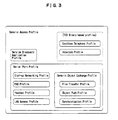
- these profiles have a hierarchy relation shown in Fig. 3, for example.
- information such as a device address (eg. a Bluetooth device address) and CoD of the communication terminal 2 is included.
- the CoD for example, is information having 24 bits shown in tables 2 to 4.
- Table 2 represents information (Major Service Class) assigned to bit 23-bit 13
- Table 3 represents information (Major Device Class) assigned to bit 12 - bit 8.
- Table 4 represents information (Minor Device Class) assigned to bit 7 - bit 2 in case that Major Device Class is a computer class
- Table 5 represents information (Minor Device Class) assigned to bit 7 - bit 2 in case that Major Device Class is a phone class.
- an address book function which performs data processing connected with an address is provided in the control part 16, and an address book DB (Data Base) is constituted in the data base part 18.
- this address book function in respect to one person's name, relates phone numbers of a fixed telephone and/or a mobile phone, an e-mail address and so on used by that person to the person's name and stores them, and forms them as a data base.
- a device address, a device name and CoD of the communication terminal 2 or X are registered in a person's name, of a person who uses or manages the communication terminal 2 or X, which is registered in registration items of an address book of the data base part 18.
- the communication terminal 2 having a function like this can exchange terminal owner information (vCard format data) including a user name, an e-mail address, a phone number and so on with other communication terminals 201, 202, ..., 20N having the same function.
- the owner information of a device of the other party obtained by using this card exchange function can be recorded in an address book application namely the data base part 18 in the communication terminal 2 as it is.
- the card information which is specifying information out of the pieces of identification information obtained from a device of the other party through communication, and a Bluetooth device address, a device name, CoD and so on which are the pieces of identification information obtained at the same time are related to the card information namely the specifying information and are registered.
- Fig. 4 shows an example of an inquiry of a terminal and a connection procedure.
- a Bluetooth device address 48 bits
- a requirement of identification information and an inquiry message representative of an inquiry are transmitted from the side of a communication terminal 2A (a master) of a side which wants to start communication, and a terminal able to communicate, which exists within a range able to communicate, is inquired. If the terminal able to communicate exists, the side of a communication terminal 2B (a slave) of the other party side of the communication responds with an inquiry response message.
- the inquiry response message is transmitted with a packet of data, and this packet of data, for example, is transmitted with FHS packet (Frequency Hopping Sequence packet) format.
- the inquiry response message includes information of an Bluetooth device address, CoD and so on of the side of the communication terminals 2B which responds.
- terminal information of a terminal candidate able to communicate which is obtained by the inquiry, is displayed on the information presenting part 22 serving as a UI (User Interface) and is informed a user.
- a display screen shown in Fig. 5 is displayed, and one or plural device names, device addresses, CoDs and so on obtained by a result of the inquiry are displayed.
- Fig. 5 a display screen shown in Fig. 5 is displayed, and one or plural device names, device addresses, CoDs and so on obtained by a result of the inquiry are displayed.
- displays 30,32 and 34 are the CoDs
- displays 36, 38 and 40 are the device addresses
- displays 42, 44 and 46 are icon displays corresponding to the CoDs.
- a user selects a device of the other party, with which the user wants to communicate, from a retrieved result (31) displayed in the screen of the terminal, and starts a connection process.
- a device name is given.
- a device manufacturer has registered a specific character string as a device name in that device at the time of a shipment.
- that device name can be changed by a user after purchase of that.
- a protocol for inquiring of a device of the other party about this device name has been prepared.
- Fig. 6 displays 48 and 50 show the device names
- displays 52 and 54 show the device addresses
- displays 56 and 58 show information of the profiles
- displays 60 and 62 show icon displays corresponding to the CoDs.
- the Bluetooth system In the Bluetooth system, information of each terminal obtained by communication connection is registered, and it is possible to start a connection by utilizing that information.
- the Bluetooth system has a function which makes it the condition of a connection to input the same PIN code (Personal Identify Number code) in the master side and the slave side.
- the PIN code is converted into secret key information called a link key, and is stored in the data base part of the control part 16 together with the device address, for example.
- the PIN code or link key may also be stored in the data base part 18.
- the communication device, the information processing method thereof and the information processing program thereof constitute an address book DB in the data base part 18, and is constituted so that, when receiving owner information from a communication terminal X namely a device of the other party by Bluetooth, a Bluetooth device address of the communication terminal X obtained at the time of communication is recorded in the address book DB by using an owner's name included in the owner information as a key.
- the system when performing a card information exchange with a person that a user meets for the first time, the system performs an inquiry operation at a step S1, and inquires a device of the other party. At a step S2, the system decides whether or not an inquiry response signal is received. If the device of the other party comes responding with an inquiry response message, the system proceeds to a step S3. At the step S3, the system displays terminal information able to communicate, namely a device address, CoD and so on, as a plurality of pieces of identification information included in that message on the information presenting part 22, and notifies the user of it. Along with this, the system inquires of the user about a device of the other party and requests the confirmation of a connection. At the following step S4, the system decides whether or not the user designates a device of the other party to be connected.
- the system starts connecting to a communication terminal X selected by the user at a step S5, and confirms at a step S6 whether or not that connection is completed.
- the system proceeds to a step S7, and demands card information to the communication terminal X which is the device of the other party.
- the system is to demand the card information of the other party after transmitting card information to the communication terminal X namely the device of the other party.
- the system is to demand transmission of the card information to the communication terminal X namely the device of the other party.
- step S8 the system decides whether or not reception of the card information from the communication terminal X which is the device of the other party is completed. If the reception of that data is completed, the system proceeds to a step S9.
- step S9 various kinds of data of a phone number, an e-mail address, an address and so on included in the card information as a plurality of identification data out of contents of that are related to a full name data namely the specifying information, and are recorded in the address book DB which is established in the data base part 18.
- the pieces of identification information of the Bluetooth device address, the device name, the CoD and so on of the communication terminal X namely the device of the other party used in the communication are related to the full name data which is the specifying information, and are stored in the address book DB.
- the data base part 18 When corresponding profile information is obtained through the SDP, this is also stored in the data base part 18 at the same time.
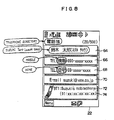
- Fig. 8 is an example of a plurality of pieces of identification information stored in the data base part 18, and shows the pieces of identification information displayed on the information presenting part 22. In Fig.
- display 64 is a full name
- display 66 is a mobile phone number
- display 68 is home telephone number
- display 70 is an e-mail address
- display 72 is a device name of Bluetooth mounted in a communication terminal X which is a device of the other party
- display 74 is a CoD list.
- a display part which displays a person's name list stored in the address book DB constituted by the data base part 18 can be constituted by the information presenting part 22, an input part of a result of selection by a user from the person's name list can be constituted by the input operation part 20, and a connection selecting part can be constituted by the control part 16.
- the connection selecting part constituted by the control part 16 is constituted so that the address book DB is retrieved by using a person's name selected by a user as a key, and so that it is possible to start communication through the Bluetooth system by using a Bluetooth device address obtained from that retrieval.
- the system selects a data, which a user wants to transmit, from the information presenting part 22 of the communication terminal 2.
- the system displays the other party of transmission (a person' name), which is the identification information, on the information presenting part 22. And then, the system selects a person namely the other party that receives transmission, and designates that person.
- the system retrieves the address book DB from the data base 18 by using this person as specifying information, and specifies a communication terminal X having Bluetooth from the identification information related to the designated person that is a result of the retrieval.
- the system decides whether or not a terminal can be specified by using display, for example, the display 74, representative of the communication terminal X which is the retrieved result of the data base part 18. If the system can not specify the display 74, the system proceeds to a step S15, and performs a notification representative of error indication and so on to the information presenting part 22 and terminates this connection operation.
- the system proceeds to a step S16, and starts a process of connection with the communication terminal X namely the device of the other party by using the device address information registered in the address book DB of the data base part 18.
- the system decides at a step S17 whether or not the connection is completed. If the connection is not completed, the system proceeds to the S15, and performs a notification representative of error indication and so on to the information presenting part 22 and terminates this connecting operation. On the other hand, if the connection is completed at the step S17, the system proceeds to a step S18 and performs data transmission.
- the system designates a person from the address book DB, and can perform the connecting operation thence.
- the connection process can be performed by utilizing that identification information.
- this identification information can be utilized on the occasion of performing display of each data in each application as well. For example, by retrieving a user name from the device address which is identification information, "from whom was that data received?" or "to whom was that data transmitted before?" can be displayed on UI of the communication terminal 2, namely the information presenting part 22.
- the communication terminal 2 having Bluetooth also records the corresponding profile information in the address book DB of the data base part 18 at the same time, and may be set so that a user can designate a profile used when communicating with another communication terminal X.
- the two kinds of a side (a client) requiring a connection and a side (a server) required a connection are to exist.
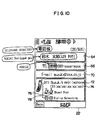
- Fig. 10 is a plurality of pieces of identification information stored in the data base part 18, and shows profile information of the pieces of identification information displayed on the information presenting part 22.
- selection displays 76 and 78 able to designate a profile used for a connection are displayed, in addition to the display 72 showing the device name and the display 74 showing the list of CoD of Bluetooth mounted in the communication terminal X which is a device of the other party.
- Fig. 10 "C” shows a client, and "S” shows a server.
- the system is constituted so that the permission and designation of a connection can be performed in relation to each of client and server.
- this embodiment has a function that designates a profile used for a connection in relation to each Bluetooth device which is registered, in the address book DB constituted by the data base part 18.
- the connection selecting part constituted by the control part 16 is constituted so that the connection selecting part retrieves the address book DB by using a person's name selected by a user as a key, determines a profile used for a connection in the above-mentioned profile designation when starting Bluetooth communication by using a Bluetooth device address obtained from that retrieval, and connects by a procedure according to that profile.
- the system displays the other party (a person's name) to be connected on the UI namely the information presenting part 22, and performs an inquiry to a user.
- the system decides whether or not a communication terminal X related to the person's name designated on the address book DB of the data base part 18 is one. If the number of communication terminals is not one, the system proceeds to a step S23, and inquires of the user about the other party to be connected from a plurality of communication terminals X which are registered.
- the system reads out profile designation information for connection use corresponding to a communication terminal X of the other party from the data base part 18, and proceeds to a step S25.
- the system decides whether or not it is possible to communicate with the communication terminal X of the other party by a designated profile. If the communication is impossible, the system proceeds to a step S26 and terminates this process after performing an error notification. On the other hand, if the communication is possible by the designated profile, the system proceeds to a step S27 and performs the communication through the designated profile.
- designation of the server can be made to function as setting of whether to permit or refuse a connection from the other party
- designation of the client can also be made to function as connection profile designation of default on the occasion of designating a communication terminal X namely a device of the other party without designating a profile.
- the address book application it is possible to set a group function which classifies people's names in groups of a family, a co-worker and so on according to category information due to the designation of a user.
- a group designation of the address book like this it is possible to perform a selection process of the permission of a connection and the refusal of a connection by a specific profile, in relation to a communication terminal X having Bluetooth owned by every group.
- this embodiment provides an address book function that has a function classifying full name data in groups, and a function that designates access permission for every group, namely an every group access permission designation function.
- the every group access permission designation function is constituted so as to be able to set in a batch whether or not to permit a connection through a specific profile from a communication terminal X which has a Bluetooth system related to a person's name belonging to a group designated by the address book.
- the system designates a group registered in the address book DB of the data base part 18, and inquires at a step S32 whether or not a user performs the setting of a connection requirement side (a client side). If the user performs this setting, the system proceeds to a step S33, and designates a registration profile from groups of the address book DB. On the other hand, if the user does not perform this setting, the system proceeds to a step S34.
- the system designates a connection permission profile of a case where a communication terminal X of the user, for example, the communication terminal 2 behaves as a server, and terminates this process.
- this embodiment is constituted so that necessary information for communication such as a device address is previously transmitted as identification information to a communication terminal X, which is not performing communication with the Bluetooth system, by using other communication means of a telephone, an e-mail and so on, and so that the identification information is used for the communication by registering it in the data base part 18. According to a constitution like this, even when communication is performed for the first time, it is possible to omit the acquisition of identification information and the confirmation of a user which are necessary on the occasion of a start of communication.
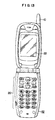
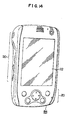
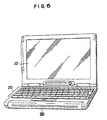
- the present invention is applied to a mobile terminal of a mobile phone 82 shown in Fig. 13, PDA 84 shown in Fig. 14, a note type personal computer 86 shown in Fig. 15, and so on.
- the present invention is provided to various kinds of apparatuses of an information apparatus such as a digital camera and a printer, an AV (Audio Video) apparatus and so on, and can be utilized for a transmission process and a exchange process of many kinds of information.
- the PDA 84 shown in Fig. 14 and the note type personal computer 86 shown in Fig. 15 common portions with the communication terminal 2 shown in Fig. 1 have the same reference numerals, and these explanations are left out.
- the communication devices, the information processing methods thereof and the information processing program thereof according to the embodiments described above are further made reference to.
- private history information representative of a communication terminal to which inquiry or communication was performed in the past is in existence. Since this history information is a device name, a device address, CoD and so on, it is possible to designate the other party of a connection by using these pieces of information.
- the device name is previously set by a device manufacturer, or a user can modify it after purchase. If a plurality of communication terminals having the same CoD, of which device names are not modified or can not be modified, exist within a range able to communicate, a device address which is identification information will be the only identification means.
- the communication devices can improve usability in case that the Bluetooth system is provided.
- the Bluetooth system for example, in a mobile phone, it is possible to relate a plurality of pieces of identification information of a Bluetooth device address and so on representative of the other party of communication and a communication terminal thereof in the card information exchange to specifying information included in the pieces of identification information, and to record them as a data base.
- a user does not need to be conscious of a record process of the identification information, and, further, complicated operations are also unnecessary.
- the pieces of identification information registered in the data base part 18 as described above, at the time of subsequent communication, are related to the specifying information out of the pieces of identification information, for example, person's name information, and the identification information representative of a communication terminal is retrieved. Then, the identification information is presented together with the person's name information from a result of that retrieval, and a communication terminal to which a user wants to connect can be selected.
- a computer program embodying the present invention program may be carried by any suitable carrier medium such as a storage medium (e.g. floppy disk or CD Rom) or a signal.
- a carrier signal could be a signal downloaded via a communications network such as the Internet.
- the appended computer program claims are to be interpreted as covering a computer program by itself or in any of the above-mentioned forms.
Landscapes
- Engineering & Computer Science (AREA)
- Signal Processing (AREA)
- Computer Networks & Wireless Communication (AREA)
- Human Computer Interaction (AREA)
- Mobile Radio Communication Systems (AREA)
- Telephone Function (AREA)
Applications Claiming Priority (2)
| Application Number | Priority Date | Filing Date | Title |
|---|---|---|---|
| JP2002314650 | 2002-10-29 | ||
| JP2002314650A JP2004153438A (ja) | 2002-10-29 | 2002-10-29 | 通信装置、その情報処理方法及び情報処理プログラム |
Publications (3)
| Publication Number | Publication Date |
|---|---|
| EP1416703A2 true EP1416703A2 (de) | 2004-05-06 |
| EP1416703A3 EP1416703A3 (de) | 2006-10-04 |
| EP1416703B1 EP1416703B1 (de) | 2013-07-31 |
Family
ID=32089509
Family Applications (1)
| Application Number | Title | Priority Date | Filing Date |
|---|---|---|---|
| EP20030256828 Expired - Lifetime EP1416703B1 (de) | 2002-10-29 | 2003-10-29 | Kommunikationsgeräte , Verfahren und Rechnerprogramme zur Informationsverarbeitung |
Country Status (3)
| Country | Link |
|---|---|
| US (2) | US7756474B2 (de) |
| EP (1) | EP1416703B1 (de) |
| JP (1) | JP2004153438A (de) |
Cited By (9)
| Publication number | Priority date | Publication date | Assignee | Title |
|---|---|---|---|---|
| EP1760944A1 (de) * | 2005-09-06 | 2007-03-07 | Research In Motion Limited | Steuerung der Sichtbarkeit eines drahtlosen Kommunikationsgerätes im auffindbaren Modus |
| US7603083B2 (en) | 2005-09-06 | 2009-10-13 | Research In Motion Limited | Controlling visibility of a wireless device in discoverable mode |
| US7796979B2 (en) | 2005-09-06 | 2010-09-14 | Research In Motion Limited | Controlling visibility of a wireless device |
| EP1931123A4 (de) * | 2005-09-01 | 2011-01-26 | Access Co Ltd | Kommunikationssytem und kommunikationsendgerät |
| EP2480018A3 (de) * | 2011-01-24 | 2012-09-19 | Nokia Corporation | Nicht vernetztes Benachrichtigungssystem |
| EP2698973A1 (de) * | 2012-08-13 | 2014-02-19 | LG Electronics, Inc. | Mobiles Endgerät und Steuerungsverfahren dafür |
| US8965284B2 (en) | 2011-04-07 | 2015-02-24 | Nokia Corporation | Facilitating positioning through Bluetooth low energy wireless messaging |
| US9084215B2 (en) | 2011-04-07 | 2015-07-14 | Nokia Technologies Oy | Transmitting positioning information via wireless communication |
| US9494673B2 (en) | 2011-01-11 | 2016-11-15 | Nokia Technologies Oy | Additional data usable in apparatus positioning |
Families Citing this family (29)
| Publication number | Priority date | Publication date | Assignee | Title |
|---|---|---|---|---|
| US20050149560A1 (en) * | 2003-12-25 | 2005-07-07 | Jao-Ching Lin | Digital transmission device |
| US8639819B2 (en) | 2004-02-05 | 2014-01-28 | Nokia Corporation | Ad-hoc connection between electronic devices |
| US9014753B2 (en) * | 2004-03-31 | 2015-04-21 | Volkswagen Ag | Communication system and information system for a motor vehicle |
| US20050277445A1 (en) * | 2004-06-09 | 2005-12-15 | Bae Hyon S | Hands-free vehicle phone system and method |
| JPWO2006054778A1 (ja) * | 2004-11-17 | 2008-06-05 | 日本電気株式会社 | 通信システム、通信端末装置、サーバ装置及びそれらに用いる通信方法並びにそのプログラム |
| DE602005020584D1 (de) | 2005-04-25 | 2010-05-27 | Sony Ericsson Mobile Comm Ab | Elektronische Vorrichtung für ein drahtloses Kommunikationssystem und Verfahren zum Betreiben einer elektronischen Vorrichtung für ein drahtloses Kommunikationssystem |
| TWI274284B (en) * | 2005-09-07 | 2007-02-21 | Micro Star Int Co Ltd | Method for changing parameter values of embedded system by way of object push profile |
| JP2007116254A (ja) * | 2005-10-18 | 2007-05-10 | Denso Corp | Bluetooth通信機能付き車載装置 |
| EP2259496B1 (de) * | 2006-04-24 | 2012-05-23 | Research In Motion Limited | Gerät und dazugehöriges Verfahren zum Erzeugen eines Notrufs, um einen Hilfsdienst von einer Notsituation eines Fahrzeugs zu unterrichten |
| JP2007318245A (ja) * | 2006-05-23 | 2007-12-06 | Nec Corp | 携帯電話システム、携帯電話端末、個人情報保護方法、個人情報保護プログラムおよびプログラム記録媒体 |
| US20070286133A1 (en) * | 2006-06-07 | 2007-12-13 | Tony Kirke | Handheld communication device for communication of information |
| KR20080001117A (ko) * | 2006-06-29 | 2008-01-03 | 삼성전자주식회사 | 블루투스를 통한 작업요청 정보를 표시하는 프린터 및 이프린터에서의 작업요청 정보 표시 방법 |
| EP1926279A1 (de) * | 2006-11-21 | 2008-05-28 | Thomson Licensing | Method und eine erstes Gerät zur Assoziierung des ersten Gerätes mit einem zweiten Gerät |
| DE102006055501A1 (de) * | 2006-11-24 | 2008-05-29 | Bayerische Motoren Werke Ag | Verfahren zur Übertragung von Telefonbuchdaten von einem Mobiltelefon zu einem externen Gerät und externes Gerät |
| JP2008172341A (ja) * | 2007-01-09 | 2008-07-24 | Toshiba Corp | 携帯端末 |
| JP2009020602A (ja) * | 2007-07-10 | 2009-01-29 | Nippon Hoso Kyokai <Nhk> | 端末設定装置、応答信号送信装置、端末設定方法、及び、端末設定プログラム |
| US8880122B2 (en) * | 2007-08-31 | 2014-11-04 | Qualcomm Incorporated | System and method for identifying devices in a wireless network |
| JP2010011064A (ja) * | 2008-06-26 | 2010-01-14 | Kyocera Corp | 無線通信端末、無線通信システム |
| JP2011072583A (ja) * | 2009-09-30 | 2011-04-14 | Fujifilm Corp | 超音波プローブ、および超音波診断システム |
| US20110102556A1 (en) * | 2009-11-03 | 2011-05-05 | Kim Sungdo | Method for displaying 3d image by using the binocular disparity in mobile terminal and mobile terminal using the same |
| KR101758854B1 (ko) * | 2010-12-03 | 2017-07-17 | 에스프린팅솔루션 주식회사 | 스캐닝장치, 이에 연결된 모바일장치 및 그 스캔작업수행방법 |
| CN102684749A (zh) * | 2011-03-18 | 2012-09-19 | 深圳富泰宏精密工业有限公司 | 蓝牙邮件收发系统及方法 |
| CN102172095B (zh) * | 2011-04-26 | 2016-03-02 | 华为终端有限公司 | 蓝牙设备连接方法及蓝牙设备 |
| JP5762984B2 (ja) * | 2012-01-10 | 2015-08-12 | 株式会社東芝 | データ送受信装置 |
| KR20140032526A (ko) * | 2012-08-28 | 2014-03-17 | 삼성전자주식회사 | 이동 통신 단말에서 착신 통지 방법과 그를 위한 이동 통신 단말 및 근거리 무선 통신 디바이스 |
| JP2014082667A (ja) * | 2012-10-17 | 2014-05-08 | Sony Corp | 端末装置およびプログラム |
| CN103856622A (zh) * | 2012-12-06 | 2014-06-11 | 中兴通讯股份有限公司 | 设置移动终端功能模块名称的方法和移动终端 |
| JP6184844B2 (ja) * | 2013-11-20 | 2017-08-23 | アルパイン株式会社 | 電子装置、携帯端末選択方法および携帯端末選択プログラム |
| US10542405B2 (en) | 2018-06-01 | 2020-01-21 | Apple Inc. | Bluetooth profile fast connect |
Family Cites Families (21)
| Publication number | Priority date | Publication date | Assignee | Title |
|---|---|---|---|---|
| JP3017925B2 (ja) * | 1994-04-14 | 2000-03-13 | 株式会社東芝 | 移動通信端末と移動通信方法 |
| JP3540496B2 (ja) * | 1996-03-18 | 2004-07-07 | 株式会社東芝 | 通信機能を備えた情報処理装置及び同装置に用いられる装置情報表示方法 |
| JPH11122415A (ja) | 1997-10-16 | 1999-04-30 | Toshiba Tec Corp | ファクシミリ装置 |
| JPH11122416A (ja) | 1997-10-16 | 1999-04-30 | Toshiba Tec Corp | ファクシミリ装置 |
| US6377161B1 (en) * | 1998-08-11 | 2002-04-23 | Motorola, Inc. | Method and apparatus in a wireless messaging system for facilitating an exchange of address information |
| FR2789251B1 (fr) * | 1999-01-28 | 2004-08-27 | Sagem | Procede d'echange de donnees |
| JP4528410B2 (ja) * | 2000-03-27 | 2010-08-18 | 株式会社東芝 | 通信端末 |
| JP2001356984A (ja) | 2000-06-13 | 2001-12-26 | Casio Comput Co Ltd | メール送受信装置、及び記憶媒体 |
| KR20020001348A (ko) * | 2000-06-28 | 2002-01-09 | 윤종용 | 근거리 이동무선시스템을 이용하여 디지탈 오디오데이타를 청취할 수 있는 헤드셋 |
| US7071814B1 (en) * | 2000-07-31 | 2006-07-04 | Motorola, Inc. | Contextually aware network announcements of people |
| US6748195B1 (en) * | 2000-09-29 | 2004-06-08 | Motorola, Inc. | Wireless device having context-based operational behavior |
| KR100458389B1 (ko) * | 2000-09-29 | 2004-11-26 | 산요덴키가부시키가이샤 | 통신단말장치 및 표시방법 |
| JP2002111860A (ja) | 2000-10-03 | 2002-04-12 | Nec Corp | 無線通信機能付き携帯端末 |
| US7512685B2 (en) * | 2000-11-30 | 2009-03-31 | 3Com Corporation | Method and system for implementing wireless data transfers between a selected group of mobile computing devices |
| JP3932281B2 (ja) * | 2001-04-19 | 2007-06-20 | 秀樹 室屋 | 無線リンクを用いた機器相互接続装置及び方法、機器相互接続用利用シーンテーブル作成方法並びに記録媒体 |
| US6842460B1 (en) * | 2001-06-27 | 2005-01-11 | Nokia Corporation | Ad hoc network discovery menu |
| US7089298B2 (en) * | 2001-08-20 | 2006-08-08 | Nokia Corporation | Naming distribution method for ad hoc networks |
| US7102640B1 (en) * | 2002-03-21 | 2006-09-05 | Nokia Corporation | Service/device indication with graphical interface |
| US6961541B2 (en) * | 2002-05-24 | 2005-11-01 | Aeroscout, Inc. | Method and apparatus for enhancing security in a wireless network using distance measurement techniques |
| JP4225743B2 (ja) * | 2002-07-04 | 2009-02-18 | 株式会社東芝 | 無線端末及び通信制御方法 |
| US7472135B2 (en) * | 2002-10-18 | 2008-12-30 | Nokia Corporation | Method and system for recalling details regarding past events |
-
2002
- 2002-10-29 JP JP2002314650A patent/JP2004153438A/ja active Pending
-
2003
- 2003-10-29 US US10/694,989 patent/US7756474B2/en not_active Expired - Fee Related
- 2003-10-29 EP EP20030256828 patent/EP1416703B1/de not_active Expired - Lifetime
-
2007
- 2007-03-19 US US11/687,687 patent/US7801485B2/en not_active Expired - Fee Related
Non-Patent Citations (1)
| Title |
|---|
| None |
Cited By (15)
| Publication number | Priority date | Publication date | Assignee | Title |
|---|---|---|---|---|
| EP1931123A4 (de) * | 2005-09-01 | 2011-01-26 | Access Co Ltd | Kommunikationssytem und kommunikationsendgerät |
| US7603083B2 (en) | 2005-09-06 | 2009-10-13 | Research In Motion Limited | Controlling visibility of a wireless device in discoverable mode |
| US7751380B2 (en) | 2005-09-06 | 2010-07-06 | Research In Motion Limited | Controlling visibility of a wireless device in discoverable mode |
| US7796979B2 (en) | 2005-09-06 | 2010-09-14 | Research In Motion Limited | Controlling visibility of a wireless device |
| US7912027B2 (en) | 2005-09-06 | 2011-03-22 | Research In Motion Limited | Controlling visibility of a wireless device in discoverable mode |
| EP1760944A1 (de) * | 2005-09-06 | 2007-03-07 | Research In Motion Limited | Steuerung der Sichtbarkeit eines drahtlosen Kommunikationsgerätes im auffindbaren Modus |
| US9494673B2 (en) | 2011-01-11 | 2016-11-15 | Nokia Technologies Oy | Additional data usable in apparatus positioning |
| EP2480018A3 (de) * | 2011-01-24 | 2012-09-19 | Nokia Corporation | Nicht vernetztes Benachrichtigungssystem |
| US8588688B2 (en) | 2011-01-24 | 2013-11-19 | Nokia Corporation | Non-networked messaging |
| US8965284B2 (en) | 2011-04-07 | 2015-02-24 | Nokia Corporation | Facilitating positioning through Bluetooth low energy wireless messaging |
| US9084215B2 (en) | 2011-04-07 | 2015-07-14 | Nokia Technologies Oy | Transmitting positioning information via wireless communication |
| EP2698973A1 (de) * | 2012-08-13 | 2014-02-19 | LG Electronics, Inc. | Mobiles Endgerät und Steuerungsverfahren dafür |
| KR20140022190A (ko) * | 2012-08-13 | 2014-02-24 | 엘지전자 주식회사 | 휴대 단말기 및 그 제어 방법 |
| US9112580B2 (en) | 2012-08-13 | 2015-08-18 | Lg Electronics Inc. | Mobile terminal and controlling method thereof |
| KR101911252B1 (ko) | 2012-08-13 | 2018-10-24 | 엘지전자 주식회사 | 휴대 단말기 및 그 제어 방법 |
Also Published As
| Publication number | Publication date |
|---|---|
| JP2004153438A (ja) | 2004-05-27 |
| US20040157589A1 (en) | 2004-08-12 |
| US20070167137A1 (en) | 2007-07-19 |
| EP1416703B1 (de) | 2013-07-31 |
| EP1416703A3 (de) | 2006-10-04 |
| US7756474B2 (en) | 2010-07-13 |
| US7801485B2 (en) | 2010-09-21 |
Similar Documents
| Publication | Publication Date | Title |
|---|---|---|
| EP1416703B1 (de) | Kommunikationsgeräte , Verfahren und Rechnerprogramme zur Informationsverarbeitung | |
| US7194238B2 (en) | Identification of terminal | |
| US8005952B2 (en) | Method for intelligently selecting wireless access point | |
| US7103313B2 (en) | Automatic determination of access point content and services for short-range wireless terminals | |
| US20070293193A1 (en) | Improved short range connectivity usability by using contact information | |
| US7110784B2 (en) | Wireless communication system | |
| US8265594B2 (en) | Method for bypassing passkey exchange and authentication procedures | |
| KR100469409B1 (ko) | 이동통신 단말기를 이용한 개인정보 관리 방법 | |
| JP3766072B2 (ja) | 無線通信装置 | |
| US20080085740A1 (en) | Method for displaying information in mobile communication terminal using bluetooth | |
| EP2043340B1 (de) | Mobiles Telekommunikationsendgerät, Kommunikationssystem und computerlesbares Speichermedium | |
| JP4724932B2 (ja) | 伝送方法及び伝送装置 | |
| JP2003333173A (ja) | コードレス電話システム、コードレス電話システムの電話機、並びにコードレス電話システムの端末装置 | |
| JP4163322B2 (ja) | 通信制御方法及び移動通信端末 | |
| KR20040044256A (ko) | 발신 번호 표시 서비스와 연동되는 부가 컨텐츠 제공 방법및 장치 | |
| JP2002280955A (ja) | 伝送方法及び伝送装置 | |
| JP3701164B2 (ja) | 携帯型通信機器 | |
| KR100474692B1 (ko) | 휴대폰의 메뉴 구성 편집방법 | |
| JP2008219494A (ja) | 通信装置、通信装置の制御プログラム、記録媒体、及び通信装置の制御方法 | |
| JP2003008769A (ja) | 情報提供装置及び情報要求装置並びに携帯端末 | |
| JP2005229526A (ja) | 電話装置、電話番号提供装置、電話装置の制御プログラム及びコンピュータで実行可能なプログラム、並びに電話装置システム | |
| EP1405465B1 (de) | Identifizierung mehrsprachiger teilnehmer an netzkommunikationen | |
| KR100602645B1 (ko) | 통신 단말장치의 전화번호 리스트 전송 방법 및 그 통신단말장치 | |
| KR20030071247A (ko) | 블루투스 기술을 이용한 이동통신 단말기간의 주소록송/수신방법 | |
| KR20060070054A (ko) | 키입력부의 조작만으로 무선 인터넷 사이트에 직접 접속할 수 있는 휴대용 이동통신 단말기와 그 운용방법. |
Legal Events
| Date | Code | Title | Description |
|---|---|---|---|
| PUAI | Public reference made under article 153(3) epc to a published international application that has entered the european phase |
Free format text: ORIGINAL CODE: 0009012 |
|
| AK | Designated contracting states |
Kind code of ref document: A2 Designated state(s): AT BE BG CH CY CZ DE DK EE ES FI FR GB GR HU IE IT LI LU MC NL PT RO SE SI SK TR |
|
| AX | Request for extension of the european patent |
Extension state: AL LT LV MK |
|
| PUAL | Search report despatched |
Free format text: ORIGINAL CODE: 0009013 |
|
| AK | Designated contracting states |
Kind code of ref document: A3 Designated state(s): AT BE BG CH CY CZ DE DK EE ES FI FR GB GR HU IE IT LI LU MC NL PT RO SE SI SK TR |
|
| AX | Request for extension of the european patent |
Extension state: AL LT LV MK |
|
| RIN1 | Information on inventor provided before grant (corrected) |
Inventor name: INOUE, NAOYUKI,C/O FUJITSU LIMITED Inventor name: WATANABE, HIDEAKI,C/O FUJITSU LIMITED |
|
| 17P | Request for examination filed |
Effective date: 20061206 |
|
| AKX | Designation fees paid |
Designated state(s): DE FR GB |
|
| 17Q | First examination report despatched |
Effective date: 20090911 |
|
| GRAP | Despatch of communication of intention to grant a patent |
Free format text: ORIGINAL CODE: EPIDOSNIGR1 |
|
| GRAS | Grant fee paid |
Free format text: ORIGINAL CODE: EPIDOSNIGR3 |
|
| GRAA | (expected) grant |
Free format text: ORIGINAL CODE: 0009210 |
|
| AK | Designated contracting states |
Kind code of ref document: B1 Designated state(s): DE FR GB |
|
| REG | Reference to a national code |
Ref country code: GB Ref legal event code: FG4D |
|
| REG | Reference to a national code |
Ref country code: DE Ref legal event code: R096 Ref document number: 60344601 Country of ref document: DE Effective date: 20130926 |
|
| PLBE | No opposition filed within time limit |
Free format text: ORIGINAL CODE: 0009261 |
|
| STAA | Information on the status of an ep patent application or granted ep patent |
Free format text: STATUS: NO OPPOSITION FILED WITHIN TIME LIMIT |
|
| 26N | No opposition filed |
Effective date: 20140502 |
|
| REG | Reference to a national code |
Ref country code: DE Ref legal event code: R097 Ref document number: 60344601 Country of ref document: DE Effective date: 20140502 |
|
| PGFP | Annual fee paid to national office [announced via postgrant information from national office to epo] |
Ref country code: DE Payment date: 20141023 Year of fee payment: 12 Ref country code: GB Payment date: 20141029 Year of fee payment: 12 Ref country code: FR Payment date: 20141008 Year of fee payment: 12 |
|
| REG | Reference to a national code |
Ref country code: DE Ref legal event code: R119 Ref document number: 60344601 Country of ref document: DE |
|
| GBPC | Gb: european patent ceased through non-payment of renewal fee |
Effective date: 20151029 |
|
| PG25 | Lapsed in a contracting state [announced via postgrant information from national office to epo] |
Ref country code: GB Free format text: LAPSE BECAUSE OF NON-PAYMENT OF DUE FEES Effective date: 20151029 Ref country code: DE Free format text: LAPSE BECAUSE OF NON-PAYMENT OF DUE FEES Effective date: 20160503 |
|
| REG | Reference to a national code |
Ref country code: FR Ref legal event code: ST Effective date: 20160630 |
|
| PG25 | Lapsed in a contracting state [announced via postgrant information from national office to epo] |
Ref country code: FR Free format text: LAPSE BECAUSE OF NON-PAYMENT OF DUE FEES Effective date: 20151102 |