EP1417942A2 - Knieprothese - Google Patents
Knieprothese Download PDFInfo
- Publication number
- EP1417942A2 EP1417942A2 EP03256284A EP03256284A EP1417942A2 EP 1417942 A2 EP1417942 A2 EP 1417942A2 EP 03256284 A EP03256284 A EP 03256284A EP 03256284 A EP03256284 A EP 03256284A EP 1417942 A2 EP1417942 A2 EP 1417942A2
- Authority
- EP
- European Patent Office
- Prior art keywords
- gas
- prosthetic
- platform
- hydraulic
- piston
- Prior art date
- Legal status (The legal status is an assumption and is not a legal conclusion. Google has not performed a legal analysis and makes no representation as to the accuracy of the status listed.)
- Withdrawn
Links
Images








Classifications
-
- A—HUMAN NECESSITIES
- A61—MEDICAL OR VETERINARY SCIENCE; HYGIENE
- A61F—FILTERS IMPLANTABLE INTO BLOOD VESSELS; PROSTHESES; DEVICES PROVIDING PATENCY TO, OR PREVENTING COLLAPSING OF, TUBULAR STRUCTURES OF THE BODY, e.g. STENTS; ORTHOPAEDIC, NURSING OR CONTRACEPTIVE DEVICES; FOMENTATION; TREATMENT OR PROTECTION OF EYES OR EARS; BANDAGES, DRESSINGS OR ABSORBENT PADS; FIRST-AID KITS
- A61F2/00—Filters implantable into blood vessels; Prostheses, i.e. artificial substitutes or replacements for parts of the body; Appliances for connecting them with the body; Devices providing patency to, or preventing collapsing of, tubular structures of the body, e.g. stents
- A61F2/50—Prostheses not implantable in the body
- A61F2/68—Operating or control means
-
- A—HUMAN NECESSITIES
- A61—MEDICAL OR VETERINARY SCIENCE; HYGIENE
- A61F—FILTERS IMPLANTABLE INTO BLOOD VESSELS; PROSTHESES; DEVICES PROVIDING PATENCY TO, OR PREVENTING COLLAPSING OF, TUBULAR STRUCTURES OF THE BODY, e.g. STENTS; ORTHOPAEDIC, NURSING OR CONTRACEPTIVE DEVICES; FOMENTATION; TREATMENT OR PROTECTION OF EYES OR EARS; BANDAGES, DRESSINGS OR ABSORBENT PADS; FIRST-AID KITS
- A61F2/00—Filters implantable into blood vessels; Prostheses, i.e. artificial substitutes or replacements for parts of the body; Appliances for connecting them with the body; Devices providing patency to, or preventing collapsing of, tubular structures of the body, e.g. stents
- A61F2/50—Prostheses not implantable in the body
- A61F2/60—Artificial legs or feet or parts thereof
- A61F2/64—Knee joints
-
- A—HUMAN NECESSITIES
- A61—MEDICAL OR VETERINARY SCIENCE; HYGIENE
- A61F—FILTERS IMPLANTABLE INTO BLOOD VESSELS; PROSTHESES; DEVICES PROVIDING PATENCY TO, OR PREVENTING COLLAPSING OF, TUBULAR STRUCTURES OF THE BODY, e.g. STENTS; ORTHOPAEDIC, NURSING OR CONTRACEPTIVE DEVICES; FOMENTATION; TREATMENT OR PROTECTION OF EYES OR EARS; BANDAGES, DRESSINGS OR ABSORBENT PADS; FIRST-AID KITS
- A61F2/00—Filters implantable into blood vessels; Prostheses, i.e. artificial substitutes or replacements for parts of the body; Appliances for connecting them with the body; Devices providing patency to, or preventing collapsing of, tubular structures of the body, e.g. stents
- A61F2/50—Prostheses not implantable in the body
- A61F2/60—Artificial legs or feet or parts thereof
- A61F2/66—Feet; Ankle joints
-
- A—HUMAN NECESSITIES
- A61—MEDICAL OR VETERINARY SCIENCE; HYGIENE
- A61F—FILTERS IMPLANTABLE INTO BLOOD VESSELS; PROSTHESES; DEVICES PROVIDING PATENCY TO, OR PREVENTING COLLAPSING OF, TUBULAR STRUCTURES OF THE BODY, e.g. STENTS; ORTHOPAEDIC, NURSING OR CONTRACEPTIVE DEVICES; FOMENTATION; TREATMENT OR PROTECTION OF EYES OR EARS; BANDAGES, DRESSINGS OR ABSORBENT PADS; FIRST-AID KITS
- A61F2/00—Filters implantable into blood vessels; Prostheses, i.e. artificial substitutes or replacements for parts of the body; Appliances for connecting them with the body; Devices providing patency to, or preventing collapsing of, tubular structures of the body, e.g. stents
- A61F2/50—Prostheses not implantable in the body
- A61F2/68—Operating or control means
- A61F2/70—Operating or control means electrical
- A61F2/72—Bioelectric control, e.g. myoelectric
-
- A—HUMAN NECESSITIES
- A61—MEDICAL OR VETERINARY SCIENCE; HYGIENE
- A61F—FILTERS IMPLANTABLE INTO BLOOD VESSELS; PROSTHESES; DEVICES PROVIDING PATENCY TO, OR PREVENTING COLLAPSING OF, TUBULAR STRUCTURES OF THE BODY, e.g. STENTS; ORTHOPAEDIC, NURSING OR CONTRACEPTIVE DEVICES; FOMENTATION; TREATMENT OR PROTECTION OF EYES OR EARS; BANDAGES, DRESSINGS OR ABSORBENT PADS; FIRST-AID KITS
- A61F2/00—Filters implantable into blood vessels; Prostheses, i.e. artificial substitutes or replacements for parts of the body; Appliances for connecting them with the body; Devices providing patency to, or preventing collapsing of, tubular structures of the body, e.g. stents
- A61F2/50—Prostheses not implantable in the body
- A61F2/68—Operating or control means
- A61F2/74—Operating or control means fluid, i.e. hydraulic or pneumatic
-
- A—HUMAN NECESSITIES
- A61—MEDICAL OR VETERINARY SCIENCE; HYGIENE
- A61F—FILTERS IMPLANTABLE INTO BLOOD VESSELS; PROSTHESES; DEVICES PROVIDING PATENCY TO, OR PREVENTING COLLAPSING OF, TUBULAR STRUCTURES OF THE BODY, e.g. STENTS; ORTHOPAEDIC, NURSING OR CONTRACEPTIVE DEVICES; FOMENTATION; TREATMENT OR PROTECTION OF EYES OR EARS; BANDAGES, DRESSINGS OR ABSORBENT PADS; FIRST-AID KITS
- A61F2/00—Filters implantable into blood vessels; Prostheses, i.e. artificial substitutes or replacements for parts of the body; Appliances for connecting them with the body; Devices providing patency to, or preventing collapsing of, tubular structures of the body, e.g. stents
- A61F2/50—Prostheses not implantable in the body
- A61F2/68—Operating or control means
- A61F2/74—Operating or control means fluid, i.e. hydraulic or pneumatic
- A61F2/748—Valve systems
-
- A—HUMAN NECESSITIES
- A61—MEDICAL OR VETERINARY SCIENCE; HYGIENE
- A61F—FILTERS IMPLANTABLE INTO BLOOD VESSELS; PROSTHESES; DEVICES PROVIDING PATENCY TO, OR PREVENTING COLLAPSING OF, TUBULAR STRUCTURES OF THE BODY, e.g. STENTS; ORTHOPAEDIC, NURSING OR CONTRACEPTIVE DEVICES; FOMENTATION; TREATMENT OR PROTECTION OF EYES OR EARS; BANDAGES, DRESSINGS OR ABSORBENT PADS; FIRST-AID KITS
- A61F2/00—Filters implantable into blood vessels; Prostheses, i.e. artificial substitutes or replacements for parts of the body; Appliances for connecting them with the body; Devices providing patency to, or preventing collapsing of, tubular structures of the body, e.g. stents
- A61F2/50—Prostheses not implantable in the body
- A61F2/78—Means for protecting prostheses or for attaching them to the body, e.g. bandages, harnesses, straps, or stockings for the limb stump
- A61F2/80—Sockets, e.g. of suction type
-
- A—HUMAN NECESSITIES
- A61—MEDICAL OR VETERINARY SCIENCE; HYGIENE
- A61F—FILTERS IMPLANTABLE INTO BLOOD VESSELS; PROSTHESES; DEVICES PROVIDING PATENCY TO, OR PREVENTING COLLAPSING OF, TUBULAR STRUCTURES OF THE BODY, e.g. STENTS; ORTHOPAEDIC, NURSING OR CONTRACEPTIVE DEVICES; FOMENTATION; TREATMENT OR PROTECTION OF EYES OR EARS; BANDAGES, DRESSINGS OR ABSORBENT PADS; FIRST-AID KITS
- A61F2/00—Filters implantable into blood vessels; Prostheses, i.e. artificial substitutes or replacements for parts of the body; Appliances for connecting them with the body; Devices providing patency to, or preventing collapsing of, tubular structures of the body, e.g. stents
- A61F2/02—Prostheses implantable into the body
- A61F2/30—Joints
- A61F2002/30001—Additional features of subject-matter classified in A61F2/28, A61F2/30 and subgroups thereof
- A61F2002/30316—The prosthesis having different structural features at different locations within the same prosthesis; Connections between prosthetic parts; Special structural features of bone or joint prostheses not otherwise provided for
- A61F2002/30329—Connections or couplings between prosthetic parts, e.g. between modular parts; Connecting elements
- A61F2002/30331—Connections or couplings between prosthetic parts, e.g. between modular parts; Connecting elements made by longitudinally pushing a protrusion into a complementarily-shaped recess, e.g. held by friction fit
- A61F2002/30362—Connections or couplings between prosthetic parts, e.g. between modular parts; Connecting elements made by longitudinally pushing a protrusion into a complementarily-shaped recess, e.g. held by friction fit with possibility of relative movement between the protrusion and the recess
- A61F2002/30364—Rotation about the common longitudinal axis
- A61F2002/30365—Rotation about the common longitudinal axis with additional means for limiting said rotation
-
- A—HUMAN NECESSITIES
- A61—MEDICAL OR VETERINARY SCIENCE; HYGIENE
- A61F—FILTERS IMPLANTABLE INTO BLOOD VESSELS; PROSTHESES; DEVICES PROVIDING PATENCY TO, OR PREVENTING COLLAPSING OF, TUBULAR STRUCTURES OF THE BODY, e.g. STENTS; ORTHOPAEDIC, NURSING OR CONTRACEPTIVE DEVICES; FOMENTATION; TREATMENT OR PROTECTION OF EYES OR EARS; BANDAGES, DRESSINGS OR ABSORBENT PADS; FIRST-AID KITS
- A61F2/00—Filters implantable into blood vessels; Prostheses, i.e. artificial substitutes or replacements for parts of the body; Appliances for connecting them with the body; Devices providing patency to, or preventing collapsing of, tubular structures of the body, e.g. stents
- A61F2/50—Prostheses not implantable in the body
- A61F2002/5003—Prostheses not implantable in the body having damping means, e.g. shock absorbers
-
- A—HUMAN NECESSITIES
- A61—MEDICAL OR VETERINARY SCIENCE; HYGIENE
- A61F—FILTERS IMPLANTABLE INTO BLOOD VESSELS; PROSTHESES; DEVICES PROVIDING PATENCY TO, OR PREVENTING COLLAPSING OF, TUBULAR STRUCTURES OF THE BODY, e.g. STENTS; ORTHOPAEDIC, NURSING OR CONTRACEPTIVE DEVICES; FOMENTATION; TREATMENT OR PROTECTION OF EYES OR EARS; BANDAGES, DRESSINGS OR ABSORBENT PADS; FIRST-AID KITS
- A61F2/00—Filters implantable into blood vessels; Prostheses, i.e. artificial substitutes or replacements for parts of the body; Appliances for connecting them with the body; Devices providing patency to, or preventing collapsing of, tubular structures of the body, e.g. stents
- A61F2/50—Prostheses not implantable in the body
- A61F2002/5016—Prostheses not implantable in the body adjustable
- A61F2002/5018—Prostheses not implantable in the body adjustable for adjusting angular orientation
-
- A—HUMAN NECESSITIES
- A61—MEDICAL OR VETERINARY SCIENCE; HYGIENE
- A61F—FILTERS IMPLANTABLE INTO BLOOD VESSELS; PROSTHESES; DEVICES PROVIDING PATENCY TO, OR PREVENTING COLLAPSING OF, TUBULAR STRUCTURES OF THE BODY, e.g. STENTS; ORTHOPAEDIC, NURSING OR CONTRACEPTIVE DEVICES; FOMENTATION; TREATMENT OR PROTECTION OF EYES OR EARS; BANDAGES, DRESSINGS OR ABSORBENT PADS; FIRST-AID KITS
- A61F2/00—Filters implantable into blood vessels; Prostheses, i.e. artificial substitutes or replacements for parts of the body; Appliances for connecting them with the body; Devices providing patency to, or preventing collapsing of, tubular structures of the body, e.g. stents
- A61F2/50—Prostheses not implantable in the body
- A61F2002/5016—Prostheses not implantable in the body adjustable
- A61F2002/5032—Prostheses not implantable in the body adjustable for adjusting fluid pressure
-
- A—HUMAN NECESSITIES
- A61—MEDICAL OR VETERINARY SCIENCE; HYGIENE
- A61F—FILTERS IMPLANTABLE INTO BLOOD VESSELS; PROSTHESES; DEVICES PROVIDING PATENCY TO, OR PREVENTING COLLAPSING OF, TUBULAR STRUCTURES OF THE BODY, e.g. STENTS; ORTHOPAEDIC, NURSING OR CONTRACEPTIVE DEVICES; FOMENTATION; TREATMENT OR PROTECTION OF EYES OR EARS; BANDAGES, DRESSINGS OR ABSORBENT PADS; FIRST-AID KITS
- A61F2/00—Filters implantable into blood vessels; Prostheses, i.e. artificial substitutes or replacements for parts of the body; Appliances for connecting them with the body; Devices providing patency to, or preventing collapsing of, tubular structures of the body, e.g. stents
- A61F2/50—Prostheses not implantable in the body
- A61F2002/5038—Hinged joint, e.g. with transverse axle restricting the movement
- A61F2002/5039—Hinged joint, e.g. with transverse axle restricting the movement allowing only for single rotation
-
- A—HUMAN NECESSITIES
- A61—MEDICAL OR VETERINARY SCIENCE; HYGIENE
- A61F—FILTERS IMPLANTABLE INTO BLOOD VESSELS; PROSTHESES; DEVICES PROVIDING PATENCY TO, OR PREVENTING COLLAPSING OF, TUBULAR STRUCTURES OF THE BODY, e.g. STENTS; ORTHOPAEDIC, NURSING OR CONTRACEPTIVE DEVICES; FOMENTATION; TREATMENT OR PROTECTION OF EYES OR EARS; BANDAGES, DRESSINGS OR ABSORBENT PADS; FIRST-AID KITS
- A61F2/00—Filters implantable into blood vessels; Prostheses, i.e. artificial substitutes or replacements for parts of the body; Appliances for connecting them with the body; Devices providing patency to, or preventing collapsing of, tubular structures of the body, e.g. stents
- A61F2/50—Prostheses not implantable in the body
- A61F2002/5038—Hinged joint, e.g. with transverse axle restricting the movement
- A61F2002/5043—Hinged joint, e.g. with transverse axle restricting the movement with rotation-limiting stops, e.g. projections or recesses
-
- A—HUMAN NECESSITIES
- A61—MEDICAL OR VETERINARY SCIENCE; HYGIENE
- A61F—FILTERS IMPLANTABLE INTO BLOOD VESSELS; PROSTHESES; DEVICES PROVIDING PATENCY TO, OR PREVENTING COLLAPSING OF, TUBULAR STRUCTURES OF THE BODY, e.g. STENTS; ORTHOPAEDIC, NURSING OR CONTRACEPTIVE DEVICES; FOMENTATION; TREATMENT OR PROTECTION OF EYES OR EARS; BANDAGES, DRESSINGS OR ABSORBENT PADS; FIRST-AID KITS
- A61F2/00—Filters implantable into blood vessels; Prostheses, i.e. artificial substitutes or replacements for parts of the body; Appliances for connecting them with the body; Devices providing patency to, or preventing collapsing of, tubular structures of the body, e.g. stents
- A61F2/50—Prostheses not implantable in the body
- A61F2002/5067—Prostheses not implantable in the body having rolling elements between articulating surfaces
-
- A—HUMAN NECESSITIES
- A61—MEDICAL OR VETERINARY SCIENCE; HYGIENE
- A61F—FILTERS IMPLANTABLE INTO BLOOD VESSELS; PROSTHESES; DEVICES PROVIDING PATENCY TO, OR PREVENTING COLLAPSING OF, TUBULAR STRUCTURES OF THE BODY, e.g. STENTS; ORTHOPAEDIC, NURSING OR CONTRACEPTIVE DEVICES; FOMENTATION; TREATMENT OR PROTECTION OF EYES OR EARS; BANDAGES, DRESSINGS OR ABSORBENT PADS; FIRST-AID KITS
- A61F2/00—Filters implantable into blood vessels; Prostheses, i.e. artificial substitutes or replacements for parts of the body; Appliances for connecting them with the body; Devices providing patency to, or preventing collapsing of, tubular structures of the body, e.g. stents
- A61F2/50—Prostheses not implantable in the body
- A61F2/60—Artificial legs or feet or parts thereof
- A61F2002/607—Lower legs
-
- A—HUMAN NECESSITIES
- A61—MEDICAL OR VETERINARY SCIENCE; HYGIENE
- A61F—FILTERS IMPLANTABLE INTO BLOOD VESSELS; PROSTHESES; DEVICES PROVIDING PATENCY TO, OR PREVENTING COLLAPSING OF, TUBULAR STRUCTURES OF THE BODY, e.g. STENTS; ORTHOPAEDIC, NURSING OR CONTRACEPTIVE DEVICES; FOMENTATION; TREATMENT OR PROTECTION OF EYES OR EARS; BANDAGES, DRESSINGS OR ABSORBENT PADS; FIRST-AID KITS
- A61F2220/00—Fixations or connections for prostheses classified in groups A61F2/00 - A61F2/26 or A61F2/82 or A61F9/00 or A61F11/00 or subgroups thereof
- A61F2220/0025—Connections or couplings between prosthetic parts, e.g. between modular parts; Connecting elements
- A61F2220/0033—Connections or couplings between prosthetic parts, e.g. between modular parts; Connecting elements made by longitudinally pushing a protrusion into a complementary-shaped recess, e.g. held by friction fit
Definitions
- the stability of a person is a function of the posture of the person's body.
- the weight line is an imaginary line through which the center of gravity of the person's body projects into the ground.
- the stability of the knee is directly relational to the distance between the weight line and the knee axis.
- stability is accomplished when the center of gravity and the weight line passing therethrough are placed anterior to the knee center, at the greatest possible distance therebetween.
- the dynamics and the structure of prosthetic knee cages force the knee center to be maintained posterior relative to the weight line.
- the knee cages of the prior art while trying to accomplish stability, typically provide a relatively minor degree of adjustments of the center of gravity and weight line of a patient relative to the pivotal axis of the cage.
- the knee cage of the invention provides the ability to manipulate and position the weight line anterior to the knee center.
- the knee cage of the invention utilizes a simple system that allows the knee unit to effectively shift the weight line up to four inches anterior or posterior relative to the center of rotation of the knee axis.
- the terminal impact is known to be the resultant force generated during the swinging motion of a lower limb and an upper limb with respect to each other, when the prosthetic leg reaches the end of its swing phase, prior to achieving a substantially straight position.
- a leg bends at the knee and is lifted above the ground. In order to be supported by the ground again, the leg has to be fully extended.
- Prosthetic legs operate in a similar manner. If the motion of the prosthetic lower limb caused by the forces of the terminal impact is not decelerated, a very revealing and often embarrassing noise is produced. To the discomfort of a patient, this makes the presence of the prosthesis very obvious, causing other people to be aware that the patient has an artificial leg.
- the terminal impact also negatively affects the structural elements of the prosthetic device itself, often leading to their damage. Thus, there is strong necessity of minimizing the effect of the terminal impact.
- Another negative aspect of the prior art prosthetic devices is the artificially high rate at which the leg advances during the swing phase to its complete straight position.
- an undesirable momentum of forces develops which has to be minimized. If this does not occur, one part of the leg will crash against the other part of the leg. Therefore, there is an obvious need for a prosthetic device capable of regulating and decelerating its motion during the swing phase before it reaches a substantially straight position.
- the prosthetic device of the invention closely simulates the movement of human limbs, without being subjected to the results of the terminal impact. It moves rapidly in the initial stages of extension, and then slows down before reaching the stop in full extension.
- a prosthetic knee cage comprising a base unit formed by spaced from each other first and second side members interconnected by a connecting element, so as to form an operational channel therebetween.
- the platform is adapted for pivotal cooperation with the base unit.
- the adjustment device is provided for adjustment of pivotal movement of the platform relative to the base unit.
- the adjustment device is situated within an interior proximal region of the base unit and includes a support bar movably arranged relative to the anterior proximal region of the base unit.
- the adjustment device further includes a support element interconnecting anterior proximal regions of the first and second side members.
- the support bar is adapted to receive a resilient member.
- position of the support bar relative to the support element is adjusted by means of adjustment members adapted for threadable engagement with the support bar.
- Position of the support bar and resilient member relative to the support element can be adjusted by means of rotation of the threadable members within the support element.
- the platform consists of a substantially flat table with first and second side plates spaced from each other and extending downwardly therefrom.
- the platform is formed with an anterior and posterior pivotal mount units separated by the pivotal axle.
- the pivotal axle of the platform is placed well posterior within the structure of the knee cage. Forward or anterior movement of the platform can be adjusted through the use of the adjustment mechanism. Thus, as the platform is allowed to tilt further in the anterior direction, the attached socket including a limb member therefore is placed in a further extended position relative to the pivotal axle. This brings the gravity center of a patient body even further in the anterior direction relative to the pivotal axle.
- the preferred embodiment of the knee cage allows for approximately between 20° to 30° of angular adjustment of the platform.
- Position of the platform perpendicular to the center of gravity is a neutral position.
- the support bar or stop of the adjustment device can be lowered, so that the platform can achieve inclination or tilt of about 10° - 15° from the horizontal in the anterior direction.
- the weight line passing through the gravity center of a body is allowed to be shifted in the anterior direction relative to the knee center, therefore making the cage and prosthetic knee of the invention inherently stable, just by manipulating the weight line. This occurs without using any locking mechanisms that are dependent upon the system of hydraulics.
- a prosthetic device comprising an upper prosthetic limb member, a lower prosthetic limb member, a hydraulic cylinder and a gas cylinder independent from said hydraulic cylinder.
- the hydraulic cylinder has a hydraulic piston movably disposed thereinside so as to form a hydraulic chamber between an interior of the hydraulic cylinder and the hydraulic piston.
- a first connecting element extends outwardly from the hydraulic piston.
- a gas cylinder is also provided having a gas piston movably disposed thereinside, so as to form a gas chamber between an interior of the gas cylinder and the gas piston.
- a second connecting element extends outwardly from the gas piston.
- the first and second connecting elements are movably associated with the upper prosthetic limb member, in such a manner that the hydraulic and gas chambers are responsive to operation of the prosthetic leg.
- valve arrangement associated with the gas chamber. Movement of the hydraulic piston toward the lower prosthetic limb member results in expansion of the gas chamber, causing the gas entering the gas chamber through the valve gas arrangement. Upon movement of the hydraulic piston away from said lower prosthetic limb member the gas piston is directed toward the lower prosthetic limb member diminishing the gas chamber. This motion is resulted in compression and discharging the gas from the gas chamber through the gas valve arrangement.
- a pressure generated by a resilient bladder forces the hydraulic fluid into the hydraulic cylinder causing motion of the hydraulic piston toward the upper prosthetic member and motion of the gas piston toward the lower prosthetic limb member.
- a pivotal platform is interposed between the upper prosthetic limb member, the hydraulic cylinder and the gas cylinder in such a manner that the first and second connecting elements are pivotally connected to the platform.
- the platform is pivotal about a pivotal axle situated within a central region of the device.
- the second connecting element is pivotally connected to the platform through an anterior pivotal mount disposed anterior to the pivotal axle, whereas the first connecting element is pivotally connected to the platform by means of a posterior pivot mount disposed posterior to the pivotal axle.
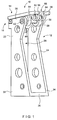
- the knee cage 10 typically consists of a base unit 12 , a platform 14 and an adjustment mechanism 16 .
- the adjustment mechanism 16 is located at a front or anterior region of the cage with the apertures 42 , 44 situated at a rear or posterior region thereof.
- a U-shaped base unit 12 is formed by spaced from each other first side member 22 and a second side member 24 which are interconnected by a connecting element 26 , so as to form an operational channel 28 therebetween.
- the first and second side members 22 , 24 are in the form of substantially flat plates extending between their respective distal parts 32 and 34 and proximal parts 36 and 38 .
- Pivoting apertures 42 , 44 are formed within the proximal region of each side member, so as to receive an axle 46 providing a pivotal connection between the base unit 12 and the platform 14 .
- the pivotal apertures 42 , 44 and the axle 46 are situated well posterior within the cage. In the assembled condition of the knee cage the pivotal axle 46 passes through the bearing unit accommodated by the pivotal apertures 42 and 44 and also passes through bearings formed within respective pivotal openings 48 , 49 of the platform 14 .
- the platform 14 is adapted for movable cooperation with a proximal region of the base unit 12 and consists of a substantially flat top table 52 with first and second side plates 54 and 56 extending downwardly therefrom.
- the side plates 54 , 56 are substantially flat and spaced from each other so as to be adapted for pivotal motion substantially within the proximal region of the operational channel 28 in the vicinity of the inner surfaces of the proximal parts 36 and 38 of the respective first side member 22 and the second side member 24 .
- the pivoting apertures 42 , 44 and the pivoting openings 48 , 49 are adapted for passage of the pivotal axle 46 therethrough.
- the platform of the adjustable prosthetic knee cage illustrated in Figures 1- 10 is formed with a single pivot mounting unit 65 which is adapted to pivotally receive a single connecting rod of the prosthetic knee unit.
- the pivotal mounting unit 65 includes a mounting recess 67 formed within the posterior rear region of the platform 14 and spaced from each other by the mounting recess 67 the first and second supporting elements 58 , 59 which extend outwardly from the bottom posterior area of the platform 14 .
- one connecting element or piston rod of the prosthetic knee unit is adapted to be received within recess 67 , between the first and second supporting elements 58 and 59 . In this manner a pivotal member passes through the apertures 62 and 64 formed within the respective supporting elements, so as to pivotally accommodate the connecting element therebetween.
- the platform 14 in addition to the posterior mounting unit 65 is formed with an anterior mounting unit 80 , which includes anterior supporting elements 82 and 84 extending outwardly from the bottom area of the platform 14 .
- the central regions of the anterior supporting elements 82 and 84 are formed with pivoting openings 48 and 49 respectively adapted for passage of the pivotal axle 46 .
- the anterior region of the anterior supporting elements is formed with apertures 86 and 87 adapted to receive the respective pivotal member.
- a space 88 between the anterior supporting elements 82 and 84 is adapted to pivotally accommodate another connecting element or piston rod of the prosthetic knee.
- the platform 14 is supported by the axle 46 and is pivotally mobile with respect to the side members 22 and 24 .
- one piston rod is pivotally accommodated within the posterior mounting unit 65 between the posterior supporting elements 58 and 59
- another piston rod is pivotally accommodated within the space 88 of the anterior mounting unit 80 between the anterior supporting units 58 and 59 .
- Mounting holes can be provided within the table 52 and connecting element 26 which are adapted to accept existing components which are common in the prosthetic industry.
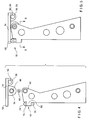
- An adjustment mechanism 16 is situated in the anterior proximal region of the knee cage and consists of a support bar 72 or a stop which is movably arranged with respect to the support element 66 interconnecting the anterior proximal regions of the first and second side members 22 and 24 .
- the support bar 72 is adapted to receive a resilient member 74 .
- Position of the support bar 72 with respect to the support element 66 is adjusted by means of adjustment elements 76 and 78 .
- the adjustment elements 76 and 78 are in the form of threadable members or screws.
- the position of the support bar 72 and the resilient member 74 can be adjusted by means of rotation of the threadable elements 76 and 78 .
- the support bar 72 is elevated with respect to the base unit 12 in general and specifically with respect to the support element 66 . In this position the downward motion of the anterior portion of the adjustable platform 14 in general, and the table 52 in particular, is restricted.
- the platform 14 including the table 52 In operation of the knee cage, upon elevation of the support bar 72 by the adjustment mechanism 16 the platform 14 including the table 52 is prevented from reaching its full downward position. Thus, the slant of the platform 14 is regulated by the height or elevation of the bar 72 and resilient member 74 .
- the reason for the anterior tilt or the over center nature of the cage is as follows. As the knee is brought to full extension because of the placement of the foot, there is a moment of instability when the knee is fully extended and not being controlled by the prosthetic knee mechanism itself. In the invention, the knee cage 10 allows the knee to become stable by allowing the weight line passing through the gravity center of a person's body to be brought well anterior to the location of the pivotal axle 46 . If the platform 14 including the table 52 is allowed to go beyond the horizontal level (see FIGs.
- the weight line passing through the gravity center of a person's body is moved even further in the anterior direction relative to the axle 46 .
- the invention prevents the knee cage from folding backwards, or to go into the flexion. This position is named hyper-extension.
- the anterior sloping position of the platform 14 is achieved (see FIGs. 6 and 16), rendering the knee to become stable. This is because, the weight line is situated to be anterior to the location of the axle 46 .
- the invention allows to place the weight line passing through the gravity center of a person's body to be anterior to the pivotal axle 46 of the knee cage.
- the more anterior the center of gravity is brought relative to the axle 46 the more stable the prosthetic knee becomes.
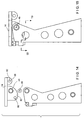
- This aspect of the invention is more specifically illustrated in FIGs. 16A and 16B in which the axis C-C passes through a pivotal axle 46 and the weight line D-D passes through the gravitational center G of a person's body.
- FIG. 16A illustrating a vertical orientation of a body with substantially horizontal position of the platform 14 .
- the distance E between the axis C-C and the weight line D-D is relatively small.
- the gravity center G and the weight line D-D moves further in the anterior direction from the axis C-C. This move is reflected in the increased distance E, indicating that the weight line is shifted anterior to the pivotal axle 46 .
- FIG. 16C Another feature of the invention is illustrated in FIG. 16C, which is applicable when a patient is not able to have enough hip extension to accommodate anterior slanting position or forward inclination from a horizontal position.
- a wedge-shaped member 90 can be interposed between the platform 14 and the socket 12. The member 90 allows the patient's limb to become oriented substantially horizontally or at the angle of 180° relative to the ground, while also allowing the platform 14 to assume the beneficial anterior inclination.
- FIG. 16D where we can see the resting point F' to the null point of 105° in relation to the axis or the center of rotation of the unit.
- FIG. 16E shows the axis being at a level with the center of rotation, rotating to 90° before the null point N is reached in relation to the axle or center of rotation.
- the center of gravity of a person's body is located at approximately lumbar to at or about the height of the navel.
- the center of rotation as illustrated in FIGs. 16D and 16E passes through the axle 46 .
- the socket When the socket is placed at a level attitude in relation to the ground with the knee unit at a level position, it is possible to gain as much as 1.5" in terms of the anterior shifting of the center of gravity in relation to the center of rotation or axle 46 .
- the center of gravity is forced to be in a more anterior or forward position. This, brings the weight line anterior to the center of rotation or axle 46 by an increase factor.
- Raising or lowering the support bar or stop 72 of the knee cage allows the prosthetic knee to flex beyond 180° or less than 180°.
- additional stability is insured.
- the flexion is less than 180°, or the posterior slanting position is accomplished, the controlled position of the knee unit is insured. This condition might be desirable for some patients having extremely long limbs. In the elderly population, and in the majority of the amputee population, increased stability not only becomes desirable for safety, but it is also necessary to insure that these patients do not fall. Some patients have knee flexion contractures.
- this condition can be accommodated by adjusting the knee cage in such a way so as to accommodate the knee flexion contracture.
- the stability of a patient can be maintained by adjusting the ankle of the tibia in relation to the foot. This brings the weight line anterior in relation to the femoral socket or the trans-femoral socket in relation to the center of gravity of the body.
- knee cage of the invention is described with reference to specific prosthetic knee units, it should be noted that the prosthetic knee cage of the invention is not limited to applications with the discussed knee systems.
- the knee cage can be used with other prosthetic knee systems, as long as such systems fit into the confinement of the elements of the cage.
- the prosthetic leg is designated generally by the numeral 120 and includes a socket or an upper prosthetic limb member 112 adapted for receiving a leg stump 111 of an amputee.
- the socket 112 is coupled by a conventional arrangement to an adjustable platform 114 provided at the top portion of the knee cage 110 , which can be provided with a removable cover 142 .
- the platform 114 is adapted for pivotal motion relative to the base of the cage.
- a pylon 117 at one end is coupled to the bottom of a knee cage 110 and at the other end is coupled to a prosthetic foot 119 .
- the pylon 117 and prosthetic foot 119 define a lower prosthetic limb member 120 .
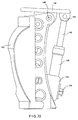
- the prosthetic knee assembly of the invention is positioned within the cage 110 and consists of a double cylinder arrangement 122 and a control valve-bladder sub-assembly 124, etc. These elements form a part of independent from each other a hydraulic system 121 and a pneumatic system 123 . With respect to the connection with the platform 114 , a gas or air cylinder unit 128 and a hydraulic cylinder unit 126 are arranged tandemly on either side of the axle 146 of the prosthetic knee cage 110 .
- the hydraulic system 121 includes a main body 130 adapted to receive a bladder 132 and a cam valve 134 operationally connected to the hydraulic cylinder 126 .
- a cartridge check valve 135 is situated within the main body directly below the output region of the hydraulic cylinder.
- the hydraulic cylinder 126 is formed by a substantially cylindrical wall 125 having an inner surface 127 and contains therein a piston 136 which is displaced by a suitable fluid which may be, for purposes of illustration, a silicone oil.
- a hydraulic chamber 140 is formed within the inner space of the cylinder 126 between its bottom and the piston 136 .
- the main body 130 is coupled to the cylinder 126 and supports a flow control valve.
- the main body 130 is also formed with a chamber adapted to receive a substantially horizontally disposed rotary cam valve which is sealed around its outer most circumference by a lip seal.
- the pneumatic system 123 includes the gas cylinder unit 128 which is formed with a substantially cylindrical housing 129 having at least an interior surface 131 , with the gas piston 133 movably position thereinside.
- a second connecting element or gas piston rod 137 is at one end thereof pivotally connected to the platform 114 of the cage at an anterior pivotal mount 180 , whereas the other end is attached to the piston 133 .
- a gas chamber 139 is formed within the inner space of the gas cylinder 128 between the bottom portion of the cylinder and the piston 133.
- One of the main functions of the pneumatic system 123 including the gas cylinder 128 is to minimize the effect of the terminal impact and to slow down motion of the leg during swing phase.
- the gas cylinder 128 is movably and/or pivotally coupled to the main body 130 of the hydraulic unit via a mounting arrangement which includes mounting plates 143 positioned on either side of the main body.
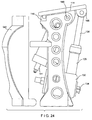
- the dual piston arrangement is pivotally associated with the knee cage assembly previously described with respect to Figures 11- 20. It is best illustrated in at least FIGs. 25- 27 that the gas piston rod 137 is pivotally connected through the anterior pivot mount 180 which is disposed anterior and below the central pivotal axle 146 . On the other hand, the hydraulic piston rod 138 is pivotally connected to the posterior pivot mount 165 which is disposed posterior and above the central pivotal axle 146 . As discussed hereinabove, the platform 114 is pivotally supported by the central pivotal axle 146 within the base of the knee cage.
- a valve arrangement or gas valve 141 is disposed within the wall of the gas cylinder 128 , so as to provide communication between the gas chamber 139 and outside environment.
- an ambient air is used for the operation of the gas cylinder 128 .
- the valve arrangement 141 can be adjusted to regulate flow of gas out of the gas chamber 139 .
- the gas valve arrangement 141 is adapted to controllably discharge the gas accumulated within the gas chamber 139 , whereas during the movement of the piston 133 in the opposite direction it operates as a check valve introducing air or gas into the expanding gas chamber.
- the prosthetic knee of the invention is capable of achieving approximately a 126° angle in the movement between the fully flexed position to the fully extended position.
- the fully flexed position as illustrated in FIG. 27, corresponds to the situation where the knee is folded or a patient achieving a kneeling position in which the gas chamber 139 is filled with gas.
- the gas trapped within the gas chamber is controllably discharged by means of the gas valve 141 regulating the speed and intensity of the extension cycle.
- a bladder membrane 132 is situated within the bladder chamber 150 which includes a bladder valve 152 .
- the valve 152 is adjustable for varying bladder compression, flexion resistance and extension drive.
- the bladder 132 is affected by the operation of valves situated within the main body 130 , so as to be compressed for storing all of the required energy.
- the bladder is capable of storing the kinetic energy for the return cycle or the upward motion of the hydraulic piston 136 . This enables the hydraulic fluid to be moved from the accumulation bladder chamber 150 into the hydraulic chamber 140 to have the required resistance within the cylinder 126 when the bladder collapses. Such action accumulates and stores the kinetic energy required for the operation of the knee unit of the invention.
- An accumulation chamber 150 accommodates the displaced oil.
- pressure is exerted on the bladder membrane 132 allowing it to compress the gas situated thereinside and accept the displaced oil. Pressure is increased on the inner area of the bladder membrane 132 , thus storing enough kinetic energy to power the return cycle and return of the piston 136 to the extended position.
- the air valve 152 communicating with the airside of the bladder chamber can adjust the level of kinetic energy.
- the force necessary to compress and extend the piston 136 and piston rod or connecting element 138 is adjustable by increasing or decreasing the amount of air pressure in the bladder cylinder 150 .
- the kinetic energy is stored in the bladder capable of driving the piston 136 .
- a cartridge-type ball check valve 135 is placed between the hydraulic chamber 140 and the bladder chamber 150 .
- a rotary cam 134 associated with the ball check valve 135 is provided to stop the flow of fluid from the cylinder 126 to the bladder chamber 150 .
- the cam is rotated, the ball is lifted or lowered into the ball seat either allowing or not allowing passage of fluid through the ball seat to the accumulation chamber.
- Free oil flow is allowed back into the cylinder 126 due to the kinetic energy stored in the compressed air/gas in the bladder chamber 150 pushing on the bladder 132 to return the oil to the hydraulic chamber 140 through the check valve 135 to the cylinder returning the cylinder to the extended position.
- the hydraulic chamber 140 is pressurized through the downward motion of the piston 136 , so as to allow the hydraulic fluid to pass through the cartridge valve 135 only when the cam lobe is in a position to lift the ball out of its seated position in the cartridge valve 135 , thereby allowing fluid to pass around the cam.
- the hydraulic fluid As the fluid passes around the cam when the cam is in the open position, the hydraulic fluid then enters through an orifice in the back of the cam chamber. Through that orifice the hydraulic fluid is allowed to pass through the hole just posterior to the cam housing into an accumulated chamber.
- the valve 135 situated above the cam also operates as a check valve. This means that it has a spring associated with the ball valve mechanism.
- the bladder pressure pushes the fluid past the ball valve 135 back into the cylinder 126 returning the plunger 136 and the rod 138 to their original extended position.
- the gas cylinder 128 provided with the adjustable valve mechanism 141 which controllably discharges the gas out of the gas chamber 139 into the atmosphere. This arrangement prevents this undesirable action and regulates the speed of the swing phase and the terminal impact.
- the amount of generated kinetic energy can be adjusted by means of the gas valve 152 associated with the bladder. If more extension is needed, the gas pressure in the bladder 132 should be increased.
- the normal operating pressure inside the bladder is between 60 and 150 pounds, according to the activity level of the patient.
- the adjustable bleeding nature of the gas valve 141 positioned at the bottom of the gas cylinder 128 is capable of releasing air in a controlled fashion, and to inhibit the rapid and uncontrolled return of the prosthetic knee and the platform of the knee cage to its most forward or downward position. In this manner, a resultant damaging force and loud noise are minimized or completely eliminated.
- the adjustable prosthetic knee cage which was previously described with reference to FIGs. 1-20 is also adaptable for use with the prosthetic knee having an in line piston arrangement.
- the structure and operation of this prosthetic knee do not form as essential part of the invention and have been in full detail disclosed by the U.S. patent application S.N 10/278,361 filed October 23,2002, which this application incorporates by reference.
- the in line piston arrangement Similar to the prosthetic knee having the dual piston arrangement previously discussed with reference to FIGs. 21-29, as illustrated in FIG. 30 the in line piston arrangement also includes a multi piston structure which is movably connected to the platform 214 of the cage by a single pivot mount 224 , which is situated in the platform 214 posterior to the central axle 246 .
- a gas piston cylinder 262 is provided outside the hydraulic cylinder 232 .
- the bottom of a gas cylinder 262 is formed with an upwardly facing lip edge 266 .
- the cap 270 seals the hydraulic cylinder 232 and also traps the gas between that seal and the bottom portion of the concentric gas plunger 272 .
- a closing cap 228 is provided at the top of the gas cylinder 262 , so as to fixedly receive the piston rod 226 which extends between the pivot mount 224 and the hydraulic piston 234 .
- the piston 234 pushes the hydraulic fluid through the system in a manner discussed hereinabove.
- the gas chamber 268 is also expanded. This is because the gas cylinder 262 moves up and down in relation to a fixedly positioned gas plunger 272 , 274 that is mounted on the cap 270 of the hydraulic unit. In this motion the gas volume increases, as the platform 214 is tilted or moved downwardly. In this action more gas enters the chamber 268 between the plunger 272 , 274 and the bottom portion 264 of the gas cylinder. When the unit is extended, as a result of the kinetic energy stored in the bladder 240 , the gas accumulated in the chamber 268 is being compressed.
- a gas valve 276 is provided at a lower portion of the gas cylinder 260 . As the gas is compressed in the chamber 268 , it is allowed to escape through the valve 276 . During the initial stages of the swing phase, gas is compressed rapidly in the chamber 268 until the pressure reaches a point where it cannot be compressed rapidly. During the slow rate of compression gas is allowed to escape through the valve 276 and therefore damping swing phase.
- This arrangement minimizes or eliminates terminal impact, so that there is a proper rate of return for the distal portion of the leg.
- the gas in the form of air is used as a medium because initial compression is easy until the pressure builds up and the last portion of the travel becomes more difficult. This occurs when the maximum amount of damping power is needed just before the leg becomes fully extended, so that it does not advance too rapidly without causing a resultant klunk.
- the in line piston arrangement of the prosthetic knee is adapted for cooperation with the knee cage which has been previously discussed with reference to Figures 1-10.
- the piston rod 226 by means of the pivotal member 240 is movably connected to the posterior mounting unit 265 .
- the free end of the piston rod 226 is received within the mounting recess 259 between two posterior mounting plates.
- the knee cage of the invention adapted for cooperation with the in line system illustrated in FIG. 30 operates in a manner similar to that used with the dual piston arrangement of FIGs. 21-29.
- the platform 214 is moved to an upward or substantially horizontal or anteriorly tilted position.
- the platform 214 is tilted anterior the knee center can be manipulated to be considerably posterior to the center of gravity of a patient.
- the weight of a patient travels approximately 1 ⁇ 2 to 3 ⁇ 4 of an inch anterior to the central axle 246 promoting stability.
- the platform has an anterior tilt as much as 5 inches of travel can be achieved anterior to the axle promoting extreme stability.
- Actuation of the cam valve 134 in the prosthetic knee of the invention is associated with at least one of the following three modalities.
- One mode of operation is mechanical in nature and operates by providing a connector or cable 147 between the prosthetic knee and a movable ankle or foot 119 (see FIG. 21).
- the connector or cable 147 pulls on the lever or arm 145 which locks the cam valve 134 into a closed position preventing flexion of the knee.
- the cam valve 134 is placed into an open position, thereby allowing the flow of fluid from the hydraulic cylinder 126 into the bladder chamber 150 .
- the prosthetic knee of the invention is also adaptable for operation in the electro-mechanical mode, whereby a switch located on the plantar surface of the foot or the bottom surface of the foot can be activated. Such activation elicits a response from a survo to pull the arm 145 into a position in which the foot contacts the floor.
- the cam valve 45 is allowed to be placed into a position facilitating the drop of the ball into the seat, so as to seal the unit. Such action prevents flow of the fluid through the prosthetic knee leading to complete stoppage of the flexionability of the knee.
- a further mode of controlling the knee is by means of myoelectric control.
- a signal from the residual musculature, or an electronic signal from the brain of a patient to the residual musculature is amplified and sent to a discriminator circuit.
- the signal is analyzed to define the type of signal in terms of its amplitude and duration.
- another discrimination step can be conducted to define a selected response mode or activity such as walking, climbing stairs, descending stairs, seating, etc.
- the proper placement of the cam valve 134 is elicited by an arrangement utilizing a signal from the discriminator circuit. This provides a measured travel, so as to place the cam valve 134 in a desired position, in order to coincide with the motion that is elicited by the brain. This is necessary to achieve one of the previously discussed activities.
Landscapes
- Health & Medical Sciences (AREA)
- Transplantation (AREA)
- Biomedical Technology (AREA)
- Cardiology (AREA)
- Oral & Maxillofacial Surgery (AREA)
- Engineering & Computer Science (AREA)
- Heart & Thoracic Surgery (AREA)
- Vascular Medicine (AREA)
- Life Sciences & Earth Sciences (AREA)
- Animal Behavior & Ethology (AREA)
- General Health & Medical Sciences (AREA)
- Public Health (AREA)
- Veterinary Medicine (AREA)
- Orthopedic Medicine & Surgery (AREA)
- Prostheses (AREA)
Applications Claiming Priority (4)
| Application Number | Priority Date | Filing Date | Title |
|---|---|---|---|
| US670353 | 2000-09-26 | ||
| US42202502P | 2002-10-29 | 2002-10-29 | |
| US422025P | 2002-10-29 | ||
| US10/670,353 US20040083007A1 (en) | 2002-10-29 | 2003-09-26 | Prosthetic device |
Publications (2)
| Publication Number | Publication Date |
|---|---|
| EP1417942A2 true EP1417942A2 (de) | 2004-05-12 |
| EP1417942A3 EP1417942A3 (de) | 2007-01-03 |
Family
ID=32110353
Family Applications (1)
| Application Number | Title | Priority Date | Filing Date |
|---|---|---|---|
| EP03256284A Withdrawn EP1417942A3 (de) | 2002-10-29 | 2003-10-06 | Knieprothese |
Country Status (2)
| Country | Link |
|---|---|
| US (1) | US20040083007A1 (de) |
| EP (1) | EP1417942A3 (de) |
Cited By (3)
| Publication number | Priority date | Publication date | Assignee | Title |
|---|---|---|---|---|
| WO2006112774A1 (en) | 2005-04-19 | 2006-10-26 | Lisa Gramnaes | Combined active and passive leg prosthesis system and a method for performing a movement with such a system |
| FR2968538A1 (fr) * | 2010-12-09 | 2012-06-15 | Pierre Chabloz | Prothese pour membre inferieur |
| WO2014005709A3 (de) * | 2012-07-03 | 2014-03-20 | Otto Bock Healthcare Gmbh | Verfahren zur steuerung einer orthopädietechnischen gelenkeinrichtung und orthopädietechnische gelenkeinrichtung |
Families Citing this family (20)
| Publication number | Priority date | Publication date | Assignee | Title |
|---|---|---|---|---|
| JP4808026B2 (ja) * | 2002-08-22 | 2011-11-02 | ヴィクソム ヒューマン バイオニクス インコーポレーテッド | 膝上部肢切断患者用の駆動源付き義足 |
| US7736394B2 (en) | 2002-08-22 | 2010-06-15 | Victhom Human Bionics Inc. | Actuated prosthesis for amputees |
| US7815689B2 (en) | 2003-11-18 | 2010-10-19 | Victhom Human Bionics Inc. | Instrumented prosthetic foot |
| US20050107889A1 (en) | 2003-11-18 | 2005-05-19 | Stephane Bedard | Instrumented prosthetic foot |
| US7637959B2 (en) | 2004-02-12 | 2009-12-29 | össur hf | Systems and methods for adjusting the angle of a prosthetic ankle based on a measured surface angle |
| CA2863933C (en) | 2004-12-22 | 2018-08-07 | Ossur Hf | Systems and methods for processing limb motion |
| US8801802B2 (en) | 2005-02-16 | 2014-08-12 | össur hf | System and method for data communication with a mechatronic device |
| US7655050B2 (en) * | 2005-07-29 | 2010-02-02 | Freedom Innovations, Llc | Computer controlled prosthetic knee device |
| EP1942843B1 (de) * | 2005-09-01 | 2017-03-01 | Össur hf | Vorrichtung und verfahren zur bestimmung der änderung des terrains |
| JP5122164B2 (ja) * | 2007-03-13 | 2013-01-16 | 株式会社長崎かなえ | 義足 |
| CN102036626B (zh) | 2008-03-24 | 2014-07-02 | 奥瑟Hf公司 | 经股的假肢系统和用于操作该系统的方法 |
| USD732167S1 (en) | 2013-02-01 | 2015-06-16 | Limbs International Inc. | Prosthetic knee |
| EP3427702B1 (de) | 2013-02-26 | 2024-12-18 | Össur HF | Fussprothese mit verbesserter stabilität und elastischer energierückspeisung |
| US9498354B2 (en) * | 2013-03-13 | 2016-11-22 | Milwaukee School Of Engineering | Actuation system for a joint |
| USD732168S1 (en) | 2013-08-19 | 2015-06-16 | Limbs International Inc. | Prosthetic knee |
| USD785177S1 (en) | 2015-06-19 | 2017-04-25 | Limbs International Inc. | Prosthetic knee |
| US9878751B1 (en) * | 2015-10-08 | 2018-01-30 | Boston Dynamics, Inc. | Three-piston ankle mechanism of a legged robot and associated control system |
| US20230293322A1 (en) * | 2017-10-11 | 2023-09-21 | Robert N Brown | Flexible multi use post operative prosthetic socket system |
| EP4003240B1 (de) * | 2019-07-30 | 2024-08-21 | College Park Industries, Inc. | Hydraulische knieprothese mit widerstandsänderungsmechanismus bei hyperextension |
| DE102020120304B4 (de) * | 2020-07-31 | 2022-03-31 | Ottobock Se & Co. Kgaa | Orthopädietechnische Einrichtung |
Family Cites Families (4)
| Publication number | Priority date | Publication date | Assignee | Title |
|---|---|---|---|---|
| GB2194443A (en) * | 1986-08-07 | 1988-03-09 | Hanger & Co Ltd J E | Improvements in knee prosthesis |
| JPH05309109A (ja) * | 1992-05-09 | 1993-11-22 | Nabco Ltd | 歩行速度制御機能を有する義足 |
| WO1994006374A1 (en) * | 1992-09-14 | 1994-03-31 | Chas A Blatchford & Sons Limited | Artificial leg |
| US5704946A (en) * | 1996-03-13 | 1998-01-06 | United States Manufacturing Company | Multi-purpose prosthetic knee component |
-
2003
- 2003-09-26 US US10/670,353 patent/US20040083007A1/en not_active Abandoned
- 2003-10-06 EP EP03256284A patent/EP1417942A3/de not_active Withdrawn
Cited By (11)
| Publication number | Priority date | Publication date | Assignee | Title |
|---|---|---|---|---|
| WO2006112774A1 (en) | 2005-04-19 | 2006-10-26 | Lisa Gramnaes | Combined active and passive leg prosthesis system and a method for performing a movement with such a system |
| CN101163457B (zh) * | 2005-04-19 | 2010-06-16 | 利萨·格拉姆奈斯 | 组合的主动和被动式假腿系统及用这种系统执行运动的方法 |
| US8814949B2 (en) | 2005-04-19 | 2014-08-26 | össur hf | Combined active and passive leg prosthesis system and a method for performing a movement with such a system |
| FR2968538A1 (fr) * | 2010-12-09 | 2012-06-15 | Pierre Chabloz | Prothese pour membre inferieur |
| EP2462901A3 (de) * | 2010-12-09 | 2013-03-20 | Pierre Chabloz | Prothese für untere Gliedmaßen |
| US8870969B2 (en) | 2010-12-09 | 2014-10-28 | Otto Bock Healthcare Gmbh | Prosthesis for a lower limb |
| US9987152B2 (en) | 2010-12-09 | 2018-06-05 | Otto Bock Healthcare Gmbh | Prosthesis for a lower limb |
| US10874531B2 (en) | 2010-12-09 | 2020-12-29 | Ottobock Se & Co. Kgaa | Prosthesis for a lower limb |
| WO2014005709A3 (de) * | 2012-07-03 | 2014-03-20 | Otto Bock Healthcare Gmbh | Verfahren zur steuerung einer orthopädietechnischen gelenkeinrichtung und orthopädietechnische gelenkeinrichtung |
| EP3278770A1 (de) * | 2012-07-03 | 2018-02-07 | Otto Bock HealthCare GmbH | Verfahren zur steuerung einer orthopädietechnischen gelenkeinrichtung |
| US10517743B2 (en) | 2012-07-03 | 2019-12-31 | Ottobock Se & Co. Kgaa | Method for controlling an orthopedic joint device |
Also Published As
| Publication number | Publication date |
|---|---|
| EP1417942A3 (de) | 2007-01-03 |
| US20040083007A1 (en) | 2004-04-29 |
Similar Documents
| Publication | Publication Date | Title |
|---|---|---|
| EP1417942A2 (de) | Knieprothese | |
| EP1311212B1 (de) | Vorrichtung in einer beinprothese | |
| US5779735A (en) | Knee unit for above-knee prosthetic leg | |
| US11679008B2 (en) | Prosthetic ankle joint mechanism | |
| US11246723B2 (en) | Lower limb prosthesis comprising a hydraulic damping and a vacuum generating mechanism | |
| US6911050B2 (en) | Prosthetic knee unit | |
| US4064569A (en) | Artificial polycentric knee joint | |
| US8628585B2 (en) | Lower limb prosthesis | |
| US6402788B1 (en) | Prosthetic pylon having an enclosed compressible volume of fluid to support a patient's weight | |
| EP1231872B1 (de) | Knieprothese | |
| EP1302183A2 (de) | Mehrachsige Sprunggelenksprothese | |
| CN112399838A (zh) | 具有脚件、小腿件和大腿件的矫形技术装置 | |
| WO2015126792A1 (en) | Prosthetic knee | |
| EP2663264A1 (de) | Künstlicher knöchel, künstlicher fuss und künstliches bein | |
| US11413168B2 (en) | Polycentric knee joint having an adjustment-free multi-stage air cylinder | |
| US11911297B2 (en) | Foot prosthesis with dynamic variable keel resistance | |
| CA2615994C (en) | Swing-phase controller with an artificial joint | |
| RU208436U1 (ru) | Протез коленного сустава | |
| CN114786627B (zh) | 假足组件 | |
| JPH01244746A (ja) | 大腿義足の膝折れ防止装置 |
Legal Events
| Date | Code | Title | Description |
|---|---|---|---|
| PUAI | Public reference made under article 153(3) epc to a published international application that has entered the european phase |
Free format text: ORIGINAL CODE: 0009012 |
|
| AK | Designated contracting states |
Kind code of ref document: A2 Designated state(s): AT BE BG CH CY CZ DE DK EE ES FI FR GB GR HU IE IT LI LU MC NL PT RO SE SI SK TR |
|
| AX | Request for extension of the european patent |
Extension state: AL LT LV MK |
|
| PUAL | Search report despatched |
Free format text: ORIGINAL CODE: 0009013 |
|
| AK | Designated contracting states |
Kind code of ref document: A3 Designated state(s): AT BE BG CH CY CZ DE DK EE ES FI FR GB GR HU IE IT LI LU MC NL PT RO SE SI SK TR |
|
| AX | Request for extension of the european patent |
Extension state: AL LT LV MK |
|
| AKX | Designation fees paid | ||
| REG | Reference to a national code |
Ref country code: DE Ref legal event code: 8566 |
|
| STAA | Information on the status of an ep patent application or granted ep patent |
Free format text: STATUS: THE APPLICATION IS DEEMED TO BE WITHDRAWN |
|
| 18D | Application deemed to be withdrawn |
Effective date: 20070704 |