EP1418793A2 - Transducteur électromagnétique avec voie de retour à reluctance faible - Google Patents
Transducteur électromagnétique avec voie de retour à reluctance faible Download PDFInfo
- Publication number
- EP1418793A2 EP1418793A2 EP03256925A EP03256925A EP1418793A2 EP 1418793 A2 EP1418793 A2 EP 1418793A2 EP 03256925 A EP03256925 A EP 03256925A EP 03256925 A EP03256925 A EP 03256925A EP 1418793 A2 EP1418793 A2 EP 1418793A2
- Authority
- EP
- European Patent Office
- Prior art keywords
- magnet
- drive
- plate
- air gap
- magnetic
- Prior art date
- Legal status (The legal status is an assumption and is not a legal conclusion. Google has not performed a legal analysis and makes no representation as to the accuracy of the status listed.)
- Withdrawn
Links
Images








Classifications
-
- H—ELECTRICITY
- H04—ELECTRIC COMMUNICATION TECHNIQUE
- H04R—LOUDSPEAKERS, MICROPHONES, GRAMOPHONE PICK-UPS OR LIKE ACOUSTIC ELECTROMECHANICAL TRANSDUCERS; ELECTRIC HEARING AIDS; PUBLIC ADDRESS SYSTEMS
- H04R9/00—Transducers of moving-coil, moving-strip, or moving-wire type
- H04R9/02—Details
- H04R9/025—Magnetic circuit
-
- H—ELECTRICITY
- H04—ELECTRIC COMMUNICATION TECHNIQUE
- H04R—LOUDSPEAKERS, MICROPHONES, GRAMOPHONE PICK-UPS OR LIKE ACOUSTIC ELECTROMECHANICAL TRANSDUCERS; ELECTRIC HEARING AIDS; PUBLIC ADDRESS SYSTEMS
- H04R2209/00—Details of transducers of the moving-coil, moving-strip, or moving-wire type covered by H04R9/00 but not provided for in any of its subgroups
- H04R2209/022—Aspects regarding the stray flux internal or external to the magnetic circuit, e.g. shielding, shape of magnetic circuit, flux compensation coils
-
- H—ELECTRICITY
- H04—ELECTRIC COMMUNICATION TECHNIQUE
- H04R—LOUDSPEAKERS, MICROPHONES, GRAMOPHONE PICK-UPS OR LIKE ACOUSTIC ELECTROMECHANICAL TRANSDUCERS; ELECTRIC HEARING AIDS; PUBLIC ADDRESS SYSTEMS
- H04R9/00—Transducers of moving-coil, moving-strip, or moving-wire type
- H04R9/06—Loudspeakers
- H04R9/063—Loudspeakers using a plurality of acoustic drivers
Definitions
- This invention relates generally to electromagnetic transducers such as audio speakers, and more specifically to a geometry having a low reluctance return path for magnetic flux from a secondary drive magnet.
- Speakers are shown in cross-section in this document. Because speakers are generally cylindrically or rotationally symmetrical about an axis line or center line, only one side of any given speaker is shown, but the skilled reader will readily appreciate the three-dimensional structure which is thus represented. The reader will appreciate, however, that the invention is not limited to such axially symmetric implementations.
- FIG. 1A illustrates a conventional audio speaker 10 such as is known in the prior art, shown as symmetrical about a center line CL.
- the speaker includes a magnetically conductive pole plate 12 which includes a pole 14 which may be either coupled to or integral with the base 16 of the pole plate, as shown.
- the pole may include an axial hole 18 for permitting airflow to cool the motor structure and depressurize the diaphragm assembly.
- a ring-shaped permanent magnet 20 surrounds the pole, with a cavity 22 between them.
- a magnetically conductive top plate 24 surrounds the pole, with a magnetic air gap 26 between them. Typically, the magnetic air gap will be smaller than the cavity.
- the pole plate, magnet, and top plate may collectively be termed a magnet assembly or a motor structure.
- the heavy black arrows denote exemplary directions of flux flow, throughout this document; the skilled reader will readily appreciate that the magnets may be reversed, and the flux will flow the opposite direction, and the transducer will operate correctly, especially when provided with an inverse phase electrical input signal.
- An electrically conductive voice coil 28 is rigidly attached to a cylindrical bobbin or voice coil former 30.
- the voice coil is suspended within the magnetic air gap to provide mechanical force to a diaphragm 32 which is coupled to the bobbin.
- an alternating current is passed through the voice coil, the voice coil moves up and down in the air gap along the axis of the speaker, causing the diaphragm to generate sound waves.
- a frame 34 is coupled to the magnet assembly.
- a damper or spider 36 is coupled to the bobbin and the frame, and a surround 38 is coupled to the diaphragm and the frame. These two suspension components serve to keep the bobbin and diaphragm centered and aligned with respect to the pole, while allowing axial movement.
- a dust cap 40 seals the assembly and protects against infiltration of dust particles and other stray materials which might contaminate the magnetic air gap and thereby interfere with the operation or quality of the speaker.
- the speaker When, as shown, the voice coil is taller (along the axis) than the magnetic air gap, the speaker is said to have an "overhung" geometry. If, on the other hand, the voice coil were shorter than the magnetic air gap; the speaker would be "underhung".
- the voice coil moves so far that there exists a different number of voice coil turns within the air gap (i.e. an overhung voice coil has moved so far that one end of it has entered the air gap, or an underhung voice coil has moved so far that one end of it has left the air gap), the speaker begins to exhibit nonlinear characteristics, and the sound quality is distorted or changed. This is especially problematic when playing low frequency sounds at high volume, which require maximum voice coil travel.
- Speakers may generally be classified as having an external magnet geometry (in which ring magnets surround a pole plate) or an internal magnet geometry (in which a cup contains magnets).
- Pole plates and cups may collectively be termed magnetic return path members or yokes, as they serve as the return path for magnetic flux which has crossed over the magnetic air gap.
- Non-magnetic materials may also be termed non magnetically conductive materials; aluminum and chalk are examples of non-magnetic materials.
- Magnetic materials are classified as hard magnetic materials and soft magnetic materials. Hard magnetic materials are also called permanent magnets, and generate magnetic flux fields without outside causation. Soft magnetic materials are those which, although not permanent magnets, will themselves become magnetized and generate flux in response to their being placed in a magnetic field. Soft magnetic materials include the ferrous metals such as steel and iron.
- FIG. 1B illustrates a shielded speaker 11 which includes a pole plate 12, a primary magnet 20, a primary plate 24, and other components as shown in FIG. 1A, with an additional shielding or bucking magnet 13.
- the bucking magnet is located on the opposite side of the pole plate from the magnet assembly, and serves to buck or cancel out the leaking flux.
- a shield 15 encloses the magnet assembly and the bucking magnet, and further reduces flux leakage.
- FIG. 1C illustrates the speaker 17 taught in U.S. Patent No. 5,550,332 to Sakamoto.
- the speaker includes a primary drive magnet 19, a drive plate 21, a bucking magnet 23, and a magnetically conductive outer ring 25.
- the drive plate and outer ring define a magnetic air gap 27.
- the bucking magnet is positioned on the opposite side of the drive plate from the primary magnet, and is oriented with its polarity opposite that of the primary magnet. In this geometry, the bucking magnet is not used to reduce flux leakage (and, in fact, it increases flux leakage) - it is used to increase flux density over the magnetic air gap.
- the magnet assembly components are held in place by a non-magnetically-conductive holder 29.
- the magnetic flux return paths from the outer ring to both magnets are solely via leakage flux FL.
- FIG. 1D illustrates the speaker 31 taught in U.S. Patent No. 4,783,824 to Kobayashi.
- the speaker includes a pole piece 12, a primary drive magnet 20, a first drive plate 24, and a diaphragm assembly substantially as in FIG. 1A.
- a bucking magnet 33 is positioned on the opposite side of the primary drive plate, with its poles oriented opposite those of the primary drive magnet, as in Sakamoto.
- Kobayashi adds a second drive plate 35 which defines a second drive magnetic air gap 37, in which Kobayashi places a second voice coil 39.
- the Kobayashi speaker is thus a "push-pull" geometry, with the respective voice coils either wound in opposite directions or driven with opposite-phase alternating current electrical signals.
- FIGS. 1A-D show, in cross-section, speaker geometries according to the prior art.
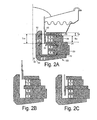
- FIGS. 2A-C show, in cross-section, one embodiment of a speaker geometry according to this invention, having one voice coil and having two air gaps over which the magnetic flux is in the same direction.
- FIGS. 3A-C show, in cross-section, a second embodiment of a speaker, having two same direction magnetic flux air gaps and two tandem voice coils.
- FIG. 4 shows, in cross-section, a third embodiment of a speaker geometry, having three air gaps and one voice coil.
- FIGS. 5A-F show, in cross-section, a fourth embodiment of a speaker geometry, having three air gaps and a single voice coil.
- FIG. 6 shows, in cross-section, a fifth embodiment of a speaker geometry, having a cooling device built into the magnet assembly, with two air gaps and one voice coil.
- FIG. 7 shows, in cross-section, a sixth embodiment of a speaker geometry, using internal magnets, two air gaps, and one voice coil.
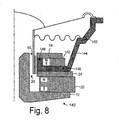
- FIG. 8 shows, in cross-section, a seventh embodiment of a speaker geometry, with a unified frame and heatsink.
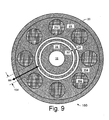
- FIG. 9 shows, in top view, an eighth embodiment of a speaker geometry, in which the upper magnet is comprised of a plurality of smaller magnets having spaces between them to permit airflow to cool the voice coil.
- FIG. 10 shows, in cross-section, a ninth embodiment of a speaker geometry using a combination of an external ring magnet as the primary magnet and an internal disc magnet for the upper magnetic air gap.
- FIG. 11 shows, in cross-section, a tenth embodiment of a speaker geometry using an internal disc magnet as the primary magnet and an external ring magnet for the upper magnetic air gap.
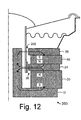
- FIG. 12 shows, in cross-section, one embodiment of an external magnet geometry speaker using a bucking magnet with low reluctance return path, according to this invention.
- FIG. 13 shows, in cross-section, another embodiment of the invention in which there are multiple drive magnetic air gaps.
- FIG. 14 shows, in cross-section, another embodiment in which there is a heatsink.
- FIG. 15 shows, in cross-section, an internal magnet geometry speaker, according to this invention.
- FIG. 16 shows, in cross-section, a shielded external magnet geometry speaker, according to this invention.
- FIG. 17 shows, in cross-section, an internal magnet geometry speaker, with low reluctance bucking magnet return path, multiple drive magnetic air gaps, and heatsink, according to this invention.
- FIG. 18 shows, in cross-section, another embodiment of a hybrid geometry including a low reluctance return path.
- FIG. 19 shows, in cross-section, another embodiment of a hybrid geometry including a low reluctance return path.
- FIG. 20 shows, in cross-section, another external magnet geometry speaker.
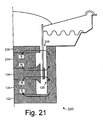
- FIG. 21 shows, in cross-section, another internal magnet geometry speaker.
- FIG. 22 shows, in cross-section, another internal magnet geometry speaker.
- the invention may be utilized in a variety of magnetic transducer applications, including but not limited to audio speakers, microphones, mechanical position sensors, actuators (which can be linear motors), and the like.
- audio speaker embodiments but this should be considered illustrative and not limiting.
- the invention may prove especially useful in high ("large") excursion applications such as subwoofer speakers, but, again, this should not be considered limiting.
- This invention permits the simultaneous utilization of less than 100% of the magnetic air gap and less than 100% of the voice coil windings.
- this invention allows optimum linear excursion to be achieved with the simultaneous utilization of 50% of the voice coil windings and 33% of the magnetic gap, or as another example, 66% of the magnetic gap and 33% of the voice coil windings could be obtained.
- a multitude of ratios are possible. This allows the designer to achieve a desired balance between, or combination of: high frequency extension, low frequency extension and enclosure volume, efficiency, linear excursion, cost, power handling, and size of the motor structure. The designer can now achieve a much broader range of combinations than were previously attainable.
- FIG. 2A illustrates one embodiment of a speaker 50 according to this invention.
- the speaker includes a pole plate 12 including a back plate 16 and a pole piece 14 which can be either integral with or coupled to the back plate.
- this hole may be advantageous to adapt this hole with beveled ends 52, 54, for improved aerodynamic performance with less turbulence, allowing the use of a smaller hole or vent without causing too much distortion. If the vent is made too large, the magnetic efficiency is reduced, because of the reduced quantity of steel in the pole, which in turn could lead to magnetic saturation of the steel.
- the magnet assembly includes a first permanent magnet 20, first plate 24, and first magnetic air gap 26 as in the prior art.
- the invention further includes a magnetic material member 56 which may, in some embodiments, be a second permanent magnet.
- the magnetic material member is oriented with its flux in the same direction as the first magnet, or, in other words, such that the first magnet 20 and the magnetic material member 56 have opposite poles facing each other.
- the speaker further includes a second plate 58 which defines a second magnetic air gap 60.
- the frame and the diaphragm assembly including the bobbin or tube, diaphragm, spider, surround, and dust cover may be substantially as known in the prior art.
- the voice coil, first plate, second magnet, and second plate may advantageously be sized such that the voice coil extends from the center of one plate to the center of the other plate.
- the voice coil may advantageously have a height Tvc which is substantially equal to the height Tm of the second magnet plus the height Tp of the second plate (which in most instances should be the same height as the first plate so the two air gaps are of equal height). In order to travel into a nonlinear response region, the voice coil would have to travel so far as to have its bottom end enter the upper second air gap, or its top end enter the lower first air gap.
- the voice coil a peak-to-peak linear travel equal to the height (thickness) Tp of the upper top plate plus twice the height Tm of the space between the magnetic air gaps.
- the two plates are of equal thickness, and the second magnet 56 should be at least as thick as either of the plates.
- the relative sizes of the magnets, plates, pole plate, and pole piece can be determined according to the specific requirements of a particular application, and are well within the abilities of ordinary skilled speaker designers, once armed with the teachings of this patent. For example, it may often be the case that the lower magnet will need to be larger (or, more to the point, more powerful) than the upper magnet, in order to have equal flux through the two air gaps, because the lower plate, between the magnets, will shunt some percentage of the lower magnet's flux directly into the upper magnet rather than through the first air gap.
- FIGS. 2B and 2C illustrate the embodiment of FIG. 2A with the voice coil at the points of maximum extension and retraction, respectively, in the region of linear excursion (Xmax).
- Xmax region of linear excursion
- FIGS. 2A-C there is an equivalent of one magnetic air gap active (100% of the top magnetic air gap in FIG. 2B, 50% of each of the two magnetic air gaps in FIG. 2A, and 100% of the bottom magnetic air gap in FIG. 2C), and a total of one magnetic air gap's height of voice coil windings active.
- 50% of the total available magnetic air gap is active, with a corresponding length of voice coil, which is equal to Tvc minus Tm.
- FIG. 3A illustrates a second embodiment of a speaker geometry 70 according to this invention, which is similar to the first embodiment except that it includes two voice coils 72, 74.
- the two voice coils should be of the same height, and the distance from the center of one to the center of the other should equal the distance between the two air gaps (or, in other words, the thickness of the magnetic material member which is between their respective plates).
- the space between the two plates and each of the two plates should be of equal thickness, and this thickness should be the same as the height, Tvc, of one of the voice coils plus the space, Ts, between the voice coils, so that when, for example, the top voice coil is just beginning to exit the top of the top magnetic air gap during extension, the bottom voice coil will be just beginning to enter the top magnetic air gap.
- FIGS. 3A-C illustrate one very optimized embodiment, in which the height Tvc of each voice coil is a distance H, the height Tp1, Tp2 of each magnetic air gap is a distance 2H, and the distance Tm between the magnetic air gaps is 2H.
- This geometry gives a linear peak-to-peak excursion of 7H; at one extreme, the top edge of the bottom voice coil is even with the top of the top magnetic air gap, and at the other extreme, the bottom edge of the top voice coil is even with the bottom of the bottom magnetic air gap.
- the voice coils are wound in the same direction, and the electrical signal is applied to them in the same polarity. In another embodiment, the voice coils are wound in opposite directions, and they receive opposite polarity electrical signals.
- the pole plate may be adapted with a groove 66 into which the voice coil bobbin may extend at its maximum downward excursion, preventing the bobbin from striking the pole plate, which would grossly distort the sound and possibly damage the bobbin or voice coil and/or other components.
- the pole piece may be adapted with a groove 78 substantially opposite the spacer or magnet between the air gaps, a groove 80 above the upper magnetic air gap, and a groove 82 below the lower magnetic air gap, to further improve linearity by concentrating more of the flux into the air gaps and creating symmetrical fringing fields above and below the edges of each air gap.
- FIG. 4 illustrates a third embodiment of a speaker geometry 90 according to this invention.
- the speaker includes a pole plate 12, first magnet 20, first plate 24, magnetic material member 56, second plate 58, and other components generally similar to those of the first embodiment.
- the speaker further includes a top magnetic material member 92 and a third plate 94 to define a third magnetic air gap 96. By including three or more air gaps, the total linear excursion of the voice coil can be made very large.
- the flux density can be made substantially equal over each of the gaps, which results in optimum linearity over the entire range of linear voice coil travel. Selection of the particular thicknesses and diameters is well within the ordinary skill of those in this field armed with the previous discussion, and need not be discussed in detail here.
- FIGS. 5A-F illustrate a fourth embodiment of a speaker geometry 100 which is similar to that of FIG. 4.
- the speaker includes pole plate 12, primary magnet 20, first gap plate 24, magnetic material member 56, second gap plate 58, magnetic material member 92, third gap plate 94, and bobbin 30, as well as the rest of the diaphragm assembly (not shown).
- the speaker further includes a voice coil 102 which extends from the center of the top magnetic air gap to the center of the bottom magnetic air gap, as shown.
- the speaker may optionally include a magnetically conductive spacer 104, if the primary magnet is not sufficiently thick to allow clearance for full voice coil travel.
- FIG. 5A This configuration has the equivalent of two magnetic air gaps - 66% of the total - active over the entire linear excursion.
- the middle magnetic air gap is active, and one half of each of the top and bottom magnetic air gaps are active.
- FIG. 5B illustrates the diaphragm assembly at its most extended linear excursion position, in which the bottom of the voice coil is even with the bottom of the middle magnetic air gap; the top and middle magnetic air gaps are active, and the bottom magnetic air gap is inactive.
- the middle magnetic air gap progressively becomes inactive.
- the speaker does not immediately exhibit high distortion. Instead, one full magnetic air gap (the top one) remains fully active until the position shown in FIG. 5C, where the bottom of the voice coil encounters the bottom of the top magnetic air gap. Only after that point, as the voice coil continues extending outward, does the electro-motive drive of the speaker trail off toward zero, at the point shown in FIG. 5D, where the bottom of the voice coil has left the top edge of the top magnetic air gap.
- FIG. 5E illustrates the other end of the linear excursion, where the top of the voice coil encounters the top of the middle magnetic air gap. Then, as the voice coil continues withdrawing, the middle magnetic air gap progressively becomes inactive, but the bottom magnetic air gap remains fully active until the position shown in FIG. 5F, where the top of the voice coil encounters the top of the bottom magnetic air gap. As the voice coil then continues withdrawing, the speaker electro-motive drive will approach zero when the voice coil completely leaves the bottom magnetic air gap.
- Fig. 5F clearly demonstrates the purpose of the spacer between the bottom magnet and the pole plate, which is to provide enough space between the bottom magnetic air gap and the pole plate such that the voice coil and bobbin do not strike the pole plate.
- This geometry provides good sound quality over an extended dynamic range, due to its stepped function in which there are, in effect, two levels of linear excursion: a center travel region in which two magnetic air gaps are active, and an outer region on either end of this center region, in which one magnetic air gap is active.
- FIG. 6 illustrates a fifth embodiment of a speaker geometry 110 according to this invention.
- the speaker includes a pole plate 12, first magnet 20, first plate 24, and diaphragm assembly as in the first embodiment.
- the speaker further includes a heatsink plate 112 which is made of a non-magnetically conductive and, ideally, highly thermally conductive, material such as aluminum.
- the heatsink plate may advantageously be equipped with a thermal dissipator portion 114 which, in some embodiments, may have a thickness Ths which is substantially greater than the thickness Tsp of the central portion of the heatsink plate.
- the overall diameter of the heatsink plate should be sufficiently greater than those of the surrounding components to allow adequate clearance for the thicker heatsink perimeter.
- the heatsink may include axial or radial slots or fins to increase surface area and improve thermal transfer.
- the speaker further includes a second plate 116 and a second permanent magnet 118.
- the second magnet is oriented opposite to the first magnet, so the magnetic flux across the two air gaps is in the same direction, enabling the use of a single voice coil or multiple voice coils generating the same electromagnetic polarity.
- FIG. 7 illustrates a sixth embodiment of a speaker geometry 120 which utilizes internal magnets and plates rather than external ring magnets and plates. Typically, this is the geometry that is employed with neodymium-iron-boron magnets or other rare earth magnets.
- the magnetic return path is via an outer perimeter of a yoke or cup 122 rather than via a pole piece.
- Within the cup are housed an internal magnet 124, a first plate 126 which defines a first magnetic air gap 128, a magnetic material member 130 which may be a permanent magnet or merely a ferrous spacer, and a second plate 132 which defines a second magnetic air gap 134.
- the bobbin may be equipped with one or more voice coils generating the same polarity and sized as indicated above.
- the magnet or spacer 130 may be sized (in diameter) such that the magnetic flux over the top magnetic air gap is substantially the same as the magnetic flux over the bottom air magnetic gap.
- the magnet or spacer 130 may be ring shaped.
- the top magnet is the same diameter as the bottom magnet, but is made of weaker magnetic material.
- holes may be provided through the cup and/or plates and/or magnets to provide air flow to both cool and depressurize the assembly when the voice coil and diaphragm are in heavy movement. In some embodiments, this may be accomplished with one central hole, in an internal ring magnet configuration.
- FIG. 8 illustrates a seventh embodiment of the invention, which is similar to those of FIGS. 2 and 6.
- the speaker 140 includes a pole plate 12, primary magnet 20, first magnetic air gap plate 24, and second magnetic air gap plate 58, as before.
- the top magnet 142 has an enlarged inner diameter to accommodate a combined frame and heatsink 144.
- the heatsink-frame 144 is made of a non-magnetically conductive material, such as aluminum, and includes a portion 146 which is disposed between the first plate and the top magnet, a portion 148 which is disposed within the enlarged inner diameter of the upper magnetic material member such that an enlarged surface area of the heatsink is exposed to the section of the voice coil spanning between the air gaps, and a portion 150 which serves as the frame to support the diaphragm assembly.
- the inner surface of the heatsink portion 148 is substantially aligned with, or slightly recessed from, the inner diameters of the two plates.
- FIG. 9 illustrates an alternative embodiment which may optionally be practiced in combination with other principles taught herein.
- Portions of a motor assembly 160 are shown in top view. From the top, the pole piece 14 is visible, with its optional air vent hole 18. The bobbin 30 and voice coil 28 are seen in cross-section when viewed from above. The bottom, primary magnet 20 is visible and disposed about the pole piece. The first plate 24 is disposed about the pole piece, and is magnetically coupled to the bottom magnet. The second plate is not shown, so that the reader can see the multiple top magnetic material members 162 which are disposed about the axis of the motor. Spaces 164 exist between adjacent top magnetic material members, to permit airflow in and out of the motor structure, to improve cooling.
- the motor structure may include a screen or mesh (not shown) to prevent foreign particles from entering into the motor through the spaces between the top magnets.
- the top magnets 162 have their magnetic poles aligned such that e.g. their North poles are facing out of the page.
- the top magnets are not necessarily of a round disc shape, and that other shapes, with or without holes, will offer different advantages. For example, a set of wedge-shaped top magnets will offer increased surface area and increased magnetic flux across the top magnetic air gap (not shown).
- the total linear excursion in single voice coil embodiments of a speaker is substantially equal to: ((NG - K + 1) * HS) + ((NS - K + 1) * HG)
- K is the number of magnetic air gaps which the voice coil can have active at a time
- NG is the number of magnetic air gaps
- NS is the number of spaces between the magnetic air gaps (or, in other words, NG - 1)
- HG is the height of a magnetic air gap
- HS is the height of the space between adjacent magnetic air gaps, as long as K is less than NG.
- FIG. 10 illustrates a ninth embodiment of a dual-gap speaker 170 using a hybrid geometry.
- the speaker includes a pole plate 172 and a primary magnet 20 which is an external ring magnet.
- An annular external top plate or return path member 174 is magnetically coupled to the primary magnet and defines a bottom magnetic air gap 176 between the annular external top plate and the pole piece of the pole plate.
- An internal top magnet 130 which may be a disc magnet, is magnetically coupled to the top of the pole piece, and has its magnetic poles oriented opposite those of the primary magnet with respect to the axis of the speaker.
- An internal top plate 126 is magnetically coupled to the internal top magnet.
- the top magnetic air gap 178 is defined between the annular external top plate and the internal top plate. Magnetic flux over the two magnetic air gaps is in the same direction with respect to the pole piece or magnetic return path member.
- a voice coil 28 and bobbin 30 assembly rides in the magnetic air gaps.
- FIG. 11 illustrates a tenth embodiment of a dual-gap speaker 180 using a different hybrid geometry.
- the speaker includes a cup which may include a back plate 182 and a side wall member 184, or it can be a monolithic structure.
- An internal magnet 124 which may be a disc magnet, is the primary magnet and is magnetically coupled to the cup.
- An extended internal top plate member 186 which may alternatively be considered as a pole piece, is magnetically coupled to the primary magnet.
- An external ring top magnet 56 is magnetically coupled to the cup, optionally over a non-magnetically conductive heatsink 188, and has its magnetic poles oriented opposite those of the primary internal magnet, with respect to the axis of the speaker.
- An external top plate 58 is magnetically coupled to the external top magnet.
- the pole piece 186 defines a bottom magnetic air gap between itself and the cup, and a top magnetic air gap between itself and the external top plate.
- the pole piece may be adapted with a hole 190 for reducing its weight and improving cooling of the motor structure.
- the hole can extend through the pole piece, the internal primary magnet (which is, then, a ring magnet), and the cup.
- a voice coil 28 and bobbin 30 assembly rides in the magnetic air gaps.
- FIG. 12 illustrates one embodiment of a speaker 200 according to this invention.
- the diaphragm assembly may be substantially unaltered from that illustrated above.
- the magnet assembly of the speaker includes a pole plate, a primary magnet 20, a primary plate 24, and a bucking magnet 33 as in the prior art.
- the bucking magnetic air gap 202 defined by the bucking plate or low reluctance return path plate 35 is not a drive magnetic air gap, and no voice coil is present in it. Rather, the magnetic air gap 202 is a low reluctance return path for the magnetic flux from the drive plate 24 to the bucking magnet 33 over the bucking plate 35.
- This second magnetic air gap which has its magnetic flux in the opposite direction to that of the primary or drive magnetic air gap 26, serves not only to increase the magnetic flux over the drive magnetic air gap (by providing a low reluctance return path for the bucking magnet), but also provides braking action to reduce over-extension of the diaphragm assembly.
- the diaphragm assembly is electromagnetically inert in the low reluctance return path magnetic air gap; however, under conditions of extreme excursion, the voice coil may enter the bucking magnetic air gap, which will result in braking action due to the flux over the bucking air gap being in the opposite direction from that of the drive air gap(s).
- the bucking magnet may be made smaller than the primary drive magnet.
- the bucking plate may also be termed a return path plate.
- FIG. 13 illustrates another embodiment of a speaker 210 according to this invention, in which the speaker includes a dual magnetic air gap geometry similar to that of FIG. 2A.
- the speaker includes a pole plate 12, a primary magnet 20, a primary plate 24 with its magnetic air gap 26, a bucking magnet 33, and a bucking plate 35 with its magnetic air gap 202.
- the speaker further includes a second magnet or magnetic material member 56 oriented in the same polarity as the primary magnet and positioned between the primary plate and the bucking magnet, and a second drive plate 58 which creates a second drive magnetic air gap 60 with its flux in the same direction as the flux over the primary drive magnetic air gap.
- This geometry provides the advantages of the dual magnetic air gap, such as increased linear excursion, plus the advantages of the bucking plate.
- the bucking plate can serve not only to increase the flux density over its neighboring drive gap, but also to reduce or avoid magnetic saturation in the return path member (pole piece or cup).
- the second magnet may be replaced with a spacer.
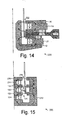
- FIG. 14 illustrates a speaker 220 similar to that of FIG. 6, with the addition of a return path plate 35 which provides a low reluctance return path over a non-driving magnetic air gap 222 to the top magnet 118.
- FIG. 15 illustrates another embodiment of an internal magnet geometry speaker 230 similar to that of FIG. 7.
- the speaker includes a magnetically conductive cup 232, a first drive magnet 124, and a first drive plate 126 which defines a first magnetic air gap 128 between the first drive plate and the cup.
- the speaker may further include a second drive magnet 130 and a second drive plate 132 which defines a second drive magnetic air gap 134.
- the component 130 can be a non-magnetically conductive spacer, in which case the upper magnet 234 provides substantially all of the magnetic flux for the upper drive magnetic air gap 134.
- the two (or more) drive magnets are oriented in the same polarity, such that their magnetic flux is in the same direction over the two (or more) respective drive magnetic air gaps.
- the cup may be a monolithic structure, as shown, or it may be formed by coupling separate back and side members. In most embodiments, it will be found advantageous to have the bucking plate disposed within the cup. In other embodiments, it may be acceptable to dispose the bucking plate slightly outside (above) the cup, albeit with a tradeoff in the efficiency of the return path.
- FIG. 16 illustrates another embodiment of an external magnet geometry speaker 240 which includes a pole plate 12, a primary drive magnet 20, a first drive plate 24, a bucking magnet 33, and a second drive plate 58 as in FIG. 13.
- the speaker is shielded by the addition of a magnetically conductive shield 242 which is coupled to the pole plate.
- the shield includes a plate portion 244 which defines a low reluctance air gap return path 246 for the bucking magnet, and a cylinder portion 248 which is magnetically coupled to the pole plate.
- the plate portion and the cylinder portion can be coupled to each other, or formed as a monolithic unit. In other embodiments, the cylinder portion could be formed as an integral portion of the pole plate.
- a non magnetically conductive spacer may be disposed between the first and second drive plates to help hold them in position; in some such embodiments, the spacer may contact the cylinder portion of the shield to improve thermal transfer away from the drive magnetic air gaps.
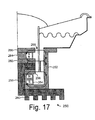
- FIG. 17 illustrates an internal magnet geometry speaker 250 which is particularly suited for high power applications in which it is necessary to remove significant amounts of heat from the speaker.
- the speaker includes a cup 252 which encloses a ring-shaped primary drive magnet 254 and a ring-shaped primary drive plate 256 which defines a first drive magnetic air gap, whereas conventional internal magnet geometry speakers would have a disc-shaped magnet and plate.
- a non magnetically conductive slug 258 or spacer extends through the primary drive plate and primary drive magnet, and is coupled to a heatsink 260 which is external to the motor or magnet assembly. In some embodiments, the heatsink may also be in thermal contact with the cup (as shown).
- the top drive plate may get part of its flux from the bottom magnet (as shown), or the bottom drive plate may get part of its flux from the top magnet.
- a second drive plate 262 resides in the cup to define a second drive magnetic air gap, and can be disc-shaped or ring-shaped.
- the second drive plate may be coupled to the top of the slug, such that the thickness of the top portion of the slug determines the distance between the drive magnetic air gaps.
- a bucking magnet 264 is coupled between the second drive plate and a bucking plate 266.
- the bucking plate defines a non-driving low reluctance return path 268 from the cup to the bucking magnet.
- the slug and the heatsink may be fashioned of any suitable non magnetically conductive material which has adequate thermal transfer properties, such as aluminum.
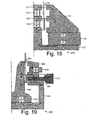
- FIG. 18 illustrates another embodiment of a hybrid geometry speaker 270 which is similar to that of FIG. 10.
- the speaker includes an internal bucking magnet 272 which has its polarity opposite that of the internal upper drive magnet 130 and the same as that of the external primary drive magnet 20.
- component 130 can be a soft magnetic material, which enables the manufacturer to charge both magnet 20 and magnet 272 at the same time after assembly of the motor.
- An internal low reluctance return path plate or bucking plate 274 is magnetically coupled to the bucking magnet and defines a non-driving return path magnetic air gap 276 back to the external return path member 174.
- FIG. 19 illustrates another embodiment of a hybrid geometry speaker 280 similar to those of FIGS. 11 and 14.
- the speaker includes a drive plate 185 which is coupled to a cup 183 containing an internal primary drive magnet 124 and internal pole piece 186, and is like the embodiment of FIG. 11 in that the pole piece and cup define the lower drive magnetic air gap.
- the speaker includes a heatsink 112, an annular plate 116, and an external bucking magnet 118, and is like the embodiment of FIG. 14 in that the pole piece and the external plate define the upper drive magnetic air gap.
- this speaker also includes an external return path plate 282 (analogous to plate 35 of FIG.
- the heatsink and the frame may be one monolithic structure, in which the frame or basket becomes a part of the radiative structure of the heatsink.
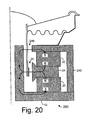
- FIG. 20 illustrates another embodiment of an external magnet geometry transducer 290 including a pole plate 12, a primary drive magnet 20, a drive plate 24, a bucking magnet 33, and an external shield 242 which is coupled to the pole plate and the bucking magnet.
- the drive plate has an extended internal margin to facilitate an underhung voice coil in a lengthened drive magnetic air gap 26.
- a low reluctance return path 246 is provided from the pole piece to the bucking magnet by the non-driving magnetic air gap between the pole piece and the shield.
- FIG. 21 illustrates another embodiment of an internal magnet geometry transducer 300 including a cup 122, a primary drive magnet 124, a drive plate 126, a bucking magnet 234, and a return path plate 236.
- the voice coil is active in a drive magnetic air gap 128, and a low reluctance return path 238 is provided by the non-driving magnetic air gap between the cup and the return path plate.
- FIG. 22 illustrates another embodiment of an internal magnet geometry transducer 310 which includes a cup 122, a primary drive magnet 124, a lower drive plate 126 which defines a lower drive magnetic air gap 128, a non-magnetically conductive spacer 212, an upper drive plate 132 which defines an upper drive magnetic air gap 134, a bucking magnet 234, and a return path plate 236 which provides a low reluctance return path from the cup to the bucking magnet over a non-driving magnetic air gap 238.
- the phrase “magnetically coupled to” is intended to mean “in magnetic communication with” or in other words “in a magnetic flux circuit with”, and not “mechanically affixed to by means of magnetic attraction.”
- the phrase “air gap” is intended to mean “gap over which magnetic flux is concentrated” and not limited to the case where such gap is actually filled with air; the gap could, in some applications, be filled with any suitable gas or liquid such as magnetic fluid, or even be under vacuum.
Landscapes
- Physics & Mathematics (AREA)
- Engineering & Computer Science (AREA)
- Acoustics & Sound (AREA)
- Signal Processing (AREA)
- Audible-Bandwidth Dynamoelectric Transducers Other Than Pickups (AREA)
Applications Claiming Priority (2)
| Application Number | Priority Date | Filing Date | Title |
|---|---|---|---|
| US289080 | 1988-12-22 | ||
| US10/289,080 US6940992B2 (en) | 2002-11-05 | 2002-11-05 | Push-push multiple magnetic air gap transducer |
Publications (2)
| Publication Number | Publication Date |
|---|---|
| EP1418793A2 true EP1418793A2 (fr) | 2004-05-12 |
| EP1418793A3 EP1418793A3 (fr) | 2007-01-24 |
Family
ID=32107631
Family Applications (1)
| Application Number | Title | Priority Date | Filing Date |
|---|---|---|---|
| EP03256925A Withdrawn EP1418793A3 (fr) | 2002-11-05 | 2003-10-31 | Transducteur électromagnétique avec voie de retour à reluctance faible |
Country Status (4)
| Country | Link |
|---|---|
| US (2) | US6940992B2 (fr) |
| EP (1) | EP1418793A3 (fr) |
| CN (1) | CN1553743A (fr) |
| BR (1) | BR0304851A (fr) |
Cited By (3)
| Publication number | Priority date | Publication date | Assignee | Title |
|---|---|---|---|---|
| EP2424272A3 (fr) * | 2010-08-25 | 2013-09-18 | Harman International Industries, Incorporated | Haut-parleur à aimant divisé |
| EP2672730A3 (fr) * | 2012-06-10 | 2015-10-14 | Apple Inc. | Systèmes et procédés de réduction de flux magnétique parasite |
| EP2007170B1 (fr) * | 2007-06-20 | 2020-02-12 | Shandong Gettop Acoustic Co., Ltd | Transducteur électro-acoustique miniature à haute efficacité et de dimensions réduites |
Families Citing this family (48)
| Publication number | Priority date | Publication date | Assignee | Title |
|---|---|---|---|---|
| JP3946047B2 (ja) * | 2002-01-21 | 2007-07-18 | アルパイン株式会社 | スピーカの磁気回路 |
| US6940992B2 (en) * | 2002-11-05 | 2005-09-06 | Step Technologies Inc. | Push-push multiple magnetic air gap transducer |
| US20040131223A1 (en) * | 2003-01-06 | 2004-07-08 | Stiles Enrique M. | Electromagnetic transducer having a hybrid internal/external magnet motor geometry |
| US7961892B2 (en) * | 2003-07-28 | 2011-06-14 | Texas Instruments Incorporated | Apparatus and method for monitoring speaker cone displacement in an audio speaker |
| JP4573576B2 (ja) * | 2004-06-14 | 2010-11-04 | 株式会社オーディオテクニカ | ダイナミックマイクロホン |
| US20070030995A1 (en) * | 2004-08-05 | 2007-02-08 | Pt. Hartono Istana Teknologi | Loudspeaker with natural hair leather diaphragm |
| US20060029249A1 (en) * | 2004-08-05 | 2006-02-09 | Pt. Hartono Istana Teknologi | Loudspeaker with hair leather diaphragm |
| JP2006060443A (ja) * | 2004-08-19 | 2006-03-02 | Pioneer Electronic Corp | スピーカ装置及びスピーカ装置の放熱部材 |
| KR100651766B1 (ko) * | 2004-10-18 | 2006-12-01 | 김성배 | 듀얼 마그넷을 구비한 자기회로 및 이를 이용한 스피커와진동발생장치 |
| US20070160257A1 (en) * | 2005-04-13 | 2007-07-12 | Stiles Enrique M | Axial magnet assisted radial magnet air return motor for electromagnetic transducer |
| US8249291B2 (en) * | 2006-03-28 | 2012-08-21 | Harman International Industries, Incorporated | Extended multiple gap motors for electromagnetic transducers |
| EP1843628A1 (fr) * | 2006-04-07 | 2007-10-10 | Sonion Horsens A/S | Haut-parleur miniature et circuit magnetique avec passage de veine d'air integree |
| US20070297639A1 (en) * | 2006-06-21 | 2007-12-27 | Noll Michael A | Multiple magnet loudspeaker |
| JP5061202B2 (ja) * | 2007-02-22 | 2012-10-31 | ハーマン インターナショナル インダストリーズ インコーポレイテッド | スピーカ磁束収集システム |
| US20100054520A1 (en) * | 2008-08-28 | 2010-03-04 | Jason Myles Cobb | Loudspeaker |
| US8121337B2 (en) * | 2008-09-08 | 2012-02-21 | Eugen Nedelcu | Free air magnetic circuit and speaker |
| KR101607957B1 (ko) * | 2008-09-29 | 2016-04-01 | 삼성전자주식회사 | 푸쉬풀 방식의 스피커 장치 및 이의 제조 방법 |
| US8249292B1 (en) | 2010-01-13 | 2012-08-21 | Eminence Speaker, LLC | Mechanically adjustable variable flux speaker |
| CN202009322U (zh) * | 2011-01-05 | 2011-10-12 | 瑞声声学科技(深圳)有限公司 | 多功能振动器 |
| CN201937818U (zh) * | 2011-01-05 | 2011-08-17 | 瑞声光电科技(常州)有限公司 | 发声器 |
| US20140119591A1 (en) * | 2011-07-25 | 2014-05-01 | AAC Microtech(Changzhou) Co., Ltd | Micro-speaker |
| US9049506B2 (en) * | 2011-07-26 | 2015-06-02 | Aac Acoustic Technologies (Shenzhen) Co., Ltd. | Micro-speaker |
| CN102953883B (zh) * | 2012-05-04 | 2015-02-04 | 浙江福爱电子有限公司 | 一种储能式高压电子燃油泵、供油装置及其应用方法 |
| JP6224324B2 (ja) | 2012-07-06 | 2017-11-01 | ハーマン ベッカー ゲープコチレンジャー ジーアルト コールライトルト フェレルーシェグ タイヤーシャーシャイグ | 音響変換器アセンブリ |
| US8855356B1 (en) * | 2012-12-18 | 2014-10-07 | Skullcandy, Inc. | Dual ring magnet apparatus |
| US9325183B2 (en) * | 2012-12-21 | 2016-04-26 | Nokia Technologies Oy | Reducing inductive heating |
| WO2014134706A1 (fr) * | 2013-03-06 | 2014-09-12 | Sentient Magnetics, Inc. | Ensemble transducteur acoustique |
| WO2014134711A1 (fr) * | 2013-03-06 | 2014-09-12 | Sentient Magnetics, Inc. | Ensemble transducteur acoustique |
| US10178479B2 (en) * | 2013-03-15 | 2019-01-08 | Jeffrey K. Permanian | Speaker driver |
| US9445201B2 (en) * | 2013-11-21 | 2016-09-13 | Harman International Industries, Inc. | Inverted dual coil transducer |
| WO2016082046A1 (fr) * | 2014-11-28 | 2016-06-02 | Audera Acoustics Inc. | Systèmes de transducteurs acoustiques à déplacement élevé |
| CN204733374U (zh) * | 2015-06-23 | 2015-10-28 | 瑞声光电科技(常州)有限公司 | 扬声器 |
| CN204887453U (zh) * | 2015-07-31 | 2015-12-16 | 瑞声光电科技(常州)有限公司 | 扬声器 |
| US11172308B2 (en) | 2015-08-04 | 2021-11-09 | Curtis E. Graber | Electric motor |
| US10375479B2 (en) | 2015-08-04 | 2019-08-06 | Curtis E. Graber | Electric motor |
| US9668060B2 (en) * | 2015-08-04 | 2017-05-30 | Curtis E. Graber | Transducer |
| US9854365B2 (en) * | 2016-04-15 | 2017-12-26 | Harman International Industries, Inc. | Loudspeaker motor and suspension system |
| WO2019134162A1 (fr) | 2018-01-08 | 2019-07-11 | 深圳市韶音科技有限公司 | Haut-parleur à conduction osseuse |
| CN108900956B (zh) * | 2018-07-03 | 2020-08-11 | 帝耳数码音频(龙南)有限公司 | 简约型全频音箱 |
| DK180111B1 (en) * | 2018-10-04 | 2020-05-06 | Upper Level Aps | A magnet system for an electromechanical transducer |
| WO2020173699A1 (fr) * | 2019-02-28 | 2020-09-03 | Purifi Aps | Moteur de haut-parleur à linéarité améliorée |
| GB2593749B (en) * | 2020-04-01 | 2024-01-03 | B & W Group Ltd | Improvements in and relating to loudspeaker magnet assemblies |
| CN111818431B (zh) * | 2020-08-31 | 2020-12-08 | 歌尔股份有限公司 | 扬声器及其制作方法 |
| US12425774B2 (en) | 2020-09-03 | 2025-09-23 | Purifi Aps | Loudspeaker motor with inner permanent magnet |
| FR3123533B1 (fr) | 2021-05-31 | 2023-12-08 | Devialet | Moteur de Haut-parleur à deux aimants opposés |
| JP7353667B2 (ja) * | 2022-01-28 | 2023-10-02 | ウエタックス株式会社 | スピーカ |
| JP7798686B2 (ja) * | 2022-05-10 | 2026-01-14 | フォスター電機株式会社 | 振動発生装置 |
| US20240381032A1 (en) * | 2023-05-08 | 2024-11-14 | Juluen Enterprise Co., Ltd. | Double gap double coil driven speaker |
Family Cites Families (19)
| Publication number | Priority date | Publication date | Assignee | Title |
|---|---|---|---|---|
| US2985092A (en) * | 1957-09-18 | 1961-05-23 | Westinghouse Electric Corp | Handle for window mounted appliance |
| JPS59139794A (ja) * | 1983-01-31 | 1984-08-10 | Ibuki Kogyo Kk | 漏洩磁場を打消したホ−ンスピ−カ− |
| GB8321810D0 (en) * | 1983-08-12 | 1983-09-14 | Linn Prod Ltd | Loudspeaker with notional feedback |
| JPS6175696U (fr) | 1984-10-23 | 1986-05-21 | ||
| JPH05122792A (ja) | 1991-10-25 | 1993-05-18 | Matsushita Electric Ind Co Ltd | スピーカ |
| US5461677A (en) * | 1993-09-16 | 1995-10-24 | Ferrofluidics Corporation | Loudspeaker |
| CA2218471C (fr) * | 1995-04-18 | 2000-05-02 | Douglas J. Button | Commande a deux bobines avec boitier multifonction |
| JP3625233B2 (ja) | 1995-12-26 | 2005-03-02 | フオスター電機株式会社 | スピーカユニット及びスピーカシステム |
| US5687248A (en) | 1996-05-02 | 1997-11-11 | Industrial Technology Research Institute | Light weight and low magnetic leakage loudspeaker |
| JP2000152381A (ja) * | 1998-11-17 | 2000-05-30 | Sony Corp | スピーカ及びスピーカ装置 |
| JP2000188798A (ja) * | 1998-12-22 | 2000-07-04 | Sony Corp | スピーカ及びスピーカ装置 |
| JP3984397B2 (ja) * | 1999-09-14 | 2007-10-03 | パイオニア株式会社 | スピーカ |
| US6229902B1 (en) * | 1999-11-09 | 2001-05-08 | Lucio Proni | Loudspeaker with frame cooling structure |
| CN1163104C (zh) | 2000-08-24 | 2004-08-18 | 松下电器产业株式会社 | 扬声器及其所使用的磁回路 |
| GB0102780D0 (en) * | 2001-02-03 | 2001-03-21 | K H Technology Corp | Loudspeaker assemblies |
| US7039213B2 (en) | 2002-01-16 | 2006-05-02 | Hyre David E | Speaker driver |
| JP3946047B2 (ja) | 2002-01-21 | 2007-07-18 | アルパイン株式会社 | スピーカの磁気回路 |
| US6940992B2 (en) * | 2002-11-05 | 2005-09-06 | Step Technologies Inc. | Push-push multiple magnetic air gap transducer |
| US20040131223A1 (en) * | 2003-01-06 | 2004-07-08 | Stiles Enrique M. | Electromagnetic transducer having a hybrid internal/external magnet motor geometry |
-
2002
- 2002-11-05 US US10/289,080 patent/US6940992B2/en not_active Expired - Fee Related
-
2003
- 2003-10-31 EP EP03256925A patent/EP1418793A3/fr not_active Withdrawn
- 2003-11-05 BR BR0304851-9A patent/BR0304851A/pt not_active Application Discontinuation
- 2003-11-05 CN CNA2003101231594A patent/CN1553743A/zh active Pending
-
2005
- 2005-04-13 US US11/105,811 patent/US7065225B2/en not_active Expired - Lifetime
Cited By (4)
| Publication number | Priority date | Publication date | Assignee | Title |
|---|---|---|---|---|
| EP2007170B1 (fr) * | 2007-06-20 | 2020-02-12 | Shandong Gettop Acoustic Co., Ltd | Transducteur électro-acoustique miniature à haute efficacité et de dimensions réduites |
| EP2424272A3 (fr) * | 2010-08-25 | 2013-09-18 | Harman International Industries, Incorporated | Haut-parleur à aimant divisé |
| US8891809B2 (en) | 2010-08-25 | 2014-11-18 | Harman International Industries, Inc. | Split magnet loudspeaker |
| EP2672730A3 (fr) * | 2012-06-10 | 2015-10-14 | Apple Inc. | Systèmes et procédés de réduction de flux magnétique parasite |
Also Published As
| Publication number | Publication date |
|---|---|
| BR0304851A (pt) | 2004-09-14 |
| US20040086145A1 (en) | 2004-05-06 |
| EP1418793A3 (fr) | 2007-01-24 |
| US20050175213A1 (en) | 2005-08-11 |
| US7065225B2 (en) | 2006-06-20 |
| CN1553743A (zh) | 2004-12-08 |
| US6940992B2 (en) | 2005-09-06 |
Similar Documents
| Publication | Publication Date | Title |
|---|---|---|
| US6940992B2 (en) | Push-push multiple magnetic air gap transducer | |
| US7477757B2 (en) | Dual-gap transducer with radially-charged magnet | |
| US20040131223A1 (en) | Electromagnetic transducer having a hybrid internal/external magnet motor geometry | |
| US7006654B2 (en) | Push-pull electromagnetic transducer with increased Xmax | |
| US7088841B2 (en) | Subwoofer | |
| KR100651766B1 (ko) | 듀얼 마그넷을 구비한 자기회로 및 이를 이용한 스피커와진동발생장치 | |
| CN103597852B (zh) | 具有低厚度和高行程的电机械-电声换能器及其制造方法 | |
| US20050041831A1 (en) | Electromagnetic transducer motor structure with radial thermal extraction paths | |
| US7706563B2 (en) | Concentric radial ring motor | |
| US7068807B2 (en) | Speaker device | |
| US5539262A (en) | Axially focused radial magnet voice coil actuator | |
| US7873180B2 (en) | Voice coil actuator | |
| JP2025505195A (ja) | 動電型スピーカドライバのための磁石アセンブリ、それを備える動電型スピーカドライバ、および関連する動電型スピーカ | |
| JP3902066B2 (ja) | スピーカ用磁気回路 | |
| US11553279B1 (en) | Electromagnetic transducer and loudspeaker | |
| US20230117602A1 (en) | Improvements in and relating to loudspeaker magnet assemblies | |
| EP4589993A1 (fr) | Moteur magnétique à intervalles multiples destiné à être utilisé dans des haut-parleurs | |
| US11245986B2 (en) | Electro-magnetic motor geometry with radial ring and axial pole magnet | |
| JP3961960B2 (ja) | スピーカ | |
| TW202508307A (zh) | 磁通跟隨音圈的揚聲器 | |
| Merit et al. | Enhanced construction of the direct radiator electrodynamic loudspeaker | |
| JP2003199190A (ja) | スピーカ装置 | |
| JPH06261393A (ja) | スピーカ | |
| JPH0560089U (ja) | スピーカ用磁気回路 |
Legal Events
| Date | Code | Title | Description |
|---|---|---|---|
| PUAI | Public reference made under article 153(3) epc to a published international application that has entered the european phase |
Free format text: ORIGINAL CODE: 0009012 |
|
| AK | Designated contracting states |
Kind code of ref document: A2 Designated state(s): AT BE BG CH CY CZ DE DK EE ES FI FR GB GR HU IE IT LI LU MC NL PT RO SE SI SK TR |
|
| AX | Request for extension of the european patent |
Extension state: AL LT LV MK |
|
| PUAL | Search report despatched |
Free format text: ORIGINAL CODE: 0009013 |
|
| AK | Designated contracting states |
Kind code of ref document: A3 Designated state(s): AT BE BG CH CY CZ DE DK EE ES FI FR GB GR HU IE IT LI LU MC NL PT RO SE SI SK TR |
|
| AX | Request for extension of the european patent |
Extension state: AL LT LV MK |
|
| RIC1 | Information provided on ipc code assigned before grant |
Ipc: H04R 9/06 20060101ALN20061220BHEP Ipc: H04R 9/02 20060101AFI20061220BHEP |
|
| STAA | Information on the status of an ep patent application or granted ep patent |
Free format text: STATUS: THE APPLICATION IS DEEMED TO BE WITHDRAWN |
|
| AKX | Designation fees paid | ||
| 18D | Application deemed to be withdrawn |
Effective date: 20061101 |
|
| REG | Reference to a national code |
Ref country code: DE Ref legal event code: 8566 |