EP1420030A2 - Procédé de synthèse de dérivés de l'acide (2S, 3aS, 7aS) - 1 - [(S)-alanyl]-octahydro-1H-indole-2-carboxylique et application à la synthèse du perindorpil - Google Patents
Procédé de synthèse de dérivés de l'acide (2S, 3aS, 7aS) - 1 - [(S)-alanyl]-octahydro-1H-indole-2-carboxylique et application à la synthèse du perindorpil Download PDFInfo
- Publication number
- EP1420030A2 EP1420030A2 EP03293085A EP03293085A EP1420030A2 EP 1420030 A2 EP1420030 A2 EP 1420030A2 EP 03293085 A EP03293085 A EP 03293085A EP 03293085 A EP03293085 A EP 03293085A EP 1420030 A2 EP1420030 A2 EP 1420030A2
- Authority
- EP
- European Patent Office
- Prior art keywords
- formula
- dihydro
- oxo
- hexafluorophosphate
- bis
- Prior art date
- Legal status (The legal status is an assumption and is not a legal conclusion. Google has not performed a legal analysis and makes no representation as to the accuracy of the status listed.)
- Withdrawn
Links
Classifications
-
- C—CHEMISTRY; METALLURGY
- C07—ORGANIC CHEMISTRY
- C07K—PEPTIDES
- C07K5/00—Peptides containing up to four amino acids in a fully defined sequence; Derivatives thereof
- C07K5/04—Peptides containing up to four amino acids in a fully defined sequence; Derivatives thereof containing only normal peptide links
- C07K5/06—Dipeptides
-
- C—CHEMISTRY; METALLURGY
- C07—ORGANIC CHEMISTRY
- C07K—PEPTIDES
- C07K5/00—Peptides containing up to four amino acids in a fully defined sequence; Derivatives thereof
- C07K5/04—Peptides containing up to four amino acids in a fully defined sequence; Derivatives thereof containing only normal peptide links
- C07K5/06—Dipeptides
- C07K5/06008—Dipeptides with the first amino acid being neutral
- C07K5/06017—Dipeptides with the first amino acid being neutral and aliphatic
- C07K5/06026—Dipeptides with the first amino acid being neutral and aliphatic the side chain containing 0 or 1 carbon atom, i.e. Gly or Ala
-
- A—HUMAN NECESSITIES
- A61—MEDICAL OR VETERINARY SCIENCE; HYGIENE
- A61P—SPECIFIC THERAPEUTIC ACTIVITY OF CHEMICAL COMPOUNDS OR MEDICINAL PREPARATIONS
- A61P9/00—Drugs for disorders of the cardiovascular system
-
- C—CHEMISTRY; METALLURGY
- C07—ORGANIC CHEMISTRY
- C07K—PEPTIDES
- C07K5/00—Peptides containing up to four amino acids in a fully defined sequence; Derivatives thereof
-
- Y—GENERAL TAGGING OF NEW TECHNOLOGICAL DEVELOPMENTS; GENERAL TAGGING OF CROSS-SECTIONAL TECHNOLOGIES SPANNING OVER SEVERAL SECTIONS OF THE IPC; TECHNICAL SUBJECTS COVERED BY FORMER USPC CROSS-REFERENCE ART COLLECTIONS [XRACs] AND DIGESTS
- Y02—TECHNOLOGIES OR APPLICATIONS FOR MITIGATION OR ADAPTATION AGAINST CLIMATE CHANGE
- Y02P—CLIMATE CHANGE MITIGATION TECHNOLOGIES IN THE PRODUCTION OR PROCESSING OF GOODS
- Y02P20/00—Technologies relating to chemical industry
- Y02P20/50—Improvements relating to the production of bulk chemicals
- Y02P20/55—Design of synthesis routes, e.g. reducing the use of auxiliary or protecting groups
Definitions
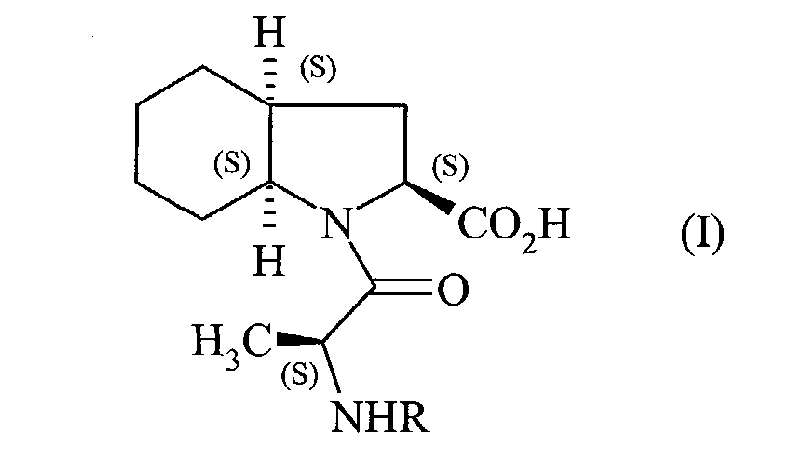
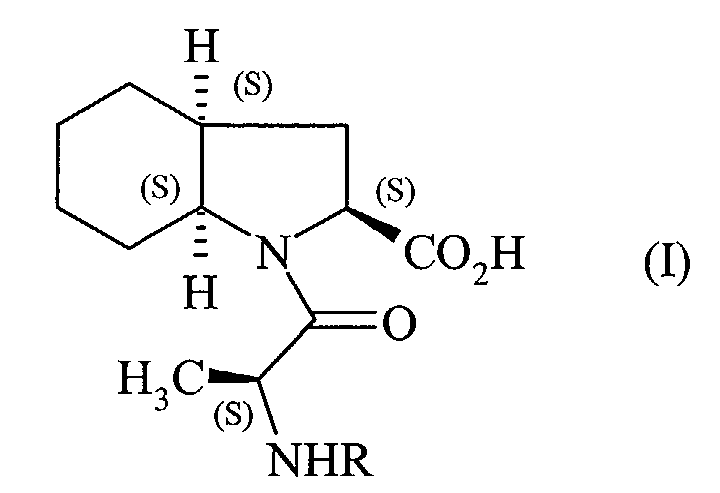
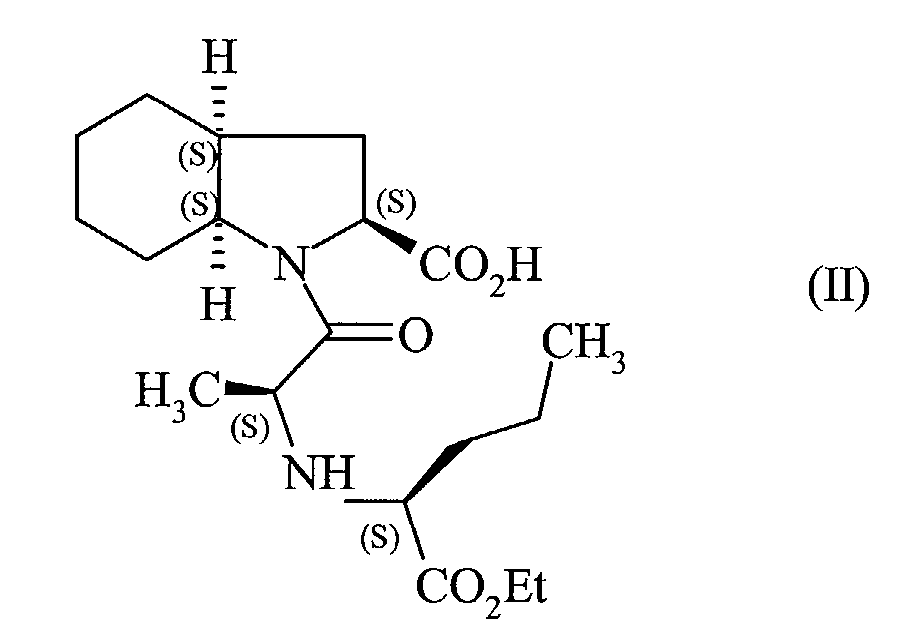
- the present invention relates to a process for the synthesis of the compounds of formula (I): in which R represents a hydrogen atom or a group protecting the amino function, and their application to the synthesis of perindopril of formula (II): and its pharmaceutically acceptable salts.
- Perindopril as well as its pharmaceutically acceptable salts, and more particularly its tert-butylamine salt, have interesting pharmacological properties. Their main property is to inhibit the angiotensin I converting enzyme (or kininase II), which on the one hand prevents the transformation of the angiotensin I decapeptide into angiotensin II octapeptide (vasoconstrictor), and on the other hand to prevent the degradation of bradykinin (vasodilator) into an inactive peptide.
- angiotensin I converting enzyme or kininase II
- Patent EP 0 308 341 describes the industrial synthesis of perindopril by coupling the benzyl ester of (2 S , 3a S , 7a S ) -octahydroindole 2-carboxylic acid with the ethyl ester of N - [( S ) -1-carboxybutyl] - ( S ) -alanine in the presence of dicyclohexylcarbodiimide, followed by deprotection of the carboxylic group of the heterocycle by catalytic hydrogenation.
- This process has drawbacks linked to the use of dicyclohexylcarbodiimide.
- the Applicant has developed a process for the synthesis of perindopril which uses other coupling agents.
- non-limiting examples that may be mentioned are tert-butyloxycarbonyl groups, benzyl and benzyloxycarbonyl.
- the catalytic hydrogenation of the compound of formula (Va) is preferably carried out under a hydrogen pressure of less than 10 bars.
- the catalytic hydrogenation of the compound of formula (Vb) is preferably carried out under a hydrogen pressure between 10 and 35 bars.
- the compound of formula (I) thus obtained is then subjected, where appropriate, to a deprotection reaction of the amino function, followed by a coupling reaction, either with ethyl 2-oxopentanoate under amination conditions reductive, either with a compound of formula (VI): in which X represents a leaving group chosen from a halogen atom, ⁇ O ⁇ SO 2 CH 3 and to lead to optically pure perindopril, which is converted, if desired, into a pharmaceutically acceptable salt such as the tert-butylamine salt.
- Stage A Benzyl (2S, 3aS, 7aS) -1 - ⁇ (2S) -2 - [(Tert-butyloxycarbonyl) -amino] -propionyl ⁇ -octahydro-1H-indole-2-carboxylate:
- Stage B (2S, 3aS, 7aS) -1 - ⁇ (2S) -2 - [(tert-butyloxycarbonyl) -amino] -propionyl ⁇ -octahydro-1H-indole-2-carboxylic acid:
- Step A (2S) -1 - ⁇ (2S) -2 - [(Tert-butyloxycarbonyl) -amino] -propionyl ⁇ -2,3-dihydro-1H-indole-2-carboxylate:
- Stage B (2S, 3aS, 7aS) -1 - ⁇ (2S) -2 - [(tert-butyloxycarbonyl) -amino] -propionyl ⁇ -octahydro-1H-indole-2-carboxylic acid:
- the residue obtained in the previous stage (200 g) is dissolved in 200 ml of methylcyclohexane and transferred to a hydrogenator, then 26 g of 5% palladium on carbon suspended in 80 ml of methylcyclohexane are added, followed by 640 ml of 'water.
- the mixture is then hydrogenated under a pressure of 0.5 bar, at a temperature between 15 and 30 ° C, until absorption of the theoretical amount of hydrogen necessary for debenzylation, then the mixture is brought to a temperature between 50 and 100 ° C and hydrogenated under a pressure of 30 bars, until absorption of the theoretical quantity of hydrogen necessary for the hydrogenation of the cycle.
- the aqueous phase of the filtrate is washed with methylcyclohexane, then lyophilized to yield the expected product.
Landscapes
- Chemical & Material Sciences (AREA)
- Organic Chemistry (AREA)
- Health & Medical Sciences (AREA)
- Life Sciences & Earth Sciences (AREA)
- General Health & Medical Sciences (AREA)
- Medicinal Chemistry (AREA)
- Biochemistry (AREA)
- Biophysics (AREA)
- Genetics & Genomics (AREA)
- Molecular Biology (AREA)
- Proteomics, Peptides & Aminoacids (AREA)
- Heart & Thoracic Surgery (AREA)
- Public Health (AREA)
- Cardiology (AREA)
- Engineering & Computer Science (AREA)
- Chemical Kinetics & Catalysis (AREA)
- General Chemical & Material Sciences (AREA)
- Nuclear Medicine, Radiotherapy & Molecular Imaging (AREA)
- Pharmacology & Pharmacy (AREA)
- Animal Behavior & Ethology (AREA)
- Bioinformatics & Cheminformatics (AREA)
- Veterinary Medicine (AREA)
- Peptides Or Proteins (AREA)
- Indole Compounds (AREA)
- Organic Low-Molecular-Weight Compounds And Preparation Thereof (AREA)
- Low-Molecular Organic Synthesis Reactions Using Catalysts (AREA)
- Medicines That Contain Protein Lipid Enzymes And Other Medicines (AREA)
- Plural Heterocyclic Compounds (AREA)
Abstract
Description
et leur application à la synthèse du perindopril de formule (II) :
Leur principale propriété est d'inhiber l'enzyme de conversion de l'angiotensine I (ou kininase II), ce qui permet d'une part d'empêcher la transformation du décapeptide angiotensine I en octapeptide angiotensine II (vasoconstricteur), et d'autre part de prévenir la dégradation de la bradykinine (vasodilatateur) en peptide inactif.
Ces deux actions contribuent aux effets bénéfiques du perindopril dans les maladies cardiovasculaires, tout particulièrement l'hypertension artérielle et l'insuffisance cardiaque.
Le brevet EP 0 308 341 décrit la synthèse industrielle du perindopril par couplage de l'ester benzylique de l'acide (2S, 3aS, 7aS)-octahydroindole 2-carboxylique avec l'ester éthylique de la N-[(S)-1-carboxybutyl]-(S)-alanine en présence de dicyclohexylcarbodiimide, suivie de la déprotection du groupement carboxylique de l'hétérocycle par hydrogénation catalytique.
Ce procédé présente des inconvénients liés à l'utilisation du dicyclohexylcarbodiimide.
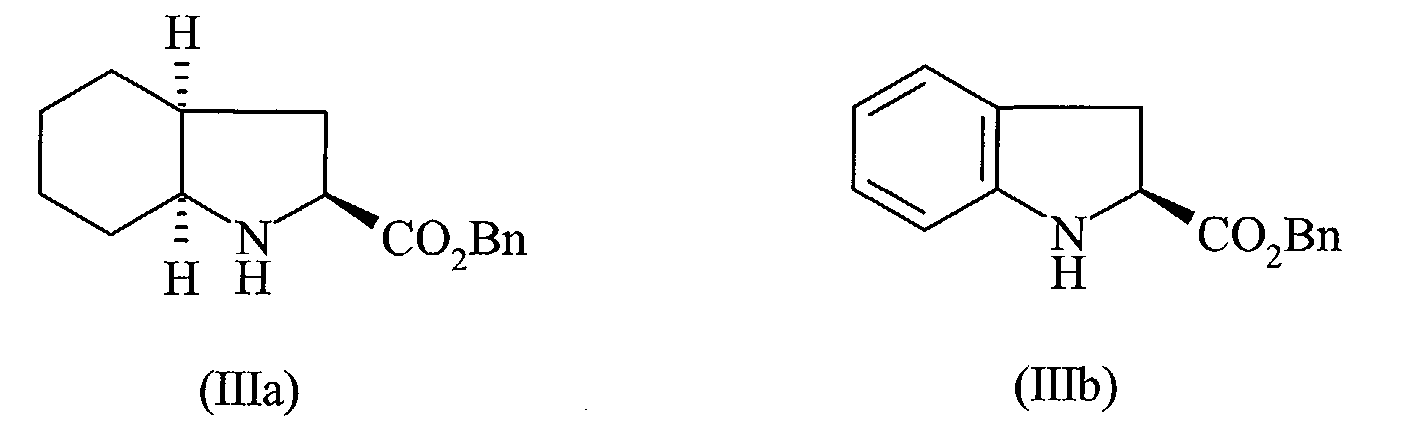
caractérisé en ce que l'on met en réaction l'ester benzylique de formule (IIIa) ou (IIIb) :
avec le dérivé de l'alanine de formule (IV) :
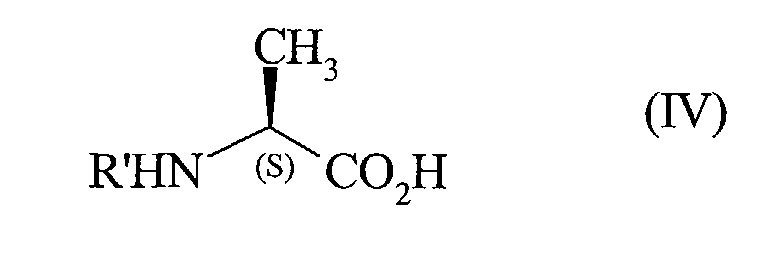
en présence d'un agent de couplage choisi parmi les réactifs et couples de réactifs suivants :
en présence éventuelle de base,
pour conduire respectivement au composé de formule (Va) ou (Vb), selon que l'on est parti du composé de formule (IIIa) ou (IIIb) :
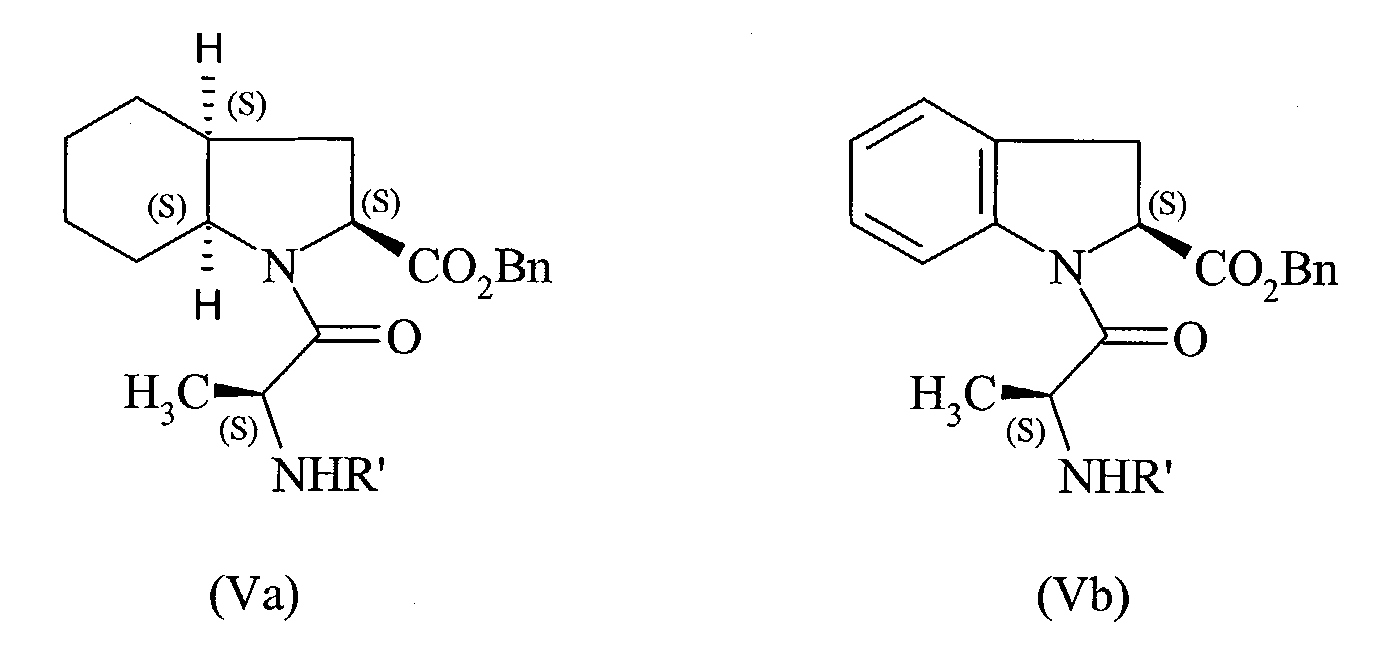
que l'on soumet à une réaction d'hydrogénation catalytique en présence de palladium, pour conduire au produit de formule (I).
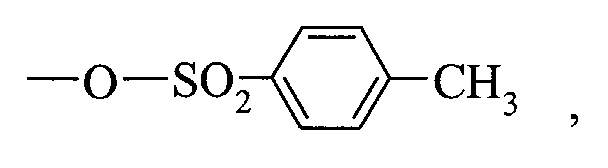
soit avec un composé de formule (VI) :
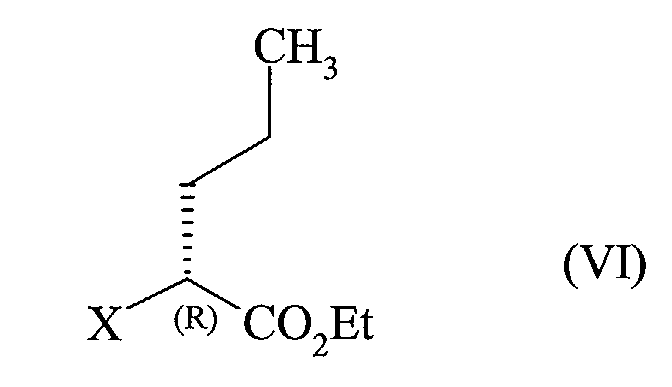
―O―SO2CH3 et
Le filtrat est ensuite lavé, puis évaporé à sec pour conduire au produit attendu.
Le mélange est ensuite hydrogéné sous une pression de 0,5 bar, à une température comprise entre 15 et 30°C, jusqu'à absorption de la quantité théorique d'hydrogène.
Après filtration du catalyseur, la phase aqueuse du filtrat est lavée par du méthylcyclohexane, puis lyophilisée pour conduire au produit attendu avec un rendement de 94%.
Le filtrat est ensuite lavé, puis évaporé à sec pour conduire au produit attendu.
Le mélange est ensuite hydrogéné sous une pression de 0,5 bar, à une température comprise entre 15 et 30°C, jusqu'à absorption de la quantité théorique d'hydrogène nécessaire à la débenzylation, puis le mélange est porté à une température comprise entre 50 et 100°C et hydrogéné sous une pression de 30 bars, jusqu'à absorption de la quantité théorique d'hydrogène nécessaire à l'hydrogénation du cycle.
Après filtration du catalyseur, la phase aqueuse du filtrat est lavée par du méthylcyclohexane, puis lyophilisée pour conduire au produit attendu.
Claims (6)
- Procédé de synthèse des composés de formule (I)dans laquelle R représente un atome d'hydrogène ou un groupement protecteur de la fonction amino,

caractérisé en ce que l'on met en réaction l'ester benzylique de formule (IIIa) ou (IIIb) :ou le sel d'addition de l'ester de formule (IIIa) ou (IIIb) avec un acide minéral ou organique,
avec le dérivé de l'alanine de formule (IV) :dans laquelle R' représente un groupement protecteur de la fonction amino,
en présence d'un agent de couplage choisi parmi les réactifs et couples de réactifs suivants :et N-hydroxy-1,2-dihydro-2-oxo-pyridine,(1,3-diméthylaminopropyl)-3-éthyl-carbodiimide chlorhydrate,(1,3-diméthylaminopropyl)-3-éthyl-carbodiimide chlorhydrate / 1-hydroxybenzotriazole,(1,3-diméthylaminopropyl)-3-éthyl-carbodiimide chlorhydrate/1-hydroxy-7-azabenzotriazole,(1,3-diméthylaminopropyl)-3-éthyl-carbodiimide chlorhydrate / N-hydroxysuccinimide,(1,3-diméthylaminopropyl)-3-éthyl-carbodiimide chlorhydrate /3-hydroxy-3,4-dihydro-4-oxo-1,2,3-benzotriazine,(1,3-diméthylaminopropyl)-3-éthyl-carbodiimide chlorhydrate / N-hydroxyphtalimide,dicyclohexylcarbodiimide / 1-hydroxy-7-azabenzotriazole,dicyclohexylcarbodiimide / N-hydroxysuccinimide,dicyclohexylcarbodiimide /3-hydroxy-3,4-dihydro-4-oxo-1,2,3-benzotriazine,dicyclohexylcarbodiimide / N-hydroxyphtalimide,O-(benzotriazol-1-yl)-1,1,3,3-tétraméthyluronium hexafluorophosphate,O-(7-azabenzotriazol-1-yl)-1,1,3,3-tétraméthyluronium hexafluorophosphate,O-(benzotriazol-1-yl)-1,1,3,3-tétraméthyluronium tétrafluoroborate,benzotriazol-1-yl-oxytripyrrolidinophosphonium hexafluorophosphate,benzotriazol-1-yl-oxy-tris-(diméthylamino)-phosphonium hexafluorophosphate,O-(benzotriazol-1-yl)-1,1,3,3-bis(tétraméthylène)-uronium hexafluorophosphate,O-(benzotriazol-1-yl)-1,1,3,3-bis(pentaméthylène)-uronium hexafluorophosphate,chloro-tripyrrolidinophosphonium hexafluorophosphate,chloro-1,1,3,3-bis(tétraméthylène)-formamidinium hexafluorophosphate,chloro-1,1,3,3-bis(pentaméthylène)-formamidinium hexafluorophosphate,N-éthoxycarbonyl-2-éthoxy-1,2-dihydroquinoléine,O-[(éthoxycarbonyl)-cyanométhylènamino]-1,1,3,3- tétraméthyluronium tétrafluoroborate,O-(3,4-dihydro-4-oxo-1,2,3-benzotriazin-3-yl-1,1,3,3-tétraméthyluronium tétrafluoroborate,O-(3,4-dihydro-4-oxo-1,2,3-benzotriazin-3-yl-1,1,3,3-tétraméthyluronium tétrafluoroborate /1-hydroxybenzotriazole,O-(3,4-dihydro-4-oxo-1,2,3-benzotriazin-3-yl-1,1,3,3-tétraméthyluronium tétrafluoroborate /N-méthylmorpholine,O-(3,4-dihydro-4-oxo-1,2,3-benzotriazin-3-yl-1,1,3,3-tétraméthyluronium tétrafluoroborate /collidine,O-(1,2-dihydro-2-oxo-1-pyridyl)-1,1,3,3-tétraméthyluronium tétrafluoroborate,O-(1,2-dihydro-2-oxo-1-pyridyl)-1,1,3,3-tétraméthyluronium tétrafluoroborate/1-hydroxybenzotriazole,O-(1,2-dihydro-2-oxo-1-pyridyl)-1,1,3,3-bis(tétraméthylène)-uronium hexafluorophosphate,O-(1,2-dihydro-2-oxo-1-pyridyl)-1,1,3,3-bis(tétraméthylène)-uronium hexafluorophosphate/1-hydroxy-benzotriazole,O-(N-succinimidyl)-1,1,3,3-tétraméthyluronium tétrafluoroborate,O-(N-succinimidyl)-1,1,3,3-bis(tétraméthylène)uronium tétrafluoroborate,O-(N-succinimidyl)-1,1,3,3-bis(tétraméthylène)uronium tétrafluoroborate/1-hydroxybenzotriazole,O-(5-norbornène-2,3-dicarboximido)-1,1,3,3-tétraméthyluronium tétrafluoroborate, anhydride propanephosphonique,imide de l'acide N-hydroxy-5-norbornène-2,3-dicarboxylique,
en présence éventuelle de base,
pour conduire respectivement au composé de formule (Va) ou (Vb), selon que l'on est parti du composé de formule (IIIa) ou (IIIb) :dans laquelle R' est tel que défini précédemment,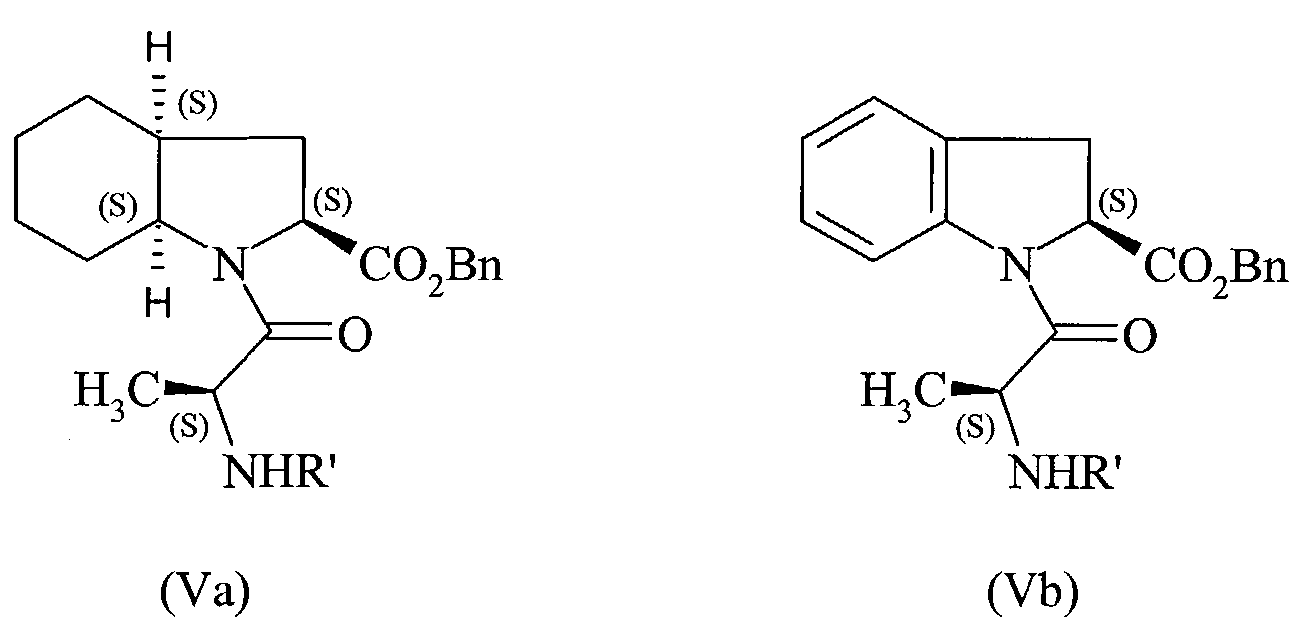
que l'on soumet à une réaction d'hydrogénation catalytique en présence de palladium, pour conduire au produit de formule (I). - Procédé selon la revendication 1, caractérisé en ce que l'on part du composé de formule (IIIa).
- Procédé selon la revendication 1, caractérisé en ce que l'on part du composé de formule (IIIb).
- Procédé selon la revendication 2, caractérisé en ce que la réaction d'hydrogénation du composé de formule (Va) est effectuée sous une pression d'hydrogène inférieure à 10 bars.
- Procédé selon la revendication 3, caractérisé en ce que la réaction d'hydrogénation du composé de formule (Vb) est effectuée sous une pression d'hydrogène comprise entre 10 et 35 bars.
- Procédé de synthèse du perindopril ou de ses sels pharmaceutiquement acceptables à partir du composé de formule (I), caractérisé en ce que le composé de formule (I) est obtenu par le procédé de synthèse selon l'une quelconque des revendications 1 à 5.
Priority Applications (20)
| Application Number | Priority Date | Filing Date | Title |
|---|---|---|---|
| EP03293085A EP1420030A3 (fr) | 2003-12-10 | 2003-12-10 | Procédé de synthèse de dérivés de l'acide (2S, 3aS, 7aS) - 1 - [(S)-alanyl]-octahydro-1H-indole-2-carboxylique et application à la synthèse du perindopril |
| UAA200607607A UA84897C2 (en) | 2003-12-10 | 2004-09-12 | Method for the synthesis of derivatives of (2s, 3as, 7as)-1-[(s)-alanyl]-octahydro-1h-indole-2-carboxylic acid and use thereof for the synthesis of perindopril |
| AU2004312186A AU2004312186A1 (en) | 2003-12-10 | 2004-12-09 | Method for the synthesis of derivatives of (2S, 3aS, 7aS)-1-[(S)-alanyl]-octahydro-1H-indole-2-carboxylic acid and use thereof for the synthesis of perindopril |
| MYPI20045096A MY136937A (en) | 2003-12-10 | 2004-12-09 | NEW PROCESS FOR THE SYNTHESIS OF (2S, 3aS, 7aS)-1-[(S)-ALANYL]-OCTAHYDRO-1H-INDOLE-2-CARBOXYLIC ACID COMPOUNDS AND APPLICATION IN THE SYNTHESIS OF PERINDOPRIL |
| CA002548406A CA2548406A1 (fr) | 2003-12-10 | 2004-12-09 | Nouveau procede de synthese de derives de l'acide (2s,3as,7as)-1-((s)-alanyl)-octahydro-1h-in-dole-2-carboxylique et application a la synthese du perindopril |
| GEAP20049502A GEP20084408B (en) | 2003-12-10 | 2004-12-09 | Method for the synthesis of derivatives of (2s, 3as, 7as)-1-[(s)-alanyl]-octahydro-1h-indole-2-carboxylic acid and use thereof for the synthesis of perindopril |
| JP2006543584A JP2007537996A (ja) | 2003-12-10 | 2004-12-09 | (2S,3aS,7aS)−1−[(S)−アラニル]オクタヒドロ−1H−インドール−2−カルボン酸の誘導体を合成する方法、およびペリンドプリルの合成のためのその使用 |
| PCT/FR2004/003167 WO2005066199A1 (fr) | 2003-12-10 | 2004-12-09 | Procede de synthese de derives de l’acide (2s,3as,7as)-1-[(s)-alanyl]-octahydro-1h-indole-2-carboxylique et application a la synthese du perindopril |
| US10/582,419 US7288661B2 (en) | 2003-12-10 | 2004-12-09 | Process for the synthesis of (2S,3aS,7aS)-1-[(S)-alanyl]-octahydro-1H-indole-2-carboxylic acid compounds and application in the synthesis of perindopril |
| PL380411A PL380411A1 (pl) | 2003-12-10 | 2004-12-09 | Sposób otrzymywania pochodnych kwasu (2S, 3aS, 7aS)-1- [(S)-alanylo]oktahydro-1H-indolo-2- karboksylowego i zastosowanie ich do syntezy perindoprilu |
| CNB200480036942XA CN100469787C (zh) | 2003-12-10 | 2004-12-09 | 合成(2s,3as,7as)-1-[(s)-1-丙氨酰基]-八氢-1h-吲哚-2-羧酸衍生物的方法及其用于合成培哚普利的用途 |
| HK07102977.6A HK1095840B (en) | 2003-12-10 | 2004-12-09 | Method for the synthesis of derivatives of (2s,3as,7as)-1[(s)-alanyl]-octahydro-1h-indole-2-carboxylic acid and use thereof for the synthesis of perindopril |
| NZ547555A NZ547555A (en) | 2003-12-10 | 2004-12-09 | New process for the synthesis of (2S,3aS,7aS)-1-[(S)-alanyl]-octahydro-1H-indole-2-carboxylic acid compounds and application in the synthesis of perindopril |
| EA200601088A EA010318B1 (ru) | 2003-12-10 | 2004-12-09 | НОВЫЙ СПОСОБ СИНТЕЗА (2S,3aS,7aS)-1-[(S)-АЛАНИЛ]ОКТАГИДРО-1H-ИНДОЛ-2-КАРБОНОВЫХ КИСЛОТ И ИХ ПРИМЕНЕНИЕ В СИНТЕЗЕ ПЕРИНДОПРИЛА |
| KR1020067013587A KR20060096521A (ko) | 2003-12-10 | 2004-12-09 | (2s,3as,7as)-1-[(s)-알라닐]-옥타히드로-1h-인돌-2-카르복실산 유도체의 합성 방법 및 페린도프릴의 합성을위한 상기 화합물의 용도 |
| ZA200604368A ZA200604368B (en) | 2003-12-10 | 2004-12-09 | Method for the synthesis of derivatives of (2S, 3AS, 7AS)-1-[(S)-alanyl]-octahydro-1H-indole-2-carboxylic acid and use thereof for the synthesis of perindopril |
| BRPI0417540-9A BRPI0417540A (pt) | 2003-12-10 | 2004-12-09 | processo de sìntese de derivados do ácido (2s, 3as, 7as)-1-[(s)-alanil]-octahidro-1h-indol-2-carboxìlico e aplicação para sìntese do perindopril |
| ARP040104614A AR047328A1 (es) | 2003-12-10 | 2004-12-10 | Procedimiento para la sintesis de compuestos del acido (2s, 3as, 7as)-1-[(s)-alanil]-octahidro-1h-indol-2-carboxilico y aplicacion en la sintesis de perindopril. |
| MA29084A MA28223A1 (fr) | 2003-12-10 | 2006-06-07 | NOUVEAU PROCEDE DE SYNTHESE DE DERIVES DE L'ACIDE (2S,3aS,7aS)-1-[(S)-ALANYL]-OCTAHYDRO-1H-INDOLE-2-CARBOXYLIQUE ET APPLICATION A LA SYNTHESE DU PERINDOPRIL |
| NO20063027A NO20063027L (no) | 2003-12-10 | 2006-06-28 | Fremgangsmaten for syntesen av derivater av (2S,3aS,7aS)-1-[(S)-alkanyl]-oktahydro-lH-indol-2-karboksylsyre og anvendelse derav i syntesen av perindopril |
Applications Claiming Priority (1)
| Application Number | Priority Date | Filing Date | Title |
|---|---|---|---|
| EP03293085A EP1420030A3 (fr) | 2003-12-10 | 2003-12-10 | Procédé de synthèse de dérivés de l'acide (2S, 3aS, 7aS) - 1 - [(S)-alanyl]-octahydro-1H-indole-2-carboxylique et application à la synthèse du perindopril |
Publications (2)
| Publication Number | Publication Date |
|---|---|
| EP1420030A2 true EP1420030A2 (fr) | 2004-05-19 |
| EP1420030A3 EP1420030A3 (fr) | 2004-05-26 |
Family
ID=32116382
Family Applications (1)
| Application Number | Title | Priority Date | Filing Date |
|---|---|---|---|
| EP03293085A Withdrawn EP1420030A3 (fr) | 2003-12-10 | 2003-12-10 | Procédé de synthèse de dérivés de l'acide (2S, 3aS, 7aS) - 1 - [(S)-alanyl]-octahydro-1H-indole-2-carboxylique et application à la synthèse du perindopril |
Country Status (19)
| Country | Link |
|---|---|
| US (1) | US7288661B2 (fr) |
| EP (1) | EP1420030A3 (fr) |
| JP (1) | JP2007537996A (fr) |
| KR (1) | KR20060096521A (fr) |
| CN (1) | CN100469787C (fr) |
| AR (1) | AR047328A1 (fr) |
| AU (1) | AU2004312186A1 (fr) |
| BR (1) | BRPI0417540A (fr) |
| CA (1) | CA2548406A1 (fr) |
| EA (1) | EA010318B1 (fr) |
| GE (1) | GEP20084408B (fr) |
| MA (1) | MA28223A1 (fr) |
| MY (1) | MY136937A (fr) |
| NO (1) | NO20063027L (fr) |
| NZ (1) | NZ547555A (fr) |
| PL (1) | PL380411A1 (fr) |
| UA (1) | UA84897C2 (fr) |
| WO (1) | WO2005066199A1 (fr) |
| ZA (1) | ZA200604368B (fr) |
Family Cites Families (3)
| Publication number | Priority date | Publication date | Assignee | Title |
|---|---|---|---|---|
| FR2620709B1 (fr) * | 1987-09-17 | 1990-09-07 | Adir | Procede de synthese industrielle du perindopril et de ses principaux intermediaires de synthese |
| WO2001048755A1 (fr) * | 1999-12-28 | 2001-07-05 | Matsushita Electric Industrial Co., Ltd. | Appareil d'enregistrement, appareil de reproduction, appareil de traitement de donnees, appareil d'enregistrement/de reproduction et appareil de transmission de donnees |
| FR2827860B1 (fr) * | 2001-07-24 | 2004-12-10 | Servier Lab | Nouveau procede de synthese de derives de l'acide (2s, 3as, 7as)-1-[(s)-alanyl]-octahydro-1h-indole-2-carboxyline et application a la synthese du perindopril |
-
2003
- 2003-12-10 EP EP03293085A patent/EP1420030A3/fr not_active Withdrawn
-
2004
- 2004-09-12 UA UAA200607607A patent/UA84897C2/uk unknown
- 2004-12-09 NZ NZ547555A patent/NZ547555A/en not_active IP Right Cessation
- 2004-12-09 KR KR1020067013587A patent/KR20060096521A/ko not_active Ceased
- 2004-12-09 WO PCT/FR2004/003167 patent/WO2005066199A1/fr not_active Ceased
- 2004-12-09 EA EA200601088A patent/EA010318B1/ru not_active IP Right Cessation
- 2004-12-09 BR BRPI0417540-9A patent/BRPI0417540A/pt not_active IP Right Cessation
- 2004-12-09 PL PL380411A patent/PL380411A1/pl not_active Application Discontinuation
- 2004-12-09 MY MYPI20045096A patent/MY136937A/en unknown
- 2004-12-09 JP JP2006543584A patent/JP2007537996A/ja active Pending
- 2004-12-09 US US10/582,419 patent/US7288661B2/en not_active Expired - Fee Related
- 2004-12-09 GE GEAP20049502A patent/GEP20084408B/en unknown
- 2004-12-09 CN CNB200480036942XA patent/CN100469787C/zh not_active Expired - Fee Related
- 2004-12-09 AU AU2004312186A patent/AU2004312186A1/en not_active Abandoned
- 2004-12-09 ZA ZA200604368A patent/ZA200604368B/en unknown
- 2004-12-09 CA CA002548406A patent/CA2548406A1/fr not_active Abandoned
- 2004-12-10 AR ARP040104614A patent/AR047328A1/es unknown
-
2006
- 2006-06-07 MA MA29084A patent/MA28223A1/fr unknown
- 2006-06-28 NO NO20063027A patent/NO20063027L/no not_active Application Discontinuation
Also Published As
| Publication number | Publication date |
|---|---|
| AU2004312186A1 (en) | 2005-07-21 |
| CA2548406A1 (fr) | 2005-07-21 |
| BRPI0417540A (pt) | 2007-03-27 |
| US20070123581A1 (en) | 2007-05-31 |
| US7288661B2 (en) | 2007-10-30 |
| KR20060096521A (ko) | 2006-09-12 |
| MA28223A1 (fr) | 2006-10-02 |
| CN1890259A (zh) | 2007-01-03 |
| WO2005066199A1 (fr) | 2005-07-21 |
| HK1095840A1 (en) | 2007-05-18 |
| MY136937A (en) | 2008-11-28 |
| NZ547555A (en) | 2009-11-27 |
| PL380411A1 (pl) | 2007-01-22 |
| UA84897C2 (en) | 2008-12-10 |
| ZA200604368B (en) | 2007-10-31 |
| EA010318B1 (ru) | 2008-08-29 |
| EP1420030A3 (fr) | 2004-05-26 |
| AR047328A1 (es) | 2006-01-18 |
| GEP20084408B (en) | 2008-06-25 |
| EA200601088A1 (ru) | 2006-12-29 |
| CN100469787C (zh) | 2009-03-18 |
| NO20063027L (no) | 2006-06-28 |
| JP2007537996A (ja) | 2007-12-27 |
Similar Documents
| Publication | Publication Date | Title |
|---|---|---|
| CZ20023291A3 (cs) | Způsob syntézy perindoprilu a jeho farmaceuticky přijatelných solí | |
| EP1256590B1 (fr) | Nouveau procédé de synthèse de dérivés de l'acide (2S, 3aS, 7aS)-1- (S)-alanyl-octahydro-1H-indole-2-carboxylique et application à la synthèse du perindopril | |
| EP1362864A1 (fr) | Nouveau procédé de synthèse du perindopril et de ses sels pharmaceutiquement acceptables | |
| EP1367061A1 (fr) | Nouveau procédé de synthèse du perindopril et de ses sels pharmaceutiquement acceptables | |
| EP1371659B1 (fr) | Nouveau procédé de synthèse du perindopril et de ses sels pharmaceutiquement acceptables | |
| CA2548405C (fr) | Nouveau procede de synthese du perindropil et de ses sels pharmaceutiquement acceptables | |
| EP1380590B1 (fr) | Nouveau procédé de synthèse du perindopril et de ses sels pharmaceutiquement acceptables | |
| EP1380591B1 (fr) | Nouveau procédé de synthèse du perindopril et de ses sels pharmaceutiquement acceptables | |
| EP1403277B1 (fr) | Nouveau procédé de synthèse de dérives de l'acide (2S, 3aS, 7aS)-1-((S)-alanyl)-octahydro-1H-indole-2-carboxylique, et application à la synthèse du perindopril | |
| EP1420030A2 (fr) | Procédé de synthèse de dérivés de l'acide (2S, 3aS, 7aS) - 1 - [(S)-alanyl]-octahydro-1H-indole-2-carboxylique et application à la synthèse du perindorpil | |
| CA2533005C (fr) | Nouveau procede de synthese du perindopril et de ses sels pharmaceutiquement acceptables | |
| EP1403275A1 (fr) | Nouveau procédé de synthèse du perindopril et de ses sels pharmaceutiquement acceptables | |
| EP1367062A1 (fr) | Nouveau procédé de synthèse du perindopril et de ses sels pharmaceutiquement acceptables | |
| MXPA06006563A (en) | Method for the synthesis of derivatives of (2s, 3as, 7as)-1-[(s)-alanyl]-octahydro-1h | |
| HK1095840B (en) | Method for the synthesis of derivatives of (2s,3as,7as)-1[(s)-alanyl]-octahydro-1h-indole-2-carboxylic acid and use thereof for the synthesis of perindopril |
Legal Events
| Date | Code | Title | Description |
|---|---|---|---|
| PUAI | Public reference made under article 153(3) epc to a published international application that has entered the european phase |
Free format text: ORIGINAL CODE: 0009012 |
|
| PUAL | Search report despatched |
Free format text: ORIGINAL CODE: 0009013 |
|
| 17P | Request for examination filed |
Effective date: 20031210 |
|
| AK | Designated contracting states |
Kind code of ref document: A2 Designated state(s): AT BE BG CH CY CZ DE DK EE ES FI FR GB GR HU IE IT LI LU MC NL PT RO SE SI SK TR |
|
| AX | Request for extension of the european patent |
Extension state: AL LT LV MK |
|
| AK | Designated contracting states |
Kind code of ref document: A3 Designated state(s): AT BE BG CH CY CZ DE DK EE ES FI FR GB GR HU IE IT LI LU MC NL PT RO SE SI SK TR |
|
| AX | Request for extension of the european patent |
Extension state: AL LT LV MK |
|
| RTI1 | Title (correction) |
Free format text: METHOD FOR SYNTHESIS OF (2S,3AS,7AS)-1-(S)-ALANYL-OCTAHYDRO-1H-INDOLE-2- CARBOXYLIC ACID DERIVATIVES AND USE IN THE SYNTH |
|
| GBC | Gb: translation of claims filed (gb section 78(7)/1977) | ||
| AKX | Designation fees paid |
Designated state(s): AT BE BG CH CY CZ DE DK EE ES FI FR GB GR HU IE IT LI LU MC NL PT RO SE SI SK TR |
|
| AXX | Extension fees paid |
Extension state: MK Payment date: 20031210 Extension state: LV Payment date: 20031210 Extension state: LT Payment date: 20031210 Extension state: AL Payment date: 20031210 |
|
| 17Q | First examination report despatched |
Effective date: 20050510 |
|
| 17Q | First examination report despatched |
Effective date: 20050510 |
|
| STAA | Information on the status of an ep patent application or granted ep patent |
Free format text: STATUS: THE APPLICATION IS DEEMED TO BE WITHDRAWN |
|
| 18D | Application deemed to be withdrawn |
Effective date: 20070414 |