EP1420155A2 - Verfahren zur Regelung der Verbrennungsqualität bei einem magerbetriebenen Verbrennungsmotor - Google Patents
Verfahren zur Regelung der Verbrennungsqualität bei einem magerbetriebenen Verbrennungsmotor Download PDFInfo
- Publication number
- EP1420155A2 EP1420155A2 EP03257177A EP03257177A EP1420155A2 EP 1420155 A2 EP1420155 A2 EP 1420155A2 EP 03257177 A EP03257177 A EP 03257177A EP 03257177 A EP03257177 A EP 03257177A EP 1420155 A2 EP1420155 A2 EP 1420155A2
- Authority
- EP
- European Patent Office
- Prior art keywords
- ionization signal
- geometric parameter
- ionization
- engine
- peak
- Prior art date
- Legal status (The legal status is an assumption and is not a legal conclusion. Google has not performed a legal analysis and makes no representation as to the accuracy of the status listed.)
- Granted
Links
Images





Classifications
-
- G—PHYSICS
- G01—MEASURING; TESTING
- G01M—TESTING STATIC OR DYNAMIC BALANCE OF MACHINES OR STRUCTURES; TESTING OF STRUCTURES OR APPARATUS, NOT OTHERWISE PROVIDED FOR
- G01M15/00—Testing of engines
- G01M15/04—Testing internal-combustion engines
- G01M15/042—Testing internal-combustion engines by monitoring a single specific parameter not covered by groups G01M15/06 - G01M15/12
-
- F—MECHANICAL ENGINEERING; LIGHTING; HEATING; WEAPONS; BLASTING
- F02—COMBUSTION ENGINES; HOT-GAS OR COMBUSTION-PRODUCT ENGINE PLANTS
- F02D—CONTROLLING COMBUSTION ENGINES
- F02D35/00—Controlling engines, dependent on conditions exterior or interior to engines, not otherwise provided for
- F02D35/02—Controlling engines, dependent on conditions exterior or interior to engines, not otherwise provided for on interior conditions
- F02D35/021—Controlling engines, dependent on conditions exterior or interior to engines, not otherwise provided for on interior conditions using an ionic current sensor
-
- F—MECHANICAL ENGINEERING; LIGHTING; HEATING; WEAPONS; BLASTING
- F02—COMBUSTION ENGINES; HOT-GAS OR COMBUSTION-PRODUCT ENGINE PLANTS
- F02D—CONTROLLING COMBUSTION ENGINES
- F02D35/00—Controlling engines, dependent on conditions exterior or interior to engines, not otherwise provided for
- F02D35/02—Controlling engines, dependent on conditions exterior or interior to engines, not otherwise provided for on interior conditions
- F02D35/027—Controlling engines, dependent on conditions exterior or interior to engines, not otherwise provided for on interior conditions using knock sensors
-
- F—MECHANICAL ENGINEERING; LIGHTING; HEATING; WEAPONS; BLASTING
- F02—COMBUSTION ENGINES; HOT-GAS OR COMBUSTION-PRODUCT ENGINE PLANTS
- F02D—CONTROLLING COMBUSTION ENGINES
- F02D41/00—Electrical control of supply of combustible mixture or its constituents
- F02D41/02—Circuit arrangements for generating control signals
- F02D41/14—Introducing closed-loop corrections
- F02D41/1497—With detection of the mechanical response of the engine
- F02D41/1498—With detection of the mechanical response of the engine measuring engine roughness
-
- F—MECHANICAL ENGINEERING; LIGHTING; HEATING; WEAPONS; BLASTING
- F02—COMBUSTION ENGINES; HOT-GAS OR COMBUSTION-PRODUCT ENGINE PLANTS
- F02P—IGNITION, OTHER THAN COMPRESSION IGNITION, FOR INTERNAL-COMBUSTION ENGINES; TESTING OF IGNITION TIMING IN COMPRESSION-IGNITION ENGINES
- F02P17/00—Testing of ignition installations, e.g. in combination with adjusting; Testing of ignition timing in compression-ignition engines
- F02P17/12—Testing characteristics of the spark, ignition voltage or current
-
- F—MECHANICAL ENGINEERING; LIGHTING; HEATING; WEAPONS; BLASTING
- F02—COMBUSTION ENGINES; HOT-GAS OR COMBUSTION-PRODUCT ENGINE PLANTS
- F02P—IGNITION, OTHER THAN COMPRESSION IGNITION, FOR INTERNAL-COMBUSTION ENGINES; TESTING OF IGNITION TIMING IN COMPRESSION-IGNITION ENGINES
- F02P9/00—Electric spark ignition control, not otherwise provided for
- F02P9/002—Control of spark intensity, intensifying, lengthening, suppression
- F02P9/007—Control of spark intensity, intensifying, lengthening, suppression by supplementary electrical discharge in the pre-ionised electrode interspace of the sparking plug, e.g. plasma jet ignition
-
- G—PHYSICS
- G01—MEASURING; TESTING
- G01L—MEASURING FORCE, STRESS, TORQUE, WORK, MECHANICAL POWER, MECHANICAL EFFICIENCY, OR FLUID PRESSURE
- G01L23/00—Devices or apparatus for measuring or indicating or recording rapid changes, such as oscillations, in the pressure of steam, gas, or liquid; Indicators for determining work or energy of steam, internal-combustion, or other fluid-pressure engines from the condition of the working fluid
- G01L23/22—Devices or apparatus for measuring or indicating or recording rapid changes, such as oscillations, in the pressure of steam, gas, or liquid; Indicators for determining work or energy of steam, internal-combustion, or other fluid-pressure engines from the condition of the working fluid for detecting or indicating knocks in internal-combustion engines; Units comprising pressure-sensitive members combined with ignitors for firing internal-combustion engines
- G01L23/221—Devices or apparatus for measuring or indicating or recording rapid changes, such as oscillations, in the pressure of steam, gas, or liquid; Indicators for determining work or energy of steam, internal-combustion, or other fluid-pressure engines from the condition of the working fluid for detecting or indicating knocks in internal-combustion engines; Units comprising pressure-sensitive members combined with ignitors for firing internal-combustion engines for detecting or indicating knocks in internal combustion engines
- G01L23/225—Devices or apparatus for measuring or indicating or recording rapid changes, such as oscillations, in the pressure of steam, gas, or liquid; Indicators for determining work or energy of steam, internal-combustion, or other fluid-pressure engines from the condition of the working fluid for detecting or indicating knocks in internal-combustion engines; Units comprising pressure-sensitive members combined with ignitors for firing internal-combustion engines for detecting or indicating knocks in internal combustion engines circuit arrangements therefor
-
- F—MECHANICAL ENGINEERING; LIGHTING; HEATING; WEAPONS; BLASTING
- F02—COMBUSTION ENGINES; HOT-GAS OR COMBUSTION-PRODUCT ENGINE PLANTS
- F02D—CONTROLLING COMBUSTION ENGINES
- F02D41/00—Electrical control of supply of combustible mixture or its constituents
- F02D41/02—Circuit arrangements for generating control signals
- F02D41/14—Introducing closed-loop corrections
- F02D41/1401—Introducing closed-loop corrections characterised by the control or regulation method
- F02D2041/1413—Controller structures or design
- F02D2041/1423—Identification of model or controller parameters
-
- F—MECHANICAL ENGINEERING; LIGHTING; HEATING; WEAPONS; BLASTING
- F02—COMBUSTION ENGINES; HOT-GAS OR COMBUSTION-PRODUCT ENGINE PLANTS
- F02D—CONTROLLING COMBUSTION ENGINES
- F02D41/00—Electrical control of supply of combustible mixture or its constituents
- F02D41/02—Circuit arrangements for generating control signals
- F02D41/14—Introducing closed-loop corrections
- F02D41/1401—Introducing closed-loop corrections characterised by the control or regulation method
- F02D2041/1433—Introducing closed-loop corrections characterised by the control or regulation method using a model or simulation of the system
-
- F—MECHANICAL ENGINEERING; LIGHTING; HEATING; WEAPONS; BLASTING
- F02—COMBUSTION ENGINES; HOT-GAS OR COMBUSTION-PRODUCT ENGINE PLANTS
- F02D—CONTROLLING COMBUSTION ENGINES
- F02D41/00—Electrical control of supply of combustible mixture or its constituents
- F02D41/20—Output circuits, e.g. for controlling currents in command coils
- F02D2041/202—Output circuits, e.g. for controlling currents in command coils characterised by the control of the circuit
- F02D2041/2058—Output circuits, e.g. for controlling currents in command coils characterised by the control of the circuit using information of the actual current value
-
- F—MECHANICAL ENGINEERING; LIGHTING; HEATING; WEAPONS; BLASTING
- F02—COMBUSTION ENGINES; HOT-GAS OR COMBUSTION-PRODUCT ENGINE PLANTS
- F02D—CONTROLLING COMBUSTION ENGINES
- F02D41/00—Electrical control of supply of combustible mixture or its constituents
- F02D41/22—Safety or indicating devices for abnormal conditions
- F02D2041/228—Warning displays
-
- F—MECHANICAL ENGINEERING; LIGHTING; HEATING; WEAPONS; BLASTING
- F02—COMBUSTION ENGINES; HOT-GAS OR COMBUSTION-PRODUCT ENGINE PLANTS
- F02D—CONTROLLING COMBUSTION ENGINES
- F02D2200/00—Input parameters for engine control
- F02D2200/02—Input parameters for engine control the parameters being related to the engine
- F02D2200/10—Parameters related to the engine output, e.g. engine torque or engine speed
- F02D2200/1015—Engines misfires
-
- F—MECHANICAL ENGINEERING; LIGHTING; HEATING; WEAPONS; BLASTING
- F02—COMBUSTION ENGINES; HOT-GAS OR COMBUSTION-PRODUCT ENGINE PLANTS
- F02D—CONTROLLING COMBUSTION ENGINES
- F02D35/00—Controlling engines, dependent on conditions exterior or interior to engines, not otherwise provided for
- F02D35/02—Controlling engines, dependent on conditions exterior or interior to engines, not otherwise provided for on interior conditions
- F02D35/023—Controlling engines, dependent on conditions exterior or interior to engines, not otherwise provided for on interior conditions by determining the cylinder pressure
-
- F—MECHANICAL ENGINEERING; LIGHTING; HEATING; WEAPONS; BLASTING
- F02—COMBUSTION ENGINES; HOT-GAS OR COMBUSTION-PRODUCT ENGINE PLANTS
- F02D—CONTROLLING COMBUSTION ENGINES
- F02D41/00—Electrical control of supply of combustible mixture or its constituents
- F02D41/02—Circuit arrangements for generating control signals
- F02D41/14—Introducing closed-loop corrections
- F02D41/1401—Introducing closed-loop corrections characterised by the control or regulation method
- F02D41/1404—Fuzzy logic control
-
- F—MECHANICAL ENGINEERING; LIGHTING; HEATING; WEAPONS; BLASTING
- F02—COMBUSTION ENGINES; HOT-GAS OR COMBUSTION-PRODUCT ENGINE PLANTS
- F02D—CONTROLLING COMBUSTION ENGINES
- F02D41/00—Electrical control of supply of combustible mixture or its constituents
- F02D41/02—Circuit arrangements for generating control signals
- F02D41/18—Circuit arrangements for generating control signals by measuring intake air flow
- F02D41/187—Circuit arrangements for generating control signals by measuring intake air flow using a hot wire flow sensor
-
- F—MECHANICAL ENGINEERING; LIGHTING; HEATING; WEAPONS; BLASTING
- F02—COMBUSTION ENGINES; HOT-GAS OR COMBUSTION-PRODUCT ENGINE PLANTS
- F02P—IGNITION, OTHER THAN COMPRESSION IGNITION, FOR INTERNAL-COMBUSTION ENGINES; TESTING OF IGNITION TIMING IN COMPRESSION-IGNITION ENGINES
- F02P17/00—Testing of ignition installations, e.g. in combination with adjusting; Testing of ignition timing in compression-ignition engines
- F02P17/12—Testing characteristics of the spark, ignition voltage or current
- F02P2017/125—Measuring ionisation of combustion gas, e.g. by using ignition circuits
-
- F—MECHANICAL ENGINEERING; LIGHTING; HEATING; WEAPONS; BLASTING
- F02—COMBUSTION ENGINES; HOT-GAS OR COMBUSTION-PRODUCT ENGINE PLANTS
- F02P—IGNITION, OTHER THAN COMPRESSION IGNITION, FOR INTERNAL-COMBUSTION ENGINES; TESTING OF IGNITION TIMING IN COMPRESSION-IGNITION ENGINES
- F02P17/00—Testing of ignition installations, e.g. in combination with adjusting; Testing of ignition timing in compression-ignition engines
- F02P17/12—Testing characteristics of the spark, ignition voltage or current
- F02P2017/125—Measuring ionisation of combustion gas, e.g. by using ignition circuits
- F02P2017/128—Measuring ionisation of combustion gas, e.g. by using ignition circuits for knock detection
Definitions
- the present invention relates generally to ignition systems in spark ignited engines, and more particularly relates to such systems in lean burn engines in which the excess air factor ⁇ is greater than 1.4.
- Free ions present in the combustion gases are electrically conductive and are measurable by applying a voltage across an ionization probe.
- the voltage is applied across the electrodes of a spark plug after the spark plug has ignited the combustion mixture.
- the applied voltage induces a current in the ionized gases that is measured in order to provide an ionization signal at a magnitude that is readable by a controller such as a microprocessor.
- the ionization signal is used in the control of the engine. For example, in U.S.
- Patent 6,029,627 ionization signals and a single O 2 sensor in the exhaust are used to control the air/fuel ratio in engines to achieve stoichiometric operation.
- This technique uses the O 2 sensor to achieve stoichiometry of the overall mixture of the engine and then equalizes the amplitude or location of the first local peak of the ionization signal in each individual cylinder.
- Another technique disclosed in U.S. Patent 5,992,386 performs a frequency analysis of the ionization signal to detect abnormal combustion conditions such as knock.
- These systems integrate the ionization signal and compare the magnitude of the integrated signal to the magnitude of the integrated signal of a normal combustion event. The abnormal combustion condition is detected if the magnitude of the integrated signal is above a threshold level, which is set above the magnitude of the integrated signal of a normal combustion event.
- stoichiometric engines One of the drawbacks of stoichiometric engines is the emission of pollutants. With fixed engine timing and load, the NO x emissions level of a typical gas engine is dependent upon the air/fuel ratio. Near a chemically correct (i.e., stoichiometric) ratio, the NO x emissions peak and then drop significantly as the amount of excess air is increased. Maintaining a stable combustion process with a high air/fuel ratio is difficult to manage. As a result, conventional spark-ignited gas engines typically operate near the stoichiometric air/fuel ratio and depend upon exhaust after treatment with catalytic converters to reduce the NO x emissions.
- Ionization sensing has not been utilized to any significant extent in these lean burn engines. Because of the lean nature of the mixture, the ionized species concentration, including NO x , is much less than at stoichiometric conditions. As a result, the ionization signal is of very low intensity and has great variability. The techniques developed using ionization signals for stoichiometric operation are unsuitable for lean burn operation and do not work. For example, the ionization signals of some lean burn engines are sufficiently variable and are low enough in magnitude that integrating the signal cannot be done reliably due to a number of factors. These factors include higher levels of noise relative to the ionization signal magnitude, the variability of the ionization signal, and the low magnitudes of the overall signal and the resultant integrated signal.
- an object of the present invention is to provide a system and method to monitor and control the combustion quality of a lean burn engine using ionization signals.
- the invention provides a system and method to monitor the combustion quality of a lean burn reciprocating engine and includes an ionization module for measuring a succession of ionization signals of the lean burn reciprocating engine for successive cycles of a running engine and processing a plurality of related ionization signals for signal stability, identifying, using an initial current level for all of the signals, a start point of the ionization signal and a peak for the resultant ionization signal, associating a geometric parameter with the resultant ionization signal which relates the start point of the ionization signal to the peak for the resultant ionization signal, and compares the geometric parameter against a reference geometric parameter related to a desired combustion quality relating to ⁇ greater than 1.4. It also includes an air/fuel module in communication with the ionization module. The air/fuel module adjusts a control parameter of the lean burn reciprocating engine such that an error difference between the geometric parameter and the reference geometric parameter is minimized.
- the ionization module is coupled to each of the plurality of cylinders.
- the air/fuel ratio module adjusts a control parameter of the lean burn reciprocating engine for each cylinder independently based upon the geometric parameter corresponding to the respective cylinder.
- a method for analyzing and controlling the combustion quality in a lean burn reciprocating engine includes receiving a succession of ionization signals of the lean burn reciprocating engine for successive cycles of a running engine and processing a plurality of related ionization signals for signal stability.
- the method includes the steps of identifying, using an initial current level for all of the signals, a start point of the ionization signal and a peak for the ionization signal, associating a geometric parameter with the ionization signal which relates the start point of the ionization signal to the peak for the ionization signal; comparing the geometric parameter against a reference geometric parameter related to a combustion quality in lean burn engines operating with a ⁇ greater than 1.4, and outputting an indication of the combustion quality.
- the indication of the combustion quality is used to adjust a control parameter of the engine such that an error difference between the geometric parameter and the reference geometric parameter is minimized.
- the geometric parameter in one embodiment is a slope of a line from the starting point of the resultant ionization signal and passing through the peak of the resultant ionization signal.
- the geometric parameter is an aspect ratio of a box having a lower left comer at the starting point of a resultant ionization signal, a top at the peak of the resultant ionization signal, and a right side at a percentage of the peak of the resultant ionization signal.
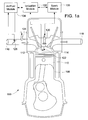
- FIG. 1a is a schematic view of a combustion quality control of the present invention
- FIG. 1b is a block diagram of the ionization module of FIG1a;
- FIG. 2 is a flow chart illustrating the steps to characterize an engine and determine parameters of a floating bounded space in accordance with the teachings of the invention
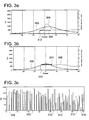
- FIG. 3a is a graphical representation of pressure and ionization current versus engine piston crank angle for a normal combustion event
- FIG. 3b is a graphical representation of pressure and ionization current versus engine piston crank angle for a misfire event
- FIG. 3c is a graphical illustration of experimental data showing a correlation between indicated mean effective pressure of an engine cylinder and misfire that is used in sizing the floating bounded space of the present invention
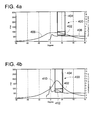
- FIG. 4a is a graphical representation of pressure and ionization current versus engine piston crank angle for a normal combustion event of a spark plug design having a high electrode surface area and electrodes that are mostly exposed to combustion chamber airflow;
- FIG. 4b is a graphical representation of pressure and ionization current versus engine piston crank angle for an incipient knock event of the spark plug design of FIG 4a;
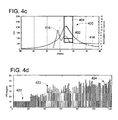
- FIG. 4c is a graphical representation of pressure and ionization current versus engine piston crank angle for a severe knock event of the spark plug design of FIG 4a;
- FIG. 4d is a graphical illustration of experimental data showing a correlation between the peak of the derivative of pressure of an engine cylinder as a function of crank angle and incipient knock and severe knock of the spark plug design of FIG 4a that is used in sizing the floating bounded space of the present invention
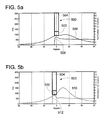
- FIG. 5a is a graphical representation of pressure and ionization current versus engine piston crank angle for a normal combustion event of a spark plug design having a high electrode surface area and electrodes that are mostly shielded from combustion chamber airflow;
- FIG. 5b is a graphical representation of pressure and ionization current versus engine piston crank angle for an incipient knock event of the spark plug design of FIG. 5a;
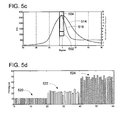
- FIG. 5c is a graphical representation of pressure and ionization current versus engine piston crank angle for a severe knock event of the spark plug design of FIG. 5a;
- FIG. 5d is a graphical illustration of experimental data showing a correlation between the peak of the derivative of pressure of an engine cylinder as a function of crank angle and incipient knock and severe knock of the spark plug design of FIG. 5a that is used in sizing the floating bounded space of the present invention
- FIG. 6a is a graphical illustration of an undesirable sequence of combustion cycles having large variability in the fuel burn rate of an engine
- FIG. 6b is a graphical illustration of a desirable sequence of combustion cycles having minimal variability in the fuel burn rate of an engine
- FIG. 7 is a limit diagram showing pressures and temperatures during a combustion event with regions of knock, high unburned hydrocarbons, and high NO x emissions;
- FIG. 8 is a graph illustrating the relationship between engine efficiency, NO x emissions, unburned hydrocarbons and the 50% burn rate of an engine
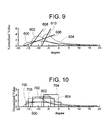
- FIG. 9 is a graphical illustration of experimental data showing the correlation between the combustion quality and the slope of a line starting at an initial ionization current and a peak of the ionization current in accordance with the teachings of the present invention.
- FIG. 10 is a graphical illustration of experimental data showing ionization current at different air/fuel ratios and a box used to determine the combustion quality in accordance with the teachings of the present invention
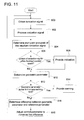
- FIG. 11 is a flow chart illustrating the steps to determine an abnormal combustion condition and to control the combustion quality in accordance with the teachings of the present invention.
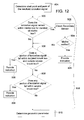
- FIG. 12 is a flow chart illustrating the steps to determine the abnormal combustion condition of FIG. 11;
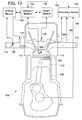
- FIG. 13 is a schematic view of the combustion quality control of FIG. 1 illustrating the use of a secondary source in accordance with the teachings of the present invention
- FIG. 14 is a graph illustrating a bum rate relationship between a 50% fuel burn location and an average ionization signal peak location in a typical natural gas power generation engine operating with air/fuel ratios corresponding to an excess-air factor lambda in the range of 1.59 to 1.67;
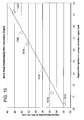
- FIG. 15 is a graph illustrating a burn rate relationship between a 50% fuel burn location and an average ionization signal peak location in a typical natural gas power generation engine operating with air/fuel ratios corresponding to an excess-air factor lambda in the range of 1.6 to 1.85.
- a lean burn reciprocating engine is a reciprocating engine operating with an air/fuel ratio corresponding to an excess-air factor lambda ( ⁇ ) greater than 1.4, typically in the range of 1.4 to 1.85, and preferably in the range of 1.67 to 1.82.
- the system includes an ionization module 102, an air/fuel module 104, a spark module 106, and a reciprocating engine. While the ionization module 102, the air/fuel module 104 and the spark module 106 are shown separately, it is recognized that the modules 102, 104, 106 may be combined into a single module or be part of an engine controller having other inputs and outputs.
- the reciprocating engine includes engine cylinder 108, a piston 110, an intake valve 112 and an exhaust valve 114. An intake manifold 116 is in communication with the cylinder 108 through the intake valve 112.
- An exhaust manifold 118 receives exhaust gases from the cylinder 108 via the exhaust valve 114.
- the intake valve 112 and exhaust valve 114 may be electronically, mechanically, hydraulically, or pneumatically controlled or controlled via a camshaft.
- a spark plug 120 with a spark gap 122 ignites the air/fuel mixture in cylinder 108.
- Spark module 106 controls ignition timing and provides power to the spark plug 120.
- the ionization module contains circuitry for detecting and analyzing the ionization signal.
- the ionization module includes an ionization signal detection module 130, an ionization signal analyzer 132, and an ionization signal control module 134.
- the ionization module 102 supplies power to the spark gap 120 after the air and fuel mixture is ignited and measures ionization signals from the spark gap 120 via ionization signal detection module 130.
- a conventional ionization probe or other conventional device to detect ionization may be used to measure the ionization signals.
- Ionization signal analyzer 132 receives the ionization signal from ionization signal detection module 130 and determines if an abnormal combustion condition exists and monitors and adjusts the combustion quality as described herein.
- the ionization signal control module 134 controls ionization signal analyzer 132 and ionization signal detection module 130.
- the ionization signal control module 134 provides an indication to the air/fuel module of the abnormal combustion condition as described below.
- the ionization module 102 sends the indication to other modules in the engine system such as an engine controller.
- ionization signal detection module 130 the ionization signal analyzer 132, and the ionization signal control module 134 are shown separately, it is recognized that they may be combined into a single module and/or be part of an engine controller having other inputs and outputs.
- the air/fuel module 104 controls fuel injection 122 and may control throttle valve 124 to deliver air and fuel, at a desired ratio, to the engine cylinder 106.
- the air/fuel module 104 receives feedback from the ionization module and adjusts the air/fuel ratio as described below.
- the ionization signal is proportional to the air/fuel ratio of the fuel mixture.
- the air/fuel ratio of the mixture is higher in lean burn engines (i.e., the amount of fuel is lower) than in stoichiometric engines.
- the lower amount of fuel relative to air results in a lower flame temperature, which translates into a lower number of free ions present in the combustion gases.
- the spark plug design in conjunction with the gasdynamic and thermodynamic characteristics of the combustion event greatly affects the magnitude and repeatability of ion signal. For example, systems having spark plugs having a high electrode surface area and electrodes that are mostly shielded from the combustion chamber airflow provide higher magnitude and more consistent ionization signals than other types of spark plugs.
- the ionization signal is not easy to detect or process in lean burn engines using conventional "J-gap" automotive type spark plugs because the signal is of very low intensity and has great variability.
- Prior art systems that use the energy delivered to ignite the fuel mixture to detect the ionization signal will not work properly because these system will get a weak signal or no signal at all.
- the preferred form of the present invention supplies power to the spark gap after the air and fuel is ignited to measure ionization signals. Additional free ions flow when the additional power is applied, thereby resulting in an ionization signal that is easier to detect.
- the ionization signal is acquired with respect to an engine parameter over the combustion cycle.
- the engine parameter may be crank angle, time after ignition, time from top dead center, etc.
- Abnormal combustion conditions such as misfire and knock are detected at specific points in the combustion cycle. These points are where the ionization signal of the abnormal combustion condition has a signal characteristic that is different from ionization signals of normal combustion conditions.
- misfire occurs when the ionization signal remains at or near an initial value for an extended interval of the combustion cycle.
- a misfire condition is often due to an inadequate air/fuel ratio (e.g., too lean), spark timing, and/or spark characteristics.
- a floating bounded space is associated with the ionization signal (measured with respect to a combustion event) to detect the abnormal combustion conditions.
- the floating bounded space is a space that is located at a position in the combustion cycle and sized such that a portion of the ionization signal will reliably be within the space during the abnormal combustion condition and reliably be outside the space during normal combustion conditions.
- the position of the floating bounded space is a function of an engine timing parameter (e.g., crank angle, time, etc.) and the size is a function of the engine timing parameter and ionization signal magnitude.
- a floating bounded space shaped as a box has one axis (e.g., length) of the box in units of the engine parameter (e.g., crank angle) and the other axis (e.g., height) of the box in units of ionization signal magnitude.
- a floating bounded space is used for each abnormal combustion condition (e.g., a floating bounded space for misfire, a floating bounded space for incipient knock, a floating bounded space for severe knock, etc.).
- the ionization signal magnitude is compared to the magnitude range of the floating bounded space.
- the ionization module 102 indicates that an abnormal combustion condition has occurred if the ionization signal is within the floating bounded space according to criteria described below.
- Use of the floating bounded space according to the invention overcomes the problems associated with prior art integrating techniques. The effect of noise is reduced by eliminating the integration of the ionization signal. Integration is implicitly a filtering operation that can miss short bursts of activity that are indicative of combustion conditions. In lean burn combustion these short bursts may be the only difference between a normal combustion condition and an abnormal combustion condition.
- the floating bounded space detects the short bursts. The variability in the ionization signal is accounted for during a calibration process when the floating bounded space is sized and positioned as described herein.
- Signal characteristics of the ionization signal are used to characterize each abnormal combustion condition and to determine at what point in the combustion cycle that the abnormal combustion condition can be reliably detected.
- the floating bounded space is derived to capture the signal characteristic of the ionization signal indicative of the abnormal combustion condition and is associated with the ionization signal.
- a floating box shall be used to describe positioning and sizing the floating bounded space.
- the ionization signal will be acquired with respect to crank angle. It is recognized that any shape may be used for the floating bounded space and the ionization signal can be acquired with respect to time or other engine parameters.
- the tuning process determines the starting position and the size of the floating bounded space.
- the process also determines an air/fuel ratio lean limit for a given spark characteristic and spark timing at which the engine has a high likelihood of misfire if the engine is operating with an air/fuel ratio above the lean limit. As the air/fuel ratio becomes leaner, the probability of misfire increases.
- the lean limit is set based upon operating constraints. For example, an engine may be allowed to misfire a percentage of the number of cycles during operation while another engine may never be allowed to misfire.
- the limit is set to a richer air/fuel ratio if the engine is not allowed to misfire that is more than the air/fuel ratio of an engine that is allowed to misfire during operation.
- air/fuel ratio and spark timing are key control parameters, it is recognized that other engine parameters can be used to control an engine (e.g., percent EGR, waste gate and throttle position, etc.).
- a set of data points of engine parameters that can be used to determine the abnormal combustion condition and a set of corresponding ionization signals at various operating conditions of the lean burn engine is obtained (step 200).
- the set of data points of engine parameters may be indicated mean effective pressure (IMEP) of the cylinder, air/fuel ratio, or any other engine parameter that can be used to determine when the abnormal combustion condition has occurred.
- IMEP mean effective pressure
- a test engine is typically used to obtain the set of data points and learn the characteristics of the engine during normal and abnormal operating conditions.
- the use of a test engine allows sensors and diagnostic equipment to be used that are typically not available in production engines.
- the IMEP of a cylinder is generally not acquirable in production engines from cylinder pressure sensors because production engines generally do not have pressure sensors in each cylinder due to cost and reliability issues.
- the ionization signal may be noisy.
- the set of corresponding ionization signals are acquired using filters to filter the ionization signal. For example, a moving average filter can be used where the number of data points to average is defined based upon signal characteristics of the ionization signal.
- the abnormal combustion condition is determined from the set of data points (step 202). For example, a misfire can be detected using the IMEP of a cylinder. A misfire occurs if the IMEP is below a defined threshold. In one embodiment this threshold is a predetermined percentage of the nominal value of IMEP for the cylinder.
- the ionization signals corresponding to the abnormal combustion condition are compared to the ionization signals of normal combustion conditions to determine characteristics of the ionization signal that can be used to identify the abnormal event (step 204).
- the starting point and size of the floating box is then determined using the characteristics of the ionization signals (step 206). In one embodiment, the starting point and size of the floating box is determined by looking at the abnormal combustion conditions and determining the upper and lower extremes in the data set.
- the floating box is sized and positioned at one extreme and then the floating box is tuned at the other extreme.
- the floating box is preferably sized and positioned with sets of data points acquired at different operating conditions.
- the floating box parameters i.e., size and position
- the floating box parameters may vary with engine operating conditions, such as speed, engine load, and desired air/fuel ratio.
- the size of the floating box is different at engine idle and full power.
- FIG. 3a is an illustration of a representative cylinder pressure 302 and ionization signal 304 of a normal combustion condition.
- FIG. 3b is an illustration of a representative cylinder pressure 306 and ionization signal 308 for a misfire condition.
- a representative set of data points of the engine parameter for 70 engine cycles is shown in FIG. 3c.
- the engine parameter used is the IMEP of a cylinder. If the IMEP of any data point is below a selected amount, the data point is classified as a misfire condition.
- the selected amount should be set to a point that detects all the misfires. In one embodiment, the selected amount is a predetermined percentage of nominal.
- Data points 310 in FIG. 3c correspond to a misfire condition.
- the ionization signal 304 of a normal combustion condition has an initial short flattened portion from the initial starting point followed by a peaked portion.
- the misfire condition remains substantially constant for a given duration.
- One characteristic of a misfire condition in the ionization signal for many engines is that a portion of the ionization signal remains substantially constant from the initial starting point 312 of the ionization signal for an extended interval as can be seen in FIG. 3b and can be confined within a bounded space. It is recognized that other characteristics may be used.
- the tuning process is used to determine the starting point and size of the floating box using the characteristics of the ionization signals.
- the tuning process adjusts the size and position of the floating box to reliably capture the misfire condition and exclude the normal combustion condition.
- the starting point and size of the floating box is adjusted until the floating box is of sufficient size and at a location of the ionization signal with respect to crank angle such that a portion of the ionization signal of a misfire condition reliably remains within the floating box 300 for the duration of the floating box 300 as shown in FIG. 3b and leaves the floating box 300 for a normal combustion condition as shown in FIG. 3a. This is accomplished by overlaying the floating box on the ionization signals corresponding to the normal and abnormal combustion cycles shown in FIG.
- the floating box is superimposed on ionization signals corresponding to the upper and lower extremes of data points 310 (i.e., the misfire conditions) in the engine being characterized and the box parameters are adjusted such that the portion of the ionization signal reliably remains within the box for each condition.
- the floating box is then superimposed on the ionization signal for the normal ionization signals that are closest in form to the ionization signals for misfire conditions.
- the ionization signals corresponding to data points 312, 314, and 316 are likely to be closest in shape or form to ionization signals corresponding to misfire conditions.
- the floating box is then adjusted until the portion of the ionization signal of the normal combustion condition is not captured by the floating box. This process is repeated for all of the ionization signals in the data set for the various engine operating conditions (e.g., speed, engine load, desired air/fuel ratio, etc.) to ensure that the floating box reliably captures misfire conditions and excludes other conditions.
- the box parameters are then used during engine operation to detect misfire conditions.
- the ionization signal analyzer 132 receives the ionization signal. It floats the floating box over the ionization signal in accordance with the box parameters. In one embodiment, the lowest magnitude of the ionization signal is determined beginning at the starting point of the floating box and ending at the boundary of the floating box (i.e., for the duration of the floating box). For example, if the duration of the floating box is thirty degrees of crank angle, the lowest magnitude of the ionization signal is determined over the thirty degrees of crank angle. The starting point of the floating box is then positioned at the starting point crank angle (i.e., time after ignition) at the lowest magnitude of the ionization signal.
- the ionization signal analyzer 132 determines if the ionization signal remains within the floating box over the duration of the floating box.
- the ionization signal analyzer 132 provides an indication to the ionization signal control module 134 that a misfire has been detected if the ionization signal remains within the floating box over the duration of the floating box.
- FIG. 3b illustrates the ionization signal remaining within the floating box over the duration of the floating box.
- the ionization signal control module 134 provides an indication to the air/fuel module 104 and spark module 106 of the misfire condition and to other modules such as the engine controller.
- the air/fuel module 104 and spark module 106 (or the engine controller), in turn, determine what action to take.
- the actions that can be taken include advancing the ignition timing and/or running the engine richer (e.g., adding more fuel to the air/fuel mixture) or doing nothing until a predetermined number of misfires have occurred and then advancing the ignition timing and/or running the engine richer.
- the air/fuel module 104 controls fuel injection 124 and/or throttle valve 126 and spark module 106 controls the spark timing to move the engine away from the misfire condition in accordance with the action decided to be taken (e.g., advancing the ignition timing and/or running the engine richer).
- the ionization signals are substantially different in overall form or shape for different types of plugs.
- the ionization signal may have a secondary peak in some spark plugs and has no secondary peak in other types of spark plugs. This means that prior methods used to detect knock based on the presence of a secondary peak in the ionization signal will not work with certain types of spark plugs.
- the present invention is adaptable to many or most such types of spark plugs in that the engine is characterized with the spark plug types that are used in production engines.
- FIG. 4a-4d the floating bounded space 400 for knock is shown for a spark plug having a secondary peak. The onset of the second peak is an indication of knock.
- the floating bounded space 400 is sized, positioned and in this case subdivided to include a lower portion 402 and an upper portion 404 to detect incipient knock and severe knock respectively.
- Incipient knock occurs when the magnitude of knock is minimal and the knock won't cause immediate damage to the engine.
- Severe knock occurs when the magnitude of the knock is such that the knock is causing or is about to cause damage to the engine.
- FIG. 4a is an illustration of a representative cylinder pressure 406 and ionization signal 408 of a normal combustion condition.
- FIG. 4b is an illustration of a representative cylinder pressure 410 and ionization signal 412 of an incipient knock condition.
- FIG. 4c is an illustration of a representative cylinder pressure 414 and ionization signal 416 for a severe knock condition. Knock occurs when pressure changes quickly.
- the engine parameter selected for characterizing the ionization signal is the peak of the derivative of pressure of a cylinder with respect to engine crank angle. Other engine parameters could be used.
- a representative set of data points of the engine parameter is shown in FIG. 4d. Acceptable knock 420, incipient knock 422, and severe knock 424 levels are shown.
- a threshold level of the peak of the derivative of pressure of a cylinder is chosen for incipient knock and a higher threshold level of the peak of the derivative of pressure of a cylinder is chosen for severe knock.
- the threshold level for incipient knock is chosen such that the knock won't cause immediate damage to the engine.
- the threshold level for severe knock is chosen such that the knock is about to do some damage to the engine. If the peak of the derivative of pressure of a cylinder is below the threshold level for incipient knock, any knock present is within an acceptable level of knock. If the peak of the derivative of pressure of a cylinder is above the threshold level for incipient knock and below the threshold for severe knock, the knock is defined as incipient knock.
- the knock is defined as severe knock.
- the threshold level for incipient knock is set to a value of 25 and the threshold level for severe knock set to a value of 45. It is recognized that the threshold levels must be determined during engine characterization and are based on the knock tolerance level of the engine.
- the starting point and size of the lower portion is determined by adjusting the starting point and size until the lower portion is of sufficient size and at a location with respect to the ionization signal and crank angle such that any portion of the ionization signal for an incipient knock condition reliably falls within the lower portion 402 and remains outside the upper portion 404 as illustrated in FIG. 4b.
- the starting point and size of the upper portion is determined by adjusting the starting point and size until the lower portion is of sufficient size and at a location such that any portion of the ionization signal for a severe knock condition reliably falls within the upper portion 404 as illustrated in FIG. 4c.
- the starting point is a fixed amount of time after the ignition event and the duration of the floating box 400 is a fixed amount of time. This time can be in terms of actual time or in terms of crank angle and is determined from the data points illustrated in FIG. 4d.
- the ionization signal eventually goes to quasi steady state value.
- the bottom of the lower portion 402 is set to a point a fixed amount above the quasi steady state value and the top of the lower portion 402 is determined from the data points.
- the fixed amount above the quasi steady state value is determined from the data points and is set to a location such that the ionization signals of normal combustion conditions do not fall within the floating box 400.
- the top of the lower portion is determined such that incipient knock conditions fall within the lower portion 402 and remain outside the upper portion 404.
- the quasi steady state value is determined and the lower portion 402 of the floating box 400 is placed at the fixed amount of time after the ignition event at the fixed amount above the quasi steady state value.
- the ionization signal analyzer 132 provides an indication to the ionization signal control module 134 that incipient knock has been detected if the analyzer determines that the ionization signal falls within the lower portion 402 while remaining outside the upper portion 404.
- the ionization signal analyzer 132 provides an indication to the ionization signal control module 134 that severe knock has been detected if the analyzer determines that the ionization signal falls within the upper portion 404.
- FIG. 5a-5d the floating bounded space 500 for configurations having no second peak is subdivided to include a lower portion 502 and an upper portion 504 to detect the incipient knock and severe knock.
- FIG. 5a is an illustration of a representative cylinder pressure 506 and ionization signal 508 of a normal combustion condition.
- FIG. 5b is an illustration of a representative cylinder pressure 510 and ionization signal 512 for an incipient knock condition.
- FIG. 5a is an illustration of a representative cylinder pressure 506 and ionization signal 508 of a normal combustion condition.
- FIG. 5b is an illustration of a representative cylinder pressure 510 and ionization signal 512 for an incipient knock condition.
- FIG. 5c is an illustration of a representative cylinder pressure 514 and ionization signal 516 for a severe knock condition.
- a representative set of data points of the engine parameter is shown in FIG. 5d.
- Acceptable knock 520, incipient knock 522, and severe knock 524 levels are shown.
- the engine parameter used is the peak of the derivative of pressure of a cylinder with respect to engine crank angle.
- a threshold level of the peak of the derivative of pressure of a cylinder is chosen for incipient knock and a threshold level of the peak of the derivative of pressure of a cylinder is chosen for severe knock.
- the threshold level for incipient knock is chosen such that the knock won't cause immediate damage to the engine.
- the threshold level for severe knock is chosen such that the knock is about to do some damage to the engine.
- any knock present is within an acceptable level of knock. If the peak of the derivative of pressure of a cylinder is above the threshold level for incipient knock and below the threshold for severe knock, the knock is defined as incipient knock. If the peak of the derivative of pressure of a cylinder is above the threshold level for severe knock, the knock is defined as severe knock. In one embodiment, the threshold level selected for incipient knock is set to a value of 15 and the threshold level for severe knock is set to a value of 45. Other values may be used.
- the starting point and size of the lower portion is determined by adjusting the starting point and size until the lower portion is of sufficient size and at a location with respect to the ionization signal and crank angle such that any portion of the ionization signal for an incipient knock condition reliably falls within the lower portion 502 and remains outside the upper portion 504 as illustrated in FIG. 5b.
- the starting point and size of the upper portion is determined by adjusting the starting point and size until the lower portion is of sufficient size and at a location such that any portion of the ionization signal for a severe knock condition reliably falls within the upper portion 504 as illustrated in FIG. 5c.
- the starting point is a fixed amount of time after the ignition event and the duration of the floating box 500 is a fixed amount of time. This time can be in terms of actual time or in terms of crank angle and is determined from the data points illustrated in FIG. 5d.
- the ionization signal eventually goes to quasi steady state value.
- the bottom of the lower portion 502 is set to a point a fixed amount above the quasi steady state value and the top of the lower portion 502 is determined from the data points.
- the fixed amount above the quasi steady state value is determined from the data points and is set to a location such that the ionization signals of normal combustion conditions do not fall within the floating box 500.
- the top of the lower portion is determined such that incipient knock conditions fall within the lower portion 502 and remain outside the upper portion 504.
- the quasi steady state value is determined and the lower portion 502 of the floating box 500 is placed at the fixed amount of time after the ignition event at the fixed amount above the quasi steady state value.
- the ionization signal analyzer 132 provides an indication to the ionization signal control module 134 that incipient knock has been detected if the analyzer determines that the ionization signal falls within the lower portion 502 while remaining outside the upper portion 504.
- the ionization signal analyzer 132 provides an indication to the ionization signal control module 134 that severe knock has been detected if the analyzer determines that the ionization signal falls within the upper portion 504.
- the ionization signal control module 134 provides an indication to the air/fuel module 104 of the incipient knock conditions and the severe knock conditions and to other modules such as the engine controller.
- the air/fuel module 104 and spark module 106 determines what action to take.
- the actions that can be taken include retarding the ignition timing, running the engine leaner (e.g., adding more air to the air/fuel mixture), or shutting down the engine.
- the air/fuel module 104 controls fuel injection 124 and/or throttle valve 126 and spark module 106 controls the spark timing to move the engine away from the knock condition by retarding the ignition timing and/or running the engine leaner, or shutting down the engine.
- the ionization signal is also used as a feedback signal to optimize combustion quality, which results in optimum engine performance (i.e., power output, brake mean effective pressure, etc.) thermal efficiency, and emissions.
- Optimal combustion quality, for internal combustion engines is defined as the in cylinder combustion temperature and pressure conditions leading to an optimal placement of the centroid of the rate of heat release, which is approximately the point where fifty percent of the fuel mixture has burned, and minimum variation of IMEP to obtain various conditions of the thermodynamic efficiency/ unburned hydrocarbons/ NO x emission tradeoff.
- the optimal combustion quality occurs when the cycle to cycle variation (coefficient of variability) in the IMEP is less than two to three percent and the end of combustion occurs within forty crank angle degrees from the start of combustion (i.e., the total combustion duration from 5% fuel burn to 95% fuel burn in a cylinder is less than forty crank angle degrees). In other applications, the optimal combustion quality occurs when the cycle to cycle variation in the IMEP is less than 1.6 percent and the total combustion duration is less than thirty five degrees.
- FIG. 6 shows example traces of the mass fraction of fuel burned.
- the burn rate of a lean burn reciprocating engine is the speed at which the combustion propagates across a cylinder.
- the combustion slows down the leaner the air/fuel ratio becomes.
- the slowing down of the combustion causes a longer burn time between the ignition point and the location in crank angles where approximately half of the mixture is burned. This position is called the "50% Burn Point.”
- the location of the 50% burn point is nearly co-located with the centroid of heat release.
- FIG. 6a shows an undesirable sequence of cycles with large variability.
- FIG. 6b shows a desirable sequence of cycles with minimal variability.
- FIG. 7 is a limit diagram showing pressures and temperatures during the combustion event. It marks regions of knock, high unburned Hydrocarbons, and high NO x emissions.
- the start of combustion (SOC) point needs to be to the left of the knock line.
- the end of combustion (EOC) needs to lie between the Hydrocarbon and NO x lines.
- FIG. 8 shows the practical application of FIG. 7.
- the controller is more able to provide the desired efficiency, unburned Hydrocarbon and NO x tradeoff the lower the variation is in the 50% burn point location.
- the combustion quality of the lean burn reciprocating engine can be determined from a geometric parameter of the ionization signal.
- the geometric parameter may be a parameter that can be unique (e.g., is calibrated) for each cylinder of an engine.
- a plurality of ionization signals is processed to produce a representative resultant ionization signal. The processing minimizes variations from cycle to cycle.
- the signals are processed to extract relevant parameters and the parameters are averaged to produce the resultant ionization signal.
- the parameters include the ionization signal starting point and the peak of the ionization signal.
- the ionization signal starting point can be either the ignition timing point (i.e., the starting point of combustion) or the starting point of the resultant ionization signal.
- the magnitude of the ionization signal starting point is determined by setting the magnitude to be the average of the ionizations signals over a region where the ionization signal has stabilized. In FIGS. 9 and 10, this average is shown as the normalized value of zero. The starting point becomes the point in the curves where the ionization signal crosses the normalized value of zero.
- FIGS. 9 and 10 show resultant ionization signals for various air/fuel ratios.
- Curve 600 is a resultant ionization signal for an engine operating at an air/fuel ratio corresponding to a ⁇ of 1.72.
- Curve 602 is a resultant ionization signal for an engine operating at an air/fuel ratio corresponding to a ⁇ of 1.67.
- Curve 604 is a resultant ionization signal for an engine operating at an air/fuel ratio corresponding to a ⁇ of 1.64. It can be seen that the ionization signal is advancing as ⁇ increases. The advance is occurring because the spark timing is advancing and the ionization signal is acquired after ignition has occurred.
- the geometric parameter is the slope 604, 606, 608 of a line drawn from the ionization signal starting point and passing through the peak of the resultant ionization signal.
- the combustion quality is determined from the slope of the line.
- the combustion quality is adjusted by changing combustion parameters until the slope is approximately equal to the slope corresponding to a desired combustion quality as determined from the test engine and/or from actual operating conditions.
- the combustion parameter is the air/fuel ratio and the air/fuel ratio, which may be determined as a function of the slope, is adjusted until the slope of the line is approximately equal to the desired slope.
- FIG. 10 An alternate embodiment of determining the combustion quality is illustrated in FIG. 10.
- the geometric parameter used is an aspect ratio of a box drawn around the signal.
- the lower left corner of the box is the ionization signal starting point
- the top of the box is at the peak of the resultant ionization signal
- a right side of the box is at a percentage of the peak of the resultant ionization signal.
- the box parameters (i.e., lower left comer, top, and percentage) may vary with engine operating conditions, such as speed and engine load.
- Box 700 corresponds to ionization signal 600
- box 702 corresponds to ionization signal 602
- box 704 corresponds to ionization signal 604.
- the combustion quality is adjusted based upon the aspect ratio of a box 700, 702, 704.
- the aspect ratio is compared to the reference aspect ratio of a reference box 706 and combustion parameters are adjusted until the aspect ratio is approximately equal to the reference aspect ratio.
- the reference aspect ratio corresponds to a desired combustion
- FIG. 11 the steps of analyzing and controlling the combustion quality of a lean burn reciprocating engine are shown. While the steps will be described sequentially, it is recognized that the steps may be performed sequentially, in parallel, a combination of sequentially and parallel, and in different order.
- a succession of ionization signals of the lean burn reciprocating engine for successive cycles (i.e., combustion events) of a running engine is obtained (step 800).
- the ionization signals are processed for signal stability and a resultant ionization signal is determined (step 802).
- An ionization signal starting point and a peak for the resultant ionization signal is determined using an initial level for all of the signals (step 804).
- the ionization signals are checked to determine if a portion of an ionization signal is within a floating bounded space 300, 400, 500 (step 806).
- An indication is provided if a portion of an ionization signal is within a floating bounded space 300, 400, 500 (step 808).
- step 806 includes determining if a portion of an ionization signal is within floating bounded space 300 for the duration of the floating bounded space 300 (step 900).
- Some engines have sensors or other engine performance indicators that can be used as a secondary sensor to verify that a misfire has occurred. If a portion of the ionization signal is within the floating bounded space for an extended interval corresponding to the duration of the floating bounded space and a secondary sensor is available on the engine, the secondary sensor is checked (step 902) to verify that a misfire has occurred.
- the secondary sensor is used to eliminate the possibility that that drift of the flame kernel produced by the spark plug 118 has moved out of the spark gap 120 before the ionization module 102 has detected the ionization signal.
- the secondary sensor is checked to see if the engine is operating normally.
- FIG. 13 illustrates the secondary sensor.
- the secondary sensor 190 provides a secondary signal 192 to the ionization module 102.
- the secondary signal 192 may be a pressure signal 194, exhaust temperature 196, IMEP, instantaneous crank angle velocity 198, or other signals such as from an oxygen sensor and the like. If the secondary signal indicates a misfire has occurred (step 904), an indication of misfire is provided (step 808).
- the ionization signal is also checked to determine if any portion of the ionization signal falls within the lower portion 402, 502 floating bounded space 400, 500, and no portion falls within the upper portion 404, 504 of floating bounded space 400, 500 (step 906). If any portion of the ionization signal falls within the lower portion 402, 502 floating bounded space 400, 500, and no portion falls within the upper portion 404, 504 of floating bounded space 400, 500, an indication of incipient knock is provided (step 808).
- the ionization signal is also checked to determine if any portion of the ionization signal falls within upper portion 404, 504 of floating bounded space 400, 500 (step 908). If any portion of the ionization signal falls within the upper portion 404, 504 of floating bounded space 400, 500, an indication of severe knock is provided (step 808).
- a geometric parameter associated with the resultant ionization signal is determined (step 810).
- the slope or aspect ratio described above is used for the geometric parameter in one embodiment.
- the geometric parameter is compared to a limit equivalent to the combustion quality limit.
- the parameter is checked to determine if the parameter is below the limit or is approaching the limit (step 812).
- An indication is provided if the geometric parameter is above the limit or is approaching the limit (step 814). For example, if the limit is slope 606, the indication is provided if the measured slope approaches slope 606 or is below slope 606.
- the limit is the aspect ratio of box 700, the indication is provided if the measured aspect ratio is approaching or is below the aspect ratio of box 700.
- the indication provides the engine controller with the ability to adjust the combustion quality to operate the engine with a lower likelihood of having a misfire condition.
- the geometric parameter is also compared against a reference geometric parameter and the error difference between the geometric parameter and the reference geometric parameter is determined (step 816).
- the reference geometric parameter is related to a desired combustion quality in a system having an air/fuel ratio relating to a ⁇ greater than 1.4.
- a control parameter of the engine is adjusted such that an error difference between the geometric parameter and the reference geometric parameter is minimized (step 818).
- the control parameter is any parameter that affects the combustion quality.
- the control parameter may be air flow, fuel flow, spark timing, EGR valve position, throttle position, etc. For example, if the geometric parameter indicates the engine is operating too lean, fuel flow can be increased, air flow may be reduced, etc. Steps 800 to 818 are repeated for subsequent combustion events of the lean burn reciprocating engine.
- the cylinders in an engine do not necessarily see the same amount of air all the time due to the geometry of the intake manifold and exhaust manifold. In such situations, this means that the airflow must be known and calibrated prior to engine operation.
- An ionization signal from each engine cylinder can be acquired with the present invention, which provides the ability to individually control each engine cylinder. As a result, the fuel and/or air flow to each cylinder of an engine can be trimmed in real time, mitigating the airflow differences.
- Burn rate is the speed at which the combustion propagates across a cylinder.
- the combustion slows down as the air/fuel ratio becomes leaner and the combustion takes longer to propagate away from the spark plug.
- the slowing down of the combustion causes a longer burn time between the ignition point and the location in crank angles where approximately half of the mixture is burned. This position is called the "50% burn point" and is typically measured in crank angle degrees.
- the fifty percent burn point is typically calculated from the cylinder pressure.
- the time between the ignition event and the peak chemical ionization point (i.e., the peak of the ionization signal, or in the case of an ionization signal having multiple peaks, the first peak) in the ionization signal determines a degree factor or slope that correlates with the burn rate.
- This time or number of degrees between the ignition point and the peak of the chemical ionization has a linear and proportional relationship to burn rate.
- FIG. 14 illustrates the relationship between a fifty percent (50%) burn and the average peak of the ionization signal as a function of degrees from ignition for various air/fuel ratios in a test engine operating with ⁇ s greater than 1.4.
- Ignition is defined as the time occurrence of the start of the spark event.
- the 50% fuel burn point is approximately at the same point in the combustion cycle where the cylinder pressure peaks.
- the power output and emissions tradeoff can be adjusted by controlling the 50% burn point to remain at a desired location for each cylinder, and in one embodiment, the same location for all cylinders.
- data point 1000 corresponds to a ⁇ of 1.59
- data point 1002 corresponds to a ⁇ of 1.61
- data point 1004 corresponds to a ⁇ of 1.62
- data point 1006 corresponds to a ⁇ of 1.64
- data point 1008 corresponds to a ⁇ of 1.66
- data point 1010 corresponds to a ⁇ of 1.67.
- FIG. 15 illustrates the relationship between the 50% burn rate location and the location of the average peak of the ionization signal as a function of degrees from ignition for various air/fuel ratios in a test engine operating with ⁇ s greater than 1.6, and more specifically, in the range of 1.6 to 1.765.
- data point 1012 corresponds to a ⁇ of 1.6
- data point 1014 corresponds to a ⁇ of 1.663
- data point 1016 corresponds to a ⁇ of 1.698
- data point 1018 corresponds to a ⁇ of 1.731
- data point 1020 corresponds to a ⁇ of 1.755
- data point 1022 corresponds to a ⁇ of 1.765.
- the combustion performance can be optimized by controlling the engine based on the location of the average ionization signal peak.
- the ionization measurement can provide a way to equalize the burn rate on an individual cylinder basis. For example, for a given engine if ⁇ is 1.64, the spark timing is adjusted until the peak of the ionization signal is approximately 27.5° from ignition to locate the 50% burn point at approximately 48° from the ignition point, or about 20° after top dead center (TDC).
- TDC top dead center
- the falling edge of the first peak of the ionization signal may be used.
- the aspect ratio described previously may be used with the reference aspect ratio corresponding to the desired burn rate.
- crank angle degree for the location of the average of the peak chemical ionization point that can be designated for the desired emissions target and/or fuel efficiency target of the engine. Equalizing the crank angle degree for each cylinder allows for optimum ignition timing for each cylinder. This burn rate information needs to relate to the crank angle degrees, or position of the piston in the engine, in order to use it for proper engine control. Averaging may be necessary to remove the cycle to cycle differences such that the ionizations local sensor effects are filtered out and a correlation holds true. The thermal efficiency, NO x emissions, and other parameters of the engine can be optimized in a similar fashion.
- Equalizing the burn rate for all cylinders may result in the cylinders having different air/fuel ratios and different power levels due to the different airflows and different fueling rates. However, these differences will add up to the lowest possible emissions. With the same burn rate, all cylinders can have similar ignition timing, unless detonation is occurring on a specific cylinder. If all cylinders have the same burn rate, the fuel efficiency can also be maximized for the engine, while minimizing the NO x plus HC emissions sum.
- the emissions and fuel economy of a lean burn engine are sometimes working against each other at the lean limit of an engine.
- Some cylinders have different compression ratios and others have a different level of charge motion.
- the lean limit of an engine is usually reached when the weakest cylinder (i.e. the cylinder with the slowest burning combustion) begins to misfire.
- the strongest cylinder will be generating the most NO x and the weakest cylinder will be generating the most unburned hydrocarbons.
- the net effect of equalizing the burn rate is providing the weak cylinders with more fuel and providing the strong cylinders with less fuel. This may cause the individual cylinders to all run at slightly different air/fuel ratios, but all cylinders will have consistent combustion, which delivers the lowest total emissions, with the best fuel efficiency tradeoff.
- Controlling the consistency of a stoichiometric engine still requires at least one global oxygen sensor to provide the accurate sensing of the air/fuel ratio for optimum catalyst operation.
- use of the ionization signal provides ideal optimization performance and consistent lean operating conditions on each cylinder through the combination of the burn rate control with abnormal combustion detection (e.g., misfire and knock).
- abnormal combustion detection and combustion quality control together produce the maximum efficiency and lowest NOx emission of a lean burn engine.
- ionization signals One important factor for using ionization signals as a control feedback is the sensing quality of the ionization signal.
- Short duration spark discharges typical of capacitive discharge (CD) ignition systems allow for ionization sensing to begin within 300 ⁇ s after the initial spark has occurred. This is a significantly shorter time delay period than an inductive ignition system can provide, which has a typical spark duration of 1.5 to 3 ms. Beginning ionization sensing within a few hundred microseconds after spark provides data during the chemical ionization phase (primarily flame propagation in the vicinity of the spark gap) that would otherwise be missed with longer duration ignition systems.
- Capacitive discharge systems also use a large capacitance for high current spark discharges that can generate a 100 ampere peak for 3 ⁇ s when discharging during ignition.
- the ionization current is approximately 30 to 50uA.
- the large capacitance retains most of its charge during the ionization portion of the combustion process and can be used to hold the voltage essentially constant across the spark plug electrodes for measuring the ionization signal.
- Another benefit of capacitive discharge systems over inductive ignition systems is the low resistance and inductance of the secondary winding of the capacitive discharge coil, which allows for a higher current flow through the secondary windings during the ionization phase. This combined with the ability to present a higher voltage across the gap also improves the ionization signal-to-noise ratio. Specific to the detection of knock, the low inductance allows the high frequency to pass through the coil.
- the combination of improved lean burn ignition plus ionization feedback for misfire purposes is especially useful in cold starting engines and operating just inside the misfire limit for leanest possible cold starts in a closed loop fashion.
- a system and method of the present invention provides the ability to detect abnormal combustion conditions and control combustion quality in a lean burn reciprocating engine using ionization signals.
- the present invention provides the ability to control the fuel in a lean burn engine utilizing the time or degrees from ignition to the peak of the chemical ionization phase and in one embodiment, equalizes that time (or degrees) for all cylinders. Additionally, the ability to control the fuel in a lean burn engine utilizing the time or degrees from the ignition event to the falling edge of the chemical ionization curve to determine the burn rate of the engine has been described.
- the slope from the starting point to the peak of the ionization signal indicates rate and intensity put together; if we equalize slope the more intense burning cylinders get leaned out to a greater extent, given they can handle the greater lean limit this may be the right approach for some engines.
Landscapes
- Engineering & Computer Science (AREA)
- Chemical & Material Sciences (AREA)
- Combustion & Propulsion (AREA)
- Mechanical Engineering (AREA)
- General Engineering & Computer Science (AREA)
- Physics & Mathematics (AREA)
- General Physics & Mathematics (AREA)
- Plasma & Fusion (AREA)
- Combined Controls Of Internal Combustion Engines (AREA)
- Electrical Control Of Ignition Timing (AREA)
Applications Claiming Priority (2)
| Application Number | Priority Date | Filing Date | Title |
|---|---|---|---|
| US42677002P | 2002-11-15 | 2002-11-15 | |
| US426770P | 2002-11-15 |
Publications (3)
| Publication Number | Publication Date |
|---|---|
| EP1420155A2 true EP1420155A2 (de) | 2004-05-19 |
| EP1420155A3 EP1420155A3 (de) | 2006-08-30 |
| EP1420155B1 EP1420155B1 (de) | 2012-06-20 |
Family
ID=32176763
Family Applications (1)
| Application Number | Title | Priority Date | Filing Date |
|---|---|---|---|
| EP03257177A Expired - Lifetime EP1420155B1 (de) | 2002-11-15 | 2003-11-13 | Verfahren zur Regelung der Verbrennungsqualität bei einem magerbetriebenen Verbrennungsmotor |
Country Status (2)
| Country | Link |
|---|---|
| US (1) | US6786200B2 (de) |
| EP (1) | EP1420155B1 (de) |
Cited By (4)
| Publication number | Priority date | Publication date | Assignee | Title |
|---|---|---|---|---|
| EP1600617A3 (de) * | 2004-04-12 | 2006-02-08 | Woodward Governor Company | Verfahren und Einrichtung zum Detektieren von abnormaler Verbrennung in einer Hubkolbenmaschine mit einer hohen Abgasrückführungverhältnis |
| EP1559888A3 (de) * | 2004-01-28 | 2006-10-18 | Stiebel Eltron GmbH & Co. KG | Verfahren und Vorrichtung zur Bestimmung mindestens einer Verbrennungsgrösse eines Verbrennungsvorgangs |
| CN104420990A (zh) * | 2013-08-29 | 2015-03-18 | 科勒公司 | 内燃机中基于位置的空气/燃料比计算 |
| AT525903B1 (de) * | 2022-05-18 | 2023-09-15 | Avl List Gmbh | Verfahren zur Klopferkennung in einem Brennraum eines Zylinders |
Families Citing this family (41)
| Publication number | Priority date | Publication date | Assignee | Title |
|---|---|---|---|---|
| US7021287B2 (en) * | 2002-11-01 | 2006-04-04 | Visteon Global Technologies, Inc. | Closed-loop individual cylinder A/F ratio balancing |
| US6955157B1 (en) | 2004-08-31 | 2005-10-18 | Visteon Global Technologies, Inc. | System for engine retard limit control |
| FR2879665B1 (fr) * | 2004-12-17 | 2009-12-18 | Inst Francais Du Petrole | Methode de detection de combustion anormale pour moteurs a combustion interne |
| DE112005003527B4 (de) * | 2005-04-01 | 2020-08-06 | Hoerbiger Wien Gmbh | Verfahren für die Schätzung von Verbrennungsparametern |
| US7779813B2 (en) * | 2006-03-17 | 2010-08-24 | Ford Global Technologies, Llc | Combustion control system for an engine utilizing a first fuel and a second fuel |
| BRPI0711951B1 (pt) | 2006-05-18 | 2018-12-11 | Ambixtra (Pty) Ltd. | método para monitorar pelo menos um parâmetro associado a uma substância gasosa em uma câmara, sem inflamar a substância gasosa |
| US7637246B2 (en) * | 2006-09-05 | 2009-12-29 | Woodward Governor Company | Compensating for varying fuel and air properties in an ion signal |
| US7798124B2 (en) * | 2006-09-28 | 2010-09-21 | Woodward Governor Company | Method and system for closed loop combustion control of a lean-burn reciprocating engine using ionization detection |
| US7798125B2 (en) * | 2006-09-28 | 2010-09-21 | Woodward Governor Company | Method and system for closed loop combustion control of a lean-burn reciprocating engine using ionization detection |
| FR2913297B1 (fr) * | 2007-03-01 | 2014-06-20 | Renault Sas | Optimisation de la generation d'une etincelle d'allumage radio-frequence |
| US8635985B2 (en) | 2008-01-07 | 2014-01-28 | Mcalister Technologies, Llc | Integrated fuel injectors and igniters and associated methods of use and manufacture |
| US7628137B1 (en) | 2008-01-07 | 2009-12-08 | Mcalister Roy E | Multifuel storage, metering and ignition system |
| US8387599B2 (en) | 2008-01-07 | 2013-03-05 | Mcalister Technologies, Llc | Methods and systems for reducing the formation of oxides of nitrogen during combustion in engines |
| US8205331B2 (en) * | 2008-01-24 | 2012-06-26 | Braly George W | Full time lean running aircraft piston engine |
| FR2938019B1 (fr) * | 2008-10-31 | 2015-05-15 | Inst Francais Du Petrole | Procede de controle de combustion d'un moteur a allumage commande au moyen d'un controle du phasage de la combustion |
| JP4975054B2 (ja) * | 2009-04-09 | 2012-07-11 | 三菱電機株式会社 | 内燃機関の点火診断装置 |
| US8490598B2 (en) * | 2009-08-20 | 2013-07-23 | Ford Global Technologies, Llc | Ignition coil with ionization and digital feedback for an internal combustion engine |
| SG181526A1 (en) * | 2009-12-07 | 2012-07-30 | Mcalister Technologies Llc | Integrated fuel injector igniters suitable for large engine applications and associated methods of use and manufacture |
| KR20120086375A (ko) * | 2009-12-07 | 2012-08-02 | 맥알리스터 테크놀로지즈 엘엘씨 | 연료 인젝터 및 점화기를 위한 적응 제어 시스템 |
| US8205805B2 (en) | 2010-02-13 | 2012-06-26 | Mcalister Technologies, Llc | Fuel injector assemblies having acoustical force modifiers and associated methods of use and manufacture |
| FR2978209B1 (fr) * | 2011-07-21 | 2013-07-12 | IFP Energies Nouvelles | Procede de detection et de caracterisation de combustion anormale pour moteurs a combustion interne |
| ITRE20110060A1 (it) * | 2011-08-02 | 2013-02-03 | Emak Spa | "sistema di controllo della carburazione" |
| US8919377B2 (en) | 2011-08-12 | 2014-12-30 | Mcalister Technologies, Llc | Acoustically actuated flow valve assembly including a plurality of reed valves |
| WO2013115712A1 (en) | 2012-01-30 | 2013-08-08 | Senfusion Ab | Method for monitoring a combustion engine |
| US9169821B2 (en) | 2012-11-02 | 2015-10-27 | Mcalister Technologies, Llc | Fuel injection systems with enhanced corona burst |
| US8746197B2 (en) | 2012-11-02 | 2014-06-10 | Mcalister Technologies, Llc | Fuel injection systems with enhanced corona burst |
| US9169814B2 (en) | 2012-11-02 | 2015-10-27 | Mcalister Technologies, Llc | Systems, methods, and devices with enhanced lorentz thrust |
| US9200561B2 (en) | 2012-11-12 | 2015-12-01 | Mcalister Technologies, Llc | Chemical fuel conditioning and activation |
| RU2532825C2 (ru) * | 2013-03-01 | 2014-11-10 | Михаил Григорьевич Рыбаков | Способ диагностирования поршневого уплотнения двигателя внутреннего сгорания по индикаторной диаграмме |
| US9194337B2 (en) | 2013-03-14 | 2015-11-24 | Advanced Green Innovations, LLC | High pressure direct injected gaseous fuel system and retrofit kit incorporating the same |
| DE102014005986B4 (de) * | 2014-04-25 | 2018-06-14 | Mtu Friedrichshafen Gmbh | Betriebsverfahren für einen Magergasmotor und Magergasmotor |
| AU2015278243A1 (en) * | 2014-06-18 | 2017-01-05 | Orbital Australia Pty Limited | Ignition control and system for an engine of an unmanned aerial vehicle (UAV) |
| US20160160776A1 (en) * | 2014-12-08 | 2016-06-09 | Caterpillar Inc. | Engine System and Method |
| US10208684B2 (en) * | 2015-03-13 | 2019-02-19 | GM Global Technology Operations LLC | Method and apparatus for controlling operation of an internal combustion engine |
| JP6312618B2 (ja) * | 2015-03-13 | 2018-04-18 | 日立オートモティブシステムズ株式会社 | 内燃機関の制御装置及び異常燃焼検出方法 |
| DK3680477T3 (da) * | 2017-09-06 | 2025-12-22 | Ihi Corp | Motorstyringssystem |
| US10801433B2 (en) * | 2018-04-24 | 2020-10-13 | GM Global Technology Operations LLC | Systems and methods for determining irregular fuel requests during engine idle conditions |
| US10934965B2 (en) | 2019-04-05 | 2021-03-02 | Woodward, Inc. | Auto-ignition control in a combustion engine |
| US11187201B1 (en) * | 2021-02-08 | 2021-11-30 | Fca Us Llc | Ion current sensing for estimation of combustion phasing in an internal combustion engine |
| CN115419511B (zh) * | 2022-11-07 | 2023-01-31 | 烟台哈尔滨工程大学研究院 | 一种船用天然气发动机燃烧闭环控制方法及系统 |
| US20260015980A1 (en) * | 2024-07-09 | 2026-01-15 | Caterpillar Inc. | Systems and methods for controlling cylinder combustion in a dual fuel engine using in-cylinder pressure sensing |
Family Cites Families (14)
| Publication number | Priority date | Publication date | Assignee | Title |
|---|---|---|---|---|
| JP3150429B2 (ja) * | 1992-07-21 | 2001-03-26 | ダイハツ工業株式会社 | イオン電流によるリーン限界検出方法 |
| US5483818A (en) * | 1993-04-05 | 1996-01-16 | Ford Motor Company | Method and apparatus for detecting ionic current in the ignition system of an internal combustion engine |
| SE503900C2 (sv) | 1995-01-18 | 1996-09-30 | Mecel Ab | Metod och system för övervakning av förbränningsmotorer genom detektering av aktuellt blandningsförhållande luft-bränsle |
| US5925819A (en) | 1995-05-10 | 1999-07-20 | Nippon Soken, Inc. | Combustion monitoring apparatus for internal combustion engine |
| US5803047A (en) | 1995-10-19 | 1998-09-08 | Mecel Ab | Method of control system for controlling combustion engines |
| SE505543C2 (sv) * | 1995-12-27 | 1997-09-15 | Mecel Ab | Metod för reglering av knackning i en förbränningsmotor |
| US5777216A (en) | 1996-02-01 | 1998-07-07 | Adrenaline Research, Inc. | Ignition system with ionization detection |
| US6029627A (en) | 1997-02-20 | 2000-02-29 | Adrenaline Research, Inc. | Apparatus and method for controlling air/fuel ratio using ionization measurements |
| US5778855A (en) * | 1997-07-03 | 1998-07-14 | Ford Global Technologies, Inc. | Combustion stability control for lean burn engines |
| JPH11247750A (ja) | 1998-02-27 | 1999-09-14 | Nippon Soken Inc | 内燃機関の異常燃焼検出装置 |
| DE19911019C2 (de) | 1999-03-12 | 2001-02-08 | Daimler Chrysler Ag | Verfahren zur Bestimmung des Luft/Kraftstoff-Verhältnisses in einem Brennraum einer Brennkraftmaschine |
| DE10011622A1 (de) * | 2000-03-10 | 2001-09-13 | Delphi Tech Inc | Verfahren zum Regeln der Verbrennung fossiler Brennstoffe |
| JP3626395B2 (ja) | 2000-06-12 | 2005-03-09 | 三菱電機株式会社 | 内燃機関用ノック制御装置 |
| JP3655890B2 (ja) | 2002-05-17 | 2005-06-02 | 三菱電機株式会社 | 内燃機関のノック制御装置 |
-
2003
- 2003-10-22 US US10/691,155 patent/US6786200B2/en not_active Expired - Lifetime
- 2003-11-13 EP EP03257177A patent/EP1420155B1/de not_active Expired - Lifetime
Cited By (8)
| Publication number | Priority date | Publication date | Assignee | Title |
|---|---|---|---|---|
| EP1559888A3 (de) * | 2004-01-28 | 2006-10-18 | Stiebel Eltron GmbH & Co. KG | Verfahren und Vorrichtung zur Bestimmung mindestens einer Verbrennungsgrösse eines Verbrennungsvorgangs |
| EP1600617A3 (de) * | 2004-04-12 | 2006-02-08 | Woodward Governor Company | Verfahren und Einrichtung zum Detektieren von abnormaler Verbrennung in einer Hubkolbenmaschine mit einer hohen Abgasrückführungverhältnis |
| CN104420990A (zh) * | 2013-08-29 | 2015-03-18 | 科勒公司 | 内燃机中基于位置的空气/燃料比计算 |
| EP2843218A3 (de) * | 2013-08-29 | 2015-09-30 | Kohler Co. | Positionsbasierte Berechnung des Luft/Kraftstoff-Verhältnisses in einem Verbrennungsmotor |
| US9279379B2 (en) | 2013-08-29 | 2016-03-08 | Kohler Co. | Position based air/fuel ratio calculation in an internal combustion engine |
| US9869261B2 (en) | 2013-08-29 | 2018-01-16 | Kohler, Co. | Position based air/fuel ratio calculation in an internal combustion engine |
| AT525903B1 (de) * | 2022-05-18 | 2023-09-15 | Avl List Gmbh | Verfahren zur Klopferkennung in einem Brennraum eines Zylinders |
| AT525903A4 (de) * | 2022-05-18 | 2023-09-15 | Avl List Gmbh | Verfahren zur Klopferkennung in einem Brennraum eines Zylinders |
Also Published As
| Publication number | Publication date |
|---|---|
| US20040094124A1 (en) | 2004-05-20 |
| EP1420155B1 (de) | 2012-06-20 |
| US6786200B2 (en) | 2004-09-07 |
| EP1420155A3 (de) | 2006-08-30 |
Similar Documents
| Publication | Publication Date | Title |
|---|---|---|
| EP1420155B1 (de) | Verfahren zur Regelung der Verbrennungsqualität bei einem magerbetriebenen Verbrennungsmotor | |
| US6935310B2 (en) | Method and apparatus for detecting abnormal combustion conditions in reciprocating engines having high exhaust gas recirculation | |
| US6742499B2 (en) | Method and apparatus for detecting abnormal combustion conditions in lean burn reciprocating engines | |
| US7798125B2 (en) | Method and system for closed loop combustion control of a lean-burn reciprocating engine using ionization detection | |
| US7707992B2 (en) | Method and apparatus for controlling exhaust gas recirculation and start of combustion in reciprocating compression ignition engines with an ignition system with ionization measurement | |
| US10450970B2 (en) | Detecting and mitigating abnormal combustion characteristics | |
| US7472687B2 (en) | System and method for pre-processing ionization signal to include enhanced knock information | |
| US7690352B2 (en) | System and method of selecting data content of ionization signal | |
| JP2007510092A5 (de) | ||
| US7798124B2 (en) | Method and system for closed loop combustion control of a lean-burn reciprocating engine using ionization detection | |
| US8924134B2 (en) | Knock control device of internal combustion engine | |
| US10519879B2 (en) | Determining in-cylinder pressure by analyzing current of a spark plug | |
| US8033165B2 (en) | Method for detecting combustion timing and system thereof | |
| JP2010174706A (ja) | 内燃機関の制御装置 | |
| Adair et al. | Ion Sensing for Off-Highway Diesel Engines to Meet Future Emissions Regulations | |
| JP2024005027A (ja) | 内燃機関の制御装置 | |
| JP2024005029A (ja) | 内燃機関の制御装置 |
Legal Events
| Date | Code | Title | Description |
|---|---|---|---|
| PUAI | Public reference made under article 153(3) epc to a published international application that has entered the european phase |
Free format text: ORIGINAL CODE: 0009012 |
|
| AK | Designated contracting states |
Kind code of ref document: A2 Designated state(s): AT BE BG CH CY CZ DE DK EE ES FI FR GB GR HU IE IT LI LU MC NL PT RO SE SI SK TR |
|
| AX | Request for extension of the european patent |
Extension state: AL LT LV MK |
|
| PUAL | Search report despatched |
Free format text: ORIGINAL CODE: 0009013 |
|
| AK | Designated contracting states |
Kind code of ref document: A3 Designated state(s): AT BE BG CH CY CZ DE DK EE ES FI FR GB GR HU IE IT LI LU MC NL PT RO SE SI SK TR |
|
| AX | Request for extension of the european patent |
Extension state: AL LT LV MK |
|
| AKX | Designation fees paid | ||
| 17P | Request for examination filed |
Effective date: 20070216 |
|
| RBV | Designated contracting states (corrected) |
Designated state(s): AT BE BG CH CY CZ DE DK EE ES FI FR GB GR HU IE IT LI LU MC NL PT RO SE SI SK TR |
|
| REG | Reference to a national code |
Ref country code: DE Ref legal event code: 8566 |
|
| 17Q | First examination report despatched |
Effective date: 20071214 |
|
| RAP1 | Party data changed (applicant data changed or rights of an application transferred) |
Owner name: WOODWARD, INC. |
|
| GRAP | Despatch of communication of intention to grant a patent |
Free format text: ORIGINAL CODE: EPIDOSNIGR1 |
|
| GRAS | Grant fee paid |
Free format text: ORIGINAL CODE: EPIDOSNIGR3 |
|
| GRAA | (expected) grant |
Free format text: ORIGINAL CODE: 0009210 |
|
| AK | Designated contracting states |
Kind code of ref document: B1 Designated state(s): AT BE BG CH CY CZ DE DK EE ES FI FR GB GR HU IE IT LI LU MC NL PT RO SE SI SK TR |
|
| REG | Reference to a national code |
Ref country code: GB Ref legal event code: FG4D |
|
| REG | Reference to a national code |
Ref country code: CH Ref legal event code: EP |
|
| REG | Reference to a national code |
Ref country code: AT Ref legal event code: REF Ref document number: 563212 Country of ref document: AT Kind code of ref document: T Effective date: 20120715 |
|
| REG | Reference to a national code |
Ref country code: IE Ref legal event code: FG4D |
|
| REG | Reference to a national code |
Ref country code: DE Ref legal event code: R096 Ref document number: 60341331 Country of ref document: DE Effective date: 20120816 |
|
| PG25 | Lapsed in a contracting state [announced via postgrant information from national office to epo] |
Ref country code: SE Free format text: LAPSE BECAUSE OF FAILURE TO SUBMIT A TRANSLATION OF THE DESCRIPTION OR TO PAY THE FEE WITHIN THE PRESCRIBED TIME-LIMIT Effective date: 20120620 Ref country code: FI Free format text: LAPSE BECAUSE OF FAILURE TO SUBMIT A TRANSLATION OF THE DESCRIPTION OR TO PAY THE FEE WITHIN THE PRESCRIBED TIME-LIMIT Effective date: 20120620 |
|
| REG | Reference to a national code |
Ref country code: NL Ref legal event code: VDEP Effective date: 20120620 |
|
| REG | Reference to a national code |
Ref country code: AT Ref legal event code: MK05 Ref document number: 563212 Country of ref document: AT Kind code of ref document: T Effective date: 20120620 |
|
| PG25 | Lapsed in a contracting state [announced via postgrant information from national office to epo] |
Ref country code: SI Free format text: LAPSE BECAUSE OF FAILURE TO SUBMIT A TRANSLATION OF THE DESCRIPTION OR TO PAY THE FEE WITHIN THE PRESCRIBED TIME-LIMIT Effective date: 20120620 Ref country code: GR Free format text: LAPSE BECAUSE OF FAILURE TO SUBMIT A TRANSLATION OF THE DESCRIPTION OR TO PAY THE FEE WITHIN THE PRESCRIBED TIME-LIMIT Effective date: 20120921 |
|
| PG25 | Lapsed in a contracting state [announced via postgrant information from national office to epo] |
Ref country code: BE Free format text: LAPSE BECAUSE OF FAILURE TO SUBMIT A TRANSLATION OF THE DESCRIPTION OR TO PAY THE FEE WITHIN THE PRESCRIBED TIME-LIMIT Effective date: 20120620 Ref country code: CZ Free format text: LAPSE BECAUSE OF FAILURE TO SUBMIT A TRANSLATION OF THE DESCRIPTION OR TO PAY THE FEE WITHIN THE PRESCRIBED TIME-LIMIT Effective date: 20120620 Ref country code: AT Free format text: LAPSE BECAUSE OF FAILURE TO SUBMIT A TRANSLATION OF THE DESCRIPTION OR TO PAY THE FEE WITHIN THE PRESCRIBED TIME-LIMIT Effective date: 20120620 Ref country code: CY Free format text: LAPSE BECAUSE OF FAILURE TO SUBMIT A TRANSLATION OF THE DESCRIPTION OR TO PAY THE FEE WITHIN THE PRESCRIBED TIME-LIMIT Effective date: 20120620 Ref country code: RO Free format text: LAPSE BECAUSE OF FAILURE TO SUBMIT A TRANSLATION OF THE DESCRIPTION OR TO PAY THE FEE WITHIN THE PRESCRIBED TIME-LIMIT Effective date: 20120620 Ref country code: EE Free format text: LAPSE BECAUSE OF FAILURE TO SUBMIT A TRANSLATION OF THE DESCRIPTION OR TO PAY THE FEE WITHIN THE PRESCRIBED TIME-LIMIT Effective date: 20120620 Ref country code: SK Free format text: LAPSE BECAUSE OF FAILURE TO SUBMIT A TRANSLATION OF THE DESCRIPTION OR TO PAY THE FEE WITHIN THE PRESCRIBED TIME-LIMIT Effective date: 20120620 |
|
| PG25 | Lapsed in a contracting state [announced via postgrant information from national office to epo] |
Ref country code: IT Free format text: LAPSE BECAUSE OF FAILURE TO SUBMIT A TRANSLATION OF THE DESCRIPTION OR TO PAY THE FEE WITHIN THE PRESCRIBED TIME-LIMIT Effective date: 20120620 Ref country code: PT Free format text: LAPSE BECAUSE OF FAILURE TO SUBMIT A TRANSLATION OF THE DESCRIPTION OR TO PAY THE FEE WITHIN THE PRESCRIBED TIME-LIMIT Effective date: 20121022 |
|
| PG25 | Lapsed in a contracting state [announced via postgrant information from national office to epo] |
Ref country code: NL Free format text: LAPSE BECAUSE OF FAILURE TO SUBMIT A TRANSLATION OF THE DESCRIPTION OR TO PAY THE FEE WITHIN THE PRESCRIBED TIME-LIMIT Effective date: 20120620 |
|
| PLBE | No opposition filed within time limit |
Free format text: ORIGINAL CODE: 0009261 |
|
| STAA | Information on the status of an ep patent application or granted ep patent |
Free format text: STATUS: NO OPPOSITION FILED WITHIN TIME LIMIT |
|
| PG25 | Lapsed in a contracting state [announced via postgrant information from national office to epo] |
Ref country code: ES Free format text: LAPSE BECAUSE OF FAILURE TO SUBMIT A TRANSLATION OF THE DESCRIPTION OR TO PAY THE FEE WITHIN THE PRESCRIBED TIME-LIMIT Effective date: 20121001 Ref country code: DK Free format text: LAPSE BECAUSE OF FAILURE TO SUBMIT A TRANSLATION OF THE DESCRIPTION OR TO PAY THE FEE WITHIN THE PRESCRIBED TIME-LIMIT Effective date: 20120620 |
|
| 26N | No opposition filed |
Effective date: 20130321 |
|
| REG | Reference to a national code |
Ref country code: CH Ref legal event code: PL |
|
| REG | Reference to a national code |
Ref country code: DE Ref legal event code: R097 Ref document number: 60341331 Country of ref document: DE Effective date: 20130321 |
|
| GBPC | Gb: european patent ceased through non-payment of renewal fee |
Effective date: 20121113 |
|
| PG25 | Lapsed in a contracting state [announced via postgrant information from national office to epo] |
Ref country code: BG Free format text: LAPSE BECAUSE OF FAILURE TO SUBMIT A TRANSLATION OF THE DESCRIPTION OR TO PAY THE FEE WITHIN THE PRESCRIBED TIME-LIMIT Effective date: 20120920 Ref country code: LI Free format text: LAPSE BECAUSE OF NON-PAYMENT OF DUE FEES Effective date: 20121130 Ref country code: CH Free format text: LAPSE BECAUSE OF NON-PAYMENT OF DUE FEES Effective date: 20121130 |
|
| REG | Reference to a national code |
Ref country code: IE Ref legal event code: MM4A |
|
| REG | Reference to a national code |
Ref country code: FR Ref legal event code: ST Effective date: 20130731 |
|
| PG25 | Lapsed in a contracting state [announced via postgrant information from national office to epo] |
Ref country code: IE Free format text: LAPSE BECAUSE OF NON-PAYMENT OF DUE FEES Effective date: 20121113 |
|
| PG25 | Lapsed in a contracting state [announced via postgrant information from national office to epo] |
Ref country code: GB Free format text: LAPSE BECAUSE OF NON-PAYMENT OF DUE FEES Effective date: 20121113 Ref country code: FR Free format text: LAPSE BECAUSE OF NON-PAYMENT OF DUE FEES Effective date: 20121130 |
|
| PG25 | Lapsed in a contracting state [announced via postgrant information from national office to epo] |
Ref country code: TR Free format text: LAPSE BECAUSE OF FAILURE TO SUBMIT A TRANSLATION OF THE DESCRIPTION OR TO PAY THE FEE WITHIN THE PRESCRIBED TIME-LIMIT Effective date: 20120620 Ref country code: MC Free format text: LAPSE BECAUSE OF NON-PAYMENT OF DUE FEES Effective date: 20121130 |
|
| PG25 | Lapsed in a contracting state [announced via postgrant information from national office to epo] |
Ref country code: LU Free format text: LAPSE BECAUSE OF NON-PAYMENT OF DUE FEES Effective date: 20121113 |
|
| PG25 | Lapsed in a contracting state [announced via postgrant information from national office to epo] |
Ref country code: HU Free format text: LAPSE BECAUSE OF FAILURE TO SUBMIT A TRANSLATION OF THE DESCRIPTION OR TO PAY THE FEE WITHIN THE PRESCRIBED TIME-LIMIT Effective date: 20031113 |
|
| PGFP | Annual fee paid to national office [announced via postgrant information from national office to epo] |
Ref country code: DE Payment date: 20191127 Year of fee payment: 17 |
|
| REG | Reference to a national code |
Ref country code: DE Ref legal event code: R119 Ref document number: 60341331 Country of ref document: DE |
|
| PG25 | Lapsed in a contracting state [announced via postgrant information from national office to epo] |
Ref country code: DE Free format text: LAPSE BECAUSE OF NON-PAYMENT OF DUE FEES Effective date: 20210601 |