EP1420347A2 - Système et méthode pour optimiser des fonctions - Google Patents
Système et méthode pour optimiser des fonctions Download PDFInfo
- Publication number
- EP1420347A2 EP1420347A2 EP03014064A EP03014064A EP1420347A2 EP 1420347 A2 EP1420347 A2 EP 1420347A2 EP 03014064 A EP03014064 A EP 03014064A EP 03014064 A EP03014064 A EP 03014064A EP 1420347 A2 EP1420347 A2 EP 1420347A2
- Authority
- EP
- European Patent Office
- Prior art keywords
- sub
- polynomial function
- input values
- region
- polynomial
- Prior art date
- Legal status (The legal status is an assumption and is not a legal conclusion. Google has not performed a legal analysis and makes no representation as to the accuracy of the status listed.)
- Withdrawn
Links
Images


Classifications
-
- G—PHYSICS
- G06—COMPUTING OR CALCULATING; COUNTING
- G06F—ELECTRIC DIGITAL DATA PROCESSING
- G06F17/00—Digital computing or data processing equipment or methods, specially adapted for specific functions
- G06F17/10—Complex mathematical operations
- G06F17/17—Function evaluation by approximation methods, e.g. inter- or extrapolation, smoothing, least mean square method
Definitions
- x inq sign ( x ) • x 4/3
- x inq is the output of the inverse quantization
- is the input spectral data, ranging from 0 to 8191.
- a lookup table in the form of an 8k-word memory is employed such that, in this example, all 8192 possible values of
- an 8k-word memory takes up too much space in the chip.
- the present invention may provide a method that approximates a particular expression.
- the method may include the steps of using a polynomial function to approximate the particular expression over a sample space of input values; and determining coefficients of the polynomial function that minimize an approximation error function including the polynomial function and the particular expression over the sample space of the input values.
- the present invention may provide a method that approximates a particular expression over a sample space of input values.
- the method may include the steps of splitting the sample space of the input values into sub-regions including a first sub-region and a second sub-region; associating a first polynomial function with the first sub-region; associating a second polynomial function with the second sub-region; determining coefficients of the first polynomial function that minimize an approximation error function including the first polynomial function and the particular expression over input values of the first sub-region; and determining coefficients of the second polynomial function that minimize an approximation error function including the second polynomial function and the particular expression over input values of the second sub-region.
- the present invention may provide a method that approximates a particular expression over a sample space of input values.
- the method may include the steps of splitting the sample space of the input values into sub-regions; associating a polynomial function for each of the sub-regions; determining coefficients of a respective polynomial function that minimize a respective approximation error function including the respective polynomial function and the particular expression over input values of the respective sub-region; and if a particular error criteria is not met, then adjusting sub-region sizes.
- the present invention may provide a method that approximates a particular expression over a sample space of input values.
- the method may include the steps of splitting the sample space of the input values into sub-regions; associating a polynomial function for each of the sub-regions; optimizing each polynomial function over the respective sub-region; and optimizing all polynomial functions over the sample space.
- the present invention need not be so limited.
- the present invention may, for example, be applied to any expression in any field or application that may be, at least in part, approximated.
- the present invention may provide a polynomial curve fitting function that may be used in approximating the expression for x inq .
- x 4/3 ⁇ F ( x ) a N x N + a N-1 x N -1 + ... + a 1 x + a 0
- F(x) is an N -th order polynomial function.
- the present invention is not specifically limited to polynomial functions, but may use other approximating functions or algorithms including conventional approximating functions or algorithms not further detailed herein, but known to one of ordinary skill in the art.
- F(x) is a good approximation for x 4/3 may be determined by any number of ways including using conventional methods known to one of ordinary skill in the art.
- F(x) may be a good approximation when the least square function L(x n ) is minimized where and where T is the total number of sample inputs (e.g., 8192), x n is the n -th sample input value, and y n includes the ideal value of, for example, of x n 4/3 .
- the coefficients of the polynomial function may be selected such that the least square expression is minimized.
- the optimized coefficients may be stored and F(x n ) may be used as a good approximation for x n 4/3 .
- Other methods for calculating the polynomial function are also contemplated by the present invention.
- FIG. 1A shows a block representation illustrating an example of a system that provides a polynomial function that approximates a particular expression according to the present invention.
- the system 10 may be used, for example, with any of the examples of processes described herein according to the present invention. The present invention may also contemplate other systems and their equivalents being used with any of the examples of the processes described herein.
- the system 10 may include a computing device 20 detachably coupled to a target device 60.
- the computing device 20 may be a computer or other such computing device and may include a processor 30 (e.g., an offline processor).
- the processor 30 may include a memory 40 and/or may be coupled to a memory 50.
- the target device 60 may be, for example, a microprocessor, a programmable memory, a decoder, a controller, etc. and may include a processor 70.
- the processor 70 may include a memory 80 and/or may be coupled to a memory 90.
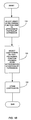
- FIG. 1B shows a flowchart illustrating an example of a process that provides a polynomial function that approximates a particular expression according to the present invention.
- step 110 an order (e.g., N ) of a polynomial function (e.g., F(x) ) is selected in which the polynomial function may provide an approximation to the particular expression (e.g., x 4/3 ).
- the processor 30 of the computing device 20 e.g., a computer
- step 120 coefficients (e.g., a 0 to a N ) of the polynomial function are selected to provide a good approximation to the particular expression.
- the processor 30 of the computing device 20 may determine the optimized coefficients of the polynomial function.
- the coefficients may be stored in at least one of the memories 40, 50.
- step 130 the coefficients are stored.
- the processor 30 may then store the coefficients into, for example, at least one of the memories 80, 90 that is to be or that has been installed (e.g., integrated) into the target device 60. Once the coefficients have been stored in at least one of the memories 80, 90, then the memories 80, 90 and/or the target device 60 may be detached from the computing device 20.
- the target device 60 may employ, for example, a less powerful processor 70 that can perform, for example, the N multiply-and-add computations.
- the coefficients take up much less memory space and physical space than the conventional 8k-word memory.
- the N+1 coefficients of the polynomial function F(x) may be stored in at least one of the target device memories 80, 90. Then the N+1 coefficients and a particular input value x n may be used to calculate an approximation of x n 4/3 . Such a process may be performed for any of, for example, the 8192 input values.
- the output of the polynomial function has been optimized in a least square sense.
- the present invention may provide an approximation for an expression such as, for example, x n 4/3 , by splitting the sample space into m sub-regions in which a polynomial function F j (x) corresponding to a respective sub-region j is optimized in a least square sense over the respective sub-region j where j is a number ranging from 1 to m.
- a polynomial function F j (x) corresponding to a respective sub-region j is optimized in a least square sense over the respective sub-region j where j is a number ranging from 1 to m.
- Each of the m polynomial functions may be optimized.
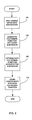
- FIG. 2 shows a flowchart illustrating an example of a process that provides a piecewise polynomial function that approximates a particular expression according to the present invention.
- the entire sample space is split into sub-regions.
- the number of sub-regions can be preset or may be determined in light of, for example, memory or resolution considerations.
- the sample space may be split into approximately equal sub-regions or the sample space may be split into approximately unequal sub-regions. For example, the sub-regions may get larger as the sample inputs get larger.
- a polynomial function is associated with each of the sub-regions.
- the order of the polynomials may be preset or determined in light of, for example, resolution or error considerations. Since the sub-regions are smaller than the entire sample space, the order of the polynomial functions may be smaller than the order of the above-described polynomial function that covered the entire sample space to achieve a possibly approximately same degree of accuracy.
- the polynomial functions may also have the same order as the above-described polynomial function that covered the entire sample space to achieve a possibly approximately higher degree of accuracy or resolution. In one example, all the polynomial functions have the same order. In another example, at least one of the polynomial functions has an order different from at least one other polynomial function.
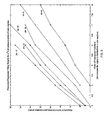
- FIG. 5 shows a plot illustrating an example of piecewise polynomial fitting results according to the present invention.
- the plot shows the interrelationship of at least three variables: number of sub-regions, order of polynomial functions and resolution behind decimal point. From the plot, in this example, it is shown that, for a particular order of polynomial functions, as the number of sub-regions increases, the resolution also increases. In this example, it is shown that, for a particular number of sub-regions, as the order of the polynomials increases, the resolution also increases.
- each polynomial function is optimized to better approximate the particular expression in the respective sub-region.
- coefficients for each polynomial function are selected to minimize a least square function over at least the samples in the respective sub-region.
- the present invention may contemplate using other optimization techniques including conventional optimization techniques.
- the coefficients for each optimized polynomial function from respective sub-regions are stored.
- the coefficients may be stored into the target device 60 which may be detachably coupled to an offline processor 30.
- the offline processor 30 may, in one example, perform one or more of the steps described in steps 140-170. Accordingly, the target device 60 may employ a less powerful processor 70 to calculate outputs of the appropriate optimized polynomial function to approximate the output of the particular expression.
- the present invention may not only split the entire sample space into sub-regions, optimize each polynomial function corresponding to the respective sub-region, but also optimize the polynomial functions over the entire sample space.
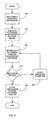
- FIG. 3 shows a flowchart illustrating an example of a process that provides a piecewise polynomial function that approximates a particular expression according to the present invention.
- step 180 the entire sample space is split into sub-regions.
- step 190 a polynomial function is associated with each of the sub-regions.
- step 200 each polynomial function is optimized to better approximate the particular expression in the respective sub-region. Steps 180-200 are similar to the above-described steps 140-160 and are not further described.
- a maximal absolute error is defined for each optimized sub-region.
- An error at a particular input sample value i.e., e ( x n )
- the MAE for a particular sub-region is, for example, the absolute value of the largest error in the particular sub-region.
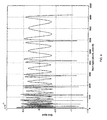
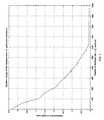
- FIG. 4 shows a graph illustrating an example of an error signal as a function of input values according to the present invention.
- the plot shows an example in which a fifth order polynomial is used in each of the ten sub-regions.
- the plot also shows in some cases that the MAE of a particular sub-region is at or near a boundary of the sub-region. Accordingly, the plot also illustrates sub-regions having different numbers of input values. In this illustrated example, the sub-regions are generally increasing in size as the input signal increases in value.
- an error criteria is whether all of the MAEs are below an absolute or relative MAE threshold.
- Another example of an error criteria is whether the MAEs all fall within an absolute or relative range.
- the range may be defined, for example, as between a first percentage and a second percentage of a particular MAE (e.g., the largest MAE of all the MAEs, the smallest MAE of all the MAEs or another MAE).
- the range may be defined, for example, as between a first percentage of a first MAE and a second percentage of a second MAE.
- the range may also be defined, for example, as some combination of absolute and relative components.
- a figure of merit that may be used in determining whether an error criteria has been met is the least square error.
- the least square error may be calculated for each sub-region or may be summed across the entire sample space for a total least square error.
- error criteria may include absolute or relative ranges or thresholds related to the concept of a least square error or a total least square error.
- step 230 the coefficients of each polynomial function is stored.
- size ( N + 1) • L where N is the order of the polynomial functions and L is the number of sub-region divisions.
- the sub-region parameters are adjusted. For example, some sub-regions may be made larger and some sub-regions may be made smaller. In another example, some sub-regions may be expanded to include more input data samples and some sub-regions may be contracted to include fewer input data samples. For example, if a sub-region has a particularly high MAE, then it may reduce the number of input sample values. If a sub-region has a particularly low MAE, then it may increase the number of input sample values. The expansion of one sub-region may be at the expense of at least one other sub-region.
- the sub-region with the highest or one of the highest MAE may decrease the number of sample input values in its sub-region by K sample input values; the sub-region with the lowest or one of the lowest MAE may increase the number of sample input values in its sub-region by K sample input values.
- One or more sub-regions may increase the number of sample input values in the respective sub-regions and one or more sub-regions may decrease the number of sample input values in the respective sub-regions.
- the present invention also may contemplate adjusting other sub-region parameters of the sub-region to reduce or to increase the MAE of particular sub-regions.
- each polynomial function in a respective sub-region is optimized in step 200.
- the coefficients of the polynomial function may be different from the first optimization.
- query 210 it is determined whether or not the error criteria has now been met. If not, then the loop including step 220, step 200 and query 210 repeats itself until the error criteria has been met or the number of times through the loop exceeds a preset threshold (e.g., 1000 times). When the error criteria has been met, then the process continues as described above at step 230.
- FIG. 6 and FIG. 7 show plots illustrating an example of the dynamic change of the overall square error and the maximum error, respectively, according to the present invention.
- a sixth order polynomial function is used in each of the ten sub-regions.
- the dynamic change is measured as a function of the number of iterations (i.e., the number of times the process goes through the loop described above).
- FIGS. 6 and 7 show that the error may decrease as the number of iterations increases for a first portion of the plots. Then, the error may level off after the number of iterations reaches a certain value in a second portion of the plots.
- the present invention also may contemplate other embodiments to the systems and methods that provide an optimized approximating function.
- a portion or portions of the sample space may have at least one dedicated lookup table.
- sample input values x 1 to x 32 may be stored in a lookup table with output values y 1 to y 32 .
- the rest of the sample space may be covered by an optimized piecewise polynomial approximation as described above.
- floating point representation or fixed point representation may be used according to the present invention.
- fixed point representations of the input value and the coefficients may be used in the optimization loop, which may potentially provide better overall performance than that of, for example, a floating point representation followed by a fixed point conversion.
- the present invention may contemplate, for optimizing each of the polynomial functions, temporarily expanding the sub-region boundaries such that the boundaries overlap.
- some sample input values may be shared by overlapping sub-regions and thus used in more than one process for optimizing polynomial functions. This overlapping of boundaries may or may not apply when determining, for example, the MAE.
- the calculation of the MAE for a sub-region may be determined using the previous non-overlapping sub-regions.
Landscapes
- Engineering & Computer Science (AREA)
- Physics & Mathematics (AREA)
- General Physics & Mathematics (AREA)
- Data Mining & Analysis (AREA)
- Theoretical Computer Science (AREA)
- Pure & Applied Mathematics (AREA)
- Mathematical Analysis (AREA)
- Mathematical Optimization (AREA)
- Computational Mathematics (AREA)
- Mathematical Physics (AREA)
- Algebra (AREA)
- Software Systems (AREA)
- General Engineering & Computer Science (AREA)
- Databases & Information Systems (AREA)
- Complex Calculations (AREA)
- Compression Or Coding Systems Of Tv Signals (AREA)
- Measurement Of Optical Distance (AREA)
- Image Processing (AREA)
Applications Claiming Priority (2)
| Application Number | Priority Date | Filing Date | Title |
|---|---|---|---|
| US177290 | 1988-04-04 | ||
| US10/177,290 US7702709B2 (en) | 2002-06-21 | 2002-06-21 | System and method for optimizing approximation functions |
Publications (2)
| Publication Number | Publication Date |
|---|---|
| EP1420347A2 true EP1420347A2 (fr) | 2004-05-19 |
| EP1420347A3 EP1420347A3 (fr) | 2011-10-05 |
Family
ID=29734350
Family Applications (1)
| Application Number | Title | Priority Date | Filing Date |
|---|---|---|---|
| EP03014064A Withdrawn EP1420347A3 (fr) | 2002-06-21 | 2003-06-23 | Système et méthode pour optimiser des fonctions |
Country Status (2)
| Country | Link |
|---|---|
| US (1) | US7702709B2 (fr) |
| EP (1) | EP1420347A3 (fr) |
Cited By (1)
| Publication number | Priority date | Publication date | Assignee | Title |
|---|---|---|---|---|
| RU2467385C1 (ru) * | 2011-08-04 | 2012-11-20 | Открытое акционерное общество "Научно-исследовательский институт физических измерений" | Способ и устройство для аппроксимации сигналов |
Families Citing this family (13)
| Publication number | Priority date | Publication date | Assignee | Title |
|---|---|---|---|---|
| DE102004001293A1 (de) * | 2004-01-07 | 2005-08-11 | Deutsche Thomson-Brandt Gmbh | Vorrichtung und Verfahren zur Datenübertragung mit reduzierter Datenmenge |
| ATE540375T1 (de) * | 2004-09-09 | 2012-01-15 | Silicon Optix Inc | System und verfahren zum repräsentieren einer allgemeinen zweidimensionalen räumlichen transformation |
| US7324706B2 (en) * | 2004-09-09 | 2008-01-29 | Silicon Optix Inc. | System and method for representing a general two dimensional spatial transformation |
| US8055070B2 (en) * | 2007-01-05 | 2011-11-08 | Geo Semiconductor Inc. | Color and geometry distortion correction system and method |
| US8442316B2 (en) | 2007-01-05 | 2013-05-14 | Geo Semiconductor Inc. | System and method for improving color and brightness uniformity of backlit LCD displays |
| WO2009157280A1 (fr) * | 2008-06-26 | 2009-12-30 | 独立行政法人科学技術振興機構 | Dispositif de compression de signal audio, procédé de compression de signal audio, dispositif de démodulation de signal audio et procédé de démodulation de signal audio |
| US8731081B2 (en) | 2011-12-07 | 2014-05-20 | Motorola Mobility Llc | Apparatus and method for combinatorial coding of signals |
| KR102359265B1 (ko) | 2015-09-18 | 2022-02-07 | 삼성전자주식회사 | 프로세싱 장치 및 프로세싱 장치에서 연산을 수행하는 방법 |
| TWI698759B (zh) | 2019-08-30 | 2020-07-11 | 創鑫智慧股份有限公司 | 曲線函數裝置及其操作方法 |
| DE102021113909A1 (de) * | 2021-05-28 | 2022-12-01 | Schölly Fiberoptic GmbH | Verfahren zur Transformation eines Datenfeldes und korrespondierende Transformationseinrichtung |
| US12613936B2 (en) * | 2022-01-17 | 2026-04-28 | Mellanox Technologies, Ltd. | Efficient piecewise polynomial approximators |
| CN116548998B (zh) * | 2023-07-11 | 2023-11-10 | 赛诺威盛科技(北京)股份有限公司 | 扫描床负载的确定方法、装置、设备和介质 |
| GB2638749A (en) * | 2024-02-29 | 2025-09-03 | Riverlane Ltd | A method for generating input polynomial coefficients |
Family Cites Families (10)
| Publication number | Priority date | Publication date | Assignee | Title |
|---|---|---|---|---|
| US5042001A (en) * | 1989-10-02 | 1991-08-20 | Cyrix Corporation | Method and apparatus for performing mathematical functions using polynomial approximation and a rectangular aspect ratio multiplier |
| US5068816A (en) * | 1990-02-16 | 1991-11-26 | Noetzel Andrew S | Interplating memory function evaluation |
| DE69232734T2 (de) * | 1991-05-29 | 2003-04-24 | Pacific Microsonics, Inc. | Verbesserungen in versteckte-Kode Seitenkanäle |
| US5951629A (en) * | 1997-09-15 | 1999-09-14 | Motorola, Inc. | Method and apparatus for log conversion with scaling |
| US6457032B1 (en) * | 1997-11-15 | 2002-09-24 | Cognex Corporation | Efficient flexible digital filtering |
| US6363405B1 (en) * | 1997-12-24 | 2002-03-26 | Elbrus International Limited | Computer system and method for parallel computations using table approximation methods |
| EP0935203A3 (fr) * | 1998-02-04 | 2000-05-24 | Matsushita Electric Industrial Co., Ltd. | Dispositif de calcul pour fonction exponentielle |
| US6124542A (en) * | 1999-07-08 | 2000-09-26 | Ati International Srl | Wavefunction sound sampling synthesis |
| US6701028B1 (en) * | 2000-01-11 | 2004-03-02 | Applied Materials, Inc. | Method and apparatus for fast signal convolution using spline kernel |
| US6976043B2 (en) * | 2001-07-30 | 2005-12-13 | Ati Technologies Inc. | Technique for approximating functions based on lagrange polynomials |
-
2002
- 2002-06-21 US US10/177,290 patent/US7702709B2/en not_active Expired - Fee Related
-
2003
- 2003-06-23 EP EP03014064A patent/EP1420347A3/fr not_active Withdrawn
Cited By (1)
| Publication number | Priority date | Publication date | Assignee | Title |
|---|---|---|---|---|
| RU2467385C1 (ru) * | 2011-08-04 | 2012-11-20 | Открытое акционерное общество "Научно-исследовательский институт физических измерений" | Способ и устройство для аппроксимации сигналов |
Also Published As
| Publication number | Publication date |
|---|---|
| US7702709B2 (en) | 2010-04-20 |
| EP1420347A3 (fr) | 2011-10-05 |
| US20030236675A1 (en) | 2003-12-25 |
Similar Documents
| Publication | Publication Date | Title |
|---|---|---|
| US12282852B2 (en) | Dynamic quantization of neural networks | |
| EP1420347A2 (fr) | Système et méthode pour optimiser des fonctions | |
| CN112085192B (zh) | 一种神经网络的量化参数确定方法及相关产品 | |
| TWI665563B (zh) | 卷積運算裝置及卷積神經網路的卷積輸入的調規方法 | |
| US8832168B2 (en) | Computations of power functions using polynomial approximations | |
| EP3931758B1 (fr) | Traitement de couche réseau de neurones artificiels par quantification à l'échelle | |
| RU2429531C2 (ru) | Преобразования с общими множителями | |
| US7129962B1 (en) | Efficient video processing method and system | |
| JP7568198B2 (ja) | ニューラルネットワーク処理装置、ニューラルネットワーク処理方法、及び、プログラム | |
| US20150120798A1 (en) | Data encoding with sign data hiding | |
| CN1172539A (zh) | 利用截尾泰勒级数的对数/反对数转换器及其使用方法 | |
| US11475285B2 (en) | Neural network accelerator and operating method thereof | |
| US20150113027A1 (en) | Method for determining a logarithmic functional unit | |
| US10963746B1 (en) | Average pooling in a neural network | |
| JP2002300430A (ja) | 入力データサンプルに適応フィルタ操作を実行するためのデータ処理装置と方法 | |
| CN118446267A (zh) | 扩散模型加速器及其全网络差分数据流计算方法 | |
| US8165198B2 (en) | Apparatus and method for performing video decoding processes in parallel | |
| CN116151321A (zh) | 半导体装置 | |
| KR20230013515A (ko) | 멀티레벨 룩업테이블을 이용한 함수근사 장치 및 방법 | |
| CN119902707B (zh) | 实时量化单元的内存优化方法、系统及电子设备 | |
| US7580965B2 (en) | Discrete-time convolution cycle reduction with programmable digital signal processor | |
| KR100465156B1 (ko) | 분산산술처리방식의 dct/idct 연산기에 있어서연산오차 및 연산시간 감소방법 | |
| JP3937463B2 (ja) | ハフマン符号化装置及び方法 | |
| JP2005175913A (ja) | 画像処理装置 | |
| Gashnikov | Multidimensional signals interpolation based on NEDI for HGI compression |
Legal Events
| Date | Code | Title | Description |
|---|---|---|---|
| PUAI | Public reference made under article 153(3) epc to a published international application that has entered the european phase |
Free format text: ORIGINAL CODE: 0009012 |
|
| AK | Designated contracting states |
Kind code of ref document: A2 Designated state(s): AT BE BG CH CY CZ DE DK EE ES FI FR GB GR HU IE IT LI LU MC NL PT RO SE SI SK TR |
|
| AX | Request for extension of the european patent |
Extension state: AL LT LV MK |
|
| RAP1 | Party data changed (applicant data changed or rights of an application transferred) |
Owner name: BROADCOM CORPORATION |
|
| PUAL | Search report despatched |
Free format text: ORIGINAL CODE: 0009013 |
|
| AK | Designated contracting states |
Kind code of ref document: A3 Designated state(s): AT BE BG CH CY CZ DE DK EE ES FI FR GB GR HU IE IT LI LU MC NL PT RO SE SI SK TR |
|
| AX | Request for extension of the european patent |
Extension state: AL LT LV MK |
|
| RIC1 | Information provided on ipc code assigned before grant |
Ipc: G06F 1/035 20060101ALI20110829BHEP Ipc: G06F 17/17 20060101AFI20110829BHEP |
|
| STAA | Information on the status of an ep patent application or granted ep patent |
Free format text: STATUS: THE APPLICATION IS DEEMED TO BE WITHDRAWN |
|
| AKY | No designation fees paid | ||
| REG | Reference to a national code |
Ref country code: DE Ref legal event code: R108 |
|
| 18D | Application deemed to be withdrawn |
Effective date: 20120103 |
|
| REG | Reference to a national code |
Ref country code: DE Ref legal event code: R108 Effective date: 20120613 |