EP1420557A2 - Egalisation combinée pour le récepteur d'un modem à tons discrets multiples - Google Patents
Egalisation combinée pour le récepteur d'un modem à tons discrets multiples Download PDFInfo
- Publication number
- EP1420557A2 EP1420557A2 EP03102666A EP03102666A EP1420557A2 EP 1420557 A2 EP1420557 A2 EP 1420557A2 EP 03102666 A EP03102666 A EP 03102666A EP 03102666 A EP03102666 A EP 03102666A EP 1420557 A2 EP1420557 A2 EP 1420557A2
- Authority
- EP
- European Patent Office
- Prior art keywords
- tone
- equalizer
- fft
- per
- function
- Prior art date
- Legal status (The legal status is an assumption and is not a legal conclusion. Google has not performed a legal analysis and makes no representation as to the accuracy of the status listed.)
- Granted
Links
- 238000000034 method Methods 0.000 claims description 67
- 230000006854 communication Effects 0.000 claims description 39
- 238000004891 communication Methods 0.000 claims description 39
- 239000000872 buffer Substances 0.000 claims description 36
- 230000005540 biological transmission Effects 0.000 claims description 34
- 230000004044 response Effects 0.000 claims description 29
- 239000011159 matrix material Substances 0.000 claims description 16
- 238000009825 accumulation Methods 0.000 claims 2
- 230000035508 accumulation Effects 0.000 claims 2
- 238000012549 training Methods 0.000 abstract description 28
- 230000006870 function Effects 0.000 description 96
- 230000008569 process Effects 0.000 description 53
- 239000013598 vector Substances 0.000 description 39
- 230000015654 memory Effects 0.000 description 29
- 238000013459 approach Methods 0.000 description 20
- 125000004122 cyclic group Chemical group 0.000 description 19
- 238000010586 diagram Methods 0.000 description 9
- 238000001914 filtration Methods 0.000 description 9
- 238000012545 processing Methods 0.000 description 7
- 230000014509 gene expression Effects 0.000 description 6
- 230000008901 benefit Effects 0.000 description 5
- 230000001419 dependent effect Effects 0.000 description 5
- 230000000737 periodic effect Effects 0.000 description 4
- 238000011084 recovery Methods 0.000 description 4
- 238000004364 calculation method Methods 0.000 description 3
- 238000006243 chemical reaction Methods 0.000 description 3
- 238000010276 construction Methods 0.000 description 3
- 238000012937 correction Methods 0.000 description 3
- 238000005516 engineering process Methods 0.000 description 3
- 238000012986 modification Methods 0.000 description 3
- 230000004048 modification Effects 0.000 description 3
- 238000005457 optimization Methods 0.000 description 3
- 238000001228 spectrum Methods 0.000 description 3
- 238000007792 addition Methods 0.000 description 2
- 238000009795 derivation Methods 0.000 description 2
- 238000013461 design Methods 0.000 description 2
- 238000001514 detection method Methods 0.000 description 2
- 235000019800 disodium phosphate Nutrition 0.000 description 2
- 230000000694 effects Effects 0.000 description 2
- 230000000977 initiatory effect Effects 0.000 description 2
- 238000011144 upstream manufacturing Methods 0.000 description 2
- 238000004458 analytical method Methods 0.000 description 1
- 230000002238 attenuated effect Effects 0.000 description 1
- 230000007175 bidirectional communication Effects 0.000 description 1
- 239000000969 carrier Substances 0.000 description 1
- 239000000470 constituent Substances 0.000 description 1
- 230000006872 improvement Effects 0.000 description 1
- 238000012544 monitoring process Methods 0.000 description 1
- 230000000717 retained effect Effects 0.000 description 1
- 238000000926 separation method Methods 0.000 description 1
- 238000004088 simulation Methods 0.000 description 1
- 230000007480 spreading Effects 0.000 description 1
Images



Classifications
-
- H—ELECTRICITY
- H04—ELECTRIC COMMUNICATION TECHNIQUE
- H04L—TRANSMISSION OF DIGITAL INFORMATION, e.g. TELEGRAPHIC COMMUNICATION
- H04L25/00—Baseband systems
- H04L25/02—Details ; arrangements for supplying electrical power along data transmission lines
- H04L25/03—Shaping networks in transmitter or receiver, e.g. adaptive shaping networks
- H04L25/03006—Arrangements for removing intersymbol interference
- H04L25/03159—Arrangements for removing intersymbol interference operating in the frequency domain
-
- H—ELECTRICITY
- H04—ELECTRIC COMMUNICATION TECHNIQUE
- H04L—TRANSMISSION OF DIGITAL INFORMATION, e.g. TELEGRAPHIC COMMUNICATION
- H04L25/00—Baseband systems
- H04L25/02—Details ; arrangements for supplying electrical power along data transmission lines
- H04L25/03—Shaping networks in transmitter or receiver, e.g. adaptive shaping networks
- H04L25/03006—Arrangements for removing intersymbol interference
- H04L2025/0335—Arrangements for removing intersymbol interference characterised by the type of transmission
- H04L2025/03375—Passband transmission
- H04L2025/03414—Multicarrier
-
- H—ELECTRICITY
- H04—ELECTRIC COMMUNICATION TECHNIQUE
- H04L—TRANSMISSION OF DIGITAL INFORMATION, e.g. TELEGRAPHIC COMMUNICATION
- H04L25/00—Baseband systems
- H04L25/02—Details ; arrangements for supplying electrical power along data transmission lines
- H04L25/03—Shaping networks in transmitter or receiver, e.g. adaptive shaping networks
- H04L25/03006—Arrangements for removing intersymbol interference
- H04L2025/03433—Arrangements for removing intersymbol interference characterised by equaliser structure
- H04L2025/03439—Fixed structures
- H04L2025/03445—Time domain
- H04L2025/03471—Tapped delay lines
- H04L2025/03484—Tapped delay lines time-recursive
Definitions
- This invention is in the field of communications, and is more specifically directed to multicarrier modulation communications, such as Digital Subscriber Line (DSL) communications.
- DSL Digital Subscriber Line
- DMT Discrete Multitone
- the available spectrum is subdivided into many subchannels (e.g., 256 subchannels of 4.3125 kHz).
- Each subchannel is centered about a carrier frequency that is phase and amplitude modulated, typically by Quadrature Amplitude Modulation (QAM), in which each symbol value is represented by a point in the complex plane.
- QAM Quadrature Amplitude Modulation
- the number of available symbol values for each subchannel, and thus the number of bits in each symbol communicated over that subchannel, is determined during initialization of the DMT communications session.
- the number of bits per symbol for each subchannel is determined according to the signal-to-noise ratio (SNR) at the subchannel frequency, which is affected by the transmission channel noise and the signal attenuation at that frequency.
- SNR signal-to-noise ratio
- relatively noise-free and low attenuation subchannels may communicate data in ten-bit to fifteen-bit symbols, represented by a relatively dense QAM constellation with short distances between points in the constellation.
- noisy channels may be limited to only two or three bits per symbol, allowing a greater distance between adjacent points in the QAM constellation.
- the SNR of some subchannels is so poor that these subchannels are unloaded, carrying no bits. DMT modulation thus maximizes the data rate over each subchannel, permitting high speed access to be carried out even over relatively noisy and attenuated twisted-pair lines.
- DMT modulation also permits much of the signal processing to be carried out in the digital domain.
- a serial digital datastream to be transmitted is arranged into symbols, one for each subchannel, with the symbol size depending on the bit loading, as noted above.
- Reed-Solomon coding and other coding techniques are typically applied for error detection and correction.
- Modulation of the subchannel carriers is obtained by application of an inverse Discrete Fourier Transform (IDFT) to the encoded symbols, producing a discrete modulated time domain signal having signal components at each of the subcarrier frequencies. This modulated signal is then serially transmitted. All of these DMT modulation operations can be carried out in the digital domain, permitting implementation of much of a DSL modem, and particularly much of the processing-intensive operations, in a single chip such as a Digital Signal Processor (DSP).
- DSP Digital Signal Processor
- the discrete output time domain signal from the modulation is converted into a time-domain analog signal by a conventional digital-to-analog converter, and is communicated over the transmission channel to the receiving modem, which reverses the process to recover the transmitted data.
- the DMT subchannels in the received signal are orthogonal so that the signal can be demodulated by a Discrete Fourier Transform (DFT).
- DFT Discrete Fourier Transform
- the non-ideal impulse response of the transmission channel distorts the transmitted signal.
- the signal received by the receiving modem can be considered to be a convolution of the transmitted analog signal with the impulse response of the transmission channel.
- One may express the time-domain signal y(n) at the receiver, based on a transmitted time-domain signal x(n), as: y(n) x(n) ⁇ h(n) This expression simply states that the received signal y(n) is the time-domain convolution of the input signal x(n) with the channel impulse response h(n).
- the transmitted signal x(n) is the IDFT of the symbol sequences at their respective subchannel frequencies
- the frequency-domain spectrum X(n) corresponds to the symbols themselves.
- the receiver can therefore retrieve the symbols X(n) by removing the channel response H(n) from the DFT of the frequency-domain received signal Y(n). Conventionally, this is performed by a single-tap frequency domain equalizer.
- time domain convolution corresponds to frequency domain multiplication only if the input sequence is infinitely long, or if the input sequence is periodic. Because the number of subchannels is finite, however, the number of real-valued time-domain samples at the output of the transmitter IDFT (i.e., the "block" length) is also finite. Accordingly, it is useful to make the transmitted signal appear to be periodic, at a period on the order of the block length.
- a well-known technique for accomplishing this is to include a cyclic prefix with each transmitted block in the datastream.
- the cyclic prefix is generally defined as a number P of samples at the end of a block of samples in the output bitstream.
- the cyclic prefix eliminates inter-symbol interference (ISI) between adjacent data frames, and inter-carrier interference (ICI) among subchannels.
- ISI inter-symbol interference
- ICI inter-carrier interference
- ISI generally arises from distortion and spreading of the transmitted signal over the channel, causing the end of one DMT symbol to overlap into the beginning of the next DMT symbol.
- ICI affects the independence of the subcarriers, resulting in loss of orthogonality among the subchannels, which in turn prevents separation of the modulating data on these subchannels at the receiver.
- the cyclic prefix In order for the input sequence to appear periodic, so that ISI is contained within the redundant prefix of the block, the cyclic prefix must be longer than the channel length. However, this causes the effective data rate of the transmission to be reduced accordingly.
- the data rate In the case of a signal with a block length of N samples and a cyclic prefix of P samples generated by prepending a copy of the last P samples of the block, the data rate is reduced by the factor: N N+P This presents a tradeoff between interference and data rate in conventional DMT communications.
- Figure 1 functionally illustrates an example of a conventional DSL communication system.
- system of Figure 1 only one direction of transmission (from transmitting modem 10 over transmission channel H to receiving modem 20) is illustrated. It will of course be understood by those skilled in the art that data will also be communicated in the opposite direction, in which case modem 20 will be the transmitting modem and modem 10 the receiving modem.
- Transmitting modem 10 receives an input bitstream that is to be transmitted to receiving modem 20.
- This input bitstream may be generated by a computer at the same location (e.g., the central office) as transmitting modem 10, or alternatively and more likely is generated by a computer network, in the Internet sense, that is coupled to transmitting modem 10.
- the input bitstream is a serial stream of binary digits, in the appropriate format as produced by the data source.
- Bit-to-symbol encoder function 11 in transmitting modem 10 groups the bits of the input bitstream into multiple-bit symbols, according to the bit loading assigned to each subchannel in the initialization of the communication session. These symbols will modulate the various subchannels of the DMT signal.
- error correction coding such as Reed-Solomon coding for error detection and correction purposes, or trellis coding, may also be applied at encoder 11 for additional signal-to-noise ratio improvement.
- the symbols generated by encoder function 11 are typically complex symbols, including both amplitude and phase information, and correspond to points in the appropriate modulation constellation (e.g., quadrature amplitude modulation, or QAM) for each subchannel, as determined upon initialization.
- the encoded symbols for each block are then applied to inverse Discrete Fourier Transform (IDFT) function 12.
- IDFT function 12 associates each input symbol with one subchannel in the transmission frequency band, and generates a corresponding number of time domain symbol samples according to the Fourier transform. These time domain symbol samples are then converted into a serial stream of samples by parallel-to-serial converter 13.
- IFFT function 12 outputs a block of N real-valued time domain samples.
- the cyclic prefix (CP) is then added into the signal, typically by prepending the last ⁇ samples of each frame to the beginning of that frame, as discussed above.
- Digital filtering function 15 then processes the datastream, by interpolating to increase the sample rate, digital low pass filtering to remove image components, and digital high pass filtering to eliminate POTS-band interference.
- the digitally-filtered datastream signal is converted to analog by digital-to-analog converter 16, and low-pass filtered by analog filtering function 18, prior to transmission. As described in U.S. Patent No.
- digital filter function 15, digital-to-analog converter 16, and analog filter function 18 are preferably implemented in a conventional codec circuit, such as a member of the TLV320AD1x device family available from Texas Instruments Incorporated.
- the output of analog filter 18 is then forwarded to transmission channel H and in turn to receiving modem 20 by conventional line driver and receiver circuitry, such as the THS7102 line driver/receiver available from Texas Instruments Incorporated, and by a conventional hybrid circuit.
- line driver and receiver circuitry such as the THS7102 line driver/receiver available from Texas Instruments Incorporated, and by a conventional hybrid circuit.
- transmission channel H is physically realized by twisted-pair wire.
- the significant distortion and noise added to the transmitted analog signal by transmission channel H is represented by its impulse response h(n), as described above.
- the downstream transmitted signal is received by receiving modem 20, which, in general, reverses the processes of transmitting modem 10 to recover the information of the input bitstream.
- analog filter function 21 processes the received signal prior to analog-to-digital conversion function 22, which converts the filtered analog signal to digital.
- Conventional digital filtering function 23 is then applied to augment the function of the analog filters.
- the combination of analog and digital filter functions 21, 23 also preferably includes some frequency band filtering to isolate the received signal from signals currently being transmitted upstream by modem 20.
- time domain equalizer (TEQ) 24 is preferably a finite impulse response (FIR) digital filter, designed to effectively shorten the length of the impulse response of the transmission channel H, taking into account the filtering performed by functions 21, 23.
- FIR finite impulse response
- the design of this digital filter is realized by the selection of the particular coefficients of the FIR implementing TEQ function 24 during initialization, or "training", of the combination of modems 10 and 20 as the communications session is established.
- the cyclic prefix is then removed by function 25.
- Serial-to-parallel converter 26 converts the filtered datastream into a number of samples for application to Discrete Fourier Transform (DFT) function 27.
- DFT Discrete Fourier Transform
- DFT function 27 will recover the modulating symbols at each of the subchannel frequencies, reversing the IDFT performed by function 12 in transmitting modem 10 to produce a frequency domain representation of a block of transmitted symbols, multiplied by the frequency-domain response of the effective transmission channel.
- the cyclic prefix of the data frame is at least as long as the channel response h(t), shortened by TEQ function 24.
- frequency-domain equalization (FEQ) function 28 divides out the frequency-domain response of the effective channel, and recovers an estimate of the modulating symbols.
- Symbol-to-bit decoder function 29 then resequences the recovered symbols, decodes any encoding that was applied in the transmission of the signal, and produces an output bitstream that is an estimate of the input bitstream upon which the transmission was based. This output bitstream is then forwarded to a client workstation or other recipient.
- time domain equalizer (TEQ) function 24 shortens the effective channel length of the transmission channel, to ensure that the length of the cyclic prefix is at least as long as the channel response, so that the transmitted signal can be successfully recovered by FEQ function 28 without significant ISI and ICI.
- TEQ coefficients are optimized to reduce the channel response as much as possible. While the channel response is necessarily frequency dependent, conventional TEQ optimization is performed simultaneously over all channels. As a result, conventional TEQ optimization is not suited for optimizing the signal-to-noise performance of the subchannels. As such, conventional TEQ training does not result in optimum bitloading capacity for the DSL communications session.
- w teq [w 0 , w 1 , ..., w v-1 ] T and is the real-valued ⁇ -tap TEQ function 24.
- matrix Y is the set of frames of time domain samples for the inputs of ⁇ FFTs associated with a time t, ⁇ being the length of the cyclic prefix and at least as large as the combined impulse response of the transmission channel and TEQ function 24:
- the matrix F N is the NxN FFT matrix of DFT function 27, and the coefficients D i constitute the complex 1-tap FEQ function 28.
- each tone i has its own, optimized, TEQ function that is implemented in the form of a ⁇ -tap FEQ.
- y fft , ⁇ -1 ⁇ F N Y and:
- y fft,i is an Nx1 vector corresponding to the FFT of the i th column of matrix Y.
- the equalizer coefficient vector w f,i is an Nx1 vector of the i th equalizer coefficients for all tones.
- Van Acker et al. requires ⁇ FFTs per symbol, rather than only a single FFT operation as in the conventional approach of Figure 1.
- the difference of y t,m (0) - y t,m-1 (N-1) is the difference between the first and last elements of y t,m and y t,m-1 , respectively.
- This per-tone approach is intended to optimize the signal-to-noise ratio, and thus the bit-loading, of each tone in the DMT signal.
- this approach theoretically optimizes the equalization and capacity performance of the entire DMT modem communications session. Simulations have been performed, in connection with this invention, that indicate that this theoretical potential can be realized.
- ITU communications standards including the G.dmt and G.dmt.bis standards (ITU-T, G.992.1 : Asymmetrical Digital Subscriber Line (ADSL) Transceivers; ITU-T, Draft G.dmt.bis: Asymmetrical Digital Subscriber Line (ADSL) Transceivers).
- ITU-T G.992.1 : Asymmetrical Digital Subscriber Line (ADSL) Transceivers
- ITU-T Draft G.dmt.bis: Asymmetrical Digital Subscriber Line (ADSL) Transceivers.
- the TEQ coefficients are established early in the DSL training sequence, typically in the "Reverb" sequence that immediately follows the pilot tone, as the TEQ coefficients must be established before the "Message Exchange" sequence can be successfully performed.
- the present invention may be implemented into a Discrete Multitone (DMT) modulation receiver modem, in either dedicated or semi-dedicated hardware, or by software routines performed by a digital signal processor (DSP) or the like.
- DMT Discrete Multitone
- a time domain equalizer function is applied to the incoming signal, with the coefficients of the time domain equalizer determined, during training, to shorten the transmission channel response.
- a per-tone equalizer function is then applied to the signals for some or all subchannels, with the coefficients for each tone optimized for that tone.
- the per-tone equalizer combines time-domain and frequency-domain equalizer functions with a sliding FFT, to faithfully produce the output symbols.
- the per-tone equalizer is applied to all tones.
- the per-tone equalizer is applied only to selected tones, specifically associated with those subchannels that are imperfectly equalized by the general time domain equalizer.
- Figure 1 is a functional block diagram illustrating conventional DSL communications between two DMT transceivers.
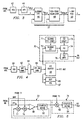
- Figure 2 is an electrical diagram, in block form, of a transceiver constructed according to the preferred embodiments of the invention.
- Figure 3 is a functional block diagram illustrating the receipt of DMT communications by a receiving modem constructed according to a first preferred embodiment of the invention.
- Figure 4 is an electrical diagram, in block form, of a hardware architecture for DMT-based modems according to the preferred embodiments of the invention.
- Figure 5 is an electrical diagram, in block form, of sliding FFT and per-tone equalization functions in the architecture of Figure 4, according to the preferred embodiments of the invention.
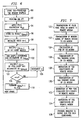
- Figure 6 is a flow diagram illustrating a method of combined per-tone equalization of DMT communications according to the first preferred embodiment of the invention.
- Figure 7 is a flow diagram illustrating a training sequence executed upon initiation of a DMT communications session, according to the preferred embodiments of the invention.
- Figure 8 is a functional block diagram illustrating the receipt of DMT communications by a receiving modem constructed according to a second preferred embodiment of the invention.
- Figure 9 is a flow diagram illustrating the equalization of DMT communications according to the second preferred embodiment of the invention.
- DMT Digital Subscriber Line
- Modem 40 in this example is in the form of a transceiver (i.e., for both transmitting and receiving) for DMT communications according to Digital Subscriber Line (DSL) standards.
- modem 40 as shown in Figure 2 may correspond to either a client side modem or to a DSL modem at the central office; while the differences in function between these applications may result in differences in the construction of the respective modems, it is contemplated that the overall hardware architecture of both the client and central office modems will still generally correspond to that illustrated in Figure 2.
- Modem 40 includes hybrid circuit 30, which is connected to a twisted-pair facility serving as transmission channel H.
- Hybrid circuit 30 is a conventional circuit that converts the two-wire arrangement of the twisted-pair facility to dedicated transmit and receive lines connected to line driver and receiver 32, considering that modem 20 is suitable for carrying out both receipt and transmission.
- Line driver and receiver 32 is a high-speed line driver and receiver for driving and receiving ADSL signals over twisted-pair lines; an example of line driver and receiver 32 is the THS7102 line driver/receiver available from Texas Instruments Incorporated.
- Line driver and receiver 32 is bidirectionally coupled to coder/decoder (codec) circuit 34, which carries out analog filtering, analog-to-digital conversion, and some amount of digital filtering, as will be described below.
- codec circuit 34 filters the incoming downstream signal to eliminate any interference from signals that it is transmitting.
- FDM frequency division multiplexing
- An example of a suitable codec device may be selected from the TLV320AD1x device family available from Texas Instruments Incorporated.
- Hybrid circuit 30, line driver and receiver 32, and codec 34 are often referred to, in the aggregate, as an "analog front end".
- Modem 40 also includes DSP 35, which serves as a digital transceiver for DSL communications.
- DSP 35 is a high performance digital signal processor, for carrying out digital operations in response to program instructions. These digital operations include the encoding of both loaded and unloaded subchannels are encoded in the manner according to the preferred embodiments of this invention, as will be described below.
- Exemplary devices suitable for use as DSP 35 include DSPs having computational power similar to or greater than the TMS320c5x and TMS320c6x DSPs available from Texas Instruments Incorporated.
- a conventional interface 36 couples DSP 35 to its host HST, which may be a server in the central office context or a workstation on the client side.
- modem 40 also includes combined equalizer function 37, as shown in Figure 2.
- Combined equalizer function 37 may be realized in dedicated or semi-dedicated hardware that is connected to and operates in combination with DSP 35 for processing received signals.
- combined equalizer function 37 may be realized as software routines that are executed by DSP 35 in its digital processing of the received signal, in which case combined equalizer function 37, represented in Figure 2, will be physically realized by program instructions stored in program memory, such as read-only memory (ROM) or loadable random access memory (RAM) associated with DSP 35.
- ROM read-only memory
- RAM loadable random access memory
- a conventional time domain equalizer is incorporated and trained to minimize the length of the transmission channel response, as known in the art.
- a combined per-tone time domain equalization and a 1-tap frequency domain equalizer is applied, in combination with a Discrete Fourier Transform (DFT) or Fast Fourier Transform (FFT), for all of the tones in the received DMT signal.
- DFT Discrete Fourier Transform
- FFT Fast Fourier Transform
- per-tone equalization can be considered as the sum: where ⁇ is a component-wise multiplication, to produce the symbol vector y pteq,final for a given tone.
- ⁇ is a component-wise multiplication
- w f,m component-by-component
- This operation is identical to the first FFT and equalizer component-wise multiplication in the "brute force" approach.
- the remaining ⁇ -1 FFTs for the tone can be derived from the difference of the first value in the m th signal vector y t,m (0) and the last value in the (m-1) th signal vector y t,m-1 (N-1): where the matrix p is: as noted above.
- y pteq,m y pteq,m -1 + y fft,m ⁇ w f,m
- the final per-tone equalizer output vector for this tone is thus y pteq, ⁇ -1 .
- This recursive calculation of the intermediate results for the FFTs and per-tone equalizer can be done with only two frame buffers, one for storing the incoming time domain samples and the other for storing the intermediate and final equalizer outputs.
- this recursive approach requires only a single full FFT for the first column of signal matrix Y, and storage of the ⁇ -1 sample differences.
- the computational complexity of this operation amounts to, for each tone, one complex multiplication and two real additions to update the FFT output, and one complex multiplication and one complex addition to derive each per-tone equalizer output.
- the coefficients of TEQ function 42 are derived during training of the DSL session, to reduce the length of the transmission channel response, at least to within the length of the cyclic prefix; of course, the possibility of ISI is further reduced as the channel length is shortened beyond the cyclic prefix length.
- the output of TEQ function 42 is time domain vector y, which contains N+v time domain samples and is properly aligned with the DMT frame boundary.
- the last N samples of vector y is the vector y t,0 , which is applied to FFT function 44. Because vector y t,0 is in the time domain, it contains components for all tones, or subchannels, in the DMT transmission.
- Vector y t,0 contains N time samples, because FFT function 44 is an NxN FFT.
- FFT function 42 performs the NxN FFT of vector y t,0 , producing FFT result vector y fft,0 , which is the FFT of the first N samples of the received DMT signal (i.e., typically not including the cyclic prefix).
- This result along with time domain vector y t,0 itself, is applied to sliding FFT function 46.
- Sliding FFT function 46 derives each of the m th intermediate FFT results from the operation: using the results of the 0 th FFT performed by FFT function 44 for the first iteration, and the results of the prior sliding FFT for later iterations, in combination with a difference of selected time domain samples from vector y t,m and y t,m-1 .
- the values of the per-tone equalizer vector w f,m is derived, for each tone in the DMT communication, during the training of the DSL communications session. Preferably, these values are determined during the pseudo-random "Medley" sequence in the training carried out according to current DSL standards, as will be described below.
- Sliding FFT function 46 and per-tone equalizer function 48 are preferably applied in sequence for each of the ⁇ -1 iterations (indexed by index m), to reduce the memory requirements. In this manner, only the (m-1) th vectors y fft,m-1 and y pteq,m-1 need be stored; once the m th iteration is complete, these (m-1) th vectors can be overwritten in memory.
- the final per-tone equalizer output vector y pteq, ⁇ -1 is applied to 1-tap FEQ function 50, from which Z is retrieved.
- 1-tap FEQ function 50 simply applies the FEQ matrix D to derive the output symbols by:
- the matrix elements D i are derived, during training of the DSL session, to represent the frequency-domain transmission channel response H(n).
- the output symbols Z are then forwarded on to the symbol-to-bit decoder and the receiving equipment, in the conventional manner.
- the combined equalizer function 37 may be implemented in hardware, as will now be described relative to Figure 4.
- Incoming samples from the analog front end (AFE) are processed by TEQ block 60, which is constructed in the conventional manner to apply a time domain equalization digital filter to effectively shorten the transmission channel response.
- the coefficients of TEQ block 60 are determined in training to reduce the channel response, with no per-tone optimization included.
- the processed samples from TEQ block 60 are stored in AFE buffer 64 by AFE direct memory access (DMA) controller 62.
- AFE DMA controller 62 stores the processed samples in AFE buffer 64 in an aligned manner, according to frame boundaries.
- FFT_IN DMA controller 66 retrieves the samples from AFE buffer 64, also in an aligned manner, and stores the samples in FFT buffer 68.
- FFT buffer 68 has an output coupled to sliding FFT function 72 in per-tone equalizer block 70.
- EQ buffer 76 has a size of N samples, and stores the complex outputs of the per-tone equalizer operations, as will be described in further detail below.
- FFT buffer 68 is also connected to difference block 65, which computes the differences of time domain samples: y t,m (0)-y t,m -1 ( N -1) for the ⁇ -1 recursive iterations of the sliding FFT and per-tone equalizer; these differences are computed by difference block 65 and stored in FFT buffer 68 or directly forwarded to sliding FFT function 72 as needed.
- FFT block 67 calculates the first (0 th ) FFT of time domain vector y t,0 to produce 0 th FFT result y fft,0 , which is the FFT of the first N samples of the received DMT signal (i.e., typically not including the cyclic prefix). This result is stored in FFT buffer 68 when it is calculated.
- Per-tone equalizer block 70 computes the sliding FFT and per-tone equalizer results for each of the ⁇ -1 recursive iterations required for each frame.
- per-tone equalizer block 70 includes sliding FFT coefficient buffer 71, and per-tone equalizer coefficients buffer 73, for storing the corresponding values of the FFT (F N ) and equalizer (W f,m ), respectively; the per-tone equalizer coefficient values are typically determined during the training sequences.
- Buffers 71, 73, as well as buffers 68, 76 may be specific memories or registers, or alternatively may be specific areas of a larger general purpose memory, accessible by the appropriate hardware, or DSP 35 as the case may be.
- Per-ton equalizer block 70 also includes sliding FFT block 72, and equalizer block 74, for performing the sliding FFT and per-tone equalizer derivation functions described above.
- FIG. 5 illustrates a preferred construction for sliding FFT block 72 and equalizer block 74, according to this hardware implementation of the preferred embodiment of the invention.
- Sliding FFT block 72 includes complex multiplier 77, which multiplies a coefficient from sliding FFT coefficient buffer 71 with a previous output of sliding FFT block 72 itself, and applies this complex product to one input of complex adder 79.
- Complex adder 79 adds this product with a difference value generated by difference block 65 and stored in FFT buffer 68. This sum is applied to one input of switch 80, which receives a value from FFT buffer 68 corresponding to an initial FFT value at its other input.
- Switch 80 is operable to forward the initial FFT value to complex accumulator 82, for the first of the v-1 recursive iterations of the sliding FFT, and to forward the output of complex adder 79 thereto for all other iterations.
- Complex accumulator 82 updates and stores the current FFT output value for the m th sliding FFT, forwarding this value back to complex multiplier 77 and also on to per-tone equalizer block 74.
- Per-tone equalizer block 74 includes complex multiplier 83, which multiplies the current output from sliding FFT block 72 with an equalizer coefficient 73 from buffer 73. This product is accumulated in complex accumulator 84, as output EQ OUT, which is presented to a 1-tap FEQ function to recover the transmitted symbols.
- FFT block 67 performs an initial FFT of the incoming time-domain vector y t,0 , storing the result in FFT buffer 68. This result is forwarded to sliding FFT block 72, and passed by switch 80 into complex accumulator 82 as the initial FFT result y fft,0 . This initial result is multiplied by the corresponding per-tone equalization coefficient W f,0 and retained by complex accumulator 84. Following the initial per-tone equalization computation, switch 80 is configured to select the output of complex adder 79 for application to complex accumulator 82.
- the contents of complex accumulator 82 are multiplied by the appropriate sliding FFT coefficient from buffer 71 in complex multiplier 77, added to the current difference of samples from difference block 65 via buffer 68, and accumulated in complex accumulator 82 to produce the sliding FFT result y fft,m .
- Intermediate sliding FFT results y fft,m need not be written to FFT buffer 68, because each intermediate result is only needed for the current per-tone equalization and the next sliding FFT operation. This result is then multiplied by the appropriate per-tone equalization coefficient from buffer 73, in complex multiplier 84, and accumulated in complex accumulator 84.
- complex accumulator 84 is storing the final per-tone equalized vector y pteq, ⁇ -1 .
- This vector includes the per-tone equalized symbols for each tone, and is applied to a 1-tap FEQ for recovery of the transmitted symbol.
- the hardware realization of the combined equalizer according to this preferred embodiment of the invention is quite efficient.
- the memory requirements are modest, requiring only several modest size buffers.
- the complexity of the computational hardware is also relatively modest, with the sliding FFT and per-tone equalizer functions requiring only two complex multipliers, a complex adder, and two complex accumulators in total.
- This relatively simple hardware realization enables the implementation of multiple parallel sliding FFT and per-tone equalizer blocks, permitting multiple tones to be simultaneously processed.
- combined equalizer function 37 may alternatively be implemented as a software routine, executable by DSP 35 ( Figure 2) in modem 40, or by such other programmable logic suitable for these tasks.
- Figure 6 illustrates such a routine, according to an exemplary implementation of such a software routine according to this embodiment of the invention.
- the operations required for implementing this embodiment of the invention include at least one Discrete Fourier Transform (FFT), and multiple complex multiply-and-accumulate operations, however, a programmable digital signal processor is especially well-suited as the processing unit for this embodiment of the invention.
- FFT Discrete Fourier Transform
- a programmable digital signal processor is especially well-suited as the processing unit for this embodiment of the invention.
- modem 40 Prior to the execution of this routine, modem 40 will have established a DSL communications session, in which the various connection-dependent parameters are established. These parameters include the coefficients for the initial non-tone-dependent time domain equalizer (TEQ function 42 of Figure 3) for minimizing channel response length, the 1-tap frequency domain equalizer (FEQ function 50 of Figure 3), the sliding FFT coefficients (matrix p) , and the per-tone equalizer coefficients (w), as used according to this embodiment of the invention. In addition, it is contemplated that these parameters may be updated during the DSL session, by way of conventional monitoring and adjustment routines. These parameters are stored in memory accessible to DSP 35, or such other programmable logic utilized to execute the software routine of this embodiment of the invention. For purposes of this description, it will be assumed that DSP 35 is carrying out the per-tone combined equalization executed according to this embodiment of the invention.
- TEQ function 42 of Figure 3 the coefficients for the initial non-tone-dependent time domain equalizer for minimizing channel response length
- Figure 7 illustrates an exemplary training routine, for establishing these parameters in a receiving modem 40. It will be understood by those skilled in the art having reference to this specification that similar DSL session training will be performed for the hardware implementation of the per-tone equalization described above, because the particular hardware or software implementation of the combined equalization is transparent to the received signals and to the training sequences.
- This training sequence is carried out by bi-directional communications between a central office modem and a remote modem, either or both of which can correspond to modem 40 according to the preferred embodiments of the invention.
- modem 40 constructed and operating according to the preferred embodiments of the invention may also (or instead) serve as the central office modem.
- the training sequence of Figure 7 will be described in a one-way fashion, by way of which remote modem 40 sets its parameters; it will be understood by those skilled in the art that similar training of the central office modem will also be carried out.
- the central office modem transmits a pilot tone to remote modem 40, generally in response to the remote modem issuing a request for DSL or other DMT communications session.
- the pilot tone is typically a single sinusoid; once received, remote modem 40 issues a "reverb" signal to the central office modem, in process 122. This reverb signal is used by the central office modem in process 124 to calculate the power spectrum density (PSD) to be used during communication.
- PSD power spectrum density
- the central office modem issues a TEQ training signal in process 126.
- remote modem 40 derives the TEQ coefficients for minimizing the channel length, or at least reducing the channel length to less than the length of the cyclic prefix. Referring back to Figure 3, these TEQ coefficients correspond to the coefficients applied by function 42.
- the central office modem transmits an pseudo random signal "Medley" to remote modem 40. From this signal, modem 40 first computes and saves per-tone equalizer coefficients in process 132.
- the Minimum-Mean-Squared (MMSE) method can be used in deriving these equalizer coefficients.
- modem 40 derives its FEQ coefficients to be used in recovering the symbols by removing the transmission channel from the received signal, in process 134.
- the central office modem and remote modem 40 carry out conventional channel analysis, to derive the signal-to-noise ratio for each tone, or subchannel, in the DMT communications.
- time domain samples y t,0 are received from TEQ function 42 ( Figure 3), and are stored in memory.
- process 92 the 0 th FFT of these time domain samples is performed, by way of a conventional DFT or FFT routine, to produce initial FFT results y fft,0 , which are also stored in memory.
- the initial pass of per-tone equalization is performed in process 94, by the complex multiplication of results y fft,0 with the appropriate per-tone equalizer coefficient vector W f,0 for the N tones resulting from the FFT.
- the result of this equalization process 94 is stored in memory as result vector y pteq,0 for all tones.
- process 98 Upon initializing of index m to the value 1 (process 98), the ⁇ -1 recursive iterations of the sliding FFT and per-tone equalization of this embodiment of the invention are performed.
- process 102 the sample difference y t,m (0)- y t,m -1 ( N -1) is added to the result of process 100, and accumulated in a memory location as the current sliding FFT result y fft,m . This result is used in the next iteration of processes 100, 102.
- current sliding FFT result y fft,m is multiplied by the corresponding per-tone equalizer coefficient w f,m , and accumulated in memory with the prior per-tone equalizer result y pteq,m-1 to produce a current per-tone equalizer result y pteq,m .
- Decision 106 next determines whether additional ones of the ⁇ -1 recursive iterations of the sliding FFT and per-tone equalization remain, by comparing the current value of index m to terminal value ⁇ -1. If index m has not yet reached the terminal value (decision 106 is NO), index m is incremented in process 108, and the next iteration of sliding FFT and per-tone equalization is performed, beginning again with process 100.
- each of the tones present in the received DMT signal are equalized, on a per-tone basis, with equalization coefficients that are optimized specifically for the frequencies associated with that tone.
- This per-tone equalization is performed in an efficient manner, whether by dedicated or semi-dedicated hardware, or as a software routine executed by a DSP.
- the implementation of per-tone equalization in this manner not only permits time domain equalization to be carried out in the conventional manner, to shorten the channel response to a length at or shorter than that of the cyclic prefix, but also enables frequency-dependent, per-tone, equalization to be applied to each tone or subchannel. This approach therefore optimizes the signal-to-noise characteristics of each tone for that tone alone, maximizing its performance and bit-loading with only a modest increase in implementation complexity.
- the output signal applied to the 1-tap FEQ is simply the corresponding row of FFT result y fft,0 .
- y fft,m [ k ] y fft,m -1 [ k ] ⁇ k + (y t,m (0) - y t,m -1 ( N - 1))
- y pteq,m [ k ] y pteq,m -1 [ k ] + y fft,m [ k ] ⁇ w f,m [ k ]
- the sliding intermediate FFT result y fft,m [k] is updated individually by tone, and the intermediate per-tone equalizer results y pteq,m [k] are determined recursively for those selected tones k, with y pteq, ⁇ -1 [k] being the final per-tone equalizer result for tone k.
- FIG 8 illustrates the functional architecture of the digital processing portion of modem 40, in which combined equalizer function 37' according to this second preferred embodiment of the invention is incorporated. Similar functions in Figure 8 to those of Figure 3 are referred to by similar reference numerals.
- the incoming time-domain signal is received from the AFE by TEQ function 42, by way of which the effective channel response length is reduced.
- Equalized time-domain vector y t,0 is then applied to FFT function 44, which performs a full NxN FFT or DFT, producing initial FFT result y fft,0 .
- FFT result y fft,0 and time-domain vector y t,0 are both applied to sliding FFT function 46'.
- FFT result y fft,0 is also applied directly to 1-tap FEQ function 50', from which the output symbols are recovered for those tones not requiring per-tone equalization.
- Sliding FFT function 46' and per-tone equalizer 48' operate as combined equalizer function 37' to produce the per-tone equalized output y pteq,m as before, with this output being applied to 1-tap FEQ function 50'.
- tone selection circuit 49 is provided to control sliding FFT function 46' and per-tone equalizer 48' to only operate upon those tones that require per-tone equalization.
- sliding FFT function 46' and per-tone equalizer 48' are implemented to operate on a tone-by-tone basis, under the control of tone selection circuit 49.
- 1-tap FEQ function 50' is controlled by tone selection circuit 49 to recover symbols Z directly from the output of FFT function 44 for those tones that do not require per-tone equalization, and to recover symbols Z from the output of per-tone equalizer 48' for those tones that do require per-tone equalization.
- the selection of which tones are to receive which treatment is preferably determined during training of the DSL session, for example after the per-tone equalizer coefficients or some other measure of goodness are derived for each tone, and compared against a threshold value.
- control circuitry having the function of tone selection circuit 49 of Figure 8 will be provided to control the operation of per tone equalizer block 70, so that those tones that are not to receive per-tone equalization need not be processed by block 70.
- the downstream 1-tap FEQ (not shown in Figure 4) will receive signals on both of line EQ OUT and also from FFT OUT, with the control circuitry (not shown) controlling the 1-tap FEQ to use the appropriate signal in its symbol recovery process. It is contemplated that those skilled in the art having reference to this specification will be readily able to realize such a hardware implementation of this second preferred embodiment of the invention.
- modem 40 Prior to the execution of the software routine of Figure 9 for payload frames, the various FFT and equalizer parameters and coefficients will have already been determined in a training sequence, for example as described above relative to Figure 7.
- modem 40 also determines which of the N tones are to receive per-tone equalization according to this embodiment of the invention, and which tones are not to receive such equalization. This decision (not shown in Figure 9) may be made according to various criteria. For example, a threshold value of signal-to-noise ratio or other subchannel performance measure may be used to identify those subchannels having the poorest performance, thus identifying those tones, if any, that are to receive per-tone equalization.
- the signal-to-noise ratios for both TEQ only and combined TEQ/per tone equalizer cases can be calculated during training.
- the decision for enabling per tone equalizer for certain tones can be made based on which case provides better performance for each tone.
- Other decision criteria for selecting the tones to be so processed will be apparent to those skilled in the art having reference to this specification.
- modem 40 stores a list of those tones that are to receive per-tone equalization, in a memory or register location available to DSP 35 or such other circuitry that is carrying out this process.
- time domain samples y t,0 are received from TEQ function 42 ( Figure 3) and are stored in memory, in process 90.
- the 0 th FFT of these time domain samples is performed in process 92, by way of a conventional DFT or FFT routine, to produce initial FFT results y fft,0 , which are also stored in memory.
- tone index k is initialized to zero for the processing of this frame.
- Decision 142 next compares the current value of tone index k to its stored list or flag register to determine whether the current tone to be processed is to receive per-tone equalization. If so (decision 142 is YES), per-tone equalization is carried out for tone k in substantially the same manner as described above relative to Figure 6, except only for the individual tone k.
- an initial pass of per-tone equalization is performed in process 94', by the complex multiplication of results y fft,0 for tone k with the appropriate per-tone equalizer coefficient vector w f,0 [k].
- the result of this equalization process 94' is stored in memory as result y pteq,0 [k] for that tone.
- Index m is initialized to the value 1 (process 98), and the ⁇ -1 recursive iterations of the sliding FFT and per-tone equalization for tone k are performed.
- the sample difference y t,m (0)- y t,m -1 ( N - 1) is added to the result of process 100', and accumulated in a memory location as the current sliding FFT result y fft,m [k].
- Process 104' multiples the current sliding FFT result y fft,m [k] by the corresponding per-tone equalizer coefficient w f,m [k] and accumulated in memory with the prior per-tone equalizer result y pteq,m-1 [k] to produce a current per-tone equalizer result y pteq,m [k].
- decision 106 next determines whether additional ones of the v-1 recursive iterations of the sliding FFT and per-tone equalization remain for tone k, by comparing the current value of index m to terminal value ⁇ -1. If index m has not yet reached the terminal value (decision 106 is NO), index m is incremented in process 108, and the next iteration of sliding FFT and per-tone equalization is performed for this tone k, beginning again with process 100'. Upon index m reaching the terminal value ⁇ -1 (decision 106 is YES), the frame corresponding to time domain vector y t,0 has been fully equalized for this single tone k.
- the final per-tone equalization result y pteq,v-1 [k] is stored in memory is the equalized signal for this tone. and is forwarded to a 1-tap FEQ (FEQ function 50 of Figure 3) for recovery of the transmitted symbols for that tone k, in process 110.
- FEQ FEQ function 50 of Figure 3
- process 144 in which the output y fft,0 [k) of FFT process 92 for tone k is forwarded to the 1-tap FEQ.
- the entirety of the per-tone equalization process processes 94' through 110' are not performed for this tone k, saving significant computational and memory resources.
- decision 146 is performed to determine whether additional tones remain to be processed for the current frame. For a typical NxN FFT, with N subchannels available in the DMT transmission, decision 146 is performed by comparing the current value of tone k to N. If additional tones remain to be processed (decision 146 is YES), tone index k is incremented in process 148, and control passes back to decision 142 to determine whether this next tone k is to receive per-tone equalization, as before. If all tones are completed for this frame (decision 146 is NO), the next frame is then received and stored in process 90, and the routine is repeated so long as communications continue.
- this second preferred embodiment of the invention which may be implemented either by hardware or in a software routine, selected ones of the tones of the received DMT signal are equalized, with equalization coefficients that are optimized specifically for the frequencies associated with that tone. While per-tone equalization for those selected tones is performed in a relatively efficient manner according to this embodiment of the invention, the computational efficiencies are still further improved by only performing per-tone equalization for those tones that are sufficiently noisy or inadequately equalized by the conventional TEQ. This selectability renders the receipt of DMT communications even more efficient.
- an efficient approach to per-tone equalization is provided.
- Time-domain equalization to reduce the transmission channel length is therefore supplemented with a combined equalization approach that accounts for frequency-dependent effects of the transmission channel.
- Performance of each subchannel can therefore be optimized, tone by tone.
- this invention enables the implementation of per-tone equalization in a manner that is compatible with DSL training sequences according to current standards.
- the present invention includes a DMT modem, comprising analog front end circuitry, for receiving analog signals from a communications facility and for converting the received analog signals into a digital data stream of time domain sample values; and a digital signal processor, programmed to perform a sequence of operations.
- the sequence of operations programmed into the digital signal processor comprising the steps of applying a first time-domain equalizer to the digital data stream of time domain sample values to produce an equalized time domain sampled signal arranged in frames; performing a first Discrete Fourier Transform on the equalized time-domain sampled signal to produce an initial transform result; applying a sliding transform matrix to a subset of the equalized time domain sampled signal; adding a difference between selected samples of the equalized time domain sampled signal to the result of the applying step, and accumulating the sum with previous transform results; multiplying the accumulated sum by a per-tone equalizer coefficient and accumulating the result with previous per-tone equalizer results; shifting the subset of the time domain sampled signal by a sample position; repeating the applying, adding, multiplying, and shifting steps for a plurality of iterations; and applying a frequency domain equalizer to the last accumulated per-tone equalizer result to recover an estimate of a frame of the DMT signal.
- DSP digital signal processor
- the repeated applying, adding, multiplying, and shifting operations are performed for all tones of the DMT signal. In yet another aspect of the instant invention, the repeated applying, adding, multiplying, and shifting operations are performed for one or more selected tones of the DMT signal.
- the DSP of the DMT modem if further operable to perform the steps of storing identification of the selected tones of the DMT signal for which the repeated applying, adding, multiplying, and shifting steps are to be performed; initializing a tone index; responsive to the current tone index value corresponding to a selected tone, performing the repeated applying, adding, multiplying, and shifting steps for the component of the initial transform result corresponding to the selected tone, to produce a last accumulated per-tone equalizer result for the selected tone; incrementing the tone index; and repeating the performing of the repeated applying, adding, multiplying, and shifting steps until the tone index reaches a terminal value.
- the step of applying a frequency domain equalizer comprises the steps of, responsive to the current tone index value corresponding to a selected tone, applying the frequency domain equalizer to the last accumulated per-tone equalizer result for the tone; and, responsive to the current index value corresponding to a tone that is not selected, applying the frequency domain equalizer to the initial transform result for the tone.
- the DMT modem is further operable to perform the steps of storing a frame of the equalized time domain sampled signal in a first buffer; and storing the initial transform result in the first buffer.
- the adding and accumulating steps comprise the steps of adding a difference between selected samples of the time domain sampled signal to the result of the applying step, adding the sum to a previous transform result to produce an accumulated sum; and rewriting the first buffer location with the accumulated sum.
Landscapes
- Engineering & Computer Science (AREA)
- Power Engineering (AREA)
- Computer Networks & Wireless Communication (AREA)
- Signal Processing (AREA)
- Cable Transmission Systems, Equalization Of Radio And Reduction Of Echo (AREA)
Applications Claiming Priority (2)
| Application Number | Priority Date | Filing Date | Title |
|---|---|---|---|
| US229652 | 2002-08-28 | ||
| US10/229,652 US7133444B2 (en) | 2002-08-28 | 2002-08-28 | Combined equalization for DMT-based modem receiver |
Publications (3)
| Publication Number | Publication Date |
|---|---|
| EP1420557A2 true EP1420557A2 (fr) | 2004-05-19 |
| EP1420557A3 EP1420557A3 (fr) | 2007-01-10 |
| EP1420557B1 EP1420557B1 (fr) | 2019-04-10 |
Family
ID=31976282
Family Applications (1)
| Application Number | Title | Priority Date | Filing Date |
|---|---|---|---|
| EP03102666.9A Expired - Lifetime EP1420557B1 (fr) | 2002-08-28 | 2003-08-28 | Égalisation combinée pour un récepteur de type DMT |
Country Status (3)
| Country | Link |
|---|---|
| US (1) | US7133444B2 (fr) |
| EP (1) | EP1420557B1 (fr) |
| TW (1) | TWI307582B (fr) |
Families Citing this family (15)
| Publication number | Priority date | Publication date | Assignee | Title |
|---|---|---|---|---|
| EP1296492B1 (fr) * | 2001-09-21 | 2006-02-15 | Alcatel | Récepteur multiporteuse avec une transformation de Fourier a fenêtre glissante et transformation de Fourier |
| WO2004014032A2 (fr) * | 2002-08-01 | 2004-02-12 | Aware, Inc. | Egalisation dans le domaine frequentiel a connexions multiples avec une retroaction de decision et un decodage par treillis |
| US7983355B2 (en) * | 2003-07-09 | 2011-07-19 | Broadcom Corporation | System and method for RF signal combining and adaptive bit loading for data rate maximization in multi-antenna communication systems |
| US7406125B2 (en) * | 2003-04-09 | 2008-07-29 | Jabil Circuit, Inc. | Method for initialization of per tone frequency domain equalizer (FEQ) through noise reduction for multi-tone based modems |
| US7564932B2 (en) * | 2003-11-26 | 2009-07-21 | Conexant Systems, Inc. | Method and system for enhancing bit rate in DMT quad spectrum systems |
| EP1545083B1 (fr) * | 2003-12-19 | 2018-04-04 | Proton World International N.V. | Appareil et procédé de complexité reduite pour égalisation de chaque porteuse dans un système multiporteuse |
| KR20070039249A (ko) * | 2005-10-07 | 2007-04-11 | 삼성전자주식회사 | 직교 주파수 분할 다중 접속 방식을 사용하는 통신시스템에서 이차원 등화 장치 및 방법 |
| FR2899051A1 (fr) * | 2006-03-27 | 2007-09-28 | France Telecom | Procede et dispositif de reception d'un signal de donnees compose de blocs de symboles et programme d'ordinateur correspondant. |
| US20080101484A1 (en) * | 2006-11-01 | 2008-05-01 | Wen-Rong Wu | ICI mitigation method for high-speed mobile OFDM systems |
| US8077646B1 (en) * | 2007-07-03 | 2011-12-13 | Marvell International Ltd. | Equalization in a wireless multiple access communication system |
| US8059737B2 (en) * | 2008-06-23 | 2011-11-15 | Mediatek Inc. | OFDM receiver having memory capable of acting in a single-chip mode and a diversity mode |
| US8290033B2 (en) * | 2009-01-09 | 2012-10-16 | Ikanos Communications, Inc. | Systems and methods for performing combined equalization in communication systems |
| US10541845B2 (en) * | 2017-09-25 | 2020-01-21 | Kenneth Stuart | Pseudo random multi-carrier method and system |
| US12165668B2 (en) * | 2022-02-18 | 2024-12-10 | Microsoft Technology Licensing, Llc | Method for neural beamforming, channel shortening and noise reduction |
| US11991034B1 (en) | 2022-11-09 | 2024-05-21 | Qualcomm Incorporated | Sample-level error-correcting code |
Citations (2)
| Publication number | Priority date | Publication date | Assignee | Title |
|---|---|---|---|---|
| US5796814A (en) | 1995-03-22 | 1998-08-18 | U.S. Philips Corporation | Digital transmission system comprising a receiver with cascaded equalizers |
| EP0967763A1 (fr) | 1998-06-26 | 1999-12-29 | Alcatel | Récepteur de signaux multiporteuses avec un egaliseur RLS en domaine fréquentiel par porteuse |
Family Cites Families (1)
| Publication number | Priority date | Publication date | Assignee | Title |
|---|---|---|---|---|
| US6219378B1 (en) * | 1997-09-17 | 2001-04-17 | Texas Instruments Incorporated | Digital subscriber line modem initialization |
-
2002
- 2002-08-28 US US10/229,652 patent/US7133444B2/en not_active Expired - Lifetime
-
2003
- 2003-08-27 TW TW092123508A patent/TWI307582B/zh not_active IP Right Cessation
- 2003-08-28 EP EP03102666.9A patent/EP1420557B1/fr not_active Expired - Lifetime
Patent Citations (2)
| Publication number | Priority date | Publication date | Assignee | Title |
|---|---|---|---|---|
| US5796814A (en) | 1995-03-22 | 1998-08-18 | U.S. Philips Corporation | Digital transmission system comprising a receiver with cascaded equalizers |
| EP0967763A1 (fr) | 1998-06-26 | 1999-12-29 | Alcatel | Récepteur de signaux multiporteuses avec un egaliseur RLS en domaine fréquentiel par porteuse |
Also Published As
| Publication number | Publication date |
|---|---|
| US7133444B2 (en) | 2006-11-07 |
| EP1420557A3 (fr) | 2007-01-10 |
| TW200421734A (en) | 2004-10-16 |
| US20040042543A1 (en) | 2004-03-04 |
| EP1420557B1 (fr) | 2019-04-10 |
| TWI307582B (en) | 2009-03-11 |
Similar Documents
| Publication | Publication Date | Title |
|---|---|---|
| EP1383291B1 (fr) | Modulation multiporteuse à rédondance dans le domaine fréquentiel | |
| US6353629B1 (en) | Poly-path time domain equalization | |
| US5285474A (en) | Method for equalizing a multicarrier signal in a multicarrier communication system | |
| JP3933971B2 (ja) | デジタル信号の変調方法及び離散的なマルチトーン被変調信号を送信するトランシーバ | |
| US6597746B1 (en) | System and method for peak to average power ratio reduction | |
| US7936851B2 (en) | Channel equalization | |
| US7133444B2 (en) | Combined equalization for DMT-based modem receiver | |
| US7031379B2 (en) | Time domain equalizer for DMT modulation | |
| US6563841B1 (en) | Per-bin adaptive equalization in windowed DMT-type modem receiver | |
| JP3909123B2 (ja) | 搬送波を使わない振幅位相変調用周波数領域復調器 | |
| US7561626B2 (en) | Method and system for channel estimation in a data transmission system | |
| US7443917B2 (en) | Method and system for transmission of information data over a communication line | |
| US20060034363A1 (en) | System and method for time-domain equalization in discrete multi-tone system | |
| US7403569B2 (en) | Efficient low-power mode for multicarrier communications | |
| US7697619B2 (en) | Training sequence for channel estimation in a data transmission system | |
| US6687291B1 (en) | Time-domain equalizer of cascaded filters for VDSL | |
| US7953163B2 (en) | Block linear equalization in a multicarrier communication system | |
| US20040096008A1 (en) | Multi-tap frequency domain equalization with decision feedback and trellis decoding | |
| KR100440833B1 (ko) | 이산 멀티톤 변조를 이용하여 발생시킨 신호를 위한디지탈 수신기 | |
| EP1248429B1 (fr) | Modulation discrète à tons multiples avec un rapport réduit entre puissance de crête et puissance moyenne par utilisation de sous-canaux non-chargés | |
| US7342975B2 (en) | Circuit arrangement and method for compensating for disturbances in a signal generated by means of discrete multitone modulation | |
| EP1303093B1 (fr) | Raccourciment de la réponse impulsionelle dans des modems de type DMT | |
| US20030152156A1 (en) | Multicarrier receiver | |
| EP1246422A1 (fr) | Egaliseur pour système multiporteuse | |
| WO2003075482A1 (fr) | Egaliseur automatique et procede d'apprentissage des coefficients |
Legal Events
| Date | Code | Title | Description |
|---|---|---|---|
| PUAI | Public reference made under article 153(3) epc to a published international application that has entered the european phase |
Free format text: ORIGINAL CODE: 0009012 |
|
| AK | Designated contracting states |
Kind code of ref document: A2 Designated state(s): AT BE BG CH CY CZ DE DK EE ES FI FR GB GR HU IE IT LI LU MC NL PT RO SE SI SK TR |
|
| AX | Request for extension of the european patent |
Extension state: AL LT LV MK |
|
| RTI1 | Title (correction) |
Free format text: COMBINED EQUALIZATION FOR DMT-BASED MODEM RECEIVE |
|
| PUAL | Search report despatched |
Free format text: ORIGINAL CODE: 0009013 |
|
| AK | Designated contracting states |
Kind code of ref document: A3 Designated state(s): AT BE BG CH CY CZ DE DK EE ES FI FR GB GR HU IE IT LI LU MC NL PT RO SE SI SK TR |
|
| AX | Request for extension of the european patent |
Extension state: AL LT LV MK |
|
| 17P | Request for examination filed |
Effective date: 20070710 |
|
| AKX | Designation fees paid |
Designated state(s): DE FR GB SI SK TR |
|
| 17Q | First examination report despatched |
Effective date: 20070829 |
|
| GRAP | Despatch of communication of intention to grant a patent |
Free format text: ORIGINAL CODE: EPIDOSNIGR1 |
|
| INTG | Intention to grant announced |
Effective date: 20181024 |
|
| RIC1 | Information provided on ipc code assigned before grant |
Ipc: H04L 27/26 20060101ALI20031205BHEP Ipc: H04L 25/03 20060101AFI20031205BHEP |
|
| GRAS | Grant fee paid |
Free format text: ORIGINAL CODE: EPIDOSNIGR3 |
|
| GRAA | (expected) grant |
Free format text: ORIGINAL CODE: 0009210 |
|
| AK | Designated contracting states |
Kind code of ref document: B1 Designated state(s): DE FR GB SI SK TR |
|
| REG | Reference to a national code |
Ref country code: GB Ref legal event code: FG4D |
|
| REG | Reference to a national code |
Ref country code: DE Ref legal event code: R096 Ref document number: 60351922 Country of ref document: DE |
|
| PGFP | Annual fee paid to national office [announced via postgrant information from national office to epo] |
Ref country code: FR Payment date: 20190717 Year of fee payment: 17 Ref country code: DE Payment date: 20190715 Year of fee payment: 17 |
|
| PGFP | Annual fee paid to national office [announced via postgrant information from national office to epo] |
Ref country code: GB Payment date: 20190728 Year of fee payment: 17 |
|
| REG | Reference to a national code |
Ref country code: DE Ref legal event code: R097 Ref document number: 60351922 Country of ref document: DE |
|
| PG25 | Lapsed in a contracting state [announced via postgrant information from national office to epo] |
Ref country code: SK Free format text: LAPSE BECAUSE OF FAILURE TO SUBMIT A TRANSLATION OF THE DESCRIPTION OR TO PAY THE FEE WITHIN THE PRESCRIBED TIME-LIMIT Effective date: 20190410 |
|
| PLBE | No opposition filed within time limit |
Free format text: ORIGINAL CODE: 0009261 |
|
| STAA | Information on the status of an ep patent application or granted ep patent |
Free format text: STATUS: NO OPPOSITION FILED WITHIN TIME LIMIT |
|
| 26N | No opposition filed |
Effective date: 20200113 |
|
| PG25 | Lapsed in a contracting state [announced via postgrant information from national office to epo] |
Ref country code: TR Free format text: LAPSE BECAUSE OF FAILURE TO SUBMIT A TRANSLATION OF THE DESCRIPTION OR TO PAY THE FEE WITHIN THE PRESCRIBED TIME-LIMIT Effective date: 20190410 |
|
| PG25 | Lapsed in a contracting state [announced via postgrant information from national office to epo] |
Ref country code: SI Free format text: LAPSE BECAUSE OF FAILURE TO SUBMIT A TRANSLATION OF THE DESCRIPTION OR TO PAY THE FEE WITHIN THE PRESCRIBED TIME-LIMIT Effective date: 20190410 |
|
| REG | Reference to a national code |
Ref country code: DE Ref legal event code: R119 Ref document number: 60351922 Country of ref document: DE |
|
| GBPC | Gb: european patent ceased through non-payment of renewal fee |
Effective date: 20200828 |
|
| PG25 | Lapsed in a contracting state [announced via postgrant information from national office to epo] |
Ref country code: FR Free format text: LAPSE BECAUSE OF NON-PAYMENT OF DUE FEES Effective date: 20200831 Ref country code: DE Free format text: LAPSE BECAUSE OF NON-PAYMENT OF DUE FEES Effective date: 20210302 |
|
| PG25 | Lapsed in a contracting state [announced via postgrant information from national office to epo] |
Ref country code: GB Free format text: LAPSE BECAUSE OF NON-PAYMENT OF DUE FEES Effective date: 20200828 |