EP1422013A1 - Réservoir pour le stockage de fluides à une pression dépassant 100 bars, en particulier pour du gaz destiné à alimenter des moteurs de véhicules et procédé de fabrication correspondant. - Google Patents
Réservoir pour le stockage de fluides à une pression dépassant 100 bars, en particulier pour du gaz destiné à alimenter des moteurs de véhicules et procédé de fabrication correspondant. Download PDFInfo
- Publication number
- EP1422013A1 EP1422013A1 EP03025978A EP03025978A EP1422013A1 EP 1422013 A1 EP1422013 A1 EP 1422013A1 EP 03025978 A EP03025978 A EP 03025978A EP 03025978 A EP03025978 A EP 03025978A EP 1422013 A1 EP1422013 A1 EP 1422013A1
- Authority
- EP
- European Patent Office
- Prior art keywords
- tank
- component
- terminal
- steel
- junction surface
- Prior art date
- Legal status (The legal status is an assumption and is not a legal conclusion. Google has not performed a legal analysis and makes no representation as to the accuracy of the status listed.)
- Withdrawn
Links
Images


Classifications
-
- F—MECHANICAL ENGINEERING; LIGHTING; HEATING; WEAPONS; BLASTING
- F17—STORING OR DISTRIBUTING GASES OR LIQUIDS
- F17C—VESSELS FOR CONTAINING OR STORING COMPRESSED, LIQUEFIED OR SOLIDIFIED GASES; FIXED-CAPACITY GAS-HOLDERS; FILLING VESSELS WITH, OR DISCHARGING FROM VESSELS, COMPRESSED, LIQUEFIED, OR SOLIDIFIED GASES
- F17C1/00—Pressure vessels, e.g. gas cylinder, gas tank, replaceable cartridge
-
- B—PERFORMING OPERATIONS; TRANSPORTING
- B23—MACHINE TOOLS; METAL-WORKING NOT OTHERWISE PROVIDED FOR
- B23K—SOLDERING OR UNSOLDERING; WELDING; CLADDING OR PLATING BY SOLDERING OR WELDING; CUTTING BY APPLYING HEAT LOCALLY, e.g. FLAME CUTTING; WORKING BY LASER BEAM
- B23K13/00—Welding by high-frequency current heating
- B23K13/01—Welding by high-frequency current heating by induction heating
- B23K13/015—Butt welding
-
- F—MECHANICAL ENGINEERING; LIGHTING; HEATING; WEAPONS; BLASTING
- F17—STORING OR DISTRIBUTING GASES OR LIQUIDS
- F17C—VESSELS FOR CONTAINING OR STORING COMPRESSED, LIQUEFIED OR SOLIDIFIED GASES; FIXED-CAPACITY GAS-HOLDERS; FILLING VESSELS WITH, OR DISCHARGING FROM VESSELS, COMPRESSED, LIQUEFIED, OR SOLIDIFIED GASES
- F17C2201/00—Vessel construction, in particular geometry, arrangement or size
- F17C2201/01—Shape
- F17C2201/0104—Shape cylindrical
- F17C2201/0109—Shape cylindrical with exteriorly curved end-piece
-
- F—MECHANICAL ENGINEERING; LIGHTING; HEATING; WEAPONS; BLASTING
- F17—STORING OR DISTRIBUTING GASES OR LIQUIDS
- F17C—VESSELS FOR CONTAINING OR STORING COMPRESSED, LIQUEFIED OR SOLIDIFIED GASES; FIXED-CAPACITY GAS-HOLDERS; FILLING VESSELS WITH, OR DISCHARGING FROM VESSELS, COMPRESSED, LIQUEFIED, OR SOLIDIFIED GASES
- F17C2201/00—Vessel construction, in particular geometry, arrangement or size
- F17C2201/01—Shape
- F17C2201/0104—Shape cylindrical
- F17C2201/0119—Shape cylindrical with flat end-piece
-
- F—MECHANICAL ENGINEERING; LIGHTING; HEATING; WEAPONS; BLASTING
- F17—STORING OR DISTRIBUTING GASES OR LIQUIDS
- F17C—VESSELS FOR CONTAINING OR STORING COMPRESSED, LIQUEFIED OR SOLIDIFIED GASES; FIXED-CAPACITY GAS-HOLDERS; FILLING VESSELS WITH, OR DISCHARGING FROM VESSELS, COMPRESSED, LIQUEFIED, OR SOLIDIFIED GASES
- F17C2201/00—Vessel construction, in particular geometry, arrangement or size
- F17C2201/05—Size
- F17C2201/056—Small (<1 m3)
-
- F—MECHANICAL ENGINEERING; LIGHTING; HEATING; WEAPONS; BLASTING
- F17—STORING OR DISTRIBUTING GASES OR LIQUIDS
- F17C—VESSELS FOR CONTAINING OR STORING COMPRESSED, LIQUEFIED OR SOLIDIFIED GASES; FIXED-CAPACITY GAS-HOLDERS; FILLING VESSELS WITH, OR DISCHARGING FROM VESSELS, COMPRESSED, LIQUEFIED, OR SOLIDIFIED GASES
- F17C2201/00—Vessel construction, in particular geometry, arrangement or size
- F17C2201/05—Size
- F17C2201/058—Size portable (<30 l)
-
- F—MECHANICAL ENGINEERING; LIGHTING; HEATING; WEAPONS; BLASTING
- F17—STORING OR DISTRIBUTING GASES OR LIQUIDS
- F17C—VESSELS FOR CONTAINING OR STORING COMPRESSED, LIQUEFIED OR SOLIDIFIED GASES; FIXED-CAPACITY GAS-HOLDERS; FILLING VESSELS WITH, OR DISCHARGING FROM VESSELS, COMPRESSED, LIQUEFIED, OR SOLIDIFIED GASES
- F17C2203/00—Vessel construction, in particular walls or details thereof
- F17C2203/01—Reinforcing or suspension means
- F17C2203/011—Reinforcing means
- F17C2203/012—Reinforcing means on or in the wall, e.g. ribs
-
- F—MECHANICAL ENGINEERING; LIGHTING; HEATING; WEAPONS; BLASTING
- F17—STORING OR DISTRIBUTING GASES OR LIQUIDS
- F17C—VESSELS FOR CONTAINING OR STORING COMPRESSED, LIQUEFIED OR SOLIDIFIED GASES; FIXED-CAPACITY GAS-HOLDERS; FILLING VESSELS WITH, OR DISCHARGING FROM VESSELS, COMPRESSED, LIQUEFIED, OR SOLIDIFIED GASES
- F17C2203/00—Vessel construction, in particular walls or details thereof
- F17C2203/06—Materials for walls or layers thereof; Properties or structures of walls or their materials
- F17C2203/0602—Wall structures; Special features thereof
- F17C2203/0612—Wall structures
- F17C2203/0614—Single wall
- F17C2203/0617—Single wall with one layer
-
- F—MECHANICAL ENGINEERING; LIGHTING; HEATING; WEAPONS; BLASTING
- F17—STORING OR DISTRIBUTING GASES OR LIQUIDS
- F17C—VESSELS FOR CONTAINING OR STORING COMPRESSED, LIQUEFIED OR SOLIDIFIED GASES; FIXED-CAPACITY GAS-HOLDERS; FILLING VESSELS WITH, OR DISCHARGING FROM VESSELS, COMPRESSED, LIQUEFIED, OR SOLIDIFIED GASES
- F17C2203/00—Vessel construction, in particular walls or details thereof
- F17C2203/06—Materials for walls or layers thereof; Properties or structures of walls or their materials
- F17C2203/0634—Materials for walls or layers thereof
- F17C2203/0636—Metals
- F17C2203/0639—Steels
-
- F—MECHANICAL ENGINEERING; LIGHTING; HEATING; WEAPONS; BLASTING
- F17—STORING OR DISTRIBUTING GASES OR LIQUIDS
- F17C—VESSELS FOR CONTAINING OR STORING COMPRESSED, LIQUEFIED OR SOLIDIFIED GASES; FIXED-CAPACITY GAS-HOLDERS; FILLING VESSELS WITH, OR DISCHARGING FROM VESSELS, COMPRESSED, LIQUEFIED, OR SOLIDIFIED GASES
- F17C2203/00—Vessel construction, in particular walls or details thereof
- F17C2203/06—Materials for walls or layers thereof; Properties or structures of walls or their materials
- F17C2203/0634—Materials for walls or layers thereof
- F17C2203/0636—Metals
- F17C2203/0648—Alloys or compositions of metals
-
- F—MECHANICAL ENGINEERING; LIGHTING; HEATING; WEAPONS; BLASTING
- F17—STORING OR DISTRIBUTING GASES OR LIQUIDS
- F17C—VESSELS FOR CONTAINING OR STORING COMPRESSED, LIQUEFIED OR SOLIDIFIED GASES; FIXED-CAPACITY GAS-HOLDERS; FILLING VESSELS WITH, OR DISCHARGING FROM VESSELS, COMPRESSED, LIQUEFIED, OR SOLIDIFIED GASES
- F17C2205/00—Vessel construction, in particular mounting arrangements, attachments or identifications means
- F17C2205/03—Fluid connections, filters, valves, closure means or other attachments
- F17C2205/0302—Fittings, valves, filters, or components in connection with the gas storage device
- F17C2205/0305—Bosses, e.g. boss collars
-
- F—MECHANICAL ENGINEERING; LIGHTING; HEATING; WEAPONS; BLASTING
- F17—STORING OR DISTRIBUTING GASES OR LIQUIDS
- F17C—VESSELS FOR CONTAINING OR STORING COMPRESSED, LIQUEFIED OR SOLIDIFIED GASES; FIXED-CAPACITY GAS-HOLDERS; FILLING VESSELS WITH, OR DISCHARGING FROM VESSELS, COMPRESSED, LIQUEFIED, OR SOLIDIFIED GASES
- F17C2205/00—Vessel construction, in particular mounting arrangements, attachments or identifications means
- F17C2205/03—Fluid connections, filters, valves, closure means or other attachments
- F17C2205/0302—Fittings, valves, filters, or components in connection with the gas storage device
- F17C2205/0308—Protective caps
-
- F—MECHANICAL ENGINEERING; LIGHTING; HEATING; WEAPONS; BLASTING
- F17—STORING OR DISTRIBUTING GASES OR LIQUIDS
- F17C—VESSELS FOR CONTAINING OR STORING COMPRESSED, LIQUEFIED OR SOLIDIFIED GASES; FIXED-CAPACITY GAS-HOLDERS; FILLING VESSELS WITH, OR DISCHARGING FROM VESSELS, COMPRESSED, LIQUEFIED, OR SOLIDIFIED GASES
- F17C2205/00—Vessel construction, in particular mounting arrangements, attachments or identifications means
- F17C2205/03—Fluid connections, filters, valves, closure means or other attachments
- F17C2205/0302—Fittings, valves, filters, or components in connection with the gas storage device
- F17C2205/0323—Valves
-
- F—MECHANICAL ENGINEERING; LIGHTING; HEATING; WEAPONS; BLASTING
- F17—STORING OR DISTRIBUTING GASES OR LIQUIDS
- F17C—VESSELS FOR CONTAINING OR STORING COMPRESSED, LIQUEFIED OR SOLIDIFIED GASES; FIXED-CAPACITY GAS-HOLDERS; FILLING VESSELS WITH, OR DISCHARGING FROM VESSELS, COMPRESSED, LIQUEFIED, OR SOLIDIFIED GASES
- F17C2205/00—Vessel construction, in particular mounting arrangements, attachments or identifications means
- F17C2205/03—Fluid connections, filters, valves, closure means or other attachments
- F17C2205/0388—Arrangement of valves, regulators, filters
- F17C2205/0394—Arrangement of valves, regulators, filters in direct contact with the pressure vessel
-
- F—MECHANICAL ENGINEERING; LIGHTING; HEATING; WEAPONS; BLASTING
- F17—STORING OR DISTRIBUTING GASES OR LIQUIDS
- F17C—VESSELS FOR CONTAINING OR STORING COMPRESSED, LIQUEFIED OR SOLIDIFIED GASES; FIXED-CAPACITY GAS-HOLDERS; FILLING VESSELS WITH, OR DISCHARGING FROM VESSELS, COMPRESSED, LIQUEFIED, OR SOLIDIFIED GASES
- F17C2209/00—Vessel construction, in particular methods of manufacturing
- F17C2209/21—Shaping processes
- F17C2209/2181—Metal working processes, e.g. deep drawing, stamping or cutting
-
- F—MECHANICAL ENGINEERING; LIGHTING; HEATING; WEAPONS; BLASTING
- F17—STORING OR DISTRIBUTING GASES OR LIQUIDS
- F17C—VESSELS FOR CONTAINING OR STORING COMPRESSED, LIQUEFIED OR SOLIDIFIED GASES; FIXED-CAPACITY GAS-HOLDERS; FILLING VESSELS WITH, OR DISCHARGING FROM VESSELS, COMPRESSED, LIQUEFIED, OR SOLIDIFIED GASES
- F17C2209/00—Vessel construction, in particular methods of manufacturing
- F17C2209/22—Assembling processes
-
- F—MECHANICAL ENGINEERING; LIGHTING; HEATING; WEAPONS; BLASTING
- F17—STORING OR DISTRIBUTING GASES OR LIQUIDS
- F17C—VESSELS FOR CONTAINING OR STORING COMPRESSED, LIQUEFIED OR SOLIDIFIED GASES; FIXED-CAPACITY GAS-HOLDERS; FILLING VESSELS WITH, OR DISCHARGING FROM VESSELS, COMPRESSED, LIQUEFIED, OR SOLIDIFIED GASES
- F17C2209/00—Vessel construction, in particular methods of manufacturing
- F17C2209/23—Manufacturing of particular parts or at special locations
- F17C2209/234—Manufacturing of particular parts or at special locations of closing end pieces, e.g. caps
-
- F—MECHANICAL ENGINEERING; LIGHTING; HEATING; WEAPONS; BLASTING
- F17—STORING OR DISTRIBUTING GASES OR LIQUIDS
- F17C—VESSELS FOR CONTAINING OR STORING COMPRESSED, LIQUEFIED OR SOLIDIFIED GASES; FIXED-CAPACITY GAS-HOLDERS; FILLING VESSELS WITH, OR DISCHARGING FROM VESSELS, COMPRESSED, LIQUEFIED, OR SOLIDIFIED GASES
- F17C2221/00—Handled fluid, in particular type of fluid
- F17C2221/01—Pure fluids
- F17C2221/012—Hydrogen
-
- F—MECHANICAL ENGINEERING; LIGHTING; HEATING; WEAPONS; BLASTING
- F17—STORING OR DISTRIBUTING GASES OR LIQUIDS
- F17C—VESSELS FOR CONTAINING OR STORING COMPRESSED, LIQUEFIED OR SOLIDIFIED GASES; FIXED-CAPACITY GAS-HOLDERS; FILLING VESSELS WITH, OR DISCHARGING FROM VESSELS, COMPRESSED, LIQUEFIED, OR SOLIDIFIED GASES
- F17C2221/00—Handled fluid, in particular type of fluid
- F17C2221/03—Mixtures
- F17C2221/032—Hydrocarbons
- F17C2221/033—Methane, e.g. natural gas, CNG, LNG, GNL, GNC, PLNG
-
- F—MECHANICAL ENGINEERING; LIGHTING; HEATING; WEAPONS; BLASTING
- F17—STORING OR DISTRIBUTING GASES OR LIQUIDS
- F17C—VESSELS FOR CONTAINING OR STORING COMPRESSED, LIQUEFIED OR SOLIDIFIED GASES; FIXED-CAPACITY GAS-HOLDERS; FILLING VESSELS WITH, OR DISCHARGING FROM VESSELS, COMPRESSED, LIQUEFIED, OR SOLIDIFIED GASES
- F17C2223/00—Handled fluid before transfer, i.e. state of fluid when stored in the vessel or before transfer from the vessel
- F17C2223/01—Handled fluid before transfer, i.e. state of fluid when stored in the vessel or before transfer from the vessel characterised by the phase
- F17C2223/0107—Single phase
- F17C2223/0123—Single phase gaseous, e.g. CNG, GNC
-
- F—MECHANICAL ENGINEERING; LIGHTING; HEATING; WEAPONS; BLASTING
- F17—STORING OR DISTRIBUTING GASES OR LIQUIDS
- F17C—VESSELS FOR CONTAINING OR STORING COMPRESSED, LIQUEFIED OR SOLIDIFIED GASES; FIXED-CAPACITY GAS-HOLDERS; FILLING VESSELS WITH, OR DISCHARGING FROM VESSELS, COMPRESSED, LIQUEFIED, OR SOLIDIFIED GASES
- F17C2223/00—Handled fluid before transfer, i.e. state of fluid when stored in the vessel or before transfer from the vessel
- F17C2223/03—Handled fluid before transfer, i.e. state of fluid when stored in the vessel or before transfer from the vessel characterised by the pressure level
- F17C2223/036—Very high pressure (>80 bar)
-
- F—MECHANICAL ENGINEERING; LIGHTING; HEATING; WEAPONS; BLASTING
- F17—STORING OR DISTRIBUTING GASES OR LIQUIDS
- F17C—VESSELS FOR CONTAINING OR STORING COMPRESSED, LIQUEFIED OR SOLIDIFIED GASES; FIXED-CAPACITY GAS-HOLDERS; FILLING VESSELS WITH, OR DISCHARGING FROM VESSELS, COMPRESSED, LIQUEFIED, OR SOLIDIFIED GASES
- F17C2260/00—Purposes of gas storage and gas handling
- F17C2260/01—Improving mechanical properties or manufacturing
- F17C2260/013—Reducing manufacturing time or effort
-
- F—MECHANICAL ENGINEERING; LIGHTING; HEATING; WEAPONS; BLASTING
- F17—STORING OR DISTRIBUTING GASES OR LIQUIDS
- F17C—VESSELS FOR CONTAINING OR STORING COMPRESSED, LIQUEFIED OR SOLIDIFIED GASES; FIXED-CAPACITY GAS-HOLDERS; FILLING VESSELS WITH, OR DISCHARGING FROM VESSELS, COMPRESSED, LIQUEFIED, OR SOLIDIFIED GASES
- F17C2260/00—Purposes of gas storage and gas handling
- F17C2260/04—Reducing risks and environmental impact
-
- F—MECHANICAL ENGINEERING; LIGHTING; HEATING; WEAPONS; BLASTING
- F17—STORING OR DISTRIBUTING GASES OR LIQUIDS
- F17C—VESSELS FOR CONTAINING OR STORING COMPRESSED, LIQUEFIED OR SOLIDIFIED GASES; FIXED-CAPACITY GAS-HOLDERS; FILLING VESSELS WITH, OR DISCHARGING FROM VESSELS, COMPRESSED, LIQUEFIED, OR SOLIDIFIED GASES
- F17C2270/00—Applications
- F17C2270/01—Applications for fluid transport or storage
- F17C2270/0165—Applications for fluid transport or storage on the road
- F17C2270/0168—Applications for fluid transport or storage on the road by vehicles
-
- Y—GENERAL TAGGING OF NEW TECHNOLOGICAL DEVELOPMENTS; GENERAL TAGGING OF CROSS-SECTIONAL TECHNOLOGIES SPANNING OVER SEVERAL SECTIONS OF THE IPC; TECHNICAL SUBJECTS COVERED BY FORMER USPC CROSS-REFERENCE ART COLLECTIONS [XRACs] AND DIGESTS
- Y02—TECHNOLOGIES OR APPLICATIONS FOR MITIGATION OR ADAPTATION AGAINST CLIMATE CHANGE
- Y02E—REDUCTION OF GREENHOUSE GAS [GHG] EMISSIONS, RELATED TO ENERGY GENERATION, TRANSMISSION OR DISTRIBUTION
- Y02E60/00—Enabling technologies; Technologies with a potential or indirect contribution to GHG emissions mitigation
- Y02E60/30—Hydrogen technology
- Y02E60/32—Hydrogen storage
Definitions
- the present invention relates to tanks for storing at operating pressures greater than 100 bar, such gases for fuelling the engine of a motor vehicle, and to a method for fabricating tanks of this type.
- Tanks of the indicated type comprise a body defining a hermetic chamber for containing the pressurised fluid; to said body is rigidly associated at least one valve, able to allow both loading the fluid into the aforesaid chamber, to fill the tank, and for drawing the fluid from the tank, for its use.
- Such tanks find application in various industries, amongst which particularly important is the automotive sector, for purposes of storing, at pressures in the order of 200-300 bar, methane gas or hydrogen destined to fuel the internal combustion engine of a vehicle.
- the body of the highly pressurised gas tanks currently used in the automotive field is made of steel, by virtue of the relatively low cost of this material and of its solidity.
- other types of bottles capable of being used as high pressure gas tanks exist, such as those made of composite material, but their very high cost in effect precludes their spread in the automotive industry.
- Low alloy or low carbon content steels are not considered suitable for the application in case of high gas pressures, as in the automotive field, due to their reduced mechanical characteristics.
- the body of known tanks for high pressure gases is manufactured in a single piece of high alloy steel, with techniques characterised by the absence of any welding process; for this purpose the body of the tank is constructed starting from a billet or from a thick metal plate, with press forging techniques, to form a hollow body with an end which must be closed; in some cases the body of the tank is obtained starting from a tube, in which case both its ends must be closed; closing the end of the body (in case of construction starting from billet or thick metal plate) or both its ends (in case of construction starting from a tube) is achieved by fluoforming, which consists in the progressive hot deformation, such as to approach them to each other, the areas to be closed.
- the tank In case of post-sale installation, i.e. on car models that did not originally contemplate gas fuel, the tank is almost always positioned in the luggage compartment; in the case of motor car models designed from the outset for gas fuel, the tank is instead housed under the vehicle floor. In both the above cases, space exploitation is vital, because space destined to house the gas tank must not be subtracted from the passenger or from the luggage compartment of the motor car. In this regard it should also be noted that natural gas, compressed to the pressure of about 200 bar and at the ambient temperature of 25°C as for use in the automotive field, requires a storage volume that is three times greater than that of petrol, for the same unrefuelled range provided to the vehicle.
- the present invention aims to solve one or more of the above drawbacks, and in particular to:
- the aforesaid aims are achieved according to the invention by a method for manufacturing a tank for storing a fluid at operating pressure greater than 100 bar, in particular a gas for fuelling the engine of a motor vehicle, having the features of claim 13.
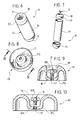
- the reference number 1 globally designates a known tank for storing a high pressure fluid; in the exemplified case, the bottle 1 is of the kind commonly used as a motor vehicle tank, for containing methane gas at a pressure variable between 200 and 300 bar, necessary for fuelling an internal combustion engine.
- the bottle 1 has a body 2 having a bottom portion 3, an intermediate portion 4 and a head portion 5; the bottom portion 3 has a substantially flat shape, the intermediate portion 4 a globally cylindrical, hollow shape, and the head portion 5 has substantially hemispherical or cap shape.
- the shape shown in Figure 1 is the typical one of the case in which the body 2 is obtained in a single piece, by press forging a billet or a thick plate of steel, to form first the portions 3 and 4; the portion 5 is then obtained by means of fluoforming, deforming an end part of the intermediate portion 4.
- the intermediate portion of the body 2 can be obtained starting from a tube, in which case both ends of the tube are shaped in the form of a hemispherical cap by fluoforming.
- the reference number 6 designates a valve, whose construction is known in itself, provided to enable both to load the methane gas into the bottle 1, in case of refuelling, and to draw the gas from the bottle, for purposes of fuelling the engine of the motor vehicle; for this purpose, in use, the valve 6 is connected to suitable pipelines for loading and drawing the gas, not shown herein.
- a threaded part of the valve is screwed in a through hole fitted with lead screw provided at the top of the head portion 5.
- the valve 6 projects from the body 2, in a position aligned with the axis thereof.
- This arrangement derives from the need to position the valve 6 in a point in which the thickness of the body 2 is high, in order to provide a sufficiently long threaded through hole therein, such as to assure a secure anchoring of the valve 6.
- the fluoforming process used to construct the head part 5 allows for this purpose to obtain a sufficiently thick area for anchoring the valve 6.
- the degree of safety and the storage capacity of the tank are increased by means of a particular modelling of the tank body, and in particular of its head end, to allow the placement of the respective valve in a safer or more protected position.
- Figures 2 and 3 for this purpose show a first possible embodiment of a tank for storing fluids at operating pressures greater than 100 bar according to the present invention, whose body is formed by the union of at least two distinct parts.
- the tank according to the invention globally designated 11, has a body 12 formed by the union of a hollow intermediate element, designated 14, and by two terminals 13 and 15, which respectively constitute the bottom and the head of the body 12.
- the intermediate element 14 ha substantially cylindrical shape, whilst the terminals 13, 15 are globally cup shaped, in particular they are shaped as hemispherical caps.
- the three components 13, 14 and 15 of the body 2 are made of hardening and tempering steel with high equivalent carbon content with breaking loads comprised between 800 e 1200 Mpa (such as chromium-manganese or chromium-molybdenum steel, or of high-strength steels, such as "P690QL1" steel).
- the valve 6 is fastened to the head terminal 15 in lateral position, this positioning possibility being allowed by virtue of a particular conformation of the terminal.
- Figure 4 shows the inner part of the terminal 15 and Figure 6 shows a section of the same terminal; as is readily apparent from said figures, along the arc of the cap that constitutes the terminal 15 is defined a reinforcing rib, designated with the reference 16. Said rib is obtained directly on the piece 15 and it has the necessary thickness to obtain a lead screw 17 or other type of through hole in the desired position and with the desired length; in this hole is screwed the threaded fastening part 6A of the valve 6, the remaining connecting part 6B of the valve remaining instead outside the body 12.
- the length development of the reinforcing rib 16 can be limited to the segment involved for fastening the valve 6 or, as shown in the example of Figures 4 and 5, it can extend along the entire arc of the cap constituting the terminal 15.
- the terminal 15 provided with the rib 16 can be obtained in simple, rapid fashion by press forging from steel billet of the type set out above, because this technology is well suited for the complexity of the profile needed for the piece.
- the bottom terminal 13 can also be obtained by press forging from billet of high alloy or high strength steel and have a similar shape to that of the terminal 15, but without the respective rib 16 and the respective hole 17. It is clear that, due to production standardisation requirements, the terminal 13 could be wholly identical to the terminal 15, with the exception of the presence of the hole 17. Obviously, both terminals 13, 15 are constructed with the profile thickness necessary for the gas tightness of the tank 11.
- the intermediate element 14 instead is constituted by a tube made of the same material constituting the terminal 13, 15.
- FIGS. 6 and 7 show a second possible embodiment of the tank or bottle according to the invention; in these figures, the same reference numbers as those of the previous figures are used, to indicate elements that are technically equivalent to those described previously.
- the bottle 11 has a body 12 formed by the union of an intermediate element, designated by the reference number 14, a bottom terminal, designated 13, and a head terminal, designated 15'.
- the head terminal 15' is shaped as to provide itself protection to the valve 6, in particular providing within the terminal itself a compartment within which the valve 6 can be housed completely, as in the case shown in the figures, or for the most part.
- the dimensions of the aforesaid compartment for the containment and protection of the valve, designated in Figures 6 and 7 by the reference number 18, can vary with those of the tank 11 and according to the type of valve 6 in use; by way of indication, the compartment 18 is similar to a cylindrical volume having a diameter of about 90 millimetres and a height of about 100 millimetres.
- the compartment 18 is obtained by appropriately shaping the terminal 15', i.e. defining a concave seat therein, designated PC in Figure 8, on the bottom whereof is provided a threaded through hole 17; in this hole 17 is inserted and screwed the threaded part 6A of the valve 6, whilst the remaining part 6B of the same valve is housed within the compartment 18.
- the shape of the terminal 15' can be obtained by means of press forging technologies, starting from a billet or metal plate.
- Figure 9 shows in particular a section of terminal 15' obtained by press forging starting from a billet of high alloy or high strength steel; this technique for obtaining it is preferable when the terminal to be obtained has relatively small dimensions, because press forging from billet allows to achieve reduced curvature radii in the piece; moreover, with this process, as shown in Figure 9, the thickness of the walls of the terminal 15' can be variable in the different areas, both for structural requirements, and to house the valve 6.
- the press forging of the terminal 15' from metal plate is instead preferably used when the dimensions of the tank 11, and hence of the terminal itself, are greater and wall thickness can be uniformly greater in all parts of the geometry of the piece.
- Figure 10 shows, by way of example, a terminal 15' obtained from press forging a thick plate of steel with high carbon content or high-strength steel.
- the bottom terminal 13 can be obtained by press forging from steel billet or plate and have similar shape to that of the respective terminal 15', but without the concave portion PC which defines the protection compartment 18 and the respective hole 17. It is clear that, due to production standardisation requirements, the terminal 13 could be wholly identical to the terminal 15', with the exception of the presence of the hole 17.
- the compartment 18 housing and protecting the valve 6 is integrally obtained in a terminal 15' obtained from steel plate; as stated, this technique can be used when the terminal to be obtained is not small, which would entail reduced curvature radii in the piece.
- Figure 11 shows an additional possible embodiment variation, which allows to overcome the technological limits of plate press forging when the dimensions of the terminal to be obtained are reduced.
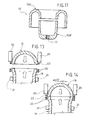
- This solution consists of forming the terminal 15' in two parts, and specifically an upper part, designated by 15A', folded back towards the interior, whereto is joined a lower part, designated by 15B', substantially shaped as a cup.
- 15A' an upper part
- 15B' a lower part
- the overall geometry of the component formed by the two parts 15A' and 15B' allows, in this case as well, to form in terminal a compartment to house the valve 6 in protected position.
- Figure 11 can also be provided to house at least the prevalent part of the valve 6 within the bulk of the head terminal 15' when the thickness of the plate used to obtain the upper part 15A is not adequate to obtain a sufficiently long threaded hole 17 therein.
- Figures 12A, 12B and 12C respectively show the case of housing, in said luggage compartment 19, of a tank 11 according to the embodiment of Figure 2-5, of a tank 1 according to the prior art as per Figure 1 and lastly of a tank 11 according to the embodiment of Figures 6-10.
- the reference L designates the dimension of maximum axial or longitudinal bulk of the bodies 2 or 12 of the three tanks, said dimension L being delimited by the head and bottom ends of the bodies themselves.
- valve 6 can be positioned in safe areas of the bodies.
- the distance between the portion 6B of the valve 6 and the respective wall of the luggage compartment 19 is instead substantially similar in the case of the tanks 1 and 11 of Figures 12C and 12B.
- a comparison between said figures readily shows that, in the second case, the length of the tank is greater, with the portion 6B of the valve 6 remaining within the dimension of maximum bulk L of the body 12, and in any case in a compartment that protects it from contact with any surfaces of the motor car which may become deformed in case of accident.
- valve 6, provided according to the invention is not strictly constrained to the transformation processes necessary to produce the tanks 11 because, potentially, current technologies could also be developed to provide such functionalities.
- redesigning the tank in accordance to the invention would seem advisable.
- the tank is conceived to be "adapted" to the requirements of the automotive manufacturer, and designed as an object obtained from the union of multiple parts, preferably a tube, i.e. the intermediate element 14, and two elements press forged into the desired shape, i.e. the terminals 13, 15 or 15'.
- This solution in addition to the aspects of greater storage capacity and enhanced safety described above, also allows to obtain important advantages in terms of product modularity, productive standardisation, easier inventory management and reduced investment costs with respect to current ones.
- the union of the pieces constituting the body 12 of the tank 11 is accomplished by means of junction techniques without weld material and without fusion, which guarantee unions with good mechanical characteristics also for high alloy steels.
- FIGS 13 and 14 show section views of the two pieces to be joined, represented in the specific case by the head terminal 15 and by the intermediate element 14, which in this case has a slightly widened end portion; each piece is sustained by respective grips, known in themselves, designated by the reference numbers 20 and 21.
- the two pieces 14 and 15 are moved progressively closer, by an appropriate linear displacement of the grips 20 towards the grips 21, or vice versa.
- a heating of the respective material to join is achieved, by means of parasitic currents produced by suitable inductor means. located in proximity to the mutually facing ends of the intermediate element 14 and of the terminal 15; the aforesaid inductor means, which can be of a type known in itself, are designated by the references 22 and 23.
- a forging step follows, by the application of a compression force between the two pieces 14, 15 to be joined, able to produce the deformation and the union in the solid state of the parts in contact. Therefore, according to the invention, the union between the pieces 14, 15 is achieved without adding material and without having the steel constituting the pieces reach the liquid state, in absence of fusion. This allows to avoid the problems which are typical of traditional processes for welding steels with high carbon content.
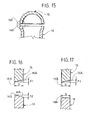
- each piece 14 and 15, designated by the references 14a and 15a, are inclined so that the respective summit point 14b, 15b is substantially in correspondence with the outer circumferential edge of the same surfaces.
- This geometry allows the progressive contact between the parts to be joined in the pasty plastic state and the achievement, during the aforesaid forging step, of a slight upsetting of material, with escape thereof from the junction area towards the exterior of the body to be obtained.
- the axial distance between the inner and outer circumferential edges of the surfaces 14a and 14b, i.e. the dimensions designated by the references F1 and F2 in Figures 15 and 16, preferably vary from 0 to 10 times the thickness "s" of the material constituting the pieces 14, 15.
- the invention has been described with particular reference to the construction of tanks or bottles for application in the automotive field, but it is clear that it is susceptible to be used in any other field exhibiting the same problems, ed in particular those linked to the necessity of assuring an adequate mechanical strength at operating pressures greater than 100 bar.
- the above tanks has been described with reference to the storage of methane gas, it is clear that they are suitable for storing any other component at operating pressures greater than 100 bar, and namely substantially comprised between 200 and 300 bar.
- the body 12 of the tanks 11 is made of three distinct pieces, but it could clearly be obtained by joining only two half-shells of adequate dimensions, obtained through the same techniques mentioned above (press forging from billet or thick plate).
- the surfaces 14a, 15a of Figures 15 and 16 could also be curved, and in particular concave shaped.
- the two pieces 15A' and 15B' could be mutually joined by the roto-forging method according to the invention. Still with reference to Figure 11, it should be noted that the two pieces 15A' and 15B' could be shaped in such a way that the respective union surfaces are external to the compartment 18. Although this is not strictly necessary, the body 13 can thereby be formed by joining first to the intermediate element 14 the bottom terminal 13 and the piece 15A', then exploiting the opening thereof to remove any residues of the process of roto-forging the inner walls of the bottle body; subsequently, the body itself would be completed by joining to the piece 15A' the piece 15B', in the manner described above.
- a head terminal 15, 15' could be different from the shape of the bottom terminal 13, for instance as shown in Figures 12A and 12C.
- the connecting part 6B of the valve 6 could also slightly project from the respective housing compartment 18, allowing in any case to enhance the working capacity of the tank 11 according to the invention with respect to the prior art.
- valves 2-5 and 6-11 allows, if necessary, to provide also two distinct valves for a same bottle, for instance one for loading the fluid and the other one for drawing it; each of said valves can be positioned in correspondence with an end of the body 12, allowing in any case to obtain the advantages described above; in the case of the embodiment of Figures 2-5, both the aforesaid valves could also project from two opposite sides of the same head terminal 15.
Landscapes
- Engineering & Computer Science (AREA)
- Mechanical Engineering (AREA)
- General Engineering & Computer Science (AREA)
- Filling Or Discharging Of Gas Storage Vessels (AREA)
Applications Claiming Priority (2)
| Application Number | Priority Date | Filing Date | Title |
|---|---|---|---|
| ITTO20021002 | 2002-11-15 | ||
| IT001002A ITTO20021002A1 (it) | 2002-11-15 | 2002-11-15 | Serbatoio per lo stoccaggio di fluidi in alta pressione, |
Publications (1)
| Publication Number | Publication Date |
|---|---|
| EP1422013A1 true EP1422013A1 (fr) | 2004-05-26 |
Family
ID=32211419
Family Applications (1)
| Application Number | Title | Priority Date | Filing Date |
|---|---|---|---|
| EP03025978A Withdrawn EP1422013A1 (fr) | 2002-11-15 | 2003-11-13 | Réservoir pour le stockage de fluides à une pression dépassant 100 bars, en particulier pour du gaz destiné à alimenter des moteurs de véhicules et procédé de fabrication correspondant. |
Country Status (2)
| Country | Link |
|---|---|
| EP (1) | EP1422013A1 (fr) |
| IT (1) | ITTO20021002A1 (fr) |
Cited By (1)
| Publication number | Priority date | Publication date | Assignee | Title |
|---|---|---|---|---|
| CN105143035A (zh) * | 2013-06-20 | 2015-12-09 | 三菱重工业株式会社 | 具有曲率变化部的独立式罐及其制造方法 |
Citations (7)
| Publication number | Priority date | Publication date | Assignee | Title |
|---|---|---|---|---|
| US2015904A (en) * | 1930-11-28 | 1935-10-01 | Chesterfield Tube Company Ltd | Portable container for compressed gases |
| DE969415C (de) * | 1944-05-26 | 1958-05-29 | Phoenix Rheinrohr Ag Vereinigt | Vorrichtung zum induktiven Stumpfschweissen von Quernaehten an Rohren, Behaeltern, Stangen und Werkstuecken aehnlich langgestreckter Form |
| US2892914A (en) * | 1958-07-02 | 1959-06-30 | Magnetic Heating Corp | Methods and apparatus for butt welding |
| FR2280024A1 (fr) * | 1974-07-26 | 1976-02-20 | Ver Deutsche Metallwerke Ag | Raccord pour un recipient resistant a la pression et en une piece |
| WO1993003304A1 (fr) * | 1991-07-26 | 1993-02-18 | Cylindric Denmark A/S | Conteneur portatif pour gaz liquefies sous pression |
| US5240167A (en) * | 1990-03-02 | 1993-08-31 | Societe Nationale d'Etude et de Construction de Motors d'Aviation (S.N.E.CM.A.) | Friction welding method with induction heat treating |
| WO2000025973A1 (fr) * | 1998-11-02 | 2000-05-11 | Industrial Field Robotics | Procede ameliore de soudure a l'etat solide et parties soudees |
-
2002
- 2002-11-15 IT IT001002A patent/ITTO20021002A1/it unknown
-
2003
- 2003-11-13 EP EP03025978A patent/EP1422013A1/fr not_active Withdrawn
Patent Citations (7)
| Publication number | Priority date | Publication date | Assignee | Title |
|---|---|---|---|---|
| US2015904A (en) * | 1930-11-28 | 1935-10-01 | Chesterfield Tube Company Ltd | Portable container for compressed gases |
| DE969415C (de) * | 1944-05-26 | 1958-05-29 | Phoenix Rheinrohr Ag Vereinigt | Vorrichtung zum induktiven Stumpfschweissen von Quernaehten an Rohren, Behaeltern, Stangen und Werkstuecken aehnlich langgestreckter Form |
| US2892914A (en) * | 1958-07-02 | 1959-06-30 | Magnetic Heating Corp | Methods and apparatus for butt welding |
| FR2280024A1 (fr) * | 1974-07-26 | 1976-02-20 | Ver Deutsche Metallwerke Ag | Raccord pour un recipient resistant a la pression et en une piece |
| US5240167A (en) * | 1990-03-02 | 1993-08-31 | Societe Nationale d'Etude et de Construction de Motors d'Aviation (S.N.E.CM.A.) | Friction welding method with induction heat treating |
| WO1993003304A1 (fr) * | 1991-07-26 | 1993-02-18 | Cylindric Denmark A/S | Conteneur portatif pour gaz liquefies sous pression |
| WO2000025973A1 (fr) * | 1998-11-02 | 2000-05-11 | Industrial Field Robotics | Procede ameliore de soudure a l'etat solide et parties soudees |
Cited By (3)
| Publication number | Priority date | Publication date | Assignee | Title |
|---|---|---|---|---|
| CN105143035A (zh) * | 2013-06-20 | 2015-12-09 | 三菱重工业株式会社 | 具有曲率变化部的独立式罐及其制造方法 |
| EP2974953A4 (fr) * | 2013-06-20 | 2016-07-13 | Mitsubishi Heavy Ind Ltd | Réservoir indépendant doté de section de changement de sphéricité et procédé de production de réservoir indépendant |
| US9868493B2 (en) | 2013-06-20 | 2018-01-16 | Mitsubishi Heavy Industries, Ltd. | Independent tank with curvature change section, and manufacturing method for independent tank |
Also Published As
| Publication number | Publication date |
|---|---|
| ITTO20021002A1 (it) | 2004-05-16 |
Similar Documents
| Publication | Publication Date | Title |
|---|---|---|
| US7427000B2 (en) | Compressed gas tank for a motor vehicle | |
| US8235240B2 (en) | Inner container surrounded by an outer container, used for receiving a cryogenic liquid | |
| EP2293919B1 (fr) | Procédé de fabrication d un réservoir de stockage | |
| US10648616B2 (en) | Pressure vessel assembly and method of forming | |
| KR101447344B1 (ko) | 구조 부재 | |
| EP4023927B1 (fr) | Récipient sous pression | |
| US20160263990A1 (en) | Operating fluid container havng a stiffening element | |
| KR19990044504A (ko) | 이중 챔버를 구비한 유체 저장 용기 | |
| US4121528A (en) | Method of construction of a container with integral valve boss | |
| US6223929B1 (en) | Pressure-proof tank | |
| US20080237240A1 (en) | Modular Container for Cryogenic Liquids | |
| KR20120038129A (ko) | 에어탱크의 제조방법 및 그 방법으로 제조된 에어탱크 | |
| US20250305632A1 (en) | Method for producing a pressure vessel | |
| JP4382536B2 (ja) | 圧力容器、燃料タンク及び車両、並びに圧力容器の製造方法及び燃料タンクの製造方法 | |
| JP2011017379A (ja) | ガスタンク | |
| DE2165880A1 (de) | Leichtbau-behaelter fuer gase | |
| CN110185918A (zh) | 高压复合容器 | |
| CN213746108U (zh) | 瓶口密封结构及高压复合容器 | |
| EP1925873B1 (fr) | Vanne papillon d'un système tourbillonnaire pour moteur à combustion interne | |
| KR100281304B1 (ko) | 자동차 lpg가스연료통 제조방법 | |
| EP1390660B1 (fr) | Recipient pour air pressurise | |
| CN106233025A (zh) | 双筒减震器 | |
| RU2302582C1 (ru) | Газовый баллон высокого давления | |
| RU2183299C2 (ru) | Газовый баллон | |
| RU2018452C1 (ru) | Автомобильный баллон для сжиженного газа |
Legal Events
| Date | Code | Title | Description |
|---|---|---|---|
| PUAI | Public reference made under article 153(3) epc to a published international application that has entered the european phase |
Free format text: ORIGINAL CODE: 0009012 |
|
| AK | Designated contracting states |
Kind code of ref document: A1 Designated state(s): AT BE BG CH CY CZ DE DK EE ES FI FR GB GR HU IE IT LI LU MC NL PT RO SE SI SK TR |
|
| AX | Request for extension of the european patent |
Extension state: AL LT LV MK |
|
| 17P | Request for examination filed |
Effective date: 20040920 |
|
| 17Q | First examination report despatched |
Effective date: 20041015 |
|
| AKX | Designation fees paid |
Designated state(s): AT BE BG CH CY CZ DE DK EE ES FI FR GB GR HU IE IT LI LU MC NL PT RO SE SI SK TR |
|
| STAA | Information on the status of an ep patent application or granted ep patent |
Free format text: STATUS: THE APPLICATION IS DEEMED TO BE WITHDRAWN |
|
| 18D | Application deemed to be withdrawn |
Effective date: 20050226 |