EP1422680A2 - Flugzeugsnotsicherheitskontrollsystem, -verfahren und -vorrichtung - Google Patents
Flugzeugsnotsicherheitskontrollsystem, -verfahren und -vorrichtung Download PDFInfo
- Publication number
- EP1422680A2 EP1422680A2 EP03256137A EP03256137A EP1422680A2 EP 1422680 A2 EP1422680 A2 EP 1422680A2 EP 03256137 A EP03256137 A EP 03256137A EP 03256137 A EP03256137 A EP 03256137A EP 1422680 A2 EP1422680 A2 EP 1422680A2
- Authority
- EP
- European Patent Office
- Prior art keywords
- aircraft
- control
- monitor
- determining
- monitoring
- Prior art date
- Legal status (The legal status is an assumption and is not a legal conclusion. Google has not performed a legal analysis and makes no representation as to the accuracy of the status listed.)
- Granted
Links
Images


Classifications
-
- G—PHYSICS
- G08—SIGNALLING
- G08G—TRAFFIC CONTROL SYSTEMS
- G08G5/00—Traffic control systems for aircraft
- G08G5/20—Arrangements for acquiring, generating, sharing or displaying traffic information
- G08G5/26—Transmission of traffic-related information between aircraft and ground stations
-
- B—PERFORMING OPERATIONS; TRANSPORTING
- B64—AIRCRAFT; AVIATION; COSMONAUTICS
- B64D—EQUIPMENT FOR FITTING IN OR TO AIRCRAFT; FLIGHT SUITS; PARACHUTES; ARRANGEMENT OR MOUNTING OF POWER PLANTS OR PROPULSION TRANSMISSIONS IN AIRCRAFT
- B64D45/00—Aircraft indicators or protectors not otherwise provided for
- B64D45/0015—Devices specially adapted for the protection against criminal attack, e.g. anti-hijacking systems
- B64D45/0031—Devices specially adapted for the protection against criminal attack, e.g. anti-hijacking systems means for overriding or restricting access to flight controls
-
- B—PERFORMING OPERATIONS; TRANSPORTING
- B64—AIRCRAFT; AVIATION; COSMONAUTICS
- B64D—EQUIPMENT FOR FITTING IN OR TO AIRCRAFT; FLIGHT SUITS; PARACHUTES; ARRANGEMENT OR MOUNTING OF POWER PLANTS OR PROPULSION TRANSMISSIONS IN AIRCRAFT
- B64D45/00—Aircraft indicators or protectors not otherwise provided for
- B64D45/0015—Devices specially adapted for the protection against criminal attack, e.g. anti-hijacking systems
- B64D45/0031—Devices specially adapted for the protection against criminal attack, e.g. anti-hijacking systems means for overriding or restricting access to flight controls
- B64D45/0034—Devices specially adapted for the protection against criminal attack, e.g. anti-hijacking systems means for overriding or restricting access to flight controls by ground-control override
-
- B—PERFORMING OPERATIONS; TRANSPORTING
- B64—AIRCRAFT; AVIATION; COSMONAUTICS
- B64D—EQUIPMENT FOR FITTING IN OR TO AIRCRAFT; FLIGHT SUITS; PARACHUTES; ARRANGEMENT OR MOUNTING OF POWER PLANTS OR PROPULSION TRANSMISSIONS IN AIRCRAFT
- B64D45/00—Aircraft indicators or protectors not otherwise provided for
- B64D45/0015—Devices specially adapted for the protection against criminal attack, e.g. anti-hijacking systems
- B64D45/0059—Devices specially adapted for the protection against criminal attack, e.g. anti-hijacking systems by communicating emergency situations to ground control or between crew members
-
- G—PHYSICS
- G08—SIGNALLING
- G08G—TRAFFIC CONTROL SYSTEMS
- G08G5/00—Traffic control systems for aircraft
- G08G5/50—Navigation or guidance aids
- G08G5/55—Navigation or guidance aids for a single aircraft
-
- G—PHYSICS
- G08—SIGNALLING
- G08G—TRAFFIC CONTROL SYSTEMS
- G08G5/00—Traffic control systems for aircraft
- G08G5/50—Navigation or guidance aids
- G08G5/58—Navigation or guidance aids for emergency situations, e.g. hijacking or bird strikes
Definitions
- the present invention relates generally to aircraft control and, more specifically, to a method and apparatus for providing autonomous control of aircraft upon detection of an emergency situation onboard the aircraft.
- An airborne aircraft may suffer loss of control due to incapacitation of the crew. This may be caused by death of one or more crewmembers, a medical emergency, a hijacking, or other emergency situation.
- the aircraft In the case of hijacking, the aircraft may be commandeered by unauthorized persons and used as a weapon as has been demonstrated. Such actions may even necessitate the destruction of the commandeered aircraft by military aircraft taking defensive measures.
- Airline safety has generally depended upon having at least two qualified pilots onboard the aircraft. In the event that one crewmember becomes disabled, the other crewmember is capable of operating the aircraft and bringing the aircraft to a safe landing. This method of using two crewmembers has worked well until recently. Even prior to the tragic events involving the hijacking and intentional crashing of an aircraft into a building, there has been at least one incident in which a pilot in command may have assumed control of the aircraft and caused it to intentionally crash. Novels and movies have addressed the issue of having both crewmembers incapacitated leaving the aircraft in perilous conditions. In certain situations, orders have been issued to destroy any aircraft that appears to pose a threat to a large population on the ground due to loss of positive control of the aircraft.
- the present invention comprises a method and apparatus for providing an Aircraft Emergency Safety Control System (AESCS) capable of regaining control of an aircraft that may have been lost due to incapacitation of the crew.
- AESCS Aircraft Emergency Safety Control System
- the baseline AESCS invention is comprised of three major segments: an airborne segment, a ground segment, and a communications segment.
- the airborne segment provides aircraft monitoring and status information to a ground control station via a communications link.
- the airborne segment augments existing electronic flight control systems to accept emergency navigation, guidance, and control instructions from a ground control station via the communications link.
- the airborne segment further provides an optional capability to disable cockpit control of selected systems.
- the Ground Control Segment (GCS) of the present invention comprises one or more monitoring and control stations.
- the purpose of the GCS is to continuously monitor aircraft to determine abnormal flight patterns, detect threatening behavior onboard the aircraft, or otherwise determine situations which may pose a hazard to either the aircraft or ground locations. Once an emergency situation onboard the aircraft has been detected, the GCS can be used to provide a signal to the aircraft to change control of the aircraft from pilot control to autonomous control.
- the communications segment provides a link between the aircraft and the GCS.
- the communications segment may comprise multiple complimentary and alternative communication channels.
- the communication link provides a way for interrogating the aircraft to extract critical information, pre-empt control of the aircraft from the onboard personnel, upload navigation and control data, monitor aircraft systems, and provide other monitoring functions such as video and audio from the cockpit and cabin to assess the situation aboard the aircraft.
- two-way communications is desired, although one-way communication is also within the scope of the invention.
- control of the aircraft is removed from the control of unauthorized person(s) onboard the aircraft, and the aircraft is directed to a destination that is considered a safe location for the aircraft given its status, and to facilitate a reasonably safe emergency landing.
- the present invention can make use of equipment which already exists on most commercial airliners, and adds electronic technology to provide an emergency control system for aircraft.
- a means is included to pre-empt the use of an aircraft as a weapon, but without the ability to guide the aircraft to a safe landing using an autonomous system.
- the system addresses safety issues on multiple fronts, and provides a means to reduce significantly the risk to both aircraft passengers and to people and property on the ground. Safety is enhanced, not only for situations involving a suicide hijacking, but also for situations that may arise due to aircraft malfunctions.
- the present invention provides a wide-ranging solution to many aviation safety issues using an integrated monitoring and control system that includes an airborne segment, a ground control segment and a communications segment.
- the present invention comprises a method and apparatus for providing an Aircraft Emergency Safety Control System (AESCS) capable of regaining control of an aircraft that may have been lost due to incapacitation of the crew.
- AESCS Aircraft Emergency Safety Control System
- incapacitation can result from situations, such as a hostile take-over from person(s) onboard the aircraft
- incapacitation of the crew may also result from a mechanical failure that renders the crew helpless.
- the present invention addresses not only safety from the perspective of loss of life and property on the ground due to hostile aircraft take-over, but also the safety of aircraft passengers in the event of a catastrophic mechanical failure onboard the aircraft.
- the system can also be used to detect and help control other emergency situations.
- the inventive system can be used to provide separate ground support during emergency situations, such as mechanical problems, onboard medical emergencies, and the like.
- the presently disclosed AESCS can remove control of the aircraft from persons onboard the aircraft and turn over control of the aircraft to a system that utilizes the onboard autonomous navigation controls, and which is directed by ground control points.
- the preferred approach is to use onboard electronic systems to navigate and control the aircraft as much as possible, although remote control piloting of the aircraft may also be utilized.
- a communications control link is provided as a means for changing the control mode of the navigation system of the aircraft from pilot control to autonomous ground control.
- the communications link also provides a way for interrogating the aircraft to extract critical information, for pre-empting control from the onboard personnel, for uploading navigation and control data, for monitoring aircraft systems and for providing other monitoring functions, such as video and audio from the cockpit and cabin, to assess the situation aboard the aircraft.
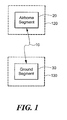
- the baseline AESCS invention is comprised of three major segments: an airborne segment 20, a ground segment 30, and a communications segment 10.
- the three system segments may encompass numerous implementation variations within each segment.
- the airborne segment 10 of the invention is resident within aircraft 120 in Figure 1 and 120, 120b, and 120c, in Figure 2.
- the airborne segment performs several functions.
- the airborne segment 10 provides aircraft monitoring and status information to one or more ground segments 30 which are usually housed in a ground control station 130, 130a, 130b and 130c. Communication between the airborne segent and the ground segment is conducted via a communications link or channel 10, 10a, 10b, and 10c.
- the airborne segment 10 also augments existing electronic flight control systems to accept emergency navigation, guidance, and control instructions from a ground control station via the communications link 10.
- the airborne segment 10 further provides an optional capability to disable cockpit control of selected systems.
- the airborne segment may require modification of the airborne navigation system software to accommodate the necessary emergency control functions, and may further require additional hardware to facilitate emergency control of the aircraft.
- the preferred airborne segment 10 comprises a three-dimensional navigation system, a full-control 3-axis autopilot, sensors for determining forward velocity, vertical velocity, roll, roll-rate, yaw, heading, angle of attack, ground speed, attitude and horizontal drift.
- the navigation and autopilot system is capable of vectoring the aircraft to programmed way points (including altitude), and establishing and maintaining final approach heading and glide slope.
- the auto-land system is capable of adjusting power, flair for landing and ground rollout after landing. These capabilities are available on most commercial airlines equipped for Category 3 landings. In order to provide a fully autonomous landing, additional capabilities that may need to be added include lowering of landing gear, flap adjustments, spoiler control, etc.
- the Ground Control Segment (GCS) 30 of the present invention is incorporated into one or more monitoring and control stations 130a, 130b, and 130c. These stations may be integrated with an existing Air Traffic Control (ATC) network, or may be located at other physical facilities and receive information collected from ATC facilities.
- ATC Air Traffic Control
- the purpose of the GCS 30 is to continuously monitor aircraft to determine abnormal flight patterns, detect threatening behavior onboard the aircraft, or otherwise determine situations which may pose a hazard to either the aircraft or ground locations.
- the GCS 30 includes features such as a "911" equivalent for flight communications, the monitoring of transponder messages for emergency or hijacking codes, and the monitoring of communications channels for cockpit alarms.
- the GCS 30 may also include more sophisticated capabilities that include correlating planned flight paths with actual flight paths, and detecting significant deviations from normal operations or loss of aircraft systems that pose a threat to the aircraft.
- the source of information for the GCS is obtained from numerous sources.
- the primary source of information is via the emergency control system communications channel 10, which is described below.
- This channel or link 10 provides, not only data from the aircraft systems, but also cockpit and cabin audio and video information.
- New ATC systems will integrate complimentary aircraft data including position, altitude, velocity, destination, and the like. This data on each flight is forwarded to the GCS.
- the GCS integrates this data into a complete database to provide full situational awareness for each aircraft.
- the communications segment may comprise multiple complimentary and alternative communications channels.
- the minimum data rate required is relatively low since the intent is to provide basic aircraft monitoring while communicating navigation and control information to the aircraft, not actually flying the aircraft by remote control.
- the communications channels should, however, be secure, i.e. encrypted.
- Communications channels can be established using existing VHF or UHF communications equipment. Even though the channel is completely unused most of the time, it is preferably maintained in a "clear" condition at all times such that the channel is always available when needed.
- Ground-based transmitters and receivers supporting the AESCS are deployed throughout the operational areas. Preferably, the ground-based transmitters and receivers are co-located with ATC radio transceivers, navigation systems or other aircraft ground equipment.
- SCS Satellite Communications System
- the communications segment makes use of digital communication techniques and employs packet protocols for reliable data communications between the aircraft and the ground.
- the information from these ground terminals is communicated to AESCS monitor and control points by existing communications means, including, but not limited to, microwave radio, fiber optic cables, copper cables, and satellite communications links.
- the GCS sends a command via the communications link to the aircraft.
- the command sequence sent to the aircraft from the GCS by way of the communications link might comprise a message that removes control of the aircraft from the cockpit and places it with the onboard electronic systems. This message would then be followed with detailed flight information.
- Such detailed flight information provided by the GCS may include climb to a specific altitude, assume a particular heading, navigate to a particular way-point, proceed to a specified destination, initiate a particular procedure, etc.
- such commands are not issued by a single individual and require authentication of the individuals initiating the change in control.
- the control messages should also be encrypted to insure that unauthorized persons could not assume control of the aircraft from illegitimate ground stations. Acknowledgment from the aircraft could also be required before final transfer of control.
- the preferred and maximum performance system is based on maximum use of electronic systems installed on most modem airliners. Such systems provide the ability to navigate and control the aircraft autonomously in the case of an emergency. Modifications required on all commercial airliners include the addition of cockpit and cabin audio and video monitoring equipment, emergency access control functions, security code functions and interface to the emergency communications link. Security features may include electronic ID of crew members such as by fingerprints or face recognition, remote control of the transponder including mode and code word changes, emergency disabling of cockpit controls including engine, electrical, fuel and cabin pressure controls, and the like.
- Older and/or smaller aircraft designs may be more difficult to modify to incorporate the full capabilities of the AESCS. It may be necessary to upgrade these aircraft to full Category 3 landing capability in order to incorporate the full range of capability of the AESCS.
- full Category 3 landing capability implies the use of equipment that may be used on a routine flight basis to land at a wide range of airports. Such equipment may impose additional maintenance and certification costs that are not acceptable for these aircraft.
- equipment may be used which is not as precise, and hence, is less expensive, but may be restricted to use only at selected airports and certified for emergency use only.
- the minimum capability AESCS may require the establishment of designated airports to accommodate aircraft with emergency situations. These locations would have long runways, minimal number of structures located in close proximity to runways, long runway overrun areas, enhanced safety facilities to handle emergencies, etc.
- the GCS includes the ability to isolate the potential emergency situations from the vast majority of normal situations. Questionable situations are flagged and presented to an operator for final resolution. The operator is provided with information from multiple sources along with the criticality of the situation. Confirmation of an emergency situation, for example the confirmation that a specific aircraft is under the control of an unauthorized person or persons, would result in a set of options from which the operator would choose a particular course of action.
- the GCS operator would issue a command to the aircraft that would enable the GCS to assume control of the aircraft.
- This control would not be the actual direct control of the aircraft, but the ability to program the flight profile of the aircraft into the aircraft's navigation system.
- the on board navigation and control systems would be responsible for the actual second-by-second flight of the aircraft.
- FIG. 3 a block diagram showing the method 100 of providing an AESCS system is shown.
- the rectangular elements are herein denoted “processing blocks” and may represent computer software instructions or groups of instructions.
- the diamond shaped elements are herein denoted “decision blocks,” and may represent computer software instructions, or groups of instructions which affect the execution of the computer software instructions represented by the processing blocks.
- the processing and decision blocks represent steps performed by functionally equivalent circuits such as a digital signal processor circuit or an application specific integrated circuit (ASIC).
- ASIC application specific integrated circuit
- the flow diagrams do not depict the syntax of any particular programming language. Rather, the flow diagrams illustrate the functional information one of ordinary skill in the art requires to fabricate circuits or to generate computer software to perform the processing required in accordance with the present invention. It should be noted that many routine program elements, such as initialization of loops and variables and the use of temporary variables are not shown. It will be appreciated by those of ordinary skill in the art that unless otherwise indicated herein, the particular sequence of steps described is illustrative only and can be varied without departing from the spirit of the invention. Thus, unless otherwise stated the steps described below are unordered meaning that, when possible, the steps can be performed in any convenient or desirable order. Furthermore, these steps represent those typical of the full embodiment of the invention. Modifications may be incorporated into systems having reduced capabilities.
- Step 110 shows that the aircraft is continuously monitored to determine if there is an emergency situation onboard.
- the above described GCS includes one or more monitor and control stations which monitor the aircraft to determine when an emergency situation exists. When there is no emergency situation, this step is repeated. When an emergency situation is detected step 120 is executed.
- Step 120 places the navigation control system of the aircraft into emergency mode.
- control of the aircraft is switched to an onboard autonomous control system.
- the pilot has no control over the flight of the aircraft at this point.
- Step 130 provides emergency navigation, guidance and control instructions to the autonomous control system. These emergency instructions are provided from the GCS to the autonomous control system by way of the communications link.
- the aircraft is controlled by way of the autonomous control system and the emergency instructions which have been provided to the autonomous control system. Accordingly, the aircraft can be directed to a predetermined location, and landed safely despite the fact that there is an emergency situation on board.
- step 150 the cockpit control of selected systems is disabled. This step prevents a person from disabling the aircraft, such as by turning off power to the control systems, emptying the gas tanks, and other acts to prevent a safe landing of the aircraft.
- step 160 the method is completed.
- control of the aircraft is removed from the control of unauthorized person or persons onboard the aircraft, and the aircraft is directed to a destination that is considered a safe location for the aircraft given it's status, and to facilitate a reasonably safe emergency landing.
- the system can be used to control the aircraft in the event the crew is incapacitated due to other causes, e.g., medical, loss of oxygen, etc.
- Another issue addressed by this invention is to preclude the AESCS itself from being used as a means of attack. Once such a means of taking control of an aircraft exits, care must be taken to ensure that the control of the aircraft is not inadvertently changed, or an unauthorized person or persons cannot usurp control. For example, if hostile forces know of such an emergency ground control link, it is possible for them to attempt to exploit the AESCS as a means of controlling the aircraft. Therefore, any casual implementation of a safety control system could lead to a "back door" threat, and such a deficiency must be avoided.
- the present invention addresses these concerns as well.
- the commands required to take control of the aircraft are not issued by a single individual and require authentication of the individuals initiating the change in control.
- the control messages are encrypted to insure that unauthorized persons could not assume control of the aircraft from illegitimate ground stations. Acknowledgment from the aircraft is required before final transfer of control.
- the biggest risk that must be overcome is to ensure that the AESCS can not accidentally place the aircraft into a threat mitigation mode when no threats exist. This is accomplished at two levels.
- the onboard equipment is designed to incorporate the fail-safe design features associated with aircraft.
- the communications channel should include the use of multiple acknowledgements of receipt and execution of commands.
- the ultimate decision to take preemptive control of an aircraft rests with two or more ground personnel.
- Removing the ability to gain unauthorized control of the aircraft is relatively simple, but ensuring that the aircraft can be placed under safe positive control of an autonomous system requires more diligence. For example, aircraft engines can be shut down, electrical power can be removed, fuel flow can be reduced, etc. from the cockpit by the unauthorized party. Such actions by unauthorized individuals could result in catastrophic loss of the aircraft in an uncontrolled manner. It would, therefore, be desirable to remove access to all aircraft systems from within the cockpit in an emergency situation. Such capability would prevent, for example, the intentional crash of an aircraft by a mentally deranged crewmember or hijacker. However, one example of a difficult modification is one that would prevent the setting of switches or circuit breakers to undesired positions from the cockpit by individuals with malevolent intentions. Hence, it may not be practical to incorporate all features of the AESCS into all aircraft.
- the present invention provides a range of cost-effective approaches for aircraft of varying degrees of sophistication and capability. For example, crop dusters do not have all of the electronic technology of commercial airliners, nor do most general aviation aircraft. However, a version of the present invention similar to a so-called "dead man's throttle” approach can be implemented at reasonable costs.
- a computer usable medium can include a readable memory device, such as a hard drive device, a CD-ROM, a DVD-ROM, or a computer diskette, having computer readable program code segments stored thereon.
- the computer readable medium can also include a communications link, either optical, wired, or wireless, having program code segments carried thereon as digital or analog signals.
Landscapes
- Engineering & Computer Science (AREA)
- Aviation & Aerospace Engineering (AREA)
- Physics & Mathematics (AREA)
- General Physics & Mathematics (AREA)
- Business, Economics & Management (AREA)
- Emergency Management (AREA)
- Alarm Systems (AREA)
- Traffic Control Systems (AREA)
- Position Fixing By Use Of Radio Waves (AREA)
Applications Claiming Priority (2)
| Application Number | Priority Date | Filing Date | Title |
|---|---|---|---|
| US300141 | 2002-11-20 | ||
| US10/300,141 US6739556B1 (en) | 2002-11-20 | 2002-11-20 | Method and apparatus for providing an aircraft emergency safety control system |
Publications (3)
| Publication Number | Publication Date |
|---|---|
| EP1422680A2 true EP1422680A2 (de) | 2004-05-26 |
| EP1422680A3 EP1422680A3 (de) | 2004-06-23 |
| EP1422680B1 EP1422680B1 (de) | 2006-10-11 |
Family
ID=32229862
Family Applications (1)
| Application Number | Title | Priority Date | Filing Date |
|---|---|---|---|
| EP03256137A Expired - Lifetime EP1422680B1 (de) | 2002-11-20 | 2003-09-29 | Flugzeugsnotsicherheitskontrollsystem, -verfahren und -vorrichtung |
Country Status (5)
| Country | Link |
|---|---|
| US (1) | US6739556B1 (de) |
| EP (1) | EP1422680B1 (de) |
| AT (1) | ATE342558T1 (de) |
| DE (1) | DE60308980T2 (de) |
| ES (1) | ES2272901T3 (de) |
Cited By (8)
| Publication number | Priority date | Publication date | Assignee | Title |
|---|---|---|---|---|
| EP1450227A3 (de) * | 2003-02-19 | 2005-06-15 | The Boeing Company | Verfahren und Vorrichtung zum automatischen Steuern der Laufbahn eines Fahrzeuges |
| EP2050671A1 (de) * | 2007-10-17 | 2009-04-22 | The Boeing Company | Flugzeug mit sich verändernder Besetzung |
| US8527118B2 (en) | 2007-10-17 | 2013-09-03 | The Boeing Company | Automated safe flight vehicle |
| FR3012650A1 (fr) * | 2013-10-24 | 2015-05-01 | Eric Daviet | Dispositif de gestion decentralisee de trafic aerien et du trafic au sol integrant un systeme anti-collision entre aeronefs |
| WO2015091637A1 (en) * | 2013-12-19 | 2015-06-25 | Here Global B.V. | An apparatus, method and computer program for controlling a vehicle |
| GB2534856A (en) * | 2015-01-30 | 2016-08-10 | Messinger Samuel | Interactive aircraft or spacecraft flight simulator |
| GB2543503A (en) * | 2015-10-19 | 2017-04-26 | Bae Systems Plc | Emergency control of an aircraft |
| EP3196725A1 (de) * | 2016-01-25 | 2017-07-26 | Sikorsky Aircraft Corporation | Automatisches flugzeugsteuerungssystem bei pilotsunfahigkeit |
Families Citing this family (57)
| Publication number | Priority date | Publication date | Assignee | Title |
|---|---|---|---|---|
| US6584383B2 (en) * | 2001-09-28 | 2003-06-24 | Pippenger Phillip Mckinney | Anti-hijacking security system and apparatus for aircraft |
| US7398209B2 (en) | 2002-06-03 | 2008-07-08 | Voicebox Technologies, Inc. | Systems and methods for responding to natural language speech utterance |
| US7693720B2 (en) * | 2002-07-15 | 2010-04-06 | Voicebox Technologies, Inc. | Mobile systems and methods for responding to natural language speech utterance |
| US6975923B2 (en) * | 2002-10-01 | 2005-12-13 | Roke Manor Research Limited | Autonomous vehicle guidance on or near airports |
| IL153291A (en) * | 2002-12-05 | 2010-05-31 | Nir Padan | System and method for situation assessment and dynamic guidance to aerial vehicles for the optimal conduct of close-in maneuvering air combat |
| US7120521B2 (en) * | 2003-01-31 | 2006-10-10 | Hal Dwayne Lilley | Anti hijacking fail-safe system with alert locator tracking capabilities |
| SE0300871D0 (sv) * | 2003-03-27 | 2003-03-27 | Saab Ab | Waypoint navigation |
| US20050061912A1 (en) * | 2003-09-22 | 2005-03-24 | Postel Ifim I. | "Dream of life" - system which gurantee safety flights for all type aircrafts |
| US7110866B1 (en) * | 2004-04-26 | 2006-09-19 | Julius Vivant Dutu | Security enhanced automatic pilot system for air vehicles |
| US7350748B2 (en) * | 2005-03-21 | 2008-04-01 | Karl F. Milde, Jr. | Modular construction of an aircraft control system |
| US7437225B1 (en) * | 2005-07-29 | 2008-10-14 | Rockwell Collins, Inc. | Flight management system |
| US7640160B2 (en) | 2005-08-05 | 2009-12-29 | Voicebox Technologies, Inc. | Systems and methods for responding to natural language speech utterance |
| US7620549B2 (en) | 2005-08-10 | 2009-11-17 | Voicebox Technologies, Inc. | System and method of supporting adaptive misrecognition in conversational speech |
| US7949529B2 (en) | 2005-08-29 | 2011-05-24 | Voicebox Technologies, Inc. | Mobile systems and methods of supporting natural language human-machine interactions |
| CN101283318B (zh) * | 2005-09-05 | 2010-06-16 | 依尔库特科技生产股份公司 | 用于飞行器领航的方法和一套设施 |
| FR2897449B1 (fr) * | 2006-02-10 | 2008-04-18 | Thales Sa | Procede de vol autonome |
| US20080065275A1 (en) * | 2006-03-17 | 2008-03-13 | Mississippi State University | Method and system for controlling manned and unmanned aircraft using speech recognition tools |
| CN100428099C (zh) * | 2006-05-17 | 2008-10-22 | 哈尔滨工业大学 | 深空探测器软着陆自主障碍规避控制方法 |
| US8180503B2 (en) * | 2006-08-08 | 2012-05-15 | Garmin International, Inc. | Assisted flight computer program and method |
| US8073681B2 (en) | 2006-10-16 | 2011-12-06 | Voicebox Technologies, Inc. | System and method for a cooperative conversational voice user interface |
| US7818176B2 (en) | 2007-02-06 | 2010-10-19 | Voicebox Technologies, Inc. | System and method for selecting and presenting advertisements based on natural language processing of voice-based input |
| FR2917221B1 (fr) * | 2007-06-11 | 2014-01-17 | Airbus France | Systeme de guidage et de pilotage d'un aeronef en cas d'incapacite des pilotes a controler l'aeronef |
| US8140335B2 (en) | 2007-12-11 | 2012-03-20 | Voicebox Technologies, Inc. | System and method for providing a natural language voice user interface in an integrated voice navigation services environment |
| US8589161B2 (en) | 2008-05-27 | 2013-11-19 | Voicebox Technologies, Inc. | System and method for an integrated, multi-modal, multi-device natural language voice services environment |
| US9305548B2 (en) | 2008-05-27 | 2016-04-05 | Voicebox Technologies Corporation | System and method for an integrated, multi-modal, multi-device natural language voice services environment |
| US8326637B2 (en) | 2009-02-20 | 2012-12-04 | Voicebox Technologies, Inc. | System and method for processing multi-modal device interactions in a natural language voice services environment |
| US9171541B2 (en) | 2009-11-10 | 2015-10-27 | Voicebox Technologies Corporation | System and method for hybrid processing in a natural language voice services environment |
| US8829707B2 (en) | 2010-07-15 | 2014-09-09 | Hamilton Sundstrand Corporation | Methods for aircraft emergency power management |
| US20120221157A1 (en) * | 2011-02-28 | 2012-08-30 | Hamilton Sundstrand Corporation | Low pressure spool emergency generator |
| US9870000B2 (en) | 2011-03-28 | 2018-01-16 | Honeywell International Inc. | Methods and systems for translating an emergency system alert signal to an automated flight system maneuver |
| US9043043B1 (en) * | 2011-09-23 | 2015-05-26 | Rockwell Collins, Inc. | Autonomous flight controls for providing safe mode navigation |
| AU2013204965B2 (en) | 2012-11-12 | 2016-07-28 | C2 Systems Limited | A system, method, computer program and data signal for the registration, monitoring and control of machines and devices |
| US9513371B2 (en) * | 2013-02-28 | 2016-12-06 | Identified Technologies Corporation | Ground survey and obstacle detection system |
| DE102014001873B4 (de) | 2014-02-07 | 2016-06-16 | Alfred-Wegener-Institut Helmholtz-Zentrum für Polar- und Meeresforschung | Geschleppter aktiver Flugkörper zur Ermittlung von Messdaten |
| WO2016044321A1 (en) | 2014-09-16 | 2016-03-24 | Min Tang | Integration of domain information into state transitions of a finite state transducer for natural language processing |
| EP3195145A4 (de) | 2014-09-16 | 2018-01-24 | VoiceBox Technologies Corporation | Sprachhandel |
| WO2016061309A1 (en) | 2014-10-15 | 2016-04-21 | Voicebox Technologies Corporation | System and method for providing follow-up responses to prior natural language inputs of a user |
| US9963229B2 (en) | 2014-10-29 | 2018-05-08 | Identified Technologies Corporation | Structure and manufacturing process for unmanned aerial vehicle |
| US9701398B2 (en) * | 2014-11-03 | 2017-07-11 | Douglas Allen SCHULTZ | Method and apparatus for augmented pilot operations of fly-by-wire vehicles |
| US10614799B2 (en) | 2014-11-26 | 2020-04-07 | Voicebox Technologies Corporation | System and method of providing intent predictions for an utterance prior to a system detection of an end of the utterance |
| US10431214B2 (en) | 2014-11-26 | 2019-10-01 | Voicebox Technologies Corporation | System and method of determining a domain and/or an action related to a natural language input |
| US20160246297A1 (en) * | 2015-02-24 | 2016-08-25 | Siemens Corporation | Cloud-based control system for unmanned aerial vehicles |
| CN105096662B (zh) * | 2015-07-24 | 2017-07-04 | 陶文英 | 一种合作驾驶航空器系统的设计方法及系统 |
| US9824689B1 (en) * | 2015-12-07 | 2017-11-21 | Rockwell Collins Inc. | Speech recognition for avionic systems |
| CN105575188B (zh) * | 2016-03-07 | 2017-11-24 | 丁元沅 | 无人机安全运营的机载自主监视及报警系统和方法 |
| WO2018023106A1 (en) | 2016-07-29 | 2018-02-01 | Erik SWART | System and method of disambiguating natural language processing requests |
| US10531994B2 (en) | 2017-01-30 | 2020-01-14 | SkyRyse, Inc. | Safety system for aerial vehicles and method of operation |
| US9849044B1 (en) | 2017-01-30 | 2017-12-26 | SkyRyse, Inc. | Vehicle system and method for providing services |
| CN106940537B (zh) * | 2017-04-17 | 2019-12-03 | 北京航空航天大学 | 一种临近空间浮空器安全控制系统及方法 |
| EP3658456A4 (de) | 2017-07-27 | 2021-04-21 | Skyryse, Inc. | System und verfahren für situationsbewusstsein, fahrzeugsteuerung und/oder kontingenzplanung |
| CN107272704B (zh) * | 2017-08-01 | 2018-02-23 | 中南大学 | 一种融合无人机牵引的智能车辆及机器人室外运载方法 |
| US11586196B2 (en) | 2020-01-22 | 2023-02-21 | Honeywell International Inc. | Approach mode activation monitoring function and automatic activation in an event of pilot incapacitation |
| US12020583B2 (en) | 2020-03-10 | 2024-06-25 | Honeywell International Inc. | Systems and methods providing assist-to-land and emergency land functions |
| US11989038B2 (en) | 2020-11-06 | 2024-05-21 | Ge Aviation Systems Llc | Systems and methods for providing contingency automation to emergency response |
| US12077314B1 (en) | 2021-04-08 | 2024-09-03 | Onstation Corporation | Transforming aircraft using low-cost attritable aircraft modified with adaptive suites |
| US12077313B1 (en) | 2021-05-28 | 2024-09-03 | Onstation Corporation | Low-cost attritable aircraft modified with adaptive suites |
| US12112649B2 (en) | 2021-06-22 | 2024-10-08 | Honeywell International Inc. | Automatic autoland activation methods and systems |
Family Cites Families (10)
| Publication number | Priority date | Publication date | Assignee | Title |
|---|---|---|---|---|
| US2709773A (en) * | 1945-10-19 | 1955-05-31 | Ivan A Getting | Remote control system with position indicating means |
| US2620148A (en) * | 1947-03-31 | 1952-12-02 | Bendix Aviat Corp | Radio-operated controller for all electric automatic pilots |
| US2446149A (en) * | 1947-06-18 | 1948-07-27 | Bell Aircraft Corp | Aircraft control system |
| US3082978A (en) * | 1955-11-28 | 1963-03-26 | Bendix Corp | Aircraft control system |
| US3564134A (en) * | 1968-07-03 | 1971-02-16 | Us Navy | Two-camera remote drone control |
| FR2584842A1 (fr) * | 1985-07-10 | 1987-01-16 | Borthayre Jean | Systeme et appareillage ameliores pour anti-detournement d'avions |
| DE19960394A1 (de) * | 1999-11-22 | 2001-05-31 | Horst Rippelmeyer | Verfahren zur Sprachdatensicherung und zur Sicherung technischer Daten eines Flugzeuges während eines Fluges des Flugzeuges |
| US6480765B2 (en) * | 2000-03-29 | 2002-11-12 | Conrad O. Gardner | Supervisory control system for aircraft flight management during pilot command errors or equipment malfunction |
| AU2002229631A1 (en) * | 2000-12-15 | 2002-06-24 | Jurgen Binder | Method and device for monitoring equipment |
| CA2463841A1 (en) * | 2001-10-10 | 2003-09-25 | Mcloughlin Pacific Corporation | Method and apparatus for tracking aircraft and securing against unauthorized access |
-
2002
- 2002-11-20 US US10/300,141 patent/US6739556B1/en not_active Expired - Lifetime
-
2003
- 2003-09-29 EP EP03256137A patent/EP1422680B1/de not_active Expired - Lifetime
- 2003-09-29 ES ES03256137T patent/ES2272901T3/es not_active Expired - Lifetime
- 2003-09-29 AT AT03256137T patent/ATE342558T1/de active
- 2003-09-29 DE DE60308980T patent/DE60308980T2/de not_active Expired - Lifetime
Cited By (16)
| Publication number | Priority date | Publication date | Assignee | Title |
|---|---|---|---|---|
| EP1450227A3 (de) * | 2003-02-19 | 2005-06-15 | The Boeing Company | Verfahren und Vorrichtung zum automatischen Steuern der Laufbahn eines Fahrzeuges |
| US7142971B2 (en) | 2003-02-19 | 2006-11-28 | The Boeing Company | System and method for automatically controlling a path of travel of a vehicle |
| EP2050671A1 (de) * | 2007-10-17 | 2009-04-22 | The Boeing Company | Flugzeug mit sich verändernder Besetzung |
| US8255098B2 (en) | 2007-10-17 | 2012-08-28 | The Boeing Company | Variably manned aircraft |
| US8527118B2 (en) | 2007-10-17 | 2013-09-03 | The Boeing Company | Automated safe flight vehicle |
| FR3012650A1 (fr) * | 2013-10-24 | 2015-05-01 | Eric Daviet | Dispositif de gestion decentralisee de trafic aerien et du trafic au sol integrant un systeme anti-collision entre aeronefs |
| US10532744B2 (en) | 2013-12-19 | 2020-01-14 | Here Global B.V. | Apparatus, method and computer program for controlling a vehicle |
| US10046767B2 (en) | 2013-12-19 | 2018-08-14 | Here Global B.V. | Apparatus, method and computer program for enabling control of a vehicle |
| WO2015091637A1 (en) * | 2013-12-19 | 2015-06-25 | Here Global B.V. | An apparatus, method and computer program for controlling a vehicle |
| GB2534856A (en) * | 2015-01-30 | 2016-08-10 | Messinger Samuel | Interactive aircraft or spacecraft flight simulator |
| GB2543503A (en) * | 2015-10-19 | 2017-04-26 | Bae Systems Plc | Emergency control of an aircraft |
| US10766605B2 (en) | 2015-10-19 | 2020-09-08 | Bae Systems Plc | Emergency control of an aircraft |
| GB2543503B (en) * | 2015-10-19 | 2021-11-17 | Bae Systems Plc | Emergency control of an aircraft |
| US11479342B2 (en) | 2015-10-19 | 2022-10-25 | Bae Systems Plc | Emergency control of an aircraft |
| EP3196725A1 (de) * | 2016-01-25 | 2017-07-26 | Sikorsky Aircraft Corporation | Automatisches flugzeugsteuerungssystem bei pilotsunfahigkeit |
| US9786189B2 (en) | 2016-01-25 | 2017-10-10 | Sikorsky Aircraft Corp. | Aircraft control systems |
Also Published As
| Publication number | Publication date |
|---|---|
| DE60308980D1 (de) | 2006-11-23 |
| ES2272901T3 (es) | 2007-05-01 |
| EP1422680B1 (de) | 2006-10-11 |
| US6739556B1 (en) | 2004-05-25 |
| EP1422680A3 (de) | 2004-06-23 |
| ATE342558T1 (de) | 2006-11-15 |
| DE60308980T2 (de) | 2007-05-31 |
Similar Documents
| Publication | Publication Date | Title |
|---|---|---|
| US6739556B1 (en) | Method and apparatus for providing an aircraft emergency safety control system | |
| US12387607B2 (en) | Unmanned aircraft control using ground control station | |
| US6641087B1 (en) | Anti-hijacking system operable in emergencies to deactivate on-board flight controls and remotely pilot aircraft utilizing autopilot | |
| RU2318243C2 (ru) | Система с устройством авиационной электроники и наземной станцией для управления летательным аппаратом, отклонившимся от маршрута, и для аварийной связи | |
| US7840317B2 (en) | Method and system for controlling a hijacked aircraft | |
| US7099752B1 (en) | Safelander | |
| US7568662B1 (en) | Emergency flight control system | |
| EP2853973B1 (de) | Verfahren zur autonomen Steuerung eines Flugzeugs und entsprechendes System | |
| US7183946B2 (en) | Safety aircraft flight system | |
| US20070055434A1 (en) | Automatic control system for controllin a vehicle on demand | |
| US20060041345A1 (en) | System for safely disabling and re-enabling the manual vehicle control input of aircraft and other vehicles | |
| CN113412217B (zh) | 被设计成集成到现有飞行器中的驾驶设备 | |
| EP1450227B1 (de) | Verfahren und Vorrichtung zum automatischen Steuern der Laufbahn eines Fahrzeuges | |
| EP1614084B1 (de) | Verfahren und vorrichtung zur verhinderung eines unbefugten flugs eines flugzeugs | |
| US20090082913A1 (en) | Method and apparatus for preventing an unauthorized flight of an aircraft | |
| US12111658B2 (en) | Alternative piloting system for integrating in a pre-existing aircraft | |
| WO2003045782A1 (en) | Emergency flight control system | |
| US10040574B1 (en) | Airplane anti-hijacking system | |
| RU2214934C2 (ru) | Способ предотвращения несанкционированного передвижения летательного аппарата | |
| Zoldi et al. | Opening the aperture: Regulatory changes for safe autonomous flight in the US national airspace |
Legal Events
| Date | Code | Title | Description |
|---|---|---|---|
| PUAI | Public reference made under article 153(3) epc to a published international application that has entered the european phase |
Free format text: ORIGINAL CODE: 0009012 |
|
| PUAL | Search report despatched |
Free format text: ORIGINAL CODE: 0009013 |
|
| AK | Designated contracting states |
Kind code of ref document: A2 Designated state(s): AT BE BG CH CY CZ DE DK EE ES FI FR GB GR HU IE IT LI LU MC NL PT RO SE SI SK TR |
|
| AX | Request for extension of the european patent |
Extension state: AL LT LV MK |
|
| AK | Designated contracting states |
Kind code of ref document: A3 Designated state(s): AT BE BG CH CY CZ DE DK EE ES FI FR GB GR HU IE IT LI LU MC NL PT RO SE SI SK TR |
|
| AX | Request for extension of the european patent |
Extension state: AL LT LV MK |
|
| 17P | Request for examination filed |
Effective date: 20041213 |
|
| AKX | Designation fees paid |
Designated state(s): AT BE BG CH CY CZ DE DK EE ES FI FR GB GR HU IE IT LI LU MC NL PT RO SE SI SK TR |
|
| AXX | Extension fees paid |
Extension state: AL Payment date: 20041213 Extension state: MK Payment date: 20041213 Extension state: LV Payment date: 20041213 Extension state: LT Payment date: 20041213 |
|
| 17Q | First examination report despatched |
Effective date: 20050202 |
|
| GRAP | Despatch of communication of intention to grant a patent |
Free format text: ORIGINAL CODE: EPIDOSNIGR1 |
|
| GRAS | Grant fee paid |
Free format text: ORIGINAL CODE: EPIDOSNIGR3 |
|
| GRAA | (expected) grant |
Free format text: ORIGINAL CODE: 0009210 |
|
| AK | Designated contracting states |
Kind code of ref document: B1 Designated state(s): AT BE BG CH CY CZ DE DK EE ES FI FR GB GR HU IE IT LI LU MC NL PT RO SE SI SK TR |
|
| AX | Request for extension of the european patent |
Extension state: AL LT LV MK |
|
| PG25 | Lapsed in a contracting state [announced via postgrant information from national office to epo] |
Ref country code: BE Free format text: LAPSE BECAUSE OF FAILURE TO SUBMIT A TRANSLATION OF THE DESCRIPTION OR TO PAY THE FEE WITHIN THE PRESCRIBED TIME-LIMIT Effective date: 20061011 Ref country code: CH Free format text: LAPSE BECAUSE OF FAILURE TO SUBMIT A TRANSLATION OF THE DESCRIPTION OR TO PAY THE FEE WITHIN THE PRESCRIBED TIME-LIMIT Effective date: 20061011 Ref country code: RO Free format text: LAPSE BECAUSE OF FAILURE TO SUBMIT A TRANSLATION OF THE DESCRIPTION OR TO PAY THE FEE WITHIN THE PRESCRIBED TIME-LIMIT Effective date: 20061011 Ref country code: NL Free format text: LAPSE BECAUSE OF FAILURE TO SUBMIT A TRANSLATION OF THE DESCRIPTION OR TO PAY THE FEE WITHIN THE PRESCRIBED TIME-LIMIT Effective date: 20061011 Ref country code: LI Free format text: LAPSE BECAUSE OF FAILURE TO SUBMIT A TRANSLATION OF THE DESCRIPTION OR TO PAY THE FEE WITHIN THE PRESCRIBED TIME-LIMIT Effective date: 20061011 Ref country code: FI Free format text: LAPSE BECAUSE OF FAILURE TO SUBMIT A TRANSLATION OF THE DESCRIPTION OR TO PAY THE FEE WITHIN THE PRESCRIBED TIME-LIMIT Effective date: 20061011 Ref country code: SI Free format text: LAPSE BECAUSE OF FAILURE TO SUBMIT A TRANSLATION OF THE DESCRIPTION OR TO PAY THE FEE WITHIN THE PRESCRIBED TIME-LIMIT Effective date: 20061011 Ref country code: CZ Free format text: LAPSE BECAUSE OF FAILURE TO SUBMIT A TRANSLATION OF THE DESCRIPTION OR TO PAY THE FEE WITHIN THE PRESCRIBED TIME-LIMIT Effective date: 20061011 Ref country code: SK Free format text: LAPSE BECAUSE OF FAILURE TO SUBMIT A TRANSLATION OF THE DESCRIPTION OR TO PAY THE FEE WITHIN THE PRESCRIBED TIME-LIMIT Effective date: 20061011 Ref country code: IT Free format text: LAPSE BECAUSE OF FAILURE TO SUBMIT A TRANSLATION OF THE DESCRIPTION OR TO PAY THE FEE WITHIN THE PRESCRIBED TIME-LIMIT;WARNING: LAPSES OF ITALIAN PATENTS WITH EFFECTIVE DATE BEFORE 2007 MAY HAVE OCCURRED AT ANY TIME BEFORE 2007. THE CORRECT EFFECTIVE DATE MAY BE DIFFERENT FROM THE ONE RECORDED. Effective date: 20061011 |
|
| REG | Reference to a national code |
Ref country code: GB Ref legal event code: FG4D |
|
| REG | Reference to a national code |
Ref country code: CH Ref legal event code: EP |
|
| REG | Reference to a national code |
Ref country code: IE Ref legal event code: FG4D |
|
| REF | Corresponds to: |
Ref document number: 60308980 Country of ref document: DE Date of ref document: 20061123 Kind code of ref document: P |
|
| PG25 | Lapsed in a contracting state [announced via postgrant information from national office to epo] |
Ref country code: SE Free format text: LAPSE BECAUSE OF FAILURE TO SUBMIT A TRANSLATION OF THE DESCRIPTION OR TO PAY THE FEE WITHIN THE PRESCRIBED TIME-LIMIT Effective date: 20070111 Ref country code: BG Free format text: LAPSE BECAUSE OF FAILURE TO SUBMIT A TRANSLATION OF THE DESCRIPTION OR TO PAY THE FEE WITHIN THE PRESCRIBED TIME-LIMIT Effective date: 20070111 Ref country code: DK Free format text: LAPSE BECAUSE OF FAILURE TO SUBMIT A TRANSLATION OF THE DESCRIPTION OR TO PAY THE FEE WITHIN THE PRESCRIBED TIME-LIMIT Effective date: 20070111 |
|
| PG25 | Lapsed in a contracting state [announced via postgrant information from national office to epo] |
Ref country code: PT Free format text: LAPSE BECAUSE OF FAILURE TO SUBMIT A TRANSLATION OF THE DESCRIPTION OR TO PAY THE FEE WITHIN THE PRESCRIBED TIME-LIMIT Effective date: 20070319 |
|
| LTIE | Lt: invalidation of european patent or patent extension |
Effective date: 20061011 |
|
| NLV1 | Nl: lapsed or annulled due to failure to fulfill the requirements of art. 29p and 29m of the patents act | ||
| REG | Reference to a national code |
Ref country code: CH Ref legal event code: PL |
|
| REG | Reference to a national code |
Ref country code: ES Ref legal event code: FG2A Ref document number: 2272901 Country of ref document: ES Kind code of ref document: T3 |
|
| ET | Fr: translation filed | ||
| PLBE | No opposition filed within time limit |
Free format text: ORIGINAL CODE: 0009261 |
|
| STAA | Information on the status of an ep patent application or granted ep patent |
Free format text: STATUS: NO OPPOSITION FILED WITHIN TIME LIMIT |
|
| 26N | No opposition filed |
Effective date: 20070712 |
|
| PG25 | Lapsed in a contracting state [announced via postgrant information from national office to epo] |
Ref country code: MC Free format text: LAPSE BECAUSE OF NON-PAYMENT OF DUE FEES Effective date: 20070930 Ref country code: GR Free format text: LAPSE BECAUSE OF FAILURE TO SUBMIT A TRANSLATION OF THE DESCRIPTION OR TO PAY THE FEE WITHIN THE PRESCRIBED TIME-LIMIT Effective date: 20070112 |
|
| PG25 | Lapsed in a contracting state [announced via postgrant information from national office to epo] |
Ref country code: EE Free format text: LAPSE BECAUSE OF FAILURE TO SUBMIT A TRANSLATION OF THE DESCRIPTION OR TO PAY THE FEE WITHIN THE PRESCRIBED TIME-LIMIT Effective date: 20061011 |
|
| PG25 | Lapsed in a contracting state [announced via postgrant information from national office to epo] |
Ref country code: CY Free format text: LAPSE BECAUSE OF FAILURE TO SUBMIT A TRANSLATION OF THE DESCRIPTION OR TO PAY THE FEE WITHIN THE PRESCRIBED TIME-LIMIT Effective date: 20061011 Ref country code: LU Free format text: LAPSE BECAUSE OF NON-PAYMENT OF DUE FEES Effective date: 20070929 |
|
| PG25 | Lapsed in a contracting state [announced via postgrant information from national office to epo] |
Ref country code: TR Free format text: LAPSE BECAUSE OF FAILURE TO SUBMIT A TRANSLATION OF THE DESCRIPTION OR TO PAY THE FEE WITHIN THE PRESCRIBED TIME-LIMIT Effective date: 20061011 Ref country code: HU Free format text: LAPSE BECAUSE OF FAILURE TO SUBMIT A TRANSLATION OF THE DESCRIPTION OR TO PAY THE FEE WITHIN THE PRESCRIBED TIME-LIMIT Effective date: 20070412 |
|
| REG | Reference to a national code |
Ref country code: FR Ref legal event code: PLFP Year of fee payment: 14 |
|
| REG | Reference to a national code |
Ref country code: FR Ref legal event code: PLFP Year of fee payment: 15 |
|
| REG | Reference to a national code |
Ref country code: FR Ref legal event code: PLFP Year of fee payment: 16 |
|
| PGFP | Annual fee paid to national office [announced via postgrant information from national office to epo] |
Ref country code: IT Payment date: 20220825 Year of fee payment: 20 Ref country code: IE Payment date: 20220819 Year of fee payment: 20 Ref country code: GB Payment date: 20220819 Year of fee payment: 20 Ref country code: DE Payment date: 20220616 Year of fee payment: 20 Ref country code: AT Payment date: 20220819 Year of fee payment: 20 |
|
| PGFP | Annual fee paid to national office [announced via postgrant information from national office to epo] |
Ref country code: FR Payment date: 20220818 Year of fee payment: 20 |
|
| PGFP | Annual fee paid to national office [announced via postgrant information from national office to epo] |
Ref country code: ES Payment date: 20221003 Year of fee payment: 20 |
|
| REG | Reference to a national code |
Ref country code: DE Ref legal event code: R071 Ref document number: 60308980 Country of ref document: DE |
|
| REG | Reference to a national code |
Ref country code: ES Ref legal event code: FD2A Effective date: 20231006 |
|
| REG | Reference to a national code |
Ref country code: GB Ref legal event code: PE20 Expiry date: 20230928 |
|
| REG | Reference to a national code |
Ref country code: IE Ref legal event code: MK9A |
|
| PG25 | Lapsed in a contracting state [announced via postgrant information from national office to epo] |
Ref country code: GB Free format text: LAPSE BECAUSE OF EXPIRATION OF PROTECTION Effective date: 20230928 Ref country code: ES Free format text: LAPSE BECAUSE OF EXPIRATION OF PROTECTION Effective date: 20230930 |
|
| REG | Reference to a national code |
Ref country code: AT Ref legal event code: MK07 Ref document number: 342558 Country of ref document: AT Kind code of ref document: T Effective date: 20230929 |
|
| PG25 | Lapsed in a contracting state [announced via postgrant information from national office to epo] |
Ref country code: IE Free format text: LAPSE BECAUSE OF EXPIRATION OF PROTECTION Effective date: 20230929 |