EP1422698A2 - Verfahren zur seitenweisen Aufzeichnung und Wiedergabe einer holographischen ROM Medium - Google Patents
Verfahren zur seitenweisen Aufzeichnung und Wiedergabe einer holographischen ROM Medium Download PDFInfo
- Publication number
- EP1422698A2 EP1422698A2 EP03257404A EP03257404A EP1422698A2 EP 1422698 A2 EP1422698 A2 EP 1422698A2 EP 03257404 A EP03257404 A EP 03257404A EP 03257404 A EP03257404 A EP 03257404A EP 1422698 A2 EP1422698 A2 EP 1422698A2
- Authority
- EP
- European Patent Office
- Prior art keywords
- storage medium
- data
- holographic
- holographic storage
- detector
- Prior art date
- Legal status (The legal status is an assumption and is not a legal conclusion. Google has not performed a legal analysis and makes no representation as to the accuracy of the status listed.)
- Withdrawn
Links
Images





Classifications
-
- G—PHYSICS
- G11—INFORMATION STORAGE
- G11B—INFORMATION STORAGE BASED ON RELATIVE MOVEMENT BETWEEN RECORD CARRIER AND TRANSDUCER
- G11B7/00—Recording or reproducing by optical means, e.g. recording using a thermal beam of optical radiation by modifying optical properties or the physical structure, reproducing using an optical beam at lower power by sensing optical properties; Record carriers therefor
- G11B7/004—Recording, reproducing or erasing methods; Read, write or erase circuits therefor
- G11B7/0065—Recording, reproducing or erasing by using optical interference patterns, e.g. holograms
-
- G—PHYSICS
- G11—INFORMATION STORAGE
- G11B—INFORMATION STORAGE BASED ON RELATIVE MOVEMENT BETWEEN RECORD CARRIER AND TRANSDUCER
- G11B7/00—Recording or reproducing by optical means, e.g. recording using a thermal beam of optical radiation by modifying optical properties or the physical structure, reproducing using an optical beam at lower power by sensing optical properties; Record carriers therefor
- G11B7/28—Re-recording, i.e. transcribing information from one optical record carrier on to one or more similar or dissimilar record carriers
-
- G—PHYSICS
- G03—PHOTOGRAPHY; CINEMATOGRAPHY; ANALOGOUS TECHNIQUES USING WAVES OTHER THAN OPTICAL WAVES; ELECTROGRAPHY; HOLOGRAPHY
- G03H—HOLOGRAPHIC PROCESSES OR APPARATUS
- G03H1/00—Holographic processes or apparatus using light, infrared or ultraviolet waves for obtaining holograms or for obtaining an image from them; Details peculiar thereto
- G03H1/04—Processes or apparatus for producing holograms
- G03H1/0402—Recording geometries or arrangements
- G03H2001/0415—Recording geometries or arrangements for recording reflection holograms
-
- G—PHYSICS
- G03—PHOTOGRAPHY; CINEMATOGRAPHY; ANALOGOUS TECHNIQUES USING WAVES OTHER THAN OPTICAL WAVES; ELECTROGRAPHY; HOLOGRAPHY
- G03H—HOLOGRAPHIC PROCESSES OR APPARATUS
- G03H1/00—Holographic processes or apparatus using light, infrared or ultraviolet waves for obtaining holograms or for obtaining an image from them; Details peculiar thereto
- G03H1/04—Processes or apparatus for producing holograms
- G03H1/0402—Recording geometries or arrangements
- G03H2001/0428—Image holography, i.e. an image of the object or holobject is recorded
-
- G—PHYSICS
- G03—PHOTOGRAPHY; CINEMATOGRAPHY; ANALOGOUS TECHNIQUES USING WAVES OTHER THAN OPTICAL WAVES; ELECTROGRAPHY; HOLOGRAPHY
- G03H—HOLOGRAPHIC PROCESSES OR APPARATUS
- G03H2223/00—Optical components
- G03H2223/19—Microoptic array, e.g. lens array
-
- G—PHYSICS
- G11—INFORMATION STORAGE
- G11B—INFORMATION STORAGE BASED ON RELATIVE MOVEMENT BETWEEN RECORD CARRIER AND TRANSDUCER
- G11B7/00—Recording or reproducing by optical means, e.g. recording using a thermal beam of optical radiation by modifying optical properties or the physical structure, reproducing using an optical beam at lower power by sensing optical properties; Record carriers therefor
- G11B7/24—Record carriers characterised by shape, structure or physical properties, or by the selection of the material
- G11B7/26—Apparatus or processes specially adapted for the manufacture of record carriers
Definitions
- the invention relates generally to holographic data storage media and systems, and more particularly to methods and systems for recording'and reading page based holographic ROM storage media.
- Holographic data storage systems store information or data based on the concept of a signal beam interfering with a reference beam at a holographic storage medium.
- the interference of the signal beam and the reference beam creates a holographic representation, i.e., a hologram, of data elements as a pattern of varying refractive index and/or absorption imprinted in a volume of a storage or recording medium such as a photopolymer or photorefractive crystal.
- a data-encoded signal beam referred to as an object beam
- a reference beam can create the interference pattern at the storage medium.
- a spatial light modulator (SLM) or lithographic data mask may create the data-encoded signal beam.
- the interference pattern induces material alterations in the storage medium that generate the hologram.
- the formation of the hologram in the storage medium is generally a function of the relative amplitudes and polarization states of, and phase differences between, the signal beam and the reference beam.
- the hologram is also dependent on the wavelengths and angles at which the signal beam and the reference beam are projected into the storage medium.
- the holographic storage system includes a light source 110, for example, a laser for providing a coherent beam of light.
- a beam splitter 114 is positioned to split the laser beam into an object beam and a reference beam.
- the object beam is directed to an SLM or data mask 116 where it is encoded with information as a two-dimensional image and directed to the recording storage medium 124 by mirror 118 and lens 120 where it interferes with the reference beam directed via mirror 130.
- a complex interference pattern is recorded in the storage medium 124 where the object beam and reference beam interact.
- the system may be modified to enable additional images to be recorded in storage medium 124. For example, by modifying the angle and/or wavelength of the reference beam, successive images may be recorded in the storage medium 124.
- a particular image may be retrieved from recording medium 124 with a reference beam similar to the original reference beam used to store the image.
- the light is diffracted by storage medium 124 according to the stored hologram and the two-dimensional image that was stored in recording medium 124 is directed by lens 126 to photo-detector array 128.
- Holographic Read Only Memory (Holographic ROM or HROM) storage media are well known.
- holographic information has been recorded in disc format HROM in an incremental manner by successively aligning different locations on the HROM with an object beam and a reference beam to record successive data bits.
- Different information can be recorded at each successive location by changing the information imparted through a spatial light modulator (SLM) or successive data masks, for example.
- SLM spatial light modulator
- U.S. Patent No. 6,272,095 entitled, "Apparatus and Method for Storing and/or Reading Data on an Optical Disk," by Liu et al. describes several examples of illustrative prior recording techniques, and is incorporated herein by reference in its entirety.
- multiple holograms can be stacked in virtual image layers through wavelength multiplex, angle multiplex, shift multiplex, confocal multiplex, or other multiplex techniques, for example.
- Each hologram in a stack may comprise a page of information, where a "page" is a collection of bits or of pixel data stored together, e.g., as a 2048 x 2048 array or a 10 x 10 array.
- U.S. Patent No. 6,322,933 entitled, "Volume Track Definition for Data Storage Media Used to Record Data by Selective Alteration of a Format Hologram," by Daiber et al. describes several examples of illustrative prior volume recording techniques, and is incorporated herein by reference in its entirety. Additionally, another reference that describes recording techniques and the bitwise retrieval of an HROM includes "Holographic ROM System for High Speed Replication," presented by Ernest Chuang et al. of Sony Corporation at the Optical Data Storage Conference, July 8, 2002, in Hawaii, USA.
- An exemplary method includes shining a planewave beam through a transmissive optical medium, e.g., a transmissive lithographic data mask, encoded with information so as to create a planewave object/signal beam.
- the encoded planewave object beam illuminates one surface of the storage medium.
- a conical planewave reference beam may illuminate an opposite surface of the holographic storage medium. The object beam and the reference beam interfere within the holographic storage medium to create an information layer within the storage medium.
- Readout of the data stored on the media may be subsequently achieved using the same reference beam used to record the data or by using a conjugate readout beam (i.e., similar to the original reference beam propagated in the opposite direction) to reconstruct a backwards-propagating signal beam that retraces the path of the original recording.
- the stored information is readout in a bitwise fashion, e.g., a bit at a time or a few bits at a time in a serial fashion as described in the Sony Corporation approach referenced above.
- a pickup lens of a system may focus a real image of the data, created using the readout beam, onto a suitable detector as the holographic medium and/or the drive translate and/or rotate with respect to each other.
- One shortcoming of the recording methods described above is that information typically is readout a bit at a time or a few bits at a time in a serial fashion.
- recording holographic storage media that more readily permits relatively higher, parallel readout rates.
- parallel readout of at least a page of information at a time e.g., many bits in parallel.
- bit-by-bit readout architecture generally limits the implementation to spinning disks in order to get reasonable transfer rates.
- page-wise readout that may allow for new more compact, portable formats such as storage cards to be practical.
- Another shortcoming of the prior proposed recording methods includes the alignment and time necessary to align and record multiple data masks in holographic storage media, e.g., HROM media.
- a method includes illuminating a data mask with a beam and recording the resulting modulated beam in a holographic storage medium, wherein the data mask includes an information layer that is divided into multiple data pages, and propagating a reference beam to the holographic storage medium to record the multiple data pages of the information layer in a parallel fashion on the holographic storage medium.
- a method includes storing at least one information layer in a holographic master data mask, illuminating the holographic master data mask to reconstruct the stored information layer and store the information layer in a holographic storage medium with an object beam, and propagating a reference beam to the holographic storage medium to record the information layer therein.
- a data mask for storing information in a holographic medium includes an information layer adapted to be relayed into a holographic medium, wherein the information layer is divided into a plurality of data pages.
- a method for reading holographic storage media includes providing a reference beam and detecting stored information in a holographic storage medium with a detector placed at a distance from the holographic storage medium, wherein the holographic storage medium includes at least one information layer divided into a plurality of data pages stored therein and adapted to be detected at the distance of the detector.
- the method includes confocally multiplexing a plurality of data masks in a holographic storage medium at two or more different distances from the center of the holographic storage medium, wherein at least one of the data masks includes an information layer divided into a plurality of data pages.
- data masks are used to record virtual layers or holographic images having a plurality of data pages centered at different locations on a holographic storage medium such that readout may be achieved in a page-wise fashion.
- parallel recording of multiple data pages in each layer allows for the fast replication of HROM media with increased storage capacity, and page-wise readout of HROM media allows for faster read rates than bitwise readout.
- the increased storage capacity is due in part to increased diffraction efficiency by recording multiple data pages in the storage media in parallel.
- the data transfer rates are increased in part because of parallel detection of an entire data page without moving the media as in serial storage devices such as CDs, magnetic disks, and the like.
- the examples are particularly suited for making high performance card storage devices; however, the examples are applicable to various storage device media and configurations such as discs and tape media as will be appreciated by those of ordinary skill in the art.
- one or more data masks are stored in a holographic medium to create a holographic master data mask for use in recording holographic storage media.
- a holographic master data mask may be fabricated and used to store one or more data layers in a holographic storage media such as HROM media.
- the holographic master data mask may be multiplexed to retrieve the various data masks with improved alignment and speed between recording different layers without the need to move and align various data masks.
- the holographic master data mask may be placed at or near a quasi Fourier transform plane of the stored data masks using a VanderLugt setup or other transforming optical system.
- Holographic master data masks may be recorded at or near Fourier planes or image planes of the optical system.
- the Fourier transform location in these systems may filter out high order transform components during recording the holographic master data mask, and reduce interference between stored data pages when recording an HROM or the like, thereby improving readout performance.
- each storage layer of a holographic storage medium is stored at the same distance d from the center of the master medium, where d is located outside of the holographic storage medium.
- a detector may be advantageously placed at the image plane of the stored information, e.g., one or more data pages, such that the information may be readout directly, without the use of additional optics such as a lens or the like. Such a feature may allow for more compact and simple read drive systems.
- the data pages are multiplexed in stacks using multiplexing techniques such as wavelength or angle multiplexing. Additionally, the data pages may be stored spatially overlapping using polytopic multiplexing.
- Polytopic multiplexing is described, e.g., in U.S. Patent Application 60/453,529, filed on March 10, 2003, and entitled, "A METHOD FOR OVERLAPPING HOLOGRAMS USING LOCATION BASED FILTERING TO SEPARATE OUT THE SIGNAL," which is hereby incorporated by reference as if fully set forth herein.
- Volume holography can be used to multiplex multiple layers in the same holographic storage medium.
- a first transmissive mask medium or data mask may be encoded with a first information layer
- a second transmissive mask medium may be encoded with a second information layer.
- Information from the first and second transmissive mask media can be multiplexed onto the holographic storage medium through angle or wavelength multiplex techniques, for example.
- multiple transmissive mask media, each encoded with different information can be used to produce multiple information layers. That is, stacks of holograms can be created in which information stored at different layers in a given stack are created by different or successive transmissive mask media.
- the use of the term "layer,” in a stack is a logical explanation or term as the physical reality of volume holographic recording is that all holograms in a stack exist in the same or nearly the same volume and not in physically separate layers in the media.
- multiple data pages included in a single hologram image or information layer are recorded in parallel in at least a portion of a holographic storage medium. Further, multiple layers may be recorded to the holographic storage medium to create stacks of data pages.
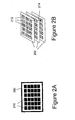
- FIG. 2A illustrates an exemplary data mask 200 including a plurality of data pages 210.
- Each data page 210 may include an array of pixels numbering in the hundreds of pixels or more.
- each data page 210 may include a 2048 by 2048 array of pixels, but various sizes and shapes of each data page 210 are possible.
- Each data page may be separated within data mask 200 and storage media by a distance equal to a few microns or larger. Alternatively, if polytopic multiplexing is used, for example, the data pages may overlap within the storage media as described in greater detail below.
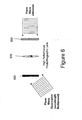
- Figure 2B illustrates an exemplary representation of hologram images or virtual information layers 202 having multiple data pages 212 of information that may be stored in a holographic storage medium by data mask 200.
- Each layer 202 may be stored onto a portion or all of a holographic medium at the same time such that multiple data page 212 of a common layer are recorded in parallel.
- multiple layers 202 may be aligned with data pages 212 forming a stack 214 of data pages 212, where one stack 214 is indicated generally by the arrow.
- a detector may be aligned with a stack 214 of one or more data pages 212 in a storage medium and each data page 212 detected or readout successively in a page-wise fashion.
- each layer 202 and data page 212 of a stack 214 may be multiplexed into the media by angle, wavelength, or other suitable methods and readout accordingly.
- the detector and/or media may be translated and/or rotated to align the detector with another stack 214 and page-wise readout continued.
- data pages 210 may spatially overlap when stored.
- Storing an information layer 202 including multiple data pages 212, across a holographic storage medium may more effectively utilize the dynamic range of holographic media, thereby increasing the storage capacity of the media.
- the storage capacity and diffraction efficiency decrease as the number of holograms, in this instance, information layers 202, are stored in similar locations of the volume medium.
- diffraction efficiency is proportional to 1/m 2 , where m is the number of holograms stored therein.
- the difference in dynamic range is due, at least in part, to overlap of the signal beam and reference beam exposing more medium with propagation through the medium. This results in more effective exposures to record the same information during serial recording and uses a greater dynamic range of the medium than parallel recording.
- localized serial recording of data pages 212 may create localized bulk index changes that can lower the signal-to-noise ratio (SNR) of the system compared to parallel recording an entire layer 202.
- SNR signal-to-noise ratio
- a system may align a detector with a data page 212 or a stack 214 of data pages 212 and readout the data pages 212 in a page-wise fashion, e.g., where the array of information stored in each data page 212 is readout in parallel.
- a detector is aligned with a stack 214 and the entire stack 214 of data pages 214 is readout page-wise (through multiplexing, etc.). The detector may then move to another stack 214 of the storage medium to readout data pages 212. Reading in a page-wise fashion may substantially increase the readout rate compared to methods and systems where readout is performed in a serial or bitwise fashion.
- detecting an entire data page 212 in parallel allows for page-wise error correction methods. For example, detecting an image of a data page 212 allows for various error correction and channel modulation techniques to recover detected signals and decode them into the storage information with greater accuracy.
- U.S. Patent Application No. 10/305,769 entitled “MICRO-POSITIONING MOVEMENT OF HOLOGRAPHIC DATA STORAGE SYSTEM COMPONENTS” describes several error correction methods and techniques and is hereby incorporated by reference in its entirety.
- Figure 3 illustrates a portion of an exemplary system for recording data mask 200 including multiple data pages onto holographic storage medium 220 where the multiple data pages are advantageously recorded in parallel.
- the exemplary systems shown and described herein may include various additional or different optical elements such as lenses, prisms, apertures, filters, beam splitters, gratings, and the like as will be recognized by those of ordinary skill in the art. For clarity, however, such additional features have been omitted from the description.
- data mask 200 is illuminated by an object beam 242 provided by light source 236 and interacts with a reference beam 240 provided by light source 236.
- Light source 236 may include any suitable light source such as a laser or other coherent light source.
- object beam 242 and reference beam 240 may be provided by the same or different light sources.
- the exemplary recording method is shown in a reflection geometry holography process configuration (object and reference beam entering the media from opposite sides), where the plane wave reference beam interferes with the data encoded object beam inside the holographic storage medium 220.
- the system illustrated may be configured in various manners and include various other features not explicitly described herein as will be recognized by those of ordinary skill in the art.
- transmission geometry holography processes may also be used to store the information of data mask 200, where the plane reference wave beam is provided from the same side of the medium 220 as the data mask 200.
- the optical system in the object beam path may include a single lens 230 as shown, no lenses, or a plurality of lenses.
- data mask 200 is illuminated by object wave 242 from light source 236 and is propagated in a transmissive system to image plane 222 that is a distance "d" from the holographic storage medium 220 center.
- the distance d can be positive, zero, or negative, i.e., on the other side of storage medium 220 shown in dotted lines.
- Image plane 222 may also be located within storage medium 220.
- One potential advantage of holographically implementing multiple layers (image planes) is that the layers do not have to physically be on the storage medium. For example, with current multilevel CD, near-field, or high na systems, the layers are on or inside the media.
- the layers can appear to a detector or drive as being located outside of the storage medium 220, inside storage medium 220, or on storage medium 220 depending on where the data mask 200 image plane 222 lies during recording.
- the usual problem of compensating for spherical aberration due to the change in the amount of substrate that the light travels through may not be necessary and in some instances may be detected without a pickup lens or lenses.
- various media defects or contamination issues such as dust, scratches, and the like may be mitigated.
- a lens system 230 can change the magnification of the mask both positive (enlarge) or negative (shrink).
- lens 230 demagnifies the image by ten.
- Lens system 230 may include one or more optical elements including lenses, lens arrays, prisms, beam splitters, and the like.
- data masks may be recorded without lenses by placing the data masks 200 near to the media, for example, at a distance d from medium 220 and recording at this location.
- Data mask 200 may be propagated to a holographic storage medium in any suitable manner.
- successive data masks 200 and 201 may be stored in the holographic storage media utilizing a procedure in which each data mask 200, 201, and so on, is effectively multiplexed for readout purposes.
- data mask 200 is Fourier transformed onto the medium 220 with a lens array including a lens element for each data page 210.
- Methods for recording multiple data pages of data mask 200 in parallel may further include a VanderLugt imaging system.
- a VanderLugt imaging system generally includes or is characterized by having lens 230 before the data mask 200 such that the data mask 200 is illuminated by a converging beam.
- Figure 5A includes an exemplary VanderLugt imaging configuration.
- the VanderLugt system is preferred in that it allows the storage medium 220 to be in or near the Fourier transform plane, and when used, e.g., with phase conjugate readout the image plane is generated without the need of a lens.
- Storage medium 220 may also be placed near the Fourier transform plane to enable an aperture to filter out high order transform components during recording. Further, the Fourier transform plane may be contained within the media, or near the media depending on the particular application.
- the Fourier plane filtering may be done at another Fourier plane in the relay system.
- phase masks or other elements to lower the DC spot energy relative to the rest of the orders intensity may be included to allow for better recording of the information.
- the wavelength of the beams 240, 242 may be changed and a new data mask 201 with data pages that have different information stored.
- a holographic master data mask having one or more layers may be used (as will be described below).
- a tunable laser device may be included, for example, where the wavelength may be varied by tuning the temperature of a diode as described in U.S. Patent Application No. 10/346,399, entitled, "System and Method for Bitwise Readout Holographic ROM,” which is hereby incorporated by reference as if fully set forth herein.
- a series of discrete laser sources with varying wavelengths may be used.
- Other methods for implementing various wavelengths in a system include techniques developed for telecom applications.
- these include electroabsorptive modulation and the use of a micro-electro-mechanical systems (MEMs) structure on a laser cavity to change the wavelength.
- MEMs micro-electro-mechanical systems
- Central wavelengths of interest can be anywhere between 350 - 950nm, and practical tuning ranges of interest can be as small as 1nm.
- a preferred range of tenability is between approximately 5nm and 15nm.
- the readout laser may include a continuous wave or pulsed beam. A pulsed beam is generally more efficient in using energy.
- Angle multiplexing may also be achieved by varying the angle of incidence of the reference beam. Additionally, phase code, polytopic, shift, correlation, or other known multiplexing methods may also be used alone or in combination.
- confocal multiplexing may be implemented by varying the image plane 222 distance d between recording successive data masks 200 and 201.
- Distance d may be varied through a repositioning device controller 232 that translates lens 230 in a direction perpendicular to data mask 200, along the optical axis of lens 230 to vary the location of d between successive layers.
- the repositioning device may include any suitable device capable of translating lens 230 (or multiple lenses) and controlled by a suitable microprocessor. This could also be implemented by moving the mask between successive layers.
- the detector On readout, the detector may be similarly varied by a repositioning device to image and detect the stored images. For example, changing the wavelength for wavelength multiplexing or changing the location of the detector for confocal multiplexing.
- a filter such as an array of pinholes at the image plane, i.e., on the detector array or at an intermediate image plane, to filter out noise from the other confocally stored holograms.
- An advantage of confocal multiplexing includes that the data mask 200 may be moved over a distance, e.g., 100 microns or more, without significant loss of image quality and without magnification change, provided that the optical system is close to telecentric.
- the multiple pages in the stack can be recorded at different depths. This can significantly increase the density that may be stored in the holographic medium 220.
- Confocal multiplexing may also be combined with Bragg based, e.g., angle, wavelength, shift, and/or momentum based multiplexing techniques, e.g., fractal, aperture, peristrophic, to increase storage density.
- Data mask 200 may include a phase mask, amplitude mask, or any combination of amplitude and phase mask, where phase and/or amplitude represents data.
- binary information can be stored as (1,0) or (1,-1,0), and detected as 1,0 on any suitable detector such as a CCD image sensor, CMOS image sensor, or other suitable sensor such as an area array sensor.
- Data mask 200 may contain information similar to that found on conventional DVD disks, including light and dark spots corresponding to 1s and 0s, data tracks, and servo patterns in the data.
- Data mask 200 may be fabricated through any suitable lithographic method as known in the art.
- an SLM or holographic storage medium may be used to encode an object beam.
- one or more data masks 200 having a layer with multiple pages may be holographically stored in a holographic medium as a holographic master data mask and used to store data into the holographic storage medium, e.g., an HROM.
- the holographically stored layer may be imaged to the HROM, and in the case of multiple pages, multiplexed to the HROM to store each hologram having multiple pages as will be described in greater detail below.
- the holographic storage media 220 may include a card medium such as a high performance card storage device or the like.
- the storage medium 220 may include disc media similar to or different from conventional CD or DVD media, tape, or any other convenient format in which optical media may be fabricated.
- the holographic storage medium 220 includes a photopolymer on or between protective substrates.
- the protective substrates are advantageously selected from glass, sapphire, polycarbonate, poly(methyl methacrylate) or PMMA, plastic, quartz, or other suitable material that is generally transparent to the wavelength of light being used, and which has adequate mechanical properties in the holographic storage system.
- the storage medium may be enclosed at least partially within a cartridge or other protective structure.
- the photopolymer layer may include a photopolymer material that is capable of recording the desired interference pattern.
- One exemplary holographic medium includes TapestryTM media manufactured by InPhase Technologies, but any volumetric media capable of recording holograms may be used.
- Other examples of photopolymers and storage media include those described in U.S. Patent No. 6,482,551, which is hereby incorporated herein in its entirety by reference. It is also desirable that the optical quality of the media be fairly high, e.g., ⁇ 4 wavelength of power per cm 2 , to achieve good image reconstruction and good Bragg selectivity.
- U.S. Patent No. 5,932,045 describes an exemplary method for fabricating exemplary media and is incorporated herein in its entirety by reference.
- Figure 4 illustrates an exemplary system for reading holographic storage media, for example, storage medium 220 recorded using the system of Figure 3 .
- Readout of data stored in storage medium 220 may be achieved in many different ways.
- a phase conjugate reference beam can be used with a reference wave the size of a single page or stack of holograms (for a plane wave reference beam this may include a plane wave in the opposite direction).
- a reference beam 260 may be introduced and deflected to the media by a beamsplitter 270.
- Beamsplitter 270 may include a standard beamsplitter, a polarizing beamsplitter, or a holographic optical element that redirects the reference beam 260 to storage medium 220.
- an aperture or angle filter (to just pass the zeroth order or some fraction of the zeroth order) between beamsplitter 270 and storage medium 220 may be used to get an appropriate sized beam and filter out the other data pages.
- a filter or aperture could also be part of the media structure itself.
- a suitable detector 250 can be placed at the image plane distance and the data page detected without the need for an optical lens or other optical elements.
- Repositioning device controller 252 may be used to vary the distance between detector 250 and storage medium 220 through a suitable repositioning device to read different data pages stored at different distances d in the stack by translating detector 250. Alternatively or additionally, repositioning device controller may also translate the position of storage medium 220 through a suitable repositioning device.
- detector 250 and storage medium 220 are capable of moving parallel to each other to align detector 250 with other data pages and stacks of storage medium 220.
- the other stacks of holograms may be accessed by moving detector 250 and the reference beam illumination to the stack that is desired.
- the media could be moved to the stack location or a combination of head and media movement as in Compact Disk (CD) or Digital Versatile /Video Disk (DVD) systems.
- the cost and/or compactness of the exemplary system may be greatly improved in this manner.
- the exemplary system depicted may include various other devices and elements including optics such as a lens or the like.
- optics such as a lens or the like.
- various lenses, apertures, filters, gratings, and the like may be used to image data pages to the detector as are known in the art.
- detector 250 includes the same number of pixels as a single data page stored in storage medium 220.
- Detector 250 may include an appropriate pixel size depending in part on the data mask pixel size used to store the data page and the optical system magnification, if any. In other examples, the detector 250 may include more pixels of a smaller size than the stored image allowing detector 250 to over sample the stored image.
- Detector 250 may include any suitable detector such as a CMOS image sensor, a CCD image sensor, or the like that are sensitive to optical information.
- a decoding unit coupled to detector 250 may determine the corresponding values of the recovered data.
- a detector may also include a line detector CCD or CMOS line sensor.
- a line detector can be scanned (physically moved across the image) to readout an entire data page, which could be the size of the storage medium or any faction of the storage medium.
- the data pages could be multiplexed and readout in a page wise fashion and detected with a line camera.
- the data pages can also be detected in a similar fashion with a CMOS or CCD camera or other such camera that contains an array of pixels to detect the reconstructed data page.
- the holograms in a stack can all be readout by changing the reference beam in the manner used to store them. For example, changing the wavelength for wavelength multiplexing or changing the location of the detector for confocal multiplexing.
- a filter such as an array of pinholes at the image plane, i.e. on the detector array or at an intermediate image plane, to filter out noise from the other confocally stored holograms.
- the filter may be at an intermediate image plane location before the detector.
- various data pages may be readout without using the phase conjugate readout. This can be done with and without lenses in the drive as well.
- a hologram or layer is stored at a distance -d (image on the opposite side of storage medium 220 shown in dotted lines) then the same reference beam shown in Figure 3 may be used to readout the layers of data.
- the holograms will appear as images a distance -d from the media (other side of media).
- the detector can be place at location -d.
- Various optical elements including pick-up lenses may also be used to image or transform as desired and is well understood by those of ordinary skill in the art.
- Various examples herein may include multiplexing multiple pages to get to high storage density in a holographic storage media or holographic master data mask. For example, wavelength, angle, confocal (storing at different distances from center of media), peristrophic, polytopic, and the like. Further, one or more of the multiplexing technique may be combined to increase storage density, e.g., (wavelength, confocal), (angle, confocal), (wavelength, polytopic) or all three. Additionally, data page(s) and layer(s) may be combined with visible image(s) for security purposes and the like.
- exemplary holographic data storage systems that may be used in conjunction with various aspects of the present invention include those described in U.S. Patent Nos. 5,920,536 entitled, “Method and Apparatus for Holographic Data Storage System," 5,719,691, entitled, “Phase Correlation Multiplex Holography,” and 6,191,875 entitled, “Process for Holography Using Reference Beam Having Correlated Phase Content,” all of which are incorporated herein by reference in their entirety.
- one or more data masks are recorded in a holographic master data mask.
- the holographic master data mask may then be used to record multiple holographic layers in a holographic storage media, such as HROM storage media or the like.
- the holographic master data mask may be used to holographically record an entire information layer across a holographic storage medium. Each layer may be divided into multiple data pages of information to be recorded in parallel. Multiple layers may be multiplexed onto a medium using wavelength, angle, peristropic, confocal, polytopic, phase-code, or other multiplex techniques.
- holographic master data mask In producing the holographic master data mask, data pages and stacks of data pages can be carefully aligned and recorded in the holographic master data mask, and the alignment maintained by using the holographic master data mask to replicate holographic storage media. For example, rather than aligning successive data masks, the various data masks to be recorded may be aligned and then recorded into a holographic master data mask by wavelength or angle multiplexing. The correct data mask may be recalled with the appropriate wavelength or angle when it is desired to be imaged and stored. This makes the interchange of data masks very quick and easy during the replication process allowing for fast cycle times.
- the alignment of the pages and stacks of pages created by the holographic master data mask may be increased such that readout is improved with minimal time for mechanical alignment and servo in the drive between different pages of a stack.
- careful alignment of layers or between stacks of data page in a layer may be used to detect fake, unauthorized, or pirated storage media. For example, by intentionally varying the alignment or holding a particular alignment between page stacks or between layers in a predetermined way, a signature of a valid storage medium may be generated in the medium itself.
- Figure 5A illustrates an exemplary system for recording data masks into the master holographic data mask.
- holographic master data mask 520 is placed near a quasi Fourier transform plane of data mask 500 to be stored therein.
- the exemplary system may include a VanderLugt imaging setup to achieve the quasi Fourier transform placement.
- a polytopic filter may also be included in the exemplary system.
- a plane wave illuminates data mask 500, which may include an SLM, lithographic data mask, or other suitable data mask, and stores a portion of holographic master data mask 520.
- the plane wave passes through a lens 530, e.g., a converging lens.
- a plane wave reference beam is also incident on the holographic master data mask 520 and may be varied, e.g., wavelength or angle, to record multiple data masks in holographic master data mask 520.
- the system may include a transmission or reflection geometry.
- An aperture, angle filter, or phase mask may also be incorporated into the system of Figure 5A .
- Holographic master data mask 520 and/or the imaging system may be moved to spatially multiplex or polytopically multiplex multiple data pages 510 across the media as shown in Figure 5B.
- the system may align one or more masks 500 at a first spatial position to record a stack of data pages 510 in holographic master data mask 520 though one or more multiplexing techniques.
- the system may then be repositioned to record another stack of data pages 510 and so on to complete holographic master data mask 520.
- Stored data pages 510 may be imaged to a holographic medium with the same plane wave reference used to record.
- Placing holographic master data mask 520 near a quasi Fourier transform plane of data mask 500 may reduce interference between pages in the same stack during recording and when data pages 510 are readout from holographic master data mask 520 and are recorded in a HROM storage medium, for example. This, in turn, may reduce interference between pages of the same stack, referred to as a book, during readout of HROM media recorded using such holographic master data mask 520. More specifically, during readout from holographic master data mask 520, a Fourier filter may be advantageously disposed in the Fourier transform plane of the holographic master data mask 520, close to a surface of an HROM medium or the like to filter out high order transform components.
- a 4-F system may be used to image into a VanderLugt imaging system with a Fourier filter in the Fourier transform plane of the 4-F system.
- a 4-F system generally includes two lenses that are separated by the sum of their focal lengths, with two dimensional input and output planes located one focal length in front of the lens pair and one focal length behind the lens pair.
- the Fourier plane may also be placed inside the media.
- Another advantage of recording HROM media in or near the Fourier transform plane is increased locational tolerance of the HROM media and detector since the Fourier transform plane is shift invariant.
- the Fourier transform plane it is possible for the Fourier transform plane to be out of position, e.g., by +/- 100 microns, in any of x, y, z, and still recover an image aligned to a camera which has much smaller pixels, e.g., ⁇ 10 microns.
- the shift invariance of the Fourier transform plane makes the tolerances on readout much better as in the example above.
- the information in the Fourier transform plane is uniformly distributed, media defects such as scratches and dust are not as severe a problem for data recovery as when in the image plane.
- the system includes a phase mask in the object beam and uses phase conjugate readout, where the phase mask may provide a degree of piracy protection.
- the phase mask is desirably the same or nearly the same phase mask as used when recording and disposed at the same or nearly the same location in the system.
- Knowledge of the phase mask and phase mask location allows for protection of the stored information. Further, such protection could be made customer specific, e.g., by recording information for customer X with one phase mask (readable with a specific drive) and customer Y with another phase mask (readable with a different drive). Customer X would not be able to read customer Y's media without a customer Y drive (or knowledge of the particular phase mask and location used in recording).
- an exemplary method for recording holographic master data masks includes using confocal multiplexing where each data mask is imaged to a different distance d from the center of the master storage medium. For example, by varying the distance of data mask 500 shown in Figure 5A or the image of data mask 500 relative to holographic master data mask 520 between recording different layers. Readout may be confocally detected with a filter similar to methods performed with confocal microscopes. Exemplary descriptions of confocal detection are described in U.S. Patent Nos. 5,202,875, 6,111,828, and 6,272,095, all of which are hereby incorporated by reference in their entirety. Confocal multiplexing techniques may be advantageously combined with volume holographic multiplexing techniques as described above.
- One potential advantage of holographically implementing multiple layers is that the layers do not have to physically be on the storage medium.
- the layers are on or inside the media.
- the layers can appear to a detector or drive as being located outside of the storage medium, inside the medium, or on the medium depending on where the data mask image plane lies during recording.
- the usual problem of compensating for spherical aberration due to the change in the amount of substrate that the light travels through may not be necessary and in some instances may be detected without a pickup lens or lenses.
- An adjustable lens system as shown in Figure 3 may be used for recording to the holographic master data mask 520 as shown in Figure 5A .
- the holographic master data mask 520 may be readout by a suitable pickup lens that may translate to image different data pages or layers stored at various distances d. Alternatively, the image and detector planes may be moved to record at varying distances.
- the holographic master data mask 520 may then be used to holographically record multiple layers on HROM media using confocal multiplexing.
- a holographic storage medium such as an HROM medium, may be recorded and readout with adjustable lens systems at varying distances from the medium.
- Figure 6 illustrates an exemplary system for recording with a holographic master data mask 520 to store data in holographic storage medium 620, e.g., HROM storage media.
- the master holographic master data mask 520 may be imaged directly into the holographic material (where image distance d is a small absolute value), where the multiple masks recorded with multiplexing in the media.
- the holographic master data mask 520 may be illuminated with a plane wave beam and multiplexed depending on how the data masks where stored therein, e.g., wavelength multiplexed, to image various data masks onto holographic storage medium 620.
- the holographic master data mask 520 is thus the data source that is recorded in the replicated holographic storage medium 620.
- the plane wave, encoded by a data mask of holographic master data mask 520, may be imaged, relayed, or propagated to holographic storage medium 620 by lens 630.
- Lens 630 may include a high performance photolithographic lens.
- the holographic master data mask 520 may be placed in proximity to the storage medium 620 and recorded without a lens (natural beam propagation).
- Holographic storage medium 620 is further illuminated with a plane wave reference beam to interfere with the encoded beam and store the data from holographic master data mask 520. It should be recognized that various other systems and configurations are possible and contemplated to record with holographic master data mask 520.
- An advantage of a Fourier transform plane in recording the holographic master data mask 520 includes that large pixels can be used and a small hologram may be recorded in the holographic master data mask 520 and then copied into the replicated holographic media 620. Additionally, an advantage of a VanderLugt imaging system is that it can form an image outside the storage medium 620 and with the information layer in the quasi Fourier plane (small) that may be readout with a phase conjugate reference beam or with a standard reference beam.
- the present VanderLugt system is illustrative only and any system that results in a Fourier Transform or quasi Fourier Transform plane will include similar advantages.
- a VanderLugt system is desirable in part because if a phase conjugate beam is used for readout, lenses are not required in a drive.
- Figure 7 illustrates a phase conjugate readout of holographic storage medium 620 created with the exemplary system of Figure 6, e.g., including a VanderLugt imaging system.
- a detector 250 may be placed opposing holographic storage medium 620.
- a Holographic Optical Element (HOE) grating 780 is placed adjacent detector 250.
- the reference beam illuminates HOE grating 780 from the side and is directed from HOE grating 780 to the storage medium 620 thereby providing the phase conjugate beam 790.
- a phase conjugate image 792 is reflected back to detector 250 from storage medium 620 for readout.
- Use of HOE grating 780 or other similar grating to introduce the readout reference beam into the optical path allows for readout in a relatively compact system.
- standard beamsplitters, polarizing beamsplitters, waveplates, gratings, and the like at various angles may also be used to introduce the reference beam into the system as will be recognized by those of ordinary skill in the art.
- Another exemplary method for recording holographic storage media that may be readout without the use of a lens includes storing multiple image planes or layers at a distance from the holographic storage medium located outside of the storage medium as described above with reference to Figure 3 .
- a detector may be advantageously placed at the distance the image was stored and detect a portion or the entire stored image, e.g., an entire data page or more in parallel.
- each storage layer of a holographic storage medium is imaged to the same distance 'd' from the data mask as shown in Figure 3 .
- each level of a holographic storage medium recorded with the holographic master data mask may be recorded such that the holographic master data mask is imaged to the same distance d from the HROM.
- the exemplary method does not require a lens during readout of the holographic image from the storage medium.
- a detector may be placed at distance d from the holographic storage medium, and an image may be readout directly to the detector without the need for a lens.
- a further advantage includes that an entire page of data can be readout to a detector in parallel.
- the normal holographic reconstruction is then naturally imaged without the need for a lens. For example, if an image plane of the system is before the media and no lenses are disposed there between, a phase conjugate wave may be used to generate an image without a lens at that image plane for readout.
- the drive has a detector at that image plane the pages in that stack can then be detected and the information in that stack of pages readout.
- Other stacks are addressed by moving the camera relative to the media to the other stacks that were recorded on to the media during replication.
- the use of a phase conjugate wave may be used for readout with a lens or optical imaging elements.
- Another exemplary recording method for holographic storage media such as HROM media or holographic master data masks includes polytopic multiplexing.
- Polytopic multiplexing described in the above referenced U.S. Patent Application 60/453,529, which is incorporated by reference herein, is an exemplary method to increase the layer density by making the individual data page stacks smaller spatially.
- Polytopic multiplexing may be used in conjunction with wavelength, angle, fractal, or other holographic multiplexing techniques.
- Polytopic multiplexing methods allow holograms to be spatially multiplexed onto a holographic material with partial spatial overlap between neighboring holograms and/or stacks of holograms.
- Each individual stack of data pages may additionally take advantage of an alternate multiplexing scheme such as angle, wavelength, phase code, peristrophic, or fractal multiplexing.
- the holograms are separated by an amount equal to the beam waist of the data beam writing the hologram.
- the beam waist is intentionally placed outside of the holographic media such that there is significant beam overlap between stacks inside the media.
- an aperture (filter) placed at the beam waist of the reconstructed data filters out the neighbors that are readout such that only the desired data is detected.
- Polytopic multiplexing may be implemented with the beam waist inside of the media with the aperture(s) placed at another Fourier plane or by using an angle filter that filters out the neighboring data page reconstructions.
- the holograms can be multiplexed by combinations of the standard multiplexing techniques as well as by polytopic multiplexing.
- Significant increases in storage density may be achieved particularly for thick media and high numerical aperture optical systems where spot sizes are relatively small.
- Previous techniques were limited in their ability to spatially separate stacks of holograms due to significant amounts of beam divergence.
- High numerical aperture optics despite the small beam waist, expand very quickly.
- the spatial separation of stacks in the prior art was generally limited by the size of the beam in the media after expansion and not limited by the spot size. Up to this point, there has generally been a tradeoff between media thickness (and therefore dynamic range) and the lens numerical aperture. Therefore, there is saturation in achievable capacity that can be obtained for any holographic storage system using the approaches given by the prior art.
- the polytopic methods described here allow a system to fully utilize high numerical aperture lenses and independently choose the media thickness and therefore gain in both bit density and media dynamic range.
- Figure 8 illustrates an exemplary readout system using a phase conjugate reference beam that may filter or block unwanted reconstructions.
- a block 820 at the beam waist 802 will block out the unwanted reconstructions as reference beam 806 is incident on holographic storage medium 800.
- Figure 8 shows a Fourier transform arrangement, including a detector 830, Fourier transform lenses 832, 834, a beam splitter 836, and SLM 838. It should be recognized, however, that this system could be used with an imaging system as well.
- the full multiplexing (angle, wavelength, etc) of the stack can be used and the stacks can be placed a minimal distance from each other that is not determined by the thickness of the medium 800.
- This allows for increased use of thick films (>100 microns) and is particularly useful for films greater than 400 microns to many millimeters.
- the stacks do not have to be recorded fully at one time. For material reasons it may be desirable to partially fill the neighboring stacks and then come back and completely fill a stack as the neighborhood of the stack is recorded. See, e.g., U.S. Patent Application No. 09/588,908, "Process for Holography Involving Skip-Sorted Hologram Storage,” which is hereby incorporated by reference as if fully set forth herein.
- the exemplary method may also be used with high numerical aperture lenses or holographic optical elements that function as lenses.
- the holograms can be recorded in a reflection or transmission holography geometry process. It should be further recognized by those of ordinary skill in the art that the exemplary system and polytopic methods may be employed without a phase conjugate reference beam.
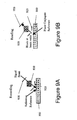
- Figures 9A and 9B illustrate another exemplary recording and reading method.
- polytopic multiplexing is used with phase conjugate readout beam to enhance high order filtering, where the data encoded signal beam is focused in front of the medium 900 as opposed to behind the medium 900 as previously discussed.
- the focus location is where the beam block 920 is now placed. This has the additional benefit of blocking unwanted higher orders diffracting from a SLM or data mask.
- the beam then propagates into the media and is holographically recorded with the reference beam as shown in Figure 9A.
- Multiplexed holograms may then be recorded at one location by a Bragg multiplexing method (angle, wavelength, etc).
- Media 900 is moved by an amount given by the dimension of the beam waist and then another stack may be recorded.
- phase conjugate readout is used as the input reference beam and this reconstructs a backwards-propagating signal beam that retraces the path of the original recording to detector 950.
- the block 920 separates out the unwanted reconstructions from the desired signal beam.
- the exemplary methods may be implemented with Fourier plane or image plane filtering or near the planes. It may also be implemented with a single lens, two or more lens, or with a VanderLugt imaging system that has no lens when reading out. This may also be relayed with a quasi Fourier plane filter in the relay and the Fourier plane of the hologram plane near or in the storage media.
Landscapes
- Holo Graphy (AREA)
- Optical Recording Or Reproduction (AREA)
- Optical Record Carriers And Manufacture Thereof (AREA)
Applications Claiming Priority (4)
| Application Number | Priority Date | Filing Date | Title |
|---|---|---|---|
| US42901202P | 2002-11-22 | 2002-11-22 | |
| US429012P | 2002-11-22 | ||
| US10/658,055 US20050036182A1 (en) | 2002-11-22 | 2003-09-08 | Methods for implementing page based holographic ROM recording and reading |
| US658055 | 2003-09-08 |
Publications (2)
| Publication Number | Publication Date |
|---|---|
| EP1422698A2 true EP1422698A2 (de) | 2004-05-26 |
| EP1422698A3 EP1422698A3 (de) | 2006-11-29 |
Family
ID=32233684
Family Applications (1)
| Application Number | Title | Priority Date | Filing Date |
|---|---|---|---|
| EP03257404A Withdrawn EP1422698A3 (de) | 2002-11-22 | 2003-11-24 | Verfahren zur seitenweisen Aufzeichnung und Wiedergabe einer holographischen ROM Medium |
Country Status (4)
| Country | Link |
|---|---|
| US (2) | US20050036182A1 (de) |
| EP (1) | EP1422698A3 (de) |
| JP (2) | JP2004177958A (de) |
| CN (1) | CN1523584A (de) |
Cited By (12)
| Publication number | Priority date | Publication date | Assignee | Title |
|---|---|---|---|---|
| EP1457974A1 (de) * | 2003-03-10 | 2004-09-15 | InPhase Technologies, Inc. | Polytopic multiplex Holographie |
| WO2006000980A1 (en) * | 2004-06-24 | 2006-01-05 | Koninklijke Philips Electronics N.V. | Phase-conjugate read-out in a holographic data storage |
| KR100852332B1 (ko) | 2007-05-23 | 2008-08-14 | 주식회사 대우일렉트로닉스 | 광정보 처리장치 및 이를 이용한 폴리토픽 필터 정렬방법 |
| EP1788563A4 (de) * | 2004-08-31 | 2008-09-03 | Alps Electric Co Ltd | Hologramm-wiedergabekopf |
| EP1882201A4 (de) * | 2005-05-17 | 2009-10-21 | Inphase Tech Inc | Verfahren und systeme zum aufzeichnen auf holographischen speichermedien |
| EP2067078A4 (de) * | 2006-08-28 | 2009-11-25 | Inphase Tech Inc | Für holographische systeme mit phasenkonjugation optimierte verschiebungstolerante linse |
| US7738153B2 (en) | 2006-09-29 | 2010-06-15 | Inphase Technologies, Inc. | Magnetic field position feedback for holographic storage scanner |
| US8141782B2 (en) | 2007-07-10 | 2012-03-27 | Inphase Technologies, Inc. | Dual-use media card connector for backwards compatible holographic media card |
| US8199388B2 (en) | 2002-11-22 | 2012-06-12 | Inphase Technologies, Inc. | Holographic recording system having a relay system |
| US8256677B2 (en) | 2007-07-10 | 2012-09-04 | Inphase Technologies, Inc. | Enabling holographic media backwards compatibility with dual-use media card connector |
| US8284234B2 (en) | 2009-03-20 | 2012-10-09 | Absolute Imaging LLC | Endoscopic imaging using reflection holographic optical element for autostereoscopic 3-D viewing |
| CN111883185A (zh) * | 2020-06-02 | 2020-11-03 | 华中科技大学 | 一种投影式超分辨光学数据的写入/读出方法及装置 |
Families Citing this family (34)
| Publication number | Priority date | Publication date | Assignee | Title |
|---|---|---|---|---|
| US20050036182A1 (en) * | 2002-11-22 | 2005-02-17 | Curtis Kevin R. | Methods for implementing page based holographic ROM recording and reading |
| JP4387118B2 (ja) * | 2003-03-14 | 2009-12-16 | Tdk株式会社 | ホログラム記録再生装置 |
| KR100555939B1 (ko) * | 2003-06-30 | 2006-03-03 | 주식회사 대우일렉트로닉스 | 홀로그래픽 디지털 데이터 저장 시스템용 디스크 정렬장치 및 그 방법 |
| KR100555916B1 (ko) * | 2003-11-17 | 2006-03-03 | 주식회사 대우일렉트로닉스 | 홀로그래픽 롬 시스템의 포커스 서보 제어용 기록 및 재생장치 |
| JP4333386B2 (ja) * | 2004-02-04 | 2009-09-16 | ソニー株式会社 | ホログラム読出システム、及びホログラフィック・ディスク記録媒体からのデータ読出方法 |
| US20050270856A1 (en) * | 2004-06-03 | 2005-12-08 | Inphase Technologies, Inc. | Multi-level format for information storage |
| US7739577B2 (en) * | 2004-06-03 | 2010-06-15 | Inphase Technologies | Data protection system |
| JP2006179080A (ja) | 2004-12-21 | 2006-07-06 | Sanyo Electric Co Ltd | 傾斜検出装置、ホログラム装置、媒体の傾斜補正方法、ホログラム媒体の傾斜補正方法 |
| US7649661B2 (en) * | 2005-07-13 | 2010-01-19 | Inphase Technologies, Inc. | Holographic storage device having a reflective layer on one side of a recording layer |
| JP2007025399A (ja) | 2005-07-19 | 2007-02-01 | Sanyo Electric Co Ltd | ホログラム装置及びそのホログラム記録再生方法。 |
| JP2007172732A (ja) | 2005-12-21 | 2007-07-05 | Fujifilm Corp | 光情報記録媒体、情報記録方法及び情報記録システム |
| JP2007199232A (ja) * | 2006-01-25 | 2007-08-09 | Sony Corp | ホログラム再生装置及びホログラム再生方法 |
| JP2007207386A (ja) * | 2006-02-03 | 2007-08-16 | Fujifilm Corp | 光記録再生装置、光記録方法及び光再生方法 |
| JPWO2007097352A1 (ja) | 2006-02-23 | 2009-07-16 | 富士フイルム株式会社 | 光記録方法、光再生方法、光記録装置、及び光記録媒体 |
| JP4641981B2 (ja) | 2006-07-21 | 2011-03-02 | 富士フイルム株式会社 | 光記録方法及び光記録装置、並びに、光記録媒体、光再生方法及び光再生装置 |
| WO2008020563A1 (en) * | 2006-08-14 | 2008-02-21 | Alps Electric Co., Ltd. | Hologram device |
| US20080059144A1 (en) * | 2006-09-01 | 2008-03-06 | Inphase Technologies | Emulation of dissimilar removable medium storage device types assisted by information embedded in the logical format |
| JP4991872B2 (ja) * | 2006-11-01 | 2012-08-01 | インフェーズ テクノロジィズ インコーポレイテッド | モノキュラーホログラフィックデータ記憶システムの構成 |
| WO2008121158A1 (en) * | 2007-04-02 | 2008-10-09 | Inphase Technologies, Inc. | Non-ft plane angular filters |
| JP4970190B2 (ja) * | 2007-08-16 | 2012-07-04 | 富士フイルム株式会社 | 干渉縞の形成方法および干渉縞形成装置ならびに干渉縞形成媒体の製造方法 |
| WO2009025897A1 (en) * | 2007-08-17 | 2009-02-26 | Inphase Technologies, Inc. | Hrom replication methods, devices or systems, articles used in same and articles generated by same |
| US20090103416A1 (en) * | 2007-10-17 | 2009-04-23 | Inphase Technologies, Inc. | Layout method for multiplexed holograms |
| KR101502622B1 (ko) * | 2007-12-27 | 2015-03-13 | 메이플 비젼 테크놀로지스 인크. | 광정보 처리를 위한 데이터 처리 시스템 및 데이터 처리방법 |
| US8446808B2 (en) * | 2008-02-14 | 2013-05-21 | Akonia Holographics, Llc | Use of feedback error and/or feed-forward signals to adjust control axes to optimal recovery position of hologram in holographic data storage system or device |
| US8374068B2 (en) * | 2008-02-29 | 2013-02-12 | The Board Of Trustees Of The Leland Stanford Junior University | Focusing and imaging compatible objective lenses for pixel-based and/or bit-based optical data recording and retrieval |
| US8345334B2 (en) * | 2008-12-31 | 2013-01-01 | General Electric Company | Mastering and replication of micro-holographic data storage media |
| US8323854B2 (en) | 2009-04-23 | 2012-12-04 | Akonia Holographics, Llc | Photopolymer media with enhanced dynamic range |
| JP5637931B2 (ja) * | 2011-05-17 | 2014-12-10 | キヤノン株式会社 | インプリント装置、インプリント方法およびデバイス製造方法 |
| JP6029167B2 (ja) * | 2012-09-26 | 2016-11-24 | 国立大学法人北海道大学 | ノイズ除去方法およびノイズ除去装置、記録再生方法および記録再生装置、ならびに、画像計測方法および画像計測装置 |
| US9541900B2 (en) | 2013-12-26 | 2017-01-10 | Lg Display Co., Ltd. | Method for producing a beam shaping holographic optical element |
| CN105161117B (zh) * | 2015-09-17 | 2017-11-17 | 青岛泰谷光电工程技术有限公司 | 全像盘片与全像储存系统 |
| EP3420601B1 (de) | 2016-02-26 | 2023-08-02 | Magic Leap, Inc. | Optisches system |
| GB2644346A (en) * | 2024-09-30 | 2026-04-01 | Holomem Ltd | Holographic data storage medium, device, and system |
| GB2644343A (en) * | 2024-09-30 | 2026-04-01 | Holomem Ltd | Method of storing data in a holographic medium |
Citations (1)
| Publication number | Priority date | Publication date | Assignee | Title |
|---|---|---|---|---|
| US20010035990A1 (en) | 1998-04-13 | 2001-11-01 | Fai H Mok | Multiplexed hologram copying system and method |
Family Cites Families (57)
| Publication number | Priority date | Publication date | Assignee | Title |
|---|---|---|---|---|
| US346399A (en) * | 1886-07-27 | Clock mechanism for operating gas-cocks | ||
| US305769A (en) * | 1884-09-30 | Samuel t | ||
| US453529A (en) * | 1891-06-02 | Process of smelting sulphides | ||
| US3758186A (en) * | 1966-11-30 | 1973-09-11 | Battelle Development Corp | Method of copying holograms |
| US3644012A (en) * | 1970-10-16 | 1972-02-22 | Trw Inc | Recording microholograms of magnified virtual images |
| US3653067A (en) * | 1970-12-16 | 1972-03-28 | Bell Telephone Labor Inc | High-speed printing apparatus |
| US3704930A (en) * | 1971-03-31 | 1972-12-05 | Sperry Rand Corp | Micro-holographic recording and reading apparatus |
| US3949235A (en) * | 1973-03-14 | 1976-04-06 | Nippon Telegraph & Telephone Public Corporation | Large holographic memory with plural overlapping detector arrays |
| US4318581A (en) * | 1980-05-13 | 1982-03-09 | Georgia Tech Research Institute | Optical holographic content-addressable memory system for truth table look-up processing |
| US4677629A (en) * | 1985-09-30 | 1987-06-30 | The United States Of America As Represented By The Administrator Of The National Aeronautics And Space Administration | Means for phase locking the outputs of a surface emitting laser diode array |
| US4715683A (en) * | 1986-11-10 | 1987-12-29 | The United States Of America As Represented By The Secretary Of The Army | Modified liquid crystal television as a spatial light modulator |
| DE69032388T2 (de) * | 1989-03-16 | 1998-10-08 | Dai Nippon Printing Co., Ltd., Tokio/Tokyo | Verfahren und filterduplikationsherstellung und herstellungsverfahren für eine fotoempfindliche schicht mit einem derartigen filter |
| US5322747A (en) * | 1989-03-22 | 1994-06-21 | Hugle William B | Method of manufacturing an optical disc |
| US4988153A (en) * | 1989-12-22 | 1991-01-29 | Bell Communications Research, Inc. | Holographic memory read by a laser array |
| US5416616A (en) * | 1990-04-06 | 1995-05-16 | University Of Southern California | Incoherent/coherent readout of double angularly multiplexed volume holographic optical elements |
| US5202875A (en) * | 1991-06-04 | 1993-04-13 | International Business Machines Corporation | Multiple data surface optical data storage system |
| US5258860A (en) * | 1991-08-13 | 1993-11-02 | Rockwell International Corporation | Optical phase adder |
| US5339305A (en) * | 1992-08-14 | 1994-08-16 | Northrop Grumman Corporation | Disk-based optical correlator and method |
| US5422746A (en) * | 1992-09-11 | 1995-06-06 | Board Of Trustees Of The Leland Stanford Jr. University | Single and multiple element holographic devices for high-efficiency beam correction |
| DE69327809T2 (de) * | 1992-11-27 | 2000-10-12 | Voxel, Laguna Hills | Verfahren und vorrichtung zur herstellung von hologrammen |
| US5510912A (en) * | 1993-08-09 | 1996-04-23 | International Business Machines Corporation | Method and apparatus for modulation of multi-dimensional data in holographic storage |
| US5483365A (en) * | 1994-05-10 | 1996-01-09 | California Institute Of Technology | Method for holographic storage using peristrophic multiplexing |
| US6272095B1 (en) * | 1994-07-22 | 2001-08-07 | California Institute Of Technology | Apparatus and method for storing and/or reading data on an optical disk |
| US5550779A (en) * | 1994-10-20 | 1996-08-27 | California Institute Of Technology | Holographic memory with angle, spatial and out-of-plane multiplexing |
| US5734485A (en) * | 1995-04-25 | 1998-03-31 | Rocky Research | Large display composite holograms and methods |
| CA2172643C (en) * | 1995-05-05 | 2000-02-15 | Kevin Curtis | Multiplex holography |
| US5719691A (en) * | 1995-05-05 | 1998-02-17 | Lucent Technologies Inc. | Phase correlation multiplex holography |
| US5838650A (en) * | 1996-06-26 | 1998-11-17 | Lucent Technologies Inc. | Image quality compensation method and apparatus for holographic data storage system |
| US5933515A (en) * | 1996-07-25 | 1999-08-03 | California Institute Of Technology | User identification through sequential input of fingerprints |
| US6081912A (en) * | 1996-12-26 | 2000-06-27 | Lucent Technologies Inc. | Method for modulating data for storage in page-wise memory |
| US5932045A (en) * | 1997-06-02 | 1999-08-03 | Lucent Technologies Inc. | Method for fabricating a multilayer optical article |
| US6482551B1 (en) * | 1998-03-24 | 2002-11-19 | Inphase Technologies | Optical article and process for forming article |
| US5995251A (en) * | 1998-07-16 | 1999-11-30 | Siros Technologies, Inc. | Apparatus for holographic data storage |
| US6064586A (en) * | 1998-12-31 | 2000-05-16 | Siros Technologies, Inc. | Method for holographic data storage and retrieval |
| US6322933B1 (en) * | 1999-01-12 | 2001-11-27 | Siros Technologies, Inc. | Volumetric track definition for data storage media used to record data by selective alteration of a format hologram |
| US6111828A (en) * | 1999-01-12 | 2000-08-29 | Siros Technologies, Inc. | Focus error signal generation using confocally filtered detection |
| US6108110A (en) * | 1999-02-25 | 2000-08-22 | Siros Technologies, Inc. | Optical relay for pixel-based holographic storage and retrieval |
| US6191875B1 (en) * | 1999-07-29 | 2001-02-20 | Lucent Technologies Inc. | Process for holography using reference beam having correlated phase content |
| JP2001184637A (ja) * | 1999-12-28 | 2001-07-06 | Pioneer Electronic Corp | 光情報記録再生装置 |
| US6614566B1 (en) * | 2000-06-07 | 2003-09-02 | Lucent Technologies Inc. | Process for holography involving skip-sorted hologram storage |
| US6538776B2 (en) * | 2001-03-20 | 2003-03-25 | Imation Corp. | Self-referenced holographic storage |
| JP2002304109A (ja) * | 2001-04-09 | 2002-10-18 | Pioneer Electronic Corp | ホログラム記録再生方法及びホログラム記録再生装置 |
| JP2002279644A (ja) * | 2001-03-22 | 2002-09-27 | Pioneer Electronic Corp | ホログラム記録媒体、ホログラム記録方法及びホログラム記録再生装置 |
| JP2002297008A (ja) * | 2001-03-30 | 2002-10-09 | Pioneer Electronic Corp | ホログラム記録媒体、ホログラム記録再生方法及びホログラム記録再生装置 |
| US6798547B2 (en) * | 2001-10-09 | 2004-09-28 | Inphase Technologies, Inc. | Process for holographic multiplexing |
| US7116626B1 (en) * | 2001-11-27 | 2006-10-03 | Inphase Technologies, Inc. | Micro-positioning movement of holographic data storage system components |
| WO2003049090A1 (en) * | 2001-12-07 | 2003-06-12 | Discovision Associates | Method and apparatus for diffractive information storage |
| US6914704B2 (en) * | 2001-12-21 | 2005-07-05 | Inphase Technologies, Inc. | Obliquity correction system |
| US6825960B2 (en) * | 2002-01-15 | 2004-11-30 | Inphase Technologies, Inc. | System and method for bitwise readout holographic ROM |
| US8786923B2 (en) * | 2002-11-22 | 2014-07-22 | Akonia Holographics, Llc | Methods and systems for recording to holographic storage media |
| US20050036182A1 (en) * | 2002-11-22 | 2005-02-17 | Curtis Kevin R. | Methods for implementing page based holographic ROM recording and reading |
| US8199388B2 (en) * | 2002-11-22 | 2012-06-12 | Inphase Technologies, Inc. | Holographic recording system having a relay system |
| US7092133B2 (en) * | 2003-03-10 | 2006-08-15 | Inphase Technologies, Inc. | Polytopic multiplex holography |
| CA2551483A1 (en) * | 2003-12-30 | 2005-07-21 | Aprilis, Inc. | Replication of data to holographic medium |
| US7848595B2 (en) * | 2004-06-28 | 2010-12-07 | Inphase Technologies, Inc. | Processing data pixels in a holographic data storage system |
| JP2006018864A (ja) * | 2004-06-30 | 2006-01-19 | Sony Corp | ホログラム複製方法 |
| JP4991872B2 (ja) * | 2006-11-01 | 2012-08-01 | インフェーズ テクノロジィズ インコーポレイテッド | モノキュラーホログラフィックデータ記憶システムの構成 |
-
2003
- 2003-09-08 US US10/658,055 patent/US20050036182A1/en not_active Abandoned
- 2003-11-21 CN CNA2003101248862A patent/CN1523584A/zh active Pending
- 2003-11-24 EP EP03257404A patent/EP1422698A3/de not_active Withdrawn
- 2003-11-25 JP JP2003394801A patent/JP2004177958A/ja active Pending
-
2008
- 2008-04-14 US US12/102,642 patent/US20080259421A1/en not_active Abandoned
- 2008-05-14 JP JP2008127585A patent/JP5466833B2/ja not_active Expired - Fee Related
Patent Citations (1)
| Publication number | Priority date | Publication date | Assignee | Title |
|---|---|---|---|---|
| US20010035990A1 (en) | 1998-04-13 | 2001-11-01 | Fai H Mok | Multiplexed hologram copying system and method |
Cited By (13)
| Publication number | Priority date | Publication date | Assignee | Title |
|---|---|---|---|---|
| US8199388B2 (en) | 2002-11-22 | 2012-06-12 | Inphase Technologies, Inc. | Holographic recording system having a relay system |
| US8786923B2 (en) | 2002-11-22 | 2014-07-22 | Akonia Holographics, Llc | Methods and systems for recording to holographic storage media |
| EP1457974A1 (de) * | 2003-03-10 | 2004-09-15 | InPhase Technologies, Inc. | Polytopic multiplex Holographie |
| WO2006000980A1 (en) * | 2004-06-24 | 2006-01-05 | Koninklijke Philips Electronics N.V. | Phase-conjugate read-out in a holographic data storage |
| EP1788563A4 (de) * | 2004-08-31 | 2008-09-03 | Alps Electric Co Ltd | Hologramm-wiedergabekopf |
| EP1882201A4 (de) * | 2005-05-17 | 2009-10-21 | Inphase Tech Inc | Verfahren und systeme zum aufzeichnen auf holographischen speichermedien |
| EP2067078A4 (de) * | 2006-08-28 | 2009-11-25 | Inphase Tech Inc | Für holographische systeme mit phasenkonjugation optimierte verschiebungstolerante linse |
| US7738153B2 (en) | 2006-09-29 | 2010-06-15 | Inphase Technologies, Inc. | Magnetic field position feedback for holographic storage scanner |
| KR100852332B1 (ko) | 2007-05-23 | 2008-08-14 | 주식회사 대우일렉트로닉스 | 광정보 처리장치 및 이를 이용한 폴리토픽 필터 정렬방법 |
| US8141782B2 (en) | 2007-07-10 | 2012-03-27 | Inphase Technologies, Inc. | Dual-use media card connector for backwards compatible holographic media card |
| US8256677B2 (en) | 2007-07-10 | 2012-09-04 | Inphase Technologies, Inc. | Enabling holographic media backwards compatibility with dual-use media card connector |
| US8284234B2 (en) | 2009-03-20 | 2012-10-09 | Absolute Imaging LLC | Endoscopic imaging using reflection holographic optical element for autostereoscopic 3-D viewing |
| CN111883185A (zh) * | 2020-06-02 | 2020-11-03 | 华中科技大学 | 一种投影式超分辨光学数据的写入/读出方法及装置 |
Also Published As
| Publication number | Publication date |
|---|---|
| CN1523584A (zh) | 2004-08-25 |
| JP5466833B2 (ja) | 2014-04-09 |
| JP2008250337A (ja) | 2008-10-16 |
| EP1422698A3 (de) | 2006-11-29 |
| JP2004177958A (ja) | 2004-06-24 |
| US20050036182A1 (en) | 2005-02-17 |
| US20080259421A1 (en) | 2008-10-23 |
Similar Documents
| Publication | Publication Date | Title |
|---|---|---|
| JP6053891B2 (ja) | ホログラフィックストレージ媒体に記録する方法 | |
| EP1422698A2 (de) | Verfahren zur seitenweisen Aufzeichnung und Wiedergabe einer holographischen ROM Medium | |
| US20120224237A1 (en) | Holographic recording system having a relay system | |
| Psaltis et al. | Holographic data storage | |
| KR100700119B1 (ko) | 홀로그래픽 기록 매체에 데이터를 기록 및 판독하는 장치 및 방법, 및 홀로그래픽 데이터 기억 시스템 | |
| JP4991872B2 (ja) | モノキュラーホログラフィックデータ記憶システムの構成 | |
| KR100477783B1 (ko) | 홀로그래피프로세스및홀로그래피어레이의복제프로세스 | |
| JP4734530B2 (ja) | 検索方法 | |
| KR19990045247A (ko) | 위상 상관 다중화 홀로그래픽 메모리 시스템 및 그에 이용되는장치 | |
| US8179579B2 (en) | HROM replication methods, devices or systems, articles used in same and articles generated by same | |
| US7859751B2 (en) | Compact apparatus for reading from and/or writing to holographic storage media | |
| US7649661B2 (en) | Holographic storage device having a reflective layer on one side of a recording layer | |
| JP2008503787A (ja) | ホログラフィックデータ記憶における位相共役読み出し方法及び装置 | |
| EP2390731A1 (de) | Monokulare Architektur für holografisches Datenspeichersystem | |
| Chuang et al. | Consumer Holographic ROM Reader with Mastering and Replication Technology |
Legal Events
| Date | Code | Title | Description |
|---|---|---|---|
| PUAI | Public reference made under article 153(3) epc to a published international application that has entered the european phase |
Free format text: ORIGINAL CODE: 0009012 |
|
| AK | Designated contracting states |
Kind code of ref document: A2 Designated state(s): AT BE BG CH CY CZ DE DK EE ES FI FR GB GR HU IE IT LI LU MC NL PT RO SE SI SK TR |
|
| AX | Request for extension of the european patent |
Extension state: AL LT LV MK |
|
| PUAL | Search report despatched |
Free format text: ORIGINAL CODE: 0009013 |
|
| AK | Designated contracting states |
Kind code of ref document: A3 Designated state(s): AT BE BG CH CY CZ DE DK EE ES FI FR GB GR HU IE IT LI LU MC NL PT RO SE SI SK TR |
|
| AX | Request for extension of the european patent |
Extension state: AL LT LV MK |
|
| RIC1 | Information provided on ipc code assigned before grant |
Ipc: G11B 7/28 20060101ALI20061023BHEP Ipc: G11B 7/0065 20060101AFI20040304BHEP Ipc: G11B 7/26 20060101ALN20061023BHEP |
|
| 17P | Request for examination filed |
Effective date: 20070402 |
|
| 17Q | First examination report despatched |
Effective date: 20070524 |
|
| AKX | Designation fees paid |
Designated state(s): AT BE BG CH CY CZ DE DK EE ES FI FR GB GR HU IE IT LI LU MC NL PT RO SE SI SK TR |
|
| STAA | Information on the status of an ep patent application or granted ep patent |
Free format text: STATUS: THE APPLICATION IS DEEMED TO BE WITHDRAWN |
|
| 18D | Application deemed to be withdrawn |
Effective date: 20101201 |